Recent gas prices causing you headache? The trip between the petrol stations seems too short? Well, if you insist to sticking to a mid-sized saloon, the ChevroletMalibu Eco might be the car for you. They say it can do 965 km of highway on a single tank of fuel. This is just another example of how a combination of simple yet clever technologies can help bring noticeable relief to your wallet.
Let’s not beat around the bush – The Malibu Eco achieves an EPA-estimated 25 miles per gallon city and 37 mpg highway fuel economy. Numbers would not have been so high if it wasn’t for the all-electric power steering. It’s cleaner, more efficient and smarter than any other hydraulic setup in the world. Thanks to it, Malibu owners can save up to 12 gallons annually, or about 120 gallons in a 10-year life. At $4 per gallon, that saves about $50 per year or $500 in 10 years say Chevrolet.
The Malibu’s power steering is not constantly operational. Instead, it kicks in only when you need it to do so. If you are going down the highway, the only thing it does is to slightly compensate outside factors that may cause directional shifts (think of uneven roads or crosswinds). Wherever you are, the feedback comes with reduced vibrations and, in some of the cars, responsiveness can be adjusted trough two settings – “comfort” and “sport”.
Chevrolet Malibu Eco (2013)
But an electric power steering is not something groundbreaking and it’s going to take more than that for the Eco, to stand up to its name. This is where GM’s fuel-saving eAssist technology comes into place. It shuts of fuel supply to the engine when the car is decelerating. While in fuel shut-off mode, the motor-generator unit continues spinning along with the engine should the accelerator pedal be pressed again. Thus, a smooth and immediate response is ensured. The system also manages to salvage up to 15kW of power that would normally be lost upon breaking, and recharges the Li-ion battery of the Malibu.
At the moment, the Eco version of it is priced at $25,595 but, with a little more patience, we will see the arrival of an all-new, greener 2.5L Ecotec engine to all Malibu models. Not before summer this. Then, sometime later, a new turbo model will be available.
Let the mid-sized sedan showdown begin! As promised, the 2013 Toyota Avalon makes its debut at the New York International Auto Show…in its own way. What we mean is that everything is official, the car will go on sale before the end of the year, there’s a lot of talk about where on the center console the USB port is and how the stitching inside is hand-sewn but…where’s the good stuff? Other than the fact that it will be powered by a V6, we know nothing. Is Toyota embarrassed about it or is there a surprise coming? Keeping in mind that the Avalon is pretty much an intentional jab in face of Nissan’s Altima, one must assume that whatever’s inside the Toyota’s engine bay, must be at least 3-liters.
Let’s talk about the things that have been revealed. Designed at the Calty Design Research Inc centers in California and Michigan, engineered at the Toyota Technical Center in Ann Arbor, Mich and set to be assembled at Toyota’s plant in Georgetown, Ky, the 2013 Avalon is a pure American-bred sedan. To set itself apart from its ancestors, this one is a bit shorter, a bit narrower and a bit lower. Essentially, the wheelbase remains the same. It’s the overhangs that have been trimmed. As a result it’s also lighter – 3,497 lbs as opposed to 3,616 lbs. Some neat design features include those LED lights at the back, the sloping roofline and the flaring wheel arches. At the front, the headlights are described as “square Double-eyed” that use a “Projector Ellipsoid System” (sounds like a bad day in geometry class). Then there’s the lower front grille which to us, looks big enough to suck in orangutangs.
The more technical stuff that we know about is the suspension. MacPherson struts and rebound springs. Less body roll is the result of stiffer sway bars and an overall increased rigidity of the body thanks to additional and strategically placed welds. The power steering is electric which goes easy on the fuel economy and yet it supposedly provides crisp feedback
As we have established, the 2013 Avalon is a bit more compact from the outside but does not prevent it from being, or feeling, more roomy inside. Due to some clever design tricks the occupants actually get some more headroom. Also the luggage space has been increased to 16.0 cubic feet – a 1.6 mark more voluminous when compared to the old one. Leather wrapped around the steering wheel, shift knob and seats creates a justified sense of luxury while the center console and instruments are treated with some chrome. In terms of equipment you get three color screens that read out the multi-information display, the audio/navigation interface and the climate control panel. By the way, the climate control, as an option, can be three zoned. Who needs three different temperatures in the same car?! Other options include the JBL Synthesis Premium Audio system, a 7-inch HDD Premium Navigation, a clever cruise control and heated seats that can cool themselves as well.
Much like the Altima, the Avalon also gets a Blind Spot Monitoring system along with a rear view camera. Then there’s the standard stuff you’d find in every car these days – ABS, traction control, stability control, brake assist etc. You know the story.
The new McLaren MP4-12C GT3 is ready for race debut in 2012, following an intensive development programme in 2011. The competitive race season begins for new McLaren GT customer teams in Germany on 31 March, with the opening rounds of the VLN and ADAC GT Masters championships at the Nürburgring Nordschliefe and Oschersleben respectively.
The MP4-12C sports car, on which the GT3 racer is based, will also make its debut as a safety car in the FIA GT1 World Championship race at the Nogaro circuit in France on 8-9 April.
The McLaren race cars will wear the unique liveries of ART, ASM, Boutsen Energy, Gulf Racing, Molitor Racing, United Autosports and Von Ryan Racing. The JAS team will also take part in selected rounds of the championship. Footage of the new 12C GT3s at the test event in southern France can be seen at “mclarenautomotivetv channel” vai Youtube.
Gemballa Racing and Doerr Motorsport will compete in the 12C GT3 in the German VLN series, which includes the famous 24 Hour Nürburgring endurance race in May.
McLaren MP4-12C GT3 at the race track
Molitor Racing and Gemballa Racing will run in ADAC GT Masters, and French FIA GT1 Champions Hexis Racing will line up on the grid of the FIA GT1 World Championship. Series Champions Apex Motorsport will enter a new 12C GT3 in selected rounds of this year’s British GT championship, while the Lapidus Racing team will contest the International GT Open series, and also compete in forthcoming 24-hour races at Spa-Francorchamps in Belgium and Circuit de Catalunya in Spain.
Teams racing the 12C GT3 in 2012 have enlisted the services of highly successful racing drivers for the 2012 season. Former Formula 1 drivers Mark Blundell and David Brabham (also a Le Mans 24hr winning driver) will race for United Autosports and 2011 Formula 2 competitor Jack Clarke will drive for Boutsen Energy. Rob Bell, Alvaro Parente and Alexander Sims, who recently joined the McLaren GT driver line-up for 2012, will be placed with customer teams, while McLaren Automotive Chief Test Driver Chris Goodwin will also contest selected races in a 12C GT3 throughout the season.
“I’m excited that we are so close to seeing the 12C GT3 in its first full race season. The feedback I have received from customers that have already taken delivery of the car is very positive.”, commented Andrew Kirkaldy, Project Manager for McLaren GT.
“The 2011 development programme was challenging, but had many highlights. We started with a pole position in qualifying at Spa-Francorchamps in the British GT Championship, and ended the race season with a third place finish in Macau. In one year, McLaren GT has taken the 12C GT3 from concept to race readiness. We will learn more about the car in the early part of the season – and expectations will naturally be high of a car full of Formula 1 technology – but our objective is to makes the 12C GT3 as much a pleasure to own and run as it is race.” , he added.
The 12C GT3 shares the same V8 twin turbo engine and carbon ‘MonoCell’ chassis as its road car sibling, and its aerodynamic package was developed by McLaren GT in partnership with specialist engineers and designers at McLaren Automotive.
Ever wondered how WRC cars manage to deliver 300 bhp and above from an engine that, by rule, cannot exceed 2.0 liters of displacement? How on earth do the heavy, low-revving diesel engines in cars today stay competitive? Or what is it that makes it possible for the Bugatti Veyron to break the 1000 bhp threshold? Well, it certainly isn’t witchcraft. By means of “forced induction”, turbochargers today boost the automotive industry to a new direction of smaller, more-efficient and bloody good fun engines.
Volkswagen like to brand their most successful turbo diesel range as TDI while Porsche, being more plain about it, call their turbocharged cars, Porsche (insert model here) Turbo. BMW, on the other hand, would never hesitate to utter their own terms like “bitrubo” or “TwinPower” whenever describing the latest M5 engine. The variety of depicting turbocharged cars is bountiful, but essentially the principles of work remain the same in every case.
Beware reader, as I am now going to get technical:
In order to understand how a centrifugal turbocharger works, one must also have some basic knowledge on how four-stroke, piston engines work. We have an engine block that contains the cylinders, right? Inside each cylinder, a piston moves up and down. Every movement made is a phase, a stroke. First we have intake – a mixture of fuel and air is sucked into the cylinder. Compression is the second stroke where the cylinder moves up and…well…compresses the molecules in the mixture. The next ignition stroke is downwards as the piston experiences pressure coming from the combustion of the mixture. The exhaust stroke has the job to expel the remaining gases through the exhaust valve. Then the intake valve lets in a new batch of fuel mixture and thus the process is repeated.
However, as far as turbochargers are concerned, exhaust gases are not exactly throw-away material. Put simply, the turbocharger utilizes the energy of exhaust to compress the the newly arrived batch of air which is to be shoved in the cylinder. More air molecules means that more fuel can be injected into the mixture and more fuel means more power.
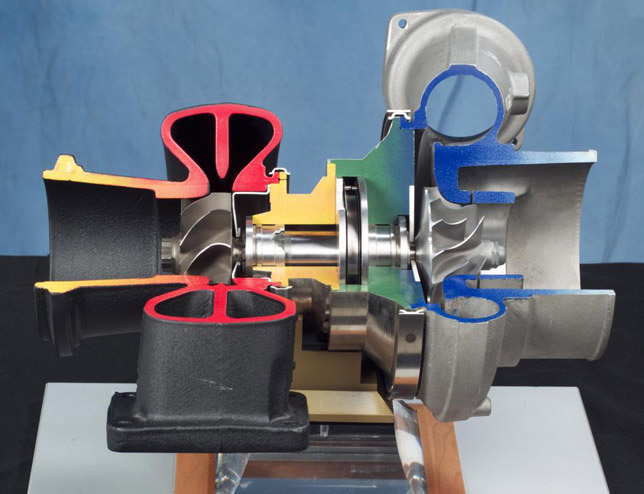
Before those exhaust gasses reach the exhaust system they go trough a turbine connected to a shaft. The more exhaust that goes through the turbine blades, the faster they spin. On the other end of the shaft we find a compressor which welcomes fresh air from the atmosphere, compresses it using the force of the turbine and then feeds it into the engine. To further increase the efficiency of the turbocharging system, an intercooler is added – it looks much like a car radiator but instead of containing cooling fluid, it holds the compressed air from the compressor. Air is denser when cooler and that’s exactly what the intercooler does – it cools the incoming air.
Cut-away view of a turbocharger held by a foil-bearing
There are issues however. First of all, a turbine amidst the flow of exhaust is essentially an obstacle. The exhaust stroke has to deal with more back-pressure thus being slightly less efficient. A functional turboshaft has to handle extreme forces (speeds go up to 150 000 rpm within the turbocharger) so a special kind of baring is needed – liquid ones or state-of-the-art ball bearings. The latter is more efficient but more expensive. Then there’s the dreaded turbo lag. The problem here is that when you put your foot down, the response is far from electric. The turbine needs some time to kick off and start spinning the compressor blades. That’s why at low engine rpm one can’t really tell if the car has a turbo or not.
There are various ways to tackle this nuisance. Make things smaller and lighter. Tiny turbochargers will grant you that off-the-line jolt but won’t be too good on the upper rpm range. Besides, if too much exhaust starts going through a relatively small turbine things may get hot and disbalanced. Usually however, there’s the wastegate in most turbines – a valve that knows how much exhaust passes through and regulates the flow by simply diverting some of the gases away from the turbine. Some companies have started putting more than one turbochargers in their cars. One small and the other, big. The small one guarantees a more immediate response while the big one takes over at higher speeds.
Essentially, that’s the story with turbochargers. We can further dive into numbers and calculations about pressure and efficiency but this, I think, is already nerdy enough. Hopefully some of you learned something new while others refreshed their memory on how the turbocharger brings easy power to our everyday lives.
The Mercedes SL. “Open top” immediately springs to mind. We tend to think of cabriolets as slow, wobbly and impracticable – a direct contradiction to what SL stands for. “Super Leicht“ or “Super Light” is the exact way where Mercedes are going with the new SL in town. Its more powerful, more economical, lighter and smarter.
The body is almost entirely made up of aluminum. The A pillars have some heavy duty steel in them but that’s understandable. The cover behind the fuel tank is from magnesium which is even lighter than aluminum. Compared to it’s predecessor, the new, longer and wider SL 350 weighs 140 kg less. That means more agility, better handling, better delivery of power and better economy. Most importantly, that diet does not compromise on rigidity, safety and comfort.
The all-new suspension set, which also has some bits and pieces in aluminum, is supposed to be comfortable yet up for occasional thrashing around the bends. Semi-adjusting damping control comes as standard but those who want even more flexibility can opt for the active suspension system ABC (Active Body Control). Either way, you are going to get some great feedback from the steering wheel as it uses an electromechanical Direct-Steer system which adjusts the firmness of the power steer in accordance with the current speed.
Mercedes-Benz SL (2013)
For power, the SL 500 uses a 4663 cc V8 that is 0.8 liters smaller than the one in the fifth generation SL. Despite that, it develops 435 hp – 12 percent more power. It’s more economical as well. 22 percent more economical to be exact. In the mean time torque now, is not 530Nm but the staggering 700Nm. The engine in the SL 350 is still a 3499 cc V6 but it too is more powerful than before. 306 hp and 370Nm of torque drink up only 6.8 litres of fuel per 100km – 30 percent less than before. All those percentages seem overblown but when we inspect the tech under the bonnet, all seems plausible. The engines are from a line called BlueDIRECT and as we all know, blue is the new green. ECO start/stop systems come strictly with both engines. The 7G-TRONIC PLUS automatic transmission that crunches all that power is fully optimized with comfort and frugality in mind. That however, does not mean, in any way, power compromising: The SL 350 accelerates from 0 to 100 km/h in 5.9 seconds, making it three tenths of a second faster than its predecessor. The SL 500 takes just 4.6 seconds – eight tenths less than the previous SL 500.
The options list is admirably lengthy. Among the many extras, there’s this Magic Vision Control and Magic Sky Control. One makes your wipers sprinkle water and the other is basically a panoramic vario-roof that can go from opaque to transparent with the push of a button. Pretty neat stuff but people wont be piling up to see you in the car. They’ll want to see the car itself because its too damn pretty.
Nissan has revealed an interesting concept vehicle. It is called DeltaWing and it will showcase the pioneering technology that will show one potential direction for the future of motorsport and will feed into the research and development of future technologies, that filter down to Nissan’s road car product range.
It is powered by a race-prepared 1.6-litre four-cylinder direct injected turbocharged petrol engine. It is badged DIG-T (Direct Injection Gasoline – Turbocharged) and is expected to produce around 300HP, sufficient to give Nissan DeltaWing lap times between LMP1 and LMP2 machines at Le Mans, despite having only half the power of those conventional prototypes.
“As motor racing rulebooks have become tighter over time, racing cars look more and more similar and the technology used has had less and less relevance to road car development. Nissan DeltaWing aims to change that and we were an obvious choice to become part of the project,” said Andy Palmer, Executive Vice President, Nissan Motor Co., Ltd.
“But this is just the start of our involvement. Nissan DeltaWing embodies a vast number of highly-innovative ideas that we can learn from. At the same time, our engineering resources and commitment to fuel efficiency leadership via our PureDrive strategy will help develop DeltaWing into a testbed of innovation for Nissan. This announcement gives Nissan the opportunity to become part of a ground-breaking motorsport project and one which could shape the future of the sport,” he added.
Nissan DeltaWing is extremely different than everything else on track. The driver sits well back in the car, almost over the rear axle and looks ahead down a long, narrow fuselage to narrow twin front tyres, specially created for the car by tyre partner Michelin.
The engine is rear-mounted and the car has a strong rearward weight bias, which makes it highly manoeuvrable, while its light weight and slippery shape make it far more efficient.
Elevate the style and performance of your new ride from off-the-lot stock to aftermarket hot by spicing it up with performance accessories. Whether you’re looking to add some sizzle to your daily driver or give your free-time ride an extra jolt of juice, custom accessories take your car, truck or SUV to unheard of levels of style and protection. And, as any automotive junkie knows, the best place to start your journey is to add some flashy protection to your front end. And, for stylish defense from the elements, a car bra is the way to go. Car bras are custom-crafted to fit every line of your exact vehicle for the stylish accent your new ride deserves. These beauties defend your bumper from pummeling pebbles, torpedoing wasps and anything else the open road can dish out. And, they’re available in a wide variety of styles and materials to compliment your unique look.
With your front end taken care of it’s time to focus on keeping your interior fresh and looking fly. And, for that you need to hook up your ride with a set of seat covers. From taking abuse from unruly teenagers to blocking Fido’s fur flinging ways, seat covers offer the best defense out there. Like putting your seats in a time capsule, seat covers put your seats on lockdown to block anything from getting at ‘em. That snug seal is all you need to stop the upholstery aging process in its tracks. Plus, they come in an astounding variety of fabrics and styles so your interior style is helped while your fabric stays factory fresh.
Now that your seats are squared away, your next step is to take care of your floorboards. Floor mats offer an unbeatable layer of defense from everything your active lifestyle can dish out. So, from mud-covered cleats to spilled soda, your floors stay stylish and clean. They’re available in a wide variety of styles and protection levels to compliment your interior. That means from matching to leather to adding some Hawaiian flare to your floorboards, you’re covered.
With your car properly protected it’s time to get to the really fun part: performance. And, nothing sets your horsepower and torque soaring like a cold air intake. These beasts suck in massive quantities of power-producing icy air and feed it to your hungry engine. That brawny breath boosts the performance of your ride better than any other upgrade. Whether you’re looking to upgrade your 4×4 for an all-out off-road attack or want to add an extra jolt of juice to your weekend ride, a performance CAI is the way to go.
Meanwhile, you can’t add that much furious power without boosting your braking system to keep pace. Upgrading your brake rotors to a brawny aftermarket setup is an essential step in the journey of any performance geek. From cross-drilled rotors to dimpled or slotted and every combination in between, performance rotors come in a variety of different styles to suit any situation from the dirt track to the raceway. Either way you go, performance rotors massively increase the stopping power of your ride. All this great gear raises your ride to a personalized statement of excellence for all on the road to envy.
It’s rare to see people expressing discontent from an AMG product, but just to be safe, German tuning house Carlsson have an ambitious project – The Carlsson CK63 RS. It is based on the current Mercedes-Benz CLS 63 AMG but with a bigger bite, lower ride and a dash of exclusivity. Carlsson do mean business, for a performance bundled version of the CK63 RS is set to appear to the public at the 2012 Geneva Motor Show.
The standard CLS 63 AMG with Performance package has a 5.5 V8 biturbo engine that feeds 557 BHP and 800 Nm of torque to the AMG Speedshift 7-speed sports gearbox. After Carlsson had finished working with it, that bar had been set even higher even higher, or so they claim – 652 BHP and one thousand Nm of torque. That is why, the Carlsson engineers also saw fit to instal an additional transmission oil cooling system. All this effort translates into a time of 4.1 seconds on the 60mph sprint. A very loud sprint if we may add. The exhaust system has been replaced by a tailor-made, multi-flow, complete stainless steel setup with downpipes, metal catalysts and front and rear silencers. Of course you can tone it down to become as silent as a gentle purr, thanks to the exhaust damper system controlled manually from the driving seat. But who would leave it like that?
Few would dare to modify the handling of a Performance package AMG but the newfound power calls for some tweaks – the front axle springs have been replaced with Carlsson springs with more progressive spring characteristics. Also as a consequence the ride is now 30 mm lower. The whole car sits on 1/10-type Carlsson wheels – 9 x 20” rims at the front and 10.5 x 20” at the back.
Carlsson CK63 RS
More personality is added when we look at the aerodynamic features of the Carlsson. A front spoiler and RS carbon spoiler lip decorate the nose while at the back we have a custom diffuser and a rear spoiler for greater downforce.
The interior of the CK63 RS can best be described as a blend of mocha-brown leather, brown Alcantara, carbon fiber, natural woods and more. The leather used is wet-dyed, providing the feeling of a fine leather glove and, because the finished product is 1/1.4 millimeters thick, it is also particularly durable. Other Carlsson highlights include the foot mats, door sill panels with blue, illuminated Carlsson lettering and door-locking pins made from polished aluminum. It’s not all upholstery though. We do not excel much in IT, but the Carlsson have fitted a ‘Viprinet Multichannel VPN Router 500’… which sounds fast. In fact it is. The company says that with this the RS will have a stable high-speed Internet connection even at high speeds.
Honda has presented the new Civic Next Generation Touring Car (NGTC). Both Gordon ‘Flash’ Shedden and triple-BTCC champion Matt Neal will be pushing the car to the limit to make it is as competitive as possible ahead of the season debut on 1 April 2012.
“This is the first opportunity we have had to get behind the wheel to really see what the car has got. The team are really pleased with the results from the test at MIRA last week and I can’t wait to finally start putting the car through its paces. It will be interesting to see how the car performs, but I’m optimistic that we’ll walk away from today confident we have a championship winning car.”, said Matt Neal.
“The feedback on the new Civic NGTC car so far is incredibly promising and I’ve been itching to get into the car since the end of the 2011 season. Like Matt mentioned, this is the first time we have had to really push the car and I’m looking forward to putting it into action.”, Gordon ‘Flash’ Shedden added.
“The team have all been working incredibly hard since the start of the NGTC programme back in August so everybody’s very excited to see the new car on track for the first time. It’ll be interesting from the point of view of both drivers and engineers to see how the car behaves on a track where we were very competitive with the S2000 Civic and we can really start to understand and develop the new car.” Team Manager, Peter Crolla concluded.
The next testing session takes place at Donington Park circuit on Thursday 23 February.
BMW is generating some hype before the 82nd Geneva Motor Show by listing all of its entries for this year. The lineup is a complex combination of European and World premiers that radiate innovation, quality, emotion and excitement. The i3 and i8 concepts will also participate in the form of BMW’s future vision of design and mobility. BMW‘s presentations won’t be on wheels only. With an array of original accessories and performance packages such as the “M performance”, the company will try to meet the needs of even the keenest BMW enthusiast. Three new engines for the 3-series sedan will also make an appearance with the prospect of even more to come this year. We do have more detailed articles on most of the vehicles in this list so feel free to browse around and find that which interests you.
World Premiere: the BMW 6 Series Gran Coupe
BMW 6 Gran Coupe (2013)
The BMW 6 Series Gran Coupe is a response to the current rivals, the Audi A7 and the Mercedes-Benz CLS. It is a 4+1 Coupe that is supposed to combine the incomparable sporty spirit of the 6-series with the practicality of a sedan. When compared to a standard 6 series Coupe, the Gran Coupe is wider by 4.5 inches and longer by 4.4 – that makes it a big, big car. At the start of this Summer, the Gran Coupe will only be branded 640i because of its TwinPower Turbo, 6-cylinder engine. However, later this summer a V8 650i will also be offered as well as an xDrive 650i. The price of the 640i is the only one given yet – $76,895. Whether this blend of practicality and lunacy has the best of both worlds or the worst, only time will show.
World Premiere: The New 2013 BMW M6 Coupe
BMW M6 Coupe (2013)
Now entering a 3rd generation, theM6 Coupe is here to dominate the world of grand touring with more power, efficiency and dynamics. Thanks to its marvelous V8 M TwinPower Turbo engine and BMW‘s EfficientDynamics, burning rubber has never been that cheap. Torque is conveyed trough a 7-speed M-Double Clutch Transmission (M-DCT) while an Active M Differential optimizes power transfer between the rear wheels. Needless to say that behind all that power and frugality, there is also the backbone of every car – the chassis. It has been tuned by M engineers and employs a Variable Damper Control (VDC) system, DSC, ABS, CBC and DBC. The M6 itself can come as a Convertible if you need wind in your hair and tan on your face.
World Premiere: BMW M Performance Automobiles
BMW M550d xDrive Sedan (2012)
The “M Performance” niche is a string of xDriven diesels that aims to set new standards. The BMW M550d xDrive, M550d xDrive Touring, X5 M50d and X6 M50d do not have the blistering performance of the more powerful M petrol line but they are out there – Under the hood in each and every one, hides a state-of-the-art TwinPower tri-turbo, common rail injected engine that feeds 280 kW/381 hp and 740 Newton meters (546 lb-ft) of power trough an 8-speed sports automatic transmission. And despite the lack of M wheel arches and numerous tail pipes, the M Performance BMWs have M tuned suspensions – subtle, discreet and serious. With that configuration, a BMW M550d accelerates in 4.7 seconds from zero to 100 km/h, while its average fuel consumption in the EU test cycle is 6.3 liters per 100 kilometers
Premiere: BMW 116d EfficientDynamics Edition
BMW 116d EfficienDynamics Edition (2013)
Porbably the most frugal car in the BMW lineup, the 116d EfficientDynamics Edition is powered by a 85 kW/116 hp TwinPower Turbo diesel engine that goes easy on the fuel (EU test cycle is 3.8 liters per 100 kilometers) thanks to the EfficientDynamics system which incorporates a Stop/Start system and braking energy storage.
World Premiere: The New Updated 2013 BMW X6.
BMW X6 (2013)
It’s an updated version of the most premium SUV out on the markets. It has poise, it has agility and it has comfort. This ultimate X model comes with xDrive (naturally), still makes use of the company’s Dynamic Performance Control and it utilizes TwinPower Turbo Tech in the form of two engine choices. Visually the 2013 X6 now has bigger kidney nostrils and a better place for its fog lights. At the back, the taillights are also restyled and if that’s not enough light for you, it can be ordered with optional LEDAdaptive headlights.
BMW i3 Concept and BMW i8 Concept
BMW i3 & i8 Concepts
Closer than ever to production, the i3 and i8Concepts are after all still be at the Geneva Show just to amaze the people there. They serve as an example of BMW‘s plan for a sustainable, electric future. Production of the “first electrically powered premium vehicle”, the i3, is expected to start early in 2013 while the plug-in performance hybrid, the i8 might be coming down in 2014.
Other highlights of the BMW booth include the arsenal of originally made accessories for that extra look and feel of the new 3-SeriesSedan – anything from unique 20 inch wheels to a fitted indoor/outdoor car cover. There will also be M Performance packages – Parts designed by the M division for the enhancement of standard BMW’s. We are talking about powertrain, suspension, aerodynamics and cockpit components that provide a tangible increase in driving dynamics by enhancing engine power, reducing weight and optimizing aerodynamic properties. Whether we have a 5-series or a-3 series or even the 1s, all parts are designed to belong.
The latest from the M division comes in the form of an M6 – Coupe and Convertible. It has retained its characteristic body line and still is the ultimate in gran touring thanks to its V8 M TwinPower Turbo engine and clever design. BMW‘s EfficientDynamics on the other hand keep it frugal and refined.
The profile is familiar but there are bodily innovations – a new front apron has been introduced with massive, honeycombed air-intake patches. No matter how massive however, they are unable to steal away the headlamp department which features the characteristic BMW Corona rings that make use of the latest Adaptive LED headlight technology. A 30 mm increase of the front track has resulted in a noticeable swelling of the wheel arches which are as ever complemented by the indicator and M badge housing gills behind them. At the back we have quad tail pipes separated into two pairs, flanking the clever diffuser. The M6 sits on 19-inch alloy wheels in a star-spoke (seven double spokes) design that come in two finishes. Alternatively, as an option one can go with the 20-inch ones that have five double spokes for the sake of lighness. As always, lightness for the Coupe is also guaranteed by the carbon-fibre reinforced plastic roof panel which lowers the center of gravity significantly with improved agility and handling as an end result. In the mean time, the Convertible M6 gets the standard 6 Series Convertible retractable roof with its independent retractable rear window. The party piece is the fact that you can operate it while in motion of up to 25 mph.
BMW M6 Coupe (2013)
Inside, the M6 is a blend of luxury and sportiness – Merino leather everywhere while an instrument fascia featuring a Black Panel technology, dials with red needles and white backgrounds adorn the dashboard. The windscreen is also affected as a HUD display provides speed readout and speed limit identification, gear and rev counter and shift lights to the driver. It’s not all flash and glam though. The new M6 has more space inside and a luggage capacity of 460 litres (300-350 litres for the M6 Convertible). The M Sport seats are more complicated than a smartphone with their electric pneumatic adjustments and the manually adjustable under thigh support.
The power plant for the new M’s is the same one found in the M5 – a mighty 560 hp V8 M TwinPower Turbo 4.4 petrol unit. That’s 53 more hp than the V10 predecessor. Put your foot down behind one of these V8‘s and you’ll be greeted by a maximum torque of 680Nm as early as 1500 rpm and will be escorted by it up until 5,750rpm. That is a lot of power at your disposal ready to thrust you back into your seat when pressed. Deep down in the confounds of the engine one would find the reason for all of that grunt – twin turbochargers built in to the twin scroll principle and direct fuel injection plus a Valvetronic variable valve timing and Double VANOS continuously variable camshaft control – that translates into 0-62mph sprint of just 4.2 seconds for the M6 Coupé, with the M6 Convertible following at 4.3 seconds. The top speed limiter starts screaming at the 155 mph mark. It’s not all muscle and grease though. Thanks to BMW’s EfficientDynamics technology, the M6 has a Stop/Start function, Brake Energy Regeneration and Active Aerodynamics – all of which help reduce consumption up to 30% in comparison to previous models: The M6 Coupé has a combined fuel consumption of 28.5mpg(Convertible 27.4mpg) with CO2 emissions of 232g/km (Convertible 239g/km).
As standard, all that power coming from the engine is digested trough a seven-speed Double Clutch Transmission (M DCT) with DRIVELOGIC. It is a uniquely complex and high-tech gearbox that has three modes of shifting (thanks to the logic thing) so that the driver has the freedom to chose a style from sportiness to comfort. It also allows manual shifting trough the paddles behind the wheel or the gearstick.
BMW M6 Convertible (2013)
Surely, with that kind of power, one needs some stability feedback from the chassis. That is why M engineers have fiddled in that area as well – The rear axle subframe has been bolted directly to the body while the front axle kinematics have been redesigned with M-specific settings, and a number of 6 Series suspension components replaced with forged aluminum items. The shock absorbers are electro-hydraulically operated trough the car’s Variable Damper Control (VDC) again with three settings. Driver aids come in many abbreviations such as DSC, ABS, CBC and DBC but thankfully all can be overridden with the very important M Dynamic Mode (MDM) which allows you to do what one must do with an M car – wheel spinning, oversteer and other tire-destructive activities. For the braking power, the M6 comes as standard with 400mm front discs and 396mm rear discs clamped by six-piston calipers (at the front at least). Novice or trackday drivers can opt for the Ceramic Brakes which are more heat resistant and counter fading after much abuse.
It all sounds really wonderful but will it be a better value from the M5? There is no answer to that question as both cars have target groups: The M6 is for the hardcore performance bachelors while the M5 is for the hardcore performance family men.
Nowadays the automotive industries enhance further their environmental friendly technologies and work on the development of vehicles which produce less CO2 emissions. The hybrid cars are a consequence of this philosophy. They include two engines – one electric and one fuel powered, and this is how they minimize the fuel consumption in drastic levels. In addition they also include a special system which stores more energy in a battery included in the vehicle. The fact that it includes two engines is probably the most controversial one, and it raises many negative and positive feedbacks in the customers of such vehicles around the world. Can they be considered as car of the future? It is only a matter of time to be understood. However, let’s review the advantages and disadvantages of this technology.
PROs:
First of all the main advantage is that such car is fuel efficient. It effectively spares you a lot of money on fuel. The second one, as you already know, is that hybrid vehicles produce far less toxic emissions and thus are considered as environmentally friendly. Third, with a hybrid, you can enjoy the city driving even more. There are several reasons for this: the mileage ratings of such car are higher in the city. For instance, when you are caught in the traffic and you stop, the battery generates more electricity which can be successfully utilized during the lower speeds. Next to be mentioned is that the hybrid car is unbelievably silent. It is even so silent that when you drive it, some times you doubt that it is working. Yes, you got it – the electric engine is completely soundless. Another benefit that you can get form a hybrid is its battery is durable. Test made on different hybrid vehicles show that after a considerable amount of kilometers driven, the cars battery performance is almost the same. And at last one of the best things about the hybrids is that they need far less maintenance, than an ordinary car. What I have in mind here is that due to the two engines, the gasoline one needs less care. And for example, you need to change the oil in more kilometers traveled, compared to normal car.
CONs:
Now, let us see the other side of the hybrid technologies and review some disadvantages. The general disadvantage of hybrid cars is that their retail price is extremely expensive in comparison to the ordinary cars. Another negative issue here is that those vehicles have far greater weight and the reason for this are the heavy batteries mounted in them. Third, they aren’t as fast as normal cars. However there are also some major disadvantages here, which are concerning some safety factors. Because they are made from lighter materials and store some additional voltage in their batteries, they tend to be very risky in accidents. Furthermore, hybrids are not very convenient, while driving on the highway. What I mean hear is that they have lower highway mileage and compared to some diesel vehicles, they produce the same fuel efficiency.
To sum up, the cars of the future seem to be very beneficial when driving in the city area for example. They also produce less CO2 emission, which nowadays is a major factor that must be taken straightly at hand. Moreover, although their retail price is far greater, compared to an ordinary car, when you make the basic mathematics, the fuel that it consumes during its utilization will spare you a lot. At last, although it is not a convenient car during long traveling, it is the perfect vehicle for an environmentally conscientious person.
Take a look at the hybrid vehicles which, which some popular brands are currently producing:
 Recent gas prices causing you headache? The trip between the petrol stations seems too short? Well, if you insist to sticking to a mid-sized saloon, the Chevrolet Malibu Eco might be the car for you. They say it can do 965 km of highway on a single tank of fuel. This is just another example of how a combination of simple yet clever technologies can help bring noticeable relief to your wallet.


 Let the mid-sized sedan showdown begin! As promised, the 2013


 The new McLaren MP4-12C GT3 is ready for race debut in 2012, following an intensive development programme in 2011. The competitive race season begins for new McLaren GT customer teams in Germany on 31 March, with the opening rounds of the VLN and ADAC GT Masters championships at the Nürburgring Nordschliefe and Oschersleben respectively.


 Ever wondered how WRC cars manage to deliver 300 bhp and above from an engine that, by rule, cannot exceed 2.0 liters of displacement? How on earth do the heavy, low-revving diesel engines in cars today stay competitive? Or what is it that makes it possible for the Bugatti Veyron to break the 1000 bhp threshold? Well, it certainly isn’t witchcraft. By means of “forced induction”, turbochargers today boost the automotive industry to a new direction of smaller, more-efficient and bloody good fun engines.
 The Mercedes SL. “Open top” immediately springs to mind. We tend to think of cabriolets as slow, wobbly and impracticable – a direct contradiction to what SL stands for. “


 Nissan has revealed an interesting concept vehicle. It is called DeltaWing and it will showcase the pioneering technology that will show one potential direction for the future of motorsport and will feed into the research and development of future technologies, that filter down to Nissan’s road car product range.


 Elevate the style and performance of your new ride from off-the-lot stock to aftermarket hot by spicing it up with performance accessories. Whether you’re looking to add some sizzle to your daily driver or give your free-time ride an extra jolt of juice, custom accessories take your car, truck or SUV to unheard of levels of style and protection. And, as any automotive junkie knows, the best place to start your journey is to add some flashy protection to your front end. And, for stylish defense from the elements, a car bra is the way to go. Car bras are custom-crafted to fit every line of your exact vehicle for the stylish accent your new ride deserves. These beauties defend your bumper from pummeling pebbles, torpedoing wasps and anything else the open road can dish out. And, they’re available in a wide variety of styles and materials to compliment your unique look.
 It’s rare to see people expressing discontent from an AMG product, but just to be safe, German tuning house Carlsson have an ambitious project –


 Honda has presented the new Civic Next Generation Touring Car (NGTC). Both Gordon ‘Flash’ Shedden and triple-BTCC champion Matt Neal will be pushing the car to the limit to make it is as competitive as possible ahead of the season debut on 1 April 2012.


 BMW is generating some hype before the 82nd Geneva Motor Show by listing all of its entries for this year. The lineup is a complex combination of European and World premiers that radiate innovation, quality, emotion and excitement. The i3 and i8 concepts will also participate in the form of BMW’s future vision of design and mobility. BMW‘s presentations won’t be on wheels only. With an array of original accessories and performance packages such as the “M performance”, the company will try to meet the needs of even the keenest BMW enthusiast. Three new engines for the 3-series sedan will also make an appearance with the prospect of even more to come this year. We do have more detailed articles on most of the vehicles in this list so feel free to browse around and find that which interests you.


 The latest from the M division comes in the form of an M6 – Coupe and Convertible. It has retained its characteristic body line and still is the ultimate in gran touring thanks to its V8 M TwinPower Turbo engine and clever design. BMW‘s EfficientDynamics on the other hand keep it frugal and refined.


