Search results for: “feed”

  • Mansory Carbonado based on Lamborghini Aventador LP700-4

    Mansory will exhibit another interesting sports car at the 2013 Geneva Motor Show. They will present a tuned Lamborghini Aventador LP700-4. The name of the project is Carbonado and you can see why? Carbon fibre everywhere the eye can see.

    The exterior boasts MANSORY aerodynamic package including a striking front skirt with optimised air intakes for improved ventilation of the front radiator. There is also a new front lip spoiler and the proprietary developed daytime running lights, a front wing as well as a new bonnet.

    The sides have grown by 40 mm on the front and by a remarkable 50 mm on the rear axle in width. Newly designed side skirts are also fitted. These steady the air flow between the axles and feed additional cooling air into the drive unit and the rear braking system through integrated routing channels.

    The diffuser built into the new rear spoiler stabilises the rear at high speeds and creates surface contact pressure together with the enlarged rear wing on the rear axle.

    The 6.5 liter V12 engine received two turbochargers and the result is sensational. The car now has 1250HP (920 kW). 0-100 km/h in 2.6 seconds and a top speed of 380 km/h (236 mph).

    In order to get some traction, the car has 9.0J x 20” front wheels and 13.0J x 21” rears with Pirelli P ZERO tyres in VA 255/30 ZR20 and HA 345/25 ZR21 sizes, respectively.

    The Lamborghini refinement program finds a perfect fulfilment in the extensiveinterior applications. Naturally only the finest of materials are used. The processed leather used for the seats as well as the dashboard is particularly durable yet still extraordinarily soft.

    To accent the character of the CARBONADO interior even more non-slip aluminium pedals as well as genuine carbon fibre components are us ed on the doors, the fittingsand the centre console. The newly positioned starter button presents one of the technical highlights of the interior. In the style of an aircraft cockpit switch Mansory has relocated this red switch from the centre console to the roof lining.

    Source: Mansory

  • Facelifted Hyundai ix35 To Be Revealed In Geneva

    hyundai-ix35-facelift-THUMBHyundai has just released the first image showing its facelifted ix35. In addition it has been disclosed that the model is going to be revealed in Geneva this week. The new ix35 comes equipped with improved powertrain line-up, which features the European-developed gasoline engine named ‘Nu’ 2,0-litre GDI (Gasoline Direct Injection).

    The latter delivers more power but still has greater economy than the ‘Theta-II’ 2,0-litre engine it replaces. Furthermore, the ‘R’ diesel engine receives clean technology, such as LP-EGR (low-pressure exhaust gas recirculation).

    Facelifted Hyundai ix35 benefits from Hyundai’s three-mode FLEX STEER driving system, where the driver can choose from Normal, Comfort and Sport modes to tailor levels of feedback and the overall driving experience. In addition, Bi-Xenon headlamps and a TFT Supervision cluster will deliver better clarity and sense of greater joy to driving.

    On the other hand, the interior receives a host of material upgrades which enhance the quality, along with some detail improvements to the trim. In fact, the styling, dynamic and technical upgrades of this model make sure that it keeps its successful character.

    Another interesting fact is that the ix35 became the fastest-selling model in the brand’s European history and still keeps its huge popularity. It was the first model to include Hyundai’s ‘fluidic sculpture’ form language.

    Source: Hyundai

  • EXCLUSIVE: 2013 MINI John Cooper Works Countryman ALL4 Dakar

    2013-MINI-John-Cooper-THUMB2013 MINI John Cooper Works Countryman ALL4 Dakar is a limited-run special edition vehicle, an all-wheel-drive performance machine which has an exclusive, partly hand-built design and equipment inspired by Stéphane Peterhansel and Jean-Paul Cottret’s victorious MINI ALL4 Racing machine.

    The launch of this special-edition MINI is happening in order to celebrate their triumph in the Dakar Rally 2013. The duo of Stéphane Peterhansel and Jean-Paul Cottret were piloting their MINI ALL4 Racing and made it to the number one place at the world’s toughest rally event for the second year in a row.

    This model is a limited-edition tribute to its rally inspiration and only eleven examples of the car will be built. 2013 MINI John Cooper Works Countryman ALL4 Dakar has exclusive design and equipment features which contribute towards the increase of the thrill and the euphoria around the model.

    As a basis for the new model served the MINI John Cooper Works Countryman. The latter is MINI’s first model which has included a race-bred powertrain and chassis technology with the all-wheel-drive system. In addition, the ALL4 serves up optimum traction and directional stability in all weather and under-wheel conditions. It also provides a noticeable increase in agility through dynamically taken corners.

    As a matter of fact, the all-wheel-drive system channels the power from the 160 kW (218 hp) turbocharged four-cylinder engine to the all four wheels. The exterior color was inspired by the one off the Dakar-taming MINI ALL4 Racing which is matt black. IN addition, there are some special bright green design accents for the exterior and interior.

    To go even further into details, some of them include Sport Stripes, which bear both the Dakar Rally winner’s logo and the signature of victorious driver Peterhansel on the bonnet. In addition, the green stripes along the car’s flanks feature “MINI ALL4 Racing” lettering, while the driver and front passenger doors display the car number 302 and the names of the victorious pairing.

    Dakar winner’s logo can also be spotted next to the John Cooper Works badge at the rear of the car MINI. The interior in the cabin includes a green contrast stitching for the gearshift lever gaiter and floor mats, and the green embroidered winner’s logo on the head restraints. These green accents are complemented by green stripes for the black interior trim strip on the centre console.

    On the interior trim strip above the glove compartment can also be seen a special-edition logo with serial number. The sports steering wheel and Gravity Black leather sports seats also feed into the cockpit’s evocative sports car ambience.

    At last, for more sproty and spirited appearance, to the car were added auxiliary spotlights, bespoke side indicator surrounds and 19-inch light-alloy wheels in Cross-Spoke Crusher design. They all add the final touches to the exclusive 2013 MINI John Cooper Works Countryman ALL4 Dakar.

    Source: MINI

  • MINI Expands its All-Wheel-Drive Range

    MINI-Cooper-D-Paceman-THUMBMINI has just announced that it is going to expand its all-wheel-drive range (ALL4) of vehicles thus delivering more driving fun, focused experience and agile handling. In March the choice of additional models with ALL4.

    That’s when the MINI Paceman will be launched featuring the ALL4 as a standard or an option. The number of models with this technology will increase up to eight. The first Sports Activity Coupé in the premium compact segment sees ALL4 optionally teaming up with the diesel engines in the Cooper SD Paceman (105 kW/143 hp) and Cooper D Paceman (82 kW/112 hp), as well as the petrol unit under the bonnet of the Cooper S Paceman (135 kW/184 hp).

    In addition, MINI John Cooper Works Paceman will also be equipped with the all-wheel-drive system as standard. The model generates 160 kW/218 hp and has as standard with a six-speed manual gearbox. Automatic transmission comes as an option.

    As a matter of fact, ALL4 delivers boost to traction, directional stability and agility through corners. In addition, the ALL4 will be featured in the Countryman, Cooper S Countryman, Cooper SD Countryman and Cooper D Countryman as an option. On the other hand as a standard it will be included in the MINI John Cooper Works Countryman.

    To go further into details, the all-wheel-drive system utilizes an electromagnetic centre differential to distribute drive seamlessly between the front and rear axles. In normal driving the system diverts up to 50 per cent of the engine’s power to the rear wheels, rising to 100 per cent in extreme conditions.

    ALL4’s control electronics are integrated directly into the DSC (Dynamic Stability Control) management unit, enabling drive to be channelled through the wheels as required in a matter of milliseconds.

    In addition it also optimizes the fuel economy. It also utilizes the data collected by DSC to tweak the power split pre-emptively and to effect through dynamically taken corners. The system feeds a higher proportion of the engine’s power to the rear wheels to make turn-in as precise as possible.

    All of the models which will feature the ALL4, will also include the DSC system with DTC (Dynamic Traction Control) mode. The latter allows controlled slip through the driven wheels to ease moving off on loose sand or deep snow. What is more, those models will also have a very specific chassis set-up, which includes an inner vibration damper and delivers great acoustic and dynamic comfort.

    Source: MINI

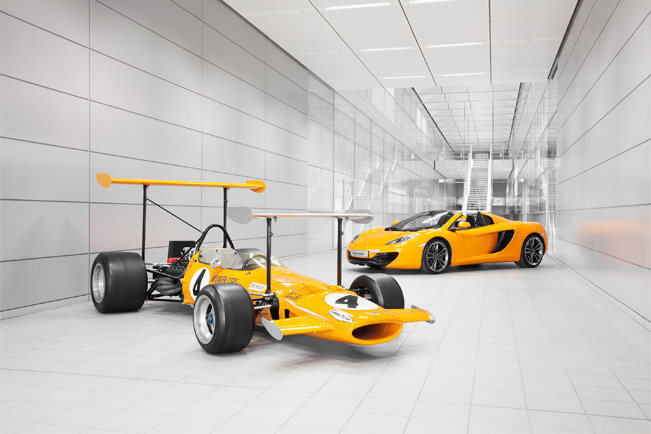
  • 1969 McLaren M7C and MP4-12C Spider

    McLaren is going to celebrate their 50th anniversary on September 2nd, this year.

    The original name of the company is Bruce McLaren Motor Racing Ltd and it has been launched since 1963. For the celebration, McLaren will use a 50th anniversary logo on everything from their shirts to the new MP4-28 Formula 1 that will debut on January 31st. They also intend to host a lot of unique events and celebration throughout the year.

    If we were to follow Bruce’s words to the letter, there’d be little time for recollection, but on the eve of our half-century there’s surely time for the briefest of breaths and the opportunity to take a look behind us at the sweeping vista built up in the indelible shadow of our founder:

    • Our Formula 1 team has become a global household name; since our arrival in the sport, at the 1966 Monaco Grand Prix, we have won more races (182) than any other constructor, started from pole position 155 times and scored 151 fastest laps. In 2012, we achieved the fastest-ever time for a Formula 1 pitstop (2.31s at Hockenheim), recorded our 58th consecutive points-scoring finish, an all-time record, and have now led more than 10,000 racing laps.
    • The exploits of our greatest world champions will always bring F1 to life: Emerson Fittipaldi ignited the passion of his native Brazil; James Hunt created as many headlines on the front pages as on the back; Niki Lauda and Alain Prost turned sport to science; the burning intensity of Ayrton Senna will live on for ever, while Mika Hakkinen and Lewis Hamilton will always be remembered for their raw speed and fearless aggression.
    • Our legacy in North American sportscar racing is writ equally large: in the heyday of the mighty CanAm series, we steamrollered the opposition, lifting five successive championship trophies (1967-1971) and winning an incredible 43 races in our iconic, thundering V8-engined sportscars.
    • We went to the Indy 500 for the first time in 1970, returning with greater strength until we won the USA’s most famous motor race in 1974 with Johnny Rutherford. We repeated the feat with Rutherford in 1976, too.

    • Today, every single car in Formula 1, the Indycar Series and NASCAR relies upon McLaren Electronics’ standardised ECUs to control their engines and feed data back to the garage.
    • Introduced back in 1993, the McLaren F1 road car has lost none of its unique appeal and is still considered by many to be automotive world’s definitive supercar. To this day, it remains the fastest naturally aspirated production car in the world. In GTR racing guise, it won the 24 Hours of Le Mans, also scooping third, fourth and fifth places on its debut in 1995.
    • The next roadcar project was with German manufacturer Mercedes-Benz, and saw the successful build of the Mercedes-Benz SLR McLaren, which became the best-selling carbon-based car ever.
    • Since its launch in 2010, McLaren Automotive has developed into a world-class road car manufacturer, successfully developing and building the 12C and the 12C Spider high performance sports cars. Both models exploit our unparalleled understanding of carbon fibre and electronic driver systems to create a groundbreaking product of unequalled weight, strength, performance and driveability.
    • In a return to our sportscar roots, the debut of the 12C GT3 was an unqualified success, scoring 19 victories on its competitive debut in 2012. In September, as Vodafone McLaren Mercedes crossed the flag to win in Monza, McLaren’s GT cars also took top spot at races in British, French and Spanish championships – an incredible achievement.
    • Fittingly, this year, McLaren Automotive stands poised to open its 50th global dealership ahead of the worldwide launch of the P1™ – our newest model and a machine that’s set to rewrite the definition of the modern supercar.
    • Away from the track, McLaren leads the world in the application of Formula 1 technology and expertise to other industries. McLaren Applied Technologies helped British cyclists, rowers, sailors and canoeists win 15 gold medals last summer. We worked alongside Specialized to design Mark Cavendish’s world championship-winning S-Works Venge bicycle. Working with Birmingham Children’s hospital, we have improved the monitoring of sick children in intensive care. McLaren has also designed systems to help the Bay Area Rapid Transit railway in San Francisco to run more efficiently and to reduce the CO2 emissions from plane movements at airports.

    Source: McLaren

  • 2013 Volkswagen Jetta Hybrid – US Price $24,995

    Volkswagen has announced the new 2013 Jetta Hybrid. The new Jetta Hybrid can go in pure electric mode, and therefore with zero emissions, at speeds of up to 70 km/h (44 mph) and over a distance of 2 km (1.3 miles). It also boasts an extremely low (combined) fuel economy value of 45 mpg.

    2013 Jetta Hybrid is powered by a 1.4-liter TSI and an electric motor. The power is put on the road through to a 7-speed DSG gearbox. The overall power is 170HP (127 kW) and 250Nm (184 lb-ft) of torque. 0-100 km/h in 9 seconds and fuel consumption of just 5.2 liters per 100 km in the combined cycle.

    The petrol engine can be fully disengaged, when the car is in pure electric driving mode or ‘sailing’ mode (coasting / braking). Therefore, during braking, the Jetta Hybrid switches over to a battery regeneration mode, which ‘captures’ kinetic energy and feeds it into the battery as electrical energy.

    The 2013 Volkswagen Jetta Hybrid SE include 15” alloy wheels fitted with all-season, low-rolling resistance tires. The mid-range SEL1 comes with 16” wheels, electric sunroof, electric adjustable driver’s seat, SAT NAV, front heated seats and keyless access. The top of range SEL2 rides on 17” alloys and adds bi-xenon headlights, fog lights and 400 WATTS Fender premium sound system.

    Extensive safety and convenience features

    Electronically stabilised. Standard equipment in the new Jetta Hybrid includes an electronic stabilisation programme (ESP), anti-lock braking system (ABS) and six airbags (driver and front passenger airbags, side airbags in front as well as window airbags, front and rear). This pack can be extended to include rear side airbags as an option.

    SE – specified exterior. Visually, even the base version (SE) of the Jetta Hybrid is distinguished by aerodynamic modifications that include a new front spoiler, a rear diffuser and a rear spoiler that is harmoniously integrated into the design. The results: the car’s Cd value was improved by 10 per cent. In addition, the Jetta Hybrid SE is equipped with a new LED rear lights design and special 15-inch alloy wheels with all-season tyres optimised for low rolling resistance. Hybrid signatures on the front, rear and side body panels identify the new drive version. Other distinguishing features: a special radiator grille where the VW logo is integrated on a blue background for the first time. Exclusively reserved for the Jetta Hybrid is the new body paint ‘Oryx white’.

    SE – upgraded interior. Inside, the car features high-end seat covers in ‘Titan black’ or ‘EcoTech’ design and new accent strips with the ‘Hybrid’ chrome signature, which identify the car as the Jetta Hybrid SE. A 2-zone automatic climate control system (Climatronic) with a new high-voltage air conditioning compressor ensures that the interior can be cooled even without the petrol engine running. Compared to the Climatronic used to date, this system also has the new ‘maxAC’ function, which cools down the interior very quickly at the press of a button. The technology of the Jetta Hybrid SE was perfected by specific instruments that include an energy flow diagram in the Premium 8 audio system, a trip computer, hands-free telephone system (Bluetooth) and interface for iPod and other multimedia sources as well as a multifunction leather-wrapped steering wheel.

    SEL1 and SEL2 are high-end. In the mid-level equipment version, the SEL1, standard features of the new Volkswagen are extended with such details as 16-inch alloy wheels, a tilt/slide glass sunroof, RNS 315 navigation system, electric driver’s seat adjustment, seat heating in front, and the Keyless Access system for door locking and engine starting via a Start button. Customers who order the top version, the SEL2, can also enjoy details such as 17-inch alloy wheels, newly developed bi-xenon headlights with dynamic cornering lights and automatic motorway lights, fog lights, reversing camera and a new Fender sound system with 400 Watts of output power. And that is how it should be. After all, who says that maximum sustainability cannot be fun as well?

    Source: Volkswagen

  • 2013 Nissan GT-R Nismo GT3 [video]

    2013 Nissan GT-R Nismo GT3Nissan has revealed the specially prepared GT-R Nismo GT3, which conforms to FIA GT3 regulations.

    Entered by NDDP RACING (Nismo) as well as customer racing teams, the GT-3 has outperformed the competition at this year’s SUPER GT series (GT 300 class), Super Taikyu (GT3 class), British GT Championship and GT Cup. Nismo has developed the 2013 Nissan GT-R Nismo GT3 using all the valuable data brought back from these races, in addition to the dyno, track tests, and customer feedback, to enhance its competitiveness and performance.

    GT-R Nismo GT3 is powered by the same twin-turbo 3.8-liter V6 with 543HP (405 kW) and 637Nm (470 lb-ft). The power is not signifactly boosted, but the weight reducing is impressive – the curb weight of this GT3 car is just 1300 kg (2866 lbs).

    If you are a racing driver or a millionare liking high speeds and adrenaline, you can now buy the 2013 Nissan GT-R Nismo GT3. It is priced at £270,000.

    httpv://www.youtube.com/watch?v=Pu1Bwmj76YA

    Specifications of the 2013 Model, Nissan GT-R Nismo GT3

    Length 4,780mm
    Width 2,036mm
    Weight 1,300kg?
    Engine Model VR38DETT
    Displacement 3,799cc
    Power 405kw (550HP) at 6,500rpm
    Torque 637Nm (470 lb-ft)
    Wheels (Fr/Rr) 13.0J X 18

    Subject to Balance of Performance defined by the FIA

    This Nissan GT-R Nismo GT3 is a racing car. It can not be used on public roads or be registered for such a license.

    Price

    Customer’s Area Price (without tax)?
    Japan, Asia, North America, South America, and Oceania ¥ 35,000,000
    Europe, including Russia and Middle East £270,000

    The sales price is EXW (ex works) and does not include shipping or delivery.

    Source: Nissan

  • 2012 Paris Motor Show: Mercedes-Benz B-Class Electric Drive Concept

    Local emission-free electric vehicles are a key element of the Mercedes-Benz strategy for sustainable mobility. The advances that the Stuttgart-based premium manufacturer has achieved in this field are demonstrated by electric passenger cars which are already being manufactured under series production conditions and demonstrating high everyday practicality today. Such vehicles include the B-Class F-CELL, the Vito E-CELL van and the smart fortwo electric drive. This broad product portfolio will be bolstered in 2014 by the addition of the battery-powered electric variant of the B-Class.

    “In developing our electric vehicles we accord top priority to customer benefits,” says Professor Dr Thomas Weber, Member of the Board of Management at Daimler AG responsible for Group Research and Head of Mercedes-Benz Cars Development. “Accordingly, the Concept B-Class Electric Drive demonstrates premium-standard electric mobility for all the family. The concept vehicle offers outstanding everyday practicality and great driving enjoyment.”

    Powerful acceleration and an effortlessly enjoyable driving experience

    The near-series concept vehicle provides a glimpse of what the near future holds. Quiet and local emission-free drive power is provided by a 100 kW electric motor. Typically for an electric drive, the maximum torque of 310 Newton metres is available right from the first tap on the accelerator pedal – corresponding on a theoretical level roughly to the torque delivery of a state-of-the-art petrol engine with a displacement of three litres. This results in unusually powerful acceleration from a standing start. For the standard sprint from 0 to 100 km/h the electric-powered B-Class requires less than ten seconds. This adds up to superlative performance and all the joys of highly dynamic driving in every situation.

    At a top speed limited to 150 km/h, the capacity of the highly efficient lithium-ion battery ensures a range of 200 local emission-free kilometres. This means that in addition to urban driving and short-range trips, longer journeys can also be mastered without any problems – such as the distances covered on a daily basis by commuters, for example. The Concept B-Class Electric Drive’s battery can be recharged at any standard domestic 230 V power outlet. A rapid charging function is also integrated which enables sufficient energy for 100 km to be charged in under an hour.

    While the car is on the move, the electric drive itself contributes to a favourable energy balance by transforming kinetic energy into electric current in deceleration mode and during braking and feeding this energy into the battery (recuperation).

    Elegant and sporty lines

    The powerful lithium-ion battery on board the Concept B-Class Electric Drive is accommodated safely and compactly in the so-called “ENERGY SPACE” under the rear part of the vehicle. This intelligent space concept ensures that the five-seater retains its familiar generously sized interior and boot.

    In terms of appearance, the Concept B-Class Electric Drive showcar differs to series production B-Class models in a number of details. These include first and foremost a striking front bumper and new side skirts which flow elegantly into both the front bumper and the newly designed rear bumper. The charging unit is installed inconspicuously behind the filler flap. A special reflective blue colour effect on the exterior highlights the Concept B-Class Electric Drive’s status as a local emission-free electric vehicle.

    High-end comfort: exclusive interior

    The range of instruments has been extended to cover functions specific to an electric vehicle. The round dial on the right incorporates a power display which is immediately and intuitively comprehensible, for example: the pointer rises when power is being consumed and drops below the zero line when the vehicle is feeding recuperative energy back into the battery. The instrumentation has been designed according to the motto “keep it clean”, i.e. avoiding any unnecessary electronic gadgets which might distract the driver unnecessarily from the traffic.

    Soft nappa is predominant inside the vehicle, covering steering wheel, seats, door centre panels, armrests and the dashboard, which is bordered with carefully applied decorative turquoise blue stitching. The passenger compartment is finished in black, white and crystal grey. The perforated seat centre panels and armrests are in keeping with the showcar’s sporty, agile character. Special highlights are provided by fine piping in black, white and turquoise which provides a border for the light seat surfaces. The head restraints additionally sport an embroidered Electric Drive logo.

    Connected services

    Cutting-edge technology ensures that the Concept B-Class Electric Drive is not only sustainable, but also fully networked and online. Remote checking and remote configuration of the vehicle is possible via the so-called Vehicle Homepage. The driver can access their vehicle on the internet, using their PC or smartphone. In this way, it is possible to check the current charge status of the lithium-ion battery or to verify the vehicle’s current range on a map. The planned route can also be displayed, showing directly whether and where the vehicle can be recharged along the way. The range of connected services is rounded off by a pre-entry climate control option offering individual timing. A further feature is smart charging. This involves the customer selecting a desired time for the beginning of his journey. The system then ensures that the battery is fully charged in time, taking economical and ecological considerations duly into account by using the most cost-effective or CO2-optimised charging times.

    Big on safety

    Mercedes-Benz attaches the same high safety standards to the Concept B-Class Electric Drive as apply to all the other series-produced vehicles of the MB brand. The very high safety standard of the new Mercedes-Benz B-Class provides the starting point. Thanks to the innovative “ENERGY SPACE”, the battery is accommodated under the floor at the rear of the vehicle, enhancing safety in the event of a crash.

    Technical data*

    Output 100 kW
    Torque 310 Nm
    Range 200 km
    Charging time for range of 100 km Under an hour at 400 V
    Acceleration 0-100 km/h Under 10 sec
    Top speed 150 km/h, electronically limited

    * provisional data

    Source: Mercedes-Benz

  • Mercedes-Benz SLS AMG Coupe Electric Drive – €416,500

    With the new SLS AMG Coupé Electric Drive, Mercedes-AMG is entering a new era: the locally emission-free super sports car featuring advanced technology from the world of Formula 1 is the most exclusive and dynamic way in which to drive an electric car. The most powerful AMG high-performance vehicle of all time has four electric motors producing a total output of 552 kW and a maximum torque of 1000 Nm. As a result, the gullwing model has become the world’s fastest electrically-powered series production vehicle: the SLS AMG Coupé Electric Drive accelerates from zero to 100 km/h in 3.9 seconds.

    A new dimension of driving performance – a convincing synonym for the AMG brand promise are the outstanding driving dynamics which come courtesy of AMG Torque Dynamics as well as torque distribution to individual wheels, which is made possible by means of wheel-selective all-wheel drive. The most “electrifying” gullwing model ever has been developed in-house by Mercedes-AMG GmbH. The high-voltage battery for the SLS AMG Coupé Electric Drive is the result of cooperation between Mercedes-AMG and Mercedes AMG High Performance Powertrains in Brixworth (GB). This is an area in which the British Formula 1 experts were able to contribute their extensive know-how with KERS hybrid concepts.

    “The SLS AMG Coupé Electric Drive is setting new standards for cars with electric drives. As the most powerful gullwing model ever, it is also representative of the enduring innovational strength of Mercedes-AMG. Our vision of the most dynamic electric vehicle has become a reality. With the help of our colleagues at Mercedes AMG High Performance Powertrains in Brixworth, we are bringing exciting advanced technology from the world of Formula 1 to the road”, according to Ola Källenius, Chairman of the Board of Management of Mercedes-AMG GmbH.

    Pioneering, visionary, electrifying: the powerful and locally emission-free super sports car with electric drive also embodies the development competence of Mercedes-AMG GmbH. With this innovative and unique drive solution, AMG – as the performance brand of Mercedes-Benz – is demonstrating its technological leadership in this segment. The SLS AMG Coupé Electric Drive is aimed at technology-minded super sports car fans who are open to new ideas and enthusiastic about ambitious high-tech solutions for the future of motoring.

    Enormous thrust thanks to 1000 Nm of torque

    The pioneering drive package in the SLS AMG Coupé Electric Drive is impressive and guarantees a completely innovative and electrifying driving experience: enormous thrust comes courtesy of four synchronous electric motors providing a combined maximum output of 552 kW and maximum torque of 1000 Nm. The very special gullwing model accelerates from zero to 100 km/h in 3.9 seconds, and can reach a top speed of 250 km/h (electronically limited). The agile response to accelerator pedal input and the linear power output provide pure excitement: unlike with a combustion engine, the build-up of torque is instantaneous with electric motors – maximum torque is effectively available from a standstill. The spontaneous build-up of torque and the forceful power delivery without any interruption of tractive power are combined with completely vibration-free engine running characteristics.

    The four compact permanent-magnet synchronous electric motors, each weighing 45 kg, achieve a maximum individual speed of 13,000 rpm and in each case drive the 4 wheels selectively via a axially-arranged transmission design. This enables the unique distribution of torque to individual wheels, which would normally only be possible with wheel hub motors which have the disadvantage of generating considerable unsprung masses.

    The key data at a glance:

    SLS AMG Coupé Electric Drive
    Max. output 552 kW
    Torque 1000 Nm
    0 – 100 km/h 3.9 s
    Range 250 km (according to NEDC combined)
    Battery energy content 60 kWh
    Battery voltage 400 volts

    Typical AMG: the sound of the 21st century

    Powerful, voluminous, dynamic, emotional and authentic: the characteristic sound of the SLS AMG Coupé Electric Drive embodies the sound of the 21st century. After an elaborate series of tests as well as numerous test drives, the AMG experts have created a sound which captures the exceptional dynamism of this unique super sports car with electric drive. Starting with a characteristic start-up sound, which rings out on pressing the “Power” button on the AMG DRIVE UNIT, the occupants can experience a tailor-made driving sound for each driving situation: incredibly dynamic when accelerating, subdued when cruising and as equally characteristic during recuperation. The sound is not only dependent on road speed, engine speed and load conditions, but also reflects the driving situation and the vehicle’s operating state with a suitable driving noise. Perfect feedback for the driver is guaranteed thanks to a combination of the composed sound, the use of the vehicle’s existing inherent noises and the elimination of background noise – this is referred to by the experts as “sound cleaning”. The impressive sound comes courtesy of the standard sound system with eleven loudspeakers.

    Advanced Formula 1 technology: high-voltage lithium-ion battery

    Battery efficiency, performance and weight: in all three areas Mercedes-AMG is setting new standards. The high-voltage battery in the SLS AMG Coupé Electric Drive boasts an energy content of 60 kWh, an electric load potential of 600 kW and weighs 548 kg – all of which are absolute best values in the automotive sector. The liquid-cooled lithium-ion high-voltage battery features a modular design and a maximum voltage of 400 V.

    Advanced technology and know-how from the world of Formula 1 have been called on during both the development and production stages: the battery is the first result of the cooperation between Mercedes-AMG GmbH in Affalterbach and Mercedes AMG High Performance Powertrains Ltd. Headquartered in Brixworth in England, the company has been working closely with Mercedes-AMG for a number of years. F1 engine experts have benefited from its extensive expertise with the KERS hybrid concept, which made its debut in the 2009 Formula 1 season. At the Hungarian Grand Prix in 2009, Lewis Hamilton achieved the first historic victory for a Formula 1 vehicle featuring KERS hybrid technology in the form of the Mercedes-Benz KER System. Mercedes AMG High Performance Powertrains supplies the Formula 1 teams MERCEDES AMG PETRONAS, Vodafone McLaren Mercedes and Sahara Force India with Mercedes V8 engines and the KERS.

    The high-voltage battery consists of 12 modules each comprising 72 lithium-ion cells. This optimised arrangement of a total of 864 cells has benefits not only in terms of best use of the installation space, but also in terms of performance. One technical feature is the intelligent parallel circuit of the individual battery modules – this helps to maximise the safety, reliability and service life of the battery. As in Formula 1, the battery is charged by means of targeted recuperation during deceleration whilst the car is being driven.

    High-performance control as well as effective cooling of all components

    A high-performance electronic control system converts the direct current from the high-voltage battery into the three-phase alternating current which is required for the synchronous motors and regulates the energy flow for all operating conditions. Two low-temperature cooling circuits ensure that the four electric motors and the power electronics are maintained at an even operating temperature. A separate low-temperature circuit is responsible for cooling the high-voltage lithium-ion battery. In low external temperatures, the battery is quickly brought up to optimum operating temperature with the aid of an electric heating element. In extremely high external temperatures, the cooling circuit for the battery can be additionally boosted with the aid of the air conditioning. This also helps to preserve the overall service life of the battery system.

    Quick charge function via special wall box

    Ideally the SLS AMG Coupé Electric Drive is charged with the aid of a so-called wall box. Installed in a home garage, this technology provides a 22 kW quick-charge function, which is the same as the charging performance available at a public charging station. A high-voltage power cable is used to connect the vehicle to the wall box, and enables charging to take place in around three hours. Without the wall box, charging takes around 20 hours. The wall box is provided as an optional extra from Mercedes-AMG in cooperation with SPX and KEBA, two suppliers of innovative electric charging infrastructures for the automotive industry.

    Eight-stage design for maximum safety

    To ensure maximum safety, the SLS AMG Coupé Electric Drive makes use of an eight-stage safety design. This comprises the following features:

    1. all high-voltage cables are colour-coded in orange to prevent confusion

    2. comprehensive contact protection for the entire high-voltage system

    3. the lithium-ion battery is liquid-cooled and accommodated in a high-strength aluminium housing within the carbon-fibre zero-intrusion cell

    4. conductive separation of the high-voltage and low-voltage networks within the vehicle and integration of an interlock switch

    5. active and passive discharging of the high-voltage system when the ignition is switched to “off”

    6. in the event of an accident, the high-voltage system is switched off within fractions of a second

    7. continuous monitoring of the high-voltage system for short circuits with potential compensation and insulation monitors

    8. redundant monitoring function for the all-wheel drive system with torque control for individual wheels, via several control units using a variety of software

    By using this design, Mercedes-AMG ensures maximum safety during production of the vehicle and also during maintenance and repair work. Of course the SLS AMG Coupé Electric Drive also meets all of the statutory and internal Mercedes crash test requirements.

    All-wheel drive with AMG Torque Dynamics enables new levels of freedom

    Four motors, four wheels – the intelligent and permanent all-wheel drive of the SLS AMG Coupé Electric Drive guarantees driving dynamics at the highest level, while at the same time providing the best possible active safety. Optimum traction of the four driven wheels is therefore ensured, whatever the weather conditions. According to the developers, the term “Torque Dynamics” refers to individual control of the electric motors, something which enables completely new levels of freedom to be achieved. The AMG Torque Dynamics feature is permanently active and allows for selective distribution of forces for each individual wheel. The intelligent distribution of drive torque greatly benefits driving dynamics, handling, driving safety and ride comfort. Each individual wheel can be both electrically driven and electrically braked, depending on the driving conditions, thus helping to

    • optimise the vehicle’s cornering properties,

    • reduce the tendency to oversteer/understeer,

    • increase the yaw damping of the basic vehicle,

    • reduce the steering effort and steering angle required,

    • increase traction,

    • and minimise ESP® and ASR intervention.

    The AMG Torque Dynamics feature boasts a great deal of variability and individuality by offering three different transmission modes:

    • Comfort (C): comfortable, forgiving driving characteristics

    • Sport (S): sporty, balanced driving characteristics

    • Sport plus (S+): sporty, agile driving characteristics

    AMG Torque Dynamics enables optimum use of the adhesion potential between the tyres and the road surface in all driving conditions. The technology allows maximum levels of freedom and as such optimum use of the critical limits of the vehicle’s driving dynamics. Outstanding handling safety is always assured thanks to the two-stage Electronic Stability Program ESP®.

    “AMG Lightweight Performance” design strategy

    The trailblazing body shell structure of the SLS AMG Coupé Electric Drive is part of the ambitious “AMG Lightweight Performance” design strategy. The battery is located within a carbon-fibre monocoque which forms an integral part of the gullwing model and acts as its “spine”. The monocoque housing is firmly bolted and bonded to the aluminium spaceframe body. The fibre composite materials have their roots in the world of Formula 1, among other areas. The advantages of CFRP (carbon-fibre reinforced plastic) were exploited by the Mercedes-AMG engineers in the design of the monocoque. These include their high strength, which makes it possible to create extremely rigid structures in terms of torsion and bending, excellent crash performance and low weight. Carbon-fibre components are up to 50 percent lighter than comparable steel ones, yet retain the same level of stability. Compared with aluminium, the weight saving is still around 30 percent, while the material is considerably thinner. The weight advantages achieved through the carbon-fibre battery monocoque are reflected in the agility of the SLS AMG Coupé Electric Drive and, in conjunction with the wheel-selective four-wheel drive system, ensure true driving enjoyment. The carbon-fibre battery monocoque is, in addition, conceived as a “zero intrusion cell” in order to meet the very highest expectations in terms of crash safety. It protects the battery modules inside the vehicle from deformation or damage in the event of a crash.

    The basis for CFRP construction is provided by fine carbon fibres, ten times thinner than a human hair. A length of this innovative fibre reaching from here to the moon would weigh a mere 25 grams. Between 1000 and 24,000 of these fibres are used to form individual strands. Machines then weave and sew them into fibre mats several layers thick, which can be moulded into three-dimensional shapes. When injected with liquid synthetic resin, this hardens to give the desired structure its final shape and stability.

    Optimum weight distribution and low centre of gravity

    The purely electric drive system was factored into the equation as early as the concept phase when the super sports car was being developed. It is ideally packaged for the integration of the high-performance, zero-emission technology: by way of example, the four electric motors and the two transmissions can be positioned as close to the four wheels as possible and very low down in the vehicle. The same applies to the modular high-voltage battery. Advantages of this solution include the vehicle’s low centre of gravity and balanced weight distribution – ideal conditions for optimum handling, which the electrically-powered gullwing model shares with its petrol-driven sister model.

    New front axle design with pushrod damper struts

    The additional front-wheel drive called for a newly designed front axle: unlike the series production vehicle with AMG V8 engine, which has a double wishbone axle, the SLS AMG Coupé Electric Drive features an independent multi-link suspension with pushrod damper struts. This is because the vertically-arranged damper struts had to make way for the additional drive shafts. As is usual in a wide variety of racing vehicles, horizontal damper struts are now used, which are operated via separate push rods and transfer levers. Thanks to this sophisticated front-axle design, which has already been tried and tested in the world of motorsport, the agility and driving dynamics of the SLS AMG Coupé Electric Drive attain the same high levels as the V8 variant. Another distinguishing feature is the speed-sensitive power steering with rack-and-pinion steering gear: the power assistance is implemented electrohydraulically rather than just hydraulically.

    AMG ceramic composite brakes for perfect deceleration

    The SLS AMG Coupé Electric Drive is slowed with the aid of AMG high-performance ceramic composite brakes, which boast direct brake response, a precise actuation point and outstanding fade resistance, even in extreme operating conditions. The over-sized discs – measuring 402 x 39 mm at the front and 360 x 32 mm at the rear – are made of carbon fibre-strengthened ceramic, feature an integral design all round and are connected to an aluminium bowl in a radially floating arrangement.

    The ceramic brake discs are 40 percent lighter in weight than the conventional, grey cast iron brake discs. The reduction in unsprung masses not only improves handling dynamics and agility, but also ride comfort and tyre grip. The lower rotating masses at the front axle also ensure a more direct steering response – which is particularly noticeable when taking motorway bends at high speed.

    Exclusive, high-quality design and appointments

    Visually, the multi-award-winning design of the SLS AMG is combined with a number of specific features which are exclusive to the Electric Drive variant. The front apron has a striking carbon-look CFRP front splitter which generates downforce on the front axle. The radiator grille and adjacent air intakes adorn special areas painted in the vehicle colour and with bionic honeycomb-shaped openings. They are not only a visual highlight but, thanks to their aerodynamically optimised design, also improve air flow over the cooling modules mounted behind them. Darkened headlamps also impart a sense of independence to the front section. Viewed from the side, the “Electric Drive” lettering stands out on the vehicle side, as do the AMG 5-twin-spoke light-alloy wheels with their specific paint design. The SLS AMG Electric Drive comes as standard with 265/35 R 19 tyres on the front and 295/30 R 20 tyres on the rear. The overall look is rounded off to dynamic effect by the new diffuser-look rear apron, and the darkened rear lamps. One feature reserved exclusively for the SLS AMG Coupé Electric Drive is the “AMG electricbeam magno” matt paint finish. A choice of five other colours is available at no extra cost.

    When the exterior colour AMG electricbeam magno is chosen, the high-quality, sporty interior makes use of this body colour for the contrasting stitching – the stitching co-ordinates perfectly with designo black Exclusive leather appointments. AMG sports seats and numerous carbon-fibre trim elements in the interior underscore the exclusive and dynamic character of what is currently the fastest electric car. Behind the new AMG Performance steering wheel there is a newly designed AMG instrument cluster: instead of a rev counter, there is a power display providing information on the power requirements, recuperation status, transmission modes and battery charge.

    AMG Performance Media as standard

    The AMG DRIVE UNIT comprises the electronic rotary switch for selecting the three transmission modes of “C” (Controlled Efficiency), “S” (Sport) and “S+” (Sport plus), which the driver can use to specify different performance levels from the electric motors, which in turn also changes the top speed and accelerator pedal response. Behind the buttons for “power” and “ESP On/Off”, there are also buttons for AMG Torque Dynamics and AMG Setup.

    In addition to carbon-fibre exterior mirrors, AMG carbon-fibre engine compartment cover, COMAND APS, Media Interface, Blind Spot Assist and reversing camera, the standard equipment also includes the AMG Performance Media system. Besides full high-speed mobile internet access, the system provides information on engine performance, lateral and longitudinal acceleration, tyre pressure, vehicle setup and lap times, as well displaying a variety of additional information such as:

    • vehicle energy flow

    • battery charge status

    • burrent range

    • AMG Torque Dynamics

    • temperatures of the battery and motors

    • energy consumption kWh/100 km

    The Mercedes-Benz SLS AMG Coupé Electric Drive will be celebrating its market launch in 2013. The price in Germany (incl. 19% VAT) will be:

    SLS AMG Coupé Electric Drive: 416,500 euros

  • The Honda CR-Z

    2010 Honda CR-ZLaunched in 2010 Honda’s CR-Z was widely considered a ground-breaking sporting hybrid from one of the world’s leading car manufacturers. “Hybrid” and “sporting” are problematic concepts when put together: in nature a hybrid car is usually heavy due to the presence of two separate motors and a hefty battery pack. Sports cars, on the other hand, need to be light in order to be fast, and their need for speed often compromises on the ecological economy required in a hybrid. Honda’s CR-Z however, married the two in a successful vehicle.

    Weighing 132lb the honda crz’s electric motor, measuring just two inches across, fits snugly between the car’s engine and its six-speed manual transmission. Beneath the floor of the boot is concealed its nick-metal hydride battery and power electronics provided by Panasonic. The electric motor adds a bit of oomph to the wheels when the driver accelerates rapidly, and can even act as a generator during overrun or when the car brakes. The results? The sporty coupe goes from 0 to 62 in 9.9 seconds, hits a top speed of 124mph and delivers 56.6mpg in its Combined cycle.

    Since its launch two years ago the CR-Z has been a big success for Honda and a major step in their journey towards total fuel economy. Although it was met with steep competition at the time from the likes of Renault’s Megane Coupe 1.5 dCi 86 and the BMW 118d Couple the CR-Z continued to attract drivers and now it looks set for an overhaul as Honda have recently revealed tantalising images suggesting an update to their hybrid success story.

    Exactly what this reissue will entail is not yet clear, but Honda have been known to continually improve on their most popular vehicles by responding to the feedback and criticisms of their customers.

  • 2013 Audi RS5: Naturally Aspirational

    Motor Trend has released a full video review of one of the best sports coupes on the market – the new 2013 Audi RS5.

    It features LED-infused headlights, nice matt aluminum trim and enormous 19” forged aluminum wheels fitted with low-profile tires. There is also a new rear diffuser, a dual sports exhaust system with nice deep sound and the final touch is a carbon fiber rear spoiler.

    The interior features a sports steering wheel, leather and Alcantara heated sport seats, some metallic accents and of course – carbon fiber trim.

    The Audi RS 5 is delivered with an extensive set of standard extras. They include the parking system plus, driver and front passenger seat heating, automatic belt feeder, wind deflector, lighting package, driver information system with rest recommendation and a comprehensive package of restraint systems. In case of an impending roll-over accident, strong aluminum plates deploy upwards behind the rear head restraints. Sporty and luxurious options include three-stage head-level heating, convenience key, high-beam assistant, adaptive light and three-zone deluxe automatic air conditioning.

    The engine is a 4.2 liter naturally aspirated V8 with 450HP (331 kW) and 430Nm (317 lb-ft) of torque. It is mated to a 7-speed S-tronic gearbox sending all that power to Quattro AWD system. 0-100 km/h in 4.9 seconds and a top speed of 250 km/h (155 mph) – electronically limited. However, upon request, Audi can increase it to 280 km/h (174 mph).

  • 2013 Audi RS5 Cabrio – wind in the hair and V8 sound [video]

    Audi has unveiled the new 2013 RS5 Cabrio, ahead of its official premiere at the 2012 Paris Motor Show. The four-seat convertible with a cloth soft top entices with a unique combination of elegance and power. The wind in the hair and the massive sound of the big V8 in front are just the perfect combination.

    Furthermore, the new RS5 Cabrio features a lightweight soft top that can be opened in 15 seconds. The exterior boasts LED-infused headlights, nice matt aluminum trim and enormous 19” forged aluminum wheels fitted with low-profile tires. Other interesting parts are the new rear diffuser, a dual sports exhaust system with nice deep sound and the final touch is a carbon fiber rear spoiler.

    The interior boasts a sports steering wheel, leather and Alcantara heated sport seats, some metallic accents and of course – carbon fiber trim. There is also a wind deflector and  a driver information system.

    The Audi RS 5 Cabriolet is delivered with an extensive set of standard features. They include the parking system plus, driver and front passenger seat heating, automatic belt feeder, wind deflector, lighting package, driver information system with rest recommendation and a comprehensive package of restraint systems. In case of an impending roll-over accident, strong aluminum plates deploy upwards behind the rear head restraints. Sporty and luxurious options include three-stage head-level heating, convenience key, high-beam assistant, adaptive light and three-zone deluxe automatic air conditioning.

    The engine of the RS5 Cabrio is a 4.2 liter naturally aspirated V8 with 450HP (331 kW) and 430Nm (317 lb-ft) of torque. It is mated to a 7-speed S-tronic gearbox sending all that power to Quattro AWD system. 0-100 km/h in 4.9 seconds and a top speed of 250 km/h (155 mph) – electronically limited. However, upon request, Audi can increase it to 280 km/h (174 mph).

    The 2013 Audi RS5 Cabrio will hit the European market in the beginning of the next year. It is priced from €88,500, which is a lot and hopefully the car will worth its price.

    httpv://www.youtube.com/watch?v=y3aqUYRYaG0

    Source: Audi