Here are several starts of a brutal Jeep Cherokee SRT-8 Supercharged with 700HP against some powerful, tuned vehicles – BMW X6M Hamann Stage 2 670HP, Porsche Cayenne Turbo Gemballa GT600 with 600HP, Ford Mustang GT500 612hp and Porsche 911 Turbo Stage 2 580HP.
As you can see, all these SAVs and cars are underpowered, but as we know – power is nothing without control. Although the BMW starts first with reaction time of only 0.310 seconds, it is quickly overtaken by the Jeep. The X6 M crosses the finish line with 248.31 km/h terminal speed against 246.74 km/h for the Cherokee.
In the second start versus the Cayenne Turbo the scenario is the same. Better reaction from the Porsche driver, but worse 60ft and overall performance – 236.43 km/h at 1 mile for the Cayenne and 262.49 km/h for the Cherokee.
The third start is versus the mighty Mustang having 612 HP, a lot less weight and way better cD (drag coefficient). At the start the Mustang is dominated, because it is RWD against the AWD in Cherokee. The Mustang’s 60ft time is bad – 2.198 seconds against just 1.699 seconds for the Cherokee. However, the car crosses the finish line with 284.27 km/h, which is more than enough for a win.
In the last start, the Cherokee is against Porsche 911 Turbo with 580HP. The SUV didn’t have any difficulties, because it started first, with better 60 ft time and overall performance – 260.05 km/h and 29.820 seconds at 1 mile.
Autocar.co.uk has revealed a video review of the new 2012 Panamera GTS. The four-door coupe car come with some nice updates: better efficiency, more power, nicer sound and lowered air suspension as standard.
It is powered by a 4.8 liter V8 with 430PS (316 kW) at 6700RPM and 520Nm (385 lb-ft) at 3500RPM. The engine is mated to a 7-speed Porsche DKG gearbox. 0-100 km/h in 4.5 seconds and Vmax – 288 km/h (179 mph). The fuel consumption is very good too – 21.6 mpg US with 256 g/km CO2. The kerb weight is 1920 kg.
The improved chassis features aptive air suspension combined with Porsche Active Suspension Management (PASM). The comfort and driving dynamics are boosted by adjusting the spring rate and electrically adjusting the damping system, combined with a self-levelling height adjustment function. Panamera GTS sits 10 mm lower than the other models in the range. Dynamic performance is further enhanced by the combination of 19” diameter Panamera Turbo wheels, 5 mm rear wheel spacers and larger brake discs from the Turbo – recognisable by their red brake callipers.
httpv://www.youtube.com/watch?v=jozAsl_MVlE
The Sound Symposer, which can be activated or deactivated by the Sport button directs intake noise into the interior by an acoustic channel picking up the intake vibrations between the throttle valve and air filter.
Other interesting feature is the standard Sport Chrono package including Sport Plus programme. In the ultimate Sport Plus mode, the adaptive air suspension lowers the vehicle to the low setting and switches to a harder spring rate. The rear spoiler angle of attack also changes to the performance-oriented setting.
The interior of the new Panamera GTS can be styled according to customer’s taste. There are leather and Alcantara – with a choice of five interior colours. The centre panels of the adaptive 18-way adjustable sports seats, the upper sections of the door armrests and front centre console armrest and roof lining are in Alcantara.
2012 Porsche Panamera GTS will be priced from around $144 100.
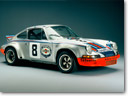
Porsche will celebrate the 40th anniversary of the iconic 911 RS 2.7 at Techno Classica, in Essen, Germany, from March 21-25.
Techno Classica is the world’s largest trade fair dedicated to classic cars, and this year’s event will see Porsche Classic showcase its wide range of customer services on a stand more than twice as large as last year’s.
To mark the occasion, two racing versions of the 911 Carrera RS from the Porsche Museum in Stuttgart are on display. The first is a 1973 911 Carrera RSR delivering 330HP, which is joined by the ultimate RS variant, the 1974 911 Carrera RSR Turbo. It produces 500HP from a small 2.1 liter turbocharged flat-six engine.
The RS-themed display is completed by a 911 Carrera RS 2.7 road car, which has been restored by the Porsche Classic workshop specialists. Also on show is an early Porsche 911, which is currently being restored for a customer at Porsche Classic.
1973 Porsche 911 RSR
Experts from Porsche Classic will be on hand to provide advice and practical assistance to visitors regarding the preservation and maintenance of their historic vehicles. They will also provide information on the availability of Porsche Classic original spare parts. Especially noteworthy, for example, is the coveted “orange” Porsche bonnet badge of the 911 models from 1965 to 1973, which has been not been available since 1974. In 2012, this will be re-released once more.
Together with a Porsche Museum information stand, Porsche Exclusive & Tequipment will also be represented on the spacious 600 plus square metre stand. A custom-equipped 911 Carrera of the current 991 model series is being used to showcase the comprehensive personalisation options.
Porsche Design Driver’s Selection rounds off the varied offering on the Porsche stand with a wide selection of Porsche.
Lately, a lot of Vorsteiner dealers tend to showcase exotic cars with kits and wheels from the source. This one is from Wheels Boutique in Florida. Vorsteiner VR-T components expose themselves here and there on this Porsche 911 Twin Turbo Cabriolet.
The VR-T line front bumper seems just about right for the job. It houses bigger carbon fiber air intakes and throws away the factory fog lights and headlight washer bezzles. The VR-T rear bumper works on the wide aspects of the Porsche – the flaring side vents also benefit the intercooler. The back end also gets a molded carbon diffuser with twin fins and enough space for the quad sport exhaust tips. For the overall complete feel, a VR-T rear deck lid and wing had to be heavily modified to fit on the convertible version.
At the end of the day, we have a perfectly decent roadster with a bit of character added that is ready to take you out under the blazing sun Florida. Hope it comes with sunscreen as well.
Ever wondered how WRC cars manage to deliver 300 bhp and above from an engine that, by rule, cannot exceed 2.0 liters of displacement? How on earth do the heavy, low-revving diesel engines in cars today stay competitive? Or what is it that makes it possible for the Bugatti Veyron to break the 1000 bhp threshold? Well, it certainly isn’t witchcraft. By means of “forced induction”, turbochargers today boost the automotive industry to a new direction of smaller, more-efficient and bloody good fun engines.
Volkswagen like to brand their most successful turbo diesel range as TDI while Porsche, being more plain about it, call their turbocharged cars, Porsche (insert model here) Turbo. BMW, on the other hand, would never hesitate to utter their own terms like “bitrubo” or “TwinPower” whenever describing the latest M5 engine. The variety of depicting turbocharged cars is bountiful, but essentially the principles of work remain the same in every case.
Beware reader, as I am now going to get technical:
In order to understand how a centrifugal turbocharger works, one must also have some basic knowledge on how four-stroke, piston engines work. We have an engine block that contains the cylinders, right? Inside each cylinder, a piston moves up and down. Every movement made is a phase, a stroke. First we have intake – a mixture of fuel and air is sucked into the cylinder. Compression is the second stroke where the cylinder moves up and…well…compresses the molecules in the mixture. The next ignition stroke is downwards as the piston experiences pressure coming from the combustion of the mixture. The exhaust stroke has the job to expel the remaining gases through the exhaust valve. Then the intake valve lets in a new batch of fuel mixture and thus the process is repeated.
However, as far as turbochargers are concerned, exhaust gases are not exactly throw-away material. Put simply, the turbocharger utilizes the energy of exhaust to compress the the newly arrived batch of air which is to be shoved in the cylinder. More air molecules means that more fuel can be injected into the mixture and more fuel means more power.
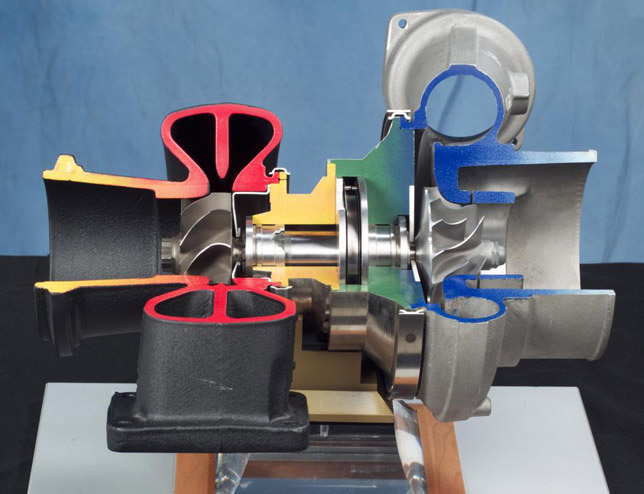
Before those exhaust gasses reach the exhaust system they go trough a turbine connected to a shaft. The more exhaust that goes through the turbine blades, the faster they spin. On the other end of the shaft we find a compressor which welcomes fresh air from the atmosphere, compresses it using the force of the turbine and then feeds it into the engine. To further increase the efficiency of the turbocharging system, an intercooler is added – it looks much like a car radiator but instead of containing cooling fluid, it holds the compressed air from the compressor. Air is denser when cooler and that’s exactly what the intercooler does – it cools the incoming air.
Cut-away view of a turbocharger held by a foil-bearing
There are issues however. First of all, a turbine amidst the flow of exhaust is essentially an obstacle. The exhaust stroke has to deal with more back-pressure thus being slightly less efficient. A functional turboshaft has to handle extreme forces (speeds go up to 150 000 rpm within the turbocharger) so a special kind of baring is needed – liquid ones or state-of-the-art ball bearings. The latter is more efficient but more expensive. Then there’s the dreaded turbo lag. The problem here is that when you put your foot down, the response is far from electric. The turbine needs some time to kick off and start spinning the compressor blades. That’s why at low engine rpm one can’t really tell if the car has a turbo or not.
There are various ways to tackle this nuisance. Make things smaller and lighter. Tiny turbochargers will grant you that off-the-line jolt but won’t be too good on the upper rpm range. Besides, if too much exhaust starts going through a relatively small turbine things may get hot and disbalanced. Usually however, there’s the wastegate in most turbines – a valve that knows how much exhaust passes through and regulates the flow by simply diverting some of the gases away from the turbine. Some companies have started putting more than one turbochargers in their cars. One small and the other, big. The small one guarantees a more immediate response while the big one takes over at higher speeds.
Essentially, that’s the story with turbochargers. We can further dive into numbers and calculations about pressure and efficiency but this, I think, is already nerdy enough. Hopefully some of you learned something new while others refreshed their memory on how the turbocharger brings easy power to our everyday lives.
Here is a Porsche Cayenne II. It has been around for 2 years now and has proven to be a very decent SUV. It’s 180 kg lighter than the first one, the front of it goes easy on the grilles and the headlights plus the interior design have some Panamera in them. So why are we even talking about it? Well, if you have an eye for that kind of things, the wheels are kind of custom and the ride is lowered.
Bad Segeberg based Schmidt Revolution house have fitted on this Cayenne four 10×22-inch one-piece five spoke summer rims. Its a set from their CC-Line. At the front, the tires size up to 295/30R22 while at the back they measure 335/25R22. They can be finished in silver, black (glossy or matte) and in exquisite black chrome. The last variant has a cover, made from a stainless steel, which doesn’t allow any dirt sticking on it. Also, because of an H&R-suspension lowering module, the Cayenne now sits lower than usual. As a result, the center of gravity is lower and drag is now a bit lower.
Otherwise, things remain pretty standard – with a base model, under the hood you should find a 3.6 L V6 engine that produces 300 PS. The power goes trough a 6-speed manual to all four wheels. Just think of it as a second generationVW Touareg and you”ll get the picture.
Gemballa do not think that the latest Porsche 991 Carrera needs a performance boost. After all, it has a 340hp 3.4 liter flat six power plant that provides an electric enough feel. And if there is anything that can get close to the mighty GT3, it’s the Carrera S version that has a 3.8 liter, 400hp engine. What I’m trying to say is that the latest “designpackage” from Gemballa for the Carrera is strictly visual. At this point we have a few aerodynamic features, new wheels and a sonorous arrangement (exhaust pipes).
Gemballa CEO, Andreas Schwarz, explains: “Creating an even more individual appearance for this iconic sports car is a natural step for Gemballa, and we are proud to present our GT package for the new Carrera.”
The body kit consists of “made in Germany” type carbon fitments – a front bumper, a rear one and some side skirts. Everything is designed to fit perfectly to the standard mounting points of the car. Installing them requires no cutting or grinding so the return to stock components is quite feasible.
Gemballa have also provided four 21-inch wheels that are just a little bit lighter than the standard 19-inch ones on the Carrera and quite a lot lighter than the 20-inch set on the Carrera S.
“Lowering the unsprung weight despite going up a wheel size was a priority,” said Schwarz.
Eventually, we reach a point where we have to talk about pipes. About all six of them. The Gemballa exhaust system helps the engine with the breathing and the singing.
2012 RUF Porsche Panamera RXL sedan is very special model witch is an extended wheelbase version of the Porsche Panamera sedan and features the iconic RUF 5-spoke, 22 inch alloy wheels and engine performance upgrades. Moreover, RUF will present the new CTR 3 Clubsport model, which features significant styling enhancements in Carbon-Fibre. With the introduction of the Porsche 991 platform, all RUF models based on the 911 will be built on the new platform and will carry over all Porsche 997 based improvements. And next, as a tribute to RUF’s 35 years of history and success with Turbo engines, RUF introduces theRt 35 Anniversary, which is an original 1977 RUF Turbo 3.3. The new generation RGT 8 is based on the Porsche 991, with its RUF V8. All vehicles will be on display in Geneva.
2012 RUF Porsche Panamera RXL
The first vehicle to be presented in Geneva is RUF CTR 3 Clubsport. The styling of the CTR 3 evokes the mid-engine Le Mans Coupes of the 1950s. It features Carbon-Fibre enhancements to the fenders, door sills, rear deck lid and the roof mounted air-duct; and afunctional rigid rear spoiler.
Technical Data CTR 3
Power at
750ps /552kW @ 7100
Torque at
960 Nm @ 4000 1/min
Displacement
3746 cm³
Transmission
6-speed sequential
Top Speed
370 km/h
Fuel consumption
Urban
20 l/100 km
Non-urban
9,9 l/100 km
Combined
13,5 l/100 km
CO2 emissions
311g/km
Next comes the RUF Rt 35 Anniversary models, which is based on the Porsche 991. Its Turbo power-train is offered only in rear wheel drive. Furthermore, the engine produces 630 hp (463 kW) and is available with the PDK transmission delivering outstanding performance.
Technical Data Rt 35 Anniversary
Power at
630ps/464kW @ 6500
Torque at
825 Nm @ 3000 1/min
Displacement
3800 cm³
Transmission
Double clutch gearbox
Top Speed
330 km/h
Fuel consumption
Urban
16,7 l/100 km
Non-urban
8,2 l/100 km
Combined
11,5 l/100 km
CO2 emissions
268 g/km
The third vehicle to be on display is RUF RGT 8, which was firstly introduced in Geneva in 2010. However, now it is available based on the new Porsche 991 platform. The vehicle includes the naturally aspirated V8 which produces 550 hp (404 kW). The flexibility of the V8 engine delivers extraordinary performance and a sound track that only a high‑revving, flat‑crank V8 can produce. The RGT 8 is available with only a six-speed manual transmission powering the rear wheels.
Technical Data RGT 8
Power at
550ps/405kW @ 8500
Torque at
500 Nm @ 4000 1/min
Displacement
4499 cm³
Transmission
6-speed manual
Top Speed
318 km/h
Fuel consumption
Urban
19,7 l/100 km
Non-urban
9,8 l/100 km
Combined
12,9 l/100 km
CO2 emissions
298 g/km
The RUF RXL was developed based on the Porsche Panamera. Here the RXL front bumper creates an aggressive front profile and the light weight wheels are iconic five-spoke 22 inches in diameter. The extended wheelbase totals an additional 400 millimetres, 250 millimetres at the B‑pillar and 150 millimetres at the rear door, distinguishing it from the standard sedan. The interior is further improved by special leather and includes a foldable multipurpose table.
Porsche will exhibit the new 2012 Boxster alongside the Panamera GTS and 911 Carrera Cabriolet at the Geneva Motor Show at 09:30 on March 6 in Hall 1.
As we previously wrote, the 2012 Boxster features all-new lightweight body, new flat-six engines with direct petrol injection, a completely revised chassis and evolutionary styling.
It is powered by a 2.7 litre boxer engine with 265PS (195 kW) and a 3.4 litre flat-six with 315PS (323 kW). Both models feature a manual 6-speed gearbox as standard, with the 7-speed dual-clutch Porsche Doppelkupplungsgetriebe (PDK) available as an option.
Built in Zuffenhausen, Stuttgart, the new Porsche Boxster will hit the UK market from May 5.
The Boxster is priced from £37 589, and the Boxster S starts at £45 384.
2012 Porsche Boxster S
The manufactureris unveiling the 911 Cabriolet to a European audience right on cue for the open air season. The new model offers sporting drivers the option to enjoy the renowned dynamic qualities and iconic design of the 911 Coupe combined with the added versatility and driving pleasure offered by its folding convertible roof.
The roadster shares its new, high tech aluminium-steel body with the Coupe and extends this innovation to its all-new, unique hood. When raised, the design of the hood ensures the iconic 911 roof line is retained in its entirety. Intelligent lightweight design, including the use of magnesium in the hood frame, ensures reduced weight for increased responsiveness, lower fuel consumption and greater comfort. As is the case with the Coupe model, the new 911 Cabriolet is significantly lighter overall than its predecessor.
The new 911 models are on sale now starting from from £79 947 and the Carrera S Cabriolet is £89 740.
2012 Porsche 911 Carrera S Cabriolet
Panamera GTS is based on the regular model, but comes with updated 4.8 liter naturally-aspirated V8 engine with 430PS (316 kW) at 6700RPM and 520Nm (384 lb-ft) at 3500RPM. It is coupled with a 7-speed Porsche Doppelkupplungsgetriebe (PDK) transmission.
Despite to kerbweight of 1 920kg, the 4-door coupe accelerates to 100 km/h in 4.5 seconds and has a top speed of 288 km/h (179 mph).
A tuned chassis boasting performance-oriented options is standard; with the air suspension at its normal level the Panamera GTS sits 10 mm lower than the other models in the Panamera range and its damping is designed to be tauter, reinforcing the sporting personality. Dynamic performance is further enhanced by the combination of 19-inch diameter Panamera Turbo wheels, 5 mm rear wheel spacers and larger brake discs from the Turbo – recognisable by their red brake callipers.
The appearance of the Panamera GTS is characterised by numerous black exterior styling details. The high-gloss black exterior package comprises the side window trim, the decorative trim on the rear lid, the headlight washer unit cover, the rear diffuser and the side air outlet panels which lend a particular sporting touch. In combination with the black side skirts, the tail end and the matt black tailpipes of the sports exhaust system the result is clear-cut and striking.
Vorsteiner has released several pictures of one of their latest tuning projects – the new V-GT program for the Porsche 991. The tuning elements will fit both Carrera and Carrera S models and are made of carbon fiber.
The exterior upgrades include: a new add-on spoiler with integrated brake duct collectors, a front GT replaceable center splitter for more downforce, a pair of side skirts with integrated carbon fiber blade extension, a new lightweight carbon-fiber bonnet, a rear add-on diffuser with integrated aero fins, a rear add-on ducktail wing spoiler, a lightweight replacement carbon fiber roof panel and sets of different forged alloy wheels in dimensions 20” or 21”.
Last, but not least, Vorsteiner offers Stainless & Titanium sport exhaust systems with valve control for better sound and some more power.
JE Design have been working on a Porsche recently and this is the end result – the JE Design Panamera 970. Judging by the pictures, we can’t decide whether they have made an ugly car even uglier or not. We do know however, that the power is up and when thundering down the road, bystanders do not pay attention to small details like aesthetics, right?
Performance upgrades for both, the Panamera Diesel and Panamera Turbo are available. The former is rather subtle but the one for the petrol restores the balance. The 3.0-liter, 250 horsepower diesel gets an ECU tweak that translates into an additional package of ponies (50 more) and some more torque (from 550 Nm to 650 Nm). That newfound power sheds .2 seconds off the 0 to 60 time which now stands at 6.5seconds. On the flip side, the 4.8 bi-turbo petrol Panamera already has a dramatically more powerful engine – 500 horsepower in total to be exact. Add the ECU upgrade to that and you get 600. Torque is up from 700 to 850 Nm and the result is a 3.8 second 60 mph sprint. It all sounds like engine abuse but actually the packages are TUV certified and the owners get a one-year warranty with the option to extend it even further.
To match the performance, some aerodynamic OEM bits and pieces have been bolted on the outside. A new front bumper now channels more airflow into the intercooler and has some rather ostentatious LED daytime running lights. The sideskirts have a strange hollow design that culminates in rear air inlets. At the back, a rear spoiler is there to stay while the rear bumper has an integrated diffuser and an air outlet. All fits perfectly with the standard exhaust system but probably it wouldn’t hurt anyone to go with the JE Design cat-back exhaust system that has controllable valves on the petrol Panamera. Each of the four oval pipes at the back end are 100 mm in diameter.
The standard “Porsche Active Suspension Management” system tells the dampers how to behave has been preserved, but now an air-suspension from JE Design hunkers down the Panamera even lower. From 20 to 30 mm lower to be more precise. At the very least. with that lowered stance, the “Pandora” 9 and 10,5 x 22 wheels fill the wheel arches even more impressively. Tires, front and back – 265/295 wide and 30/25 thin, complete the overall JE Design feel.
The tuning company LUMMA Design is going to preview what they have done on the Porsche Carrera 911 S for the first time. The project carries the name CLR 9 S and has aerodynamic package, beautifully designs light alloy rims and an attractive interior. Of course, the tuners have put a lot of attention on the details and this was made with the help of their CLR aerodynamic components. In particular, the front spoiler lip with integrated cup-spoiler sword is now combined with the CLR-design front grill frame. This undoubtedly this gives the LUMMA Design CLR 9 S very unique appearance. In addition, there have been included stylish headlights which add even further to the design. The overhanging fenders at the rear of the CLR 9 S are additionally emphasized by a three-part spoiler lip, which also provides increased down force at the rear axle. This results in improvement of the handling at high speeds.
With the installation of LUMMA Design four-pipe sports muffler made from a high-quality V4A-alloy and the matching tailpipes with a 90-millimeter diameter, the vehicle is now even sportier. The tailpipes, with their unique “pipe-in-pipe” design are also available individually, just like the CLR 9 S aerodynamic components, which are produced in OEM quality. Additionally, the LUMMA Designrear sports muffler is also available with valve control, which produces the gritty flat engine sound in an even more dynamic fashion. Of course, all this comes with an attractive exterior racing stripe kit. Furthermore, the Porsche sits on the unique LUMMA Edition “GS/R” Edition Sports Rims which are forged light-metal alloy rims. With a weight of just 9.4 kilograms in the 9 x 20” version and 11.4 kilogramsin the 12 x 20” variant, the “GS/R” forged rims are truly lightweight. They are also available in tow colors – silver and black. The wheels of the LUMMA Design CLR 9 S measure 9 x 20 inches at the front and 12 x 20 inches at the drive shaft. High-performance tires measuring 245/30-20 and 305/30-20 are installed at the front and rear respectively.
LUMMA Design Porsche CLR 9 S
LUMMA Design has used of course only high-quality materials combined with the finest craftsmanship in the transformation of the interior. In details it is full leather interior: a mix of red leather and black alcantara. The two-color finish in leather and alcantara can be seen on the dashboard, sports steering wheel, roof, door panels, central console and the many other interior features. Everything is wrapped in leather and alcantara, except for the aluminum pedals and the white instrument panel. In addition, the range of sophisticated accessories from LUMMA Designis also exquisite: the door sill panels are made of aluminum, there is also include leather-trimmed velour mats and interior panels in embossed carbon leather. The aluminum pedals are fitted with rubber studs, rendering them highly slip-resistant. The steering wheel on the other hand is all covered with alcantara.
With the worldwide debut of the LUMMA Porsche CLR 9 S at the 2012 Geneva Motor Show, LUMMA Design will present a completely modified Porsche Carrera 911 while remaining true to the original Porsche design.
 Here are several starts of a brutal Jeep Cherokee SRT-8 Supercharged with 700HP against some powerful, tuned vehicles – BMW X6M Hamann Stage 2 670HP, Porsche Cayenne Turbo Gemballa GT600 with 600HP, Ford Mustang GT500 612hp and Porsche 911 Turbo Stage 2 580HP.
 Autocar.co.uk has revealed a video review of the new 2012 Panamera GTS. The four-door coupe car come with some nice updates: better efficiency, more power, nicer sound and lowered air suspension as standard.


 Porsche will celebrate the 40th anniversary of the iconic 911 RS 2.7 at Techno Classica, in Essen, Germany, from March 21-25.


 Ever wondered how WRC cars manage to deliver 300 bhp and above from an engine that, by rule, cannot exceed 2.0 liters of displacement? How on earth do the heavy, low-revving diesel engines in cars today stay competitive? Or what is it that makes it possible for the Bugatti Veyron to break the 1000 bhp threshold? Well, it certainly isn’t witchcraft. By means of “forced induction”, turbochargers today boost the automotive industry to a new direction of smaller, more-efficient and bloody good fun engines.
 Here is a Porsche Cayenne II. It has been around for 2 years now and has proven to be a very decent SUV. It’s 180 kg lighter than the first one, the front of it goes easy on the grilles and the headlights plus the interior design have some Panamera in them. So why are we even talking about it? Well, if you have an eye for that kind of things, the wheels are kind of custom and the ride is lowered.


 Gemballa do not think that the latest Porsche 991 Carrera needs a performance boost. After all, it has a 340hp 3.4 liter flat six power plant that provides an electric enough feel. And if there is anything that can get close to the mighty GT3, it’s the Carrera S version that has a 3.8 liter, 400hp engine. What I’m trying to say is that the latest “designpackage” from Gemballa for the Carrera is strictly visual. At this point we have a few aerodynamic features, new wheels and a sonorous arrangement (exhaust pipes).


 Porsche will exhibit the new 2012 Boxster alongside the Panamera GTS and 911 Carrera Cabriolet at the Geneva Motor Show at 09:30 on March 6 in Hall 1.


 Vorsteiner has released several pictures of one of their latest tuning projects – the new V-GT program for the Porsche 991. The tuning elements will fit both Carrera and Carrera S models and are made of carbon fiber.


 JE Design have been working on a Porsche recently and this is the end result – the JE Design Panamera 970. Judging by the pictures, we can’t decide whether they have made an ugly car even uglier or not. We do know however, that the power is up and when thundering down the road, bystanders do not pay attention to small details like aesthetics, right?


