Tag: Porsche

  • Porsche Taycan Turbo GT


    Porsche is amplifying the Taycan’s performance capabilities with the introduction of the Taycan Turbo GT and Taycan Turbo GT with Weissach Package. These new additions represent the pinnacle of electric sports car design, boasting exceptional power, lightweight construction, and advanced aerodynamics.

    Unparalleled Performance from the Start

    Demonstrating their track prowess even before customer deliveries, the Taycan Turbo GT with Weissach Package shattered the record for the fastest series-production electric car at Laguna Seca Raceway. Development driver Lars Kern piloted the car to a staggering lap time of 1:27.87 minutes, solidifying the Taycan’s position as a leader in electric vehicle performance. Additionally, the model established a new electric car record on the Nürburgring Nordschleife circuit, further cementing its dominance.

    Enhanced Driving Dynamics with Attack Mode

    The Taycan Turbo GT models offer an exhilarating driving experience, amplified by the innovative Attack Mode. This driver-selectable function delivers an additional 120 kW of power for 10 seconds, ideal for overtaking maneuvers or unleashing bursts of acceleration. The intuitive paddle-shifter activation ensures seamless control while maintaining focus on the track.

    Cutting-Edge Powertrain Technology

    Porsche has significantly upgraded the Taycan powertrain for these high-performance models. New rear-axle pulse inverters featuring silicon carbide semiconductor technology deliver increased power and torque compared to previous iterations. Additionally, the transmission has been reinforced to handle the augmented power figures.

    Lightweight Design Meets Striking Aesthetics

    Intelligent lightweight construction measures contribute to the Taycan Turbo GT’s impressive weight reduction of 75 kg compared to the Taycan Turbo S. Extensive use of carbon fiber components, from B-pillars and mirror housings to side skirt inlays, exemplifies Porsche’s commitment to weight reduction. Lightweight bucket seats and a focus on eliminating unnecessary amenities further optimize the car’s weight-to-power ratio.

    The exterior design emphasizes the Taycan Turbo GT’s performance aspirations. The front spoiler with integrated aeroblades and the adaptive rear spoiler with a Gurney flap in carbon fiber create a visually aggressive stance. Exclusive paint finishes and customizable decal options allow for a personalized touch.

    Sporty Interior with Standard Bucket Seats

    The Taycan Turbo GT’s interior reflects its racing pedigree. Standard Race-Tex upholstery with black leather accents establishes a sporty yet luxurious ambiance. Lightweight bucket seats finished in a glossy carbon weave offer exceptional support during spirited driving. The GT sports steering wheel with a 12 o’clock marker underlines the car’s performance focus.

    Weissach Package: The Ultimate Track-Focused Variant

    The Taycan Turbo GT with Weissach Package further elevates the performance envelope. Additional aerodynamic enhancements and weight-saving measures transform this variant into a dedicated track weapon. The Weissach Package sheds an additional 70 kg compared to the standard GT model by incorporating a lightweight carbon fiber rear section in place of rear seats and through other purposeful omissions. This translates to a phenomenal 0-100 km/h acceleration time of just 2.2 seconds and a top speed of 305 km/h.

    The Weissach Package further distinguishes itself with a fixed rear wing in carbon fiber for maximized downforce, and an optional striped wrap for a true motorsport aesthetic.

    The Taycan Turbo GT and Taycan Turbo GT with Weissach Package represent the vanguard of electric vehicle performance. These exceptional models offer a thrilling driving experience, unparalleled by any other electric car on the market today.

  • Porsche Mission X Concept

    Celebrating 75 years of Porsche sports cars, the storied marque today revealed its newest concept car: the Mission X. As a design study, not offered for sale, with production to be decided in due time, the Mission X is a glimpse into what the sports car of the future could look like.

    “The Porsche Mission X is a technology beacon for the sports car of the future. It picks up the torch of iconic sports cars of decades past: like the 959, the Carrera GT and the 918 Spyder before it, the Mission X provides critical impetus for the evolutionary development of future vehicle concepts,” says Oliver Blume, Chairman of the Executive Board of Porsche AG. “Daring to dream and dream cars are two sides of the same coin for us: Porsche has only remained Porsche by constantly changing.”

    Michael Mauer, Head of Style Porsche, says: “The Mission X is a clear commitment to the core of the brand. The continuing, enhanced expression of our brand and product identity is an important compass for us to navigate the development of our series-production models. The concept study symbolizes a symbiosis of unmistakable motorsport DNA with a luxurious overall impression.”

    Measuring approximately 177 inches long and 78.7 inches wide, the Mission X concept study is a relatively compact hypercar. With a wheelbase of 107.4 inches, it has the dimensions of the Carrera GT and 918 Spyder. For aerodynamic purposes, the concept car has staggered tires, with 20-inch wheels at the front and 21-inch wheels at the rear.

    Design

    The Mission X represents the pinnacle of performance and modern luxury. At the same time, its sculpted form and muscular lines demonstrate that hypercars do not have to look aggressive. The low-slung body, which is less than 47.2 inches tall, is finished in Rocket Metallic – an elegant paint color specially designed for the concept study. Design elements in a carbon fiber are found below the beltline. These components have a satin finish and are therefore slightly colored, but their material structure remains recognizable.

    The wheels of the concept study feature elaborate details: the rear axle is fitted with almost transparent aero blades, which are designed like turbines for better cooling of the brakes.

    A lightweight glass dome with an exoskeleton made of carbon fiber reinforced plastic (CFRP) extends over both occupants. Le Mans-style doors are attached to the A-pillar and the roof; they open forwards and upwards. This type of door was previously used on the legendary Porsche 917 racing car. Another eye-catcher is the light signature: for the Mission X, the designers have reinterpreted the characteristic Porsche four-point graphic. The vertical base form of the headlights was inspired by historic racing cars such as the Porsche 906 and 908 and drawn well down towards the road. A high-tech support structure frames the LED light modules and presents the exposed narrow elements of daytime running lights and indicators. When activated, the light opens up like an eye blinking open. Fully illuminated, the headlights make a confident statement.

    A full-length light unit that appears to float characterizes the rear of the Mission X. Transparent, illuminated Porsche lettering is a standout feature. The sculptural rear light emerges, as if suspended in the air, from a support structure and extends across the entire width of the vehicle in four segments. While charging, the ‘E’ of the Porsche lettering pulses.

    One special detail is the modernized Porsche crest, which makes its debut on the Mission X. Brushed precious metal, a three-dimensional honeycomb structure, a refreshed heraldic beast and more subtle gold color – on close inspection, these are the differences between the modernized Porsche crest and its immediate forerunner. With its cleaner and more state-of-the-art execution, the refined crest communicates the character of Porsche. On the Mission X, it is found on the hood and steering wheel as well as in monochrome form on the wheel centers.

    The driver focus can be seen in the asymmetry of the interior and its color concept. The two seats are colored differently. Apart from the leather pads in Andalusia Brown, the driver’s seat is Kalahari Grey and forms a single unit of color with the center console and the dashboard. The passenger seat is in the contrasting Andalusia Brown shade. Beyond the CFRP seat shells, and their six-point seatbelts integrated into the monocoque, further motorsport parallels include the open-top steering wheel, which has mode switches and shift paddles. There are multiple cameras on board. Recording starts as soon as the driver presses the Record button (REC) on the multi-purpose controller.

    Another highlight is found on the passenger side, where there is a bayonet system embedded in the instrument panel to which a stopwatch module can be attached. For the Mission X, Porsche Design has created a special stopwatch module with an analogue and digital display. The clocks are designed for both racetrack and rally use and can display the lap times or vital data of the driver, among other information.

    Technical vision

    Porsche exemplifies e-performance yet is also a pioneer in sustainable mobility. The concept study meets both objectives in full measure. If the Mission X goes into series production, then it should:

    • be the fastest road-legal vehicle around the Nürburgring Nordschleife
    • have a power-to-weight ratio of roughly one hp per 2.2 lbs.
    • achieve downforce values that are well in excess of those delivered by the current 911 GT3 RS
    • offer significantly improved charging performance with its 900-volt system architecture and charge roughly twice as quickly as the current Porsche frontrunner, the Taycan Turbo S

    The battery is installed centrally behind the vehicle’s seats. This ‘e-core layout’ centers the mass in the car. As with a conventionally powered mid-engine car, this provides the basis for excellent agility.

    Predecessors

    The fastest series-production car of its time; first series-production Porsche to be made of carbon fiber, and the first road-legal vehicle to beat the seven-minute mark on the Nürburgring Nordschleife – the Porsche 959 (1985), Carrera GT (2003) and 918 Spyder (2013) were milestone models in the world of super sports cars. And that makes them the conceptual forerunners of the Mission X.

    In 1985, the Porsche 959 made its debut as a technology platform. Its 443 hp six-cylinder twin-turbo boxer engine, combined with an aerodynamically optimized body, propelled the super sports car to a top speed of 197 mph – then the world record for a series-production sports car.

    With its V10 engine and 605 hp, fierce design and, not least, its incomparable driving experience, the Porsche Carrera GT remains an icon among super sports cars to this day.

    Porsche hybrid technology reached a spectacular zenith with the 918 Spyder. In September 2013, the 887 hp two-seater was the first road-approved vehicle to crack the seven-minute barrier on the 12.8-mile Nürburgring Nordschleife, completing the lap in 6:57 minutes. Porsche aims to stay true to this standard of the highest e-performance: our vision, should the Mission X go into series production, is for it to be the fastest road-legal vehicle on the Nürburgring Nordschleife.

  • Porsche 718 Spyder RS

    Porsche has launched a new version of the 718 Spyder, called the 718 Spyder RS, which is the most powerful mid-engined roadster they have produced yet. The new model features the high-revving naturally aspirated engine from the 911 GT3, which has never before been used in an open-topped mid-engined sports car. The 718 Spyder RS is the open-top version of the 718 Cayman GT4 RS, and is designed for maximum driving pleasure. The engine used in the 718 Spyder RS is the same one that powers the Porsche 911 GT3 Cup racing car. The lightweight and purist-pleasing manual soft-top roof of the 718 Spyder RS amplifies the sound of the engine, which is already a highly evocative experience. The car also comes with a lightweight stainless steel sports exhaust system and distinctive process air inlets on the sides behind the headrests.

    High-revving naturally aspirated engine and resolutely lightweight construction

    The powertrain of the 718 Spyder RS is the same as the 718 Cayman GT4 RS coupe. It has a 4.0-liter six-cylinder boxer engine that can rev up to 9,000 rpm and produce 368 kW (500 PS) of power and a maximum torque of 450 Newton metres. With a short-ratio seven-speed PDK transmission, the car can go from 0-100 km/h in 3.4 seconds and reach 200 km/h in just 10.9 seconds. The 718 Spyder RS is 80 PS more powerful than the regular 718 Spyder and can reach 100 km/h half a second faster. It has a top speed of 308 km/h.

    The car is only available with Porsche’s dual-clutch transmission (PDK) which can shift through its seven gears quickly. Drivers can use gearshift paddles or the selector lever on the center console to manually shift gears. The car’s lower weight, which is 1,410 kg, contributes to its better performance. It is 40 kg lighter than the 718 Spyder with PDK and five kilograms lighter than the closed 718 Cayman GT4 RS. The Spyder RS is the latest addition to the 718 model line, which was introduced in 2016.

    Balanced aerodynamics

    The front end of the new Porsche 718 Spyder RS is very similar to the 718 Cayman GT4 RS. It has a standard front bonnet made of CFRP and a wide air outlet above the bumper. Two NACA ducts improve brake cooling while maintaining the car’s Cd value. Sideblades on the outer ends of the bumper increase downforce. The front spoiler lip is slightly shorter than that of the 718 Cayman GT4 RS. This, along with the large rear wing, creates more overall downforce on the Cayman and requires a larger spoiler lip for aerodynamic balance. Instead of a wing, the 718 Spyder RS has a noticeable ducktail-shaped tear-off edge. All aerodynamic components work together to maintain the car’s aerodynamic balance and ensure maximum driving stability at high speeds.

    Purist soft-top design

    The 718 Spyder RS has a single-layer, lightweight soft-top that can be manually operated. It consists of a sun sail and a weather deflector, both of which can be removed and stowed separately or together in the car. The sun sail can also be used as a ‘Bimini top’ to protect the driver and passenger from sunlight while leaving the side and back open. When combined with the weather deflector, it creates a complete roof that offers protection against rain when the side windows are up. The entire roof, including its mechanical parts, weighs only 18.3 kg, which is 7.6 kg less than the 718 Spyder and 16.5 kg less than the 718 Boxster. If the weather allows, drivers can remove the top entirely to shave an additional eight kilograms from the car’s weight.

    Sports suspension of the highest precision and agility

    The 718 Spyder RS uses parts from the 718 Cayman GT4 RS and 718 Spyder for a thrilling driving experience on winding roads. It comes with Porsche Active Suspension Management (PASM) and has been lowered by 30 millimetres. The car also has Porsche Torque Vectoring (PTV) with mechanical limited-slip differential, ball-jointed suspension bearings and 20-inch forged aluminium wheels. The chassis provides precise steering and agile, neutral handling. The ride height, camber, track and anti-roll bar are all adjustable. The spring and damper rates have been reduced compared to the 718 Cayman GT4 RS for a more relaxed convertible-style feel.

    Performance-focused interior

    The car’s interior is designed to be functional and ergonomic, with a sporty character. The RS sports steering wheel is covered with Race-Tex and has a yellow 12-o’clock marking. The standard full bucket seats are made of lightweight CFRP and provide excellent lateral support. The seat covers are made of black leather with a perforated Race-Tex centre in a contrasting colour of Arctic Grey or Carmine Red.

    A ‘Spyder RS’ logo in the corresponding colour is embroidered on the headrests. The dashboard and trims are covered with leather. The car is available in four plain and three metallic colours, including the new Vanadium Grey Metallic, as well as the special colours Arctic Grey, Shark Blue and Ruby Star Neo.

    Optional Weissach Package and matching chronograph

    You can also make the content more readable by breaking it down into smaller sections with shorter sentences. Here’s my attempt:

    The Spyder RS offers a Weissach Package option that comes with exceptionally lightweight forged magnesium wheels and a sports exhaust system made of titanium. The upper part of the dashboard is covered with anti-glare Race-Tex, which looks amazing inside the car.

    What’s more, buyers of the Spyder RS can get a Porsche Design Timepieces handcrafted chronograph. The watch matches the car’s configuration with a lightweight titanium case, carbon dial, and vehicle leather strap. The rotor on the back mimics the respective wheel rim design on the Spyder RS.

    According to Andreas Preuninger, Head of GT Cars, “The 718 Spyder RS raises driving pleasure to a new level for open-top cars.” The car offers an unfiltered driving experience thanks to its GT3 engine, close-ratio transmission, compact dimensions, low weight, and racing suspension.

    The new Porsche 718 Spyder RS makes its public debut in June at the 75th anniversary of Porsche Sports Cars in Stuttgart-Zuffenhausen. It will also appear at the Goodwood Festival of Speed in England shortly after.

  • Porsche Cayenne

    Porsche has made significant improvements to its luxury SUV, the Cayenne, with a new digital display and control system, advanced chassis technology, and cutting-edge features. Michael Schätzle, the Vice President of Product Line Cayenne, calls it one of the most comprehensive product upgrades in Porsche’s history. The Cayenne now features HD Matrix LED Headlights that adjust to different driving situations, an air quality system that cleanses the interior air, and a new infotainment display for front passengers to stream videos. With its upgraded design and more powerful engines, the Cayenne aims to be the sportiest car in its segment.

    Porsche Driver Experience

    Porsche has updated the display and control concept in the new Cayenne, with a focus on the driver’s axis and optimising operation. The lever behind the steering wheel has additional functions for operating the driver assistance systems, and the automatic transmission selector lever is on the dashboard. The cockpit includes a fully digital 12.6-inch instrument cluster with variable display options, an optimised head-up display, and a 12.3-inch central Porsche Communication Management display. There is also a 10.9-inch display for the passenger side, which provides access to the infotainment system controls and the option of streaming video content on the road.

    Refined design

    The new Cayenne boasts an eye-catching appearance, featuring a redesigned front end, more pronounced wings, a new hood, and technically advanced headlights, all highlighting the vehicle’s width. The rear end of the Cayenne has three-dimensional taillights, clean surfaces, and a new rear apron with an integrated number plate holder. The new colour palette includes three new colours, and the car comes with a range of 20, 21, and 22-inch wheels, allowing for individual configuration.

    The new Cayenne is equipped with standard Matrix LED Headlights, with the HD Matrix LED Headlights being an optional feature. These lights are innovative with over 32,000 pixels per headlamp, and their advanced technology picks out other users on the road and blocks the high beam to prevent dazzling. The brightness of the modules can be regulated in over 1,000 steps depending on the driving situation.

    The new Cayenne now features an air quality system that detects tunnel entrances and automatically activates air recirculation, and a sensor that detects the level of fine dust particles in the air and filters it if necessary. An ioniser removes germs and pollutants, providing benefits for allergy sufferers.

    Additionally, the new Cayenne is equipped with a comprehensive range of new and improved assistance systems, including the active speed limiter, swerve assist, cornering assist, and Porsche InnoDrive as part of the adaptive cruise control, making it even safer in hazardous situations and traffic jams on motorways and main roads.

    Make the range between ride comfort and performance higher.

    Porsche has now made available for the Cayenne a steel spring suspension that comes with Porsche Active Suspension Management (PASM) as a standard feature. The shock absorbers of the new suspension have two valves, which allow for separate rebound and compression stages and better performance in all driving situations. The comfort, handling and support during cornering, pitch, and roll have also been improved. Porsche offers an adaptive air suspension with two-chamber, two-valve technology that further enhances the driving experience. This improves the suspension characteristics, vehicle stability, on-road, and off-road handling compared to both the standard suspension and the previous model. Additionally, the adaptive air suspension enhances driving precision, performance, and reduces body movements during dynamic driving. The suspension has three driving modes to choose from: Normal, Sport, and Sport Plus.

    The new hybrid model boasts increased power and a range of up to 90 kilometers on electric power.

    The new Cayenne has three engine versions in Europe. The V6 engine in the previous Cayenne S has been replaced with a refined four-litre V8 biturbo engine. It has a maximum output of 349 KW (474 PS) and a torque of 600 Nm, which is 25 kW (34 PS) and 50 Nm more than its predecessor. It accelerates both the SUV and the SUV Coupé to 100 km/h in 4.7 seconds and has a top speed of 273 km/h. The entry-level Cayenne has a three-litre V6 turbo engine that generates 260 kW (353 PS) and 500 Nm, which is 10 kW (13 PS) and 50 Nm more than before.

    The Cayenne E-Hybrid’s powertrain is based on the six-cylinder engine, paired with a new electric motor that has been enhanced by 30 kW to 130 kW (176 PS). This leads to an increased combined output of 346 kW (470 PS). The E-Hybrid has a high-voltage battery that has been expanded from 17.9 kWh to 25.9 kWh, which enables a purely electric range of up to 90 kilometres according to WLTP. The new 11 kW on-board charger shortens the charging time to less than two and a half hours, regardless of the increased battery capacity. Additionally, the optimized e-hybrid driving modes increase the efficiency of the vehicle during the trip.

    In most Porsche markets outside the EU, the Turbo GT is the top model in the Cayenne range, specifically designed for maximum on-road performance. It comes exclusively as a coupe and incorporates all the optimizations and innovations of the series. The four-liter V8 biturbo engine of the Turbo GT now delivers an increased output of 485 kW (659 PS) with an additional 14 kW (19 PS). With this power, the Cayenne Turbo GT can go from zero to 100 km/h in just 3.3 seconds, with a top speed of 305 km/h.

  • Porsche Vision 357 Concept

    75 years ago, on 8 June 1948, the 356 No. 1 Roadster became the first automobile bearing the name Porsche to receive its general operating permit – the birth of the sports car brand.

    Porsche is now embarking on its anniversary year with the Porsche Vision 357 and a reference to the Porsche 356 – the dream of Ferry Porsche of a sports car. As an homage to this, the design study brings the monolithic form into the present day. Liberated from the regulations that apply for implementation as a series model, the Style Porsche Team manifests potential expressions of the future design philosophy: one example is the consistent enhancement of the light signature, which is both progressive and visionary in the way it points towards the future. The fundamental concept is reflective of the interplay between tradition and innovation: what would the dream of a sports car of Ferry Porsche might look like today?

    356 as a basis to design DNA

    “We created a very special birthday present in the form of the Porsche Vision 357, one which uses the 356 as a basis to underscore the significance of our design DNA,” as Michael Mauer, Vice President Style Porsche, says. “The design study is an attempt to combine the past, present and future with coherency, featuring proportions that are reminiscent of its historical archetype and details that visualise the outlook for the future.”

    Built on the technology platform of the 368 kW (500 PS; 718 Cayman GT4 RS: Fuel consumption* combined (WLTP) 13.2 l/100 km, CO₂ emissions* combined (WLTP) 299 g/km) 718 Cayman GT4 RS, the Porsche Vision 357 represents outstanding sports car performance. The exterior design study is the highlight of the special exhibition “75 Years of Porsche sports cars” at the Volkswagen Group’s “DRIVE” Forum in Berlin, which opened with an exclusive evening event on 25 January 2023. The exhibition will be open to the public from 27 January 2023, and the Porsche Vision 357 will be on exhibit until mid-February. The design study will be presented at the South by Southwest in Austin from 10 March 2023 and at further international events over the course of the year.

    Design has been an elementary component of the Porsche legend since the very beginning. Visionary studies and concept cars form the foundation for Porsche’s unmistakable yet innovative design. “Thinking out loud about the future is one of the core missions of Style Porsche. Design studies are the pool of ideas that feed the design of tomorrow,” says Michael Mauer. “We are perpetually on the conceptual journey into the future of mobility. Time and again, the brand history serves as a source of inspiration. Taking a look back at our tradition with a future concept car is not as paradoxical as it might seem. Creative freedom is also important: this is where valuable ideas can emerge unfettered, ones that help us imagine our consistent design philosophy in innovative new directions.”

    Modern interpretation of the Porsche 356

    With its monolithic form, the narrow passenger cell with an abruptly sloping flyline and broad shoulders, the proportions of the Porsche Vision 357 evoke the lines of the 356. The windscreen sharply wraps around the A-pillars. As in its historic forebear, Porsche is pushing the boundaries of glass production: early 356s had a split windscreen with a bar down the middle. The split design was replaced in model year 1952 by a one-piece windscreen with a bend down the centre. The A-pillars of the Porsche Vision 357 are black and visually unite the side window surfaces into a single unit. This DLO (daylight opening) graphic resembles the visor of a helmet.

    The functional details are integrated and underpin the sculptural character of the vehicle. This includes the concealed door openers by the side windows and the tail lights, which sit behind a patterned array of points in the body itself. Another nod to the original is the grille pattern in the rear, in which the third brake light is integrated. Like all current Porsche models, the Vision 357 features a four-point light signet in front. The round design of the headlights is also a throwback to the characteristic lights of the 356. There are also parallels in the paintwork: the two-tone concept with Ice Grey Metallic and Grivola Grey Metallic in the nether regions of the front end hearkens back to the grey tones that were already popular in the 1950s.

    The wide track makes a bullish impression and enhances driving stability. The 20-inch wheels are made of magnesium and are equipped with aerodynamically advantageous carbon fibre hubcaps and central locks. Visually, they also recall a legendary Porsche wheel: the 356 A and 356 B with drum brakes had rims with the notably large bolt circle of 205 millimetres.

    Sporty details from the 718 Cayman GT4 RS

    The “75” anniversary logo adorns the doors and the front of the design study like a start number. And that is far from the only detail from the world of racing: there’s nothing behind the lower area of the front wheels, which allows better ventilation of the wheel arches. The wrap-around, jointless front bonnet is fastened with quick-release mechanisms. Threaded rods stabilise the large front spoiler. On the side sills, the Porsche designers employed natural fibre-reinforced plastic (NFRP) – as in the Porsche Mission R, the concept study for an all-electric GT racing car presented in 2021. The basis for the sustainable materials is provided by flax fibres from agriculture. Instead of traditional exterior mirrors, the design study is equipped with cameras on the edge of the roof. The visible tailpipe trim in the rear is made of a blueish-looking titanium, while the inside of the tailpipe is made of ceramic.

    Like the 718 Cayman GT4 RS, the Porsche Vision 357 has process air intakes positioned high behind the driver- and passenger-side windows, which designers adorned with comic-style “Air” decals. Like the “eFuel” logo on the tank cap on the right wing, the decals are reminiscent of motorsport decals. The naturally aspirated six-cylinder boxer engine theoretically draws 368 kW (500 PS) from four litres of displacement. The high-speed mid-engine would be designed for operation with e-fuels.

  • Porsche 911 Dakar

    Porsche is celebrating a very special world premiere at the Los Angeles Auto Show – the new Porsche 911 Dakar, which feels equally at home on loose surfaces as it does on country roads. The exclusive model limited to 2,500 units globally demonstrates that the concept of the Porsche 911 knows almost no boundaries. It harks back to the first overall Porsche victory at the 1984 Paris-Dakar Rally – which also represents the first use of the all-wheel drive system in a Porsche 911. To commemorate this achievement, the new 911 Dakar will be offered with an optional Rallye Design Package inspired by the iconic winning car of 1984.

    Standing tall, sliding sideways

    The first thing that immediately stands out on the Porsche 911 Dakar is its ride height: It is 50 millimeters higher than on a 911 Carrera model equipped with Sport Suspension. In addition to this, the standard lift system can raise the front and rear of the car by an additional 30 mm – achieving a level of ride height and ramp-over angles similar to conventional SUVs. The lift system is not only designed to help clear obstacles at low speeds, but is also an integral component of the newly calibrated suspension. The “High Level” setting is usable at up to approximately 105 mph for spirited off-road driving. Above this speed, the car returns to its normal ride height.

    Specially developed Pirelli Scorpion All Terrain Plus tires, measuring 245/45 ZR 19 in front and 295/40 ZR 20 at the rear complement the especially sporty off-road appearance of the new model. The off-road focused tread pattern has a depth of nine millimeters, the reinforced sidewalls and tread have dual carcasses, making them suitable for off-road excursions and more resistant to sidewall damage. Summer performance tires and snow tires from the Pirelli P Zero tire family are optionally available, and also feature dual carcass layers, but the new all-terrain tires are standard equipment.

    Powerful engine for all surfaces

    The 3.0-liter twin-turbo Boxer engine makes 473 hp and 420 lb.-ft. of torque and delivers commanding performance accompanied by the unmistakable Boxer engine sound. The new 911 Dakar accelerates from 0 to 60 mph in 3.2 seconds, the top track speed is limited to 150 mph due to the cross section height of the tires for this model.

    The engine is paired with an eight-speed-PDK and Porsche Traction Management (PTM) all-wheel drive. Rear-axle steering, engine mounts adopted from the 911 GT3 and the body roll reducing Porsche Dynamic Chassis Control (PDCC) system are also standard equipment. The interplay of all these components enables the 911 Dakar to tackle sand and loose gravel especially well. Two new drive modes – Rallye Mode and Off-Road Mode – offer the excellent off-road performance that can be activated using the mode switch on the steering wheel. Rallye Mode is programmed for loose, uneven surfaces and biases power to the rear axle. In Off-Road Mode, which is focused on maximizing traction on sand and in rough terrain, the “High Level” ride height is automatically engaged. A new Rallye Launch Control mode was developed specially for this model and is available in both model-specific drive modes. It enables impressive acceleration on loose surfaces and allows wheel spin of up to 20 percent.

    Optional roof basket and tent

    The 911 Dakar also features a fixed rear spoiler, and a hood made of CFRP, of which the latter is taken from the 911 GT3, with large openings designed to extract air. Red front and rear tow hooks made of forged aluminum, flared fender arches and rocker panels contribute to the off-road appearance as do stainless steel body elements on the front and rear fascia and side skirts. The side air intakes in the newly designed front fascia also have stainless steel mesh grilles to rocks and other damaging objects from entering.

    The roof of the 911 Dakar is equipped with a 12-volt-socket for the headlights of the optional roof basket. It can hold up to 92 lbs. of equipment such as spare gas and water canisters, folding shovels and recovery boards. A roof tent is available for the 911 Dakar as well.

    The interior of the 911 Dakar underscores the performance-oriented nature of the car with standard Full Bucket Seats and deleted rear seats. Lightweight glass also helps save mass so that the 911 Dakar has a curb weight of 3,552 lbs. – just 16 lbs. more than a 911 Carrera 4 GTS with PDK.

    Another Dakar-specific detail is the standard Race-Tex upholstery with decorative stitching in Shade Green, which is exclusive to the 911 Dakar as an exterior paint color.

    Rallye Design Package harks back to Dakar winner of 1984

    The optional Rallye Design Package starts with a two-tone paint consisting of White and Gentian Blue Metallic. This also represents the first time that Porsche is combining a two-tone paint color with decorative livery. Customers can opt for a start number on the side of the car between “0” and “999.” Customers of the 911 Dakar can order an exclusive Porsche Design Chronograph 1 ‒ 911 Dakar or the Chronograph 1 ‒ 911 Dakar Rallye Design Edition. For the first time, the housing is made of particularly light and scratch resistant titanium carbide.

    The Porsche 911 Dakar is expected to begin arriving in U.S. dealers in Spring 2023, with a starting MSRP of $222,000 excluding $1,450 for delivery, processing and handling.

  • 2022 DMC Porsche 992 GT3 “Velocita”

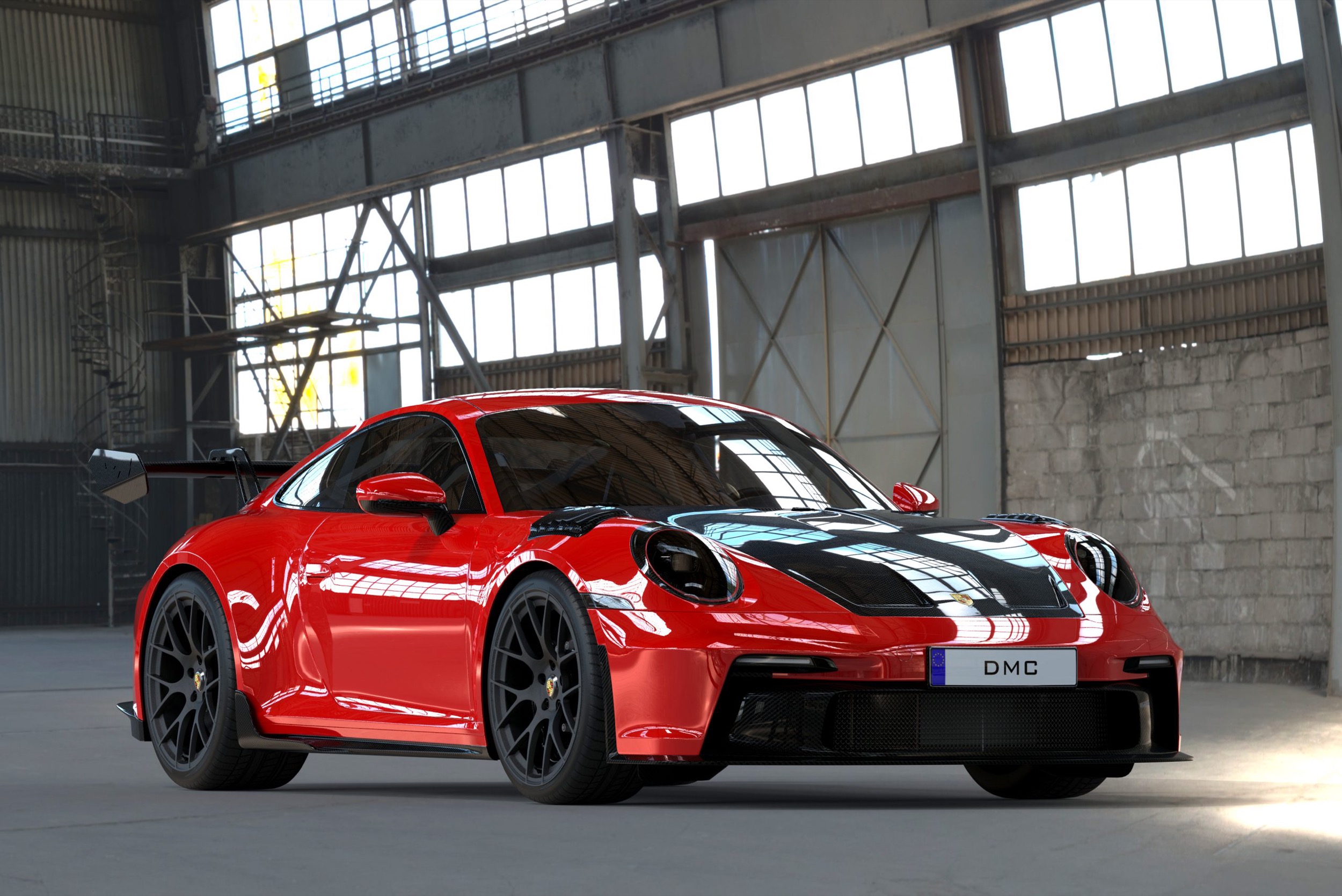
    2022 DMC Porsche 992 GT3 Velocita - Front Angle

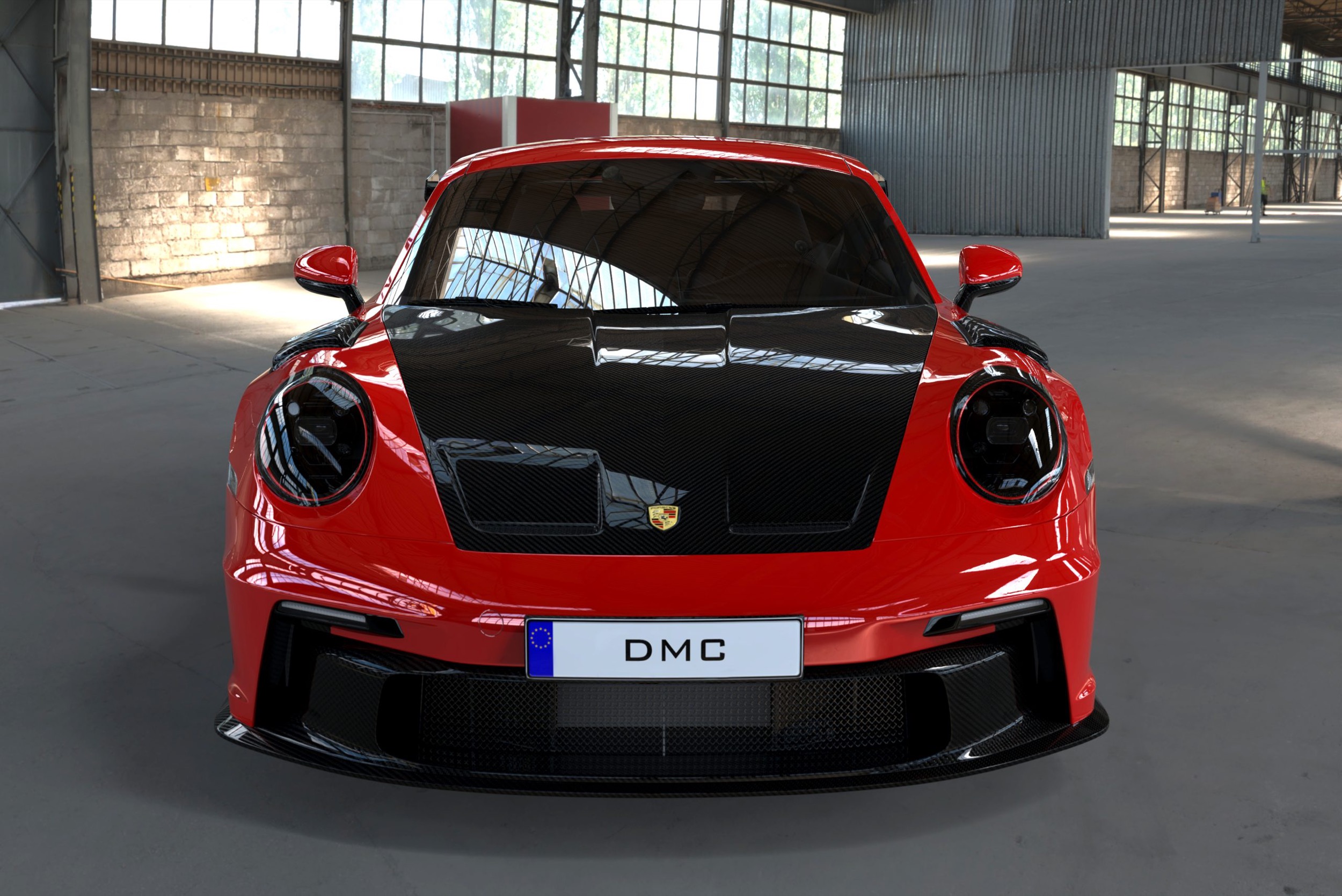
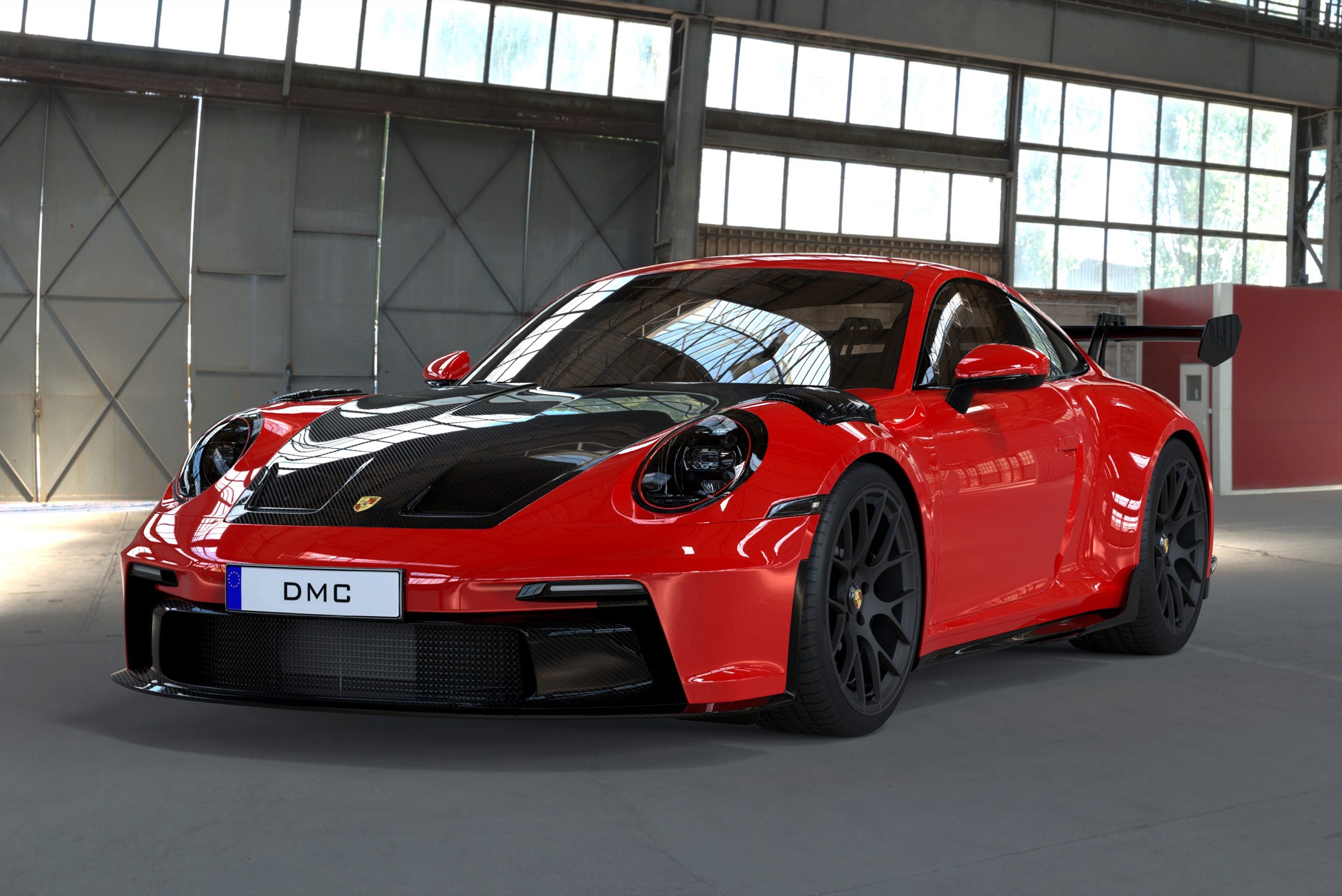
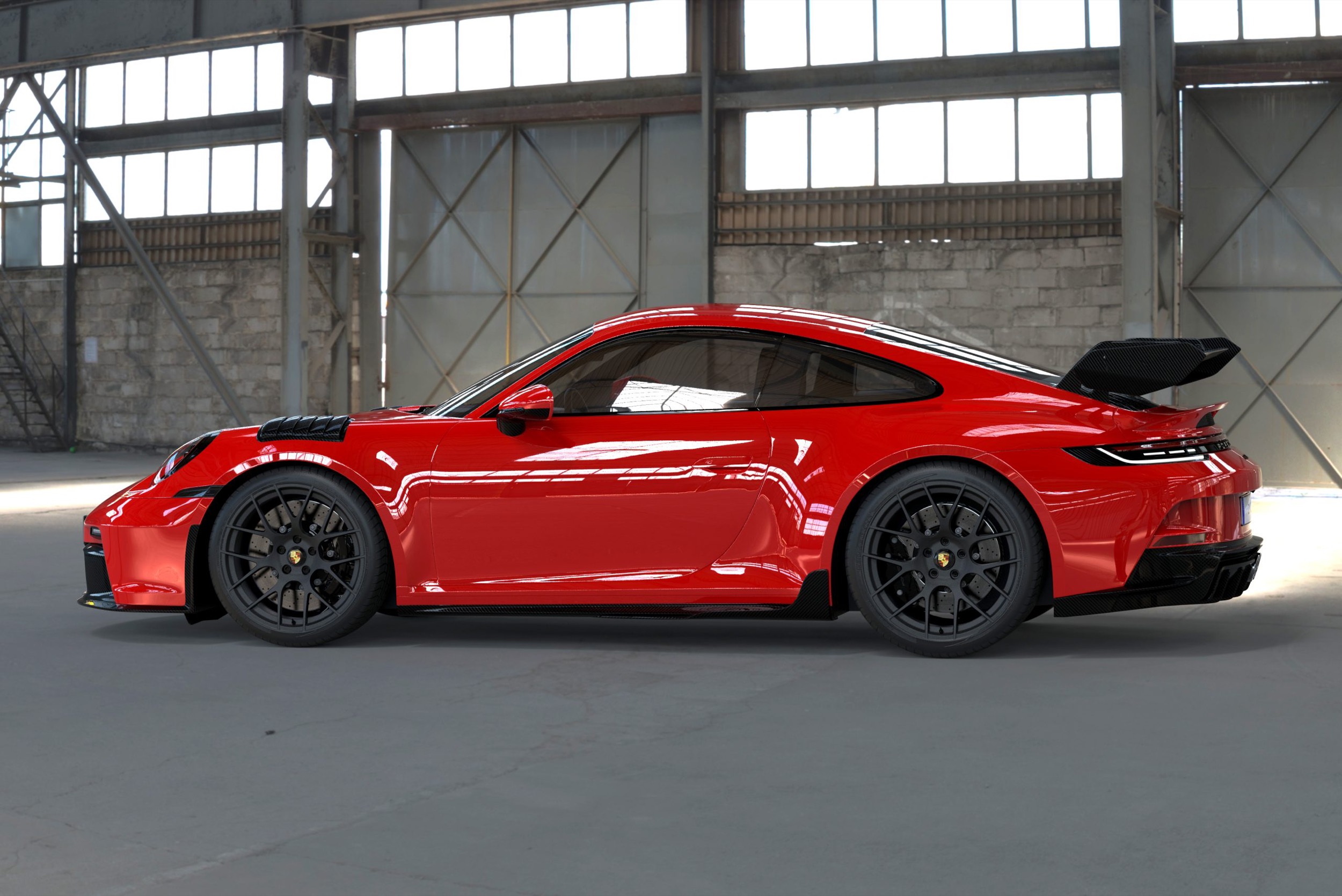
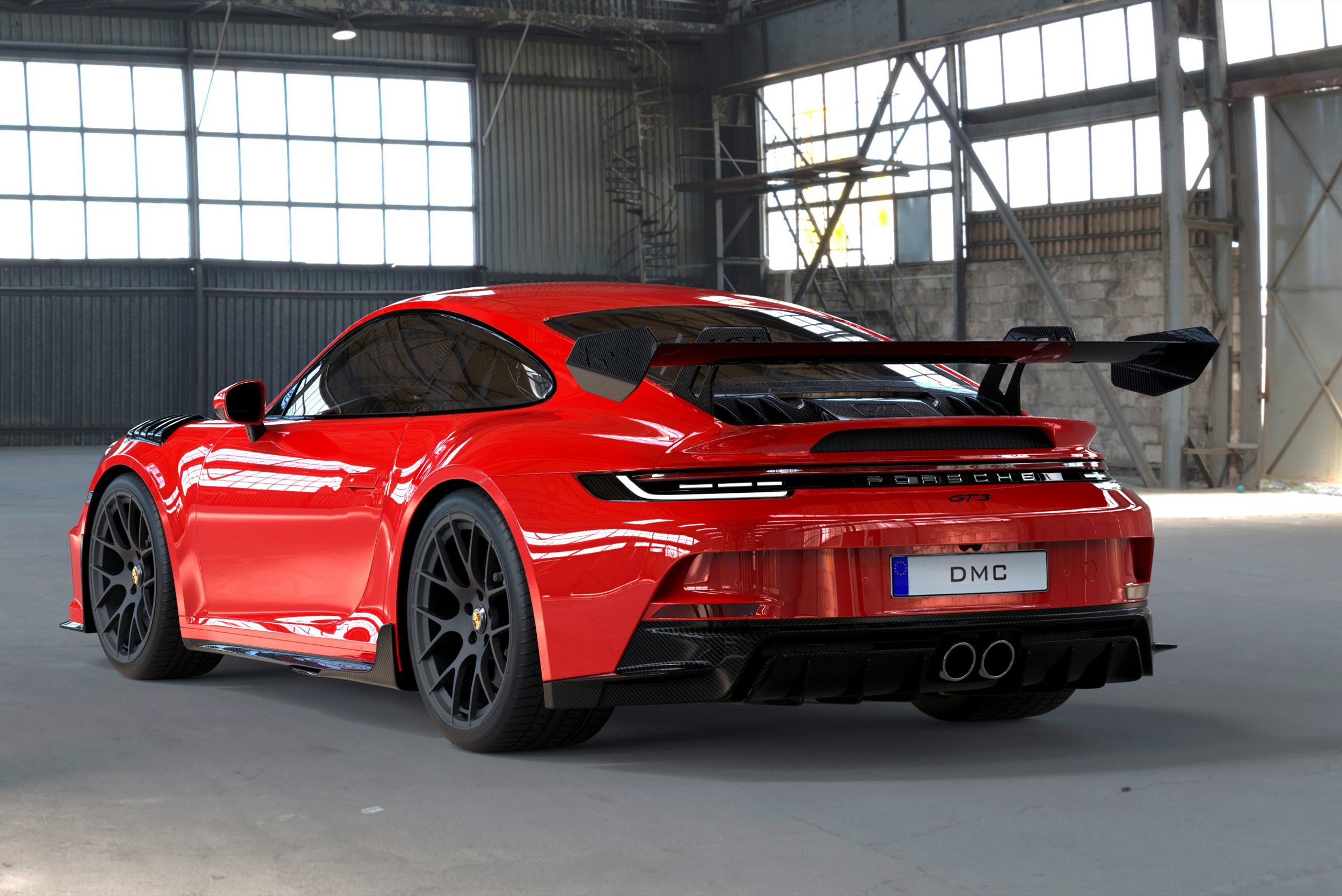
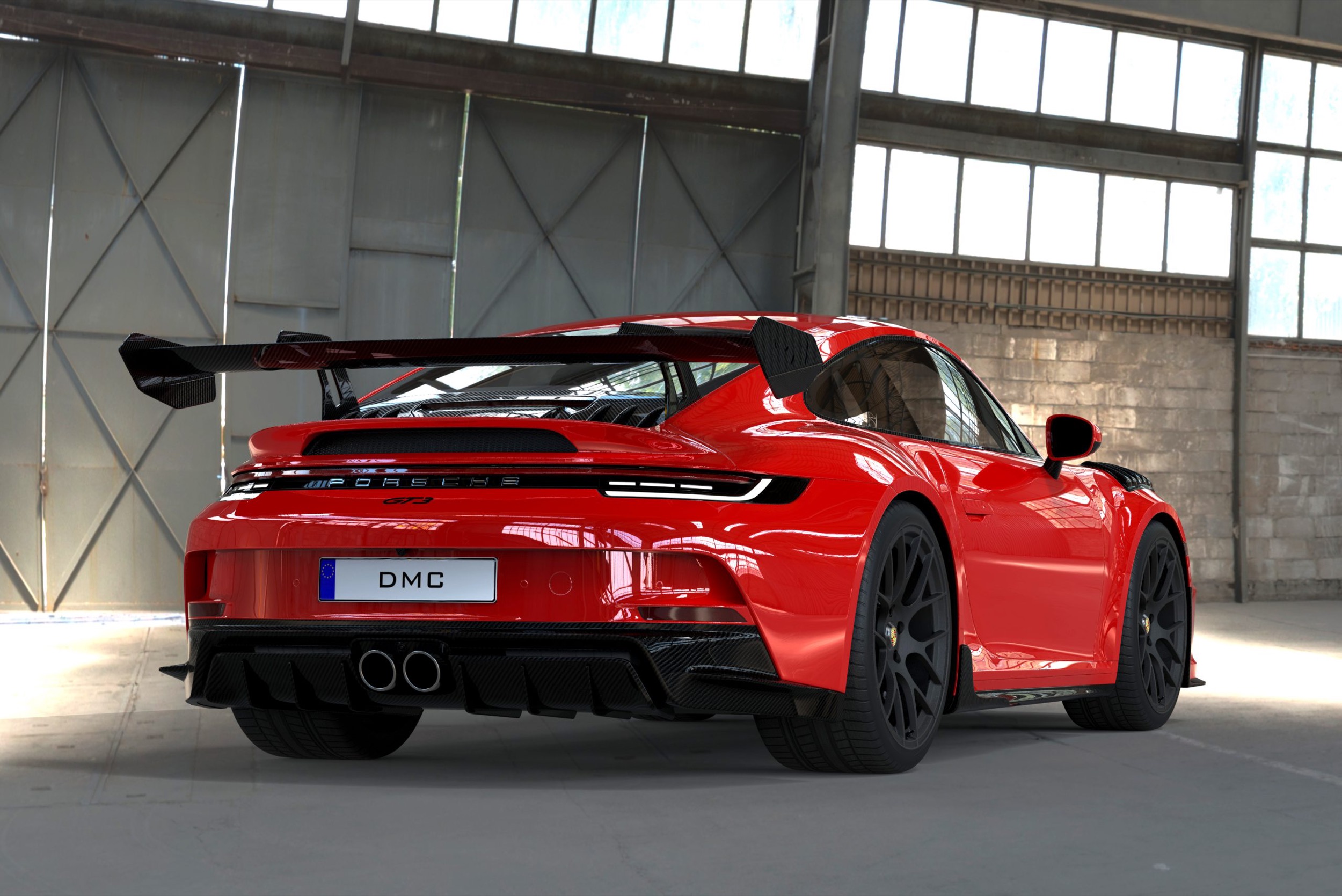
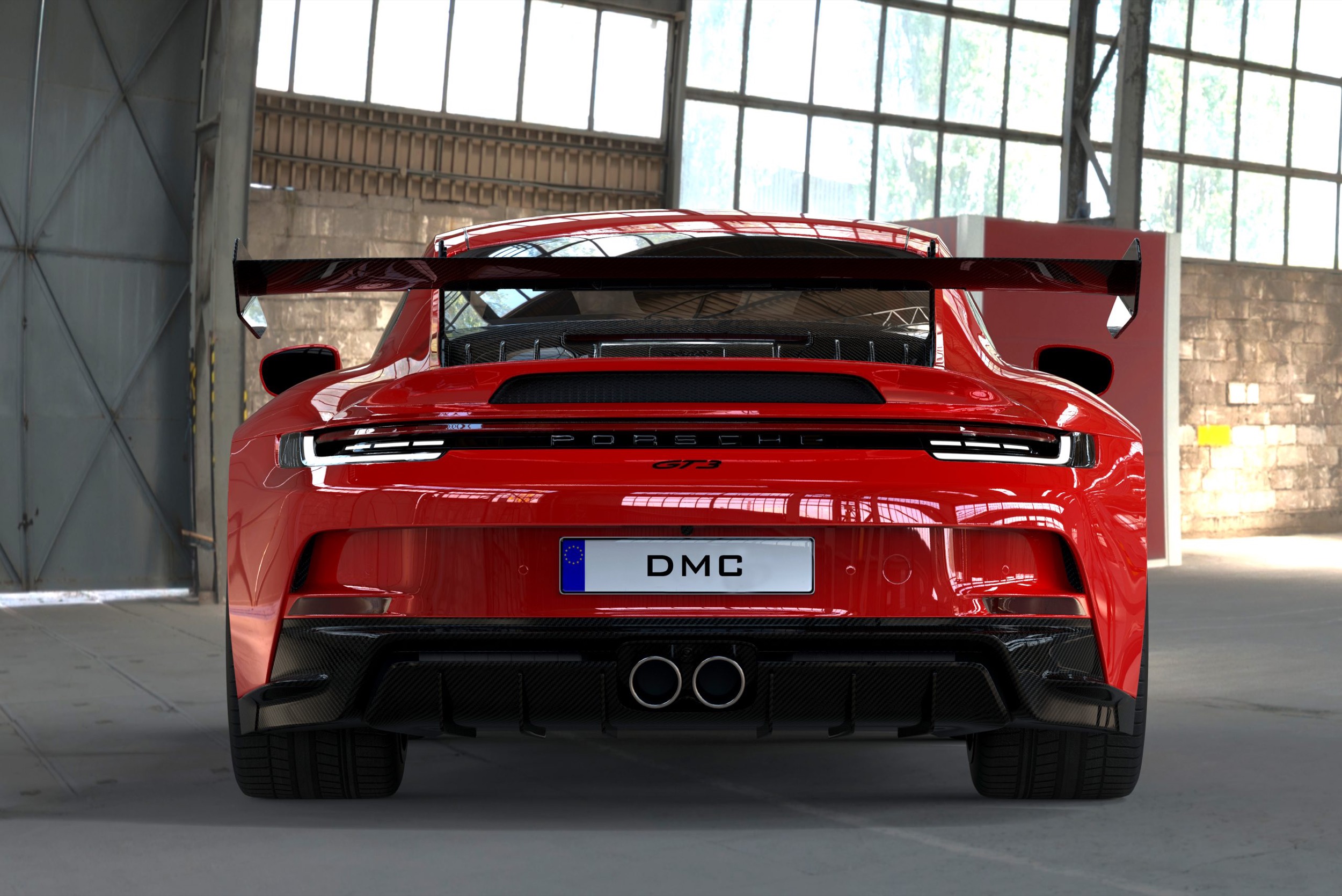
    DMC, a German tuning company, has expanded its line-up of tuning packages by introducing the latest 992 GT3 to its offerings, marking its entry into the Porsche market. The company has developed an all-new aerodynamic package for the 992 GT3 models that adds a sporty and stylish look to the car’s appearance. The package includes lightweight carbon aero front fenders with wheel arch louvers, wide carbon side skirts, and ultra-lightweight carbon fiber parts that replace the front bumper’s inner grill, rear diffuser, and front hood design. These carbon parts are not yet available from OEM Porsche. The most notable feature of the package is the massive 175 cm rear wing that is FIA conform and TUV certified. The design of the carbon parts is inspired by GT3-RS lines, providing the car with an aggressive appearance.

    According to DMC, the company aimed to offer its customers a chance to experience the GT3RS appearance without compromising on comfort. The use of DMC’s Aero-Kit allows the regular GT3 to achieve a similar or even better look than the GT3RS. The carbon parts provided by DMC replace the original components and reduce the car’s weight, providing a weight advantage. For example, DMC’s version of the front fenders and larger wing can be installed with the GT3’s original connection brackets. The carbon rear spoiler profile has a new and distinctive design with DMC lettering, and the wing end plates are enlarged in the driving direction and downwards to create a striking racing look while maintaining the vehicle’s aerodynamic balance.

    DMC’s carbon kit for the 911 GT3 allows car owners to customize the kit’s parts to match their vehicle, with the option of matte or high gloss visible carbon fiber. Furthermore, DMC has also introduced a new sports exhaust system made of titanium for the Porsche 911 GT3 models. This valve-controlled sports exhaust system by ZESAD GmbH in Germany produces a sound festival that enhances the car’s performance-oriented driving experience. The exhaust system is specifically designed for the Porsche 911 GT3 and GT3 with the touring package.

    In addition to the carbon kit and sports exhaust system, DMC has developed a new lightweight forged wheel named DMC Velocita. The engineering team has designed a new directional forged wheel with various surface finishes customized for each vehicle. The wheel size for the Porsche 911 GT3 is 9.5 x 20 inches at the front and 12 x 21 inches at the back.

    2022 DMC Porsche 992 GT3 Velocita - Front 2022 DMC Porsche 992 GT3 Velocita - Front Angle 2022 DMC Porsche 992 GT3 Velocita - Side 2022 DMC Porsche 992 GT3 Velocita - Rear Angle 2022 DMC Porsche 992 GT3 Velocita - Rear Angle 2022 DMC Porsche 992 GT3 Velocita - Rear

  • Carlex Design Porsche 911 Turbo

    The Porsche 911 Turbo in this unique edition, whose lines cannot be mistaken for anything else in the world. A collectable and a real treat for the lovers of sheer beauty and luxury.

    The characteristic feature of all Racing Green conversions is emerald green 100% hand-brushed paint. The subtle and glittering pattern under the coat of paint, carefully mastered by Carlex Design experts, has given the Porsche 911 Turbo a unique touch. The Porsche 911 Turbo in this special version is a real piece of art with an extraordinary character and a totally lavish look. The Carlex Design bespoke forged three-piece rims, painted to match the car’s exterior, as well as copper-hued brake callipers, perfectly mark the car’s outstanding interior.

    Top quality leather, unmatched design and original handcraft. This perfect combination is possible only when creating limited editions, due the availability of materials and the demand for collector cars.

    This is what makes the work on special editions absolutely fascinating.

    The new interior of the Racing Green Edition is all about top quality aged leather that is classic, light chocolate brown, and perfectly corresponds with bottle green hued leather inserts, matching the Racing Green car body. The seat chord seams give it a rough and artisanal look, and the perforation has increased the comfort and aesthetic qualities. These is a lot more to discover: the Alcantara® headlining, the plastic parts painted to match the car body colour, or the subtle embossed motifs in leather headrests with the Carlex Design crest. A stylish holdall and a backpack perfectly match this unique special edition.

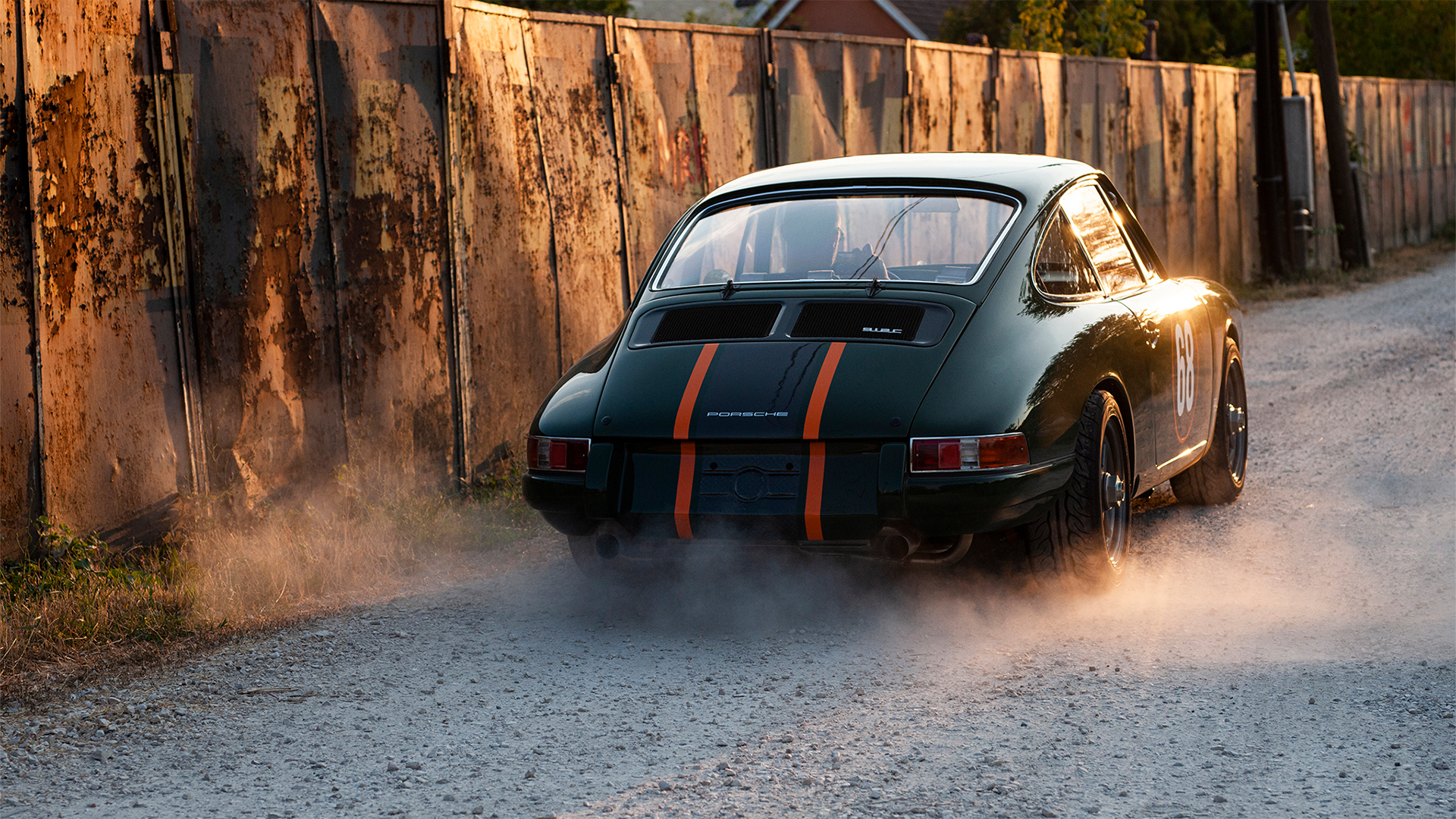
  • KAMM Manufaktur Launches 912c Classic Restomod

    KAMM 912 sports car - Front Angle

    Introducing KAMM Manufaktur, a new and exciting automotive brand from Budapest, dedicated to creating the perfect interpretation of the legendary 912 sports car.

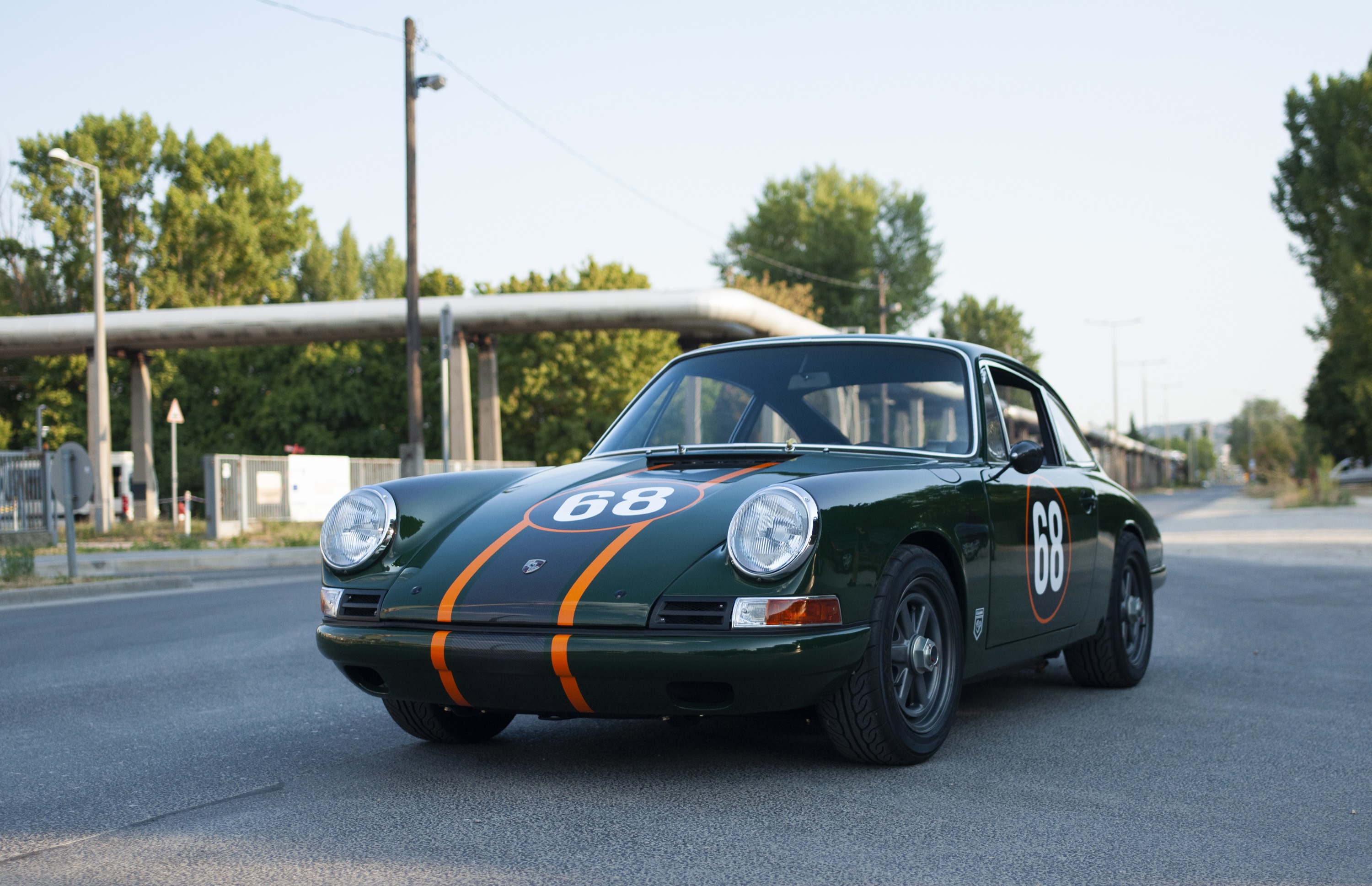
    Founded by Miklós Kázmér in Budapest, Hungary, KAMM focuses solely on the 912 sports car produced between 1965-1969. Renowned for being the lightest of all the road-going 911/912s, but with a better balance than a typical 911, the 912 may not be an obvious choice for a restomod, but its slim, simple lines, outstanding handling and iconic 4-cyliner engine makes the 912 the perfect choice for a KAMM creation.

    The KAMM 912c is an exquisitely engineered, beautifully built, modern take on the 60s sports car icon. In an age where electronics take over many of the driver inputs, the KAMM 912c offers something different in the world of restomods in that it maintains the charm of a 1960s racer, with sensitive updates, instead of trying to completely modernise the 912 driving experience.

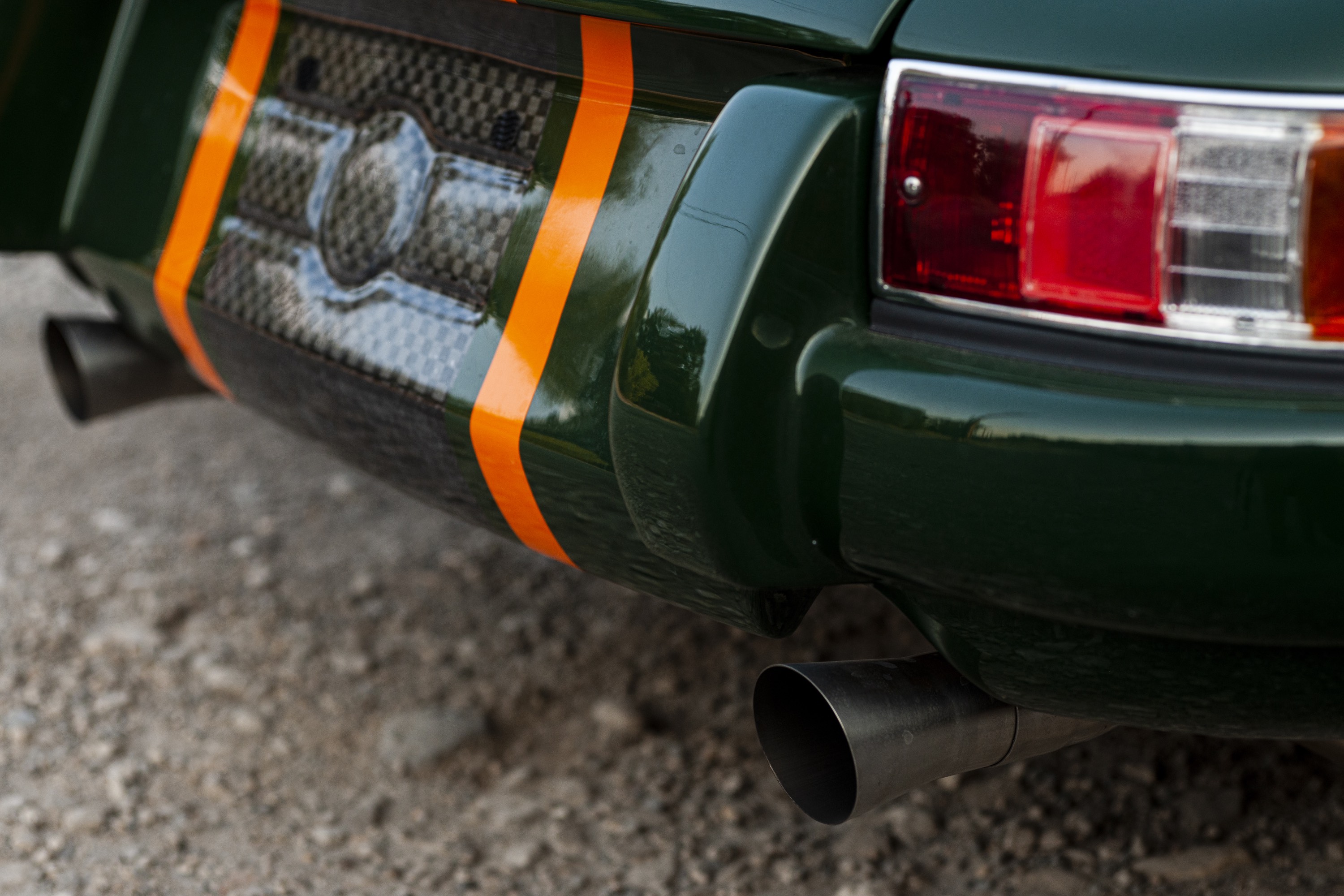
    KAMM improves on perfection, without compromise, building on existing greatness to create the KAMM 912c. Taking an original 912, KAMM engineers restore every donor car to perfection, providing the perfect basis for a bespoke creation. Steel is replaced with carbon, seamlessly blended without trace, ensuring flawless fit and finish.

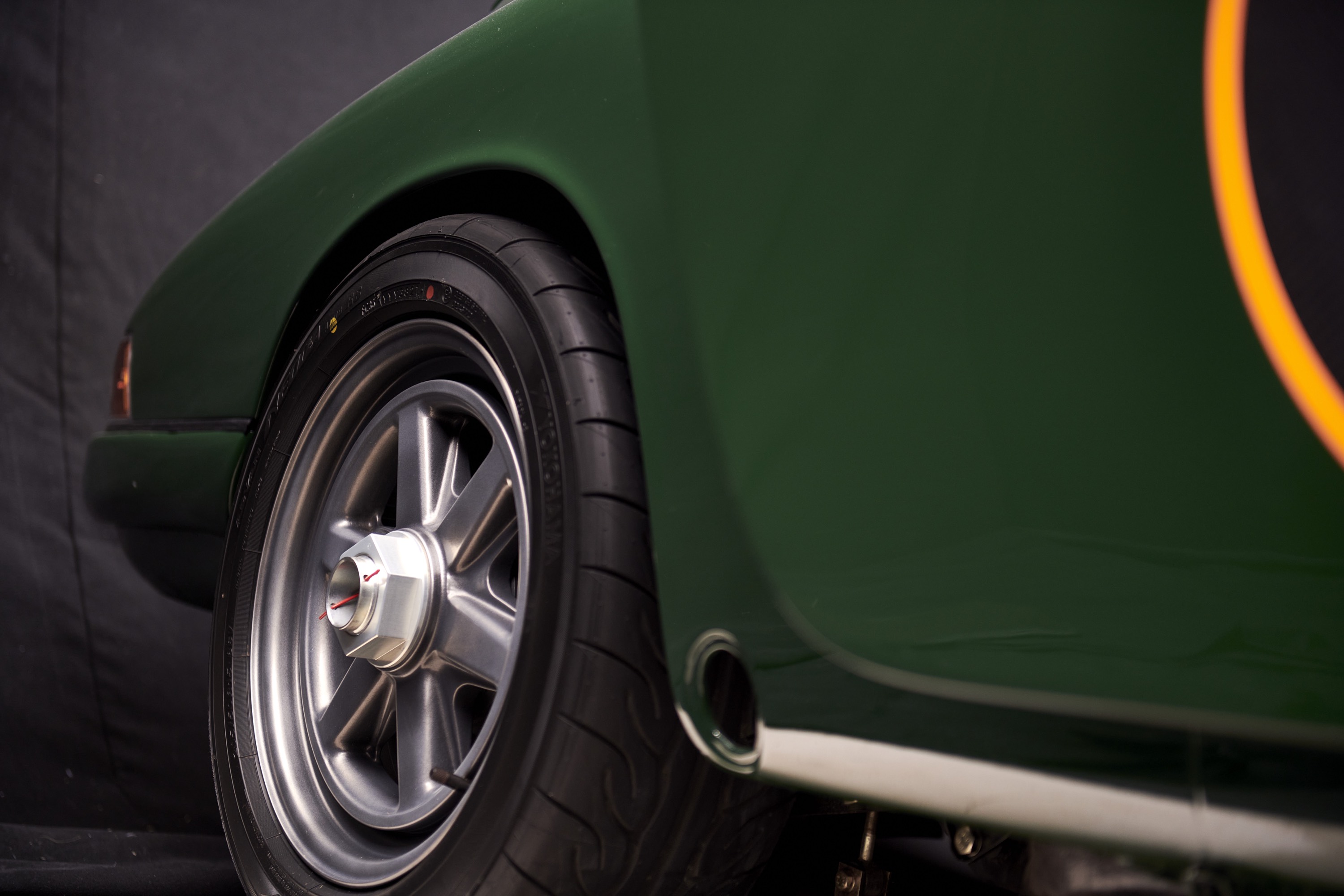
    KAMM engineers enhance the chassis, brakes suspension, wheels and tyres and replace all original elements with brand new, factory parts including lights, fixings, and rubbers.

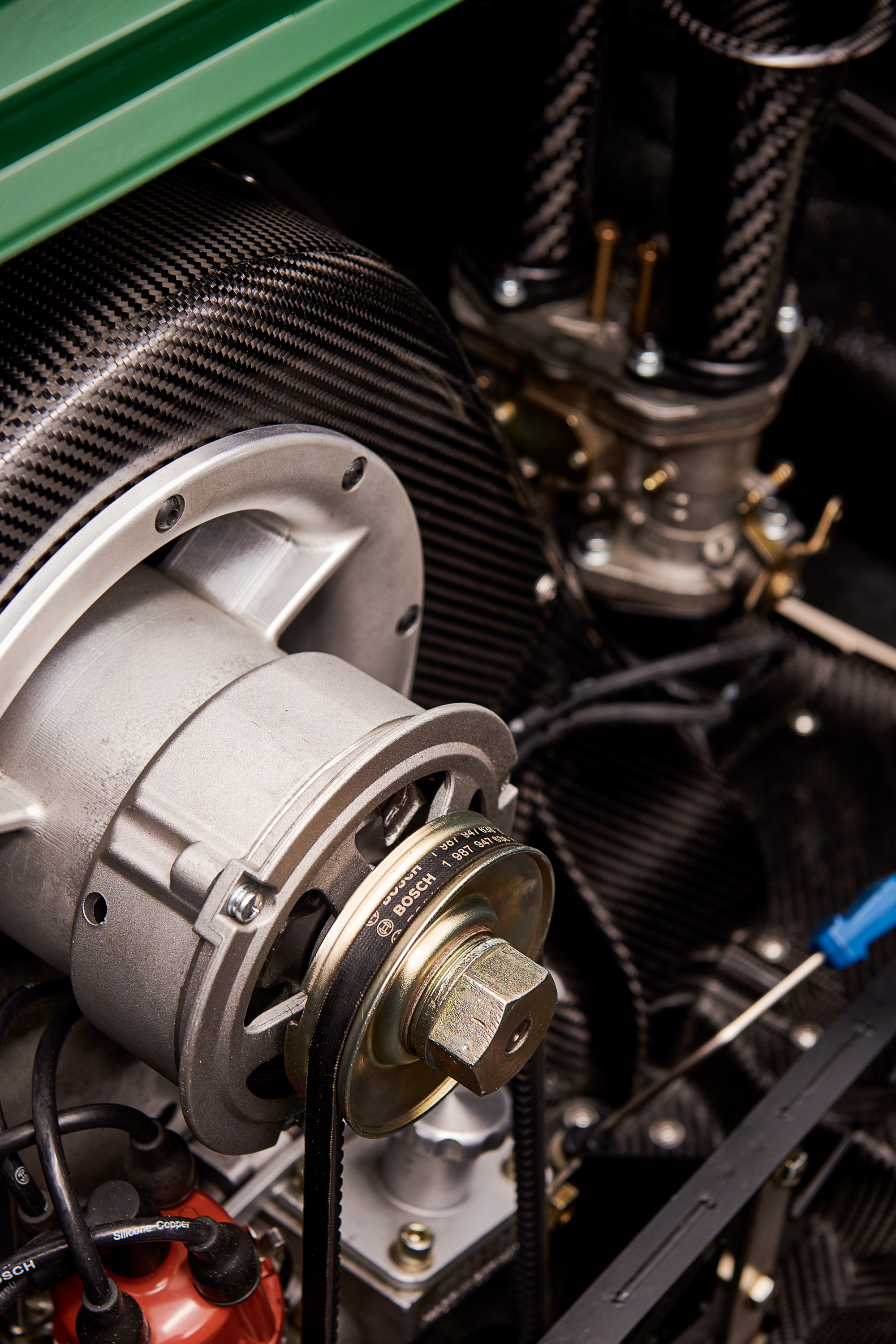
    Swiss air-cooled experts JPS Aircooled assist with the creation of a bespoke, high-performance, 170hp, 4-cylinder engine providing the ultimate in reliability combined with exemplary performance, helped by a kerb weight of less than 750kg.

    Bespoke paint finishes and interior redesign completes the transformation before a thorough evaluation by KAMM Founder Miklós Kázmér to ensure every 912c is worthy of the KAMM name ahead of client delivery.

    Whilst the KAMM 912c is perfectly at home on the race track, the car has also been designed to be used regularly as a road car. KAMM developed the 912c to appeal to drivers seeking an updated classic racer experience with a truly analogue feel. Rear seats can remain, audio options are suggested, luggage areas are carefully trimmed, and air conditioning has been added for cabin comfort on road and track. The attention to detail shines through, as seen in elements such as the bespoke door mirrors, which not only look beautiful, but also perform perfectly at speed.

    KAMM 912c technical specifications

    Body:

    • Carbon fibre
    • Fully restored and reinforced
    • Lexan windows
    • Total weight: 750kg

    Engine:

    • 912 2.0 litre, JPS Aircooled 616 engine
    • 170HP
    • Fast road tune
    • High-compression 10.5
    • Rev limit 7200RPM
    • KAMM carbon Carrera cooling
    • Weber 44IDF carburettor
    • 123ignition
    • KAMM bespoke stainless steel

    Gearbox:

    • 901/2 5-speed (dogleg)
    • ZF LSD Differential
    • Porsche aluminium, hydraulic, racing clutch

    Brakes:

    • Front –  964
    • Rear – Brembo aluminium
    • Ventilated front and rear discs
    • Hydraulic handbrake

    Suspension:

    • Front Custom coilovers by KAMM
    • Rear adjustable arms
    • Adjustable front and rear sway bars
    • Adjustable front and rear dampers

    Interior:

    • KAMM carbon fibre seats
    • Electric Air-Conditioning
    • Lightweight carpeting
    • Carbon fibre interior trim
    • Tilton pedal box

    Wheels:

    • Centre-lock 3-piece wheels
    • Yokohama AD08RS tyres

    KAMM Founder Miklós Kázmér said, “The KAMM 912c has been years in the making, and I am proud to share my vision of the perfect 912 to the world. Budapest has a surprisingly well-developed car culture born out of a desire for individuality. During the socialistic era, drivers had to be creative, home-tuning whatever cars they could get hold of into race machines. This love of car culture, and a burning desire to make whatever was available as fast and as beautiful as possible, spawned a talented and dedicated Budapest car scene. In the 90s things changed as borders opened and Hungarians gained access to western cars and Hungarian car enthusiasts evolved. KAMM is a proud son of Budapest car culture, striving to turn original classic cars into fast, reliable, and perfected versions of themselves, all whilst keeping the analogue driving experience intact.”

    The KAMM 912c will enter full production in 2023 priced at €325,000. Clients may buy a complete car from KAMM or supply their own 912 for conversion. Bespoke specifications can be quoted on request.

    KAMM 912 sports car - Rear Angle KAMM 912 sports car - Rear Angle KAMM 912c - Wheels / Rims KAMM 912c - Exterior Detail KAMM 912c - Engine

  • RUF Bergmeister

    RUF Automobile GmbH, manufacturer of exclusive and authentic high-performance sports cars, reveals two special vehicles at The Quail, A Motorsports Gathering during Monterey Car Week. Project RBS, or “Bergmeister,” makes its world debut alongside the naturally aspirated SCR, which is being seen for the first time in North America.

    The never-before-seen Bergmeister is inspired by the legendary Porsche 906, the 909 Bergspyder and the 718 RS 60 Spyder hillclimb cars and was designed by Tony Hatter. Mounted in the rear is a dry sump, RUF-engineered, air-cooled 3.6-liter single-turbocharged flat-six engine producing 450 bhp and 442 lb-ft of torque, connected to a six-speed manual transmission.

    The Bergmeister all-carbon skinned roadster combines the best of classic design and modern engineering in a package ready to master both road and track. True to RUF’s heritage, the pursuit of the perfect driving experience has never been more visceral. Black Alcantara lines the entire interior and the driver sits in bucket seats, with an Alcantara-clad steering wheel rounding out the driving experience. With its direct steering, the Bergmeister responds to the slightest wheel input and ensures precise handling.

    “When we began building our own automobiles in 1974 it was all for the thrill of the drive,” said Alois Ruf, owner of RUF Automobile GmbH. “We are honored to be featured at The Quail and to celebrate the passion for driving with our friends. Bergmeister embodies the most elemental driving experience, while the SCR highlights the latest technology offerings from our team in Pfaffenhausen.”

    Alongside Bergmeister and debuting in North America for the first time, the newly developed SCR prototype carries much of the same DNA as the 1978 original dressed in a modern package using RUF’s latest technology and engineering. The carbon-fiber monocoque and bodywork deliver maximum strength with minimum weight, while an integrated roll cage and rear space frame provide rigidity.

    The iconic SCR build is designed as a state-of-the-art sports car for those who prefer the soundtrack of a naturally aspirated engine. The consistent light-weight construction and powerful engine result in the feeling of a racecar built for the street. The 4.0-liter flat-six produces 510 bhp at 8,270 RPM and 346 lb-ft of torque. Power is routed to the rear wheels via a six-speed manual gearbox, giving the car the optimal mechanical feel.

  • Porsche 911 GT3 RS Carrera RS 2.7 Tribute

    The 2023 Porsche 911 GT3 RS made its first in-person appearance today at The Quail, A Motorsports Gathering, only two days after its digital world premiere. The show car – customized by the GT Model Line and Style Porsche – is a tribute to the 1972 911 Carrera RS 2.7. Additionally, as announced by Kjell Gruner, President and CEO of Porsche Cars North America Inc. (PCNA), the car will serve as inspiration for a limited-availability Porsche Exclusive Manufaktur offering exclusive to U.S. customers: a Tribute to Carrera RS Package.

    “America is the second home of the 911 and a special tribute exclusive to the U.S. is the perfect way to celebrate the 50th anniversary of the 911 Carrera RS 2.7,” said Gruner. “So many of us idolized the original 1972 car. We want to create a special experience that combines exclusive options on the new GT3 RS with a one-of-a-kind list of accompanying items. Together, it will be an exciting and individual tribute to the RS lineage. This is a live project in its early stages, and is being created by enthusiasts, for enthusiasts as a joint effort between our colleagues in Zuffenhausen, Flacht and our team in America. The ideas and concepts are really exciting and we’re having a lot of fun developing it – all of us are looking forward to sharing more details with you soon.”

    Appropriately for Monterey Car Week, the model on display is extensively personalized. Finished in white with key areas in Python Green, the car is a direct reference to the iconic white and green color configuration offered in 1972 on the first 911 “RS” model as well as a new interpretation of it. In this instance, the body is finished in non-metallic white including side air intakes painted to match with model designation graphics on the sides and rear in Python Green, forged aluminum wheels in Python Green with white pinstripes. Exclusive Design taillights emphasize the green-on-white theme by eliminating the red color from the rear taillights and third brake light. Finally, the side plates on the left and right ends of the large rear wing are painted white with RS logos in Python Green.

    “Porsche Exclusive Manufaktur allows customers to personalize their car to a point where the vehicle is as much a reflection of them as it is of Porsche,” said Karl-Heinz Volz, Director of Exclusive Manufaktur Options. “Personalization is a Porsche tradition dating back to our first production model, the 356, when a customer requested a wiper be added to the rear window of their car. Today it is an incredibly extensive personalization program, offering options ranging from small changes to true one-off creations.”

    The headlights also feature a pinstripe ring in white, something that is not available via the normal list of factory-available options. The color combination continues inside the car with matching stitching, trim panels in white to match the exterior.

    “As a car enthusiast growing up, my walls were plastered with models that I was particularly fond of. One of the most influential was the 911 Carrera RS 2.7. As a young kid it captured me imagination and even today it puts a smile on my face,” said Andreas Preuninger, Director GT Model Lines. “That’s where the styling inspiration of the 996 GT3 RS came from, which was one of my first projects at Porsche. At the time, that car felt totally extreme so colors nodding to the forefather made sense. Today, it’s a very emotional moment for me to pay tribute to the first 911 RS model with our most extreme and capable 911 GT3 RS yet.”

    About the 2023 911 GT3 RS
    The 2023 Porsche 911 GT3 RS is the most extreme street-legal 911 model yet. Its 4.0-liter naturally aspirated boxer six-cylinder engine generates 518 hp, and revs to 9,000 rpm. That power is routed exclusively to the rear wheels via a seven-speed PDK dual-clutch automatic transmission. Making extensive use of motorsport-derived aerodynamics, it generates more than 900 lbs. of downforce at 124 mph and 1,895 lbs of downforce at 177 mph. This is also the first example of a 911 GT3 RS with active aerodynamics, a feature that is used to offer incredible levels of downforce, provide deceleration assistance by creating an air brake, and by offering a Drag Reduction System (DRS) that can reposition aerodynamic elements to cut drag at the driver’s command in certain conditions.

    About the 1972 / 1973 911 Carrera RS 2.7
    Fifty years ago, the world knew the 911 Carrera RS 2.7 as Germany’s fastest sports car. It began as a homologation special and featured many technological innovations. It was the most powerful version of the first-generation 911, generating 210 PS at 6,300 rpm and 188 lb.-ft. of torque at 5,100 rpm from its air-cooled flat-six developed by Hans Mezger and Valentin Schäffer.

    A more potent engine was only part of the success story. Much like the new 911 GT3 RS, wind tunnel testing and aerodynamic science introduced never-before-seen technology to the 911. The ducktail, now as much an icon of style as an element of function, was critical in achieving stability at high speeds. Not only did it unlock the ability to drive faster, but it did so without incurring additional drag. In fact, it reduced the drag coefficient.

  • Porsche 911 GT3 RS

    The 2023 Porsche 911 GT3 RS is clear in its intentions: it is uncompromisingly designed for maximum performance. The 518 hp road-legal high-performance sports car takes full advantage of technology and concepts from motorsport. Even beyond the high-revving naturally aspirated engine with racing DNA and intelligent lightweight construction, it is, above all, the cooling and aerodynamic systems of the 911 GT3 RS that connect it most directly with its motorsport brother, the 911 GT3 R.

    Central-radiator inspired by motorsport – the foundation for active aerodynamics

    The basis for a significant performance boost is the concept of a central radiator – an idea that was first used in the Le Mans class-winning 911 RSR and subsequently in the 911 GT3 R. Instead of the three-radiator layout seen in previous cars, the new 911 GT3 RS relies on a large, angled center radiator in the car’s nose, positioned where the luggage compartment is located on other 911 models. This has made it possible to use the space freed up on the sides to integrate active aerodynamic elements. Continuously adjustable wing elements in the front and on the two-part rear wing, in combination with a number of other aerodynamic measures, provide more than 900 lbs. of downforce at approximately 124 mph, twice that of the 991.2-generation predecessor and three times as much as a current 911 GT3. At 177 mph, total downforce is 1,895 lbs, or the equivalent of a Porsche 356 A.

    A drag reduction system (DRS) is fitted in a production Porsche for the first time. To achieve low drag and higher speeds on straight sections of the track, the DRS allows the wings to be flattened out at the push of a button, within a specific operating range. During hard braking at high speeds, the airbrake function positions the wing elements at the front and rear to support deceleration by maximize aerodynamic drag.

    The purposeful look of the new 911 GT3 RS is characterized by the large number of functional aerodynamic elements. The most prominent feature of the GT sports car is the swan-neck-supported rear wing, which is significantly larger in all dimensions than the wing of its predecessor. The rear wing consists of a fixed main wing and a hydraulically adjustable upper blade. For the first time on a Porsche production vehicle, the upper edge of the rear wing is higher than the roof. A front splitter divides the air flowing over and underneath working in parallel with side blades on the front fascia that deflect air outwards. Front wheel-arch ventilation is provided via distinctive louvered openings in the front quarter panels. Inlets behind the front wheels inspired by the iconic Le Mans-winning 911 GT1 reduce the dynamic pressure in the wheel arches. Air from the centrally positioned radiator flows out of large nostrils on the front lid – further back, fins on the roof direct the air outwards, ensuring cooler intake temperatures in the rear. In the new 911 GT3 RS, the openings in the rear side panel are used exclusively to improve aerodynamics and not to draw in combustion air. The rear wheel arch also features an intake and a side blade for optimized airflow. The rear diffuser is a modified version of that fitted to the 911 GT3.

    Track suspension that can be adjusted from inside the car

    Even the suspension is modified for improved aerodynamics. Because the wheel arches of the new 911 GT3 RS are subject to powerful airflows, the components of the double-wishbone front axle are designed with teardrop-shaped profiles. These aerodynamically efficient links increase downforce on the front axle by around 88 lbs. at top track speed and are otherwise only used in high-end motorsport applications. Front track width increases by 1.14 inches (29 millimeters), necessitating longer double-wishbone front axle links.

    To ensure that the downforce balance between the front and rear axles is maintained even when braking from high speeds, the suspension engineers have significantly reduced pitching under braking. On the new 911 GT3 RS, the front ball joint of the lower trailing arm has been set lower on the front axle. The multi-link rear axle has also been adjusted, with modified spring rates. The driver assistance systems and rear-axle steering also have an even more dynamic set-up here.

    The 911 GT3 RS offers three driving modes: Normal, Sport and Track. In Track mode, the basic settings can be individually adjusted. Among other settings, the rebound and compression damping of the front and rear axles can be adjusted separately and in several stages. The rear differential can also be adjusted via rotary controls on the steering wheel. This is done quickly and intuitively with an operating and display concept also borrowed from endurance racing. Four individual rotary controls and a button for the Drag Reduction System (DRS) are located on the steering wheel. These rotary controls appear in the instrument cluster during the adjustment process. The 911 GT3 RS also features the track screen already familiar from the 911 GT3. At the touch of a button, the driver can reduce the two seven-inch side displays to essential information only. The gearshift indicator lights to the left and right of the analog tachometer have also been taken from the 911 GT3.

    High-revving four liter six-cylinder boxer engine

    The 4.0-liter high-revving naturally aspirated engine has been further optimized compared with the 911 GT3. The increase in power to 518 hp (911 GT3 – 502 hp) is achieved primarily via new camshafts with modified cam profiles. The single-throttle intake system and the rigid valvetrain are derived from motorsport. Like the 911 GT3, this engine also has six individual throttle bodies; one per cylinder. The seven-speed Porsche Doppelkupplung (PDK) has a shorter overall gear ratio than the 911 GT3 and is aided by air intakes on the underbody to ensure that the transmission can withstand even extreme loads during frequent use on track.

    The 911 GT3 RS accelerates from 0 to 60 mph in 3.0 seconds (911 GT3 – 3.2 seconds) and reaches a top speed of 184 mph in seventh gear. Six-piston aluminum monobloc fixed-caliper brakes and brake discs with a diameter of 408 mm are used on the front axle. Compared with the 911 GT3, the piston diameters have been increased from 30 to 32 mm. In addition, the thickness of the discs has been increased from 34 to 36 mm. The rear axle continues to be fitted with 380-mm brake discs and four-piston fixed-caliper brakes. The optionally available Porsche Ceramic Composite Brakes (PCCB) use 410-mm discs on the front axle and 390-mm discs on the rear axle. The new 911 GT3 RS also comes standard with forged light-alloy center-locking wheels. Street-legal Ultra High Performance tires measuring 275/35 R 20 at the front and 335/30 R21 at the rear provide a high level of mechanical grip.

    Lightweight construction all the way

    Intelligent lightweight construction has been a basic principle of all RS models ever since the legendary 911 Carrera RS 2.7. Thanks to an array of lightweight construction measures such as the extensive use of carbon fiber reinforced plastic (CFRP), the 911 GT3 RS weighs in at only 3,268 lbs.. The doors, front quarter panels, roof and hood, for example, are made from CFRP. Lightweight CFRP is also used in the interior, including the standard full bucket seats, trimmed in black leather and Race-Tex joining carbon fiber trim throughout the interior to characterize the pure, sporty ambience.

    Available with Weissach package

    The Weissach package, which is available at extra cost, includes a considerable number of changes to the standard vehicle. The hood, roof, parts of the rear wing and the upper portion of the side mirrors housing feature visible carbon fiber. The front and rear anti-roll bars, the rear coupling rods and the shear panel on the rear axle are made of CFRP and contribute to a further enhancement of the driving dynamics. Another highlight of the Weissach package is the PDK shift paddles with motorsport-derived magnet technology. This makes gear changes feel especially precise thanks to a pressure point and a clearly perceptible click. Forged magnesium wheels are included in the Weissach package and save 17.6 lbs of unspring weight compared to the standard wheels.

    The 2023 911 GT3 RS is expected to arrive at U.S. dealers by Spring, 2023. The starting MSRP is $223,800 excluding $1,450 for processing, delivery and handling.

    Exclusive Porsche Design Chronograph

    Inspired by the motorsport mindset – where maximum precision is paramount – Porsche’s own watchmaking operation in Solothurn, Switzerland, has developed the 911 GT3 RS chronograph. This mechanical watch is available as an option, and is reserved for owners of the car. It is based on a glass-bead blasted case, made from either natural or black titanium, and with a screw-down crown. Inside the watch is the mechanical Porsche Design chronograph caliber WERK 01.200, which has been COSC-certified for its high accuracy. Its flyback function allows the wearer to start, stop and reset the second hand with a single action. The chronograph pushers, which feature ”Start/Stop” and ”Next Lap” laser engravings, reveal that this chronograph is not just about telling the time. In addition to innovations, such as the pulsometer scale on the bezel, many design features and materials from the GT3 RS are also found.