Lexus has achieved a great success at this year’s prestigious Intellichoiceawards, continuing the tradition and winning in three categories in the 2012 Best Overall Value of the Year (BOVY) section. Lexus CT 200h and Lexus RX 350 were recognized as value leaders in their respective segments. In addition the new CT 200h luxury hybrid hatch won the Premium Compact Passenger Car category. Moreover this same model won its class at 2011 Australia’s Best Car awards. On the other hand the Lexus RX 350 gained the leading ranking in the Premium Crossover/Wagon category for the second year in succession. The Best Overall Value of the Year awards appraise vehicles whose total cost of ownership is far much lower than expected relative to their peer models. Their aim is to help consumers in making better purchase decisions. And undeniably, by receiving these awards Lexus brand shows again their ability to deliver luxury vehicles at more than excellent value.
The award winners are selected after an in-depth, data-driven study that analyses nearly 1800 vehicles in 24 segments. Vehicles are being ranked based on the whole-of-life costs over the first five years of ownership and data obtained from automotive manufacturers, the US government and third-party resources. In addition, the accumulated expenses are taken into consideration, featuring repairs, insurance, depreciation, fees, fuel, financing, and insurance.
The award winning 2011 Lexus CT 200hThe award winning Lexus RX 350 SUV
Nowadays the automotive industries enhance further their environmental friendly technologies and work on the development of vehicles which produce less CO2 emissions. The hybrid cars are a consequence of this philosophy. They include two engines – one electric and one fuel powered, and this is how they minimize the fuel consumption in drastic levels. In addition they also include a special system which stores more energy in a battery included in the vehicle. The fact that it includes two engines is probably the most controversial one, and it raises many negative and positive feedbacks in the customers of such vehicles around the world. Can they be considered as car of the future? It is only a matter of time to be understood. However, let’s review the advantages and disadvantages of this technology.
PROs:
First of all the main advantage is that such car is fuel efficient. It effectively spares you a lot of money on fuel. The second one, as you already know, is that hybrid vehicles produce far less toxic emissions and thus are considered as environmentally friendly. Third, with a hybrid, you can enjoy the city driving even more. There are several reasons for this: the mileage ratings of such car are higher in the city. For instance, when you are caught in the traffic and you stop, the battery generates more electricity which can be successfully utilized during the lower speeds. Next to be mentioned is that the hybrid car is unbelievably silent. It is even so silent that when you drive it, some times you doubt that it is working. Yes, you got it – the electric engine is completely soundless. Another benefit that you can get form a hybrid is its battery is durable. Test made on different hybrid vehicles show that after a considerable amount of kilometers driven, the cars battery performance is almost the same. And at last one of the best things about the hybrids is that they need far less maintenance, than an ordinary car. What I have in mind here is that due to the two engines, the gasoline one needs less care. And for example, you need to change the oil in more kilometers traveled, compared to normal car.
CONs:
Now, let us see the other side of the hybrid technologies and review some disadvantages. The general disadvantage of hybrid cars is that their retail price is extremely expensive in comparison to the ordinary cars. Another negative issue here is that those vehicles have far greater weight and the reason for this are the heavy batteries mounted in them. Third, they aren’t as fast as normal cars. However there are also some major disadvantages here, which are concerning some safety factors. Because they are made from lighter materials and store some additional voltage in their batteries, they tend to be very risky in accidents. Furthermore, hybrids are not very convenient, while driving on the highway. What I mean hear is that they have lower highway mileage and compared to some diesel vehicles, they produce the same fuel efficiency.
To sum up, the cars of the future seem to be very beneficial when driving in the city area for example. They also produce less CO2 emission, which nowadays is a major factor that must be taken straightly at hand. Moreover, although their retail price is far greater, compared to an ordinary car, when you make the basic mathematics, the fuel that it consumes during its utilization will spare you a lot. At last, although it is not a convenient car during long traveling, it is the perfect vehicle for an environmentally conscientious person.
Take a look at the hybrid vehicles which, which some popular brands are currently producing:
Smart ForTwo has received a brand new facelift thus giving it striking new look, featuring an upgraded exterior and a fresh leather/fabric mix in the interior. It now has even more dynamic appearance, featuring a larger radiator grille with integrated logo, striking front aprons in a new design, horizontally arranged LED daytime driving lights, muscular side skirts and modified rear aprons. The chrome-coloured logo is now positioned straight on the black radiator grille. Moreover, the air inlets under the number plate have been combined into a single unit. The new, optionally available LED daytime driving lights are now arranged in horizontal fashion. There is also a choice of three new alloy wheels: the smart fortwo passion comes with a new 9-spoke alloy wheel; two additional alloy wheels fitted with wide tyres and featuring a 3-spoke and 3-twin-spoke design respectively round off the range. In addition, the choice of colours includes seven different options. , including matt anthracite for the first time.
2012 Smart ForTwo
Although the general focus here is on the exterior, there are changes inside the car as well: new, high-quality interior package in crystal grey, including a fresh leather/fabric combination for the seats, an imitation leather/fabric mix for the door trims and black imitation leather for the instrument panel in combination with a grey knee pad.Thee front grille and the rear trim strip are in silver, while the front spoiler, side skirts and rear apron are painted in the car’s exterior colour.
2012 smart fortwo will continue to be available as a coupé and cabrio version and with six engine and motor variants. The spectrum ranges from the environment-friendly electric power train in the fortwo electric drive and the efficient micro hybrid petrol engine through the powerful turbo petrol engine to the fuel-efficient cdi turbodiesel. Prices begin at € 10 275 for the smart fortwo 45 kW mhd pure.
Here is an overview of the engine range:
Model type
cc
Output kW/hp
Maximum torque
l/100 km
CO2 g/km
0-100 km/h
(s)
Top speed km/h
Purchase price in € (incl. 19% VAT)
smart fortwo 40 kW cdi
799
40/54
130 Nm
3.3 (3.3)
86 (87)
16.8
135
from 12 095
smart fortwo 45 kW mhd*
999
45/61
89 Nm
4.2 (4.3)
97 (98)
16.8
145
from 10 275
smart fortwo 52 kW mhd
999
52/71
92 Nm
4.2 (4.3)
97 (98)
13.7
145
from 10 835
smart fortwo 62 kW
999
62/84
120 Nm
4.9 (4.9)
114 (115)
10.7
145
from 12 885
smart fortwo 75 kW
BRABUS
999
75/102
147 Nm
5.2
119
8.9
155
from 17 220
smart fortwo electric drive
–
35 kW constant
55 kW peak
130 Nm
–
–
< 13
> 120
under 19 000
The smart fortwo is available for ordering now. The first vehicles will reach dealers at the beginning of April.
The engineering service provider EDAG is going to present a world debut of the outstanding Concept vehcile, called EDAG Light Car – Sharing at this years Geneva Auto Show. This is a concept car made especially to fit instantly to the booming leasing business. More importantly the car is electrically driven and has been constructed strictly for use as a leasing car. According to the manufacturers it answers all the needs of the customer: it is simple and easy to use as a local publuc transport. To be more precise, these requirenents, led to the non-featuring of storage surfaces nor fancy door trims in the new EDAG Light Car – Sharing Concept Car. And even more, to make it simpler, aside from the accelerator, brake and steering wheel, the only other control the customer will find is a lever to work the indicators. There is just one display element which gives basic information abut the speed, state of charge, range and navigation.
Moreover, the car created by the EDAG is designed with two side doors and twin rear doors. However it keeps room for 6 passengers. Thank to the car’s height of 1.90 m the passangers can get in and out easily. Additionally, there are also folding seats included. They provide maximum transport capacity. The materials used in the interior are are easy to clean, and as they are modular-based, so therefore also easy to exchange.
2012 EDAG Light Car – Sharing concept
There is also a unique technologies included in this leasing concept vehicle. For example, there shouldn’t be any worry about bumping the car when parking, bacause the sensitive spots are fitted with “Technogel” pads, and these can withstand minor collisions. Of course, light plays a prominent role as a communication instrument in this car: the LEDs integrated in the pads and “Plexiglass truLED” give a continual, visible indication of the status of the car. Furthermore, while parking the car or opening the doors, a laser integrated in the mirror starts projecting a safety zone onto the asphalt, ensuring that passengers can get in and out in safety. Another interesting and innovative feature is that the rear window can be marketed as advertising space by the fleet owner, but only when the car is not being driven. With this exceptional concept car – EDAG Light Car – Sharing, the EDAG Group shows extremely high competence and eagernessin finding new ideas and developing innovative vehicle concepts.
Mazda Motor Corporation has just started the production of the all-new Mazda CX-5. However the model will include a new-generation SKYACTIV-D 2.2-litre, super clean diesel engine. The manufacturing will take place at the Ujina Plant near Mazda’s headquarters in Hiroshima. This vehicle is the first Mazda model, which adopts SKYACTIV TECHNOLOGY. The latter is included throughout the vehicle, in the powertrain, body and chassis. At the same time the CX-5 will also fully embrace Mazda’s new design theme, called “KODO – Soul of Motion.” Mazda will start introducing the new CX-5 firstly in Japan in the spring of this year, followed by Europe and other markets around the world.
To go further into details, the special Mazda’s SKYACTIV-D 2.2 diesel engine is the world’s first diesel engine to comply with global exhaust gas regulations, including Japan’s Post New Long-Term Regulations and Europe’s Euro6, without the need for an expensive nitrogen oxide (NOx) aftertreatment system. The system precisely controls the fuel injection and improves the exhaust valve’s opening and closing mechanism. Moreover the SKYACTIV-D diesel engine has achieved remarkable success in resolving longstanding issues encountered in low compression ratio engines. For example – poor start capability and lower combustion stability when the engine is cold, now is no more a problem. Hence, all these improvements lead to the achievement of the world’s lowestcompression ratio of 14.0:1 for a diesel engine in the class of mass production vehicles. In addition, Mazda has achieved an exclusive emissions performance combined with excellent fuel economy and ample torque equal to a 4-liter V8 gasoline engine.
To sum up, now Mazda will offer the customers of the eco-car market the unique opportunity to drive a fresh, fun-to-drive Mazda CX-5 with the SKYACTIV-D diesel engine – an option that also combines outstanding environmental performance and pioneers a new era of diesel power.
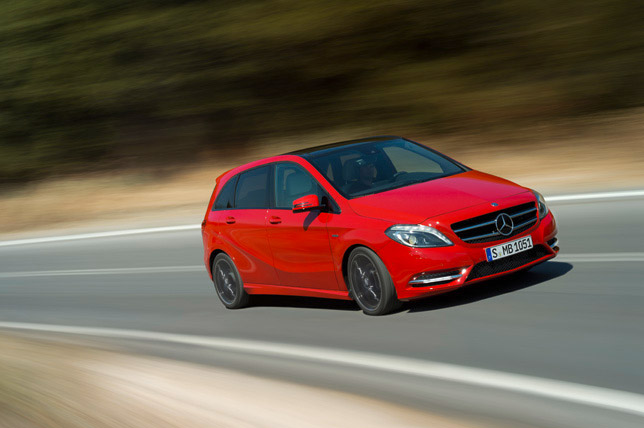
The new Mercedes Benz B 180 has just received the Environmental Certificate, because ir produces 16 percent less CO2 emissions than the prvious one. The high level of environmental compatibility however can be seen even beyond the reductions in fuel consumption. To be more precise Mercedes-Benz analyses the environmental compatibility of its models according to their entire life cycle. This cycle embraces not only the production of the vehicle but also includes their long years of service and eventually adds the recycling at the end of their lives. But this wasn’t the only vehicle produced by the luxury brand, which has received the forespoken certificate. Additionally nine other model series were awarded with the Environmental Certificate.
But let us revew the entire life cycle of the Mercedes-Benz B-Class. Starting with the production, through service of over 160,000 kilometres and ending with the recycling – the new model B 180 causes 16 percent less CO2 emissions than its predecessor. The primary energy consumption over the vehicle’s entire life cycle is cut by 14 percent, of couse this is in comparison to the precious version of the car. For instance, the fuel consumption of the B 180 BlueEFFICIENCY petrol model with dual clutch transmission ranges from 5.9 to 6.2 l/100 km. To make it clearer the last version of the B 180 had a fuel consumption of 7.3 to 7.5 l/100 km. Therefore this means that there is substantial reduction in fuel consumption of up to 19 percent! These savings are due to an intelligent package of measures, namely – the BlueEFFICIENCY technologies. They include optimisation measures in the area of the powertrain, energy management, aerodynamics, tyres optimised for minimum rolling resistance, weight reduction through lightweight construction and driver information to encourage an energy-saving style of driving.
2012 Mercedes-Benz B-Class
Moreover the new B-Class already meets the recycling rate of 95 percent by weight. To be more precise the B-Class includes 75 components representing a total weight of 39 kilograms which can be produced with the partial use of high-quality recycled plastics, thus resulting in 13 percent increase in the weight of approved recycled components. For example, the typical areas of use are wheel arch linings, cable ducts and underbody panels, which consist for the most part of polypropylene. In addition to that there is also an increased emphasis on closed automobile materials cycles. For instance, a recyclate is used for the front wheel arch linings, which is produced from refabricated vehicle components such as starter battery housings, bumper panels from the Mercedes-Benz Recycling System (MeRSy) and production waste from cockpit units. Furthermore, 21 components in the B-Class weight 20 kilograms. They
are produced using natural materials, which marks an increase of 29 percent. And to go further into detaisl these natural materials consist primarily of coconut and wood fibres and honeycomb cardboard in combination with various polymer materials. Next, the modular body-in-white concept is a sign that the B-Class is constructed to accommodate versions with an alternative drive. For example, the appropriate interfaces in the body shell enable the main floor panel to be modified and a step to be
produced for the “ENERGY SPACE” on the versions with alternative drive. At last the underfloor compartment covers part of the area under the rear bench seat, thus offering space for alternative energy accumulators.
2012 Carlsson Smart is now the newest tuning that a Smart can get. And as you view the pictures below, I am sure you think it’s worth it. Carlsson now offer this modification of the vehicle, which includes aerodynamic components, light alloy wheels in up to 17“ and complete interior enhancements in finest Carlsson Nappa leather. Besides those various possibilities for exterior refinements, the tuners now offer also performance kit for the Smart, called CK10.
The CK10 enhances the overall performance of the vehicle. In details, it endows the small city runabout with 82kW (112hp) and 158Nm (117 lb-ft) of torque. This was made possible thank to the special set-up of the engine management system and a sport air filter. Moreover the Carlsson engineers not only obtained a considerable increase in power output and torque, but also they have increased the number of the top speed.
With the first shipment of the all-new 2013 Chevrolet Malibu Eco midsize sedan today, Chevrolet makes a continuation of its global rollout. This is the most fuel-efficient model of Malibu ever created, and now it is available at dealers across the United States. However, this version of Malibu is only the first model of the all-new 2013 Malibu lineup, which is going to reach showrooms in the U.S. Now, it is more appealing than ever, because it features a sporty exterior shaped to save fuel, an all-new interior with more room, comfort and premium materials, sound-reducing and sound-absorbing components to make it the quietest Chevrolet in history, all-new Chevrolet MyLink infotainment system that enhances customer connectivity, all-new ride-and-handling package, and engineering to meet top safety results around the world!
2013 Chevrolet Malibu Eco is Ready for Delivery to Dealers
However, the heart of the Malibu Eco is its most important and exclusive segment, is the fuel-saving eAssist™ technology. Thank to it the car now has GM-estimated 25 mpg city and 37 mpg highway fuel economy. Moreover, it combines start-stop technology with regenerative braking. There is also a lightweight lithium-ion battery which provides an electric boost in certain conditions, improves fuel economy by 12 percent over today’s four-cylinder engine – and delivers better fuel economy than any non-hybrid midsize sedan currently available. In addition the all-new Ecotec 2.5L engine will debut in the Malibu later this summer, followed by an all-new Ecotec 2.0L turbo engine.
2013 Chevrolet Malibu Eco is Ready for Delivery to Dealers
The great news continues, because the all-new Malibu Eco is priced less than a full hybrid vehicle. The suggested retail price is $25,995 and it includes a $760 destination charge. The 2013 Malibu is Chevrolet’s first global midsize sedan. It will be sold in nearly 100 countries on six continents. More importantly, last year, the Malibu was GM’s second-best selling car in the United States behind the Chevrolet Cruze compact sedan. The new Malibu is already on the world market, in particular is on sale in South Korea and will soon arrive in dealerships in China.
The electromobility strategy of BMW today has been finally revealed with the delivery of the first all-electric ActiveE model in the US. More importantly BMW are happy to confirm that with the electric vehicles can absolutely serve one’s daily driving needs without compromise. The launch of the new all-electric BMW i model is expected in 2013.
To go further into details, the BMW’s electromobility development strategy began with the MINI E Field Trial in the summer of the year 2009. There were a lot of questions going on along with the launch of the MINI E. For instance, could a private individual live with an electric vehicle on a daily basis without changing their driving habits? The results were spectacular, because not only all of the MINI E pioneers proved without unquestioningly that it could be done, but also that doing so required no change in their daily routine! The only exception and difference was the plugging-in instead of stopping at the gas station.
2012 BMW All-Electric ActiveE
The Moloughneys today became the first dealership who will lease a BMW ActiveE for a two year period. Deliveries will continue over the next several weeks. As already tested – the MINI E provided valuable information about the life with an EV; now is the BMW ActiveE lease period is prepared to be used to gather feedback that will be part of the development of the BMW i3 (the latter will come to market in 2013). More importantly, the ActiveE is the only car that is 100% Electric and 100% BMW. And it will definitely provide the performance and efficiency everyone has come to expect from The Ultimate Driving Machine®. It has an output of 170 hp (125 kW) and maximum torque of 184 lb-ft (250 Nm) from a standstill. Hence, it is possible for the BMW ActiveE to accelerate from 0–60 mph in under nine seconds. Moreover, newly developed lithium-ion batteries facilitate a driving range of up to 100 miles on a full charge.
2012 BMW All-Electric ActiveE
BMW Group makes a big step towards an emission-free, mass-produced electric vehicle with the launch of this BMW ActiveE. Within the framework of project i, the BMW Group is carrying out research and development work on the development of electrically powered vehicles. The next step will be the BMW i3, which is prepared for launching in 2013. The design of the vehicle will meet the demands of a sustainable mobility solution for congested urban areas. Therefore the drive components and battery technology that are going be used in the BMW i3 are now being tested in the BMW ActiveE. However the ongoing field tests involving more than 600 MINI E cars, have already given important information about the demands on future electrically powered production vehicles. Beginning with year in the US, Europe and China, a test fleet of over 1100 BMW ActiveE vehicles, produced at BMW’s Leipzig plant, will provide further valuable insights into the everyday use of the vehicle. Furthermore, the feedback from customers driving the MINI E and the BMW ActiveE will be used directly into series production of the BMW i3.
The new 2012 Peugeot 107 is now renewed, refreshed and even more modern and urban than ever. It shows subtle and sophisticated style, and it will undeniably attract more attention. The reasons for this are several. Firstly, the designers have put a lot of attention on its appeal without making any sacrifices in terms of its advantages when facing the constraints of city driving. Next, the car has become even more practical and fuel-efficient. Moreover the new 2012 Peugeot 107 is enriched with a regularly renewed range, special editions and new equipment, in order to keep up with customer expectations. Furthermore it will offer a great satisfaction above all through its maneuverability, driving pleasure and economy. The aim of the designers was to develop its advantages in an increasingly competitive segment.
As you can see they have featured new exterior style, which is subtle and sophisticated. For instance it is with completely redesigned front face but unchanged in dimensions, thus making the 107 adopt the new style of the Peugeot brand, cut as closely as possible to the mechanics, while retaining its compactness. Moreover the new and more curved bonnet incorporates the new identity of the brand, so the rib of the bonnet which frames the two-tone lion and the number plate repositioned in the centre of the lower front panel hint at its relationship with the 208.
2012 Peugeot 107
Furthermore the light units are more refined. At the front, they are extended and adopt a two-tone mask, echoing the color of the brand emblem situated on the bonnet. On the other hand at the rear they are adorned with a dark mask thus framing the lamps with a deep ruby color. In addition there is a new radiator grille, which is composed of honeycomb cells specific to the 107. It forms a fine and distinguished mouth, suspended by the body color that surrounds it. Next, the new lower front panel has contact cappings (one on the front face and the other two at the side). This makes it aesthetic and protective, particularly useful in city driving.
Adding further to its new style, the 2012 Peugeot 107 adopts a new visual signature at the lower front panel by means of LED day running lamps which emphasize the side protectors, and fog lamps animated by a chromed bead. Of course all of these style components were designed with the utmost care. Moreover the range of colors sees the addition of an exclusive and provocative new “Plum” color. The interior has new equipment and color schemes: “Mistral” interior color scheme, the new “Manhattan” seat upholstery and the two material door and dashboard trims. Furthermore there is also new comfort equipment which features CD audio system with two additional speakers as standard or as an option according to the level of finish; new PC Bluetooth CD audio system available as an option, combined with two additional speakers; USB, MP3 and Bluetooth connections; new steering wheel combined with a new gear lever knob, both leather trimmed, available as standard or as an option.
The 2012 Peugeot 107 is available in 3 and 5 door versions and with 2 different engines: 1.0i 5-speed manual and 1.0i 5-speed two-tronic manual. Last but not least, the car is designed to be environmentally efficient. The 107 lowers its levels of CO2 emissions still further to 99 and 104 g/km respectively for the manual and two-tronic gearboxes. Its running costs are also improved with fuel consumption reduced to 4.3 and 4.5 l per 100km (respectively for the manual and two-tronic gearboxes).
2012 Peugeot 107
In addition to the good news for this new 2012 Peugeot 107 there are more and they are concerning a new very feminine special edition of the version called ENVY, which will be available at the launch in March 2012. This awesome, modern and glamorous version is adorned with either the new “Plum” color or “Caldera Black” and bears special decorations with a cherry blossom branch motif. In details there are stickers on the rear door, the bonnet and the tailgate, a “Plum” color embroidered and braided mat and a rev counter central decoration. Moreover aluminum door sills and a badge give a further touch of refinement. A style line taking up the cherry blossom branch motif is also available. Additionally it has a clever handbag pocket, ideal for organizing your belongings and changing handbag without forgetting anything, as well as a very practical handbag hook, which is extremely useful for keeping your. There are several accessories developed especially for the ENVY 107: alloy wheels, a brushed aluminum gear lever knob, chromed effect door sills or mats embroidered with “107” give a touch of elegance and a distinctive character, a retractable navigation system (which has a connection for an iPhone or iPod), side moldings, which can protect the bodywork against urban impacts. For leisure pursuits, the 107 offers various roof boxes and roof bars for transporting bicycles, skis and numerous other accessories.
The new CITROËN C1 is sharper and greener than ever before. The new car will make its first appearance at the 2012Brussels Motor Show on 10 January. Then it will be at showrooms in March. Since 2005 the brands model has gained many fans and customers all over the world. However, this year’s model will be more special then ever. If you wonder why, it will be galvanized by a new image and CO2 emissions of just 99 g/km.
The first highlight about CITROËN C1 is that, as it is obvious, it is a compact, economical and ecological city car. Moreover the new 2012 model includes new features and optimizations, such as CO2 emissions of just 99 g/km, LED daytime running lights, a CD audio system with the brand’s Connecting Box and an electronic gearbox system with steering wheel mounted paddles. Now the C1 is even more practical and user-friendly city car. Moreover it will be launched in both 3-door and 5-door guises. The car is able to transport four persons with plenty of room in the front and back seats – unlike many cars of the same segment. Nevertheless the 2012 CITROËN C1 keeps its compact dimensions – at 3.44 m long (which makes it one of the shortest cars on the market) – perfect for traffic cases, isn’t it! Furthermore it is a treat to handle – with a turning circle of just 9.63 meters kerb to kerb; and it is user-friendly across the board, with a plethora of storage compartments in the dashboard, central console and door panels. In addition boot volume can be adjusted thanks to a folding rear bench and ranges from 139 liters to over 700 liters.
The next thing to be highlighted about this vehicle is that it spends just 4.3l/100km and does it with just 99 g/km of CO2! The new model is powered by a three-cylinder petrol engine which develops 68 bhp (92 kW). Moreover to bring more excitement to the driving experience, it is equipped with a manual gearbox which boasts improved fuel consumption and emissions performance and sets a new standard on environmental protection (as already stated) with 4.3 l/100 km over a combined cycle and 99 g/km of CO2. It is good to be noted that it is the first CITROËN petrol-engine car to emit less than 100 g/km of CO2. And for enhanced handling and driving comfort the new model is also available with an electronic gearbox system for enhanced handling and driving comfort. However, here the C1 1.0i EGS consumes 4.5 l/100 km and emits 104 g/km of CO2.
In addition the designers have changed the appearance of the car a little bit. The new C1 looks even more appealing through its new front end with a shorter bonnet. The headlights keep their rounded shape, while the entirely redesigned bumper now houses fog lamps and LED daytime running lights. The vertical design light signature (which is specific to CITROËN) strengthens the character of the new version of C1. Furthermore at the back, the car retains its innovative glass tailgate and adopts modernized chevrons and monograms. Another new thing about the C1 is the “Notus” design 14-inch wheel rims. However it is still available with “Rift” alloy wheel rims but with a new touch in the form of a centre sporting the new chevron design. Moreover the new CITROËN C1 comes with several special colours: Botticelli blue, Scarlet red, Tritium yellow, Electra blue, Lipizan white, Caldéra black and two grey tones, one light, Gallium, and one dark, Carlinite. CITROËN has also finished the grille with a chrome-finished strip available from Confort trim level.
2012 Citroen C1
In the inside the designers have made the new CITROËN C1 as attractive as it is outside. They have included cheery cabin with components in the same color as the body. To make it eve more harmonious, the lower part of the dashboard, the central console and door panels change from grey to black and get the same color as the top part of the dashboard. Another modification included is the leather steering wheel for EGS models, which has been redesigned, while manual gearbox versions get a new-look gearstick handle. The Confort and Exclusive models are available in new Orsai Multicolore seat upholstery and the entry-level models come with Nokimat Mistral mesh. The Leather/Alcantara option is still available, adding the final touch to the interior of the car.
Moreover the 2012 CITROËN C1 includes modern and innovative features. For example the LED daytime running lights are an initial visual nod to “Créative Technologie”. In addition for more traveling comfort, the radio offering has been improved. With a fascia matching the styling of the dashboard and featuring a time display, the all-new CD audio system with a Connecting Box (optional from the second trim level and standard on Exclusive models) can read all MP3 formats and is equipped with a Bluetooth function. Additionally it is accompanied by USB and jack hook-ups at the base of the central console. Other new technological features include steering wheel mounted controls for the electronic gearbox system and parking assist, which is available as an accessory.
Of course the new CITROËN C1 has perfect safety features such as power steering settings and shock absorbers. The C1 is also equipped with a range of technologies for safer urban and peri-urban journeys, including ABS, airbags, emergency brake assist, Isofix anchor points, electronic brake force distribution and ESP.
At the 2012 North American International Auto Show in Detroit, Volvo Car Corporation will reveal an innovative petrol plug-in hybrid, which is going to be a unique blend of petrol and electric power. The project is called Volvo XC60 Plug-in Hybrid Concept and it is an electric car, a highly economical hybrid and a powerful high-performance car. All this comes in one package! The great news is that the driver can choose which one of the options they want to drive, with only one touch: there is a button, with which the driver decides how the available power from the combination of the high-performance petrol engine and the electric motor is to be used.
This is undeniably world-class petrol plug-in hybrid technology. Moreover it features a state-of-the-art four-cylinder engine from the upcoming Volvo Environmental Architecture engine family. However we will have to wait a couple of years to see it reaching the American showrooms. As we have already stated, the driver chooses the driving mode via three buttons on the instrument panel. Through these buttons the car “receives” three different modes: Pure, Hybrid or Power. In the first one, the vehicle is powered solely by its electric motor. The range according to the European certification driving cycle NEDC is 28 miles. In the next, Hybrid mode (which by the way is the standard setting whenever the car is started), the petrol engine and electric motor co-operate to provide maximum driving pleasure with minimum environmental impact. According to the European certification driving cycle NEDC, CO2 emissions are 53 g/km (2.3 l/100 km) – which translates into fuel economy of over 100 mpg. The car has a total operating range of up to 600 miles (960 km). The last mode is a technological optimization which creates the optimum possible power. Here the petrol engine with 280 hp (206 kW) and 380 Nm (280 lb.-ft.) is combined with the electric motor with 70 hp (52 kW) and 200 Nm (148 lb.-ft.). This results in car’s acceleration from 0 to 100 km/h 6.1 seconds.
Volvo XC60 Plug-in Hybrid Concept features three Modes
In addition the front wheels of the XC60 Plug-in Hybrid Concept are powered by a four-cylinder turbocharged petrol engine from the forthcoming VEA (Volvo Environmental Architecture) engine family. This is the engine which produces 280 horsepower (206 kW) and maximum torque of 380 Nm (280 lb.-ft.). Power delivery to the wheels comes via a newly developed eight-speed automatic transmission. Moreover the concept car carries a “T8” badge, which emphasises the combined 350 horsepower of the high-performance four-cylinder engine and the electric motor. The highlight here is that this moves the car into a range previously occupied solely by eight-cylinder engines.
Volvo XC60 Plug-in Hybrid Concept
In details, VEA is a modular range of diesel and petrol engines. To be more precise, the petrol versions come with direct injection, minimised internal losses and balance shafts for maximised comfort. Several levels of turbocharging open up for flexibility that encompasses the whole range from high power and torque variants to extremely fuel-efficient derivatives. In addition certain engines will have added performance via hybrid drive or other spearhead technology. The modular format is based on a standard of 500cc (30 cubic inches) per cylinder for optimum thermodynamics. Additionally, it could also be used to develop three-cylinder engines. What is more important here is that VEA offers several advantages. The first thing to be mentioned is that the number of unique parts is reduced. Therefore this promotes manufacturing efficiency, quality assurance and efficiency of new development projects. Secondly, the new powertrains are considerably lighter weight than the present engines with similar performance. Next, the fuel economy is improved by up to 35 percent, again in comparison to the engines with similar performance. And at last, the modularity and compact transverse design are also ideal for future electrification developments.
In addition the engine in the XC60 Plug-in Hybrid Concept has no conventional starter motor or alternator. On its place there is an Integrated Starter motor and Generator (ISG) connected to the crankshaft, which is located between the engine and the transmission. In details, the ISG is capable of delivering the additional 34 kW (45 hp) during acceleration. Moreover it also charges the battery during braking. Furthermore the rear axle of the XC60 Plug-in Hybrid Concept is driven by an electric motor which produces 70 horsepower (52 kW). It is supplied with power from a 12 kWh lithium-ion battery pack installed under the floor of the load compartment.
Volvo XC60 Plug-in Hybrid Concept
The battery pack can recharged from a regular power outlet, at home or at a parking place. The recharging time varies with the current. If 220V is available, a full charge with 12A takes just 3.5 hours. On the other hand, with the 110V/12A a full charge takes 7.5 hours. In addition it is also possible while recharging the car to heat or cool the passenger compartment. Therefore this also means that more battery power is available to propel the car.
There is no doubt that the car will feature an infotainment system, called Volvo Sensus. It will keep the driver constantly updated on everything that makes the journey simpler, more efficient and more entertaining. For example it can show the best route to a destination depending on whether the driver prioritises low energy consumption, the fastest route or the shortest distance. Moreover it can also show Low Emission Zones where sufficient capacity is needed for running on pure electricity. Next instance is that it provides information about charging stations with access to renewable electricity or locations along the route with access to quick-charging facilities. The driver can also connect to the car via a mobile phone application. Thus way making it possible for the driver to see remotely the battery’s charge level, remaining range, and the location and capacity of the nearest recharging station. Moreover via the app, it is also possible to verify if the charger cable is hooked up and it is also possible to pre-program the car’s interior climate.
The exterior of the Volvo XC60 Plug-in Hybrid Concept is painted in white colour and the 21-inch wheels enhance the muscular appearance. On the other hand the interior includes unique detailing and colours, such as sober dark-blue leather upholstery and inlays of blue-grey wood. The instruments have been tailored to give the driver all the necessary information about petrol and electricity consumption, battery charge level, remaining range and so on.
Volvo XC60 Plug-in Hybrid Concept
Moreover the electric four-wheel drive in this exceptional concept is activated by pressing the AWD (All Wheel Drive) button. Instead of the mechanical power transfer of conventional four-wheel drive, the central control unit distributes power between the petrol-driven front wheels and the electrically driven rear axle. This electric four-wheel drive system has been designed to provide better traction when starting and when driving on slippery roads. The car will be designed in order to give the driver the option to choose to save battery power for later in order to drive on pure electricity later in. For instance while driving in an urban green zone or in the heart of a city. When Save is activated, the generator charges and tops up the battery pack if necessary. The goal is to ensure sufficient battery power for about 12 miles (20 km) of driving on electricity.
 Lexus has achieved a great success at this year’s prestigious Intellichoice awards, continuing the tradition and winning in three categories in the 2012 Best Overall Value of the Year (BOVY) section. Lexus CT 200h and Lexus RX 350 were recognized as value leaders in their respective segments. In addition the new CT 200h luxury hybrid hatch won the Premium Compact Passenger Car category. Moreover this same model won its class at 2011 Australia’s Best Car awards. On the other hand the Lexus RX 350 gained the leading ranking in the Premium Crossover/Wagon category for the second year in succession. The Best Overall Value of the Year awards appraise vehicles whose total cost of ownership is far much lower than expected relative to their peer models. Their aim is to help consumers in making better purchase decisions. And undeniably, by receiving these awards Lexus brand shows again their ability to deliver luxury vehicles at more than excellent value.


 Smart ForTwo has received a brand new facelift thus giving it striking new look, featuring an upgraded exterior and a fresh leather/fabric mix in the interior. It now has even more dynamic appearance, featuring a larger radiator grille with integrated logo, striking front aprons in a new design, horizontally arranged LED daytime driving lights, muscular side skirts and modified rear aprons. The chrome-coloured logo is now positioned straight on the black radiator grille. Moreover, the air inlets under the number plate have been combined into a single unit. The new, optionally available LED daytime driving lights are now arranged in horizontal fashion. There is also a choice of three new alloy wheels: the smart fortwo passion comes with a new 9-spoke alloy wheel; two additional alloy wheels fitted with wide tyres and featuring a 3-spoke and 3-twin-spoke design respectively round off the range. In addition, the choice of colours includes seven different options. , including matt anthracite for the first time.