Blog

  • All-New Honda 2023 HR-V Boasts Sportier Design

    Honda 2023 HR-V

    Stylish and sporty with a roomy, feature-rich interior, the all-new 2023 Honda HR-V gains aspirational qualities beyond its segment. A larger, more responsive engine, an all-new platform with a smooth-riding independent rear suspension, and a clean, high-tech interior with standard digital instrumentation display and Apple CarPlay® and Android Auto™ compatibility, take HR-V to a new level. The new HR-V will begin arriving at dealerships in early June.

    The new second-generation HR-V was designed and engineered without compromise. Longer and wider, it’s more comfortable yet also sportier and more fun-to-drive than its predecessor, while featuring more rear seat legroom and one of the largest cargo areas in its class. For a smoother ride, HR-V’s wheelbase has been extended and its tracks are significantly wider, creating an athletic stance and improving stability. Class-leading safety features include standard Honda Sensing®, next-gen front airbags, as well as standard side-impact and front occupant knee airbags.

    ‘The new Honda HR-V is just the right size for young, active buyers looking for a sporty driving experience, and plenty of space and utility for an adventurous weekend escape,’ said Michael Kistemaker, assistant vice president, Honda National Sales, American Honda Motor Co., Inc. ‘This new HR-V will welcome a new generation of customers to Honda, and we look to grow its position as the segment leader with young buyers, first-time buyers, and multicultural customers.’

    Key HR-V Features:

    • Clean, sporty and upscale exterior and interior styling
    • Standard 7-inch digital instrumentation includes the tachometer, digital speedometer and multi-information display (separate analog speedometer included)
    • Standard 7-inch color touchscreen with Apple CarPlay® & Android Auto™ compatibility
    • Available HD 9-inch color touchscreen with wireless Apple CarPlay® & Android Auto™ compatibility (EX-L)
    • Based on the new Honda global architecture, like the new 11th-generation Civic
    • New fully independent rear suspension
    • Larger, more responsive 2.0-liter engine
    • Available Real Time AWD with Intelligent Control™
    • New Hill Descent Control feature standard across the lineup
    • Standard Honda Sensing® system with new front wide-view camera, new Traffic Jam Assist (TJA) and Traffic Sign Recognition (TSR)
    • Standard front occupant knee and rear passenger side-impact airbags
    2023 HR-V Pricing and EPA Fuel Economy Ratings – City/Hwy/Comb.1
    Trim MSRP MSRP Plus $1,245 Destination Charge EPA Mileage Rating
    City/Hwy/Comb
    LX (FWD) $23,650 $24,895 26 / 32 / 28
    LX (AWD) $25,150 $26,395 25 / 30 / 27
    Sport (FWD) $25,650 $26,895 26 / 32 / 28
    Sport (AWD) $27,150 $28,395 25 / 30 / 27
    EX-L (FWD) $27,450 $28,695 26 / 32 / 28
    EX-L (AWD) $28,950 $30,195 25 / 30 / 27

    Expressive Exterior Styling

    HR-V’s all-new design features a low horizontal beltline that begins with the extended hood and continues over the swell of the rear fenders, adding stature to

    HR-V’s sleek flowing forms. Wide-set LED headlights and taillights highlight HR-V’s increased width (2.6 inches wider) and broad-shouldered stance. Overall length has grown by 9.4 inches.

    In front, an expressive grille is flanked by air curtain inlets that route air through the bumper and around the front wheels, improving aerodynamic efficiency. For a cleaner upscale look, laser-brazing technology eliminates the need for unsightly roof moldings and HR-V’s windshield wipers hide under the hood line when not in use.

    In the rear, the sculpted hatch and standard tailgate spoiler highlight HR-V’s sporty proportions, and the outer edge of the taillights have been shaped to improve aerodynamics.

    Each HR-V grade features distinct design details. HR-V LX is highlighted by a matte-finish on its honeycomb-style grille, and the lower section of its front and rear bumpers. Large 17-inch alloy silver-painted wheels are standard.

    HR-V Sport gets an even more aggressive horizontal-themed grille mesh, a gloss-black rear spoiler, and a chrome exhaust finisher. The lower portion of the rear bumper is painted gunmetal metallic, and the HR-V Sport’s exclusive 18-inch split 5-spoke wheels are finished in gloss Berlina Black.

    For a distinctly upscale character, the HR-V EX-L features a unique gloss-black version of the honeycomb grille, gloss black door pillars, and gloss black trim on the front and rear bumpers. EX-L also rides on 17-inch alloy wheels, painted Shark Gray with an exclusive machined finish.

    HR-V will be available in seven different colors, including two all-new colors exclusive to HR-V: Nordic Forest Pearl and Urban Gray Pearl.

    Simple, Sporty and Spacious Interior

    HR-V’s clean and sporty interior is a fresh take on Honda’s new ‘simplicity and something’ design direction introduced with the 2022 Civic. Outward visibility is improved thanks to HR-V’s low cowl, expansive greenhouse and outside mirrors that have been positioned away from the windshield pillars.

    Further improving visibility is the top of the HR-V’s wide instrument panel, which has been designed with minimum cutlines to reduce windshield reflections and visual distractions. A striking metal honeycomb mesh accent stretches from door to door across the dash. It serves both form and function, creating a dramatic visual dividing line between the audio, information displays and the climate controls, while the intricate flow-through design conceals the air vents that might otherwise mar the uncluttered and harmonious look of the dash.

    Premium materials are used throughout the interior, with close attention paid to the operation of all switchgear and controls, including the click and heft of knobs, stalks and switches. HR-V’s center console is uniquely curved and richly upholstered with French stitching. A clever pass-through complete with USB charging ports is ideal storage for small items, such as a smartphone.

    All-new Body Stabilizing Seats firmly hold the body, reducing fatigue and enhancing comfort on long drives. The rear seat area is wider to better accommodate three-passengers. It also features thoughtful touches, such as a rear tray for placing a smartphone.

    HR-V’s standard cargo area (behind rear seat) has been enlarged to 24.4 cu.-ft. (all trims), and its low lift-over height of just over 27 inches makes loading large or heavy items easy. The standard 60/40 split rear seatbacks fold easily to a flat floor, expanding the space to 55.1 cu.-ft. The lower door panels and side panels of the cargo area have been designed with an attractive wavy pattern that better hides scratches and scuffs.

    Driver-Focused Technology

    Technology has been smartly integrated into the HR-V cabin. For the first time, HR-V features a digital instrument display, while gaining notably larger standard and available color touchscreens featuring standard Apple CarPlay® and Android Auto™ compatibility.

    All HR-V grades are equipped with a 7-inch color LCD instrument display. An all-digital speedometer and tachometer are on the left side of the instrument panel, while a physical speedometer dial occupies the right side. The 7-inch multi-information display also features user-selectable functions such as Honda Sensing® settings, vehicle information and more.

    A new 7-inch color touchscreen is standard on LX and Sport models. It features physical knobs for audio system volume and station tuning, buttons along the bottom for switching modes, and a simplified menu structure.

    HR-V EX-L comes with a large 9-inch color touchscreen with wireless Apple CarPlay® and Android Auto™ compatibility, plus a Qi-compatible wireless charging pad and an upgraded audio system with eight speakers for crisp, clear sound quality. The new touchscreen features a physical volume knob, large, easy-to-recognize icons, and a simplified navigation structure with fewer embedded menus. On the left are hard buttons for Home and Back functions. Other mode selections are at the bottom of the touchscreen, with a 0.8-inch finger rest making it easier to use the touchscreen by providing a stable surface to rest your hand.

    Fun-to-Drive

    For a sportier driving experience, the new HR-V features a significantly stronger structure, a new independent rear suspension and a larger, more responsive engine.

    Based on the new Honda global architecture, like the new 11th-generation Civic, HR-V’s new architecture supports improvements in ride, handling and overall refinement. A new fully independent suspension features MacPherson struts in front and a new multilink arrangement in the rear, engineered with low-friction components to improve ride quality, while delivering improved response and a sporty driving feel.

    HR-V’s wheelbase has been extended to 104.5 inches (+1.7 inches) for a smoother ride and significantly wider tracks (+2.0 inches in the front and +2.5 inches in the rear) increase stability on the road.

    Similar to the critically acclaimed steering found on the 11th-generation Civic, the HR-V features a honed steering column and special tuning to the electronics for improved straight-line stability and excellent feel. New larger brakes increase stopping power, while a low-drag caliper design aids fuel efficiency.

    Powering every 2023 HR-V is a larger 2.0-liter 4-cylinder engine producing 158-horsepower (SAE net @ 6,500 rpm) and 138 lb.-ft. of torque (SAE net @ 4,200 rpm). Compared to the 1.8-liter 4-cylinder in the first-generation HR-V, the new engine is more powerful (+17 hp and +11 lb.-ft. of torque), while delivering improved drivability, refinement, and lower emissions.

    The standard continuously variable automatic transmission (CVT) has been reengineered for improved power delivery, refinement and engine sound. This new transmission also features a more naturally responsive feel thanks to improved G-Design programming and the addition of Honda’s ‘Step-Shift’ programming, which simulates gear changes when accelerating at full throttle.

    For better traction management in slick snowy conditions, HR-V’s available Real Time AWD with Intelligent Control™ has been re-tuned to send more engine torque to the rear wheels when things get slippery.

    Increasing HR-V’s capability and debuting for the first time in a Honda SUV is Hill Descent Control for more control on steep, slippery declines. With the press of a button on the center console, drivers can select a speed between 2 and 12 mph using the brake or gas pedal. Once the pedal is released, HR-V will maintain that set speed, allowing the driver to concentrate on steering for as long as the Hill Descent Control is active.

    HR-V drivers can customize the driving experience for different conditions using the drive mode switch on the center console. HR-V features three driving modes, Normal, Eco, and a new Snow mode that alters the drive ratios and throttle mapping to maximize available traction and performance in slick snowy conditions. Eco mode reduces throttle and transmission sensitivity, as well as air conditioning output to help preserve fuel efficiency.

    Small Crossover Safety Performance Leadership

    The second-generation HR-V is a leader in crossover safety performance thanks to advanced active and passive safety technology that is standard equipment. HR-V features the latest version of Honda’s Advanced Compatibility Engineering™ (ACE™) architecture, specifically designed to meet present and anticipated future collision standards, while minimizing additional weight. This is achieved with the extensive use of lightweight materials, such as aluminum and various grades of high-strength steel, as well as an expanded application of structural adhesives.

    Honda’s latest driver and passenger front airbag technology is now applied to HR-V, designed to cradle the head and offer enhanced protection. For the first time,

    HR-V features standard front occupant knee and rear-passenger side impact airbags.

    HR-V features the new single-camera Honda Sensing® suite of safety and driver assistive systems first introduced on the 11th-generation Civic. The new system features a 100-degree field of view which is twice as wide as the camera-and-radar setup of the previous system. It can detect feature points of a target and recognize attributes of objects such as a vehicles or pedestrians, as well as white lines, road boundaries such as curbs, other vehicles, pedestrians, bicyclists and road signs.

    New for HR-V are Traffic Jam Assist (TJA) and Traffic Sign Recognition (TSR), as well as more natural responses for existing features, such as Adaptive Cruise Control (ACC) with Low-Speed Follow and Lane Keeping Assist (LKAS).

    Additional driver assistive technologies include blind spot information (BSI) for the first time on HR-V. EX-L grades feature four sonar sensors on the front and rear bumpers, which enable Low-Speed Braking Control and front and rear false-start prevention, reducing the likelihood of low-speed collisions.

    HR-V now features a Driver Attention Monitor, which issues a warning on the dash if it senses the driver is becoming inattentive. A standard Rear Seat Reminder notifies drivers when exiting the car to check the rear seating area for children, pets or other precious cargo.

    2023 HR-V Key Specifications and Features

    ENGINEERING LX Sport EX-L
    Engine Type 16-Valve DOHC i-VTEC® In-Line 4-Cylinder
    Displacement 1,996 cc
    Horsepower (SAE net)1 158 @ 6,500 rpm
    Torque (SAE net)2 138 lb.-ft. @ 4,200 rpm
    Redline 6,800 rpm
    3-Mode Drive System (ECON/Normal/Sport/) •
    Continuously Variable Transmission •
    Ratio Range 2.526~0.408
    Reverse 2.706~1.552
    Final Drive 3.941
    MacPherson Strut Front Suspension plus Multi-Link Rear Suspension •
    Wheels 17-in. Shark Gray Alloys 18-in. Berlina Black alloys 17-in. Shark Gray alloys with machined finish
    Tires (all-season) 215/60R17 225/55R18 215/60R17
    EXTERIOR MEASUREMENTS LX Sport EX-L
    Wheelbase 104.5
    Length 179.8
    Height 63.4 63.8 63.4
    Width 72.4
    KEY FEATURES LX Sport EX-L
    Honda Sensing® •
    Advanced Compatibility EngineeringTM (ACETM) Body Structure •
    10 Airbags, Including Next-Generation Driver and Front Passenger Front Airbags •
    Blind Spot Information System (BSI) – • •
    Apple CarPlay® and Android Auto™ Compatibility • • Wireless
    7-Inch Color Touchscreen with Volume and Tuning Knobs • • –
    9-Inch HD Color Touchscreen with Volume Knob, Customizable Feature Settings and Smart Shortcuts – – •
    Driver Information Interface Screen 7.0 in
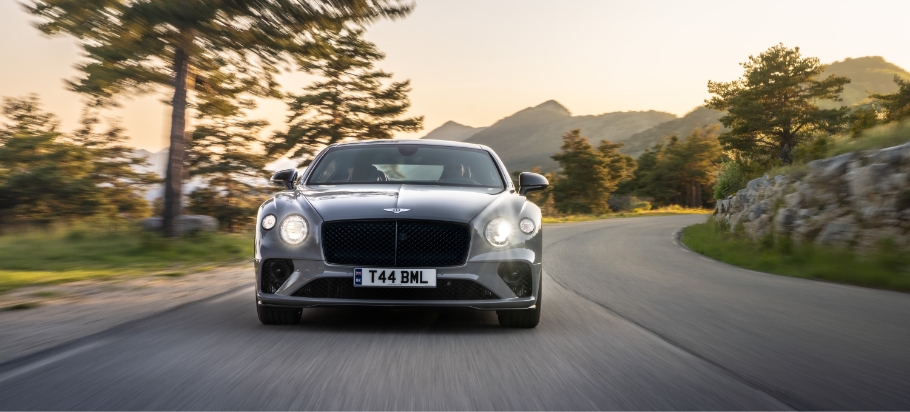
  • New Continental GT and GTC S – a sharper edge

    2023 Bentley Continental GTC S - front view

    Bentley is bringing contrast and depth to its Continental GT family with the launch of a new S range, focused on driving performance and visual presence. Through a multitude of enhancements to the exterior design, interior specification and dynamic system, the new S range adjusts the Bentley grand touring recipe to center on the pleasure of driving – an opposing yet complementary emphasis to the “Wellbeing behind the Wheel” concept of the recent, comfort-centric Azure range launch.

    Owners of Bentley’s two-door models long appreciated the breadth of choice available to them, from the towering performance of the 6.0-liter W12 Continental GT Speed to the characterful beat of the 4.0-liter Continental GT V8. Now, with the arrival of the Continental GT and GTC S, owners can choose to emphasize the sporting character of the 4.0-liter V8-powered Bentley Continental GT, thanks to a package of performance-focused design and engineering features.

    Agile and Exhilarating

    The new S range retains the 542 bhp (550 PS) and 568 lb.ft (770 Nm) 4.0-liter V8 engine that’s proved incredibly popular with customers around the world, delivering a time of just 4.0 seconds for 0-62 mph (100 km/h). For the GT and GTC S, the engine is enhanced by the fitment as standard of a Sports Exhaust to amplify the crossplane V8 beat.

    The eager, free-revving and lighter 4.0-liter V8 engine gives the Continental GT S models a responsive and agile character, and this is amplified by Bentley Dynamic Ride – the advanced 48 V electric active anti-roll control system first pioneered by Bentley. By generating up 959 lb.ft (1300 Nm) in 0.3 seconds, motors within the anti-roll bars actively compensate for cornering forces to minimize body roll under hard cornering, while also improving ride comfort at cruising speeds by decoupling the left- and right-hand wheels from each other.

    Exterior Design: Assertive and Purposeful

    From the black gloss radiator grille and black brightware to distinctive S badging on the front fenders, the new S models make an instant and dramatic impact. Headlamps and rear lights are dark tinted, while all exterior brightware is specified in gloss black – with only the winged Bentley badge and lettering being finished in bright chrome. Gloss black wing build on the darker exterior look. The effect of these features is dramatic, giving the GT and GT S a more assertive stance regardless of the limitless choice of exterior colors they’re paired with.

    The S range is offered with an all-new 22” wheel option, with five Y-shaped spokes finished in gloss black and also available in a new Pale Brodgar Satin finish. Red-painted brake calipers sit behind the wheels to provide a perfect sporting contrast.

    A second wheel option for the S models is a 21” tri-spoke wheel design that combines gloss black and bright machined finishes – also unique to S.

    Finishing touches for the exterior include S badging on the front fenders, quad exhaust tailpipes (in black, naturally) and sill extenders in black as featured on the Continental GT Speed.

    Interior Design: Tactile, Dramatic and Individual

    Complementing the dynamic and purposeful exterior design is an interior that’s striking and performance-focused, with a two-tone color split that’s unique to the S models.

    In the early days of Bentley, competitors at Brooklands and Le Mans would wrap steering wheels in cord for extra cushioning and a more secure grip. Today’s sporting Bentley drivers are rather better served, with the suede-like properties of Dinamica proving ideal for the steering wheel, gear lever, seat cushion and seat backrest of the Continental GT and GTC S range. Leather hide is employed on the seat bolsters, door pads, along the instrument panel and around the console. The pairing of Dinamica with Bentley’s incomparable leather brings an interior that offers the tactile contrast of smooth hide and the soft napped finish of Dinamica.

    Driver instrumentation continues the sporting theme with the same performance-focused graphics as the Continental GT Speed. The S design seats are fluted, with quilting available as an option, and the ‘S’ emblem is embroidered on the headrest of each seat; embroidered Bentley wings are a no-cost alternative. Finishing touches include a metal S signature badge on the fascia and illuminated Bentley treadplates with the ‘S’ device replacing the Bentley Motors Ltd plaque.

    Customer Choice – Sports and Wellness in Differing Blends

    The combination of striking design, performance and agility gives the Continental GT S and Continental GTC S strong appeal for all those who love powerful, extrovert performance cars. With the recent launch of the wellness-focused Azure range alongside the S models, Bentley is providing customers with easier ways to choose the emphasis of their Bentley – centering on either onboard comfort and wellbeing through Azure, or dynamic performance and visual presence through the S and Speed options.

  • Bugatti Type 59 Sports – Sporting the Battle Scars of Early Grand Prix Racing

    1934 Bugatti Type 59 Sports

    The first of the six existing Type 59 Sports racing cars – produced back in the 1930s – still exists today in near-original condition and is considered an invaluable surviving specimen of Bugatti’s successful racing history.

    Scuffed leather seats and a steering wheel bearing the battle scars of racing drivers’ heroic efforts. Traces of hard duels and high-speed attrition can be seen on the paintwork. If this Bugatti Type 59 Sports could talk, it would have many a story to tell about its time being pushed to the limit around the world.

    Victory is what defines the Type 59 Sports. This open-top two-seater was built in 1934 as a Type 59 Sports with a Type 57 chassis. A short time later, it received a special new chassis for the next series of Grand Prix races, where it would be driven by Bugatti’s courageous racing drivers.

    Its racing history is fully documented – just like its famous owners and drivers are. René Dreyfus, top driver of the pre-war period and a hero of the French Resistance, took to the wheel in the mid-1930s, as did racing drivers Robert Benoist and Jean Pierre Wimille. One of the later owners of the sports car was King Leopold III of Belgium – an avid Bugatti fan himself.

    Recently, the Type 59 Sports was awarded the prestigious FIVA Trophy for “Best Preserved Pre-War Car” as the world-famous Concorso d’Eleganza at Villa d’Este in Italy, in competition with some of the finest classic automobiles from fellow marques.

    A True Thoroughbred

    Bugatti presented the Type 59 Sports for the first time on September 24, 1933, at the San Sebastian Grand Prix. A marvel of engineering both powerful and delicate. Beneath its sleek and low lines, the supercharged inline eight-cylinder engine fit almost perfectly. The wheels with piano wire spokes minimized unsprung mass enormously, and, with new sophisticated shock absorbers, ensured balanced handling with an unusually high level of comfort for a racing car. The Type 59 Sports is as elegant as it is fast. It is proof of Ettore Bugatti’s constant striving for more performance and better driving characteristics.

    Bugatti first used this factory Type 59 Sports with a 3.3-liter eight-cylinder engine (No. 5) in the 1934/1935 season. Driver René Dreyfus drove straight to third place at the Monaco Grand Prix in April 1934. Robert Benoist crossed the finish line in fourth place at the French Grand Prix in Montlhéry in July of the same year, and likewise a few weeks later at the Belgian Grand Prix in Spa-Francorchamps. At the Spanish Grand Prix in September, Jean-Pierre Wimille finished sixth. Ettore Bugatti – used to winning – retires from Grand Prix racing with the Type 59 Sports and sells four vehicles to British enthusiasts. One of them was transformed into a racing car by the company itself, in Molsheim. It is a first for Bugatti – until today. The Type 59 Sports remains the only Grand Prix car to be converted into a sports car at the factory and exists today in virtually unrestored original condition as a perfect witness to the period in which it thrived.

    The engineers removed the supercharger from the engine compartment and integrated a new oil tank with two-pump lubrication and a four-speed dry sump fully synchronized transmission with central shifting. They also re-tailored the bodywork: small motorcycle mudguards, a small windshield, small headlights positioned far down and side doors – with the new chassis number 57248.

    A two-seater car not only for the streets, but also for the racetrack, that is where Jean-Pierre Wimille increasingly used the Type 59 Sports sports car from 1935 in the new 750-kilogram class. In the 1937 sports car season, this Type 59 Sports with Wimille at the wheel won the Grand Prix de Pau and de Tunis and de Marseille, among others. Affectionately called “La Grand Mère” (Grandmother) by the mechanics in Molsheim, the sports car took part in races in Africa and won the last edition of the Algerian Grand Prix. In July 1937, Jean-Pierre Wimille won a Grand Prix for the last time with the Type 59 Sports: the Grand Prix de la Marne on the race track in Reims – over three minutes ahead of the runner-up. The fast and superior Bugatti caused a sensation on the scene. At the end of the season, a long-time Bugatti customer bought this exceptional sports car with a successful racing history: King Leopold III of Belgium between 1934 and 1951.

    Ettore Bugatti had the previously blue car specially repainted for the King in the King’s favorite color of black, decorated with a yellow stripe reminiscent of the Belgian racing colors. How the King used the powerful sports car in the years to come is not known. The Bugatti would have likely been put into storage in the run-up to the war and used little for time. Leopold III and his wife were deported to Saxony in June 1944, and after the war the family initially went into exile in Switzerland. It was not until 1959 that the ex-monarch moved with his family to Argenteuil Castle in the province of Brabant-Wallonia – with the Bugatti as part of the inventory.

    In 1967, the former King sold the Bugatti to a Belgian collector, who kept it for around 20 years, not restoring it and certainly not polishing it. In 1989, the historic racing car passed to an American Bugatti enthusiast, who also leaves it in its original condition and merely restores the car’s technology. After that, the sports car moved to two other garages owned by well-known collectors, who continued to respect the car’s past and left the body untouched. Over 80 years old, this invaluable witness with a successful racing history is now owned by a Bugatti enthusiast who recently had the incredible patina preserved as an important milestone in automotive history. The areas of paintwork that were still in good condition but already patinated were conserved in a sealed manner, while the damaged areas were only gently repaired. What remains: scuffed leather seats and scars in the wooden steering wheel.

  • Mercedes-Benz GLC

    The new Mercedes-Benz GLC is even more dynamic, powerful and sustainable. It is available only as a hybrid: either as a plug-in hybrid or as a mild hybrid with 48-volt technology and integrated starter generator. The plug-in hybrids offer a range of more than 100 kilometres (WLTP). The GLC thus sets new standards in the all-wheel drive SUV segment. Systematic electrification of the GLC, the company’s best-selling model series, makes a significant contribution to reducing the CO2 balance over the entire lifecycle. The new GLC is on the way to climate-neutral mobility, which is the goal of “Ambition 2039”. The technical highlights of the GLC also include special equipment such as DIGITAL LIGHT, rear-axle steering and new assistance systems. Its pronounced off-road suitability is underlined by features such as electric off-road driving in the plug-in hybrids, or the “transparent bonnet”. The GLC will be in the showrooms of our western European sales partners from autumn 2022.

    The new GLC is immediately recognisable as a member of the Mercedes-Benz SUV family. Standard equipment includes the AVANTGARDE Exterior line with Chrome package and 18-inch light-alloy wheels. This adds striking design features and enhances the unique proportions of the vehicle.

    Exterior design: Expressive highlights

    One of the defining design highlights of the GLC is the redesigned front end, with headlamps that connect directly to the radiator grille to emphasise the vehicle’s width. DIGITAL LIGHT headlamps with additional daytime driving light ellipses and new blue trim, plus active ground lighting, also in blue, are available as optional extras. The typical Mercedes SUV radiator grille with redesigned cut-out has a chrome surround. This frames a sporty louvre in matt grey with chrome trim and the grille with vertical louvres in high-gloss black. From AMG Line upwards, a radiator grille with Mercedes-Benz pattern is available: a three-dimensional star pattern with high-gloss chrome surfaces. The new simulated underguard in chrome at the front emphasises the vehicle’s width and accentuates the off-road look.

    The body design is characterised by a full, spanned surface design enriched with precisely shaped edges in the sides. These emphasise the proportions as well as the muscular wheel arches, and also create a balance between elegance and off-road performance. Wheel arch liners in the vehicle colour are available from AMG Line upwards for the first time. These accentuate the sportiness of AMG Line. Also available as an optional extra are easy-entry running boards and the Night package.

    Other features of the sporty, confident appearance are the wide track and flush wheels in 18 to 20-inch size. Several of the wheels available ex factory not only feature a modern design with a high-sheen finish and bicolour surfaces, but are also aerodynamically optimised.

    The new two-section rear lights with a handle strip in high-gloss black emphasise the width of the rear. Their interior has a three-dimensional look, and as an optional extra they are available with an animation. The rear end also has a simulated chrome underguard, which encases the simulated chrome-look tailpipes.

    Interior design: modern, sporty luxury

    Welcome to the modern, sporty luxury of Mercedes-Benz: this is the message the interior of the new GLC with AVANTGARDE line already sends out in its standard configuration. It continues the familiar, successful concept, adopting highlights and developing them further with its own keynotes.

    The dashboard is clearly structured: the upper section has a wing-like profile with new, flattened round nozzles reminiscent of the engine nacelles of an aircraft. The lower section has a generous trim area that flows harmoniously into the curved centre console. Its orientation towards the driver contributes to sportiness: the dashboard is slightly angled towards the driver by six degrees.

    There is a free-standing, high-resolution LCD screen in front of the driver. It appears to float in front of the wing profile and trim area. This sets the driver’s display apart from traditional cockpits with classic dial instruments. It has a size of 12.3 inches (31.2 centimetres).

    A high-quality chrome insert divides the centre console into a rear, softly padded area for the armrest and a front area in glossy deep black. The central display rises seamlessly and seemingly without joints from this three-dimensional surface. It appears to float above the trim area.

    The central display also makes the paradigm shift towards digitisation clear: the vehicle functions can be controlled using the high-quality touchscreen. Its portrait orientation is particularly advantageous for navigation. Like the dashboard, the screen surface is slightly angled towards the driver. The central display has a screen diagonal of 11.9 inches (30.2 centimetres). Ergonomically located below the central display is a fingerprint scanner. A colour head-up display can be ordered as optional equipment.

    The modern, highly reduced design of door panels frames both ends of the dashboard. The door centre panel with integrated armrest evolves from a vertical surface into a horizontal orientation. Reflecting the design of the centre console, the front section takes the form of a metallic high-tech element. It can be used as a grab or closing handle, and houses the power window controls. Another highlight is the floating control cluster, into which the door opener and seat adjustment controls are integrated.

    The avant-garde seat design of the new GLC plays with layers and contoured surfaces, lending them visual lightness. The head restraints and their connection to the backrest with an enclosed cover have been redesigned. The new GLC is available with a leather-lined dashboard with nappa-look beltlines (optional, standard for AMG Line). Some trim elements have innovative surfaces. These include new interpretations of open-pored veneers in brown tones, as well as an open-pored, black wood veneer featuring fine, form-following inlays in real aluminium. On request, direct ambience lighting with light guides replaces the standard indirect ambience lighting.

    Intuitively operated and learn-capable: Latest generation of MBUX

    After the S-Class and C-Class, the new GLC also has the second generation of the MBUX (Mercedes-Benz User Experience) infotainment system. The vehicle interior becomes even more digital and intelligent, as both the hardware and software have made great strides: On the LCD screens, brilliant images make it easy to control vehicle and comfort functions.

    The driver and central display offer a holistic, aesthetic experience. The information is presented in a clearly structured way. The appearance can be individualised with a total of three display styles (classic, sporty, discreet) and three modes (navigation, assistance, service). In addition, the GLC offers the off-road mode.

    • In “Classic” style, the driver is welcomed with a familiar display environment. The proven display of two tubes and alternating content in between provides all driving-related information.
    • In “sporty”, the colour red dominates and the central rev counter is dynamically presented.
    • In “discreet” style, the content is reduced to what is essential. In addition, both screens can be shown in seven colour schemes with the ambience lighting. This creates an impressive colour experience in the interior.
    • The “assistance mode” displays the traffic situation in real time and supplements it with important display information.
    • The new “off-road mode” makes specific content such as gradient, inclination, compass and steering angle visually tangible and, in conjunction with the optional 360-degree camera, offers the “transparent bonnet” function.

    The full-screen navigation offers the driver the best possible guidance while driving. Augmented Video is available as optional equipment. A camera registers the surroundings in front of the vehicle. The central display shows the moving images and also superimposes virtual objects, information and markers. These include, e.g. traffic signs, directional arrows, lane-change recommendations and house numbers. This can make navigation much easier, especially in urban areas.

    Hey Mercedes: the increasingly sharp voice assistant

    The voice assistant “Hey Mercedes” becomes more interactive and capable of learning by activating online services in the Mercedes me App. Moreover, certain actions can be performed even without the activation keyword “Hey Mercedes”. These include taking a telephone call, for example. “Hey Mercedes” also explains vehicle functions with the voice command “Help”, and provides assistance e.g. when wanting to connect a smartphone via Bluetooth or looking for the first-aid kit. Hey Mercedes even recognises vehicle occupants by their voices.

    Tourguide: audio travel guide in MBUX

    As part of the “MBUX Voice Assistant” from Mercedes me, the audio “Tourguide” adds an interesting and entertaining feature to the previous travel information functions. In response to the voice command “Hey Mercedes, start Tourguide”, the MBUX infotainment system reads out extensive information about points of interest along the route. The system responds to the approximately 3400 brown signs along German motorways. The new audio Travelguide is initially available exclusively in Germany, but will later be rolled out in other countries.

    Smart Home: Mobile intelligence for maximum operating convenience from a distance

    With the MBUX Smart Home function, the GLC now becomes a mobile control centre for the home. Because Smart Home refers to WLAN, sensors and actuators making the home increasingly intelligent and communicative: temperature and lights, shutters and electrical appliances can be remotely monitored and controlled. Motion detectors and window contacts inform the user of welcome or unwelcome visitors.

    “Hey Mercedes, is there anybody in my home right now?” “I checked. The last movement detected was in the kitchen one hour ago.” In future, for example, dialogues can be conducted via the MBUX (Mercedes-Benz User Experience) voice assistant between the driver or passenger in the GLC and the user’s smart home. At the market launch, the MBUX Smart Home function will support numerous devices offered by important smart home providers – corresponding contracts have already been concluded with Bosch Smart Home and Samsung SmartThings. Further providers will follow, and be announced at a later stage. Right from the start, Hey Mercedes understands questions and commands in four languages (German, Chinese, US and British English). Lamps, sockets, thermostats, shutters and blinds, motion detectors, door and window contacts and temperature sensors can be addressed. So the system can also answer this question: “Did I remember to turn the heating down?” Depending on the response and the thermostats installed in the home, it is possible to change the setting: “Set the temperature to 18 degrees in the whole house!” It also enhances comfort, because the heating can also be remotely turned up again in good time.

    Music: Streaming and sound systems

    With the “Online Music” service, Mercedes-Benz has fully integrated the largest music streaming providers into the MBUX infotainment system. MBUX allows seamless access to the personal user profile at the linked music provider. In this way, customers not only have convenient access to their favourite songs and their own playlists, but also the opportunity to discover millions of songs and curated playlists. Operation is intuitive using the MBUX voice assistant, touch controls on the steering wheel or directly on the central display. In addition to the standard sound system with a front bass woofer and four mid-range speakers, optional extras are available:

    • Advanced Sound System. This comprises nine speakers – five midrange, two tweeters, two front bass speakers with 2 x 50 watts from an auxiliary amplifier and a total output power of 225 watts.
    • Burmester® surround sound system, specially configured for the GLC by this sound specialist. It comes with a total of 15 premium speakers: seven 50-watt midrange speakers, four 20-watt tweeters, two 20-watt 3D speakers and two premium front bass speakers at 120 watts each. A 15-channel amplifier drives all speakers fully actively with a total output of 710 watts. In addition, high-quality sound presets, optimisation via a digital signal processor, individual sound settings and staged operation bring the system to life. The metal speaker grilles bear the Burmester® lettering.

    Further highlights: Head-up display and fingerprint sensor

    A colour head-up display can be ordered as optional equipment. The driver is presented with a virtual image measuring 9 x 3 inches (around 23 x 8 centimetres) floating a good 3 metres ahead of the bonnet. This is roughly equivalent to a 25-inch monitor. The head-up display consists of a full-colour display module with a native resolution of 800 x 480 pixels, illuminated by high-power LEDs. A mirror optics unit projects the virtual image onto the windscreen and into the driver’s field of vision. Sensor-controlled, the display brightness automatically adjusts to the outside conditions.

    With the fingerprint scanner, users can log in to MBUX quickly, conveniently and securely. Because personal settings and data such as favourites, last destinations, behaviour-based predictions, professional calendar entries or emails are protected. Payment processes via Mercedes me are also restricted to authenticated users.

    “Over-the-air” (OTA) updates: The very latest software

    As soon as a new software update is available from Mercedes-Benz, a message appears in MBUX. Download and installation take place in the background. The user must then explicitly agree to activation of the update. This means that the vehicle always remains up to date. New features can also be uploaded to already sold vehicles by over-the-air updates. For data transmission, Mercedes-Benz relies on the high security standard provided by mobile radio technology and the communication module installed in the vehicle.

    Another way to an updated and improved user experience is to add new features in the Mercedes me Store, such as music streaming or in-car office functions. Subscription services can also be renewed or rebooked directly online via the Mercedes me Store.


    Powertrain: More electric than ever

    The new GLC is available only as a hybrid: either as a plug-in hybrid or as a mild hybrid with 48-volt technology and integrated starter generator. The engine range has four-cylinder units from the current FAME (Family of Modular Engines) Mercedes-Benz engine family. Accordingly, the engine range plays a major role in the flexibility of the international production network, with needs-based electrification. The power spectrum of the four-cylinder engines ranges up to 190 kW and 400 Nm of torque in the petrol models, and up to 195 kW and 550 Nm in the diesel models, each plus up to 17 kW and 200 Nm of electrical support from the ISG.

    Systematic electrification means:

    • All the drive systems available for the GLC are hybrids.
    • Four of these are mild-hybrid units, which receive intelligent support in the low rpm range with a second-generation integrated starter-generator (ISG) in conjunction with a 48-volt electrical system.
    • Three further engine variants are plug-in hybrids, including an all-electric driving mode and a range of more than 100 kilometres.

    The integrated starter-generator with the petrol and diesel engines provides intelligent support in the low rpm range. In combination with turbocharging, this ensures excellent power delivery. The system includes the 48-volt electrical system, which enables functions such as “gliding”, boost or recuperation and thus significant fuel savings. In addition, the engines start very quickly and comfortably with the help of the ISG, so that the start-stop function is almost imperceptible to the driver, as is the transition from “gliding” with the engine stationary to powerful propulsion with engine power. When idling, the intelligent interaction between the ISG and the combustion engine ensures outstandingly smooth running.

    Transmission: Automatic is standard equipment

    The 9G-TRONIC automatic transmission is standard equipment in all GLC models. This has been developed further for ISG adaptation: the electric motor and the power electronics are accommodated in the transmission housing, and thermal management of both components is carried out via the transmission cooling system. Previously necessary lines are therefore no longer required, which offers advantages in terms of installation space and weight. In addition, the gearbox has a higher efficiency. Among other things, optimised interaction with the electric auxiliary oil pump reduces the delivery volume of the mechanical pump by 30 percent compared to its predecessor – good for efficiency. Furthermore, it uses a new generation of the fully integrated transmission control with multi-core processor and new design and connectivity technology. In addition to the increased computing power, the number of electrical interfaces has been drastically reduced.

    All-wheel drive: Mercedes-Benz 4MATIC

    All models of the new GLC come with the latest 4MATIC all-wheel drive system. The new front-axle drive allows higher torque levels to be transferred, with an ideal axle load distribution for driving dynamics. This also has a considerable weight advantage compared to the axle drive of the preceding series. The longitudinal transfer case, which is also new, further reduces friction losses. It also has a closed oil circuit and does not require any additional cooling measures.

    Diesel with integrated second-generation starter-generator

    The OM 654 M with integrated second-generation starter-generator and 48-volt onboard power supply is at the forefront of efficient drive technology. Recuperation and the possibility to “glide” with the engine switched off further increase efficiency. Apart from electrification including an electric refrigerant compressor for the air conditioning system, these are the most important changes for the output of up to 198 kW plus a boost of 17 kW by the ISG:

    • Stroke of 94.3 millimetres and displacement of 1993 cc (previously: 92.3 and 1950) thanks to new crankshaft.
    • 2700 bar injection pressure (previously 2500).
    • Particularly fast response and smooth power delivery thanks to two water-cooled turbochargers, now both with variable turbine geometry.
    • Cooling channel in the steel piston filled with sodium for effective reduction of temperature peaks in the piston crown.

    These are the exhaust aftertreatment components for the diesel:

    • A close-coupled NOx storage catalytic converter to reduce nitrogen oxides.
    • A diesel particulate filter (DPF) with special coating, also to reduce the nitrogen oxides.
    • A near-engine mounted SCR (Selective Catalytic Reduction) catalytic converter with metered injection of AdBlue®).
    • an additional SCR catalytic converter in the vehicle’s underbody, with a separately metered injected quantity of AdBlue®

    Four-cylinder petrol engine with second-generation ISG.

    After the C-Class, the new GLC is the second Mercedes-Benz model series to receive the four-cylinder M 254 petrol engine with integrated second-generation starter-generator (ISG). The ISG provides up to 17 kW of additional power and 200 Nm more torque, can recuperate higher electrical outputs than a belt-driven starter generator, shifts the load point of the combustion engine and allows hybrid functions such as “gliding” with the engine switched off, boosting and recuperation. This makes the petrol engines very efficient. In the M 254, Mercedes-Benz has also combined all the innovations of the modular engine family of four and six-cylinder petrol and diesel engines in a single unit. They include NANOSLIDE® cylinder coating, CONICSHAPE® cylinder honing (trumpet honing) and the exhaust aftertreatment system positioned directly at the engine. All the engines are characterised by superior power delivery, smooth running and excellent noise comfort.

    The segmented dual-flow turbocharger has been completely redeveloped as a further development of the twin-scroll technology, for an even more spontaneous response. This turbocharger is the result of collaboration between Mercedes-Benz turbocharger development and the Mercedes-AMG Petronas Formula 1 team. The technology transfer to series production sets new standards in terms of performance combined with maximum efficiency.

    Plug-in hybrids: more than 100 kilometres electric range (WLTP)

    The GLC also receives the fourth-generation plug-in hybrid drive in three power levels. Using the identical basic engines, electrification has taken another big step. With an electric drive power of up to 280 kW (381 hp) and an all-electric range of more than 100 kilometres (WLTP), the plug-in hybrid models of the GLC will in many cases and on many days be on the road purely electrically, without the use of the combustion engine. Whether with one of the two petrol engines or the diesel: as plug-ins, they are not only very efficient but also extremely dynamic on the road.

    The new high-voltage system is more compact and more powerful. The number of high-voltage interfaces is significantly reduced. Integration of the power electronics into the transmission housing reduces the required installation space and simplifies assembly processes in production. In addition, a higher system voltage increases the drive power without the need for larger cable cross-sections.

    The high power density of the hybrid drive unit comes courtesy of a permanently excited internal rotor synchronous motor. The 440 Nm peak torque of the electric motor is ready to go right from the start, resulting in high agility when moving off, along with dynamic driving performance. The full electric power is available up to 140 km/h.

    The high-voltage battery is an in-house development by Mercedes-Benz. In particular, the total capacity of 31.2 kWh in combination with more efficient recuperation and improved aerodynamics allow an all-electric range of more than 100 kilometres. To accommodate the high power density, the high-voltage battery has an internal cooling system. The thermal management system can therefore control the operating temperature irrespective of the climate control in the vehicle interior. In addition to continuous operation in hot and cold regions, this also allows quick charging with direct current.

    Even when the battery is completely discharged, it can be fully charged in around 30 minutes with the optional 60 kW DC charger. A standard-fit 11 kW charger (depending on the market) is available for three-phase charging at a Wallbox connected to the domestic AC mains. The standard charging cable can be stored within easy reach in a floor compartment just behind the tailgate.

    Charging at public charging points becomes a pleasant secondary matter with Mercedes me Charge. The charging network with around 300,000 charging points in Europe offers three charging tariffs that are tailored to the individual driving distances. This makes charging with Mercedes me Charge even easier and more transparent. Drivers of a plug-in hybrid from Mercedes Benz receive an exclusive price advantage for public charging, with fixed price rates per kilowatt hour of electricity in the first year after registration. In addition, the monthly standing charge of 4.90 euros in the M tariff is waived in the first year for new car buyers. This appeals to city commuters, for example.

    Mercedes me Charge gives customers access to a wide range of public charging stations located in cities and in places like shopping centres, hotels or service stations. The Mercedes me App indicates the exact position, current availability and price at the selected charging station in advance.

    Recuperate instead of braking

    Also thanks to improved recuperation, the new GLC offers significantly higher overall efficiency of the hybrid system compared to its predecessor: The amount of recovered electrical energy has increased significantly.

    Recuperation recovers electricity for the e-drive from the vehicle’s kinetic energy. It is based on an interlocking interaction between the components: while the electric motor receives electrical energy during acceleration to generate mechanical energy, it is mechanically driven by the vehicle’s kinetic energy on the overrun and during deceleration, thus working as a generator and generating electrical energy. This is fed into the vehicle’s high-voltage battery and is available for the drive system.

    A decisive factor for efficiency in recuperation is the interaction of the hydraulic service brake with the electric motor. In addition, the automatic transmission performs several gearchanges during deceleration. The use of a vacuum-independent braking system in the new GLC has significantly optimised the entire interaction. Depending on the driving situation and the driver’s braking requirements, this braking system automatically controls the flexible transition between hydraulic braking and recuperation. This allows the maximum recuperation power of up to 100 kW to be achieved more frequently, and over a longer period of time. For this purpose, the system variably reduces the braking power of the hydraulic brake, even at constant pedal pressure, so that the high recuperation power is maintained as speed decreases. A further, pleasant effect for the driver is that he/she does not perceive this automatic transition.

    The graph below illustrates the advantages of the hybrid drive in the new GLC.

    The curves in the diagram compare example braking of the new GLC and its predecessor from 100 km/h to standstill with constant deceleration. The diagram clearly shows that the initial braking power is significantly higher than the maximum recuperation power. The recuperation time with maximum recuperation power is significantly longer in the new GLC, as the new system can flexibly reduce the contribution made by hydraulic braking. This is where the new GLC scores: significantly higher recovery of electrical energy from kinetic energy than in the preceding model. This has a positive effect on the electric range.

    The optimised driving modes of the new GLC plug-in hybrid support the management of recuperation and optimal use of the available electrical energy. Based on the information from the route guidance of the navigation system, the hybrid driving programme provides the electric driving mode for the most appropriate route sections in each case. Electric driving is prioritised on journeys in urban areas, for example.

    A driver wishing to influence the energy recovery rate can do so directly in three stages controlled by rocker switches behind the steering wheel. This is possible in all driving modes except SPORT. In the driving mode  D-, for example, the driver can experience the “one-pedal feeling”: when the driver takes his/her foot off the accelerator, the vehicle slows down purely electrically to the extent that the hydraulic operating brake is often not needed. In addition the operating strategy communicates with the sensors of the assistance systems, efficiently supporting the driver in many situations.

    Two driving modes allow the driver to use the possibilities of the plug-in drive in a particularly targeted manner:

    BATTERY HOLD: Priority is given to preserving the charge state of the high-voltage battery, for example when planning to drive in a city centre or low emission zone later on. The hybrid drive system selects the appropriate drive depending on the driving situation and distance.

    ELECTRIC: Electric driving up to 140 km/h, activation of the combustion engine via the pressure point of the accelerator pedal.

    If the route-based operating strategy is activated, data on the expected route is evaluated when route guidance is active. This takes into account factors such as navigation data, topography, speed limits and the traffic conditions for the entire planned route. With the route-based operating strategy, the two forms of energy of the hybrid vehicle can be distributed in the best possible way. The drive control automatically selects the most suitable operating mode so that the state of charge of the high-voltage battery can be specifically influenced. For example, electrical energy can be saved for e-driving so as to drive all-electrically in inner-city areas or in environmental zones later on.

    In the HYBRID and ELECTRIC driving modes, as well as in BATTERY HOLD, the ECO Assistant also evaluates the route data and supports the greatest possible efficiency and recuperation energy according to the route. If the navigation map or sensors and cameras detect e.g. a roundabout ahead, a hairpin bend, a tight bend, a T-junction, a gradient, a vehicle in front or a speed limit, the ECO Assistant calculates the optimum vehicle speed from the distance, speed and gradient. For any necessary deceleration, the hybrid system primarily uses the electrical resistance of the electric motor for recuperation.

    The plug-in hybrid variants of the new GLC have a haptic accelerator pedal module. In the ELECTRIC driving mode, this signals the change from electric driving to driving with the combustion engine by means of a perceptible pressure point. If the pressure point is exceeded, the combustion engine is switched on and provides additional drive torque.

    All in all, driving with the new GLC plug-in hybrid becomes significantly more electric. Thanks to the increase in electric range to more than 100 kilometres, everyday journeys can largely be covered purely electrically.

    The mild hybrid model range:

    GLC 200 4MATIC GLC 300 4MATIC GLC 220 d 4MATIC GLC 300 d 4MATIC
    Displacement cc 1999 1999 1993 1993
    Output kW/hp 150/204 190/258 145/197 198/269
    Add. output (boost effect) kW/hp 17/23 17/23 17/23 17/23
    Peak torque Nm 320 400 440 550
    Add. torque (boost effect) Nm 200 200 200 200
    Combined fuel consumption (WLTP)[1] l/100 km 8.2-7.3 8.2-7.3 5.9-5.2 6.2-5.6[2]
    Combined CO2 emissions (WLTP)1 g/km 186-167 186-167 155-136 163-1462
    Acceleration
    0-100 km/h
    s 7.8 6.2 8.0 6.3
    Top speed km/h 221 240 219 243
    Price from [3] euros 57,631.70 68,240.55* 60,237.80 n.n.

    [1] The figures shown are the WLTP CO2 figures measured according to Art. 2 No. 3 of Implementing Regulation (EU) 2017/1153. The fuel consumption figures were calculated on the basis of these figures.
    [2] Figures for fuel consumption and CO2 emissions are provisional and were obtained in accordance with the WLTP test procedure. EC type approval and a certificate of conformity with official figures are not yet available. Differences between the stated figures and the official figures are possible.
    [3] Recommended retail price in Germany including 19% VAT.

    The model range of plug-in hybrids:

    GLC 300 e 4MATIC GLC 400 e 4MATIC GLC 300 de 4MATIC
    Petrol engines Diesel
    Displacement cc 1999 1999 1993
    Rated output petrol/diesel engine kW/hp 150/204 185/252 145/197
    at rpm 6100 5800 3600
    Rated torque petrol/diesel engine Nm 320 400 440
    at rpm 2000-4000 2000-3200 1800-2800
    Rated output, electric motor kW 100 100 100
    Rated torque, electric motor Nm 440 440 440
    System output kW/hp 230/313 280/381 245/335
    System torque Nm 550 650 750
    Rated battery capacity kWh 31.2 31.2 31.2
    Top speed km/h 218 237 217
    Top speed, electric km/h 140 140 140
    Acceleration
    0-100 km/h
    s 6.7 5.6 6.4
    Combined consumption, weighted (WLTP)[4] l/100 km 0.6-0.5 0.6-0.5 0.5-0.4
    Combined CO2 emissions, weighted (WLTP)4 g/km 15-12 15-12 14-11
    Combined power consumption, weighted (WLTP)4,[5] kWh/100 km 22.5-20.4 22.5-20.4 22.9-20.5
    All-electric range (combined EAER) (WLTP)4,5 km 118-130 118-130 112-128

    [4] Figures for fuel consumption, CO2 emissions, power consumption and range are provisional and were obtained in accordance with the WLTP test procedure. EC type approval and a certificate of conformity with official figures are not yet available. Differences between the stated figures and the official figures are possible.
    [5] Power consumption [and range] was [were] determined on the basis of Directive 692/2008/EC.

    Suspension: comfort and agility

    Key components of the GLC’s dynamically designed suspension system are a new four-link suspension at the front and a multi-link independent rear suspension mounted to a subframe. The standard suspension already provides a high level of suspension, ride and noise comfort, agile handling and driving enjoyment. It is equipped with an amplitude-dependent damping system.

    As an option, the new GLC is available with the Engineering package which includes AIRMATIC air suspension and rear-axle steering. AIRMATIC is equipped with variably adjustable damping for compression and rebound. The plug-in hybrids have air suspension and level control at the rear axle as standard. Another optional extra is the Offroad Engineering package, which increases ground clearance by 20 millimetres and has an underride guard at the front and underbody protection. In conjunction with AMG Line Exterior, the GLC has a sport suspension.

    Rear-axle steering: more agile and dynamic

    The new GLC is particularly agile and stable with the optional rear-axle steering combined with a more direct steering ratio at the front axle. The steering angle at the rear axle is up to 4.5 degrees. This reduces the turning circle by 90 centimetres to 10.9 metres. The driver also needs fewer turns of the steering wheel from lock to lock.

    At speeds of less than 60 km/h, the rear wheels steer in the opposite direction to the front wheels – when parking, by up to 4.5 degrees counter to the front axle angle. Depending on the situation, this virtually shortens the wheelbase, and the vehicle is more light-footed and agile as a result. When the speed reaches 60 km/h or more, the rear wheels steer in the same direction as the front wheels by up to 4.5 degrees. The resulting, virtually extended wheelbase offers noticeable advantages in handling stability and driving safety at high speeds, and during fast lane changes or sudden evasive manoeuvres.

    In addition, during dynamic manoeuvres such as driving on a country road, significantly less steering movement is required – and the vehicle responds more directly to steering commands. This is supported by the integrated dynamic control function of ESP®.

    Driving assistance systems: stress-relief and support in hazardous situations

    The latest generation of the Driving Assistance package Plus contains additional and improved functions. These reduce driver workload in day-to-day situations for more comfortable and safe driving. When danger threatens, the assistance systems are able to respond to impending collisions as the situation demands. The operating principle of the systems is visualised on the driver display by a new display concept.

    Further improved assistance systems – some examples:

    • On all types of roads – motorways, country roads or in town – Active Distance Assist DISTRONIC can automatically maintain a preset distance from vehicles in front. A new feature is the ability to react to stationary vehicles on the road at speeds up to 100 km/h (previously: 60 km/h).
    • Active Steering Assist helps the driver to stay in lane at speeds up to 210 km/h. New features: lane detection using an additional 360-degree camera, with particular advantages in the low speed range, for example when forming an emergency lane; significantly increased availability and cornering performance on country roads; increased lane centring on motorways.
    • In addition to conventionally posted speed limits, Traffic Sign Assist recognises signs on overhead gantries and at roadworks. The system recognises even conditional signs, for example “in wet conditions”, by evaluating all vehicle sensors. The stop sign and red traffic light warning functions (as part of the Driving Assistance package Plus) are new.
    • The new Parking package with 360-degree camera offers the best all-round visibility and facilitates the parking process e.g. with assisted parking and unparking. The “transparent bonnet” now included as a new function makes slow manoeuvring easier, and makes for more precise driving on rough terrain.

    Sophisticated parking systems: Support during slow manoeuvres

    Thanks to more powerful environment sensors, the parking systems can better support the driver when manoeuvring, thus improving safety and comfort. Integration into MBUX makes operation more intuitive and is supported by the visual display. The optional rear-axle steering is integrated into the parking assistants, and calculation of the lanes (trajectories) is coordinated accordingly. Emergency braking functions also serve to protect other road users, and can increase road safety.

    The Parking package with 360-degree camera and “transparent bonnet” and the functions of Active Parking Assist with PARKTRONIC is available as an optional extra. It offers the best possible all-round visibility and facilitates the parking process. The central display clearly shows the direct vehicle surroundings during the parking or manoeuvring process. The display is composed of four individual camera images from the front, rear and both sides of the vehicle, and includes a virtual bird’s eye view. In addition, the display shows different viewing angles such as front, rear or trailer mode. The driver decides whether to park manually or hand control over to Active Parking Assist.

    Over hill and dale: Off-road with the GLC

    Like its predecessor, the new GLC is explicitly designed for driving on rough terrain: it is prepared for this use in numerous details, and also offers several new features and systems. Standard equipment includes an off-road driving mode and DSR (Downhill Speed Regulation). The new off-road screen has easier operation, there is clearer information thanks to the “transparent bonnet” and outstanding traction and handling safety by virtue of improved control systems. With the plug-in hybrid models, purely electric off-road operation is possible even over long distances. With these, the driver can choose between off-road driving with purely electric or conventional drive.

    The new off-road screen uses both displays for clearly arranged information. Among other things, the driver’s display shows, inclination, gradient, topographical altitude, geo-coordinates and a compass, as well as road speed and engine speed when operating with an internal combustion engine. The central display additionally shows e.g. the current position of the SUV on the terrain with uphill/downhill gradient and inclination, the steering angle of the front wheels and, if rear-wheel steering is available, the steering direction of the rear wheels as well as – with AIRMATIC – the current suspension level and the current wheel deflection. It also shows the tyre pressure, tyre temperature, current torque and output, and the engine and transmission oil temperature.

    The Engineering package (optional) with AIRMATIC air suspension including level control and rear-axle steering also brings its comfort advantages to bear when off-road, where it offers additional benefits. For example, AIRMATIC allows a high ground clearance off-road, regardless of the load, and a long suspension travel for the best possible traction. The rear-axle steering increases off-road manoeuvrability even further. Alternatively, the off-road suspension (part of the Offroad Engineering package) with 20 millimetres more ground clearance is also available as an optional extra.

    If the vehicle is equipped with DIGITAL LIGHT, an off-road light is also included. This provides maximum, wide illumination when driving in rough terrain, and makes for accurate and safe manoeuvring around obstacles in unfamiliar environments.

    View beneath the vehicle: “Transparent bonnet”

    The GLC also offers a “transparent bonnet”: when the off-road mode is active, the central display shows a virtual view under the front of the vehicle, including the front wheels and their steering position. The view is composed of the images from the 360-degree camera. There are two views: under the vehicle and looking ahead. At speeds up to 8 km/h the “transparent bonnet”, i.e. the view under the vehicle, is shown. From 8 to 20 km/h the system shows the view ahead. The camera image is switched off at higher speeds. The “transparent bonnet” is extremely helpful: it enables the driver to recognise obstacles such as large stones or deep potholes in the vehicle’s path at an early stage. The optional Parking package with 360-degree camera is a prerequisite for the “transparent bonnet”.

    Off-road electric: Very powerful and efficient

    The plug-in models of the new GLC already offer a driving experience of the future: all-electric off-road driving. This has many advantages: since the electric motor’s full torque of 440 Nm is available from the very first engine revolution, its power is very easy to control at all times. This allows highly precise, controlled driving even in difficult terrain. In addition, because the electric motor only consumes energy when it is actually moving the vehicle, and the power demand is comparatively low when driving slowly as is usual when off-road, a long all-electric driving time is possible even in demanding terrain. In keeping with the nature of the electric drive, noise emissions are also very low when driving slowly. All this makes for a completely new off-road experience.

    Trailer menu and towing route planner

    The GLC is a popular towing vehicle, and the new edition is specifically designed for this purpose. The new trailer menu and the towing route planner in MBUX are two highlights of the GLC for towing operations. The aim of these and numerous further advanced functions for operation as a towing vehicle is to make towing as safe and pleasant as possible. Moreover, the 4MATIC all-wheel drive provides outstanding traction on any surface. In trailer mode, the ESP® trailer stabilisation is activated: This can compensate for dynamic instabilities while driving.

    in the central display, routes can be planned that are suitable for driving with the previously defined trailer. The system also takes into account e.g. passage widths and passage heights. As soon as the ballhead is engaged and an electrical connection exists, the system inquires about the intended use of the trailer coupling: Is it a small trailer? Or something larger, such as a caravan or horsebox? Or is a bicycle carrier installed? The towing route planner takes the information into account.

    The trailer hitch (optional equipment) has a fully electrically swivelling ball head. The socket is located in the trailer hitch. The image from the reversing camera includes the trailer coupling and the area directly behind it, so that the hitching process can be observed on the central display.

    The enhanced Trailer Manoeuvring Assist (optional) in the new GLC makes manoeuvring with a trailer even easier, more comfortable and safer. The system automatically regulates the steering angle of the towing vehicle up to a speed of 5 km/h and an uphill gradient of up to 15 percent. It is also integrated into MBUX and can be operated intuitively. In addition to stabilising the combination when reversing, the system can for the first time also guide it around freely selectable bends of up to 90 degrees. The steering of the towing vehicle is operated automatically so that the selected angle is maintained. This allows more precise positioning of the trailer. The driver can also select the “pull straight” function once the trailer has reached the desired direction and needs to reverse in a straight line. The entire manoeuvring process can be followed from different camera perspectives on the central display. Dynamic guide lines show the trajectory and the vehicle width.

    Weight specifications for towing operations:

    GLC 200 4MATIC GLC 300 4MATIC GLC 220 d 4MATIC GLC 300 d 4MATIC
    Tongue weight (kg) 100 100 100 100
    Towing capacity
    (kg, braked)
    2400 2400 2500 2500

    High passive safety

    The GLC is available on all continents. Whether in right or left-hand drive, with petrol engine, diesel engine or as a plug-in hybrid: When it comes to crash safety, all models meet the typically high Mercedes safety standards.

    Together with the familiar PRE-SAFE® protection concepts for frontal and rear impacts, PRE-SAFE® Impulse Side (available in conjunction with the Driving Assistance package Plus) forms a virtual crumple zone around the vehicle. As only a limited crumple zone is available in a side impact, PRE-SAFE® Impulse Side (availability depending on selected equipment) can move the affected driver or front passenger away from the danger even before the crash as soon as the system detects that a side collision is immediately imminent. For this purpose, air chambers in the side bolsters of the front seat backrest are inflated in fractions of a second.

    All in all, the GLC’s safety concept is based on an intelligently designed body with a particularly rigid passenger cell, selectively deformable crash structures and situational interaction between the seat belts, belt tensioners and airbag systems. In addition to legal requirements, the vehicle also fulfils internal Mercedes-Benz test requirements and test criteria that are derived from real accidents.

    Extensive crash simulations were used to configure the vehicle structure in such a way that the occupants are particularly well protected in the event of a crash. The bodyshell concept incorporates all areas – front structure, passenger cell, side walls and floor assembly. It is implemented through the design and construction of the body components, a stress-related material mix and appropriate wall thicknesses in highly stressed areas. The overall concept leads to homogeneous load distributions and high energy absorption with moderate deceleration acting on the occupants. In addition, sufficient protective space can be provided for the occupants.

    Aerodynamics: Now Cd = 0.29

    From around 60 km/h, air resistance exceeds the total of all other driving resistances and is a main control factor for saving fuel and reducing CO2 emissions. The air resistance is significantly influenced by the drag coefficient (Cd) and the frontal area (A). The noise level in the vehicle is also increasingly dominated by wind noise at higher speeds. Optimisation of the vehicle with respect to aerodynamic drag and wind noise was carried out with the help of extensive digital flow simulations (CFD – Computational Fluid Dynamics), as well as tests with real vehicles in the aeroacoustic wind tunnel.

    In its aerodynamically most favourable configuration, the minimal drag coefficient of the GLC is Cd = 0.29. This makes it two hundredths better than its predecessor (Cd = 0.31) – a notable advance for an SUV with conventional drive. The frontal area is 2.60 square metres. Purely battery-electric vehicles have more possibilities for an even lower level in terms of aerodynamics. Among other things, they have a different cooling air concept for the powertrain, so that an airflow through the bodywork can be largely avoided.

    Many factors contribute to the improved aerodynamics of the new GLC. The most important measures include the following:

    • air control system with two levels (radiator grille and front apron) with aerodynamically optimised basic ventilation position for maximum aerodynamic performance
    • ideally positioned and aerodynamically/aeroacoustically optimised beltline mirror
    • aerodynamic design of the roof spoiler and integrated side spoilers
    • side spoiler lips in the rear lights
    • optimised wheel spoilers at front and rear
    • aerodynamic cladding on the spring control arms (if steel suspension)
    • an optimised underbody panelling concept that is as uniform as possible for the different engine variants
    • aerodynamically optimised wheels
    • aerodynamically optimised suspension lowering in Eco driving mode

    Noise comfort: Quiet and pleasant acoustics

    The electrification of vehicles means that wind noise is increasingly noticeable, as it is no longer masked by noise from a combustion engine. The influence of wind noise on homogeneous acoustics in the vehicle interior is therefore increasing. An optimised airflow around the outer skin of the vehicle, plus high-quality seals and sound insulation, are key factors in reducing wind noise.

    The new GLC is a pleasantly quiet vehicle with a serene sound signature and very low rolling and wind noise. This was achieved with acoustic optimisation of the bodyshell and sophisticated sound insulation. An acoustic membrane in the windscreen is standard equipment, for example. The optionally available, acoustically effective thermal insulation glass meets even higher comfort expectations. The driver’s door window is of acoustically effective laminated glass. Detailed fine-tuning further enhances the level of “Noise – Vibration – Harshness” (NVH). All the acoustic measures jointly contribute to the “welcome home” atmosphere that is typical of Mercedes-Benz. Three examples:

    • Large parts of the upper bodyshell structure are filled with very light and highly effective acoustic foam. Elimination of the cavities noticeably reduces the noise level compared to the preceding model.
    • The metal sheets of the drive tunnel cover and flanks are lined with acoustic material. This NVH technology in the bodyshell particularly reduces noise from the drive system.
    • The development work on the bodyshell particularly focussed on rigidity and strength. Among other things, the proportion of ultra-high-strength and hot-formed steels and sheet blanks with variable wall thicknesses (tailored rolled blanks) has been increased compared to the preceding series.

    Discreet acoustic feedback indicating the current power delivery additionally enhances the harmonious character of the vehicle. The low, well-balanced exterior noise as well as the acoustics in the interior underline the high perceived value of the new GLC.

    General noise optimisation, especially in the high-frequency range, was also achieved through numerous detailed measures. A few examples: modified door and window seal sections; flexible inner door cavity struts for optimum contact with the adjacent window guide rail; reduction of component vibrations in the doors by increasing the structural rigidity of the door body.

    Spotlight The new exterior mirror

    As a particularly good example, the exterior mirror illustrates the high development standard of the new GLC with respect to aerodynamics and aeroacoustics. The GLC now has beltline mirrors instead of the previous door mirrors. The most favourable mirror position on the exterior door panel was identified, and the mirror base was aerodynamically and aeroacoustically improved. The effects are manifold: the air flows around the vehicle with even less turbulence, which improves the Cd figure. In addition, the wind noise at the new exterior mirror is lower, so that the side acoustics in the interior are even more pleasant.

    What sounds simple as a result required extensive consultations about every detail between the departments involved, for example design, material choice, position and sealing. Right from the early development phase, simulations made a major contribution and provided findings that were directly adopted in the hardware design. Further improvements to the weather seals were made by computer tomography when prototype vehicles became available. The aim was to offer the smallest possible surface to the slipstream, and therefore ensure significantly better overall aerodynamics and aeroacoustics compared to the preceding model.

    DIGITAL LIGHT: Extremely powerful with optional projection functions

    The new GLC has LED High Performance headlamps as standard. DIGITAL LIGHT is available as an optional extra. This revolutionary headlamp technology allows new functions such as the projection of auxiliary markings and warning symbols onto the road. DIGITAL LIGHT contains a light module in each headlamp, with three extremely powerful light-emitting diodes (LEDs) whose light is refracted and directed with the help of 1.3 million micro-mirrors. This corresponds to a total resolution of more than 2.6 million pixels.

    With its dynamics and precision, DIGITAL LIGHT creates almost unlimited possibilities for high-resolution and targeted light distribution according to the ambient conditions. The technology in the headlamp is controlled highly dynamically depending on the situation. Camera and sensor systems in the vehicle recognise other road users, while powerful computers evaluate the data and digital maps in milliseconds and give DIGITAL LIGHT the commands for adapted light distribution in all situations. The result is excellent visibility for the driver, without impairing that of other road users or dazzling oncoming traffic. This also applies to the ULTRA RANGE high beam. The aim here is not to set new records for headlamp range, but to achieve the best possible visibility and brilliance without glare thanks to an innovative overall concept.

    DIGITAL LIGHT with projection function is available as an option. This innovation offers extra safety for the driver, especially when driving at night, and allows communication with other road users. A few examples:

    • DIGITAL LIGHT can make driving safer by projecting guidance lines, symbols and animations, and e.g. project two guiding lines when passing through roadworks. This marking approximately indicates the width of the vehicle, enabling the driver to negotiate the narrowed lane more easily.
    • The intelligent technology highlights pedestrians in the danger zone with a spotlight function and clarifies their position with projected direction points.
    • Customers driving the wrong way on motorway entry ramps or in one-way streets are warned by a symbol.
    • The same warning symbol appears before running red lights or stop signs.

    The DIGITAL LIGHT projection functions that are allowed in different countries can vary. The integrated geofencing helps the driver to comply with legal regulations in every country. When the vehicle crosses a national border, the functions of DIGITAL LIGHT are automatically adapted to the applicable regulations. While the corresponding projections can still be activated in the multimedia system, the function is suppressed while the vehicle remains in that country.

    DIGITAL LIGHT’s digital intelligence also communicates with the driver. For example, when unlocking the vehicle the driver is greeted with a light display by the headlamps and rear lights (“Coming home”), and when locking the vehicle it bids him/her farewell (“Leaving home”). The customer can switch the animation function on and off via MBUX, and choose between different animations.

    DIGITAL LIGHT also offers a special function for off-road driving. When driving off-road, an off-road light automatically switches on to illuminate the way ahead as broadly as possible to better detect obstacles. It is activated as soon as the off-road driving mode is selected.

    Comfort appointments: Improvements in many details

    The massage function in the optional multicontour seat has been extended and covers the entire back area: Eight inflatable air chambers in the backrest provide an improved deep-massage effect. A vibration massage is also possible on the driver’s side, and the cushion contains four corresponding motors. Up to six massage programmes are available. Three-stage seat heating for the rear seats is another new feature.

    The holistic “Fit & Healthy” approach of the optional ENERGIZING package Plus makes it possible to experience the various comfort systems at the touch of a button or by voice command, and bundles them into worlds of experience in up to seven comfort programmes. At the same time, the system creates a matching atmosphere in the interior – for example, invigorating in case of fatigue or relaxing in case of an elevated stress level. The ENERGIZING COACH suggests an appropriate fitness or wellness program based on vehicle and trip data. It also factors the information about sleep quality and stress level into its intelligent algorithm if the driver has a suitable wearable. In conjunction with the plug-in hybrids, the “Power Nap” programme is available as a useful function e.g. during a break at a service station or when charging the battery en route. The programme has three phases – falling asleep, sleeping, waking – and can increase performance and provide new energy.

    The AIR-BALANCE package is also part of the ENERGIZING package Plus. It offers an individual, subtle fragrancing experience in the interior – according to personal preference and depending on the mood. The fragrance intensity can be regulated in three stages, and different aromas are available. Thanks to refreshing ionisation and purifying filtration of the outside and inside air, the AIR-BALANCE package simultaneously contributes to improved air quality on board and to an increased sense of well-being. Active ionisation is modelled on the natural oxygen ionisation of the ambient air, for example by the earth’s magnetic field. This can inactivate certain viruses, bacteria and spores, and therefore increase well-being. The fine particle filter based on a fleece with activated carbon can reduce exposure to e.g. pollen or gaseous emissions.

    The optional ENERGIZING AIR CONTROL intelligently monitors the air quality of the vehicle interior. It uses air quality and fine particle sensors for this purpose. If defined limits are exceeded, it switches the air conditioning to air recirculation mode. If the values fall below the limit values, the system switches back to fresh air operation. A two-stage filter concept can additionally filter fine dust and a large proportion of pollutants from the air.

    The ambience lighting available for the GLC creates an individual feel-good atmosphere in the vehicle interior by day and night. New functions improve comfort and safety compared to the preceding model. Standard equipment includes premium ambience lighting with optical fibres. The functions also include the following:

    • high-quality interior light, for example after unlocking the vehicle
    • dimming of the interior light when opening a door, to allow for the different brightness perceptions of passengers
    • ambience lighting extending from the dashboard to the rear doors
    • 64 colours
    • ten brightness levels
    • three brightness zones
    • additional variations using programmes, colour themes and effects
    • ambience lighting in conjunction with ENERGIZING COMFORT

    The optional Premium Plus ambience lighting also provides direct ambience lighting. In contrast to indirect lighting, no surfaces are illuminated here, as precise light lines emphasise the contour of the corresponding area.

    The new GLC is available with a new panoramic sunroof as an optional extra. The lined cross-strut is slimmer than in the previous version, providing an almost uninterrupted view through the larger glass roof area. If required, the panoramic sunroof can be covered with a roller blind.

    Standard equipment: significantly upgraded

    Based on the luxury strategy of Mercedes-Benz, the standard equipment of the new GLC has been significantly upgraded, and offers the customer a highly attractive vehicle right from the start. The AVANTGARDE line is standard, for example, as are popular features such as the large displays, Smartphone Integration, wireless charging and heated front seats.

    In addition, the packaging logic has been considerably simplified to reduce the effort of choosing from numerous individual options. functional features that are frequently ordered together are now bundled into equipment packages on the basis of actual buyer behaviour. There are only very few functional options available beyond this. Where design options such as paint finish, upholstery, trim and wheels are concerned, customers can configure their vehicles individually as before.

    GUARD 360°: Intelligent vehicle protection

    The GUARD 360° vehicle protection package provides all-round monitoring. It comprises an anti-theft alarm system plus tow-away protection which is able to detect changes in position. Movement in the vehicle interior also triggers visual and acoustic warnings. Mercedes me theft and parking collision detection informs the owner via an app. GUARD 360° vehicle protection Plus also includes vehicle locating in the event of theft, as well as emergency key deactivation.

    Dimensional concept and practical details: great day-to-day operating convenience

    The key dimensions of the new GLC emphasise the SUV’s even more dynamic and powerful appearance. With a length of 4716 mm, it is 60 mm longer and 4 mm lower than its predecessor. The track widths have been increased by 6 mm at the front (now 1627 mm) and 23 mm at the rear (now: 1640 mm). The increased vehicle length benefits the wheelbase (plus 15 mm to 2888 mm) and the overhangs at the front (plus 12 mm) and rear (plus 33 mm).

    The vehicle width has remained the same at 1890 mm. The new beltline exterior mirrors make a major contribution to overall vehicle aerodynamics. The minimum drag coefficient of the GLC in its aerodynamically best configuration is now Cd = 0.29, two hundredths better than its predecessor (Cd = 0.31).

    The luggage capacity benefits from the larger rear overhang and has increased significantly to 620 litres (+ 70 litres compared to the preceding model). This is noticeable in day-to-day driving, also during holiday journeys with the family or for everyday transport requirements. The rear seat backrest can be split-folded in a 40:20:40 ratio. Electrically operated unlocking of the rear seat backrest is done by push-button switches on the left and right side of the rear seat backrest, or via controls in the load compartment. After unlocking, the backrest sections can be folded forward. They can then be folded back into the sitting position by hand. In addition, the rear seat backrests can be adjusted to a 10-degree steeper cargo position. In conjunction with the optional Load Comfort package, the rear seat backrests can be folded electrically and the load compartment roller blind can be opened and closed electrically

    The GLC has the EASY-PACK tailgate as standard. This opens or closes conveniently at the touch of a button: using the button on the ignition key, the switch in the driver’s door or the unlocking handle on the tailgate. More operating convenience: as in the preceding model, the roller blind and the dividing net are in two sections. The roller blind can now be stowed under the load compartment floor and the folded dividing net in a bag.

    Key dimensions:

    GLC X 254 Preceding model Difference
    Exterior dimensions (mm)
    Length 4716 4656 +60
    Width 1890 1890   0
    Width incl. exterior mirrors 2075 2096 -21
    Height 1640 1644 -4
    Wheelbase 2888 2873 +15
    Track, front 1627 1621 +6
    Track, rear 1640 1617 +23
    Interior dimensions (mm)
    Max. headroom, front, driver 1048 1064 -16
    Headroom, rear 1.007 1006 +1
    Legroom, front 1036 1037 -1
    Legroom, rear 950 948 +2
    Elbow room, front 1499 1499   0
    Elbow room, rear 1480 1474 +6
    Shoulder room, front 1456 1455 +1
    Shoulder room, rear 1438 1436 +2
    Luggage capacity acc. to VDA (l) 620 550 +70
  • Buick Unleashes Wildcat EV Concept

    2022 Buick Wildcat EV Concept

    Buick today unveiled the Wildcat EV concept — an expressive vision of the brand’s new design direction as it transitions to an all-electric future.

    The Wildcat was developed to convey the all-new design language that will influence Buick production models for the foreseeable future. Buick’s new tri-shield logo, mounted prominently on the body front and rear, symbolizes the design transformation and new production models will wear it starting next year.

    “The Wildcat EV concept represents the real design future for the brand,” said Sharon Gauci, executive director, Global Buick and GMC Design. “Buick has always been forward looking and this expression is a glimpse of where we’re going, and the optimism we have for the limitless possibilities of an electric future.”

    https://www.youtube.com/watch?v=WjrZvFab8u4

    The Wildcat EV concept also introduces a new, expressive face for Buick, distinguished by a bold, forward-leaning front-end appearance that features a low-mounted, trapezoidal grille. Sharp, high-mounted and horizontal check mark-shaped lighting flanks the vehicle, while the outer edges of the grille house primary lighting. The lighting elements are configured to create a unique welcome choreography when the driver approaches.

    Further, the vehicle — a 2+2 coupe — strikes a powerful, expressive presence, with an all-new, laid-back proportion complemented by a low, wide stance. The windshield wraps around and flows into the side glass, which tapers dramatically with the fast roofline to accentuate the aggressive profile.

    “From every angle, the vehicle looks like it’s ready to pounce,” said Bob Boniface, director, Global Buick Design. “It’s the result of careful attention to the proportions and sculptural beauty derived from the intersection of forms, not lines.”

    Additional exterior design highlights include:

    • Distinctive semi-swing doors for easy entry and exit.
    • Unique aluminum trim that appears to flow seamlessly into the interior seat structures.
    • Micro-LED lighting technology and thin-beam projector lenses for the front lighting.
    • Blade-style taillights embedded in the roof’s sail panels, culminating in check mark-style horizontal lamps that echo the front lighting signature.
    • An external “state of charge” indicator visible in the exterior hatchback glass.
    • Jet Age-inspired 18-spoke “turbine” wheels.

    “The more you look at the Wildcat EV concept, the more the details reveal themselves,” said Boniface. “Its timeless proportions acknowledge the brand’s rich design legacy, while our latest technology moves you forward.”

    A blend of modernity and warmth

    Inside, the Wildcat EV concept’s cabin has an inner glow that is inviting and comforting, all while integrating new technologies designed to make the riding experience more enjoyable.

    “It’s a space intended to strike an emotional chord,” said Therese Pinazzo, Buick exterior and interior design manager. “It is defined by simple, graceful forms that convey balance, harmony and a feeling of warmth.”

    The 2+2 configuration, delineated by a prominent console that extends from the base of the instrument panel to the rear seating area, uses unique graphic and color contrasts to create the perception of visually floating elements intended to accentuate the cabin’s lightweight feel and spaciousness.

    Color plays an important role in the warmth and comfort the interior conveys. Legato Green flows through the cabin and is accented with brushed or polished aluminum trim. Lively orange elements, including the seat belts, also add visual distinction.

    Additional interior design elements include cockpit-style seats with cantilevered headrests that appear to be floating, and a lightweight, flat-bottom steering wheel.

    When it comes to technology integration and infotainment interaction, a sweeping touchscreen is the access point on the instrument panel, along with a complementing screen on the console.

    The Wildcat EV concept is built to be a platform for futuristic features such as artificial intelligence, biometrics and aromatherapy. The vehicle is designed to detect an elevation in driver heart rate and automatically adjust vehicle settings to calm them down. For example, when Zen Mode is activated, it will dim the cabin lights, disperse calming aromatherapy scents and activate massaging seats.

    Everything about the concept is intended to convey what’s possible — in design, technology and the transformative experience of EV mobility.

    “We are on the cusp of true change, and this concept is a tangible vision of it,” said Gauci. “It inaugurates the next chapter in Buick’s design heritage, as we make the crucial transition to our all-electric future.”

  • Toyota Celebrates the Pure Sports Car with 2023 GR86 Special Edition

    2023 Toyota GR86 Special Edition

    Toyota is celebrating the pure fun of sports car driving with a limited-edition GR86 for 2023. The second-generation GR86, introduced for 2022, made headlines with a significant jump in power over the first-gen model, along with a more stirring design and tighter handling, all while keeping weight low and the price affordable.

    Built on the GR86 Premium grade, the 2023 GR86 Special Edition will leave an unforgettable visual impression with its Solar Shift orange paint color, which is exclusive to this model. A GR cat-back performance exhaust system with stainless steel pipes, black chrome tips and debossed GR logo ensures that the GR86 Special Edition will leave a deep, growling auditory signature in its wake.

    GR matte-black 18-inch wheels with black center caps and black lug nuts with Michelin Pilot Sport 4 tires, a black GR C-pillar graphic and Ultrasuede/leather trimmed interior with GR special edition badge accent the striking color. The 2023 GR86 Special Edition will be limited to just 860 units. It makes this limited-run appearance just as Toyota expands its GR sports car line, which also includes the acclaimed GR Supra, the first-ever 300-horsepower and rally-bred All-Wheel-Drive GR Corolla hot hatch – all of which will offer a manual transmission. “GR” stands for Gazoo Racing, Toyota’s motorsports and performance division.

    Sports Car Fundamentals, Nailed Again

    The second-gen GR86 built on the considerable cred of the first-gen, amping up affordable sports car fun with a new 2.4-liter engine that yields nearly 11% more horsepower and 18 more torque than the first-gen model’s 2.0-liter. The 2.4-liter engine delivers 228 hp (up from 205 in the 2.0-liter) and 184 lb.-ft. of torque (up from 156 over prior generation). Critically, the new engine is tuned so peak torque arrives far earlier in the powerband, at 3,700 RPM, versus 6,600 RPM before. The result is a more responsive and powerful driving experience in all situations.

    This more powerful engine improves zero-to-60 acceleration from 7.0 to 6.1 seconds for the 6-speed manual transmission, and from 8.0 to 6.6 seconds for the available 6-speed electronically controlled automatic transmission with intelligence (ECT-i). Fuel economy comes in at an EPA-estimated 20 city/27 highway/22 combined MPG for the manual transmission and 21 city/31 highway/25 combined MPG for the automatic.

    Toyota’s D-4S dual injection, which combines direct fuel injection and port-injection technologies, provides a cooling effect in the cylinders to allow a very high 12.5:1 compression ratio for maximum power. The port fuel injectors come into play during light- and medium-load conditions to help maximize combustion efficiency. The exhaust system’s larger center pipe capacity produces a satisfying growl, with augmented engine sound in the cabin from an Active Sound Control system.

    Two Grades of Toyota Value

    The special edition adds a third choice to GR86’s two grade lineup.

    The GR86 base grade sits on 17-inch, 10-spoke machined-finish aluminum alloy wheels wrapped in Michelin Primacy HP tires. Interior features include six-way adjustable black GR-embossed fabric with sport fabric side bolsters, along with textured vinyl and sport fabric trim on the dash and doors. Dual-zone automatic climate control, an 8-inch touchscreen multimedia system with six-speakers and an anti-theft system with engine immobilizer and alarm are also standard.

    The GR86 Premium grade rides on standard 18-inch, 10-spoke black aluminum alloy wheels with Michelin Pilot Sport 4 tires. To all the standard model’s equipment, the Premium adds a duckbill rear spoiler that sweeps up from the rear deck. Inside, black and silver accented six-way adjustable front seats feature two-level heating and perforated UltraSuede upholstery with leather side bolsters. Black and silver accents continue to the leather-wrapped steering wheel, shifter boot and parking brake handle.

    The Premium grade is upgraded to an 8-speaker audio system with an amplifier and features aluminum sport pedals and footrest. For those who want even more bass, a dealer or factory-installed 10-inch, 200W subwoofer is available for either grade.

    While the Solar Shift paint is restricted to the 2023 GR86 Special Edition, the other models offer a palette of seven dynamic colors: Track bRED, Halo White, Steel Silver, Pavement Grey, Raven Black, Neptune and Trueno Blue.

    Light, Strong and Taut

    For the second-gen GR86, the GR engineering team reworked the chassis and body to complement the increased engine performance. Strategic chassis reinforcements and use of structural adhesives resulted in a 50% increase in torsional rigidity over the prior-gen 86. A new full-ring rear frame ties the upper and lower chassis together, and a combination of high-strength steel, hot-stamped steel and aluminum is strategically used throughout the frame.

    More extensive use of aluminum in the body kept weight to just a few pounds over the prior-gen model, even with the new car’s added power, safety and comfort features. The GR86 uses an aluminum hood, front fenders and roof panel, versus just the hood for the prior-gen model. The increased use of aluminum in the body lowered the already super-low center of gravity by an additional 1.6mm. That seemingly small difference pays dividends in steering response and agility.

    The GR86’s low weight, ultra-low center of gravity and 53% front:47% rear balance combines to make for a pure driver’s car. The 2023 GR86 weighs in at just 2,811 pounds with the manual transmission, and 2,851 pounds with the automatic.

    Other examples of weight-shaving ingenuity for the second-gen GR86 include a resin fuel-filler door, new lightweight front seat frames, redesigned electric power-steering and changes to the driveline and engine block.

    Driven by Control

    The Electronic Power Steering (EPS) system with a column-mounted integrated motor and control unit reduces both weight and space. A rigid steering gearbox mount enhances the direct steering feel for the driver, and the quick ratio yields just 2.5 turns lock-to-lock for tight maneuverability.

    Sport-tuned independent MacPherson front struts feature refined damping performance and internal rebound springs to enhance handling characteristics. A double wishbone-type multi-link rear suspension employs stiffer springs and sport-tuned shock absorbers to provide planted, predictable handling. Both GR86 grades are equipped with power-assisted 11.6-inch front and 11.4-inch rear ventilated disc brakes.

    High Performance in with Manual or Automatic Flavors

    Sports car purists will love GR86’s 6-speed manual transmission. With the push of a button, drivers can engage Track mode or switch off Vehicle Stability Control (VSC). A carbon synchronizer improves shifts into 4th gear. The transmission uses low-viscosity oil and bearings for smooth shifting operability with the higher torque output of the 2.4-liter boxer engine.

    For the 6-speed automatic, steering-wheel-mounted paddle shifters offer enthusiasts a dynamic driving experience. Drivers can choose between Normal, Sport or Snow modes. When in Sport mode, the transmission senses brake and accelerator operation and vehicle behavior to automatically select the optimal gear, bringing drivers the control they want. Additional clutch discs and a new high-capacity torque converter allow for smooth delivery of the 2.4-liter engine’s higher power and torque.

    With either transmission, the GR86 comes equipped with a Torsen® limited-slip rear differential for improved traction while cornering.

    Driver-Focused Tech and Comfort

    The GR86 doesn’t sacrifice tech or comfort to achieve its fighting weight. A Smart Key System functions on both the driver and passenger door. A push-button start fires up a boxer-inspired GR-logo animation on its 7-inch Thin Film Transistor (TFT) multi-information display.

    Display content varies based on whether drivers are in Normal, Sport, Snow or Track mode. (Track mode comes with manual transmission only.) Selecting Sport mode illuminates a red ring around the speedometer for a racy look. Track Mode was developed with race driver input. When it is selected, the instrument panel prominently displays an RPM-band in the center, along with oil and water coolant temperatures and a lap timer.

    The small-diameter, leather-wrapped steering wheel integrates controls for the audio system, hands-free calling, voice-recognition system, display meters and cruise control. Power windows feature auto up/down and pinch protection. A split-opening center console provides two cup holders or storage as needed, with one auxiliary audio and two USB connections inside. The automatic transmission model also has an open storage area in the center.

    For both 2023 GR86 grades, the multimedia system comes with Wired Apple CarPlay® and Android Auto™ compatibility, Bluetooth® for hands-free phone capability, a SiriusXM® 3-month Platinum Plan trial and a trial access to a suite of available connected services (with additional subscription).

    Complimentary 1-year NASA Membership

    Purchase of a 2023 GR86 comes with a complimentary 1-year membership to the National Auto Sport Association (NASA). GR86 owners will enjoy a host of benefits, including one free High Performance Driving Event (HPDE) and discounted admission to NASA-sanctioned events.

    GR86 Safety and Connected Services

    The GR86 automatic transmission model comes standard with an active safety system that includes Pre-Collision Braking, Adaptive Cruise Control, Pre-Collision Throttle Management, Lane Departure Warning, Sway Warning, Lead Vehicle Start Alert and High Beam Assist.

    Both grades are equipped with: Vehicle Stability Control (VSC), Traction Control (TRAC), Anti-lock Brake System (ABS), Electronic Brake-force Distribution (EBD), Brake Assist (BA) and Hill Start Assist Control (HAC). Additional safety features include rear seat LATCH (Lower Anchors and Tethers for Children) and a Tire Pressure Monitor System (TPMS). Seven airbags include a driver’s knee airbag.

    Remote Services are available for enhanced safety and security. The Remote Connect package, which requires a subscription, includes engine start, climate control operation, vehicle locator, lock/unlock, diagnostic alert, monthly vehicle health reports, service usage reports and lights/hazard flasher/horn operation. Important for GR86 owners with young drivers in the household, the system includes geo fencing, speed alert and curfew features.

    The Safety Connect package, which also requires a subscription, includes enhanced roadside assistance, SOS emergency assistance, automatic collision notification and stolen vehicle recovery service.

  • Toyota GR Corolla Goes Wild with MORIZO Edition

    2023 Toyota GR Corolla Morizo Edition - Front Angle

    How does TOYOTA GAZOO Racing squeeze even more excitement into the ultra-hot GR Corolla? Like any enthusiasts, they take it to the garage and figure out how to add power, reduce weight and enhance handling – all while keeping an eye on building a car that’s ready to jump from the street to the track. Then, after tweaking, testing and re-testing, they come away with a GR Corolla that can carry only one name: GR Corolla MORIZO Edition.

    The purpose-built MORIZO Edition adds even more heat to Toyota’s GR lineup, which includes the performance ready GR Corolla Core Grade, launch-year-only Circuit Edition, as well as GR Supra and GR86. The MORIZO Edition was named for GR Master Driver and Toyota president Akio Toyoda. This track-oriented version of GR Corolla was designed to meet specifications desired by Toyoda himself, with tight handling, a high power-to-weight ratio and a highly rigid body. Only 200 numbered-units will be produced for model year 2023.

    Like the Core and Circuit Edition, the MORIZO Edition comes in at 300 horsepower, with torque bumped up to 295 lb.-ft. versus the 273 lb.-ft. available in its siblings. TOYOTA GAZOO Racing engineers retuned GR Corolla’s engine for additional power, with peak torque coming in at 3250-4600RPM. The MORIZO edition has an exclusive close ratio intelligent Manual Transmission (iMT) and shorter differential gears for satisfying acceleration across the power band.

    GR Engineers removed nearly 100 pounds of weight versus the GR Corolla Circuit Edition model, preliminary curb weight is estimated at 3,186 pounds (GR Corolla Circuit Edition preliminary curb weight is estimated at 3,292 pounds). Primary weight reduction came from the removal of the rear seats, a forged carbon fiber roof (also used on the GR Corolla Circuit Edition) and forged wheels. The two-seater design also allowed for additional weight removal in the rear, with no rear door speakers or rear window regulator, even the rear wiper blade and motor were pulled to save every ounce.

    For tight handling, the MORIZO edition has extra-wide grip, Michelin Pilot Sport Cup 2 tires mounted on 18-inch forged alloy wheels with an exclusive matte black finish and TOYOTA GAZOO Racing logo on the rim. It will be equipped with red-painted monotube shock absorbers and have unique suspension tuning for a precision driving feel fit for racing.

    GR engineers have also increased rigidity, with two additional floor braces and one additional rear strut brace, and its frame has an additional 349 spot welds and over six meters more structural adhesive than a standard Corolla hatch frame. The MORIZO Edition comes equipped with the GR-Four All Wheel Drive system, with selectable 30-70, 50-50, and 60-40 front-to-rear wheel power settings for custom control. Dual limited slip differentials come standard.

    On the inside of the MORIZO Edition, drivers will find exclusive red and black Ultrasuede and leather sport seating with high bolsters and harness holes, and an Ultrasuede wrapped steering wheel with red sightline, shift knob and boot and parking brake lever.

    Two braces span the rear of the cabin for structural support, with ample space to fit four tires for a track day. It features the same 12.3-inch digital, color Multi-Information Display (MID) as the Core and Circuit Edition. Toyota’s new Multi-Media System with touchscreen and Toyota’s Safety Sense 3.0 (TSS 3.0) system come standard.

    On the outside it features functional venting, with MORIZO exclusive front brake ducts, and the same forged carbon fiber roof, vented bulge hood and GR-Four stamped side rockers on the Circuit Edition, and aerodynamic features like a flat underfloor and rear lip spoiler. It will be available in Windchill Pearl and a MORIZO Edition exclusive NEW matte finished Gray and be built at the GR Factory at Toyota’s Motomachi Plant. MSRP for will be announced later this year with availability at Toyota dealerships in 2023.

    Revolutionary 3-Cylinder Turbo Engine

    For GR Corolla MORIZO grade, we took the same turbocharged G16E-GTS powerplant used in the GR Corolla and bumped the torque. Displacing 1,618 cubic centimeters, it produces a maximum power of 300 hp and 295 pound-feet of torque.

    Compact and lightweight, the DOHC 12-valve engine features a single-scroll ball-bearing turbo that’s matched to a 6-speed intelligent manual transmission (iMT) with rev-matching engineered to accommodate high torque levels. TGR engineers adjusted the transmission gear ratios, differential gear ratio and engine tuning to support sustained acceleration at peak torque on the MORIZO edition. The turbocharger is integrated in the exhaust manifold, reducing weight, while control of wastegate bypass gases is used to improve the catalyst’s warm-up efficiency.

    The G16E also benefits from motorsport technologies that maximize performance, including multi-oil jet piston cooling, large-diameter exhaust valves and a part-machined intake port. Combustion is fed by Toyota’s D-4S direct and port fuel injection system, which operates at high pressure for maximum fuel dispersion and efficiency. This compact-yet-powerful three-cylinder engine has increased power for GR Corolla thanks to improved engine exhaust efficiency and a 3-piece muffler with valve capped off with brushed stainless steel tips. This design reduces exhaust pressure and outside noise, which are essential to backpressure performance.

    Wide, Rigid and Designed to Handle

    To achieve control worthy of the GR badge, a highly rigid body was specially constructed for GR Corolla. Based off the GA-C platform, it produced handling performance that rewards the driver. Enhanced rigidity comes from significantly more weld points in the frame, particularly to strengthen joints. Further gains are made through extensive use of structural adhesive, increasing the joint rigidity between component parts.

    The front suspension is a MacPherson-type strut design that offers both light weight and firm handling, maximizing the tires’ grip potential. Made up of circuit-tuned coil springs, monotube shock absorbers and stabilizer bars, the front suspension is designed to deliver all the engine’s power to the road and provide optimum cornering capability on all surfaces. The rear suspension uses a double-wishbone type multilink system that accommodates the AWD system’s goal of maximum agility and stability.

    Extra wide tread tires help ensure high cornering performance while maintaining the excellent high speed stability of the GR Corolla’s 103.9-inch long wheelbase. It has 10 more millimeters of tread width than its siblings and wears Michelin Pilot Sport Cup 2 tires that are mounted to 18” forged alloy wheels.

    Braking power comes from opposed, fixed-caliper disc brakes with 14-inch x 1.1-inch ventilated and slotted rotors outfitted with 4-piston red painted, GR-logoed aluminum calipers. At the rear, 11.7-in. x 0.7-in. ventilated rotors with 2-piston aluminum fixed-caliper disc brakes with red-painted calipers and GR logo are standard.

    The GR-FOUR System

    With all TOYOTA GAZOO Racing sports cars firmly rooted in motorsports, it only makes sense that the GR Corolla’s drivetrain was born from the rigors of rally racing.

    At the heart of the new GR Corolla is the GR-FOUR All-Wheel-Drive system, Toyota’s first sports all-wheel-drive system in over 20 years. Developed in collaboration with the TOYOTA GAZOO Racing World Rally Team and honed by WRC drivers, it delivers exceptional levels of traction and control with engineering designed to optimize drive power to each wheel, while also being simple and lightweight.

    Made for rally, the GR-Four system is designed for a variety of conditions. Whether the driver is looking to adjust performance for dirt, rain or snow, or just in the mood for a different feel, the GR-Four system offers settings to match.

    With the twist of a dial, GR Corolla can adjust four-wheel drive performance to fit the driver’s needs. For every-day situations, drivers can set a front/rear torque distribution of 60:40; for a more sport setting, balance can shift to the rear, with 30:70 distribution for a fun-to-drive quality on winding roads and circuits; and for maximum stability, a 50:50 setting can be used for fast, competitive track driving on circuits or special stages. In each mode, the torque balance will automatically adjust in response to the driver’s inputs, vehicle behavior and road or track conditions.

    The GR Corolla MORIZO Edition is also equipped with front and rear Torsen Limited-Slip Differentials (LSD) which offer enhanced cornering performance and grip with control of left and right-hand drive torque distribution on the front and rear axles.

    Lightweight and Aerodynamic

    Throughout the GR Corolla MORIZO grade, there has been a focus on saving weight to maximize the performance potential. This rigorous approach is particularly evident in the car’s construction, with extensive use of lightweight metals and materials used in key areas.

    On the MORIZO Edition, the roof is made of a forged (rather than woven) carbon sheet molding compound. This lightweight, highly rigid material keeps off the ounces that steel roof would bring and helps lower the car’s center of gravity.

    Aluminum is used for the hood and front door panels, with light and strong high-tensile steel in critical areas to help ensure the car’s structure can still safely absorb and dissipate impact forces.

    For the best possible aerodynamic performance, GR Corolla’s nose ascends to a tapering roof line. Wind flow is directed onto the rear lip spoiler to generate extra downforce. As with rally cars, the shaping of the front and rear canards and GR-Four stamped lower rockers efficiently channel airflow down the sides of the vehicle. Hood, fender and rear bumper ducts, and a flat underfloor reduce drag, add downforce and improve stability.

    Rally Ready Hot Hatch Style

    The wide stance and broad hatch exterior design of GR Corolla MORIZO edition projects a strong, attack ready style with its black GR badged functional matrix grill. Flanked by functional air ducts on both sides, the front grille comes in gloss-black and features integrated LED fog lamps with auto on/off LED headlamps and LED DRLs standard.

    The MORIZO Edition features wide front and rear fender-flares and a bulge hood with functional gloss-black air ducts. Front brake cooling vents are also standard. The Carbon Fiber roof matched with a matte-black roof mounted shark fin antenna. Gloss-black heated power outside mirrors with turn signal indicators, gloss-black window molding and black GR Corolla badges are standard.

    At the rear, it features a rear lower bumper cover with functional air vents finished in gloss black. The tapering of the roof and rear pillars are complimented by a high mounted matte-black rear spoiler. The wide track and flaring of the rear fenders emphasize the car’s wide and low silhouette.

    Race Inspired Interior

    The design of the GR Corolla’s interior reflects the car’s performance, particularly around the driver’s cockpit.

    Incorporating the feedback of professional drivers, a GR Full TFT meter was newly developed with a 12.3-inch color Multi-Information Display (MID) that has a GR meter with 4WD mode, turbo pressure, gear position indicator and tachometer. The brightly lit display is designed for easy-viewing in any condition and even features a start-up GR animation.

    The shift lever has a shortened stroke for a quick throw between gears. Positioned where the driver’s arm is naturally lowered from steering, the action is light with short shift strokes, adding to the performance quality. GR Corolla MORIZO Edition uses a pull type mechanical parking brake.

    The MORIZO Edition’s interior is finished in black with red trim details around the door handles, steering wheel and side air vents. Seating features Brin Naub® suede and synthetic leather trim with red stitching, accentuated by red mesh inserts and GR badged headrests with a 6-way adjustable driver’s seat. A GR Ultra Suede-trimmed tilt/telescopic sport steering wheel with audio, Multi-Information Display, Bluetooth® hands-free phone and voice-command controls comes standard. 

    For comfort and convenience, drivers will find automatic climate control and power front windows with one-touch auto up/down functionality. Additional features include a standard push button GR engine start/stop button, aluminum sport pedals, two USB charging ports, one 12V auxiliary power outlet, lighted foot wells, front console tray and rear console box and Qi-compatible wireless smartphone charging with full charge indicator light. 

    Toyota Audio Multimedia

    All GR Corollas feature Toyota’s all-new, North American developed Audio Multimedia system. Featuring an 8-inch touchscreen, the system offers an improved user experience and a wide range of enhanced connectivity and convenience features, including being Over-the-Air (OTA) updatable. Users can interact with the new system’s design through touch and voice activation. With Intelligent Assistant available through Drive Connect*, simple phrases like “Hey Toyota” awakens the system for voice-activated commands to search for directions, find Points of Interest (POI), adjust audio controls, change the cabin temperatures and more.

    The cloud-based native navigation system also offered through Drive Connect allows for real-time Over-the-Air updates for mapping and Points of Interest (POI), and Google POI data is integrated to ensure up-to-date search capability.

    Toyota Audio Multimedia allows for simultaneous dual Bluetooth phone connectivity with support for wireless Apple CarPlay® and Android Auto™ capability. A Wi-Fi Connect subscription offers 4G connectivity for up to five devices. Adding to the already robust offering of audio playback ability with HD Radio, USB data and a SiriusXM® Platinum Plan 3-month trial subscription, Wi-Fi Connect also enables the new Integrated Streaming feature, providing the ability to link your separate Apple Music® and Amazon Music subscriptions to the vehicle for onboard control.

    The GR Corolla MORIZO Edition offer a host of additional Connected Services. Safety Connect includes an Emergency Assistance Button (SOS), 24/7 Enhanced Roadside Assistance, Automatic Collision Notification, Stolen Vehicle Locator and Collision Assistance comes with a 1-year trial service. Service Connect offering drivers the capability of receiving Vehicle Health Reports, Maintenance Alerts and reminders come with a 3-year trial.

    Safety & Other Technology

    All GR Corolla grades come standard with Toyota Safety Sense 3.0 (TSS 3.0), which includes enhancements made possible by system sensors with improved detection capability. The Pre-Collision System with Pedestrian Detection is capable of detecting motorcyclists and guardrails in certain conditions. When making a turn or approaching an intersection, the system is designed to detect certain forward or laterally approaching vehicles and provides audio/visual alerts and automatic braking in certain conditions.

    Improved lane recognition delivers refined performance of Lane Departure Alert with Steering Assist and Lane Tracing Assist. GR Corolla will be equipped with Dynamic Radar Cruise Control (DRCC). Lane Departure Alert with Steering Assist is designed to notify the driver via audible and visual alerts and slight steering force if it senses the vehicle is leaving the lane without engaging a turn signal. When DRCC is set and engaged, Lane Tracing Assist uses visible lane markers or a preceding vehicle to help keep the vehicle centered in its lane.

    Automatic High Beams are designed to detect preceding or oncoming vehicles and automatically switch between high beam and low beam headlights. Road Sign Assist is designed to recognize certain road sign information using a forward-facing camera and display them on the multi-information display (MID).

    Toyota’s Rear Seat Reminder comes standard on all GR Corolla grades. The feature can note whether a rear door was opened after the vehicle has been turned on, with a reminder message in the instrument cluster after the engine is turned off, accompanied by multitone chimes.

    In addition to the TSS 3.0 system, other standard safety features on the GR Corolla include Blind Spot Monitor (BSM), which is designed to help detect and warn you of vehicles approaching or positioned in the adjacent lanes, and Rear Cross Traffic Alert (RCTA) for added peace of mind by helping to detect vehicles approaching from either side while backing out and alerting you with a visual and audible warning. Hill Start Assist Control (HAC) also comes standard.

    GR Corolla comes with a one year trial subscription of Toyota Safety Connect® at no additional cost — which includes Emergency Assistance, Stolen Vehicle Locator, Roadside Assistance and Automatic Collision Notification.

    The Gazoo Racing Story

    In 2007, Akio Toyoda wanted to expand the company’s use of racing in its car development activities. As a starting point, he chose to compete in the 24 Hours of Nürburgring, the grueling endurance race held on the famous track winding through the German forest. It was an unofficial Toyota activity at the time, so the team was called GAZOO Racing and was made up of employees, including Akio Toyoda driving under the alias of MORIZO.

    With a limited budget, the newly named team entered the race with two second-hand Altezzas. Despite adversity, both cars finished the challenging race, and a new era of Toyota motorsports and product development, one founded on a spirit of challenge aimed at instigating change, began.

    As TOYOTA GAZOO Racing’s first wholly developed and manufactured model for the North American market, the GR Corolla carries this spirit forward.

    With professional drivers, experts and MORIZO at the wheel, GR Corolla was tested repeatedly at some of Japan’s leading circuits, including Fuji Speedway, Suzuka and Tsukuba Circuit. In addition, the GR team carried out heavy duty dirt and snow driving with a Japanese Rally Championship driver. No road was left unturned in the process, so engineers and technicians could sharpen acceleration and control worthy of the GR name.

    GR Factory

    To help meet the performance goals for the GR Corolla, Toyota has established a dedicated GR Factory at its production facility in Motomachi, Japan. It’s the birthplace of legends such as the Lexus LFA and Supra A80 and is now home to the first GR production line, where GR Corolla and GR Yaris are precision built.

    Instead of the traditional conveyor system, the body and assembly lines comprise several different cells connected by automatic guided vehicles (AGVs) rather than the conveyors featured in conventional car plants. This fully flexible method of working, with many manual assembly techniques, enables precise body and suspension alignment, with variations in vehicle dimensions and weight kept to a minimum.

    Using manual expertise means that the assembly of each GR Corolla takes longer than a conventional mass-produced car. The production line has been streamlined for performance, with elements such as body alignment and weld checks to ensure that each GR Corolla is built with meticulous care and attention.

    TOYOTA GAZOO Racing has brought together highly skilled technicians from throughout the company to work on the GR Corolla. This team not only assembles every GR Corolla but also contributes to the technical skills of workers at other Toyota facilities. It’s a team structure that’s part of the overall GR mission at Toyota, developing people, driving fans, and making ever better cars.

  • First-Ever 2023 Toyota Corolla Cross Hybrid

    2023 Toyota Corolla Cross Hybrid - Front AngleToyota is expanding the Corolla Cross family by adding a healthy helping of performance and efficiency to an already incredible package. Based on the ever-popular Corolla sedan, the all-new 2023 Corolla Cross Hybrid made its U.S. debut today, to provide even more options for entry SUV customers. The all-new 2023 Corolla Cross Hybrid, along with the gas model launched in 2021, will be assembled in the U.S. at the new Mazda Toyota Manufacturing plant in Huntsville, Alabama – a brand new facility that will have the capacity to roll out up to 150,000 Corolla Cross vehicles per year.

    Fifth Generation Hybrid System with Increased Performance

    Available exclusively with all-wheel drive (AWD), the Corolla Cross Hybrid maximizes the inherent potential of the high-strength TNGA-C platform, enabling the all-new model to achieve high-quality performance, a comfortable ride and outstanding spaciousness. What’s more, the surprising cargo capacity gives it the versatility to accommodate life’s adventures.

    With the new Fifth Generation Toyota Hybrid System under the hood, coupled with the Electronic All-Wheel Drive system that’s new to the Corolla nameplate, the new Corolla Cross Hybrid offers increased power and fuel-economy. With 194 horsepower and an 8.0 second 0-60 time, the Corolla Cross Hybrid is fun to drive while having an impressive manufacturer-estimated 37 combined miles per gallon for all grades.

    Making the Grade

    The 2023 Corolla Cross Hybrid will be available in three new grades: S, SE and XSE, as well as the familiar LE and XLE grades. The S and SE grades come standard with 17-inch Alloy wheels, 8-inch touchscreen, a sport-tuned suspension, LED head and tail lamps and smart key access. The SE grade adds privacy glass, roof rails and paddle shifters – not to mention standard Blind-Spot Monitor (BSM) and Rear Cross Traffic Alert (RCTA). When moving up to the XSE grade, the Corolla Cross Hybrid’s sportiest offering builds on the features of the SE and gains standard 18-inch Alloy wheels, premium LED head lamps, taillamps and fog lamps, Softex-trimmed seats with the addition of heated front seats and a power driver’s seat.

    For exterior color options for SE and XSE grades, the 2023 Corolla Cross Hybrid will be available in four two-tone combinations: Sonic Silver/ Black Roof, Barcelona Red/ Black Roof, Blue Crush Metallic/ Black Roof and Acidic Blast/ Black Roof (all-new color). Additionally, Corolla Cross Hybrid will be available in:

    • Wind Chill Pearl ($425 extra-color cost)
    • Sonic Silver Metallic
    • Jet Black Mica
    • Barcelona Red Metallic
    • Cypress
    • Blue Crush Metallic

    Inside, Corolla Cross’ spacious interior offers many of the same desirable features as its sedan and hatchback siblings. In higher grades, the all-new model can be outfitted with a power moonroof, as well as either single- or dual-zone automatic climate control, with all grades featuring standard heating and air conditioning vents for rear seat passengers.

    For interior color options, the 2023 Corolla Cross Hybrid is offered in:

    • LE: Fabric-trimmed seats in Light Gray and Black
    • XLE: SofTex®-trimmed seats in Macadamia/Mocha or Black
    • S: Fabric-trimmed seats in Black/Gray
    • SE: Fabric-trimmed seats in Black/Gray or Black/Blue
    • XSE: SofTex®-trimmed seats in Black or Black/Blue

    Distinctive Hybrid Appeal, Inside & Out

    The all-new Corolla Cross Hybrid is sporty by nature, representing the perfect next step for this model line. From an engineering perspective, it offers an approachable exterior as well as a higher line-of-sight thanks to the revised TNGA-C platform. For the Sport grades, the Corolla Cross Hybrid offers eye-catching details that set it apart from its gas sibling, such as unique front and rear styling. It’s available with two-toned paint and available 18-inch alloy wheels… with sporty looks that are destined to standout… But we couldn’t stop there.

    Now Standard for Corolla Cross – Newest Toyota Multimedia System

    Standard across all Corolla Cross grades for 2023 is the new Toyota Multimedia System, Wireless Apple CarPlay and Android Auto, and added USB-C charge ports to keep all your devices ready for action.

    Thanks to the Toyota Audio Multimedia system designed and engineered by Toyota’s Texas-based Connected Technologies team, Corolla Cross drivers will be at the ready thanks to a wide range of enhanced connectivity and convenience features, including being Over-the-Air (OTA) updatable. Users can interact with the system through intuitive touch and voice activation controls. With the available Connected Service Drive Connect trial or subscription, drivers and passengers have access to Intelligent Assistant, Cloud Navigation and Destination Assist. With Intelligent Assistant, simple phrases like “Hey Toyota” awaken the system for voice activated commands to search for directions, find Points of Interest (POI), adjust audio controls, change the cabin temperatures and more. Cloud Navigation, the available onboard navigation solution, utilizes the cloud to download the latest available map, traffic and routing information. To ensure users have the most up-to-date search capabilities, POI search is provided by Google Points-of-Interest data. Destination Assist also gives access to 24/7 live agent assistance to locate the next destination.

    The new Toyota Audio Multimedia allows for dual Bluetooth® phone connectivity, with support for standard wireless Apple CarPlay® and Android Auto™ compatibility. With further connectivity, the Corolla Cross has an available Wi-Fi Connect subscription that offers 4G connectivity for up to five devices – turning the Corolla Cross into an AT&T Hotspot. Adding to the already robust offering of audio playback ability with HD Radio®, USB data and a SiriusXM® Platinum Plan 3-month trial subscription, Wi-Fi Connect trial or subscription also enables the new Integrated Streaming feature, providing customers the ability to link their separate Apple Music® and Amazon Music subscriptions to the vehicle for onboard control.

    Standard Toyota Safety Sense 3.0

    In addition to collision protection provided by the TNGA-C platform, all 2023 Corolla Cross models comes standard with Toyota Safety Sense 3.0, Toyota’s suite of active safety systems, which includes enhancements made possible by system sensors with improved detection capability. The Pre-Collision System with Pedestrian Detection is also capable of detecting motorcyclists in certain conditions. When making a turn or approaching an intersection, the system is designed to detect forward or laterally approaching oncoming vehicles and provides audio/visual alerts and automatic braking in certain conditions. Improved lane recognition delivers refined performance of Lane Departure Alert with Steering Assist and Lane Tracing Assist.

    Corolla Cross will be equipped with Dynamic Radar Cruise Control (DRCC). Lane Departure Alert with Steering Assist is designed to notify the driver via audible and visual alerts and slight steering force if it senses the vehicle is leaving the lane without engaging a turn signal. When DRCC is set and engaged, Lane Tracing Assist uses visible lane markers or a preceding vehicle to help keep the vehicle centered in its lane.

    Automatic High Beams are designed to detect preceding or oncoming vehicles and automatically switch between high beam and low beam headlights. Road Sign Assist is designed to recognize certain road sign information using a forward-facing camera and display them on the multi-information display (MID).

    Toyota’s Rear Seat Reminder comes standard on all grades. The feature can note whether a rear door was opened within 10 minutes of the vehicle being turned on, or at any time after the vehicle has been turned on, with a reminder message in the instrument cluster after the engine is turned off, accompanied by multitone chimes.

    In addition to the TSS 3.0 system, other standard safety features include Blind Spot Monitor (BSM), which is designed to help detect and warn you of vehicles approaching or positioned in the adjacent lanes and Rear Cross Traffic Alert (RCTA) for added peace of mind by helping to detect vehicles approaching from either side while backing out and alerting you with a visual and audible warning. Hill Start Assist Control (HAC) also comes standard.

    Limited Warranty

    Toyota’s 36-month/36,000 mile basic new-vehicle warranty applies to all components other than normal wear and maintenance items. Additional 60-month warranties cover the powertrain for 60,000 miles and against perforation from corrosion for 60 months with no mileage limitation. Hybrid-related components that require repairs needed to correct defects in materials or workmanship are covered for 8 years/100,000 miles, whichever comes first from original date of first use when sold as new. The hybrid battery is covered for 10 years/150,000 miles, whichever comes first, and is transferable across ownership.

    The 2023 Corolla Cross also comes with ToyotaCare, a plan covering normal factory-scheduled maintenance, for two years or 25,000 miles, whichever comes first, and 2 years of Roadside Assistance, unlimited mileage.

  • Redefining the luxury crossover that launched a segment: The all-new 2023 Lexus RX

    2023 Lexus RX - Front Angle

    Lexus pioneered the luxury crossover segment with the launch of the first RX more than 20 years ago and never looked back. Today, Lexus redefined what the RX means to guests with the global reveal of the all-new RX at the Lexus New Product Showcase. And as the first luxury brand to offer a hybrid in the segment, it’s only fitting that RX returns with a variety of electrified powertrains. The 2023 Lexus RX, the fifth generation for the Lexus core model, is completely redesigned from the wheels to the roof rails, featuring a new global platform, two all-new grades, available Digital Key, Lexus Safety System+ 3.0 and Lexus Interface Multimedia System.

    While pursuing a unique identity for 2023, the redesigned model maintains what makes an RX an RX: a comfortable, quiet in-cabin atmosphere, refined ride comfort, excellent grip and drive force control and confident driving enjoyment.

    “Nothing exemplifies our commitment to the transformation we’re making as a brand and Next Chapter for Lexus product more than the renewal of our best-selling vehicle – the RX,” said Andrew Gilleland, group vice president and general manager, Lexus Division. “We’re breathing new life into the segment-leading RX with enhanced safety and technology, human-centered design and undeniable performance from a diverse mix of powertrains.”

    Bold, Alluring Design

    The 2023 RX builds on the foundation of the iconic Lexus spindle design and evolves into a new, cohesive spindle body design. This sleek, dynamic design is symbolized by a sense of solid mass. Central to the new spindle body design are the carefully sculpted seamless grille and integrated headlamps that strengthen and evolve the signature design. The refined, low center of gravity is realized through a mature, grounded stance accented by 19-inch wheels with a dark gray machined finish and color-keyed overfenders. For those who want a more powerful look, 21-inch wheels are available in luxury color variations. From the side, the three-dimensional surface strongly flares from the rear door toward the tire to evoke powerful traction produced by the rear motor. From the back, the RX inherits the signature L-shaped light bar lamp with lenses that wrap around to the sides of the body to emphasize a wider, more powerful silhouette.

    The 2023 RX will be offered in six grades: Standard, Premium, RX-first Premium+, Luxury, F SPORT Handling and RX-first F SPORT Performance.

    The 2023 RX will be offered in 10 exterior color options depending on grade: Ultra White, Eminent White Pearl, Nebula Gray Pearl, Iridium, Caviar, Matador Red Mica, Copper Crest, Nori Green Pearl, Nightfall Mica and Grecian Water.

    Inside, the RX follows an intentional, human-centered design with control surfaces tuned to enable a deeper and more intuitive connection to instill confidence and control in the driver – a key element in the Lexus Driving Signature philosophy. Opening the door with just a touch of the e-Latch system, the RX welcomes the driver with available multi-colored illumination accents, tasteful door trim options and an available panorama glass roof that evokes a relaxing, open space. Driver controls like the steering wheel switches, available head-up display (HUD), available navigation and audio have been designed in a functional, concise layout to minimize driver distraction. Lexus Interface and trials come standard on the RX and a 14-inch Multimedia Touchscreen Display is available.

    The 2023 RX will be offered in six interior color options with four ornamentation styles depending on grade. Interior colors: Macadamia, Black, Birch, Palomino, Peppercorn and Rioja Red. Ornamentation styles: Black Cascade, Ash Bamboo, Black Open Pore and Dark Graphite Aluminum.

    The GA-K Platform Difference

    RX’s new GA-K platform offers a low center of gravity and optimal weight distribution. To be exact, the all-new RX is up to 198 pounds lighter than the outgoing generation, as a result of material optimization in the main framework components of the chassis and new global platform. Furthermore, by reducing weight and increasing rigidity, the key Lexus Driving Signature touches, ride comfort and quietness, become more refined. The new RX rides on a 2.36-inch longer wheelbase with a 2.36-inch shorter rear overhang, keeping the overall length of the vehicle the same as the previous generation. The rear section of the platform features an all-new multi-link suspension design, attached to a rigid high-torsion rear body frame that facilitates more consistent suspension input/travel during acceleration, deceleration and steering moments.

    The GA-K platform also increases the front/rear couple distance, resulting in more legroom for rear passengers. RX guests will also enjoy increased cargo space and a lowered back door trim to decrease loading height.

    A Powertrain for Everyone

    The all-new RX will be offered in four new powertrain options to help meet the needs of varying guests, including a Plug-In Hybrid Electric Vehicle (PHEV) model. Supporting the larger Lexus Electrified vision, RX continues the brand’s continued progress toward supporting the evolution, education and understanding that electrified vehicles can provide exhilarating performance. One mission RX will fulfill is its role as a global core model that helps contribute to the realization of a carbon-neutral society, while staying close to the increasingly diversified needs and lifestyles of guests.

    The RX 350 (FWD/AWD) offers a responsive 2.4L turbocharged inline-4 engine for torque-filled, dynamic driving performance.

    The RX 350h (AWD) fourth-generation large-capacity fuel-efficient hybrid system features a front unit that integrates a high-torque 2.5L inline-4 engine.

    The RX 450h+ plug-in hybrid vehicle details for the U.S. market will be shared at a later time.

    Next Level Performance: RX-first F SPORT Performance Grade

    Building on more than 20 years of hybrid electric technology and experience, the RX 500h F SPORT Performance introduces a new hybrid electric system for the Lexus brand with a front unit that integrates a high-torque 2.4-liter turbo engine, six-speed automatic transmission, inverter and an electric motor, with an eAxle rear unit that integrates a high output electric motor, inverter and reduction gearbox. This configuration allows the electric motor to provide low-end torque that helps to provide improved performance and quick acceleration. The turbocharged engine produces high torque throughout its entire rev range, delivering powerful acceleration even at higher speeds.

    The Lexus RX 500h F SPORT Performance utilizes the DIRECT4 drivetrain, our advanced methodology for controlling our highest technology all-wheel drive systems. DIRECT4 AWD supplies optimal power to the eAxles to provide maximum grip, traction and acceleration in all situations.

    A first for the RX lineup, the RX 500h F SPORT Performance grade goes beyond the current generation F SPORT design package for a sportier, more performance-driven look and feel. The RX 500h features opposed six-piston brake calipers, mesh grille, front bumper and 21-inch aluminum wheels that exude a wide, confident stance and contribute to aerodynamic performance.

    The interior includes a host of F SPORT accents like a perforated leather-trimmed steering wheel with paddle shifters, suede-trimmed interior door trim, F SPORT scuff plate, leather trimmed interior, aluminum pedals and more.

    Human-Centered Approach: Lexus Safety System+ 3.0

    One of the hallmarks of RX’s success is its dependable safety features. For 2023, the all-new Lexus RX includes Lexus Safety System+ 3.0, which provides additional features offered with the available driver monitor system, including: Pre-Collision System (PCS) with Pedestrian Detection, Intersection Support and a new feature of Motorcycle Detection; All-Speed Dynamic Radar Cruise Control with new Curve Speed Management (DRCC); Lane Departure Alert with Steering Assist (LDA); and Emergency Driving Stop System (EDSS). Available Advanced Park expands support for parallel parking. In addition to conventional back-up parking, forward-facing parking is now supported, enabling forward-facing/back-up exit.

    The 2023 RX is expected to go on sale at the end of 2022.

    2023 RX Preliminary Specifications

    Powertrain RX 350 RX 350h RX 500h F SPORT
    Performance
     Platform GA-K
     Engine   2.4LT Gas  2.5L HV 2.4L Turbo Hybrid
    Transmission  8 Speed A/T  ICVT  6 Speed A/T
     Drivetrain  FWD/AWD  AWD  DIRECT4 AWD
     Horsepower  275 hp  246 hp  367 hp
     Torque  317 lbs.-ft  (233 Ibs.-ft  406 lbs.-ft
     Manuf. EST. MPG
    (combined)
     24 MPG 133 MPG  26 MPG
     10-60  FWD 7.5s / AWD7.2s  7.4s  5.9s
     Overall length  192.5 in  192.5 in  192.5 in
     Overall width  75.6 in.  75.6 in.  75.6 in.
     Overall height  67.3 in.  167 3 in.  67.3 in.
     Wheelbase  112.2 in  112.2 in.  112.2 in.
     Tread (Fr/Rr)  64.96 in./65.55 in.  64.96 in./65.55
    lin
    64.96 in./65.55 in.
    Wheels 19-inch21-inch available 19-inch
    (21-inch
    available
    19-inch
    21-inch available
     Tires 19″-235/60
    21″-235/50
    19″-235/60
    21″-235/50
    19″ – 235/60
    21″ – 235/50


  • The new Mercedes-AMG ONE: Formula 1 technology for the road

    2023 Mercedes-Benz AMG ONE - Front View

    Highly exclusive hypercar with E PERFORMANCE hybrid drive and system performance of more than 1000 hp

    Affalterbach.  AMG’s foundation stone was laid back on 1st of June 1967. To mark the 55th anniversary of the performance and sports car brand, the production version of the Mercedes-AMG ONE (combined weighted fuel consumption: 8.7 l/100 km; combined weighted CO2 emissions: 198 g/km; combined weighted electrical consumption: 32 kWh/100 km)[1] is celebrating its world premiere. The two-seater super sports car brings the world’s most modern and efficient Formula 1 hybrid drive technology from the race track to the road for the first time. The performance hybrid produces a total output of 782 kW (1063 hp) from one combustion engine and four electric motors, with a top speed capped at 352 km/h. The extremely complex development was carried out in close cooperation with the Formula 1 experts at Mercedes-AMG High Performance Powertrains in Brixworth. The Mercedes-AMG ONE will also officially be seen in action for the first time in the UK, as part of the Festival of Speed at Goodwood (23 to 26 June 2022).

    The unique hypercar inspires not only with its E PERFORMANCE Formula 1 hybrid drive, but also with further motorsport technology. This ranges from the carbon-fibre monocoque and carbon-fibre body to the load‑bearing engine/transmission unit, active aerodynamics and the push-rod suspension. With its complex technology, the two-seater Mercedes-AMG ONE offers even more than a Formula 1 racing car in some cases. It features the AMG Performance 4MATIC+ fully variable all-wheel drive with hybrid-driven rear axle and electrically driven front axle with torque vectoring. It can also drive purely electrically.

    “With the Mercedes-AMG ONE, we have more than pushed the envelope. The immense technical challenges of making a modern Formula 1 powertrain suitable for everyday road use have undoubtedly pushed us to our limits. Over the duration of the development period, many may have thought that the project would be impossible to implement. Nevertheless, the teams in Affalterbach and the UK never gave up and believed in themselves. I have the highest respect for all those involved and am proud of this team achievement. To put such a hypercar on wheels is certainly unique. This applies to us as Mercedes-AMG not only from a technical point of view, but also in terms of the close exchange with our loyal customers. Together with us, they have gone through ups but also downs in the course of development. They were an integral part of Project One from the very beginning and can now look forward to the highly exclusive and unique Mercedes-AMG ONE, which has now also been able to clear the next hurdle and passed all ECE certification tests”, says Philipp Schiemer, Chairman of the Board of Management of Mercedes-AMG GmbH.

    “The performance data of the Mercedes-AMG ONE are ultimately only a small excerpt of what technology is in this vehicle. Apart from a Formula 1 powertrain that generates 1063 hp from a relatively small, highly efficient internal combustion engine in combination with four electric motors, the monumental task was above all the exhaust gas aftertreatment. The Mercedes-AMG and Mercedes-AMG High Performance Powertrains teams have really done a great job here. This project was partly a curse and a blessing at the same time. But we have walked the stony path, and as a technician you naturally get carried away with all the details. From the materials used, the exceptional chassis components to the aerodynamic refinements – in terms of complexity, the Mercedes-AMG ONE is hard to beat. In a Formula 1 car, a team of engineers with laptops makes sure that the powertrain starts. With our hypercar, all it takes is the push of a button. This also illustrates the immense software know-how that has gone into this vehicle”, says Jochen Hermann, Technical Managing Director of Mercedes-AMG GmbH.

    Exceptional E PERFORMANCE hybrid drive with 1.6-litre V6 engine and four electric motors

    The E PERFORMANCE hybrid drive of the Mercedes-AMG ONE comes directly from Formula 1 and has been realised in close cooperation with the experts at Mercedes-AMG High Performance Powertrains in Brixworth. It consists of a highly integrated and intelligently networked unit comprising one hybrid, turbocharged combustion engine with a total of four electric motors. One has been integrated into the turbocharger, another has been installed directly on the combustion engine with a link to the crankcase and the two remaining motors drive the front wheels.

    The 1.6-litre V6 hybrid petrol engine with electrically assisted single-turbocharging corresponds in its technology to the current Formula 1 power unit. The four overhead camshafts are driven by spur gears. To achieve high engine speeds, the mechanical valve springs have been replaced by pneumatic valve springs. The engine, mounted in mid-engine position in front of the rear axle, revs up to 11,000 rpm. However, for longer durability and the use of commercial super plus petrol, it deliberately stays below the F1 rev limit.

    The high-revving power unit is boosted by a high-tech turbocharger. The exhaust gas turbine and compressor turbine are positioned at a distance from each other and connected by a shaft. This allows a lower installation position for the turbocharger. On the shaft is an approx. 90 kW electric motor. Electronically controlled, this drives the turbocharger shaft directly, accelerating the compressor wheel up to 100,000 rpm before the exhaust gas flow takes over. The Formula 1 designation for this unit is MGU-H (Motor Generator Unit Heat).

    Lightning-quick response, faster than a naturally aspirated V8 engine

    The major advantage: the response improves significantly, immediately from idle speed (when the exhaust flow is still weak) across the entire rev range. The 1.6-litre V6 engine responds even more spontaneously to accelerator pedal commands, while the overall driving experience is highly dynamic. In addition, the electrification of the exhaust gas turbocharger enables higher torque at low engine speeds. This also increases agility and optimises acceleration. Even when the driver takes their foot off the accelerator or brakes, the technology is able to maintain boost pressure at all times. This ensures a continuously direct response.

    The electric exhaust gas turbocharger in the Mercedes-AMG ONE has yet another advantage: it uses part of the surplus energy from the exhaust gas flow to generate electrical energy as a generator. This is either stored in the high-voltage lithium-ion battery or fed to the electric front axle or the electric motor (MGU-K = Motor Generator Unit Kinetic) on the combustion engine. The MGU-K has an output of 120 kW, is positioned directly on the combustion engine and is connected to the crankshaft via a spur gear system – another technology that ensures maximum efficiency and performance in Formula 1.

    Turbocharging and direct injection with spray-guided combustion not only enable high power output, but also increase thermodynamic efficiency, thus reducing fuel consumption and exhaust emissions. The high‑performance six-cylinder engine has two injection systems. Direct injection delivers the fuel into the combustion chambers at up to 270 bar pressure. This is a multiple process at times, and is controlled by the engine management system as required. The additional port injection is needed to achieve the high specific power of the engine and at the same time comply with the exhaust emission limits.

    Added to this is the very complex and effective exhaust gas cleaning system with four preheated metal catalytic converters, two ceramic catalytic converters and two petrol particulate filters. The four heating elements with a combined output of 16 kW make it possible to comply with the EU6 exhaust emission limits under real driving conditions (RDE). The exhaust gas cleaning system is also backpressure-optimised to avoid power losses. This also applies to the large rear silencer made of lightweight titanium.

    Technical data – powertrain

    Bore x stroke 80.0 x 53.03 mm
    Displacement 1599 cc
    Max. system output 782 kW (1063 hp)
    Max. speed, combustion engine 11,000 rpm
    Max. output, combustion engine 422 kW (574 hp) at 9000 rpm
    Specific output, combustion engine 359 hp/l
    MGU-K (electric motor on the crankshaft) 120 kW (163 hp)
    MGU-FL/MGU-FR (electric motors on the front axle) 2 x 120 kW = 240 kW (326 hp)
    MGU-H (electric motor of the electric exhaust gas turbocharger) 90 kW (122 hp)
    Max. turbocharger boost pressure 3.5 bar

    New all-wheel drive with purely electrically driven front axle

    The two 120 kW electric motors on the front axle reach rotor speeds of up to 50,000 rpm. They are each connected to the front wheels via a reduction gear. The front axle, which is thus driven purely electrically, operates wheel-selectively in each case and thus enables individual torque distribution for particularly high driving dynamics (“torque vectoring”). In addition, the two electric motors also allow the braking energy to be optimally used for recuperation – up to 80 percent under everyday driving conditions. This energy is stored in the battery and is available for a longer electric range or for more drive performance. Each electric motor is controlled by its own power electronics located in close proximity to the electric motors in the floor assembly.

    High Performance Battery with Formula 1 technology

    The lithium-ion energy storage system is also a special Mercedes-AMG development. Its technology has already proven itself in the Mercedes-AMG Petronas F1 Team’s Formula 1 hybrid racing cars under the toughest conditions and can also be found in the battery of the Mercedes-AMG GT 63 S E PERFORMANCE. The AMG High Performance Battery combines high power that can be called up frequently in succession with low weight to increase overall performance. Added to this are the fast energy draw and the high power density. This means that during a brisk drive in hilly terrain, for example, drivers can immediately call on the full power potential on uphill stretches, while recuperation is strong when driving downhill.

    The arrangement of the battery cells and the cell cooling mirror the Mercedes-AMG Formula 1 racing car. For everyday use, however, their number is many times greater in the Mercedes-AMG ONE. The capacity of 8.4 kWh is sufficient for a purely electric range of 18.1 kilometres. Charging is via alternating current and the integrated 3.7 kW on-board charger. In addition, the battery can be supplied with fresh energy via recuperation or from the combustion engine. The lithium-ion, high-voltage battery and the DC/DC converter supporting and charging the 12 V onboard electrical system are accommodated in space-saving configuration in the vehicle floor behind the front axle.

    Innovative direct cooling of the high-voltage battery

    The basis for the high performance of the battery is the innovative direct cooling: A high-tech coolant flows around all the cells and cools them individually. Background: Every battery needs a defined temperature for optimum power delivery. If the battery becomes too cold or too hot, it noticeably loses power at times, or has to be regulated to avoid damage if the heat becomes excessive. The even temperature of the battery therefore has a decisive influence on its performance, service life and safety.

    The coolant circulates from top to bottom through the entire battery past each cell with the help of a high‑performance electric pump and also flows through a heat exchanger attached directly to the battery. The system is designed to ensure even heat distribution in the battery. The result is that the battery is always in a consistent, optimal operating temperature window of 45 degrees Celsius on average – no matter how often it is charged or discharged. It may well be that the average temperature is exceeded when driving at high speeds. The protection mechanisms are therefore configured so that the maximum performance can be obtained from the battery, with the temperature level subsequently lowered by direct cooling.

    Only direct cooling makes it possible to use cells with very high power density. Thanks to this individual solution, the battery system is particularly light and compact. The low weight is also due to the material‑saving busbar concept, and the lightweight yet strong crash structure of the aluminium housing. It ensures the highest level of safety. Another feature is the high voltage of the drive system, which operates at 800 volts instead of the usual 400 volts. Thanks to the higher voltage levels it is possible to significantly reducing the cable diameters, for example, thereby saving design space and weight.

    Intelligent operating strategies for optimum output and efficiency

    All in all, the High Performance Plug-in Hybrid Drive System offers numerous intelligent operating strategies that are optimally adapted to different application scenarios. The drive programs range from purely electric operation to a highly dynamic mode (Strat 2), which corresponds to a setting used in Formula 1 qualifying for the best possible lap times. Despite the high system complexity, the driver will always receive the optimal combination of performance and efficiency – depending on the current requirement.

    Six drive programs – from purely electric driving to race track mode

    The Mercedes-AMG ONE starts silently at first by switching on the electric motors on the front axle. In parallel, the catalytic converters are preheated. The combustion engine will not start until the correct catalytic converter temperature is reached.

    • Race Safe: standard program with on-demand hybrid driving mode and all-electric start-up. Only when higher power is required does the combustion engine switch on.
    • Race: hybrid driving mode with special charging strategy. The combustion engine runs continuously and can charge the high-voltage battery more so that full electric power is always available.
    • EV: all-electric driving.
    • Race Plus (race track only): active aerodynamics, chassis lowering by 37 mm (front)/30 mm (rear), firmer chassis tuning, special performance management.
    • Strat 2 (race track only): active aerodynamics, even firmer suspension tuning and vehicle lowering by 37 mm (front)/30 mm (rear). Full power from all motors as in Formula 1 qualifying.
    • Individual: settings according to personal preferences for the road modes.

    Impressive acceleration values are possible with the RACE START function in the Race, Race Plus and Strat 2 drive programs: the sprint from a standstill to 200 km/h is completed in just 7.0 seconds.

    Completely new, automated 7-speed manual transmission

    Power is transmitted to the rear wheels by means of a 7-speed manual transmission completely newly developed for the Mercedes-AMG ONE. The lightweight transmission design saves weight, while integration into the body-in-white enhances rigidity and takes up little space. It is specifically designed for the high torque and speed capacity of the powerful Formula 1 hybrid powertrain. Shift rods and the 4-disc carbon‑fibre clutch are hydraulically controlled. The gear ratios are designed to minimise the power difference after upshifting and keep the combustion engine at high revs. The locking differential is integrated into the transmission.

    Multi-link suspension with innovative push-rod suspension

    The basis for the outstanding driving characteristics of the Mercedes-AMG ONE is the lightweight and high‑strength carbon-fibre monocoque, the technology of which also originates from Formula 1. The same applies to integration of the engine and transmission: both fulfil load-bearing functions and completely support the rear suspension.

    The chassis is an aluminium construction at the front and rear, each with five links and two adjustable suspension struts. The coil-over suspension has several special features: both push-rod spring struts have been installed across the direction of travel. The innovative arrangement of the spring and damper unit replaces the function and use of a conventional tubular cross stabiliser. This solution reliably prevents rolling movements, even during very rapid directional changes, without being uncomfortable. Roll stiffness and roll damping are completely independent of lift stiffness and lift damping. Wheel bearings with ceramic ball bearings for less friction reflect the attention to technical detail.

    The adaptive damping adjustment can be adapted via the drive program: the C (Comfort) and S (Sport) suspension settings are available in the EV, Race Safe, Race and Individual drive programs; the S (Sport) and S+ (Sport+) suspension settings are available in the Race Plus and Strat 2 drive programs. As part of the active aerodynamics, the chassis can be lowered hydraulically: by 37 millimetres on the front axle and by 30 millimetres on the rear axle. In addition, a lifter for the front axle (can only be activated in the road drive programs) prevents the Mercedes-AMG ONE from touching down on underground parking ramps, for example.

    The overall tuning of springs and dampers has been designed for perfectly balanced, easily controllable and highly dynamic handling. This is also assisted by the all-wheel drive and torque vectoring. Unlike in Formula 1, ABS is on board as standard, while ESP® can be regulated in three stages, as is customary at Mercedes-AMG. ESP® ON stands for high safety and is always activated in “Highway” mode. ESP® SPORT HANDLING MODE allows higher yaw angles before system intervention for sporty driving. ESP® OFF switches the system off for extremely dynamic driving on closed-off circuits. All three settings are possible in “Track” mode.

    Exclusive forged wheel with carbon-fibre partial cover

    A new development is the 10-spoke forged aluminium wheel with centre lock, which is exclusive to the Mercedes-AMG ONE. This has a radial carbon-fibre partial cover with an aerodynamically sophisticated shape: it improves the aerodynamic efficiency of the vehicle by enhancing the flow around the wheel. This is another example of how the AMG development team has paid the utmost attention to even the smallest aspects, so as to improve the efficiency of the hypercar.

    Newly developed 9-spoke magnesium forged wheels designed exclusively for the Mercedes-AMG ONE are also available as an option. In addition to the centre-lock technology, they feature a patented bionic design to maximise lightweight construction and rigidity. The aerodynamically designed carbon-fibre partial cover is a good example of the combination of low weight, optimised brake cooling and aerodynamic efficiency. At the same time, nine air vanes per wheel ensure active ventilation of the wheel arch and thus improved heat dissipation from the brakes.

    At the front, the Mercedes-AMG ONE runs on 10.0 J x 19 wheels with 285/35 ZR 19 Michelin Pilot Sport Cup 2R M01 tyres, which were developed exclusively for the hypercar, and at the rear on 12.0 J x 20 wheels, with Michelin Pilot Sport Cup 2R M01 tyres in size 335/30 ZR 20. The exclusivity of the tyres is reflected in the design of the sidewall, which incorporates the vehicle silhouette and the number 1.

    A special, weight-optimised AMG carbon-fibre ceramic high-performance composite brake system is used for deceleration. The front axle sports 6-piston fixed callipers and also internally ventilated and perforated brake discs measuring 398 x 38 millimetres. The rear axle is fitted with 4-piston fixed callipers. In addition, it has internally ventilated and perforated brake discs measuring 380 x 34 millimetres. The low weight of the system reduces the unsprung masses and thus increases driving dynamics and agility. Furthermore, the ceramic brake features a longer service life, higher corrosion resistance and higher thermal stability. The “AMG Carbon Ceramic” lettering and the specially painted brake callipers visually distinguish this unique brake system.

    Exterior design: fascination and function

    The design of the carbon-fibre body is inspired by the top class of motorsport. But above all, it embodies the Mercedes-AMG principle that fascination is always linked with function. Each component fulfils a task. The mid-engine concept based on a carbon-fibre monocoque plus a load-bearing engine/transmission unit provides the extremely muscular proportions: the cockpit is positioned far forward, as is typical for racing, combined with voluminous wheel arches, a wasp waist and a wide tail.

    Designers and aerodynamics experts worked closely together on the design. Even the basic body has been aerodynamically designed for maximum downforce and balance. And this move has been a successful one: the Mercedes-AMG ONE generates downforce from as low as 50 km/h, which becomes increasingly stronger as the speed increases.

    Front view: powerful and functional

    The front view is characterised by the large front apron, the various air intakes of which extend across the entire vehicle width. The trapezoidal centre section bears a large, white AMG logo. Above it, on the vehicle body, is the Mercedes star. It is designed in the form of an artistically and technically perfect airbrush motif – by a specialist in the UK. The AMG-typical A-wing under the centre section adds another characteristic highlight and merges seamlessly into the wings.

    Large air intakes dominate on the left and right, framed by U-shaped air deflectors and each divided by two black transverse fins. Flat LED headlamps blend seamlessly into the body contours. The black air outlets in the bonnet guide the hot airflow around the sides of the driver compartment. This allows the flow of fresh air to pass unhindered across the driver compartment and into the intake tract on the roof. The active flaps on the front diffuser influence the aerodynamic performance at the front axle and ensure excellent aerodynamic balance. The active air vents (so-called louvres) in the front wheel arches also increase the downforce on the front axle.

    Taut flanks, voluminous wheel arches

    The low, dynamic greenhouse has an unmistakable, spherical architecture with a distinctive window pattern. The large, dark area stands for important technical functions. These technical components form a visual contrast to the clean overall lines of the vehicle.

    The roof is dominated by the air intake derived from Formula 1, through which the engine draws in fresh air as needed. The black intake transitions elegantly into the black, vertical shark fin: it prevents cross-flow and/or a breakaway of airflow at the rear and thus improves cornering stability. Overall, this also means more performance and safety at high speeds. The power unit is hidden under two removable carbon-fibre covers. Large NACA air intakes are integrated into each of these, guaranteeing optimum guidance of the airflow for the radiators placed below.

    The side view shows a sensual and clear surface design, equally combined with functional features. The vehicle flanks are tautly recessed, with black carbon-fibre surfaces redirecting the airflow around the vehicle body as in motorsport. The airbrush design on the flanks was created by the same artist who designed the paintwork for the Formula 1 racing cars. Tight-fitting wheel arches stretch over all four wheels like muscles, ready to leap into action.

    The doors open diagonally forwards and upwards. The fuel filler flap is at the rear right, and the charging socket for the plug-in hybrid battery is at the rear left.

    Rear end: fascination and function

    The sharp spoiler lip and the two-part rear diffuser bring aerodynamic efficiency and performance advantages at high speeds. This also applies to the specially shaped underbody with longitudinal fins and openings for cooling ducts. The rear wing is a two-piece retractable blade plus integrated adjustable flap. The design of the exhaust tailpipe with its large, round outlet and two further small, round apertures has been adopted directly from the Formula 1 cars. The muscular appearance is further enhanced by the rear apron with its large, black mesh and carbon-fibre components. The tail lights each feature three diamond-shaped lighting elements to echo the graphic design of the AMG brand logo, and therefore also the design of the headlamps.

    The high-tech materials and colour combinations of the outer skin are transferred directly from racing. Functional exterior components are presented in exposed carbon fibre and contrasted with sculpturally sensual paint surfaces.

    Active aerodynamics: three interpretations to choose from

    The active, hydraulically controlled aerodynamics increase downforce on the front and rear axles and also improve aerodynamic efficiency. Depending on the driver’s preference and the selected drive program, three different aerodynamic setups are available:

    • “Highway” in the “Race Safe”, “Race”, “EV” and “Individual” drive programs:
      the louvres are closed, the active flaps on the front diffuser are extended and the rear wing including flap is retracted.
    • “Track” in the drive programs “Race Plus” and “Strat 2” (both only allowed on the race track):
      the front diffuser flaps fold up to shape the front diffuser contour to maximum efficiency. The rear wing extends fully, as does the rear wing flap. The louvres are opened to increase the downforce on the front axle and to increase the negative pressure in the wheel arches. The vehicle is lowered by 37 millimetres at the front axle and 30 millimetres at the rear axle. The consequence of all these measures: the total downforce increases up to five times compared with the road drive programs, depending on the speed.
    • “Race DRS” (Drag Reduction System), can be activated at the touch of a button as in Formula 1, in the race track drive programs:
      the rear wing flap retracts completely and the louvres are closed. Although this reduces downforce by around 20 percent, the Mercedes-AMG ONE reaches high speeds even faster. DRS can be deactivated manually or is automatically deactivated as soon as the driver brakes or lateral acceleration is measured.

    Interior: Formula 1 for two

    The interior design concept follows function on the racetrack and is expressed in the radical design idiom. In this way, Formula 1 technology can be experienced authentically on the race track and on the road. Here, too, every detail has a function. “No styling” is the design consequence resulting from the requirements for this driving machine. The design is a synthesis of sculptural form language and uncompromising racing design. In the bold minimalism of the monocoque interior, the reduced components are emphasised and showcased in terms of design and function.

    The ergonomically contoured interior has room for two occupants. The firmly fixed racing seat-pan sculpture combines aesthetically with the footwell to form a single unit. It also merges smoothly into the sill area at the side and becomes an integral part of the highly sculptural monocoque landscape. The backrests of the AMG Motorsport seat pans can be adjusted to two positions: 25o and 30o. The steering wheel is electrically adjustable and the pedal box mechanically adjustable (in eleven steps) so that the driver can adopt an optimal driving position. The passenger footrest is also individually adjustable.

    The centre tunnel is also a functional part of the carbon-fibre support structure. It blends fully into the seat sculpture and follows the principle of minimalism with its gently rising contour. A high-quality stowage compartment, a reduced switch panel and the Engine Start button form a single unit. The compartment is designed with a transparent lid. Two mini-USB ports for external audio devices enhance everyday usability. The Start/Stop button is prominently positioned on the tunnel and forms the end of the controls towards the front. The cylindrical housing body, made of real metal, is held laterally by two lugs that protrude organically from the basic volume of the tunnel.

    Interior with functional structural parts

    The slim wing profile of the instrument panel appears light as if floating. As a functional structural component, it also stiffens the monocoque of the hypercar. The two high-resolution, free-standing 10-inch displays with individual Mercedes-AMG ONE graphics are finished with high-quality real-metal parts and adapted to the instrument panel. The instrument cluster display is in a slightly raised position in front of the driver. The multimedia monitor on the right of the centre console is tilted towards the driver. The double-nozzle ventilation unit is suspended under the centre screen like a gondola. Screen and nozzles merge into one unit and underline the purist design concept. The ventilation nozzles repeat the basic rectangular shape of the displays.

    The door panels are in functional, high-grade carbon fibre, and integrate smoothly into the sporty interior. A cassette of solid metal combines the air vents and power window switches, which are integrated as deeply recessed rectangles. Like a muscle, a contour drawn far forward in the door runs out to the rear and creates space for the characteristic course of the exterior window line.

    Formula 1-style steering wheel

    In the radically designed and high-quality race steering wheel, operating and functional elements are combined with original race car components to ensure safe operation in extreme driving situations. The “shift light” is displayed at the top of the steering wheel rim, as is usual in racing cars. The steering wheel, which is flattened at the top and bottom and has an integrated airbag, offers further motorsport trim elements: the two integrated AMG steering wheel buttons can be used to activate various functions without having to take your hands off the wheel. For example, the drive programs, the nine-stage AMG Traction Control, the activation of the DRS or the suspension settings.

    Screen instead of interior mirror, colours and materials from the racing car

    The Mercedes-AMG developers have also thought about suitability for everyday use and further ease of operation: air conditioning and electric windows are on board as standard, and the infotainment system ensures seamless connectivity. The user interface is integrated as an autonomous concept. The most important information is displayed on the road in the line of vision above the steering wheel, so that the driver is not distracted. To ensure optimal rearward visibility despite the vertical wing on the rear, the interior mirror is replaced by a screen. It shows real-time footage from a MirrorCam integrated into the rear. The screen housing is fully integrated into the roof and accommodates further controls.

    Inspired by the Formula 1 racing car, the material contrasts are also consistently and authentically continued in the interior. Here, too, the exposed carbon fibre of the monocoque forms a delightful contrast with the material/colour combination of the seat pans in magma grey nappa leather and black DINAMICA microfibre. With their special design, the seat inlays support air circulation at the driver’s back. Yellow contrasting topstitching adds further highlights as standard, but other colours are also available.

    Material-appropriate and high-quality details, such as the ventilation nozzles in silver shadow and dark chrome, create further individual highlights. The seat belt straps and contrasting topstitching in the typical AMG yellow underscore the performance claim. Customers also have extensive options for very personal individualisation, which can be specified in close consultation with the experts at Mercedes-AMG.

    Technical data

    Mercedes-AMG ONE.

    Engine
    Number of cylinders/arrangement 6/V
    Displacement cc 1599
    Max. system output kW/hp 782/1063
    Max system torque Nm Specification not possible due to complex drive train
    Max. output, combustion engine kW/hp 422/574 at 9000 rpm
    Max. speed, combustion engine rpm 11,000
    Mixture formation Microprocessor-controlled petrol injection, combination of direct and intake manifold injection
    Combined output, electric motors kW/hp 450/611
    Power transmission
    Drive system AMG Performance 4MATIC+ fully variable all-wheel drive with hybrid-driven rear axle, electrically driven front axle and torque vectoring
    Transmission 7-speed automated manual gearbox
    Gear ratios
    1st/2nd/3rd/4th/5th/6th/7th gear 12.803 / 9.267 / 7.058 / 5.581 / 4.562 / 3.878 / 3.435
    Reverse 14.599
    Suspension
    Front axle Five-link aluminium coil-over suspension with two transverse adjustable push-rod spring struts and adaptive damping adjustment
    Rear axle Five-link aluminium coil-over suspension with two transverse adjustable push-rod spring struts and adaptive damping adjustment Aerodynamically shaped lower links
    Brake system Hydraulic AMG carbon-fibre ceramic high-performance composite brake system, front 398 x 38 mm composite brake discs, internally ventilated and perforated, 6-piston aluminium fixed callipers; rear 380 x 34 mm composite brake discs, internally ventilated and perforated, 4-piston aluminium fixed callipers; electric parking brake, ABS, Brake Assist, 3-stage ESP®
    Steering not specified
    Wheels front: 10 J x 19 H2; rear: 12 J x 20 H2
    Tyres front: 285/35 ZR 19; rear: 335/30 ZR 20
    Dimensions and weights
    Wheelbase mm 2720
    Front/rear track mm 1721/1669
    Length/height/width mm 4756/1261/2010
    Turning circle m not specified
    Boot capacity l not specified
    Kerb weight according to DIN kg 1695
    Payload kg not specified
    Tank capacity l 55
    Performance, consumption, emissions
    Acceleration 0-100 km/h s 2.9
    Acceleration 0-200 km/h s 7.0
    Acceleration 0-300 km/h s 15.6
    Top speed km/h 352
    Fuel consumption, weighted,comb.1 l/100 km 8.7
    CO2 emissions, weighted, comb.1 g/km 198
    Electrical consumption, weighted, comb. 1 kWh 32
    Electrical range km 18.1

    [1] The figures for fuel consumption and CO2 emissions are provisional and were determined internally in accordance with the “WLTP test procedure” certification method. Confirmed values from the technical service or an EC type approval or certificate of conformity with official values are not yet available. Differences between the stated figures and the official figures are possible.

  • Miura: the world’s first production car equipped with a transverse central – rear mounted V12 engine

    1969 Lamborghini Miura P400 S

    In 1966, the Lamborghini V12 engine firmly established itself as an all-time legend when it was mounted transversally in a rear-mid position on the P400 Miura: the vehicle for which the term “supercar” was coined.

    Everything revolves around the Miura in the latest chapter of the V12 engine’s story, which has powered iconic cars for almost 60 years and come to epitomize the cornerstones of Lamborghini’s DNA: technological innovation, vision and engineering expertise. 2022 is the year of the last pure Lamborghini V12 combustion engine. Mounted in the Aventador Ultimae[1], it brings the curtain down on a glorious era ahead of the first hybrid production model in 2023, which will mark the start of the hybridization process at Lamborghini.

    Ferruccio Lamborghini: “I like this one: it’ll earn us legendary status”

    Less than two years after Lamborghini was founded in 1963, the Sant’Agata Bolognese company was still small but had managed to establish itself solidly at the top end of the tricky grand tourer market, and the 350 GT was being manufactured on a steady basis. Ferruccio Lamborghini was satisfied because he had triumphed in his own personal technical challenge despite rather widespread initial skepticism. Nonetheless, he was dreaming of making an even more stunning car that would take everyone’s breath away. And that is just what happened.

    Taking care of the technical side of things were the young engineers Giampaolo Dallara and Paolo Stanzani, who were responsible for development and production at Automobili Lamborghini at the time. A big part in the Miura’s success was – and continues to be – down to its exceptional engine: a 4 liter 60° V12 with 4 Weber 40 IDL 3L carburetors that generated maximum power of 350 CV, 370 CV and 385 CV in the P400, P400S and P400SV models respectively. That was enough to make it the fastest production road car in the world at the time. The outstanding design by Carrozzeria Bertone did the rest and the Miura enjoyed unprecedented sales for a Lamborghini vehicle. The original forecast was for 50 cars to be sold in three years, but in the end the total number reached 763 in seven years, between 1966 and 1973.

    Engineer Paolo Stanzani: a linchpin of the Lamborghini V12 engine

    The engineer Paolo Stanzani (1936-2017) was one of the first people to be hired by Ferruccio Lamborghini. Appointed straight after he graduated from the University of Modena, he went on to become one of the most important players in the story of the V12 engine and the Miura. Stanzani was the one who took the V12 engine designed by the engineer Giotto Bizzarrini and made it suitable for serial production and use on the road. In addition, Stanzani was part of the small group of young talents who developed and created the Miura and its cutting-edge technical features. He held various roles at Lamborghini, ranging from Technical Director to Production Manager and General Manager. As well as the Miura, he made crucial contributions to the production of the Countach, Espada and Urraco, the latter of which was his personal favorite.

    The Miura was a real star whose iconic appeal lay not only in its looks but also in its “voice”

    As soon as it was presented, the Miura became the most sought-after car among film directors. It has appeared in no fewer than 43 movies, often in a starring role. One of the most famous is unquestionably “The Italian Job” in 1969. Lasting more than three minutes, the entire opening sequence is dedicated to Rossano Brazzi driving a P400 Miura as Matt Monro sings “On Days Like These”. The accelerating V12 engine can be heard in the background of the sequence, which has gained cult status in the world of car movies.

    The Miura has starred on the covers of dozens of car magazines and other publications. Its first appearance in an international article came in November 1966. The piece in question was in the weekly magazine Autocar and it was by Paul Frère, the Belgian racing driver turned journalist. There is no doubt that the most renowned article was the one written by the English journalist Leonard “LJK” Setright for the British monthly magazine CAR. Divided into two parts, it described the delights of a journey from Sant’Agata Bolognese to London in a P400 Miura.

    Putting together a comprehensive list of personalities who have owned a Miura over the years is a tough task. For instance, Little Tony and Rod Stewart both owned more than one; Eddie Van Halen kept his for more than 30 years; and Jay Kay of Jamiroquai still has his today. Other examples of notable Miura owners are the actor Peter Sellers; the model Twiggy; the singers Johnny Hallyday (who made headlines when he crashed his P400 into a tree) and Elton John; the opera singer Grace Bumbry; the jazz musician Miles Davis; the racing driver Jean-Pierre Beltoise; and finally the Shah of Iran, who owned a number of Miuras including one of only four SVJs that were ever made.

    [1] Aventador LP780 Ultimae Coupé and Ultimae Roadster Fuel consumption combined: 18.0 l/100km ; CO2-emissions combined: 442 g/km (WLTP)

  • Alpine founder’s centenary celebrations include the reveal of commemorative limited-edition A110 GT

    2022 Alpine A110 GT Jean Redele Limited Edition

    Alpine has marked the 100th anniversary of the birth of its founder, Jean Rédélé, with the world premiere of a limited-edition model that celebrates his pioneering legacy and that of the brand he created: the A110 GT J. Rédélé.

    The stylish limited-edition was unveiled at the Alpine 100 year celebrations at the brand’s birthplace in Dieppe this weekend, an event that also saw 1,000 examples of iconic Alpine models past and present gather in the town.

    Based on the A110 GT model, the new limited-edition features a colour that Jean Rédélé was particularly fond of, Montebello Grey, combined exclusively with a high-gloss black roof. Designed with grand touring in mind, the latest addition to the Alpine line-up blends striking looks with a high level of standard equipment.

    The exterior is completed with diamond-cut black 18-inch Grand Prix alloy wheels, through which exclusive silver brake callipers are visible. Inside, the black leather interior and elegant grey stitching throughout the cockpit emphasise the synergy between the Montebello Grey paint scheme and the dark styling elements.

    The A110 GT J. Rédélé Limited Edition is powered by the same intoxicating 300hp engine as the A110 GT.

    Limited to just 100 units in reference to the 100th anniversary of its founder, each vehicle will carry a numbered placque bearing the signature of Jean Rédélé. The limited-edition will be available to order via the Alpine app from 1 June.

    The A110 GT J. Rédélé Limited Edition lead a special celebratory parade from the Manufacture Alpine Dieppe Jean Rédélé, the historical production site of Alpine then and now, that culminated at the Dieppe seafront.

    Jointly leading the parade was the BWT Alpine A552 F1 car, which for the first time ever took to the town’s roads. Completing the impressive sight was a procession of old and new Alpines and the iconic Gendarmerie’s A110 Berlinette.

    On reaching the Dieppe seafront, Michelle Rédélé, the wife of the Alpine founder, was handed the keys to the very first A110 GT J. Rédélé. Saturday’s event concluded with a gala dinner that welcomed personalities who have each played a key role in the brand’s long and storied success.

    On Sunday, visitors to the celebrations were able to cheer on Fernando Alonso and Esteban Ocon behind the wheel of their BWT Alpine F1 Team single-seater during the Monaco Grand Prix, which was broadcast on giant screens in the town centre and on the waterfront.

    The memorable event was hosted by the IDÉA collective (Initiative Dieppe Événements Alpine) with the support of Alpine.