Blog

  • VW Jetta GLI

    The 2006 VW Jetta GLI is Volkswagen’s answer to drivers who seek the sporty attitude, style and driving dynamics of an Autobahn-bred performance sedan with the everyday practicality of a large four-door compact, all at a solid Volkswagen value that offers a lot of car for the money.

    Backed by the promise of Volkswagen’s advanced German engineering and meticulous attention to details, the new GLI infuses the very best of Volkswagen’s unique driving pleasure sought by the automaker’s enthusiasts everywhere into the solid 2006 Jetta line-up, which includes the all-new Jetta Value Edition, Jetta 2.5, Jetta 2.0 T, and Jetta TDI.

    Like all Jettas recently launched in calendar year 2005, the new GLI is the product of a complete redesign and is thus bigger than previous VW Jetta GLI models in nearly every dimension, including occupant space, legroom and trunk volume. While the GLI is clearly a Jetta sibling, its exterior and interior design features clearly distinguish it as a very performance-minded alternative in the line-up. New styling incorporates several sporty updates that give the GLI a more aggressive overall presence than any Jetta before it.

    The heart of the 2006 GLI is Volkswagen’s new and highly regarded 2.0 T turbocharged four-cylinder engine producing 200 horsepower at 5,500 to 6,000 revolutions per minute and 207 ft.-lbs. of torque from 1,800 to 4,700 rpm. With a standard six-speed manual transmission, the new GLI accelerates from 0 to 60 miles per hour in just 6.7 seconds.

    VW Jetta GLI 2006

    The transverse, front-mount engine incorporates dual overhead camshafts, four valves per cylinder, and maintenance-free hydraulic lifters for smooth, worry-free operation. A fully electronic engine management system includes drive-by-wire throttle control and FSI direct injection for optimal fuel combustion, which increases power, improves efficiency, and reduces emissions.

    The 2006 GLI is available with Volkswagen’s new six-speed DSG™ automatic transmission with Tiptronic® as an option. The direct shift gearbox permits fully automatic or manual gear changes using a twin-clutch, wet-plate design that eliminates the power interruption associated with traditionally clutched gear changes.

    Sport-oriented drivers will surely find pleasure behind the wheel of a GLI, as will those who measure performance satisfaction by miles per gallon. An Environmental Protection Agency fuel economy rating of 32 Highway/25 City and an electronically limited top speed of 130 mph confirm that power and economy can come in one package.

    Several model-exclusive cues differentiate the new GLI from its 2006 Jetta siblings. A standard sport suspension, blue-tinted windows, a black honeycomb mesh grille with red surround strip, a rear passenger-side GLI badge, and optional 18-inch alloy wheels and summer performance tires provide a unique exterior appearance.

    Model-exclusive interior treatments include alloy pedals and trim, sport seat fabric, and a three-spoke, leather-wrapped multi-function sport steering wheel with audio and telephone controls, plus shift paddles for the optional DSG automatic transmission.

    Two GLI options packages are available. The first adds a power sunroof, and satellite radio for a choice of XM® or SIRIUSä service. The second options package includes Climatronicä dual-zone automatic climate control, top-level front sport seats with leather seating surfaces, heated front seats, and heated windshield washer nozzles.

    The list of technologically advanced standard equipment on the GLI is extensive and includes: auto-leveling, high intensity gas-discharge Xenon headlights with washer system; a next-generation Electronic Stabilization Program; four-wheel independent suspension; electro-mechanical steering; and a multi-function trip computer with compass and instant calculations for elapsed time and distance and fuel usage.

    Standard comfort and convenience features include fully reclining, eight-way manually adjustable sport seats with height and lumbar support adjustments, plus adjustable and lockable head restraints.

    As with every new Volkswagen automobile, a comprehensive package of safety features comes standard, including front and side supplemental airbag restraints for the driver and front passenger, Side Curtain Protectionä for front and back passenger head protection, a three-point safety belt for each seating position, crash-active front headrests, a rear LATCH system to aid child seat positioning and restraint, and crash-optimized body panels.

    A rear passenger side thorax airbag supplemental restraint system is available as an option, as are 18-inch alloy wheels and summer performance tires.

    The new GLI and the entire all-new Jetta line-up are built to segment-leading quality standards at the Volkswagen production facility in Puebla, Mexico. With a stronger body than its predecessors, the Jetta is the first car model to “ace” the International Institute for Highway Safety side impact crash tests. The 2006 Jetta earns an IIHS “Best Pick” in its class.

  • VW EOS

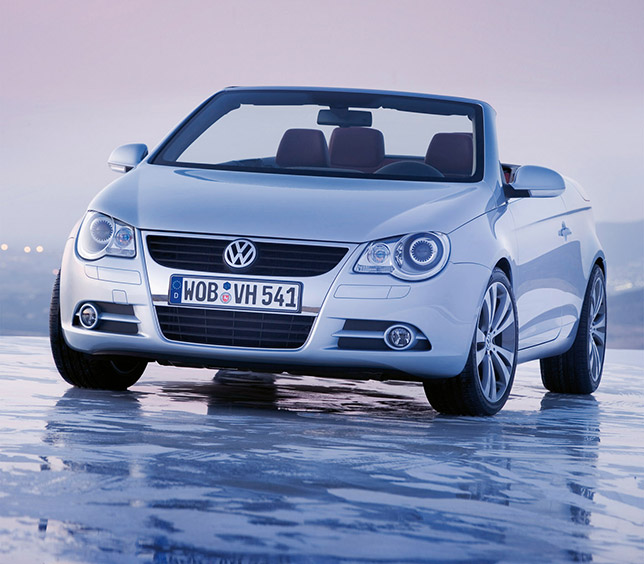
    IAA world premiere: 18 months after the concept C study made its debut at the Geneva Automobile Salon, Volkswagen now presents the series version of its new convertible coupe in the form of the VW Eos. This is the world’s first four-seater car with a five-section CSC roof; the folding hard top combines the characteristics of a coupé, sliding and convertible roof, thereby unifying three different car concepts to form a whole.

    Consistently new design

    CSC design: When closed, the CSC roof curves in an arc between the rear end and the windscreen, giving rise to an outstanding coupé roof which is both elegant and sporty. The roof’s curve is elongated, the rear end muscular and the overall impression is one of high quality. When the roof is open, the 4.41 metre long and 1.79 metre wide VW Eos also clearly reveals that it has been specifically developed as a convertible coupé, and that its body concept has not been derived from any other model in existence. The CSC roof has enabled the windscreen frame to be kept short and the rear compact, lending the vehicle sensuous proportions in the style of a classic convertible.

    CSC characteristics: The five-section CSC structure offers not only optical, but also practical advantages. Firstly, pure convertible feeling. As the windscreen frame – the roof cross member, to be perfectly accurate – projects far less into the interior than is the case with many similar solutions, there is nothing above the driver and front passenger but blue skies. Secondly, optimum entry and exiting. The shorter windscreen frame makes it easier to get into the VW Eos when the top is down, as the driver or passenger does not have to manoeuvre his head past the frame. Thirdly, the integrated glass/sliding/tilting roof, because the sun does not always shine, nor is it always summer. In such cases, the glass/sliding/tilting roof fitted in the VW Eos lets in light, air and good humour.

    Full opening and closing are very speedy, by the way, taking around 25 seconds from the first “clack” to the last “click”. The system concludes the process with a signal tone, confirming that the roof is either open or closed completely. In addition, the CSC roof offers the general advantages of unimpeded suitability throughout the year and minimal driving noise when closed. It is also less appealing to vandals than a soft top. Of course, a roll-over protection system, which shoots out within a maximum of 0.25 seconds increases safety in critical situations.

    VW EOS 2005

    Very wide and powerful

    Dimensions: The convertible coupé is 1.79 metres wide, 4.41 metres long and 1.44 metres high. In relation to each other, these dimensions enhance the vehicle’s dynamics. In comparison with its length and height, the vehicle’s width lends the VW Eos a particularly powerful appearance. Its large track width (over 1.55 metres) not only looks good, it also contributes extensively towards the extraordinarily agile and safe handling characteristics exhibited by the VW Eos. The result is pure driving enjoyment regardless of whether the roof is up or down.

    Scheduled for launch in spring 2006 above the New VW Beetle convertible

    Market launch: TheVW Eos is scheduled to be launched in Europe in spring 2006; the other continents are set to follow the same year. The car will open up a new sub-segment and will be positioned precisely between the A (Golf) and B class (Passat). In parallel, the New Beetle convertible, over 126,000 of which have been built and which underwent a facelift in 2005, will further extend its position as successor to the Golf convertible at the centre of the A class.

    Engines: Volkswagen makes specific use of technical synergies between its model series. Take the engines, for example: In detail, these encompass four petrol engines with outputs ranging from 85 kW / 115 PS, 110 kW / 150 PS and 147 kW / 200 PS to 184 kW / 250 PS plus a 103 kW / 140 PS TDI equipped with a diesel particulate filter as standard. Four-cylinder direct injection engines are fitted to provide outputs up to 147 kW, whilst the 184 kW variant derives its power from six cylinders.

    Sporty, elegant interior

    Passenger compartment: The interior design is also new. Whilst the functional and operating details (e.g. light, air conditioning, radio systems) are familiar from other models, many fundamental VW Eos elements are new developments. These include the cockpit, the door and side trim panels and the rear seat system. Volkswagen is additionally fitting electrically activated easy-entry seats for the first time: These “remember” the driver’s and front passenger’s longitudinal seating positions, and return to these – once the rear passengers have entered or exited the vehicle – at the push of a button. When the roof is open, a volume of 205 litres is available; when closed, 380 litres of stowage space are on offer. As standard, a power latching system closes the boot lid the last few millimetres. A through-loading aperture is additionally integrated into the rear bench seat.

    One equipment version, many equipment details

    Equipment: The VW Eos will be launched in just one high-quality equipment version. Permanent details fitted as standard will include ESP, safety-optimised front headrests, front airbags and specially developed side head-thorax airbags; 16″ alloy wheels (V6: 17″), air conditioning system (Climatic / V6: Climatronic)), fog lights, electric window lifters, ambient lighting, leather-covered steering wheel*, gear lever knob* and handbrake lever* plus sports seats* (* = standard as of 103 kW, optional extras for 85 kW). Optionally, innovative features such as a Dynaudio sound system with ten-channel amplifier, ten loudspeakers and
    600 W output power or bi-xenon headlights with dynamic and static cornering lights will be available for the VW Eos.

  • VW Golf R32 2006

    VW Golf R32 -  front angleIt was the most powerful Golf ever. The VW Golf R32 powered by a 177 kW (241 bhp) engine was first launched in August 2002. Not only was it one of the hottest cars on the road, it also sold like hot cakes: three times as many R32’s were sold than originally planned. These are excellent prospects for its successor.

    Now comes a new R32 based on the Volkswagen Golf V generation. This time it packs 184 kW (250 bhp) under the bonnet; the permanent 4MOTION four-wheel drive again promises excellent roadholding. The new model will see its world premiere at the 59th Frankfurt Motor Show (15 to 25 September). Presales in Germany start on 19 August. Market launch will be at the end of September. Prices for the new Volkswagen Golf R32 start at €32,200.

    From the outside, the best Golf ever is not only recognisable by the R32 logo. Similar to its predecessor, the new top Golf has a design and equipment all of its own. The VW Golf R32 has a top speed of 250 km/h and comes either with a 6-speed manual gearbox or the optional dual clutch gearbox (DSG). Equipped with the DSG the “R32” is even faster: 6.2 instead 6.5 seconds from 0-100 km/h. Despite all this, the model is unusually easy to handle.

    From the front, the new R32 generation is immediately recognisable by its unique aluminium-effect shield-shaped radiator grille. At the top of the grille are double aluminium cross struts. Under the number plate there is another central air scoop for the powerful 3.2-litre V6 engine. Two more large openings on each side of the shield-shaped radiator grille are intended for fresh air supply. As opposed to all other Golfs, there are air ducts at the bottom and on either side of the fully painted front bumper. The lines of the air duct continue into the side skirt all the way along to the rear bumper.

    The rear of the VW Golf R32 is also designed as a fully painted bumper. Only the middle section in the shape of a diffuser is in black. The two round tailpipes made of polished stainless steel are placed centrally next to each other and are integrated prominently in the rear bumper. A glance at the outline of the VW Golf R32 shows the 18-inch light-alloy wheels (type “Zolder“). They are fitted with 20 spokes and continue the design theme of the first R32 wheel. The spokes still allow glimpses of what lies behind them: brake calipers painted blue. They come with 345 mm (diameter) discs at the front and 310 mm at the rear.

    The 225/40 tyres bear the Y-pattern tread for high-speed tyres up to 300 km/h. A large-size rear spoiler makes sure that the rear wheels stay firmly on the road. The fact that the wheel-tyre combination sits snugly in the wheel housings is partly due to the 18-inch wheel size but also to the specially tuned sports running gear that is lower by 20 millimetres.

    VW Golf R32 2006 - Front

    The sporty concept of the VW Golf R32 is a theme that permeates the entire vehicle. Take the interior, for example. There are distinctive instruments, sports seats, pedals in aluminium look and special applications that emphasise the sporty nature of the Golf. The sports steering wheel, with perforated leather along the grip area, and the R32 gear shift knob lie firmly in the hand.

    As opposed to the more purist style of the Golf GTI, the R32 top model boasts a dazzling array of standard equipment at no extra price, such as automatic air conditioning (Climatronic), the RCD 300 audio system with ten loudspeakers, anti-theft alarm system plus, multifunction display, automatic anti-dazzle interior mirror, rain sensor, tyre pressure monitor and the complete safety programme comprising six airbags, ESP and brake assistant. The standard bi-xenon headlights light up the night like day.

    The Golf range: The Golf tops the new registration statistics in Europe. Not only that: no other car in this segment offers so many different engines. With the introduction of the VW Golf R32 the model range now stretches from 55 kW (75 bhp) to 184 kW (250 bhp). Including the VW Golf R32-V6, there are ten engines on offer – six petrol and four diesel. This year two more interesting engines will be added to the Golf range. The Golf remains an exciting car to watch.

  • VW Passat 3.6 L

    The Volkswagen Passat, the mid-sized car that forever changed the attitude of owning a “grown up” family sedan and wagon, is ready to take this popular segment to greater heights and was unveiled at one of metro Detroit‘s premier automotive events during a press conference on August 2, 2005 at Meadow Brook Mansion.

    For the first time ever, Volkswagen has chosen the burgeoning Meadow Brook Concours d’ Elegance, which has emerged as one of the most renowned automotive events in the world, to take the wraps off its most powerful Passat ever, the 280-horsepower 2006 VW Passat 3.6L—an all-new car that arrives at U.S. dealerships in two months. For car enthusiasts and admirers of renowned engine designs, the 3.6L marks the return of VW’s groundbreaking narrow-angle six cylinder powerplant – with a significant growth in displacement, brawn and refinement – to the Passat model line up (this historic engine is known as the VR6).

    This new Passat will be among the most powerful front-drive, family midsize cars ever offered, with the refinement, safety and speed of a true Autobahn bred sedan. The V6 offers a nearly class-leading power-to-weight ratio that allows this family hauler to propel from 0-60 mph in just 6.6 seconds.

    Prior to the launch of this new top-of-the-line V6, Volkswagen will bring the 2006 VW Passat 3.6L model to the U.S. market beginning this month. This all-new sedan will represent the most, sophisticated and affordable German-built family midsize car on the market today, with the starting price at less than $23,000.
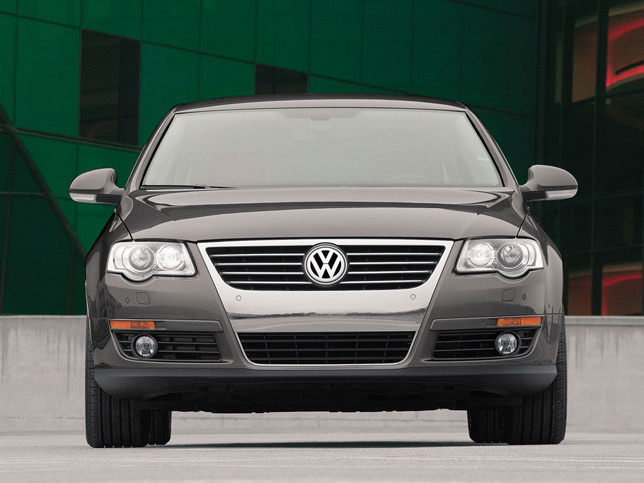
    VW Passat 3.6 L Front

    Significantly, the new Passat’s base engine is upgraded to a sophisticated new four-cylinder engine called the 2.0T. This two-liter is efficient and sporty and uses a turbocharger and an intercooler for cool, higher-density intake air. The 2.0T’s high-end breathing is further enhanced by its four-valves per cylinder. The engine’s overall efficiency begins with an advanced direct-injection fuel delivery system that culminates in 200 hp at 5,100 revolutions per minute, and 207 lbs.-ft. of torque all the way from 1,800 rpm to 5,000 rpm—an extraordinary torque curve that provides plenty of pulling power from the low end through the top.

    Soon after the launch of this new 2.0T engine, Volkswagen’s renowned narrow-angle six-cylinder technology will make its return to the Passat line up. With the Passat’s return to a transverse engine mount, Volkswagen will re-introduce a very refined and powerful version of its famous narrow-angle V6 (widely called the VR6; this version’s cylinder bank’s create a “V” angle of just 10.6 ?). This newly advanced V6 engine has higher-displacement, four-valves-per-cylinder, and variable valve timing, and promises 280 hp at 6,200 rpm and 265 ft.-lbs, at just 2,750. Mated to this ultimate V6, as standard equipment, will be Volkswagen’s refined six-speed automotive transmission with Tiptronic™ and sport mode selection (no plans for a manual).

    Later in the model year, Volkswagen will once again offer the Passat in a wagon version as well. Both the sedan and its variant will offer a 4Motion® (all-wheel-drive) version later in the 2006 model year. Models will therefore include in both body styles: a Passat “Value Edition” 2.0T; a Passat 2.0T; a Passat 3.6L and soon a 3.6L 4Motion.

    The launch of the new Passat in the U.S. is no small event. When it arrived on North America’s shores back in 1997, the contemporary Volkswagen Passat sedan and wagon essentially started the transformation of the common family sized car market. The Passat proved that the inevitable midsize car could actually invigorate drivers and passengers alike. It not only offered great utility, value, safety and room but also dynamic European styling, innovative technology and a “real” German-bred driving experience.

    Today, this same model is setting a new target for all those manufacturers who have played catch up to meet the new expectations of so many family car buyers. As expected in a modern Volkswagen, the all-new 2006 Passat has been stridently refined and moved closer than ever to perfection in its attention to detail, advanced technology, Teutonic driving qualities and uncompromising safety design and features.

    Actually, this new 2006 Passat is the sixth all-new generation of Volkswagen’s midsize car line that can trace its roots back to the Dasher and Quantum of the 1970s and 80s. The outgoing generation that began with the 1998 model in the U.S. was the most successful of any Volkswagen midsize with sales in the U.S. averaging more than 75,000 a year (from 1998-2004).

    While the dictum of form always follows function is an enduring foundation of Volkswagen design, the exterior and interior styling of the departing but contemporary Passat dazzled this sleepy market with its simple sporty European styling and a refined German driving experience. It was hailed universally as one of the most acclaimed and trendsetting in recent automotive history; and, if imitation is the best form of flattery, then the Passat ranks at the highest end of the admiration spectrum as well.

    Fortunately, just as more and more automakers play follow-the-leader and begin perfecting their cloning, Volkswagen’s designers have breathed new passion and power into the look, ambience and spatial presence of an all-new 2006 Passat.

    Overall, the sixth Passat is by far the most skillfully refined, secure and technically advanced of any iteration before it. Befitting this progressive target for the newest B class, Volkswagen’s designers harmoniously sculpted a car that is characterized with an almost avant-garde potency and class—one that is clearly muscular, but in a purposeful, sinewy way that commands respect but in no way demands it.

    The new Passat goes proudly into the busy world of modern family life with a new medallion-shaped grille accented by brilliantly clear, clean, high-tech headlight housings that exude the precision engineering and advanced production of this new leader of the family class. Its eyes, the front lights, willingly challenge the road ahead, staring it down with the focus of a highly prepared athlete anxious for competition.

    This confident stance is also seen in the new Passat’s silhouette – paralleling in a contemporary way its trendsetting predecessor – arching with functionality, beauty and a timeless tension that creates a visual balance when admiring eyes travel pleasantly from front to rear. At the car’s back, one can see a classic and dynamic Volkswagen design leap that harmoniously mixes sharply tailored rear lighting with an enduring sporty and functional overall design.

    The new Passat’s pure exterior dimensions have broadened slightly to accommodate, partly, a more functional and ergonomic interior. The wheelbase lengthens slightly to a new 106.7 inches versus the previous 106.4. Overall length is more dramatic: now 188.2 inches versus 185.2 before. The body is wider as well (71.7 inches as opposed to 68.7). Stability in general should further be enhanced with a wider track Passat layout, both at the front and rear, which measures 61.1 inches (previously 59.6).

    A clear indication of the new Passat’s quality foundation is its static torsion stiffness that is measured at a 57 percent higher level than its predecessor’s already solid static rigidity. Dynamically, the new Passat also improves on the Passat’s traditionally stiff driving tolerances that allow for a refined chassis and subsequent ability for engineers to dial in optimum suspension settings and improvements.

    The Passat’s fundamentals are the tireless collaboration of designers, the R&D teams, engineers and production experts who have allowed for extremely innovative production methods, new techniques, and materials. This production process is a complex array of advances but the most dramatic contributor is achieved through the use of more high-strength, yet lighter materials throughout and an advanced, highly automated, laser-welding system that requires a battalion of new-generation robotics and elaborate laser-measuring check points. This results in a dramatic increase in laser welded seams, and also helps establish a significant breakthrough in weight barriers that allow for improvements in size, the aforementioned rigid integrity of the overall chassis, and the car’s new class-leading amenities.

    Inside, a simple glance reveals another evolution in Volkswagen’s renowned interior design and simple but unrelenting attention to detail. Residing in a new Passat is again a unique and progressive automotive experience: whether at the wheel or residing in the front or rear, the occupants find a fresh, stylish, modern design that remains strikingly simple with use of top quality materials, attention to comfort, driving and details throughout all models, from the standard trim level that symbolizes Volkswagen’s commitment to value for the money, to the top-levels such as those found in numerous equipment options and stand-alone packages.

    More exterior room for the new Passat certainly translates into more width and legroom, especially in the rear seating area, where it grows from 35.3 inches to 37.7”. New rear vents for the standard air conditioning and heater also provide more comfort at the car’s stern, and the trunk, which provides a 60/40 split folding seat if needed and pass through for much longer items, is 14.2 cubic feet of space that because of thoughtful overall design offers incredible utility with plenty of neatly unobstructed space. Overall, the new Passat provides 96.3 cubic feet of passenger volume (versus 95 cu.ft. in today’s version).
    As one expects of Volkswagens, the new Passat embodies the German engineering mandate of building ever higher and higher levels of advanced occupant protection with each new generation of car. The previous Passat was proven to be among the safest vehicles on the roads of America, regardless of vehicle class or weight. In the most important “real world” study of its type, the highly regarded Insurance Institute for Highway Safety studied data from serious accidents and measured those with the lowest death rates (see IIHS “Status Report, March,” 2005). Among all passenger vehicles, the Passat attained the third lowest death rate. The only “car” ranked higher was the Mercedes E. The only truck, the Toyota 4Runner.

    The new 2006 Passat is now the newest example of this important Volkswagen reputation for safety, and brings true Autobahn-bred safety development and features to this family car segment by employing the most comprehensive standard list of advanced passive and active safety technology in its class. Safety is the tantamount function of all that is formed in the creation of a new Volkswagen, which is why the German automaker’s overriding philosophy is to bring the most sophisticated safety technology to the widest range of models when feasible.

    Major standard safety items for the newest Volkswagen–many of which have been updated with the latest in technology but have been standard on Passats for several years—include eight total airbags, including front side thorax airbags, and Side Curtain Protection™ (head) in the front and rear.

    A few of the most significant passive safety features now offer standard crash-active front headrests and crash-optimized foot pedals that descend upon serious impact. Daytime Running Lights (DRL), three-point safety belts, and adjustable headrests for all five occupants are also important holdover items to help in protection. And where details and precision positioning count the most, Volkswagen has made sure all outboard occupants are able to easily position their safety belts with shoulder height adjustments. Front belts use pre-tensioners with load limiters, and all safety belts use emergency locking retractors. Rear side thorax airbags are optional for the first time ever in a Passat, and if chosen, will supplement the standard head curtain protection system.

    As expected in a Passat, active safety is also tantamount to the development of Volkswagens and the 2006 Passat is no exception and is arguably among the leaders in its segments in offering a list of performance items that can help avoid accidents in the first place, including the stability and surefootedness of a precise-handling front-drive sedan, with standard four-wheel disc ABS brakes that are coupled with a sophisticated Engine Braking Assist system. Another major technical advancement in the new Passat is a standard electro-mechanical power steering system that can help assist with straight-ahead driving adjustments when necessary—an example of this could be freeway driving through strong crosswinds. All Passats come standard with an Electronic Stabilization Program—an active safety item that is being recognized through independent research to be an increasing vital safety features—Anti-Slip Regulation (ASR) and Electronic Differential Locking (EDL). Of course later in the year 2006, all wheel drive comes with 4Motion.

    The new Passat employs an advanced version of the tried-and-true independent McPherson strut architecture. The car’s strut-type axle creates a very desirable direct steering ratio; a high level of transversal axle rigidity and a low tendency to allow body roll on tight turns. The Passat’s precise handling is only one attribute of this front suspension; this design also helps enhance its ride through the optimization of the springs, the separate mounting of springs and dampers, improved mounting points for the lower wishbones, and the use of twin-sleeve shock absorbers. This, of course, offers less noise during varied driving conditions and surfaces.

    At the rear, the new Passat is now equipped with an advanced multi-link independent rear suspension. This feature promises to help the Passat set a new standard in its market segment by providing an ideal balance of sporty driving dynamics and ride sophistication. This fully independent four-link suspension, with coil springs, telescopic shocks and stabilizer bar, also allowed the designers and engineers to create more utilitarian space and practicality including great width in the luggage compartment.

    Handling performance is honed to perfection by a new electro-mechanical power rack-and-pinion steering system that offers an extremely good “center feel” and contributes significantly to the new car’s confident-feeling stability. Unlike some similar systems found on luxury cars, the new Passat’s function varies the steering assist based on the speed of the car and other driving factors. This gives the Passat driver a desirable connected-to-the-road feel but also provides the added capability of active-return steering and straight-ahead driving correction assistance.

    As expected, Volkswagen is backing the new Passat with a comprehensive warranty that includes a bumper-to-bumper New Vehicle Limited Warranty for four years or 50,000 miles, whichever comes first, with wear-and-tear items and adjustments covered during the initial 12 months or 12,000 miles. Additional coverage is provided by 24-hour roadside assistance for four years with unlimited mileage, a five year/60,000-mile Powertrain Limited Warranty and a Limited Warranty against Corrosion Perforation for 12 years with unlimited mileage.

  • VW Passat Estate

    The new VW Passat Estate is currently in pre-production, and its launch in Europe is imminent, with the first cars set to debut on August 19th at Volkswagen dealerships in Germany. Advance sales will begin on June 3rd, with prices starting from 22,900 euros, which includes standard features such as air conditioning system (Climatic), roof rails, electronic parking brake, and ESP.

    The Passat Estate is among the most successful cars in the world, with over 4.3 million units produced to date. The latest generation has been designed with even more refined professional functionality and presented in an attractive package. Its VW design aims to create anticipation for the new Passat Estate and other exciting things to come in the current VW model lineup.

    Passat Estate design in detail

    The Passat saloon’s design, launched earlier this year, has a distinctive, trendy, and progressive look. The chrome shield-shaped radiator grille is the brand’s new face, which highlights its uniqueness. While the front of the saloon and the estate appear similar, their dissimilarities are visible from the B-pillar. The side lines and rear part of the five-door vehicle reveal Volkswagen’s excellent design. The Passat Estate’s appearance is traditional yet unusual. Its design is a clear indication of a Passat, but it has a stronger and more emotional feel than its predecessor’s timeless elegance.

    The car’s silhouette is robust, with the lower edge of the side windows slanting upwards towards the rear section and the top edge downwards. The “window line” gradually tapers from the B to the D-pillar, producing a “lighter,” “elongated,” and “sportier” impression. While the roofline has a subtle curve towards the back, it makes the roof side members more prominent below the roof rail and towards the D-pillar. A trim strip incorporated into the sill panels and the rear bumper element emphasize these “tapered” lines. The LED rear lights, with their distinct day and night design, and the pronounced haunches above the rear wheels, provide the design with a sense of presence.

    VW Passat Estate

    The new Passat Estate boasts a bigger and more athletic appearance due to its unique silhouette design and powerful haunches, which add to its elegance. However, this modern appearance does not compromise the car’s luggage compartment capacity or suitability for daily use. Despite appearing lower and more dynamic than its predecessor, the new Passat Estate is actually 1.9 centimetres taller, measuring a total of 1.52 metres.

    An overview of the dimensions of the new VW Passat Estate

    The new Passat Estate boasts a spacious interior and exterior design. It is 4.77 meters long and 1.82 meters wide, which is 9.2 centimeters longer and 7.4 centimeters wider than its predecessor, providing more room for passengers. The luggage compartment can hold up to 603 liters when loaded to the cover and 1,731 liters when fully used, including the 90-liter spare wheel well. The fuel tank capacity has also been increased to 70 liters, and it can carry a maximum load of 638 kilograms.

    A selection of the standard equipment available in the new VW Passat Estate

    The new VW Passat Estate will be available in four equipment lines, namely Trendline, Comfortline, Sportline and Highline, similar to the saloon version. The base model, Trendline, comes equipped with standard features such as ESP, air conditioning system, six airbags, 16-inch wheels, central locking with remote control, electronic parking brake, electro-mechanical power steering, folding luggage compartment floor, asymmetric split folding rear seat bench, and black roof rails.

    In addition to the features of Trendline, the Comfortline, Sportline and Highline models offer more chrome details, extended centre console with armrest, storage compartment, and rear plug socket, electric rear windows, and a 6-way electrically-adjustable driver seat. These three equipment lines also come with unique features such as folding passenger seat backrest in the Passat Estate Comfortline, sports suspension in the Sportline version, and chrome roof rail in the Highline version.

    The new optional equipment for the Passat Estate

    In addition to these features, the new VW Passat Estate also has a clever rear section with a low loading sill and an optional easy open function for the tailgate, which opens automatically when the driver “kicks” their foot under the rear bumper. The luggage compartment can also be equipped with an optional electrically deployable tow bar which swivels out from underneath the vehicle. This feature makes it easy to attach a trailer without having to bend down or dirty your hands.

    The new VW Passat Estate engines

    The Passat Estate will offer eight engine options, with only the entry-level engine (75kW/102 PS petrol engine) being carried over from the previous range. Four new petrol engines are available, all featuring homogeneous direct injection, with power outputs ranging from 85 kW/115 PS to 147 kW/200 PS. Additionally, a 3.2 litre V6 FSI engine with 184 kW/250 PS will be added to the range in the last quarter of 2005, and will come standard with 4MOTION four-wheel drive. The 150 and 200 PS versions of the Passat Estate can be recognized by twin tailpipes at the rear left, while the 250 PS version features a large tailpipe on both left and right sides.

    For the first time, each of the three TDIs will be used in the Passat Estate series. The diesel engines will come in three different units, offering 77 kW/105 PS, 103 kW/140 PS, and 125 kW/170 PS. The most powerful TDI features a highly innovative piezo-operated high-pressure fuel injection system and comes standard with a diesel particulate filter. The filter will be an optional addition for the TDI engines with 105 and 140 PS.

    Source: Volkswagen

  • Volkswagen Beetle

    VW Beetle 2006 - Front Angle
    Volkswagen of America, Inc. revealed its “new” VW Beetle and VW Beetle convertible which has a subtle but stylish new look that fashionably updates, yet maintains, the core emotional appeal of the iconic new Beetle design, first launched in 1998.

    The 2006 VW Beetle and the convertible will be launched in September of this year and will come standard with a more powerful new 2.5 liter, five-cylinder engine that creates 150 horsepower (versus the four-cylinder, 2.0 liter that created 115 hp).

    Another significant technical update is standard traction control with Electronic Stabilization Program (ESP).

    Styling changes for the 2006 VW Beetle include bolder, slightly sharper bodylines, especially at the wheel wells and bumpers that are tailored for a more modern overall impression. New details include a larger, more oval headlight treatment, new taillights, and new bumper designs; inside, the freshening involves a new instrument cluster design with chrome applications to the instruments and also the air vents.

    Volkswagen said it will release more details on the 2006 models later this summer. The automaker showed the 2006 VW Beetle in conjunction with its 50th anniversary as a subsidiary in the U.S.

  • Brabus B63 S

    Brabus B63 S

    BRABUS B63 S engine tuning enhances the power output of all Mercedes 63 AMG models, with the high-revving 6.2-liter V8 now delivering 550 hp / 404 kW and peak torque of 650 Nm. This results in a sprint time from 0 to 100 km/h in just 4.3 seconds and a top speed of 330 km/h, making the CLS 63 AMG with BRABUS B63 S tuning perform like a true super sports car.

    BRABUS power kit includes reprogrammed engine electronics with a unique injection and ignition mapping. In addition, the kit has a sport air filter that enhances the combustion air supply, and high-performance metal catalysts on the exhaust side with low back pressure to comply with EURO IV emission limits.

    BRABUS recommends the locking differential for all Mercedes 63 models with rear wheel drive to transfer the increased power to the road with minimum slip. The locking rate of up to 40 percent is great to have.

    The BRABUS B63 S performance kit can be installed in all Mercedes 63 AMG models. With 550 hp / 404 kW, the ML 63 can accelerate from 0 -100 km/h in 4.9 seconds and reach a top speed of 275 km/h when combined with the BRABUS V/max unit.

    To fully utilize the increased power, modifications to the tires, suspension, and brakes are recommended by BRABUS. Depending on the Mercedes 63 AMG model, custom-tailored tire and wheel combinations up to size 11Jx23 with tires up to 315/25 R 23 in size are available. BRABUS has developed a control module for the ABC suspensions, which lowers the ride height by 20 millimeters to further enhance the already great handling characteristics. Additionally, BRABUS sport stabilizers minimize body roll and optimize turn-in.

    BRABUS offers a high-performance brake system for all Mercedes 63 AMG models. This system provides excellent stopping power and endurance, typically only found in sports cars. Customers can also request a special version with ceramic discs. The front axle has 380 x 36 millimeter discs and 12-piston aluminum fixed calipers, while the rear axle has six-piston fixed calipers and 355 x 28 mm brake discs.

    BRABUS offers various interior accessories such as genuine carbon-fiber trim, illuminated scuff plates with the BRABUS logo, and sport steering wheels. They also provide a speedometer with a 360-km/h dial.

    Customers can request a special interior made of the soft and durable BRABUS Mastik leather and Alcantara from the company’s upholstery shop.

  • Yes! Roadster

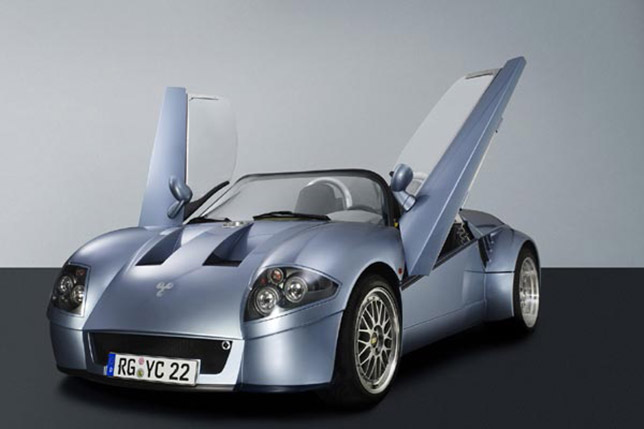
    It can well be expected that their expectations will be met: Both the YES! Roadster and the YES CUP/R are a manifestation of the creed of two company founders and current managing directors Herbert Funke and Philipp Will: Reduce to the core. And for the two designers this means that the direct car-road communication must not be interfered by unnecessary gadg-ets. Hence, what the owner of a YES! will purchase is nothing more and nothing less than a driving machine.

    Translated into plain figures this means: Like the original YES! Clubsport model the new YES! Roadster possesses a performance-enhanced 1.8 liter 210 KW (286 hp) Volkswagen turbo engine that takes the car from 0 to 100 km/h in just 4.2 seconds at 5900 rpm and with a maximum torque of 330 NM. These characteristics place the car in the top performance range. The second new development YES! CUP/R even surpasses the features of the Roadster.
    The vehicle’s 250 kW (340 hp) 2.0 liter turbo engine meets all racing de-mands: chassis, undercarriage, brakes – the entire technology has been designed for the in professional motors sports. Apart from the engine features, the car’s ultimate lightweight design plays an important role: All three models are based on an aluminum space frame, enhanced by the use of composite materials for the carbody and understructure.

    YES! Roadster

    Taylor-made hand manufacture

    The production of the cars at the Funke and Will plant, established in 2001, strongly differs from the familiar mass output. Each YES! sports car is a hand-manufactured unique to which the purchaser contributes to a large extent. Before completion, the fine tuning is made on-site together with the buyer to adapt the car’s every detail to its subsequent owner: colour, special features, ideal sitting and switching position, and pedal alignment. This participation concept and the 100-percent hand production make the YES! a singular occurrence on the sportscar market. The same holds true for another feature: On the company’s 2.2 mile long former runway of an old military air field, the buyer can test-drive his car up to maximum speed. And finally: the manufacturers’ service concept matches the car’s individuality. If necessary, a YES! partner comes to the customer, 24 hours a day, seven days a week.

    It started with a diploma thesis

    The YES! sports cars owe their birth to the graduation of the two company founders at Co-logne Technical College. In the scope of their final thesis the two engineers designed road-ster. A friend, the Stuttgart based designer Oliver Schweizer developed the cars styling. The prototype was first presented under at the International Motor Show IAA in Frankfurt and generated an unexpected demand. Owing to this favourable development the engineers decided to set up their own business. The start-up company’s highly positive development on the hard-fought international automobile markets proved the founders right to uncom-promisingly pursue their initial concept of a minimalist pure sports car.

  • VW Fox

    Volkswagen’s 2005 model offensive is maintaining its impressive momentum as the new VW Fox and new VW Polo make their international debuts. Following the Jetta in the USA, the Golf Plus, and the new Passat, two more models are now set to be unveiled. The 15th AMI Leipzig (2-10 April 2005) will also be the venue for the first appearances of the VW Passat und VW Golf Plus at a German motor show.

    Both debuting models will be unveiled at the press conference on 1 April 2005 at 9:00 am on the Volkswagen stand in Hall 1.

    2005 VW Fox

    The Fox makes no compromises. It is the maximum vehicle for the minimum money – with two doors, a large tailgate, and masses of space. It is a fully-fledged car in every way, despite a frugally calculated price. The VW Fox has superior running gear with the option of ESP. ABS is part of the standard specification. Its galvanised and laser-welded body combines functionality with high build quality. And prices for the Fox start at under 10 000 euros. Volkswagen will start taking orders for the Fox shortly after the AMI Leipzig opens and its launch will begin in late April.

    The VW Fox interior is designed for clear operating logic and optimum benefit for the user. It is based on a four-seat configuration and offers excellent space both in the front and rear. The VW Fox comes with an optional adjustable rear seat, which can be moved lengthways by up to 15 centimetres and has a two-section backrest divided in the middle. Depending on the configuration, boot capacity varies between 260 and 1 016 litres. Three engines are available for the Fox: two petrol engines and one turbodiesel (TDI). The two petrol engines have an output of between 40 kW (55 PS) and 55 kW (75 PS). The TDI develops 51 kW (70 PS).

    2005 VW Fox Rear

    The latest generation of the Polo, a grown-up, but still youthful all-rounder, will continue to set the standard for its class. For years its has it successfully set itself apart from its competitors in reader surveys and in new car registration figures. The Polo has retained its likeable looks. Despite improved comfort and safety equipment, it is priced at the same level as its predecessor. The 1.2 litre 40 kW (55 PS) petrol engine Polo costs 11 250 euros, the 51 kW (70 PS) TDI base model starts at 13 485 euros, which actually places it at a lower price than the predecessor model with the equivalent engine. The new Polo will be launched in Germany and the major European markets in late April.

    The Golf Plus, while unmistakeably part of the Golf family, offers completely new dimensions and has its own absolutely distinctive character. The body and interior are completely new developments and have been tailored to customer needs. Highlighting the practical benefits for customer are “Plus” features such as variability and functionality in the interior with substantially more space for rear passengers and an adjustable rear seat with 16 centimetres travel, outstanding seat ergonomics, and up to 43 stowage features.

    The new Passat was developed with a focus on emotional quality and pleasure in technical content. It redefines technology competence for the mid-class car. The design of the new Passat represents the greatest evolutionary leap since the creation of the series.

    2005 VW Fox Interior

    It features a seemingly unending list of innovations from a completely new running gear with a noise-reduced four-link rear suspension or ESP with trailer stabilisation, new brakes with disc drying, a button-operated electromechanical parking brake, the new starting and locking system, through to automatic distance control or the new Bluetooth telephone system and more…

    Volkswagen is also showing the way with the presentation of natural gas powered studies of the Touran und Caddy. These vehicles are already at an advanced development level and show Volkswagen’s competence in alternative drive technologies. Both studies are fitted with a quasi-monovalent engine concept. That means that the engine is optimised for operation with natural gas, but can run on petrol if the nearest natural gas fuel station is too far to reach. The Caddy is equipped with a natural gas tank holding 28 kilograms, which gives it a range of 450 kilometres. The Touran covers approx. 300 kilometres on its 20 kilograms of natural gas.

  • VW Polo

    VW Polo 2005 - Front View
    In time for its 30th birthday, the new VW Polo appears optically more dynamic and fresher than ever before. The new front end with its V-shaped radiator grille, in particular, lends the VW Polo a significantly more striking look. Pre-sale will start on March 14; despite improved equipment, the vehicle’s prices will remain at the same level.

    The new VW Polo is coming! Based on its well-known virtues, the most recent generation of this all-round talent will remain the benchmark in its class. The Polo’s appealing radiance has also remained, although its exterior appears more mature and even more modern. Pre-sale of the new Polo will start on March 14 in Germany.

    Despite its improved convenience and safety equipment, the vehicle’s prices will remain at the same level. The VW Polo 1.2, which has an output of 40 kW / 55 hp, therefore costs €11,250; the basic TDI, which offers 51 kW / 70 hp, starts from €13,485 and therefore costs less than the predecessor’s entry-level diesel version. Market launch in Germany and the most important European countries will take place at the end of April.

    Following the new Passat, the new Polo will be the second Volkswagen to display the new brand face. The entirely redesigned front end bears the escutcheon grille and re-interprets the V topic. From the A-pillars, a striking curve stretches via the bonnet to the radiator grille.

    However, the new Polo’s face is essentially characterised by its headlights. These are defined as a trapezoidal element, enhanced by the eye-catching, circular element of the main headlights.

    Thanks to this front end design, the Polo retains its appealing character, but its modern design style places it in a higher-quality class. In comparison with the predecessor, its redesigned front extends the new Polo by 19 millimetres to 3916 millimetres. Its width (1650 millimetres) and height (1465 millimetres) correspond to the currently available model.

    The rear end lends the vehicle a further dynamic touch. Here, the rear window ends in a V shape in the lower frame area, making the Polo appear more lively and sporty when viewed from the rear. The redesigned rear lights also demonstrate character, picking up on the front end’s circular elements and clearly setting the tone at the rear of the new Polo.

    Regarded from the side, the Polo stands out thanks to a design which is both clear and convincing. Accentuation of the two available body versions is typical of the VW Polo: whilst the two-door’s ascending lateral curve bears coupé-like features, the four-door reveals stature and solidity in its clear design and third side window in the C-pillar.

    This most recent generation of the Polo will be available in three equipment levels: “Trendline”, “Comfortline” and “Sportline”. In addition to the good convenience and safety features familiar from these equipment levels, the new Polo is fitted with further, new details as standard. These include an anti-lock brake system with dual-rate brake assist, electric window lifters in the front, air conditioner (as of Comfortline) and central locking. Until recently, features such as Park Distance Control, Tyre Pressure Monitor and the dipped-beam’s “Coming Home” function were exclusively available for luxury class models. The VW Polo will set the pace with these features, and combines a high-quality, modern design with innovative equipment which meets the requirements of progressive customers.

    The new VW Polo has also been modernised inside. High-quality fabrics in an exclusive and fresh design lend a reviving touch. In addition to the redesigned instrument graphics, new steering wheels are also available.

    The new VW Polo is fitted with front and side airbags on both front seats as standard. An optional head airbag system, in which the curtain airbags inflate to provide protective padding covering the entire side window area, is also available. The Electronic Stabilisation Programme (ESP), which is fitted as standard in engines as of 74 kW / 100 hp, and is optionally available for the other engines, additionally offers effective support for safe driving.

    The new Polo demonstrates its first-class qualities as an all-round talent in the diversity of its engines. Five petrol engines with outputs ranging from 40 kW / 55 hp to 74 kW / 100 hp – including an FSI engine – and four state-of-the-art TDI engines with outputs from 51 kW / 70 hp to 96 kW / 130 hp are available.

    Access to the VW Polo’s diesel world is provided by a modern 1.4-litre three-cylinder TDI with 51 kW / 70 hp, which replaces the familiar 1.9 SDI. Another new engine, a three-cylinder 1.4-litre TDI with 59 kW / 80 hp, meets customers’ wishes for higher output.

  • VW Beetle Ragster

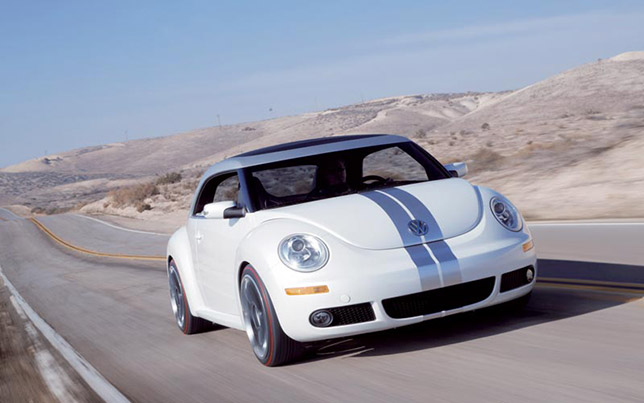
    2005 VW Beetle RagsterIt’s a statement, an automotive way of life. More than 800.000 drive one, the Volkswagen with the perhaps most famous design in the world: the New VW Beetle Ragster. For the North American International Auto Show in Detroit the German company presents the hot potential of the design classic – with a study on 2005 VW Beetle Ragster. Its most visible characteristic: a drastically dropped roof with a large ragtop.

    Ragtop + Speedster = Ragster The development team based the Ragster on the reinforced convertible, shortening the A-pillars by about 90 millimeters and creating a set u-shaped roof fixing for the Ragtop’s frame. It becomes instantly clear where the „Hot Rod“ with its ragtop and speedster dimensions got its name.

    New design: The Ragster shows new visual ways. And this does not only hold true for the top. The fenders, bumpers, headlights, tail lights and 19” aluminum rims are all newly designed as well and more progressive and sporty than ever. Newly designed interior: Racing car bucket seats, sports car type steering wheel with integrated engine start button (right side) and ragtop control (left side), center console and the extremely clean designed cargo area.

    Power? Anything goes: The drive – A powerful gasoline engine or a high torque TDI are imaginable. Although it has yet to be determined which motor will be built and if the study will be produced in series – Anything goes. Just as in Concept 1, the study on the New VW Beetle Ragster, which also started in Detroit. – A great place for a world premiere…