Category: Redirect

  • Mercedes-Benz S 400 BlueHYBRID

    The CO2 champion in the luxury class, with an efficient hybrid drive system and lithium-ion technology

    Mercedes-Benz is launching its first passenger car model equipped with a hybrid drive system in summer 2009 – the S 400 BlueHYBRID. The combination of a modified V6 petrol engine and a compact hybrid module makes the S 400 BlueHYBRID the world’s most economical luxury saloon with a spark-ignition engine.

    The NEDC combined fuel consumption is a mere 7.9 litres per 100 kilometres. This makes for the world’s lowest CO2 emissions in this vehicle and performance class – just 190 grams per kilometre. These exemplary figures go hand in hand with assured performance. The 3.5-litre petrol engine develops an output of 205 kW/279 hp, the electric motor generates 15 kW/20 hp and a starting torque of 160 Nm. The result is a combined output of 220 kW/299 hp and a combined maximum torque of 385 newton metres. Moreover, the new S 400 BlueHYBRID is the first series-production model to be equipped with a particularly efficient lithium-ion battery specially developed for automotive use. This is another major contribution by Mercedes-Benz to the electrification of the car.

    The new Mercedes-Benz S 400 BlueHYBRID is based on the S 350, and features an extensively modified drive train. This encompasses a further development of the 3.5-litre V6 petrol engine, an additional magneto-electric motor, the 7G-TRONIC seven-speed automatic transmission specially configured for the hybrid module, the necessary operating and control electronics, the transformer and a high-voltage lithium-ion battery.

    The compact hybrid module is a disc-shaped electric motor that also acts as a starter and generator. The system offers a double benefit, as it both helps to save fuel and increases driving enjoyment. This is partly due to the booster effect of the electric motor, as it powerfully backs up the petrol engine with a maximum additional torque of 160 newton metres during the high-consumption acceleration phase. The driver benefits from the combined action of these two units in the form of even more impressive torque characteristics and smooth, effortlessly superior acceleration.

    The hybrid module also has a comfortable start/stop function, which switches the engine off when the vehicle is at a standstill – for example at traffic lights. When it’s time to move off again, the electric motor almost imperceptibly restarts the main power unit. This likewise makes a contribution to fuel economy and environmental protection: because the engine restarts first time, and practically instantly, emissions are also minimised during the starting phase.

    When the vehicle is braked the electric motor acts as a generator, and is able to recover braking energy by a process known as recuperation. Working in finely tuned partnership, the electric motor supplements the braking effect of the petrol engine and the wheel brakes to deliver a smoothly progressive braking action. The recuperated energy is stored in a compact yet highly efficient lithium-ion battery in the engine compartment, and made available when required. This complex system is managed by a high-performance control unit, which is likewise located in the engine compartment.

    A milestone on the road to electrification

    The centrepiece of the modular, very compact and highly efficient hybrid drive system is the new high-voltage lithium-ion battery, which was specially developed for automotive use and is the first such unit worldwide to be introduced in a series-production vehicle. In this way Mercedes-Benz is making a trailblazing contribution to the electrification of the car, with the S-Class once again playing the role of the technological trendsetter.

    Major advantages over conventional nickel/metal hydride batteries include a higher energy density and better electrical efficiency, together with more compact dimensions and a lower weight. Thanks to space-saving installation in the engine compartment, where it replaces the conventional starter battery, the generous interior space and boot capacity of the S 400 remain unchanged. The lithium-ion battery not only stores energy for the electric motor, but is also connected to the 12-Volt onboard network via the transformer to supply power to other standard consumers such as the headlamps and comfort features. The completely newly designed battery system consists of the cell block with its lithium-ion cells and the cell monitoring system, the battery management function, the high-strength housing, the cooling gel, the cooling plate, the coolant feed and the high-voltage connector.

    Optimised thermal efficiency lowers the engine’s fuel consumption

    The 3.5-litre V6 petrol engine with variable valve control has been throughly re-engineered and improved. In the process the development engineers made use of the advantages offered by the Atkinson principle,where the expansion phase is longer than the compression phase. The intake valve is kept open slightly longer between the intake and compression phases, which improves the engine’s thermal efficiency while reducing the specific fuel consumption and untreated emissions. A new cylinder head, different pistons and a modified camshaft with different camshaft control increase the output by 5 kW/7 hp to 205 kW/279 hp – while reducing fuel consumption at the same time.

    Especially on rural journeys and on motorways, the S 400 BlueHYBRID achieves a further efficiency improvement by moving the so-called operating point of the petrol engine to produce a lower specific fuel consumption. The extremely high start-off torque made possible by the boost effect of the electric motor gives the driver a particularly exhilarating feeling of powerful acceleration, while fuel consumption and emissions are reduced.

    The electric motor improves efficiency

    The compact, disc-shaped electric motor, which is space-savingly installed in the torque converter housing between the engine and the 7G-TRONIC seven-speed automatic transmission, improves efficiency even further. This is a 3-phase AC external rotor magneto motor, which develops a peak output of 15 kW/20 hp and a starting torque of 160 newton metres with an operating voltage of 120 Volts.
    This compact motor also acts as a starter and generator, adopting the functions of both these conventional ancillary units.

    Sophisticated interaction with the internal combustion engine makes numerous additional functions possible that positively influence the emissions and agility of the S 400 BlueHYBRID in equal measure. Moreover, this disc-shaped motor effectively dampens torsional vibrations in the drive train, thereby further reducing noise and vibrations in the interior. The result is even more ride comfort for both driver and passengers.

    “Boost” effect for even more driving pleasure

    The overall system offers extensive benefits: firstly by helping to save fuel, and secondly by increasing driving pleasure with the help of the “boost” effect, where the electric motor gives powerful assistance to the petrol engine with its maximum torque of 160 newton metres right from the beginning of the fuel-intensive acceleration phase. This means that the hybrid drive system of the S 400 BlueHYBRID moves off powerfully even from very low engine speeds, as the torque curve impressively confirms. The additional torque of the hybrid module also has a consistently positive effect during subsequent acceleration phases. In all driving situations, the driver therefore benefits from the interaction between the two units in the form of powerful responsiveness and muscular torque – but without an increased fuel consumption.
    The S 400 BlueHYBRID accelerates from zero to 100 km/h in 7.2 seconds, and reaches an electronically governed top speed of 250 km/h. The S 400 BlueHYBRID betters the already very favourable NEDC fuel consumption of the conventionally powered S 350 by up to 2.2 litres per 100 kilometres. CO2 emissions are reduced by 21 percent.

    The start/stop function already saves fuel when rolling to a stop

    In addition the hybrid module features an extremely comfortable and efficient start/stop function, which already switches the engine off when the vehicle is rolling to a stop at less than 15 km/h, for example before stopping at traffic lights. When it’s time to move off again, the electric motor immediately and imperceptibly restarts the main engine as soon as the driver releases the brake pedal or operates the accelerator. This likewise contributes to fuel economy and environmental conservation: as the engine restarts practically instantly, emissions are also minimised during the starting phase. The vibrations and jolts that are unavoidable when starting with a conventional starter are also reduced to a minimum.

    Steering and climatic comfort remain unchanged, as both the steering servo pump and the refrigerant compressor are electrically powered. Both systems therefore continue to operate even when the vehicle is at a standstill with the engine automatically switched off. The intelligent control logic is able to detect whether the driver is executing a turning or parking manoeuvre. In this case the automatic start/stop function is temporarily deactivated, so that these manoeuvres can be carried out in comfort.

    Every braking action generates electric power for the battery

    When the vehicle is braked, the electric motor acts as a generator and uses a process known as recuperation to convert the kinetic energy into electrical energy. This energy is stored in the compact yet highly efficient lithium-ion battery, and made available when required.

    In the process the electric motor assists the engine braking effect of the internal combustion engine in two smooth, seamless stages: In stage one, on the overrun with no braking action, the electric motor acts as a generator and begins to recuperate energy. Stage two commences as soon as the driver lightly operates the brake pedal: the generator output is then increased proportionally, and perceived as heavier deceleration by the driver. Only when more brake pedal pressure is applied are the wheel brakes activated in addition to recuperation. In this way more electrical energy can be generated, while saving wear and tear on the hydraulic braking system at the same time. To make the best possible use of this double benefit, Mercedes engineers also developed a new braking system with a new brake pedal module for the S 400 BlueHYBRID.

    Cleverly located control electronics

    Dedicated control electronics are required to operate the 3-phase AC electric motor in the 120-Volt high-voltage DC network. The current converter is accommodated in the space formerly occupied by the starter. As the control electronics heat up as a result of electric currents measuring up to 150 amps, the system is equipped with its own, additional low-temperature cooling circuit.

    Mercedes-Benz engineers have accommodated the transformer in the right front wheel arch, where it facilitates the exchange of energy between the 120-Volt high-voltage network and the 12-Volt onboard network – and also allows the option of emergency starting with jump leads if the standard battery should lose its charge. To ensure a consistently high level of electrical efficiency, the transformer is likewise cooled by a low-temperature circuit. The 12-Volt lead/acid battery is installed in the boot, and not only supplies the standard consumers but also the monitoring system for the high-voltage components with energy. Thanks to its interaction with the lithium-ion battery, it is considerably smaller in size and lighter than usual.

    Tried-and-tested automatic transmission with a new configuration

    Mercedes-Benz developers also adapted the well-proven 7G-TRONIC automatic transmission to suit the hybrid drive, with newly programmed software for the transmission management system. A newly developed auxiliary oil pump ensures reliable lubrication of the transmission even during phases when the internal combustion engine is switched off.

    This complex system is managed by the modified high-performance engine control unit. This incorporates extensive functions, and distinguishes between operating conditions such as city traffic, rural journeys, motorway driving or slow manoeuvring.

    Hybrid status is shown in the instrument cluster

    The driver is also able to monitor the status of the hybrid drive system visually. The instrument cluster has a separate, centrally positioned, display showing the energy flow during boost and recuperation phases, as well as the battery charge status.

    Seven-stage safety concept in addition to the Mercedes-Benz standard

    As is usual at Mercedes-Benz, the development engineers gave safety aspects their very special attention. Know-how incorporated into the series-production car included long years of Daimler research experience with fuel-cell technology. The challenge lay in not only complying with all the worldwide and in-house legal crash test requirements, but also in ensuring the greatest possible safety for the electrical components. This safety system already applies in production, includes workshop personnel during servicing and maintenance, and also takes the emergency services into account when passengers need to be recovered following an accident.

    Accordingly the hybrid technology of the S 400 BlueHYBRID is equipped with an extensive 7-stage safety concept.

    1. In the first stage all the wiring is colour-coded to eliminate confusion, and marked with safety instructions. This prevents assembly errors in production, and makes the regular quality checks easier to carry out.

    2. The second stage comprises comprehensive contact protection for the entire system by means of generous insulation and newly developed, dedicated connectors.

    3. As part of the third stage, the world’s first lithium-ion battery to be used in a series-production model has been given a whole package of carefully coordinated safety measures. This innovative battery is accommodated in a high-strength steel housing, and also secured in place. Bedding the battery cells in a special gel effectively dampens any jolts and knocks. There is also a blow-off vent with a rupture disc and a separate cooling circuit. An internal electronic controller continuously monitors the safety requirements and immediately signals any malfunctions.

    4. The fourth stage of the safety concept includes separation of the battery terminals, individual safety-wiring for all high-voltage components and continuous monitoring by multiple interlock switches. This means that all high-voltage components are connected by an electric loop. In the event of a malfunction the high-voltage system is automatically switched off.

    5. Active discharging of the high-voltage system as soon as the ignition is switched to “Off”, or in the event of a malfunction, is part of the fifth stage.

    6. During an accident, the high-voltage system is completely switched off within fractions of a second (stage six).

    7. As the seventh and last stage, the system is continuously monitored for short circuits.

    Thanks to its compact dimensions and modular design, the additional weight of the overall system is only 75 kilograms – including the comprehensive safety systems. The superior driving experience for which a Mercedes is known is therefore ensured by this trailblazing and very versatile technology, which can be used for practically all Mercedes-Benz model series. Moreover, the payload remains unchanged at 595 kilograms.
    The intelligent high-performance engine management system responds very sensitively to different driving conditions, and optimally configures the drive system for the relevant application, ensuring that both fuel consumption and emissions are kept to the lowest possible level.

    *At standstill the petrol engine is usually switched off, and therefore consumes no fuel. The electric drive of the refrigerant compressor and steering servo pump allows uninterrupted operation of the air conditioning and power steering. Comfort is in no way compromised, and is at the same high level as in all S-Class models.

    *Moving off and acceleratingaway gently remains a smooth and comfortable procedure. A driver who kicks down the accelerator for a brisk start benefits from the boost function of the electric motor, which produces considerably more dynamic acceleration.

    *At constant speedsthe intelligent electronics recognise situations such as relaxed motorway stretches, and automatically adjust the load point of the internal combustion engine to achieve a lower specific fuel consumption, thereby helping to save fuel and reduce emissions.

    *When rolling to a stopthe recuperation function is activated as soon as the drive is interrupted in any way (foot off the accelerator, engine braking). Once the vehicle speed falls below 15 km/h, the petrol engine is automatically switched off.

    *If the driver brakes using the brake pedal, the electric motor initially begins to convert the vehicle’s kinetic energy into electrical energy. In this case the electric motor acts as a generator, storing the kinetic energy as electrical energy in the lithium-ion battery. This process feels like a stronger engine braking effect to the driver. The conventional disc brakes at the wheels are not yet employed, saving wear and tear. The disc brakes are only activated if the driver applies heavy pressure to the brake pedal, braking the car together with the engine brake and recuperation.

    *Once the driver selects “R” (reverse) in the 7G-TRONIC automatic transmission when manoeuvring, this automatically activates the Manoeuvring mode and prevents the start/stop function from switching off the engine at short, frequent intervals.

    *The advantages of the hybrid drive system really come into their own in city traffic, with frequent stops at red traffic lights. Already switching off the petrol engine as the car frequently coasts to a stop significantly lowers the fuel consumption and emissions, while the long recuperation phases increase the battery charge. The electric motor ensures particularly comfortable and rapid restarting when the start/stop function is active.

    *On rural roadsthere are frequent changes between boost, constant speed and recuperation phases. Depending on the nature of the route, large quantities of recuperation energy are available to reduce fuel consumption and emissions. The more braking and acceleration phases there are, the better: uphill and downhill gradients, as well as winding, dynamic stretches, make for the largest savings.

    *The hybrid effect is inherently less important on motorways, however thanks to specific modifications to the V6 petrol engine and the 7G-TRONIC automatic transmission, the driver is also able to achieve significant fuel savings and correspondingly lower emissions on fast road stretches like these.

    The S 400 BlueHYBRID is produced at the Sindelfingenplant, together with the other S-Class models. The petrol engine, 7G-TRONIC automatic transmission and electric motor are first put together to form a hybrid module, then delivered to the production line as a unit. The market launch in western Europe is planned for June 2009; China is expected to follow in August 2009 and the USAin September 2009.

    Modular technologies for the environmentally friendly future of the premium car

    The new S 400 BlueHYBRID exemplifies the strategy of Mercedes-Benz, whose declared aim is to offer the brand’s customers economical and environmentally compatible premium cars – without compromising in terms of typical brand attributes such as safety, comfort and a superior driving experience.
    Major areas of development focus include modular drive technologies, which are used on a stand-alone basis or in combination depending on the vehicle class, operating profile and customer requirements – Mercedes-Benz has already described how this applies to the product portfolio in its “Road to the Future”. In this context Mercedes-Benz also provides an outlook on the future of the internal combustion engine, with the innovative DIESOTTO engine in the F 700 research car.

    Dedicated solutions for different requirements

    The requirements for the cars of the future are complex and multi-facetted. This is because the world population, and therefore the demand for mobility, are set to increase drastically over the next few decades. At the same time the world’s natural resources are becoming increasingly scarce, and therefore more and more expensive for both consumers and car manufacturers. Depending on the world region, there are also sometimes very different legal requirements with respect to the environmental compatibility of vehicles. Examples include the environmental zones already established in many European cities, or the legally prescibed quotas for emission-free vehicles in California.

    These developments are already having a noticeable effect on customer behaviour. In addition to economic factors – above all increasing fuel prices – the environmental compatibility of a car is becoming increasingly important as a buying criterion. What is more, the day-to-day driving requirements of customers are becoming more and more individual and distinctive: drivers covering long rural distances have different requirements from those who mainly or even exclusively drive in densely populated urban areas.
    In the view of Mercedes-Benz, there is therefore no single technology that will provide the ideal solution for sustainable mobility in the future. Instead the company offers versatile, tailor-made solutions to meet these very varied requirements. The individual technologies deliver their benefits in terms of optimal fuel consumption and emissions in the specific areas of application concerned. The approach taken by Mercedes-Benz envisages vehicle concepts with modular drive technologies, which ensure that customer benefits and environmental compatibility are always jointly emphasised.

    Roadmap for sustainable mobility

    The corporate development strategy is aimed at safeguarding the leading position in the premium segment on a lasting basis. To this end three areas of emphasis were defined in the roadmap for sustained mobility:

    *Vehicle optimisation with the latest internal combustion engine technology – for example by downsizing, high-pressure charging, direct injection and the environmentally friendly diesel technology BlueTEC – as well as specific vehicle improvements in the areas of aerodynamics, lightweight construction and energy management (BlueEFFICIENCY), for example.

    *Further efficiency improvements by means of need-related hybridisation in various development stages – from the start/stop function to the two-mode hybrid operating under electric power alone.

    *Locally emission-free driving with fuel-cell and battery-powered vehicles.

    The company is also actively involved in the development of clean and alternative fuels that do not compete with the production of foodstuffs – particularly in SunDiesel, which is obtained from plant waste.

    An intelligent mix of drive systems as a solution for the mobility of the future

    Mercedes-Benz has already brought numerous answers to the challenges of tomorrow to market. The most recent examples are the BlueEFFICIENCY models in the A-Class, B-Class and C-Class, the natural-gas-powered B 170 NGT and the powerful yet economical and clean BlueTEC SUVs, which were first introduced into the US market this year. A mix of modular drive systems, from the latest internal combustion engines with BlueTEC or direct injection, with or without hybridisation, right up to locally emission-free battery and fuel-cell-powered vehicles, provides all the conditions that will enable Mercedes-Benz to offer its customers need-related mobility to the brand’s customary high standard into the long-term future.
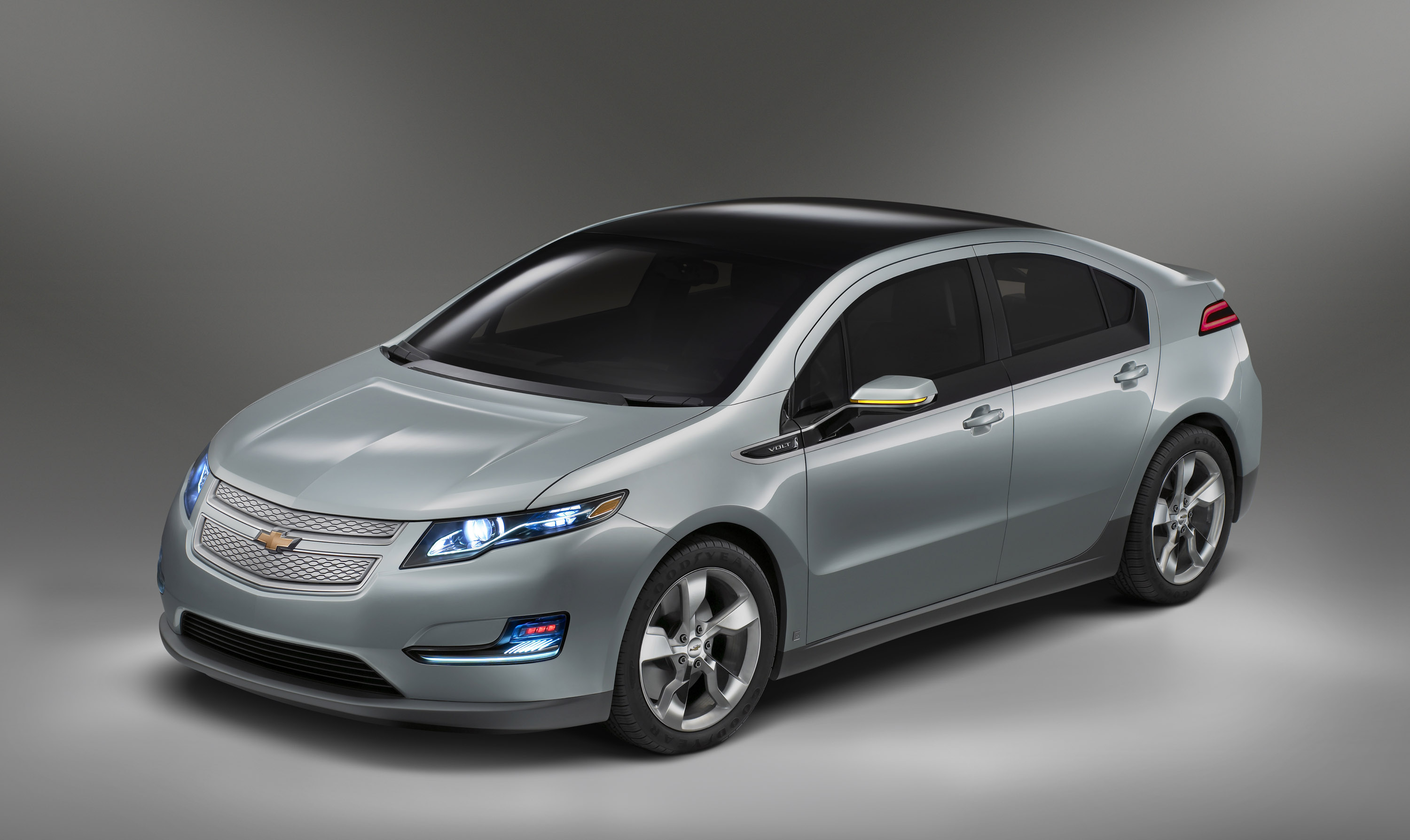
  • Chevrolet Volt

    2011 Chevrole Volt - Side View

    General Motors launched its next 100 years today by unveiling the much-anticipated production version of the Chevrolet Volt – a vehicle that delivers up to 40 miles of gasoline- and emissions-free electric driving, with the extended-range capability of hundreds of additional miles.

    “Revealing the production version of the Chevy Volt is a great way to open our second century,” said Rick Wagoner, GM Chairman and CEO. “The Volt is symbolic of GM’s strong commitment to the future … just the kind of technology innovation that our industry needs to respond to today’s and tomorrow’s energy and environmental challenges.”

    Form follows function

    The design of the Chevrolet Volt production car has evolved from the original concept that was unveiled at the 2007 North American International Auto Show in Detroit.

    Because aerodynamics plays a key role in maximizing driving range, GM designers created an aerodynamically efficient design for the production vehicle. Many of the design cues from the concept vehicle endure in the production Volt, including the closed front grille, athletic stance, rear design graphics, outside rearview mirrors and more. The Volt’s rounded and flush front fascia, tapered corners and grille are functional, enabling air to move easily around the car. In the rear, sharp edges and a carefully designed spoiler allow the air to flow off and away quickly. An aggressive rake on the windshield and back glass help reduce turbulence and drag.

    Working closely with GM aerodynamicists to shape the Volt, design and engineering teams developed one of the most aerodynamic vehicles in GM’s history. They spent hundreds of hours with the Volt in GM’s wind tunnel, testing and re-testing parts such as the front and rear quarter panels, rear spoiler, rockers and side mirrors. Aerodynamic improvements enabled GM to reach the Volt’s target of driving up to 40 miles (based on EPA city cycle) without using gasoline or producing emissions.

    Inside, the Volt offers the space, comfort, convenience and safety features that customers expect in a four-passenger sedan, and it delivers them in a variety of interior color, lighting and trim options unlike any offered before on a Chevrolet sedan. Modern controls and attractive materials, two informational displays, and a touch-sensitive infotainment center with integrated shifter distinguish the Volt’s interior from other vehicles in the market.

    Some of Volt’s interior technological features include:

    • Driver-configurable, liquid crystal instrument display
    • Standard seven-inch touch screen vehicle information display
    • Touch screen-style climate and infotainment controls
    • Optional navigation system with onboard hard drive for maps and music storage
    • Standard Bluetooth for cellular phone and USB/Bluetooth for music streaming

    New era in automotive transportation

    The Chevrolet Volt is leading a new era of electrification of the automobile by creating a new class of vehicle known as the Extended-Range Electric Vehicle, or E-REV.

    The Volt uses electricity to move the wheels at all times and speeds. For trips up to 40 miles, the Volt is powered only by electricity stored in its 16-kWh, lithium-ion battery. When the battery’s energy is depleted, a gasoline/E85-powered engine generator seamlessly provides electricity to power the Volt’s electric drive unit while simultaneously sustaining the charge of the battery. This mode of operation extends the range of the Volt for several hundred additional miles, until the vehicle’s battery can be charged. Unlike a conventional battery-electric vehicle, the Volt eliminates “range anxiety,” giving the confidence and peace of mind that the driver will not be stranded by a depleted battery.

    The Chevrolet Volt can be plugged either into a standard household 120v outlet or use 240v for charging. The vehicle’s intelligent charging technology enables the Volt’s battery to be charged in less than three hours on a 240v outlet or about eight hours on a 120v outlet. Charge times are reduced if the battery has not been fully depleted. At a cost of about 80 cents per day (10 cents per kWh) for a full charge that will deliver up to 40 miles of electric driving, GM estimates that the Volt will be less expensive to recharge than purchasing a cup of your favorite coffee. Charging the Volt about once daily will consume less electric energy annually than the average home’s refrigerator and freezer units.

    Charge out of driving
    The Chevrolet Volt offers spirited driving performance in a remarkably quiet interior. More than 220 lithium-ion cells contained within the Volt’s battery pack provide ample power. The Volt’s electric drive unit delivers the equivalent of 150 horsepower, 273 lb-ft. (370 Nm) of instant torque, and a top speed of 100 miles per hour. The lack of engine noise, combined with special sound-deadening materials, make the Chevrolet Volt an extremely quiet vehicle to drive.

    GM estimates that the Volt will cost about two cents per mile to drive while under battery power compared to 12 cents per mile using gasoline priced at $3.60 per gallon. For an average driver who drives 40 miles per day (or 15,000 miles per year), this amounts to a cost savings of $1,500 annually. Using peak electric rates, GM estimates that an electrically driven mile in a Chevy Volt will be about one-sixth of the cost of a conventional gasoline-powered vehicle. The cost savings are even greater when charging during off-peak hours, when electric rates are cheaper.

    The Chevrolet Volt is expected to be built at GM’s Detroit-Hamtramck manufacturing facility, subject to GM successfully negotiating satisfactory government incentives. Production is scheduled to begin late 2010 for models in the United States. Pricing has not been announced. Visit media.gm.com/volt for more information.

    General Motors Corp. (NYSE: GM), the world’s largest automaker, has been the annual global industry sales leader for 77 years. Founded in 1908, GM today employs about 266,000 people around the world. With global headquarters in Detroit, GM manufactures its cars and trucks in 35 countries. In 2007, nearly 9.37 million GM cars and trucks were sold globally under the following brands: Buick, Cadillac, Chevrolet, GMC, GM Daewoo, Holden, HUMMER, Opel, Pontiac, Saab, Saturn, Vauxhall and Wuling. GM’s OnStar subsidiary is the industry leader in vehicle safety, security and information services. More information on GM can be found at www.gm.com.

    PRELIMINARY SPECIFICATIONS: 2011 CHEVROLET VOLT

    General

    Vehicle type: 5-door, front-wheel-drive sedan
    Category: Extended-Range Electric Vehicle (E-REV)
    E-REV competitors: none
    Chassis: independent McPherson struts front, compound crank twist axle rear, four-wheel disc brakes, full regenerative brakes to maximize energy capture, electric power-assist steering
    Seating capacity: four
    Manufacturing location: Detroit-Hamtramck Assembly (subject to GM successfully negotiating satisfactory government incentives)

    Performance

    Top speed (mph): 100
    EV range, city (miles): 40 (based on EPA city cycle)

    Dimensions

    Wheelbase (in / mm): 105.7 / 2685
    Length (in / mm): 177 / 4404
    Width (in / mm): 70.8 / 1798
    Height (in / mm): 56.3 / 1430
    Cargo volume (cu ft / L): 10.6 / 301

    Battery system

    Type: lithium-ion
    Energy (kWh) 16

    Electric drive unit

    Power (kW / hp): 111 / 150
    Torque (lb-ft / Nm): 273 / 370

    Exterior

    Tire and wheel size: specially developed low rolling-resistance tires on 17-inch forged aluminum wheel
  • Citroen C4

    Citroën’s dynamic C4 range is now more alive with technology than ever before. An exciting new look gives the popular model even more appeal with new exterior and interior styling, updated equipment, body colours and wheel designs, as well as the introduction of two new low CO2, fuel efficient, petrol engines co-developed with BMW. HDi models will also be available with new low-rolling resistance Michelin tyres for improved fuel consumption and CO2 emissions.

    Changes to the exterior focus on restyling the vehicle’s front end, bringing the C4 in line with the prestigious looks of the recently launched C5. Its new bonnet features a more rounded, curvier design, whilst the grille benefits from restyled integrated chevrons. The front bumper has also been revamped and the number plate repositioned for a stronger, sportier, more dynamic look.

    The rear lights of the C4 Coupe are now finished in transparent crystal and a choice of three new alloy wheel styles – either 16-inch or 17-inch – as well as two new body colours – Bourrasque and Recif blue are now available. For added elegance, chrome inserts are featured on some models.

    In the cabin, the C4 has been improved for enhanced comfort whilst, for greater clarity, the rev counter has been relocated to the innovative translucent central display unit. As with the award-winning C4 Picasso, a plush grain is now featured on the dashboard and doors for a more upmarket feel. New decors have been designed with an improved quality finish whilst the integrated scented air freshener makes the interior smell as good as it looks.

    no images were found

    The C4 also retains much of the innovative equipment that made it a standard-setter when it was launched. Drivers can benefit from convenient and reassuring technology such as directional headlamps, front and rear parking assist, lane departure warning system, hill start assist, laminated side windows, speed limiter and cruise control.

    The new C4 arrives with all of the safety equipment that made the original C4 such a reassuring car to drive, including the unique to Citroën torso shaped driver’s airbag that can be incorporated because of the fixed-centre steering wheel. The original C4 achieved some of the highest EuroNCAP ratings in the segment for frontal impact, child protection as well as a 3-star pedestrian safety rating.

    Citroën’s latest generation navigation system, NaviDrive, has also been introduced, which features a hi-resolution 7-inch colour screen with Europe-wide satellite navigation, real time traffic reports as well as an audio system with built-in 30GB hard drive. The system also offers a video auxiliary socket and a USB connection.

    The C4 is now available with two new petrol engines which have been co-developed with the BMW group – the 1.6 16v VTi 120hp and the 1.6 16v THP 150hp. Both units offer the optimum blend of performance, driving pleasure and fuel economy, with significantly lower consumption and CO2 emissions.

    C4 1.6 16V VTi 120hp  (Variable valve lift and Timing Injection)

    The VTi 120hp petrol engine, with a manual or automatic gearbox, replaces the 1.6i 16V 110hp unit, offering an economical and responsive driving experience, with fuel efficiency of 42.2mpg and CO2 emissions of 159g/km on the combined cycle (down 6% on the former unit).

    The VTi unit is fitted with an aluminium block and cylinder head and features continuously variable valve timing. The intake valves also benefit from a system that allows their maximum travel to be adjusted gradually depending on the force applied to the accelerator pedal. These two features boost engine efficiency and increase responsiveness with some 90% of maximum torque available all the way through the rev range from under 2,000 through to 6,000rpm.

    C4 1.6i 16V THP 150hp (Turbo High Pressure)

    The new THP 150hp (Turbo High Pressure) engine provides the perfect blend of higher performance, driving pleasure and economy with significantly lower fuel consumption and CO2 emissions. With its six-speed manual gearbox, the THP 150hp’s fuel consumption is 40.9mpg on the combined cycle with CO2 emissions of 164g/km.

    The THP 150hp features engine technology that is new to the C4 range with the introduction of direct sequential injection and a twin-scroll turbocharger as well as continuously variable inlet valve timing. This gives the engine excellent low-down pulling power with maximum torque of 177lb.ft almost all the way from just 1,400 through to 3,500rpm and continues strongly through the rev range.

    Citroën’s HDi diesel engine line-up is widely recognised for its frugal, clean and dynamic qualities, and in keeping with the model’s upgrade, the C4’s diesel engine range has also been improved.

    The 2.0HDi unit with six-speed manual gearbox and particulate filter fitted as standard, boasts fuel efficiency of 53.3mpg on the combined cycle and CO2 emissions of just 140g/km. The other diesel powered models – the 1.6HDi 92hp and 1.6HDi 16V 110hp DPFS EGS – are just as dynamic as before and now even greener thanks to a switch to low rolling resistance Michelin Energy Saver® tyres, available on 16-inch wheels, which reduce the fuel consumption and lower the  CO2 emissions.

    The original C4 was one of the most environmentally friendly cars in the small family segment with two models returning emissions of 120g/km. Now, with its reduced emissions, the C4 is even cleaner and even greener.

    Trim

    Engine

    ‘On the Road’ RRP

    HATCHBACK MODELS

    LX

    1.4i 16V 90hp

    £12,695.00

    SX

    1.4i 16V 90hp

    £13,895.00

    1.6i 16V 110hp BioFlex

    £14,695.00

    1.6 16V VTi 120hp

    £14,695.00

    1.6 16V VTi 120hp Auto

    £15,695.00

    1.6HDi 16V 92hp

    £15,295.00

    1.6HDi 16V 110hp

    £16,195.00

    1.6HDi 16V 110hp DPFS EGS

    £16,695.00

    VTR+

    1.6 16V VTi 120hp

    £15,495.00

    1.6HDi 16V 110hp

    £16,995.00

    1.6HDi 16V 110hp DPFS EGS

    £17,495.00

    Exclusive

    1.6 16V VTi 120hp

    £16,495.00

    2.0HDi 16V 140hp DPFS

    £18,895.00

    2.0HDi 16V 138hp DPFS Auto

    £19,895.00

    Trim

    Engine

    ‘On the Road’ RRP

    COUPE MODELS

    VTR

    1.4i 16V 90hp

    £13,895.00

    1.6i 16V 110hp BioFlex

    £14,695.00

    1.6 16V VTi 120hp

    £14,695.00

    1.6HDi 16V 92hp

    £15,295.00

    VTR+

    1.6 16V VTi 120hp

    £15,495.00

    1.6HDi 16V 110hp

    £16,995.00

    1.6HDi 16V 110hp DPFS EGS

    £17,495.00

    VTS

    1.6i 16V THP 150hp

    £17,495.00

    2.0HDi 16V 140hp DPFS

    £18,895.00

    Technical Specification

    1.6 16V VTi 120hp

    1.6 16V VTi 120hp Auto

    1.6 16V THP 150hp

    1.6HDi 16V 92hp

    1.6 HDi 16V 110hp

    1.6HDi 16V 110hp DPFS EGS

    2.0HDi 16V 140hp DPFS

    2.0HDi 16V 138hp DPFS Auto

    Capacity (cc)

    1598

    1598

    1598

    1560

    1560

    1560

    1997

    1997

    POWER

    Max power DIN (hp/rpm)

    120/6000

    120/6000

    150/5800

    92/4000

    110/4000

    110/4000

    143/4000

    138/4000

    Max torque DIN (lb.ft/rpm)

    118/4250

    118/4250

    177/1400

    159/1750

    177/1750

    177/1750

    236/2000

    320/2000

    WEIGHTS (KG)

    Kerb weight (Coupe/Hatchback)

    1217/1220

    1273/1273

    1271/1276

    1255/1257

    1269/1270

    1293

    1379/1381

    1410/1416

    Max laden weight (Coupe/Hatchback)

    1727/1731

    1756/1761

    1754/1763

    1775/1777

    1790

    1790

    1835/1849

    1880

    Max towing weight braked (Coupe/Hatchback)

    1550

    1520

    1650

    1637/1636

    1641/1640

    1540

    1811

    1750

    Max tow hitch download

    65

    65

    70

    66

    66

    65

    73

    70

    Max roof rack load

    75

    75

    75

    75

    75

    75

    75

    75

    PERFORMANCE

    Max speed (mph)

    121

    116

    131

    112

    119

    119

    129

    128

    0-62mph (secs)

    10.0

    11.9

    8.4

    12.5

    11.2

    11.2

    9.7

    10.4

    ECONOMY (MPG)

    Urban

    30.4

    28.5

    28.8

    49.6

    46.3

    48.7

    40.3

    31.0

    Extra urban

    54.3

    52.3

    53.3

    76.3

    70.6

    76.31/74.32

    64.2

    55.4

    Combined

    42.2

    40.4

    40.9

    64.2

    58.8

    64.21/62.82

    53.3

    42.8

    CO2 emissions (g/km)

    159

    165

    164

    117

    128

    1181/1202

    140

    175

    1. SX
    2. VTR+
  • Ford Fiesta Zetec S

    All-New Ford Fiesta Zetec SLower or the same insurance ratings on all new models
    Design and driving quality independently rated as “class-leading”
    All-new Fiesta priced from just £8,695-£155 less than outgoing equivalent (more…)

  • Volkswagen Golf

    2008 Volkswagen Golf

    Five generations, 34 years and over 26 million vehicles after the original first went on sale, the sixth generation of the Golf has been unveiled.

    The new model continues the evolution of an icon.  The new Golf is the safest, most technically advanced and most dynamic iteration yet.  Not only does the new Golf promise great value, but it aims to set benchmarks in quality, style, safety and the reduction of emissions.

    Prof. Dr. Martin Winterkorn, Chairman of the Board, Volkswagen AG, commented: ‘This sixth generation of Golf cars will completely redefine the quality and comfort level of its class over broad categories, offering more customer value than ever before.’

    Instantly apparent in the sixth generation of Golf is a sharply defined look that draws on the new design direction established by the Scirocco.  Klaus Bischoff, Head of Design for the Volkswagen brand led the team responsible for the shape of the new car, overseen by Volkswagen Group’s head of design, Walter de Silva.  ‘It is more accentuated than its predecessor with precisely defined lines and edges and with finely proportioned flared surfaces and recesses,’ commented de Silva.

    The new look aims to combine the elements that define the Golf across five generations while bringing them up to date.  The result is a clean, elegant design that’s easily recognisable as a Golf yet remains an all-new shape.

    The same elements of simplicity and attention to detail were applied to the vehicle’s interior.  A new level of quality is established in the Golf with the adoption of materials and equipment usually associated with a vehicle in a higher segment.

    Clearly defined white backlit dials sit in recessed, individual cowells behind a three-spoke steering wheel with the option of controls for entertainment and communications functions.  High quality, soft touch plastics are integrated with tasteful aluminium and chrome highlights.  The new look is combined with advances made by Volkswagen engineers in reducing wind noise, including a completely new design of door and window seals, a new damping film that supports the windscreen and a new engine mounting system.  The result is new levels of acoustic damping to make the new Golf the quietest yet.

    Aiding this refinement are advanced new petrol and diesel engines.  The new 2.0-litre TDI 110 PS common rail diesel engine emits just 119 g/km of CO2 while returning 62.7 mpg on the combined cycle.  Other diesel variants are available with 90 PS, 140 PS and 170 PS outputs linked to a choice of six-speed manual or DSG gearboxes.  Many of the petrol engines adopt highly efficient TSI technology with outputs of 80 PS, 102 PS, 122 PS and 160 PS.

    For the first time, Volkswagen’s Adaptive Chassis Control (ACC) will be offered on the Golf.  This is available on the Passat CC and standard on the new Scirocco, and allows the driver to select from normal, comfort or sport modes to define the desired suspension, steering and accelerator response settings for any particular journey.

    Automatic Distance Control is also offered, which monitors the area around the vehicle through a series of sensors and will, if necessary, reduce the vehicle’s speed should an obstruction be identified.  In extreme cases the vehicle can be brought to a complete stop using the system.

    Building on the technical advances are new levels of safety equipment including the addition of a knee airbag for the driver to bring the total number of airbags fitted as standard to seven.  A new head restraint system designed to reduce whiplash injuries and rear seat belt detection sensors are joined by new, more advanced Electronic Stabilisation Programme (ESP) software.

    Prices and specifications for the new Golf will be announced closer to the vehicle’s launch towards the end of the year.  The new Golf goes on sale in the UK in January.

  • AC Schnitzer BMW X6

    An eyecatcher at first glance – this calls for a closer look AC Schnitzer presents the new styling and performance package for the BMW X6. The new BMW X6 exerts a particular form of magnetism: not only does its chassis sit perfectly on the road, it also magically attracts attention. Now it appears there is only one place where the fascination, dynamism and presence of the first Sports Activity Coupé (SAC) can be enhanced: in the workshops of AC Schnitzer in Aachen. The result is a visual and technical masterpiece which further magnifies the core qualities of the X6.

    Engines – Exhaust

    Typical AC Schnitzer: The vehicle’s appearance is not misleading, but simply a reflection of its inner values. The renowned BMW tuner has developed a real firecracker under the bonnet of the diesel versions 3.0dX and 3.5dX with a new Motor Control Unit. Precise performance data will be released shortly.
    Another eyecatcher is the chromed tailpipes of the dual-flow exhaust system in AC Schnitzer Racing Design.

    The Suspension Technology

    Of course, sheer engine power is not the only ingredient in sporting performance. So Manfred Wollgarten, Technical Director of AC Schnitzer, has developed a unique suspension spring kit for the X6 on the North Loop of the Nürburgring.

    The Bodywork

    In the X6 by AC Schnitzer, the front skirt with its diagonal air intakes and repositioned fog lights are exposed.
    The drive-under protection has been removed in favour of a more dynamic contour of the spoiler edge.
    The rear carries a massive skirt with framed edges.
    In contrast to the original, all components are painted body-colour throughout, so the body appears downstretched and hence more dominant.
    Instead of the drive-under protection originally fitted here, AC Schnitzer Designer Michele Viandante has opted for a rear diffuser.

    The Interior

    Perfect handling with corresponding Look and Feel is ensured by the “EVO” 3-spoke Sport Airbag steering wheel.
    With AC Schnitzer, you hold the road firmly in almost any position. The X6 by AC Schnitzer takes control on public roads as willingly as on changing terrain with varying up and down gradients!

    The Wheels

    22 inches racing alloy wheels Type VII  are just as fascinating.
    We recommend Continental and Michelin.
    Discover the AC Schnitzer wheel range for your dream car, too. Actually here you can find our complete wheel variety for many current BMW models. Enjoy assembling your AC Schnitzer dream wheel.

  • Carlsson Aigner Mercedes-Benz CK65 RS Blanchimont

    Carlsson, the premium aftermarket expert has presented its latest, luxurious limited edition ride dubbed Carlsson Aigner CK65 RS Blanchimont. Styled and engineered in cooperation with the leather and lifestyle marque Etienne Aigner AG, the top-end Mercedes vehicle boasts amazingly attractive exterior and remarkably cosy interior styling, which catches the mood of an international clientele precisely.

    The fragrance of Etienne Aigner leather permeates the interior

    The vehicle’s interior trim and upholstery were created by the world-famous lifestyle brand Etienne Aigner. A combination of the renowned Aigner leather and Aigner Alcantara invite the viewer to climb inside and savour the ambience. The highest level of workmanship characterises the newly-created interior. The ergonomic design of the Carlsson sports steering wheel in leather and in Alcantara turns driving and controlling the Carlsson Aigner into a particularly enjoyable tactile experience. Carlsson aluminium sports pedal pads, illuminated door sill protectors and further visual touches all point the way into a world of luxorious elegance.

    It goes without saying that the Carlsson Aigner CK65 RS Blanchimont is only supplied fully equipped with all comfort and safety features. Navigation system, automatic air-conditioning system, ventilated seats with memory function, Carlsson multi-function steering wheel, Distronic, Parktronic, Comand, TV function, KeylessGo and many other inclusive options round off the appointments of the luxury coupé. Moreover, the interior colour scheme can be chosen from more than 30 different combinations. Processing the natural materials is time cosuming and calls for the highest degree of perfection and quality. The Aigner leather, the Aigner Alcantara and the matching wood trim are fitted exclusively by hand. Hence, in the view of the fact that the individual stages call for cooling and setting phases, the production and installation of the entire interior takes over two weeks.

    The In-Car Infotainment System or Carlsson Office Concert Hall Infotainment System

    Whether you want to be entertained or to work when you’re on the move, Carlsson has the perfect solution. In terms of entertainment, only components by Alpine and Focal – companies that set the highest benchmark standards – are use. Passengers travelling in the front will experience the highest listening pleasure through 3-way loudspeaker system of the Focal Utopia Be Kit No.7 make, which the specialist press has praised as the “best system in the world” von. Power amplification is provided by a further benchmark in the in-car hi-fi sector, the 2-channel output stage Focal Dual Monitor. Muscular bass sounds are provided courtesy of a 33cm Focal Utopia Be 33 WX2 subwoofer. For the front passengers, the signal source is the original COMAND system, which works more effective with the Carlsson entertainment package. But it goes without saying that passengers in the back can savour high-tech sounds too.

    Carlsson’s “Rear Seat Entertainment” creates the authentic atmosphere of a cinema.

    The ears are pampered with the patented 6.1 surround sound, while 7” monitors behind the headrests make it possible for the rear passengers to enjoy different programmes at the same time. Still more of a cinematic experience is provided by the 15” monitor integrated into the roof interior. Control of the system is handled by the Alpine F#1 Status DVD tuner, which has garnered countless awards worldwide. Three 3-way systems of the Focal Utopia Be Kit No.7 make are used for playback of the left, centre and right channels. The “Rear Seat Entertainment” system is completed by further Focal Utopia Be components for the surround sound channels and signal reinforcement. Bass sounds are provided by the subwoofer of the front system as soon as the rear system is activated. The rear centre console – which is probably unique in this form worldwide – has been converted by Carlsson to serve as the centre speaker. The entire entertainment system has been specially adapted to be compatible with the interior of this particular vehicle, thus making it possible to enjoy a sound quality you would otherwise expect to hear only from a top-quality home audio set-up.

    Naturally, all the components, such as the loudspeakers or the power amplifiers, are unobtrusive or have been integrated into the decor attractively. The complete standard boot space remains the same.

    If required, the Carlsson Aigner CK65 RS Blanchimont also functions as though designed as a workspace. Anyone who is being driven can take advantage of the Carlsson business solution, “Carlsson Office Concert Hall Infotainment System”. Each of the hinged tables behind the front seats can easily accommodate a laptop, and the integrated power supply ensures this will remain ready for use even during lengthy journeys. The highlight – another worldwide first – is a WLAN UMTS router, enabling three laptops to go online, wireless and completely independent of each other. You don’t need a UMTS card – all you need is a WLAN-enabled laptop. So users have their own personal hot spot right inside the car – in fact, they can even use it a short distance away from the Carlsson Aigner CK65 RS Blanchimont!

    A technical masterpiece

    At work beneath the bonnet of the Carlsson Aigner CK65 RS Blanchimont, there’s a 12-cylinder engine with an output of 705 HP and an electronically limited torque of 1.100 Nm. The Carlsson engine conversion includes a newly tuned electronic control unit with special maps for injection and ignition. On the intake side, special sports air filters make sure that aspiration is optimised, while a stainless steel sports exhaust pipe system optimises exhaust gas back pressure. A further performance-enhancing modification to the engine is improved intercooling to reduce the temperature of charge air. The upshot is that the V12 is constantly at the top of its game – allowing the driver to relax, with an abundance of power resources to draw on.

    An elegant vehicle with an incomparable finish, the Carlsson Aigner CK65 RS Blanchimont must surely represent the most thrilling and luxurious limousine ride currently available. For example, the Carlsson Aigner CK65 RS Blanchimont revels in a top speed of 320 km/h – electronically regulated for safety reasons – together with an acceleration of 0-100 km/h in just 3.9 seconds. Hardly surprising, then, that the Carlsson Aigner CK65 RS Blanchimont can test virtually any other sports car to its very limits.

    Ultra-light forged 3/11 UL wheels for greater driving comfort

    Unlike the standard form of cast wheels, the Carlsson Ultra Light metal wheels are approximately. 50% lighter than the standard form of cast wheels. The result is that because of their reduced, unsprung mass, they are less inclined to tramp than cast wheels, thus providing an almost ideal level of contact with the road. For the driver, this mean improved handling, and thus greater driving safety and greater driving comfort. The Carlsson Aigner CK65 RS Blanchimont travels on three piece 3/11 Ultra Light forged wheels with dimensions of 9 x 21” at the front axle, using Dunlop SP Sport Maxx 265/30 ZR 21 tyres, and 10.5 x 21” at the rear axle, using Dunlop SP Sport Maxx 295/25 ZR21 tyres.

    Electronic C-Tronic® SUSPENSION ABC-2 lowering gear

    The Carlsson Aigner CK65 RS Blanchimont comes equipped with the electronic C-Tronic® SUSPENSION ABC-2 lowering gear, which lowers the vehicle approximately 30 mm further. However, not only does the Carlsson C-Tronic® SUSPENSION lower the centre of gravity, it also uses a sophisticated technology to enable the vehicle to react intelligently with the actual road conditions. On a poor stretch of road, or in the event of persistently heavy compression, the height of the vehicle is automatically readjusted to ensure that the necessary reserve of spring travel required for preserving driving comfort is maintained. The driver feels the effects of the C-Tronic® lowering gear in the form of reduced body roll and a much greater agility in handling. In other words, the C-Tronic® SUSPENSION also means greater driving pleasure. In addition it also guarantees that even at speeds in excess of 120 km/h, the vehicle is never lowered below the maximum depth permissible for the standard model – in other words, the minimum vehicle level – thus ensuring that the suspension travel remains optimal at all times.

    At the same time, with less air flowing beneath the vehicle, there is a reduction in aerodynamic drag and lift.

    Stainless steel rear exhaust silencers: sonorous tones and enhanced flexibility

    The Carlsson sports exhaust gas system produces a particularly powerful sound as well as improved output. Dominating the rear view of the Carlsson Aigner CK65 RS Blanchimont are four exhaust tailpipes designed by Carlsson. The sporty, sonorous tones these generate are an impressive sound. In contrast to the regular production model, in this exhaust gas system both the exhaust gas back pressure and the pipe run have been optimised – thus allowing Carlsson to achieve an improved torque and higher output.

    Real carbon for improved aerodynamics

    Carbon is normally only used as a material in motor sports the aerospace industry. For the engineers at Carlsson, however, it is the material of choice. Which is why the sporty appearance of the Carlsson Aigner CK65 RS Blanchimont is underscored by the front spoiler lip and the rear apron lip, both designed in a typical Carlsson diffuser look, and also by the rear wing. All the aerodynamic attached parts improve the contact pressure, this in turn improving driving stability. The cd value is kept down to 0.33 – significantly below that found in comparable limousines.

    Blanchimont – the very life’s breath of motor sports

    The Carlsson Aigner CK65 RS Blanchimont provides luxury – not for nothing was it named after one of the world’s most famous race track curves, the Blanchimont turn on the Spa Francorchamps track in the Ardenne in Belgium. Many of the technical developments in the Carlsson Aigner CK65 RS Blanchimont have their origins in motor sports.

    Individuality that knows no limits

    The Carlsson Aigner CK65 RS Blanchimont is offered on an individual basis in countless two-tone combinations – with no limits imposed on the individuality and desires of its clientele. “With this car, we quite deliberately adopted a positioning between the S Class and the Maybach – while still remaining faithful to the essential manufacturing concept and to the desire for maximum performance. With a horsepower in excess of 700, the Carlsson Aigner CK65 RS Blanchimont is the most powerful luxury limousine in the world,” declares Markus Schuster, C.E.O. of Carlsson Autotechnik GmbH. Prices start at 464.100,00 Euro in Germany and 390.000,00 Euro for export.

  • Ford Fiesta Econetic

    Bringing style and new levels of low-CO2 efficiency, Ford of Europe’s most frugal car ever – the new Fiesta ECOnetic – makes its world premiere today at the British International Motor Show in London.

    Powered by a specially-calibrated version of the 90 PS 1.6-litre Duratorq TDCi, combined with coated Diesel Particulate Filter, Ford’s most economical Fiesta can travel 100 kilometres using just 3.7 litres of fuel, on the EC Combined Cycle. This impressive fuel economy is matched with a class-leading CO2 output of 98 grams per kilometre – making Fiesta ECOnetic the lowest CO2 vehicle in both its segment and Ford’s European range.

    Compared to previous-generation Fiesta 1.6-litre TDCi, Fiesta ECOnetic will use 160 litres less fuel over 20.000 km, offering genuine savings in daily driving, at a time when saving fuel means saving even more money.

    Extra-urban highway fuel economy is even better – Fiesta ECOnetic requires just 3.2 litres to cover 100 kilometres.  Yet this efficiency is not at the expense of driving quality or performance, with Fiesta ECOnetic reaching 0-100 km/h in 12,3 seconds and a top speed of 178 kph.

    This is because Fiesta boasts the same attention to detail as earlier ECOnetic models, with improved aerodynamics, low rolling resistance tyres and enhanced lubrication to achieve best possible CO2 and fuel consumption.  Lowered ride height and aerodynamic details such as wheel covers and wheel deflectors build on Fiesta’s already streamlined drag co-efficient (Cd) of 0.33.

    At the same time, low rolling resistance tyres in an economical 175/65 R14 profile, a longer final drive gear ratio and special lubricants drive efficient powertrain performance, especially in highway cruising.  In conjunction with energy partner BP, Ford has developed low-viscosity transmission and low-friction engine oils for ECOnetic models.

    Such modifications create Fiesta ECOnetic’s class-leading efficiency, without sacrificing the driving quality, style or practicality of the core Fiesta range.

    Fiesta ECOnetic’s London debut is no coincidence – its ultra-low CO2 rating will also exempt it from UK road taxes.

    It is not just the ECOnetic version of new Fiesta that benefits from Ford of Europe’s sustainability efforts – all new Fiestas feature Electric Power Assist Steering (EPAS), using far less fuel and engine power than a standard hydraulic power assist system, without compromising driving dynamics or steering feedback.

    Extensive use of high strength steels and a focus on weight saving has also reduced the mass of new Fiesta by 40 kilogrammes versus the previous model, despite improved safety equipment and sound insulation.

    Sustainability has influenced not only new Fiesta’s development, but also the facilities behind its manufacture. Ford’s Dagenham Diesel Centre in Britain produces Duratorq TDCi engines for new Fiesta and derives all its electricity from renewable sources, with two dedicated wind turbines and plans for a third.

    Ford is also sourcing renewable electricity to cover the full electric power demand of its Fiesta manufacturing and engineering facilities in Cologne, Germany. Through this initiative, the company will reduce its CO2 emissions by 190.000 tonnes per year.

    Dr Wolfgang Schneider, Ford of Europe Vice President, Legal, Governmental and Environmental Affairs said: “The new Fiesta is the strongest example yet of Ford of Europe’s commitment to and investment in sustainable mobility. Fiesta ECOnetic is a compelling, stylish yet no-compromise choice for customers, offering class-leading low CO2 and genuine savings, while also benefitting from our investment in efficient production facilities.”

    New Fiesta ECOnetic will be on sale across Europe later this year and completes an initial trilogy of models in the company’s European vehicle range that also includes a 139 g/km Ford Mondeo ECOnetic and a 115 g/km Ford Focus ECOnetic.

  • Saturn Fans Invited To ‘Kiss My Astra’ In Online Photo Contest

    Saturn today launched the “Kiss My Astra” national photo contest, offering Saturn fans an opportunity to show just how much they would love to win a new Saturn Astra. (more…)

  • Mastretta MXT

    Bristling with design flair, the all-new Mastretta MXT is the exciting and exclusive new sports car that will put Mexico on the map and offer UK drivers performance and more choice in the sub £40,000 sector.

    The lightweight two-seater weighs just 900kg. And with top speed of 150mph, it is aimed at thrill seekers who also have an eye to the environment, who want to have fun and enjoy driving without causing damage through their car’s excessive weight and power.

    Mastretta MXT is the first car to be designed and built in Mexico, and the aggressive and sculpted sports coupé makes its debut here at the British International Motor Show.


    This unique, rear-wheel drive two-seater’s 2.0litre turbocharged Duratec engine develops nearly 240bhp pushing it on to 60 mph from rest in less than 5.0secs.

    Constructed from bonded aluminium, the semi-monocoque chassis features aircraft style technology. Closed mould techniques sculpt the distinctive body from high quality fibreglass and the air-conditioned interior is leather-trimmed.

    Direct racecar feel comes through rack and pinion steering – 2.8 turns lock to lock. And 293mm ventilated brake discs with ABS as standard slow the car with eye-popping power, when necessary. Mastretta MXT has double wishbone suspension front and rear.

    Lifestyle Automotive is the company licensed to import and distribute the cars in Europe and company boss Tom Martin is confident of success with Mastretta MXT.

    “Customers who place orders at the show will be able to register their cars in May next year,” he says. “The Mastretta MXT on display at ExCeL 22 July – 3 August is the penultimate prototype,” Martin says. “We should complete Vehicle Certification Agency testing by October and RHD production, which is limited to 80 cars in the first full year, will start by January.”

    National pride as well as burning ambition for their new car motivates the Mastretta brothers who have taken the car from idea through concept to reality.

    “We needed to create a great car because Mexico has no tradition of sophisticated sports car manufacturing,” says designer Daniel Mastretta. “It is most important that our customers are delighted by the new MXT. That’s what we aimed to do from the first drawing of the car, but we also want to make our country proud of the MXT and to show the world what we can do.”

    Come and see the sensational Mastretta at the British Motorshow and decide for yourself.

    Mastretta MXT – the figures

    Price (rrp) £32,999 Weight 900 kg
    Engine 1999 cc Power/weight 267/tonne
    Aspiration Supercharged Length 3900 mm
    Power 240 bhp Width 1790 mm
    Torque 184 lb ft Height 1150 mm
    Transmission 5 speed manual 0-60 mph < 5 secs (est)
    Front tyres 205/45 R17 Rear tyres 235/45 R17
  • Hamann Bmw 6 Series

    When it comes to exclusively refining BMWs, HAMANN-Motorsport is one of the first addresses. Again, the Laupheim-based company gives proof to this by introducing its latest refinements for the new BMW 6-series. By developing an entire tuning programme not only for the coupe, but also the convertible, HAMANN-Motorsport renders an additional sportive and individual touch to the facelift already applied by BMW. (more…)
  • Ford Adds Striking New Fiesta Limited Edition

    The appeal of the exciting Ford Fiesta line-up continues to expand with the debut of a new sporty, feature-packed special edition – the Zetec S Red. Just 400 new Zetec S Red special editions, representing 10 per cent of all Zetec S models, will be available, priced at £13,000. (more…)