Category: Auto News

Auto news – automobile industry news. Articles about all the latest car models and concepts. Breaking news, uncovered secrets.

  • 75 years of Gran Turismo Maserati celebrates the A6 1500

    Maserati A6 1500 Gran Turismo - Front Angle

    Gran Turismo is a way of life: a type of high-performance car, suitable for long distances and comfortable journeys.

    It all began 75 years ago with the Maserati A6 1500, a model with a revolutionary spirit, the forerunner of a class of car that had never been seen before. It would go on to influence the automotive landscape all over the world, and successive generations of Maserati road cars.

    In March 1947, the Geneva Motor Show witnessed the launch of the first Gran Turismo in history: the Tipo A6 (taking its name from the project), better known as the A6 1500 Gran Turismo.

    Accorded an enthusiastic welcome by professionals and the public, the Tipo A6 represented the first step in a story in which Maserati has revamped the technology and design. The brand has held true to its hallmarks of elegance and high performance, ubiquitous in every model in the range and continuing in the next generation of the GranTurismo, the Trident brand’s first 100% electric car, due to be launched onto the market in 2023.

    The history of the A6 1500 dates back to even earlier than 1947.

    It actually goes all the way back to 1941 and the design of a sedan with a fixed head engine and twin camshaft, which had to be a close descendant of the 6CM’s, if of course revisited with Gran Turismo in mind. The upshot was an outstanding engine with a maximum output of 65 hp, with its single Weber 36DCR carburettor giving the car a top speed of 150 km/h.

    The project was named A6, A for ‘Alfieri’, 6 for the number of cylinders.

    It also featured independent wheel front suspension, with oscillating trapeziums and coil springs, rigid beam with leaf springs in the rear, hydraulically controlled brakes and disc wheels (spoked on request), with a 3.5” channel, 16” in diameter, and 5.50-16 tyres.

    Intended for the Geneva Motor Show, the first model was produced in February 1947 by the Pininfarina bodyshop, bearing its characteristic mechanically operated retractable inside headlights. However, the clearest innovation from the past was its tubular chassis with circular cross-section components, to adopt some of the most fashionable trends at the time.

    Not only was it the retractable headlights and chassis that would attract the attention of the public in Geneva, but also the plexiglass sunroof and a bonnet that could be raised from both sides or removed.

    Resounding compliments and awards quickly led to the decision to give the green light to production, albeit with certain changes from the prototype. These included the restoration of more conventional lights, framed in chrome plating. The Extra Lusso version also featured a new, more modern grille and larger side windows.

    Production of the A6 1500 Gran Turismo continued until 1950, with a cosmetic update taking place in 1948. Pininfarina would also make further changes to the bodywork: the embossed trim was removed from the front fenders, and two rear seats were added to the cabin.

    Despite the relatively limited number of units produced, 58 over its 4 years, the A6 1500 was a milestone in Maserati history. At that point, the brand began to establish itself as a producer of tailor-made, high-quality road cars, with sport in its DNA. The glorious Pininfarina-designed bodywork would then go on to inspire successive generations of Maserati cars: a high-class, timeless design that continues to resound to this day in the current range, and will take the brand forward into the future. While the A6 1500 represented the beginning of the Maserati epic of road cars, like passing the baton, the new GranTurismo will mark the brand’s entry into the world of Full-Electric with Folgore, and will light the fuse of a new, innovative energy.

  • 2023 Acura Integra Revealed as a Premium Performance Gateway for a New Generation

    2023 Acura Integra - Front View

    The 2023 Integra returns one of the brand’s most iconic nameplates to the Acura lineup, delivering a premium, exhilarating driving experience and a sleek liftback design to a new generation of enthusiast drivers. A premium sport compact inspired by the fun-to-drive spirit of previous Integras, the all-new model will arrive at dealers this Spring with a starting price of about $30,000, to become the new performance gateway of the Acura brand. The 2023 Integra is available for reservation at participating dealers starting today, and the first 500 customers to reserve their next gen Integra will have the opportunity to claim a limited edition NFT.

    https://www.youtube.com/watch?v=fePUO0lMRPY

    “The 2023 Acura Integra is serving the same role in the lineup as the original model that helped launch the brand three decades ago by bringing in the next generation of driving enthusiast,” said Emile Korkor, Assistant Vice President, Acura National Sales. “With its engaging driving character, flexible five-door liftback body style and advanced technology and features, the Integra will welcome a host of new buyers to the Acura brand.”

    Completing Acura’s return to Precision Crafted Performance, the new Integra is powered by a high-output turbocharged engine delivering 200 horsepower and paired with either a segment-exclusive 6-speed manual or a continuously variable transmission (CVT). An ultra-rigid body structure and sport tuned chassis are tuned for an exhilarating driving experience. As the only 5-door liftback in the premium sport compact segment, Integra offers sleek style while benefitting from the extended cargo flexibility enabled by the liftback bodystyle.  Designed to engage the driver in all aspects, Integra also features generous rear seat legroom that’s rarely encountered in its class.

    Sporty and personal, Integra’s distinctive driver-focused interior design creates the perfect environment for spirited driving. A high level of standard features includes a 10.2-inch Acura Precision Cockpit™ digital gauge display, smart phone integration, 8-speaker premium audio system and USB-C charging. High-tech available features include a head-up display (HUD), wireless smart phone charging, Amazon Alexa Built-in and 16-speaker ELS STUDIO 3D® audio system.

    The 2023 Integra sets a new benchmark for both active and passive safety technology in the premium compact class with Acura’s rigid Advanced Compatibility Engineering™ (ACE™) body structure, cutting-edge airbag designs and an updated AcuraWatch™ suite of active safety and driver-assistive technologies. Groundbreaking new first-in-segment front airbags for the driver and front passenger are designed to reduce the risk of traumatic brain and neck injuries. Rear seat side airbags are standard.

    Fun, Engaging Performance

    Integra’s class-leading driving dynamics and engaging performance is built upon an exceptionally rigid body and sport-tuned chassis combined with Integra’s fully independent suspension to deliver precise, sporty handling and a comfortable ride. Integra also benefits from powerful brakes and precise variable-ratio steering.

    A standard Integrated Dynamics System (IDS) enables the Integra driver to choose between three distinct driving modes (Comfort, Normal and Sport) for the throttle response, automatic transmission mapping, steering feel and gauge coloration. A-Spec with Technology Package adds adjustments for in-cabin sound, plus an “Individual” mode that allows the driver to customize the IDS setting combinations to their liking.

    An available Adaptive Damper System (ADS) gives drivers even more precise control of Integra’s ride and handling performance with distinct damping characteristics for Comfort, Normal and Sport driving modes. Drivers also can customize their driving experience with an Individual mode that allows independent selection of steering, engine response, and suspension firmness for a tailored driving experience at the touch of a button.

    Under Integra’s aluminum hood is a VTEC®-enhanced DOHC 1.5-liter turbocharged 4-cylinder engine producing 200 horsepower (SAE net @ 6,000 rpm) and 192 lb.-ft. of torque (SAE net @ 1,800 – 5,000 rpm). A new coil type exhaust system adds an emotional exhaust sound that further enhances Integra’s engaging driving experience.

    Tuned specifically for the high-output turbocharged engine, Integra’s standard CVT automatic transmission responds quickly to throttle inputs and Step Shift programming simulates gear changes when accelerating. For added driver control, steering wheel-mounted shifter paddles are standard.

    An available segment-exclusive 6-speed manual transmission dials up the engagement even further. The short-throw, close-ratio 6-speed features automatic rev matching for the ultimate in precision driving. To maximize available traction when accelerating out of corners, power is routed through a helical limited-slip differential (LSD) in manual transmission-equipped vehicles.

    Sleek Exterior Design

    The 2023 Integra features sporty and compact proportions inspired by previous Integras, specifically the original 5-door model that helped launch the Acura brand in 1986. The new Integra combines a coupe-like profile with surprising flexibility thanks to its liftback design. Thin A-pillars and a low cowl create an expansive greenhouse for excellent outward visibility which is also beneficial during spirited driving.

    Integra continues Acura’s alluring contrast design language, first seen on the 2019 RDX. A sophisticated front fascia features a frameless version of Acura’s Diamond Pentagon grille, framed by four JewelEye® LED headlight elements and “Chicane” LED daytime running lights. LED fog lights integrated into the lower fascia are available.

    An aggressive rear fascia with dual exhaust finishers emphasizes the Integra’s wide track and sporty stance. An upswept decklid and wide, single piece LED taillights harken back to previous generation models, and the embossed Integra logos in the front and rear fascia recall the 3rd generation car. Distinctive 17-inch alloy wheels are standard while 18-inch wheels are optional, and accessory 19-inch wheels are available.

    An available A-Spec® sport-appearance package pumps up the visual style with a gloss-black window surrounds and front and rear fascia trim. A sporty lip spoiler and A-Spec® badges adorn the front fenders and tailgate. Shark Gray 18-inch alloy wheels are wrapped in larger 235/40R18 all-season performance tires.

    Sporty and Personal Interior Experience

    Inside, Integra has a sporty and personal cabin featuring high-quality materials and switchgear, with all touch points imparting a premium feel. The climate control vents reflect the diamond mesh pattern of the grille, highlighted by piano-black trim.

    Integra’s low cowl, thin pillars and door-mounted exterior mirrors help create exceptional visibility. Rear seat passengers enjoy generous legroom and to support active lifestyles, Integra’s 60/40 split rear seatbacks can be folded flat to flexibly expand the cargo area.

    2023 Acura Integra Interior

    Standard on the 2023 Integra are new body-stabilizing and heated front seats wrapped in synthetic leather, with 8-way power adjustment for the driver, available in either Ebony, Red or Orchid. The optional Technology Package adds a 12-way power seat (includes lumbar support) for the driver (4-way for the front passenger) as well as microsuede inserts for the front seats.

    When equipped with the A-Spec® sport appearance package, Integra communicates its performance edge with stainless steel pedals, red gauge needles, and contrast stitching on the steering wheel, seats, shifter and shift boot.

    Intelligent Technology

    Integra’s segment-leading technology includes a standard 10.2-inch Acura Precision Cockpit™ digital gauge cluster with multiple display modes and a 7-inch digital touchscreen with Apple CarPlay® and Android Auto™ integration.

    The available Technology Package increases the touchscreen size to 9-inches and adds wireless Apple CarPlay® and Android Auto™ integration, Alexa Built-In, Qi-compatible wireless charging and a 5.3-inch Head-Up Display (HUD). Additionally charging is supported by a USB-C port up front, along with two more USB-C charging ports at the back of the center console for rear-seat passengers.

    Standard premium audio is provided via 8-speakers while the available 16-speaker ELS STUDIO 3D® premium audio system adds a new dimension with two Highline™ speakers mounted in the headliner, above the front seat passengers.

    Cutting-Edge Safety Features and Performance

    As with every Acura model, Integra benefits from Acura’s Advanced Compatibility Engineering™ (ACE™) body structure, which is designed for improved crash compatibility between vehicles of varying sizes, such as an SUV and a small car, and occupant protection in angled frontal collisions. A new upper A-pillar structure, side frame and lower firewall structure are all engineered to route crash energy around the cabin, rather than through it.

    Integra also features a segment-first new generation of driver and passenger front airbags, specifically designed to cradle the head and reduce the risk of brain injuries, especially in offset collisions. Integra’s aluminum hood features an embossed inner structure that will distribute the force of an impact with a pedestrian’s head in the event of a collision to reduce the likelihood of injury.

    Integra’s standard AcuraWatch™ suite of driver assistive and safety technologies features an all-new, single-camera system with a wide field of view and long range. Using the new single-camera system, Collision Mitigation Braking System™ (CMBS™) can distinguish between vehicles, pedestrians, and even bicycles. It also includes functionality such as Traffic Sign Recognition (TSR) and Traffic Jam Assist (TJA, CVT only), and more natural feeling responses for functions such as Adaptive Cruise Control (ACC) and the Lane Keeping Assist System (LKAS).

    Also standard on every Integra is a blind spot information system (BSI) with Rear Cross-Traffic Monitoring. Integra A-Spec® with Technology Package includes front and rear parking sensors and Low-Speed Braking Control (LSBC).

    Manufactured in the U.S.

    Production of the 2023 Integra will mark the first time Integra is built in America, to begin soon in Marysville, Ohio, on the same production line as the Acura TLX*.  Integra’s engine is made exclusively at the Anna Engine Plant in Ohio, which also produces the Type S Turbo V6 that powers TLX Type S, MDX Type S, and the 600-horsepower twin-turbo V6 of the NSX Type S supercar.

    * using domestic and globally-sourced parts

    2023 Integra Key Specs & Features


    Integra

    A-Spec® Package

    A-Spec® with Technology Package

    A-Spec Sport Appearance Package

    –

    •

    •

    Power Moonroof with Tilt

    •

    •

    •

    Jewel Eye® LED Headlights

    •

    •

    •

    Chicane™ LED Daytime Running Lights

    •

    •

    •

    LED Fog Lights

    –

    •

    •

    Chicane™ LED Taillights

    •

    •

    •

    LED Exterior Puddle Lamps

    –

    –

    •

    AcuraWatch™ Advanced Safety and Driver Assistive Technology

    •

    •

    •

    Blind Spot Information System with Rear Cross Traffic Monitoring

    •

    •

    •

    Front and Rear Proximity Sensors

    –

    –

    •

    Smart Entry (Front Doors)

    •

    •

    •

    3-mode Integrated Dynamic System (IDS)Comfort / Normal / Sport

    •

    •

    •

    Individual Mode

    –

    –

    •

    Adaptive Damper System (ADS)

    –

    –

    •

    Acura Precision Cockpit 10.2-inch Digital Instrument Display

    •

    •

    •

    7-inch Touchscreen Display

    •

    •

    –

    9-inch Touchscreen Display

    –

    –

    •

    Interior LED Ambient Lighting

    –

    –

    •

    8-Speaker Premium Audio System

    •

    •

    –

    16-Speaker ELS STUDIO® 3D Premium Audio System

    –

    –

    •

    Apple CarPlay® & Android Auto™ Integration

    Wired

    Wired

    Wireless

    Alexa Built-in

    –

    –

    •

    Head Up Display (HUD)

    –

    –

    •

    Wireless Charging Pad

    –

    –

    •

    USB Ports (Type A)

    1

    1

    1

    USB Ports (Type C)

    –

    –

    3

    Heated Front Seats

    •

    •

    •

    8-Way Power Driver’s Seat

    •

    •

    –

    12-Way Power Driver’s Seat with 2 Position Memory

    –

    –

    •

    4-Way Power Front Passenger’s Seat

    –

    –

    •

    Synthetic Leather Trimmed Seats

    •

    •

    –

    Synthetic Leather Trimmed Seats with Microsuede Inserts

    –

    –

    •

    Keyless Remote Engine Start

    –

    –

    CVT Only

    AcuraLink™

    –

    –

    •

    2023 Integra Key Specs and Dimensions


    Integra

    Integra A-Spec®

    Bodystyle

    5-Door Liftback

    Available Packages

    –

    Technology Package

    Engine

    1.5-liter turbocharged inline-4 with VTEC®

    Standard Transmission

    Sport-tuned Continuously Variable Transmission (CVT) with Paddle Shifters

    Available Transmission

    Close-ratio 6-speed manual (6MT) with Rev-Matching and Limited Slip Differential

    Peak Horsepower (SAE Net)

    200 @ 6,000 RPM

    Peak Torque (SAE Net)

    192 @ 1,800 – 5,000 RPM

    MacPherson Strut Front Suspension

    •

    Multi-Link Rear Suspension

    •

    Electric power-assisted variable-ratio steering

    •

    Alloy Wheels (in.)

    17 x 7

    18 x 8

    Tires

    215/50R – 17

    235/40R – 18

    Ventilated Front Disc / Solid Rear Disc Brakes (in)

    12.3 / 11.1

    Wheelbase (in.)

    107.7

    Length (in.)

    185.8

    Width (in.)

    72.0

    Height (in.)

    55.5

    Track (in., Fr/Rr)

    60.5 / 61.6

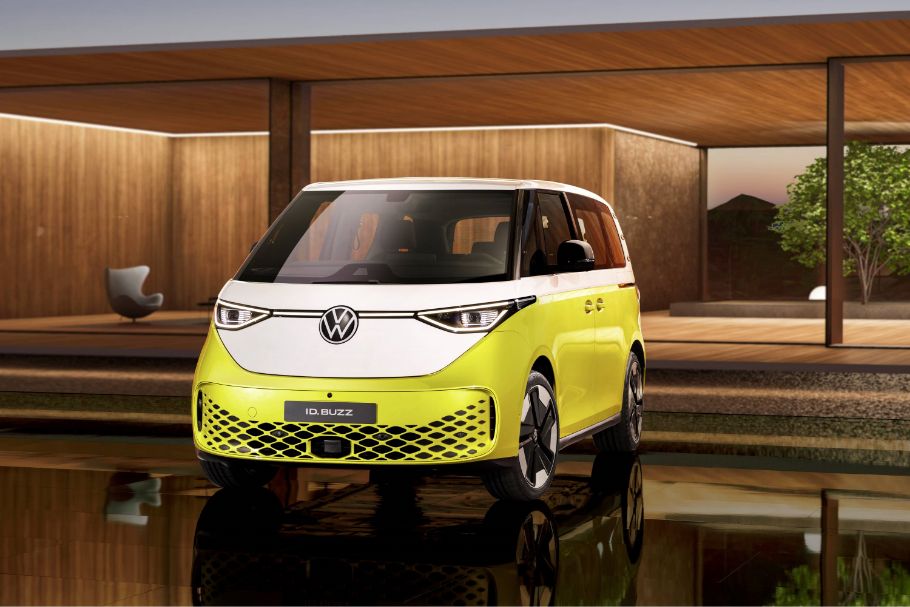
  • Volkswagen ID. Buzz

    Volkswagen ID. Buzz - Front Angle

    Today, Volkswagen Commercial Vehicles and Volkswagen Passenger Cars present the all-new ID. Buzz and ID. Buzz Cargo. The two zero-tailpipe emission vehicles transfer the design of one of the greatest automobile icons—the T1 Microbus—to the era of electric mobility. The short overhangs, spacious interior and available two-tone color palette pay homage to the past, while the high-tech interior, progressive and sustainably crafted design features, and EV technology marks it clearly as a vehicle of the future.

    The ID. Buzz and ID. Buzz Cargo will come onto the market in the first few European countries in the third quarter of this year. The features and specifications that follow apply to European models; details for the U.S. version will be available closer to launch.

    With the ID. Buzz, the Volkswagen Group further accelerates its transformation into one of the leading suppliers of electric vehicles. As with other models of Volkswagen’s all-electric family, the new ID. Buzz and ID. Buzz Cargo are based on the Group’s Modular Electric Drive Kit (MEB). The MEB is the world’s first scalable large-production-run platform, and it provides the basis across the brands for all sorts of different models and segments. At present, 30 percent of all electric vehicles in the Group are already based on the MEB. By 2025, it’s planned to be more than 80 percent. For Volkswagen Commercial Vehicles, the all-electric ID. Buzz is an important building block in order to continually help reduce the carbon footprint of the whole product portfolio.

    The first European versions of the ID. Buzz and ID. Buzz Cargo will come to market with a high-voltage lithium-ion battery providing gross energy content of 82 kWh (77 kWh net). With its twelve modules, the battery system supplies a 201 horsepower electric motor, which drives the rear axle. Maximum torque of 229 lb-ft is instantly available and the top speed is electronically limited to 90 mph. More battery versions with various power output levels are expected to follow in 2023.

    The battery is mounted in the floor of the vehicle, giving the ID. Buzz agile handling for a vehicle of its size. The charging power when using alternating current (AC) is 11 kW. Via a CCS plug connector at a DC fast-charging station (direct current), the charging power increases to as much as 170 kW. With DC-fast charging, the battery charge level rises from 5 to 80 percent in just 30 minutes. Using the latest software, the ID. Buzz model line will offer the Plug & Charge function in the future.

    For Europe, bi-directional charging will enable the new ID. Buzz and ID. Buzz Cargo to feed power that they don’t need into the domestic grid (vehicle-to-home). In the future, this can also make the power available for stabilizing the grid. The power transfer and communication take place via an optional DC bi-directional wall box.

    Exterior

    The ID. Buzz and ID. Buzz Cargo are launching in Europe this year in the normal-wheelbase form. In 2023, extended wheelbase versions of both ID. Buzz models will arrive on the European market: the U.S. version, arriving in 2024, will be based off the long-wheelbase passenger model.

    The standard wheelbase measures 2,988 mm (117.6 in), and both ID. Buzz models are 4,712 mm (185.5 in) long and 1,985 mm (78.1 in) wide, excluding wing mirrors. The ID. Buzz is 1,937 mm (76.3 in) high, while the cargo version is 1,938 mm due to slight differences in the chassis.

    The short body overhangs are possible because the zero-tailpipe emission vehicle’s electric drive system is built in a very space-efficient way. The advantages of this include maximum space utilization, more compact overall dimensions than a comparable model with a conventional drive system, and an unusually small turning circle for this vehicle class—just 11.1 meters (36.4 ft).

    “The T1 – an icon of the 1950s – represents freedom and the democratization of mobility. With the ID. Buzz, we are transferring the T1 DNA to the present day and thus into the era of electric mobility and sustainability”, says Jozef Kabaň, Head of Volkswagen Design. The looks of the ID. Buzz concept car shown in Detroit in 2017 have been closely followed for the production version. Kabaň adds: “We very consciously ensured that we were not making another T1. The ID. Buzz shows that it is successfully transferring the genes and stylistic elements of that iconic vehicle into the digital era.” That includes extremely short body overhangs, maximum space utilization on a minimal vehicle footprint, splitting the bodywork design into upper and lower levels, the unmistakable front end with its V-shaped “hood” between the charismatic headlights, and the unique rear section.

    The ID. Buzz makes full use of LEDs. At the front, it’s the charismatically styled headlights, daytime running lights, and a slim lateral bar between the headlights. In an homage to the T1, the VW logo is much larger than all other current Volkswagens. At the back, the ID. Buzz has horizontally arranged LED taillights, which are connected to one another by a full-width light strip for the first time on a Volkswagen Commercial Vehicles model.

    Volkswagen Commercial Vehicles will be offering the ID. Buzz and ID. Buzz Cargo—as is the tradition for the Microbus—both in the base colors and in various two-tone paintwork finishes for European markets. The spectrum consists of a total of eleven color variants: seven single-color options—‘Candy White’, ‘Mono Silver’, ‘Lime Yellow’, ‘Starlight Blue’, ‘Energetic Orange’, ‘Bay Leaf Green’, and ‘Deep Black’—and four two-tone options. On two-tone ID. Buzz models, the upper section, including roof and V-shaped hood, is finished in ‘Candy White’, while the areas below the character line are in a choice of four shades: ‘Lime Yellow’, ‘Starlight Blue’, ‘Energetic Orange’ or ‘Bay Leaf Green’. Exterior mirrors and door handles are finished in body color.

    Both European ID. Buzz versions will come with 18-inch steel wheels as standard. On passenger vehicle models, aluminum-alloy wheels are available in sizes ranging from 18 to 21 inches.

    Interior

    The ID. Buzz features a spacious cabin, which maximizes utility and comfort, while dazzling with high-tech features and an interplay of colors and materials.

    The standard length ID. Buzz will launch with five seats. Driver and front-seat passenger sit on individual seats with adjustable armrests (standard on the inside, optional on the outside). Integrated into the backrests of each front seat is a side thorax airbag, and in the driver’s seat there is also a center airbag, which in the event of a crash protects the driver and front-seat passenger from hitting each other. In top trims, the seats are completely electrically adjustable and have both memory and massage functions. Front seats can be adjusted up to 245 mm (9.6 in) forward and aft, and 61.5 mm (2.4 in) in height. A three-person bench seat in the rear can be folded down completely or split 40:60, and it can be moved lengthways a total of 150 mm (5.9 in). A love for detail is reflected in the stylized vehicle silhouette that is embossed in the lower side seat trim, and the fold-down tables located in the backs of the front seats. Wholly practical, by contrast, is the optional height-adjustable trunk floor, which creates a level load space surface. The upward-opening rear hatch reveals 1,121 liters (39.6 cu ft) of luggage space. Two side sliding doors are fitted as standard.

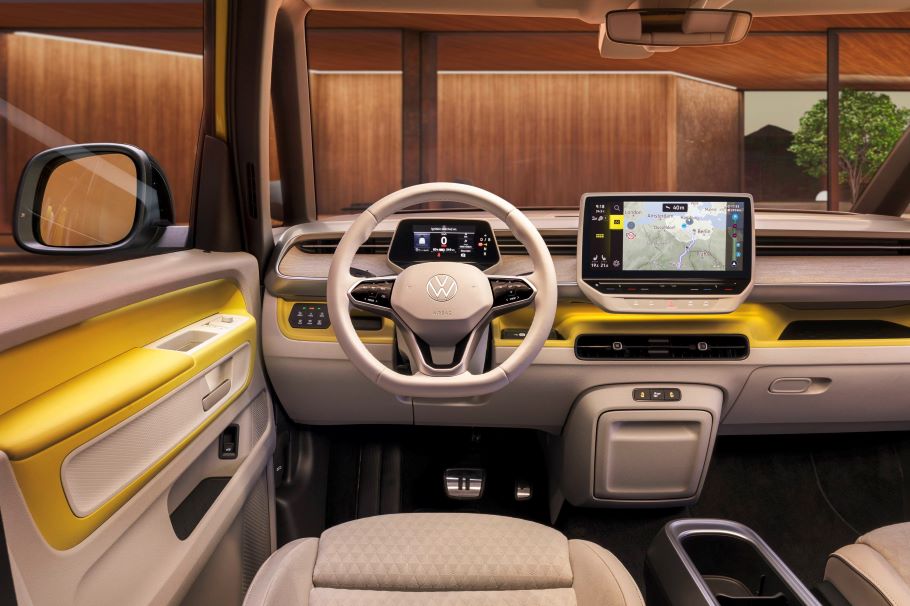
    2023 Volkswagen ID. Buzz Interior

    On the standard wheelbase, a six-seat configuration will come later with individual seats arranged in three rows of two. With the extended wheelbase, a seven-seat configuration will also be available in a 2/3/2 arrangement.

    The ID. Buzz Cargo is an ultra-modern zero-tailpipe emission van. It will launch with three seats in the cab as standard—driver’s seat plus double bench seat— and have an optional individual seat for the front-seat passenger. Behind the seats is a fixed partition, separating off the cargo space. This partition will be optionally available with a window and an opening for loading items. The cargo space measures 3.9 cubic meters (137.7 cu ft) and provides room for two euro pallets. Loads can be secured via lashing rings in the floor and bars on the side walls. The new ID. Buzz Cargo is fitted with a wide-opening tailgate and a sliding door on the passenger side. It will be possible to configure the van with a second sliding door as a custom option.

    The cockpit of the ID. Buzz is both high-tech and ergonomic. As standard, a 10-inch Digital Cockpit display is paired with a 10-inch infotainment system that is positioned centrally in the dashboard. A 12-inch display with navigation is optional. Both the Digital Cockpit and infotainment system are connected with the instrument panel only at the bottom, looking like free floating tablets. Beneath the infotainment system is a control bar with digital buttons and touch sliders. The touch sliders are used to regulate temperature and volume, while the buttons provide direct access to menus for the dual-zone Climatronic® HVAC settings, driver assist systems, driving profiles, and the parking functions.

    The transmission is operated via a steering column stalk: turn it forwards from the neutral position ‘N’ to ‘D’ for drive and back from ‘N’ to ‘R’ for reverse. To the left of the multifunction steering wheel, there is an island of digital controls for activating the light functions, as well as heating and defrost for the windshield and rear window. To the right of the steering wheel are two USB-C plugs and a tray for wireless charging (wireless App-Connect is also standard). In the center console there are, depending on specification, two more USB-C plugs; there is a fifth in the front passenger door, another in each of the two sliding doors, and one by the rearview mirror for a dash cam. Two cupholders fold out from the lower dashboard area. In the ID. Buzz Cargo, there are two more cupholders near the A-pillars.

    Volkswagen Commercial Vehicles has developed an optional movable and removable center console specifically for the ID. Buzz. The idea for this multifunction box was derived from the Detroit concept car. In its upper section, it provides storage bins (in the case of the Cargo a cup holder), a 1.4-liter (1.5 quart) flip-lid compartment (e.g. for a water bottle), and a 5-liter (1.3 gallon) drawer to accommodate tablets or laptops. In the two-seat Cargo and five-seat ID. Buzz, the center console is latched in place between the driver’s seat and front passenger seat. On the six-seat ID. Buzz, it can also be placed in the middle of the second seating row. It can be easily taken out and fitted back in.

    As with other models of Volkswagen’s all-electric vehicle family, the new ID. Buzz comes with the interactive ‘ID. Light’. It stretches across in front of the windshield in the driver’s field of vision above the instrument panel, and gives the driver intuitive information based on the color and position of the light signal. For example, a signal in the right-hand area of the strip advises of obstructions in this area or corresponds with a navigation instruction to change lanes. When ‘ID. Light’ goes red, it is signaling danger and the need to brake.

    The ID. Buzz also features standard 10-color ambient lighting, with 30 colors as optional. The 30-color version lights up a strip in the instrument panel, the decorative strips in the four doors, the storage bins in the doors and the footwell. The Digital Cockpit and the infotainment system also take on the chosen base shade. In addition, two colors can be combined in each case for the different zones, and a ‘Mood Menu’ activates preconfigured lighting profiles.

    In Europe, the base interior trim for the ID. Buzz and ID. Buzz Cargo that goes with all exterior colors is called ‘Soul’. Four ‘Mistral’ interior trim options—available exclusively for the ID. Buzz five-seater—feature the two-tone finishes found on the exterior. ‘Candy White’ is used in for the instrument panel, the door trim around the inserts, the seats’ outer panels and backs, and optionally even the steering wheel, while ‘X-Blue’, ‘Orange’, ‘Yellow’, and ‘Green’ are can be found in the dashboard and upper section of the door inserts, as well as the seat inner panels.

    Driver Assist Systems

    The spectrum of driver assist systems in the ID. Buzz includes innovatively interconnected technologies. European five-seater ID. Buzz models are equipped with standard Front Assist, Lane Assist, and Dynamic Road Sign Display. Optional systems include Adaptive Cruise Control, Side Assist, Travel Assist, Emergency Assist, Park Assist, Light Assist, and Area View.

    Sustainability

    Volkswagen is utilizing innovative technologies and processes demonstrating that both versions of the ID. Buzz have been designed with sustainability in mind. The array of such measures starts with removing any use of leather in the vehicle. The steering wheel cover is made of polyurethane, but looks just as high quality as leather and provides a similar feel. The materials used for the seat covers, floor coverings and roof liner of the ID. Buzz incorporate recycled material. There will be a fabric made of what is known as Seaqual® yarn, with fibers consisting of 10 percent collected ocean plastic and 90 percent recycled PET bottles.

    The two new ID. Buzz models will also use organically based vehicle paint and forgo cobalt in the high-voltage battery. The company’s sustainability measures include a plant that recycles the high-voltage batteries at the end of their automotive life cycle to prepare them for a second use. Volkswagen Commercial Vehicles gives a guarantee of eight years or 160,000 kilometers (100,000 miles)—whichever occurs first—on the ID. Buzz battery.

    Production

    The new ID. Buzz and ID. Buzz Cargo models are being produced by Volkswagen Commercial Vehicles at its main plant in Hannover. Production of the ID. Buzz here reaches, in parts, an automation level of up to 90 percent. In parallel with the transformation of the plant, the workforce is also taking a big step into the future. Many job profiles are changing, and through retraining measures, the workers are acquiring the necessary knowledge for dealing with the new hardware and software of the ID. Buzz.

    The majority of the ID. Buzz electric drive system modules being supplied to the plant for this are also being made in Germany, by the Group’s own Volkswagen Group Components division. The modules—including the electric motor, the axles and the battery system—are being produced at the components factories in Kassel, Braunschweig, Salzgitter and Hannover. The ID. Buzz is the first model in Volkswagen’s family of all-electric vehicles for which Volkswagen Group Components is making the axles. This is being done in an assembly hall specifically set up for the purpose at the Hannover-Barsinghausen site with 200 employees.

    Long term, Hannover also plans to produce the battery system for the ID. Buzz—it is currently being made in Braunschweig—and the company is currently investing around 100 million euros in the construction of the battery system assembly.

    QUICK FACTS – the ID. Buzz and ID. Buzz Cargo

    European models

    • ID. Buzz (five-seater)
    • ID. Buzz Cargo (van, three seats in the front)

    Important anticipated dates

    • Start of European ID. Buzz Cargo production: first half of 2022
    • Start of European ID. Buzz production: first half of 2022
    • European launch (initial countries): third quarter of 2022
    • Start of advance sales in Europe (initial countries): May 2022
    • North American debut of long wheelbase: 2023
    • North American sales launch: 2024

    Technical platform

    • Modular Electric Drive Kit (MEB)

    External dimensions

    • Width excluding wing mirrors: 1,985 mm (78.1 in)
    • Height:
      • ID. Buzz: 1937 mm (76.3 in)
      • ID. Buzz Cargo: 1,938 mm (76.3 in)
    • Length: 4,712 mm (185.5 in)
    • Wheelbase: 2,988 mm (117.6 in)
    • Load sill:
      • ID. Buzz: 619 mm (24.4 in)
      • ID. Buzz Cargo: 623 mm (24.5 in)

    Cargo space

    • ID. Buzz: up to 1,121 liters (39.6 cu ft)
    • ID. Buzz Cargo: 3.9  cubic meters (137.7 cu ft), room for two euro pallets

    Drive system

    • Type: all-electric rear-wheel drive
    • Max. power: 150 kW (201 horsepower)
    • Max. torque: 310 Nm (229 lb-ft)
    • Battery capacity: 82 kWh gross, 77 kWh net
    • AC charging power (alternating current): 11 kWh
    • DC charging power (direct current) at fast-charging stations: up to 170 kWh

    Driving performance and turning circle

    • Top speed: 145 km/h, electronically limited (90 mph)
    • Driving range: to follow at a later date
    • Turning circle: just over 11 meters (36.4 ft)

    Sustainability

    • Zero-tailpipe emission electric drive system
    • Leather replaced by non-animal material
    • Use of partial recycled materials in seat covers, floor coverings and roof liner

    Production site

    • Volkswagen Commercial Vehicles’ main plant in Hannover, Germany

    Colors

    • Non-metallic: ‘Candy White’
    • Metallic: ‘Mono Silver’, ‘Lime Yellow’, ‘Starlight Blue’, ‘Energetic Orange’ and ‘Bay Leaf Green’
    • Pearl-effect: ‘Deep Black’
    • Two-tone: ‘Candy White’ in combination with ‘Lime Yellow’, ‘Starlight Blue’, ‘Energetic Orange’ or ‘Bay Leaf Green’

    Fun Facts

    • The ID. Buzz is not the first ‘Bus with an electric drivetrain—50 years ago at the Hannover Trade Fair, Volkswagen showed a T2 powered by a rear-mounted electric motor with a maximum range of 85 kilometers (52.8 miles)
    • The five-seater ID. Buzz features a stylized silhouette of the vehicle embossed into the side of the luggage compartment and seats, reminiscent both of the T1 and the Microbus concept vehicle unveiled in 2000 in Detroit
    • The idea for the movable and removable center console of the production ID. Buzz originated in the 2017 I.D. BUZZ Detroit concept car
  • Ford Mustang Turns California Dreaming into Reality in Europe for the First Time

    Ford Mustang California Special EU 2022 - Side View

    The quintessential style of west coast America has crossed the Atlantic as the Ford Mustang California Special arrives in Europe for the first time.

    Embodying the free-spirited ethos of the 1968 original, the new California Special is offered exclusively in convertible body style with a folding soft-top for classic looks and open-air thrills. A special-edition design package with unique badging, detailing, 19-inch alloy wheels and special “colour shift” California Special decals delivers distinctive style, and Ford’s charismatic 450 PS V8 petrol engine provides the power for effortless cruising.

    Inside, the Mustang California Special is designed to help liberate all the fun of the open road whatever the weather, with bespoke California Special detailing adding exclusive appeal. Standard comfort technologies include heated and cooled front seats, a 12-inch customisable instrument cluster, and advanced SYNC 3 connectivity that enables drivers to call up their favourite road trip soundtrack or find directions to the nearest beach using just their voice.

    A new video released today by Ford marks the Mustang California Special’s arrival in Europe by celebrating the spirit of Mustang and demonstrating that California is a state of mind to be enjoyed wherever you are.

    https://www.youtube.com/watch?v=WtKU2C-v4pk

    “The California Special is a huge part of the Mustang’s legacy in America and it symbolises so much of what Mustang stands for: The joy of driving and the freedom of the open road. Those ideals resonate just as strongly with driving enthusiasts in Europe, so it’s about time customers here got to experience the unique California Special blend of style, performance and driving fun,” said Matthias Tonn, Mustang chief programme engineer, Ford of Europe.

    Classic design reinvented

    When the now iconic Ford Mustang first hit the streets in 1964, owners’ clubs sprang up across America, with many regional dealers creating their own personalised designs. One – inspired by the 1967 Shelby GT notchback coupe prototype – came to be called the California Special.

    That original version featured a blacked-out grille, fog lights and a side racing stripes that ended ahead of new rear side air scoops, as well as a Shelby-inspired spoiler. Impressed, Ford put a limited number of California Special cars into production for 1968.

    The newest interpretation – available only as a folding soft-top convertible in homage to the famously Mediterranean-like climate of “the Golden State” – reflects the original with a honeycomb front grille finished in Ebony Black and featuring a GT/CS badge in Race Red, as well as lower side stripes finished in black, red and grey. Incorporating GT/CS logos, the stripes run from the front to rear wings and feature a hidden “California Special” script that is almost invisible in low light conditions but becomes much more prominent in stronger sunlight.

    Like the original, aerodynamic enhancements hint at V8 performance, with a larger front splitter and optional rear side air scoops. At the rear, a California Special faux filler cap sits above quad tailpipes. Unique five-spoke alloy wheels add to the exclusivity. Front 19 x 9-inch and rear 19 x 9.5-inch wheels are finished in Carbonised Grey to complement the front splitter, side skirts and rear diffuser. Under the bonnet, a strut tower brace features a California Special badge.

    Nine exterior colours include signature Grabber Blue and Cyber Orange, contrasting with the black roof that folds to transform the coupe profile into a sleek convertible in eight seconds.

    Further unique design touches and comfort features inside the Mustang California Special highlight its special-edition status. Standard heated and cooled front seats help occupants stay comfortable with the roof down in summer or winter. The leather seats and door inserts are part-finished in grey Miko® suede – an ecological, synthetic material made from recycled polyester – with red stitching. Seats and floor mats are embossed with the GT/CS logo, and the instrument panel is finished in Carbon Hex aluminium with a unique Mustang California Special badge.

    Ford’s SYNC 3 communication and entertainment system 1 is designed to always be ready for a spur of the moment road trip, enabling drivers to control their connected smartphones, audio, navigation, and climate functions with conversational voice commands and a central 8-inch touch screen. The system is compatible with Apple CarPlay and Android Auto 2 at no extra cost and connectivity is provided on the move by a standard FordPass Connect modem. 3

    Standard driver assistance technologies including Adaptive Cruise Control with Pre-Collision Assist and Lane Keeping Alert 4 help make every day driving less demanding, with the ultimate in stress relief provided by the folding roof, creating unlimited headroom.

    Good vibrations

    The Mustang California Special’s 5.0-litre Ford V8 engine – delivering 450 PS and 529 Nm 5 of torque – provides the performance and soundtrack befitting a special-edition Mustang.

    Combined with Ford’s six-speed manual transmission featuring rev-matching technology for seamless gearchanges and an even sportier character, the model accelerates from 0-62 mph in 4.8 seconds. Ford’s advanced 10-speed automatic transmission delivers 4.5-second 0‑62 mph acceleration.

    The automatic transmission also optimises performance depending on the selected Drive Mode. 4 Normal, Sport, Track and Snow/Wet modes deliver the appropriate driving experience whether on Route 66 or the A6. Good Neighbour mode can automatically limit the exhaust’s noise output at pre-programmed times of the day.

    Traction and cornering grip are maximised by a standard limited-slip differential and an available MagneRide® 6 suspension system. It monitors conditions one thousand times per second and uses an electronically-controlled fluid to match damping resistance to the driving scenario.

    The Ford Mustang California Special expands the European Mustang family that includes the Mustang GT fastback and convertible, the track-ready Mustang Mach 1, and the all-electric Mustang Mach-E and Mustang Mach-E GT. 5

    Mustang Mach-E combines the style, character and performance of the iconic sports car with an energy-efficient, battery-electric drivetrain capable of delivering up to 610 km WLTP pure-electric driving range. 5 Mustang Mach-E GT delivers Ford’s most exhilarating all-electric production vehicle driving experience yet, with a specially tuned all-wheel drive powertrain offering 487 PS and 860 Nm for 0-62 mph acceleration in 3.7 seconds. 7

    # # #

    1 Don’t drive while distracted. Use voice-operated system when possible; don’t use handheld devices while driving. Some features may be locked out while the vehicle is in gear. Not all features are compatible with all phones.

    2 Requires phone with active data service and compatible software. SYNC 3 does not control 3rd party products while in use. 3rd Parties are solely responsible for their respective functionality.

    3 FordPass Connect, the FordPass app and complimentary Connected Service are required for remote features (see FordPass terms for details). Connected Service and features depend on Vodafone or Vodafone partner mobile network availability. Evolving technology/mobile networks/vehicle capability may limit functionality and prevent operation of connected features. Connected Service excludes Wi-Fi hotspot.

    4 Driver-assist features are supplemental to and do not replace the driver’s attention, judgment and need to control the vehicle. It does not replace safe driving. See Owner’s Manual for details and limitations.

    5 Ford Mustang Mach-E delivers up to 610 km WLTP homologated pure-electric driving range in rear-wheel drive, extended-range battery configuration.

    Ford Mustang Mach-E GT delivers up to 500 km WLTP homologated pure-electric driving range.

    Ford Mustang California Special and GT six-speed manual homologated CO2 emissions 268-276 g/km WLTP and homologated fuel efficiency 11.8-12.1 l/100 km WLTP.

    Ford Mustang California Special and GT 10-speed automatic homologated CO2 emissions 256-265 g/km WLTP and homologated fuel efficiency 11.2-11.6 l/100 km WLTP.

    Ford Mustang Mach 1 six-speed manual homologated CO2 emissions 284 g/km WLTP and homologated fuel efficiency 12.4 l/100 km WLTP.

    Ford Mustang Mach 1 10-speed automatic homologated CO2 emissions 270 g/km WLTP and homologated fuel efficiency 11.7 l/100 km WLTP.

    CO2 emission and fuel efficiency ranges may vary according to vehicle variants offered by individual markets.

    The declared WLTP fuel/energy consumptions, CO2-emissions and electric range are determined according to the technical requirements and specifications of the European Regulations (EC) 715/2007 and (EU) 2017/1151 as last amended. The applied standard test procedures enable comparison between different vehicle types and different manufacturers.

    6 MagneRide® is a trademark of BWI Group.

    7 Ford test data based on testing methodology using 1-ft rollout i.e. from a rolling start.


  • Polestar O2 concept envisions new age for electric roadsters

    Polestar O2 concept - front angle

    Polestar, the pure play electric performance car brand, has revealed a new concept car that redefines sports roadsters for the electric age. Named Polestar O2, the hard-top convertible is Polestar’s vision of open-top performance and a thrilling driving experience – with all the benefits of electric mobility.

    “Polestar O2 is the hero car for our brand,” comments Thomas Ingenlath, Polestar CEO. “It opens the door to our secret chamber of future potential. This is a taste of what we can design and engineer with the talent and technology we have in-house. It looks incredible, and being able to lower the roof and not hear an engine promises a superb sensation.”

    Dynamics

    Maximilian Missoni, Polestar’s Head of Design, says: “Polestar O2 is our vision of a new era for sports cars. By mixing the joy of open top driving with the purity of electric mobility, it unlocks a new mix of emotions in a car. But as with all our cars, we are about more than just straight line sprints. It’s when you turn the steering wheel that the true fun begins.”

    The driving experience in the Polestar O2 is designed to be lively, light and full of confidence. Predictability and playfulness are core to exciting, spirited driving. Tight body control, high rigidity and intuitive dynamics are inherent benefits of the bespoke bonded aluminium platform which is adapted from the Polestar 5, developed in-house by Polestar’s R&D team in the UK.

    The high quality and rigidity of the bonded aluminium platform are geared towards heightened dynamic response. Handling dynamics are taut thanks also to small roll angles and high roll damping, and the agile, direct steering feel is linear, with great steering torque build-up.

    Design

    Clearly related to the Polestar Precept concept car but with its own distinct character, the look of Polestar O2 shows how Polestar’s evolving design language can be adapted to different body styles with a strong family resemblance. The low and wide body with an assertive stance, compact 2+2 cabin design, minimal overhangs and a long wheelbase, embody classic sports car proportions but with a clearly modern, electric feel.

    “This car is a meeting point between technology and art, between precision and sculpture, with a determined but not aggressive stance,” continues Maximilian Missoni.

    Aerodynamics are manipulated to maximise range thanks to disguised design features like integrated ducts that improve laminar air flow over the wheels and body sides, and the rear lights that function as air blades to reduce turbulence behind the car.

    Sustainability and technology

    Polestar O2 also showcases advances in sustainability and technology. A new thermoplastic mono-material features extensively in the interior. The term “mono-material” describes the use of a single base material to manufacture different components.

    In Polestar O2, recycled polyester is the sole material used for all the soft components of the interior: foam, adhesive, 3D knit fibres and non-woven lamination. This simplifies recycling and is a significant step towards greater circularity, while also reducing weight and waste.

    Polestar sustainability teams believe that materials should be recycled, not downcycled. In Polestar O2, they have integrated a new method of controlling recycled content and improving circularity of metal components. Different grades of aluminium are used throughout the chassis to help deliver a thrilling driving experience.

    These different grades are labelled, allowing them to be recycled more effectively and for their properties to be retained. High grade aluminium remains high grade, while other grades maintain their varied characteristics, allowing for greater material efficiency and a lower requirement for virgin aluminium.

    Innovation

    In a world increasingly driven by social media, the Polestar O2 features an autonomous cinematic drone integrated behind the rear seats. Developed in collaboration with Aerofugia’s consumer electronics brand Hoco Flow, the concept drone can be deployed while the car is moving, to record the perfect driving sequence.

    Polestar engineers have developed a specialised aerofoil that raises behind the rear seats to create a calm area of negative pressure that allows the drone to take off when the car is on the move. The drone operates autonomously, automatically following the car at speeds up to 90 km/h, and the driver can choose between an atmospheric sequence – great for a coastline cruise – or a more action-filled sequence with a sportier expression. After filming, the drone can autonomously return to the car. Video clips can be edited and shared directly from the 15-inch centre display when the car is parked.

    “We wanted to emphasise the experience you can have with a car like the Polestar O2 in new and unusual ways,” continues Maximilian Missoni. “Integrating an autonomous cinematic drone was something that allowed us to push the boundaries on the innovation front. Not needing to stop and off-load the drone before filming, but rather deploying it at speed, is a key benefit to this innovative design.”

    Polestar O2 continues the strong foundations laid by Polestar Precept as a vision of the company’s future design, technology and sustainability ambitions. Polestar plans to launch three new cars over the coming three years, starting in 2022, each of which has potential to gradually realise some of the ideas presented by these concept cars.

    Polestar also intends to list on the Nasdaq in a proposed business combination with Gores Guggenheim, Inc. (Nasdaq: GGPI, GGPIW, and GGPIU), which is expected to close in the first half of 2022.

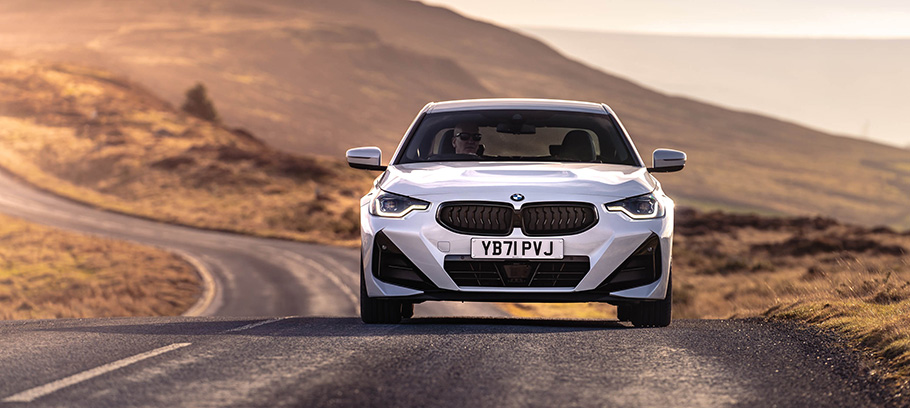
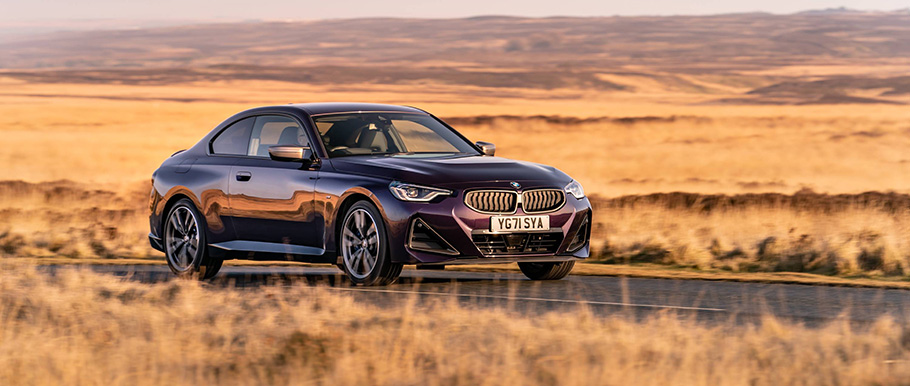
  • BMW 2 Series Coupe [UK]

    2022 BMW 2 Series Coupe UK - Front View

    Striking looks, exceptional handling and classical rear-wheel drive will leave potential customers of the new BMW 2 Series Coupé in no doubt that this is a car to excite and inspire.

    The new generation of the two-door model incorporates the new BMW design language to highlight a fresh, youthful feel with meticulously engineered and perfectly balanced driving attributes.

    Reaffirming its sector-leading status, the BMW 2 Series Coupé boasts rear-wheel drive, a six-cylinder in-line engine option and new equipment features that combine to underscore its standout sporting characteristics.

    The advances made over the predecessor model are also reflected in a far broader range of driver assistance systems and the latest connectivity innovations.

    The standalone vehicle concept of the BMW 2 Series Coupé puts clear water between it and the BMW 1 Series models (which are based on an advanced front-wheel-drive architecture) and borrows extensively from the technology used in the BMW 3 Series and BMW 4 Series. As a result, the new BMW 2 Series Coupé occupies a defiantly niche position in both the brand’s model portfolio and among its rivals.

    The UK market launch begins in March 2022 with three model variants initially available. Topping the range is the all-wheel-drive BMW M240i xDrive Coupé, which is powered by a 374hp six-cylinder in-line engine, while customers can also choose from four-cylinder petrol and diesel versions in the standard M Sport specification.

    The new BMW 2 Series Coupé is built at the BMW Group’s San Luis Potosí plant in Mexico.

    Individual proportions, optimised aerodynamics

    The exterior dimensions provide the ideal starting point for excellent driving dynamics. A length of 4,537mm and width of 1,838mm represent increases over the predecessor model of 105mm and 64mm respectively. The new car is 28mm lower, however, with a vehicle height of 1,390mm. Its wheelbase is also 51mm longer at 2,741mm. Wider track widths of 1,575mm (an increase of 54mm) at the front axle and 1,587mm (an increase of 31mm) at the rear axle (BMW M240i xDrive Coupé: +63mm at the front, +35mm at the rear) are ideal for excellent cornering dynamics.

    The new BMW 2 Series Coupé’s boot offers load capacity of 390 litres – a 20-litre increase in primary capacity over its predecessor – and the height of the loading edge is 35mm lower.

    The concept for the new BMW 2 Series Coupé body also includes targeted measures for optimising its aerodynamics. An active air flap control system for the BMW kidney grille – adjustable through ten stages according to need – and the lower intake in the front apron, plus air curtains, flush-fitting door handles, aerodynamically optimised light-alloy wheels and an almost completely sealed underbody, serve to channel the airflow effectively. The BMW M240i xDrive Coupé also has turning vanes and splitters at the front of the underbody which deflect the air precisely as required to reduce lift.

    Intelligent lightweight design optimises rigidity and weight

    An intelligent mix of materials succeeds in minimising the weight of the new BMW 2 Series Coupé, while also enhancing the body’s rigidity and crash safety.

    As in the new BMW 4 Series Coupé, die-cast aluminium spring struts and an engine side member made from extruded aluminium profiles are deployed to save weight at the front end. Other advances over the outgoing model have been achieved through the aluminium construction of the bonnet and front side panels of the new BMW 2 Series Coupé. These measures alone account for a reduction in weight of around 9.6kg.

    A comprehensive passive safety concept maximises occupant protection and the BMW 2 Series Coupé is also equipped as standard with an active bonnet system to optimise pedestrian protection.

    Sporty, classically designed exterior with eye-catching front-end design

    The exterior design of the new BMW 2 Series Coupé instantly announces its overtly sporting nature. With powerful proportions set within the classical three-box design of bonnet, passenger compartment and boot, it truly embodies the extraordinary dynamic potential of the new 2 Series Coupé.

    Three-dimensional surfaces, triangular forms and diagonal lines are integral to the front end of the new BMW 2 Series Coupé. The low-reaching front apron, headlights positioned to the outer edges of the front end and the horizontal BMW kidney grille give the car a wide, low-slung look.

    2022 BMW2  Series Coupe M240i

    The BMW kidney grille features vertically arranged air flaps at its heart in place of the classical bars. These operate electrically and only open when the engine has an increased need for cooling air.

    Inspired by the legendary BMW 02 models, the headlight units each have a single individual circular headlight using full-LED technology for both low beam and high beam.

    A long bonnet, short overhangs and a set-back passenger compartment give the new 2 Series Coupé proportions cut from the time-honoured BMW mould. The car’s roofline, that dramatically swoops down from the B-pillar, and the short boot lid culminating in a pronounced spoiler lip, typify sporting compact BMW coupés.

    Powerful rear with striking light and shadow effects

    Horizontally pronounced surfaces give the rear end of the new BMW 2 Series Coupé its structure. They produce an interplay of light and shadow effects to accentuate the rear end and complement the darkened rear lights.

    The rear end also features a dark shadow rear apron insert, while the exhaust tailpipes on petrol-engined models come in a dual-branch arrangement. The tailpipes are circular on the BMW 220i Coupé and trapezoidal on the BMW M240i xDrive Coupé.

    Customers can choose from one non-metallic and six metallic exterior paint shades. A new addition to the range is the Thundernight metallic colour available exclusively for the sporty two-door model.

    Distinctive M accents enhance the performance-focused appearance

    Specific design features of the six-cylinder BMW M240i xDrive Coupé highlight its performance attributes. The surfaces bordering the lower air intake in the front apron display the U-shaped graphic typical of BMW M cars. A black splitter rounds off the front apron at its lowest point. The BMW kidney grille surround and side air-intake trim come in Cerium Grey, as do the M-specific exterior mirror caps, the exhaust tailpipes and the model badges. Also part of the standard specification for the BMW M240i xDrive Coupé are M High-gloss Shadow Line trim and 19‑inch M light-alloy wheels. Like the rear apron inlay, its side skirts are also in High-gloss Black. An M-specific boot-lid spoiler painted in body colour and a black diffuser between the exhaust tailpipes optimise the airflow at the rear of the car.

    The standard M Sport specification also sends a clear message about the car’s dynamic ability. It includes the powerfully structured front apron with large side air intakes, M High-gloss Shadow Line trim and 18-inch M light-alloy wheels. The side skirts and the lower section of the rear apron with integral diffuser are painted in Dark Shadow metallic.

    Interior: sports-car flair meets a premium ambience

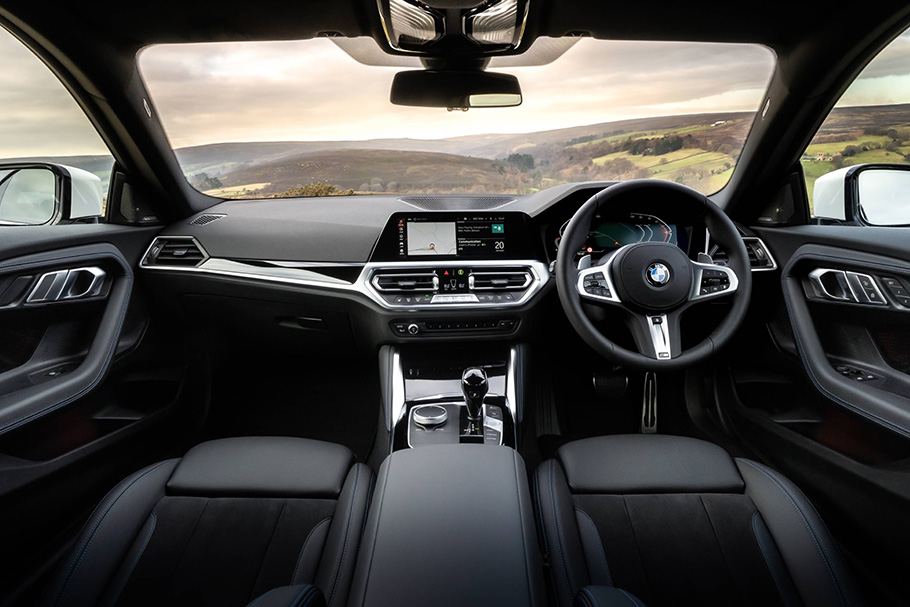
    Inside the new BMW 2 Series Coupé, the latest interpretation of the driver-focused cockpit design is defined by the ergonomically optimised arrangement and operation of the displays and controls. The BMW Controller, gear selector lever, Start/Stop button, Driving Experience Control switch and numerous other function buttons are grouped within a modern-looking control panel in the centre console. High-quality materials, precise workmanship and carefully executed details mark out the elevated quality levels of the interior.

    Standard equipment includes a Sport leather steering wheel with newly designed multifunction buttons. The standard M Sport specification come with Alcantara/Sensatec upholstery in Black with blue contrast stitching and the BMW M240i xDrive Coupé comes with Vernasca leather.

    The standard heated sport seats for the driver and front passengers of M Sport provide both excellent long-distance comfort and pronounced lateral support. Electric M Seats with integrated headrests and M seatbelts feature in the six-cylinder flagship model.

    2022 BMW 2 S0eries Coupe UK Interior

    The Easy-Entry function slides the electric front seats forward in a controlled movement when the backrests are folded, making it easier for passengers to access the rear compartment. The contours and integral headrests of the two rear seats give them a sporty look and feel.

    The combination of triangular surfaces and diagonal lines in the exterior of the car is carried over into the interior. A new design feature comes in the form of trapezoidal accent surfaces above the armrests in the doors.

    The interior trim strips on all variants come in High-gloss Black as standard. Standard equipment also includes cushioned knee pads on the centre console, an M headliner in Anthracite, door sill finishers bearing the M logo, M pedals, M floor mats and M-specific displays in the instrument cluster.

    Advanced chassis technology honed to deliver class-leading driving dynamics

    From day one, the series production development process for the new BMW 2 Series Coupé was focused squarely on leading the way in terms of dynamic performance in the premium compact segment. Compact dimensions, intelligent lightweight design for the body and chassis, almost perfect 50:50 weight distribution and optimised aerodynamics create an ideal blueprint for a vehicle character focused on sporting excellence.

    Another central element of the vehicle concept underpinning the new BMW 2 Series Coupé is power transfer to the rear wheels or – in the new BMW M240i xDrive Coupé – via intelligent all-wheel drive with a noticeable rear-wheel bias.

    In all model variants, sophisticated chassis components originally designed for the BMW 3 Series and BMW 4 Series models ensure supreme driveability at all times. While the new BMW 2 Series Coupé outstrips its predecessor in terms of performance agility, the comfort it offers remains at the same high level. When it comes to rolling comfort and acoustics, the new car has made significant improvements.

    Highlights of the chassis technology include a two-joint spring strut-front axle, five-link-rear axle, wheel bearings that are 2.7kg lighter and have 45 per cent less friction than before, lift-related dampers with bespoke characteristics, and weight-saving construction throughout.

    Adaptive M suspension spans an extremely wide spectrum between sportiness and comfort

    The adaptive M suspension available as an option for the new BMW M240i xDrive Coupé allows drivers the widest possible spread between sporty and comfort-oriented responses. Adaptive M suspension combines the characteristics of M Sport suspension with electronically controlled dampers.

    Switching between the various Driving Experience Control modes produces a clearly perceptible variation in the damping characteristics – from the well-balanced long-distance refinement of COMFORT mode through to the highly dynamic set-up activated in SPORT PLUS.

    An extra mode can be selected using the Driving Experience Control switch on models with adaptive M suspension. In the ADAPTIVE setting, the steering, damping and accelerator responses along with the transmission’s shift characteristics are automatically adjusted to suit the driving style.

    Variable sport steering is fitted as standard to all versions of the new BMW 2 Series Coupé.

    M Sport braking system with model-specific adjustments

    Powerful lightweight braking systems with a bespoke configuration also play a part in the car’s precisely controllable performance. The optional M Sport brakes (standard on the new BMW M240i xDrive Coupé) provide excellent braking performance through a specification that includes four-piston fixed callipers at the front and single-piston floating callipers at the rear. The callipers bear the M logo and are painted red as standard or with a blue finish option available at no cost.

    The functions provided by the Dynamic Stability Control (DSC) system include not only anti-lock braking (ABS) and Dynamic Traction Control (DTC), but also a variety of stabilising functions and the drive-off assistant. The Performance Control function gives the car even more agile handling by varying the distribution of drive torque to the rear wheels according to the situation at hand.

    BMW 2 Series Coupe M Sport braking system

    M Sport differential fitted as standard on the BMW M240i xDrive Coupé.

    The outstanding performance attributes of the new BMW M240i xDrive Coupé stem from a carefully composed package of powertrain and chassis technology, which also includes an M Sport differential as standard. Its electronically controlled, fully variable locking function in the rear differential optimises traction and directional stability, as well as agility and cornering dynamics.

    Trio of engine options include a six-cylinder in-line petrol engine in the BMW M240i xDrive Coupé

    The flagship model in the 2 Series Coupé range is equipped with the most powerful six-cylinder in-line petrol engine in the core BMW brand engine portfolio. Producing 374hp, the 3.0-litre unit develops 34hp more than the engine in its predecessor. Its peak torque of 500Nm is on tap from 1,900-5,000rpm. The BMW M240i xDrive Coupé accelerates from 0 to 62mph in only 4.3 seconds.

    Developed using the motor-racing expertise of BMW M GmbH, the engine features an aluminium crankcase with a closed-deck construction and an alloy cylinder head. Internal engine efficiency is increased by weight-optimised pistons and con rods and a forged steel crankshaft. Power development and efficiency also benefit from the latest BMW M Twin Power Turbo technology. The standard M Sport exhaust system provides the perfect soundtrack to the engine’s spirited power delivery.

    As well as the latest version of BMW TwinPower Turbo technology with twin-scroll turbocharging and High Precision Injection, the four-cylinder 2.0-litre petrol engine of the new BMW 220i Coupé also has a cylinder head with integrated exhaust manifold. Making its debut in the 184hp unit, this design enables particularly effective exhaust gas cooling, which helps to minimise emissions. It generates 300Nm of torque, enabling acceleration of 0-62mph in 7.5 seconds.

    The enhanced 2.0-litre power unit in the new BMW 220d Coupé develops 190hp and peak torque of 400Nm. It now features two-stage turbocharging and further developed common rail direct injection. Mild-hybrid technology supports the diesel engine. A 48V starter generator takes the role of an electric drive system, providing an extra 11hp of power. This electric boost enhances dynamic response when accelerating off the line and overtaking. The BMW 220d Coupé sprints from 0-62mph in 6.9 seconds.

    Model Max Power(hp) Peak Torque(Nm) Acceleration(0-62mph) Top Speed(mph)** Fuel economy(mpg)* CO2 emissions(g/km)* OTRStarting Price
    220i 184 300 7.5 147 44.8 155-144 £34,980
    220d 190 400 6.9 147 60.1 132-122 £36,900
    M240i xDrive 374 500 4.3 155** 34.9 200-185 £45,795

    **Electronically governed.

    Standard across the new BMW 2 Series Coupé: eight-speed Steptronic Sport transmission

    The eight-speed Steptronic Sport transmission fitted as standard in all BMW 2 Series Coupé model variants helps the driver to execute dynamic manoeuvres. As well as gearshift paddles on the steering wheel, this transmission also brings a Launch Control function for when the driver is looking to power off the line with optimal traction. For quick bursts of speed while on the move, meanwhile, there is the Sprint function. Here, the transmission automatically shifts into the lowest usable gear when the driver pulls the left-hand shift paddle for at least one second.

    BMW xDrive: precisely controlled power distribution for optimal traction and driving pleasure

    The intelligent all-wheel-drive system BMW xDrive in the new BMW M240i xDrive Coupé increases traction, directional stability and agility. It uses an electronically controlled multi-plate clutch in the transfer case interlinked with the powertrain and chassis systems to distribute power between the front and rear wheels as required for the situation at hand. In this way, any tendency of the vehicle to oversteer or understeer is nipped in the bud.

    In driving situations where all-wheel drive is not necessary, the power from the six-cylinder in-line engine is sent to the rear wheels alone. This set-up and the M Sport differential likewise fitted as standard in the new BMW M240i xDrive Coupé work together to deliver the type of performance experience customers expect from a BMW when pushing the dynamic limits.

    Standard equipment includes three-zone automatic climate control and BMW Live Cockpit Professional

    The standard-fitted BMW Live Cockpit Professional features a fully digital screen grouping. It includes a high-resolution instrument cluster behind the steering wheel with a screen diagonal of 12.3 inches and a 10.25-inch control display. The fully digital instrument display in the cockpit provides enough room to accommodate an excerpt from the navigation map, media content or status indicators for the driver assistance systems.

    The new BMW 2 Series Coupé is fitted as standard with acoustic glazing for the windscreen and a rain sensor with automatic headlight activation. Electrically adjustable, heated and folding exterior mirrors also form part of the standard specification, as does three-zone automatic climate control and LED lighting for the interior. The new version of the optional glass slide/tilt electric sunroof has a transparent surface that is 80mm longer than in the outgoing model and is nearly 20 per cent larger overall.

    Tailor-made performance: M Sport package Pro and M Performance Parts

    The standard M Sport trim can be further enhanced with the M Sport package Pro. Comprising M Sport brakes, 19-inch M light-alloy wheels, M High-gloss Shadow Line with extended features, the M lights Shadow Line, a black M rear spoiler, this package delivers optimised driving dynamics and particularly striking looks. A sporty drive sound in the interior, Steptronic Sport transmission, the harman/kardon hi-fi speaker system and M seat belts also increase levels of driving pleasure.

    In addition, the M Performance Parts available for the new BMW 2 Series Coupé allow customers to give their car an extra sporting touch, as per their personal tastes.

    New and improved driver assistance systems

    The new BMW 2 Series Coupé enhances safety and comfort with a significantly expanded selection of driver assistance systems. The automated assistance functions are among the best on the market. They assist the driver or lighten their workload in a wide variety of driving situations and when parking.

    The BMW 2 Series Coupé is fitted as standard with front-collision warning. This system includes Collision Warning with braking function and pedestrian and cyclist warning with braking function. Speed Limit Info with no-overtaking indicator is another feature fitted as standard.

    Also to be found on the standard equipment list is an enhanced version of Lane Departure Warning with lane return, which can be used when travelling at speeds between 44 and 130mph.

    Active Cruise Control with Stop&Go function is also optional as part of Driving Assistant. This system works when driving at speeds of 19-99mph and is capable of braking the vehicle to a standstill, if necessary, and even setting off again automatically after short pauses lasting up to 30 seconds. The standard and optional cruise control systems both include a manual Speed Limit Assist function.

    Drivers of the new BMW 2 Series Coupé can also benefit from effective assistance when parking and manoeuvring, for example from the standard Park Distance Control (PDC) with sensors at the front and rear. The optional Parking Assistant Plus offers even more assistance with features that, among other functions, generate an excellent 360-degree image of the vehicle and its surroundings.

    Innovative digital services enabled by the standard BMW Operating System 7

    Both driver and passengers will benefit from the enhanced options offered in the standard-fit BMW Operating System 7. Individually configurable display content and intelligent connectivity underpin multimodal and seamless interaction between driver and vehicle. Drivers can take their pick of control interface depending on the situation, using either the control display touchscreen, the BMW Controller, multifunction buttons on the steering wheel or voice control. The new BMW 2 Series Coupé also gives customers on-board access to a range of highly advanced digital services, including the BMW Intelligent Personal Assistant, optional BMW Digital Key, Real Time Traffic Information including hazard alert, Connected Music and Remote Software Upgrades.

    Making its BMW 2 Series Coupé debut: the BMW Head-Up Display

    The BMW Head-Up Display – available for the BMW 2 Series Coupé for the first time as an optional extra – helps the car to provide focused and safe driving experience. It projects driving-related information directly into the driver’s field of vision on the windscreen without the need to divert their eyes from the road. The latest generation of the system boasts a very large projection area and full-colour graphics.

    2022 bmw 2-series coupe uk navigation

    Fast, accurate, informative: the BMW Maps navigation system

    The cloud-based BMW Maps navigation system boasts significantly enhanced performance and excellent accuracy along with a simplified method of destination entry. The new-generation navigation system offers extremely fast route calculation carried out dynamically and based on precise real-time traffic data transmitted at short intervals.

    BMW Maps also uses Connected Parking to provide assistance when searching for a parking space close to the destination, providing information at both the start of a journey and near its end.

    Smartphone linking and integration of third-party services

    BMW Live Cockpit Professional comprises optimised smartphone integration, e.g. via Apple CarPlay, allowing customers to access an array of digital services such as Siri, various map apps, music streaming services like Apple Music and WhatsApp.

    The BMW Group has extended the reach of seamless connectivity in its vehicles with the addition of another customer-centric service. Android Auto™ provides a simple, safe way to use smartphone functions such as music, media and messaging apps during a journey. Customers can interact with their smartphone with the help of the Google Assistant. Highlights of the interplay between Android Auto and BMW include user-friendly and wireless connectivity and the intelligent integration of Google Maps™ navigation instructions in the BMW Head-Up Display.

    The My BMW App is available in more than 40 countries for both iOS and Android operating systems, and can be downloaded free from the Apple App Store or Google Play Store. It acts as a new universal interface to the car, providing information on the vehicle’s status at any time. Depending on the equipment fitted, it also enables remote operation of functions, such as vehicle locating, locking and unlocking the doors or monitoring the car’s immediate vicinity (Remote 3D View).

    The deep integration of Amazon Alexa means customers can now use the voice assistant from Amazon in their car in exactly the same way they already do at home. Amazon Alexa can be installed in the car in just a few steps with the help of the My BMW App.

    The optional BMW Digital Key enables customers to lock and unlock their new BMW 2 Series Coupé via Near Field Communication (NFC) with their Apple iPhone, making a conventional car key superfluous. Holding the smartphone up to the door handle opens the car. Once inside, the engine can be started as soon as the phone has been placed in the wireless charging tray.

    BMW Intelligent Personal Assistant with extended functions

    The latest generation of the BMW Intelligent Personal Assistant provides a particularly close connection between driver and car in the new BMW 2 Series Coupé. Activated by a spoken prompt (for example “Hey BMW”) or at the touch of a button, this digital companion acquires new capabilities all the time. Naturally formulated spoken instructions can now also be used to adjust the air conditioning. In addition, the BMW Intelligent Personal Assistant is also capable of learning routines that increase both convenience and driving pleasure in specific situations. For instance, the driver’s window can be opened automatically when the vehicle reaches a chosen location entered using GPS coordinates, such as the entrance to a garage or multi-storey car park.

    Always up to the minute: Remote Software Upgrades for over-the-air updates

    The BMW Group is one of the key players in the field of over-the-air function upgrades. The Remote Software Upgrades function keeps the BMW 2 Series Coupé right up to date with the latest software. All updates can be imported over the air, either on a smartphone via the My BMW App or directly into the car using its built-in SIM card. The intelligent connectivity technology also makes it possible to incorporate additional vehicle functions at a later date.

  • BMW 2 Series Active Tourer

    BMW 2 Series Active Tourer UK 220i

    The UK market launch for the completely reengineered BMW 2 Series Active Tourer commences in March 2022, with the model offering a host of new features to create an even more tempting proposition in the premium compact segment. It boasts significant advances in all key areas and comes with an array of innovations previously reserved for the brand’s larger, more expensive models.

    Notably, it marks the debut of BMW Operating System 8 and the new generation of the BMW iDrive control system with BMW Curved Display in a compact-class BMW. Until now the advanced system has only featured in the fully-electric BMW iX and BMW i4. Likewise, the range of driver assistance systems specified as standard or available as options sets a new benchmark both for the BMW model line-up and the sector.

    The new BMW 2 Series Active Tourer’s all-new architecture is designed to accommodate both electrified drive systems and conventional engines. New engines, the second generation of 48V mild hybrid technology from BMW, the seven-speed Steptronic dual-clutch transmission fitted as standard in all model variants, and extensively updated chassis technology take both efficiency and agility to new heights.

    Customers can choose from two petrol engines and one diesel, with the range set to expand from summer 2022 with the addition of two plug-in hybrid models equipped with fifth-generation BMW eDrive technology for a significantly extended electric range.

    A choice of Sport, Luxury and M Sport variants, plus the availability of extensive individualisation options, ensure the new BMW 2 Series Active Tourer appeals to a wide number of drivers. Its contemporary style, interior packaging, advanced technology and efficient drivetrains are destined to continue the original’s popularity: the first-generation model sold more than 430,000 units with, significantly, around 80 per cent of sales to customers who were new to the BMW brand.

    The model is produced at BMW Group Plant Leipzig with the three and four-cylinder petrol engines built at BMW Hams Hall near Birmingham. Careful selection of materials optimises sustainability in the manufacture of the new BMW 2 Series Active Tourer and ensures a high degree of recyclability at the end of its life.

    Sporting elegance expressed in a new style with increased presence

    At the front of the car is the iconic BMW kidney grille, which has a radar sensor for the optional driver assistance systems integrated into the central section. The addition of full LED headlights as standard adds to the front end’s fresh look. A new interpretation of the distinctive light graphic divides the headlights into three clusters for low beam, high beam and daytime driving light, the latter also performing the role of turn signal indicators. Adaptive LED Headlights, available as an option (or standard on the M Sport models), include a cornering light function, non-dazzling matrix high beam, urban lights, a motorway beam pattern and bad weather light.

    When viewed from the side, two precisely drawn character lines underscore the car’s surfaces. The upward tick, the forward-leaning BMW kidney grille, raked A-pillars, stretched side window graphic and slim C-pillars not only increase the appeal but improve all-round visibility. The rear of the new BMW 2 Series Active Tourer features slim light units with LED technology for all light functions, arranged – if the optional Adaptive LED Headlights are specified – in a striking L shape.

    The new model is larger than its predecessor – by 32mm in length, 24mm in width, and 21mm in height. While the wheelbase is unchanged at 2,670mm, its track widths have been increased by 25mm at the front and 26mm at the back. An intelligent mix of materials minimises the body’s weight while enhancing rigidity and crash safety.

    The aluminium bonnet reduces weight at the front while lightweight plastic supports for the doors and lightweight forged wheels bring further weight savings.

    Optimised aerodynamic properties and acoustic comfort


    Aerodynamic optimisation brings benefits for both driving dynamics and efficiency. Measures undertaken to channel the flow of air around the car include an active air-flap control system for the BMW kidney grille and the addition of aerodynamic body aids, while a virtually fully sealed underbody with air guides and integrated exhaust tailpipes contribute to the car’s low drag coefficient of just 0.26 on some models. Wind noise has also been reduced and a new engine and transmission mounting improves vibration isolation, particularly when starting and stopping the engine.

    Sport, Luxury and M Sport models

    The new BMW 2 Series Active Tourer is be offered in Sport, Luxury and M Sport specification. Sport includes 17-inch alloy wheels, Sport seats with anthracite cloth upholstery, LED headlights, high-gloss Shadowline exterior trim, and Parking Assistance with reversing camera and Park Distance Control as standard. Luxury cars feature 17-inch V-Spoke alloy wheels, Aluminium exterior trim, Vernasca leather upholstery, and heated front seats. The M Sport package introduces a distinctive front apron design, 18-inch Bi-colour alloy wheels, Adaptive M Sport suspension, Adaptive LED headlights, folding exterior mirrors, Sport seats with Alcantara/Sensatec upholstery, Luxury Instrument Panel, heated seats, Comfort Access, and wireless charging.

    Large selection of exterior colour shades and light-alloy wheels

    Two non-metallic and nine metallic paint finishes are available for the new BMW 2 Series Active Tourer, including the new Sparkling Copper Grey metallic. 17-inch light-alloy wheels are fitted as standard to Sport and Luxury models, with additional18- and 19-inch wheels as options.

    Progressive premium ambience for the interior

    The interior of the new BMW 2 Series Active Tourer has been completely redesigned. Taking its cues from the BMW iX, the BMW Curved Display – with its frameless glass surface angled towards the driver – brings a modern highlight to the cabin, as well as enhancing the spacious and open feeling of the cabin. Five interior trim variants, including the new Aluminium Hexacube and open-pore fine eucalyptus wood, enable owners to individualise their car. The newly designed control panel contains the redesigned gear selector, Start/Stop button, volume control, and buttons to activate the parking brake, My Modes, Park Assist and vehicle settings. The front area of the centre console serves as a smartphone tray with wireless charging an option, or standard for M Sport models.

    The new BMW 2 Series Active Tourer enjoys increased headroom, shoulder room and elbow room in both rows of seats compared to its predecessor. Rear seat passengers also enjoy a noticeable increase in kneeroom over the previous model.

    Newly-developed seats provide improved long-distance comfort and enhanced lateral support. Anthracite cloth upholstery is standard on Sport models with perforated Sensatec as an option. Vernasca leather and Alcantara/Sensatec with blue stitching are featured on Luxury and M Sport models respectively. Seat heating can be specified as an option for Sport models, as can 6-way electric adjustment with memory, lumbar support and massage function for all models.

    BMW 2 Series Active Tourer UK 220i interior

    ISOFIX child safety seat fasteners are integrated into the rear outer seats, and the 40:20:40 split rear backrests can be folded down to expand boot capacity. The backrest angle can be adjusted separately, allowing the boot capacity to grow by up to 90 litres, while the forward/back adjustment allows up to 13cm of travel.

    Load capacity can be expanded from 470 to 1,455 litres (BMW 218d Active Tourer) or from 415 to 1,405 litres (BMW 220i Active Tourer, BMW 223i Active Tourer). The boot of the plug-in hybrid model holds up to 1,370 litres of cargo. Automatic tailgate operation comes as standard, while the optional Comfort Access (standard for M Sport) adds hands-free opening and closing.

    A Sport steering wheel is standard, while the M Sport specification includes an M leather steering wheel with shift paddles, joined by an anthracite M headliner, Sensatec/Alcantara sport seats, M pedals and an M logo in the information display.

    A host of further options allow owners to individualise the premium interior to their own tastes and requirements, including an electric panoramic roof with a new multi-layer roller blind cover and a 12-speaker Harman Kardon Sound System.

    New engines, seven-speed Steptronic dual-clutch transmission as standard, 48V mild hybrid technology, plus two plug-in hybrid models

    Driving pleasure, reduced fuel consumption and lower emissions are key features of the new BMW 2 Series Active Tourer, with petrol and diesel engines taken from the latest generation of the BMW Group’s EfficientDynamics engine family. A more powerful version of 48V mild hybrid technology makes its debut in the new BMW 2 Series Active Tourer, with two plug-in hybrid variants to follow. All engines are married to a new seven-speed Steptronic dual-clutch transmission as standard.

    Petrol engines with optimised fuel consumption and emission levels

    Two latest-generation petrol engines are available from launch, starting with a new 1.5-litre three-cylinder unit. Its output of 156hp is assisted by a 19hp electric motor for a combined output of 170hp and peak torque of 280Nm. As a result, the new BMW 220i Active Tourer accelerates from 0-62mph in 8.1 seconds. The 2.0-litre four-cylinder unit powering the BMW 223i Active Tourer develops 218hp (204hp plus 19hp) and 360Nm. It sprints from 0-62mph in 7.0 seconds, yet emits just 137-149g/km and achieves 42.8-47.1mpg.

    Diesel engine with even greater efficiency

    The new BMW 218d Active Tourer is offered with a 2.0-litre four-cylinder diesel engine that has undergone extensive development. Friction-optimised pistons, a graphite coating for the piston skirts, and an active oil separator with map-controlled electric motor all contribute to increased overall efficiency, as do optimisations to the two-stage turbocharging system, common-rail injection system and exhaust gas recirculation system. With 150hp and 360Nm, the new 218d accelerates from 0 to 62mph in 8.8 seconds, while returning 53.3-58.9mpg with emissions of just 125-138g/km.

    Model Power
    (hp)
    Torque
    (Nm)
    0-62mph
    (s)
    Top speed
    (mph)
    Fuel economy
    (mpg)
    CO2 emissions
    (g/km)
    OTR
    Starting Price
    220i 170 280 8.1 137 43.5–47.9 148–133 £30,265
    223i 218 360 7.0 150 42.8-47.1 137-149 £32,715
    218d 150 360 8.8 137 53.3-58.9 125-138 £31,820

    Standard: seven-speed Steptronic dual-clutch transmission

    The new BMW 2 Series Active Tourer is the first to feature a new version of the seven-speed Steptronic dual-clutch transmission. The latest generation of BMW’s automatic transmission features all-electric actuation, a wider gear spread, better shift quality and higher internal efficiency. It also offers a gear selection strategy adapted to the route profile and now includes a coasting function in all My Modes options. When the engine is switched off, the transmission now automatically shifts into the P position.

    Debut for new 48V mild hybrid technology

    Mild hybrid technology has enabled the BMW 223i and 220i Active Tourer models to deliver improved driving dynamics and optimised efficiency. The 48V electric motor acts as a starter generator and power booster for the engine and is now integrated into the automatic transmission. It delivers an extra 19hp when pulling away from a standstill, or during mid-range acceleration. The starter generator enhances the smoothness of the Auto Start Stop function, with the energy required stored in a 48V battery located underneath the boot, charged by recuperation during overrun and braking.

    Two plug-in hybrid models added to the range

    Plug-in hybrid technology is expected to join the range from summer 2022 with the BMW 230e xDrive and 225e xDrive Active Tourer. The fifth-generation BMW eDrive technology consists of a current-excited electric motor installed in a single housing along with the power electronics and transmission plus the latest battery and charging technology. In both models, the electric motor acts on the rear wheels while a three-cylinder petrol engine drives the front wheels. With the aid of an intelligent powertrain management system, this results in all-wheel drive that delivers exceptional sportiness, directional stability and traction in all driving situations.

    Maximum output is 326hp (150hp plus 177hp) for the BMW 230e xDrive Active Tourer and 245hp (136hp plus 109hp) for the BMW 225e xDrive Active Tourer. Maximum charging capacity is up from 3.7kW to 7.4kW, meaning that a full charge can be delivered in around 2.5 hours, or just under 8 hours via a conventional household socket. Electric range has also been increased and is now up to 49 miles based on the WLTP cycle.

    Great to drive and comfortable, whatever the situation

    The chassis of the new BMW 2 Series Active Tourer has been engineered to combine driving pleasure and ride comfort. All front-end components have been re-developed almost from scratch to give the car better turn-in and optimised steering feel, while highlights of the rear include a bespoke modular three-link axle with relocated springs and dampers that free up more interior space.

    Adaptive M suspension with mechanically controlled adjustable dampers is standard on M Sport models. The package brings a 15mm drop in the vehicle’s ride height (except plug-in hybrid models) and includes M Sport steering with a more direct rack ratio.

    Near-actuator wheel slip limitation for extremely quick, precise response

    The new BMW 2 Series Active Tourer now comes with near-actuator wheel slip limitation to maximise the car’s agility. This traction control system is integrated into the engine management, eliminating the long signal paths to the control unit for the DSC (Dynamic Stability Control) and allowing corrective inputs to be applied up to ten times faster than in conventional systems, ensuring optimum traction even on slippery roads and during acceleration.

    The functions provided by the DSC system include not only anti-lock braking (ABS) and Dynamic Traction Control (DTC), but also a variety of stabilising functions and the drive-off assistant. The Performance Control function further increases agility by varying torque to the front wheels.

    Integrated braking system optimises handling characteristics

    The braking system in the new BMW 2 Series Active Tourer is unique in its segment and delivers outstanding stopping power and reliable pedal feel. This system brings together brake activation, brake booster and braking control functions within a compact module. The required brake pressure is triggered using an electric actuator that generates pressure more dynamically and ensures faster and more precise interventions by the DSC.

    Driver assistance systems

    Comfort and safety in the new BMW 2 Series Active Tourer are enhanced by the largest selection of automated assistance functions ever offered in a compact BMW. These functions can be improved or expanded by means of Remote Software Upgrades and Functions on Demand.

    The right speed for every situation – automatically

    Automatic Speed Limit Assist controls the car’s speed by maintaining the desired safe distance from vehicles in front and observing speed restrictions along the route. It takes into account speed limits detected by the Speed Limit Info system or by using data from the navigation system and, with the system enabled, the maximum permitted speed is automatically adopted.

    The route monitoring function uses the navigation system’s map to look ahead and reduce the car’s speed when approaching a corner, roundabout, junction or an exit. The system also adjusts the speed as required before entering built-up areas.

    Cruise Control with brake function and manual Speed Limit Assist as standard

    Cruise Control with brake function is fitted as standard. A manual Speed Limit Assist function is also available, allowing the driver to import the speed limit registered by the Speed Limit Info system including no-overtaking indicator – another standard feature – as the new set speed.

    The optional Active Cruise Control with Stop&Go function can maintain the preferred speed (operational between 19-112mph) while also keeping a safe distance from vehicles travelling ahead by using sensor data from the cameras and radar.

    Front-collision warning and Lane Departure Warning are also standard, with the former now able to react to oncoming traffic.

    The complete package: Driving Assistant Professional including Steering and Lane Control Assistant

    With the optional Driving Assistant Professional package, Active Cruise Control can be used at speeds up to 130mph, with Steering and Lane Control Assistant helping drivers to maintain their current course with subtle steering corrections. Active Navigation, meanwhile, helps the driver to keep to the route calculated by the navigation system on multi-lane roads.

    Emergency Lane Assistant (in selected European countries including the UK) and Lane Keeping Assistant with active side collision protection are also included, while Road Priority Warning, Wrong-way Warning and Front-crossing traffic Warning help to further prevent collisions. Exit Warning activates visible and acoustic signals if a vehicle or cyclist is approaching and there is a risk of collision on either side of the vehicle.

    Providing the help required with parking and manoeuvring: Reversing Assist Camera, Reversing Assistant, Parking Assistant

    Active Park Distance Control (PDC) uses visual and acoustic alerts and automatic brake inputs to help avoid collisions with obstacles and includes a Reversing Assist Camera as standard.

    The latest version of the Parking Assistant is also standard and helps the driver to park in spaces parallel or perpendicular to the road. Instead of just using other vehicles to help it select a parking space, the system is now also able to use the kerb as a guide. Parking Assistant can now be used both to enter and exit spaces and as well as steering, it also carries out the acceleration, braking and gear changes required.

    Reversing Assistant, meanwhile, offers the option of automated reversing in confined spaces or situations where the driver does not have a clear view, such as multi-storey car parks.

    The optional Parking Assistant Plus incorporates Surround View, Panorama View and 3D View to create a 360-degree image of the vehicle and its surroundings. Meanwhile, the Remote 3D View function gives drivers the ability to call up a three-dimensional live image of their vehicle and its immediate vicinity on their smartphone.

    BMW Drive Recorder is available on cars with Parking Assistant Plus and uses the driver assistance systems’ cameras to record video all around the vehicle, up to 60 seconds in length, for later playback or export via the USB interface. In the event of a collision, up to 20 seconds of video taken both before and after the impact (40 seconds in total) are stored.

    The new BMW iDrive and innovative digital services

    The new BMW 2 Series Active Tourer is the first premium compact model to be equipped with the most recent incarnation of the BMW iDrive display and operating system. Boasting new-generation BMW Operating System 8 software along with powerful connectivity and data processing, it takes interaction between driver and vehicle to another level.

    The user experience is underpinned by the seamless interaction between the BMW Curved Display, voice control, the multifunction buttons on the steering wheel and the optional BMW Head-Up Display. The new display grouping and the expanding capabilities of the BMW Intelligent Personal Assistant mean the new BMW iDrive has been geared towards interaction using touch and natural language. As a result, steps previously carried out with the BMW Controller can now be performed more easily and intuitively using the touchscreen, voice control or the buttons on the steering wheel.

    Fully digital BMW Curved Display with state-of-the-art graphics

    The BMW Curved Display fitted as standard in the new 2 Series Active Tourer is formed by a 10.25-inch information display and a control display of 10.7 inches. The screens are housed together behind a glass surface that curves towards the driver, so they merge into a single fully digital, high-resolution unit.

    The BMW Curved Display’s graphics and menu structure have been designed to have a smartphone-style appearance. The layout in the centre of the display can be customised to suit the driving situation and personal preferences, while the arrangement of widgets on the home screen provides a simple overview of the menu options.

    The automatic climate control is operated by voice control or the touchscreen. Controls for adjusting the temperature on the driver and front passenger side are shown permanently, while airflow, air distribution and the seat heating function can be controlled by calling up the climate control menu.

    Personalised driving experience with the new My Modes

    Drivers of the new BMW 2 Series Active Tourer have a choice of PERSONAL, SPORT and EFFICIENT My Modes, each activating specific settings for the powertrain and steering, the style of the readouts on the BMW Curved Display and the interior lighting.

    Fast, accurate, informative: the BMW Maps navigation system

    The cloud-based BMW Maps navigation system, which is part of the standard BMW Live Cockpit Plus, offers enhanced performance and accuracy along with a simplified method of destination entry. The new-generation navigation system enables fast route calculation, carried out dynamically and based on real-time traffic data. The arrival time is calculated using an anticipatory method which factors in the usual traffic levels along the entire route.

    With Connected Parking, BMW Maps is also able to provide assistance when searching for a parking space close to the destination.

    Precision navigating with Augmented View

    The new optional Augmented View function supplements the navigation system’s map view with a live video stream from the driver’s perspective shown on the control display and augmented by, for instance, an animated directional arrow to help the driver take the best turn-off for the planned route.

    Natural dialogue with the BMW Intelligent Personal Assistant

    The new generation of BMW iDrive also sees the BMW Intelligent Personal Assistant gaining additional skills. Spoken instructions can now be used to adjust the air conditioning, open a window or operate the optional panoramic glass roof, for instance. The system is also capable of recognising routines and proactively suggesting that the driver automates them, for example, if you have to scan an ID badge upon arriving at work at a similar time each day, BMW Intelligent Personal Assistant will recommend automating the driver window lowering.

    Interior camera for snapshots; glancing inside the car using the My BMW App

    The new overhead interior camera can be used by the car’s occupants to take snapshots during the journey. Pictures can be shared by simply scanning a QR code in the control display with any smartphone connected to the car via Wi-Fi.

    Customers are also able to have pictures from the interior camera sent to their smartphone using the My BMW App’s remote function if they wish to glance inside the car to check whether bags or other items have been left there, for example. The interior camera is also activated when the Remote Theft Recorder is triggered.

    Personalisation using the BMW ID

    With the new BMW iDrive, customers benefit from greater personalisation thanks to BMW ID. This is used for securely storing personalised settings and transferring them between vehicles with a PIN code for security. Scanning a QR code is all it takes to create a new BMW ID on a smartphone, and if the user already has a BMW ID, this will be automatically imported into the car via the app.

    The BMW ID can be created and activated in vehicles with BMW Operating System 8 or BMW Operating System 7. Once imported, the driver will receive a personal greeting that will include their customised profile image. At the same time, personal settings for seat position, exterior mirrors, navigation system, driver assistance functions, display layouts, shortcuts and favourites as well as infotainment system settings will be imported automatically. Personalised suggestions from the BMW Intelligent Personal Assistant are also stored in the BMW ID, together with individually selected wake words and privacy settings.

    Smartphone linking and integration of third-party services

    Android Auto and Apple CarPlay are integrated wirelessly as standard, allowing customers to access digital services they use on their smartphones such as voice assistants, map apps, music streaming and messaging services. Information from the apps can be viewed both in the control display and in the instrument cluster or optional Head-Up Display.

    The My BMW App is available in more than 40 countries for both iOS and Android operating systems and can be downloaded free from the Apple App Store or Google Play Store. It acts as a universal interface to the car, providing information on the vehicle’s status at any time, enabling (depending on equipment) remote operation of functions such as vehicle location, door locking, Remote 3D View and, on plug-in hybrid models, the auxiliary climate control system.

    The optional BMW Digital Key Plus enables customers to lock and unlock their new BMW 2 Series Active Tourer with their Apple iPhone via NFC technology, making a conventional car key superfluous. The car owner can share access with up to five other users and can create a configuration for young drivers which restricts top speed, engine power, maximum radio volume and more.

    Always up to the minute: Remote Software Upgrades for over-the-air updates

    The Remote Software Upgrades function keeps the BMW 2 Series Active Tourer up to date with the latest software, offering new services and improved vehicle functions. All updates can be downloaded over the air, on a smartphone via the My BMW App, or directly into the car using its built-in SIM card.

    The new BMW 2 Series Active Tourer is priced from £30,265 with first UK deliveries in March 2022.

  • Nissan JUKE: new hybrid powertrain combines innovation, driving fun and efficiency

    Nissan Juke Hybrid Blue - Front View

    Nissan’s iconic compact crossover, the JUKE, will soon welcome a new powertrain to its line-up with the addition to the line-up of a hybrid powertrain, delivering responsive performance combined with reduced emissions/consumption.

    “Nissan’s electrified product strategy is gaining momentum and the JUKE Hybrid which will join the line-up later this year will represent another milestone on our strategic ambition to have fully-electrified range by 2023,” said Guillaume Cartier, Chairperson, Nissan AMIEO region.

    JUKE Hybrid will showcase a true multi-modal hybrid powertrain, as opposed to enhancing traditional internal combustion engines with electric capabilities, in turn delivering key customer benefits:

    • 100% electric-only start up – every time.

    • Enjoyable driveability in all circumstances.

    • Excellent fuel efficiency thanks to the smart multi-modal gearbox, efficient regenerative braking, and high performance battery

    Central to the development of the hybrid powertrain was the importance to JUKE customers of a rewarding driving experience. And, the thrill of the drive can be matched by this new powerful, responsive and efficient powertrain.

    Efficient engine thanks to Alliance synergies

    The new hybrid powertrain fully leverages the engineering strengths found within the Alliance.

    The JUKE hybrid powertrain consists of a new generation, state-of-the-art Nissan internal combustion engine specifically developed for working in a hybrid powertrain application. It produces 69kW (94hp) and 148Nm of torque.

    On the electric side, Nissan supplied the main electric motor which produces 36kW (49hp) and 205Nm of torque, while Renault provided the 15kW high voltage starter/generator, the inverter and the 1.2kWh water-cooled battery, as well as the highly innovative gearbox. The net result is a powertrain providing 25% more power than the current petrol engine option, with a fuel consumption reduction of up to 40% in urban cycle, and up to 20% combined. (Figures subject to homologation)

    Smart automatic gearbox

    Key to the driving pleasure at the heart of the Nissan JUKE Hybrid is an advanced low friction multi modal gearbox that provides optimal use of the propulsive power, whether electric, petrol engine, or both.

    To reduce friction, this gearbox uses dog clutches instead of conventional synchroniser rings to shift the 4 “ICE” gears and 2 “EV” gears. Additionally, to reduce friction, this gearbox does not use a clutch. All vehicle starts are 100% electric, and the 2 EV motors are used in combination to synchronise the gears, delivering a smooth, connected and responsive acceleration.

    The gearbox is controlled by an advanced algorithm, managing the shift points, battery regeneration, as well as the advanced series-parallel architecture. The powertrain can navigate through different hybridisation type possible (series, parallel, series-parallel) according to acceleration and power requirements seamlessly and without any driver input. As a result, driver will enjoy trouble-free responsive acceleration as well as efficient low emissions – the best of both worlds.

    EV-like drive experience

    The JUKE Hybrid’s intelligent drive system governs the powertrain according to many parameters, with the objective of optimising the amount of time JUKE spends in EV mode. During testing, Nissan’s engineers have achieved up to 80 per cent of an urban drive in pure EV mode, with short hybrid phases to recharge the battery before returning to EV mode. The JUKE Hybrid not only starts 100% in electric mode, it can reach speeds up to 55kph/34mph in pure EV, for drivers to enjoy strong, constant and sustained EV driving experience.

    The system will automatically maximise EV usage, but JUKE Hybrid also gets a dedicated EV mode switch that can be used as a feature for when the driver does not want the engine running, such as residential areas, around built up areas like schools, car parks, drive-through and in traffic jams. While battery state of charge permits, it will force the JUKE Hybrid to operate as an electric-only vehicle.

    Regenerative braking

    When slowing down, the electric motor will act as a generator and capture kinetic energy, turning it into electricity to be stored in the hybrid propulsion battery.

    The advanced Regenerative Cooperative Brake function blends regenerative braking and traditional friction braking to achieve a natural pedal feeling and efficient energy recovery. The driver will be unaware of the adjustments between the two systems, ensuring the feedback through the brake pedal remains constant and intuitive.

    JUKE Hybrid also comes with a drive mode selector, allowing driver to select Eco/Normal/Sport mode. Not only does the drive mode changes the steering effort, climate control operation and accelerator pedal response, in the case of the new hybrid powertrain, it also changes the regenerative braking behaviour and battery state of charge. In Sport mode, for example, regeneration under braking is set to a high level in order to maximise electric power for effective acceleration.

    e-Pedal for seamless urban driving

    As with the LEAF pure EV, the JUKE Hybrid will be equipped with Nissan’s e-Pedal step system, which, when activated, allows the progress of the car to be controlled using the accelerator pedal. When the foot is lifted from the accelerator, moderate braking is applied (up to 0.15g) and will decelerate the JUKE to creep speed (~5kph/3mph). Additional foot braking may sometimes be necessary to decelerate, and is needed to achieve full stop (auto hold function can be selected for convenience). Using e-Pedal quickly becomes intuitive and the effect is to reduce the workload of the driver during their urban drive and in doing so, it provides a smooth & relaxing driving experience, while maximising hybrid battery regeneration opportunities, further enhancing the EV experience.

    External modifications

    The sporty coupe crossover design of the JUKE remains on the new Hybrid version. Close attention has been paid to every detail and a series of small changes have been made to optimise its aerodynamic efficiency – and to identify the JUKE Hybrid as the electrified version. “Hybrid” badges have been applied to the front doors and the tailgate.

    The front grille of JUKE Hybrid now sports the new Nissan brand logo and also features a strip of black gloss material where it meets the hood, putting it in line with other electrified Nissan models who share this same design motif.

    The design of the grille itself is now mesh and has a smaller opening area to optimise aero efficiency, made possible thanks to lower cooling requirements of the Hybrid version. Modifications have also been made to the bodywork below the bumper to improve airflow and, uniquely for the hybrid, a radiator grille shutter has been added, allowing airflow to be automatically adjusted according to cooling needs, reducing aero drag as much as possible.

    The rear spoiler which is mounted above the rear window has been re-profiled for cleaner airflow behind the car. And in front of the front wheels, the tyre spoilers have been reshaped and repositioned to clean the airflow, while the rear axle has gained a cover which smooths the airflow under the car.

    All-new two-tone 17” alloy wheels will be introduced at the same time as JUKE hybrid (also available on ICE versions), as well as NISSAN Ariya-derived two-tone 19” aero wheels for visual impact and efficiency.

    Internal updates

    Inside the cabin, the right-hand of the two dials shows speed and the left-hand dial shows a power gauge, with the needle moving between “charge”, when energy regeneration is taking place, through “eco” when propulsion is electric and “power” when the internal combustion engine and electric motor combine. Within the lower portion of the left-hand dial, there’s a gauge showing the battery’s state of charge.

    A visual representation of the flow of power can be displayed on the 7” combimeter screen between the two dials, showing all the different energy flows in a simple and clear animation, maximizing driver understanding of the system’s operation.

    The button for e-Pedal is positioned in the centre console, behind the electric parking brake button, while the button to activate 100 per cent EV mode is between two of the central air-vents. When e-Pedal and EV mode are activated, visual reminders appear at the bottom of the combimeter screen.

    The boot space is 354 litres, a slight reduction of 68 litres compared to the petrol version, as a consequence of the packaging of the 1.2kWh battery pack. With rear seats folded, load space remains best in class with 1237 litres, while rear knee room remains unchanged at 553mm.

    “The introduction of the new JUKE Hybrid this summer will be another key addition to Nissan’s electrified range. We are in the middle of an electrified product offensive that places equal emphasis on eco-efficiency and driving pleasure. Like all of our electrified products, JUKE Hybrid rewrites the rules in its segment thanks to the bold innovation that delivers more performance and more efficiency,” said Arnaud Charpentier, Region Vice President, Product Strategy and Pricing, Nissan AMIEO region.

    TECHNICAL SPECIFICATIONS*

    1.6-litre engine & e-motor
    Power HP (kW) 94hp (69kW) + 49hp (36kW)
    Combined consumption* mpg 54
    Combined CO2 emissions* g/km 118

    *subject to homologation

  • Introducing Super 3: the all-new Morgan

    Morgan Super 3 (2023)

    The Morgan Motor Company today unveils Super 3, one of the most intriguing and distinctive vehicles the company has ever built. Super 3 has been designed from the ground up to offer new levels of character, thrill and adventure, principles that have defined Morgan’s three-wheeled product since the company was founded 113 years ago.

    At the very heart of Super 3’s personality is its driving character. Primarily, a three-wheeled Morgan is a vehicle that entices you to get behind the wheel, offering a unique combination of mechanical feel, connection to the environment and visual differentiation from anything else on the road. Few vehicles will engage their occupants like Super 3, which encourages owners to feel present in the craft of motoring and entices them to embark on incredible adventures.

    As the company’s most configurable model to date, Super 3 offers an extensive list of options and accessories that allow owners to tailor their own experience. From adventure touring accessories to race-inspired liveries, Super 3 adopts multiple personalities to reflect the individuality of its owner. Three expressions of these personalities can be seen on the launch vehicles.

    Like every Morgan, Super 3 will be built in Malvern, Worcestershire, at the company’s Pickersleigh Road factory. Skilled craftsmen and women have been handcrafting cars in these hallowed red brick buildings since 1914, just five years after HFS Morgan invented the first Morgan, known as ‘The Runabout’.

    Design

    Overview

    With Super 3, Morgan introduces a new design philosophy. In comparison with the outgoing 3 Wheeler, which was created in the style of the 1920s V-twin-engined three-wheelers, Super 3’s designers and engineers have drawn influences from the mid to late century. The jet age was an era in which there was a logical relationship between function and form, as the horizons of imagination were broadened.

    Aerodynamic and mechanical requirements have heavily influenced the form and proportions of Super 3. This is most notable in the cast aluminium structures that provide the face of the vehicle, brace the engine and control the corner packages, while also directing air into the side-mounted cooling packs.

    Two rectangular ‘diffuser plates’ – referred to as ‘sideblades’ – intelligently manage cooling requirements while also presenting a platform for panniers, luggage racks and liveries.

    Super 3 is Morgan’s first clean-sheet design since the launch of the Aero 8 in 2000 and the company’s biggest visual departure since the 1962 Plus 4 Plus. Super 3 challenges the typical perceptions of Morgan design yet remains true to the company’s underlying principles and heritage.

    The exact positioning of the engine – now car-derived and mounted in-board – within Super 3 is of crucial importance. Chosen in part due to its compact nature, the inline three-cylinder block sits precisely behind the front axle line, delivering optimum weight distribution and desirable proportion. The latter is a key principle for Morgan’s designers, who determine it vital that the body of the car is visually towed by its front wheels rather than sat on top of them. Super 3 has a mechanically intricate front end and exhibits linear geometry, which is intentionally contrasted against the trailing aerodynamic passenger compartment.

    Honesty of design is one of Morgan’s key principles, and Super 3 embodies this wherever you look. Every feature – no matter how superficial it may appear – has an underlying mechanical purpose: the vehicle celebrates the marriage of design and engineering. Examples of this are prominent throughout Super 3. Features such as the metallic impressions in the footwell side panels, which stiffen the surface but are exposed as a design feature. Everything is honest, with reason.

    Face

    Super 3’s face portrays two familiar headlights and a horseshoe front grille, both recognisable elements of Morgan design. Mounted on the headlight pods are two small, machined aluminium turrets. These turrets house the indicators and position lights, satisfying wide field-of-vision requirements and resulting in the headlights themselves sitting lower and delivering a low-slung, purposeful aesthetic.

    The engine resides beneath the nose cone, which is positioned deliberately to deliver both optimal weight distribution and desirable proportion. This visual mass sits directly behind the centre line of the front wheels and is a principle proportion of Super 3. Beneath the cowl, the engine is visible through a mesh with its moving mechanical components clear to see.

    Bracing the engine are structural aluminium castings finished in silver or black. These castings support the engine and corner packages while also ducting air into the cooling packs. The mechanical requirements of these castings have delivered the character of Super 3’s face and have become a crucial design element.

    All of the elements of Super 3’s wishbones, pull-rod suspension and headlight structure have been shaped to assist airflow to the radiators behind them, and the mechanical complexity is reminiscent of that of early-century three-wheeled Morgans. The headlight stalks themselves are structural, acting as an additional brace between the upper and lower wishbone pick-up points, while continuing to reflect the vehicle’s trihedral theme.

    Morgan Super 3 Front View

    As well as providing an aerodynamic advantage, the pull-rod suspension brings dynamic benefits by reducing unsprung weight. In parallel with the shape of the front casting, it facilitates a free flow of air towards the side-mounted radiator packs. Visually, the setup reduces clutter and is yet another example of form and function being one and the same.

    The engine mount strategy is unique to Super 3. Specifically, the Hartland Strut – named after the Morgan engineer that designed it – is the foremost mount and integral to the face of the car, while managing the torque reaction of the engine.

    The front wheel design is by Morgan. The wheels’ positive offset allows for the longest possible suspension wishbones, with the brakes mounted far out. This maximises ride quality, handling and stability. The inside face of the wheel arches is closed-off, which works aerodynamically both to reduce wind noise and to help the flow of cooling air to the radiators behind them. To keep Super 3 looking proportionally correct, an all-new tyre has been developed with Avon (see driving dynamics, below).

    Sideblades (diffuser plates)

    One challenge faced during the creation of Super 3 was the desire to maintain a small footprint while also improving on the turning circle of the outgoing model. Sculpted castings carefully flank the engine, with rectangular radiators sitting outboard of these castings, and this limited the space available for the front wheels.

    To overcome this challenge, the radiators have been encapsulated behind extremely thin and flat panels. On a jet aircraft, these panels would be referred to as ‘diffuser plates’; on Super 3, these ‘diffuser plates’ are referred to as the ‘sideblades’. The sideblades efficiently manage inbound and exhaustive airflow through the radiators.

    Coincidently, this aesthetic reflects a long-standing Morgan design trait of a central body flanked by separate wing forms.

    2023 Morgan Super 3 - Side View

    The sideblades also allow numerous luggage mounting options thanks to some uniquely designed universal fixings, also referred to as ‘accessory rails’. Owners can choose from a range of panniers and exo racks that are neatly fixed and secured to the sideblades. The feedback and experience of existing 3 Wheeler owners has been instrumental in determining Super 3’s adventure and touring credentials. During a decade of Morgan 3 Wheeler production, owners have taken their vehicles on road trips and adventures around the world. These adventures, combined with adventure motorcycle touring and overland vehicle design, provided inspiration to Super 3’s designers throughout the project.

    Sideblades can be painted to match the main body colour or finished in a contrasting colour, and they provide a canvas for the application of decals and livery packs.

    Tail

    While the front end embodies mechanical honesty, the tail contrasts this with elegant, streamlined simplicity. An exposed rib forms a beltline around the vertical midpoint of the vehicle. This feature is a nod to traditional seam joining techniques deployed on mid-century aircraft fuselages, and it is often apparent in ‘belly tank’ racers and early jets. Beneath it lies a unique cut-off tailpipe design, a feature that would normally be impossible but which meets regulations due to its positioning inbound of this beltline.

    A casting at the rear apex of Super 3 mirrors the texture and functional prowess of the front castings. Primarily, the rear casting clamps the two sides of the monocoque structure together. However, it also houses the fog and reverse lights, provides a base for the number plate mount and obscures the all-important pressure relief venting for the rear wheel well. Furthermore, the rear casting integrates a hinge for the rear boot lid and optional luggage rack, and it allows this accessory to be lifted independently or in unison with the boot. Underneath the rear clamshell boot is an enclosure sculpted to provide maximum luggage capacity.

    Interior

    The interior of Super 3 has – necessarily, given its adventure credentials – been designed for resilience. Rated at an approved ingress protection level of IP64, any part of the interior is completely dust-tight and protected against water splashing from any direction, even down to the integrated USB sockets.

    The minimalist dashboard features Morgan’s traditional centre-mounted dials, but for the first time in a Morgan they are fully digital. Their surrounds – available in both anodised black or silver finishes – are formed from metal, just like any touchpoint in the cabin, and are cold to the touch, giving a material authenticity. The engine start/stop button, inspired by the ‘missile release’ button on military aircraft, is carried over from the outgoing model.

    A choice of seat materials includes vinyl, water-resistant leather, saddle leather with enhanced durability and a technical fabric that combines a high level of water resistance, UV resistance and ease of maintenance and which offers an appealing alternative to leather.

    Morgan Super 3 Interior View

    Available for the first time is a footwell heater, making Super 3 even more suitable for adventure, while comfort is further enhanced by a reach- and rake-adjustable steering wheel and a quick-release adjustable pedal box.

    A universal fixing – the same as the ones mounted to the vehicle sideblades – is mounted under the dashboard and allows for a cup holder or Quad Lock phone mount to be fitted. Bungee cords can be fitted to the chassis impressions in the outer cockpit to provide a quick storage solution for coats, maps and small bags, while a discreet lockable underseat compartment allows more valuable items to be stored.

    Jonathan Wells, Head of Design, Morgan Motor Company, said:

    “Morgan 3 Wheeler owners are individual, relish doing things in their own way, and actively seek adventure. With Super 3, we aimed to exaggerate these qualities through design.

    “Super 3 stands out as something different. It looks towards our past, is relevant in the present, and reinstates a firm vision of Morgan’s design future.

    “It felt natural to derive influences for Super 3 from the succeeding decades its 1920s inspired predecessor was paying homage to. During the ‘jet age’, the balance of form vs function was equalised. It was within these decades that the most aerodynamic forms were, not only required, but also admired.

    “Morgan offers a unique cohesion of design, engineering and craft in all of its products, and this is especially apparent within Super 3. No component is superfluous. Every part has a function and – in most cases – has more than one purpose. This approach has provided significant economic benefits and has allowed us to deliver an exceptional high quality throughout.

    “Super 3 gives you a deep mechanical connection to the car and your surroundings. It takes the idea of adventure and escapism beyond just a romantic notion, whilst presenting a blank canvas for self-expression.

    “Life is rarely more complicated after a drive in a Super 3.”

    Engineering

    Platform

    Underpinning the Morgan Super 3 is a bonded aluminium Superformed monocoque platform. Morgan’s expertise with bonded aluminium platforms dates back more than two decades, to the start of Aero 8 production, and was furthered with the CX-Generation platform used in the 2020 Plus Four and 2019 Plus Six. Super 3’s platform evolves that technology further still.

    For the first time in Morgan history, the platform is a true monocoque, with stressed exterior ‘A-surfaces’ (as opposed to a unibody design found on most modern production cars, with bolt-on non-structural panels). Not only does this make for a lighter and more rigid chassis but also provides packaging benefits and gives more interior occupant space with no intrusion. Its rigidity not only benefits the car’s dynamic capability but also enhances safety, with Super 3 meeting the same exacting M1 and Reg. 12 frontal impact standards as Morgan’s Plus Four and Plus Six four-wheeled cars.

    Super 3 continues Morgan’s long-standing use of Superform technology. The heating of aluminium to a superplastic state before vacuum forming it allows for intricate exterior shapes to be created with a lower material stress than pressing. While Superformed exterior panels are a proven technology in automotive production, this is the first time the process has been used to produce a structural vehicle platform.

    Further displaying Morgan’s use of innovative construction techniques is the exposed structural front casting. As well as providing the rigidity of the car and mounting points for the suspension while performing a vital safety function, it also carries the attractive finish required of an A-surface. As a display of the car’s mechanical honesty, it provides a link to motorcycles, which use exposed castings in their frames.

    Drivetrain

    In 1933, Morgan introduced the F-Type three-wheeler, which made the switch from V-twin power to a conventional Ford engine, housed under a bonnet. Almost a century later, Ford has again been chosen to supply the engine, specifically its innovative 1.5-litre naturally aspirated three-cylinder petrol engine. Powerful, efficient and characterful, it provides a combination of attributes which make it perfectly suited to its application in the Morgan Super 3. Extensive development has gone into tuning the engine’s acoustic content and enhancing its natural and distinctive three-cylinder character. It is exceptionally compact and has allowed Super 3’s design to remain true to form without compromising passenger space.

    The engine is coupled to five-speed Mazda gearbox, as found in MX-5 and used in the outgoing Morgan 3 Wheeler. Unlike the previous model, however, no compensator is required in the driveline, therefore minimising complexity and weight. The bevel box has been re-engineered using a custom tooth profile, and it drives through a carbon fibre-reinforced drive belt.

    The powertrain meets motorcycle Euro 5a, which is in line with cars, and will meet Euro 5b which includes OBD requirements.

    Driving dynamics

    Core to any Morgan product is driving enjoyment, and thanks to more than a century of experience, the company has become a global leader in the dynamic behaviour of three-wheeled vehicles. Super 3 is no exception. It is fundamentally stable – achieved through a dedication to keeping the vehicle’s mass within its contact triangle – and feels planted but with an assertive turn-in feel. Pull-rod suspension is key to this, bringing mass inboard and reducing unsprung mass while aiding airflow to the radiators.

    Morgan has worked in partnership with Avon to develop its own 20-inch diameter tyre for Super 3. Reviving the iconic Speedmaster name, the tyre is based on the look of a heritage motorcycle tyre with ‘ballooned’ sidewalls but has been engineered specifically for Morgan and is closer to a car tyre in its design. To ensure ultimate performance, the compound and casing design have been through multiple iterations of fine tuning.

    The rear tyre on a three-wheeler plays a crucial role in the handling and dynamic capabilities. The company has undergone a rigorous testing programme to determine the exact tyre choice for the rear of Super 3. After significant real-world testing and simulation, an Avon all-season tyre was selected to provide optimum slip angle. The rear tyre on a three-wheeler is often subjected to the dirtiest, wettest part of the road, and as the driving tyre it must maintain appropriate contact and grip.

    Extensive development has also taken place to tune the feel of the controls. For example, the clutch is deliberately well weighted with a short travel, to reflect the short throw of the gearbox. Particular attention has been paid to the pedal spacing, allowing easy heal-and-toe gearchanges and retaining a playful feel.

    While mechanical connection was crucial, refinement has been enhanced thanks to a combination of the rigidity of the bonded chassis and extensive drivetrain development. A new bevel box with custom tooth profiles (see drivetrain, above) reduces additional noise, and has been carefully tuned to ensure it maintains a straight-cut, race-car feel but without an overbearing mechanical noise.

    Durability

    The Super 3 marks Morgan’s most comprehensive vehicle development programme yet. The company has employed a new level of competence in CAE (computer-aided engineering) and structural durability simulations. Its engineering practices are in line with many OEM whole-vehicle programmes and far exceed motorcycle standards.

    In testing, Super 3 has outperformed its targets. Several validation prototype vehicles have been operational at numerous proving grounds, undergoing continual durability programmes comprising Belgian pavé, torsional ramps and continuous full-bore acceleration and braking tests.

    Further test vehicles have undergone ‘real-world’ mileage accumulation in all conditions, exceeding the parameters of any testing programme operated by the company to date and allowing for extensive insight into the life of the vehicle.

    Particular focus has been paid to Super 3’s cooling package. Using a temperature-, pressure- and load-controlled environment, simulations have included the running of the car fully laden in some of the harshest and most challenging environments in the world, all of which were achieved with high levels of cooling redundancy.

    Chris Arthur, Chief Engineer, Morgan Motor Company, said:

    “The Morgan Super 3 represents a new level of engineering integrity for Morgan. Superform techniques have allowed us to achieve something that is typically out of reach for niche manufacturers. The monocoque platform is light, stiff, strong and resilient and looks good. Throughout the vehicle, the quality of finish is comparable to that of much larger manufacturers, and we feel we have engineered a car that delivers a lot more value to Morgan customers.

    “Super 3 remains true to Morgan’s roots because it’s a non-standard construction and every element has purpose. We have employed techniques that are appropriate and improve the quality for the customer. It is a modern take on utilising your own production methods to remain unique.

    “I am particularly proud to be a part of the team tasked with delivering Super 3. While we have grown in recent years, we remain a small yet hugely resourceful and talented group. Super 3 is a testament to their skill, knowledge and hard work.”

    Options & accessories

    Customisation

    Super 3 is the most configurable Morgan to date. The company has curated an extensive list of more than 200 options and accessories, each one allowing owners to tailor their Super 3. A key project aim was to design and homologate all accessories and options alongside the development of the main vehicle. This not only ensures that those options work in total harmony with the vehicle but also removes the need to retrofit additional options once the vehicle has been built.

    Feedback from owners of previous three-wheeled models has been instrumental in defining some of the key accessory themes. These themes – three of which can be witnessed on the vehicles demonstrated at launch – include adventure touring, contemporary design and classic motorsport.

    Morgan has developed many of its own options and accessories and worked with several key partners to help curate the options available. These project partners include Malle London, Beeline and Quad Lock.

    Malle London

    Malle London creates the finest British motorcycle luggage and adventure accessories. Morgan has worked in partnership with Malle London to develop the Morgan x Malle range of vehicle and clothing accessories.

    The Morgan x Malle pannier is made from 18oz waxed black canvas and features unique fixtures on the reverse to attach the pannier to the sideblade. The size of the pannier is unique to Morgan and features multiple compartments as well as a rear-mounted cup holder.

    A Morgan x Malle driving jacket has been developed in a partnership between the two companies. Available in black or desert sand, a matching knee guard helps to protect the occupant’s legs in adverse weather conditions.

    Morgan Super 3 Driving Jacket

    Beeline Navigation

    Working in partnership with Beeline, Super 3 features Morgan’s first in-car navigational solution. Deliberately simple yet effective in its application, Beeline technology is currently employed in several motorcycle applications. A bespoke bracket fits onto the column top to neatly mount the Beeline device. The device itself is waterproof and shockproof, linking to a smartphone app offering worldwide coverage via Google mapping.

    Quad Lock

    Making use of accessory rails situated around the vehicle and under the dashboard, a secure smartphone mounting solution has been developed in partnership with Quad Lock. Using Quad Lock’s universal fixings, a smartphone mount works alongside a Quad Lock case that is available for all smartphones.

    Accessory rails

    In what has been recognised as the company’s first patent, a unique fixing has been designed to allow for myriad opportunities to adorn Super 3 with additional options. Known as ‘accessory rails’, the fixings are available in anodised black or silver and can be applied to sideblades, under the dashboard, on the front and rear bulkheads, on wind deflectors, on the rear luggage rack and on the rear end of the hard shell pannier. Accessory rails allow for the addition of items such as soft panniers (developed with Malle London), a hard shell pannier available in body colour or mohair, an exo side rack with optional bungee cords, an internal cup holder, a Quad Lock phone mount, a helmet mount and camera mounting points. Accessory rails also fix on to the wind deflectors, which are available in two sizes and can be interchanged as desired. A tall wind deflector can be fitted for longer touring, while low wind deflectors can be optioned in clear or yellow tint. Each accessory rail also features a thread for mounting a camera, providing owners with a simple solution to capture their adventures on video.

    Hard shell pannier

    Aluminium hard shell panniers can be optioned as part of a Super 3 build specification. The panniers use accessory rails to fix on to the sideblades and can be secured using a security fastening mechanism. Available in mohair fabric finish – or painted to match the specified body colour of the vehicle – hard shell panniers provide a quality and aesthetically pleasing luggage solution. A fabric-lined interior and weatherproof exterior ensure that items are transported in safety. To the rear of the hard shell pannier there is an accessory rail to allow for an externally mounted cup holder.

    Graphics packs

    As with the previous Morgan 3 Wheeler, graphics packs play a significant role in the customisation of the Morgan Super 3. A choice of five full vehicle liveries and seven individual decals can be selected, with the opportunity to combine graphics and apply a custom ‘call sign’ or national flag.

    Inspirations from aviation, technical glitch graphics and heritage markings have inspired many of the decals. Owners can select a call sign for their Super 3, which will add their ‘pilot’ name and that of their ‘co-pilot’ in a motorsport-inspired application just below the cockpit. Should they wish, owners can also choose to add their national flag, which will be situated next to their call sign.

    Super 3 is all about fun and being different. Each of the liveries and decals has been designed to add further personality to the vehicle, a quality that has resonated with Morgan owners in previous models.

    2023 Morgan Super 3 Bag

    Luggage racks

    An exo-skeleton rear luggage rack is sculpted to the rear profile of Super 3 and can be specified in black or silver. The rack is attached by a hard fixing point to the aluminium casting at the rear of the vehicle and is designed to open and close along the same axis as the boot, negating the need to remove it when opening and closing the boot. When down, the rack latches on to the roll hoops with a simple fixing. It also features holes and slits to allow for the attachment of storage netting.

    Side racks are designed in the same style as the rear rack and are also available in black or silver with a range of bungee cord colours to choose from. The side racks allow for the quick storage of soft bags or clothing.

    Toby Blythe, Head of Marketing, Morgan Motor Company, said:

    “Options, accessories and customisation are fundamental to the ethos of Super 3. We identified several key themes among owners of the previous Morgan 3 Wheeler and looked to expand on them. Working with a hand-picked selection of project partners in the premium lifestyle, outdoor and technology industries, we have been able to offer Super 3 owners an almost endless choice of vehicle options that can be specified at order point or at a later date.

    “The concept of premium utility is something that features heavily in Super 3’s options: the idea that you can equip items that are luxurious and quality yet still ruggedised and functional. This concept is celebrated in products such as the Malle London x Morgan soft panniers, and we are delighted to have worked with such like-minded companies.

    “We are confident that Super 3 will build on Morgan’s incredible heritage of three-wheeled vehicles by offering something to our existing customers as well as appealing to those who are new to the brand. We can’t wait to watch as Super 3 owners embark on incredible adventures all over the world.”

    Super 3, the name

    Morgan has a long history of using the word ‘Super’ in its product names, dating back to Super Sports three-wheelers of the 1930s and more recently with four-wheeled cars such as the Aero SuperSports. In any deployment, the term has represented an enhanced level of performance and refinement and a moving forward of technology. Super 3 is the embodiment of this. A further link is the prominence of the term ‘super’ in the American lexicon of the 1950s and 1960s, a period of culture during which some of the early inspiration for Super 3 was anchored. Super also defines a new product family for the company, joining the ‘Plus’ range and setting a new design language for future models.

    History

    HFS Morgan built his first three-wheeler in 1909, in the process founding the eponymous Malvern-based manufacturer. Three-wheelers would continue to be produced until 1952, over that time setting myriad records in racing and taking on adventures in some of the most extreme parts of the world. In 2011, Morgan would revive the three-wheeler with a version encapsulating the spirit of the early V-twin-engined cars.

    Notable was the introduction of a new variant in 1932, the F-Type, which featured an enclosed car-derived Ford engine in place of the original front-mounted V-twin, itself prophetic of a narrative that was set to repeat nine decades later. The original need for the F-Type was based on customer feedback, including customer demand for a third gear as well as reverse.

    Ordering

    Super 3 is available to order from Morgan dealerships in the UK, Europe, the USA and select ROW markets at launch. Customers in the UK and Europe will receive their vehicles first, with USA deliveries following later in 2022. Japan, Australia and select other ROW markets will follow thereafter. Interested customers are encouraged to contact their nearest Morgan dealership for information on availability in their market.

    The price for Super 3 starts at £34,958.33 excluding local market taxes. In the UK, which is Morgan’s biggest market, Super 3 is £41,995 plus on-the-road costs. Pricing is in line with the outgoing model, which finished production in 2021 with a limited run of P101 special editions.

    A new configurator is live at launch, allowing customers to fully tailor their new Super 3. Expressions of the vehicle provide a starting point for users to begin configuration. The configurator is powered by gaming technology and gives users a 360° view of the vehicle.

    Steve Morris, Chairman and CEO, Morgan Motor Company, said:

    “Following on from the incredible success of the outgoing Morgan 3 Wheeler has been no easy task. When we first decided to reintroduce it back in 2011, the company couldn’t have imagined just how popular and successful the V-twin model would be. The Morgan 3 Wheeler represents something different, something unique and something to be celebrated. As we launch Super 3, I am confident that our latest three-wheeled offering is as relevant as ever.

    “We have developed this vehicle at a time when the industry, and the wider world, has been challenged beyond comprehension. Yet our engineering and design teams, along with our project partners, have been able to deliver a fitting new chapter to Morgan’s three-wheeled story.

    “The all-new Super 3 introduces new levels of engineering integrity to Morgan, a new sense of adventure to the brand and a new design language that indicates our future direction.”

    Technical specification

    Engine Ford 1.5-litre, inline three-cylinder
    Gearbox Five-speed manual
    Maximum power 118 bhp (87 kW) at 6500 rpm
    Maximum torque 110 lb ft (150 Nm) at 4500 rpm
    Acceleration 0-62 (0-100kph) 7 seconds (pending final certification)
    Top speed 130 mph (209 kph)
    Fuel economy (combined) 40 mpg (pending final certification)
    CO2 emissions 130g/km
    Dry weight 635kg
    Length 3581mm
    Width 1850mm
    Height 1132mm


  • Next-Gen Ford Ranger Raptor Rewrites the Rulebook for Ultimate Off-Road Performance

    2023 Ford Ranger Raptor - Front Angle View

    The next-generation and next-level Ford Ranger Raptor has arrived. Built to dominate in the desert, master the mountains and rule everywhere in between, the second-generation Ranger Raptor raises the off-road performance bar as a pick-up built for true enthusiasts.

    Developed by Ford Performance, the Next-Gen Ranger Raptor is the ultimate performance derivative of the all-new Ford Ranger. With smarter technology controlling tougher, next‑generation hardware, Ranger Raptor blends raw power with mechanical and technical precision to create the most advanced Ranger ever.

    “We’ve really focused on delivering a genuine performance truck with the Next-Gen Ranger Raptor,” said Dave Burn, Ford Performance chief programme engineer for Ranger Raptor. “It’s significantly faster, looks incredible, is packed with new features, and it’s the toughest Ranger we’ve ever made.”

    European Ranger enthusiasts have special reason to celebrate as the all-new Ranger Raptor is the first model from the Next-Gen Ranger line-up to be launched in Europe, with customer deliveries starting in the final quarter of 2022.

    The Raptor’s imminent arrival in Europe is marked by an all-action stunt video,3 which shows the vehicle leaping from a cargo plane in order to arrive on time for its European launch.

    https://www.youtube.com/watch?v=ofObwFznJgg

    More power to play

    The biggest news for performance fans is the introduction of an all-new twin-turbo 3.0-litre EcoBoost V6 petrol engine tuned by Ford Performance to produce a targeted 288PS and 491Nm of torque.1

    The twin-turbo 3.0-litre EcoBoost V6 engine boasts a compacted graphite-iron cylinder block, which is around 75 per cent stronger and up to 75 per cent stiffer than the iron used in traditional castings. Ford Performance ensured the engine delivers immediate response to throttle inputs, and a race-bred anti-lag system similar to that first seen on the Ford GT road car and Focus ST enables rapid delivery of boost on demand.

    The new anti-lag system, available in Baja mode, keeps the turbochargers spinning for up to three seconds after the driver backs off the throttle, allowing for faster resumption of acceleration out of corners or through the gears when the driver steps back on the accelerator. In addition, the engine is programmed with an individual turbocharging boost profile for each of the advanced 10-speed automatic transmission’s gears, for optimised performance.

    “The 3.0-litre engine brings a different dynamic to the Ranger Raptor that will satisfy even the most hardcore performance enthusiast,” Burn said. “The acceleration and raw performance of the new powertrain leave you grinning from ear-to-ear.”

    Ranger Raptor’s new powertrain delivers effortless acceleration on gravel, dirt, mud and sand. To match this comprehensive performance, an electronically‑controlled active exhaust system amplifies the engine note in four selectable modes enabling Ranger Raptor to adapt its vocal character.

    Drivers can choose their preferred engine sound by pressing a button on the steering wheel, or by selecting a drive mode that uses one of the following settings:

    • Quiet – prioritises quietness over performance and sound to keep the peace with neighbours on early mornings
    • Normal – intended for everyday use, this profile offers an exhaust note with presence while not being too loud for street use. This profile is applied by default to Normal, Slippery, Mud/Ruts, and Rock Crawl drive modes
    • Sport – offers a louder and more dynamic note
    • Baja – the most striking exhaust profile in both volume and note, in Baja mode the exhaust behaves more like a straight-through system. Intended for off-road use only.

    The current 2.0-litre EcoBlue bi‑turbo diesel engine will continue to be available in the Next-Gen Ranger Raptor from 2023, with further details available closer to launch.

    Hardware for heavy hitters

    The Next-Gen Ranger Raptor has a unique chassis when compared to the all-new Ranger. A series of Raptor-specific mounts and reinforcements for elements including the C-pillar, load box and spare wheel, as well as unique frames for the jounce bumper, shock tower and rear shock bracket all combine to ensure Next-Gen Ranger Raptor can handle punishing off-road conditions.

    A high-performance off-roader like the Ranger Raptor needs the running gear to match, so Ford engineers completely redesigned the suspension. All-new tough yet lightweight aluminium upper and lower control arms, long‑travel front and rear suspension and a refined Watt’s link rear end have been designed to deliver more control across rough terrain at high speed.

    “The suspension upgrades in the Ranger Raptor make the most of the new FOX® Live Valve dampers. The suspension adapts in real-time to enable exceptional on-road body control while absorbing corrugations and bigger ruts off-road with ease, ensuring maximum control and performance,” Burn said.

    The next-generation FOX® 2.5-inch Live Valve internal bypass shock absorbers feature cutting-edge control technology offering position-sensitive damping capability. These shock absorbers are the most sophisticated ever fitted to Ranger Raptor and are filled with Teflon™‑infused oil that reduces friction by around 50 per cent compared to those on the outgoing vehicle.

    While the hardware is FOX®, the tuning and development work was carried out by Ford Performance using a mixture of computer-aided engineering and real-world testing. Everything from adjusting the spring rates to setting the ride height, valve tuning and honing the ride zones was performed to create the perfect balance between comfort, control, stability and traction on- and off-road.

    Linked to Ranger Raptor’s revised selectable drive modes,2 the Live Valve internal bypass system has been developed to provide better on-road comfort and off-road ride quality both at high and low speed.

    In addition to working with the drive modes, the system works in the background to prepare Next-Gen Ranger Raptor for different conditions. As the shocks compress, different zones within the bypass system give exactly the amount of support needed for the travel being used, and work in reverse as the shocks rebound back to full height.

    To provide protection against severe bottom outs, race-proven FOX® Bottom-Out Control provides maximum damping force in the last 25 per cent of shock travel. Similarly, the system can stiffen the rear dampers to prevent Ranger Raptor from squatting under hard acceleration, improving vehicle stability. With the shocks providing the right amount of damping force at every position, Ranger Raptor stays planted on both the road and track.

    Ranger Raptor’s ability to tackle rough terrain is further enhanced with some serious underbody protection. The front bash plate is almost double the size of the standard Next‑Gen Ranger’s unit and is made from 2.3mm-thick high-strength steel. This plate, combined with the engine undershield and transfer case shield, is designed to protect key components such as the radiator, steering system, front crossmember, engine sump and front differential.

    Twin rated tow hooks at the front and rear provide flexible recovery options while driving off‑road; the design facilitates access to one of the tow hooks if the other is buried, as well as enabling the use of balance straps during snatch recoveries in deep sand or thick mud.

    All-terrain control

    For the first time, Ranger Raptor gets an advanced full-time four-wheel drive system with an all‑new electronically‑controlled on-demand two-speed transfer case, combined with front and rear locking differentials – a valuable feature for hardcore off-road enthusiasts.

    “While Ranger Raptor was inspired by desert racers, it’s also a supremely capable overlanding vehicle. Out of the box we’ve created an off-road vehicle that you don’t need to modify to get you where you need to go and back again safely,” Burn said.

    Helping Next-Gen Ranger Raptor handle anything from smooth roads to mud and ruts, plus everything in between, are seven selectable drive modes,2 including the off-road oriented Baja mode, which configures the vehicle’s electronic systems for ultimate performance during high-speed off‑roading.

    “We really wanted Baja mode to be the ultimate expression of the high-speed off‑road capability,” Burn said. “It’s a feature at the core of what the Ranger Raptor customer expects.”

    Each selectable drive mode adjusts a number of elements from engine and transmission to ABS sensitivity and calibration, traction and stability controls, exhaust valve actuation, steering and throttle response. In addition, the gauges, vehicle information and colour themes on the instrument cluster and centre touchscreen change with the selected drive mode.2

    On-road

    • Normal – designed for comfort and fuel efficiency
    • Sport – more responsive for spirited on-road driving
    • Slippery – for more confident driving on slippery or uneven surfaces

    Off-road

    • Rock crawl – for optimum control in very low speed driving over extreme rocky and uneven terrain
    • Sand – optimises gearchanges and power delivery for progress in sand and deep snow
    • Mud/Ruts – for maximum grip during launch and maintaining vehicle momentum
    • Baja – sets all systems to maximum attack for peak high-speed off-road performance

    Next-Gen Ranger Raptor also features Trail Control™, which is like cruise control for off‑roading. 2 The driver simply selects a set speed below 20mph and the vehicle will manage its acceleration and braking while the driver concentrates on steering through difficult terrain.

    Tough and athletic

    Matching the enhanced capability of Ranger Raptor is an all-new look that builds on Next‑Gen Ranger’s bold, strong style. Flared wheel arches and C-clamp headlight designs emphasise the pick‑up’s width, while bold F-O-R-D lettering on the grille and the tough separate bumper add more visual muscle.

    “Everything designed for the Ranger Raptor is there for a reason,” said Dave Dewitt, Ranger Raptor exterior design manager. “We’re communicating what Raptor can do just by the way it looks.”

    The matrix LED headlights with LED daytime running lights push Ranger Raptor’s lighting performance to new levels, featuring predictive curve lights, glare-free high beam and auto dynamic levelling to deliver better visibility for Ranger Raptor drivers and other road users.

    The flared fenders cover muscular 17-inch alloy wheels wrapped in Raptor-exclusive performance all‑terrain tyres. Functional vents, aero features and tough, grippy cast-aluminium side steps help enhance the look and functionality of the truck. At the rear, LED taillights provide a signature styling link to the front, while the Precision Grey rear bumper features an integrated step pad and towbar that is tucked up high to avoid compromising the departure angle.

    Inside, the theme continues to emphasise Ranger Raptor’s off-road performance and high‑energy nature. The cabin features all-new, jet fighter-inspired sports seats in the front and rear to increase comfort and offer more support during high-speed cornering.

    The Code Orange accents on the instrument panel, trim and seats are mirrored by Ranger Raptor’s ambient lighting, which bathes the interior in an amber glow. A premium leather sports heated steering wheel with thumb swells, on-centre marking and cast-magnesium paddle shifters completes the sporty feel.

    Ford Ranger Rraptor Interior (2023)

    Occupants will also benefit from the latest digital technology; the high‑tech cabin features a 12.4‑inch all-digital cluster and 12-inch centre touchscreen boasting Ford’s new-generation SYNC 4A® connectivity and entertainment system4 that delivers wireless Apple CarPlay and Android Auto™ compatibility at no extra cost.5 A 10-speaker B&O® sound system6 provides the soundtrack to your next adventure.

    Part of the Ford Performance family

    The roots of the Raptor name lie in North America, where Ford has used it on high‑performance pick-up trucks and utility vehicles since the first-generation F-150 SVT Raptor, which was optimised for high-speed off-road performance. The Ford Performance-developed Ranger Raptor expanded the Raptor badge to other global markets in 2018, including to a new audience of hardcore off‑road truck fans in Europe.

    More recently, Ford Performance has announced the Bronco Raptor performance SUV and limited-edition Bronco DR desert racer in North America. Ford also recently proved its rugged racing credentials in the FIA World Rally Championship’s electrified era; nine‑time champion Sébastien Loeb and co‑driver Isabelle Galmiche took victory at the iconic Monte Carlo Rally in the M‑Sport Ford Puma Hybrid Rally1 car.

    The all-new Ranger Raptor continues this legacy, with a purpose‑built vehicle that balances daily duties with performance never before seen in a pick-up of Ranger’s size.

    “We knew that customers would expect improved performance with the Next-Gen Ranger Raptor, but I’m not sure they’re really expecting the enormous leap we’ve made. It’s a seriously fun truck to drive and I think the raw performance is going to blow them away,” Burn said.

    1 Officially homologated fuel efficiency and CO2 emissions figures will be published closer to on-sale date. The declared WLTP fuel/energy consumptions, CO2-emissions and electric range are determined according to the technical requirements and specifications of the European Regulations (EC) 715/2007 and (EU) 2017/1151 as last amended. The applied standard test procedures enable comparison between different vehicle types and different manufacturers.

    2 Driver-assist features are supplemental to and do not replace the driver’s attention, judgment and need to control the vehicle. It does not replace safe driving. See Owner’s Manual for details and limitations.

    3 Professional driver on a closed course. Always consult the Raptor supplement to the Owner’s Manual before off-road driving, know your terrain and trail difficulty, and use appropriate safety gear.

    4 Don’t drive while distracted or while using handheld devices. Use voice-operated systems when possible. Some features may be locked out while the vehicle is in gear. Not all features are compatible with all phones.

    5 Requires phone with active data service and compatible software. SYNC 4 does not control 3rd party products while in use. 3rd Parties are solely responsible for their respective functionality.

    6 BANG & OLUFSEN© 2021 and B&O© 2021. BANG & OLUFSEN™ and B&O™ are registered trademarks of Bang & Olufsen Group. Licensed by Harman Becker Automotive Systems Manufacturing Kft. All rights reserved.

  • Mercedes-AMG EQE: New all-electric performance sedan

    Mercedes-Benz EQE 53 AMG (2023) - Front Angle View

    Mercedes-AMG is consistently pushing ahead with the Future of Driving Performance and expanding its product portfolio with battery-electric performance models. New to the range is the Mercedes-AMG EQE sedan, which is based on the electric-exclusive Mercedes architecture of the luxury and premium class (EVA2). AMG-specific solutions – particularly reflected in the areas of drive, suspension, brakes, sound, exterior and interior design, and equipment – ensure a dynamic and emotively appealing AMG driving experience.

    “With the new model, we are expanding our range with a purely electrically powered performance vehicle and are thus addressing additional target groups. The AMG EQE focuses on sportiness and impressive driving dynamics. And that’s not the end of our Future of Driving Performance: After performance hybrids and allelectric AMG derivatives based on EVA2, stand-alone AMG electric vehicles will follow in the not too distant future. These are based on AMG.EA, our new, completely in-house-developed platform,” says Philipp Schiemer, Chairman of the Board of Management of Mercedes-AMG GmbH.

    “The compact format of the EQE forms the perfect starting point for realizing a highly agile and very emotional driving experience with our AMG-specific solutions. This applies in particular to the areas of drive, chassis, brakes and, above all, sound. This ensures that our customers can also look forward to our brand’s hallmark Driving Performance in our second all-electric model series,” says Jochen Hermann, Chief Technical Officer of Mercedes-AMG GmbH.

    The new Mercedes-AMG EQE offers a performance-oriented drive concept with two electric motors. The powerful electric drivetrain (eATS), with a motor on each of the axles, also offers fully variable all-wheel drive, which optimally transmits the drive power to the asphalt under all driving conditions. The AMG EQE produces an impressive power output of 677 hp and 738 lb-ft when equipped with the AMG DYNAMIC PLUS Package and boost function.

    AMG EQE 

    Maximum total output:
    (without/with AMG DYNAMIC PLUS Package)

    617 hp/  677 hp

    Maximum total torque
    (without/with AMG DYNAMIC PLUS Package)

    701 lb-ft/ 738 lb-ft

    Acceleration
    0-60 mph
    (without/with AMG DYNAMIC PLUS Package)

    3.4 / 3.2 seconds
    (min. 70% state-of-charge; est.)

    Top speed
    (without/with AMG DYNAMIC PLUS Package)

    137 mph/ 149 mph

    AMG SOUND EXPERIENCE: emotional sound spectrum for a unique driving experience

    Mercedes-AMG models have always stood for emotionality. The vehicle sound has always been an important part of the hallmark AMG driving experience – including all-electric AMG Performance vehicles. The sound system creates a unique sound experience with the help of special speakers, a bass actuator and a sound generator. There are “Authentic” and optional “Performance” sound programs available for selection. Both are available in three variants each: “Balanced”, “Sport” and “Powerful”. The tonality and intensity of this exclusive AMG SOUND EXPERIENCE is tuned to the current driving status, selected drive program or driver’s preference, both inside and out.

    AMG-specific electric motors for perfectly balanced Driving Performance

    The AMG-specific electric motors at the front and rear axles are permanently excited synchronous motors (PSM). The decided emphasis on performance is already evident in the output and torque values. In addition, the electric motors are characterized by an optimal balance of power increase, efficiency and noise comfort. The AMG EQE uses AMG-specific electric motors with adapted windings and laminations, higher currents and a specific inverter. This enables higher engine speeds and even more power, which is particularly noticeable during acceleration and at top speed.

    The electric motor on the rear axle is particularly powerful thanks to its six-phase design, based on two windings with three phases each. The stator with pull-in winding ensures a particularly strong magnetic field.

    Added to this is the highly resilient thermal concept, which allows repeated acceleration maneuvers with consistently high performance. The centerpiece of the sophisticated design is the water lance in the shaft of the rotor, which cools it. Other AMG-specific cooling elements in the cooling circuit include special ribs on the stator and the needle-shaped pin-fin structure on the inverter, which is made of high-performance ceramics. In addition, there is the transmission oil heat exchanger: In addition to cooling, the oil is also preheated during cold starts to increase efficiency.

    New battery generation with a capacity of 90.6 kWh

    The new Mercedes-AMG EQE model is equipped with a powerful 328-volt high-performance drive battery manufactured using the latest lithium-ion technology. It has a usable energy content of 90.6 kWh and consists of ten modules with a total of 360 pouch cells. The battery management system is also tuned specifically for AMG. In the Sport and Sport+ drive programs the focus is on performance, in the Comfort drive program the focus is on operating range. The battery generation is characterized by a high energy density and has a high charging capacity. Another new feature is the possibility to install updates for the battery management system over-the-air for continuous improvements over the life cycle. The AMG EQE also features an AMGspecific wiring harness adapted to the higher performance capability. A major advancement in sustainability has been achieved in the cell chemistry: the cobalt content is reduced to ten percent. The optimized active material consists of nickel, cobalt and manganese in a ratio of 8:1:1.

    Quick charging times through intelligent thermal management

    Another advantage of the new battery generation is the quick charging times. The energy storage system can charge with up to 170 kW at fast charging stations with direct current. In this case, electricity for 180 kilometers or 112 miles (WLTP) can be recharged in just 15 minutes . Thanks to the onboard charger, the electrified AMG can be conveniently charged at home or at public charging stations with alternating current. In addition, there are intelligent charging programs that can be activated automatically depending on the location. Functions such as battery-saving charging make operations even more efficient.

    The efficient thermal management also plays a part in shortening charging times. If Navigation with Electric Intelligence is activated, the battery is preheated or cooled while driving to reach the optimal temperature for fast charging at the charging point. The desired temperature range of the battery is achieved with the aid of the cooling circuit and a PTC (Positive Temperature Coefficient) booster heater integrated into it.

    The battery design aims to ensure the optimum battery operating temperature under all operating conditions. The aluminum extrusions of the battery frame have defined cavities through which the coolant flows. All in all, the intelligent temperature and charging management ensures that high charging currents can be maintained for a long time.

    The battery also stands out for its durability. The ECO Charging function makes a significant contribution to this: the intelligent control reduces the battery load during charging, and thus slows down the natural ageing process of the battery. Customers can also benefit from the “charging interruption” function: the charging process can be paused at freely selectable times to use cheaper off-peak electricity at a later time, for example. The battery certificate stands for the long service life of the high-voltage batteries.

    2023 Mercedes-Benz EQE 43 AMG - Front Angle

    Intelligent recuperation for efficient energy recovery

    The battery can also be charged through efficient energy recovery using recuperation. The recuperation power reaches up to 260 kW2. The driver can adjust the level of recuperation in three stages via switches on the steering wheel, and receive situation-optimized support from ECO Assist. Here, one-pedal driving and combined braking to a standstill are possible in recuperation levels D and D-. In DAuto, up to 5 m/s² deceleration is achieved, 3 m/s² of which is due to recuperation (2 m/s² via the AMG high-performance brake system). With the help of the Driver Assistance Pkg., deceleration to detected vehicles ahead is automatic until they come to a standstill, for example at traffic lights.

    Variable all-wheel drive AMG Performance 4MATIC+

    The power of the engines is brought to the road by the standard-fit AMG Performance 4MATIC+ variable allwheel drive. In contrast to previous usage, the “+” in 4MATIC+ stands not only for the variable all-wheel drive but for the entire additional performance and sportiness that the AMG EQE offers. The system continuously distributes drive torque between the front and rear axles depending on the driving situation: compared to a mechanical all-wheel drive system, the electric-specific system ensures a significantly faster response. The torque is checked 160 times per second and adjusted if necessary. The torque distribution depends on the selected drive program: in “Comfort” mode the focus is on maximum efficiency, while in “Sport” and “Sport+” the torque is more rear-biased for greater lateral dynamics.

    AMG RIDE CONTROL+ suspension with adaptive adjustable damping

    The AMG RIDE CONTROL+ air suspension with adaptive adjustable damping is based on a four-link front axle and multilink rear suspension. Both are optimized with AMG-specific wheel carriers, suspension links and antiroll bars

    with higher rigidity. It corresponds in its basic features to the suspension of the AMG EQS and the AMG GT Four-Door Coupe, but its setup has been adapted for the AMG EQE. The rear axle carrier is connected to the body shell with 50 percent stiffer bearings and reduced bearing clearance to create even more direct road contact. The AMG engineers have specifically tuned all components to meet the special requirements of AMG customers. This applies to ride comfort as well as driving dynamics.

    The adaptive adjustable damping uses two pressure limiting valves. These continuously variable control valves located outside the damper allow the damping force to be adjusted even more precisely to different driving conditions and drive programs: one valve independently controls the rebound phase while the other independently controls the compression phase. This technology makes it possible to increase comfort, while also creating sportier driving dynamics.

    The suspension control unit analyzes data – including data from the acceleration and wheel path sensors – to adjust the damping force for each wheel in a few milliseconds to suit the situation. AMG developers were able to significantly increase the spread between sportiness and comfort by, among other things, widening the spread between minimum and maximum damping force characteristics as well as providing even greater flexibility in characteristic mapping. By using two adjustment valves, the damper is able to provide damping force adjustment across the full range of wheel vibrations. Thanks to the special design of the valves, the damper reacts quickly and sensitively to changing road surfaces and driving conditions.

    Efficiency also feeds into the intelligent driving level control, which enables better aerodynamics and lower power consumption. In the S and S+ drive programs, the Mercedes-AMG EQE drives at the low level (0.6″) from 0 mph. In drive program C, speed-dependent control takes place with lowering from 78 mph and raising from 50 mph.

    Rear axle steering as standard

    The Mercedes-AMG EQE is equipped with rear axle steering as standard. The steering angle of up to 3.6 degrees promotes agile handling. The interaction between front axle and rear axle steering is designed to achieve agile response with little steering effort when driving in town or on country roads. At speeds below 37 mph, the rear wheels steer in the opposite direction to the front wheels. This makes the Mercedes-AMG EQE maneuverable, light-footed and nimble. The effect is particularly impressive when making a turn, changing direction quickly and maneuvering slowly. At speeds above 37 mph, the rear wheels steer in the same direction as the front wheels. The resulting virtually extended wheelbase offers increased handling stability and driving safety at high speeds, during fast lane changes or sudden evasive maneuvers.

    For an individual driving experience: AMG DYNAMIC SELECT drive programs

    The driving characteristics can be changed by the driver at the touch of a button to suit the situation or their own preferences. This is made possible by the five AMG DYNAMIC SELECT drive programs “Slippery”, “Comfort”, “Sport”, “Sport+” and “Individual”. The programs cover a broad spectrum from high comfort to pronounced sportiness. Important parameters such as drive and performance characteristics, suspension settings, AMG DYNAMICS with, among other things, steering torque characteristics, and AMG SOUND EXPERIENCE are included in the selected drive program accordingly. The maximum drive power can be selected through the Sport+ drive program, or in all drive programs via kick-down. In the other drive programs (except Sport+), the maximum power is adjusted to increase efficiency and reduce consumption.

    AMG EQE

    Slippery 50% output (=308 hp)
    Comfort 80% output (=493 hp)
    Sport 90% output (=555 hp)
    Sport+ 100% output (=617 hp)
    RACE START without boost function 100% output (=617 hp)
    RACE START with boost function (included in AMG DYNAMIC PLUS Package) 110% power (=677 hp)

    The driver can also pre-select the basic suspension setup via the AMG DYNAMIC SELECT drive programs: at the touch of a button, the driving style varies from maximum dynamics in “Sport+” mode to smooth gliding in the “Comfort” setting. In addition, the tuning can be adjusted in three stages independently of the drive programs via a dedicated button.

    Depending on the drive program, the central drive control unit automatically activates different de-rating and cooling strategies: in “Sport” and “Sport+”, the cooling system is activated sooner and the cooling capacity is increased to maintain delivered power for longer. The driver has the option of even more driving pleasure – for example on dedicated race tracks – by using the ESP OFF function.

    AMG high-performance brake system

    The AMG high-performance brake system with six-piston brake calipers and 16.3″x1.3″ brake discs on the front axle delivers first-class deceleration values with high resistance to fading and excellent durability. The rear axle has single-piston brake calipers and 14.9″x0.87″ brake discs. The optional AMG ceramic highperformance compound brake system uses even larger brake discs measuring 17.3″x1.6″ at the front (only in conjunction with 21″ wheels). Another high-tech feature is the intelligent i-Booster brake booster. It ensures that the brake system combines electric recuperation with the hydraulic brake highly efficiently. For that really authentic driving experience, the i-Booster is specially tuned to the characteristic AMG pedal feel and AMG brake system.

    AMG SOUND EXPERIENCE: unique sound experience with a wide bandwidth

    With the AMG SOUND EXPERIENCE, AMG is giving a new voice to electric mobility – a soundtrack for outside and inside that emotionally enhances the dynamic driving experience. Like the drive programs, the acoustic composition has a wide bandwidth: in the standard basic version “Authentic”, the customer can regulate the sound and its intensity depending on the driving status and the selected drive program. The hallmark AMG driving sounds are generated with the help of additional hardware, including special speakers, a bass actuator and a sound generator.

    Another option for even more individuality: using the AMG steering wheel buttons or the central display, the driver can select the sound characteristics “Balanced”, “Sport” and “Powerful” in any drive program. During RACE START, the vehicle produces a unique sound to match the dynamic acceleration.

    The AMG DYNAMIC PLUS Package also includes the AMG SOUND EXPERIENCE “Performance”, which creates an even more emotional soundscape. In addition to the drive sounds, it also includes most of the event sounds – fitting sounds for all vehicle functions that emit a sound. This includes locking the vehicle, as well as starting and stopping the motor. The program even simulates the click of the indicators, because many drivers are unwilling to do so without the familiar sound. A brand new feature is the AMG-specific event sound that is heard when the vehicle is locked. The event sounds can be deactivated at any time via the multimedia system settings – separately for the exterior and interior.

    Exterior design with characteristic AMG features

    With its one-bow lines and cab-forward design with fastback, the new Mercedes-AMG EQE model is clearly distinguishable from vehicles with combustion engines. The design philosophy is reflected in generously modelled surfaces, reduced joints and seamless transitions. The exterior design also picks up on characteristic AMG elements.

    The AMG-specific black panel grille with hot-stamped vertical struts in chrome, integrated Mercedes star and “AMG” lettering characterizes the front view. The DIGITAL LIGHT headlamps feature a specific AMG projection when opening and closing the vehicle. The distinctive design idiom continues in the front bumper, which is painted in the vehicle color. This is contrasted by the front bumper in the typical AMG A-wing design, which is painted in high-gloss black and features chrome trim. The same look characterizes the front splitter in highgloss black with chrome trim and flics and fins on the optical air intakes. In addition, there are air diffusers on the left and right in high-gloss black for an AIR CURTAIN effect. AMG side sill panels in high-gloss black, rear bumper in the vehicle color with an aerodynamically optimized diffuser, and larger rear spoiler round off the dynamic appearance. The measures improve the driving dynamics and efficiency: rear lift is reduced without significantly changing drag. All AMG light-alloy wheels are aerodynamically optimized.

    Mercedes-Benz EQE 53 AMG Interior view

    Interior design with a particularly sporty touch

    The interior is also dominated by style-defining AMG features. Here the new model offers a sporty ambience, including AMG seats with individual graphics and special seat covers in MB-Tex with microfiber and red decorative topstitching. Alternatively, seat upholstery in nappa leather is optionally available, also with AMGspecific seat graphics. In addition, there are AMG badges on the backrests of the front seats and embossed AMG emblems in the front head restraints.

    Numerous other details underline the independent style of the interior:

    • Instrument panel and beltlines in space grey MB-Tex with red topstitching
    • Door center panels and also transition from center console to instrument panel in black microfiber with red topstitching
    • AMG Performance steering wheel in nappa leather, with flattened lower section, perforated in the grip area with silver-colored aluminum paddles for setting various recuperation levels, in addition to standard AMG Drive Unit steering wheel buttons
    • AMG sports pedals, AMG floor mats and door sill trims with AMG lettering (illuminated with exchangeable cover)

    The AMG Performance steering wheel with its striking twin-spoke design and seamlessly integrated buttons combines visual stability with lightness. The steering wheel rim, which is flattened at the bottom and covered in nappa leather, can be heated. The standard AMG Drive Unit steering wheel buttons impress with brilliant displays and allows important driving functions and drive programs to be controlled without having to take your hands off the steering wheel. The menus on the left steering wheel button can be individually supplemented, exchanged or reduced. For this, there is a list in the Multimedia Touchscreen Display or in the optional Hyperscreen with more than 15 information and setting options, allowing for direct selection for the steering wheel buttons.

    Optional Hyperscreen with AMG-specific functions and displays for the MBUX infotainment system

    The AMG EQE can be optionally equipped with the innovative MBUX Hyperscreen. This large, curved screen unit extends from A-pillar to A-pillar. Three screens sit under a glass cover and appear to merge into one. With adaptive software, MBUX adapts completely to its user and offers personalized suggestions for numerous infotainment, comfort and vehicle functions. With the innovative zero layer, the most important applications are always displayed situationally and contextually on the top level in the field of vision.

    MBUX offers a range of additional AMG functions that emphasize the performance character. This is particularly true of the distinctive displays in the instrument cluster, as well as the multimedia display and the head-up display. Quick access to the AMG DYNAMIC SELECT drive programs is provided by the corresponding direct-entry button in the center console.

    AMG DYNAMIC PLUS Package with dynamic driving extras

    The AMG DYNAMIC PLUS Package, combines driving dynamics extras – including the powerful boost for RACE START, the increase in maximum speed to 87 mph, and the emotional AMG SOUND EXPERIENCE “Performance”. Sounds composed especially for this sound world – for charging or infotainment functions, for example – round off the AMG experience.

    The driving dynamics deliver what the sound promises: if the temperature and state of charge are suitable, the maximum power and torque for RACE START can be briefly increased. The Mercedes-AMG EQE needs just 3.2 seconds to sprint from 0 to 60 mph (est.). The onboard bass actuator and speakers make the power of the electric motors clear even when stationary, and provide an emotionally charged sound backdrop to match the high acceleration. The AMG-specific graphics in the displays visually underscore the driving performance. The AMG Sound Experience can also be deactivated at any time via the settings of the multimedia system, and separately for the outside and inside.

    Further options for even more dynamism

    Numerous AMG options enhance the dynamic impression if required. These include design features such as the AMG Night Package with elements in black and black chrome, red brake calipers, or AMG carbon-fiber trim elements. The high-performance electric sedans can also be further refined in terms of driving dynamics, for example with the AMG ceramic high-performance compound brake system. There is also a choice of aerodynamically optimized 20- and 21-inch AMG light-alloy wheels.

    AMG TRACK PACE MBUX app, the virtual race engineer, is also available: the software is part of the MBUX infotainment system and permanently records more than 80 vehicle-specific data (i.e. speed, acceleration), for example while driving on a race track. On top of this, lap and sector times are displayed, as well as the respective difference from a reference time. Because specific display elements are shown in green or red, drivers are able to identify them at a glance, without reading numbers to see whether they are currently faster or slower than the best time. The data is displayed on the multimedia display, in the instrument cluster and on the optional head-up display.

    Predictive route planning and efficient driving with Electric Intelligence

    As far as Navigation with Electric Intelligence is concerned, the name says it all. The sophisticated system plans the fastest and most convenient route, including charging stops, based on numerous factors and reacts dynamically to traffic jams or a change in driving style. Electric Intelligence plans a fast and convenient route in advance, including charging stops, based on numerous factors such as the calculated energy demand. The system includes all relevant data in the calculation, from topography and route to driving speed and heating and cooling requirements.

    With Electric Intelligence, the new AMG EQE is able to react dynamically to traffic situations on the planned route. The AMG vehicle records traffic jams and road closures, as well as changes in energy demand. For its calculations the system uses information from the cloud, which it combines with onboard data.

    The planned route can be edited individually. For example, the customer can set the additional reserve at the destination and at the charging station (SoC, State of Charge) – ten percent SoC is standard. If the “Charge at destination” function is selected, the set reserve may be undercut until the destination is reached. MBUX indicates whether the available battery capacity is sufficient to drive back to the starting point without charging.

    Further options for individual route planning:

    • The route calculation prefers manually added charging stations along the route
    • The driver can exclude suggested charging stations
    • The estimated charging costs per charging stop are calculated

    If the destination or charging station cannot be reached with the selected settings, MBUX informs you ahead of time thanks to the “Active range monitoring” with a message to activate the ECO driving functions.

    Comprehensive safety concept: Battery is crash-protected in the underbody

    The battery sits in a crash-protected area in the underbody, embedded in the body shell structure including an extruded aluminum profile on the side. During extrusion, a heated block of metal is pushed through the dies and turns into an endless section, which is then cut to fit. This makes highly complex profiles that are precisely tailored to the requirements possible. The housing with energy absorbing structures at the front and side as well as a rigid, double-walled base plate provide additional protection for the modules. In addition, there is a separate, multi-level

    seconds to sprint from 0 to 60 mph (est.). The onboard bass actuator and speakers make the power of the electric motors clear even when stationary, and provide an emotionally charged sound backdrop to match the high acceleration. The AMG-specific graphics in the displays visually underscore the driving performance. The AMG Sound Experience can also be deactivated at any time via the settings of the multimedia system, and separately for the outside and inside.

    Further options for even more dynamism

    Numerous AMG options enhance the dynamic impression if required. These include design features such as the AMG Night Package with elements in black and black chrome, red brake calipers, or AMG carbon-fiber trim elements. The high-performance electric sedans can also be further refined in terms of driving dynamics, for example with the AMG ceramic high-performance compound brake system. There is also a choice of aerodynamically optimized 20- and 21-inch AMG light-alloy wheels.

    AMG TRACK PACE MBUX app, the virtual race engineer, is also available: the software is part of the MBUX infotainment system and permanently records more than 80 vehicle-specific data (i.e. speed, acceleration), for example while driving on a race track. On top of this, lap and sector times are displayed, as well as the respective difference from a reference time. Because specific display elements are shown in green or red, drivers are able to identify them at a glance, without reading numbers to see whether they are currently faster or slower than the best time. The data is displayed on the multimedia display, in the instrument cluster and on the optional head-up display.

    Predictive route planning and efficient driving with Electric Intelligence

    As far as Navigation with Electric Intelligence is concerned, the name says it all. The sophisticated system plans the fastest and most convenient route, including charging stops, based on numerous factors and reacts dynamically to traffic jams or a change in driving style. Electric Intelligence plans a fast and convenient route in advance, including charging stops, based on numerous factors such as the calculated energy demand. The system includes all relevant data in the calculation, from topography and route to driving speed and heating and cooling requirements.

    With Electric Intelligence, the new AMG EQE is able to react dynamically to traffic situations on the planned route. The AMG vehicle records traffic jams and road closures, as well as changes in energy demand. For its calculations the system uses information from the cloud, which it combines with onboard data.

    The planned route can be edited individually. For example, the customer can set the additional reserve at the destination and at the charging station (SoC, State of Charge) – ten percent SoC is standard. If the “Charge at destination” function is selected, the set reserve may be undercut until the destination is reached. MBUX indicates whether the available battery capacity is sufficient to drive back to the starting point without charging.

    Further options for individual route planning:

    • The route calculation prefers manually added charging stations along the route
    • The driver can exclude suggested charging stations
    • The estimated charging costs per charging stop are calculated

    If the destination or charging station cannot be reached with the selected settings, MBUX informs you ahead of time thanks to the “Active range monitoring” with a message to activate the ECO driving functions.

    Comprehensive safety concept: Battery is crash-protected in the underbody

    The battery sits in a crash-protected area in the underbody, embedded in the body shell structure including an extruded aluminum profile on the side. During extrusion, a heated block of metal is pushed through the dies and turns into an endless section, which is then cut to fit. This makes highly complex profiles that are precisely tailored to the requirements possible. The housing with energy absorbing structures at the front and side as well as a rigid, double-walled base plate provide additional protection for the modules. In addition, there is a separate, multi-level safety system for everyday operation. This includes, for example, temperature, voltage or insulation monitoring. If a fault occurs, the battery switches off. Crash monitoring when stationary (during DC charging) is also standard.

    Materials cycle

    The components weigh over 175 lbs and are made of resource-saving materials (recycled and renewable raw materials). A new yarn made of regenerated nylon is sewn into the floor coverings of the all-electric AMG model. One ton of this yarn saves over 6.5 tons of CO2 compared to new material. The steel for the vehicle body consists of 80 percent secondary steel, most of which is obtained from recycled steel scrap.

    After use in the vehicle, a second life is also possible for the batteries: for example, in an energy bank operated by Mercedes-Benz Energy GmbH. Together with its partners, the company has already brought three large-scale energy banks with a total of around 50 MWh of energy from automotive battery systems into the German electricity grid. The first 2nd-life battery storage system was connected to the grid in October 2016 in Lünen, Westphalia.

    Technical data

    Mercedes-AMG  EQE 

    Electric motors Type Two permanently excited synchronous motors (PSM)
    Max. drive output
    (without/with AMG DYNAMIC
    PLUS Package)
    Hp 617 / 677
    Max. drive torque
    (without/with AMG DYNAMIC
    PLUS Package)
    Lb-ft 701 / 738
    Drive system layout Variable all-wheel drive AMG Performance 4MATIC+
    Acceleration 0-60 mph
    (without/with AMG DYNAMIC
    PLUS Package)
    s 3.4 / 3.2 (est.)
    Maximum speed
    (without/with AMG DYNAMIC
    PLUS Package)
    mph 137 / 149
    Battery energy content, usable kWh 90.6
    Rated voltage Volts 328
    Max. recuperation power kW 260
    On-board charger (standard/optional) kW 11/22
    Max. DC charging output kW 170
    Range (WLTP) km 444-518 (provisional)*
    Length/width/height in 195/75/58*
    Trunk capacity, VDA l 430*

    *U.S.-Specific measurements to be announced closer to launch

  • Tradition meets the future: The 2023 MINI Cooper SE Resolute Edition

    MINI Cooper SE Resolute Edition (2023) - Front Angle View

    The recent announcement of three new MINI special editions extending across the full 2023 MY product range included a special version of MINI’s all-electric model, the MINI Cooper SE Resolute Edition.  This new all-electric special edition is a bold statement of individual style and sustainable driving fun that blends heritage-inspired MINI design with forward-looking EV drive technology.

    Based on the purely electric MINI Cooper SE 2-door hardtop, its exclusive exterior design makes for an authentic appearance inspired by the brand’s history. In this way, the MINI Cooper SE in the Resolute Edition clearly conveys the message that locally emission-free driving fun has now become an integral part of the brand’s character and its more than 60-year history.

    With its 135 kW/181 hp electric motor and thrillingly agile handling, the MINI Cooper SE transfers the brand’s hallmark go-kart feeling to the world of electric mobility. Its EPA range of up to 114 miles* enables locally emission-free driving fun, both in an urban setting and on outings beyond the city limits. These are the qualities that have made the fully electric MINI the brand’s most popular model variant, with global sales figures having almost doubled in 2021. * based on ’22 MY figures – ’23 MY figures pending

    The exclusive design and equipment features of the Resolute Edition now give sustainable driving fun even greater appeal. With a body finish in Rebel Green – previously reserved for the high-performance John Cooper Works models – and the contrasting Pepper White finish for the roof and exterior mirror caps, the MINI Cooper SE Resolute Edition has a sporty look underscoring the brand’s British pedigree.

    The deliberate avoidance of chrome elements on the exterior provides a look ahead to the future: instead, the hallmark design features are finished in exclusive Resolute Bronze. These include the surrounds of the headlights, radiator grille and rear lights, the side scuttles on the front side panels and the handles of the doors and tailgate. By contrast, the surrounding strip at the lower edge of the windscreen is finished in Piano Black, as are the inner frame of the radiator grille, the brand logos and the model inscription.

    The unmistakable appearance of the MINI Cooper SE in the Resolute Edition is further enhanced by means of bonnet stripes in an exclusive design. Like the door sill trims, they feature a pattern made up of parallel lines with a color gradient that runs between a light and a dark shade of gold, along with the inscription “RESOLUTE”. The edition model features 17-inch alloy wheels in Electric Collection Spoke design.

    In the interior of the MINI Cooper SE Resolute Edition, the sense of hallmark driving fun is further reinforced by means of seats with a Light Chequered fabric/ Black Pearl leatherette finish, and an anthracite-colored roof liner, as well as black armrests and knee rolls. The sports leather steering wheel in Nappa finish bears an edition-specific MINI Resolute logo on the lower spoke. With evenly curved lines in a light golden tone, the graphic design forms an exquisite pinstripe pattern on the interior surfaces. The Resolute Edition’s exclusive design features go together to form a perfectly balanced overall package for premium exterior and interior style.

    While the car’s look clearly conveys a sense of tradition, this can be combined with state-of-the-art equipment features in the areas of driver assistance, infotainment and connectivity. The MINI Cooper SE Resolute Edition comes standard with MINI’s Driver Assistance Package that includes a Heads-up Display for added visibility of vehicle read-outs, Park Assist help safely maneuver in parking situations, Lane Departure Warning which alerts the driver to unintentional lane drifting by vibrating the steering wheel, and Active Cruise Control with Stop & Go function. This technology offered increased safety, convenience and comfort whether navigating tight spaces, in stop and go traffic, or on the open road.

    With its modern graphic display on an 8.8-inch touchscreen, the latest generation of the MINI operating system is optimized for quick and intuitive control of the vehicle functions, audio program, communication, navigation and apps. In addition, numerous digital services are available, including Apple CarPlay which comes standard, all to enhance driving fun by means of high-quality convenience and entertainment functions.

    The MINI Cooper SE Resolute Edition will be available from March 2022 production and should be arriving at US dealers shortly thereafter.

    US Edition Pricing for Model Year 2023*

    Model MINI Cooper SEIconic TrimMSRP Resolute EditionPrice MINI Cooper SEResolute EditionMSRP
    Cooper SE Hardtop 2 Door (Resolute Edition) $36,900 +$1,000 $37,900

    *Plus $850 destination and handling