Category: Auto News

Auto news – automobile industry news. Articles about all the latest car models and concepts. Breaking news, uncovered secrets.

  • Toyota Launches All-New bZ4X SUV Battery-Electric Vehicle

    2023 Toyota bZ4X

    The all-electric Toyota bZ4X SUV not only looks to further Toyota’s commitment to a carbon neutral future, but it does so in style. Ready to make a fresh mark on the Battery Electric Vehicle (BEV) segment, bZ4X blends bold, modern styling with tech-laden features in an extremely capable platform. bZ4X is more than a battery-electric SUV – it’s a new take on multi-purpose vehicles.

    Coming to dealerships this spring with an EPA-estimated range rating of up to 252 miles (for XLE front-wheel drive models, based on EPA’s testing procedure standards), the 2023 Toyota bZ4X will have a starting MSRP of $42,000. According to the EPA, the average estimated fuel cost savings over five years for the 2023 bZ4X XLE FWD compared to the average new vehicle is up to $5,000.

    Going Beyond

    bZ4X is the first Toyota vehicle to be launched under the global bZ series, with more bZ vehicles on the horizon intending to elevate the BEV segment for years to come. “bZ,” which stands for “Beyond Zero,” was developed with human-centricity at the heart, meaning it hopes to provide more than a mobility solution but also an innovative space for customers.

    bZ4X joins an extensive lineup of Toyota electrified vehicles that, in total, accounted for about a quarter of Toyota’s total sales volume in the U.S. last year. These include hydrogen fuel cell electrics, hybrids, plug-in hybrids and now battery electric vehicles. Toyota envisions a future in which carbon neutrality is achieved through a portfolio of products with advanced, alternative-fuel and zero-emission powertrain technologies.

    Toyota plans to expand to around 70 electrified models globally by 2025. This future lineup will feature 15 dedicated BEVs, including seven carrying the bZ (Beyond Zero) brand moniker. This diverse portfolio of electrified products will help propel Toyota toward its goal of carbon neutrality by 2050. Globally, Toyota has put more than 20 million electrified models on the road – with a CO2 emissions reduction effect equivalent to the CO2 emissions reduction of over 5.5 million BEVs. Over the next nine years, Toyota will invest $70+ billion in electrified vehicles as a whole with the target to launch 3.5 million BEVs globally in 2030. 

    Unique Design with a Familiar SUV-Feel

    For the all-new bZ4X, the engineering team looked to challenge conventions with a unique, futuristic design without losing the familiarity commonly found in SUVs. Based on the design theme “hi-tech and emotional,” the all-new, all-electric SUV is fit for a multifaceted lifestyle – offering originality that stands out in an urban cityscape coupled with SUV-like power to take on the adventurous outdoors.

    Offered in two grades, XLE and Limited, in both Front Wheel Drive (FWD) and All-Wheel Drive (AWD), the bZ4X offers impressive capability and versatility. In terms of size, the bZ4X sits squarely in the middle of the compact SUV segment. It is 3.7 inches longer than the RAV4, at 184.6 inches, with a 6.3-inch longer wheelbase at 112.2 inches. It is 2.0 inches lower than RAV4 at 69.0 inches high, and 0.2 inches wider, at 73.2 inches. bZ4X offers a comfortable 42.1 inches of legroom for the front seat and 35.3 inches for passengers in the rear seat. Cargo volume is 27.7 cubic feet behind the second row.

    The profile of the bZ4X is balanced and sleek, with dynamic character lines that flow from front to rear. The axis is lowered toward the tires to create a dynamically flowing silhouette that takes full advantage of the long wheelbase.

    Viewing the bZ4X head-on, the design places emphasis on the corners to achieve a futuristic aesthetic. The result is an aero-dynamic appearance, with the curved shape of the front bumper expressing a unique look and feel. The headlamps further highlight the contours of bZ4X, with the main lamps arranged directly under the signature lamps to create a smart and vigorous impression.

    Viewed from the rear, bZ4X exudes a powerful stance, thanks to its “interlocked” trapezoidal design between the rear lamps, back door and bumper. Eyes are drawn to the corners and taillamps.

    Aesthetics aside, bZ4X’s design is functional. The low hood height provides superior, forward driver visibility and the ducktail spoiler and lower diffusers offer aerodynamic performance while also creating a unique look.

    The 2023 bZ4X offers a variety of exterior color options, including both standard and two-tone with black roof (additional cost): Heavy Metal*, Black, Elemental Silver Metallic*, Supersonic Red* and Wind Chill Pearl*.

    *Extra-cost color

    2023 Toyota bZ4X Interior

    Interior Space Designed for Comfort and Cargo Functionality

    The bZ4X cockpit embodies a new generation of mobility with a design that helps the driver keep their eyes on the road and their hands on the wheel. Thanks to the BEV-dedicated platform, the engineering team achieved an extra wide interior cabin that results in a spacious, quiet and relaxing space for driver and passengers alike. The cabin allows for ample legroom for both front and rear seats as well as copious side-to-side space in the rear – further contributing to a feeling of home-like comfort.

    Piano-black parts are featured throughout the vehicle, enhancing the quality feel, while a satin material is found on the higher Limited grade to exude a feeling of luxury. A soft-touch material is also added to the dashboard for a premium touch.

    For interior color options, the 2023 bZ4X is offered in Softex®/Fabric-trimmed in Black for the XLE grade, and options of Softex®-trimmed in Black or Softex®-trimmed in Light Gray for the Limited grade.

    With the roominess one would expect from an SUV, the placement of surrounding elements is also engineered with purpose. The unique instrument panel and precision-placed MID screen expands the vehicle’s feeling of space, while also emphasizing meter visibility to help keep driver’s sight lines up and on the road. Soundproofing glass and wind-noise reduction features provide a quiet refuge from the world outside. The available fixed panoramic roof provides a feeling of openness to bring the outside environment into the vehicle when needed, and a power sunshade to keep it out when not needed.

    The hub of the cockpit is positioned around a shared center console that functions like a table with storage for a smartphone with available wireless charging coupled with a transparent lid. The accessible USB ports (A and C) offer power and connection points in convenient locations. The door handles are a specialized shape designed to be more ergonomic, making them easier to grip.

    Functional Design for Intuitive Tech

    The interior styling of bZ4X exudes a certain familiarity, with premium finishes, designed to make everything easily accessible, from the USB ports to the all-new multimedia system.

    The bZ4X comes standard with a 12.3-inch widescreen Toyota Audio Multimedia system, designed and engineered by Toyota’s Texas-based Connected Technologies team. bZ4X drivers will be at the ready thanks to a wide range of enhanced connectivity and convenience features, including being Over-the-Air (OTA) updatable. Users can interact with the system through intuitive touch and voice activation controls. With an included three-year trial, the latest Connected Service, Drive Connect, gives access to Intelligent Assistant, Cloud Navigation and Destination Assist. With Intelligent Assistant, simple phrases like “Hey Toyota” awakens the system for voice activated commands to search for directions, find Points of Interest (POI), adjust audio controls, change the cabin temperatures and more. Cloud Navigation, the available onboard navigation solution, utilizes the cloud to download the latest available map, traffic and routing information. To ensure users have the most up-to-date search capabilities, POI search is provided by Google Points-of-Interest data. Destination Assist also gives access to 24/7 live agent assistance to locate the next destination.

    The new Toyota Audio Multimedia allows for dual Bluetooth phone connectivity, with support for standard wireless Apple CarPlay® and Android Auto™ compatibility. With further connectivity, the bZ4X offers an available Wi-Fi Connect subscription that offers 4G connectivity for up to five devices – turning the bZ4X into an AT&T Hotspot. Adding to the already robust offering of audio playback ability with HD Radio, USB data and a SiriusXM® Platinum Plan 3-month trial subscription, Wi-Fi Connect also enables the new Integrated Streaming feature, providing the ability to link separate Apple Music® and Amazon Music subscriptions to the vehicle for onboard control.

    For those looking for an enhanced audio experience, the bZ4X comes available with a JBL® Premium Audio system with 9 speakers, including an 8-channel HiD 800-watt amplifier and 9-in. subwoofer.

    Each bZ4X comes with a host of additional standard Connected Services. Safety Connect includes an Emergency Assistance Button (SOS), 24/7 Enhanced Roadside Assistance, Automatic Collision Notification, Stolen Vehicle Locator and Collision Assistance with a 1-year trial service. Service Connect gives drivers the capability to receive Vehicle Health Reports, Maintenance Alerts and reminders with a 3-year trial.

    With the Toyota App, users can stay connected to their bZ4X with Remote Connect service, included as a 3-year trial service. Users can activate headlights, a horn alert, buzzer and unlock the rear hatch. The remote climate features include the ability for in-cabin temperature controls, including remote activation of the available seat heaters/ventilators, steering wheel heater, defroster and the ability to schedule a timer to activate in a daily routine. For added convenience, the bZ4X is the first Toyota vehicle to also incorporate an enhanced remote vehicle start feature.

    With the bZ4X Limited grade, drivers also have access to the available Toyota-first Digital Key, a feature of the Remote Connect service. Owners can now share vehicle access with ease. Making it simple to lock, unlock and start the vehicle all through the Toyota App.

    Remote Charging capabilities are also included with Remote Connect on the bZ4X, which includes the ability to check charging status, start/stop charging with a vehicle that is already plugged in and even edit charging schedules, allowing for enhanced controls of the bZ4X’s charging. The Toyota App also provides an easy-to-use map to find charging station locations near you or along your route.

    Electrified Powertrain with Truly Electric Performance

    The bZ4X offers the off-road performance you’d expect from a capable SUV, coupled with a longer wheelbase and an expansive silhouette that achieves the smooth and fun driving performance inherent in an all-electric vehicle.

    Thanks to the e-TNGA dedicated platform, driving the bZ4X is fun and engaging. Due largely in part to the maximum torque available at the first RPM. No torque ramp-up, no power bands – just throw-you-in-the-back-of-your-seat power.

    Offered in both Front-Wheel Drive (FWD) and All-Wheel Drive (AWD), the all-electric bZ4X produces a horsepower rating of 201 for FWD and a horsepower rating of 214 for AWD. And with an estimated 0-60 acceleration time of 7.1 seconds for FWD and 6.5 seconds for AWD, the bZ4X offers instantaneous torque.​

    The XLE FWD model has an EPA-estimated range rating of up to 252 miles. The XLE AWD model has an EPA-estimated range of up to 228 miles. The EPA-estimated fuel economy rating for XLE FWD is 131 MPGe city, 107 MPGe highway and 119 MPGe combined. The EPA-estimated fuel economy rating for XLE AWD is 114 MPGe city, 94 MPGe highway and 104 MPGe combined.

    Impressive driving performance is due in part to the bZ4X being built on the BEV-dedicated e-TNGA platform, a first for Toyota. Through this architecture, bZ4X achieves a low center of gravity and greater rigidity thanks to the high-capacity Lithium-Ion battery pack placed flat under the floor. The engineering team aimed to achieve the utility typically offered in small SUVs, along with smooth and powerful driving performance one would expect from an electric vehicle. Impressive handling is also due in part to the battery cross-framing structure, which adds to overall vehicle rigidity. The adoption of a lightweight body structure with sections of high tensile steel reinforced frame components around the battery pack coupled with a dynamic suspension contribute to the agile responsiveness of bZ4X.

    An intelligent throttle feature provides a smoother feel when accelerating and decelerating and slip suppression provides impressive control on slippery roads. The Regenerative Braking Boost Mode feature reduces the frequency the brake pedal must be depressed, helping to reduce the burden on the driver.

    The engineering team also focused on features that help optimize energy-saving and cruising range for year-round driving. In addition to aerodynamic design choices and body weight reduction efforts, the following systems and equipment were adopted to reduce energy consumption, especially power used for heating in cold climates:

    • Heat pump system for both heating and air-conditioning
    • Available Seat and steering wheel heaters
    • Available Front-seat radiant foot-and-leg heater (first for Toyota)

    All-Wheel Drive with X-MODE®

    When you combine the impressive driving performance of bZ4X with a new AWD system with X-MODE®, an available standout feature for bZ4X AWD models and a Toyota first, you get an exhilarating, yet comfortable, driving experience suited for everyday driving and off-pavement exploration. Coupled with Multi-terrain Select, the new AWD system with X-MODE® can be used in two modes (Snow/Dirt and Snow/Mud) to tackle slippery or uneven surfaces.

    Engage Snow/Dirt Mode with X-MODE® to enhance vehicle stability and improve traction on slippery, dirt surfaces. For unpaved and bumpy roads, engaging Snow/Mud Mode applies the brakes on spinning wheels to produce a limited-slip differential (LSD) effect for additional traction. This mode also tackles softer road surfaces covered by heavy snow, providing more vehicle stability by automatically positioning the tires to slip in a way that clears away snow or mud. And in downhill situations that require the driver to apply heavy braking, Downhill Assist Control helps maintain a constant speed to allow the driver to concentrate on steering.

    Another impressive feature of the AWD system is Grip-Control, a low-speed system that leverages motor drive power modulation to achieve capable off-road performance during turns. This feature was developed as an added X-MODE function to determine road surface characteristics and maintain a constant speed to prevent slipping on rough roads, allowing the driver to focus more on steering.

    Charged Up

    When it comes to powering up bZ4X there are plenty of options, including 120V and 240V chargers as well as DC fast-chargers. All bZ4X models are equipped with a J1772/CCS1 (Combined Charging System (CCS)) socket, which allows for both home and public charging. The 6.6 kW onboard charger allows the bZ4X to charge from low to full in about 9 hours with a Level 2 charger either at home or at a public charger (at optimal outside temperatures).

    New bZ4X owners can also include a ChargePoint home charging system into the cost of their new vehicle purchase or lease. And with the assistance of installation platforms like Qmerit, customers can locate a licensed electrician to install it. bZ4X customers will have the option to purchase a ChargePoint® Home Flex Level 2 charger from participating Toyota dealerships or directly from ChargePoint online. ChargePoint Home Flex is ENERGY STAR® certified and Wi-Fi enabled, can be installed indoors or out, comes with a 23-foot charging cable to support different parking configurations and can charge electric vehicles up to nine times faster than a standard outlet. Translated for the bZ4X, the home charger can charge up to 25 miles of range per hour and fully charge the battery when plugged in overnight. To install the ChargePoint Home Flex, Qmerit will help bZ4X customers find a certified electrician who can install an EV charger installer, offer an initial free quote and provide additional services to support them all the way through installation completion.

    To help make ownership even easier, customers who purchase or lease a new 2023 Toyota bZ4X will also get one year of unlimited complimentary charging at all EVgo-owned and operated public charging stations nationwide. Customers will be able to use the Toyota App on their mobile device to sign up for this offer, locate EVgo stations and initiate complimentary charging for their new bZ4X.

    Driver Assist and Safety

    bZ4X is the first to feature the latest Toyota Safety SenseTM safety package (TSS 3.0). This system has been enhanced by expanding the detection range of the millimeter wave radar and monocular camera. Toyota has enhanced the performance of each function and added new functions to assist in normal driving conditions. For example, the Pre-collision system has been enhanced to offer Low-Light Cyclist Detection, Daytime Motorcyclist Detection and Guardrail Detection. Also, lane recognition is enhanced to add improved functionality while in Lane Tracing Assist mode. The goal of TSS is designed to help prevent or mitigate accidents, further reduce traffic fatalities and injuries and ease the burden on drivers.

    Blind Spot Monitor is standard on all grades. A new safety feature and a Toyota First, Safe Exit Assist, is also standard on bZ4X. This system helps support avoidance of collisions between an open door and/or occupants who have exited and vehicles approaching from the rear. As part of the Blind Spot Monitor functionality, if the system detects an approaching vehicle and judges that there is a possibility of a collision with an opened door or passengers who have exited, an indicator in the outer mirror is lit to audibly alert the occupants. Even with the door closed, the indicator will be lit if the system judges that there is a possibility of a collision if the door is open.

    Bird’s Eye View Camera with Perimeter Scan including 360-degree Overhead View in low-speed drive and reverse, and Curb View is available on the Limited grade.

    The engineering team strategically placed the Top-Mounted Meter right above the steering wheel with the goal to reduce the number of times the driver takes their eyes off the road. The parallax angle of the meter also extends the perspective for the driver when viewing, also achieving a reduced response time between the road and the MID. Even the steering wheel is more ergonomic — the spoke width has been reduced, achieving excellent grip comfort and the diameter of the wheel is smaller to allow for a meter layout that requires minimal eye movement.

    In terms of battery safety, Toyota added many measures to help protect cell integrity, thanks to the design and a multiple monitoring system intended to protect the vehicle’s battery system.

    This includes:

    • A meticulous production process that helps reduce contamination of battery components to help bolster battery durability
    • Redundant monitoring of battery voltage, current and temperature designed to detect signs of abnormal heating to maintain optimal battery temperature and help prevent cell damage
    • Utilization of a high-resistance coolant circulation system is designed to help prevent fire from short circuits even in high battery load conditions due to repeatedly switching between high-speed driving and rapid charging
    • Integration of the high-capacity battery pack within the floor of the body frame structure is designed with protection in mind in the event of a collision

    Pricing

    Year Make Model Grade Drive Pricing*
    2023 Toyota bZ4X XLE FWD $42,000
    2023 Toyota bZ4X Limited FWD $46,700
    2023 Toyota bZ4X XLE AWD $44,080
    2023 Toyota bZ4X Limited AWD $48,780


  • Huracan Tecnica: designed and engineered for the best of both worlds

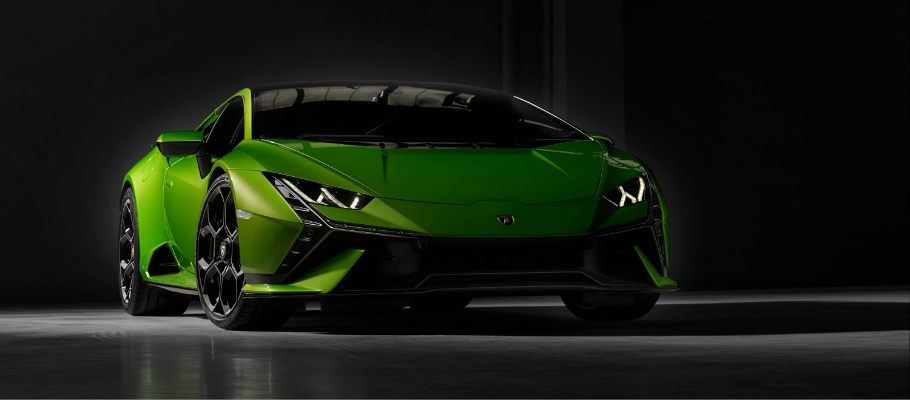
    2023 Lamborghini Huracan Tecnica - Front Angle

    Automobili Lamborghini presents the Huracán Tecnica: the next-generation rear-wheel drive V10, developed for pilots seeking driving fun and lifestyle perfection on both road and track. The Tecnica’s moniker embodies the advanced evolution of the Huracan’s technical prowess and, instantly distinguishable, is as much a Huracán innovation externally as it is under the hood, with its new looks accenting improved aerodynamics for heightened performance, stability and ease of use, particularly on a circuit.  Taking its engine from the Huracán STO, with an increase of 30 CV over the Huracán EVO rear-wheel drive (RWD), the powertrain delivers 565 Nm of torque at maximum 6,500 rpm and improved acceleration of 0-100 km/h in 3.2 seconds. The lightweight Tecnica’s recalibrated LDVI system and distinctly tuned driving modes with specific suspension set-up, rear-wheel direct steering, and innovative brake cooling improvements allow the driver to experience the perfect Huracán for every occasion: the Huracán Tecnica exploits its talents to deliver the best of both worlds – a poignantly versatile super sports for road and track.

    “The Huracán Tecnica condenses Lamborghini’s design and engineering expertise to create the perfect fun-to-drive Huracán, as compelling when driving to the race circuit as it is on the street itself,” says Automobili Lamborghini Chairman and CEO Stephan Winkelmann. “The Tecnica ensures that the pilot enjoys the strongest connection to the car and asphalt, with the car’s potential always at his fingertips for ease of use in every driving mode and environment: in an era of virtual experiences it pays homage to technical purity and physical sensation. The Tecnica completes the Huracán line-up, sitting perfectly between the RWD and the track-focused STO, flawlessly presenting technology, performance and the Huracán’s V10 aspirated engine in a dramatically evolved design.”  

    Tecnica – engineering in its soul

    The Huracán Tecnica takes the 5.2 l powerplant outputting the same 640 CV power as its STO stablemate, producing 565 Nm of torque at 6,500 rpm for exhilarating yet comfortable everyday driving with highly responsive maximum power and torque when demanded.

    With a dry weight of 1,379 kg, the Tecnica delivers a weight-to-power ratio of 2.15 kg/CV. The uprated power is matched by an enhanced, sharper engine sound at higher revs while inside the cockpit the Tecnica provides improved acoustic comfort.

    This Huracán has at its heart the LDVI (Lamborghini Dinamica Veicolo Integrata) system, which controls every aspect of the car’s dynamic behaviour by integrating vehicle systems and set-up to deliver feed-forward pre-control in virtual real-time, for perfect driving dynamics.

    The rear-wheel drive Tecnica incorporates rear-wheel steering with direct steering ratio and torque vectoring, together with a modified Performance Traction Control System (P-TCS) and specific suspension set-up for the Tecnica. Depending on the drive mode selected – STRADA, SPORT or CORSA – every dynamic system is calibrated on the Tecnica to provide a highly differentiated response to each environment.

    In STRADA, the rear-wheel-steering provides stability and manoeuvrability, complemented by the torque vectoring and P-TCS. The engine and gearbox are both tuned for comfortable everyday driving in every setting.

    When SPORT mode is selected, maximum driving fun comes from the rear-wheel steering’s enhanced oversteer and the enhanced slip threshold of the P-TCS, while torque vectoring ensures the Tecnica’s agility and responsiveness in the hands of the driver.  The highly responsive powertrain sparks at the touch of the accelerator and the seven-speed gearbox provides a tactile and emotive shift.

    In CORSA mode, the car’s and driver’s race spirit is awoken: the Tecnica responds to the pilot’s every input with extreme precision, with the naturally aspirated Lamborghini engine’s roar an impassioned reminder of the car’s track talents.  The powertrain is calibrated to provide optimized track-oriented throttle response and the fastest gearshifts, with the Tecnica demonstrating maximum precision and agility from all systems via the LDVI, including maximum lateral and longitudinal grip from the torque vectoring and P-TCS respectively.

    Extraordinary performance comes with new brake cooling management, inspired by track-based Lamborghini experience, delivering consistently better braking performance on both road and track. The Tecnica’s carbon ceramic brakes adopt specifically designed cooling deflectors and calliper ducts, directing the airflow into the discs to maximise heat dissipation and reduce brake fluid temperatures and brake pedal elongation: the reduction in disc temperatures also supports brake pad consumption.

    Aerodynamic inspired design

    The Huracán Tecnica sports a significant and sophisticated design revision, impressing its dual personality of an iconic super sports lifestyle and track-oriented car from every angle. Aerodynamic efficiency and lightweight engineering energize every element while retaining a distinct elegance, with the Tecnica clearly distinguishable from its Huracán stablemates.

    A revised design lends the Tecnica a stronger, predatory stance: a powerful, inward-facing front with muscular shoulders meets a lightweight, fully carbon fiber hood. A new bumper featuring the Terzo Millennio’s black Ypsilon design, incorporates an air curtain for the first time in a Huracán. A new front splitter, with lower, open slats directing air through the wheels, contributes to improved downforce and cooling. Black at the base of the windscreen increases the lightweight impression.

    The profile of the car also sets it apart from the Huracán family: at 6.1 cm longer than the Huracán EVO it is the same height and width but appears lower and broader, with a silhouette inspired by the daylight opening line from the Essenza SCV12.  The black of the front Ypsilon feature continues along the flank of the car to the side air intakes, emphasizing the car’s dynamic vitality, while the body-color roof can also be painted black as an option.

    The clear, sculptural architecture that defines a Lamborghini is as evident in the revised rear.  The reshape of the rear, including a new vertical rear glass window gives improved visibility, while a redesigned engine hood in lightweight carbon fiber celebrates the V10 heart of the Tecnica. The powerful rear incorporates a new bumper with optimized air inlet; diffuser painted in body color or optional black; and combines new hexagonal exhaust pipes that deliver the enhanced fanfare from the Tecnica’s powertrain.

    While aesthetically the fixed rear wing completes the unique lines of the Tecnica, its aero design essentially contributes to the 35% improvement in rear downforce compared to the Huracán EVO RWD, as well as ensuring no increase in drag: in fact, drag is reduced by 20%, improving aero balance and supporting stability during braking and turning speed.  The Tecnica’s underbody is also optimized with new aero deflectors for improved aerodynamic efficiency.

    New Damiso 20” diamond cut wheels, taking inspiration from the Lamborghini Vision GT, sport a hexagonal design and are fitted with Bridgestone Potenza Sport tires.

    Created for the driver

    The versatility of the Huracán Tecnica continues in its interior as well as in the extensive customization options available: the Huracán Tecnica delivers what the driver wants, in the way it looks, in its dynamic set-up and driver feed-back, in its connectivity but most importantly in its capabilities on both road and track.

    Inside, the height-adjustable sports seats immerse the pilot in his cockpit. Further options include a lightweight door design; a rear arch and wheel bolts in lightweight titanium; and harness seat belts for those heading more regularly to the circuit.

    A redesigned, sophisticated HMI interface is exclusive to the Tecnica.  The driver’s instrument panel reduces colors and emphasizes readability in a large new ‘arc’ in front of the pilot. The central console screen puts the fun-to-drive elements at the disposal of the cockpit’s occupants, including the LDVI functions in real-time display, as well as all connectivity functions including Apple CarPlay, Android Auto and Amazon Alexa. Inspired by the STO, the HMI includes connected telemetry and on-board diaries of destinations and track times, connected to the UNICA app.

    Standard and optional colour and trim choices lend themselves to both luxury-oriented and more sporty specifications. Together with eight standard exterior colours, more than 200 additional paint options are available through the Ad Personam program, as well as a new interior trim in Alcantara specifically for Tecnica, and further exclusive options such as stitching designs and colors and the ‘Tecnica’ motif embroidered into seat bolsters.

    Beyond the Tecnica’s exclusive options, Lamborghini’s Ad Personam department offers the potential for clients to customize their Huracán Tecnica with virtually unlimited color and trim possibilities.

  • The MINI Cooper S Hardtop 2 Door in the Resolute Edition

    2023 Mini Cooper S Hardtop 2 Door Resolute Edition

    Expressive design, inspirational driving fun, premium quality and individual style: the MINI Cooper S Hardtop 2 Door combines all this with a classic body concept and the brand’s fascinating tradition. The new Resolute Edition of the original in the premium small car segment now captures the very essence of this unique combination. With its exclusive design and equipment features, it offers a modern re-interpretation of the authentic qualities embraced by the MINI Cooper S Hardtop 2 Door.

    In the Resolute Edition, the MINI Cooper S Hardtop 2 Door is a prime example of traditional sporty flair. Its 2.0-litre 4-cylinder engine with MINI TwinPower Turbo Technology has a peak output of 189 hp and a maximum torque of 206 ft-lbs. With the standard 6-speed manual transmission, this highly spirited small car sprints from standstill to 60 mph in 6.5 seconds. When fitted with the optional 7-speed Steptronic transmission with double clutch, it moves a touch faster – in this case the standard sprint takes just 6.4 seconds. The car’s top speed is 145 mph.

    Athletic talent is part and parcel of the MINI genes. The Resolute Edition echoes the brand’s early motor racing career, in particular with a body finish that is inspired by the classic color used for British racing cars: the exterior in the Rebel Green variant clearly expresses the sporting spirit of the premium small car – this finish was previously exclusive to the top athlete MINI John Cooper Works. The body color is combined with a finish in Pepper White for the roof and exterior mirror caps. Bonnet stripes with parallel lines in light and dark gold tones along with exclusive 18-inch light alloy wheels in Pulse Spoke Black round off the sporty appearance of the edition vehicle.

    A clear commitment to the brand’s historic roots is also signaled by the “RESOLUTE” inscription on the bonnet stripes and door sill finishers. Hallmark design features are finished in exclusive Resolute Bronze. This includes the headlight surrounds, the radiator grille and rear lights, the side scuttles on the front side panels, the door and tailgate handles, the air intakes in the front apron and the fuel filler cap. An attractive contrast is provided by the brand logos and model inscriptions, which like the inner frame and crossbar of the radiator grille and the tailpipe trim of the exhaust system are finished in Piano Black.

    An authentic interior atmosphere geared towards driving fun is ensured by the anthracite-colored roof liner and sports seats in exclusive Black Pearl/Light Chequered fabric/leatherette, which are combined with black armrests and knee rolls. The range of standard equipment also includes the Nappa sports leather steering wheel. An edition emblem is featured on the bottom spoke of the Nappa sports leather steering wheel and on the floor mats.

    The high-quality and authentic style of the MINI Cooper S Hardtop 2 Door in the Resolute Edition is further highlighted by means of distinctive interior surfaces. Against the black background of these surfaces, parallel and evenly curved lines in a light golden tone form an exquisite pinstripe pattern, also echoing the structure of the bonnet stripes. The design features of the Edition are atmospherically showcased by the lighting package, with LED units that provide targeted interior illumination, as well as by the Ambient Light, which additionally includes such features as a laser-engraved ring for the central instrument and also light piping in the doors and cockpit area, as well as illuminated door handles and door entry areas. The MINI Driving Modes likewise form part of the equipment package for the MINI Cooper 2 Door in the Resolute Edition. A toggle switch can be used to activate more strikingly sporty characteristics in the vehicle’s drive and suspension systems.

    The MINI Cooper S Hardtop 2 Door Resolute Edition, available from March 2022 production has begun to arrive at US MINI dealers.

    Current US Edition Pricing for Model Year 2023*

    Model M INI Cooper S Hardtop 2 Door Iconic Trim
    MSRP
    R esolute Edition Price M INI Cooper S Hardtop 2 Door Resolute Edition MSRP
    Price
    Cooper S Hardtop 2 Door (Resolute) $34,900 $1,000 $35,900
  • 2023 Nissan Pathfinder Rock Creek adds aggressive style, off-road tuned suspension

    2023 Nissan Pathfinder Rock Creek - Front View

    Just one year after the introduction of the all-new Nissan Pathfinder SUV, the new, bolder, off-road-inspired 2023 Pathfinder Rock Creek joins the Nissan lineup. Offered in four-wheel drive only, Pathfinder Rock Creek is designed for buyers seeking a higher level of fun and adventure, without compromising the family comfort and conveniences of other Pathfinder grade levels.

    “The 2022 Pathfinder was all about a ‘return to rugged,’ and the Pathfinder Rock Creek takes that spirit even further,” said Michael Colleran, senior vice president, Nissan U.S. Marketing and Sales. “From the urban jungle to the natural beauty that can be reached within minutes from the city, Pathfinder Rock Creek has both the style and hardware to create an adventure just about anywhere.”

    Key additions found on the Rock Creek version include:

    • Off-road tuned suspension with 5/8-inch lift
    • 18-inch beadlock-style wheels mounted with all-terrain tires
    • Tubular roof rack with up to 220-pound load capacity
    • Exclusive front fascia with dark V-motion grille and mesh insert
    • Rock Creek badging
    • Exclusive leatherette + fabric seats with Rock Creek embroidery
    • Orange contrast stitching on the seats, steering wheel, instrument panel, center console and door panels
    • Standard Intelligent Around View® Monitor with Off-Road Mode

    Other standard equipment includes a tow hitch receiver and harness, 6,000-pound maximum towing capacity, 2nd row captain’s chairs and LED fog lights. It will be available in six mono-tone exterior colors and four two-tone exterior combinations, complementing the aggressive exterior design.

    2023 Pathfinder Rock Creek also offers increased available horsepower (295 hp versus 284) and torque (270 lb-ft versus 259) over the standard grades when using premium fuel1, due to revised fuel mapping.

    The new Rock Creek, along with the complete 2023 Pathfinder lineup, is scheduled to go on sale in late summer 2022.

    The 2022 New York International Auto Show runs April 15 – 24, at the Jacob Javits Convention Center.

    1. Premium fuel is not required, regular fuel can be used. Increased horsepower and torque are only available with premium fuel.

  • Ford GT Holman Moody Heritage Edition Honors 1-2-3 Ford Sweep At 1966 Le Mans

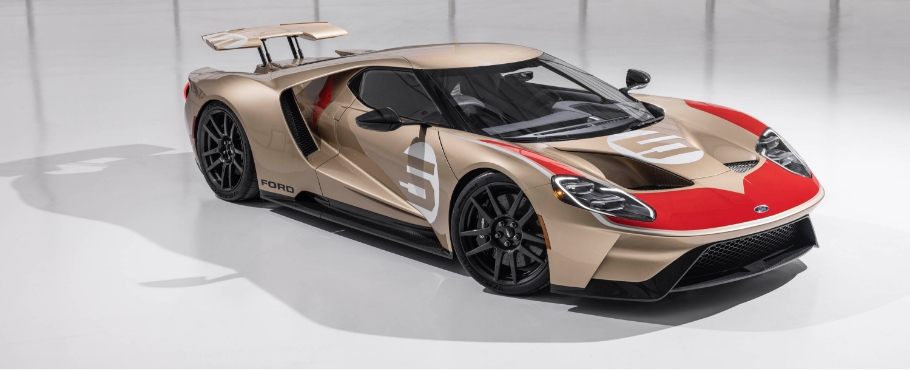
    Ford GT Holman Moody Heritage Edition

    In a special nod to the debut of the original Ford GT40 prototype at the 1964 New York Auto Show, Ford is returning to the Big Apple for the first public appearance of its new GT Heritage Edition – the 2022 Ford GT Holman Moody Edition.

    This marks the final 2022 Heritage Edition paying tribute to the GT40 MK II race car that completed the famous 1-2-3 sweep at the 24 Hours of Le Mans in 1966.

    “Of all the Ford GT Heritage Edition liveries we’ve done, the Holman Moody Heritage Edition’s can’t-miss signature gold and red theme is an epic tribute to our 1966 Le Mans finish,” said Mike Severson, Ford GT program manager. “Inspired by one of the most well-known Ford GT40 race cars, this latest Ford GT honors the Holman Moody race team’s knowhow and ability to out-innovate global competitors.”

    The Holman Moody team played a critical role in the GT40’s race success. Following the 1965 Le Mans race, Ford’s newly formed Le Mans committee tasked Holman Moody (and Shelby American) to rework the GT40 MK II. Driven more than 265 laps over eight days in January 1966, chassis No. P/1016 became a laboratory on wheels as the teams worked to redesign brakes, suspension and tire setups to be more competitive, even trying an experimental automatic transmission. They had one goal – to win at the 1966 Le Mans race.

    This spirit of innovation continues today, with the 2022 Ford GT’s track-capable hardware, paddle-shifting 7-speed dual-clutch transmission and carbon fiber body.

    The ultra-limited-production GT Holman Moody Edition supercar will be on display at the 2022 New York International Auto Show side-by-side with the podium-placing Holman Moody Ford GT40 MK II, chassis No. P/1016.\

    Final 2022 Heritage Edition to pay tribute to the original race car that completed Ford’s 1-2-3 sweep

    The unique gold and red livery of the limited-edition supercar includes signature Oxford White roundels with No. 5 stamped on the doors, hood and rear wing – all matching the appearance of the 1966 Ford GT40 raced by Holman Moody. Exposed gloss carbon fiber components are prominent, including on the 20-inch wheels, front splitter, side sills, mirrors, engine louvers and rear diffuser. Brembo® brake calipers lacquered in black with silver graphics, plus black lug nuts further modernize the aesthetic.

    Carbon fiber carries into the cabin, appearing on door sills, console and registers, and even features a cleaver matte No. 5 roundel on the door panels. Ebony Alcantara®-wrapped carbon fiber seats feature gold accent stitching, while embossed seating surfaces and head restraints carry a debossed GT logo. The instrument panel is wrapped in Ebony leather and Ebony Alcantara, while pillars and headliner are wrapped exclusively in Ebony Alcantara.

    Gold appliqués on the instrument panel, door register bezels and seat X-brace are paired with the matte carbon fiber on the registers, door sills, lower A-pillars and console. The steering wheel is finished in Ebony Alcantara with black stitching, while dual-clutch paddle shifters are finished in exterior-matching Holman Moody Gold.

    Further building on the Heritage Edition series

    The Ford GT Heritage Edition series celebrates the supercar’s landmark moments in motorsports history, including, of course, its Le Mans titles. In all, the series includes nine ultra-limited-edition supercars, with two still in production. These include:

    • 2022 Ford GT Alan Mann Heritage Edition honoring the No. 16 Alan Mann Ford GT MK I lightweight experimental prototype that helped pave the way for the 1-2-3 sweep at the 1966 24 Hours of Le Mans; currently in production
    • 2022 Ford GT ’64 Prototype Heritage Edition honoring Ford GT’s roots and the earliest five original Ford GT prototypes; currently in production
    • 2021 Ford GT ’66 Daytona Heritage Edition honoring the Ford GT MK II No. 98 race car that gave Ford a 1-2-3-5 domination at Daytona in 1966, kicking off a magical season for the Ford GT40 MK II; only 50 built
    • 2020 Ford GT ’69 Gulf Livery Heritage Edition honoring the Ford GT40 MK I No. 6 race car that was victorious at Le Mans in 1969; only 50 built
    • 2019 Ford GT ’68 Gulf Livery Heritage Edition honoring Ford GT40 MK I No. 9 race car that was victorious at Le Mans in 1968; only 50 built
    • 2018 Ford GT ’67 Heritage Edition honoring Ford GT40 MK IV No. 1 race car that was victorious at Le Mans in 1967; only 39 built
    • 2017 Ford GT ’66 Heritage Edition honoring Ford GT40 MK II No. 2 that won 1966 Le Mans race; only 27 built
    • 2006 Ford GT Gulf Livery Heritage Edition commemorating GT40’s back-to-back 24 Hours of Le Mans titles in 1968 and 1969; only 343 built

    The 2022 Ford GT Holman Moody Heritage Edition is available for approved Ford GT customers, with first deliveries taking place this spring.

  • Mercedes-AMG SL 43: Attractive entry-level model with innovative engine technology

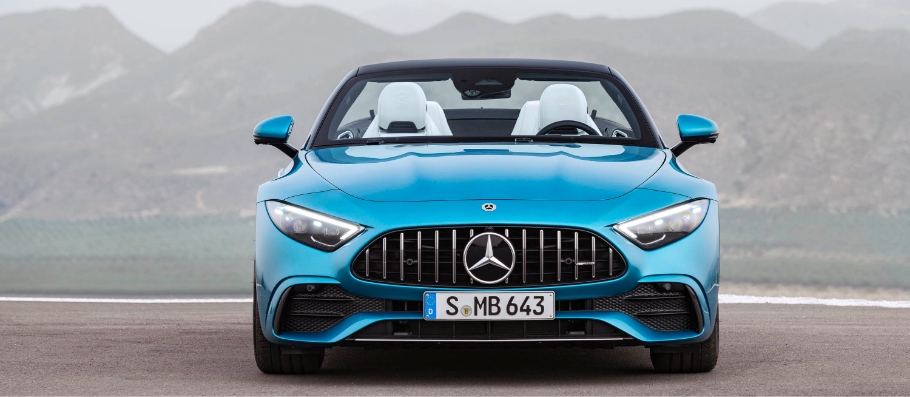
    Mercedes-AMG SL 43 - Front View

    Following the two variants with V8 engines, Mercedes-AMG presents the SL 43 (combined fuel consumption 9.4-8.9 l/100 km, combined CO2 emissions 214-201 g/km),[1]a technically innovative entry-level model of the newly developedroadster icon. Under the bonnet of the open-top 2+2-seater with fabric soft top is an in-line four-cylinder petrol engine with two litres displacement that provides the befitting propulsion. This is the first time in the world that an electric exhaust gas turbocharger is being used in a production vehicle. This technology comes from Formula 1™. The system in the SL 43 is a direct derivative of the development successfully used by the Mercedes-AMG Petronas F1 Team for many years in the premier class of motorsport. The new form of turbocharging guarantees particularly spontaneous throttle response across the entire rev range, thereby offering an even more dynamic driving experience while increasing efficiency at the same time. The turbocharger is operated via the 48-volt electrical system, which also feeds the belt-driven starter-generator (RSG). As a result, the Mercedes-AMG SL 43 has an output of 280 kW (381 hp) and a maximum torque of 480 Nm, plus an additional short-term boost of 10 kW (14 hp) from the RSG in certain driving situations. The new entry-level model in the SL family also shines with extensive standard equipment. In addition, numerous options that enhance comfort and safety offer a wide range of possibilities for individualisation.

    In the 70 years of its development history, the SL experienced the transformation from a thoroughbred racing car to an open-top luxury sports car – and has long enjoyed legend status, not least for this reason. The new Mercedes-AMG SL now marks another milestone in the model’s history. It combines the distinct sportiness of the original SL with the unique luxury and technological excellence of the modern Mercedes-AMG models. As the new entry-level model in the series, the SL 43 is a particularly good example of this. It is the world’s first series-produced vehicle to feature an electric exhaust gas turbocharger. This technology comes directly from Formula 1™ and solves the trade-off between a small, fast responding supercharger that nevertheless achieves comparatively low peak power and a large supercharger with high peak power that only responds delayed. With its innovative engine concept, the new entry-level model of the 2+2-seater roadster is aimed more at particularly tech-savvy buyers. With its combination of a comparatively light four-cylinder engine on the front axle and rear-wheel drive, the SL 43 also displays distinctly discrete handling characteristics.

    “In its long history, the SL has repeatedly set technological milestones. For example, while the legendary 300 SL Gullwing in 1954 was the world’s first series-produced passenger car with direct petrol injection, the new Mercedes-AMG SL 43 is now the very first series-produced vehicle with an electric exhaust gas turbocharger. With this technology, the SL also has an outstanding performance range in its entry-level version. This means that our seemingly smallest SL combines the typical AMG Driving Performance with luxury and comfort at the absolute top level. What’s more, with this innovative engine we are undoubtedly also appealing to a wider clientèle”, says Philipp Schiemer, Chairman of the Board of Management of Mercedes-AMG GmbH.

    “The electric exhaust gas turbocharger is a fascinating example of the extensive transfer between Formula 1 technology and the development of production vehicles. In implementing this in conjunction with our powerful M139 four-cylinder, we were also able to draw on the enormous wealth of experience of our colleagues at Mercedes-AMG High Performance Powertrains. The technology increases agility and thus driving fun, while at the same time improving the efficiency of the drive system. We are pursuing ambitious goals with a view to our electrified future. Innovative components such as the electric exhaust gas turbocharger help us to achieve this”, says Jochen Hermann, Chief Technical Officer of Mercedes-AMG GmbH.

    Electric exhaust gas turbocharger improves engine responsiveness

    The operating principle of the electric exhaust gas turbocharger is based on the same technology used by the Mercedes-AMG Petronas F1 Team. An electric motor around four centimetres thin is integrated directly on the turbocharger shaft between the turbine wheel on the exhaust side and the compressor wheel on the intake side. Electronically controlled, this drives the shaft of the turbocharger directly and thus accelerates the compressor wheel before the exhaust gas stream starts to drive it conventionally.

    This significantly improves immediate response from idle speed and across the entire engine speed range. The combustion engine responds even more spontaneously to accelerator pedal input, while the overall driving experience is more dynamic. In addition, the electrification of the turbocharger enables higher torque at low revs. This also increases agility and optimises acceleration from a standstill. Even when the driver takes their foot off the accelerator or applies the brakes, the technology of the electric turbocharger is able to maintain the boost pressure at all times. This ensures so that a continuous immediate response.

    The turbocharger, which is operated via the 48-volt on-board electrical system, works at speeds of up to 170,000 rpm, which enables a very high airflow rate. The turbocharger, electric motor and power electronics are connected to the combustion engine’s cooling circuit to create an optimal temperature environment at all times. In combination with the internally named M139 two-litre, in-line four-cylinder engine, the innovative technology in the SL 43 produces a rated output of 280 kW (381 hp) at 6750 rpm. The maximum torque of 480 Nm is available between 3250 rpm and 5000 rpm. Depending on the situation, the system also guarantees an additional boost of 10 kW (14 hp) for a short time from the belt-driven starter generator (RSG).

    The second-generation RSG also functions as a mild hybrid in the 48-volt on-board electrical system, which in addition to the temporary power boost enables functions such as gliding mode and energy recovery for maximum efficiency. At the same time, the 48-volt technology also increases comfort, as the transitions between the start-stop function and the gliding mode function are almost imperceptible.

    AMG SPEEDSHIFT MCT 9G transmission with wet start-off clutch and rear-wheel drive

    The four-cylinder engine known as the M139, which has long been used transversely in Mercedes‑AMG compact models without an electric exhaust turbocharger, is positioned longitudinally in the SL 43. In the entry-level model in the SL series, which always features rear-wheel drive, it is also combined with the AMG SPEEDSHIFT MCT 9G transmission (MCT = Multi-Clutch Transmission) for the first time. A wet start-off clutch replaces the torque converter. It reduces weight and, thanks to its lower inertia, optimises response to accelerator pedal input, especially during spurts and load changes. The elaborately calibrated software ensures extremely short shift times as well as fast multiple downshifts if required. In addition, the intermediate throttle function in the “Sport” and “Sport+” driving modes delivers a particularly emotionally appealing gearshift experience. There is also the RACE START function, which ensures optimal acceleration from a standstill.

    The driving performance is up to par: from a standstill, the SL 43 accelerates to 100 km/h in just 4.9 seconds if required, and the top speed is 275 km/h. In addition to the performance it offers, the entry-level model of the series is also distinguished by comparatively low consumption and emission figures.

    Roadster architecture with aluminium composite structure for typical AMG Driving Performance

    The new SL of the R232 series is based on a completely new vehicle architecture developed by Mercedes‑AMG. The new dimensional concept allows a 2+2 seating configuration for the first time since 1989 (Mercedes SL model series R129). This makes the new SL even more versatile. The rear seats increase daily practicality and offer space for people up to 1.50 metres tall (up to 1.35 metres with a child seat). If the extra seating is not needed, an insertable draft stop behind the rear seats can protect front-seat occupants from draughts on the back of their necks. Or the second row of seats can be used as additional stowage space and accommodate a golf bag, for example.

    Constructed from lightweight aluminium composite, the chassis consists of an aluminium space frame with a self-supporting structure. The design guarantees maximum rigidity and is thus the perfect basis for precise driving dynamics, high comfort, optimal packaging and sporty body proportions. The aim of the body shell architecture is to realise the typical AMG Driving Performance with a focus on lateral and longitudinal dynamics, while at the same time meeting the high standards on comfort and safety.

    In the new SL, the intelligent material mix enables the highest possible rigidity at a low weight. The materials used include aluminium, magnesium, fibre composites and steel, from which the windscreen frame is made, for example. This serves as roll-over protection in conjunction with the roll bar system behind the rear seats, which pops up at lightning speed when needed.

    Compared to the previous model series, the torsional rigidity of the body shell structure was increased by 18 percent. The transverse rigidity is 50 percent higher than the already outstanding value of the AMG GT Roadster. The longitudinal rigidity is 40 percent higher. The weight of the body shell per se is only around 270 kilograms. Together with the low centre of gravity, the systematic lightweight construction ensures optimal driving dynamics.

    Entry-level model with subtle distinguishing features in the exterior design

    The exterior design of the SL 43 differs in individual details from the two eight-cylinder models. For example, it has differentiated front and rear aprons as well as round instead of angular double tailpipe trim. The defining features of the SL body design include the long wheelbase, the short overhangs, the long bonnet, the passenger compartment set further back with steeply raked windscreen, and the powerful rear end. This results in the typical SL proportions. They give the roadster its powerful, dynamic appearance – together with the voluminously modelled wheel arches and the large light-alloy wheels that are flush with the outer skin. The SL 43 runs on 19-inch light-alloy wheels as standard. In addition, the same range as for the eight-cylinder models is available as an option: aerodynamically optimised light-alloy wheels with diameters of 20 or 21 inches, which reduce air resistance through low turbulence. Particularly sophisticated are 20-inch wheels with plastic aero rings that save additional weight.

    Active aerodynamics to increase dynamics and efficiency

    A technical highlight for improving aerodynamics is the AIRPANEL active air control system. The horizontal louvres behind the upper air intake are electronically controlled and can be opened and closed with actuator motors. In this way, the airflow is directed according to demand, thus improving aerodynamic performance.

    Normally the louvres are closed – even at top speed. This position reduces air resistance. Only once predefined components have reached certain temperatures and the demand for cooling air is particularly high do the louvres open and allow the maximum amount of cooling air to flow to the heat exchangers. This calls for highly intelligent and fast control.

    The same applies to another active component of the aerodynamics: the retractable rear spoiler seamlessly integrated into the vehicle profile. It changes its position depending on the driving status. In doing so, the control software takes into account numerous parameters: It factors the driving speed, the longitudinal and lateral acceleration and the steering speed into the calculation. The spoiler assumes five different angle settings from 80 km/h to either optimise the handling stability or reduce drag.

    The optional Aerodynamics Package for the Mercedes-AMG SL 43 includes larger flics on the front and rear bumpers and a larger rear diffuser. This improves both downforce and aerodynamic drag even further. The modified speed thresholds of the rear spoiler and its steeper angle of attack of 26.5 degrees (instead of 22 degrees) in the Dynamic position also contribute to this.

    Fabric soft top for less weight and lower centre of gravity

    The sportier positioning of the new SL also suggested the decision for an electric soft top instead of the previous metal vario-roof. The 21-kilogram reduction in weight and the resulting lower centre of gravity have a positive effect on driving dynamics and handling. The Z-fold saves space and weight, and makes it possible to dispense with a conventional soft-top compartment cover. The front header bow ensures that the open soft top is flush in its final position. At the same time, the developers were faced with the task of maintaining the high suitability for everyday use and the exemplary quiet-running. The three-layer design consists of a tightly stretched outer shell, a precisely finished roof liner and an acoustic mat made of high-quality 450 g/m² PES fleece inserted in between.

    Opening and closing takes only about 15 seconds and is possible up to a speed of 60 km/h. The soft top is operated using the switch panel in the centre console or the multimedia touch screen, on which an animation shows how the process is progressing.

    Interior with “hyperanalogue” cockpit and standard luxury seats

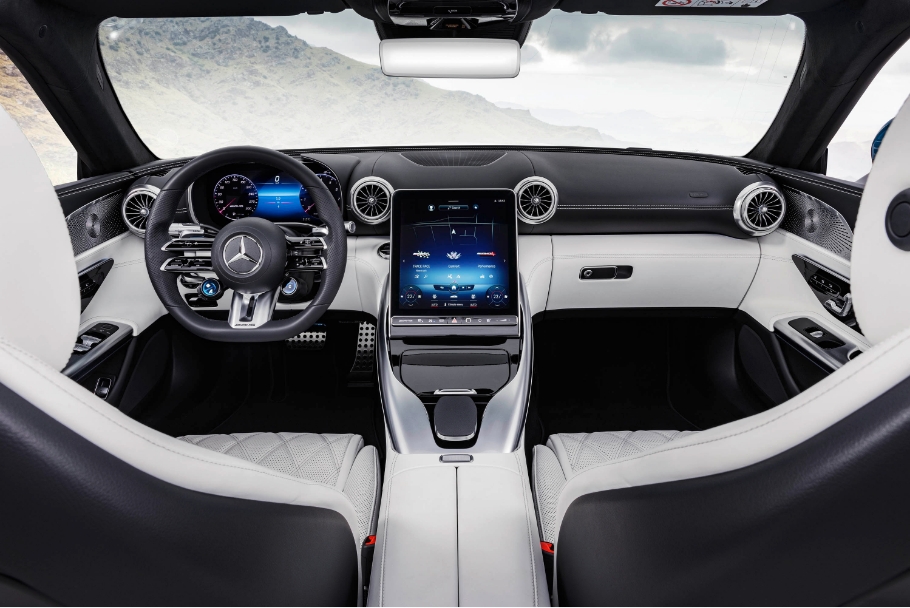
    The interior of the Mercedes-AMG SL 43 also features an exciting combination of analogue geometry and the digital world – known as “hyperanalogue”. This is exemplified by the fully digital instrument cluster, which is integrated into a three-dimensional visor. The standard MBUX infotainment system offers a choice of several specific display styles and different modes. The symmetrical instrument panel is designed as a powerful wing and structured into an upper and lower section. The highlight are the four galvanised turbine nozzles. Their surfaces merge into the instrument panel in the form of powerful power domes. The lower section of the instrument panel evolves fluidly from the centre console, seamlessly connecting the two elements.

    Despite symmetry, the cockpit design creates a clear focus on the driver: The high-resolution 12.3-inch LCD screen of the instrument cluster is not designed to be free-standing, but integrated into a high-tech visor that prevents reflections caused by sunlight. In order to avoid disturbing light reflections caused by different sun positions when the soft top is open, the tilt of the touch screen on the centre console can also be electrically adjusted from 12 degrees to 32 degrees.

    2023 Mercedes-Benz SL 43 AMG Interior

    The latest generation MBUX (Mercedes-Benz User Experience) is intuitive to operate and capable of learning. It offers a host of functional content and the operating structure of the second-generation MBUX system, which debuted in the new Mercedes-Benz S-Class. In the SL, extensive AMG-specific content in five display styles is added. Exclusive menu items such as “AMG Performance” or “AMG TRACK PACE” also emphasise the sporty character.

    The SL 43 is equipped as standard with a wide range of electrically and manually adjustable luxury seats in a combination of ARTICO man-made leather and fabric. Seat covers in leather, NAPPA leather and NAPPA AMG leather are optionally available, as are AMG sports seats and AMG Performance seats with their sculptural design. The optionally available upholstery in MANUFAKTUR macchiato beige/titanium grey or in MANUFAKTUR truffle brown/black ensures a particularly exclusive touch. The AMG Performance seats can also be upholstered in a combination of nappa leather and DINAMICA microfibre with yellow or red decorative topstitching.

    In addition to the standard high-gloss black, the trim elements and centre console are also available in aluminium or carbon and in MANUFAKTUR chrome black. The AMG Performance steering wheel with optional steering wheel heater is available in nappa leather and nappa leather/MICROCUT microfibre.

    Newly developed chassis with multi-link front axle and innovative lightweight construction measures

    As standard, the SL 43 is equipped with a newly developed AMG RIDE CONTROL steel suspension with particularly powerful aluminium shock absorbers and lightweight coil springs. The new SL is the first production vehicle ever from Mercedes-AMG to feature a multi-link front axle with five links arranged entirely within the rim. This significantly improves the kinematics. At the rear axle, a 5-link design likewise controls the wheels.

    To reduce unsprung masses, all suspension links, steering knuckles and wheel carriers on the front and rear axles of the new SL are made of forged aluminium. The multi-link concept controls each wheel with the least amount of elastic movement. The high camber and track stability not only enables high cornering speeds, it also provides the driver with optimal road contact at the high cornering limit. This is reflected in excellent lateral dynamics and driving stability at high speeds as well as in the good-natured reaction to external influences such as crosswinds, bumps or jumps in friction coefficients.

    The lightweight coil springs are a new development: special tempering allowed their weight to be lowered without reducing their performance. In the manufacturing process, the spring pad is glued onto the spring for the first time. This firm connection prevents wear and tear caused by dirt such as sand over the course of a vehicle’s life. The spring does not corrode over the life cycle, and the maximum component load can consequently be increased at less weight. This saves around 0.2 kilograms per spring.

    Another lightweight construction measure concerns the torsion bar stabilisers on the front and rear axles of the SL 43. Thanks to a variable wall thickness, their weight can be reduced. The maximum wall thickness is now only used where it is required due to the maximum load, in this case in the area of the rubber mounts.

    The latest generation of AMG adaptive adjustable damping is available as an option for the SL 43. The suspension control unit uses data analysis – including acceleration and wheel travel sensors – to adjust the damping force for each wheel in a few milliseconds to suit the situation. The driver can pre-select the basic set-up via the AMG DYNAMIC SELECT driving modes: at the touch of a button, the handling characteristics change, for example, from full dynamics in “Sport+” mode to smooth cruising in the “Comfort” setting. In addition, the tuning can be adjusted in three stages independently of the driving modes via a dedicated button.

    AMG high-performance composite brake system for short braking distances

    The newly developed AMG high-performance composite brake system guarantees excellent deceleration values and precise control. It impresses with short braking distances, sensitive response and last but not least with high stability and durability – even under extreme stress. Comfort functions include Hill Start Assist as well as pre-filling and dry braking in wet conditions. When the ignition is switched off and the vehicle is stationary, the parking position “P” is also activated. When starting off, the electric parking brake is released automatically.

    The composite brake discs are particularly light: Driving dynamics and turn-in behaviour benefit from the reduced unsprung masses. Brake disc (made of cast steel) and brake disc pot (made of aluminium) are now connected with special pins. This design saves space, which is used for even better brake cooling. The directional perforation is also new: In addition to the weight saving and better heat dissipation, this solution scores points with a faster response in wet conditions as well as better pad cleaning after braking.

    Optional rear-axle steering combines agility and stability

    The Mercedes-AMG SL 43 can be equipped with active rear-axle steering (HAL) as an option. Depending on the speed, the rear wheels steer either in the opposite direction (up to 100 km/h) or in the same direction (faster than 100 km/h) as the front wheels. The system thus enables both agile and stable driving characteristics. The front-wheel steering ratio is more direct, making it easier to steer the vehicle at the limit with less steering effort.

    Six driving modes and AMG DYNAMICS: from comfortable to dynamic

    The five AMG DYNAMIC SELECT driving modes “Slippery”, “Comfort”, “Sport”, “Sport +” and “Individual”, as well as the “RACE” mode included in the optional AMG DYNAMIC PLUS Package, enable a wide spread of vehicle characteristics from comfortable to dynamic. The distinct driving modes offer an individual driving experience, precisely tailored to different driving conditions. As a feature of the AMG DYNAMIC SELECT driving modes, the SL models also feature AMG DYNAMICS. This integrated vehicle dynamics control expands the stabilising functions of ESP® with interventions that enhance agility in the steering characteristic and in ESP® additional functions. When cornering at speed, for example, brief braking intervention at the inner rear wheel generates a defined yawing moment around the vertical axis for responsive and precise turn-in.

    SL equipment programme: great variety for an individual look

    With the details of its extensive standard equipment as well as many additional options available, the Mercedes-AMG SL 43 offers a broad individualisation spectrum for a wide range of customer wishes – from sporty and dynamic to luxuriously elegant. This includes twelve paint finishes including the two exclusive SL colours hyper blue metallic and MANUFAKTUR monza grey magno, three roof colour variants and several new wheel designs.

    Three exterior design packages are available to sharpen the look further and make it more elegant or more dynamic.

    • The AMG Exterior Chrome Package contains elegant high-gloss chrome accents on the front apron, the side sill trim and the rear.
    • In the AMG Night Package, selected exterior elements are finished in high-gloss black, such as the front splitter, the side sill trims, the mirror caps and the trim element in the rear diffuser. Added to this are darkened tailpipe trims. Depending on the chosen paint finish, this results in striking contrasts or flowing transitions.
    • The AMG Night Package II includes additional elements in high-gloss black, including radiator grille, typography and Mercedes star at the rear.
    • With the AMG Exterior Carbon Package, lightweight components made of carbon fibre evoke the SL’s motorsport history. The carbon parts include the front splitter and the flics in the front bumper as well as the trim strip in the side member trim. Furthermore, there are tailpipe trims in high-gloss black and the trim strip in the diffuser in carbon or high-gloss black.

    AMG DYNAMIC PLUS Package for maximum driving pleasure

    The AMG DYNAMIC PLUS Package, which combines numerous high-performance components, is optionally available for the SL 43:

    • Dynamic AMG engine mounts connect the engine more rigidly or more flexibly to the body, depending on the driving situation. In every driving situation, this results in the best possible balance between driving dynamics and comfort.
    • The electronically controlled AMG limited-slip rear differential distributes the required power to the wheels even more promptly and precisely during dynamic cornering and rapid acceleration, thus guaranteeing maximum traction.
    • The “RACE” driving mode delivers race track performance at the touch of a button with even more spontaneous engine response and a more direct accelerator pedal characteristic. Selectable as an additional driving mode via the AMG steering wheel buttons.
    • The lowering by ten millimetres lowers the vehicle’s centre of gravity and additionally stabilises the vehicle.
    • The yellow-painted AMG brake callipers visually underline the increased driving dynamics potential.

    Driving assistance systems and MBUX: intelligent helpers in the background

    With the aid of numerous sensors, cameras and radar, the driving assistance systems, some of which are optional, monitor the traffic and surroundings of the new SL 43. If necessary, the intelligent helpers can intervene at lightning speed. As in the current generations of the Mercedes C-Class and S-Class, the driver is supported by several new and enhanced systems. This is done in everyday situations, for example, by helping with speed adaptation, distance control, steering and lane changes. This makes it easier to react to impending collisions. The functioning of the systems is visualised by a new display concept in the instrument cluster.

    The new assistance display in the instrument cluster shows comprehensibly and transparently how the driving assistance systems work in a full-screen view. The driver can see their car, lanes, lane markings and other road users such as cars, trucks and two-wheelers in an abstracted 3D way there. The system status and operation of the assistants are visualised in this depiction of the surroundings. The new, animated assistance display is based on a 3D scene generated in real time. This dynamic, high-quality representation makes the operation of the driving assistance systems transparent as an augmented reality driving experience.

    Numerous connectivity services available

    The MBUX (Mercedes-Benz User Experience) infotainment system enables extensive operating options and many digital services from Mercedes me connect. The strengths include the intuitive operating concept via touch screen or touch control buttons on the steering wheel, Smartphone Integration of Apple CarPlay and Android Auto as well as hands-free operation via Bluetooth connection and Digital Radio (DAB and DAB+). In conjunction with MBUX, customers already have access to connectivity services such as Live Traffic Information. Mercedes me connect makes the new SL altogether more intelligent: Additional functions can be used before and after the journey or while on the road. All that is required is to link the roadster to a Mercedes me account in the Mercedes me Portal and accept the Terms of Use. Thanks to navigation with Live Traffic Information and Car-to-X communication, the customer drives with real-time traffic data. This way, traffic jams can be avoided efficiently and valuable time can be saved. Networked vehicles exchange information about traffic events by means of car-to-x communication.

    Technical data1

    Mercedes-AMG SL 43

    Engine
    Number of cylinders/arrangement 4/in-line
    Displacement cc 1991
    Rated output kW/hp 280/381
    at engine speed rpm 6750
    Additional output (Boost) kW/hp 10/14
    Rated torque Nm 480
    at engine speed rpm 3250-5000
    Compression ratio 10.0
    Mixture formation combined direct petrol injection and intake manifold injection, turbocharging by means of electrically assisted exhaust gas turbocharger
    Power transmission
    Drive system layout Rear-wheel drive
    Transmission AMG SPEEDSHIFT MCT 9G (automatic transmission with wet multi-disc start-off clutch)
    Gear ratios
    1st/2nd/3rd/4th/5th/6th/7th/8th/9th gear 5.35/3.24/2.25/1.64/1.21/1.00/0.87/0.72/0.60
    Reverse 4.80
    Chassis
    Front axle AMG RIDE CONTROL suspension with aluminium double wishbones, anti-squat and anti-dive geometry, lightweight coil springs and stabiliser bar
    Rear axle AMG RIDE CONTROL suspension with aluminium double wishbones, anti-squat and anti-dive geometry, lightweight coil springs and stabiliser bar
    Brake system Hydraulic dual-circuit brake system; 390 mm composite brake discs at front, vented and perforated, 6-piston aluminium fixed calliper; 360 mm composite brake discs at rear, vented and perforated, 1-piston aluminium floating calliper; electric parking brake, ABS, Brake Assist, 3-stage ESP®
    Steering Electromechanical speed-sensitive power steering with rack and pinion, variable steering ratio (12.8:1 at dead centre) and variable power assistance
    Wheels front: 9.5 J x 19; rear: 11 J x 19
    Tyres front: 255/45 ZR 19; rear: 285/40 ZR 19
    Dimensions and weights
    Wheelbase mm 2700
    Front/rear track mm 1665/1629
    Length/height/width mm 4705/1359/1915
    Turning circle m 12.84
    Boot capacity l 213-240
    Kerb weight acc. to EC kg 1810
    Payload kg 335
    Tank capacity/of which reserve l 70/10
    Performance, consumption, emissions
    Acceleration 0-100 km/h 4.9
    Top speed km/h 275 (electronically limited)
    Combined fuel consumption, WLTP l/100 km 9.4-8.9
    Combined CO2 emissions, WLTP g/km 214-201

    [1] The stated figures are the measured “WLTP CO₂ figures” in accordance with Article 2 No 3 Implementing Regulation (EU) 2017/1153. The fuel consumption figures were calculated on the basis of these figures.

    [1] The stated figures are the measured “WLTP CO₂ figures” in accordance with Article 2 No 3 Implementing Regulation (EU) 2017/1153. The fuel consumption figures were calculated on the basis of these figures.


  • 2022 Kia Niro to accelerate EV transition

    2022 Kia Niro - Front Angle

    Kia’s popular Niro crossover has been entirely redesigned from the ground up to meet the complex and diverse needs of today’s environmentally-conscious car users. Three state-of-the-art electrified powertrains, sustainable interior materials and exceptional safety performance combine to ensure the all-new version surpasses customer expectations. The redesigned Niro is an intrinsic model in Kia’s growing eco-friendly line-up, which will include 14 BEV models by 2027.

    The C-CUV segment is one of the most competitive, with a dizzying array of comparable models on offer. The all-new Niro illustrates Kia’s fresh approach to the traditional CUV and provides key differentiators to make it stand out in a crowded segment. A perfect blend of form and function ensures that the new Niro provides a safe, family-friendly vehicle with favourable economic and environmental credentials that will encourage many people to take a meaningful first step into electrification.

    The all-new Niro smooths the transition to sustainable mobility via a choice of low- and zero-emission powertrains: hybrid electric (HEV), plug-in hybrid (PHEV) and battery electric (BEV). The HEV and PHEV models feature Kia’s super-efficient Smartstream 1.6-litre GDI gasoline engine. The battery electric Niro provides environmental and practical benefits with a 463km* (WLTP) electric-only range.

    Jason Jeong, President of Kia Europe, said, “Kia has redesigned Niro to provide people with a clearer path to clean mobility. The range of eco-friendly powertrains will encourage even the most hesitant customers to make the switch to more sustainable forms of movement.

    “The already popular Niro benefits from Kia’s latest tech advancements and can meet the mobility needs of all drivers, attracting new people to the brand. The current Niro family is Kia’s third best-seller, and the new version will further extend Niro’s position as a volume model within the Kia portfolio and help accelerate Kia’s global sales of eco-friendly vehicles to two million units in 2030.”

    At 4,420mm long, 1,825mm wide, and up to 1,570 high, the clean-sheet redesign of new Niro is formulated on Kia’s third-generation ‘K’ platform. The 2,720mm wheelbase and enhanced design proportions inside the cabin reward occupants with class-leading interior space and storage capacity.

    Premium-effect recycled materials adorn the cabin, to augment the interior space and underline Niro’s sustainable credentials. The dash and driver controls feature minimal clutter and smooth lines to ensure a distraction-free yet intuitive user experience. A head-up display (HUD) system enhances safety and convenience on the move, while a suite of new safety systems brings the latest advancements in protection to this family-friendly crossover.

    The second-generation Niro benefits from a full complement of Kia’s DriveWise intelligence Advanced Driver Assistance Systems (ADAS) which operate to avoid potential hazards on the road and bring peace of mind to all. Forward Collision-Avoidance Assist (FCA) warns and stops the vehicle of possible incidents with other road users or pedestrians, while Junction Turning and Junction Crossing functions provide an added layer of safety when negotiating turns and even stops the vehicle when there is crossing traffic from left or right. These are two of many safety systems included in Kia’s DriveWise technology that combine to improve confidence and convenience behind the wheel.

    Each and every enhancement on all-new Niro has been curated for maximum customer benefit. “Niro currently occupies an important position in the Kia line-up, providing an accessible electrified model at volume. It is a crucial model for Kia, and therefore it was a natural progression that, following our re-brand, Niro also received a re-brand of its own. The all-new Niro will offer existing customers the Kia heritage they value while also broadening the brand’s appeal to new environmentally-conscious buyers,” concluded Jason Jeong.

    Sustainability made simple

    With all-new Niro, Kia has simplified the customer decision-making process, providing three distinct powertrain options designed to meet the demands of every customer’s lifestyle. At the core of this strategy lies a trio of eco-friendly powertrains.

    The PHEV and HEV models benefit from Kia’s exceptional Smartstream 1.6 GDI gasoline engine paired with Kia’s second-generation six-speed dual-clutch automatic transmission (6DCT). The innovations on the second-generation GDI engine include low-friction ball bearings, gears optimised for transmission efficiency, and the removal of the reverse gear that saves 2.3kg alone. Reverse motion is instead drawn solely from the electric motor, helping to eliminate tailpipe emissions during reverse manoeuvres.

    The four-cylinder unit produces a combined maximum power output of 141PS when combined with the HEV’s 32kW permanent magnet synchronous electric motor. A 62kW e-motor in the PHEV version results in combined maximum power of 183PS and provides an electric-only range covering up to 65km (WLTP combined, with 16-inch wheels) of zero-emission journeys, adequate for most daily commutes.

    The Niro PHEV debuts Hyundai Motor Group’s very first 5.5kWh high-volt Positive Temperature Coefficient (PTC) heater for Plug-in Hybrid models, extending the electric driving range in colder conditions. The self-regulated ceramic elements provide cabin heating to complement the vehicle’s heating core and ensure a continuous flow of warm air.

    An intelligent Green Zone Drive Mode on Niro HEV and PHEV automates the use of electric power by taking location guidance from the navigation system, driving pattern learning or manual driver input. Built-up areas or roads nearby schools and hospitals are designated as Green Zones, and the vehicle automatically switches to electric-only driving to reduce the exhaust emissions to zero in these environments. The customer can also take control of Green Zones along the route by setting other areas in which they wish to reduce their vehicle’s emissions, such as around their neighbourhood.

    The BEV version of all-new Niro combines its outstanding 463km* (WLTP) range with energetic and lively performance, producing 150kW of available power between 6,000-14,600rpm and instant torque rated at 255 Nm (26.0 kgf.m). With a top speed of 167km/h and 0-100km/h taking just 7.8 seconds, the Niro EV will enable drivers to make effortless and smooth progress in all conditions. Furthermore, Niro EV’s low drag coefficient of 0.29 ensures minimum aerodynamic resistance and maximum energy efficiency.

    Topping up the Niro EV’s 64.8kWh lithium-ion polymer battery from 10-80 per cent takes just 43 minutes with a suitable DC rapid charger. When temperatures are low, the system in Niro EV uses navigation-based battery conditioning to pre-heat the battery when a charge point is selected as a destination, which helps shorten charge times and secure battery performance. The all-new Niro comes with a standard CCS charging port for added convenience.

    For HEV and PHEV versions, maximum braked towing capacity remains at a capable 1,300kg. The next generation Niro EV gains a respectable towing capacity of 750kg opening up the possibilities for zero-emission adventures. 

    Expressive and confident road presence

    New Niro’s redesign was guided by Kia’s Opposites United design ethos, specifically focussing on the ‘Joy for Reason’ design pillar that fuses the emotional with the rational to create vehicles that inspire movement. With a purposeful and head-turning exterior, new Niro brings much needed aesthetic appeal to the CUV segment.

    At the front, all-new Niro showcases the latest evolution of Kia’s signature Tiger Face, which has enlarged to now extend from the hood down to the front fender. The expansive windshield features a unique double-cowl design where the top and bottom cowl covers mirror each other for a sense of design union. Angular ‘Heartbeat’ daytime running lights (DRLs) add to the contemporary look, while a bold skid plate and cladding enhance the vehicle’s rugged character.

    The EV version is distinguished from the PHEV and HEV models by a two-tone closed grille and unique steel grey side cladding. The Niro EV has also received a dedicated lower grille and bumper treatment in addition to model-specific 17-inch alloys. The plug-in charging port for the EV model is conveniently positioned in the centre of the front grille for easy access at all charge points.

    When viewing the side profile of all-new Niro, the eye is guided by simple character lines to focus on the bold Aero C-Pillar toward the rear. This has been carefully crafted to aid airflow underneath the cavity for improved aerodynamic performance and allows new Niro to achieve an impressive draft coefficient (Cd) of 0.29. The efficient design of the 16- or 18-inch alloys on HEV and PHEV versions deliver further aerodynamic benefits.

    Moving along the side profile and past the C-Pillar, boomerang-shaped LED taillights intensify the vehicle’s sporty stance and sense of purpose. These sit alongside an uncomplicated licence plate pocket which houses the plate and Kia logo, while the heartbeat-shaped rear reflectors, rugged skid plate and strong diffuser echo design elements from the all-new Niro’s front-end.

    Customers can choose from nine modern exterior colours; Cityscape Green, Clear White, Snow White Pearl, Aurora Black Pearl, Mineral Blue, Interstellar Gray, Orange Delight, Runway Red and Steel Gray. Further personalisation options include the choice of different C-Pillar colours that contrast or complement the body colour and up to three different finishes for the cladding depending on the trim level chosen.

    Technologically advanced driver-centric cabin

    Every aspect of all-new Niro’s interior has been carefully planned to ensure an aesthetically pleasing, calm and functional environment for all users.

    Thanks to the C-segment K platform, the interior of the latest Niro has improved design proportions over the incumbent model. Increased overall interior space and ergonomic improvements provide exceptional space for occupants in the front, including a new passenger ‘relaxion’ seat. When the vehicle is stationary, Niro’s front passenger can enjoy a rest at the simple touch of a button. The seat will lift and recline to maximise comfort and provide optimal postural support while resting.

    The slim front seat design frees up additional rear space to give more room for passengers seated in the rear, while seat-mounted fast USB-C points provide charging convenience. No longer is a vehicle seen as a temporary vessel for movement; with the new Niro, it is a functional extension of living space.

    The driver is enveloped by the off-centre dash, which curves around the comfortable seating position to present necessary controls within easy reach. Two seamless 10.25-inch display screens show vehicle and navigation information, while a multi-mode touch display allows control of infotainment and heating while minimising driver distractions.

    A 10-inch head-up display (HUD) system projects vital driving information, including speed, ADAS data and navigation commands, directly onto the front windshield. The ultra-clear graphics are displayed directly ahead of the driver, helping to minimise eye movement while driving, enhancing safety and convenience.

    An advanced Voice Car Control system featuring Natural Voice Recognition technology allows occupants to control key vehicle systems such as temperature and audio settings. A new Multi-Command feature means passengers can also control multiple functions with one command. Additional convenience is provided by a power tailgate that opens automatically on detecting the user’s smart key.

    Via Kia Connect, drivers of the Niro EV can view and control vehicle charge status in addition to planning a route using online navigation, syncing calendars, and accessing on-board features such as charge station proximity, live weather, and real-time traffic alerts.

    Other convenience features added to the new Niro include Remote Smart Parking Assist (RSPA) and vehicle-to-load (V2L) functionality. RSPA allows the driver to exit the vehicle before parking and complete the parking manoeuvre at the touch of a button. In tight parking positions, the vehicle can park itself autonomously by moving in straight lines back and forth using surround-view cameras and ultrasonic sensors.  V2L, already proving a beneficial user feature on Kia’s EV6, means that any unused battery charge can be used to power external electrical appliances thanks to the bi-directional ability of the EV power pack.

    Echoing the choice of eco-friendly powertrains, the environmental considerations continue inside the cabin. The headlining is made from recycled wallpaper, door panels are finished with VOC free paint and the PU vegan leather seat coverings contain Tencel from Eucalyptus trees, and the cargo screen is knitted material made of 75 per cent recycled fibres. These sustainable elements produce an environmentally considerate interior full of natural and tactile finishes.

    Establishing its prominent position in the CUV segment, new Niro offers generous passenger space and provides a larger cargo capacity than key rivals. With 475 litres of trunk space and an additional 20 litres in the frunk, new Niro EV comes with 495 litres of storage space in total. HEV and PHEV models come with 451 and 348 litres, respectively, each of which can be further maximised by fully reclining the flat-fold rear seats. With the rear seats folded, cargo space increased to 1,445 litres on the HEV, 1,342 litres on PHEV and 1,392 litres for the EV.

    Comfortable and responsive drive

    Developed from the ground up, the new Niro has been built around the accommodating third-generation K platform to cater for each of the three powertrains. This latest architecture applies a multi-load pass structure for optimal front crash performance, facilitates improvements in the basic suspension and steering, and enhances design proportions and interior space.

    The K architecture allows for various battery mounting options depending on the powertrain; rear-seat underfloor mounting for HEV and PHEV and central underfloor mounting for the BEV version. Each configuration ensures an ideal weight distribution to optimise ride quality, particularly in the BEV model where the underfloor arrangement leads to a lower centre of gravity and enables superior performance. 

    The all-new Niro has received suspension and steering improvements to deliver an enjoyable and responsive drive. At the front, the new Niro benefits from a MacPherson strut-type suspension, while the rear gets a four-link type set-up. Both, front and rear geometry together with an optimised steering gear ratio have been tuned for improved responsiveness, stability and ride comfort. A new tilt-type strut bearing reduces the friction in the strut and enables a smoother start of damper motion. It also reduces the friction in the steering system that together with an individual steering software tuning provides a very natural steering feel with excellent feedback.

    Additional insulation and padding have been inserted around the vehicle’s structure to help combat unwanted engine and road noise – especially important when running the near-silent BEV version.

    Other engineering advancements include a slight increase in torsional rigidity, delivering improvements in ride, handling, and steering behaviour. A significant increase of 22 per cent in the proportion of high-tensile strength hot-stamping steel serves to improve efficiency and safety. Additionally, while the body in white weight was reduced by 6 per cent or 20.3kg, the torsional stiffness was increased by 1 per cent through Structure and Material Optimisation.

    Kia’s advanced suite of DriveWise intelligent Advanced Driver Assistance Systems (ADAS) ensures that all-new Niro delivers Kia’s most technologically advanced protective systems to give the ultimate peace of mind for occupants of the family-friendly crossover.

    Forward Collision-Avoidance Assist (FCA) will deliver an audible and visual warning (or even brake) to the driver if the system detects a possible collision with other road users or pedestrians. When navigating junctions, using Niro’s turn signal will activate the Junction Turning function, and in Niro EV a Junction Crossing function also assists the driver. The system will warn if there is a possibility of collision with another vehicle either from oncoming or side traffic. If the system has issued a warning, but the driver takes no action, it will automatically apply the brakes to avert an impact.

    Niro’s front view camera and inbuilt navigation system work in conjunction to display the current speed limit. The Intelligent Speed Limit Assist (ISLA) system will display current speed and issue a visual warning if the vehicle is exceeding the speed limit. Also keeping Niro occupants safe on the roads are other ADAS features, including Lane Keeping Assist (LKA), Lane Following Assist (LFA), Highway Driving Assist (HDA), Driver Attention Warning (DAW), High Beam Assist (HBA), Navigation-based Smart Cruise Control-Curve (NSCC-C), Blind-Spot Collision-Avoidance Assist (BCA), Rear View Monitor (RVM) and Rear Cross-Traffic Collision-Avoidance Assist (RCCA).

    Niro’s ADAS offers a helping hand with parking and exiting the vehicle too. Remote Smart Parking Assist (RSPA) is a feature that enables the vehicle to park itself autonomously by moving in straight lines back and forth using surround-view cameras and ultrasonic sensors. When conducting driver-controlled parking, the Reverse Parking Collision-Avoidance Assist (PCA-R) and Front/Rear Parking Distance Warning (PDW-F/R) systems help manoeuvre into the tightest of spots. Once parked, Safe Exit Assist (SEA) provides a warning when a vehicle is approaching from the rear-side when getting out of the vehicle, with the electronic child lock preventing rear-seat passengers from opening the rear door.

  • Lotus Eletre

    2023 lotus eletre

    The ongoing transformation of Lotus to a truly global performance car brand has reached its most significant milestone yet.

    The all-new and all-electric Lotus Eletre is a striking and progressive Hyper-SUV – the first of a new breed of pure electric SUVs. It takes the core principles and Lotus DNA from more than 70 years of sports car design and engineering, evolving them into a desirable all-new lifestyle car for the next generation of Lotus customers.

    The company’s famed expertise in the fields of ride and handling, steering and optimised aerodynamics have been carefully and respectfully evolved. The Eletre takes the heart and soul of the latest Lotus sports car – the Emira – and the revolutionary aero performance of the all-electric Evija hypercar, and reinterprets them as a Hyper-SUV.

    Known until two days ago only by its Lotus codename, Type 132, the Eletre is a globally relevant product, a shining halo of sustainable mobility for a worldwide audience. Embodying emotion, intelligence and prestige, it extends the reach of the Lotus name, badge and renowned driver engagement to a new audience.

    A bold new dimension to the Lotus performance car portfolio, the Eletre delivers a significant number of firsts for Lotus – the first five-door production car, the first model outside sports car segments, the first lifestyle EV, the most ‘connected’ Lotus ever. And yet it remains a true Lotus, a beautiful car ‘carved by air’, packed with pioneering technology, genuine sporting performance and simplicity of purpose, designed and developed by a passionate and global team. The Lotus Eletre is alive with character and personality.

    The Eletre is 4WD, has a battery capacity that’s over 100kWh and with power from 600hp. A 350kW charger will deliver a 400km (248 miles) range in just 20 minutes. The car’s target maximum WLTP driving range is c.600km (c.373 miles). It also comes with the ability as standard to accept 22kW AC charging which, where available, reduces the time plugged in.

    Technology includes the most advanced active aerodynamics package on any production SUV, and intelligent driving technologies such as the world’s first deployable Light Detection and Ranging (LIDAR) system in a production car. Add in a dynamic walk-up sequence that delivers a moment of theatre every time the driver approaches the car, and it’s clear the Eletre is making a simple statement – this is Lotus reinvented, the birth of a new icon into the Lotus stable.

    Matt Windle, Managing Director, Lotus Cars, commented: “The Eletre is a bold and revolutionary new car, delivering on our commitment to move Lotus into completely new automotive segments as we widen our global appeal and accessibility. This is a momentous point in our history and a clear signal of our ongoing desire to transform our business. It is a true Lotus, and we’re confident it will delight performance car customers and offer a distinct alternative to the segment’s established players. The Eletre has the soul of a Lotus and the usability of an SUV. Alongside the Emira sports car, this is the perfect two-car garage from Lotus.”

    Qingfeng Feng, CEO, Group Lotus, added: “The Eletre, our Hyper-SUV, is a new performance car from an iconic performance car brand and it will appeal to independent-minded and adventurous driving enthusiasts – those who love the thrill of driving. It is a unique combination of beautiful design, exceptional dynamic performance and everyday usability, for those who dare to look beyond the conventional, and marks a turning point for our business and brand.”

    He added: “While the worldwide critical acclaim for the Emira has reaffirmed Lotus’ position as a respected sports car marque, the Eletre will make Lotus accessible to a whole new audience. It is a compelling alternative for those who desire a true driver’s car but whose lifestyle demands something more practical than a traditional sports car. And it is only the start for Lotus – there is much more to come.”

    The Eletre is the first in a new range of premium lifestyle performance electric vehicles to be built at an all-new state-of-the-art production facility in Wuhan, China. The car has been ‘Born British, Raised Globally’, with design led by the UK, supported by collaborative work with teams in China, Sweden and Germany. The overall exterior and interior design has been led by an international team based at the Lotus Tech Creative Centre (LTCC) in Warwickshire, UK.

    Peter Horbury, Senior Vice President, Executive Advisor, Design, Lotus, commented: “The Eletre is a rare creative opportunity in performance car design – the chance to start with a blank sheet of paper and develop an all-new vehicle that takes a brand in a completely fresh direction. There has been a close working relationship and much collaboration between the Lotus design studios in Warwickshire and Hethel. The result is a ‘Hyper-SUV’ that is genuinely different to what’s on the market; the electric powertrain has inspired a ‘cab-forward’ design that echoes the iconic mid-engined layout of Lotus sports cars, creating a unique look and position in the SUV segment. The arrival of the Eletre signals the start of a new era of pure electric SUVs.”

    The Eletre is built on Lotus’ all-new and highly versatile Electric Premium Architecture (EPA). The low-to-the-ground design means outstanding handling, and the EPA can easily adapt to accommodate C+ to E+ vehicle class battery sizes, motors, component layouts and intelligent driving technologies.

    The platform will be the basis for an all-new range of premium lifestyle performance electric vehicles from Lotus. Led by the Eletre, these cars will catapult Lotus into a new era of higher retail volumes and significant revenues.

    The Lotus Eletre is on sale now across global markets, with first customer deliveries in 2023 starting in China, the UK and Europe. For more information and to reserve your Lotus Eletre please visit www.lotuscars.com.

    The Lotus Eletre in detail

    The Eletre is a new icon from Lotus. It is the latest in a long line of Lotus road cars whose name begins with the letter E, and means ‘Coming to Life’ in some Eastern European languages. It’s an appropriate link as the Eletre marks the start of a new chapter in the history of Lotus – the first accessible EV and the first SUV.

    The immersive experience with the Lotus Eletre begins before the driver has reached the car. Pressing the button on the key or smartphone app activates a moment of theatre that’s unique in the automotive world. The car’s exterior lights run through a short sequence, the active front grille ‘breathes’ and the illuminated flush door handles deploy. The experience is repeated inside the car as the door closes behind the occupant.

    Ben Payne, Head of Studio at LTCC, said: “This walk-up sequence is a ‘peacock moment’ – a little ‘showing-off’ that highlights the Eletre’s engaging personality. It’s a visual expression of a car coming to life, and a metaphor for the reinvention of the Lotus business and brand which begins with the Eletre.”

    From the very earliest discussions about the car and its position at the heart of the Vision80-led transformation of Lotus, the Eletre was to be a showcase for how a Lotus can deliver performance-oriented driving thrills and refinement outside of the traditional sports car segments.

    It is ‘Born British Raised Globally’ and that is more than a slogan. It has defined a rewarding collaborative process which has set the standard for the development and quality of the next generation of Lotus performance cars.

    The fundamentals of what makes the Eletre a Lotus were established in Hethel, UK – the iconic home of Lotus since 1966. The global Lotus team worked together to deliver the strategic direction for the forthcoming range of Lotus lifestyle vehicles, plus the dynamic development, systems integration, aerodynamic optimisation and overall driver satisfaction of the Eletre.

    A new Lotus research and development facility, established in China in 2020, utilises the market’s leading intelligent technologies and digital competencies to build the Eletre at an all-new state-of-the-art manufacturing centre. Teams at Lotus Tech Innovation Centre (LTIC) in Raunheim, Germany, have assisted with component integration, durability testing, certification and homologation, with experts from the engineering team in Gothenburg, Sweden, working on the car’s EV management systems.

    Exterior design: daring and dramatic

    Design of the Lotus Eletre has been led by Ben Payne. His team has created a daring and dramatic new model with a cab-forward stance, long wheelbase and very short overhangs front and rear. Creative freedom comes from the absence of a petrol engine under the bonnet, while the short bonnet echoes the styling cues of Lotus’ iconic mid-engined layout. Overall, there’s a visual lightness to the car, creating the impression of a high-riding sports car rather than an SUV. The ‘carved by air’ design ethos which inspired the Evija and Emira is immediately obvious.

    Ben commented: “The Eletre is a progressive all-electric performance vehicle embodying emotion, intelligence and prestige and, as the first of the brand’s lifestyle cars, it sets the standard for what will follow. We have taken the iconic design language of the Lotus sports car and successfully evolved it into an elegant and exotic Hyper-SUV.”

    A signature element of the design is its ‘porosity’ – the aerodynamic principle of air flowing through the car as well as under, over and around it. Porosity was at the heart of the Evija’s design, is integral to the Emira, and has provided clear inspiration for the Eletre. It is most obvious where air is channelled under the leading edge of the car, emerging through two exit vents in the bonnet above. There are other examples of porosity ahead of and behind the front wheel arches, behind the rear wheels, and even at the top of the D-pillar. For the driver there are clear benefits to porosity – less resistance in cutting through the air, delivering a more efficient journey in terms of improved vehicle range, speed and performance.

    At the front of the Eletre, the very sharp and crisp leading edge reveals a clear lineage with the Emira and Evija. It draws a distinct line across the very striking and contemporary design treatment below. There are further echoes of Evija in the layering of the surfaces, the creation of space and the optimised aerodynamic performance.

    Just above the leading edge are the very slim and technical light clusters which house the Daytime Running Lights and scrolling directional indicators. The main lamps, which are available with matrix technology to permit constant high beam use without affecting oncoming traffic, are housed below, recessed and partially hidden.

    Lower down is the Eletre’s active front grille, a network of interconnecting triangular petals that dominate the central section. Intricately designed, they remain closed when the car is at rest or when there’s a need to reduce drag during driving. They open in a distinctive pattern to feed air into the radiator, allowing the Eletre to ‘breathe’ when cooling of the electric motors, battery pack and front brakes is required. It’s a further example of the car’s porosity and also offers aerodynamic benefits.

    Overall there is a unique sense of flow and a kinetic quality to the Eletre’s front end, which also includes a deployable LIDAR sensor mounted at the top of the windscreen. All the black components are finished in carbon fibre while the body panels are aluminium. It is the bold leading edge of the Eletre’s bonnet which continues round into the front wing, wheel arch and ultimately the length of the vehicle as a feature line. The car’s taut and muscular lines are dominant above it, while the aerodynamic elements are below.

    Moving round the car, its muscular haunches dominate the profile view. The air outlet immediately behind the front wheels defines the sculpted shape of the doors, each of which has a flush handle. The electrically opening cover for the charging port is fitted in the front wing, as are the deployable LIDAR sensors, one on each side and a world-first technology for the Eletre.

    The aggressive rake of the windscreen is clearly visible in profile, with a relatively narrow, glass area – and black cantrail above – which tapers away dramatically at the rear. That leads into a unique floating D-pillar, engraved with the Eletre wordmark and featuring an innovative ‘air blade’ which aids drag reduction. Another example of porosity, it’s an aerodynamic performance enhancement taken directly from the front bumper of the Emira.

    Each door mirror is replaced by an Electric Reverse Mirror Display (ERMD), which houses three different cameras1 – one for the rear-view mirror, a second to help create a 360-degree view of the car from above to aid parking, and a third that’s part of the intelligent driving technologies. It works in tandem with the Eletre’s LIDAR system to deliver autonomous driving capability. The car rides on 23-inch machine-cut split-finish five-spoke alloys with carbon fibre inserts to aid air flow and ceramic composite 10-piston caliper brakes2.

    Moving to the rear, the full-width ribbon light strip picks up the feature line from the profile. Situated just above the Lotus wordmark, it is red when the car is moving and includes a scrolling directional indicator at each end, where it curves gently into the air outlets from the wheel arches – another design cue which echoes both the Emira and Evija. The light can appear in four colours, playing a role in the car’s theatrical unlocking sequence and indicating battery charge status.

    The rear is dominated by the unique cantilevered carbon fibre ‘floating’ split roof spoiler, a motorsport-inspired design feature that evokes race car winglets. With the central section removed weight is saved – a very Lotus concept – and allows the LIDAR sensor to be integrated at the top of the glass. Optimised for exceptional aerodynamics, the roof spoiler channels airflow down the glass and into the active tailgate spoiler which is deployed automatically at speed. It has three distinct deployment angles, depending on the drive mode selected.

    Interior design: a new level of premium for Lotus

    The Eletre takes Lotus interiors to an unprecedented new level. The performance-oriented and technical design is visually lightweight, using ultra-premium materials to deliver an exceptional customer experience. Shown with four individual seats, this is available to customers alongside the more traditional five-seat layout. Above, a fixed panoramic glass sunroof3 adds to the bright and spacious feeling inside.

    Sustainability has been a core focus of the design team, which has worked with leading supplier Kvadrat on material choices. The interior uses premium feel and highly durable man-made microfibres on the primary touchpoints, and an advanced wool-blend fabric on the seats. It is 50% lighter than traditional leather, allowing for further weight savings. The hard materials are carbon fibre, though rather than use the traditional ‘weave’ most often associated with automotive design, Lotus has recycled the fibres trimmed from the edge of the weave. These have been reconstructed into a new matting, then compressed in a resin to create the car’s premium marble-like finish.

    The driver-focused cockpit and high centre console are inspired by the Lotus Emira and Evija, creating a cossetted feeling. The layering of materials and textures creates a truly premium feel, augmented by a triangular theme – seen externally on the car’s active front grille – replicated in multiple locations around the cabin.

    The Lotus philosophy of light-weighting – removing material if it’s not needed – is clearly illustrated in the instrument panel. The floating wing’s central section has been taken out, echoing the design of the rear spoiler.

    There is a wealth of practical storage space in the Eletre’s cabin. The centre console includes a storage tray with wireless charging for mobile phones, as well as twin cupholders of different sizes which sit flush to the surface until they’re needed. The beautifully sculpted door design includes storage that will take a litre bottle.

    The smart design is continued in the rear of the car, with space in the doors and between the two chairs. There is a central draw at knee height and the armrest splits behind the two cupholders. It ends in an angled nine-inch touch-screen for infotainment, with a wireless charging tray beneath.

    Infotainment and technology: a world-class digital experience

    The infotainment experience in the Eletre sets new standards in the automotive world, with pioneering and innovative use of intelligent technologies. The result is an intuitive and seamless connected experience. It is a collaboration between the design team in Warwickshire and the Lotus team in China, who have huge experience in the fields of User Interface (UI) and User Experience (UX).

    Below the instrument panel a blade of light runs across the cabin, sitting in a ribbed channel that widens at each end to create the air vents. While it appears to be floating, the light is more than decorative and forms part of the human machine interface (HMI). It changes colour to communicate with occupants, for example, if a phone call is received, if the cabin temperature is changed, or to reflect the vehicle’s battery charge status.

    Below the light is a ‘ribbon of technology’ which provides the front seat occupants with information. Ahead of the driver the traditional instrument cluster binnacle has been reduced to a slim strip less than 30mm high to communicate key vehicle and journey information. It’s repeated on the passenger side, where different information can be displayed, for example, music selection or nearby points of interest. Between the two is the latest in OLED touch-screen technology, a 15.1-inch landscape interface which provides access to the car’s advanced infotainment system. It automatically folds flat when not required. Information can also be displayed to the driver via a head-up display featuring augmented reality (AR) technology, which is standard equipment on the car.

    While every element of the Eletre can be controlled digitally, certain key controls are duplicated with analogue switches – another nod to the simplicity for which Lotus is famed. Voice control through advanced speech recognition technology is also available.

    The technical look, compact size and premium feel of the steering wheel delivers maximum comfort, performance and usability. Visually lightweight, it houses switchgear for the adaptive cruise control and infotainment system. Both it and the driver’s seat move back to create more space for ingress and egress, returning to the pre-set position as the door is closed.

    The standard audio system on the car is provided by renowned British brand KEF. Called KEF Premium, it is a 1,380-watt 15-speaker set-up with Uni-QTM and surround sound technology. Uni-Q dispenses with separated tweeter and mid-range speakers, instead combining both into an acoustically idealised single unit. It covers the entire mid and high-frequency sound spectrum from a single point in space, delivering a more coherent, hyper-realistic sound experience.

    Customers can upgrade to KEF Reference, a 2,160-watt 23-speaker system with Uni-Q and 3D surround sound technology. KEF Reference also features Uni-CoreTM, a pioneering new approach to speaker and subwoofer design, and the Eletre marks its debut in the automotive world. It uses two dual force-cancelling drivers with concentrically arranged and overlapping voice coils, driven by a single motor. This enables high-level performance while reducing the subwoofer or speaker volume significantly. Both KEF Premium and KEF Reference feature partially exposed speakers in the doors, a very technical execution and beautiful design feature.

    At the core of the Eletre’s UI/UX is the Lotus attribute of simplicity, which is realised through three pillars. The first is ‘lightweight’, a name given to both the system components and the experience. For example, with three touches of the main screen users can access 95% of the car’s functionality. The second pillar of ‘intelligence’ means the system is versatile, creating a vehicle which is fully customisable through the settings menu. The final pillar is ‘immersive’, with carefully crafted and curated content and interactions that excite and engage occupants – a very Lotus attribute. This includes the on-screen three-dimensional world in which the car is viewed, showcasing the Eletre as the hero and adopting user experiences from the worlds of gaming and mobile technology.

    Technology is used for much more than infotainment on the Eletre. It is also at the heart of the car’s comprehensive suite of intelligent Advanced Driver Assistance Systems (ADAS), many of which are designed to be futureproof so new features can be enabled via Over The Air (OTA) updates. Several utilise the LIDAR system; its deployable sensors are hidden when not required, ensuring the car’s striking design shines through and only emerging from the top of the windscreen, the top of the rear glass, and from the front wheel arches as required.

    The LIDAR system means the Eletre supports end-to-end autonomous driving technology and is future-proofed for further development, achievable because of the hardware that’s already integrated. Further capability can be added via OTA software updates, as and when it is allowed by local market regulation.

    Maximilian Szwaj, Vice President of Lotus Technology and Managing Director, LTIC, commented: “The Eletre is packed with relevant technologies which take Lotus to a new level in the premium lifestyle segment, and also sets new standards across the global automotive landscape. ADAS technologies such as LIDAR sensors and cameras will become increasingly common on new cars as we move into a more autonomous era, and to have the world’s first deployable LIDAR system on the Eletre is a signal of the technology vision we have for Lotus. This car has tech for today, and also for tomorrow, as it’s been developed to accept OTA updates as standard. I’m hugely proud of what the LTIC team, working in close collaboration with colleagues in China, has achieved.”

    The Eletre is available with Intelligent Adaptive Cruise Control (ACC); Collision Mitigation Support Front (CMSF); Traffic Sign Information (TSI); Door Open Warning (DOW); Rear Cross Traffic Alert (RCTA); Front Cross Traffic Alert (FCTA); Lane Change Assist (LCA); Children Presence Detection (CPD); Lane Keep Aid with Lane Departure Warning / Prevention (LKA+); Parking Emergency Brake (PEB); Collision Mitigation Support Rear (CMSR); and Emergency Rescue Call (E-Call). There are i-Size child seat anchor points on the outboard rear seats.

    The latest connectivity technology, including 5G compatibility, is part of the Eletre package. This enables continuous connection to the car via smartphone app, OTA software updates and the ability for customers to purchase new features enabled via software as they become available. A smartphone app for Eletre owners will include access to driving logs, vehicle and charge status, remote features, location services and a host of other functionality.

    A dedicated all-new EV platform delivering outstanding performance

    Gavan Kershaw, Director, Attributes and Product Integrity, Lotus, has been involved in defining the attributes of the Eletre from the very start, and continues to lead the Hethel-based dynamics team in their collaborative work with colleagues in China, Sweden and Germany.

    He said: “Dynamically, the Eletre has been developed to deliver everything you would expect from a Lotus – outstanding ride and handling, highly communicative steering and exceptional driver engagement. From a performance perspective, we know the world is watching so there has been an obsession with getting everything just right. Everyone is delighted with it – it’s a world-class product and a true Lotus.”

    The Eletre is built on an all-new 800v dedicated electric vehicle architecture with integrated, high-voltage power distribution system. This architecture uses aluminium and high tensile steel for optimum structural rigidity. The flat ‘skateboard-style’ battery pack and electric motors are close to the ground to create a low centre of gravity and deliver on the core Lotus commitment of outstanding dynamic performance. The high energy density of the battery pack provides the best possible balance of performance and driving range. There are two electric motors, one driving the front wheels and another driving the rear wheels. A three-in-one electric drive system integrates each motor with a controller and reducer, an efficient design which makes the unit smaller and lighter – a very Lotus solution.

    Every Eletre comes with exceptional dynamics, outstanding comfort and true Lotus performance. The car has five-link suspension at the rear for optimised ride and handling, while standard equipment includes air suspension and Continuous Damping Control (CDC). Active ride height, active rear axle steering, an active anti-roll bar and torque vectoring via braking are all available.

    The car comes with four drive modes, which adjust the steering, damper settings, powertrain and accelerator pedal response. The modes are Range, Tour, Sport, Off-Road and Individual, and are standard on all versions of the car.

    Lotus Eletre: Technical Specification

    Power and performance:

    Eletre Eletre S Eletre R
    Max power (kW / hp) 450 / 603 450 / 603 675 / 905
    Max torque (Nm) 710 710 985
    Top speed (mph / km/h) 160 / 258 160 / 258 165 / 265
    0-62 mph / 0-100 km/h (secs) 4.5 4.5 2.95
    80-120 km/h (secs) < 2.2 < 2.2 < 1.9
    Battery capacity (kWh) 112 112 112
    Charging time 10%-80% (mins) via rapid charger 20 20 20
    WLTP maximum range (km / miles) 600 / 373 * 600 / 373 * 490 / 304

    * Using 20-inch wheel, available as a no-cost option in the UK

    Dimensions (mm):

    Length 5,103
    Width with Electric Reverse Mirror Displays 2,135
    Width with door mirrors 2,231
    Height 1,630 (20-inch wheel)
    1,636 (22/23-inch wheel)
    Wheelbase 3,019
    Ground clearance 187 (20-inch wheel)
    194 (22/23-inch wheel)
    Rear boot capacity 611 litres (four seats)
    688 litres (five seats)
    Rear boot capacity (five-seater, rear seats folded) 1,532 litres

    Lotus Eletre: UK and European Pricing

    Market Currency Eletre Eletre S Eletre R
    UK GBP 89,500 104,500 120,000
    Germany EUR 95,990 120,990 150,990
    Netherlands EUR 97,690 123,090 153,090
    Belgium EUR 97,690 123,090 153,090
    France EUR 96,890 122,090 152,090
    Italy EUR 98,490 124,090 154,890
    Norway NOK 887,990 1,114,990 1,390,990
    Sweden SEK 1,119,990 1,409,990 1,739,990
    Switzerland CHF 115,090 143,890 179,890
  • 2023 Ford F-150 Rattler Offers Customers Distinctive Styling, Rugged Off-Road Capability

    2023-ford-f-150-rattler

    Today Ford introduces the F-150 Rattler, a distinctive, rugged, entry-level addition to its 2023 F-150 lineup for adventure-seeking customers looking for a stylish truck with standard four-wheel drive for exceptional off-road capability.

    “Our new F-150 Rattler offers aspiring adventurers an off-road option with expressive looks and capability in one package,” said Todd Eckert, Ford truck group marketing manager. “This truck builds off the F-150 off-road legacy while allowing us to introduce new customers to the right blend of styling and value in the F-150 lineup.”

    The F-150 Rattler package is built off the XL series, with FX4 content featuring skid plates to help ensure Built Ford Tough protection for a confident off-road experience, electronic rear-locking differential for enhanced traction, hill descent control for precision throttle and braking on steep descents, and specially tuned off-road shock absorbers for increased stability over tough terrain. In addition, F-150 Rattler features rugged all-terrain tires for versatility and capability.

    Distinctive looks reflect the capabilities of the F-150 Rattler package, with a dual exhaust system that combines aggressive styling with a bold sound, plus painted 18-inch aluminum wheels that add to the truck’s solid, sporty stance. F-150 Rattler badging on the fender vents and rattlesnake-inspired graphics amplify its unmistakable appearance.

    Onyx seats featuring burnished bronze accents and impeccable stitching match the trim on the instrument panel to create a unique interior in keeping with the desert-inspired theme of the new F-150 Rattler. Exterior colors include Oxford White, Avalanche, Iconic Silver, Carbonized Gray, Antimatter Blue, Stone Gray, Agate Black and Rapid Red TriCoat*.

    The 2023 F-150 Rattler goes on sale this fall.

  • Aston Martin Works marks the anniversary of a true British classic

    1992 Aston Martin Virage - Front Angle

    Aston Martin Works – the heritage home of the great British luxury car maker – is marking 30 years since the dramatic debut of, arguably, one of the marque’s most memorable and desired ‘niche’ models: the Aston Martin Virage and Virage Volante 6.3-litre conversion.

    Created as a comprehensive upgrade package for the ‘standard’ Virage – launched in 1989 to worldwide acclaim, not least for being the first entirely new Aston Martin in 20 years – the 6.3-litre conversion was made available by the brand’s Customer Service Division – now known as Aston Martin Works – in the early months of 1992.

    Embracing the ‘more is more’ ethos of the time, the 6.3-litre conversion made the Virage among the most potent sports cars of its day with suspension, braking and comprehensive styling changes complementing the huge uptick in power and performance.

    The Virage 6.3 has its roots firmly in the marque’s motorsport activities of the time. The late 1980s saw Aston Martin return to sports car racing after a 25-year hiatus with its AMR1 Group C machines contesting the World Sports Prototype Championship in 1989. The racing programme saw the capacity of Aston Martin’s all-alloy V8 increase from its standard 5.3 to 6.0 and, later, 6.3-litres. Naturally, then, when the Virage debuted with the V8 in four-valve form it was only logical that it should in due course be offered with the option of 6.3-litre power.

    And what a difference that engine upgrade made! At its launch the standard Virage Coupe’s 5,340 cc V8 was good for around 330 bhp at 5,300 rpm, and 350 lb/ft of torque at 4,000 rpm – hardly modest by the standards of the day.

    However, with the 6.3 conversion the Virage became nothing less than brutally powerful. That reworked 6,347 cc engine now gave 500 bhp at a heady 6,000 rpm, while torque grew to 480 lb/ft at 5,800 rpm – with 400 lb/ft of that on offer at only 2,500 rpm meaning a largely flat torque curve to boot.

    The numbers are breathtaking. This 1,969 kg machine – 4,737 mm from nose to tail and a few millimetres shy of two metres wide – could sprint from rest to 62 mph in 5.1 seconds. 0-100 mph took a mere 11.5 seconds while the top speed was an entirely adequate 174 mph.

    The engine featured specially manufactured Cosworth racing pistons, a new crankshaft, modified cylinder heads and new inlet camshafts. These were combined with modified Weber/Alpha sequential fuel injection, a comprehensively re-mapped engine management system and special exhaust catalysts.

    Suspension and brakes

    The 6.3 conversion’s dramatic increase in power and performance naturally necessitated a corresponding upgrade in the Virage’s suspension and braking capabilities.

    The wishbone/coil spring front suspension and the de Dion rear tube, with radius arms and Watt linkage, featured newly-designed rose joints all round together with uprated springs, bespoke dampers, a larger front anti-roll bar, and the fitment of an anti-roll bar at the rear. Detail geometry changes and improved steering rack mountings further improved driver feedback.

    The 6.3 conversion boasted five-spoke 10.5×18-inch OZ alloy wheels while the 285/45 ZR Goodyear Eagle tyres were tasked with transmitting that prodigious power to the tarmac.

    Bringing two tonnes of Aston Martin to a controlled halt from 174 mph was no mean feat, either, and to that end the 6.3 conversion was fitted with ventilated and cross-drilled disc brakes all round, derived from the AMR1 Group C sports car and featuring an electronically controlled four-channel anti-lock system. Indeed, at 14 inches in diameter the front discs were at the time the largest fitted to any production car in the world and, with their four cylinder racing calipers, provided the immense stopping power demanded by physics.

    Styling

    To accommodate the significantly increased wheel and tyre sizes, the standard Virage’s wheel arches were substantially flared using hand-crafted aluminium panels. These were complemented by extended side sills, a deeper front air dam, an extended rear valance and a prominent boot spoiler.

    Inside, the 6.3 conversions retained all the creature comforts of the day synonymous with Aston Martin luxury such as Connolly hide trim on the seats. Options included such hi-tech features as a mini-disc player and even a mini television receiver with video monitor for rear seat passengers.

    At the time of the 6.3 conversion’s introduction in 1992 the standard Virage was retailing at around £140,000 excluding options. The cost of the conversion added £60,000 to that figure.

    While the precise number of Virage and Virage Volante 6.3 conversions carried out remains unconfirmed, it is thought that as many as 60 conversions were created over the course of a couple of years. The opaqueness around the number of cars built is due largely to a number of special, coach-built Virage models that carried some or all of the constituent parts of the conventional 6.3 conversion. Nevertheless, it is clear that the revisions did make a significant impact on the brand and its customers.

    Aston Martin sold a grand total of 46 cars in 1992 – all Virage – and of those a good number would certainly have then visited what is today Aston Martin Works for the 6.3 conversion work to be carried out over the course of 12 weeks or so, per car.

    Aston Martin Historian, Steve Waddingham, explained: “The Virage and Volante 6.3 conversion came at a testing time for Aston Martin. The business had experienced a boom in the late 1980s, but with the economic downturn of the early 90s sales were harder to come by.

    “This ingenious offering created by the brand’s Customer Service Division – now Aston Martin Works – not only created a huge amount of positive media interest in the marque but also provided many of our well-heeled customers with the opportunity to acquire an iconic road car with real motorsport heritage.”

    Paul Spires, President of Aston Martin Works, was himself involved in the Virage 6.3 conversion project and remembers driving the development and demonstration vehicle, affectionately known today as ‘Minky’.

    He said: “The Virage 6.3 conversion was, and remains, a superb example of the capabilities of the department that is now Aston Martin Works.

    “The car was comprehensively re-engineered, and restyled, right here in Newport Pagnell. It remains a true testament to the ingenuity and vision of the Aston Martin business and I’m thrilled – but also a little shocked from a personal point of view – that we are able to celebrate its 30th anniversary in 2022.”

  • Mercedes-AMG G 63 “Edition 55” – exclusive model to mark “55 years of AMG” anniversary

    Mercedes-AMG G 63 Edition 55 - Front Angle

    For 55 years these three letters have signified top-level performance, exclusivity, and high driving dynamics worldwide. The G-Class has held a unique position in the AMG portfolio for over two decades and represents the pinnacle of off-road driving performance. Its cult status makes it the ideal ambassador to ring in the 55th anniversary of the performance luxury brand with the Mercedes-AMG G 63 “Edition 55.” Exquisite details underline Mercedes-AMG’s claim to offer customers the highest possible individuality and exclusivity. Limited to 55 units in the U.S., the anniversary model will be available later this year.

    “From a two-man start-up in 1967 to a state-of-the-art development site including its own engine manufacturing facility for high-performance vehicles and more than 2000 excellently qualified employees in 2022, the success story of Mercedes-AMG over the past 55 years is simply impressive. The same applies to the G-Class, which has remained true to itself for over four decades in the course of its unique career. Its storied history and genuine character makes it the perfect first well-wisher for me on our 55th birthday. And just as the G-Class will lose none of its original character in its future all-electric variant, Mercedes-AMG is also ensuring the hallmark driving performance made in Affalterbach in its electrified future. The departure into the next 55 years of the company’s history will certainly be as exciting and challenging as the task our company founders Hans Werner Aufrecht and Erhard Melcher set themselves back then,” says Philipp Schiemer, Chairman of the Board of Management of Mercedes-AMG GmbH.

    The 2022 Mercedes-AMG G 63 “Edition 55” is finished in Obsidian Black metallic and features the AMG emblem. 22-inch AMG forged wheels in a cross-spoke design with a matte grey paint finish and a high-sheen rim flange, as well as the AMG Night Package and AMG Night Package II provide visual contrast. The fuel filler cap in silver chrome with AMG lettering further exemplifies the exceptional attention to detail.

    The interior is characterized by contrasting black and red elements. Stainless steel door sill trims with red illuminated AMG lettering welcome the driver. To match, the black AMG floor mats made of high-quality velour feature red contrasting stitching and “Edition 55” lettering woven in red. The AMG Performance steering wheel in Microfiber also commemorates the anniversary with the “AMG” and “55” badges, making this special model an exclusive collector’s item. AMG seats are finished in two-tone Nappa Leather in Classic Red/Black. The exclusive ambience of the interior is rounded off by AMG matte carbon trim elements.

    The G 63 “Edition 55” also includes a customized AMG Indoor Car Cover, made from a breathable, tear- resistant synthetic fiber fabric with an antistatic inner fabric made of flannel.

    55 years of the Mercedes-AMG success story

    Founded in 1967 by engineers Hans Werner Aufrecht and Erhard Melcher, the company has continued to build on its position as a highly successful performance and sports car brand through numerous successes in motorsport and the development of unique road cars. Today the Affalterbach-based company is a wholly owned subsidiary of Mercedes-Benz Group AG and is the Group’s sporting spearhead. For each of the more than 2,000 employees the focus is on the brand promise of “Driving Performance,” which unites the core strengths of AMG: cutting-edge technology and a passion for dynamic, emotionally-appealing products.

    The current Mercedes-AMG portfolio comprises more than 50 vehicles with a power range from 302 hp (AMG CLA 45 Coupe and GLA 45) to 831 hp of system power in the first performance hybrid from Affalterbach, the Mercedes-AMG GT 63 S E PERFORMANCE. The selection ranges from performance vehicles in various body styles to completely independently developed sports cars such as the Mercedes-AMG GT 4-Door Coupe and the new Mercedes-AMG SL. The range of powertrains has also been continuously developed in line with market requirements and customer wishes, and currently offers efficiency-optimized combustion engines with four, six or eight cylinders. In addition, Mercedes-AMG is consistently pursuing the path of the Future of Driving Performance: under the label E PERFORMANCE, performance hybrids are offered with an independent drive layout and technology derived from Formula 1. The portfolio also includes the all-electric AMG EQS and EQE, derivatives based on the Group’s “EVA2” platform. In the near future, completely independently developed battery-electric AMG models will also follow, which will be based on a new electrical architecture (AMG.EA) that has been developed completely in-house.

    With 145,979 vehicles delivered globally in 2021 and growth of 16.7 percent, Mercedes-AMG has started the anniversary year with a record figure.

    Over two decades of the high-performance G-Class

    The first production model of an AMG variant of the G-Class was launched globally in 1999 to mark the 20th anniversary of the off-road legend. The G 55 AMG marked the beginning of a new, highly successful chapter in G-Class history. The 5.5-liter naturally aspirated eight-cylinder engine with three-valve technology and dual ignition produced 349 hp and 387 lb-ft of torque at 3,000 rpm. In 2004 the high-performance model received an even more powerful V8 supercharged engine with 469 hp. Another highlight was the 2015 introduction of the G 65 AMG. Its 621 hp V12 engine achieved an impressive 738 lb-ft of torque.

    The current Mercedes-AMG G 63 continues the success story. Its unique position among performance SUVs is underpinned by the powerful drive, AMG RIDE CONTROL suspension, AMG-specific driving programs and luxurious interior. The Handcrafted AMG 4.0L V8 Biturbo engine with 577 hp and 627 lb-ft of torque, 40:60 ratio all-wheel drive with three differential locks, extremely fast-shifting nine-speed automatic transmission, double-wishbone independent front suspension and adaptive adjustable damping deliver on the AMG brand promise of “Driving Performance” on- and off-road.

  • Mercedes-AMG GT Track Series: limited edition, unlimited performance

    Mercedes-AMG GT Track Series

    The most powerful customer sports car ever developed by Mercedes-AMG: the Mercedes-AMG GT Track Series, conceptualized for use during track day events. With the exclusive limited edition, the Mercedes-AMG motorsport department is celebrating the 55th anniversary of the Affalterbach- based company. Limited to 55 units, the Mercedes-AMG GT Track Series serves as a memento to AMG founders Hans Werner Aufrecht and Erhard Melcher and their philosophy: making the best even better yet. The result is an uncompromised, exclusive performance car that reflects the automotive constructors’ art of Mercedes-AMG in a unique way.

    1. New Mercedes-AMG GT Track Series is limited to 55 units
    2. Most powerful customer sports car ever to be developed by Mercedes-AMG
    3. Extension of AMG portfolio by an exclusive member for track day events

    The Mercedes-AMG GT Track Series is extending the GT legacy with a new iconic model. The legendary top performer, Mercedes-AMG GT Black Series, served as the basis for the development. Similar to the GT Black Series, the GT Track Series stands out for its unique vehicle concept aimed at top-level performance, combined with the racetrack-proven qualities of the GT3 and GT4 models. Ineligible for road use approval, the GT Track Series underlines its high exclusivity by means of numerous unique technical and visual features.

    Fascinating performance offer

    The heart of the Mercedes-AMG GT Track Series is the Handcrafted AMG 4.0L V8 Biturbo engine from the Mercedes-AMG GT Black Series, the engineers from Affalterbach enhanced its impressive performance figures even further. For instance, thanks to custom motorsport injectors and a specific engine application, the power unit equipped with a flat-plane crankshaft now delivers 778 hp and 627 lb-ft.

    The sequential Hewland HLS 6-speed racing gearbox with adjustable differential transfers the power to the rear axle. Like in all the models from the GT family, it has been installed on the rear axle in transaxle configuration and has a torsion and torque resistant connection to the engine by means of a carbon fiber torque tube. The suspension of the Mercedes-AMG GT Track Series features comprehensively adjustable four-way Bilstein dampers. As is common in motorsport, they each have a high-speed and low-speed setting in the rebound and compression levels and allow for adjustments of the ride height. In addition, the anti-roll bars are individually adjustable.

    In combination with the underlying car concept, these high-performance components result in highly precise handling with unmistakable feedback. This allows drivers of all skill levels to quickly build up confidence in the vehicle.

    Optimized aerodynamics combined with a powerful design

    The design and aerodynamics of the Mercedes-AMG GT Track Series strictly follow the performance philosophy. The hood, fenders, side sills, trunk lid and rear bumper are made of carbon fiber and largely contribute to the high driving dynamics. Another important effect of the material mix is the reduction of the curb weight of the vehicle to 3,086 lb.

    The integrated louvers of the carbon wing on the front axle provide a higher downforce. The side sills with elements of black visible carbon, transitioning into vertical blades both at the front and the rear, significantly contribute to an optimal airflow around the vehicle. To ensure effective cooling of the rear brakes, the sills also incorporate cooling air ducts. The rear bumper with double diffuser and lateral wheel arch air outlets also speaks to the racing DNA of the Mercedes-AMG GT Track Series.

    The front of the exclusive model is characterized by the AMG specific radiator grille, which ensures optimum air flow to the radiator. The high-downforce front splitter was developed exclusively for the GT Track Series. It is complemented by a modified, mechanically adjustable racing rear wing that is based on the aero element of the GT Black Series. It was further developed to improve the downforce on the rear axle.

    Another direct motorsport derivative is the exclusive characteristic hood with large air outlet. It guides the hot air from the engine bay, increases the overall downforce while contributing to the cooling of the engine at the same time.

    Another special development for the Mercedes-AMG GT Track Series are the exclusive high-sheen milled and forged 18-inch wheels, the common wheel rim size for GT race cars. All the usual competition tire types can be used.

    A special visual highlight is the exclusive semi-gloss special finish in MANUFAKTUR Cirrus Silver Magno with design elements in red and anthracite. Another highlight that emphasizes the exclusivity of this GT model is the integration of the AMG emblem in the upper area of the front fascia.

    Comprehensive safety package and motorsport specific interior

    Like in the GT3 and GT4, user and service friendly racing electronics have been installed in the GT Track Series as well. They include a racing specific traction control and a motorsport ABS, each adjustable across 12 levels (level 1: maximum TC/ABS activity, level 11: minimum TC/ABS activity, level 12: off).

    The brake components are motorsport-proven as well. The GT Track Series comes with steel brakes (front axle: 15.4″/rear axle: 14″). A brake beam has been installed for adjusting the brake balance. The carbon brake air ducts and the dimensionally stable brake air lines guarantee optimal cooling of the performance brake system in the process.

    Proven within the GT family, the safety concept has been applied in the interior: the roll cage of high-tensile steel is bolted to the aluminum space frame and an extrication hatch has been placed in the roof. The carbon driver safety cell has large dimensions and is even offering taller drivers sufficient room to move. Moreover, it has a five-point safety harness and customizable ergonomic seat. As a result, the driver safety cell meets the latest FIA standards and offers a considerably higher protection level than usual race seats. A powerful motorsport fire extinguisher system and driver safety nets complement the comprehensive safety concept of the GT Track Series.

    During the design process of the interior, the Mercedes-AMG engineers have paid particular attention to the purpose of the vehicle: the GT Track Series has been assembled as a thoroughbred motorsport vehicle and therefore does without any typical comfort elements. To achieve the 3,086 lb curb weight, the search for any components like padding materials, interior fairing or electric windows is in vain.

    The steering wheel, exclusively developed for the GT Track Series in cooperation with the sim racing experts at Cube Controls, has a wide adjustment range and numerous control opportunities. The pedals can also be adjusted and can be individually adapted to the driver’s physique. The dashboard with visible carbon and a matte finish includes a fully programmable BOSCH DDU 11 Driver Display Unit, designed for intuitive operation and user-friendliness. Moreover, it incorporates a comprehensive data logging system for motorsport purposes, for instance a lap trigger to keep track of lap times. The GT Track Series is one of the first cars around to feature the newly developed system.

    55 years of Mercedes-AMG – 55 Mercedes-AMG GT Track Series

    The Mercedes-AMG GT Track Series stands for maximum exclusivity. The special series is limited to 55 units, each of them built by hand in Affalterbach. Thus, Mercedes-AMG reminisces about the founding of the company by Hans Werner Aufrecht and Erhard Melcher in 1967, exactly 55 years ago. A high-quality embossed “1 of 55” plaque in the interior identifies every Mercedes-AMG GT Track Series as a unique piece from the special edition. The “Track Series” embroidery on the driver’s seat and on the limited car cover also refer to the exclusivity of the GT Track Series.

    Comprehensive service and support included

    Mercedes-AMG GT Track Series owners benefit from a comprehensive service and support range that is continually being developed and expanded. It also includes such privileges that normally are exclusive to the Mercedes-AMG Motorsport customer teams: a technical training prior to delivery of the vehicle, individual engineer support during track days and club sport activities upon request, a service hot line during race weekends as well as logistical services such as an optimal spare parts supply.

    Technical support is guaranteed by the motorsport experts at HWA AG, carrying out services and rebuilds as Mercedes-AMG’s development and production partner. The exclusive online-based ordering and information system “Customer Service Portal” is in place for ordering accessories and spare parts as well as providing all technical documentation.

    Direct sales from Affalterbach

    Worldwide sales of the Mercedes-AMG GT Track Series is being handled from Affalterbach where Mercedes-AMG has its headquarters. Customer delivery of the special edition starts in the second quarter of 2022. The list price of the Mercedes-AMG GT Track Series including air conditioning is € 369,000 plus VAT. A spare parts starter set, seat and helmet ventilation system, drinking system and passenger safety cell are available as options. Further equipment options are available upon request.

    The Mercedes-AMG GT Track Series at a glance:

    Engine Handcrafted AMG 4.0L V8 Biturbo engine
    Displacement 3,982 cc
    Output 778 hp
    Torque 627 lb-ft
    Drive Transaxle configuration: front engine, gearbox on the rear axle, connected by Torque Tube
    Gearbox Sequential AMG 6-speed competition gearbox with mechanical (adjustable) self-locking differential and magnesium casing as well as
    shift paddles on the steering wheel, pneumatically operated
    Bodywork Aluminum space frame;
    roll cage of high-tensile steel
    Safety Carbon driver safety cell to latest FIA standards, individualized seat and integrated headrest as well as extrication hatch in the roof;
    powerful motorsport fire extinguisher system
    Suspension Aluminum double wishbones front and rear;
    shock absorbers with adjustable rebound and compression
    Electronics Motorsport electronics with torque control;
    optimized driver aid systems: AMG TRACTION CONTROL, competition ABS, Race-Start Control; service-friendly durable motorsport wiring
    Steering Electro-mechanical power steering
    Brakes Competition brake system with adjustable ABS; self-ventilating composite brake discs with special cooling air guidance; brake calipers with 6 pistons at the front and 4 pistons at the rear; brake
    disc diameter: 15.4″ (390 mm) front / 14″ (355 mm) rear
    Wheels AMG light alloy wheels, front: 12×18″, rear: 13×18″, forged
    Tires front: 325/660-18 / rear: 325/705-18
    Weight 3,086 lb (1,400 kg)
    Fuel tank capacity 31.7 gal (motorsport safety tank)
    Price 369,000 Euros (ex Affalterbach, VAT not included)

    Christoph Sagemüller, head of Mercedes-AMG Motorsport: “Everything on the GT Track Series is subordinated to the performance philosophy that has been the dominating theme in the conception of our cars since the founding of Mercedes-AMG 55 years ago. Our customers require the suitable vehicle for every kind of activity. Therefore, expanding our portfolio with an exclusive club sport car was logical. But we have even gone one step further, offering our customers not just an outstanding product with excellent performance and quality, but also a strictly limited special edition model.”

    Stefan Wendl, head of Mercedes-AMG Customer Racing: “For the development of the Mercedes-AMG GT Track Series, we set ourselves the aspiring goal of being able to provide ambitious motorsport customers with a matured and highly exclusive track tool. Our engineers and motorsport experts have accomplished this in an impressive way. I am looking forward to our customers setting new personal records with the
    GT Track Series at racetracks around the world.”