Category: Auto News

Auto news – automobile industry news. Articles about all the latest car models and concepts. Breaking news, uncovered secrets.

  • Volkswagen Beetle

    VW Beetle 2006 - Front Angle
    Volkswagen of America, Inc. revealed its “new” VW Beetle and VW Beetle convertible which has a subtle but stylish new look that fashionably updates, yet maintains, the core emotional appeal of the iconic new Beetle design, first launched in 1998.

    The 2006 VW Beetle and the convertible will be launched in September of this year and will come standard with a more powerful new 2.5 liter, five-cylinder engine that creates 150 horsepower (versus the four-cylinder, 2.0 liter that created 115 hp).

    Another significant technical update is standard traction control with Electronic Stabilization Program (ESP).

    Styling changes for the 2006 VW Beetle include bolder, slightly sharper bodylines, especially at the wheel wells and bumpers that are tailored for a more modern overall impression. New details include a larger, more oval headlight treatment, new taillights, and new bumper designs; inside, the freshening involves a new instrument cluster design with chrome applications to the instruments and also the air vents.

    Volkswagen said it will release more details on the 2006 models later this summer. The automaker showed the 2006 VW Beetle in conjunction with its 50th anniversary as a subsidiary in the U.S.

  • Brabus B63 S

    Brabus B63 S

    BRABUS B63 S engine tuning enhances the power output of all Mercedes 63 AMG models, with the high-revving 6.2-liter V8 now delivering 550 hp / 404 kW and peak torque of 650 Nm. This results in a sprint time from 0 to 100 km/h in just 4.3 seconds and a top speed of 330 km/h, making the CLS 63 AMG with BRABUS B63 S tuning perform like a true super sports car.

    BRABUS power kit includes reprogrammed engine electronics with a unique injection and ignition mapping. In addition, the kit has a sport air filter that enhances the combustion air supply, and high-performance metal catalysts on the exhaust side with low back pressure to comply with EURO IV emission limits.

    BRABUS recommends the locking differential for all Mercedes 63 models with rear wheel drive to transfer the increased power to the road with minimum slip. The locking rate of up to 40 percent is great to have.

    The BRABUS B63 S performance kit can be installed in all Mercedes 63 AMG models. With 550 hp / 404 kW, the ML 63 can accelerate from 0 -100 km/h in 4.9 seconds and reach a top speed of 275 km/h when combined with the BRABUS V/max unit.

    To fully utilize the increased power, modifications to the tires, suspension, and brakes are recommended by BRABUS. Depending on the Mercedes 63 AMG model, custom-tailored tire and wheel combinations up to size 11Jx23 with tires up to 315/25 R 23 in size are available. BRABUS has developed a control module for the ABC suspensions, which lowers the ride height by 20 millimeters to further enhance the already great handling characteristics. Additionally, BRABUS sport stabilizers minimize body roll and optimize turn-in.

    BRABUS offers a high-performance brake system for all Mercedes 63 AMG models. This system provides excellent stopping power and endurance, typically only found in sports cars. Customers can also request a special version with ceramic discs. The front axle has 380 x 36 millimeter discs and 12-piston aluminum fixed calipers, while the rear axle has six-piston fixed calipers and 355 x 28 mm brake discs.

    BRABUS offers various interior accessories such as genuine carbon-fiber trim, illuminated scuff plates with the BRABUS logo, and sport steering wheels. They also provide a speedometer with a 360-km/h dial.

    Customers can request a special interior made of the soft and durable BRABUS Mastik leather and Alcantara from the company’s upholstery shop.

  • Yes! Roadster

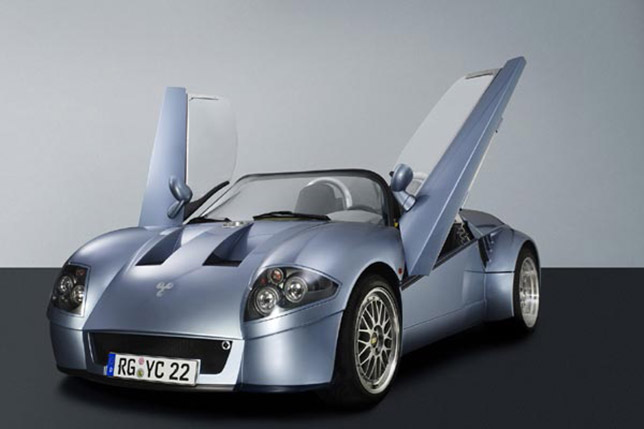
    It can well be expected that their expectations will be met: Both the YES! Roadster and the YES CUP/R are a manifestation of the creed of two company founders and current managing directors Herbert Funke and Philipp Will: Reduce to the core. And for the two designers this means that the direct car-road communication must not be interfered by unnecessary gadg-ets. Hence, what the owner of a YES! will purchase is nothing more and nothing less than a driving machine.

    Translated into plain figures this means: Like the original YES! Clubsport model the new YES! Roadster possesses a performance-enhanced 1.8 liter 210 KW (286 hp) Volkswagen turbo engine that takes the car from 0 to 100 km/h in just 4.2 seconds at 5900 rpm and with a maximum torque of 330 NM. These characteristics place the car in the top performance range. The second new development YES! CUP/R even surpasses the features of the Roadster.
    The vehicle’s 250 kW (340 hp) 2.0 liter turbo engine meets all racing de-mands: chassis, undercarriage, brakes – the entire technology has been designed for the in professional motors sports. Apart from the engine features, the car’s ultimate lightweight design plays an important role: All three models are based on an aluminum space frame, enhanced by the use of composite materials for the carbody and understructure.

    YES! Roadster

    Taylor-made hand manufacture

    The production of the cars at the Funke and Will plant, established in 2001, strongly differs from the familiar mass output. Each YES! sports car is a hand-manufactured unique to which the purchaser contributes to a large extent. Before completion, the fine tuning is made on-site together with the buyer to adapt the car’s every detail to its subsequent owner: colour, special features, ideal sitting and switching position, and pedal alignment. This participation concept and the 100-percent hand production make the YES! a singular occurrence on the sportscar market. The same holds true for another feature: On the company’s 2.2 mile long former runway of an old military air field, the buyer can test-drive his car up to maximum speed. And finally: the manufacturers’ service concept matches the car’s individuality. If necessary, a YES! partner comes to the customer, 24 hours a day, seven days a week.

    It started with a diploma thesis

    The YES! sports cars owe their birth to the graduation of the two company founders at Co-logne Technical College. In the scope of their final thesis the two engineers designed road-ster. A friend, the Stuttgart based designer Oliver Schweizer developed the cars styling. The prototype was first presented under at the International Motor Show IAA in Frankfurt and generated an unexpected demand. Owing to this favourable development the engineers decided to set up their own business. The start-up company’s highly positive development on the hard-fought international automobile markets proved the founders right to uncom-promisingly pursue their initial concept of a minimalist pure sports car.

  • VW Fox

    Volkswagen’s 2005 model offensive is maintaining its impressive momentum as the new VW Fox and new VW Polo make their international debuts. Following the Jetta in the USA, the Golf Plus, and the new Passat, two more models are now set to be unveiled. The 15th AMI Leipzig (2-10 April 2005) will also be the venue for the first appearances of the VW Passat und VW Golf Plus at a German motor show.

    Both debuting models will be unveiled at the press conference on 1 April 2005 at 9:00 am on the Volkswagen stand in Hall 1.

    2005 VW Fox

    The Fox makes no compromises. It is the maximum vehicle for the minimum money – with two doors, a large tailgate, and masses of space. It is a fully-fledged car in every way, despite a frugally calculated price. The VW Fox has superior running gear with the option of ESP. ABS is part of the standard specification. Its galvanised and laser-welded body combines functionality with high build quality. And prices for the Fox start at under 10 000 euros. Volkswagen will start taking orders for the Fox shortly after the AMI Leipzig opens and its launch will begin in late April.

    The VW Fox interior is designed for clear operating logic and optimum benefit for the user. It is based on a four-seat configuration and offers excellent space both in the front and rear. The VW Fox comes with an optional adjustable rear seat, which can be moved lengthways by up to 15 centimetres and has a two-section backrest divided in the middle. Depending on the configuration, boot capacity varies between 260 and 1 016 litres. Three engines are available for the Fox: two petrol engines and one turbodiesel (TDI). The two petrol engines have an output of between 40 kW (55 PS) and 55 kW (75 PS). The TDI develops 51 kW (70 PS).

    2005 VW Fox Rear

    The latest generation of the Polo, a grown-up, but still youthful all-rounder, will continue to set the standard for its class. For years its has it successfully set itself apart from its competitors in reader surveys and in new car registration figures. The Polo has retained its likeable looks. Despite improved comfort and safety equipment, it is priced at the same level as its predecessor. The 1.2 litre 40 kW (55 PS) petrol engine Polo costs 11 250 euros, the 51 kW (70 PS) TDI base model starts at 13 485 euros, which actually places it at a lower price than the predecessor model with the equivalent engine. The new Polo will be launched in Germany and the major European markets in late April.

    The Golf Plus, while unmistakeably part of the Golf family, offers completely new dimensions and has its own absolutely distinctive character. The body and interior are completely new developments and have been tailored to customer needs. Highlighting the practical benefits for customer are “Plus” features such as variability and functionality in the interior with substantially more space for rear passengers and an adjustable rear seat with 16 centimetres travel, outstanding seat ergonomics, and up to 43 stowage features.

    The new Passat was developed with a focus on emotional quality and pleasure in technical content. It redefines technology competence for the mid-class car. The design of the new Passat represents the greatest evolutionary leap since the creation of the series.

    2005 VW Fox Interior

    It features a seemingly unending list of innovations from a completely new running gear with a noise-reduced four-link rear suspension or ESP with trailer stabilisation, new brakes with disc drying, a button-operated electromechanical parking brake, the new starting and locking system, through to automatic distance control or the new Bluetooth telephone system and more…

    Volkswagen is also showing the way with the presentation of natural gas powered studies of the Touran und Caddy. These vehicles are already at an advanced development level and show Volkswagen’s competence in alternative drive technologies. Both studies are fitted with a quasi-monovalent engine concept. That means that the engine is optimised for operation with natural gas, but can run on petrol if the nearest natural gas fuel station is too far to reach. The Caddy is equipped with a natural gas tank holding 28 kilograms, which gives it a range of 450 kilometres. The Touran covers approx. 300 kilometres on its 20 kilograms of natural gas.

  • VW Polo

    VW Polo 2005 - Front View
    In time for its 30th birthday, the new VW Polo appears optically more dynamic and fresher than ever before. The new front end with its V-shaped radiator grille, in particular, lends the VW Polo a significantly more striking look. Pre-sale will start on March 14; despite improved equipment, the vehicle’s prices will remain at the same level.

    The new VW Polo is coming! Based on its well-known virtues, the most recent generation of this all-round talent will remain the benchmark in its class. The Polo’s appealing radiance has also remained, although its exterior appears more mature and even more modern. Pre-sale of the new Polo will start on March 14 in Germany.

    Despite its improved convenience and safety equipment, the vehicle’s prices will remain at the same level. The VW Polo 1.2, which has an output of 40 kW / 55 hp, therefore costs €11,250; the basic TDI, which offers 51 kW / 70 hp, starts from €13,485 and therefore costs less than the predecessor’s entry-level diesel version. Market launch in Germany and the most important European countries will take place at the end of April.

    Following the new Passat, the new Polo will be the second Volkswagen to display the new brand face. The entirely redesigned front end bears the escutcheon grille and re-interprets the V topic. From the A-pillars, a striking curve stretches via the bonnet to the radiator grille.

    However, the new Polo’s face is essentially characterised by its headlights. These are defined as a trapezoidal element, enhanced by the eye-catching, circular element of the main headlights.

    Thanks to this front end design, the Polo retains its appealing character, but its modern design style places it in a higher-quality class. In comparison with the predecessor, its redesigned front extends the new Polo by 19 millimetres to 3916 millimetres. Its width (1650 millimetres) and height (1465 millimetres) correspond to the currently available model.

    The rear end lends the vehicle a further dynamic touch. Here, the rear window ends in a V shape in the lower frame area, making the Polo appear more lively and sporty when viewed from the rear. The redesigned rear lights also demonstrate character, picking up on the front end’s circular elements and clearly setting the tone at the rear of the new Polo.

    Regarded from the side, the Polo stands out thanks to a design which is both clear and convincing. Accentuation of the two available body versions is typical of the VW Polo: whilst the two-door’s ascending lateral curve bears coupé-like features, the four-door reveals stature and solidity in its clear design and third side window in the C-pillar.

    This most recent generation of the Polo will be available in three equipment levels: “Trendline”, “Comfortline” and “Sportline”. In addition to the good convenience and safety features familiar from these equipment levels, the new Polo is fitted with further, new details as standard. These include an anti-lock brake system with dual-rate brake assist, electric window lifters in the front, air conditioner (as of Comfortline) and central locking. Until recently, features such as Park Distance Control, Tyre Pressure Monitor and the dipped-beam’s “Coming Home” function were exclusively available for luxury class models. The VW Polo will set the pace with these features, and combines a high-quality, modern design with innovative equipment which meets the requirements of progressive customers.

    The new VW Polo has also been modernised inside. High-quality fabrics in an exclusive and fresh design lend a reviving touch. In addition to the redesigned instrument graphics, new steering wheels are also available.

    The new VW Polo is fitted with front and side airbags on both front seats as standard. An optional head airbag system, in which the curtain airbags inflate to provide protective padding covering the entire side window area, is also available. The Electronic Stabilisation Programme (ESP), which is fitted as standard in engines as of 74 kW / 100 hp, and is optionally available for the other engines, additionally offers effective support for safe driving.

    The new Polo demonstrates its first-class qualities as an all-round talent in the diversity of its engines. Five petrol engines with outputs ranging from 40 kW / 55 hp to 74 kW / 100 hp – including an FSI engine – and four state-of-the-art TDI engines with outputs from 51 kW / 70 hp to 96 kW / 130 hp are available.

    Access to the VW Polo’s diesel world is provided by a modern 1.4-litre three-cylinder TDI with 51 kW / 70 hp, which replaces the familiar 1.9 SDI. Another new engine, a three-cylinder 1.4-litre TDI with 59 kW / 80 hp, meets customers’ wishes for higher output.

  • VW Beetle Ragster

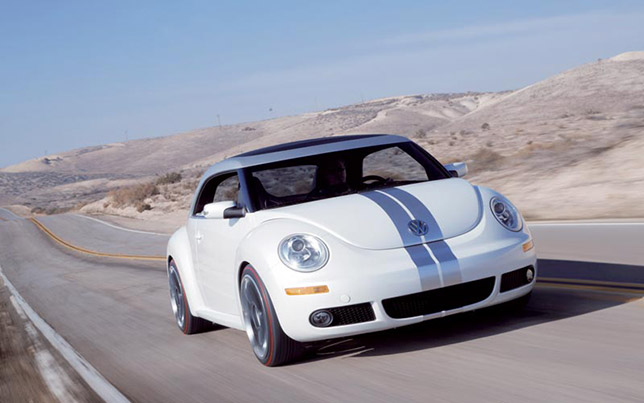
    2005 VW Beetle RagsterIt’s a statement, an automotive way of life. More than 800.000 drive one, the Volkswagen with the perhaps most famous design in the world: the New VW Beetle Ragster. For the North American International Auto Show in Detroit the German company presents the hot potential of the design classic – with a study on 2005 VW Beetle Ragster. Its most visible characteristic: a drastically dropped roof with a large ragtop.

    Ragtop + Speedster = Ragster The development team based the Ragster on the reinforced convertible, shortening the A-pillars by about 90 millimeters and creating a set u-shaped roof fixing for the Ragtop’s frame. It becomes instantly clear where the „Hot Rod“ with its ragtop and speedster dimensions got its name.

    New design: The Ragster shows new visual ways. And this does not only hold true for the top. The fenders, bumpers, headlights, tail lights and 19” aluminum rims are all newly designed as well and more progressive and sporty than ever. Newly designed interior: Racing car bucket seats, sports car type steering wheel with integrated engine start button (right side) and ragtop control (left side), center console and the extremely clean designed cargo area.

    Power? Anything goes: The drive – A powerful gasoline engine or a high torque TDI are imaginable. Although it has yet to be determined which motor will be built and if the study will be produced in series – Anything goes. Just as in Concept 1, the study on the New VW Beetle Ragster, which also started in Detroit. – A great place for a world premiere…