Category: Auto News

Auto news – automobile industry news. Articles about all the latest car models and concepts. Breaking news, uncovered secrets.

  • Space travel through the megacity

    2022 Audi Urbansphere Concept - front view

    Systematically designed from the inside out – Audi is presenting the Audi urbansphere concept car. Designers and engineers have created the Audi urbansphere primarily for use in traffic of Chinese megacities. In these metropolitan areas, where personal space is in particularly short supply, the concept car offers the largest interior space of any Audi to date. In addition, it intelligently coordinates this with technologies and digital services that appeal to all the senses and thus offer a new quality of experience.

    The development process took place in close collaboration between Audi’s design studios in Beijing and its headquarters in Ingolstadt. For the first time, potential customers in China also took part, contributing their own desires and experiences to the development process (known as “co-creation”).

    The result of this process can be seen in the Audi urbansphere concept, above all in the interior. As such, the spacious automobile acts as a lounge on wheels and mobile office – the vehicle serves as a third living space during the hours spent in traffic. To this end, the Audi urbansphere combines the luxury of complete privacy with a comprehensive range of high-tech features on board, even during the daily rush hour. Level 4 automated driving technology transforms the interior without a steering wheel, pedals, or displays into a mobile interactive space that opens up to the offerings of a comprehensive digital ecosystem.

    Audi sphere – first class to the power of three

    Audi skysphere, Audi grandsphere, and Audi urbansphere are the three concept cars that the brand with the four rings is using to showcase its vision of the premium mobility of tomorrow. Audi is creating a vehicle experience that goes far beyond the purpose of merely spending time in a car to get from point A to point B.

    In August 2021, Audi debuted the electrically-powered skysphere concept roadster – the spectacular vision of an autonomous GT that transforms itself into a self-driving sports car with a variable wheelbase.

    Just a few weeks later, Audi unveiled the second model in the sphere series, the Audi grandsphere concept, at the IAA 2021. This large, prestigious four-seater saloon exemplified the brand’s ambition to define the future of progressive luxury.

    What both concept cars have in common with the Audi urbansphere is that the entire concept is derived from the ability to drive in a level 4 autonomous vehicle. This is a technology that Audi is working towards introducing in the second half of the decade together with CARIAD, the Volkswagen Group’s software think tank.

    Interior size

    en at first glance, the Audi urbansphere concept reveals itself as the largest model in the sphere family, indeed of all Audi concept cars to date. Its grand dimensions – 5,510mm long, 2,010mm wide, and 1,780mm tall – place it in the upper echelons of the automotive world, yet the Audi urbansphere concept radically breaks with the conventions of the segment.

    This is because it has been systematically designed from the inside out, as it were, around its passengers. Consequently, the most important dimension for passengers is the unrivalled wheelbase of 3,400mm. The interior of the Audi urbansphere is not subject to the conventional maxim of squeezing as many seats, storage compartments, and functional elements as possible into a space limited by the physics of driving. Instead, it primarily responds to the passengers’ need to be able to experience generous space as a distinctive element of comfort.

    The Audi urbansphere not only frees the driver from the burden of driving whenever possible, but at the same time offers everyone on board a wide variety of options to use this freedom to enjoy customizable experiences – communication or relaxation, work, or a retreat into a private sphere when desired. The Audi urbansphere concept itself also transforms from merely an automobile into a platform for groundbreaking experiences.

    Thanks to Audi’s own options and the ability to integrate digital services from other providers, the possibilities are nearly endless. These can be used to access a wide range of services related to the current trip. The vehicle also takes care of everyday tasks that go beyond the ride itself – such as making dinner reservations or shopping online from the car. In addition, the autonomous Audi urbansphere concept picks up its passengers at home and independently takes care of finding a parking space and charging the battery.

    Customized infotainment offerings are also available, such as the seamless integration of onboard streaming from music and video providers the customer already uses. In an additional step, Audi will make personalized and exclusive options available in the future – concerts, cultural events, or even sporting events that customers will be invited to.

    The architecture – from the inside out

    The word “sphere” in the name already suggests that the focus of the Audi skysphere, grandsphere, and urbansphere concept cars is on the inner space, the interior. It is no longer the powertrain or the driving dynamics that are at the top of the list of requirements for this new generation of cars. Instead, the interior becomes the foundation for design and technology. And this means that it transforms into the passenger’s sphere of life and experience on the road.

    Their needs and desires shape this space, its architecture, and all of the integrated functions. As a result of this shift, the design process itself also changes. At the beginning of all discussions, the focus is on the interior. Only then are the package, exterior lines and proportions designed, which, together with the technological specifications, turn the automobile into a complete work of art.

    Surface, form, function – the interior

    The doors of the Audi urbansphere concept are counter-hinged at the front and the rear; there is no B-pillar. As a result, the whole world of the interior opens up to passengers as soon as they climb in. Seats that swivel outward and a red carpet of light projected onto the ground next to the vehicle transform the simple act of entering the car into an experience of comfort.

    A wheelbase of 3,400mm and a vehicle width of 2,010mm delineate what is a more than stately footprint, even for a luxury-class automobile. Together with 1,780mm of headroom and expansive glass surfaces, these dimensions result in an exceptionally spacious experience of the interior – both subjectively and objectively.

    Four individual seats in two rows offer passengers luxurious first-class comfort. The seats in the rear offer particularly generous dimensions and a wide range of adjustment options. In Relax and Entertain modes, the backrest can be tilted up to 60 degrees while leg rests extend at the same time. The centre-mounted armrests integrated into the sides of the seats and their counterparts in the doors create a comforting feeling of security.

    The seats also cater to the changing social needs of passengers in a variety of ways. While conversing, passengers can turn to face each other on their swivelling seats. On the other hand, those who want some seclusion can conceal their head area from the person next to them using a privacy screen mounted behind the headrest. In addition, each seat has its own sound zone with speakers in the headrest area. Individual monitors are also built into the backs of the front seats.

    When passengers want to use the infotainment system together, on the other hand, there is a large-format and transparent OLED screen that pivots vertically from the roof area into the zone between the rows of seats. Using this “cinema screen,” which occupies the entire width of the interior, the two passengers in the back row can take part in a video conference together or watch a movie. Even split-screen use is possible. When the screen is not in use, it offers a clear view to the front thanks to its transparent design –or when folded upwards –also through the glass roof area to the sky.

    Like in the Audi grandsphere concept, the interior of the urbansphere blends space and architecture, digital technology, and authentic materials into a single entity. The lines emphasize the vehicle’s horizontal proportions.

    The open, wide interior supports the impression of a one-of-a-kind space. The steering wheel, pedals, and conventional dashboard can be hidden during automated driving, which enhances the feeling of transparency and spaciousness.

    The seating surfaces and backs of the two seats with integrated seat belts are visually separate. Between the rear seats – normally locked in place in a low position – is a centre console that swivels upwards. It contains a water dispenser and glasses – another testament to the Audi urbansphere concept’s first-class credentials.

    The Audi urbansphere also qualifies as a wellness zone thanks to innovative digital options that emerged in no small part as a result of the input from the co-creation process with Chinese customers. Stress detection is a prime example – this adaptive program uses facial scans and voice analysis to determine how passengers are feeling and offers each of them individual ways to relax, for example with a meditation app that can be used via the personal screen and the private sound zone in the headrests.

    Less is more –displays and operation

    In the Audi urbansphere, simplicity has become a design principle. Neither batteries of circular instruments nor black screens for virtual display concepts are visible before activating the driving functions.

    Instead, passengers find clearly structured and calm zones composed of materials of the highest quality. Wood and wool as well as synthetic textile fabrics serve as panelling, seat coverings, and floor carpets, all of which have a high-quality feel and are pleasant to the touch.

    Soft beige and grey tones structure the interior horizontally. A dark, toned-down green serves as the colour of the seat shells and soothes the eye. The interior colour zones become lighter from top to bottom and, together with the natural light entering the space, create a homogeneous, wide interior.

    It almost comes as a surprise that, when the vehicle comes to life at a simple tap of the finger, there are displays at all – albeit in the form of projections on the wooden surfaces below the windshield. Depending on the driving status – whether manual with a steering wheel or level 4 – they are either distributed across the entire width of the interior or segmented for the driver and front seat passenger. All the information needed during the journey can be viewed in ultra-fine resolution.

    In addition, a sensor bar is integrated under the projection surfaces for quick switching between content – for instance, for music or navigation. It shows all the functions and applications that are active in the car. Icons flash for the different menus.

    One particular, extremely innovative control element is located near the door cut-out on the interior cladding: the MMI touchless response. If the driver or passenger is sitting in the upright position, far forward in his or her respective area, they can use this element to physically select various function menus via a rotating ring and buttons and click their way through the individual levels. A simple, intuitive operation.

    If, on the other hand, the seatback is reclined far back, passengers still do not have to forgo the use of this convenient feature. This is because in this position, they can use a combination of eye-tracking and gesture control. A sensor directed at the eye detects the line of sight when the control unit is to be engaged. And the passenger only needs to make analogous hand motions – without leaning over – that are similar to physical operation and can use the system just as well that way – without touching a thing.

    When it comes to all operating modes, including eye-tracking, gesture or voice control, and touch, the Audi urbansphere concept adapts to the respective user and learns their preferences as well as frequently used functions – and on this basis can not only usefully supplement rudimentary commands, but also make individual suggestions to the user itself.

    Control panels are even integrated into the armrests on the doors. That way, the car always offers passengers invisible touch surfaces using an optic indicator to show its position. At the same time, there are VR glasses in the armrests on the left and right doors that can be used in conjunction with infotainment options – for instance for the Holoride system.

    Sustainability as a guiding principle

    Many of the materials in the interior of the Audi urbansphere concept, such as the hornbeam veneers, come from sustainable sources. This wood makes it possible to use wood that has grown close to the site, and the entire trunk can be utilized. During processing, the manufacturers do not use any chemicals.

    The seat padding is made of ECONYL®, a recycled polyamide. This material can also be recycled after its use in the automobile – without any loss of quality. The fact that the respective materials are installed separately also plays an important role in the ability to recycle them, as mixing them would drastically reduce the potential for recycling.

    Bamboo viscose fabric is used in the armrests and the rear of the vehicle. Bamboo grows faster than ordinary wood, sequesters a great deal of carbon, and doesn’t require herbicides or pesticides to grow.

    Space concept for the luxury class – exterior design

    A grand, and undoubtedly self-assured, appearance – one’s first encounter with the Audi urbansphere concept is certain to leave an impression. A length of five and a half metres, its height of almost 1,780mm, and its width of more than two metres are undoubtedly prestigious enough to rub shoulders with the automotive elite.

    The flowing silhouette of the vehicle body features traditional Audi shapes and elements, but are combined here to create a new composition – the distinctive Singleframe with the digital eyes of the adjacent lighting units. Viewed from the side, is the widely curved, dynamic roof arch, a massive sill that conceals the battery unit, and large 24-inch wheels. They reference an icon of the 90s – the Audi Avus concept car. The six double spokes simultaneously convey lightweight design and stability, reminiscent of functional motorsport wheels and the Bauhaus tradition of the brand’s design.

    The implied wedge shape of the vehicle body is emphasized by the large, flat windshield. At the front and also at the rear, there are large digital lighting surfaces that leave their mark on the design and at the same time serve as communication elements.

    The Audi urbansphere defies classification into conventional vehicle categories. Nevertheless, it reveals itself to be a typical Audi at first glance. The similarities to the Audi grandsphere concept are particularly eye-catching. The monolithic design of the vehicle body is common to these two concept cars, as is the sculpted, soft shape of the wheel arches. A long wheelbase of well over three metres and short overhangs indicate that this is an electric vehicle. Elegance, dynamism, an organic design language – these are the attributes that immediately spring to mind despite the stately proportions of the Audi urbansphere, just as they do in the significantly flatter grandsphere.

    Visible technology – light

    The front end features an innovative interpretation of the Singleframe that defines Audi’s look – it is shaped like a large octagon. Even though the grille has lost its original function as an air intake on the EV, it still remains prominent as an unmistakable signature of the brand. The digital light surface lies behind a slightly tinted, transparent visor that covers a large area of the front. The three-dimensional light structure itself is arranged in dynamically condensed pixel areas. The upper and lower edges of the Singleframe are still made of aluminium, the vertical connections are formed by the LEDs as part of the light surface.

    The entire surface of the Singleframe becomes a stage or canvas (known as the “Audi Light Canvas”) and can be used for communication – with dynamic lighting effects to clearly signal to other road users in order to improve road safety.  Low beams and high beams are implemented via light segments in the outer sections of the Singleframe.  A similarly functioning matrix LED surface is located in the rear.

    The lighting units to the right and left of the Singleframe look narrow, like focused eyes. These digital lighting units, known as Audi Eyes, echo the logo of the brand with the four rings, as they enlarge and isolate the intersection of two rings to form a pupil – a new, unmistakable digital light signature.

    The illuminated surfaces – and therefore the expression of the eyes – can be adapted to the traffic situation, environment, or even the mood of the passengers. As a daytime running light, the gaze can be focused or open, and the iris can be narrow or wide. A digitally created eyebrow also functions as a dynamic turn signal when required. Thanks to their outstanding visibility, they make an unmistakable statement in favour of safety.

    A special tribute to China,  is a luminous accessory that passengers can take with them when they leave their Audi urbansphere – the Audi Light Umbrella, a self-illuminating umbrella. Inspired by traditional Chinese umbrellas, this one acts as a protective companion and multifunctional light source – the inner skin of the umbrella is made of reflective material, so the entire surface acts as a glare-free lighting unit.

    The Audi Light Umbrella not only gives users a better view of their path, but they also become more visible – when crossing a street or in dangerous situations, it activates a rhythmic flashing of the luminous cone by means of artificial intelligence and sophisticated sensor technology.

    And the Light Umbrella also literally places its wearer in the best possible light, because it evenly illuminates their face for perfect selfies whenever needed.

    Drive system and charging

    The technology platform of the Audi urbansphere – the Premium Platform Electric or PPE – was designed exclusively for battery-electric drive systems and therefore takes full advantage of all the benefits of this technology. The key element of the PPE is a battery module between the axles, which – as in the Audi grandsphere –holds around 120 kWh of energy. Audi has succeeded in achieving a flat layout for the battery by using almost the entire base of the vehicle between the axles.

    Together with the large 24-inch wheels, this produces basic proportions that are perfect not only from a design perspective. The core benefits include a long interior and therefore legroom in both rows of seats. Additionally, the absence of a gearbox cover and a cardan tunnel increases spatial comfort in electric cars.

    The Audi urbansphere concept’s two electric motors are capable of delivering a total output of 295 kW (401ps) and a system torque of 690Nm. These are impressive figures that are often not fully utilized when driving as part of a convoy in urban traffic. Nevertheless, the Audi urbansphere is still equipped with quattro permanent four-wheel drive – an essential feature for the brand’s high-performance models.

    The concept car has one electric motor each on the front and rear axles which, by means of electronic coordination, implement the permanently available all-wheel drive as required and, above all, with a view to economy and range. An innovative feature is that the motor on the front axle can be deactivated as required in order to reduce friction and thus energy consumption when coasting.

    Fast charging, high range

    The heart of the drive system is the 800-volt charging technology. It ensures that the battery can be charged with up to 270 kW at fast-charging stations in the shortest possible time. As such, charging times are approaching those of a conventional stop to refuel a car powered by an internal combustion engine, as just 10 minutes are enough to charge the battery to a level sufficient to power the car more than 300 kilometres (186 miles). In addition, the battery, which holds more than 120 kWh, can be charged from 5 to 80 percent in less than 25 minutes. This means that a range of up to 750 kilometres (466 miles) can be expected acing to the WLTP standard –and even when used for more energy-intensive city and short-distance trips, it is generally possible to avoid making unexpected stops to charge.

    Air suspension for maximum comfort

    The front wheels are connected via a five-link axle that has been specially optimized for electric vehicles. In the rear, there is a multi-link axle that, like the front, is made of lightweight aluminium. Despite the long 3,400mm wheelbase, the steerable rear wheels provide excellent manoeuvrability. The Audi urbansphere concept, like its closest relative the grandsphere, features Audi adaptive air suspension –a single-chamber air suspension with semi-active damper control. It offers outstanding comfort not only on city highways but even on the uneven, often patched asphalt of downtown streets with no noticeable body movement.

  • Mercedes-Benz EQS SUV: Redefined SUV luxury

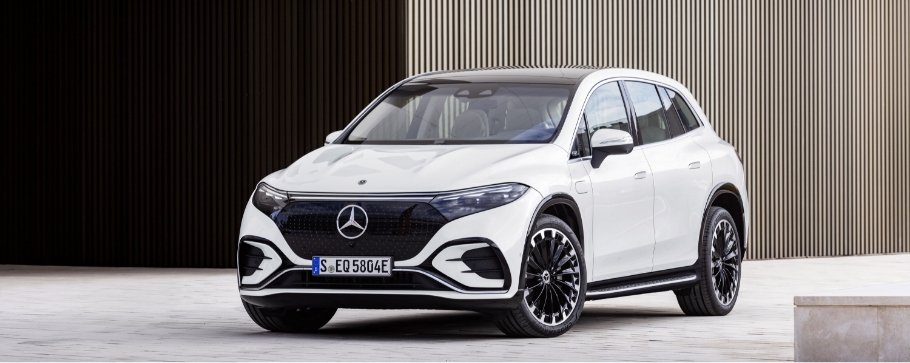
    2023 Mercedes-Benz EQS SUV front angle

    With the luxury saloon EQS and the sporty executive saloon EQE, Mercedes-Benz has entered a new, all- electric era in the upper market segments as well. The EQS SUV, the third model series with this architecture developed for electric vehicles, will soon follow. The SUV offers plenty of space, comfort and connectivity for up to seven passengers in its avant-garde, luxurious interior. Thanks to powerful electric motors, responsive 4MATIC all-wheel drive and an intelligent OFFROAD driving mode, the EQS SUV is also capable of tackling light terrain with ease.

    The new EQS SUV shares the long wheelbase (3210 millimetres) with the EQS Saloon, but is over 20 centimetres higher. The dimensions in detail: 5125/1959/1718 millimetres (length/width2/height3). The interior dimensions benefit from these generous SUV dimensions and from the advantages of the purpose design tailored to the electric platform. The second row of seats can be electrically adjusted as standard. Up to four golf bags fit in the boot. A third row of seats with two additional individual seats and extensive comfort features for all passengers is available as an option.

    The EQS Saloon is the current aerodynamics world champion for production cars4. Its purpose design with smooth underbody and usually closed radiator shutter was a good starting point for aerodynamic measures on the EQS SUV. The optimisation of SUV-typical flow details led to a hitherto unique combination of spaciousness and aerodynamic efficiency.

    All EQS SUVs have an electric drive train (eATS) on the rear axle, and the versions with 4MATIC also have an eATS on the front axle. In the 4MATIC models, the Torque Shift function ensures intelligent, continuously variable distribution of drive torque between the rear and front electric motors and thus the use of the most efficient eATS in each case. The electric motors on the front and rear axles are permanently excited synchronous motors (PSM). The advantages of this design include high power density, high efficiency and high power constancy.

    The EQS Saloon was the first model series from Mercedes-Benz in which completely new vehicle functions can be activated in several areas via over-the-air updates (OTA). With the EQS SUV, this offer is significantly expanded. For example, Trailer Manoeuvring Assist or MBUX (Mercedes-Benz User Experience) Augmented Reality Navigation can be activated at a later date.

    With the EQS SUV, Mercedes-Benz is taking a major step towards zero-emission mobility and is moving a step closer to fulfilling Ambition 2039. The model is produced in a completely CO2-neutral way. The EQS SUV puts real solutions for emission-free mobility, intelligent resource conservation and responsible circular economy on the road.

    The chassis of the new EQS SUV has a four-link axle at the front and an independent multi-link suspension at the rear. The AIRMATIC air suspension with continuously adjustable damping ADS+ is standard equipment.

    The vehicle level can be raised by several centimetres. In addition to the DYNAMIC SELECT modes ECO, COMFORT, SPORT and INDIVIDUAL, the 4MATIC versions feature OFFROAD, a further mode for off-road driving. Furthermore, rear-axle steering with a steering angle of up to 4.5 degrees is standard. It provides plenty of manoeuvrability in the city and agility over land. Optionally and also via an OTA update, a version with up to 10 degrees steering angle is available.

    The principles of Integral Safety, in particular accident safety, apply regardless of the platform. Like all other Mercedes-Benz models, the EQS SUV therefore has a rigid passenger cell, special deformation zones and modern restraint systems. The European version of the EQS SUV is the first Mercedes-Benz model to be able to detect whether rear seats are actually occupied. If a passenger in the rear is not wearing a seat belt, the driver receives a specific warning. Another new feature at Mercedes-Benz is what is known as the occupant presence reminder. This system can indicate children who may have been overlooked in the rear of the vehicle. In vehicles for Europe, Australia and New Zealand, the reminder is on board as standard.

    Mercedes me Charge5 is one of the largest charging networks worldwide: it currently comprises over 700,000 AC and DC charging points, including around 300,000 are in Europe. Since 2021, Mercedes-Benz has ensured a subsequent offset with green electricity when customers use Mercedes me Charge to charge their cars in Europe. High-quality guarantees of origin ensure that as much green power from renewable energies is fed into the grid as is withdrawn via Mercedes me Charge. The new Mercedes me Charge function Plug & Charge makes charging the EQS SUV at public charging stations that support Plug & Charge convenient.

    Navigation with Electric Intelligence plans the fastest and most convenient route, including charging stops, based on numerous factors and reacts dynamically to traffic jams or a change in driving style, for example. This includes a visualisation in the MBUX infotainment system as to whether the state of charge of the battery is sufficient to return to the starting point without charging. Charging stations along the route that have been added manually are given preference in the route calculation. Proposed charging stations can be excluded.

    The estimated charging costs per charging stop are calculated.

    With ENERGIZING AIR CONTROL Plus, Mercedes-Benz thinks holistically about air quality in the EQS SUV. The system is based on filtration, sensors, a display concept and air conditioning. The HEPA (High-Efficiency Particulate Air) filter has a very high filtration level to trap fine particles, microparticles, pollen and other substances entering with the outside air.

    With intelligent software, MBUX fully adapts to its users and provides them with personalised suggestions for numerous infotainment, comfort and vehicle functions. With what is known as the zero layer, the most important applications are always offered on the topmost level within the field of vision, according to situation and context.

    The highlight of the interior is the MBUX Hyperscreen (special equipment). This large, curved screen unit spans almost from A-pillar to A-pillar. Three screens sit under a common cover glass and merge visually. The 12.3-inch OLED display for the front passenger gives them their own display and control area. In Europe, and in a growing number of countries, the front seat passenger is also able to watch dynamic content while the vehicle is on the move. This is because Mercedes-EQ is able to rely on an intelligent, camera-based blocking logic: If the camera detects that the driver is looking at the passenger display, the system automatically dims the dynamic content.

    The Dolby Atmos sound system® takes the audio experience in the EQS SUV to a new level. Individual instruments or voices of the studio mix can be placed all around the listening area. A new kind of sound animation thus becomes possible: This is because while conventional stereo systems usually have a left-right dynamic, Dolby AtmosÒ can use the entire space and create a 360-degree experience.

    Key technical data6

    EQS 450+ EQS 450 4MATIC EQS 580 4MATIC
    Drive system Rear-wheel drive All-wheel drive All-wheel drive
    Electric motor(s): Type Permanently excited synchronous motor(s) (PSM)
    Output kW 265 265 400
    Torque Nm 568 800 858
    Rated voltage Volts 396 396 396
    On-board charger (standard/option) kW 11/22 (USA: 9,6)
    AC charging time, three-phase
    (11/22 kW)
    h 5/10 (USA: 11,5)
    DC charging capacity, max. kW 200
    DC charging time at fast charging station7 min 31
    DC charging: max. range after 15 minutes8 (WLTP) km 250 n/a n/a
    Vehicle
    Length/width/height mm 5125/1959/1718
    Length/width/height (USA) mm 5125/1959/1718
    Wheelbase mm 3210
    Turning circle (with rear-axle steering 4.5°/10°) m 11.9/11.0
    Luggage capacity VDA (five/seven-seater) l 645-2.100/565-2.020
    Electrical consumption and range
    Electrical consumption (WLTP) kWh/100 km 23,0 – 18,6 24,0 – 20,0 24,0 – 20,0
    CO2 emissions (WLTP) g/km 0 0 0
    Range (WLTP) km 536 – 660 507 – 613 507 – 613
  • MINI John Cooper Works returns to the 24h race at the Nürburgring

    2022 Mini John Cooper Works 24h Nurburgring Race - Front Angle

    The 24-hour race at the Nürburgring is considered to be the ultimate endurance test for human and machine. This year, a MINI John Cooper Works will compete in the 50th edition of the high-speed showdown taking place from 26-29 May at the 25.378 kilometre circuit, consisting of the Grand Prix circuit and legendary Nordschleife.

    In September last year, the project was launched at Bulldog Racing in the Eifel region, just a few metres away from the Nordschleife. The base vehicle is a MINI John Cooper Works with the 4-cylinder turbo engine known from the MINI John Cooper Works Clubman and MINI John Cooper Works Countryman with 225 kW/306 hp and a maximum torque of 450 Nm. The 8-speed Steptronic gearbox taken from large-series-production featuring an integrated, mechanical differential lock with a locking effect of up to 70% ensures that the drive torque is converted into thrilling performance without any losses.

    Racing modifications

    For racing purposes, the following modifications were made to the standard MINI John Cooper Works which go beyond SP3T class regulations:

    • A specially developed racing cage was installed.
    • The fuel tank volume was increased to 100 litres.
    • Far-reaching interventions in the aerodynamics, including an adjustable rear wing, a completely covered underbody, a rear diffuser and front splitter were made.
    • Weight was consistently reduced, e.g. by using Makrolon® window panes.
    • A model-specific racing suspension with adjustable rebound and compression damping was fitted.
    • All moving chassis and suspension parts were replaced with reinforced Uniball bearings.
    • A pneumatic lifting unit was installed.
    • The sports exhaust system was adapted with a racing catalytic converter.
    • Original BMW M Performance brake components were installed.

    MINI in motorsport

    Pat Moss made motorsport history in 1962, scoring the first international rally victory for MINI at the Tulip Rally. Her victory marked the beginning of the Classic Mini’s unique success story in rally sport, with 3 overall Monte Carlo Rally wins in 1964 (Paddy Hopkirk), 1965 (Timo Mäkinen) and 1967 (Rauno Aaltonen).

    This string of successes included six overall Dakar Rally victories in 2012 (Leonid Novitskiy), 2013 (Stéphane Peterhansel), 2014 (Nani Roma), 2015 (Nasser Al-Attiyah), 2020 (Carlos Sainz Sr.) and 2021 (Stéphane Peterhansel).

    The MINI John Cooper Works racing car “Made in Nürburg” pays homage to the racing tradition of the MINI brand in the classic colour scheme of the 1960s racing cars in red / white.

  • Land Rover introduces new Range Rover Velar HST Edition

    2023 Range Rover Velar HST Edition - Front Angle

    Land Rover introduces a new HST model to the Range Rover Velar family. The HST was first introduced on the high-performance Range Rover Sport and Evoque models and its dynamic character is now available on the Velar for the first time.

    A distinctive combination of design enhancements and chassis features bring a new dimension of sporting luxury to the line-up, all based around the R-Dynamic design. Its stealthy character is supported by a Black contrast roof and full exterior Black Pack. Available in the full colour palette and exclusively in new Arroios Grey, privacy glass and unique Gloss Black 21-inch 5 split-spoke alloy wheels complete the exterior.

    The dynamic theme continues inside, with Black Suedecloth headlining and steering wheel. A sliding panoramic roof ensures a light and airy cabin while a combination of chassis technologies ensure the perfect balance of ride comfort and handling.

    The new HST features Electronic Air Suspension with Adaptive Dynamics for optimum comfort and control, with Adaptive Dynamics constantly monitoring the road conditions and adjusting the suspension responses accordingly. Configurable Dynamics also ensures drivers are able to tailor the driving experience to suit their preferences.

    In keeping with its dynamic personality, the HST is available with a choice of powerful six-cylinder Ingenium engines. Customers can choose from the P400 (400PS) and D300 (300PS) Mild Hybrid Electric Vehicle (MHEV) petrol and diesel powertrains for effortless performance and refinement.

    The Range Rover Velar’s elegant design and connected technologies have seen the mid-size luxury SUV win a succession of international awards, including the World Car Design of the Year title at the 2018 World Car Awards.

    Finbar McFall, Land Rover Brand Director, said: “The new Range Rover Velar HST offers a combination of carefully curated design enhancements and chassis features; to add to its breadth of capability, without compromising its trademark refinement and comfort.”

    In addition to the HST model, the desirable Range Rover Velar Edition has been reintroduced to the line-up. Based on the R-Dynamic SE, this special edition is now available with the full Velar paint palette and features a black contrast roof complemented by Black Pack exterior detailing and 20-inch Gloss Black alloy wheels. A sliding panoramic roof and privacy glass complete the enhancements. 1

    Amazon Alexa is now available on the Range Rover Velar when fitted with the advanced Pivi Pro infotainment system and the Online Pack.2 Seamless integration brings the familiar Alexa experience into the vehicle and provides natural voice interaction with Pivi Pro’s navigation and entertainment features. Use Alexa to set destinations or find points of interest en route, stream media, make lists and set reminders, make calls and control your smart home. 3

    The Velar also features the latest Advanced Driver Assistance Systems (ADAS) technologies, including Adaptive Cruise Control with Steering Assist. This intelligent technology is available as part of the Driver Assist Pack and makes automatic steering adjustments in order to keep the vehicle in the centre of the lane it is travelling in.

    Customers can experience superior air quality thanks to Cabin Air Purification Plus. The advanced technology enhances Cabin Air Ionisation with PM2.5 filtration, providing superior interior air quality by monitoring CO2 levels and automatically introducing fresh external air when levels drop.

    Greater convenience comes courtesy of the Park Assist Pack. While all Velar models feature a rear camera as standard, this comprehensive pack includes 3D Surround Camera and Park Assist for automatically controlled parking manoeuvres.

    UK Pricing

    Diesel
    Powertrain Derivative OTR  CO2 g/km*
    2.0L 204HP DIESEL AWD AUTO D200 Velar £46,565 167
    D200 S £52,100 168
    D200 R-Dynamic S £54,550 171
    D200 R-Dynamic SE £57,205 171
    D200 R-Dynamic HSE £64,395 176
    D200 Velar Edition £61,005 171
    3.0L 300HP DIESEL AWD AUTO D300 R-Dynamic SE £63,080 198
    D300 HST £69,865 200


    Petrol
    Powertrain Derivative OTR  CO2 g/km* EV Range
    (miles)
    2.0L 249HP PETROL AWD AUTO P250 R-Dynamic S £55,685 220 –
    P250 R-Dynamic SE £58,340 218 –
    P250 R-Dynamic HSE £65,580 226 –
    P250 Velar Edition £62,020 219 –
    2.0P 404HP PHEV  AWD AUTO P400e SE £65,195 49 32.9
    P400e R-Dynamic S £65,235 52 31.2
    P400e R-Dynamic SE £67,630 51 31.8
    P400e R-Dynamic HSE £72,920 56 29.2
    3.0L 400HP PETROL AWD AUTO P400 HST £73,815 229 –


  • Chrysler Airflow Graphite Concept at 2022 NYIAS

    2022 Chrysler Airflow Graphite Concept - Front Angle

    Chrysler today unveiled a Graphite variation of its all-electric Airflow Concept at the 2022 New York International Auto Show.

    The Chrysler Airflow Concept originally debuted at the 2022 Consumer Electronics Show (CES) in Las Vegas, but with the new Graphite, Chrysler offers a reimagined look at the brand’s journey to a fully electric future.

    The Chrysler Airflow Graphite Concept features a new Galaxy Black exterior and Cyprus Copper interior and exterior accents to bring out a sleek, refined new personality for the Airflow Concept’s official global auto show debut.

    Chrysler also announced in January at CES that the brand will launch its first battery-electric vehicle (BEV) by 2025 and offer an all-electric Chrysler vehicle lineup by 2028.

    “The Chrysler Airflow Graphite Concept, the latest version of our all-electric concept, represents the many possibilities on our brand’s road to an all-electric future,” said Chris Feuell, Chrysler brand CEO – Stellantis. “This new persona of the Airflow highlights the flexibility of the Chrysler brand’s future design direction and our ability to create personalities reflective of our diverse customers. As our brand evolves to offer a full battery-electric vehicle portfolio, we are completely rethinking and reinventing the customer experience. Project Ingenuity is an initiative in which we collaborate with customers on our future innovations and services, offering uniquely personalized and delightful customer experiences throughout the purchase, service and ownership journey.”

    Chrysler Airflow Graphite Concept

    The early development of the Airflow included several potential design expressions for the all-electric concept, including the Chrysler Airflow Graphite Concept.

    The Chrysler Airflow Graphite Concept features a Galaxy Black exterior body color, inspired by a sophisticated urban mindset that feels at home navigating amid big city skylines. The Galaxy Black hue also provides a vivid contrast to the Arctic White exterior previously shown on the Airflow Concept at CES.

    The Galaxy Black exterior unites with Cyprus Copper accents both inside and out to imprint the latest Airflow iteration with its own refined, sophisticated design. Cyprus Copper accents highlight the top of the panoramic glass roof as well as select surfaces of the 22-inch wheels.

    The Chrysler Airflow Graphite Concept interior is modern and spacious, integrating the lightness of Ice Grey and warmth of Cyprus Copper accents to achieve a rich interior feel. Evoking the appeal of a first-class lounge that delivers a comfortable space between home and work, the interior boasts premium features and finishes, using sustainable materials and a calming color palette, creating a greater feeling of spaciousness and comfort.

    Future of the Chrysler Brand

    The Chrysler Airflow Graphite Concept represents the future direction of the Chrysler brand, highlighting the dynamic design, advanced technologies and seamless connectivity that characterize the brand’s all-electric transformation. The concept is designed as a space to bring people together, both physically and virtually.

    Enabled by STLA Brain and STLA SmartCockpit, the user experience in the Airflow Concept is agile, intuitive and always fresh. The interior showcases ideas for giving every passenger a personalized experience that seamlessly connects them with their digital lives.

    The Airflow Concept unifies these advanced technologies, communicating through advanced visualization and thoughtful interaction. The Airflow Concept user experience employs multi-layered, high-contrast graphics and thoughtful details to provide a clean, sophisticated appearance that is safe, easy to use and easy to understand.

    Using a menu-based format, screens throughout the Airflow interior can be personalized, simplified and organized based on individuals and interests. Information on the screens can be shared with all passengers by swiping.

    Each screen is a personalized space to access the digital world via connected entertainment, apps and downloads. And each seat also features a built-in camera, enabling occupants to participate in a group video conference call from the comfort of the Airflow cabin.

    Over-the-air (OTA) updates keep Airflow Concept services current and let passengers quickly and easily add new and innovative features. That functionally keeps the vehicle fresh, exciting and capable and enhances the overall ownership experience.

    The backbone of the Airflow Concept user experience is the new electrical/electronic (E/E) and software architecture, STLA Brain. This architecture is highly flexible, breaking today’s bond between hardware and software generations. It enables software developers to create and update features and services quickly, taking advantage of capabilities built into the cockpit without waiting for a new hardware launch.

    The STLA SmartCockpit, demonstrated in the Airflow Concept and built on top of STLA Brain architecture, seamlessly integrates with the digital lives of vehicle occupants to deliver AI-based applications such as navigation, voice assistance, e-commerce marketplace and payment services.

    Fully Electrified + Fully Connected

    Along with the fully connected user experience, the Chrysler Airflow Graphite Concept previews the brand’s commitment to deliver a fully electric vehicle lineup by 2028, produced using clean manufacturing processes and made with recyclable and renewable materials. Through the use of industry-first technologies, the Chrysler brand will delight customers and influence the industry to make the world better, cleaner and safer.

    The Chrysler Airflow Concept is equipped with STLA AutoDrive, which delivers Level 3 autonomous driving capabilities and will be upgradable via OTA updates.

    The concept features all-wheel-drive capability and is powered by two 150 kW electric drive motors (EDMs), one in the front and one in the rear. The concept is designed to accommodate larger capacity EDMs, offering the potential for future high-performance applications. Drive motors are located toward the front and rear of the vehicle, maximizing interior space and enabling the large wheel size and wide stance of the Airflow Concept. The battery is designed to achieve up to 400 miles of range on a single charge.

    Dynamic Design Language

    The sculptural, expressive design of the Chrysler Airflow Graphite Concept envisions the next generation of premium transportation and user experience. The concept reimagines a first-class travel experience that balances technological needs within a serene environment.

    The Airflow Concept features a streamlined, dynamic design proportion that achieves an elegant, athletic profile while increasing EV range. A long wheelbase and wide track, along with large 22-inch wheels and tires, are enhanced visually with accent color cladding. The design elements work together to enable a dramatic stance and deliver confident, spirited handling and performance dynamics.

    The Airflow’s silent electric ride harmoniously supports the design aesthetic, with the concept’s dramatic expression completed by the sleek Galaxy Black exterior. Up front, the Airflow announces its electric aesthetic with the Chrysler wing logo tied into a cross-car grille light blade illuminated with crystal LED lighting. A crystal LED taillight runs the full width of the vehicle, accentuating the wide stance. The Airflow Concept features welcome, departure and animated lighting, including a unique aqua that signifies the vehicle is charging. The diffuser shape of the lower rear fascia highlights the aerodynamic, smooth underbody, a key to achieving optimum driving range.

    Technology is integrated seamlessly into the interior in the form of dark glass sculptures. The central control area integrates individualized climate controls near the C-shaped air slots. Crystalized textures throughout the vehicle add a sense of precision, providing an intricate transition from the exterior and aligning with the advanced interior design highlighted by premium refinement.

    The Airflow Graphite Concept redefines interior touchpoints and combines illusionary weightlessness and grounding metals to provide contemporary, comforting spaces. Soft leather-wrapped seats help achieve a lighter, smoother atmosphere. Materials, including vegetable-tanned leather, as well as floor mats, fabric and carpeting made of recycled materials, imagine a future of sustainable design.

    Infotainment screens seamlessly integrate technology within the overall interior composition. Seating uses a unique slim structure that rests on a pedestal base, enhancing comfort and roominess while allowing for maximum legroom, shoulder space and personal storage for each passenger.

  • The EQE: the new business avant-garde

    2023 Mercedes-Benz EQE - Front

    Hot on the heels of the EQS, Mercedes-EQ is already presenting the next model series to be based on the electric architecture developed specifically for electric vehicles, the new EQE. The sporty business saloon offers all the essential functions of the EQS in a slightly more compact format. At market launch in late April 2022, the model line-up will initially comprise two variants: the EQE 350+ (WLTP: combined electrical consumption: 18.7-15.9 kWh/100 km; combined CO2 emissions: 0 g/km)[1] with 215 kW and the Mercedes-AMG EQE 43 4MATIC (WLTP: combined electrical consumption: 22.5-19.7 kWh/100 km; combined CO2 emissions: 0 g/km)[1]. With 350 kW, this is the entry-level model for electric Driving Performance from Mercedes-AMG. The EQE 500 4MATIC (provisional figures WLTP: combined electrical consumption: 21.1-17.8 kWh/100 km; combined CO2 emissions: 0 g/km) [2] and Mercedes-AMG EQE 53 4MATIC+ (provisional figures WLTP: combined electrical consumption: 23.2 – 20.3 kWh/100 km; combined CO2 emissions: 0 g/km) will follow. Production of the EQE takes place at two locations of the Mercedes-Benz Cars global production network: at the German Mercedes-Benz plant in Bremen for the global market and at the German-Chinese joint venture BBAC in Beijing for the local market.

    Compared to the luxury liner EQS, the EQE is even more streamlined, with a slightly shorter wheelbase, shorter overhangs and more recessed flanks – it carries the concept of the business saloon into the future. Sensual Purity is reflected in generously modelled surfaces, reduced joints and seamless transitions (seamless design). The overhangs and the front end are kept short, the rear provides the dynamic accent with a sharp rear spoiler. Flush with the outer edge of the body, the 19- to 21-inch wheels, together with a pronounced muscular shoulder section, give the EQE an athletic character.

    In its outer dimensions (length/width/height: 4946/1961/1512 millimetres), the EQE is comparable to the CLS. Like the latter, it has a fixed rear window and a boot lid. The interior dimensions even exceed those of today’s E-Class (213 model series) quite significantly, e.g. in terms of the shoulder room in the front (plus 27 mm) or the interior length (plus 80 mm).

    Unconventional interior design and high operating convenience

    With the optionally available MBUX Hyperscreen, the entire instrument panel is a single, ultimate widescreen. This determines the aesthetics of the entire cockpit and interior. The high-resolution screens merge seemingly seamlessly under the shared glass cover. The graphic appearance of their MBUX content is perfectly coordinated. The MBUX Hyperscreen is integrated into the instrument panel in minimalist fashion.

    The 12.3-inch OLED display for the front passenger gives them their own display and control area. In Europe and in a growing number of countries, the passenger is allowed to watch dynamic content such as videos, TV or the internet even while on the move. This is because Mercedes-EQ is able to rely on an intelligent, camera-based blocking logic: if the camera detects that the driver is looking at the front passenger display, this is automatically dimmed for certain content.

    The vent band spans across the entire width at the top and is very slim at the same time. These extreme proportions, together with the glass wave of the MBUX Hyperscreen, create the avant-garde architecture of the cockpit. The outer nozzles feature a turbine design. They play on the theme hyperanalogue through the contrast between high-tech precision mechanics and digital, glass display world.

    The latest MBUX generation, recently introduced in the EQS, is also on board the EQE. With adaptive software, the control and display concept completely adapts to its user and makes personalised suggestions for numerous infotainment, comfort and vehicle functions. With the zero-layer design, the user does not have to scroll through submenus or give voice commands. The most important applications are offered situationally and contextually on the top level in the field of view. In this way the EQE driver is relieved of certain operating steps.

    Efficient drive system

    The first models to come onto the market at the end of April 2022 will be the EQE 350+ with 215 kW and the Mercedes-AMG EQE 43 4MATIC with 350 kW. The EQE 500 4MATIC with 300 kW and the Mercedes-AMG EQE 53 4MATIC+ with up to 505 kW will follow. All EQE models have an electric drivetrain (eATS) on the rear axle. The versions with 4MATIC are also equipped with an eATS at the front axle. The electric motors are permanently excited synchronous motors (PSM). With the PSM, the rotor of the AC motor is fitted with permanent magnets and therefore does not need to be supplied with power. The advantages of this design include high power density, high efficiency and high power constancy. The motor on the rear axle is particularly powerful due to its six-phase design: it has two windings with three phases each.

    In the EQE 350+, the lithium-ion battery is made up of ten modules and has a usable energy content of 90 kWh. The innovative battery management software, developed in-house, allows updates over the air (OTA). In this way, the energy management of the EQE remains up-to-date throughout the life cycle.

    With this generation of batteries, a major step has been achieved in terms of the sustainability of the cell chemistry: The optimised active material consists of nickel, cobalt and manganese in a ratio of 8:1:1. This reduces the cobalt content to less than ten percent. The continuous optimisation of recyclability is part of Mercedes-Benz’s holistic battery strategy.

    Key technical data

    EQE 350+[3] EQE 500 4MATIC[4]
    Drive system
    Electric motor Type Permanently excited synchronous motor Permanently excited synchronous motor
    Output kW 215 300
    torque Nm 565 858
    Rated voltage Volts 328.5 328.5
    On-board charger (standard/optional) kW 11/22 11/22
    AC charging time, three-phase (11/22 kW) h 8,25/4,25 8,25/4,25
    DC charging capacity, max. kW 170 170
    DC charging time at quick-charging station[5] min 32 32
    DC charging: max. range after15 minutes[6] (WLTP) km 250 230 (provisional)
    Vehicle
    Length/width/height mm 4.946/1.961/1.510 4.946/1.961/1.510
    Length/width/height (USA) mm 4.995/1.961/1.511 4.995/1.961/1.511
    Wheelbase mm 3120 3120
    Turning circle (without/with rear-axle steering 4.5°/10°) m 12.5/11.6/10.7 12.5/11.6/10.7
    Boot capacity, VDA l 430 430
    Power consumption and range
    Power consumption (WLTP) kWh/100 km 18.7-15.9 21.1-17.8 (provisional)
    CO2 emissions (WLTP) g/km 0 0
    Range (WLTP) km 567-654 503-590 (provisional)

    Consistently high performance and multiple accelerations without a drop in power characterise the EQE’s drive philosophy. This includes a sophisticated thermal concept and several variants of energy recovery by means of recuperation. In this process, the high-voltage battery is charged by converting the mechanical rotary motion into electrical energy during overrun or braking mode. The driver can manually select the deceleration in three stages (D+, D, D-) as well as the gliding function via shift paddles behind the steering wheel. Also available: DAuto.

    ECO Assist also offers situation-optimised recuperation – deceleration is so strong or weak that it ultimately results in the most efficient driving style. If possible, recuperative deceleration is also used for vehicles detected ahead. This even occurs until they come to a standstill, for example at traffic lights. The driver does not need to press the brake pedal for this – literally one-pedal driving.

    Navigation with Electric Intelligence plans the fastest and most convenient route, including charging stops, based on numerous factors and reacts dynamically to traffic jams or a change in driving style, for example. This includes a visualisation in the MBUX infotainment system as to whether the available battery capacity is sufficient to return to the starting point without charging.

    High noise and vibration comfort, Sound Experiences as a contrast

    As a saloon with a boot lid, the EQE’s concept is well equipped to offer a high level of NVH comfort Noise, Vibration, Harshness) into account. Numerous measures contribute to this. In the electric drivetrains (eATS), the magnets are arranged inside the rotors in an NVH-optimised way (known as ‘sheet metal cut’). In addition, the eATS have a special foam mat all around as an NVH cover. The inverter cover is a sandwich construction. The eATS are double-decoupled from the body via elastomeric bearings:

    Highly effective spring/mass components provide continuous sound insulation from the crossmember under the windscreen to the floor of the boot. Acoustic foams are inserted into many carriers during body-in-white construction.

    If desired, the ride in the EQE nevertheless becomes an acoustic experience: if the Burmester® 3D surround sound system is fitted, the EQE features the two soundscapes Silver Waves and Vivid Flux. Silver Waves is a sensuous and clean sound. Aimed at EV enthusiasts, Vivid Flux is crystalline, synthetic yet humanly warm. They can be selected or switched off as sound experiences on the central display. The additional soundscape Roaring Pulse can be activated as an over-the-air update. This sound experience is reminiscent of powerful machines, and is sonorous and extroverted.

    Air suspension and rear-axle steering as options

    The suspension of the new EQE, with four-link front suspension and multilink rear suspension, is closely related in design to the new S-Class. As an option, the EQE is available with AIRMATIC air suspension with ADS+ adaptive damping system. With rear-axle steering (optional extra), the EQE feels as manoeuvrable as a compact car in the city. The steering angle at the rear axle is up to ten degrees. The turning circle is reduced from 12.5 to 10.7 metres with rear-axle steering.

    New vehicle functions can be activated via over-the-air technology (OTA). Available from launch: the additional sound experience “Roaring Pulse”, two special driving modes for young drivers and service personnel, small games, the highlight mode as well as DIGITAL LIGHT with projection function and DIGITAL LIGHT individualisation. In Highlight mode the vehicle presents itself and its equipment highlights – this can be activated via the “Hey Mercedes” voice assistant. In addition to the light animation “Digital Rain”, DIGITAL LIGHT individualisation includes other coming-home/leaving animations such as “Brand World”. The OTA functions are available in the Mercedes me Store, and the range will be successively expanded.

    Convenient charging in a large charging network

    With the new Mercedes me Charge Plug & Charge function, the EQE can be charged even more conveniently at Plug & Charge-enabled public charging points: when the charging cable is plugged in, the charging process starts automatically; no further authentication by the customer is required. The vehicle and the charging station communicate directly via the charging cable.

    What’s more, Mercedes me Charge customers continue to benefit from the integrated payment function with automatic payment. The customer chooses the preferred payment method only once. Every charging process is then automatically debited – including abroad. The individual charging processes are clearly listed in a monthly invoice.

    Mercedes me Charge is one of the largest charging networks worldwide: it currently comprises around 700,000 AC and DC charging points worldwide, of which more than 300,000 are in Europe. By means of high-quality certificates of origin, Mercedes-Benz guarantees that energy from renewable energy sources is fed into the grid for charging current sourced via Mercedes me Charge.

    High level of passive and active safety

    The principles of Integral Safety, in particular accident safety, apply regardless of the platform. Like all other Mercedes-Benz models, the EQE therefore has a rigid passenger cell, special deformation zones and modern restraint systems with PRE-SAFE®.

    The fact that the EQE is based on an all-electric architecture also opened up new design possibilities for its safety concept. It meant, for example, that a favourable location could be chosen for the installation of the battery, in a crash-protected area in the underbody. And because there is no large crankcase on board, the behaviour in a frontal crash could be modelled even better. In addition to the standard crash tests, the car’s performance in various additional load situations was verified and extensive component tests carried out at the Vehicle Safety Technology Centre (TFS).

    The latest generation of driving assistance systems includes numerous driver support functions. One new function is the additional microsleep warning from ATTENTION ASSIST (in conjunction with MBUX Hyperscreen). It analyses the driver’s eyelid movements using a camera in the driver display. The assistance display within the driver’s display shows the operation of the driving assistance systems in a comprehensible full-screen view.

    Mercedes management on the EQE

    “After the EQS, the EQE is already the second model to be built on our new platform for electric vehicles. This speed of innovation shows the advantages of the scalable architecture: With the new EQE, we can quickly make the high-tech solutions of our electric flagship EQS available to a wider group of buyers. And our production flexibility reaches new heights with the EQE: at the Bremen plant, where the versions for the world market roll off the production line, ten other models are already in production.“
    Markus Schäfer, Member of the Board of Management of Mercedes-Benz Group AG and COO of Mercedes-Benz Cars

    “With its dynamic driving experience and comprehensive range of Connected Services, the EQE is a perfect fit for the desires of a modern generation of customers. We reconcile innovation and emotionality with sustainability: with Green Charging, we are actively contributing to the reduction of CO2 emissions. In addition, there are numerous intelligent functions that make everyday life easier for our customers. This includes Plug & Charge, for example – plug in and the EQE is charged without further authentication or registration.”
    Britta Seeger, Member of the Board of Management of Mercedes-Benz Group AG and Mercedes-Benz AG, responsible for Mercedes-Benz Cars Marketing and Sales

    “The Mercedes EQE is the next electric luxury saloon. The hallmark one-bow design, finely sculpted lines and silhouette together create a very aerodynamic and futuristic look. It all adds up to make the EQE a more extravagant, more entertaining and more exceptional car, while at the same time defining the next luxury class for the Mercedes-EQ brand.“
    Gorden Wagener, Chief Design Officer Mercedes-Benz AG

    “The Mercedes-EQ brand is pursuing an ambitious and equally clear goal: We want to build the most sustainable and technically most advanced cars in the world. By bringing responsible innovations onto the road, we are driving forward this process of transition. The EQE is the latest example of this – and its contribution will be significant.”
    Christoph Starzynski, Vice President Electric Vehicle Architecture & Head of Mercedes-EQ

    [1] Range and electrical consumption have been determined on the basis of Commission Regulation (EC) No. 2017/1151/EU.

    [2] Data on electrical consumption and range are provisional and were determined internally in accordance with the “WLTP test procedure” certification method. Confirmed TÜV figures, EC type approval and certificate of conformity with official figures are not yet available. Differences between the stated figures and the official figures are possible.

    [3] Range and electrical consumption have been determined on the basis of Commission Regulation (EC) No. 2017/1151/EU.

    [4] Data on electrical consumption and range are provisional and were determined internally in accordance with the “WLTP test procedure” certification method. Confirmed TÜV figures, EC type approval and certificate of conformity with official figures are not yet available. Differences between the stated figures and the official figures are possible.

    [5] The charging times are for a 10-80% charge at a DC fast charging station of category “K” or “L” pursuant to EN17186 with 500 A charging current

    [6] At DC fast charging stations with 500 amps based on provisional WLTP range

  • Genesis X Speedium Coupe at EV-focused event

    2022 Genesis X Speedium Coupe Concept - Front Angle

    Today, Genesis premiered the Genesis X Speedium Coupe at Genesis House New York, a cultural space in Manhattan’s Meatpacking District. The concept car incorporates Genesis’ DNA, while looking ahead to the next wave of EVs and highlighting Genesis’ future as a luxury electric vehicle brand.

    The brand also announced plans for U.S. production of its upcoming Electrified GV70 SUV at its manufacturing facility in Montgomery, Ala. Production is set to start in December.

    In a series of electrification-focused announcements, the brand also revealed its GV60 Priority One program for U.S. consumers.

    Envisioning a new styling convention for the future

    The Genesis X Speedium Coupe was born out of a “freestyle” design exercise based on the Genesis X Concept.  Luc Donckerwolke, Genesis Chief Creative Officer and 2022 World Car Person of the Year led the initiative. It embodies the timeless Genesis’ design philosophy, Athletic Elegance, in an even more progressive way.

    The name Speedium was inspired by the Korean racetrack in the city of Inje and the passion for motorsport it inspired in Genesis designers. The name also encapsulates Genesis’ belief that the emotional value of driving will remain strong in the era of electrification. The addition of the word “coupe” further accentuates the enjoyment of driving through aesthetic designs.

    Genesis followed the principle of reductive design, or “less is more,” for the concept car. The Genesis X Speedium Coupe stands out for its restrained elegance, clean lines, and subtle curves.

    The model challenges the status quo of a defined car type. It is not a conventional concept car that previews plans for the production lineup.

    “This car is an open-door moment in Genesis’ journey towards our future EV design,” said Luc Donckerwolke, chief creative officer of Genesis. “This isn’t a show car — it’s a look into our design processes as we explore ideas for the next wave of EVs, one that incorporates Genesis’ DNA.”

    On the front of the vehicle, Genesis’ signature Two Lines lamps have evolved into a full-width element that encompasses the shape of the crest resembling the Genesis Crest Grille. It was designed to carry the brand signature of the wing face for the electrification era by integrating the daytime running lamps with the low beam and high beam together. It carries an EV face that symbolizes Genesis’ transformation towards becoming an all-electric car brand with a six-model lineup by 2030.

    From an overhead perspective, the hourglass silhouette highlights the car’s passion and character. The curvaceous and sensuous form accentuates the wheel arches creating muscular presence.

    Viewed from the side, the Parabolic Line extending from the front to the rear of the car maintains a certain tension in the design as a classic car would. The deliberate “anti-wedge” design culminates in a streamlined look that exudes understated elegance.

    Meanwhile, an elliptical tail balances out the look for a visually engaging tension between convex and concave surfaces in the rear. The V-shaped brake lights interrupt the circular shape by producing the striking contrast that is one of the hallmarks of a Genesis vehicle.

    “We are giving each design element space to breathe,” said Donckerwolke. “It’s not about making the design elements compete with each other, but about orchestrating the elements so that they complement and respect one another.”

    The concept’s metallic emerald green shade is referred to as “Inje Green.” As expected of a car that was inspired by a Korean racetrack, the color encompasses the mountainous landscape where the track is located, completing the image of a classic car that embodies dynamism, speed, and timeless elegance.

    Genesis Priority One

    Genesis has shown significant growth in the U.S. market, setting monthly sales records for the past 16 months. The brand recorded 11,723 sales in Q1 2022, the largest quarterly sales achievement since its foray into the U.S. market in 2016.

    Starting today, clients in select U.S. markets may enroll in Priority One, a program designed to curate a personalized purchase experience for GV60, the brand’s first dedicated electric vehicle. By visiting genesis.com and providing their contact information and $500 refundable deposit, a Genesis Concierge will simplify the process and match clients with a qualified retailer.

    “We are pleased to bring the highly-anticipated first Genesis EV to market in the U.S. with GV60,” said Claudia Marquez, chief operating officer of Genesis Motor North America. “With Genesis Priority One, we are renewing our promise to our clients to provide a purchase experience tailored to them.”

    Genesis Priority One will be available at launch in California, Connecticut, New Jersey, and New York for a limited time while quantities last.

    Production Plans for the Electrified GV70

    Genesis announced that the Electrified Genesis GV70 will be its first vehicle produced in the U.S. at its manufacturing facility in Montgomery, Ala. Production is expected to begin in December 2022 with the goal of strengthening Genesis’ EV market position in the region and continuing its commitment to electrification.

    “We are pleased to bring Genesis production to the United States for the first time,” said José Muñoz, president & CEO of Genesis Motor North America. “The GV70 SUV has won the hearts and minds of American consumers and industry experts alike. We are proud to begin offering consumers the new electrified model, built right here in America.”

    About Genesis House

    Genesis House New York opened in November 2021 as the brand’s base in the U.S. It’s more than just a showroom — it’s a cultural oasis in the heart of the city. Measuring over an acre of floorspace (over 46,000 square feet) and consisting of three floors, it carries forward the bold and innovative spirit of the brand by welcoming guests in a gracious manner that is deeply rooted in Korean culture.

    The announcements took place during a press-only event at the Cellar Stage — a basement space outfitted with floor-to-ceiling LED-lit staging and state-of-the art audio-visual technology. Genesis holds numerous events at the Cellar Stage in collaboration with artists in the local community.

    The first floor is an exhibition space where guests can experience the Genesis vehicle lineup, both existing models and concept cars that express the brand’s future vision. The architects used tessellated mirrors to beautifully set off the cars on display, and curators are on hand to provide detailed explanations. The curator service at Genesis House is provided in English, Spanish, French, Chinese, and Korean, among other languages.

    On the second floor, guests can enjoy a Korean cultural experience in the library, the Tea Pavilion, Genesis House Restaurant and the Terrace Garden.

    Genesis House Restaurant, established in collaboration with Onjium — a Michelin-starred restaurant and traditional cultural research center in Seoul — offers a creative and elegant gastronomic experience that harkens back to the Korean Noble class cuisine that took inspirations from what Joseon-era royalty once enjoyed in their palaces.

    At the event, the Genesis House Restaurant unveiled its new Spring menu, curated by Onjium.

    The 9,493-square-foot Terrace Garden, located outside on the second floor, overlooks Hudson Yards, the Hudson River, and the High Line. Reminiscent of a courtyard outside a “hanok,” or traditional Korean house, it is surrounded by low walls and an alley, serving as a cozy spot to enjoy a cup of coffee or tea.

    Building upon the success of Genesis House New York, the brand is exploring future plans to open branded cultural spaces in other regions.

    Genesis Gives

    To mark the occasion and give back to the local New York community, Genesis presented a $50,000 donation to Girls Who Code, an organization whose mission is to close the gender gap in technology and to change the image of what a programmer looks like and does. Girls Who Code is building the largest pipeline of future female engineers in the world. In nine years, they have reached more than 450,000 girls globally.

    This charitable contribution marks the continuation of Genesis Gives, a new initiative that supports STEAM (science, technology, engineering, arts, mathematics) education, sports, and athletics programming for youth. Genesis Gives has contributed more than $300,000 to causes across the United States since its launch in November 2021.

  • 2023 Kia Telluride arrives at New York Auto Show

    2023 Kia Telluride - Front Angle

    Three years after bursting onto the scene as one of the most in-demand and award-winning three-row eight-passenger SUVs in the U.S., the Kia Telluride returns for 2023 with an array of enhancements that build upon the success of the original.  The Telluride has not only attracted over 75 percent of its buyers as new to the Kia family, but because of high customer satisfaction, Telluride owners have the most brand loyalty of any midsize SUV when returning to market for another vehicle. Big, capable, and powerful, the Telluride is as ready as ever for adventures of all kinds, from family road trips across the country to off-road excursions bound by few limits.

    The SUV that swept the “triple crown” of automotive accolades and claimed the most recent award for best resale value from JD Power now wears new design elements inside and out and brings an expanded list of ADAS safety technology for greater peace-of-mind and driver confidence.  With class-leading passenger room, the Telluride arrives with two all-new trim levels for 2023: X-Line and X-Pro.  These iterations exude a more rugged personality with features and capabilities that allow the Telluride to venture off the beaten path and explore new realms of wilderness.

    Designed for America

    Designed specifically for the U.S., Telluride has been a head-turning proposition from the very start.  Retaining its bold and sophisticated appearance, the Telluride undergoes some exterior restyling for a more rugged and refined look in the new model year:

    • Revised vertical headlamp design (standard LED) and available foglamps
    • New bumpers and grille
    • Revised taillamps
    • New rear fascia and trim
    • Revised lower door garnish trim/side sills
    • New wheel designs for every trim
    • Three new exterior colors
      • Midnight Lake Blue
      • Dawning Red
      • Jungle Wood Green

    As before, the Telluride interior captures a feeling of upscale exploration in a spacious, three-row, eight-passenger environment with class-leading passenger room.  Thoughtful new updates include:

    • Curved and seamless dual 12.3-inch display screens – gauge cluster (available) and navigation
    • Redesigned dashboard with revised trim panels and HVAC vents
    • Redesigned steering wheel
    • New interior color packages

    Introducing Two New Adventure-Ready Trim Levels: X-Line and X-Pro

    The new Telluride introduces two new trim levels – X-Line and X-Pro – for Kia owners who choose to go off the beaten path every so often.  Both all-wheel drive models offer a roster of exclusive upgrades and enhancements over other Telluride trims.  As seen below, the X-Pro model builds off the X-Line model.  Furthermore, the X-Line model replaces the former Telluride Nightfall Edition.

    Telluride X-Line

    Exterior

    • Unique radiator grille design
    • Bridge-type roof rails
    • Body-color door handles
    • Exclusive 20-inch wheels
    • “X-Line” badging

    Interior

    • “X-Line” embossing on front seat upper backrest
    • Exclusive color packages

    Chassis and Capability

    • Higher ground clearance (+10mm)
    • Improved approach and departure angles
    • Tow mode for optimized trailering performance (shift logic, sway control)
    • Upgraded Traction Control System (TCS)

    Telluride X-Pro (in addition to or in place of X-Line features)

    Exterior

    • Exclusive 18-inch black wheels and 18-inch all-terrain tires (Continental)
    • “X-Pro” badging

    Interior

    • “X-Pro” embossing on front seat upper backrest
    • 110-volt inverter outlet (cargo area)

    Chassis and Capability

    • Increased towing limit from 5,000 pounds to 5,500 pounds

    As Powerful and Capable As Ever

    The new Telluride continues to provide a capable and confidence-inspiring experience for driver and passengers, alike.  Major mechanicals remain virtually unchanged, yielding the SUV’s composed ride and performance:

    • Atkinson Cycle LAMBDA II 3.8L V6 GDI engine producing 291 horsepower at 6,000 rpm and 262 lb.-ft of torque at 5,200 rpm
    • 8-speed automatic transmission
    • Four-wheel independent suspension
    • Rigid body structure due to the monocoque shell that is composed of 59.4 percent advanced high-strength steel
    • Available self-leveling rear suspension. Ride height is automatically calibrated depending on vehicle load to optimize control and stability
    • Choice of four drive modes – Smart, Eco, Sport and Comfort – each using different settings for powertrain, drivetrain, and steering effort mapping to provide the desired driving experience.  In addition to the four regular drive modes, in vehicles equipped with AWD, drivers can select from two different modes, “Snow” and “AWD Lock” for specific driving conditions
    • Available active on-demand all-wheel drive helps provide enhanced driving performance by actively distributing torque between front and rear wheels depending on road conditions and driver input. The system utilizes electro-hydraulic AWD coupling to precisely activate the multi-plate clutch, constantly redistributing the amount of power transferred to the front and rear wheels. During normal driving, power is distributed according to the drive mode selected. “Eco” and “Comfort” modes can deliver up to 20 to 35 percent of the power to the rear wheels, respectively.  “Sport”, “Smart” and “Snow” modes can deliver up to 50 percent of the power to the rear wheels. “AWD Lock” mode delivers power evenly to all four wheels
    • Standard towing rated up to 5,000 pounds (5,500 pounds for X-Pro trim)5
    • Newly added Downhill Brake Control (DBC) maintains a controlled descent on steep roads

    A New Level of Convenience Technology

    The 2023 Telluride adds new technology features that makes ownership easier and more convenient:

    • Upgraded 12.3-inch navigation screen (increased from 10.3 inches)
    • Optional Full Display Mirror with HomeLink functionality (replacing standard rearview mirror)
    • Available Smart Power Liftgate with “Auto Close” functionality

    Kia Connect services provide advanced embedded connectivity:

    • Digital Key: Allows customers to use their compatible iPhones, Apple Watches, and Samsung Galaxy smartphones as a virtual vehicle key to lock, unlock and drive. Furthermore, these keys can be shared with friends and family over text messages on available devices
    • In-vehicle Wi-Fi Hotspot connects up to five devices to 4G LTE-based internet
    • Map and Infotainment Over-The-Air (OTA) updates: Keeps maps and infotainment system updated automatically with the latest functionalities to deliver the best driving experience
    • Kia Access App with smartwatch compatibility through Apple Watch and Samsung Galaxy smart watches to access features like remote climate control, door lock/unlock and more
    • Stolen vehicle tracking and immobilization capability
    • Connected Routing: The server-based system calculates the optimal route by using real-time and predicted traffic information based on past information and AI that has learned the user’s preferred route.
    • Smart Speaker Integration lets customers use Amazon Alexa or Google Assistant enabled smart speakers or devices to remotely control some functions (such as remote start)

    Technology highlights carried over from the previous model year include:

    • Available 10-speaker Harman/Kardon audio system (AM/FM/SiriusXM)
    • Apple CarPlay
    • Android Auto
    • Available wireless smartphone charging
    • Up to six USB charging ports – two in each row. Five ports are standard (updated from A type to C type)
    • Multi-Bluetooth wireless connectivity allows two phones to connect simultaneously for audio streaming
    • Head-Up Display: Upgraded from 8.5-inches to 10-inches.  Added information makes this system especially useful. Provides turn-by-turn navigation, speed, smart cruise control and blind-spot warnings (available)
    • Driver Talk: Uses a microphone to enhance communication with second- and third-row passengers
    • Quiet Mode: Cuts audio output in second and third row so the audio choices of the front occupants are only heard in that row
    • Rear Occupant Alert: Uses ultrasonic sensors designed to detect child or pet movement in the second and third row after the car’s doors have been locked and then can issue audible alerts to the driver

    Expanded ADAS Suite

    As Kia’s flagship SUV, the new Telluride is brimming with technology to keep occupants safe.  The long list of ADAS features grows for 2023 with several new additions, including two new standard systems (ISLA, FCA-JT):

    • Intelligent Speed Limit Assist (ISLA): Maximum speed sign recognition that alerts driver and also limits the speed of the car depending on the settings (standard)
    • Navigation-based Smart Cruise Control – Curve (NSCC-C): Leverages the navigation system to lower the vehicle’s speed proactively before upcoming curves in the road (available)
    • Highway Driving Assist 2 (HDA 2): A driving convenience system that maintains the distance from the vehicle in front and the lane position on the highway, and also assists in lane changes (available; HDA 1.5 is standard on Telluride)
    • Forward Collision Avoidance – Junction Turning (FCA-JT): Detects oncoming vehicles while turning left at an intersection (junction).  If a collision appears likely, the system applies the brakes to stop the car (standard)
    • Forward Collision Avoidance – Junction Crossing (FCA-JC): Detects crossing vehicles while passing through an intersection.  If a collision appears likely, the system applies the brakes to stop the car (available)
    • Forward Collision Avoidance – Lane Change Oncoming (FCA-LO): Assists in preventing collision with oncoming vehicles while passing other vehicles by providing steering input (available)
    • Forward Collision Avoidance – Lane Change Side (FCA-LS): Assists in preventing collision with cycles/vehicles in the front of the car while changing lanes by providing steering input (available)
    • Forward Collision Avoidance – Evasive Steering Assist (FCA-ESA): Assists in preventing collision with obstacles/pedestrians/vehicles in front of the car while driving straight by providing steering input (available)

    The Telluride’s long list of carryover ADAS4 (standard and available) systems include:

    • Forward Collision Warning (FCW)
    • Forward Collision Avoidance Assist with Pedestrian Detection (FCA)
    • High Beam Assist (HBA)
    • Lane Departure Warning (LDW)
    • Lane Keeping Assist (LKA)
    • Blind Spot Collision-Avoidance Assist-Rear (BCA-R)
    • Blind Spot View Monitor (BVM) (available)
    • Driver Attention Warning (DAW)
    • Smart Cruise Control with Stop & Go
    • Rear Cross-Traffic Collision-Avoidance Assist (RCCA)
    • Parking Distance Warning – Forward (available) and Reverse
    • Surround View Monitor (SVM) (available)
    • Highway Driving Assist (HDA) (HDA 1.5 – standard; HDA 2.0 – optional)
    • Lane Following Assist (LFA)
    • Safe Exist Assist (SEA)
  • The all-new 2023 Kia Niro debuts

    2023 Kia Niro

    Today, the all-new Kia Niro CUV made its North American debut at the New York International Auto Show. The next-generation Niro has been designed from the ground up to meet and exceed the expectations of eco-minded consumers. With striking styling cues and a commitment to sustainability and connectivity throughout, the 2023 Niro will launch in the United States with three highly efficient, electrified powertrains: hybrid electric (HEV), plug-in hybrid (PHEV) and all-electric (EV).

    “Kia’s electrified vehicle momentum continues with the launch of the all-new second-generation Niro, which offers more refinement, versatility, connectivity, and technology than ever,” said Steven Center, COO & EVP, Kia America. “The 2023 Niro was designed for today’s needs and for sustainable future mobility.”

    An urban environment like Manhattan, where space is at a premium, provides an optimal backdrop for the launch of the 2023 Niro. When it arrives at Kia retailers in all 50 states late fall, 2022, the 2023 Niro family will present state-of-the-art electrified powertrain options and outstanding efficiency wrapped in a sleek, aerodynamic, and technologically focused package. In its second generation, Niro remains the only vehicle on the market available with three different electrified propulsion options.

    Shaped by Nature

    Inside and out, the 2023 Niro features bold design inspired by the “Opposites United” philosophy that infuses inspiration from nature with aerodynamic refinement. The exterior of the 2023 Niro embodies a sophisticated and adventurous sense of purpose that takes strong influence from the 2019 HabaNiro concept, and it achieves an impressive drag coefficient (Cd) of 0.29. Its upswept, striking daytime running lights (DRL) flank the signature tiger nose grille, which has evolved with the new Kia brand identity. At the rear, boomerang-shaped LED taillights sit alongside uncomplicated surface treatments for a concise and aerodynamic styling combination, while the heartbeat-shaped rear reflector, rugged looking skid plate garnish and lower bumper enhance the front-end design. Niro HEV and Niro PHEV can be identified by black door cladding and wheel arches, while Niro EV is distinguished by Steel Grey or black exterior trim, depending on body color.

    The all-new Kia Niro features a bold and dynamic design inspired by the brand’s acclaimed ‘Opposites United’ design philosophy, and specifically its design pillar ‘Joy for Reason’. The treatment takes inspiration from nature, while the choice of colors, materials and finishes aim to strike the perfect balance between an environmentally responsible approach to mobility and a future-oriented passenger car vision.

    The side profile of the 2023 Kia Niro is accentuated by the Aero Blade, a highly distinctive shape that also aids airflow underneath. The Aero Blade can be painted in body color or in a variety of contrasting colors. Further enhancing the profile of Niro HEV and Niro PHEV are optional 18-inch wheels inspired by the HabaNiro.

    Dimensionally, the 2023 Niro retains a compact footprint but is incrementally larger than the vehicle it replaces. The wheelbase increases to 107.1 inches, and overall length increases to 174 inches. Cargo capacity behind the rear seats increases to 22.8 cubic feet. And with 6.3 inches of ground clearance, Niro can easily handle urban activities. With these changes, Niro has 8 more cubic feet of passenger cabin room and 50 percent more cargo room than the Tesla Model 3.

    Forward-Looking Interior Design

    Complementing the bold exterior of the all-new Niro is an avant-garde interior, styled and upholstered with premium materials and textured surfaces. Its parametric design borrows cues from the all-electric EV6 for a tech-focused environment in all configurations and trims.

    Upscale touches abound inside the 2023 Niro, and sustainability is integral to the materiality of the passenger compartment. The interior of Niro EV is composed of animal-free textiles, including the premium seating surfaces to touchpoints throughout the cabin. The headliner is composed of recycled wallpaper, which contains 56 percent reused PET fibers. The slim, contemporary seats with integrated coat hangers enhance roominess, and they are covered by high-quality bio polyurethane and Tencel made from eucalyptus leaves. BTX-free paint, which is free from benzene, toluene, and xylene isomers, is used on the door panels to minimize the impact on the environment and reduce waste.

    Style and in-car technology contribute to a sense of calm in the interior of the all-new Kia Niro. The off-center dashboard curves around the front occupants, with opposing horizontal and diagonal lines leading to a calming yet daring aesthetic. Available panoramic, dual 10.25-inch screens for the instrument cluster and infotainment system create a powerful, first visual impression, and offer state-of-the-art connectivity. Ambient mood lighting in a multitude of color combinations heightens the senses while creating a serene environment. Active Sound Design allows the driver to digitally enhance the engine and motor sounds of the Niro; an eight-speaker Harman/Kardon premium sound system is optional. The front seats, which feature optional heating and ventilation, offer standard USB ports on the side and optional seat memory positions on some variants.

    Thanks to developments in interior packaging, the 2023 Niro now offers the roominess of a vehicle one size larger—and best-in-class passenger room. Generous front and rear headroom, legroom, and shoulder room demonstrate Kia’s commitment to passenger comfort and spaciousness.

    Vehicle Technology Takes Center Stage

    Advanced vehicle technology manifests in myriad forms in the all-new Kia Niro, from customizable vehicle settings through the in-dash infotainment system to class-leading, standard active safety equipment.

    Approaching the vehicle, heartbeat-inspired DRLs and available power-folding mirrors act as a warm greeting. Once inside, available memory seats on some variants recall the driver’s position, and programmable mood lighting sets the scene. An available Head-Up Display (HUD) projects directions, active safety warnings, vehicle speed, and current infotainment directly in the driver’s line of sight. Wireless Apple CarPlay and Android Auto capability are standard, and a wireless phone charger is optional.4

    The 2023 Niro EV is available with the same vehicle-to-load (V2L) onboard generator functionality pioneered by the EV65.

    Standard, cutting-edge ADAS6 technology on the 2023 Niro includes:

    • Forward Collision Avoidance (FCA) with Pedestrian detection capability: Warns if there is risk of a collision with a pedestrian in front of the vehicle while driving and may automatically assist with braking
    • Lane Keeping Assist (LKA): Helps detect lane markings and provides steering inputs to help prevent the vehicle from leaving the lane while driving
    • Lane Following Assist (LFA): Helps detect lane markings and vehicles ahead and provides steering inputs to help center the vehicle in the lane
    • Driver Attention Warning (DAW)7: Analyzes the driver attention level and provides a warning if a break is recommended. It may also provide a leading vehicle departure alert if the leading vehicle departs from a stop and the driver does not react within a certain time period
    • Blind Spot Collision Avoidance (BCA) with Parallel Exit: May help avoid collisions with rear-side vehicles when exiting a parallel parking spot by automatically assisting with braking
    • Rear Cross-Traffic Collision Avoidance-Assist (RCCA): Helps detect approaching cross traffic when in reverse. When approaching cross traffic is detected, the system alerts the driver and may apply brakes
    • Safe Exit Warning (SEW)8: Provides a warning when a vehicle is approaching from the rear-side while someone is exiting the vehicle
    • Rear Occupant Alert (ROA)9: Provides a warning to the driver to check the rear seat before exiting the vehicle

    Smart Cruise Control with Stop & Go and Navigation-Based Curve is available across the Niro lineup, as is FCA with Assist-Junction w/ Cyclist & Junction Turning. Optional for the first time on Niro EV is Highway Driving Assist II10, which integrates the functionality of Lane Change Assist, FCA with Lane Change, and Smart Cruise Control with Machine Learning.

    Kia Connect advanced in-vehicle connectivity, which is accessible in-car or through the Kia Access App, is standard on Niro EX and above11. Additionally, the driver can unlock the 2023 Niro’s doors through new Digital Key 2.0, which facilitates opening and starting the Niro using an Apple iPhone, Apple Watch or Samsung Galaxy smartphones. And sharing Digital Key 2.0 is as simple as sending a text. Over-The-Air (OTA) updates ensure that maps and the infotainment system are updated automatically. Stolen Vehicle Recovery and Immobilization offers peace of mind for owners, with the capability to assist law enforcement agencies to recover a stolen vehicle. Smart Speaker Integration lets customers use Amazon-Alexa or Google-Assistant enabled smart speakers or devices to remotely control certain vehicle functions, such as remote start. Additional functionality, including 911 Connect and Roadside Assistance, are also part of the Kia Connect feature set.

    Three Flavors, All Sustainable

    The all-new Kia Niro will arrive in the U.S. in three distinct powertrain configurations: the Niro HEV hybrid, the Niro PHEV plug-in hybrid, and the all-electric Niro EV. All Niro models are front-wheel-drive, which provides advantages in adverse weather. A 6-speed dual-clutch automatic transmission is standard in HEV and PHEV.

    The Niro HEV features a 1.6-liter four-cylinder engine coupled with a 32kW permanent magnet synchronous electric motor, for a combined maximum power output of 139 horsepower and 195 lb.-ft. of torque. Improved cooling, friction and combustion technologies ensure maximum fuel efficiency, and Niro HEV returns a targeted 53 mpg combined and an estimated driving range of 588 miles.

    The Niro PHEV pairs the 1.6-liter engine with a 62kW electric motor, for a total system output of 180 hp and 195 lb.-ft. of torque. When it is connected to a Level 2 charger, the Niro PHEV can refill its 11.1-kWh lithium-ion polymer battery in under three hours. Fully charged, the all-electric range (AER) of the Niro PHEV is estimated at 33 miles12 when fitted with 16-inch wheels: an improvement of 25 percent over the model it replaces.

    The all-electric Niro EV is powered by a 64.8 kWh battery and a 150kW (201-horsepower) motor with DC fast-charging capability as standard. Plugged in to a Level 3 fast charger, the Niro EV can replenish 10 to 80 percent in under 45 minutes, at a maximum charging capability of 85 kW. The 11kW onboard charger also helps recharge the Niro EV in under seven hours on a Level 2 charger. Targeted AER for the Niro EV is 253 miles. An optional heat pump and battery warmer help preserve range in cold temperatures.

    In addition to Sport and Eco drive modes, the all-new Kia Niro introduces Green Zone Drive Mode, which automatically transfers Niro HEV and Niro PHEV into EV drive mode in residential areas, and nearby schools and hospitals. The Niro automatically uses electric power based on navigation cues and driving history data, and recognizes favorite places, such as home and office set in the navigation system.

    Intelligent regenerative braking enables a variety of regeneration levels to easily slow the car and recuperate kinetic energy to maximize driving range. The system can calculate the amount of regeneration required using radar and road gradient information, and it can allow all Niro models to harvest the maximum amount of energy from its brakes while bringing the vehicle to a gentle halt.

  • 2023 Hyundai Palisade Makes World Debut at the NYIAS

    2023 Hyundai Palisade - Side Angle

    Hyundai today unveiled its significantly enhanced 2023 Palisade SUV in a global debut at the New York International Auto Show. The new Palisade offers freshened interior and exterior design cues, new infotainment and safety features, and advanced driver assistance systems. The 2023 Palisade arrives at Hyundai dealers this summer.

    “The enhanced 2023 Hyundai Palisade offers the design appeal and features worthy of Hyundai’s flagship SUV,” said Olabisi Boyle, vice president, product planning and mobility strategy, Hyundai Motor North America. “More than ever, Palisade is the ultimate family vehicle for daily use and memory-making road trips.”

    2023 Palisade New Enhancements and Available Features

    Exterior

    • New front and rear bumper fascia
    • New front grille
    • New headlamps and daytime running lights
    • New multi-spoke alloy wheel design
    • Auto-dimming outside mirrors

    Interior

    • New instrument panel, gauge cluster and audio interface design
    • New steering wheel design
    • New seating surfaces and materials
    • Ergo-motion driver’s seat
    • 2nd-row armrest angle adjuster (8 passenger, first for Hyundai)
    • Heated 3rd row seats (first application for Hyundai)
    • Acoustic-laminated rear door glass (Calligraphy model)


    Infotainment/Convenience Technology

    • 12-inch navigation with 720p resolution
    • Digital, full-display center rearview mirror (first application for Hyundai)
    • WiFi hotspot (first application for Hyundai)
    • Digital Key 2 Touch (compatible with iPhone and Android)
    • New Bluelink features (see Bluelink detail)
    • Enhanced USB-C ports replace USB-A ports (quicker charging up to 3 amps)
    • Enhanced wireless device charging (from 5W to 15W)
    • Enhanced dynamic voice recognition

    Advanced Driver Assistance Systems

    • Forward Collision-Avoidance Assist
    • Navigation-based Smart Cruise Control
    • Highway Driving Assist
    • Reverse Parking Collision-Avoidance Assist
    • Remote Smart Parking Assist

    Passive Safety Technology

    • Standard rear side-impact airbags

    2023 Hyundai Palisade - Front View

    Flagship SUV Design

    The design of the 2023 Palisade conveys dignified refinement with clear differentiation worthy of a flagship SUV. A wider, cascading grille form outlines rugged parametric shield elements for a premium appearance. The new forward lighting signature features vertically-connected LED composite lights that frame the grille creating a sharp-edged, technical appeal. New, 20-inch multi-spoke alloy wheels fill the wheel openings for a premium flagship presence. New strake detailing on the lower front skid plate element further conveys a rugged demeanor. The powerful, extended hood profile creates an impressive road presence, while bold C-pillars and panoramic side glass graphics convey generous third-row spaciousness. The rear view emphasizes a wide, stable stance via vertical LED taillamps and lower fascia skid plate details.


    2023 Hyundai Palisade - Rear View

    This design has aerodynamic benefits as well, with specific design cues that include a fast A-pillar angle, a rear spoiler side garnish, an optimized front cooling area with an extended internal air guide, aero underside panels, and rear wheel aero deflectors.

    Intuitive Utility and Premium Design Elements

    2023 Palisade now offers an innovative Ergo driver’s seat designed to provide comfort and help reduce fatigue during long drives. Palisade’s third-row seating now offers heating for its passengers, a first for Hyundai. The second row of seats now offers wing-out headrests and seat ventilation for extra comfort. For the driver, an available full-display digital center rearview mirror uses a rearview camera to allow the driver to clearly see behind the Palisade without the obstructions of passengers or cargo. New, slim horizontal air vents add a sense of spaciousness and premium ambience. The instrument panel has been redesigned for a more voluminous appearance with new ambient lighting themes.

    2023 Hyundai Palisade Interior

    Wireless charging capability has been upgraded from 5 watts to 15 watts for faster device charging. The 2023 Palisade supports the latest version of Hyundai Digital Key. Digital Key 2 Touch allows owners to leave their car key at home and use an iPhone, Apple Watch, or Samsung Galaxy smartphone to lock, unlock, and start their vehicle. After the car key has been added to Apple Wallet or Samsung Pass, users can simply hold the supported device near the door handle to lock or unlock the car. Touching an Apple Watch near or placing the phone in the wireless charger and then pressing the start button allows the driver to start the Palisade’s engine. Apple Wallet or Samsung Pass also allows secure sharing of keys with family and friends. The 2023 Palisade is also the first Hyundai vehicle to offer Wi-Fi hotspot capability. Customers with cellular connectivity will be able to provide a hotspot that allows others to browse the internet, stream videos or music and more – just like at home.

    The interior design combines a sense of relaxation and comfort creating a serene environment with eight-passenger seating standard for family adventures. The One-Touch second row seat allows for easy operation to move the seat forward and out of the way for easy access into and out of the third-row seat. For more convenience, the third row offers power-folding/unfolding and reclining seats. Second-row captain’s chairs are also available. USB-C outlets have been added for faster device charging throughout the interior, providing extra convenience for all passengers. Even more, a conversation mirror allows the driver to clearly see passengers in the rear.

    Ultrasonic Rear Occupant Alert monitors the rear seats to detect the movements of children and pets, reminding drivers to check the rear seats when exiting the vehicle; if the system detects movement in the rear seats after the driver leaves and locks the vehicle, it can sound the horn and send an alert to the driver’s smartphone via Bluelink. The system is designed to help prevent children and pets from being forgotten in the car, but it can also help in case children accidentally lock themselves in.

    Powertrain

    Palisade power comes from an Atkinson-cycle 3.8-liter V6, dual CVVT, direct-injected engine, for excellent power and efficiency. This 3.8-liter powerplant produces an estimated 291 horsepower @ 6,000 rpm and an estimated 262 lb.-ft. of torque @ 5,200 rpm. Palisade delivers that power to the wheels via a refined eight-speed automatic transmission with a multi-plate torque converter and offers both two-wheel and HTRAC® four-wheel-drive configurations, with a final drive ratio of 3.648 for confident acceleration. Palisade is extremely quiet, with generous under-hood insulation, special sound-deadening carpets and powertrain tuning that delivers smooth, linear response. In addition, Palisade offers drivers the ability to start the vehicle via remote key fob or via the Blue Link app.

    HTRAC® With New Tow Mode Capability

    The 2023 Palisade offers Hyundai’s HTRAC® All-Wheel-Drive (AWD) system, which adds Tow Mode. Tow Mode adjusts the towing powertrain profile, holding lower gears longer and reducing the frequency of shifting response. The HTRAC AWD system was developed as a multi-mode system, providing an electronic, variable-torque-split clutch, with active torque control between the front and rear axles. The driver-selectable HTRAC Normal, Sport and Smart modes help provide confident control in all weather conditions. The Sport setting gives a more agile feel by sending more available torque to the rear wheels, for a sporty dynamic feel when desired. This system has a wider range of torque distribution variability than many competitive systems and has been tuned to conditions such as straight-line acceleration, medium- or high-speed cornering, and hill starts.

    2023 Hyundai Palisade side

    New Safety and Convenience Technologies

    SUV buyers do not want to compromise when it comes to protecting their passengers, so Hyundai has expanded its safety technologies on the 2023 Palisade, with rear side-impact airbags as standard equipment to help provide additional occupant protection. Its generous suite of advanced driver assistance systems includes many innovative technologies, including Forward Collision-Avoidance Assist, Blind-Spot Collision-Avoidance Assist, Safe Exit Assist, Driver Attention Warning, High Beam Assist, Navigation-based Smart Cruise Control, Lane Following Assist, Highway Driving Assist, Rear Cross-Traffic Collision-Avoidance Assist, Reverse Parking Collision-Avoidance Assist and Remote Smart Parking Assist.

    Forward Collision-Avoidance Assist
    Forward Collision-Avoidance Assist helps to avoid collisions with objects in front of the vehicle while driving. If a preceding vehicle suddenly slows, or if a forward-collision risk is detected, such as a stopped vehicle or a pedestrian, it provides a warning. After the warning, if the risk of collision remains, it can assist with emergency braking. While driving, if there is a risk of collision with a cyclist ahead, or with an oncoming vehicle while turning at an intersection, it can help assist with emergency braking. While driving through an intersection, if there is a risk of collision with oncoming vehicles detected from the left or right, it can assist with emergency braking. When changing lanes while driving, if there is a risk of collision with an oncoming vehicle detected in the next lane or a preceding vehicle in the next lane, it can assist with steering to help avoid a collision. If there is a risk of collision with a pedestrian detected, partially in the vehicle’s intended path, it can assist with steering to help avoid a collision.

    Lane Keeping Assist
    Lane Keeping Assist helps to keep the vehicle within the lane while driving.

    Lane Following Assist
    Lane Following Assist helps to keep the vehicle centered within the lane while driving.

    Blind-Spot Collision-Avoidance Assist
    Blind-Spot Collision-Avoidance Assist helps to avoid collisions with a rear-side vehicle when changing lanes. When operating the turn signal to change lanes, if there is a risk of collision detected with a rear-side vehicle, it can provide a warning. If exiting a parallel parking spot and there is a risk of collision detected with a rear-side vehicle, it can assist with emergency braking.

    Safe Exit Assist
    Safe Exit Assist can help avoid collisions with a rear-side vehicle detected when exiting the vehicle. When the occupant opens the door to exit the vehicle after a stop, if an approaching vehicle from the rear side is detected, it provides a warning. It can also help keep the rear door closed through operation of the electronic child lock when a potential collision is detected.

    Driver Attention Warning
    Driver Attention Warning analyzes the driver’s attention while driving and can warn the driver of inattentive driving inputs.

    High Beam Assist
    High Beam Assist can help switch high beam lights on and off at night for approaching vehicles in the opposite oncoming lane.

    Navigation-based Smart Cruise Control
    Navigation-based Smart Cruise Control can help maintain safe speeds on the highway using navigation data. In a highway curved section, the speed can be reduced appropriately before entering the curve. When leaving the curved section, the speed can return to the original setting.

    Rear Cross-Traffic Collision-Avoidance Assist
    Rear Cross-Traffic Collision-Avoidance Assist can help avoid collisions with oncoming vehicles detected on the left or right side of the vehicle while reversing. If there is a risk of collision detected with an oncoming vehicle on the left or right side while reversing, it provides a warning. After the warning, if the risk of collision remains, it can assist with emergency braking.

    Highway Driving Assist
    Highway Driving Assist helps maintain a set distance and speed from the vehicle ahead when driving on a highway and helps center the vehicle in the lane, even when driving through curves.

    Reverse Parking Collision-Avoidance Assist
    Reverse Parking Collision-Avoidance Assist can help avoid collisions with rearward objects detected while reversing. If there is a risk of collision detected with a rearward object while reversing, the system provides a warning. After the warning, if the risk of collision remains, it can assist with emergency braking.

    Remote Smart Parking Assist
    Remote Smart Parking Assist helps remotely park or exit a parking spot from outside the vehicle.

    In addition, 2023 Palisade now applies nine standard airbags: dual front, dual side-front and rear, driver’s knee, and roll-over-sensing side-curtain airbags. Palisade uses a full-length large side curtain airbag that includes third-row seating coverage for enhanced rear occupant protection in the event of a collision. Palisade has a very rigid structure, with strategic use of Advanced High Strength Steel (AHSS) in key areas to provide increased tensile-strength. Use of Advanced High Strength Steel has several benefits: lighter overall vehicle weight and greater vehicle strength and rigidity without the excessive costs of more exotic lightweight materials. Robust underbody and side structures are designed to increase energy absorption and cabin intrusion in a severe collision, especially in the small overlap test. Further, its underbody uses multiple load paths to better disperse potential crash energy in the event of a collision.

    New Rugged Palisade XRT Model

    2023 Palisade will also offer a new, dark-themed, rugged XRT model to complement the Santa Fe and Tucson XRT models in the Hyundai SUV line-up. The Palisade XRT will include:

    • Dark-finish, rugged-themed 20-inch alloy wheels
    • Rugged-look front and rear fascia with skid plate design elements
    • Rugged-look lower door trim
    • Dark-finish front grille
    • Black roof rails
    • Power sunroof (conventional type)
    • Black leatherette seating surfaces

    Bluelink® Connected Car Feature Enhancements

    Hyundai offers the latest version of its upgraded Bluelink® connected car services with the 2023 Palisade. This range of new features allows customers to control vehicle functions with their smartphone or voice to make their drive more convenient and enjoyable. New Bluelink features include Connected Routing, Last Mile Navigation, and a new User Profile feature.

    Automatic Collision Notification (ACN) is an important safety feature within Bluelink. In the event of an accident and an airbag deploys, an Automatic Collision Notification signal can be automatically transmitted to the Bluelink Customer Care Center. A trained Bluelink response operator can attempt to establish voice communication with the vehicle occupants, dispatch appropriate services and remain on the line until help arrives.

    New to 2023 Palisade, Bluelink-enabled features include:

    • Remote Profile Management stores select personalized driver preferences in the Bluelink cloud, and can remotely update and push-back to the vehicle
    • Remote Start Enhancements offer remote seat heating and ventilation functions as well as preloads of individual driver settings for seating position
    • Vehicle Status Notifications inform owners if the vehicle has doors unlocked or windows open
    • Maintenance Alert Enhancement tracks maintenance intervals in the multimedia system, with ability to reset

    Palisade’s Dynamic Voice Recognition system accepts simple voice commands to conveniently control cabin A/C, radio, hatch opening/closing, heated steering wheel, heated/cooled seats, and other functions. The system can also assist with various points of interest (POI), weather status and stock market data updates.

    Color

    2023 Palisade exterior colors continue to include: Abyss Black, Hyper White, Steel Graphite, Sierra Burgundy, Typhoon Silver and Moonlight Cloud, with Robust Emerald as a new color for 2023. Interior seating is available in cloth, leatherette, leather and premium Nappa leather.

  • Subaru debuts refreshed 2023 Outback SUV

    2023 Outback SUV - Side Angle

    Subaru of America, Inc. today debuted the 2023 Outback at the New York International Auto Show. The legendary SUV receives updated styling as well as new safety and in-vehicle technologies. Also new for 2023, the Onyx Edition trim level will be available with two engine options.

    For 2023 model year, Outback will be available in Base, Premium, Onyx Edition, Wilderness, Limited, and Touring trim levels when it arrives in Subaru retailers this fall. The XT models and Wilderness come standard with the powerful 2.4-liter turbo engine. Also, a new Wide-Angle Mono Camera is added to Touring models.The Outback lineup (except the recently released Wilderness) receives a bolder look thanks to a new front fascia incorporating a more prominent grille; redesigned LED headlights and fog lights; and a more rugged front bumper cover. On the sides, the expanded wheel arch cladding adds to the vehicle’s bolder new look while providing additional protection.The 2023 Outback comes standard with the latest version of EyeSight Driver Assist Technology. The enhanced system operates more smoothly and under a greater range of conditions. These improvements are thanks to a wider field of view, updated control software, and the addition of an electric brake booster.

    The top-level Touring trim adds a Wide-Angle Mono Camera that works together with the dual-camera EyeSight system. The additional camera further expands the field of view to recognize pedestrians and bicycles sooner when the vehicle enters an intersection at low speed. EyeSight gives an alert to the driver, and, when necessary, applies brakes to avoid collisions with crossing bicycles and pedestrians.  Also new for Touring is a full LCD Smart Rear-View Mirror with auto-dimming, compass, and Homelink®.

    On models equipped with Blind-Spot Detection with Lane Change Assist and Rear Cross-Traffic Alert, EyeSight includes Automatic Emergency Steering. The new feature works in conjunction with the Pre-Collision Braking System to help avoid a collision at speeds less than 50 mph.

    ONYX EDITION UPDATES

    The Onyx Edition is now available with the 2.5-liter naturally aspirated SUBARU BOXER® engine. The Onyx Edition features black-finish exterior elements, 18-inch alloy wheels, and badging as well as an exclusive gray two-tone interior. Further, the seats are wrapped in a water-repellant durable StarTex® material. The Onyx Edition builds on the Premium trim and adds Hands-Free Power Gate; Front View Monitor; Dual-Mode X-MODE; and full-size spare tire.

    PERFORMANCE AND CAPABILITY

    The 2023 Outback delivers the optimal blend of SUV capability and car-like ride and handling with standard Subaru Symmetrical All-Wheel Drive, Active Torque Vectoring, Vehicle Dynamics Control and X-MODE with Hill Descent Control. The 8.7 inches of ground clearance (9.5 inches for Wilderness) is greater than that of many SUVs, yet the Outback maintains a comfortably low step-in height for both front and rear passenger entry.

    Standard on XT models, the 2.4-liter turbocharged BOXER engine delivers robust all-around performance with 260 horsepower at 5,600 rpm and 277 lb-ft of torque at 2,000 rpm. Meanwhile, the standard naturally aspirated 2.5-liter BOXER has a responsive 182 horsepower at 5,800 rpm and 176 lb-ft of torque at 4,400 rpm.

    All 2023 Outback models are paired with a Lineartronic CVT featuring an 8-speed manual mode function with steering wheel paddle shifters. The 2.4-liter turbo delivers an estimated 23/30 mpg city/highway and has a 3,500-lb. towing capacity, the most of any Outback in history. The 2.5-liter achieves up to an estimated 33 mpg and a range of more than 600 miles on a single tank.

    STRUCTURE AND SAFETY

    Introduced for 2017, the Subaru Global Platform has been optimized for the Outback, boasting a structure that is 70-percent stiffer in both torsional and front-suspension rigidity.  It is also 100-percent stiffer in both front lateral flexural and rear subframe rigidity compared to the previous Outback’s platform. Crash protection is improved, as the new body absorbs over 40-percent more energy in front/side crashes than the prior model. When a crash is unavoidable, the Outback protects driver and passengers with eight standard airbags, including a driver knee airbag. Subaru expects the 2023 Outback will achieve top safety scores when it is tested later this year, including a TOP SAFETY PICK+ rating from the Insurance Institute for Highway Safety (IIHS).

    Standard EyeSight Driver Assist Technology includes Advanced Adaptive Cruise Control with Lane Centering, which provides steering assist when the vehicle veers toward the outside of its lane, helping the driver maintain a direct path. The DriverFocus™ Distraction Mitigation System uses a dedicated infrared camera and facial recognition technology to identify signs of driver fatigue or distraction and provides audio and visual warnings to alert the driver and passengers. Additional available driver-assist technologies include Reverse Automatic Braking; and EyeSight Assist Monitor with head-up display.

    An available Front View Monitor captures images within the driver’s blind spots in front of the vehicle and displays a 180-degree view on the 11.6-inch display, providing safety and assistance when checking road conditions ahead, parking, and off-roading.

    COMFORT, CONVENIENCE, AND VERSATILITY

    All trim levels feature power door locks, windows and side mirrors; Welcome Lighting; Sound Insulation Windshield; and One-Touch Folding Rear Seats. Moving up to the Premium trim adds the All-Weather Package; a 10-way power front driver seat with lumbar support; and LED rear gate light.  The Limited trim gains Keyless Entry with Push-Button Start and heated rear seats (outboard position). The Touring trim adds ventilated front seats and a heated steering wheel (360-degree) to its roster of standard features.

    For powering and pairing personal devices, Outback provides front and rear USB A ports and two 12-volt DC power sockets as standard. Front and rear USB C ports are added to Premium trim and higher.

    With a cargo floor length of 75 inches with the rear seatbacks folded, the 2023 Outback offers up to 75.6 cu ft of cargo. And with a wide rear gate opening, the Outback can comfortably accommodate long items such as camping gear, golf clubs or strollers. For added convenience while loading the vehicle, an available Hands-Free Power Gate allows the owner to open the rear gate by simply waving in front of the Subaru emblem (positioned in the center of the rear gate), and a single-touch lifting cargo cover provides easier access. For additional cargo versatility, the Outback offers standard roof rails with tie-down points and integrated and retractable cross bars. Outback Wilderness retains its stronger roof rails that allow for roof tent capability.

    BOLD DESIGN

    The Outback’s exterior emphasizes ruggedness and functionally while evoking a sense of adventure. For 2023, the Outback lineup (except Wilderness) receives a new front fascia that includes an aggressive front bumper cover; larger grille; and redesigned LED headlights and fog lights. The wheel arch cladding has been updated to improve functionality.

    The interior design uses a wide windshield and long lines from the center of the instrument panel to the door panels to create an open environment. The tablet-style 11.6-inch Full HD center information display (dual 7.0-inch display on base) offers direct touch controls for multimedia, HVAC, X-MODE, and vehicle settings.
    The top-of-the-line Touring trim leverages luxurious appointments inside and out, including new Black Nappa leather with contrasting tan stitching, high-gloss black molding for the pillars, chrome plating decorated door handles and satin tone plated side mirrors.

    SUBARU IN-VEHICLE TECHNOLOGY

    The 2023 Outback debuts the latest version of the STARLINK 11.6-inch Multimedia Plus system with standard wireless Apple CarPlay® and Android™ Auto with full screen display. The system features an 11.6-inch high-resolution touchscreen with combination meter integration and improved on-screen controls for audio, HVAC, X-MODE and vehicle features. Additional standard features include new Valet Mode; Bluetooth® hands-free phone and audio streaming connectivity; AM/FM stereo; rear vision camera; SiriusXM® All-Access Radio and SiriusXM Travel Link® (4-month free subscriptions); HD Radio®; and over-the-air updates.

    The 11.6-inch Multimedia Navigation system includes voice -activated navigation powered by the latest version of TomTom® and SiriusXM Travel Link (3-year free subscription).

    The 2023 Outback is the first vehicle in the Subaru model line up to integrate what3words (W3W), an innovative location technology that provides a simple way to communicate precise locations using just three simple words. W3W has divided the world into a grid of 10-foot squares and given each square a unique combination of three words — a what3words address. Customers can navigate to and share trailheads, scenic overlooks and other hard to find places with precise accuracy using just three words. The feature is standard on models equipped with the STARLINK 11.6-inch Multimedia Navigation system.

    The Outback is built at Subaru of Indiana Automotive (SIA) in Lafayette, Indiana along with the Ascent, Impreza, and Legacy.

  • The new BMW X7

    2023 BMW X7 M60i - Front View

    With its inimitable combination of exclusivity, dynamic excellence, luxuriant spaciousness and versatility, the BMW X7 has quickly developed into the most successful BMW model in the luxury class. And now the unique character profile of the brand’s largest Sports Activity Vehicle (SAV) has been honed to significant effect thanks to extensive design refinements – most notably a visually impactful front end – plus a new-look M Sport package, light-alloy wheels measuring up to 23 inches (an ex-factory first for BMW) and the latest-generation iDrive control/operation system including BMW Curved Display and BMW Operating System 8. The new BMW X7 also comes with a further expanded range of standard equipment, additional driver assistance systems and the latest 48V mild hybrid technology for the three engine variants offered.

    The new BMW X7 is a central pillar in the ongoing product offensive at the most exclusive reaches of the premium carmaker’s model line-up. The new X7 will be produced at BMW Group Plant Spartanburg, the competence centre for BMW X models in the US state of South Carolina. The worldwide market launch for the new BMW X7 will get underway in August 2022.

    Exterior design: exclusive looks, progressive style.

    Fuelled by its highly versatile skillset, the largest BMW X model convinces with both on-the-road elegance and off-road ability. Extensive design modifications accentuate above all the visual exclusivity of the largest BMW X model even more vividly. Indeed, its design underscores more clearly than ever the status of the new BMW X7 as one of the brand’s flagship models. The newly structured front end picks up on signature BMW design cues such as the twin headlights and BMW kidney grille. In their newly interpreted form, these features emphasise the car’s upright stance and reinforce its road presence.

    Split headlight units are making their debut in the new BMW X7. The horizontal LED light elements set higher up in the front end house the position light, daytime driving lights and turn signal indicators. The LED units located below them for the low-beam and high-beam headlights give the impression of retreating into the background with their dark housing and deeply embedded position in the front apron, and only come to the fore when activated. The new adaptive matrix LED headlights with non-dazzling high beam and adaptive light distribution now also provide the functionality of front fog lights with their automatic bad weather light.

    Discreet cascade lighting for the two BMW kidney grille elements brings a richly extravagant feeling to the front end of the new BMW X7, both when stationary and on the move. The “Iconic Glow” BMW kidney grille is a standard feature of the range-topping BMW X7 M60i xDrive (fuel consumption combined: 13.3 – 12.2 l/100 km [21.2 – 23.2 mpg imp]; CO2 emissions: 303 – 278 g/km in the WLTP cycle; figures in the NEDC cycle: –) and will be offered as an option for the other model variants.

    At the rear end, the progressive style of the extremely slim light units, which now have three-dimensional sculpting, is accentuated. The elegant chrome bar connecting the rear light units on the new BMW X7 is enclosed within an exquisite glass cover.

    The optional, newly designed M Sport package shines an even brighter spotlight on the dynamic driving properties of the BMW X7. And M-specific design features for the exterior and interior also clearly emphasise the performance attributes of the BMW X7 M60i xDrive. The M Marina Bay Blue metallic paint finish can be ordered exclusively for the BMW M model. Another new addition to the range of exterior colours is Sparkling Copper Grey metallic. 20-inch light-alloy wheels are fitted as standard on the new BMW X7. The range-topping model and cars specified with the M Sport package come with 21-inch M light-alloy wheels. Optional 23-inch light-alloy wheels are available ex-factory for the first time for a BMW model.

    Luxuriant spaciousness, extended standard equipment.

    The generous feeling of space on board the new BMW X7 can be enjoyed across three rows of seats. The second row accommodates three passengers as standard and offers two particularly comfortable individual seats as an option. Heated comfort seats are provided as standard for the driver and front passenger. In European markets, BMW Individual Merino extended leather upholstery comes as standard. In other markets, standard specification includes seat surfaces in new Sensafin trim (not available in Europe). This high-quality, vegan surface material with leather-like properties has exclusive three-dimensional quilting and surface perforation.

    Together, the newly designed instrument panel – with its slim air vents and an ambient light bar included as standard in its lower section – and the BMW Curved Display bring a modern style shaped by progressive digitalisation to the cockpit. The innovative light bar complements the likewise standard ambient light. Its effective backlighting – with the help of LED units and a graphic including “X7” lettering (or the M logo in the new BMW X7 M60i xDrive) – is an integral element of the situation-based light effects and enhances the aura of exclusivity inside the cabin. The gear selector lever is also given a new and cutting-edge design.

    The further expanded range of standard equipment for the new BMW X7 goes to new lengths in enhancing the comfort of those on board and maximising their wellbeing. As well as the four-zone automatic climate control, panoramic glass sunroof and hi-fi system, it now also includes the comfort seats for the driver and front passenger, a Sport leather steering wheel with gearshift paddles and a new tray for wirelessly charging compatible mobile phones. Highlights of the options list include the Sky Lounge panoramic glass sunroof (illuminated by LED units), the Bowers & Wilkins Diamond Surround Sound System and the newly designed Travel & Comfort System. Active seat ventilation and a massage function are also offered for the driver and front passenger. If the new Comfort Package is specified, the seats in the second and third rows can also be heated, as can the steering wheel and the armrests for the driver and front passenger.

    Newly developed engines with the latest 48V mild hybrid technology.

    The engine range is headed by a new 4.4-litre petrol V8 for the range-topping BMW X7 M60i xDrive, which is derived from the engines powering the high-performance cars coming out of BMW M GmbH. M TwinPower Turbo technology and a cross-bank exhaust manifold imbue the 390 kW/530 hp unit with peak torque of 750 Nm (553 lb-ft) with impressively assured power development.

    A latest-generation six-cylinder in-line engine makes its debut in the BMW X7 xDrive40i (fuel consumption combined: 10.5 – 9.2 l/100 km [26.9 – 30.7 mpg imp]; CO2 emissions: 240 – 210 g/km in the WLTP cycle; figures in the NEDC cycle: –). It boasts a wealth of innovations for the combustion process, gas exchange, valve control, injection and ignition system that enhance both performance and efficiency. The output of the new engine is 35 kW/47 hp up on the predecessor unit, at 280 kW/380 hp, while peak torque rises by 70 Nm (52 lb-ft) to 520 Nm (383 lb-ft) – and can be boosted to as much 540 Nm (398 lb-ft) with the input of the mild hybrid system.

    Detailed upgrades to the six-cylinder in-line diesel engine in the new BMW X7 xDrive40d have also yielded improvements to its fuel economy and emissions (fuel consumption combined: 8.7 – 7.6 l/100 km [32.5 – 37.2 mpg imp]; CO2 emissions: 230 – 200 g/km in the WLTP cycle; figures in the NEDC cycle: –). The maximum output of its overall drive system is 259 kW/352 hp. The nominal torque of the diesel engine is 700 Nm (516 lb-ft), which can be increased to as much as 720 Nm (531 lb-ft) with the input of the mild hybrid system.

    The most important shared feature of the three engines is the integration of new-generation 48V mild hybrid technology. In its latest incarnation, this form of electrification consists of a crankshaft-mounted starter generator integrated into the transmission and contributes an extra 9 kW/12 hp of output and an extra 200 Nm (147 lb-ft) of torque. All of the engines partner with an eight-speed Steptronic Sport transmission including shift paddles on the steering wheel and a Sprint function. Engine power is channelled to the road – or unsurfaced terrain, if required – via the intelligent all-wheel-drive system BMW xDrive.

    Sophisticated chassis technology optimises agility and comfort.

    The adaptive two-axle air suspension teams up as standard with electronically controlled dampers to deliver signature BMW dynamic prowess combined with excellent comfort on long journeys. Standard specification for the new BMW X7 M60i xDrive also includes Integral Active Steering and the Executive Drive system with active roll stabilisation. Both are available as options for the six-cylinder models, as is the xOffroad package.

    All the chassis systems have been retuned for the new BMW X7 to enable it to span the widest possible spectrum between sporty handling and driving comfort. Standard specification for the BMW X7 M60i xDrive also includes 21-inch M light-alloy wheels and an M Sport differential at the rear. The six-cylinder models come as standard with 20-inch light-alloy wheels. And the new BMW X7 is the brand’s first ever model to be offered with the option of factory-fitted 23-inch light-alloy wheels.

    Expanded selection of driver assistance systems.

    Comfort and safety in the new BMW X7 are further enhanced by a significantly expanded selection of automated driving and parking systems. New features include the extended range of functions offered by the front-collision warning system, which now also reduces the danger of a collision with cyclists, pedestrians or oncoming vehicles when turning off. If the optional Active Cruise Control with Stop&Go function is specified, the automatic Speed Limit Assist, route monitoring and traffic light recognition features will be included too. Also new is the exit warning function, which alerts occupants to a risk of collision when opening the door.

    The standard Parking Assistant also includes the Reversing Assist Camera and Reversing Assistant. On cars with the optional Parking Assistant Professional specified, the Reversing Assistant can now take over the job of steering the car for a distance of up to 200 metres. And the new Trailer Assistant makes it easier to execute reversing manoeuvres when towing a trailer. The new Manoeuvre Assistant can store manoeuvres covering a distance of up to 200 metres each. When the vehicle next arrives at a memorised starting point, the Manoeuvre Assistant will be able to carry out all the tasks required to complete the manoeuvre, controlling the accelerator, brakes and steering as well as changing gear to move forward or reverse. While the automated manoeuvre is being performed, the driver can focus on monitoring the vehicle’s surroundings.

    Latest-generation BMW iDrive with BMW Curved Display.

    The standard BMW Live Cockpit Plus in the new BMW X7 includes the latest edition of the BMW iDrive control/operation system. It is based on BMW Operating System 8 and comprises the BMW Curved Display, which is formed by a 12.3-inch information display and a control display with a screen diagonal of 14.9 inches. With the new display grouping in place and the continually expanding skillset of the BMW Intelligent Personal Assistant, the new BMW iDrive is geared squarely towards touch operation and gesture control as well as dialogue using natural language.

    The cloud-based navigation system BMW Maps can be specified as an option with Augmented View on the control display. The optional BMW Digital Key Plus enables customers to lock and unlock their new BMW X7 with their Apple iPhone via security-enhanced ultra-wideband (UWB) radio technology. And the new BMW X7 also allows customers to enjoy the benefits of optimised smartphone integration, a personalised BMW ID and an eSIM designed for the new 5G mobile technology.

    CO2 EMISSIONS & CONSUMPTION.

    BMW X7 xDrive40i:

    Fuel consumption, combined: 10.5 – 9.2 l/100 km

    (26.9 – 30.7 mpg imp) (WLTP); – (NEDC);

    CO2 emissions, combined: 240 – 210 g/km (WLTP); – (NEDC).*

    BMW X7 M60i xDrive:

    Fuel consumption, combined: 13.3 – 12.2 l/100 km

    (21.2 – 23.2 mpg imp) (WLTP); – (NEDC);

    CO2 emissions, combined: 303 – 278 g/km (WLTP); – (NEDC).*

    BMW X7 xDrive40d:

    Fuel consumption, combined: 8.7 – 7.6 l/100 km

    (32.5 – 37.2 mpg imp) (WLTP); – (NEDC);

    CO2 emissions, combined: 230 – 200 g/km (WLTP); – (NEDC).*

    * preliminary data