
Passion for detail, maximum precision, and top quality: The new Audi e-tron GT reflects all the passion with which Audi develops and builds cars. For the production of the electrically powered Gran Turismo at Audi Böllinger Höfe at the Neckarsulm site, the company uses customised new technologies – however, the finishing touches are applied by highly skilled hands. And since the dynamic work of art must also sound good, Audi has brought musical flair and technical competence to bear in composing a unique sound for the e-tron GT. It sounds powerful and progressive – just as an Audi should.
Production of the Audi e-tron GT
The Audi e-tron GT is the brand’s first fully electric car to be built in Germany. The Gran Turismo will start rolling off the production line at Audi Böllinger Höfe at the Neckarsulm site at the end of 2020. The small-series production facility has been expanded, upgraded, and converted for its new role. The skilled craftsmanship from the previous facility has been retained and is supplemented by digital processes and smart technologies. During the expansion, production planners made use of new virtual methods. The tests of the work procedures on the assembly line and the logistic processes were conducted in the virtual domain for the first time, with container planning also performed with the help of VR technology. Production of the e-tron GT was designed without physical prototypes – a first at Audi.
Large areas of the body of the all-electric Gran Turismo are constructed from ultra-high-strength steel and aluminium. To produce this material mix in the planned quantities, a body shop was established that combines the skilled craftsmanship of the employees with the full potential of automated production technology. It consists of an innovative body assembly line along which each body passes twice. It is constructed around what is called the two-way framer, in which ten robots are used to attach the inner and outer side panels. It combines all manufacturing steps involved in joining the sides in a single system – thus making production of the Audi e-tron GT possible on the existing floorspace.
The inline measuring procedure for the bodies is also new. It guarantees even greater accuracy and can respond very quickly to minute deviations. At the end of the body assembly line is where precise craftsmanship comes into play: Experienced workers fit the add-on parts and check the finish of the completed body. The expressive design of the Audi e-tron GT places unusually high demands on production quality – the side wall frame, for instance, has a remarkably large draw depth of 35 centimetres (13.8 in) between its highest and lowest point.
The expanded assembly line includes 36 instead of the previous 16 cycles. The e-tron GT shares it with the R8 – this integration of two technically completely different cars is unique in the Volkswagen Group. Both models are moved using the same driverless transport vehicles and an electrically powered monorail system. At one station of the line, humans and robots work side by side. A 3D printer is also on hand to produce customised assembly aids at the employees’ request. Once completed, every car is driven for 40 kilometres (24.9 mi) on public roads, which also includes sections on the highway and in urban traffic.
“With the integration of the Audi R8 and Audi e-tron GT, a unique combination of craftsmanship and smart factory technology is coming to life at Böllinger Höfe,” says Production Head Wolfgang Schanz in summary. “I am especially proud of the passion and spirit of our team.”
The e-sound of the Audi e-tron GT
Whether it’s quality, design or technical characteristics – the Audi e-tron GT is a car packed with all the passion of Audi. This also applies to the sound of the electrically powered Gran Turismo. Engineers Rudolf Halbmeir and Stephan Gsell conceived and designed the progressive electronic sound – on the computer, in the sound laboratory, inside the moving car, and in customer studies.
As with every electric car, the e-tron GT also features the statutory acoustic vehicle alerting system (AVAS), although embedded within a broader acoustic spectrum. A loudspeaker fitted in the front of the vehicle emits the AVAS sound. For customers ordering the optional sound package, a second, large loudspeaker is added in the rear. In parallel, two loudspeakers in the interior provide an emotional sound experience. Two control units continuously remix the e-tron GT sound based on variables such as speed or accelerator position. The Audi drive select system allows drivers to set whether and how intensively they wish to experience the sound.
Facts and figures
Production
- Production of the Audi e-tron GT at Audi Böllinger Höfe, which opened in 2014 at the Neckarsulm site; expansion and conversion 2019; new virtual planning methods
- Head of Production Wolfgang Schanz: “Here, we are bringing a unique combination of craftsmanship and smart factory technology to life”
- The body shop for the e-tron GT is around 85 percent automated; ten stations with a total of 34 robots
- Optimum area management with a body assembly line along which each body passes twice; two-way framer combines multiple manufacturing steps on limited floorspace
- Correlation-free inline measurement is a new technology offering the highest precision, with a maximum possible deviation of just +/-0.20 millimeters
- The joint assembly line for Audi e-tron GT and Audi R8 despite their different technology concepts is unique in the Volkswagen Group
- Different conveyor technologies on the assembly line: 20 driverless transport vehicles, new electrically powered overhead conveyor rail, autonomous transfer station
- Human-robot cooperation for bonding the front and rear windows
- Customised assembly aids from the 3D printer based on employee ideas
e-sound
- Development of the e-sound for the Audi e-tron GT with musical creativity and technical competence; designed on the computer, in the sound laboratory, and in the car
- 32 individual sound elements; weighted and modulated based on drive management data
- Optional sound package: two control units in the luggage compartment, two external loudspeakers on the car and two internal loudspeakers in the rear doors
- Sound characteristics can be adjusted across multiple stages using Audi drive select







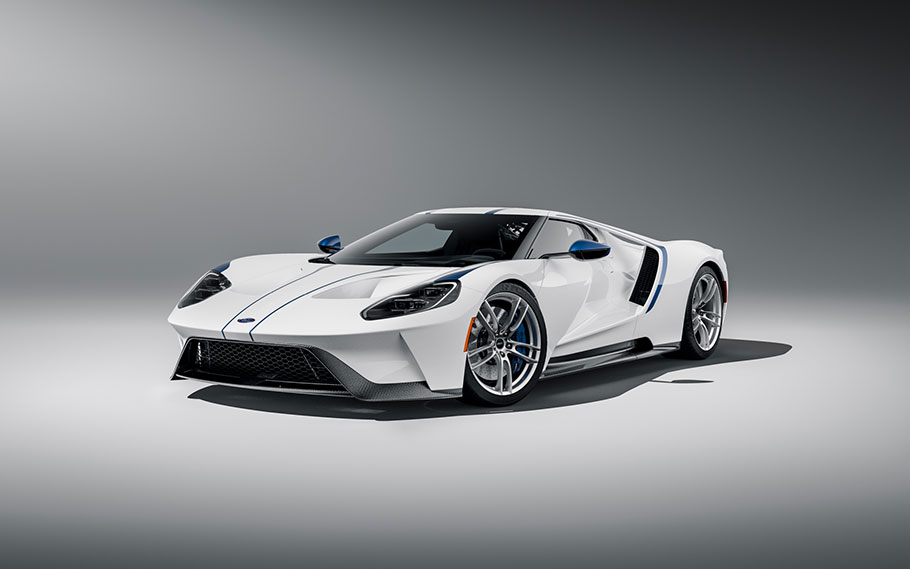





 2019 Ford GT Heritage Edition honors the iconic American Gulf Oil-sponsor Ford GT40 by showcasing a pretty notable color scheme, along with additional exclusive features and goodies. Famous among enthusiasts as Chassis No. 1075, the 1968 GT was one of the few vehicles that has achieved repeat victories at the 24 Hours of Le Mans event.


 Traveling across Europe with a car can be very exciting and a proof for that is the special video series recently released by Ford and BP/Castrol. Dubbed under the name “Europe’s Greatest Driving Roads”, the footages explore six of the most exclusive pathways that could be found on the Old Continent.
 Mercedes-AMG GT and GT S, oh, who doesn’t love these? Especially when it comes to high-speed and style the models are among the most preferred, not only for a stock purchase but also by tuning companies, which love to play with these little masters. One of those customization specialists are those at Sportservice Lorinser, who know what they are doing when it comes to refining Mercedes-Benz models. With their newly produced components for the AMG GT and GT S, these guys are “killing it”!


 The carbon-fiber-bodied Ford GT will be available with an optional all-new carbon-fiber wheels for further weight reduction and handling optimization. With collaborating partner Carbon Revolution, Ford presents the next-gen of fiber and resin technology that will probably change the world of technology.


 Revealed more than a year ago, the new Ford GT has caught the interest of many people around the world. The evidence is that more than 200,000 fans have visited the official virtual configurator and have built the Ford GT of their dreams. From this number of people, around 10,800 showed interest online in buying the new EcoBoost-powered carbon-infused supercar. The result is the following: Ford received 6,506 fully completed applications from people around the world in one month during the first application window.


 Vauxhall revealed GT Concept’s interior with the idea to showcase the innovative technologies and futuristic design of the cabin. And ahead of vehicle’s global debut at 2016 Geneva Motor Show, the team made a glimpse of what is to be the Human Machine Interface. This is a special system that allows sports cars to be completely operated by voice only and a central touch pad. Sounds cool, but is it really practical?


