Tag: Ford

  • Measuring Powers: 2015 Ford Mustang GT vs 2015 Chevrolet Camaro SS

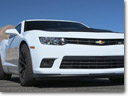
    Attention please! Let me present to you the clash of the titans; the battle of the 2015 Muscle Cars; the wrath of engines; the power-measuring between 2015 Chevrolet Camaro SS 1LE and 2015 Ford Mustang GT! This is not a movie. This is the ultimate rivalry and desire for supremacy.

    The rivalry between Ford Mustang and Chevrolet Camaro is perhaps older than the Universe. Ok, not that old but slightly older than our plant. Well, maybe I exaggerated a bit too much but the important thing is that you got the point. Nevertheless, with the modern-day enhancements the two vehicles have never been functioning better than now. Both the 2015 Camaro SS and the recent 2015 Mustang GT pull out more than 420 HP and have 6-speed manual transmissions. But which one is the winner of this race? (I’m not going to spoil it for you right away and say it is the 2015 Camaro… Oops. I just did it.)

    When you put the Camaro and the Mustang side by side it is probably more than just obvious enough to spot who is going to be the wolf and who is going to be the sheep. Or is it…? Exceeding in almost every feature and characteristics, 2015 Chevrolet Camaro SS is expected to eat up the 2015 GT. Yet, many of the Ford fans still kept their hopes up for the next generation Mustang was introduced with an independent rear suspension setup that would improve the handling and had a little more horsepower than that of the Camaro.

    httpv://www.youtube.com/watch?v=rTJPDurLEKw

    In order to see if the improvements on the Ford Mustang will help it win, Motor Trend set the two cars through the paces to show which would demonstrate better time.

    In the video we see Carlos Lago who continues to compare the two cars. The first one to be tested is the Ford Mustang GT. Despite the fact that it loses (not really surprising after all), the muscle car shows some spectacular results too. It is slightly faster than the Camaro – and it covers ¼ miles in 12.8 seconds at 112.2 mph while the Chevy accomplishes its ¼ mile in 12.9 seconds at 110.5 mph. Just like the winner, though, the GT braking performance hits 0-60 mph in 4.4 seconds. As for the figure eight, the Camaro beats its opponent with the final result of 24.5 seconds at 0.87g (avg).

    My personal favorite though is the 2015 Chevrolet Camaro. It burns with tight and strong power and it also has really good turning and balance-management at a high speed performance. It is pulling some serious leading characteristics there! Mustang is less track-focused and it lacks the high level of stability that the Chevrolet hits us with. The latter is really kind of what you want and expect out of such car.


    Source: Motor Trend Channel

  • Automotive Technology With Teenagers In Mind

    Car crashes are the number-one killer of teenagers in the United States. Contributing factors include behaviors such as speeding, lack of seat belt use, drinking, and texting. Various manufacturers have addressed this issue with safety technology and the many of the systems they have developed are quite unique. In this article we looked at systems from Ford, GM, Hyundai, and Mercedes-Benz.

    GM’s Family Link is part of OnStar and costs $3.99 a month on top of the OnStar subscription fees. It allows parents to find their teen’s car on a map on their website and receive a text or email as to their whereabouts. Parents can set a time to receive a geo-based alert, which is helpful to verify they arrived at their destination safely.

    Hyundai BlueLink is similar to OnStar in that it keeps track of the vehicle and driver’s safety in an emergency. For $179 a year, you get roadside-assistance features in addition to teen safeguards, such as a speed alert, geo-fencing (restricts where the car can be driven), and curfew alert. This allows parents to set these boundaries on the car and to receive a message when they are overridden.

    The Ford MyKey system became standard on most Ford models in 2010. It allows a parent to program a second vehicle key that holds specific driving restrictions. Here are some of the features offered to parents:

    • Sets off an alarm and won’t allow the radio to go on when a seat belt isn’t fastened
    • Sets a top speed up to 80 mph, with chimes that go off at 45, 55, or 65 mph.
    • Limits audio volume.
    • Set the low-fuel warning at an earlier level, so instead of 50 miles to empty, you can change it to 75 miles.
    • Driving aids such as blind spot, park aid, and traction control cannot be deactivated.

    Mercedes-Benz mbrace2 has similar features as Hyundai’s BlueLink. It adds an interesting feature called Safe Ride that allows the driver to signal they need help getting home, such as if they are intoxicated. The cost for mbrace2 is $280 a year and $20 more for mbrace plus, which adds a geo-fencing, speed alerts, a comprehensive driving journal, and travel assistance.

    The reception to the public to these features by the public has been strong. The fees can sometimes sound expensive for these services, yet in reality, most families would probably use them just for a couple of years. Of course, most parents don’t necessarily buy a new car for their teen, but when sharing a family car (which saves on insurance), teens can benefit from these potentially life-saving services.

    Source: Anthony Buick GMC

  • How Your Car’s Anti-Lock Braking System Works

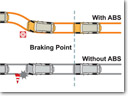
    Before Anti-lock Braking Systems (ABS) were installed on cars, drivers were told to rapidly pump their brakes if they felt a tire start to skid. Today, you don’t need to pump your car’s brakes when skidding, anti-lock braking systems do this for you. In this article, we’ll learn about anti-lock braking systems and how they work.The operational theory starts with the fact that a skidding wheel has less traction than a non-skidding one. The best thing to do when a skid does occur is to slow your engine down and let the tires “grab”. ABS systems do the same thing, they sense when a wheel is skidding during braking and then they pulse the brake automatically to regain traction. This not only allows you to stop in a shorter distance, you’ll be able to regain your steering too. Here are four components we should quickly discuss:1) Speed Sensors – The ABS needs some way of knowing when a wheel is about to lock up. Speed sensors, which are located on each wheel assembly, provide this information.2) Brake Line Valves – There is a valve in the brake line of each brake controlled by the ABS. This electrically-controlled valve controls the brake pressure going to each brake assembly.3) Electric Pump – When a Brake Line Valve reduces the pressure in a brake line, there is an electric pump to bring the restore the pressure.4) ABS Controller – The ABS controller is a small computer. It runs the whole ABS system.The ABS Controller is the brain of the system. It constantly monitors the four wheel speed sensors, looking for speed decelerations in any of the four wheels that are out of the ordinary. The ABS controller knows that rapid deceleration is technically “impossible” under normal driving conditions, so it reduces the brake line pressure to the brake involved until it sees it speed up again. The result: this gives the system maximum braking power. When the ABS system is in operation you will feel a pulsing in the brake pedal; this comes from the rapid opening and closing of the valves.Have you ever wondered what you should do when your car starts to skid? First, do not pump your brakes! The ABS system does this for you. In an emergency stop in a car with ABS, you should just apply your brake pedal firmly and hold it while the ABS does all the work. You will feel a pulsing in the pedal that may be quite noticeable but this is completely normal so don’t let off the brake. When your ABS system is functioning properly, you should have some steering control quickly return so use that to get back on course.

  • Petty’s Garage Ford Mustang to Debut at SEMA Show

    Pettys-Garage-Ford-Mustang-THUMBIn two weeks Ford is bringing performance oriented Mustangs to the halls of the Specialty Equipment Market Association (SEMA) show. Among the modified Mustangs will be the Galpin Auto Sports version, as mentioned earlier today, as well as versions by other tuners such as Roush, Petty’s Garage, MRT and many more. The performance specialists will not only show how they have boosted the 2.3-liter EcoBoost four-cylinder engine sleeping under the hood of the pony car, but also will demonstrate newly developed aftermarket parts which enhance its track handling.

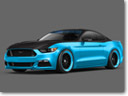
    Petty’s Garage will also be among the featured customizer at the show. It will be bringing a Mustang wearing Richard Petty’s famous blue paint and a discrete No. 43. The secret about this number is that this is Petty’s car number in his NASCAR days. In addition, this car will be equipped with Roush’s supercharged V8 engine.

    Ford has also stated that this particular model will be auctioned by Barrett-Jackson and the proceeds will go to the Victory Junction. The latter is dedicated to helping chronically ill children attend summer camp.

    2015 Ford Mustang features new independent rear suspension and multilink front suspension. They have been both improved by Roush and Steeda. SEMA will also see plenty of 5.0-liter V8s roaring around. The spotlight however will be on the new 2.3-liter EcoBoost four-cylinder engine.

    The unit not only provides an entirely new platform for experienced turbocharging specialists, but also delivers stunning 310 horsepower (228 kW) and 434 Nm (320 lb.-ft.).  Another secret revealed by Ford is that there are several tuners which will be on hand with high-powered versions of the new turbo four-cylinder.

    Source: Ford


  • Galpin Auto Sports Reveals SEMA-bound Ford Mustang

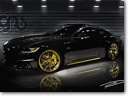
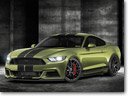
    Galpin-Auto-Sports-Ford-Mustang-THUMBThe SEMA-bound Galpin Auto Sports Ford Mustang is a special vehicle which comes to celebrate the golden anniversary of the production Mustang. The modified pony car features a special gold theme, enhanced engine, custom LEDs and other intricate tweaks. Galpin Auto Sports (GAS) is the tuning arm of the largest Ford dealer in the United States. 2015 GAS Mustang embodies a golden anniversary design philosophy and will be of course premiered at the Specialty Equipment Market Association (SEMA) show.

    At first the tuners gave a facelift to the iconic model via a new front fascia, which was restyled to match the three strakes found in the factory headlights. In details, the new headlights now integrate LED turn signals and turn on in sequence to match the rear turn signals. In addition, there have been also installed a carbon fiber front splitter and rocker panels as well as a more aggressive rear diffuser.

    Under the hood of this Mustang is positioned the Whipple supercharger, which has been custom powder-coated to appear gold.  It sits atop the 5.0-liter Coyote V8 engine. The integrated into the hood glass window has the purpose to show off the engine. More importantly, these modifications are not only a cosmetic change, but also signify a boost in the power output. The engine generates the astounding 725 horsepower (533 kW).

    Next, the car is also equipped with suspension components delivered by Steeda and new exhaust by Magnaflow. GAS also reveal that with this black and gold idea, they wanted to get the color as close to 24-carat gold as possible. Speaking of which, this GAS Mustang will be running on 20-inch wheels finished in gold. In the same color are also the side sills, brake calipers and badging.

    Inside, the same black-gold theme can be found on the entire range of elements which were previously chrome or metallic. Recaro seats are covered with a fabric finished in black and gold, and the headliner is black microsuede. And if you think that the exterior is finished in paint that appears black, then you will be surprised to see that it is actually filled with gold metallic flecks.

    Source: Galpin Auto Sports

  • Ford Reveals Two F-Series SEMA-bound Trucks

    Vaughn-Gittin-Jr-street-truck-THUMB
    Two Ford F-Series trucks are getting readied for the forthcoming SEMA Show. The company has collaborated with SEMA builders in order to produce the radical F-150 trucks. The MY2015 F-150 is the lightest truck ever created by ford and precisely has “lost” 700 pounds. At the same time it is also the toughest and most capable F-150 ever created. In addition, the trucks will be competing for the “Hottest Truck” award at the Specialty Equipment Market Association tradeshow in Las Vegas. Another interesting fact is that the Ford F-Series has won this award in four consecutive year.

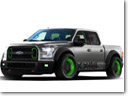
    There will be two custom versions of the 2015 truck displayed. The fist one is the Deegan 38 and the other – Vaughn Gittin Jr. street truck. Deegan 38 is a project which is a result of the joint work of Ford Racing’s Brian Deegan and the F-150. Under the hood of this beast is the 3.5-liter, twin-turbo EcoBoost engine.

    Other industry leaders involved in this project are the Addictive Desert Designs, Mickey Thompson Performance Tires & Wheels, FOX Racing Shox, KC Hilites, Mastercraft Safety, Rockford Fosgate, Full-Race Motorsports, Leading Edge Tuning, ProEFI and SCT Performance. They have joined forces in order to deliver extreme motorsport experience to all enthusiasts with the ultimate example of this truck.

    Vaughn Gittin Jr. street truck can show-off with 12 inches of King shock-controlled travel via a Kibbetech custom suspension. This second truck is a purpose-built F-150 under the guidance of Formula DRIFT superstar Vaughn Gittin Jr.

    He has taken advantage of the weight savings and serious torque offered by the engine. The vehicle has aggressive stance and features Air Lift Performance air ride. Also disclosed around this project is that the seats of the truck will be Recaro.

    Source: Ford


  • Vortech Superchargers Makes a mightier 2015 Ford Mustang

    2015-Ford-Mustang-by-Vortech-Superchargers-THUMBVortech Superchargers has released an upgrade for 2015 Ford Mustang. The tuning specialists have developed a special Vortech V-3 Si centrifugal supercharger, which is capable of supporting up to 775 horsepower (570 kW). Their 78% isentropic efficient compressor deliver cooler running, denser air, and reduced parasitic drive losses. In addition, it also eliminates “nose-over” top end power loss.

    To create advanced centrifugal compressor stages, Vortech has utilized a range of design and analytical software tools. Performance quantification and the development happens with the help of the ab SAE J1723 compliant test cell, which has enabled the customizers to fine tune each compressor stage and create compressor maps. The latter are then used for application matching.

    If one considers 775 horsepower not enough, then Vortech said that its systems are upgradeable. To go into details, the V-3 for this Ford model includes a self-contained lubrication system with internal oil reservoir as well as a remote fluid drain hose (attached to supercharger) that allows for simple fluid changes without removing the supercharger from the vehicle.

    The improvement of the fuel system features high-capacity fuel injectors, and custom Vortech tune that controls ignition timing and fuel enrichment. Furthermore, the integrated oversized air/air charge cooler configuration is what delivers additional horsepower gains, meaning more than 900 hp!

    Source: Vortech Superchargers


  • Roush Reveals Custom 2015 Ford Mustang RS Lineup

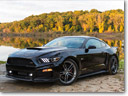
    2015-Roush-Ford-Mustang-Lineup-THUMBRoush Performance is famous for its customization projects involving muscle cars. Under the lights toady is Roush’s latest freshly redesigned Ford Mustang. The aggressive 2015 RS lineup will be built on the Mustang’s V6 platform. The first Stage will feature the new turbo-charged Ford 2.3L Eco-Boost motor, while the second – the naturally aspirated 5.0L V8. All of the modified Mustangs will get the R7, or the seventh generation aero-body package.

    To go further into details, the R7 kit comprises of an entirely remodeled fascia with integrated aero-pockets, a five-blade upper grille, high-flow lower grille with driving lamps, and a front chin splitter. Along with the aggressive new look, the Stage 1 and Stage 2 get the new ROUSH quad-tip performance exhaust system.

    There are also available suspension setups that deliver handling boost as well as new Quicksilver 20-inch Roush wheels. They were wrapped in the Roush/Cooper RS3-S ultra high-performance tires.

    Inside, the vehicle was also modified. The cabin now includes Roush embroidered floor mats and a serialized dash badge. There is an optional gauge cluster and leather seating upgrades. There will be also offered several exterior and interior options, including side quarter window scoops, body side scoop, hood scoop and more.

    The Mustangs will first be available in manual coupes. Later, the convertible chassis and automatic transmissions will follow. 2015 Roush Ford Mustang Lineup is expected to be available at dealerships in mid October.

    Source: Roush 

  • Hennessey Supercharges 2015 Ford Mustang GT with 717 HP

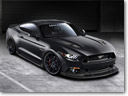
    2015-Hennessey-Ford-Mustang-GT-THUMBHennessey Performance has made an HPE700 Supercharged Upgrade for the 2015 Ford Mustang GT 5.0L V8. Only 500 units will be built for the model year 2015, making the vehicle a limited Edition. What is more, thanks to the refinement, the Mustang is now capable of delivering 717 horsepower, meaning that it can finally battle Chevy’s Corvette Z06 and Dodge’s SRT Hellcat. In fact, with this project, the tuners are offering a 2015 Mustang that will outperform some of the fastest cars currently offered, but at a lower price point.

    Key to that 717 hp (527 kW) and the 856 Nm (632 lb-ft) of torque at 4400 rpm is the Roots-type high-helix supercharger packing 7.25 psi of boost. Helping the V8 breathe more deeply is a high-flow throttle body and stainless-steel exhaust system. Upgraded injectors and fuel pump feed the V8, managed by Hennessey’s proprietary engine management calibration.

    The increase in horsepower also results in astonishing acceleration time, which in this case in only 3.6 seconds for the sprint from 0 to 60 mph. The tuning company is also offering for this Ford model customization options such as CarbonAero carbon-fiber bodywork that includes front splitter, side sills, rear diffuser and rear lip spoiler. There are also available 20-in. Hennessey H10 wheels shod with Michelin Pilot Super Sport 2 tires and a Brembo brake package with 15.1-in front rotors.

    2015 Hennessey Ford Mustang GT has a pricing which starts at $59,500 USD.

    Power

    • 717 bhp @ 6,600 rpm
    • 632 lb-ft torque @ 4,400 rpm

    Performance
    • 0-60 mph: 3.6 sec.
    • ¼ mile: 11.2 @ 131 mph

    HPE700 Supercharged 5.0L V8 Engine Upgrade
    • 2.9 Liter Supercharger System
    • Throttle Body Upgrade
    • HPE Air Induction System
    • Upgraded Fuel Injectors
    • Upgraded Fuel Pump
    • All Necessary Gaskets & Fluids
    • Professional Installation
    • HPE Engine Management Calibration
    • Dyno Tuning & Road Testing
    • Hennessey Exterior Badging
    • HPE700 Exterior Badging
    • Supercharged Exterior Badging
    • Hennessey Premium Floormats
    • Serial-Numbered Dash & Engine Plaques
    • 3 Year / 36,000 Mile Limited Warranty

    Additional Upgrades
    • CarbonAero Carbon Fiber Bodywork
    • CarbonAero Front Splitter
    • CarbonAero Side Sills
    • CarbonAero Rear Diffuser
    • CarbonAero Rear Lip Spoiler
    • Stainless Steel Exhaust System Upgrade

    Wheels & Tires
    • Hennessey H10 Lightweight 20-inch wheels
    • Michelin Pilot Super Sport 2 tires

    Source: Hennessey

  • The 1970 Ford Mustang Boss 302 – raw power for all car enthusiasts

    1970-Ford-Mustang-front_thumb1970-Ford-Mustang-front_651

    If you look back in time you will easily discover a number of popular, even iconic muscle cars. Today many of them still serve their owners and each one of them has a story to tell. But did you know that there are muscle cars, situated on top of muscle cars? That is, they are improved versions? Like the 1970 Ford Mustang Boss 302 that’s an enhanced version of the regular Ford Mustang of that age? Don’t worry if you failed this little test – now we are going to tell you something more about this great car.

    Just like many cars in its class the 1970 Ford Mustang Boss 302 has a story to tell and it’s a long and interesting one. Designed to compete in SCAA’s Trans-Am series, the 1970 Ford Mustang Boss 302 carries strength and adrenaline in its veins right from the start. The car is an improved, more powerful version of the standard Ford Mustang of that time period and it even features a few more upgrades compared to the 1969 Ford Mustang Boss 302, which was the first model ever produced. Despite all the years that have passed by the importance and popularity of the car are still here as the Ford Mustang Boss 302 was once more produced as a modernized model in the years 2012 and 2013.

    But what makes the 1970 Ford Mustang Boss 302 such an icon? The answer is simple: everything! The car is a powerful animal even for today’s standards and do we need to tell you how valued it is nowadays? Built in limited numbers 40 years ago the vehicle is a hotly contested item if you happen to see it somewhere for sale and highly valued by collectors who keep one such Mustang here and there. The improvements featured in the 1970 year model add some spice to the picture too. The car is powered by a 4.9-liter V8 gasoline engine that outputs 290 HP (213 kW) and 290 lb-ft (393 Nm) of torque; the same engine is found in the year 1969 model. But like we said, the 1970 Ford Mustang Boss 302 has been touched here and there. For example the car comes with a diameter reduction of the intake valve from 2.23 inches (5.66 cm) to 2.19 inches (5.56 cm), which increases low-end torque for slightly better initial acceleration. Another change from the year 1969 model is that there is an increase in the engine compression ratio too – from 10.5:1 to 10.6:1. The most important change regards the water pump – it is moved to the driver’s side, which also means changes in the radiator and the plumbing. The pump features 0.75-inch ball bearings to improve durability and a ceramic-faced impeller seal. The rest of the engine changes include an updated pulleys system, new accessory brackets, a new vibration damper and more. What’s even better is that even nowadays, more than 40 years after the debut of the 1970 Ford Mustang Boss 302, there are engine parts everywhere so fixing the engine in case of need should not be a problem.

    1970-Ford-Mustang-rear_651

    An engine is nothing without a transmission so here it is – the 1970 Ford Mustang Boss 302 features a 4-speed Toploader manual transmission but don’t hope to find one with an automatic gearbox as it was never offered even as an option. To make things a bit more interesting Ford offered the manual transmission in two versions – with wide-ratio or with close-ratio; both are easy to identify by code – close-ratio is code 6, while wide-ratio is code 5. Both of them offer a Hurst T-handle shifter. The transmission is said to be very durable as with time passing by it became the basis for today’s NASCAR Jerico transmissions. Even if you encounter problems, you can easily rebuild it – parts are plentiful and a master repair kit costs only around USD 140.

    A powerful engine needs powerful brakes or otherwise how will you stop? Well, the 1970 Ford Mustang Boss 302 provides them. The car has power front vented discs that are strong enough to stop the car that weighs 3200 pounds (1453 kilograms) from 60 mph (97 km/h) to zero in just 112 feet (34 meters). You’d better wear a seat belt or you’ll fly through the windshield if you attempt this somewhere! The rear brakes are cast-iron drums – an industry standard. Just like all other car systems that we have mentioned so far, the brakes can be easily serviced – you can find pads, new drums and cylinders for much less than USD 100. In addition to that you can find rear brake disks in aftermarket shops.

    We can’t continue the description of this great car if we don’t say a few words about its chassis and interior. The chassis of the 1970 Ford Mustang Boss 302 is also a bit upgraded thanks to its Trans-Am origin. The car features “competition” suspension that consists of an independent front, tube shocks, coil springs rated at 320 lbs/inch and an anti-roll bar. There are rear leaf springs and staggered tube shocks that handle the rear load and an anti-roll bar that is not included in the year 1969 model. Unfortunately the 1970 Ford Mustang Boss 302 does not come with power steering as standard; available as an option it does not require much else than standard maintenance.

    1970-Ford-Mustang-inside_651

    The description of this great and iconic car will not be complete if we do not say a word about what you will find inside the car. The 1970 Ford Mustang Boss 302 is a muscle car but it knows how to be gentle and that’s why it treats you with a comfortable interior. Colored in black as standard the interior offers high-back, vinyl-clad bucket seats and instrument gauges that fit the 1970 Ford Mustang Boss 302 as a muscle car. The only things that are missing are the full-length console and the tach and trip odometers but they were offered as options back in the day. If you are lucky enough you will be able to choose among different colors for the full-length console too. On the outside you will find faux vents that underline the racy front end, reflective back stripes that come out of hood stripes at the aft edge, Boss 302 decals and other similar goodies. After all a muscle car does have to look like a muscle car, right?

    The 1970 Ford Mustang Boss 302 does look and feel great, doesn’t it? Unfortunately like with everything else we have to go back to real life. Only 6318 such Mustangs were produced decades ago and as you can imagine they are hard to find nowadays. Even if you encounter one of them prepare to spend between USD 46,500 and USD 105,500 on the car depending on its condition and looks. This is not cheap but at the same time the car is worth it. You not only get a muscle car, you get a living icon. If the 1970 Ford Mustang Boss 302 is your dream, then go for it – after all dreams exist to get fulfilled, don’t you think?
  • Three 2015 Ford Mustangs.99 Challenge

    2015-Ford-Mustang-t2015-Ford-Mustang-651

    Here are the newest three Ford Mustangs equipped with genuine racing parts, being tested by the crew at Milan Dragway and US 131 Dragway. Ford sets for itself three goals to achieve with these three new models. In the world of Mustang performance whenever there’s a major change: be it platform or new engine, there is always someone who wants to be the first. The first supercharged V8 2015 models are put to the test with all their new additions and modifications. Here are exact specifications of the three models:

    The new 2.3-liter Ecoboost modifications come with ford racing performance parts, including: Ford racing development engine calibration, drive shaft safety loops Protoype off-road exhaust and performance rear subframe kit. 12.56 seconds E.T., 109 mph (175 km/p)

    The 5.0-liter naturally aspirated GT modifications: Performance rear subframe kit, heavy duty half-shaft kit, Prototype off-road exhaust, drive shaft safety loops, ford racing development engine calibration 11.77 second E.T., 116 mph (186 km/p)

    5.0-liter Supercharged GT main and unique modification: Ford Racing/ROUSH Performance supercharger kit. 10.97 second E.T., 128 mph (206 km/h)

    httpv://www.youtube.com/watch?v=Kulx2AfNZuY#t=220

    Source: Ford

  • Ford Mustang 50 Year Limited Edition Sold for $170,000 at Barrett-Jackson

    Ford-Mustang-GT-50-Year-Limited-Edition-THUMBThe last production Ford Mustang GT 50 Year Limited Edition model with the badge No. 1,964 has been fetched $170,000 USD at the Barrett-Jackson Las Vegas auction. The proceeds will benefit “Get Your Heart Racing” fundraising event that supports Henry Ford Health System’s Edith and Benson Ford Heart & Vascular Institute.

    The winner of the bidding is Jack Fairchild. He is not only the proud owner of one of the rarest of this limited stock, but we must highlight that he has also made an important contribution to the health and well-being of individuals across the United States.

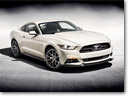
    This limited edition Mustang is based on the 2015 Mustang GT fastback but includes a performance package. 50 Years Limited Edition delivers outstanding performance and unique appearance.

    It is driven by the upgraded 5.0-liter V8 engine, which produces 420 horsepower (310 kW) and 530 Nm (390 lb.-ft.) f torque. Every 50 Year Limited Edition will be equipped with the Mustang GT performance pack, which includes six-piston Brembo front brakes and 19-inch alloy wheels fitted with high-performance Y-speed-rated Pirelli P-Zero summer tires.

    Inside, there is a distinctive aluminum trim panel that spans the double-brow instrument panel and gets an axel spin finish. A special serialized 50 Year Limited Edition badge on the passenger side adds also to the uniqueness of the model. This limited-edition Mustang is the only model with a cashmere-stitched, leather-wrapped steering wheel. The same stitching is also applied on the instrument panel, shifter boot, center armrest, door inserts and seats.

    Ford and Barrett-Jackson have raised more than $6 million US dollars at various auctions benefiting local and national charities.

    Source: Ford