Tag: Concept

  • Volkswagen Atlas Basecamp Camping Concept

    Featuring rugged Basecamp® styling components and a custom graphics package, the Atlas Basecamp Camping concept makes the outdoors more accessible. To get you where you want to go, the concept—based on a 2022 Volkswagen Atlas SEL VR6 3.6L 4Motion—adds an H&R® raised suspension, utilizing Street Performance Adventure Lift coilovers and TRAK+® wheel spacers. Custom floodlights and 17-inch fifteen52® Traverse MX wheels in Frosted Graphite are wrapped in 245/70R17 all-terrain tires to add an aggressive look to match the off-road styling of the Atlas concept.

    To increase the versatility of the Atlas, the concept has a Volkswagen Accessories cross bar and Thule® Basket & Side Awning, as well as a prototype 2-in-1 Air Pump by NSV incorporated in the trunk area to inflate a camping mattress or sporting equipment. Other Volkswagen Accessories on the concept include the Full Display Mirror®, security console safe by Tuffy® Security Products, tablet holder, Muddybuddy® floor liners, roadside assistance and first aid kit, Bumperdillo® protection plate, and hood deflector. The Atlas Basecamp Camping concept is shown with an air mattress, camping lights, and a fire extinguisher.

  • Mitsubishi XFC Concept

    Mitsubishi Motors Corporation (hereafter, Mitsubishi Motors) today held the world premiere of the Mitsubishi XFC Concept, a compact SUV concept car, in Ho Chi Minh City, Vietnam. The car will be on display at Vietnam Motor Show 2022 to be held from October 26 to 30.

    With the concept of being the “best-suited buddy for an exciting life,” the Mitsubishi XFC Concept is a next-generation compact SUV that offers the powerful and imposing design of an SUV, utility such as ease of handling and an ample cargo space, comfort including a class-leading interior space, and safe, secure road handling even on rough surfaces or roads flooded by heavy rains.

    “We will launch the new compact SUV sequentially in the ASEAN markets including Vietnam in fiscal year 2023*,” said Takao Kato, president and chief executive officer, Mitsubishi Motors. “In the future, we plan to add an electrified variant to the lineup and to also roll it out in regions outside ASEAN. We hope to grow the model from a vehicle for the ASEAN market to a global strategic vehicle, making it a core model like the sales-leading Xpander crossover MPV.”

    The Mitsubishi XFC Concept is a compact SUV that is not part of the current ASEAN lineup. It complements Mitsubishi Motors’ wide range of products tailored to the ASEAN market — the Triton pickup truck and its derivative, the Pajero Sport midsize SUV; the Outlander and Outlander PHEV midsize SUVs; the Xpander and Xpander Cross crossover MPVs; and the Mirage compact hatchback and its variant, the Attrage sedan.

    Powerful and imposing design

    In line with Mitsubishi Motors’ design philosophy of Robust & Ingenious, the Mitsubishi XFC Concept combines a compact yet powerful and imposing aura of an SUV with a sleek surface that forms one continuous flow, starting from the three-diamond emblem on the front and extending to the sides and rear. This gives it a stylish and sporty profile to match the cityscapes of the ASEAN region. In addition, with enhanced road handling on rough surfaces thanks to ample ground clearance and large-diameter wheels, the Mitsubishi XFC Concept expresses both toughness and agility while featuring an authentic SUV styling that stands out in outdoor scenes.

    At the front, the Dynamic Shield concept, which expresses both performance and protection, has evolved in line with the concept. The L-shaped headlight in the headlight unit’s upper portion combines with the louver-like daytime running lights (DRL) below to light up in an iconic T-shape, which shows a sense of broadness. The sides of the body are composed of rich, muscular surfaces, with sculpted front and rear fender flares and character lines expressing the power and dynamism of an SUV. Like the front, the rear also features T-shaped tail lights to create a rear styling that accentuates wideness and stability.

    The interior offers ease of operation and comfortableness, which are essential for an SUV. For the instrument panel, a horizontally themed design is adopted, making it easier to sense changes in the vehicle’s posture when driving on rough surfaces while also improving forward visibility. Meanwhile, the dynamic design extending from the instrument panel to the door trim, along with a series of soft padding, give a sense of enclosure and protection to create a secure and comfortable interior.

    Utility provided by ease of handling and ample cargo space

    The Mitsubishi XFC Concept is designed for ease of operation, providing good forward visibility, easy perception of the vehicle’s dimensions, and smooth handling. The instrument panel features a large display panel integrating a full digital driver display and a center display that can show three separate information such as navigation, road surface conditions, and other information necessary for driving on one screen to provide a safe and comfortable driving environment while also expressing a sense of advanced design. Despite its compact body size, the Mitsubishi XFC Concept is also designed for utility with ample cargo space.

    Comfort provided by class-leading interior space

    Although it is a compact SUV, the Mitsubishi XFC Concept comes with spacious cabin area. In particular, with its generous legroom in the rear seats, it offers top-level comfort in its class. Moreover, everyone on board can feel safe and reassured, with vehicle stability control in slippery road conditions and high-quality ride comfort.

    Safe and reliable driving on rough and flooded roads

    With plenty of ground clearance and four drive modes — Normal, Wet, Gravel and Mud — the Mitsubishi XFC Concept offers a fun, safe and secure ride in various weather and road conditions. The Wet mode, introduced for the first time in a Mitsubishi vehicle, is designed with use in ASEAN countries in mind, such as enabling safe driving even on roads flooded by sudden showers.

  • Jeep Avenger 4×4 Concept

    At the Paris Motor Show today the Jeep® brand provided an extra thrill and surprise for its global audience by revealing the Jeep Avenger 4×4 Concept.

    Announcing the 4×4 Concept at the finale of the Jeep brand press conference, Christian Meunier, Jeep brand CEO, said: “The Avenger has been designed as a Jeep vehicle from the outset, and the all-electric 4×2 model already offers some of the best-in-class capabilities that identify the Jeep brand.”

    “But we couldn’t help but wonder, what would happen if we injected the Jeep brand’s four-wheel drive electrified capabilities into a compact package, while retaining the brand’s unique design language, capability and personality?” he added as the Jeep Avenger 4×4 Concept was introduced.

    Exemplifying the ‘concentrated freedom’ ethos of the new Jeep Avenger, the 4×4 Concept blends, design, capability and innovation in a compact body. Eye-catching, fun, and distinctive, the new arrival will be added to Jeep’s range of 4xe models coming in the future.

    Externally, the 4×4 Concept features tow hooks, wider bumpers and track, and is equipped with larger, exposed and more aggressive tyres. To further enhance the capability of the Jeep Avenger, the approach angle has been improved to 21 degrees, departure angle to 34 degrees and breakover angle to 20 degrees, thanks to the ground clearance which now exceeds 200mm.

    The front end has additional protection, with thicker cladding and there are extra built-in flood lights to improve visibility when driving at night.

    The Avenger 4×4 Concept displays a new lightweight roof cargo system concept that, with a special belt system, compresses the luggage on the roof and has scratch-proof protection along its entire length. The whole package is completed by an anti-reflective bonnet sticker and anti-scratch grille treatment for additional peace of mind when driving off-road.

    The Avenger 4×4 Concept represents the ultimate expression of Jeep’s legendary capability, which has been enhanced by electrification, a combination that means customers can benefit from even more off-road capability, more fun and more freedom while driving in almost total silence.

    Concluding the unveiling, Meunier said: “Here in Paris, we have shown that we have a full portfolio of new all-electric 4×4 capable Jeep models just around the corner, with a clear goal in mind: to become the number one electrified SUV brand in the world as we continue our path towards achieving our mission of Zero Emission Freedom.”

    The full-electric Avenger joins a portfolio of Jeep vehicles which are 100 percent electrified in continental Europe.

  • Renault 4Ever Trophy Concept

    The Renault 4 is much more than a car: it is a true icon. With over 8 million units sold in more than 100 countries, it has been crossing generational and social gaps for the past 60 years. It is as comfortable in cities as far out in the countryside, and multipurpose – you can drive it to work and on long journeys, use it to carry loads, and a lot more.

    It is unpretentious yet in, chic yet a car for everyone, and appeals to men and women alike.

    Production was discontinued 30 years ago but the 4L has never left the limelight. It is one of the original young-timer vintage cars and the past 25 years have seen the 4L Trophy prove time and again its worth as a versatile car built to last. This explains why it is still a crowd pleaser, especially with the younger generations.

    The 4EVER Trophy show car that Renault is unveiling at the 2022 Paris Motor Show is its second iconic model to get an electric reboot, following Renault 5 Prototype, during the Renaulution. Renault, in other words, is tapping into its illustrious past to better electrify its future.

    A MODERN TWIST AND A LOT OF DARING

    The Renault 4EVER Trophy show car creates new memories while bringing back old ones. Under a muscular exterior, the stylistic ties to its 4L predecessor are evident. The original car’s main features have been revived:

    • The silhouette with the prominent bonnet, bumper, and hallmark angled rear section, are readily recognisable
    • The rear, trapezoidal side windows with their rounded corners are located just above the rear wheels
    • The front flanks have been left bare (no lights or stylish markers)
    • The wings sit atop the wheel arches and reach through to the shield

    The retro style blends harmoniously with the rest of the otherwise sophisticated and technological lines.

    The show car has generous curves and a very elaborate grille. The ‘ultra tech’ connections between the spokes and bodywork bring an added layer of precision and modernity. The same can be said for the meticulously honed rim around the roof.

    “The 4L is a legend. And legends never die! Today, it is this universal dimension of the 4L, a car that everyone can love, that we want to find through a modern and electric reinterpretation of the Renault 4.”
    Luca de Meo, Chief Executive Officer of RENAULT S.A

    “To bring 4EVER Trophy into the modern era, we have infused its streamlined shape with technological sophistication. All these ingredients have been carefully crafted so that the design resonates with those who are familiar with the 4L and its illustrious history, and with younger generations.”
    Gilles Vidal, VP, Renault Brand, Design

    A UNIQUE LIGHT SIGNATURE

    4EVER Trophy puts a new twist on the Renault 4’s iconic wide horizontal grille featuring the round, built-in lamps, now with Matrix LED lights. The innovative lights give the vehicle a strong identity. While the recognisable pill-shaped rear lights have also been entirely redesigned, they remain readily recognisable and are a clear nod to the iconic 4L. 

    A LIGHTWEIGHT OFF-ROADER EAGER TO EXPLORE

    An electric vehicle that ventures off the beaten track: that is what the rugged 4EVER Trophy show car conveys at first glance. The electric motor reflects the future production model.

    The low section on 4EVER Trophy, painted Gun Metal Silver, has been designed for the great outdoors. An open invitation to explore new horizons, this show car exudes a clearly adventurous spirit. It has a certain flair to its look with the silver coat, and magenta highlights on the roof straps, suspension springs and wheel emblems.
    The dune-buggy vibe gives 4EVER Trophy a competitive look. The hollowed-out bonnet has a huge air exhaust that vastly improves the efficacy of the radiator located in the centre of the shield. The front overhang has been shortened considerably for a greater clearance capacity.

    With a spare tyre located on the carbon fibre roof, and a shovel and waffle boards on the upper section of the rear door, the car is ready to tackle any situation.

    The vast body protection panels on the lower section are made with a considerable 20 cm clearance around the wheel arches. The high-seated body highlights the width of the 753 mm wheels mounted on 19 inch rims. The underbelly has been reinforced to provide greater protection for the battery located in the middle of the chassis.

    Each wheel on 4EVER Trophy has a visible compressor that can be readily adjusted from inside the car to adapt the tyre pressure to suit the terrain.

    While 4EVER Trophy is clearly an off-road car by nature, it was also designed to be enjoyed on any road, fuss-free. The future electric 4L aims to be as versatile as its predecessor once was – or rather has always been since 1962.

    A FUTURE B SEGMENT SUV

    The 4EVER Trophy show car paves the way for the future all-electric B Segment SUV that will be at ease on urban and rural roads alike.

    Like the Renault 5, it will be made using the new CMF-BEV platform for B segment electric vehicles. The platform will guarantee the best performance in terms of range, acoustics, and on-road behaviour, without compromising on the design.
    The market positioning of the future Renault 5 and Renault 4 will be much like that of Clio and Captur. The 4EVER Trophy and Renault 5 Prototype on display at the Renault stand during the Paris Motor Show embody Renault’s nouvelle vague.

    Like its predecessor, the future vehicle built off 4EVER Trophy’s design will be made in France. Thanks to their shared traits, all vehicles using the CMF-BEV platform will be built in the ElectriCity hub in northern France.

    TECHNICAL SPECS RENAULT 4EVER TROPHY

    Length: 4,160 mm
    Width: 1,950 mm
    Height: 1,900 mm
    Wheelbase: 2,570 mm
    Front and rear tyres: 255/55R19
    Powertrain:  full-electric, wound rotor
  • Alpine Alpenglow Concept

    This is what motor sports needs to look like tomorrow: as sensational as ever – and ever cleaner. Alpenglow represents Alpine’s reboot. It is ushering in a new age revolving around a solid commitment to entrenching sustainable development in the motor-sports landscape. Its design captures the spirit of competition that has inspired it since 1955. The power it radiates when it darts by is comet-like; the effect is awe-inspiring, titillating and verging on the artistic. This is the Alpine brand’s overarching goal: sustainable sportiness, combining clean emissions (including hydrogen) in roadgoing and racing line- ups with a design where the driver can fuse with the cockpit. The future starts here!

    An alchemy of natural elements

    The alchemy between Alpine and the longing for a cleaner future is undeniable. Alpenglow stands for a future where racing cars as well as the upcoming generations of Alpine products release clean emissions. “Green” hydrogen is one of the solutions that the brand is considering for sustainable mobility. A hydrogen-powered engine releases practically nothing but steam during combustion. Water, in other words, is central in Alpenglow’s design. It underlines its purity and its power.

    The colours and materials are also evocative of what the Alpine cars of the future will look like: emotion and technology intertwining to treat drivers to a one-of-a-kind, real experience. Natural elements and states – such as fire, water, ice, wind and steam – inspire this object’s impressive, generous shapes, its flowing, streamlined body, and the all-round feeling of purity. It is designed as an agile and elegant car that is just as comfortable on roads as it is on tracks.

    Motor-sports competition, which steeps the brand’s history, was the compass throughout Alpenglow’s creation. Its bodyshell resembles a wingsuit, pointing to the most extreme of mountain sports. Two triangles interlock, forming a singular shape to spark extraordinary sensations.

    An avant-garde name announcing the morrow

    Alpenglow is a perfect name. The reddish glow over the mountains just before sunrise is a symbol for this concept car: it is a magnificent moment, the dawn of revolutionary technologies and shapes, and the brand is lifting the veil on the next phase, which will usher in the Alpine cars of the future.

    INSPIRING DESIGN, COMBINING EMOTIONS AND SUSTAINABLE SPORTINESS

    In this single-seater, the driver sits on the centre line, between two hydrogen tanks, and becomes one with the cockpit. This is the idea at the core of the Alpenglow concept car, which captures the very essence of driving, the emotion that sitting in a futuristic Alpine sparks, a full immersion in unspoilt, technical and technological features.

    The inside and outside in symbiosis

    This concept car’s interior and exterior meld. The bodyshell is light and seems to float, enveloping the driver who fuses with their material surroundings. The driver’s silhouette leaves a mark in the cockpit, a bit like someone who falls back into the slow to leave their print. The two “pontoon” waterdrop-shaped tanks on either side of the cockpit add the feeling of being at one with the machinery and at the same time optimise driving comfort. The car becomes a source of pleasure and a vessel for physical engagement. The vehicle triggers emotions and bewitches the driver in ways they will never forget. This driving experience will be developed inside future Alpine models.

    A competition-inspired cockpit

    A sports car inspired by motor sports races, plus a singular, sophisticated silhouette: that is Alpine’s promise. The Alpenglow concept car’s cockpit is transparent, has a blueish hint and is helmet- shaped. You can make out the driver through it, but it merges into the car’s body.

    An Alpine driving wheel

    The Alpenglow concept car’s geometric steering wheel is inspired by LMP1 (Endurance) racing cars. It treats the driver to a sporty, high-performance driving experience. The Alpine identity shines through the snowflakes embedded in a central prism, with the logo in the background, which calls to mind the Alpine, mountainous universe that defines this creative, mysterious object. The paddle gear shifters are transparent and backlit, adding to the weightlessness in the lean interior, where only the experience matters. The base of the steering wheel also houses two selectors for the various built-in functions, which mirror the ones in Formula 1 and LMP1 cars. In the concept car, they control several features including Track Control and Regenerative Braking. The steering wheel also has an Overtake button unleashing a power boost. The driver has a prism-shaped ignition key that slots into the steering wheel. It completes the pyramid in the centre, which lights up as the car springs to life.

    A red centre line

    A red line cuts across the car lengthways. It underlines the driver’s position, at one with the car, in a central, exclusive place that connects them to the road and their surroundings.

    Alpine’s new signature lights

    Alpenglow’s signature lights have evolved and adopted a new look. They match with the ones on Alpine cars today, stand out on the strength of their up-to-the-minute style and might, and at the same time remain true to the brand’s identity. They are ushering in a new chapter in Alpine’s history, where passion for speed and performance are more alive than ever. The light stream starts at the front, where it is red, symbolising a comet entering the atmosphere, and works its way back, where it turns various shades of blue pointing to its hydrogen internal-combustion engine, which releases practically nothing but steam. Also at the front, triangles of light form a sprinkling of stars rising from the four headlamps, mirroring Alpine’s emblematic signature. Overall, they create an all-round impression of movement across the car’s body. The blueish lights at the rear point to the use of hydrogen. They are open, look stunning and serve a purpose, venting the steam from the hydrogen’s combustion. In contact with the air, a blue stream emerges from the clean exhaust pipes, giving the Alpenglow concept car a sporty and at the same time magical aura.

    Rims that radiate Alpine’s identity

    The snowflake-shaped rims on the wheels have a transparent structure and also capture something about Alpine’s identity. They transport us to the mountains. The triangle built into the centre of the wheels underscores this impression. Like the triangles in the steering wheel, the ones on the wheels contain hydrogen and have a built-in window into the Alpine logo, to attract attention to the brand’s singular signature.

    A transparent, high-tech spoiler

    This concept car’s spoiler is completely transparent, which effaces it and the purpose it serves. Besides being very light, it plays an essential role: as it moves, it reduces drag and increases downforce.

    Generous shapes and opposing surfaces

    Designed around technical and aerodynamic components, this concept cars embodies a one-of-a-kind philosophy, where form derives from function. Its silhouette was shaped around two hydrogen tanks, which envelop the body and point to Alpenglow’s sheer might.

    The Alpenglow concept car’s shape optimises air flow and thereby increases aerodynamic performance. The moving surfaces, sculpted by the air, range from positive to negative, in the form of a twist. The front with the distinctive V-shape is the starting point for the red line. On the side, another line also adding character forms an air inlet and creates an aerodynamic tunnel. This concept car is cast for competition: the extremely long and slender wings are a nod to the endurance A220 from the late 1960s, which reached the ultimate heights of aerodynamics. The two tanks enhance the sides with generous, sensual contours that blend seamlessly into Alpenglow’s chiselled design.

    This concept car is more than 5 metres long, over 2 metres wide and less than 1 metre high – a dream car’s proportions. It is exceedingly agile and its sculpted shapes encapsulate Alpine’s future design language.

    A concept around materials that triggers sensations

    Alpenglow works its magic when you approach it. The choice of colours and materials was inspired by natural elements and states, such as fire, water, ice, wind and steam. All those elements move, evolve, change when you are in contact with them. They add movement and life to Alpenglow. The opaque areas become transparent, providing a glimpse of the inner workings. The red zones representing heat are counterpointed by penetrating blue hinting at the cold weather in the Alps. The magic is hidden, and the elements appear and disappear, to unveil this object one detail at a time.

    A new and more sophisticated shade of blue

    The new shade of blue on the Alpenglow concept car’s body stems from Alpine’s iconic blue in motion. This blue is brighter, deeper and has a very fine pearly sheen that creates liquid effects, changing colours and shadows like the surface of a lake or ocean, and adds striking, hefty volume.

    Recycled carbon

    An Alpine is lightweight as a matter of course. Alpenglow is no exception – and is packed with a wealth of engineering and design expertise, making it remarkably buoyant. And, in the interest of sustainable development, recycled carbon was also used in this concept car’s design. It is all sourced from recycling streams.

    Contrasting materials

    The symbolic contraposition between hot and cold mirrors the contrasting materials that add up to the Alpenglow concept car’s balance. Inside, the driver finds a wraparound cockpit and a racing-inspired environment. The many transparent surfaces reveal the technology that powers this vehicle. The black components such as the suspension and steering column catch the eye.

    Magnified transparency

    The pedals, paddles on the steering wheel, triangles housing hydrogen, spoiler and part of the engine bonnet are transparent, revealing an ultra-high-tech universe that was out of sight for enthusiasts until now.

    Fine and proud flags and logos

    Alpenglow is a concept car that is proud of its origins. The blue, white and red flag on the outside and inside is a statement about where it was built and a nod at French automotive excellence and expertise. The Alpine signature is also built into the front and rear bonnets, also underlining the pride that Alpine sports cars exude.

    DREAM GARAGE: AIMING HIGH AND TAKING A STAND

    Alpenglow is the source of the design and technology for the future Alpine racetrack and production models. The core of the concept is passion for motor sports and the unparalleled pleasure of driving an Alpine.

    The design and technologies that inspire the Dream Garage…

    Building on its heritage but at the same time firmly focused on the future, the Alpine brand is at the cutting edge of innovation in the motor sports arena with Formula 1 and on roads. Its next generation of models – its Dream Garage – will comprise three exclusive and trailblazing all-electric models: a compact sports car (B segment), a GT crossover (C segment) and a A110 replacement. The driving experience in them all revolves around the driver, driving sensations and sheer pleasure.

    Alpenglow’s light signature is one of the design hallmarks that will inspire the brand’s models – at the front as well as the rear.

    Alpine cars will also come with an intuitive sports car steering wheel inspired by Alpenglow. The ergonomic features will be exclusive to Alpine models.

    Carbon, including recycled carbon, will also be built into the upcoming cars so that they are as proudly lightweight as every Alpine before them.

    The generous, chiselled shapes hint at future Alpine models’ silhouettes. The might and powerful character will be instantly recognisable in every model – as will be the snowflakes, the distinctive hallmarks that make each Alpine one of a kind.

    … and racing cars

    It’s unimaginable to speak about an Alpine car without touching on the spirit of competition and Alpine’s feats on tracks. Alpenglow is the embodiment of a racing car. Its shape beckons you to try it on every bend in a circuit. Its single-seater build adds to the Formula 1 feel inside, its outer silhouette points to endurance racing. The helmet-shaped windscreen is a staggering sight for every enthusiast longing to embark on this adventure. The engine at the rear and the model’s aerodynamic shape are the ultimate expressions of its motor sports soul. The future LMDh-category Alpine hypercar’s shape, headlamps and spirit will draw on Alpenglow’s spectacular personality.

    ALPENGLOW AT THE CUTTING EDGE OF INNOVATION

    Alpenglow is a showcase for a clean emissions future that is within reach for tomorrow’s racing cars and future Alpine vehicle generations. The excitement of driving the car is heightened by the trailblazing technology around the hydrogen internal-combustion engine, which produces the sounds that sports car enthusiasts love.

    Hydrogen as a sustainable solution for clean mobility

    Alpenglow is Alpine’s first step on the path to sustainable solutions for clean mobility. Mobility will combine carbon-neutral systems, tapping into the natural complementarity between vehicles running on an electric battery (BEVs), vehicles running on a fuel cell (FCEVs) and vehicles with hybrid internal- combustion engines using a sustainable fuel – possibly green hydrogen.

    This is why Alpine is looking into a technology that could prefigure the brand’s racing and roadgoing cars. A hybrid hydrogen internal-combustion engine is environmentally-friendly and comes with the inimitable driving pleasure that this technology provides, including the sheer might, weightlessness and enthralling soundscape.

    Combining hydrogen technology with technical expertise honed in the heat of motor sports competitions will give future vehicles the kind of performance that only racing cars can reach – while producing practically nothing besides steam and riveting engine roars.

    With its two cylindrical hydrogen tanks at 700 bar, Alpenglow is as lightweight as the rest of the brand’s cars, and treats drivers to the ultimate experience as well as clean emissions.

    An ecosystem around hydrogen

    To develop this technology, Alpine is leveraging expertise from the Renault Group entities that have built a full ecosystem revolving around hydrogen, which includes HYVIA. Alongside the Formula 1 Grand Prix in France last July, the BWT Alpine F1 Team and HYVIA announced plans to enter into a partnership to invest together in state-of-the-art technologies and the transition to sustainable mobility.

  • Citroen Oli Concept

    For Citroën, predicting the future of affordable mobility is an obsession, and the success of Ami 100% ëlectric has provided the impetus to take ‘unconventional’ to a new level in the conceptual oli [all-ë].

    Citroën oli concept is designed to do the same for family mobility that Ami achieved for personal urban mobility. Significantly, oli acts as a precursor to the concepts and innovations that will be available in future Citroën electric models.

    Citroën CEO, Vincent Cobée, explains: “We called this project ‘oli’ as a nod to Ami, and because it sums up what the vehicle is all about – further proof that only Citroën can deliver no-nonsense, All-Electric mobility to all kinds of people in unexpected, responsible and rewarding ways.”

    While Ami was literally a small step in ‘walking the talk’, oli signals an exciting leap forwards. Rather than being a 2,500kg ‘palace on wheels’ filled with screens and gadgets, oli proves that more can be achieved with less, and showcases how inventive use of responsible materials and a sustainable production process can lead to inexpensive yet desirable zero-emission vehicles that meet multiple lifestyles.

    Vincent Cobée adds: “Three societal conflicts are happening simultaneously – first is the value of and dependence on mobility, second is economic constraints and resource uncertainty, and third is our growing sense of desire for a responsible and optimistic future.

    “A typical mid-70s family car weighed around 800kg and was 3.7 m long and 1.6m wide. Today’s equivalents have grown to more than 1200kg, at least 4.3 m long and 1.8m wide. Some even weigh more than 2500kg. Legal and safety requirements have driven some of this, but if the trend continues and we carry on parking these vehicles 95% of each day and driving 80% of journeys with a single occupant, the conflict between the need to protect our planet and the future promise of sustainable, electrified mobility will not easily be resolved.

    “Citroën believes electrification should not mean extortion, and being eco-conscious should not be punitive by restricting our mobility or making vehicles less rewarding to live with.  We need to reverse the trends by making them lighter and less expensive and find inventive ways to maximise usage.”

    1.AMBITION

    Citroën believes the time is right to say ‘enough’ to the trend for excess and expense and to focus instead on creating pure, honest vehicles that are lighter, less complicated and truly affordable, as well as inventive and joyful.

    With oli, Citroën is showing how it will raise the stakes for future family mobility by re-thinking every detail to reduce resources and materials without compromising on quality or versatility.

    BEST LIFE CYCLE ASSESSMENT

    Citroën oli is a conceptual multi-activity family vehicle with sustainability at its heart and demonstrates how ‘best-in-class’ Life-Cycle-Assessment (LCA) can be achieved, from conception with restrained, optimal use of lightweight and recycled materials, to sustainable production processes, and from durability for an extended ‘life in service’ to responsible end-of-life recyclability.

    Thoughtful details are found throughout. The seats, for example, are simply constructed and use 80% less parts than a traditional seat. They are made of recycled materials and clever ‘mesh’ backrest designs enhance the natural light inside the vehicle. They can also be easily upgraded or personalised to suit the taste of individual owners.

    Laurence Hansen, Head of Citroën Product Development, explains: “Ultimately, it’s a lifestyle choice more than a vehicle choice. You can choose to pay for all the latest features and artificial intelligence which you only use 2% of the time when driving, or you can ask yourself ‘what is the responsible thing to do and how much of this do I really need?’ oli is a way to say enough, that ‘I do want something innovative, but I want it straightforward, affordable, responsible and long lasting’.  oli is all of that.”

    LIGHTER, FURTHER, LONGER

    Through the use of lightweight materials, oli can extend the range of the 40kWh battery on board to up to 248 miles between charges. Citroën has also limited the top speed of the oli to 68mph to maximise efficiency, while rapid charging capability ensures a charge from 20% to 80% takes just 23 minutes.

    LASTING PARTNERSHIP

    Citroën oli has been designed to maximise longevity and durability. This has prompted Citroën to re-evaluate every service and experience it provides to electric vehicle owners throughout their participation with the brand, particularly in the face of rising costs and the challenges of mobility.

    Consequently, Citroën is revealing a comprehensive new programme of all-encompassing ‘CITROËN CITIZEN’ services and experiences inspired by oli. The intent is to enhance the feeling of ‘zen’ that owners of electric Citroëns will enjoy when they adopt the vehicles into their lives and families.

    2.INGENUITY

    Citroën oli is effectively a life partner – a useful everyday entity that helps people live life to the full, even when it’s not on the move. Citroën enjoys a legacy of inventing consumer lifestyles that went with its vehicles, and as a new generation of customers is being even more creative in living with the unorthodox Ami, the optimistic spirit of oli can potentially do the same.

    ELECTRIC LIFESTYLE ENABLER

    By supporting smart ‘Vehicle to Grid’ (V2G) capability, the potential exists for a vehicle like oli to make money for its owner by storing excess energy from home solar panels, and selling this back to energy suppliers, as well as helping to manage power issues when there is peak demand or a power outage in the grid.

    Citroën oli also shows how a vehicle can perform as a home away from home for summer trips to the beach or a camping weekend in the hills, thanks to its ‘Vehicle to Load’ (V2L) capability. Considering its 40kWh battery and a power socket output of 3.6kW (the equivalent of a 230v 16amp domestic socket), oli can theoretically provide power to a 3,000 w electric device for around 12 hours.

    DESIGN AESTHETICS DRIVEN BY FUNCTIONALITY

    Striking and clearly making a statement, oli’s unconventional stance and silhouette exude personality, productivity and positivity in a footprint similar to a compact SUV at 4.20m long, 1.65m high and 1.90m wide.

    It defies traditional labelling. oli can be whatever it needs to be – family limo, urban explorer, adventure vehicle, workmate, or even an extension to the family home thanks to its ability to power everyday appliances.

    Citroën’s Head of Design, Pierre Leclercq, believes oli embraces purity and geniality for families who don’t care for automotive status and stereotypes. Leclercq explains: “There’s a purity that Citroën has always been about that other brands don’t have, and it is much more challenging to design an object that is pure but unique than it is to create something overcomplicated and make it unique.  Think of iconic vehicles like Ami or 2CV – silhouettes that are instantly recognisable as Citroën and which, because of their pragmatism, may live longer as well.”

    In oli, the aesthetic approach has been deliberately exaggerated to reinforce functionality and versatility. And, like Ami, it is not afraid to show its simple and intuitive approach and distinguishes itself with its playful use of colour highlights, bright trim materials and vivacious patterns that advocate opportunities for personalisation.

    The team thought through each element of oli based on the need for multiple functionality, weight and complexity reduction by using fewer or more common parts, and the responsible use of recycled or recyclable materials wherever possible.

    VERSATILE PLATFORM

    oli’s flat bonnet, roof and rear ‘pick-up bed’ panels, as well as driving the vehicle’s unique silhouette, were chosen to meet the objectives for low weight, high strength and maximum durability.

    Made from recycled corrugated cardboard formed into a honeycomb sandwich structure between fibreglass reinforcing panels, they have been co-created with partner BASF. They are coated in Elastoflex® Polyurethane resin covered in a protective layer of tough, textured Elastocoat®, which is often used on parking decks or loading ramps, and painted with innovative, waterborne BASF R-M Agilis® paint.

    The panels are very rigid, light and strong – so strong that an adult can stand on them – and weight is reduced by 50 per cent when compared to an equivalent steel roof construction.

    Load carrying versatility is not compromised either, as roof rails each side of the roof panel allow owners to attach accessories like bicycle racks and roof boxes for family vacations, while below the bonnet panel are neatly detailed storage areas including compartments for charging cables plus personal and emergency items.

    HORIZONTAL MEETS VERTICAL

    Making a conscious decision to create flat surfaces because of the resource and material targets allowed the team to experiment with the contrast of vertical and horizontal design elements, for example in the glass and lighting details.

    According to Leclercq: “All of the key design elements on oli are perfectly horizontal or vertical, which is something we want to explore. The usual approach would be to go for dynamic lines and other vehicle makers wouldn’t dare to do what we have done – but we are looking for honesty and efficiency in the form language.”

    The windscreen is vertical because it’s the shortest distance between top and bottom and uses the smallest amount of glass. As well as reducing weight and complexity, the smaller screen is less expensive to produce or replace.

    To aid aerodynamic efficiency, oli features an experimental “Aero Duct” system between the front section of the bonnet and the flat top panel which blows air towards the screen, creating a curtain effect to smooth airflow over the roof.

    The eye-catching windscreen frame is finished with a bright ‘infra-red’ wrap – a new signature colour Citroën will use in conjunction with a new brand identity.

    The contrast between horizontal and vertical is evident in the rationally thought-through side panels and glass.

    The front doors follow the example set by Ami and are identical on each side, though mounted differently. They are lighter, yet still strong, and much easier to make and assemble.

    Reducing complexity and simplifying construction saves 20% in weight per door compared to a typical family hatchback. Half the number of components is required, and around 1.7kg per door is saved by the removal of the loudspeaker, soundproofing material and electrical wiring.

    The external door panel is simpler to stamp and is designed to maximise interior storage. Gentle curvatures flow up the sides of the vehicle, and into the top of the side glass as it tumbles home to the roof.

    Large, horizontal windows are tilted slightly towards the ground to help to reduce the effects of the sun, and manual, easy-to-operate “flip up” pantograph opening sections, similar to those used on Ami, provide fresh air ventilation.

    The narrower rear doors are hinged at the rear of the vehicle and use vertical glass to give rear passengers more light and visibility. The change in form between the front and rear doors also gave an opportunity to add a passive air intake providing ventilation for rear seat passengers.

    Access to the spacious cabin is wide, uncluttered and unhindered with both side doors open – ideal for when the driver needs to get straggling family members loaded efficiently.

    Front and rear lighting modules are, again, uncomplicated but highly distinctive, and also play with the contrast between two horizontal lines and one vertical section. This approach will be evolved further as a distinctive Citroën lighting signature in future production vehicles.

    PICK-UP PARTY TRICK

    Instead of a conventional boot, oli features an unexpected, inspired exercise in useful product design, and comes with a pick-up bed inside the boot for added practicality. The independent rear seat headrests pop up into the roof, the rear screen glass opens upwards, with the flat 994mm wide removable load bed expanding in length from 679mm to 1050mm.

    The tailgate folds down and with the load bed panel removed there is up to 582 mm height between the vehicle floor and the rear glass. With the panel in place, 330 mm height of useful and secure trunk space is available below. The removable bed panel is light and flat, and made from the same recycled cardboard structure as the bonnet and roof panels.

    Thoughtful rails each side of the bed allow users to attach hooks or accessories, and additional storage boxes are located on the sidewalls to provide secure undercover stowage.

    NEW BUT FAMILIAR LOGO

    oli draws on Citroën’s rational engineering legacy to introduce a proud new Citroën identity.

    While oli’s form language contrasts horizontal with vertical and rounded with flat to suggest functionality, technical competence and clever industrial design, the new ‘floating’ logo does exactly the same. Prominent chevrons are positioned boldly and horizontally across the badge to signal engineering and technical efficiency and are contrasted with the warm softness of a vertical oval surrounding them to suggest the brand’s unwavering commitment to the well-being of its customers.

    The new badge purposefully evokes the company’s original 1919 logo and subtly re-imagines it for future Citroëns. The identity is set to appear progressively on future products, as well as throughout the Citroën corporate and dealership networks.

    WHEELS KEEP ON TURNING

    Another key area of innovation is wheels and tyres. The ingenious and efficient 20-inch wheel and tyre combination fitted to oli marries a new hybrid wheel prototype design with a conceptual, sustainable and intelligent tyre co-created with Goodyear.

    Because full aluminium wheels are expensive and energy-intensive to produce and full steel wheels are heavy, the decision was taken to blend the two. The resulting hybrid wheels are 15 per cent lighter than the equivalent full steel wheel, contributing to an overall vehicle weight reduction of 6kg. There are also design benefits to consider.

    Citroën partnered with Goodyear to use the Eagle GO concept tyre, which combines sustainability with longevity and intelligent technology for monitoring the tyre’s condition and health.

    The tyre tread compound is made of nearly all sustainable or recycled materials, including sunflower oils and rice husk ash silica, as well as pine tree resins and full natural rubber which replace synthetic, petroleum-based rubber.

    Great news for vehicle owners is that Goodyear has set an impressive objective for the Eagle GO concept tyre to achieve up to a 310,000-mile lifespan through the reuse of the sustainable carcass and the fact the 11 mm tread depth can be renewed twice across the lifetime of the tyre. The tyre is also equipped with Goodyear SightLine technology, which includes a sensor that monitors a variety of tyre health parameters constantly throughout its life.

    PROTECTION ALL-ROUND

    Citroën oli is both protective and protected, thanks to tough exterior plastic sections which demonstrate the same purity when it comes to reducing the number of parts, using responsible materials and reducing weight.

    To execute Citroën’s signature design element, partner Plastic Omnium helped create a ‘mono material’ approach to facilitate easy recycling with strong but light side protection and 100% recyclable bumpers made from PolyPropylene containing 50% recycled materials. Each wheel arch is capped with an identical, strong recycled plastic protector with a horizontal top, echoing the contrast theme used for the windows and lighting modules.

    Central bumper sections, like those used in Ami, are identical front and rear. Below, triangular infra-red ‘handles’ are, in fact, strong hooks which would help drivers tow another vehicle out of the mud, or pull a large obstacle out of the way.

    Even oli’s tough white BASF R-M Agilis® waterborne paint is eco-effective with the lowest level of volatile organic compounds (below 250g/l).

    INNER SPACE: THE CHALLENGING FRONTIER

    Instead of a full dashboard with multiple screens and hidden computers, oli features a single symmetrical ‘beam’ running across the width of the console and features the steering column, a smartphone dock, and five clearly identified toggle switches for the air conditioning system in the centre.

    Notably, oli uses just 34 parts in this space while a comparable compact family hatchback uses around 75 parts in its dashboard and centre console.

    The beam houses an electrified rail into which accessories can be plugged via USB sockets that slide along it. Two direct air vents, one each in front of the driver and passenger, allow the use of a smaller air conditioning unit to further aid efficiency and reduce weight.

    Sitting behind and below the beam is the “sofa” made of BASF Elastollan® – a bright orange, recyclable 3D-printed Thermoplastic Polyurethane (TPU) storage shelf featuring flexible “mushrooms” which keep objects like coffee cups or soda cans in place.

    PLUG AND PLAY

    In oli, all the infotainment and communication you need is brought into the vehicle on your smartphone, which is docked in the central socket on the beam. Once plugged in, phone information and apps are merged with essential vehicle data like speed and charge level This is made visible via a ‘Smartband’ system, which projects information across the width of the lower windscreen surround.

    The same approach is used for in-vehicle audio. Each end of the beam is hollow and cylindrical Bluetooth loudspeakers can be ‘docked’ to provide high-quality sound for listening to podcasts or music on the move. In fact, 250g of weight has been saved by eliminating the usual audio system alone.

    Because the speakers are removable, sounds can be enjoyed when parked anywhere and everywhere.

    HMI CONTROL

    Having looked at several solutions for operating the Human Machine Interface (HMI), the team came up with the unusual idea of using a joystick from a professional modular gamepad, mounted on oli’s neat steering wheel.

    The steering column also incorporates a neat rotating shift lever dial for the vehicle’s automatic transmission control, coupled with the “start-stop” button, while smaller stalks operate the vehicle’s lights and indicators.

    SPACE-EFFICIENT

    Instead of bulky automotive armchairs to block out the light and fill the cabin, oli’s space-efficient front seats use 80% fewer parts than the seats in an equivalent SUV – just 8 rather than 37.

    Bright orange front seats are made up of strong tubular frames onto which are mounted a comfortable base cushion covered in textile made from 100% recycled polyester which is 100% recyclable.

    Innovative 3D-printed mesh backrests feature an integrated headrest and are inspired by modern office furniture. They are slim but highly supportive, comfortable and rigid exactly where they need to be.

    Co-created with BASF, they are made from lightweight, 100% recyclable Thermoplastic Polyurethane (TPU) and the material has been covered with an orange coating to ensure they look and feel inviting. The mesh backrests amplify the feeling of space and light inside the vehicle – key contributors to occupant comfort and well-being.

    Rear seat passengers can use the backrest’s exposed tubular frame to mount accessories – for example, a small tablet device powered via a USB socket, hooks for hanging a tote bag, a cupholder frame, a magazine net like in an airliner, or a small tray for the kids to enjoy a snack on the move.

    In keeping with Citroën’s commitment to comfort, front seats attach to the floor through flexible, recyclable TPU isolation rings that absorb road imperfections and vibrations and echo Citroën’s acclaimed “Progressive Hydraulic Cushions”.

    Equally comfortable individual rear seats are made from similar materials and the backrests fold flat to extend the rear load bay floor.  Roof-mounted circular TPU headrests float above each backrest and fold up into the roof when required.

    On each side of the vehicle below the rear seats, and accessible when rear doors are open, is a discreet storage compartment for a first aid kit. A storage console sits neatly in the space between the individual rear seats.  Like the ‘sofa’, this orange, recyclable soft 3D-printed TPU component features flexible “mushrooms” to hold items in place. Notably, all interior BASF TPU parts can be recycled together, which is a further step towards sustainable mono-materiality as an element of the Life Cycle Assessment.

    Instead of heavy inner door panels containing switches, armrests, speakers and window motors, oli’s simplified panels maximise storage while providing the infrastructure for comfort and easy opening and closing.

    A large, open storage net is inserted between the inner and outer panels of the front doors, and an orange armrest pad covered in 100% recycled and recyclable polyester textile is affixed directly to a horizontal line on the panel.  Opening the front doors is easy, thanks to a recyclable pull toggle presented through the panel, and directly connected to the mechanism. Screws and fixings used in the doors and seats are interchangeable which further reduces complexity.

    Instead of hard-to-clean carpets, oli features a single-piece, modular floor covering made in partnership with BASF from Expanded Thermoplastic Polyurethane (E-TPU). The foam is as elastic as rubber but lighter, extremely resilient and highly resistant to abrasion. It can be replaced altogether if an owner prefers a new colour.

    CIRCLE OF LIFE

    A key element of the oli story is how it has been conceived with longevity to create its own circular economy. It shows how a vehicle can be easily and affordably reinvented for several subsequent lives with new owners using refurbished parts, new décors or colours, and even upgraded parts over time.

    The overall cost of ownership will be low, but if there is a need to replace a door, headlamp or bumper, recycled parts could be sourced responsibly via Citroën from other oli vehicles that are no longer serviceable.

    Logically, if it costs more to refurbish a vehicle than to buy a new one, vehicles won’t be refurbished. oli changes this – it is more environmentally and economically positive to refurbish than replace over several lifecycles. When no longer economical to refurbish, Citroën would turn each oli into a recycled parts donor for others requiring parts or send other parts for general recycling.

    3.MISSION

    With oli, Citroën is on a mission to convey serious messages about the future of affordable, sustainable and enjoyable family mobility along with the future of the brand itself.

    Pierre Leclercq, Head of Design, Citroën, explains: “We took a risk with Ami, and we are taking a risk with oli because we need to push creativity for production. There’s no sense in proposing cool materials or designs that will never influence future production vehicles. That’s why the inclusion of the new logo on oli is significant because just as you will see elements of its design and technology in future models, the new interpretation of Citroën’s badge will be our welcoming new standard.”

    Vincent Cobée, Citroën CEO, concludes: “Citroën oli exemplifies our mobility mission: responsible, straightforward and affordable for your daily life while still aspirational, desirable and enjoyable. It is our guiding light for the solution you’ll want to have as the only vehicle your family needs ten years from now.”
  • Volkswagen Gen.Travel Concept

    At Chantilly Arts & Elegance near Paris, the Volkswagen Group will present an innovative design study that will redefine the long-distance mobility of the future on September 24. The all-electric powered Innovation Experience Vehicle (IEV) is a real prototype that drives autonomously (Level 5) and gives a realistic outlook for the mobility of the coming decade. The car’s modular interior concept makes it a flexible, sustainable Mobility-as-a-Service alternative to short-haul flights. As a research vehicle, the purpose of the Gen.Travel is to test the concept and new functionalities for customer response. Based on the study results, individual features may later be transferred to series vehicles.

    With GEN.TRAVEL, the Volkswagen Group has developed an iconic, innovation-packed study that constitutes a completely new vehicle category in the premium portfolio between sedan and MPV (Multi Purpose Vehicle). “With its NEW AUTO strategy, Volkswagen defines the mobility for generations to come – sustainable and digital,“ says Dr. Nikolai Ardey, Head of Volkswagen Group Innovation. “In the group-wide Volkswagen Innovation Research department, we are further advancing this idea, showing how our customers will be able to experience mobility in the future – for example, as a service. With GEN.TRAVEL, we can already experience today what will be possible in the near future with innovative technology. Door-to-door travel at a new level. Emission-free and stress-free.”

    The GEN.TRAVEL drives autonomously and turns the driver into a relaxed passenger who has time for other things: Work. Relaxation. Entertainment. Family. Klaus Zyciora, Head of Volkswagen Group Design, explains: “The GEN.TRAVEL offers us a glimpse of the travel of the future. It shows us what autonomous driving will look like in the future. The GEN.TRAVEL embodies the visionary design of beyond tomorrow for the mobility of tomorrow. Efficient shaping characterizes the extremely distinctive design. Thus, in an age of technical perfection and virtually unlimited possibilities, ‘form follows function’ becomes ‘form follows freedom’. The automobile will not only be better, but also more exciting than ever before.”

    The GEN.TRAVEL has a unique, modular interior concept that can be customized for each journey and booked as a Mobility-as-a-Service offering. Depending on the configuration, up to four people can be transported in the concept vehicle. For business trips, the conference setup with four comfortable seats and a large table in the middle of the interior provides relaxed surroundings. Dynamic lighting creates a pleasant working environment and avoids the danger of kinetosis (motion sickness). A configuration in the overnight-setup allows the conversion of two seats into two beds that can be folded out to a full-flat position.

    An innovative passenger restraint system ensures maximum safety even in a lying position. The GEN.TRAVEL lighting system influences melatonin production to help passengers fall asleep and wake up naturally. For family trips, the GEN.TRAVEL with front seats can be configured to entertain the children using augmented reality (AR). The interior is light, with a natural design. All HMI (human-machine interface) elements are produced using sustainable materials, combined with recycled or natural materials.

    The futuristic exterior of the GEN.TRAVEL is divided into two parts: The transparent, glass cabin is perfectly incorporated into the lower section, which houses all the technical features. The edge of the window is at waist level, making it very low so as to maximize the view of the outside. At the same time, when passengers are lying down flat in the car, they do not experience any external influences. The wing doors of the GEN.TRAVEL facilitate better entry and exit.

    For maximum comfort, the GEN.TRAVEL has the active suspension eABC (electric Active Body Control) that calculates vertical and lateral movements such as acceleration, braking, or cornering ahead of time, and optimizes the driving style and trajectory accordingly. Artificial intelligence (AI) and platooning – fully autonomous driving in convoys – are used to further increase the range for long-distance journeys.

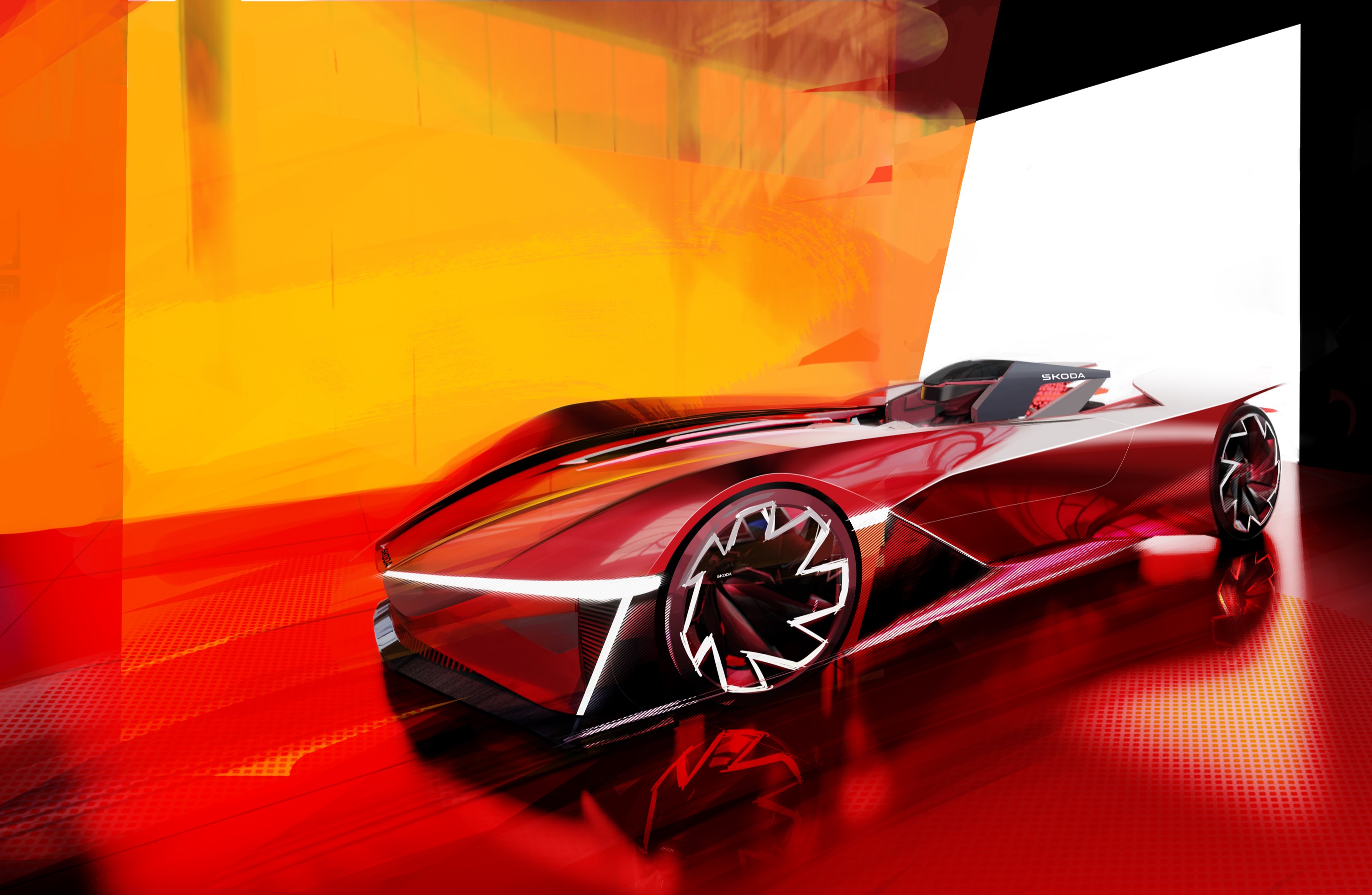
  • 2022 Skoda Vision GT Concept

    Skoda Vision GT Concept - Exterior Sketch

    SKODA Design has introduced a new design concept, the VISION GT, which is an all-electric racing car in the form of a computer-generated model. It is currently being showcased at the ‘Design and Transformation’ exhibit in Brussels, as part of the Czech Republic’s EU Presidency. The VISION GT draws inspiration from SKODA’s 1100 OHC concept from 1957 and is part of the ‘Icons Get a Makeover’ series that reinvents iconic models from SKODA’s past, such as the 130 RS, FELICIA, and RAPID MONTE CARLO.

    The ŠKODA VISION GT is a featured exhibit at the ‘Design and Transformation’ exhibition in Brussels. It is an all-electric racing car in the form of a computer-generated model that draws its inspiration from SKODA’s 1100 OHC concept from 1957. The exhibit showcases Czech products and designs from 1990 to 2020, in alignment with the Czech Republic’s EU presidency. The SKODA design team has infused the VISION GT with the company’s commitment to sustainable sportiness and emotion in the digital age.

    The VISION GT’s single-seater design, with the driver placed in the center, is based on the SKODA 1100 OHC, featuring a futuristic carbon steering wheel that is flattened at the top and bottom, and a red, open-top design. The active cockpit with a flexibly suspended seat aims to offset g-forces for a superior driving experience. The on-screen bar, located above the wheel, serves as a windshield and displays critical information on the driver’s helmet visor, similar to a head-up display.

    2022 Skoda Vision GT Concept

    The VISION GT’s design is flat, with clear lines and sharp edges, inspired by the design of Formula E racing cars. The two-piece rear wing is a standout feature, with active aerodynamics to maximize performance. The holographic SKODA wordmark is situated between the upper wing profiles and on the front of the car, referencing the curved SKODA line.

    In conclusion, SKODA Design’s VISION GT concept, a computer-generated all-electric racing car, has been displayed at the ‘Design and Transformation’ exhibit in Brussels. Drawing inspiration from the 1100 OHC and featuring a red, open-top design, the VISION GT’s flat and sharp design is inspired by Formula E racing cars. The VISION GT is part of SKODA’s ‘Icons Get a Makeover’ series, reinventing iconic models from the company’s history with a commitment to sustainable sportiness and emotion in the digital age.

  • Dacia Manifesto Concept

    With the reveal of Manifesto Concept, Dacia is emphatically reaffirming its unrivalled vision of an essential, cool, robust, affordable and environmentally efficient car. Although it does not prefigure an upcoming model, Manifesto is a lab for ideas with some of its innovative features available on future vehicles in the Dacia range.

    Manifesto explores a connection to nature by being environmentally friendly, robust and by demonstrating usefulness in the outdoors. It is a bold statement about the brand’s aim to stand by customers as they become ever keener to try outdoor pursuits, while expanding on the values and qualities that have helped to build Dacia’s success.

    ESSENTIAL BUT COOL

    Manifesto Concept is redefining the essentials, offering an ever simpler and more genuine experience. There are no barriers between the passengers and the environment – no doors, no windows, no windshield. The driver and passenger are therefore fully immersed in nature. As you prepare for your open-air activities, there’s nothing quite as convenient as a hard-wearing work surface that serves a variety of purposes instead of a tailgate.

    Passengers can also be close to nature and at the same time remain connected with the services available on their smartphone: Dacia’s simple, effective and economical Bring-Your-Own-Device approach makes it possible to fully integrate a smartphone into the dashboard and on-board computer. This ingenious system is already available on several of the brand’s current models and will evolve in the future.

    Manifesto Concept demonstrates another piece of smart thinking by Dacia with YouClip, a very simple system to secure a variety of handy and modular accessories. This pioneering idea will be built into future Dacia models.

    Lastly, as cool often overlaps with useful at Dacia, Manifesto offers a single headlamp – why use two if one provides all the light you need? – this can also be detached to be used as a powerful torchlight!

    ROBUST AND GEARED FOR OUTDOOR ACTIVITIES

    Dacia cars are famed for being sturdy and dependable. Duster, Jogger and Sandero Stepway stand out as cars that customers can count on for their outdoor pursuits. Manifesto Concept pushes the limits even further, turning a car into a go-between by connecting people and nature.

    Manifesto Concept comes with all the off-road hallmarks, including 4-wheel drive, very generous ride height, large wheels and a body built to withstand the toughest terrain.

    It is waterproof: you can clean the inside with a jet washer.

    What’s more, the removable seat coverings become sleeping bags in seconds.

    For extra practicality, the roof rack can carry all sorts of loads as the carrier bars can shift into a variety of configurations. Dacia has already demonstrated excellence in this area with innovative modular roof bars available on Sandero Stepway and Jogger, soon coming to Duster.

    A dedicated and removable battery supplies power through a household outlet, turning Manifesto Concept into an energy source for any outdoor activities requiring power.

    ECO-SMART

    With Manifesto Concept, the brand is proudly showing its vision for a vehicle with a minimal environmental footprint. As it is compact and lightweight, it consumes less energy. This quest for efficiency goes back a long way in the Dacia range – Jogger, for instance, is 300kg lighter than its 7-seat rivals.

    Manifesto Concept’s main plastic body parts contain a significant portion of recycled material. Called Starkle®, it is made from already processed polypropylene, with a flecked effect.

    The interior is fitted with natural materials such as the cork covering the dashboard. As with the latest Dacia models, the decorative chrome plating is gone.

    The concept airless tyres are another innovative feature, as they aim for environmental friendliness as well as savings. The underlying principle is durability as tyres are puncture-proof and last for as long as the vehicle.

    Commenting on Manifesto, David Durand, Dacia Design Director said: “At Dacia, we like to keep it real. As we were developing and exploring new ideas, we felt we needed to push them past 3D simulations and see what they look like in real life! As well as being a designer object, Manifesto Concept encapsulates our vision and combines a wide range of innovation – some involve extreme implementation, but they are still affordable for customers. We will be using a few of them on future Dacia models.”

    Lionel Jaillet, Dacia Product Performance Director, said: “We want to build a range of products that strengthens our brand promise, focusing on the essentials and adapting our vehicles for outdoor activities. Beyond our models, we are also working on innovative features that match our customers’ need and lifestyles even more closely. Manifesto Concept is a “lab” to try out and mock up new ideas. The version you can see today will keep on evolving as we keep on exploring! So don’t miss the next models: they will be ever smarter, ever more tailored to outdoor activities and ever more Dacia!”

  • Volkswagen ID Xtreme Concept

    Volkswagen presents the ID. XTREME in Ticino, an exceptional off-road concept car that will generate an enthusiastic response among the many electric mobility fans at the event. The fully electric concept car with all-wheel drive system is based on the ID.4 GTX and combines the strengths of a modern SUV with the sense of adventure embodied by a rugged off-road vehicle.

    The ID. XTREME01 from Volkswagen stands for maximum emotion and a desire for adventure. The concept vehicle was created by the team of Andreas Reckewerth (Head of overall vehicle MEB) in the Volkswagen Development department. “The modular electric drive matrix (MEB) has enormous technical potential,” says Silke Bagschik, Head of the MEB Product Line. “For many of our customers, vehicles are much more than just a means of transport. With the ID. XTREME, we are raising electric mobility from VW to a new performance level.” The result of the project is a unique off-road vehicle that impresses with its rugged appearance and outstanding power. A high-performance drive on the rear axle and software adaptations in the drive control unit increase the system power of the concept car by 65 kW to 285 kW compared with the ID.4 GTX02 – in other words, by about 30 percent. “The ID. XTREME is made by enthusiasts at Volkswagen for ID. enthusiasts here in Locarno. We are really eager to find out how the fans of electromobility react to the vehicle. Based on the feedback from our community, we will decide how to proceed with the project,” adds Silke Bagschik.

    The exterior of the VW ID. XTREME01 also shows that the vehicle is ready for every off-road adventure. Raised rally running gear, 18-inch off-road wheels, a modified crash member with additional front bumper, and 50 mm-wider wings manufactured by 3D printing combine to give the concept vehicle an authentic off-road look. The roof carrier with additional LED lights and the completely closed aluminium underbody also equip the fully electric all-wheel drive vehicle for excursions away from paved roads.

    Acoustically also, the ID. XTREME01 has something special to offer: the driving noise was developed together with Volkswagen Design especially for the concept vehicle and is output to the outside via a sound generator in the wheel housing. In the interior, the concept car impresses with various highlights, including numerous Alcantara applications, revamped seats and elements in the accent colour orange. And it goes without saying that the ID. XTREME is sustainable: a no longer required test vehicle from production development and a used 82 kWh battery were taken as the basis for the concept vehicle.

    Volkswagen is presenting the ID. XTREME01 to the public for the first time at the ID. Treffen in Locarno. The event by and for fans of electric mobility is taking place for the second time this year and could become the green and sustainable event for electric mobility modelled on the GTI meeting at Lake Wörth (Austria). This year, ID. enthusiasts from the whole of Europe are meeting up on the shore of Lago Maggiore from 6 to 10 September to share their experiences with electric mobility.

    Initiated and organized by private members of the ID. Drivers Club the ID. Treffen is supported by Volkswagen as part of its commitment to the way to ZERO. Together with experts from the company the team of the Volkswagen Drivers Club is attending the event to provide insights into the current developments in the area of sustainable mobility. Alongside the ID. XTREME01, Volkswagen is also presenting other models from the ID. family in Locarno.

  • Jeep Recon Concept

    One of the first all-new electric SUVs that will launch in North America is the Jeep Recon.

    This all-new vehicle is aimed at those who love to explore extreme adventures in near silence with a rugged, fully electric vehicle package.

    The Jeep Recon is designed from the ground up to be 100% Jeep 4×4 and 100% zero emission. This SUV will be offered exclusively as a BEV, and it will enhance off-roading adventures with:

    • True trail-rated capability with Jeep Selec-Terrain traction management system, e-locker axle technology, under-body protection, tow hooks and aggressive off-road tires
    • Authentic Jeep open-air freedom with a one-touch powertop, removable doors and glass
    • The latest generation Uconnect system, including detailed travel guides of the most notable off-road trails

    “The all-new, all-electric Jeep Recon has the capability to cross the mighty Rubicon Trail, one of the most challenging off-road trails in the U.S., and reach the end of the trail with enough range to drive back to town and recharge,” said Meunier.

    This global SUV will be displayed to the public next year and production will start in 2024 in North America. Customers in the U.S. will be able to make a reservation for the new Jeep Recon BEV SUV in early 2023. The Jeep Recon will be sold in major markets around the world, including Europe.

  • Jeep Wagoneer S Concept

    The Wagoneer family is also set to grow with an all-new SUV. Code-named Wagoneer S, this fully electric vehicle will continue to expand the brand’s presence in the premium SUV segment by offering a unique, sleek, aerodynamic design and 4×4 capability as standard, with all-terrain management, advanced Jeep brand-focused technology and impressive performance credentials.

    This new, all-electric, global SUV will be offered exclusively as a BEV, targeting a range of 400 miles on a single charge, 600 hp and a 0-60 mph time of around 3.5 seconds.

    With an exterior design marked by a signature LED-lit grille, this SUV is driven by aerodynamic efficiency, combined with the upright iconic Wagoneer side view.

    “We’ll delight our customers with a premium, highly efficient SUV that is loaded with technology and high quality craftmanship, offering 4×4 capability, high performance, rapid acceleration and a target range of 400 miles on a single charge,” added Meunier.

    The all-new Wagoneer BEV will also be displayed to the public next year and production will start in 2024 in North America. Customers in the U.S. will be able to make a reservation for this all-electric Wagoneer model in early 2023. It will be sold in major markets around the world, including Europe.