Magnat Chevrolet Camaro Audio is a modification visibly and audibly enhanced by the brand Magnat of the firm Audivox. The iconic muscle car is linked with German sound technology and now exudes a stance of an impressive show car.
The tuners have enhanced Chevrolet’s engine performance via performance kit. The latter was delivered by the firm Wimmer racing engineering. Additionally, thanks to software customization, optimization of the air induction and stainless steel exhaust system, the Camaro achieves performance figures of 452 hp (332 kW) and has a maximum torque of 596 Nm (440 lb-ft) at 4,300 r / min). The maximum speed after this power increase is 274 km/h.
Furthermore, the Magnat Camaro rolls on the streets with a grandiose wheel-tire combination by Oxigin in 10×22 inches all around with Yokohama Advan Sport tires in 265/30ZR22 at the front and 295/25ZR22 at the rear axle. The perfect sport handling is available thanks to the height adjustable KW coilover suspension, Variant 1.
To go further into details, the interior has been improved as well. Here one can see that the cabin is exclusively equipped with high quality leather and Alcantara. The diamond pattern of the seats underlines the sportive character and upgrades the interior clearly.
But most importantly, why this Camaro carries the name Audio/ The answer lies in the audio equipment which includes new Audiovox VME 9520NAV, with navigation, Bluetooth hands-free system, iPod / iPhone control, DVD and linkage to the steering wheel remote control, handles the powerful Magnat 4400Watt system.
In addition, what transforms the cabin into a concert hall are the two-way component front system, coaxial rear system, 2x 30cm subwoofer and digital amplifiers transform. Here the installed Ipod serves as a database of all music requests. The illuminated show installation in the trunk completes this great project to the maximum.
Chevrolet has announced the dream of millions of Hot Wheels fans of all ages – the Camaro Hot Wheels Edition, which will hit the dealerships early next year. This is the first time a full-size production Hot Wheels car has been offered for sale by any manufacturer.
“Millions of us grew up playing with Hot Wheels,” said Chris Perry, vice president of Chevrolet Marketing.
“Offering a special production model of the Camaro Hot Wheels is an opportunity to bring those memories to life, for kids of all ages.”, he added.
The Camaro Hot Wheels Edition is available in V8 coupe with manual or automatic transmission, blending exterior cues of the high-performance Camaro ZL1 with a Kinetic Blue exterior colour and unique graphics. Exterior highlights include:
ZL1 rear spoiler
ZL1 front upper grille
Ground effects package, including front splitter and rocker treatment
Black 20-inch wheels
Two-tone matte hood graphic and rear taillight panel “blackout” graphic
Fender “flame” graphics
Hot Wheels grille and decklid logos
It is powered by a V8 6.2-liter engine producing 432 HP (318 kW) and 569 Nm (420 lb-ft) of torque when connected to the manual gearbox, and 405 HP (298 kW) and 556 Nm (410 lb-ft) when linked to an automatic transmission.
2013 Chevrolet Camaro Hot Wheels is priced from £41,520.
Car Specs:
Exterior
New exterior colour Kinetic Blue metallic
20” Black Wheel with Black wheel centre caps
Ground effects in dark smoke gray finish, which includes ZL1 rocker mouldings and a front splitter
Stripes (hood, roof, decklid, spoiler, upper grille blackout with red pin stripe and rear quarter Hot Wheels stripe)
Blackout stripe (Original Wraps) with red pinstripe – between tail lamps on rear fascia
New “Hot Wheels” emblem in front grille
ZL1 spoiler with package shelf CHMSL closeout
Side gill decal stripes
“Hot Wheels” sill plates
ZL1 upper front grille
Hot Wheels emblems located on each fender near the Camaro nameplate
All models include a black accessory engine cover
Interior
Black interior with torch red and Jet black stitching (front is a combination of red and black stitching, rear seats is red stitching, Instrument Panel soft insert, steering wheel, shift knob, and shift boot)
Seat inserts perforated leather except for the panel where the Hot Wheels logo will be embroidered onto a red patch
Steering wheel with torch red stitching
New Hot Wheels badge on steering wheel with existing trim plate
Surface mounted decal to implement a Hot Wheels flame logo on door inserts
Carbon Flash I/P and door inserts and red light pipe.
Premium floormat with torch red stitching and Silver “Camaro” name
Instrument Panel gauge cluster bezel (Carbon Flash), HVAC centre Instrument Panel bezel and bright silver parts on steering when painted black soft touch
Chevrolet Camaro Hot Wheels Special Edition will arrive at dealerships in the beginning of the next year thus making a debut as the first full-size, production Hot Wheels car offered for sale.
The special edition Chevy just debuted at the SEMA Show in Las Vegas, showing off its vibrant, graphics-accented metallic paint scheme (Kinetic Blue) and red-lined wheels. The vehicle will be available in both coupe and convertible form, in 2LT (V-6) and 2SS (V-8) trims.
Some of the other exterior highlights here include ZL1 rear spoiler (coupe models), ZL1 front upper grille, Ground effects package, including front splitter and rocker treatment, black 21-inch wheels with red outline stripe, two-tone matte hood graphic and rear taillight panel “blackout” graphic, fender “flame” graphics, Hot Wheels grille and decklid logos.
The interior of this Camaro is as exciting as the exterior. It is black leather-trimmed, accented with red and black seat stitching with the Hot Wheels logo embroidered on the front seats. The instrument panel and door inserts are black as well, with the Hot Wheels-style flame decal on each door. Hot Wheels® Edition sill plates and Camaro-logo premium floor mats with red edging are also included.
More importantly, the SS models include a 6.2L V-8 engine, which is offered in two iterations: the “L99” on automatic-equipped vehicles and the “LS3” on manual-equipped models. In particular, the power generated for the L99 is 400 hp (298 kW) and torque is 410 lb.-ft. (556 Nm). It also features fuel-saving Active Fuel Management. The LS3 develops 426 horsepower (318 kW) and 420 lb.-ft. (569 Nm) of torque.
LT-based models feature the “LFX” 3.6L V-6 engine, with dual-overhead camshafts, variable valve timing and direct injection. This one propels 323 horsepower at 6,800 rpm. In addition, there is a dual-mode exhaust system available on the SS models mated to the six-speed manual transmission, as well as LT models with either the manual or automatic transmission.
Chevrolet Racing started a campaign which aims to raise breast cancer awareness. This weekend at Atlanta Motor Speedway every lap run under the caution flag lead to a $200 contribution by Chevrolet to the American Cancer Society’s Making Strides Against Breast Cancer initiative.
”At Chevy, we believe everyday heroes can accomplish extraordinary things, and it is in this spirit that we work to achieve a world without breast cancer”, said Don Johnson, vice president of Chevrolet Sales and Service.
There was a special car prepared for the event as well; it is a one-of-a-kind pink Camaro SS featuring the Making Strides Against Breast Cancer logo. And just as a reminder, in 2011, 64 caution laps at Atlanta generated $12,800 for the American Cancer Society.
2013 Chevrolet Camaro Dusk Special Edition is a unique Chevrolet model equipped with an optional Dusk Special Edition package. The latter is available only for 2LT and 2SS Camaro coupe or convertible models.
In particular, the package features halo ring HID head lamps, the new for 2013 Blue Ray Metallic exterior color and the factory installed 21-inch Bright Silver painted aluminum wheels with P245/40ZR21 front and 275/35ZR21 summer performance tires. When the model which is to be tuned is a convertible, then the top is in blue color as well.
Furthermore the interior of the Camaro Dusk Special Edition model includes exclusive Mojave leather-appointed wrapping with yellow stitching on the seats. More highlights concerning the interior are shift knob, center armrest and steering wheel.
Here can also be seen enhancements such as the Mojave color of the panel insert and Blue Ray Metallic color of the door inserts.
The Manufacturer Suggested Retail Price of the Dusk Special Edition package is $5995.
2013 Chevrolet Camaro Dusk Special Edition Details:
Chevrolet Camaro is a legend among the cars and it has been famous and gathered greater popularity since its launch in 1967. One of the main reasons for its initial popularity was probably that it had a unique characteristic: it combined a sports car driving feeling with an everyday drive.
2013 Chevrolet Camaro is road-racing-inspired which now has unique gearing, suspension tuning and tires that make the model capable of more than 1 g of lateral acceleration. The package is offered on Camaro SS coupes but only on those equipped with manual transmissions.
In particular all Camaro SS models now include variable-effort electric power steering and an available dual-mode exhaust system. Again we are talking about manual transmission-equipped models.
As mentioned, the 1LE package will be offered on 1SS and 2SS coupe models with an exclusive Tremec TR6060-MM6 six-speed manual transmission. Paired with a numerically higher 3.91 final-drive ratio, the close-ratio gearing of the transmission is tuned for road-racing performance.
A Camaro with the 1LE package can be recognized by its matte black hood, front splitter and rear spoiler. Furthermore, it has unique 10-spoke ZL1-based wheels, which are also in the colour black. In addition the front splitter and rear spoiler enhance to the car’s on-track performance by helping to reduce aerodynamic lift at high speeds.
Inside, the 1LE has the ZL1’s flat-bottom steering wheel, trimmed in sueded-microfiber and designed for easier heel-and-toe driving on the racetrack. The quick-acting, short-throw shifter from the ZL1 is also trimmed in sueded-microfiber.
2013 Chevrolet Camaro 1LE
Being a true Camaro it offers heritage-inspired interior and exterior, which offer sportiness through iconic design cues. On the other hand the emblematic power of the vehicle is ensured by several powertrains. The standard in LS and LT models come equipped with the 3.6L V-6 engine, which produces 323 horsepower (241 kW).
Two other options are available for the Camaro SS, which namely are 6.2L V-8 ones. The first one generates 400 hp (298 kW) at 5,900 rpm and torque is 410 lb.-ft. (556 Nm) at 4,300 rpm. The second one develops 426 horsepower (318 kW) and 420 lb.-ft. (569 Nm). All Camaro models can be equipped with either a six-speed manual or six-speed automatic transmission with TapShift.
Other equipment which will go on all Camaros is the new seven-inch touchscreen. Through it the driver will control the car’s entire audio system, which now includes MyLink features with apps like Pandora and Stitcher.
Other changes to optimize the 1LE for track-day use include:
• Larger, 27-mm solid front stabilizer bar, and 28-mm solid rear stabilizer bar for improved body control
• Higher-capacity rear-axle half shafts to cope with increased levels of traction
• Strut tower brace for improved steering feel and response
• ZL1-based 20 x 10-inch front and 20 x 10-inch aluminum wheels
• 285/35ZR20 Goodyear Eagle Supercar G:2 tires front and rear (identical to the front tires for ZL1)
• ZL1 wheel bearings, toe links and rear shock mounts for improved on-track performance
• ZL1 high-capacity fuel pump and additional fuel pickups for improved fuel delivery during high-load cornering.
The 2013 Camaro lineup includes the following:
• The 323-horsepower (241 kW) V-6-powered LS coupe and LT coupe and convertible – including the 2LS with an EPA-rated 30 mpg on the highway
• The Camaro SS coupe and convertible, with a 6.2L V-8 delivering up to 426 horsepower (318 kW)
• The 580-horsepower (432 kW) supercharged Camaro ZL1 coupe and convertible. (Please see the separate Camaro ZL1 release for complete details.)
In addition to the new performance features offered on the Camaro SS, all 2013 Camaro models offer a wider range of choices and enhancements that will help it remain America’s most popular sports car. New and revised content includes:
• Chevrolet MyLink and color-touch radio standard on LT, SS, and ZL1 models
• Chevrolet MyLink and color-touch radio with GPS map navigation (late availability)
• Hill start assist now standard on all manual transmissions
• ZL1-style shift knob standard on all manual transmissions
• Remote vehicle start now include on 1LT and 1SS with automatic transmission
Chevrolet was a main star in the past two years in the FIA WTCC seasons. Chevrolet’s emblematic vehicle was always “one wheel ahead” of its peers and with the Cruze ended up number one plus an additional place on the podium in 2010 and 2011.
Now in the year of 2012, Chevrolet is proud to present the another race car for the World Touring Car Championship. The company expect that it will leave its competitors far behind. This is namely the official Chevrolet Camaro Safety Car.
The video below chows how the coolest pace car in the WTCC history is portrayed. In there you will also see its predecessors and the most emotional scenes from the 46-year Camaro history.
Chevrolet Camaro Safety Car
In fact the first ever Camaro was built in 1966, and ever since then it has only showed its huge motor sports potential. It has proven this with the number of trophies it has won during the years.
Although as the WTCC safety car the Camaro includes a serial V8 engine, which produces 432 hp (318 kW). With it, it can undoubtedly it outrace the touring cars of the series by about 40 percent.
Behind the wheel of this exciting car will be Bruno Correia. He is an experienced race driver and has driven in more than 350 races. In the five-minute video clip include below, he casts light on the life of a pace car driver. Furthermore he speaks about the accident that had happened in 2009, when the safety car’s crew was acting rather rashly and collided with another race car. The result was serious accident.
O.CT-Tuning do not like to beat around the bush. That’s what evident by this example – it’s a Chevrolet Camaro (The Yellow Steam Hummer, they’ve called it) that has no obvious signs of modifications. That doesn’t come as a big surprise, since O.CT-Tuning are apparently renown for their expertise on compressor modifications. Many of their subjects have in fact been Chrysler SRT-8 models. Now it’s time to move on a bigger scale. Why not a genuine Transformer. Bring in more power!
By “modifying” the forced induction system (supercharger), the power of the Camaro can go up from 602 hp and 682 Nm of torque to 630 hp and 730 Nm of rotque. Easy stuff for the compressor wizzards at O.CT-Tuning but we can’t help but thinking – won’t those tires shred themselves as soon as you put your foot down. 100 Nm of torque is like having an additional Smart car under the hood…that’s been infected with rabies
The one thing that complements the enhancement, is the exhaust system. Still very subtle but there nevertheless. Not trying to burst your year drums at low revs, evoking the gods of thunder when you approach the read line – that’s what this is all about. Apart from that, nothing else has been changed. That’s the point when it comes to the Transformers – they need to blend… despite that this is an yellow Chevrolet Camaro we are talking about but hey, that’s Hollywood.
It’s worth noting, that the power tweaking is staged – you can have a little bit more or a whole lot more. To avoid any legal issues or personal worries, genuine documentation is also provided – a certificate of technical inspection and a DTC certificate. Thus, even the scrutinizing law of Switzerland cannot deem this vehicle unfit for road use.
Since its production in 1967 Chevrolet Camaro became an emblematic muscle car model which had captured and still enchants many hearts (including mine). With its distinctive exterior and strong stance, combined with an outstanding performance throughout its 45 year s of history, it is no surprise that it has become one of the iconic cars of our society.
Through the years from its first appearance in the automotive world, till 1992, the model underwent three transformational stages, through which it’s exterior, interior and performance were improved and eventually made the car famous.
In 1993 began the production of fourth generation Camaros. Until the year of 2002 they had a strong presence on the market, although after 2002 there was a eight year break in the production of the model.
In this period the car was even lighter in weight. It was made from plastic body panels over a steel space frame. In addition it had several optimizations in terms of suspension, for instance. What was new here was the LT1 V8 engine mated to a six-speed manual transmission. However, the V8 engine didn’t come as a standard but was optional instead and only went standard on Z28 models. As a standard came the 160 hp (118 kW) 3.4 L V6 engine working with a five-speed manual or four-speed automatic transmission.
No matter how much it had change through the years, Chevy Camaro manged to retain its main characteristics, which made its so popular. It still got the same coupe body style with 2+2 seating and was offered in a cabriolet version. There wasn’t any change regarding the rear-wheel drive as well.
An innovation to be highlighted is that now the anti-lock brakes were standard equipment for all models of the vehicle. And in time there were slight transformations of the interior and the exterior as well.
And the year of 2002 was the 35th anniversary of the model: its production in fact didn’t suffer any pauses but remained in continuous manufacture.
Nonetheless, due to sales drop, the Camaro was taken out of production.
The year of 2006 is that one when the model regained power and “got back to life”. This was the time when two concept models were developed – coupe and convertible, thank to which started the beginning of the fifth generation of Camaros. The new models however went on production three years later – in the spring of 2009, and been sold as 2010 model year vehicles.
no images were found
The coupe has been manufactured in LS, LT, and SS trim levels. The first two models are powered by a powerful 3.6 L V6 engine, which produces the exciting 304 hp (227 kW). Here the customers have a choice in terms of gear-shift: it can be either six-speed manual or a six-speed automatic with manual shift. On the other hand the more exuberant SS version is empowered by the 6.2 L LS3 V8 engine. The latter develops the outstanding 426 hp (318 kW) and is mated to a six-speed manual transmission. And if the driver is more keen of automatic gear-shift, than he or she has to be satisfied with the L99 V8 engine, which produces 400 hp (300 kW).
And as I already mentioned in the previous article, 2012 is they year when General Motors marks the 45th anniversary of the Camaro. As a natural consequence, the Chevrolet brand will release a special limited edition model finished in striking Carbon Flash Black with bespoke red and silver anniversary stripes, dark silver 20-inch alloys, a unique 45th anniversary leather interior with red, white and blue stitching and a one-off white-backed instrument panel.
Furthermore, the 2012 Camaro models include all of the characteristics that made the original muscle cars famous. That automatically means that they got great performance and stunning looks. All models come with six-speed manual or a six-speed automatic transmission. The power of the Chevy comes from its 6.2-litre V8 engine, which delivers the 432 hp (317 kW). This makes it possible for the new model to accelerate from 0 to 100 km/h in only 5.2 seconds.
Few, days ago Chevrolet brought Camaro further with the introduction of the 2013 Chevrolet Camaro 1LE. It includes and upgraded package and will be offered as usual in both coupe and convertible versions. The model carries V8 under its bonnet which is mated to a manual transmission as standard. The latter is able to produce the impressive 426 hp (318 kW) at 420 lb-ft of torque (569 Nm).
What is distinct for this model is that it has some new exterior features such as a matte-black hood, a front splitter and a rear spoiler. Regarding the interior, it includes suede micro fiber material, which covers the flat-bottomed steering wheel and the gear shift.
And by going through all the history around this emblematic muscle car, I can only say that it will undoubtedly stay in the automotive world for a long time in the future, due to its strong presence and successful history.
Chevrolet Camaro is a legend among the cars and it has been famous and gathered greater popularity since its launch in 1967. One of the main reasons for its initial popularity was probably that it had a unique characteristic: it combined a sports car driving feeling with an everyday drive. This iconic muscle car was in fact General Motor’s reply to the Mustang developed by Ford.
Till present there are five generations of the Camaro model, with the latest one being developed and released on the market just recently. As a matter of fact, 2012 is the year of 45th anniversary of the model and given that Chevrolet has decided to launch a special limited edition mode, to mark those 45 years of success.
First generation began, when the iconic Chevy was released for the first time in September 1966, preparing it for the model year of 1967. In particular the production of the first generation Camaros lasted for only two years – from 1967 until 1969.
Even back in the 1967, the first model of Camaro was offered in two variants: coupe and convertible. They were equipped with a standard 3.8l I6 engine which delivered 140 hp (104 kW) and was mated to a three-speed or to a four-speed manual transmission, or to their automatic equivalents. Later the same year, the powerful 290 hp (216 kW) 5.7 L (350 in³) V8 engine was introduced to the Chevrolet.
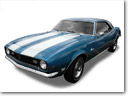
Going further to 1968, there wasn’t much of a change in the model. It got a similar look, although it had undergone slight cosmetic changes such as cloth trims, side marker lights, etc. What made it different was the modified grille and tail lights.
1968 Chevrolet Camaro Z28
Traveling even ahead in time, in 1969 the Camaro was again transformed and carried the name 1969 Chevrolet Camaro Hugger. Now it got a new sheet metal which made it lower and closer to the ground, and attributed to its wider stance. In addition, the model got a vinyl roof which made it distinct. And orange color version of the car eventually became emblematic.
1969 Chevrolet Camaro Hugger Orange
The production of the second generation Camaros lasted longer – from 1970 until the late 1981. The 1970–1/2 Camaro debuted as a 2+2 coupe and included new body style, looked sleeker, as well as optimized suspension. Nevertheless, no cabriolet version was offered, and in fact there wouldn’t be any convertible production of the Camaro until the third generation.
In terms of engines and drivetrain components there was nothing significantly changed. The major differences were made on the exterior and interior, which contributed to the growth in popularity of the car. What was new here in terms of technology was the 4.1 L six cylinder bas engine, which was actually the enhanced version of the previous 3.8 l one. The 4.1 L engive performed far better and produced 155 hp (116 kW). In the second generation the best performance was carried through the 6.5 L V8 engine, which delivered the astonishing 375 hp (280 kW).
It is apparent that the car was thoroughly restyled and now was even larger and with wider stance. However, the unique markers of the previous generation Camaro stayed untouched. For instance, in the second generation Camaros could be still seen the unibody structure, front subframe, theA-arm front suspension and leaf springs.
1972 Chevrolet Camaro Turbo 350
A highlight here is the introduction of the Z28 Special Performance Package in 1977. With it the customers enjoyed not only the amazing driving performance of the vehicle, but had the opportunity to ride on a car which produced 360 horsepower due to its 5.7 L V8 engine. Later in 1980 and 1981 to afore mentioned package was added an air induction hood scoop, with an intake door that opened under full throttle.
1977 Chevrolet Camaro Z28
Through the next ten years – from 1982 till the 1992, Chevrolet brand undertook the introduction campaign of the first Camaro models which were equipped with factory fuel injection and gave the customers the choice between Turbo-Hydramatic 700R4 four-speed automatic transmission and five-speed manual transmission. Furthermore, a new hatchback body style could be recognized in the third generation. Now, 16 inch wheels were standard, and the overall weight of the car was significantly reduced.
The iconic Chevrolet Camaro IROC-Z came for the first time on the world scene in 1985 and its production continued till the end of 1990. A lot of innovations and transformations were added during that period. For instance there was a new brake light added.
Worth mentioning is the new engine added two years later. Namely, it was the 5.7L 350 V8 engine, which eventually turned out to be the standard one for the IROC-Z models. What was specific about those particular Camaro models is that they only came with an automatic transmission.
Various Camaros have gone under the 1LE label since 1988. It’s an upgrade package inspired by the car’s involvement in Pro-Am road racing. Now it is on the horizon again for the 2013 SS coupe versions – the 1SS and 2SS that carry a V8 under their bonnets and a manual transmission as standard. Actually, the whole makeover is intentionally reminiscent of the ZL1 spec.
“The Camaro 1LE combines the best elements of the SS and ZL1 to take road-racing performance to a whole new level,” said Al Oppenheiser, Camaro chief engineer.
Power levels will be pretty much the same as the ones in the SS – 426 horsepower (318 kW) and 420 lb-ft of torque (569 Nm). The transmission is an exclusive one however – Tremec TR6060-MM6: a close ratio setup tuned for road-racing performance.
The suspension gets new monotube rear dampers as opposed to the twin-tube ones previously used. That way, drivers have more flexibility in terms of adjusting the road behavior while preserving respectable comfort.
Other goodies for track days include the:
Larger, 27-mm solid front stabilizer bar, and 28-mm solid rear stabilizer bar for improved body control
Higher-capacity rear-axle half shafts to cope with increased levels of traction
Strut tower brace for improved steering feel and response
ZL1-based 20 x 10-inch front and 20 x 11-inch aluminum wheels
285/35ZR20 Goodyear Eagle Supercar G:2 tires front and rear (identical to the front tires for ZL1)
ZL1 wheel bearings, toe links and rear shock mounts for improved on-track performance
ZL1 high-capacity fuel pump and additional fuel pickups for improved fuel delivery during high-cornering
At first glance, it would be hard for you to notice all of that but worry not. The 1LE gets some distinctive exterior features as well – a matte-black hood, a front splitter and a rear spoiler. The aforementioned wheels also come in black and have 10-spokes. Can’t miss that.
Inside, suede microfiber material covers the flat-bottomed steering wheel and the stubby shifter stick. Most importantly, Chevrolet’s MyLink infotainment is available on all 2013 Camaro LT, SS and ZL1 models – a complex interactive system that has Bluetooth, SmartRadio, Pandora and the lot.
A smart electric power steering can sense whether we are at cruising speed or trying to park and adjust the firmness appropriately. Also new for 2013 is an available dual-mode exhaust system, available on Camaro SS models. Again all ZL1 derivatives.
Prices for the 1LE model will start at under $40 000
Two concept vehicles, both in green paint will shine in the range line among Chevrolet models. Chevrolet aims with these concept performance cars to make any enthusiast green with envy. Of course, don not take this literally. The firs concept vehicle is the outstanding Chevrolet Camaro Hot Wheels Concept, which you already might be familiar of. The car in fact can fulfill every child’s wish, who has ever played with the little model. The news here is that the Chevrolet Camaro Hot Wheels Concept will return next month to the New York International Auto Show, after its successful debut last autumn at Specialty Equipment Market Association (SEMA) Show. The vehicle was inspired by the “Custom Camaro” – the dazzling green Spectraflame® 1:64-scale toy that was one of the original 16 Hot Wheels cars released back in 1968. This beautiful green paint finish was achieved using a meticulous, several-step process which included applying a liquid-metal solution and several layers of green tint.
Chevrolet Camaro Hot Wheels Concept
Next to be paid attention to is the 2013 Chevrolet Spark, which was designed to challenge preconceived notions of how an affordable mini car can look. And it definitely does this very well! More importantly, the “Spark” will begin shining in dealerships this Sumer and in addition will feature a attention-grabbing exterior finishes including Jalapeno, Salsa, Denim, Lemonade and Techno Pink. In particular, this Chevrolet is a four-passenger, five-door hatch, and it was designed to appeal to first-time buyers and city dwellers with its bold styling, affordability, 10 standard air bags, fuel efficiency and maneuverability.

 Magnat Chevrolet Camaro Audio is a modification visibly and audibly enhanced by the brand Magnat of the firm Audivox. The iconic muscle car is linked with German sound technology and now exudes a stance of an impressive show car.




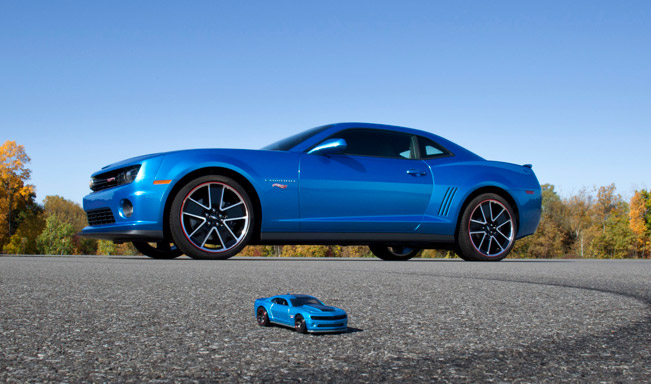 Chevrolet Camaro Hot Wheels Special Edition will arrive at dealerships in the beginning of the next year thus making a debut as the first full-size, production Hot Wheels car offered for sale.
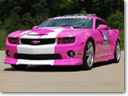
 Chevrolet Racing started a campaign which aims to raise breast cancer awareness. This weekend at Atlanta Motor Speedway every lap run under the caution flag lead to a $200 contribution by
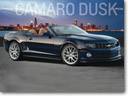 2013 Chevrolet Camaro Dusk Special Edition is a unique

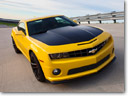 Chevrolet Camaro is a legend among the cars and it has been famous and gathered greater popularity since its launch in 1967. One of the main reasons for its initial popularity was probably that it had a unique characteristic: it combined a sports car driving feeling with an everyday drive.


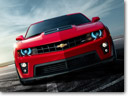




 Various


