 Hennessey Performance also known as Turbos and Superchargers Masters are never satisfied with the results that an OEM vesrion can bring. They always have to add something to push the car to its limits. (more…)
Tag: Chevrolet Camaro
-
2010 HPE700 Camaro with LS9 engine
-
Ford Mustang GT
 The 2010 Ford Mustang, now in dealer showrooms, builds on a proud, unbroken 45-year heritage of Fast, Fun and Affordable with an all-new exterior design, available cutting-edge technology and performance enhancements pioneered on Ford’s extensive racing and special programs.
One hallmark of Mustang’s enduring popularity is the opportunity to customize this American icon. Enthusiasts who have personalized and customized Mustangs range from legends, such as Carroll Shelby, to professional drivers to hobbyists who enjoy a weekend at the track.
For those customers interested in more-aggressive performance, an optional factory-installed Track Pack is available this summer for 2010 Ford Mustang GT coupes with manual transmission. Ford Racing’s FR3 Handling Package also is available for those enthusiasts who want even more aggressive suspension tuning and can be installed in their garage or at a Ford dealer. Car and Driver magazine recently declared a 2010 Mustang equipped with a Track Pack the winner in a comparison test against the new Chevrolet Camaro and Dodge Challenger, calling the body control of the Mustang with the Track Pack “astounding.”
For decades, the Mustang has been the preeminent car in many forms of racing compiling victories and championships on road courses all over the world. In just the last few years Ford Racing’s Mustang FR500C captured the European GT4 drivers championship (2007, 2008) and the Grand-AM KONI Challenge championship (2005, 2008).


“At Ford, we always apply what we learn at the track to the street,” said Fritz Wilke, Mustang Performance/Enthusiast Manager. “The Track Pack and Ford Racing FR3 Handling Pack continue that heritage and give our performance customers great ways to have an even sportier experience in the 2010 Mustang GT coupe.”
Packaged aimed at performance enthusiasts
Both the 2010 V-6 and GT models feature improved handling, but Team Mustang wanted to create a distinctive option package aimed at performance enthusiasts. Starting with the 2010 GT manual coupe, the engineering team was able to create a package that hits the sweet spot.
The first ingredient was to add a high-performance summer tire, and the 19-inch Pirelli P Zero P255/40ZR-19 proved to be an inspired choice for improved grip. Ford’s engineering team then went to work on the underpinnings of the 2010 Mustang GT coupe, using Ford’s proven technology from the Shelby GT500 program.
The front and rear stabilizer bars from the 2009 Shelby GT500 complement the Pirelli tires and help balance the Track Pack 2010 Mustang GT coupe front to rear. The struts and shocks were retuned for the increased capability of the new tire and stabilizer bar changes. The engineering team also spent significant time at the track to ensure the Track Pack was rewarding on the track and offered a balance of spirited driving and track prowess.
The roll gradient (how much the car rolls while steering) was reduced nearly 13 percent compared with the base 2010 Mustang GT. Damping was increased by 23 percent in the front and 8 percent in the rear in the low- to mid-speed compared to the 2010 Mustang GT.
“By reducing the roll gradient, the car stays flatter in turns,” said Tom Barnes, Vehicle Engineering Manager, 2010 Mustang. “And when the car is flatter, the driver is more in command and more confident in what the car’s doing.
“Great handling comes from great control. A driver’s control of the vehicle is facilitated by information. This Track Pack communicates to the driver through the tires and suspension so well that is it easy to drive very quickly. It rewards smooth driving, while offering great capacity to cover driver error.”
Looking at all areas for improvement
In addition to the hardware changes and extensive tuning, the Ford team also took a more holistic approach to improving the Track Pack Mustang.
“Handling is not just chassis,” Barnes said. “Vehicle dynamics – how the Mustang responds under acceleration and braking – is important as well.”
The solution from the powertrain part of the equation was to use a 3.73 limited-slip axle with carbon-fiber clutch plates.
“The 3.73 axle allows for a more-responsive Mustang, especially at mid-range speeds,” Barnes said. “The carbon-fiber plates allow a very robust architecture in terms of temperature and repeated hard driving on the track.”
Performance® Friction brake pads, which better resist brake fade, are used front and rear. Both the anti-lock braking system (ABS) and AdvanceTrac were retuned to complement the advanced capabilities of the new tires and brakes. AdvanceTrac is standard on the 2010 GT coupe and can be operated in any of three modes: On, Off or Sport.
“The Track Pack covers all the bases,” Barnes said. “The new tires give the Mustang more grip, we have a more-responsive acceleration, better brake linings that are more consistent over time and the car is tied down better because of the changes to the bars and the shock tuning.”
“Track Pack has the grip, the handling and it has the ‘go.’ And it absolutely can be used as a daily driver. Track Pack offers the best of both worlds – great performance on the track or if you’re cruising down the road.”
Ford Racing’s FR3 Handling Pack features components proven out on the racetrack. Included in the pack are dampers, lowering springs, sway bars and a strut tower brace.
“The FR3 Handling Pack is derived from our extensive experience with the Ford Mustang FR500C competing in the Grand-Am KONI Challenge and FIA GT4,” said Andy Slankard, Engineering Supervisor, Ford Racing.
Enhancements from the FR3 Handling Pack include:
- Ride height lowered by more than 1 inch
- Increased spring rate by about 75 pounds to improve turn in and mid-corner performance
- Front and rear sway bars stiffened to eliminate roll
- Re-tuned dampers, increasing the compression and rebound
The Track Pack retails for $1,495 while the FR3 Handling Pack retails for $1,335.
-
Chevrolet Launches All-New Camaro in Middle East
 The all-new Chevrolet Camaro has taken North America by storm and is set to expand Chevy’s global appeal with its launch in the Middle East later this summer. (more…)
-
Camaro 2010 by GeigerCars.de – the legend is alive
 The triple is complete: after the Ford Mustang and the Dodge Challenger, Chevrolet completes the revival of the Pony Cars with the new Camaro. From 1966 to 2002 Chevrolet produced four Camaro generations. Well preserved exemplars of the first model range are treasured collectibles nowadays. (more…)
-
Hennessey Transforms the 2010 Camaro from Muscle Car to Super Car
 Hennessey Performance Engineering (HPE), well known for their extreme performance sports cars and muscle cars, announces their Limited Edition 2010 HPE700 Camaro. (more…)
-
Hennessey Limited Edition 2010 HPE550 Camaro
 Hennessey Performance Engineering (HPE), well known for their extreme performance sports cars and muscle cars, announces their Limited Edition 2010 HPE550 Camaro. (more…)
-
Chevrolet Announces Pricing for the 2010 Camaro
 Chevrolet today announced pricing for the all-new, 2010 Camaro. It starts at $22,995 MSRP for the V-6-powered LS model, and $30,995 for the V-8-powered Camaro SS (all prices include $750 destination charge). Customer ordering opened on Oct. 13, with production scheduled to start in first quarter of 2009. (more…)
-
Chevrolet Camaro Convertible
 The Chevrolet Camaro concept was the celebrated star of the American 2006 auto show season. Now, at the beginning of the 2007 auto show season, there is a new star rising: The Chevrolet Camaro convertible concept. It will be unveiled on the eve of the North American International Auto Show at GM Style, an exclusive, fashion-splashed event combining celebrities, couture and automobiles. Chevrolet already has announced production plans for the Camaro, which will go on sale in the US in 2009. A production convertible model will be added later that year.
The Camaro convertible concept is based on the original Camaro concept, with only minor changes required to accommodate the convertible body style. It shares exterior dimensions with the Camaro concept (L/W/H: 4,730/2,022/1,344 mm), although the convertible concept’s windshield surround, which features a bright anodized finish, is changed slightly to accommodate the convertible top. The Camaro convertible concept is motivated by a torquey V-8 engine that rightly sends power to the rear wheels via a manual transmission. It also features a four-wheel independent suspension system and four-wheel disc brakes.
“The best follow-up to last year’s award-winning Camaro concept is a Camaro convertible,” said Ed Welburn, GM vice president, global design. “The Camaro convertible concept instantly evokes an emotional response – it’s a vehicle that you want to make room for in your garage.”
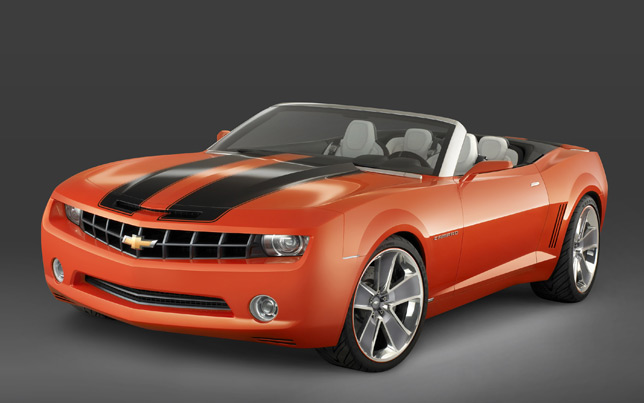
Chevrolet Camaro Concept 2007 


Like the Camaro concept vehicle, the Camaro convertible concept blends a dramatic, forward-looking design that is mindful of the brand’s storied heritage. That design includes classic long hood/short deck proportions and a wide, wheels-at-the-corners stance that gives the vehicle the look of hugging corners even when stationary.
Additional design details include:
• Tonneau cover over the folded top
• “Halo” headlamps
• LED taillamps
• Rear spoiler with LED-lit CHMSL
• Racing-inspired fuel filler door
• Front-inlet hood scoop, inspired by the Corvette Z06
• Heritage-inspired rear fender “gills”The Camaro convertible concept’s Hugger Orange pearl tri-coat color is a contemporary update of the classic hue, which was originally offered in 1969. It is complemented with twin gunmetal gray sport stripes. The modern interpretation of the classic color and its dark accent stripes simultaneously reflect the Camaro’s heritage and deliver a deep, lustrous and thoroughly contemporary appearance.
The Camaro convertible concept rides on 21-inch front wheels and 22-inch rear wheels. The wheels have a deep-dish, five-spoke design and feature charcoal center sections with bright outer edges and an orange outline on the wheel edge. The charcoal wheels complement the gunmetal gray stripes on the body.
Inspired cockpit
Inside, the Camaro convertible features a simple yet purposeful interior that reflects design elements inspired by the muscle car era, including the first-generation Camaro. A new, light-and-dark color scheme enhances the airy feel of the convertible, particularly when the top is lowered.
The seats’ fronts feature platinum-tone leather surrounding suede-like Alcantara® inserts, with black, sculpted seatbacks. The use of light color only on the seating surface is reminiscent of vintage houndstooth interiors, while a matching, tri-coat platinum paint is used to accent the door panels and instrument panel, giving a modern, bold feel to the interior.
“The light-on-dark interior coloring makes a strong statement that conveys the spirit of freedom and fun that is embodied by a Camaro convertible,” said Micah Jones, interior designer.
As with the Camaro coupe concept, the convertible concept features an instrument panel inspired by first-generation Camaros (1967 – 1969), including an intricate “round-gauges-in-square-holes” design. The gauges have a deep, three-dimensional appearance, with white faces and red pointers. “The instrument panel – including the four auxiliary gauges mounted in front of the shifter – pays homage to first-generation Camaros, while achieving a modern appearance through its refined integration of components,” said Jones.
Craftsmanship and attention to detail are evidenced throughout the interior, including the smoke satin aluminum finish on trim plates, vents, seat handles and safety belt buckles. The shifter and pedals are made of billet aluminum. The steering wheel has a detailed, deep-dish three-spoke design and the front seats are hinged at the center – rather than the sides – for an integrated appearance. A separate ignition button is used to start the engine and the speedometer and tachometer needles complete full-sweep indexing when the engine rumbles to life.
A “spine” motif runs through the center of the vehicle and on the seatbacks, including a prominent center console that stretches to the rear seat. The spine reinforces the symmetry of the Camaro convertible, as well as its precision.
An attainable icon
The original Camaro was introduced to the Baby Boomer generation, a large group of young, individualistic and mobile Americans that drove fundamental changes in the auto industry. The Camaro was personal, sporty and powerful – attributes that were typically found on more expensive, smaller and, often, foreign sports cars. The Camaro represented a real life-sized sporty car that was attainable for just about everyone. An almost endless list of optional features, colors and trim combinations ensured owners could tailor their Camaro to their exact taste.
As Boomers transitioned into larger vehicles to accommodate growing families, younger drivers embraced used Camaros as their first cars, and third- and fourth-generations of the Camaro continued to deliver affordable fun and performance to a new generation of enthusiasts. Indeed, hundreds of thousands of owners of all walks of life have found driving fun in a Camaro during the past 40 years.
The new Camaro concepts draw on their namesakes’ heritage, but also the global, youthful influences of the 21st century. These influences are seen in the Camaro convertible concept’s bold proportions, tailored wheel-to-body relationship and detailed interior – including the multi-dimensional instruments. It’s a design that resonates with a generation of younger car buyers influenced by highly stylized “tuner” cars and import sports cars.
“Youthful buyers want a car that makes a statement in its design as much as its performance,” said Brian Smith, exterior designer. “The new Camaro concepts bridge heritage with contemporary style, with a design that is simultaneously admired among import-influenced youth and traditional enthusiasts.”
Along with style and performance, the timeless spirit of fun is woven into the new Camaro concepts.
“Camaro has always represented the American ethic that style and performance don’t belong exclusively to the wealthy,” said Smith. “Camaro has always been everybody’s sports car, and these new concepts demonstrate its spirit is relevant for a new generation.”


