ADF Motorsport has presented the specially prepared racing version of BMW F30 335i. It comes with some BMW Performance parts, which are unveiled for the first time in South Africa.
The car will compete in the local production car championship, the Wesbank Super Series, which is held at Killarney in Cape Town. After that, the F30 race car will hit the Nurburgring for the 2012 24-hour race at the world’s most difficult race track.
Now some performance data: the 335i F30 is powered by the famous TwinPower Turbocharged 3.0 liter straight-six with some upgrades like a new engine management system, Akrapovic sports exhaust system and different turbocharger to comply with the race regulations. The result is the impressive 408PS (300 kW) and 600Nm (443 lb-ft), which is increase of 102PS and 200Nm of torque. The kerb weight is 1360 kg (2998 lbs), so you have to expect superb performance.
Other upgrades include enormous ///M-performance front discs with 370 mm diameter, 18” BBS light alloy wheels fitted with performance tyres and a special GPS data logging system to keep track of everything that happens with the car and on the track.
The price of the racing toy is around $260 000. ADF Motorsport needed just a month and a half to build it.
BMW has recently announced their new Diesel M Performance Division powered by the all-new N57S tri-turbocharged engine. This is the most powerful diesel ever fitted in BMW models. It showcases the commitment of the manufacturer to the pment of ultra-sporty yet impressively efficient diesel power units.
The new N57S features a lot of innovative technologies. It is the first engine adopting tri-turbocharging, latest common rail injection system with maximum pressure of 2200 bars and red line at 5400RPM making it also the most revving diesel in the world. The result is the incredible 381PS (280 kW) and 740Nm (546 lb-ft) of torque at just 2000RPM. 0-100 km/h in 4.7 seconds and a top speed of 250 km/h (155 mph) – electronically limited. In terms of efficiency, the N57S is astonishing – 6.3 liters per 100 km with emission of just 165 g/km CO2.
The new N57S needs a perfect gearbox – ZF 8-speed automatic transmission sending all that torque to the world’s most intelligent xDrive AWD system.
The 2 993 cc engine achieves an incredible output of 127.3HP (93.6 kW) per litre of displacement.
The tri-turbocharging system comprises two relatively small turbochargers and one large turbo, which join forces precisely to deliver the amount of power required. This reduces the turbo-lag to minimum and gives sensational power at high revs.
Check out the gallery below to see details of the new N57S.
Vorsteiner seem to be preoccupied these days with BMWs. More specifically, the M3 range. Well, this time it’s not actually Vorsteiner. It’s one of their dealers – Vivid Racing, based in Glibert, Arizona. They have taken a 2008 BMW M3 Sedan (E90) and have spiced it up in the name of aesthetics. At least, that’s how some people see it.
Power is not up, but Vivid Racing are considering it as the bar for more performance is now up. By the bar, I mean the stopping power – four new Brembo 380mm crossed drilled rotors complete with six-piston calipers at the front and four-piston ones at the back.
The handling may also benefit from the newly installed H & R springs and sway bars that give the beemer some more rigidity and a lower stance. For the aerodynamics, Vivid have gone for the Vorsteiner GTS3 Carbon Fiber Front Bumper that comes with an air splitter, and a Vorsteiner Carbon Fiber Boot Lid. The rear also gets a Carbon Fiber diffuser for an overall complete feel.
Subtle, lean and sleek. We like it.
BMW M3 (E90) by Vivid RacingBMW M3 (E90) by Vivid RacingBMW M3 (E90) by Vivid RacingBMW M3 (E90) by Vivid Racing
Ever wondered how WRC cars manage to deliver 300 bhp and above from an engine that, by rule, cannot exceed 2.0 liters of displacement? How on earth do the heavy, low-revving diesel engines in cars today stay competitive? Or what is it that makes it possible for the Bugatti Veyron to break the 1000 bhp threshold? Well, it certainly isn’t witchcraft. By means of “forced induction”, turbochargers today boost the automotive industry to a new direction of smaller, more-efficient and bloody good fun engines.
Volkswagen like to brand their most successful turbo diesel range as TDI while Porsche, being more plain about it, call their turbocharged cars, Porsche (insert model here) Turbo. BMW, on the other hand, would never hesitate to utter their own terms like “bitrubo” or “TwinPower” whenever describing the latest M5 engine. The variety of depicting turbocharged cars is bountiful, but essentially the principles of work remain the same in every case.
Beware reader, as I am now going to get technical:
In order to understand how a centrifugal turbocharger works, one must also have some basic knowledge on how four-stroke, piston engines work. We have an engine block that contains the cylinders, right? Inside each cylinder, a piston moves up and down. Every movement made is a phase, a stroke. First we have intake – a mixture of fuel and air is sucked into the cylinder. Compression is the second stroke where the cylinder moves up and…well…compresses the molecules in the mixture. The next ignition stroke is downwards as the piston experiences pressure coming from the combustion of the mixture. The exhaust stroke has the job to expel the remaining gases through the exhaust valve. Then the intake valve lets in a new batch of fuel mixture and thus the process is repeated.
However, as far as turbochargers are concerned, exhaust gases are not exactly throw-away material. Put simply, the turbocharger utilizes the energy of exhaust to compress the the newly arrived batch of air which is to be shoved in the cylinder. More air molecules means that more fuel can be injected into the mixture and more fuel means more power.
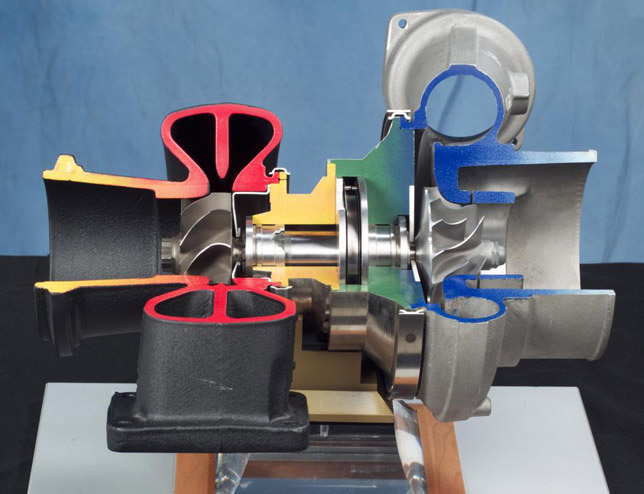
Before those exhaust gasses reach the exhaust system they go trough a turbine connected to a shaft. The more exhaust that goes through the turbine blades, the faster they spin. On the other end of the shaft we find a compressor which welcomes fresh air from the atmosphere, compresses it using the force of the turbine and then feeds it into the engine. To further increase the efficiency of the turbocharging system, an intercooler is added – it looks much like a car radiator but instead of containing cooling fluid, it holds the compressed air from the compressor. Air is denser when cooler and that’s exactly what the intercooler does – it cools the incoming air.
Cut-away view of a turbocharger held by a foil-bearing
There are issues however. First of all, a turbine amidst the flow of exhaust is essentially an obstacle. The exhaust stroke has to deal with more back-pressure thus being slightly less efficient. A functional turboshaft has to handle extreme forces (speeds go up to 150 000 rpm within the turbocharger) so a special kind of baring is needed – liquid ones or state-of-the-art ball bearings. The latter is more efficient but more expensive. Then there’s the dreaded turbo lag. The problem here is that when you put your foot down, the response is far from electric. The turbine needs some time to kick off and start spinning the compressor blades. That’s why at low engine rpm one can’t really tell if the car has a turbo or not.
There are various ways to tackle this nuisance. Make things smaller and lighter. Tiny turbochargers will grant you that off-the-line jolt but won’t be too good on the upper rpm range. Besides, if too much exhaust starts going through a relatively small turbine things may get hot and disbalanced. Usually however, there’s the wastegate in most turbines – a valve that knows how much exhaust passes through and regulates the flow by simply diverting some of the gases away from the turbine. Some companies have started putting more than one turbochargers in their cars. One small and the other, big. The small one guarantees a more immediate response while the big one takes over at higher speeds.
Essentially, that’s the story with turbochargers. We can further dive into numbers and calculations about pressure and efficiency but this, I think, is already nerdy enough. Hopefully some of you learned something new while others refreshed their memory on how the turbocharger brings easy power to our everyday lives.
In search for an executive saloon but tired of BMWs or Audis and Mercedeses? They are the usual choice but one can never get hurt from trying something different. Oh Look! Here’s an Opel Insignia… and it’s been tweaked by German motoring specialists JMS. It’s a starter project with more options due to come. I basically depends on the customer.
What you do get however, is a KW coilover version 3 inox for a suspension. That will set you back $2,226. Because of it, the Insignia will be lower than usual – specifically, 55mm lower at the front and 45mm at the back. For a more modest sum of $315 you’ll also get a JMS racelook apron which you can screw on the standard front bumper and apply…glue, apparently.
By far the most expensive feature on this Insignia are the 9×20 AR1 Race wheels wrapped in 245/35R20 tires. All four of them cost $3,423.
More exterior enhancements and exhaust pipes can be ordered upon request for an overall complete look.
New stuff from SR Auto. Well, actually it’s the BMW M5, the E60 one. A project called the “Excalaber” – the strange misspelling trend continues – aims to provide a refreshing look on a generation of BMWs that is on the verge of being overshadowed by its current successor.
The idea here is that, SR Auto do not provide any parts of their own, but rather mash together what they can find and see if it works out as an art piece. That’s why we have here a Hamannaero kit (front lip, side skirts, and rear lip). Top priority for it was to be a perfect fit. Four matte black exhaust ends give away a Dinan exhaust system that apparently helps with the performance.
The alteration that sticks out the most however, are the PUR 4OUR DEPTH wheels that are usually seen on Lamborghinis and Ferarris. In fact these 21-inch wheels have been originally made for Lamborghini with bolt patterns of 5×112. That’s why the SR people started drilling until they got a size of 5×120. So there you go, PURs on an M5. Neat!
Overall, the job is not really that extensive. But SR Auto take it very personal when it comes to aftermarket changes. To them, observing a customization of a car is like watching a child growing up – endearing, rejoicing and contentful. Besides, too much flash makes the onlooker dash.
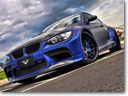
Vorsteiner‘s GTRS3 program for the BMW M3 Coupe is not really something that came out yesterday – it’s been around for almost two years now. However, it sill is hot by today’s standards and the latest proof of that is what we see here – a matte blue GTRS3 M3 having a photo shoot in Taiwan and generally gaining popularity.
The program is mainly visual and consists of a widebody kit – front and rear bumpers (rear end diffuser included), flaring wheel arches and extended side skirts, all made from carbon fiber, adorn the M3. The hood and bood lid have been completely replaced and some piping has been done as well. All summed up, as an end product, it is a flashy looking thing with its big air scoops everywhere, its asphalt grinding stance and its taunting stainless steel quad exhaust system.
As a round up element, the wheels have been changed as well. It’s the twin 7-spoked, three piece Concave Forged Mesh wheels from Vorsteiner‘s V-308 line. Sizes come in both 19 and 20 inches.
For how long are the Vorsteiner people going to rely on it? Although, with those looks, its hard to give it up as a portfolio car.
Here’s a Pagani Huayra. Beautiful isn’t it? However, when it goes on sale in 2013, prices will start from $1,150,000. I think “Huayra” is the sound one makes upon signing a deal. This is roughly the price of four Lamborghini Aventadors. What are Pagani‘s arguments on that? Yes, it has an AMG V12, 6.0-liter engine that develops above 700 hp and 1000Nm of torque, it’s clever enough to operate, by itself, a set of flaps that can either reduce drag or increase downforce and it will most probably do 230 mph when pressed. But, because it is such an engineering perfection, it will be horrible to live with – Imagine this: You get in it, start the ignition and an oil well in Sahara evaporates. Whenever you see a speed hump, you’ll have to spend precious time in looking for an alternative route and how are you going to take the children to school in it? A BMW M5 suddenly seems much more “sensible” and fit for the job.
So in an attempt to justify the Huayra‘s cosmic price, Pagani have released a documentary about the process of building one. It’s rather good and it accents on the fact that the people making it are painfully striving towards attention to detail perfection. The rear emblem starts as a block of aluminum which is due to undergo a 24h carving procedure. The design process of the whole car took 5 years of research and inspiration (partly drawn from Leonardo da Vinci, obviously).
Set aside 15 minutes to watch the clip and afterward, you’ll close the browser with a sense of awe. You still might not get convinced to sell your house, sell your other house and the yacht in order to order one, but you’ll leave home knowing something about a great car, from a great car manufacturer. And that is always useful in the pub.
M cars are not the only prime candidates for first-class tuning. Take the BMW 328i for example. It’s pretty neat, powerful, compact and nimble. It only takes a company like AC Schnitzer to turn it into a desirable performance machine.
The engine receives an extra control unit that amps the power from 245hp to 295hp. The maximum torque is now 410Nm. Top speed is still limited to 250 km/h but zero to one hundred happens in 5.7 seconds – .2 of a second less.
The suspension has been lowered thanks to a spring kit provided by Schnitzer and the choice of wheels is mind boggling: AC Schnitzer wheels Type IV BiColor and silver, Type VI and Type VIII in 18 , 19 and 20-inch sizes. The Type VIII are also available in BiColor – lacquered silver with bright turned aluminium accents.
Additional aerodynamic features include the AC Schnitzer front spoiler, rear roof spoiler, rear spoiler and rear skirt extension. From the latter, 2 pairs of chromy twin tailpipes stick out, giving away the AC Schnitzer sports rear silencer.
The interior of the car serves as a showcase of AC Schnitzer‘s“Black Line” aluminum themes – that includes the “i-Drive” system controller and the handbrake handle. Pedal set is aluminum as well and so is the foot rest. The floor mats are in velours.
You can go and see it right now at the Geneva Motor Show but if you want to get one, that’s going to have to happen latter this year. In the summer perhaps.
Full specs bellow.
AC Schnitzer BMW 328i
Basic car:
BMW 328i (F30)
Engine:
AC Schnitzer performance upgrade –
Performance: 217kW/295hp (standard: 180kW/245hp)
at 5800rpm (standard: 5000-6500rpm)
Maximum torque: 410Nm (standard: 350Nm)
at 2000-3000rpm (standard: 1250-4800)
Maximum speed (km/h) 250 – electronically limited
0 – 100 km/h: 5,7 seconds (standard: 5,9 seconds)
AC Schnitzer engine optics
Exhaust:
AC Schnitzer sports rear silencer with
2 chromed “Racing” tailtrims in
right / left combination
Suspension:
AC Schnitzer spring kit, lowering approx. 25 mm
Aerodynamics:
AC Schnitzer front spoiler
AC Schnitzer front grille, chromed
AC Schnitzer rear roof spoiler
AC Schnitzer rear spoiler
AC Schnitzer rear skirt
AC Schnitzer decals
Interior:
AC Schnitzer aluminium cover, “Black Line”
for BMW “i-Drive“ system controller
AC Schnitzer aluminium handbrake handle, “Black Line”
AC Schnitzer gear knob with digital shift display
AC Schnitzer leather gear knob, illuminated
AC Schnitzer aluminium gear knob “Black Line”
AC Schnitzer aluminium pedals
AC Schnitzer foot rest
AC Schnitzer floor mats, velours
Wheel/Tyre sets:
AC Schnitzer Wheel/Tyre Set with Type VIII Wheels BiColor Silver
front: 8,5 x 18″ with tyres 225/45 R 18
rear: 8,5 x 18″ with tyres 225/45 R 18
front: 8,5 x 19″ with tyres 225/40 R 19
rear: 8,5 x 19″ with tyres 255/35 R 19
front: 8,5 x 20″ with tyres 225/35 R 20
rear: 8,5 x 20″ with tyres 255/30 R 20
AC Schnitzer Wheel/Tyre Set with Type IV Wheels BiColor
front: 8,5 x 18″ with tyres 225/45 R 18
rear: 8,5 x 18″ with tyres 225/45 R 18
front: 8,5 x 19″ with tyres 225/40 R 19
rear: 8,5 x 19″ with tyres 255/35 R 19
AC Schnitzer Wheel/Tyre Set with Type IV Wheels Silver
front: 8,5 x 18″ with tyres 225/45 R 18
rear: 8,5 x 18″ with tyres 225/45 R 18
front: 8,5 x 19″ with tyres 225/40 R 19
rear: 8,5 x 19″ with tyres 255/35 R 19
AC Schnitzer Wheel/Tyre Set with Type VIII Wheels BiColor
front: 8,5 x 19″ with tyres 225/40 R 19
rear: 8,5 x 19″ with tyres 255/35 R 19
AC Schnitzer Wheel/Tyre Set with Type VI Wheels BiColor
When the latest BMW M5 came out, it was the definition of balance between mad performance and everyday sedan practicality. Now the Aachen-based AC Schnitzer want to tip the scales in faveor of more power, more sportiness and more flamboyancy. It’s the ACS5 Sport Saloon.
To start off, they added an additional control unit on the engine that boosts the power to620hp. The engine’s torque output is also increased to 790Nm. Zero to sixty now takes 4.1 seconds. An AC Schnitzer twin sports silencer with valve control provides the sound to match the grunt. Chromed “Sports Trim“ tailpipes enclose the Schnitzer carbon rear diffuser.
That brings us to aerodynamics. The diffuser plus the carbon front spoiler, rear roof spoiler and rear spoiler provide necessary down force which is there to tame the fresh power. In the mean time, a chromed front grille, “Magic Blue“ and silver livery, AC Schnitzer badges for the side and anAC Schnitzer logo “ACS5 Sport“ visually complete the aerodynamic power pack.
The suspension has been slightly tweaked as a new AC spring kit replaces the standard one. There is also a generous choice of wheels. 20-inch Type V forged alloy wheels orType IV BiColor rims in the same size. The third option involves a set of bigger, 21-inchType VIII racing and forged alloy rims.
“Magic Blue“ is the prevailing theme inside. A “Black Line“ aluminum cover for the “i-Drive” system controller and aluminum pedals add some contrast. The footrest also matches the pedals while the floor mats are in velours.
So if you ever want more from your BMW M5, AC Schnitzer is the company for you.
Full specs bellow
AC Schnitzer BMW M5
Basic car:
BMW M5 (F10)
Engine:
AC Schnitzer performance upgrade –
Performance: 456kW/620hp(standard: 412kW/560hp)
at 6300rpm(standard: 6000-7000rpm)
Maximum torque: 790Nm (standard: 680Nm)
at 3000 rpm (standard: 1500-5750rpm)
Maximum speed: 305 – electronically limited
0 – 100 km/h: 4,1 seconds (standard: 4,3 seconds)
AC Schnitzer engine optics
AC Schnitzer engine compartment optics
Exhaust:
AC Schnitzer twin sports rear silencer with
valve control and chromed “Sports Trim” tailtrims
Suspension:
AC Schnitzer spring kit, lowering approx. 25 mm
Aerodynamics:
AC Schnitzer carbon front spoiler
AC Schnitzer front grille, chromed
AC Schnitzer vitro emblems for side walls
AC Schnitzer rear roof spoiler
AC Schnitzer rear spoiler
AC Schnitzer carbon rear diffuser
AC Schnitzer emblem “ACS5 Sport”, side right/ left
Vehicle wrap BiColor “Magic Blue” – Silver
Interior:
AC Schnitzer aluminium cover, “Black Line”
for BMW “i-Drive“ system controller
AC Schnitzer aluminium pedals
AC Schnitzer foot rest
AC Schnitzer floor mats, velours
Interieur panels and steering wheel insert wrapped in “Magic Blue”
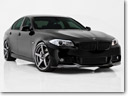
Vorsteiner is a company that spends a great deal of time focusing on designing wheels. And they are not looking bad at all. From time to time however, they tend to issue full-blown tuning programs complete with aerodynamic sets, wheels naturally and exhaust systems. Their latest one is called the V-MS Program and in order to eligible for it, you must posses a BMW 5 (F10) series that has the factory M Tech aero package.
The Vorsteiner provided aero bits are all from the company’s pre-peg carbon fiber line. That includes a specially designed front spoiler, a subtle trunk lid spoiler and a high-temperature resistant diffuser between the VorsteinerF10 Sports Exhaust pipes. They on the other hand, offer a tiny power boost (+12hp and 2lb/ft of torque according to their dyno test) and also, they can sing pretty well, Formula 1 style. Rounding up the look, are the four 20 and 21-inch custom made forged wheels on which the car sits. They have been specifically made for the F10 with their 5-spoke star design matte black feel. Another thing finished (or not-finished) in matte black is the bodywork itself. I have to admit that, combined with the visible carbon aerodynamic elements, all looks astonishingly well. The only problem I have with this car are the taillights. They look like those “Shutter Shade” glasses people wear to look like Kanye West. If you are going to go subtle, go subtle – tint them or leave them as they are.
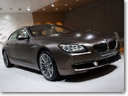
BMW has presented the new 6-series Gran Coupe at the 2012 Geneva Motor Show. The four-door coupe will compete against Audi A7 and Mercedes CLS.
The engine range includes three power units as the exhibited version is the 640i, which is powered by a twin-turbocharged 3.0 liter inline-six with 320PS (235 kW) and 450Nm (332 lb-ft). 0-100 km/h in 5.4 seconds and a top speed of 250 km/h (155 mph) electronically limited.
The price for this toy starts at €79 500.
The more powerful 650i has the famous twin-turbo 4.4 liter V8 with 450PS (330 kW) and 650Nm (479 lb-ft). 0-100 km/h in 4.6 seconds and a top speed of 250 km/h (155 mph) – limited.
The price list starts at €92 600.
Last is the super-efficient diesel – 640d with a 3.0 liter twin-turbocharged engine delivering 313PS (230 kW) and 630Nm (465 lb-ft). 0-100 km/h is the same as the petrol – 5.4 seconds and a top speed of 250 km/h (155 mph).
 ADF Motorsport has presented the specially prepared racing version of BMW F30 335i. It comes with some BMW Performance parts, which are unveiled for the first time in South Africa.


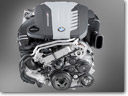 BMW has recently announced their new Diesel M Performance Division powered by the all-new N57S tri-turbocharged engine. This is the most powerful diesel ever fitted in BMW models. It showcases the commitment of the manufacturer to the pment of ultra-sporty yet impressively efficient diesel power units.





 Ever wondered how WRC cars manage to deliver 300 bhp and above from an engine that, by rule, cannot exceed 2.0 liters of displacement? How on earth do the heavy, low-revving diesel engines in cars today stay competitive? Or what is it that makes it possible for the Bugatti Veyron to break the 1000 bhp threshold? Well, it certainly isn’t witchcraft. By means of “forced induction”, turbochargers today boost the automotive industry to a new direction of smaller, more-efficient and bloody good fun engines.
 In search for an executive saloon but tired of BMWs or Audis and Mercedeses? They are the usual choice but one can never get hurt from trying something different. Oh Look! Here’s an Opel Insignia… and it’s been tweaked by German motoring specialists JMS. It’s a starter project with more options due to come. I basically depends on the customer.


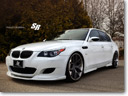 New stuff from SR Auto. Well, actually it’s the BMW M5, the E60 one. A project called the “Excalaber” – the strange


 Vorsteiner‘s GTRS3 program for the BMW M3 Coupe is not really something that came out yesterday – it’s been around for almost two years now. However, it sill is hot by today’s standards and the latest proof of that is what we see here – a matte blue GTRS3 M3 having a photo shoot in Taiwan and generally gaining popularity.


 Here’s a Pagani


 M cars are not the only prime candidates for first-class tuning. Take the BMW 328i for example. It’s pretty neat, powerful, compact and nimble. It only takes a company like AC Schnitzer to turn it into a desirable performance machine.


 Vorsteiner is a company that spends a great deal of time focusing on designing wheels. And they are not looking bad at all. From time to time however, they tend to issue full-blown tuning programs complete with aerodynamic sets, wheels naturally and exhaust systems. Their latest one is called the V-MS Program and in order to eligible for it, you must posses a BMW 5 (F10) series that has the factory M Tech aero package.


 BMW has presented the new 6-series Gran Coupe at the 2012 Geneva Motor Show. The four-door coupe will compete against Audi A7 and Mercedes CLS.


