News from Audi as a Q3 concept has appeared which suspiciously looks munch like the Vali Concept we saw earlier this year. At the very least, this new one is also red… If not even redder. So red in fact that Audi have called it the Red Track. It’s a themed contribution to the Wörthersee Tour that starts in May 16th – a populiar Volkswagen and Audi show.
As we said, red, or Energy Red, is the predominant theme in this one. We suspect that Audi dipped the whole Q3 Red Track in pant since even the cylinder head cover has traces of red on it. Inside, it’s pretty much the same story with added ultra-leather-nappa-aluminum-luxury. The uphostery boasts red piping with double seams and red stitching. Patches from it are made of red Velvet leather. Same segments can be found on the doors as well, despite them being generally in steel gray Nappa leather. The headlining is also gray, but made from Alcantra. The instrument panel is barraged with aluminum which sticks out nicely from the overall tone of the again Nappa material that covers it.
Enough about fabrics though as we feel an allergy coming. How about the more healthy aspects of the Red Track such as the engine – a good dose of 340 hp coming from a 2.5-liter, five-cylinder TFSI petrol unit – tremendous but then again, it should be as all of that goes to all the four wheels (permanently) trough a seven-speed S tronic transmission. In other words: zero to sixty mph in 5.4 seconds, top speed – 163 mph and naturally an upper edge on the uncharted territories. (why else would it flare it’s arches so flamboyantly?).
Obviously, when designing the Q3, the Audi engineers and masterminds had the Alps as an image in their heads. Overcoming the natural obstacles that mother nature has in store…. with flash lights and hot coffee. No, seriously. At the luggage compartment, on one of its side, there’s a station designated for storing and charging flashlights while a thermos canister can be found within the cup holder that’s in between the front two seats. Then there are the roof rails which look like completely ordinary (aluminum maybe) but Audi say they are specifically designed to carry a set of skis.
2012 Fostla Audi Q7 SUV is a unique and newly tuned vehicle which will amaze you with its 600 horsepower (441 kW) and exceptional appearance added to the inherent Audi class and style.
The tuning company is no other but German based and in details it specializes in premium wrapping foils. In details the machine which stays behind this makeover, is the Audi Q7 V12 TDI. It has served as a basis for the foiling.
In fact, this was the first ever V12 TDI in a passenger vehicle. This engine has the capacity to produce an output of 368 kW (500 hp) and 1,000 Nm of torque (737.56 lb-ft) from its six liters. This means that solely the base model catapults from zero to 100 km/h (62.14 mph) in only 5.5 seconds and has an electronically capped top speed of 250 km/h (155.34 mph).
But let’s go back to the work of Fostla. What is important to highlight here is that the skilled handwork turns out to be a one of the most important things. The primary color of the Audi was green. However, the refinement now is made with PWF foil in diamond black matt.
2012 Fostla Audi Q7 SUV
In addition, the discs were also toned between fifty-five and eighty-five percent. The front and back lights have five percent of tinting.
Additional changes are also offered – this time not only in terms of exterior foiling style, but also in terms of set of 11×23 inch matt powder coated side Mansory C5 rims with 315/25R23 tyres in combination with 15 mm front and 30 mm back track plates.
More importantly in my opinion here is the work that has been done on the engine. To be more précised it was optimized and now is able to deliver the astonishing 600 hp (441 kW) and 1,150 Nm (848 lb.-ft.) torque.
To sum up: a great tuning to be considered by many!
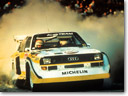
Audi Sport Quattro is a legendary car produced in limited series of just 224 units. It was introduced back in 1985. The brutal car is still known as the most powerful rally car ever competed in an international competition – 600HP (441 kW).
However, the officially stated power of the inline 2.1 liter five-cylinder turbocharged engine was 480PS (350 kW). A recirculating air system helping the turbocharger spinning at high RPM, when the driver does not apply the throttle allowed the engine to resume full power immediately after the resumption of full throttle. This was extremely good move, because it reduced the turbo lag a lot and boosted the engine to 507PS (373 kW) at 8000RPM.
Here is a nice video of an original Quattro which was converted by UK firm Dialynx into a short wheelbase Sport Quattro competing at the Isle of Man Manx Classic Hillclimb and Sprint Series in April.
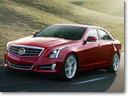
The latest Cadillac ATS RWD sedan, gets a price tag which makes its future look good. Starting from $33,990, the 2.5-liter/30+ mpg model even comes with destination charges. It’s a small poke in the eye for Mercedes-Benz and Audi. Their own compact-sedans (the C250 and A4 respectfully) have a significantly higher price.
Besides the 2.5, for one can get the mid-range power train ($35,795) which is 2.0 but it is turbocharged thus more powerful and less thirsty. Manual and Automatic transmissions are available as is the choice between RWD and AWD. The top of the range model that costs $42,090, incorporates a 3.6-liter V6 engine rated at 320 horsepower. The transmission is strictly automatic and the standard equipment includes leather 8-way power seats with memory for settings storage, adaptive start, CUE tech and much more. Full specifications are due to came later on.
The CUE technology represents Caddilac’s user interface. It’s akin to that used in many smartphones and tablets. The idea is that it uses electrodes to sense the conductive properties of objects, such as a finger – in other words… a touchscreen.
The handling is also expected to be top-notch since the Nürburgring in Germany, among other tracks has been a favorite of Cadillac testing engineers for quite a while. The ATS is also lighter than the aforementioned A4 and C250 by around 100 pounds. The top-of-the-line 3.6 is expected to do 0 to 100 kph in less than 6 seconds.
Eight automakers from Europe and United States are going to display one-of-a-kind fast-charging technology. It is unique because it will enable recharging of most electrified vehicles for just 15 to 20 minutes.
The brands which are taking part in this project are: Audi, BMW, Chrysler, Daimler, Ford, General Motors, Porsche and Volkswagen. They have agreed to work in collaboration in order to provide a harmonized single-port fast charging approach.
The name of this project is DC-fast charging with a Combined Charging System. It will be utilized for vehicles in the U.S. and Europe.
More importantly, the first live charging demonstrations will take place during the Electric Vehicle Symposium 26 (EVS26) (6th-9th of May).
What the combined charging system does is to integrate one-phase AC-charging, fast three-phase AC-charging, DC-charging at home and ultra-fast DC-charging at public stations into one vehicle inlet. The purpose of this is that any driver will be able to recharge its vehicle almost anywhere, regardless of power source.
Another benefit of this project concerns a more affordable adoption of a standardized infrastructure.
Combined Charging System Connector
Furthermore, the European association of vehicle manufacturers has chosen the Combined Charging System as its AC/DC-charging interface to become integral part in the all new vehicles in Europe, with a starting date in 2017.
It is also important to mention that this charging system was designed having in mind existing charging strategies, the ergonomics of the connector and preferences of U.S. and European customers.
Moreover, an additional advantage of the Combined Charging System will create a uniform standard with identical electrical systems, charge controllers, package dimensions and safety mechanisms.
Next, the system will be also responsible for maximizing the capability for integration with future smart grid developments through common broadband communication methods. This will happen of course, regardless the global location of the charging system.
Last, but not least, this approach will also minimize the development and infrastructure complexity, and enhance the charging reliability, reduce the total cost-of-ownership for end customers and offer low maintenance costs.
Commercially available combined charging stations are projected to be on disposal later this year and vehicles using the technology will be available starting 2013.
2013 Audi TT RS Plus Coupe and Roadster models are even more focused version of the high performance sports ca. They now come with outstanding 174mph top speed, which increased in power and torque means 360 hp (265 kW) and 465 Nm (343 lb-ft).
To go further into details, what makes the new Audi model so special is the tuned 2.5-litre, five-cylinder TFSI petrol engine. Thank to it the car is able to produce the additional 20PS (15 kW) and 15Nm (11 lb-ft) of torque compared – all this when it is compared with the ‘standard’ car.
The result basically is the astonishing 360 ho and 465 Nm, which are channelled to the quattro all-wheel-drive system through either a six-speed manual gearbox or the seven-speed S tronic twin-clutch transmission.
Thanks to the latter, 2013 Audi TT RS plus Coupe is able to accelerate from 0 to 100 km/h in only 4.1 seconds (manual version 4.3 seconds). On the other hand the Roadtser needs 4.2 seconds (manual version 4.4 seconds) to achieve this speed.
Notwithstanding these great figures the RS plus models also are more fuel efficient. For isntance the Coupé is achieving a combined economy test figure of 33.2mpg and the Roadster 32.8mpg in the same test.
The reason for this impressive fuel economy is the hugely lightweight Audi Space Frame (ASF) bodies made of aluminium at the front and sheet steel at the rear. The overal weight of the TT RS plus Coupé with manual transmission is 1 450kg.
2013 Audi TT RS Plus Coupe
Both Audi models run on 19-inch five-arm “Rotor” design titanium-look alloy wheels. Another characteristic feature is the single frame radiator grille with its matt aluminium surround and polished anthracite diamond-pattern mesh.
Adding to this, visually attractive are also the carbon fibre-reinforced polymer (CFRP) door mirror housings and black oval tailpipe trims. These indicate that the TT RS plus is fitted as standard with the sports exhaust system.
A variety of innovative technologies are also included in these models. Some examples are the satellite navigation, the Bluetooth phone preparation and Audi Music Interface iPod connection.
2013 Audi TT RS Coupe and Roadster will be available in dealerships early in May and will come with a starting proce of £48 945.
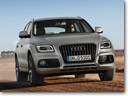
2013 Audi Q5 SUV is all about sportiness and comfort. It is multifunctional and spacious, and now even more efficient. The model comes with updated design, infotainment system, chassis and engines.
For instance, the 2013 Audi Q5 Hybrid Quattro is the fist hybrid model which the brand is producing. It draws its power from a powerful V6 engine, which however delivers fuel economy of a four cylinder one.
First, let’s review the engine choice. The upgraded Audi model comes with five engine options: three TDI and two TFSI engines. No matter of the type of the engine, all combine direct fuel injection with charging, and a start-stop system as a standard.
In addition to this it is important to mention that the engines now are with lower fuel consumption in comparison to the previous model.
In fact, the most efficient one is the 2.0 TDI engine, which is offered in two versions: the first one is four-cylinder engine in combination with manual transmission and front-wheel drive, which produces 105 kW (143 hp) and 320 Nm (236.02 lb-ft) of torque. It has an average fuel consumption of 5.3 liters of diesel per 100 km (44.38 US mpg) – and a CO2 equivalent of 139 grams per km (223.70 g/mile).
The second one is with 130 kW (177 hp) and 380 Nm (280.27 lb-ft) of torque (with S tronic and quattro drive) and has a fuel consumption value of 6.0 liters per 100 km (39.20 US mpg).
The third available engine is the 3.0 TDI, which delivers 180 kW (245 hp) and 580 Nm (427.79 lb-ft) of torque. It comes with V6 diesel engine and is mounted to a seven-speed S tronic and quattro drive system.
This engine helps the Q5 to accelerate from 0 to 100 km/h (62.14 mph) in 6.5 seconds and has a top speed of 225 km/h (139.81 mph). The figure of its combined fuel consumption is just 6.4 liters of fuel per 100 km (36.75 US mpg).
Furthermore, in the engine range are also included gasoline engines, which feature the highlight of the TFSI engine line-up. Namely, it is the new two-liter, four-cylinder engine which includes innovations such as in the control of valves and their stroke, innovative thermal management, the fuel injection system, turbocharger and integration of the exhaust manifold in the cylinder head.
Next the new 2.0 TFSI outputs 165 kW (225 hp) and 350 Nm (258.15 lb-ft). Its fuel consumption is 7.6 liters per 100 km (30.95 US mpg).
More impressive in terms of performance is the new 3.0 TFSI – the three-liter V6 engine with supercharging. This one replaces the 3.2-liter engine. It deliver 200 kW (272 hp) of power and 400 Nm (295.02 lb-ft) of torque.
The acceleration from 0 to 100 km/h (62.14 mph) for this one is possible in 5.9 seconds. With it the car has a top speed of 234 km/h (145.40 mph), and combined fuel consumption of 8.5 liters per 100 km (27.67 US mpg).
Important changes in the Audi SUV have been made in terms of transmission as well. Each of the models now comes with an optimal transmission system.
For instance, the four-cylinder engine works with a manual six-speed transmission. This is the standard equipment of the engine.
On the other hand the eight-speed tiptronic is available as an option for the 2.0 TFSI with 165 kW (225 hp). This one comes as standard in the 3.0 TFSI.
Next, the sporty seven-speed S tronic is standard transmission in the 3.0 TDI. It is optionally available in the 2.0 TDI with 130 kW (177 hp).
What comes also as a standard on all versions (except for the 2.0 TDI engine) of the Q5 is the quattro permanent all-wheel drive system.
Additional changes have been made to the chassis, which now comes with new refinement and comfort in the characteristics of the springs, shock absorbers and stabilizers. The new electro¬mechanical power steering system gives the driver a better feel for the road with direct gearing.
Furthermore, 2013 Audi Q5 runs on 17-inch aluminum wheels and size 235/65 tires.
Another exceptional feature in the Audi Q5 is the Audi drive select system. It allows the driver vary the characteristic of the accelerator pedal, the shift points of the automatic transmission, amount of power steering assist and operation of the automatic air conditioning system via four modes.
2013 Audi Q5 SUV
As you can clearly see the Audi Q5’s exterior is progressive and sporty, spacious and functional. It has a coupe-like roof line and wrap-around tailgate. The interior design of the headlights has been modified; the LED daytime running lights of the optional xenon plus units are shaped as curved bands that surround the headlights.
The high-gloss black Singleframe grille has beveled upper edges; its vertical chrome struts and the Audi rings have a sculpted look. In addition, bumpers are modified and integrate air inlets with high-gloss black inserts and fog lights with chrome rings.
The new Audi Q5 is available in wide range of fifteen colors, four of which are new.
In terms of upgrades in dimensions, the SUV is now 4.63 meters (15.19 feet) long, 1.90 meters (6.23 feet) wide and 1.65 meters (5.41 feet) tall. Its drag coefficient is 0.33 and its frontal area is 2.65 m2 (28.52 square feet); the curb weight of the base version is 1,755 kg (3,869.11 lb).
The interior of the Audi Q5 has also been restyled. For example, many of the user controls have narrow chrome trim; the steering column control stalks, ignition key and instruments were as well modified. Additionally, the narrow panels of the center console are high-gloss black.
Other refinements have been made to the controls for the seat heating, air conditioning system, Audi drive select system and the multifunction steering wheel.
Of course, throughout the interior can be seen a lot of efforts put in terms of details. All this has been done with high-quality of craftsmanship and precise selections of materials, colors and upholstery fabrics.
Moreover, the interior now comes in three new interior colors, three fabric and three leather qualities.
Audi delivers a wide selection of infotainment systems in the upgraded Q5: the Bang & Olufsen sound system, MMI navigation plus with a large hard drive, seven-inch color monitor, 3D graphics and DVD player.
2013 Audi Q5 SUV Interior
2013 Audi Q5 Hybrid Quattro is a version of the model which in fact is the first hybrid model from Audi. It is highly efficient and yet powerful. It draws its power from the 2.0 TFSI engine which produces 155 kW (211 hp) and 350 Nm (258.15 lb-ft) of torque as well as an electric motor with a peak output of 40 kW (54 hp) and peak torque of 210 Nm (154.89 lb-ft).
Combined, the two power sources can output a system power of 180 kW (245 hp) and a system torque of 480 Nm (354.03 lb-ft).
In particular, this make possible for the hybrid to accelerate from 0 to 100 km/h (62.14 mph) in 7.1 seconds and to reach a top speed of 225 km/h (139.81 mph).
Another important fact is that in pure electric mode, it can cover up to three kilometers (1.86 miles) at a constant speed of 60 km/h (37.28 mph). In this mode, its top speed is 100 km/h (62.14 mph), while its combined fuel consumption is just 6.9 liters per 100 km (34.09 US mpg).
Furthermore, the Q5 hybrid comes equipped with an eight-speed tiptronic transmission which transfers engine power to the drivetrain without requiring a torque converter.
Here, driver switches between the three driving modes with the help of a button and a tiptronic gear selection lever. The EV characteristic map prioritizes the electric drive. The D mode controls both the internal combustion engine and electric motor. At last, the S mode and the manual shift gate of the tiptronic are stand for more sporty style of driving.
The 2013 Audi Q5 Hybrid Quattro can be recognized by its siblings by its entirely painted bumpers and by the hybrid-specific ten-arm turbine design of its wheels. It runs on 19-inch wheels are standard.
The new 2013 Audi Q5 SUV will be available at dealerships this summer with a starting price of 39,900 euros.
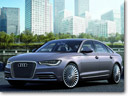
Audi is presenting its first luxury-class e-tron concept car – Audi A6 L e-tron at Auto China 2012 in Beijing. The manufacturer also presents two other brand new concept vehicles at the auto show, but they won’t be in focus now.
The plug-in hybrid is based on the long-wheel-base version of Audi A6 saloon, which is the best-selling model on the Chinese market. It is typical for the European manufacturers to run LWB versions specially for the Chinese market like the BMW 3-Series F30 LWB. These models are widely appreciated and well sold in China, that’s why Audi decided to run their new hybrid in LWD version.
However, the styling has been updated to differentiate it from the production model. The A6 L E-tron comes with new front grille with horizontal chrome bars giving it better front look and massive appearance. There is also a new rear diffuser and enormous 21” alloy wheels in special e-tron design.
The A6 L e-tron concept is precisely tailored to the requirements of Chinese customers. Plug-in hybrids that can travel long distances electrically – thereby enabling zero emissions driving in local areas – are ideal for use in rapidly growing megacities. Beyond its drive system, the A6 L e-tron concept has all of the qualities that customers value in Audi cars: prestige, comfort and sporty performance.
The powertrain features a 2.0 liter TFSI with 211HP (155 kW) coupled with an electric motor with 95HP (70kW). The electric motor is powered by a special liquid-cooled lithium-ion battery, which alloys the A6 L to travel up to 80km in all-electric mode if travelling at a constant speed of 60 km/h.
The interior boasts intuitive controls. The powermeter replaces the tachometer; its pointer indicates total drive system power on a scale of zero to 100%. Colored segments indicate the current operating state of the A6 L e-tron concept; an auxiliary instrument visualizes the charge state of the lithium-ion battery.
The Audi A6 L e-tron concept offers a lot of space at all seating positions. It integrates all of the model line’s luxury-class features. The seats offer ventilation and massage functions, the Bose surround system delivers good sound, and the deluxe automatic air conditioning system with air ionizer ensures a pleasant climate in the car. Ambient lighting adds subtle highlights to the interior illumination.
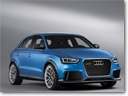
Audi has announced that they will exhibit the incredible RS Q3 Concept at the 2012 Auto China in Beijing. The interesting crossover comes with complete performance package including mighty engine and a lot of spoilers.
The power is coming from a 2,5 liter TFSI with 260HP (191 kW). 0-100 km/h in 5.2 seconds and a top speed of 265 km/h (165 mph). The engine is mated to a 7-speed speed S tronic gearbox and the power is delivered to the wheels via the permanent Quattro AWD system. The sporty Q3 roll enormous 20” high-gloss alloy wheels fitted with low-profile performance tires.
The exterior boasts a new front grille with special honeycombs that are slightly offset to one another deeper inside, creating a distinct three-dimensional effect. The new headlights are slightly tinted and inside they feature some chrome parts, which are dark or covered by panels of carbon fiber-reinforced polymer (CFRP).
The rear end features a new front bumper with a stylish air diffuser in order to underline the sporty theme. The exterior design is completed by the Ordos Blue color – a matt blue with a slight yellow tint.
The interior comes with Fine Nappa leather and Dark blue Alcantara in order to bring some colour.
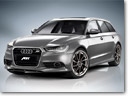
ABT has announced their new tuning program for Audi A6 Avant. The name of the project is AS6 Avant.
“The car is characteristically versatile, stylish and dynamic – and we have tied performance packages which are perfectly suitable to it.”, said Hans-Jurgen Abt CEO of the long established Bavarian.
“The history began with the introduction of the Audi 100 C2, which hit the market in 1977 as Avant. With the new AS6 Avant we look back on 35 successful years in the segment of the noble lifestyle-transporter.”, he added.
There are performance upgrades for the 3.0 TFSI boosted to 420HP (309 kW) and 540Nm – an increase of 120HP and 100Nm. The new 3-liter bi-turbo diesel engine now has 360HP (265 kW) and 700Nm – an increase of 47HP and 50Nm.
Other upgrades include ABT lowering springs or the electronic lowering of the vehicle’s barycentre with the help of the ABT Level.
The exterior features side skirts, a front spoiler as well as a rear spoiler and a new rear skirt set with two powerful double end pipes.
The sportive impression is strengthened with the ABT sports rims. ABT recommends the CR and DR model which harmonises particularly well with the silhouette of the Avant. The wheels are available in 19 up to 21” and naturally also in combination with high speed tyres.
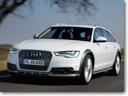
Welcome, to the Audi A6 Allroad. It’s like that beefy relative of yours that’s always around when a pickle jar needs to be opened. The one that also has a degree in geology… anyways. What we have here is a quattro Avant that comes with smart, stop/starting, thermo-efficient engines, a light body and a sturdy look.
There are four engine choices available – three diesels and a TFSI, all in the V6 category. That last one, the petrol, doesn’t make much sense. It’s 3.0-liter displacement accommodates 310PS and 440Nm of torque. It will get the A6 to 60 mph from a stand still in no more than 5.9 seconds and, supposedly, it will return around 31.7 mpg on the combined cycle. That sounds impressive by itself but when a 3.0-liter BiTDI engine is out there as an alternative, the choice is a no brainer really. “Bi” as in two turbochargers, this one has the same power output as the TFSI (313PS) and almost a third more torque – 650 Nm. 0 to 60 mph is done in 5.6 seconds and the economy amounts to 42.2mpg – better in every way really.
If it’s economy you’re after however, then the “standard” TDI is the engine for you – respectable power of 205PS and an economy figure of 46.3mpg with a CO2 output rate of 159 g/km – just bellow a taxation threshold in many countries. For those who won’t be comfortable even with that, there will always be a fourth option which is the mid-range TDI that has 40PS more than the base one and a healthy lump of torque that amounts to 580 Nm. The 60 mph run is done in 6.6 seconds and the cost of it won’t be much as the economy figures are the equally impressive 44.8 mpg.
Except for the BiTDI Allroads, a seven-speed S tronic dual-clutch transmission comes as standard. The BiTDI ones get the latest eight-speed tiptronic automatic transmission.
Regardless of what you might choose, know that power will always go trough Audi’s quattro all-wheel-drive that splits the incoming torque in a 40:60, front to back manner. Know also that, the engines will have the task to propel the lightest A6 generation so far – 70 kg less then the previous models.
Audi A6 Allroad Avant
To affirm itself as an Allroad, the A6 has to flare its wheel arches a bit. The side sills are kind of extended and there are front and rear stainless steel underbody guards that keep rocks out of the sump department.
It’s not all rough-and-tumble with the Allroad. Inside, there’s cleverness as well – a 6.5 inch display, sat nav, an electromechanical steering, Bluetooth and a drive selector that lets you choose how all the gizmos, as well as the adaptive suspension and the engine, work – Comfort, Dynamic, Automatic, Individual and Efficiency are the modes to chose from.
So, does it do better than the VW Passat Alltrack? As a bigger brother, it should so.
Audi has finally announced that the new Audi A8 Hybrid will hit the showrooms this spring. The luxury vehicle is the only European car in this segment. Furthermore, it is the world’s most efficient luxury-class hybrid sedan.
2012 A8 Hybrid is powered by a 2.0 liter TFSI and an electric motor with combined power of 245PS (180 kW) and 480Nm (354 lb-ft) of torque. 0-100 km/h in 7.6 seconds and a top speed of 235 km/h (146 mph). It returns whopping 37.3 mpg (US), which is 6.3 liters per 100 km on combined cycle and CO2 emissions of 144 g/km.
The 2.0 liter TFSI engine features two balancer shafts offset second-order inertial forces to ensure virtually vibration-free and pleasantly quiet operation that goes well with the luxurious character of the A8. All other components are optimized to minimize friction ensuring smooth run. The flow-rate-regulated, pressure-controlled oil pump further reduces fuel consumption.
The electric motor has 45PS (33 kW) of power and 211Nm (156 lb-ft) of torque. Its full power is available practically right from standstill and contributes to a sportily powerful start-up.
The power is put on the road through an 8-speed tip-tronic gearbox.The propulsive power of both drive systems is applied to the road through the front wheels.
The A8 Hybrid comes with state-of-the-art lithium-ion battery mounted in the rear section of the vehicle. It is lighter and substantially more powerful than the previous version. It has a high-strength housing, and a ventilation module ensuring that it always operate within the ideal temperature range.
However, the luggage compartment doesn’t suffer at all – the capacity is 400 liters.
The hybrid drive is designed for fully electric-powered driving up to 65 km/h (40 mph) and for a distance exceeding two kilometers – especially well-suited for driving in the city or residential suburbs.
So everything on paper is just perfect and have to wait a while to see, how the new A8 Hybrid handles the real conditions.
 News from Audi as a Q3 concept has appeared which suspiciously looks munch like the Vali Concept we saw earlier this year. At the very least, this new one is also red… If not even redder. So red in fact that Audi have called it the Red Track. It’s a themed contribution to the Wörthersee Tour that starts in May 16th – a populiar Volkswagen and Audi show.


 Audi Sport Quattro is a legendary car produced in limited series of just 224 units. It was introduced back in 1985. The brutal car is still known as the most powerful rally car ever competed in an international competition – 600HP (441 kW).


 The latest


 Eight automakers from Europe and United States are going to display one-of-a-kind fast-charging technology. It is unique because it will enable recharging of most electrified vehicles for just 15 to 20 minutes.


 2013 Audi Q5 SUV is all about sportiness and comfort. It is multifunctional and spacious, and now even more efficient. The model comes with updated design, infotainment system, chassis and engines.


 Audi is presenting its first luxury-class e-tron concept car – Audi A6 L e-tron at Auto China 2012 in Beijing. The manufacturer also presents two other brand new concept vehicles at the auto show, but they won’t be in focus now.




 ABT has announced their new tuning program for Audi A6 Avant. The name of the project is AS6 Avant.


 Welcome, to the


