A beautiful car needs a powerful engine, that’s why the Italian tuner Romeo Ferraris take the stunning Brera and put a supercharger kit under the hood. Furthermore, the stylish vehicle received a nice exterior package.
The supercharger kit includes a compressor, an intercooler, special piping, an ECU re-map and new full sport exhaust system including a 200 cell catalytic converter. The result is very nice – additional 98PS (72 kW) and 120Nm (89 lb-ft), so the total power of the supercharged 3.2 liter V6 is 358PS (263 kW) and 440Nm (325 lb-ft) of torque. The performance is superb – 0 to 100 km/h in 5 seconds flat and a top speed of 260 km/h (162 mph).
The body kit includes a new front bumper, a pair of side skirts and a modified rear bumper. The stance of the Brera is further optimized by an adjustable sports suspension kit.
All components, including the supercharger, have been developed by Autodelta and Romeo Ferraris is distributor and authorized service center for Italy.
Prior Design has announced the complete BMW E92/E93 M3-style wide body kit for current 3-series.
The body kit includes a new front bumper, a pair of side skirts, a pair of front fenders, a rear bumper, wider rear side wall and modified hood. All parts fit to E92/E93 models and come with TUV certificate for easy entry. You can also order a matching M3 Style stainless steel silencer to complete the original look of the vehicle.
All products are made from quality Dura-Flex. This material is characterized by an excellent texture, provides sufficient flexibility combined with high stability and gives you a simple and inexpensive painting.
In addition, Prior Design allows you as a result of the high accuracy of fit and thus a simple cost-effective installation.
Package includes:
* – Prior-Design PD-MET front bumper fits all BMW E92/E93 models (PDC and SRA also possible)
* – Prior-Design PD-MET side pair (right / left.) Suitable for all models of BMW E92/E93
* – Prior-Design PD-MET front fender pair (right / left.) Suitable for all models of BMW E92/E93
* – Prior-Design PD-MET rear bumper for BMW E92/E93 models (also sheetingable PDC)
* – Prior-Design PD-MET wider rear side wall (right / left.) Suitable for all models of BMW E92/E93
* – Prior-Design PD-M hood for BMW E92/E93 models
* – Mounting material
* – * Including TÜV parts certificate for easy entry of the body parts of § 19.3
Prior Design BMW E92 and E93 M3-Style Wide Body Kit
2012 Toyota Avensis 2.0 D-4D offers unique pence-per-mile performance of just 49.64 pence or £29 781 for 3 YEARS / 60 000 MILES. The family vehicle also has low emission, good dynamic performance, extra equipment and last, but not least sharp new styling.
The new D-4D engine delivers the same amount of power – 124bhp (92 kW), but it has improved combined cycle fuel economy by 15% and a 14% reduction has been achieved in CO2 emissions. In figures this means 61.4 mpg and 119 g/km.
The revision includes a new turbocharger with lower friction bearings and an electric actuator. The torque characteristics of each gear have also been adjusted and as a result, drivers enjoy greater torque at low speeds.
Improvements in engine cooling and lubrication and the use of low rolling resistance tyres have helped cut the CO2 exhaust emissions, along with new glow plug control, changes to the diesel particulate filter and a new piston bowl shape that allows for improved combustion performance.
The new 2012 Avensis benefits from changes to the front and rear suspension. Adjustments have been made to the aerodynamics and strategic use of extra insulation material has further reduced NVH levels in the cabin.
Particular attention has been paid to the electric power steering, which adopts a quicker gear ratio, giving more direct performance, making the car more agile and manoeuvrable.
The focus on comfort extends to changing the design of the front seats to offer better lateral support.
2012 Toyota Avensis D4-D
One of the most important things is the cost of ownership and the new Avensis 2.0 D-4D TR offers best-in-class pence-per-mile performance. This combines with the new model’s higher equipment specification to make it a very attractive proposition for business customers, delivering significant savings compared to rival models in terms of both tax bills and the features you get for your money.
2012 Avensis comes with SAT NAV as standard, advanced connectivity and information features included in the Toyota Touch & Go system.
Overall, the new Avensis 2.0 D-4D cuts the cost-of-ownership bill by £2 000 compared to the previous model thanks to the improved residual values, fuel economy, CO2 emissions and service, maintenance and repair costs over three years/60 000 miles.
The first place goes to Jay-Z’s Maybach Exelero with the cost of the $8 000 000. Beyonce’s husband obviously can provide such ride for him, his DIVA and their upcoming baby. You can even see this “look-like-a-batmobile” vehicle in his video for the song “Lost One”. The optimum speed of this unbelievably expensive car goes up to the number of 351.45 km/h (218.38 mph). Moreover it’s acceleration from 0 to 100 km/h is achievable only in 4.4 seconds. And all this the superstar gets despite the weight of the vehicle, which is the whole 2.66 tones! Maybah Exelero is a high-performance German luxury sports car that was originally made as a one-off for Fulda Tires back in 2005. However nowadays Maybach decided to manufacture them for the general public. I guess only the rich ones can afford them!
Jay-Z and Maybach Exelero
The second place deservedly goes to the Rapper Birdman with his purchase of Bugatti Veyron for the $2 000 000. And although you might think the sum is far less than Jay-Z’s, this car is absolutely worth the price! This European car is one of the most expensive ones in the world, but also is the fastest street legal car in the world! This mid-engine grand touring car has a top speed of 408.00 km/h . In comparison to it, the Super Sport version is much faster with a top speed of 431 km/h (268 mph). The fact you might not know is that it was originally based on the Bentley Hunaudieres concept, and designed and developed by Volkswagen Group. More details about the vehicle is that it features an 8.0 litre quad-turbocharged W16 cylinder engine, which is the equivalent of the two narrow-angle V8 engines.
Rapper Birdman and Bugatti Veyron
Not surprisingly probably for anyone, the third place goes again to …. Bugatti Veyron. This time on the driver’s seat is Simon Cowell – the Super Super-Producer, best known for American Idol and X-Factor. Of course, given these facts, we can imagine that the sum of the $1 700 000 wasn’t a heartbreak for Simon. What we haven’t said about the car already is its acceleration, which for only 2.5 seconds goes from 0 to 100 km/h. And not to forget the maximum speed of 431 km/h (268 mph) which makes the car the one of the fastest car in the world (sorry Jay-Z!). And obviously Simon Cowell has a very good taste for cars and likes to collect them, because in his “backyard” you can also see Ferrari, Rolls Royce Phantom, and 100EX Cabriolet.
Alpina has announced 2012 B6 Bi-Turbo featuring all-aluminium V8 power plant with two turbochargers delivering stunning amount of power.
2012 Alpina B6 Bi-Turbo has a twin-turbo 4.4 liter V8 with 540PS (397 kW) at 5500RPM and 700Nm (516 lb-ft) of torque at just 3000RPM. Two turbo-chargers configured in parallel, each feeding one of the two cylinder banks, with specially developed large diameter exhaust-turbines allow this engine configuration to provide both exceptional power output and an abundance of torque over an especially broad rpm range while maintaining excellent throttle response at low rpm.
High-performance MAHLE pistons are designed specifically to deal with temperatures and pressures associated with up to 1.0 bar charging and the engine’s 9.2:1 nominal compression ratio. Altogether this results in an impressive specific output of 122.7hp (90kW) per litre and a mean total compression of 20.1 bar. Direct injection and Double-VANOS contribute to the B6 Bi-Turbo’s class-leading consumption and emission figures: 10.5 l/100km and 244 g/km CO2, Combined cycle, measured according to ECE Norm.
The performance is simply astonishing – 0 to 100 km/h in 4.4 seconds, which is exactly the same as the latest M5 F10 and a top speed of 320 km/h.
The engine is mated to SWITCH-TRONIC 8-speed Sport Automatic Transmission by ZF. It offers Sport Shift Mode (S) and Manual Shift Mode (M).
2012 BMW Alpina B6 Bi-Turbo
The suspension comes with specific springs, increased front wheel camber and a subtle adjustment of the toe-in in conjunction with a 20″ wheel-tyre combination all serve to produce a very agile chassis set-up. The lightweight 20″ Alpina CLASSIC wheels, with MICHELIN PILOT SUPER SPORT tyres in the dimensions 255/35 ZR20 front and 285/30 ZR20 rear, contribute significantly to the direct handling and precise steering. Conventional tyres are used to promote ride comfort. There are also Drive Performance Control (electronically adjustable dampers) and Dynamic Drive (active roll stabilization) as standard.
The exterior boasts aerodynamics body kit including a new front spoiler with carbon fiber splitter and a rear spoiler with a rear wing, which is available as an option. All these components also ensure the effective flow of air to various cooler groups, such as the inter-coolers and engine cooling system. One special detail: the high-performance brakes, with a diameter of 374mm front and 345mm rear, are additionally supplied with cooling air by a specially constructed NACA air intake on the front underbody.
The interior comes with blue Alpina instruments with high resolution information display with black panel LCD technology. There are also a sport steering wheel, hand-stitched in LAVALINA leather, blue illuminated entry sills with logo and classic Alpina myrtle wood.
The B6 Bi-Turbo features an extensive range of standard equipment, including leather upholstery, fully adjustable comfort seats with heating system, navigation system with preparation for Bluetooth mobile phone, USB audio interface, Xenon lights and LED fog lights.
The Ducati Streetfighter 848 was the inspiration for the “streetfighter yellow” colour of the SLK 55 AMG. And here the designers definitely got it! This vision ensures an exciting appearance from all angles: the exceptional paint finish is guaranteed to provide a high level of appeal. The AMG Performance Studio made it possible to bring this design for the customers as an individual optional extra. Not only is the outside look of the car stunningly appealing, but also is the interior of the SLK 55 AMG. Here the contrasting yellow stitching makes a striking effect against the black nappa leather appointments, and is to be found on the door centre panels, beltlines, armrests, leather-covered roll-over bars, dashboard, the shift lever gaiter and also the AMG Performance steering wheel. You already love it, don’t you! Furthermore the yellow AMG door sill panels feature LED technology, and everything together rounds off the striking effect of the interior.
As it is already well known, AMG Performance Studio is very popular with its special paintwork and leather appointments, but also with its technical solutions and extensive body improvements and transformations. Everything goes around the individual customer requirement, whether it is a stylish upgrade high level of hand-crafted. In the same time everything is made according the highest safety and quality standards, which are very typical for Mercedes-Benz.
The Mercedes-Benz SLK 55 AMG and the Ducati Streetfighter 848 compared to each other are not only similar visually but also technically. In details, both models are the perfect combination of excellent driving dynamics, astonishing design and intense driving pleasure.
Some even may say that the SLK 55 AMG is the most powerful SLK of all time. First of all, because of it’s newly developed AMG 5.5-litre naturally aspirated V8 engine with cylinder shut-off system. Hence, this allows an ultimate performance with the lowest possible consumption levels. With a maximum output of 422 hp (310 kW) and maximum toque of 540 Nm (399 lb-ft), the SLK 55 AMG outperforms all of its direct competitors. In addition its fuel returns 33.6 mpg (14.3 km/l) on the combind cycle and CO2 emissions of 195 grams per kilometer. The acceleration time from 0 to 100 km/h of the SLK 55 AMG is jus 4.6 seconds. The top speed is electronically limited up to 155 mph (249 km/h). High levels of driving dynamics are ensured thanks to the AMG sports suspension with Direct-Steer system, Torque Vectoring Brakes and 3-stage ESP®, as well as the AMG high-performance braking system.
Mercedes-Benz SLK 55 AMG and Ducati Streetfighter 848
The brand new top-of-the range AMG model already demonstrates its uniqueness even at first sight: distinctive AMG light-alloy wheels, specific AMG body styling with AMG spoiler lip and two chrome-plated twin tailpipes at the rear complement the classic roadster proportions.
On the other hand we have the inspiration for the Mercedes-Benz SLK 55 AMG – the new Ducati Streetfighter 848. This amazingly beautiful motorcycle provides unbridled biking pleasure. The reason for this is not only the innovative technology, but also the outstanding appearance that it has. To be more precise, here we speak about a Testastretta 11° engine with 132 hp (97 kW) and an exciting 93.5 Nm (69 lb-ft) of torque as well as a modified frame geometry. All of this is to guarantee a safe, agile handling. In addition all this is supported by the smooth, easy-to-manage power delivery of the engine, improved ergonomics and a tuned traction control (DTC) system. And the extremely talented Ducati designers had taken care of the appearance of the Streetfighter.
To match every taste, there are several visual variants of the bike. The first one is in traditional red with red frame, and the second new Streetfighter 848 is also available in yellow with frame in Racing Black. In addition the Dark Stealth colour variant with frame in Racing Black underscores the amazing outlook of the Streetfighter. Definitely we have no choice but to admit that in the new Streetfighter 848, Ducati has succeeded in combining state-of-the-art technology and astonishing styling in a contemporary design.
Mercedes-Benz SLK 55 AMG and Ducati Streetfighter 848
Volvo launches automatic DRIVe diesels with the same fuel consumption as manual versions
We have very exciting news form Volvo Car Corporation, which just has announced the latest step in its ‘DRIVe towards Zero’ emissions strategy. This will be made possible with the launch of an automatic gearbox option in four Volvo DRIVe models: the S60 DRIVe, V60 DRIVe, V70 DRIVe and the S80 DRIVe. For the first time, these DRIVe models can be ordered with Volvo’s Powershift dual-clutch automatic gearbox. What needs to be highlighted here is that buyers of these cars won’t compromise on environmental care or economy as the automatic cars deliver exactly the same fuel economy and emissions as the class-leading manual variants.
This only can mean that for the first time in history the fuel consumption in variants with an automatic gearbox is brought down to the same level as in the manual versions.
2012 Volvo S60 DRIVe Auto
If you wonder about the fuel consumption (combined cycle) and CO2 figures, here there are:
But wait, if you hurry to buy a DRIVe Powershift, you’ll have to do it in early 2012. The production of the car starts mid-February. And if you are curious about the prices they are exactly £25,230 for the S60 DRIVe, £26,405 for the V60 DRIVe, £27,730 for the V70 DRIVe and £26,980 for the S80 DRIVe.
What I like about this DRIVe Powershift is that the low consumption and emission levels result in a number of technological improvements. First of all, there is a reduction of the friction between gearbox components. Second, the engine and gearbox software have been modified. Third, the start/stop system cuts off the diesel engine when the car is still rolling (below 3mph). Next, to create lower energy consumption, all electrical systems have been optimized. And at last, all the S60, V60, V70 and S80 DRIVe are fitted with Volvo’s latest 4 cylinder 8 valve 1.6-litre turbo diesel engine, which delivers low CO2 while at the same time still delivering a healthy 115hp (84.5 kW) and 270 Nm (199 lb-ft) of torque.
T go further into DRIVe details, the variants of the vehicle are now available with either a 6-speed manual or a 6-speed Powershift automatic gearbox. Next, there is included a brake energy regeneration, a turbo with variable turbine geometry, common rail fuel supply fitted with Piezo injectors. To enhance it more, they have also added a combined catalytic converter and diesel particulate filter, Start/Stop technology with intelligent climate monitoring, Low rolling resistance tires. And at last the details of the Powershift gearbox are the following: wet double clutch, split input shaft (outer hollow shaft encloses the inner shaft), manual gear selection available via the gear selector and hydraulic control.
2012 Volvo S80 DRIVe Auto
With the motto ‘DRIVe Towards Zero’, Volvo Car Corporation aims on improvements on the petrol engines. They are made possible by the optimization of the four-cylinder, 1.6-litre T3 engine (150 hp/110 kW), which is available in the Volvo S60 and V60. Moreover Volvo’s engineering specialists have managed to bring fuel consumption down to 49.0mpg (20.8 km/l) in the S60 (previously 42.8mpg /18,2 km/l). Hence, this corresponds to CO2 emissions of just 135 g/km, which is a reduction of 17g/km!
The Powershift transmission can now be specified with the T3 engine. The reason to do this is that it will reduce an entry level price of an automatic S60 to £24,270. And if you are asking about the figures for the direct-injected T3 engine combined with automatic Powershift in the S60, they are 39.8mpg (16.9 km/l) and 164 g/km.
The S60 and V60 T3 Powershift will be available to order in early 2012. However, they will be firstly delivered in April.
This DRIVe Powershift maybe will make VOLVO Car Corporation a European leader in CO2 reduction. The corporation has a leading role among European carmakers in terms of reducing carbon dioxide emissions. This is being confirmed in the annual analysis presented by the European Federation for Transport and Environment (T&E).
G-Power has revealed BMW X6 M Typhoon with new wide-body kit made from PU RIM. The vehicle is practically the same like G-Power X6 M Typhoon S except the aerodynamics package. Thanks to optimised air flow and up to 15% more cooling, the G-POWER body kit clears the way for an increase in the base output of the mighty engine with 170PS.
The X6 M Typhoon wide body is powered by the same 4.4 liter twin-turbocharged V8 coming with an ECU re-map, a stainless steel sport exhaust system, modified cylinder heads, new exhaust manifolds and new connection pipes between the turbochargers. The result of all this tuning is no less than 725PS (533 kW) and 890Nm (656 lb-ft) of torque, which is an increase of 170PS (125 kW) and 210Nm (155 lb-ft) over the stock. From 0 to 100 km/h in 4.2 seconds and top speed is over 300 km/h (186 mph).
The big SAC (Sports Activity Coupe) stands on enormous 11J x 23” up front and 12J x 23” for the rear axle fitted with 315/25 ZR 23 high-performance tires from Michelin. The suspension features G-Power coilovers and a 30 mm lower ride height. The separate and independently adjustable rebound- and compression damping allows for an individual suspension setup.
G-POWER BMW X6 M Typhoon Wide Body
The G-POWER X6 M TYPHOON wide body kit is produced in OEM quality and features muscular flared wheel arches plus distinctive skirts and spoilers on the front and rear trimmed for maximum aerodynamic efficiency. The body kit is made from PU RIM and has been developed by G-POWER designers using state-of-the-art CAD technology.
Pricing for the TYPHOON aerodynamics package starts at € 13 361– by G-POWER in Autenzell, the optional G-POWER VENTURI hood is € 5 865. The price for the 23” G-POWER SILVERSTONE RS or EDITION wheel set with MICHELIN tyres is € 8 865. The G-POWER GX6M-RS coilover suspension is € 3 029. The G-POWER Bi-Tronik V3 output enhancement to 725PS including complete exhaust system and modifications to the turbocharger installation is available for € 13 526. The G-POWER ceramic braking system for the front axle is € 14 460 and € 11 778 for the rear axle. All prices are net prices plus installation.
G-POWER BMW X6 M Typhoon Wide Body
G-POWER X6 M TYPHOON:
• 725 hp / 533 kW at 6,000 r/min (+ 170 hp / 125 kW)
• 890 Nm at 1,500 r/min (+ 210 Nm)
• V max – more than 300 km/h
• 0-100 km/h – 4.2s
• TYPHOON aerodynamic package starting at € 13.361,– (net)
• G-POWER Bi-Tronik V3 performance enhancement to 725 hp starting at € 13.526,– (net)
Alpina has introduced B3 GT3 sports car, which is based on the BMW E92 335i. The manufacturer purposefully demonstrates that despite a long absence from motor sports, cutting edge automotive know-how and technical expertise continues to be the foundation for the development of exclusive BMW Alpina automobiles.
Alpina B3 GT3 is powered by a 3.0 liter twin-turbocharged inline-six with 408PS (300 kW) and 540Nm (398 lb-ft). The new 8PS (6 kW) over the B3 S Bi-Turbo came from a modified exhaust system. The B3 GT3 also features a titanium rear silencer with double 115 mm tailpipes from Akrapovic. The performance is superb – 0 to 100 km/h in 4.6 seconds.
Fast car needs big brakes and the B3 GT3 has a high performance motor sport brake set-up with 6-piston fixed callipers at the front and 4-piston fixed calliper at the rear, with discs measuring 380 x 35 mm at the front and 355 x 32 mm at the rear.
The grip is crucial, so forged Alpina GT3 CLASSIC 19″ lightweight alloy wheels are available with
Alpina GT3 CLASSIC 19″ lightweight alloy wheels, forged fitted with Michelin Pilot Sport 2 tires for the road or Michelin Pilot Sport Cup+ tires for the track. The dimensions of the wheels are 8.5J x 19” at the front and 9.5J x 19” at the rear as the weight is just 8.6 kg and 9.5 kg, respectively.
Alpina B3 BMW E92 GT3
The suspension features fully adjustable coilovers, meaning the ride height of the vehicle can be changed significantly and additionally the dampers feature a 12-fold compression and 18-fold rebound adjustment.
The interior boasts upholstery in black, both driver and passenger are seated in lightweight Recaro sport seats with seat heating. The seats can be adjusted in height by about 30mm via their mounting points and feature manual back and horizontal adjustment. There are also vertical stripes designed in Alpina racing colours integrated into the front and rear seats. The sports steering wheel with paddles is finished in grippy Alcantara, hand finished with Blue/Green stitching.
The sports car will be available in limited edition series of just 99 units. It will be available from spring 2012 as the price is € 90 000.
Audi has exhibited the A1 Samurai Blue at the 42nd Tokyo Motor Show. The vehicle is specially created in honor to the Japanese national soccer team. The manufacturer plans to sell the SAMURAI BLUE as a one-off model and donate a part of the profit for a charity.
The special edition A1 is powered by a 1.4 TFSI with 122PS (90 kW) and 200Nm (148 lb-ft). From 0 to 100 km/h in 8.9 seconds and a top speed of 203 km/h (126 mph). The car also comes with 18” alloy wheels finished in red and black equipment with contrasting stitching in blue and corresponding colorful accents for the air vent nozzles, inlays, center console and floor mats. The stance and handling are improved thanks to a sport suspension.
An Audi A1 Limited Edition is also planned to sell in 2012, with its design based on the SAMURAI BLUE.
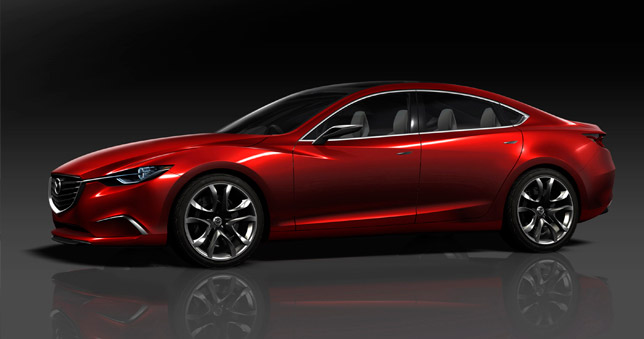
Mazda TAKERI is the new-generation mid-sized saloon concept. The vehicle was firstly presented to the market at this year’s Tokyo Motor Show. This concept car is the crystallization of the new ‘KODO — Soul of Motion’ design theme and breakthrough SKYACTIV Technology. The aim is to show future of Mazda’s new-generation mid-sized saloon.
From the vision of Mazda SHINARI, TAKERI has taken the four-door sports coupe. The car is equipped with unique features such as SKYACTIV-D diesel engine, Mazda’s i-stop idling stop system, and a specific regenerative braking system, called ‘i-ELOOP’, which was developed in the pursuit of ultimate energy efficiency. Together, these technologies achieve astonishing improvements in fuel efficiency and driving performance.
Because of the design, the driving characteristics and environmental credentials, Mazda TAKERI is at the core of Mazda vehicle line-up.
What has to be taken into account about the design is that Mazda TAKERI styling reflects the full nature of a Mazda mid-sized saloon – fully balanced and powerful. And if you wonder what the name means, TAKERI is derived from the Japanese word ‘male’. As it is obvious, in the development of TAKERI, Mazda has sought a breakthrough saloon design. The goal was have a balance between the striking emotional appeal and its’ unmistakable saloon styling. This all happens at a level never achieved before. Hence, the result embodies the quality and appeal demanded in the mid-sized saloon segment.
Furthermore, Mazda TAKERI is fully equipped with the breakthrough SKYACTIV Technology which has been previously introduced on the Mazda CX-5. Its engine is the highly efficient SKYACTIV-D diesel, which, in combination with the six-speed SKYACTIV-Drive automatic transmission and i-stop idling stop system, delivers refined performance and more importantly, offers fuel efficiency.
Mazda’s new regenerative braking system i-ELOOP has been used here too. In addition through the combination of regenerative braking, the highly efficient SKYACTIV powertrain and architecture, and i-stop, Mazda TAKERI offers extremely high levels driving pleasure and outstanding environmental performance. And all of this happens without the use of hybrid technologies.
The exterior design of Mazda TAKERI is built on the styling of the previous model – SHINARI. However, here Mazda has put a focus on making the car’s exterior view design even more arresting by visually capturing a sense of coiled animal power. In addition it fits perfectly around the layout and packaging of a mid-sized saloon car. The front fascia has a powerful overhanging front bumper line, sculpted over the wheels. In addition, the designers had put strengths building a powerful axis that runs the full length of the vehicle. Don’t you think that this vision evokes an image of the car’s spine, and moreover portrays a confident, masculine power as well as a sense of speed?
With SKYACTIV Technology Mazda TAKERI has the superior aerodynamic performance. It was achieved by optimally tuning the airflow over the upper body and efficiently managing the airflow beneath the car with the under floor design.
In comparison to Mazda SHINARI, TAKERI’s interior is a high-level balance of the sense of speed and the functionality of the driver-car interface. But don’t worry, because all necessary materials have been used in order to be achieved the overall comfort and ambience of the cabin.
What is really fascinating about the interior is that the instrument panel fascia has a metal base with a clear coating. Thus, when struck by light, the base naturally has a metallic sheen, displaying a sense of depth and quality.
However, the highlights here have to go for Mazda TAKERI’s new SKYACTIV-D clean diesel engine. The reason for this is that it achieves compression-induced spontaneous ignition at the world’s lowest compression ratio. Hence, the effect is an ideal combustion cycle with highly efficient energy conversion. Moreover, it also results in lower mechanical stress, reducing friction and allowing drastic reductions in the weight of each engine component. Because of these advantages, SKYACTIV-D offers exhilarating acceleration in combination with exceptional fuel economy.
Furthermore TAKERI is also equipped with the specific Mazda’s i-stop system. This system has been developed especially for use with a diesel engine that achieves the world’s first re-ignition with a single compression. The consequences of this are the elimination of the load on the battery and starter motor during restarts and reduction of fuel use to achieve superior environmental performance. This sets i-stop apart from conventional diesel engine idling stop systems, giving smooth, fast restarts and relaxed, stress-free driving.
Check out the specs, below!
Mazda Takeri Saloon Concept
Technical Specifications
Body type
Four-door saloon
Seating capacity
4
Overall length x width x height
4,850mm x 1,870mm x 1,430mm
Wheelbase
2,830mm
Engine
SKYACTIV-D 2.2
Transmission
SKYACTIV-Drive (six-speed automatic)
Drive
Front-wheel drive
Major systems
i-stop idling stop system
i-ELOOP regenerative braking system
Suspension
Front: MacPherson struts
Rear: multi-links
Brakes
Front: ventilated discs
Rear: ventilated discs
Steering system
Electric power assisted steering
Tyres
Bridgestone 245/40 R20
Wheels
9.5J x 20-inch
Engine
SKYACTIV-D 2.2 diesel
Displacement
cc
2 188
Type
Water-cooled, inline 4-cylinder DOHC, 16-valve, direct injection
New for Ssang Yong line up is the Korando crossover. The superbly equipped Korando uses SsangYong’s first monocoque platform and offers a perfect blend of competent off road handling with on road refinement. And can you imagine that the price starts only from £16,995. The benefits of such car are countless. It has the practicality of a 4×4/SUV, the accessibility of a family hatchback, the contemporary looking Korando. Moreover this vehicle has the capability to go from a muddy campsite to the motorway or an icy country lane to the urban school run, and everything is in complete comfort for the convenience of the driver and the passengers.
First of all what is important about Korando is that it has been designed as a towing vehicle. All models are powered by an advanced 173bhp (129 kW) 2.0 litre four cylinder turbo diesel engine producing 360Nm (265 lb-ft) of torque with CO2 emissions from only 157g/km ensuring smooth and strong acceleration no matter what you’re towing.
What is more here is that the four wheel drive Korando EX also has an all wheel drive lock function. It functions when low speed grip and control is needed, such as when driving up a slippery track or off a sodden field dragging a caravan or horsebox.
Korando can pull almost 100% of its own gross vehicle weight. The reason for this is not only the strength of the engine, but also Korando’s inherent stability and grip. This combination leads to solid, dependable pulling power no matter what the conditions are.
The customer can chose between a six speed manual or six speed automatic transmission. In addition, buyers can opt for S or ES trim in their front wheel drive Korando or top of the range EX specification in four wheel drive models. What you’ll love about this vehicle is that it comes entirely equipped with cruise control, ESP with Hill Start Assist and reverse parking sensors as standard. On the other hand the ES comes with a sunroof, climate control, leather upholstery and heated front and rear seats, so that all the needs of the driver and the passenger can be met.
All models are available with a detachable Witter tow bar and electrics at an optional cost of £602.
 A beautiful car needs a powerful engine, that’s why the Italian tuner Romeo Ferraris take the stunning Brera and put a supercharger kit under the hood. Furthermore, the stylish vehicle received a nice exterior package.


 Prior Design has announced the complete BMW E92/E93 M3-style wide body kit for current 3-series.


 2012 Toyota Avensis 2.0 D-4D offers unique pence-per-mile performance of just 49.64 pence or £29 781 for 3 YEARS / 60 000 MILES. The family vehicle also has low emission, good dynamic performance, extra equipment and last, but not least sharp new styling.


 The first place goes to Jay-Z’s Maybach Exelero with the cost of the $8 000 000. Beyonce’s husband obviously can provide such ride for him, his DIVA and their upcoming baby. You can even see this “look-like-a-batmobile” vehicle in his video for the song “Lost One”. The optimum speed of this unbelievably expensive car goes up to the number of 351.45 km/h (218.38 mph). Moreover it’s acceleration from 0 to 100 km/h is achievable only in 4.4 seconds. And all this the superstar gets despite the weight of the vehicle, which is the whole 2.66 tones! Maybah Exelero is a high-performance German luxury sports car that was originally made as a one-off for Fulda Tires back in 2005. However nowadays Maybach decided to manufacture them for the general public. I guess only the rich ones can afford them!


 Alpina has announced 2012 B6 Bi-Turbo featuring all-aluminium V8 power plant with two turbochargers delivering stunning amount of power.


 The Ducati Streetfighter 848 was the inspiration for the “streetfighter yellow” colour of the SLK 55 AMG. And here the designers definitely got it! This vision ensures an exciting appearance from all angles: the exceptional paint finish is guaranteed to provide a high level of appeal. The AMG Performance Studio made it possible to bring this design for the customers as an individual optional extra. Not only is the outside look of the car stunningly appealing, but also is the interior of the SLK 55 AMG. Here the contrasting yellow stitching makes a striking effect against the black nappa leather appointments, and is to be found on the door centre panels, beltlines, armrests, leather-covered roll-over bars, dashboard, the shift lever gaiter and also the AMG Performance steering wheel. You already love it, don’t you! Furthermore the yellow AMG door sill panels feature LED technology, and everything together rounds off the striking effect of the interior.


 Volvo launches automatic DRIVe diesels with the same fuel consumption as manual versions


 G-Power has revealed BMW X6 M Typhoon with new wide-body kit made from PU RIM. The vehicle is practically the same like G-Power X6 M Typhoon S except the aerodynamics package. Thanks to optimised air flow and up to 15% more cooling, the G-POWER body kit clears the way for an increase in the base output of the mighty engine with 170PS.


 Alpina has introduced B3 GT3 sports car, which is based on the BMW E92 335i. The manufacturer purposefully demonstrates that despite a long absence from motor sports, cutting edge automotive know-how and technical expertise continues to be the foundation for the development of exclusive BMW Alpina automobiles.


 Audi has exhibited the A1 Samurai Blue at the 42nd Tokyo Motor Show. The vehicle is specially created in honor to the Japanese national soccer team. The manufacturer plans to sell the SAMURAI BLUE as a one-off model and donate a part of the profit for a charity.


 Mazda TAKERI is the new-generation mid-sized saloon concept. The vehicle was firstly presented to the market at this year’s Tokyo Motor Show. This concept car is the crystallization of the new ‘KODO — Soul of Motion’ design theme and breakthrough SKYACTIV Technology. The aim is to show future of Mazda’s new-generation mid-sized saloon.


 New for Ssang Yong line up is the Korando crossover. The superbly equipped Korando uses SsangYong’s first monocoque platform and offers a perfect blend of competent off road handling with on road refinement. And can you imagine that the price starts only from £16,995. The benefits of such car are countless. It has the practicality of a 4×4/SUV, the accessibility of a family hatchback, the contemporary looking Korando. Moreover this vehicle has the capability to go from a muddy campsite to the motorway or an icy country lane to the urban school run, and everything is in complete comfort for the convenience of the driver and the passengers.


