The latest ground braking innovation from Honda is the Solar Hydrogen Station on Grounds of Saitama Prefectural Office. This initiative is part of the Electric Vehicle Testing Program for Honda’s next-generation personal mobility products.
Furthermore, Honda also equipped the HondaFCX Clarity fuel cell electric vehicle with an outlet to function as a 9kW power source. How it works: the FCX Clarity uses a chemical reaction between hydrogen and oxygen to create power with zero CO2 emissions. This new outlet will help the vehicle to serve as a zero-emission mobile electric generator.
In particular, this is the first installation in Japan which produces stores and dispenses hydrogen with ZERO CO2 emissions.
A uniquely developed high pressure water electrolysis system by Honda produces hydrogen. It has no mechanical compressor, and in addition operates silently and with high energy efficiency. Utilizing Solar and grid power, the system is capable of producing 1.5kg of hydrogen within 24hours, which enables an FCX Clarity to run approximately 150km (90miles).
The goal of the brand is to develop in the future a system which offers clean energy sources for the home in the future, to help replace fossil fuels, reduce emissions and combat climate change.
Honda FCX Clarity uses the new Solar Hydrogen Station in SaitamaHonda FCX Clarity uses at new Solar Hydrogen Station in Saitama
Skoda brand is releasing limited-edition version of its Yeti compact SUV, whihch is named 2012 Skoda Yeti Urban Limited Edition. The model is based on the already highly popular SE trim. However, it features some worthy equipment. The Yeti model achieved great success after its launch in 2009 and won in fact 12 independent products awards. It has overtaken the public by its high-quality on-road performance, family orientated practicality and rugged styling. The new Yeti Urban LE is restricted to just 750 cars, which will expand that appeal to younger and more style-conscious customers.
What is more in that particular model is that in it are featured some new and exclusive technologies. For instance, DAB digital radio comes now as standard. In addition, Yeti Urban includes Amundsen+ satellite navigation, Bluetooth connectivity and a multi-function steering wheel to control the audio system and telephone.
2012 Skoda Yeti Urban Limited Edition
Fascinating design features are also included: 17-inch black-and-chrome ‘Matterhorn‘ alloys, wheel arch extensions, chrome side strips, silver door mirror caps, silver roof rails and stylish eye-catching roof stripes. For the interior customers can choose between red or black sports seats and sunset glass in the rear.
Furthermore, the Yeti Urban is available in two-wheel-drive with manual transmission only, and comes with a choice of two engines. The first one is the petrol engine 1.2-litre TSI 105PS (77 kW), which offers fuel economy of 44.1mpg (combined) and CO2 emissions of 149g/km. Of course, there is a diesel version as well: the popular 2.0-litre TDI CR 110PS (81 kW) DPF, which offers figures of 52.3mpg (combined) and CO2 emissions of 140g/km.
The exterior body paint of the model is offered in several different colors: Black Magic pearl effect, Candy White, Brilliant Silver metallic and Steel Grey metallic.
Skoda retailers have a number of accessories worthy of mention: stainless steel pedals, sports exhaust trim, and Nextbase Click 9 Lite Duo portable DVD player with twin 9-inch screens.
Yeti Urban standard features are: 17-inch black-and-chrome Matterhorn alloy wheels; Amundsen+ satellite navigation; Bluetooth GSM II telephone preparation; DAB Digital radio; Chrome exterior side moulding strips; Decorative interior insert; Silver door mirror covers; Multi-function steering wheel for radio and telephone; Roof stripes; Silver roof rails; Sports seats – red or black; Sunset glass; Wheel arch extensions; Metallic paint; Acoustic rear parking sensors; Cruise control; Dual-Zone air conditioning; Maxi-dot trip computer; Fog lights; Front centre armrest with storage compartment.
2012 Skoda Yeti Urban Limited Edition will go on sale from the beginning of April this year with a starting price of £16 900 for the petrol model and £18 330 for the diesel.
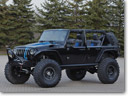
Jeep Wrangler Apache Concept is extremely rough off-road vehicle. It is powered by a new Mopar 6.4 liter HEMI V8.
The engine delivers 470HP (346 kW) and 637Nm (470 lb-ft) of torque. The engine is mated to a Chrysler Group’s W5A580 5-speed automatic transmission. However, a 6-speed manual gearbox will be also available.
Other highlights include Mopar Pro 60 5.13 front and rear axles, a 4.5” Stage 3 long arm lift kit and off-road bead-lock wheels. There are also high-clearance flat fenders, front and rear half-door kits, rock rails and a Stinger front bumper.
A Warn 9.5ti XP winch, a locking center console box, Katzkin leather seats, and a Mopar branded interior complete the package.
The Mopar Wrangler V8 conversion kit will be available this summer.
Here’s a video of a Ford GT setting up a record on the Texas Mile Event at Chase Field Industrial Complex in south Texas: 257.7 mph – full 4.6 mph faster than the previous champion.
As you might have guessed, this is no ordinary Ford GT. It’s a Hennessey job this. Owned by Mark Heidaker, driven by Sean Kennedy this overhauled beast wrote some history. But before that, some professional help was needed. That’s when Hennessey Performance glued 34 psi Precision Turbochargers to the 5.4 liter Ford engine. The engine and power management as well as the data acquisition system were all installed and tuned by MoTeC people. Add some high-octane racing gasoline and you’ve got yourself a record breaking formula.
“I think I can do better in the lower gears next time and we can run an even better speed.” said Kennedy – ambitious. So, next stop: the Texas Mile Event on October the 26th 2012. Goal: 260 mph.
Autocar.co.uk has released a test review of the strange Nissan Juke-R, which is claimed to be the ultimate crossover. Practically, the car is a GT-R with different body, because everything from the sports car is taken and put in the Juke.
The Juke-R is powered by a twin-turbo 3.8 liter V6 with 485HP (357 kW) at 6400RM and 588Nm (434 lb-ft) at 3200RPM. The engine is mated to a 6-speed dual-clutch gearbox enabling the car to accelerate to 100 km/h in just 3.7 seconds and having a top speed of 258 km/h (160 mph).
There is no doubt, that the Juke-R is very interesting, fun and spectacular, but all in all it is a marketing trick aiming to boost Nissan’s sales.
The car have been developed by Nissan and are being built by leading motorsports outfit RML with input from Nissan Technology Centre for Europe (NTC-E).
The ultimate crossover also features sport suspension, huge wheels and performance brake system. The interior is also coming from GT-R. You’ll see the same dashboard, dials, steering wheel and many more.
What are the impressions? Check in the video below.
Various Camaros have gone under the 1LE label since 1988. It’s an upgrade package inspired by the car’s involvement in Pro-Am road racing. Now it is on the horizon again for the 2013 SS coupe versions – the 1SS and 2SS that carry a V8 under their bonnets and a manual transmission as standard. Actually, the whole makeover is intentionally reminiscent of the ZL1 spec.
“The Camaro 1LE combines the best elements of the SS and ZL1 to take road-racing performance to a whole new level,” said Al Oppenheiser, Camaro chief engineer.
Power levels will be pretty much the same as the ones in the SS – 426 horsepower (318 kW) and 420 lb-ft of torque (569 Nm). The transmission is an exclusive one however – Tremec TR6060-MM6: a close ratio setup tuned for road-racing performance.
The suspension gets new monotube rear dampers as opposed to the twin-tube ones previously used. That way, drivers have more flexibility in terms of adjusting the road behavior while preserving respectable comfort.
Other goodies for track days include the:
Larger, 27-mm solid front stabilizer bar, and 28-mm solid rear stabilizer bar for improved body control
Higher-capacity rear-axle half shafts to cope with increased levels of traction
Strut tower brace for improved steering feel and response
ZL1-based 20 x 10-inch front and 20 x 11-inch aluminum wheels
285/35ZR20 Goodyear Eagle Supercar G:2 tires front and rear (identical to the front tires for ZL1)
ZL1 wheel bearings, toe links and rear shock mounts for improved on-track performance
ZL1 high-capacity fuel pump and additional fuel pickups for improved fuel delivery during high-cornering
At first glance, it would be hard for you to notice all of that but worry not. The 1LE gets some distinctive exterior features as well – a matte-black hood, a front splitter and a rear spoiler. The aforementioned wheels also come in black and have 10-spokes. Can’t miss that.
Inside, suede microfiber material covers the flat-bottomed steering wheel and the stubby shifter stick. Most importantly, Chevrolet’s MyLink infotainment is available on all 2013 Camaro LT, SS and ZL1 models – a complex interactive system that has Bluetooth, SmartRadio, Pandora and the lot.
A smart electric power steering can sense whether we are at cruising speed or trying to park and adjust the firmness appropriately. Also new for 2013 is an available dual-mode exhaust system, available on Camaro SS models. Again all ZL1 derivatives.
Prices for the 1LE model will start at under $40 000
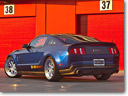
The New York International Auto Show will be the venue where Shelby American Inc. will debut their most powerful project yet – the GT Ford Shelby 1000 which started life as a more “standard” 2012 GT 500. And no, the 1000 does not consist of two GT 500s. It’s only one of them, with handling, power and breaking performance all beefed up.
Although it’s called the Shelby 1000, both of the versions in which it will be offered do not develop 1000 bhp. A street legal one has the “mere” 950 ponies while a track spec. called the Shelby 1000 S/C delivers 1100 bhp. In a strange world we live in.
For that kind of power one would expect a nuclear bomb under the hood. Well, it’s actually an overhauled Ford 5.4-liter V8 unit that has new rods, crank and pistons. Also, the heads have been flown, the cooling and exhaust upgraded and the supercharger replaced.
The stopping power on the other hand, is provided by four massive disc brakes – six-piston callipers at the front and four-piston ones at the back. The suspension includes new struts, sway bars and bushings. There are some aerodynamic tweaks as well for the sake of downforce.
A limited production of Shelby 1000s will be built, each numbered and documented. The upgrade packages alone are expected to cost up to $154,995. That’s almost as expensive as three “normal” GT 500s.
Nissan won’t be the only company that shows back ends as teasers for the New York International Auto Show. Here’s something from Toyota as well. Supposedly it will be a “stunning” sedan that has been U.S.-designed. The global premiere will take place in the Galleria room within the Jacob Javits Center at 10:30 a.m. EDT on April 5, 2012.
Toyota are being quite quiet about it so we’ll just have to guess. “Elegant yet athletic” they say. Well, this sketch here does suggest the latter. Obviously, those wheel arches won’t be that full in real life, or will they? Whichever the case, the teaser does seem to work. We are deeply interested now of what this might be. That further works for the argument that one doesn’t need silly 8-second videos that show passing florescent lights over something, in order to inspire curiosity.
On the day of the reveal a live-streaming video chat with the designers is being scheduled. The public and the media can forward direct inquiries about this sedan via Facebook or Twitter.
I have a beef with today’s hybrids and electric vehicles. Its their batteries that get me. One does not even have to own a hybrid. Instead, simply observe how your cell phone acts throughout the years – the charge capacity is getting lower and lower, cold weather doesn’t help at all and neither do the summer days. Now, imagine that in a car – driving along with 2 or more “bars” on the dials, no worry in the world, and then it all suddenly goes bust. Nerve wrecking.
Happily however, Volvo are aware of the situation, aware of my frustration obviously. That’s why with the C30 Electric, the company is working towards providing relief to the dying batteries around the world. Essentially they are aiming at a vehicle that is available and drivable at all conditions – scorching hot, arctic cold or lukewarm if you will.
For the former two conditions, one needs a cabin that comes with climate-control. It would be plainly silly to use the precious battery charge on heating or cooling the insides of the car. That’s why the C30 Electric is is equipped with a sophisticated climate system that can be activated both during charging and driving. It works for the passengers, it works for the drivetrain and most importantly, it works for the battery pack.
Whilst charging a C30 Electric (people tend to do it at home with a standard power socket), you can precondition it. Let’s say that the outside temperature is -19 degrees Celsius: no worries. Even if not plugged in, the car’s automatic battery heating will kick in to prevent the charge from going bust. Otherwise, if plugged in, an immersion heater (6 kW) uses power from the wall socket for warming up the coolant in the climate system.
So, should you ever decide on buying an electric car and the seasons are a bit extreme at your place, why not get a Volvo C30? It’s like literally having someone to warm up the bed for you.
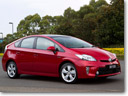
In a bid to attract even more buyers, Toyota have turned up, in Australia, with a bag of updates for the 2012 Prius. It now has a new face, some extra equipment, its suspension has been tweaked and is cheaper than ever.
Visually, the front lower end sees a new bumper and a larger, trapezoidal lower grille. LED daytime running lights find their place right beneath the indicators within the bumper while the fog lights have moved on the sides of the lower grille. Elsewhere, one would find that the taillight cluster has been changed, the mirrors are now heated and power-folding. The wheels remain 15 inches (17 for the i-Tech trim) but the design is new. Overall the 2012 Prius is 20 mm longer than the previous ones but that length seems to have gone to the overhangs as the wheelbase stays the same.
Inside we get new seats and more quality upholstery, the multi-information display is now more vivid than ever and even the entry level gets a rear view camera. There are some less useful features as well – an “ECO calculator” that apparently allows you to do math and estimate how much money you are dreadfully spending on fuel. Wasn’t it the whole purpose of buying a Prius to set yourself free from consumption worries? Why would I want to preoccupy my mind with that? Anyway, Toyota have also added a HUD readout on the screen and a touch pad sort of thing on the steering wheel so that you, or anyone else who might be driving, can remain focused on the road. In case you get lost however you can always refer to the HDD navigation system (i-Tech again). Other standard safety features include seven airbags, stability and traction control, active front head restraints and anti-skid brakes.
Sounds unimaginable when talking about a Prius, but, assuming you won’t be always driving around in ECO mode, performance and comfort may actually benefit from a now stiffer, better welded together body. The improve rigidity allows the installment of a softer and kinder suspension.
Underneath it all hides a hybrid system as usual – 100 kW of combined power coming from an 1.8-liter Atkinson cycle petrol unit and a 650-volt electric motor/generator powered by a 201.6-volt nickel-metal hydride battery pack. In return you get 89 g/km of CO2 emissions and 3.9 liters per 100 km of fuel economy. In EV mode, the Prius is capable of covering road stretches of 1-2 km solely on a battery charge.
For the whole package, you have to pay $33,990 – almost $6000 less than the price of the first ever Prius. The i-Teck on the other hand, sticks to its price tag – $45,990. What do you think? A good buy? 17,000 in Australia alone seem to approve.
Here are several starts of a brutal Jeep Cherokee SRT-8 Supercharged with 700HP against some powerful, tuned vehicles – BMW X6M Hamann Stage 2 670HP, Porsche Cayenne Turbo Gemballa GT600 with 600HP, Ford Mustang GT500 612hp and Porsche 911 Turbo Stage 2 580HP.
As you can see, all these SAVs and cars are underpowered, but as we know – power is nothing without control. Although the BMW starts first with reaction time of only 0.310 seconds, it is quickly overtaken by the Jeep. The X6 M crosses the finish line with 248.31 km/h terminal speed against 246.74 km/h for the Cherokee.
In the second start versus the Cayenne Turbo the scenario is the same. Better reaction from the Porsche driver, but worse 60ft and overall performance – 236.43 km/h at 1 mile for the Cayenne and 262.49 km/h for the Cherokee.
The third start is versus the mighty Mustang having 612 HP, a lot less weight and way better cD (drag coefficient). At the start the Mustang is dominated, because it is RWD against the AWD in Cherokee. The Mustang’s 60ft time is bad – 2.198 seconds against just 1.699 seconds for the Cherokee. However, the car crosses the finish line with 284.27 km/h, which is more than enough for a win.
In the last start, the Cherokee is against Porsche 911 Turbo with 580HP. The SUV didn’t have any difficulties, because it started first, with better 60 ft time and overall performance – 260.05 km/h and 29.820 seconds at 1 mile.
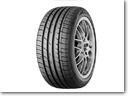
Falken is one of the biggest tyre manufacturers in the world. Until now, tyre engineers have struggled to offer lower rolling resistance and the highest levels of wet weather grip, finding attributes to be usually mutually exclusive. However, the Japanese tyre maker has achieved this challenging balance by taking alternative ways to reduce the heat and therefore the energy required to deliver the desired grip performance required for a European premium tyre.
By using silica in combination with long, modified polymer chains, a new rubber compound has been developed which reduces excess heat generation and therefore, rolling resistance. The result is a 3.8% fuel saving compared with a non-optimised tyre.
Other advantage is the extended operating life of the new tyres affecting the running costs.
The engineers in Falken also looked closely at using the tread pattern to get better wet weather performance. The result was a total of four wide tread grooves in the tyre cap design to allow for efficient water deflection and achieve superb hydroplaning resistance.
The new ZIEX ZE914 comes with tread wear indicators to precisely monitor tyre wear. It is available in 10 sizes with speed ratings of V, W and H at launch. By 2013, Falken will expand the range to include 70 versions. The ZIEX ZE914 is the third tyre launched in Europe by Falken in as many months and aims to compliment the significant growth the firm achieved in Europe in 2011.
Falken ZIEX ZE914
Tyre dimensions available as of spring 2012
From spring 2012 the new Falken ZIEX ZE914 will be offered in ten different dimensions with V, W and H speed ratings. Two new sizes will be available:


 Jeep Wrangler Apache Concept is extremely rough off-road vehicle. It is powered by a new Mopar 6.4 liter HEMI V8.


 Here’s a video of a
 Autocar.co.uk has released a test review of the strange Nissan Juke-R, which is claimed to be the ultimate crossover. Practically, the car is a GT-R with different body, because everything from the sports car is taken and put in the Juke.
 Various


 The New York International Auto Show will be the venue where



 I have a beef with today’s hybrids and electric vehicles. Its their batteries that get me. One does not even have to own a hybrid. Instead, simply observe how your cell phone acts throughout the years – the charge capacity is getting lower and lower, cold weather doesn’t help at all and neither do the summer days. Now, imagine that in a car – driving along with 2 or more “bars” on the dials, no worry in the world, and then it all suddenly goes bust. Nerve wrecking.


 In a bid to attract even more buyers,


 Here are several starts of a brutal Jeep Cherokee SRT-8 Supercharged with 700HP against some powerful, tuned vehicles – BMW X6M Hamann Stage 2 670HP, Porsche Cayenne Turbo Gemballa GT600 with 600HP,
 Falken is one of the biggest tyre manufacturers in the world. Until now,

