Blog

  • MINI Multitone Edition

    MINI has launched a brand-new limited edition for the MINI Electric; the Multitone Edition, with exclusive designs on both the exterior and interior of the car.

    Limited to just 200 examples in the UK, the MINI Multitone Edition symbolises the diversity within the MINI community and is offered with an edition-exclusive multitone roof design. Extending from the windscreen frame to the rear across the entire roof, the gradient starts with Aspen White before transitioning through the subdued grey shade of Melting Silver II then finishing in Jet Black.  The unique look created by this colour gradient is complemented in the MINI Multitone Edition by an abstract, white rainbow on the roof, which is also featured throughout the design of the special edition.

    This special look is made possible by the innovative wet-on-wet painting process used by the British MINI plant in Oxford. With this Spray Tech paint finish, the three colour shades are applied directly one after the other. Due to changing environmental conditions, deviations in the colour pattern may occur, making each MINI Multitone Edition vehicle unique.

    Offered on MINI Electric for the first time, the new MINI Multitone Edition is presented exclusively in Sage Green Metallic, which has previously only been available on the MINI Countryman.

    The black or chrome trims surrounding the headlights and MINI badge have been replaced and are offered for the first time in White alongside 17” Scissor Spoke 2-tone wheels.

    On the exterior of the vehicle, a graphic rainbow motif made up of Indian Summer Red and Sage Green colours can be found on the C-Pillar with matching-coloured designs also found on the side scuttle and door sills, and exclusive self-levelling wheel caps in a two-tone design.

    These motifs continue into the interior of the vehicle, where logos can be found on the sun visor, floor mats, cockpit facia and steering wheel. Customers of the MINI Multitone Edition will also receive a 3D printed key car in Sage Green.

    The MINI Multitone Edition is offered to market as a MINI Electric Level 2, featuring front heated seating, automatic dual zone air conditioning, sports leather steering wheel and sports seats as standard. Also standard is a 8.8” centre display screen, Apple CarPlay, MINI Navigation system, cruise control, MINI Driving Modes, rain senior with automatic headlight activation, rear view camera and rear park distance control.

    The new MINI Electric Multitone Edition is limited to just 200 units in the UK .

  • Skoda Vision 7S Concept

    Unveiling its seven-seater VISION 7S study, ŠKODA AUTO provides a first view on the brand’s new design language, which combines robustness, functionality and authenticity. The VISION 7S is also the first ŠKODA with a matt body colour. The interior ambience is characterised by sustainable materials and interactive surfaces. The concept car boasts a range of over 600 kilometres (370+ miles) in the WLTP cycle thanks to an 89 kWh battery.

    New front view with Tech-Deck Face

    The ŠKODA VISION 7S is the first model to feature the Czech carmaker’s new, striking design language. Along with the Tech-Deck Face at the front end, it sports a solid underbody and aerodynamic roof lines, enhancing its efficiency. At first glance, the long passenger compartment hints at the generous interior space.

    The front of the vehicle also incorporates familiar design elements, such as the signature ŠKODA line. The redesigned ŠKODA wordmark replaces the brand’s picturemark and is complemented by a new ambient light strip. This extends across the entire width of the vehicle at the upper edge of the front section and features illuminated graphics. The so-called Tech‑Deck Face embodies a modern reinterpretation of the familiar ŠKODA grille. Though it has similar lines, the Tech-Deck Face is significantly flatter and wider than the previous styling. The ribs have been replaced by dark glass that conceals the vehicle’s sensors.

    New T light cluster, front and rear

    The narrow headlights are positioned further outwards and arranged in two rows one above the other, extending the four-eye light cluster to form a ‘T’. The daytime running lights extend well into the wings and form the sharply defined upper line of the ‘T’, visually framing the front. The rear LED lights are also arranged in a ‘T’. Again, the upper line extends laterally into the wings. This design accent is repeated on the camera exterior mirrors as well as the sensor door handles, which are recessed into the body and arranged vertically.

    Robust bumpers with distinctive air intakes

    The bumpers at the front and rear of the ŠKODA VISION 7S are particularly striking. They are made of durable, recycled tyres. This material is also used for the wheel arch linings and adds a rugged visual highlight. Seven vertical air intakes are integrated into the front, through which air is directed to the cooling systems and brakes. The VISION 7S has nine vertical air outlets in the rear bumper. A control element in bright Flashy Orange is located in the centre of both the front and rear. These can be pulled out to serve as hooks. In addition, they can be used to safely cut off the vehicle’s high-voltage current from the outside, if required.

    High tornado line and gently sloping roof for aerodynamic efficiency

    A high tornado line separates the solid underbody from the side windows and emphasises the powerful shoulder sections through its curve. The squared-off wheel arches beneath it are prominent and clearly recessed. The wheels have a diameter of 22 inches; the aerodynamically optimized rims are almost completely closed. Additional air outlets are positioned between the wheel arches and above the side skirts. These act as running boards for the portal doors that swing up in opposite directions and also have cover grilles. These grilles channel the warm air generated from cooling the high-voltage battery to the outside. The flat roofline gently slopes to the rear and merges with a pronounced roof spoiler for high aerodynamic efficiency. The triangular D-pillar extending to the rear features a bold design. At the bottom, it bears the new ŠKODA wordmark, which also appears on the tailgate and is lit up in the same way as at the front of the vehicle. The matt metallic paint finish in the bright colour Explorer Green underscores the minimalistic look of the VISION 7S. This is also the first ŠKODA with a matt body colour.

    Sustainable materials in the interior, operation even more intuitive

    The minimalistic interior is as spacious as you would expect from ŠKODA and conveys a sense of security, which is further enhanced by the combination of dark and light materials. These are leather-free, mostly come from sustainable sources and are extremely durable thanks to some smart material combinations. One example is the floor of the VISION 7S, which is also made from recycled tyres. The interior trim is also sustainable. This is coated with a fine, matt metallic layer and thus conserves valuable resources. The fabrics are made of 100% recycled polyester yarns.

    Great emphasis was placed on further optimising usability. In addition, the vehicle’s menu structure and infotainment functions have been streamlined, and the controls on the central, free-standing touchscreen, as well as haptic keys for important or frequently used functions, are particularly intuitive.

    The right interior for every setting

    The VISION 7S represents a compelling further development of ŠKODA’s interior concept, combining a spacious, protective interior for up to seven passengers with a complete reconceptualization of the natural human-machine interaction (HMI). The highlights include two distinct interior configurations – Driving and Relaxing – and an ideal balance between haptic and digital controls. A sense of safety and protection is conveyed by the innovative child seat, which is mounted in front of the second row of seats on the centre console opposite to the direction of travel. All of this is surrounded by durable, sustainable materials and many new Simply Clever ideas. Rounding off the interior design is the unique X-shaped decorative stitching, which accentuates the SUV character.

    The interior of the VISION 7S embraces its (up to) seven passengers with the spaciousness typical of a ŠKODA as well as a feeling of safety and protection. The interior is symmetrical, giving all passengers the same generous sense of space. The upper line of the instrument cluster continues into the door panels, completing the wrap-around design and supporting the feeling of protection. In addition, the wide, horizontal dashboard extends to the doors, accentuating the airy and spacious interior.

    Two interior configurations: Driving and Relaxing

    The VISION 7S offers passengers two different interior configurations, with a rotating central touchscreen and sliding elements to create the perfect ambience for different situations – Driving and Relaxing. While driving, all the controls are in their ideal position within easy reach for the driver, and the central 14.6-inch touchscreen is oriented vertically for enhanced accessibility and information stacking. When charging or stopping, the Relax mode can be selected at the touch of a button in the centre console. The interior transforms in one elegant, synchronous movement; the steering wheel and instrument cluster slide backwards away from the driver and passengers to create additional space. The first-row seats rotate inwards and recline for extra comfort, also allowing the rear passengers to view the screen. The seats in the second row also recline. All passengers can then enjoy a more comfortable seating position and a better view of the screen, which rotates to a horizontal position to optimally display the entertainment content.

    Natural HMI operation completely re-envisioned

    For the VISION 7S, the ŠKODA Design team reconceptualised the car’s HMI from the ground up, emphasising the perfect harmony between the haptic (manual) and virtual (on-screen) controls. Everything was designed with the aim of simplifying the user experience. The control elements are intuitive, always enabling the driver to easily find and use the function they are looking for.

    In Drive mode, the driver benefits from an advanced AR head-up system displaying the most important driving data and an 8.8-inch digital instrument display for extra information.

    The steering wheel has been completely redesigned, with two solid spokes at the 12 and 6 o’clock positions. The new ŠKODA wordmark is positioned centrally. The steering wheel rim is flattened at the top and bottom, making the 8.8-inch digital instrument display easy to see. There are dedicated haptic scroll wheels for the most important functions during driving, highlighted by Flashy Orange accents for quick orientation. In Relax mode, the driver can control more sophisticated functions through the integrated touchpad on the lower spoke.

    The centre of the interior is dominated by the large, rotating 14.6-inch screen, the largest ever installed in a ŠKODA car. In Drive mode the display is oriented vertically, allowing for information to be perfectly stacked; the upper area of the screen, for example, is dedicated to important visual content such as the map and navigation guidance, while the lower area is easy to reach and control. It is supported by an ergonomically placed hand rest atop the centre console. The user can adjust the amount of information simply by swiping up or down. In addition, the menu widget can be used to scroll through various functions. For instance, the baby camera image can be placed anywhere in the user-defined area. The remaining area could be used in high resolution for the maps, for example. In Relax mode, in particular with the screen oriented horizontally, user-installed apps can be used for watching films or gaming. Given the longer distance to the screen when the seats are reclined, the infotainment system can also be operated by smartphone.

    Three rotary controls for easy usability

    The redesigned centre console features six additional buttons that give the driver direct access to the infotainment, phone, vehicle settings, navigation and app menus; the sixth button can be user-assigned. Below are three large rotary controls; the two outer dials are dedicated to climate control, while the middle one controls the screen content. It can be used to zoom in and out on the map and scroll through lists. Beneath these are two buttons for switching between the Drive and Relax modes and a dedicated volume scroll wheel. Like the steering wheel controls, the buttons and dials feature accents in Flashy Orange to aid orientation.

    Smartphones can be placed in the centre console. These are the main sources of information and customisation for the entire system and can be used as a remote trackpad. They are held in place by magnets and partially covered by the central armrest for protection. In this position, the armrest can be used to support the arm for perfect ergonomics in conjunction with the hand support under the screen.

    Passengers in the second and third row can magnetically attach their devices to the seat backrests in front of them for optimal viewing. Interactive surfaces with coloured lights shining through the fabric are integrated into the door panels; a bright light in Flashy Orange, for example, points to the door openers hidden in the lower part of the panel, while a blue or red light visualises air‑conditioning temperature changes. You can also write on the fabric with your finger – to leave short notes or for children to create little drawings.

    Maximum protection: Child seat in the safest position in the vehicle

    The position of the child seat is also innovative and mounted in the safest place in the vehicle. It is integrated into the centre console, which extends to the second row of seats, opposite to the direction of travel. This means the child is optimally protected, and the passengers in the second row can always keep an eye on him or her. An optional interior camera in the rear roof area can also transmit a video of the child to the central infotainment display. This makes it possible for the driver and front passenger to see the little ones on board at all times.

    More Simply Clever features

    The VISION 7S introduces a new series of Simply Clever features ŠKODA is famous for. The air vents on the dashboard work in a discreet, diffuse mode until more direct ventilation is needed; at the touch of a button, they slide upwards to provide a direct stream of air.

    Passengers will also find magnetic surfaces under the floating centre console, where metal ŠKODA drinks bottles or a first-aid kit can be securely attached. The VISION 7S also includes practical backpacks that are magnetically attached to the seat backrests magnetically and can be taken with the family on days out. A large panoramic glass roof floods the interior of the VISION 7S with light. In front of the central screen on the instrument cluster is a large crystal that indicates the battery and charging status of the VISION 7S using different colours. This can be seen easily from outside the car.

    Sustainable materials and ambient lighting

    The entire interior is trimmed in a mix of sustainable, durable materials. The upper part of the dashboard and doors are finished in a dark artificial leather and bordered by indirect ambient lighting that emphasises the protective wrap-around design. The lower parts, like the dashboard and the door armrests, are trimmed in a lighter artificial leather that echoes the exterior colour Explorer Green and is accentuated by direct ambient lighting. In the area where the B-pillar would be and the counter-hinged doors meet, the lower part of the door trim is drawn upwards at an angle, culminating in a crystal on both the front and rear doors. These crystals illuminate the entry into the vehicle with a running white light, for example, or warn of an oncoming vehicle or cyclist with a red light when the door is open. The central zone of the door panels is upholstered in a black fabric made from recycled polyester yarns. Recycled fabric is also used for the inner areas of the seats and on the dash. Rounding off the interior design is the unique X-shaped decorative stitching, which accentuates the SUV character.

    This is the first time ŠKODA has replaced the traditional chrome accents with a unique matt paint. All functional elements, including the controls, seatbelts and first-aid kit, are highlighted in the eye‑catching Flashy Orange colour.

    The floor and boot, which are made entirely of recycled-tyre veneer, also follow the VISION 7S’ sustainable ethos. This special material is scratch-resistant and easy to clean, underlining the car’s suitability for exploring the great outdoors as well as its practicality and family friendliness.

  • Audi enters Formula 1

    Audi Formula 1 - Front Angle

    Audi enters the premier class of motorsport. From 2026, the premium Audi brand will compete in the FIA Formula 1 World Championship with a specially developed power unit. The project will be based at Audi Sport’s facility in Neuburg near Ingolstadt. This is the first time in more than a decade that a Formula 1 power train will be built in Germany.

    Audi announced its entry at a press conference at the Formula 1 Belgian Grand Prix at Spa- Francorchamps. At the event, Markus Duesmann, chairman of the Board of Management of AUDI AG, and Oliver Hoffmann, member of the Board of Management for Technical Development, answered questions in the company of Formula 1 President and CEO Stefano Domenicali and Mohammed bin Sulayem, president of the International Automobile Federation (FIA).

    “Motorsport is an integral part of Audi’s DNA,” says Markus Duesmann. “Formula 1 is both a global stage for our brand and a highly challenging development laboratory. The combination of high performance and competition is always a driver of innovation and technology transfer in our industry. With the new rules, now is the right time for us to get involved. After all, Formula 1 and Audi both pursue clear sustainability goals.”

    The key to getting involved in the world’s most popular racing series is the clear plan to become more sustainable and cost-efficient. The new technical rules, which will apply from 2026, focus on greater electrification and advanced fuel that is more sustainable than that which is currently used. In addition to the existing cap on costs for teams, a cost cap for power unit manufacturers will be introduced in 2023. In addition, Formula 1 has set itself the ambitious goal of being a carbon-neutral racing series by 2030.

    Actively Shaping Formula 1’s Transformation

    Oliver Hoffmann, member of the Board for Technical Development, says: “In view of the major technological leaps that the series is making towards sustainability in 2026, we can speak of a new Formula 1. Formula 1 is transforming, and Audi wants to actively support this journey.

    A close link between our Formula 1 project and AUDI AG’s Technical Development department will enable synergies.”

    From 2026, the electric power output for the power units, consisting of an electric motor, battery, control electronics, and a combustion engine, will increase sharply compared to today’s Formula 1 drive systems. The electric motor will then be nearly as powerful as the combustion engine, which has an output of about 400 kW (544 horsepower). The highly efficient 1.6-liter turbo engines run on advanced fuel that is more sustainable – also a prerequisite for Audi’s entry into the series.

    202 Audi Formula 1 - Front

    High Popularity in Key Markets and with Young Target Groups

    Globally recognized, highly emotional, and technologically advanced – that’s how Formula 1 has met Audi’s exact requirements. The series holds races in all relevant markets of the brand. As a spectacular platform for the most demanding electrified racing cars in the world, it is of particular interest to car manufacturers. Audi is taking on the challenge of proving its “Vorsprung durch Technik” in this competitive environment.

    The great interest in Formula 1 is global and this racing series is one of the sporting events with the highest reach in the world. In 2021, more than 1.5 billion TV viewers watched the races. Formula 1 is popular in key markets such as China and the United States, and the trend continues to rise – even among younger target groups. On social media, Formula 1 is now experiencing the highest growth rates among the world’s most popular sports.

    Neuburg Site to Develop the Power Unit

    The power unit will be built at Audi Sport’s state-of-the-art Competence Center Motorsport in Neuburg an der Donau, not far from AUDI AG’s company headquarters located in Ingolstadt. “For the development and manufacture of the Formula 1 power train, we will build on the valuable expertise of our motorsport employees, continue to invest in our motorsports center, and also recruit highly specialized professionals,” says Audi Sport managing director Julius Seebach, who organized the entry into Formula 1 as part of Audi’s realignment toward motorsport.

    In Neuburg there are already test benches for F1 engine testing as well as for electric motor and battery testing. Additional necessary preparations are currently being made in terms of personnel, buildings, and technical infrastructure, with everything essential to be set in place by the end of the year. A separate company was recently founded for the power unit project as a wholly owned subsidiary of Audi Sport. Adam Baker will take over the management of the company and thus the Formula 1 project as CEO. As a trained engineer he has held various senior positions for manufacturers and teams in motorsport. Before joining Audi in 2021, he worked for the FIA for three years.

    Audi will announce a decision on which team they will be lining up with in 2026 by the end of this year.

    202 Audi Formula 1 - Rear

    Formula 1 Decision Governs Motorsport Focus

    Audi Sport is assembling its strengths for the Formula 1 project and as a consequence is discontinuing its LMDh project. The motorsport division had recently suspended the development of the sports car for endurance racing. Alongside customer racing, Audi Sport will continue its innovation project with the RS-Q e-tron in the Dakar Rally. Next year, Audi’s aim is to gain overall victory in the desert.

    Whether the World Rally Championship, World Sportscar Championship, U.S. motorsport, DTM, Le Mans, or Formula E – Audi Sport has set standards in many categories with numerous titles. “Formula 1 is the next major milestone in Audi’s motorsport history,” says Julius Seebach.

    Rolf Michl to succeed Julius Seebach

    Audi’s entry into Formula 1 marks the conclusion of its motorsport restructure, but also the close of a formative period at Audi Sport GmbH. managing director Julius Seebach will join AUDI AG on September 1, 2022, and will take on a new strategic business area in Technical Development, reporting directly in to the Executive Board.

    Hoffmann, who, in his role as an executive board member also serves as chairman of the Advisory Board of Audi Sport GmbH, thanked Seebach for his performance: “Julius stands for strategic foresight, consistent action, and sustainable results in challenging times.” Under his leadership, Audi Sport GmbH has repeatedly achieved record sales and earnings figures. Sales doubled with the RS model offensive and the all-electric RS e-tron GT was successfully brought to market.

    In 2020, Seebach also assumed responsibility for motorsport at Audi and resolutely made it ready for the future. Under his leadership, the most complex racing car in Audi history was developed in record time: the RS Q e-tron for the Dakar Rally. Following its successful debut with four stage wins at the Dakar Rally in January, the Audi RS Q e-tron achieved its first overall victory in Abu Dhabi in March – the first triumph of a car with an electric powertrain in a desert rally. Entering Formula 1 is the successful conclusion of his work.

    2026 Audi Formula 1- Front Angle

    Starting September 1, Seebach will be succeeded by Rolf Michl, who has been chief operating officer, Racing at Audi Sport since February. Together with Dr. Sebastian Grams, he will form the Management Board of Audi Sport GmbH. Michl has a degree in business administration and is a long-standing member of the Audi Sport family. After holding various positions in marketing at AUDI AG and Audi Sport, he took over as Head of Product Marketing RS Models in 2016. After moving to Abt Sportsline as Director Vehicle Customization, he returned to Audi Sport GmbH as Head of Sales/Marketing in 2019. Michl has played a key role in shaping the company’s portfolio and sales successes over time. Hoffmann notes that “Rolf is an authentic leader and brings with him the experience he will need from motorsport and series production.” In addition to his positions in marketing, Michl was responsible for devising and implementing the Audi Sport TT Cup in 2014.

    *Information on fuel consumption and CO2 emissions as well as efficiency classes in ranges depend on the tires/wheels used as well as the selected equipment.

  • Kia Forte

    One year after a significant product enhancement featured new front and rear design elements, a new available 10.25-inch widescreen navigation display, and an expanded roster of Advanced Driver Assistance Systems (ADAS), the Forte compact sedan returns mostly unchanged for model year 2023. The Forte is still available in four trim levels – LX (formerly FE), LXS, GT-Line, GT and maintains up to 41 MPG on the highway1. For 2023, all LX, LXS and GT-Line models with 2.0-liter engines are SULEV30 compliant. Furthermore, the GT Technology Package has been deleted. However, FCA Fusion – a combination of Front Collision Alert -Cyclist (FCA-Cyc), Electronic Parking Brake (EPB), Highway Driver Assist (HDA) and Navigation Based Smart Cruise Control (NSCC) — which was previously included in the GT Technology Package, has been added to the GT model with DCT.

    Pricing2 – MSRP (excludes $1,095.00 destination):
    LX $19,490
    LXS $19,990
    GT-Line $21,690
    GT (DCT) $24,190
    GT (MT) $24,890
    Engine:
    2.0 MPI I-4 – CVT: 147 hp/132 lb.-ft. of torque
    1.6T GDI 1-4 – 6-Speed Manual or 7-Speed DCT: 201 hp/195 lb.-ft. of torque
    Fuel Economy1 – EPA-est. MPG (City/Highway/Combined):
    LX: 30/41/34
    LXS: 28/39/32
    GT-Line: 28/39/32
    GT: 27/35/30
    GT w/MT: 22/31/26
    Highlighted Kia Drive Wise Advanced Driver Assistance Features3:
    Blind Spot Collision Avoidance Assist
    STD GT-Line, GT(DCT); OPT LXS
    Forward Collision Avoidance Assist – Ped
    STD all trims
    Highway Driving Assist
    STD GT; OPT GT-Line
    Lane Keeping Assist
    STD all trims
    Lane Following Assist
    STD all trims
    Navigation Based Smart Cruise Control
    STD GT; OPT GT-Line
    Parking Distance Warning – Reverse
    STD GT w/MT; OPT GT
    Rear Cross Traffic Collision Avoidance Assist
     STD GT-Line, GT, GT(DCT); OPT LXS
    Safe Exit Warning
    STD GT-Line, GT, GT w/MT; OPT LXS
    Dimensions:
    Overall Length: 182.7 in.
    Overall Width: 70.9 in.
    Overall Height: 56.5 in.
    Wheelbase: 106.3 in.
    • 1 Based on EPA estimates. Actual mileage will vary with options, driving conditions, driving habits and your vehicle’s condition.
    • 2 MSRP excludes destination and handling, taxes, title, license fees, options and retailer charges. Actual prices set by retailer and may vary.
    • 3 These systems are not substitutes for proper and safe driving, parking, and/or backing-up procedures. These systems may not detect every object behind or alongside the vehicle or in the vehicle’s blind spot or direction of travel. Always drive safely and use caution.
  • Mercedes-Benz AMG GT3 Edition 55

    For its 55th anniversary, AMG presents a highly exclusive race car, the Mercedes-AMG GT3 EDITION 55. Only five units of the special series will be hand-built at the race car manufactory in Affalterbach. Next to its limitation, the GT3 shines with unique technical characteristics and many specific equipment features, making it a coveted collectors’ piece, from the striking edition design via high-quality visible carbon elements up to the optimised engine performance. Moreover, the special edition comes with an EDITION 55 – 1 OF 5 box, containing an exclusive IWC time piece with engraved chassis number.

    “Motorsport is what drives us.” The words by AMG founder Hans Werner Aufrecht have been a leitmotiv for the performance and sports car brand from Affalterbach for 55 years. Accordingly numerous and legendary are the race track achievements from the past five decades, from the sensational class win of the Mercedes-Benz 300 SEL 6.8 AMG in the 24 Hours of Spa in 1971 up to the historic 1-2 by the Mercedes-AMG GT3 in this year’s running of the same race. As a homage to its rich motorsport heritage, Mercedes-AMG now presents its current GT3 Customer Racing car in a strictly limited EDITION 55.

    The quantity of the Mercedes-AMG GT3 EDITION 55 has been limited to five. To guarantee and to document the minimal production run, a specific range of numbers (“GT3.190-55”) was created for the chassis numbers of the five units. Beyond that, the special series has numerous specific characteristics compared to the car it is based on. Among others, the EDITION 55 isn’t FIA homologated and can therefore come up with more engine power: the optimised AMG 6.3 litre V8 engine delivers 650 hp, amounting to around 100 hp more than in the FIA version. Appropriately, the performance exhaust system made of Inconel comes without a silencer, generating an even more characteristic sound pattern as a result.

    A maximum of exclusivity is also in place when it comes to the colour and the design of the Mercedes-AMG GT3 EDITION 55: its special finish in MANUFAKTUR alpine grey uni with red accents perfectly complements the matte finish of the aero components in visible carbon (front diffuser, rear diffuser, rear wing including end plates, flicks, louvre, radiator grille, side skirts). The Affalterbach crest has been painted on the doors of the slick-shod special edition. Next to the AMG logo, the 55 year anniversary logo also adorns the rear wing.

    In the functional racing cockpit, the Mercedes-AMG GT3 EDITION 55 shows exclusive details. The seat embroidery includes the anniversary symbol and plaques with “EDITION 55 – 1 OF 5” inscription can be found on the centre console and the carbon seat. The matte Anthracite metallic is characteristic for the interior with the high-quality visible carbon elements harmoniously blending in, from the door sills, door covers and centre console to the dashboard. Another optical feature in the interior are the seat belts with silver accents.

    As a technical highlight, the cockpit of the Mercedes-AMG GT3 EDITION 55 includes a Data Display Unit (DDU) of the latest generation. The Bosch DDU 11 has a high-resolution graphic display to show relevant information like speed, engine speed, operating temperatures, lap times, gear and shift indication and additional information. A special eye-catcher is the appearance of the 55 year anniversary logo when the Mercedes-AMG GT3 EDITION 55 is started.

    Next to the numerous special equipment features, the exclusive AMG GT3 also comes with a tailor-made and specially designed car cover. Another highlight comes from Mercedes-AMG co-operation partner IWC Schaffhausen: exclusively for the launch of the car, the Swiss luxury watch maker has created a limited EDITION 55 box that contains a Pilot’s Watch Chronograph Edition “AMG” (Reference IW377903). The chassis number of the corresponding Mercedes-AMG GT3 EDITION 55 has been engraved on the back of the watch case made of grade 5 titanium. The box also contains a black textile strap. The high-quality time piece will be handed over in an IWC Boutique near the buyer’s residence.

    With the Mercedes-AMG GT3 EDITION 55, Mercedes-AMG is expanding its portfolio of special series at the occasion of the brand’s 55th anniversary. Next to the GT3, there are further Edition cars based on various Mercedes-AMG production models. The sales price of the Mercedes-AMG GT3 EDITION 55 is 625,000 Euros (VAT not included).

    Christoph Sagemüller, head of Mercedes-AMG Motorsport: “With the Mercedes-AMG GT3 EDITION 55, we acknowledge the 55-year history of our brand once again this year. It is a reverence to the many unforgettable motorsport moments we have been able to collect in over five decades at the race tracks of this world. We have strictly limited the production of this special edition: there are only five unites, all equipped with high-quality special features and added elements. That makes the Mercedes-AMG GT3 EDITION 55 to a collector’s piece that can hardly be exceeded in terms of exclusivity.”

    Mercedes-AMG GT3 EDITION 55*:

    Special features interior Special finish chassis: Anthracite metallic matte
    Bosch DDU 11 display with anniversary logo
    Seat embroidery with anniversary logo
    Seat belts with silver accents
    Plaque “EDITION 55 – 1 OF 5“
    Visible carbon with matte finish for dashboard, door sills, door covers, air duct, centre console, fuel tank cover
    Special features exterior Special finish: MANUFAKTUR alpine grey uni (956)
    Performance exhaust made of Inconel without silencer
    Optimised engine performance
    Painted Affalterbach crest on the doors
    Painted rear wing with AMG logo and anniversary logo
    Visible carbon with matte finish for front diffuser, rear diffuser, rear wing incl. end plates, flicks, louvre, radiator grille, side skirts
    Limited car cover with anniversary logo
    Delivery with slick tyres
    IWC Pilot’s Watch Chronograph Edition “AMG” Limitited EDITION 55 box with plaque “EDITION 55 – 1 OF 5”
    Engraved chassis number
    Additional strap
    Handing over at an IWC Boutique in the buyer’s country

    * upon specific customer request, a production with FIA homologation is possible

  • Honda celebrates 25 years of the Civic Type R

    Honda’s iconic Civic is celebrating two anniversaries this year: 50 years of continuous production and 25 years of the high-performance, race-derived Type R variant, which rewrote the rulebook on what a hot hatch should be. Despite being born as the more attainable Type R, the Civic variants embody the Type R philosophy the maximum thanks to exquisite engineering and engaging dynamics. Over six generations, the formula has evolved to deliver the ultimate front engine, front wheel drive performance hatchback to customers. One that can comfortably handle the daily commute from Monday to Friday, before tackling the circuit at weekends.

    EK9 (1997-2000): An affordable, accessible Type R for all

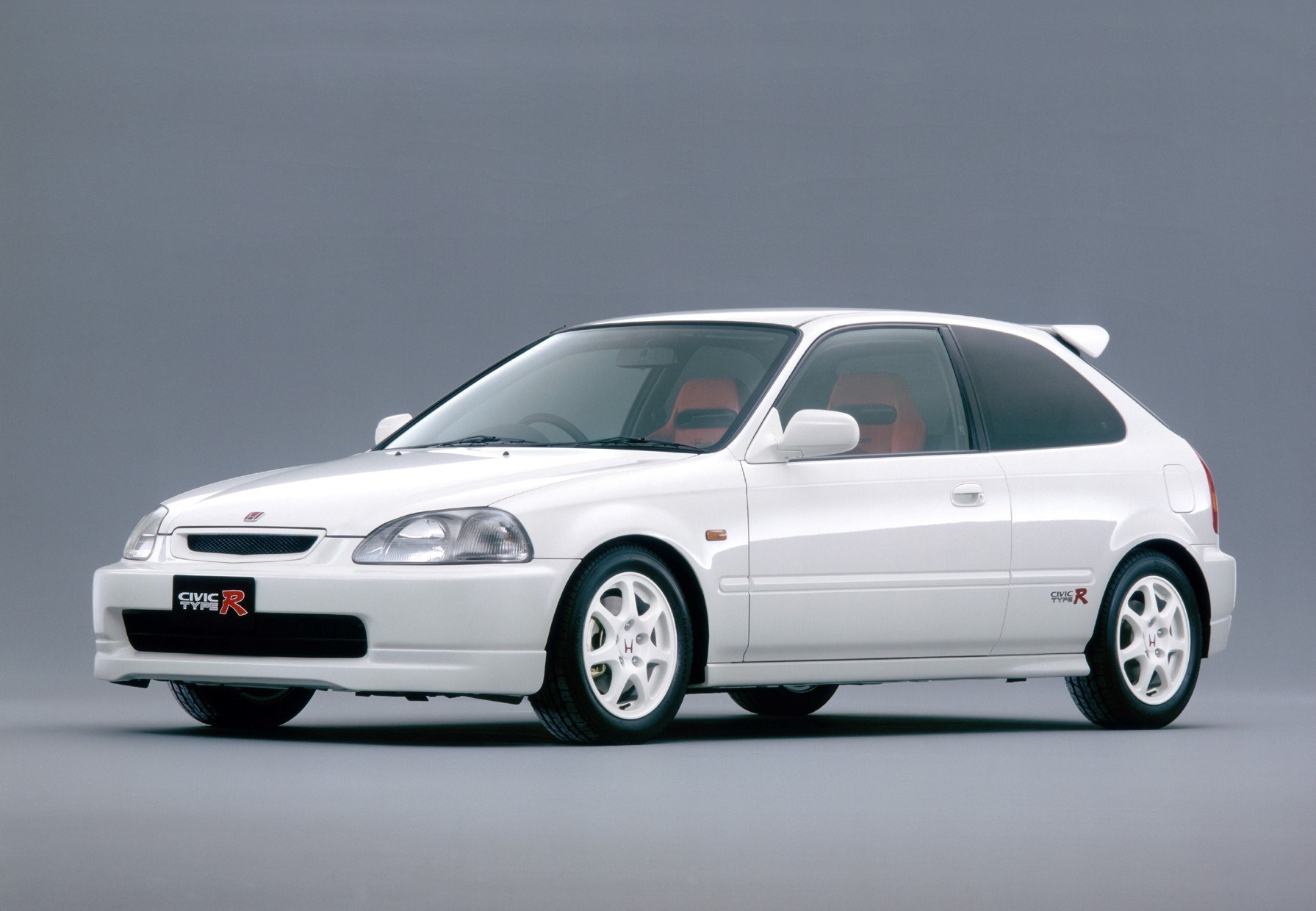
    EK9 (1997-2000) Honda Civic Type R

    The Type R nameplate can be traced back to the 1992 Honda NSX Type R, which raised the bar on performance and dynamic ability, but was only available in extremely limited numbers. Applying the Type R philosophy to the Civic followed a similar engineering ethic to the Integra and NSX to offer an engaging, rewarding drive. The EK9 was offered to the Japanese market only and had a high-end specification; including a hand-ported 1.6-liter DOHC VTEC engine that produced a highly impressive 116bhp-per—litre, a lightweight seam-welded shell that contributed to a total vehicle weight of just 1050kg, paired with a helical Limited Slip Differential (LSD), and unique suspension components to completely transform the driving experience. Launched to outstanding reviews, the EK9 set in motion the pursuit of the ultimate front-engine, front wheel drive performance hatchback.

    EP3 (2001 – 2005) A European take on the Type R

    EP3 (2001–2005) Honda Civic Type R

    As a result of the overwhelming success of the first-generation car, the second-generation was offered across Europe; thanks, in part, to now being manufactured in the United Kingdom. The new car introduced an all-new, and now iconic 2.0-liter DOHC i-VTEC ‘K’ series engine that redefined what a normally aspirated two-litre engine could do. It too featured uprated brakes, a precise, close-ratio six-speed transmission and a shell that made extensive use of high-tensile steel to increase torsional static rigidity by 80% over the EK9. Toe-control link strut suspension in the front and reactive-link double-wishbone suspension at the rear combined with new electric power steering (EPS) and variable gear ratio (VGR) for highly rewarding steering feel and feedback.

    FN2/ FD2 (2007-2011) Type R – two ways

    FN2-FD2 (2007-2011) Honda Civic Type R

    The third generation Civic Type R was unique in that the European and Japanese models differed dramatically. Europe received the FN2-based hatchback, which retained the proven 2.0-liter engine, but introduced a new chassis that moved the fuel tank beneath the front seats to improve interior space and flexibility. Japanese customers were instead offered the FD2 saloon, which offered an even more focused driving experience thanks to additional items such as a more powerful K20A engine, a helical LSD and powerful Brembo brakes. The saloon’s increased weight was countered by extensive use of structural adhesives instead of welding, and aluminium in both the chassis and panels.

    FK2 (2015-2017) Introducing the VTEC TurboA

    FK2 (2015-2017) Honda Civic Type R

    As market and regulatory expectations shifted, the move toward turbocharging was inevitable. Honda engineers worked meticulously to develop the K20C1 turbocharged 2.0-liter engine that offered explosive performance thanks to a 310PS output. In order to better control that significant increase in power, Honda introduced its Dual Axis Strut Suspension paired with a limited-slip differential to counter the torque-steer encountered in high output front wheel drive cars. The 2015 Civic Type-R sprinted from 0-100km/h in just 5.7 seconds and came equipped with large diameter (351mm) front discs that formed part of the high-performance Brembo braking system. The FK2 proved a formidable base for a competition car, winning several TCR Touring Car titles across the globe.

    FK8 (2017-2022) The Ultimate Sports hatchback

    FK8 (2017-2022) Honda Civic Type R

    Arriving in 2017, the FK8 was the ultimate evolution of the Civic Type R. A significant evolution of the FK2, the new car gained a host of new mechanical features such as adaptive dampers, and further revisions to the K20C1 engine to boost power to 320PS. The model also introduced downforce to the equation for an even more intense drive; the external aerodynamic package worked in unison with an advanced, almost flat underfloor, to actively contribute to negative lift. The model also made its debut in the United States, with the region leading global sales for the car.

    FL5 (2022-) Ultimate Sports 2.0

    FL5 (2022) Honda Civic Type R

    Launching later this year, the all-new generation car further evolves, matures, and refines technologies that have been developed over several generations. Whilst new technologies and refined aerodynamics have helped set the bar higher once again, a clear lineage can be traced back to the FD2 generation with the incremental revisions resulting in the fastest, most rewarding and addictive Civic Type R ever built. Already the track record holder at Suzuka, the 2022 Civic Type R is a fitting way to celebrate 30 years of the Type R nameplate.

  • First exterior sketches of SKODA VISION 7S

    SKODA VISION 7S - Front Angle

    Releasing the first exterior sketches of the VISION 7S concept car, ŠKODA AUTO reveals further details of its new design language. The drawings provide a preview of the study’s body. The sketches show a powerful SUV featuring a striking front end with T-shaped headlights.

    The exterior sketches of the all-electric ŠKODA VISION 7S concept car depict a newly designed, striking front end. The significantly wider and flatter ŠKODA grille is dark and closed. The front headlights, which have been repositioned far out to the edge of the vehicle, are arranged in two rows one above the other, and the sharply defined daytime running light strip above them extends laterally into the pronounced wings, extending the light cluster to form a ‘T’.

    The sharply contoured bonnet cites the well-known ŠKODA line. The striking, completely redesigned bumper features seven vertically arranged air inlets, with the central one sporting an insert in eye-catching orange. The lower apron area is fitted with an aluminium underride guard. Large, aerodynamically optimised wheels emphasise the VISION 7S’s powerful visual appearance. The side view is defined by clear surfaces and a gently sloping roof line to the rear.

    ŠKODA’s new design language reflects familiar brand values, such as robustness, functionality and authenticity, and stands out with its spacious interior, durable, sustainable materials and aerodynamic, efficient body.

    SKODA VISION 7S - Rear Angle

  • Ford Mustang Shelby GT500 Code Red

    Shelby American, a wholly owned subsidiary of Carroll Shelby International Inc. (CSBI:PK), made history today at the Michigan Woodward Dream Cruise when it unveiled the limited-edition Shelby GT500 CODE RED with a twin turbocharged V8 pumping out up to 1,300 horsepower. For the first time in its history, the company turned an experimental car into a limited edition vehicle. In addition to the replacement of the factory supercharger with a twin turbo setup, each hand-built CODE RED Shelby GT500 will receive suspension, braking, cooling and aesthetic upgrades.

    • CODE RED pumps out 1,000+ horsepower and 780-foot pounds of torque on 93 octane pump gas with up to 1,300 horsepower and 1,000-foot pounds of torque on E85 Ethanol
    • Only 10 total worldwide per model year for 2020-2022 Shelby GT500s will be built
    • Shelby GT500 CODE RED is the first twin turbo limited edition car offered by Shelby American

    “Shelby American has built cutting-edge experimental versions of the Shelby GT500 since the model was launched in 1967,” said Joe Conway, CEO of Shelby American. “While these testbeds for innovation never became production cars at the time, they helped make our vehicles better. For the first time in our 60-year history, we’re turning an experimental car into a limited-edition vehicle. The enormous demand for a CODE RED edition is an opportunity to demonstrate our capabilities, as well as the enormous potential of Ford Motor Company’s marvelous Shelby GT500 as a dedicated straight-line performer.”

    Famous “EXP” experimental cars have included the Green Hornet, the Super Snake, Little Red and the 2008 twin turbo CODE RED. Shelby’s ’67 GT500 Super Snake had a 427-race engine while the Green Hornet was an experimental ’68 hardtop used to test fuel injection and independent rear suspension. The 1967 Little Red had twin superchargers and a host of other innovations.

    Shelby American replaced the supercharger with a pair of turbos on the experimental 2008 CODE RED Shelby GT500. The 5.4-liter V8 re-engineered by Nelson’s Racing Engines had a dual-feed fuel system that blended in high-octane racing gas as needed. Shelby American enhanced the cooling capacity to handle the heat and worked with AMS to develop a speed-sensitive boost controller for the car.

    Along the way, the drivetrain was reworked to include a new transmission that could withstand all the power, a one-piece aluminum driveshaft, Currie 9-inch rear end, Air Locker differential and 35-spline axles. The car boasted Shelby/Eibach adjustable suspension, Shelby/Baer brakes and rotors, 20-inch wheels shod with Pirelli P Zeros on front and stickier Nitto NY555R drag radials at the rear.

    However, the high cost of the car and its extreme nature meant it was not viable for production.

    “CODE RED is designed to be the pinnacle of Shelby Mustangs,” said Gary Patterson, president of Shelby American. “While we never put it into production during 2008, many were keen to own one. The current generation Shelby GT500 is so robust and spectacular that many of the issues we encountered 14 years ago no longer exist. It’s so perfect for CODE RED transformation that we began quietly building a few for insiders who asked. Though we did not initially intend to offer a formal edition, demand was so strong that we elected to build a very small number of them.”

    Based on the 2020-2022 Ford Shelby GT500, the new CODE RED edition is truly a horse of a different color than the Shelby Super Snake and Shelby GT500KR. Only 10 per model year (2020-22) will be built.

    “The unique nature of this new car required us to pour in lessons learned from extreme vehicles like the 2008 CODE RED, Shelby 1000 and 2020 Shelby GT500 Dragon Snake concept,” said Vince LaViolette, Shelby American Vice President of Operations and Chief of R&D. “All of the massive horsepower and torque we develop with the new CODE RED car required us to focus on optimizing traction. That is why CODE RED is more of a straight-line performer than a road course warrior. While not street legal, it’s very capable at moderate speeds in most any curve. But when the turbos spool up, the car is best enjoyed moving straight ahead.”

    Over the past 60 years, Shelby has worked with some of the biggest names in the business, such as Ford Performance Brembo, Michelin, Borla, Recaro and Tremec. CODE RED’s drivetrain was engineered in collaboration with Fathouse Performance, an official development partner of Shelby American.

    “We worked closely with Shelby American to develop a robust, powerful and reliable package based on our 50 years of combined experience in the high-performance auto industry,” said Ben Stoner, vice president of Fathouse Performance. “The 5.2L engine now features all-new high-performance components boosted by an intercooled premium twin turbo system, a new fuel system, engine management system and more. CODE RED boasts 1,000+ horsepower and 780-foot pounds of torque on 93 octane pump gas with up to 1,300 horsepower and 1,000-foot pounds of torque on E85 Ethanol.”

    CODE RED is far more than just a drivetrain upgrade. It also features the widebody package with new wheels, tires, axles, suspension tuning, interior, badges, carbon fiber hood, and more. Shelby American has spent countless hours testing the car. Both LaViolette (chief test driver) and Patterson (senior test driver) worked hard to refine and tame CODE RED.

    Each CODE RED Shelby GT500 includes membership in Team Shelby, the worldwide club Carroll Shelby established in 2008, and will be documented in the official Shelby Registry. The package MSRP starts at $209,995, not including the base car. Production has begun in Las Vegas and owners of 2020-2022 model year Shelby GT500s can contact Shelby American about transforming their car into a CODE RED edition.

    Package MSRP starts at $209,995

    Standard Features

    Powertrain Features

    • Shelby by FHP Twin Turbo System
      • Xona 7869S Dual Ball Bearing Turbos
      • Stainless Steel Tial Vband Exhaust Housings
      • PTP Titanium Turbo Blankets
      • PTP Titanium Turbo Manifold Blankets
      • Tial MVS Wastegates
      • Custom High Flow Air Filters
      • 3″ Stainless Steel Turbo Downpipes
      • Stainless Steel Tubular Turbo Headers with Billet Collectors and Merges
      • 3″ Stainless Active Exhaust
      • ARP Header Bolt Kit
    • Engine Upgrade
      • Custom Manley Pistons 10.5:1 CR
      • Manley I Beam Rods
      • ARP Main Studs
      • ARP Head Studs
      • Oil Squirter Block Offs
      • PAC Valve Springs
      • Ferrea Competition Valves
      • HD Secondary Timing Chains
      • Ford Performance Oil Pump Gear and Crank Sprocket
      • Amsoil 5w50 Signature Oil
      • NGK Spark Plugs
      • Billet Anodized Coil Cover Set with Shelby Logo
    • Intake and Intercooler System:
      • Fathouse Performance Intake Manifold/ A2W Intercooler
      • Fathouse Performance Billet Throttle Body Adapter and Coupler
      • Fathouse Performance Ice Tank with Reservoir
      • Coated Aluminum Intercooler Piping
      • Tial Blow Off Valve
      • Upgraded Heat Exchanger
      • Custom Turbo Scavenge System
      • Fathouse Performance Race Oil Catch Can
      • Fathouse Valve Cover Adapter Fittings
      • BMRS High Temp Polymer Hose Plumbing
    • Fuel System
      • ID1300x Injectors
      • Billet Fuel Rails
      • Return Style Fuel System
      • BMRS Line Kit
      • Fore fittings, Fuel Pressure Reg, and Fuel Filter
      • Upgraded fuel pumps
    • MoTeC M150 Engine Management Package:
      • MoTeC M150 ECU
      • Plug and Play Mil-Spec Wiring Harness
      • Power Adjustment via Factory Drive Mode Controls (650hp-1200hp)
      • Advanced Traction Control (9 Different Levels)
      • Boost-by-Gear
      • Rolling Anti-Lag
      • Flex Fuel 93/E85 System Automatically Adjusts Power Based on Ethanol Content
      • Ghost Cam Feature (Activated in Drag Mode)
      • Advanced Launch Control
      • Engine Protection Features
      • Level 3 Advanced Data Logging (Captures Data Automatically)

    Performance Features

    • Shelby Widebody package
    • Performance half-shafts
    • Ride-height adjustable front and rear springs
    • Ford Performance front and rear sway bars
    • MagneRide®> suspension recalibration
    • Caster camber plates
    • Shelby forged aluminum wheels
      • One-piece 6061-T6 forged aluminum
      • 20×11 front
      • 20×13 rear
    • Performance spec 305/30/20 front tire
    • Performance spec 345/30/20 rear tire
    • Extended and hardened wheel studs

    Exterior and Interior features

    • Shelby carbon fiber hood
    • Carbon fiber front splitter
    • Carbon fiber rear diffuser
    • Carbon fiber pedestal wing
    • Shelby rocker panels
    • Carbon fiber rocker wings
    • Billet engine caps
    • 60th Anniversary Badging (2022 MY only)
    • Code Red badging
    • Leather seat recovers
    • Shelby rocker stripes
    • CSM numbered engine and dash plate
    • Door sill plates
    • Rear seat delete and harness bar

    Optional Features

    • Le Mans style over the top stripes
    • Painted stripes
  • 2023 Range Rover SV Carmel Edition

    2023 Range Rover SV Carmel Edition - Side

    Jaguar Land Rover North America revealed the Ultra-Exclusive Range Rover SV Carmel Edition at Range Rover House last evening before a group of VIP guests. Set along a cove on the Pacific Ocean, the modernist home provided the ideal background to reveal the Carmel Edition and establishes a base of respite and a host of curated luxury experiences throughout Monterey Car Week.

    Influenced by the beauty of nature, the Range Rover SV Carmel Edition’s unique specification is inspired by the landscape found along the coastline and coves around Carmel, California. The SV Bespoke personalization team chose an exclusive Bespoke Satin Bronze exterior, with SV 23” Diamond Turned wheels finished in Dark Grey Gloss with matching Satin Bronze inserts. Inside the vehicle, a duo tone Near-Aniline leather interior features Liberty Blue front seats with Caraway contrast rear seats.

    Luxurious details are found throughout the cabin of the Range Rover SV Carmel Edition. The four-seat SV Signature Suite is the pinnacle of design and luxury. It is centered around an elegant front-to-rear console that runs the full length of the cabin and accommodates an electrically powered Club Table, electrically deployable cupholders and an integrated refrigerator with SV-etched Dartington Crystal glassware. Additional interior elements include Gloss White ceramic controls and Satin White ceramic finishers with embossed mosaic.

    Custom details featuring Carmel Edition are found throughout this exclusive model. SV Bespoke branded treadplates feature the Carmel Edition word mark, along with 1 of 17 designation. The rear seats feature exclusive Carmel Edition embroidery. Exterior SV Bespoke Puddle Lamps illuminate the ground at night.

    Clients will also receive Two Titleist Custom Club fittings at Titleist’s Performance Institute along with full club sets for the Carmel Edition owner and partner. Range Rover will also be donating a portion of proceeds from each vehicle to the Monterey Bay National Marine Sanctuary.

    “The Range Rover SV Carmel Edition pays homage to the beauty of the Carmel Coast” says Joe Eberhardt, President and CEO of Jaguar Land Rover North America. “We are pleased to present this ultra-exclusive vehicle to our guests at Range Rover House and showcase the craftmanship and design elements which make this edition so special”.

    The Carmel Edition is limited to just 17 units, each finished by the SV Bespoke team and powered by Range Rover’s 523hp V8 Twin Turbo engine, with a retail price of $345,000. The vehicle is being offered exclusively to guests of Range Rover House.

    Range Rover House is a premier destination during Monterey Car Week. Located in Carmel, California, this property exemplifies the beauty of reductive design which is synonymous with the New Range Rover. A series of curated events will take place throughout the weekend which align with the lifestyle of Range Rover owners.

    Range Rover SV Carmel Edition - Rear Angle Range Rover SV Carmel Edition (2023) - #Interior Detail Range Rover SV Carmel Edition (2023) - #Interior Detail 2023 Range Rover SV Carmel Edition - #Interior Detail Range Rover SV Carmel Edition - #Interior Detail Range Rover SV Carmel Edition - #Interior Detail

  • Bentley Mulliner Batur

    Bentley Motors has today unveiled the Bentley Mulliner Batur – a new two-door grand touring coupé limited to 18 series pieces that embodies the start of a design revolution at Bentley.

    Created by Director of Design Andreas Mindt and his team, the Batur is a showcase of a new design DNA that will ultimately guide the design of Bentley’s future range of Battery Electric Vehicles (BEVs).

    The collection of just 18 series examples of the Batur is the latest project by Bentley’s in-house bespoke and coachbuilding division, Mulliner, and succeeds the Bacalar – a run of 12 individually specified, designed and handcrafted Barchettas that relaunched coachbuilding at Bentley. Like its predecessor – the Bacalar – the Batur is named after a beautiful natural body of water. Lake Batur is an 88m deep, 16 km2 crater lake in Kintamani on the island of Bali, Indonesia, and provides nutrient-rich water to both local hot springs and agriculture.

    The Batur will also be the most powerful Bentley yet, with a 740+ PS version of the iconic, hand-assembled 6.0-litre twin-turbocharged W12 engine that has metaphorically and literally powered Bentley’s success for the last two decades. As the engine enters its twilight years as part of Bentley’s Beyond100 transformation journey to being fully electrified, the Batur forms the first part of a celebration of the W12’s extraordinary power, torque and refinement. Engine performance will be matched to the most advanced Bentley chassis ever, with Speed-tuned air suspension, electric active anti-roll control, eLSD, four-wheel steering and torque vectoring.

    All 18 examples of the Batur have already been reserved. Each one will be designed collaboratively with each customer, guided by Mulliner’s in-house design team. Customers will be able to specify the colour and finish of practically every surface of the Batur, to create a car as individual as they are. Each one will then be handcrafted over the course of several months in Mulliner’s workshop at Bentley’s carbon neutral factory in Crewe, England, with first deliveries expected in mid-2023.

    The Batur was unveiled at Bentley’s Signature Party at Monterey Car Week, in front of almost 500 VIP guests, by Bentley’s Chairman and Chief Executive, Adrian Hallmark, who comments:

    “The Batur is a significant car for Bentley. Far more than the heir to the highly successful Bacalar, the Batur showcases the design direction that we’re taking in the future as we develop our range of BEVs. Andi Mindt and his team have reimagined the classic Bentley design cues into a stronger, bolder design that remains both elegant and graceful.

    “Beneath the beautiful exterior lies the most powerful engine we’ve ever developed. Our W12 engine is easily the most successful twelve-cylinder automotive engine in history, and as it approaches its retirement to make way for future hybrids and BEVs, we want to mark its accomplishments.

    “The 18 lucky customers who have already reserved their Batur will enjoy an unrivalled co-creation experience with our Mulliner Design team in specifying their cars. The Batur is the next step in Mulliner’s expansion, demonstrating the demand for truly bespoke vehicles that combine luxury and performance in ways that only Bentley can deliver.”

    A Design Revolution

    The design of the Batur is the work of Bentley’s Director of Design, Andreas Mindt, and his team including Head of Exterior Design, Tobias Suehlmann and Head of Interior Design, Andrew Hart-Barron. The Bentley design DNA that has driven the creation of the Continental GT, Flying Spur and Bentayga families has been revolutionised for the Batur, introducing new themes, approaches and details. The new form language defines a new chapter for Bentley design, as part of Bentley’s Beyond100 transformational journey to become the world’s leading sustainable luxury mobility company.

    The Batur previews the design principles that are driving the development of the company’s first BEV – due in 2025 – and the families of cars that follow.

    Andreas Mindt explains the design:

    “For any design team, the chance to redefine our own rules is the most exciting challenge. We have reimagined the Bentley design language, keeping some continuity to the past and present while also drastically changing key elements.

    “The design of a modern Bentley should always be potent, inspirational and harmonious. The form has to be strong and muscular whilst remaining graceful – there must be both elegant flow and muscularity. The term we use is the “resting beast stance” – picture a lion or tiger, laying low in attack position in long grass. That powerful shape – of ultimate power at rest, that looks fast even when stationary – is one that drives our new interpretation of the classic Bentley power line and haunch.

    “A mark of power and prestige has always been a long bonnet. Our new design cues include a line that stretches from the bonnet along the whole length of the car, connecting the bonnet into the body, making the car long and lean and giving an elongated proportion to the front end. We call this feature the “endless bonnet”, and it’s the only accent highlight to the cleaner shape. Meanwhile the visual mass of the car is moved rearwards, giving the impression that the car is sat on the rear axle, which adds further depth to the haunches.

    “At the very front of the car, we’ve modernised the famous Bentley grille and made it lower and more upright, to give a stronger face and a more dominant stance. This upright elegance bring self-confidence with a luxury stance. The grille is flanked by a new headlight shape and design, an evolution of the design used on Bacalar and maintaining the single large headlight either side. These are matched with all-new tail-lamps at the rear, that sit either side of a deployable spoiler.

    “Overall, the form is cleaner and simplified, and we rely more on curvaceous surfaces bisected in the right places to reflect light and dark and bring more muscle to the design.”

    The Next Exceptional Mulliner Project

    The Batur is the heir and successor to the Bacalar, the 12-off Barchetta design that brought coachbuilding back to Mulliner. Mulliner has become adept at delivering complex projects, including the Bacalar and the Blower Continuation Series – the world’s first continuation of a pre-war car. The coachbuilding skills that have been reborn through both projects will combine with generational handcraftsmanship to deliver the 18 Baturs that are to be built, each one entirely and meticulously by hand.

    Paul Williams, Director of Mulliner, comments:

    “With Bacalar, we proved the appetite of our clients for truly bespoke and individual Bentleys. We’re building on that story with the Batur, and the fact that all 18 cars are already reserved is testament to the fact that our design team is creating cars that our clients want to buy. Batur is not only a beautiful handcrafted Bentley – it is the next member of a distinguished line of cars coachbuilt by Mulliner, which include the W.O. Bentley’s favourite car in the 8 Litre and the now truly-iconic R-Type Continental.”

    Mulliner’s in-house design team will co-create every Batur with its customer, working together for several hours through a specially-created Mulliner visualiser that allows any part of the car to be customised in colour and surface finish. Endless samples of unique materials bring texture to the process, and the resulting designs will be truly individual and created by the customer – limited only by their imagination. From the main exterior paint to the surface finish of the air vents, and literally everything in between, each customer will specify even the tiniest of details.

    Through handcrafted materials and exceptional colours, each Batur will then be brought to life by Mulliner’s team of automotive artisans in a process taking several months for each car.

    Exterior Details

    Beyond the exterior form of the car lies an almost endless array of choices for each car’s future owner to make. Paint choice is infinite – starting with the full Mulliner colour palette and travelling beyond into fully bespoke paint and even hand-painted graphics.

    The aerodynamic additions of front splitter, side skirts and rear diffuser can be crafted in both carbon fibre or new, sustainable Natural Fibre composite.

    The exterior brightware can be any mix of light and dark, satin or gloss or even titanium. As per the first car, another option is graduated contrast colour to the front grille, for a vibrant ombre effect.

    The Batur sits on unique 22” wheels, with the ‘standard’ option being painted in Black Crystal and then surface bright machined and polished. A darker option combines dark gloss faces with satin spokes, while customers can also choose to paint-match the wheels to the body with or without contrast finish, or to choose a totally different contrast colour.

    The car revealed in Monterey has been specified to showcase the Batur’s form language. The exterior paintwork is a bespoke colour – Bonneville Pearlescent Silver – that provides flowing contrast across the curvaceous surfaces. The bodywork is underscored by carbon fibre front splitters, side skirts and rear diffuser painted in Black Crystal. The front of the car features a grille of exceptional art – with the main matrix finished in Gloss Dark Titanium, accented with contrast chevrons in a horizontal ombre pattern that flows from Hyperactive Orange in the centre and gradually darken to the sides to Black Crystal. The “endless bonnet” line is finished in Satin Titanium paint, as are the 22” wheels – with the spokes in Satin Dark Titanium to match the grille.

    A Cabin of Sustainable Bespoke Beauty

    The two-seat interior space of the Batur is designed for ultimate personalisation and long-distance grand touring. Inspired by the success of the interior design of the Bacalar, the Batur builds on the core elements of the Bacalar’s cabin design and adds new sustainable luxury features.

    Every element of the cabin is tailored to the customer’s specifications. Clients can choose from a variety of sustainable interior materials, including:

    • Low-carbon leather sourced from Scotland, which travels significantly smaller distance than leather sourced from outside the UK.
    • Sustainable tannage leather from Italy, in five different colours.
    • Dinamica, an alternative suede-like sustainable material to leather.

    The range of veneers available for the fascias include a new material for Bentley – Natural Fibre composite, which is a sustainable alternative to carbon fibre. Available as a 2×2 twill weave and finished in satin lacquer, the Natural Fibre composite brings a new sustainable texture to the cabin. Regardless of the veneer chosen, the passenger fascia panel is finished with a unique etching of the audio signature of the W12 engine – and bespoke etching is also available.

    The final sustainable elements are the carpets, which are matched to the leather and made from recycled yarn, in a first for Bentley.

    Clients will choose between bright or dark treatments to the interior brightware and titanium options are also available. Certain controls – like the organ stops for ventilation – are even available in 3D-printed 18K gold.

    The interior of the launch Batur has been trimmed by hand in a stunning combination of black, red and orange – specifically, Beluga, Hotspur and Hyperactive. Beluga main hide is contrasted with new, even more sustainable low CO2 Mulliner Hyperactive Orange leather. A complementary texture is provided through the use of Dinamica – a suede-like alternative to leather – in both Beluga and Hotspur. Unique “Batur Chevrons” to the outer wings of the seats are finely embroidered by hand in Snap Orange thread, whilst the remainder of the upholstery carries a white thread in contrast throughout. The soft elements are completed with a new feathered artisan piping in Beluga, with Hyperactive Orange piping to the seat centres and a Hyperactive Orange finish to the lower spoke of the steering wheel.

    The veneers to the Instrument Panel, fascias and doors are Gloss Black painted, with a ‘guitar fade’ to Fine Brodgar that flows from the fascias to the doors, before fading back to black. The fascia is completed with a unique piece of art – a laser-etched sound wave, which represents the unique sound generated by the W12 engine. The metallic elements of the interior are a blend of Black Anodised Aluminium and Satin Titanium, completed with a hallmarked 18 karat gold Bentley Dynamic Drive Selector and ‘12 o’clock’ steering wheel centre band.

    The Mighty W12

    The Batur features the most power engine yet fitted to a Bentley. The 6.0-litre W12 that started the rebirth of Bentley with the Continental GT in 2002 has been through several design iterations since, and is now the most advanced twelve-cylinder engine in the world. It has always been hand-crafted in Bentley’s carbon neutral factory in Crewe, England.

    For the Batur, a new intake system, upgraded turbochargers, new intercoolers and extensive recalibration more than 740 PS and 1,000 Nm of torque, to deliver exceptional performance for this new pinnacle grand tourer. This development of the engine is in celebration of its achievements over 20 years, over which time it has been developed to produce nearly 40% more power while fuel economy has improved by 25%. For the Batur, the W12 is paired with Bentley’s eight-speed double-clutch transmission, and a sports exhaust to provide a soundtrack in keeping with the level of performance. The entire exhaust system is in titanium, while the finishers are 3D-printed in titanium in a first for Bentley.

    As Bentley moves towards the era of electrification, the W12 is entering its twilight years. Before its retirement, this engineering masterpiece is worthy of commendation, and the Batur is the perfect home for the ultimate development of W12 performance.

    A Chassis System to Match

    As well as being the most power and most exclusive Bentley coupe to date, the Batur will also be the most dynamic.

    Adaptive three-chamber air springs each have three switchable chambers, changing the volume of the air spring and so its effective stiffness. The driver can select the balance between ride comfort and body control using the four-mode Drive Dynamics Control in the centre console, choosing between Sport, Bentley, Comfort and Custom.

    The Drive Dynamics Control also changes the behaviour of the 48V electric active anti-roll control system, which can provide up to 1,300 Nm of anti-roll torque in 0.3 seconds or completely decouple the wheels at either end of each axle. The anti-roll control system can also be used to adjust the roll stiffness front-to-rear, giving the Batur sharper turn-in and greater ability to balance the car on the throttle when in Sport mode.

    Overall traction and cornering grip is maximised through the use of an electronic Limited Slip Differential (eLSD) that actively vectors drive torque across the chassis. This is complemented by torque vectoring by brake, whereby the car can lightly brake the inside rear wheel on turn-in for greater front-axle response, and also lightly brake both inside wheels on corner exit to move power across to the outside, loaded wheels for better traction.

    Braking is via Bentley’s CSiC (Carbon-Silicon-Carbide) braking system, with 440 mm front and 410 mm rear discs, matched with 10-piston front and four-piston rear calipers. The Batur rides on bespoke 22” wheels with Pirelli tyres.

  • RUF Bergmeister

    RUF Automobile GmbH, manufacturer of exclusive and authentic high-performance sports cars, reveals two special vehicles at The Quail, A Motorsports Gathering during Monterey Car Week. Project RBS, or “Bergmeister,” makes its world debut alongside the naturally aspirated SCR, which is being seen for the first time in North America.

    The never-before-seen Bergmeister is inspired by the legendary Porsche 906, the 909 Bergspyder and the 718 RS 60 Spyder hillclimb cars and was designed by Tony Hatter. Mounted in the rear is a dry sump, RUF-engineered, air-cooled 3.6-liter single-turbocharged flat-six engine producing 450 bhp and 442 lb-ft of torque, connected to a six-speed manual transmission.

    The Bergmeister all-carbon skinned roadster combines the best of classic design and modern engineering in a package ready to master both road and track. True to RUF’s heritage, the pursuit of the perfect driving experience has never been more visceral. Black Alcantara lines the entire interior and the driver sits in bucket seats, with an Alcantara-clad steering wheel rounding out the driving experience. With its direct steering, the Bergmeister responds to the slightest wheel input and ensures precise handling.

    “When we began building our own automobiles in 1974 it was all for the thrill of the drive,” said Alois Ruf, owner of RUF Automobile GmbH. “We are honored to be featured at The Quail and to celebrate the passion for driving with our friends. Bergmeister embodies the most elemental driving experience, while the SCR highlights the latest technology offerings from our team in Pfaffenhausen.”

    Alongside Bergmeister and debuting in North America for the first time, the newly developed SCR prototype carries much of the same DNA as the 1978 original dressed in a modern package using RUF’s latest technology and engineering. The carbon-fiber monocoque and bodywork deliver maximum strength with minimum weight, while an integrated roll cage and rear space frame provide rigidity.

    The iconic SCR build is designed as a state-of-the-art sports car for those who prefer the soundtrack of a naturally aspirated engine. The consistent light-weight construction and powerful engine result in the feeling of a racecar built for the street. The 4.0-liter flat-six produces 510 bhp at 8,270 RPM and 346 lb-ft of torque. Power is routed to the rear wheels via a six-speed manual gearbox, giving the car the optimal mechanical feel.

  • Lucid Air Sapphire

    Lucid Group, setting new standards with the longest-range, fastest-charging electric car on the market with the award-winning Lucid Air, today introduced Sapphire, Lucid’s new ultra-high-performance brand, led by the new Lucid Air Sapphire – the world’s first fully electric luxury super-sports sedan.

    “Last year, Lucid rocked the world with the launch of Lucid Air, a fusion of unsurpassed range, efficiency, superior driving dynamics, and interior space, uniquely enabled by our in-house technology.” said Peter Rawlinson, CEO and CTO, Lucid Group. “Today, with the introduction of the Sapphire line, we take the next logical step of advancement. Lucid Air Sapphire, being the very first Lucid product to bear the Sapphire name, builds upon our technical prowess to take electric high-performance on to next level. Sapphire represents the pinnacle of electric performance; finally achieving the performance that I’ve so long searched for. After painstaking development work, I am able to confirm Lucid Air Sapphire has achieved a satisfactory performance, and I trust the most discerning drivers will agree.”

    “Sapphire is the embodiment of what ultra-high-performance luxury means to Lucid,” said Derek Jenkins, SVP of Brand and Design, Lucid Group. “Sapphire is among the most valued gemstones, prized for their brilliance, color, and hardness. Imperial Blue has long been the de facto national color for American motorsports teams engaged in international competitions. As Lucid’s dedicated ultra-high-performance brand, Sapphire references this history while setting new standards for innovation and technology.”

    Lucid Air Sapphire: The World’s First Luxury Electric Super Sedan

    At the heart of Lucid Air Sapphire lies a three-motor powertrain – the first from Lucid – featuring a new twin motor rear-drive unit and a single motor front-drive unit.

    “With three state-of-the-art electric motors – all developed and manufactured in-house by Lucid – Lucid Air Sapphire reaches an entirely new level of performance,” said Eric Bach, SVP of Product and Chief Engineer, Lucid Group. “And because a three-motor Lucid Air was always part of the development program, it retains all the strengths of Lucid Air variants already on the market – including limo-like rear legroom, a voluminous trunk and frunk, and impressive efficiency.”

    These technically innovative electric motors incorporate Lucid’s microjet stator cooling and wave winding. The twin rear-drive unit also introduces new heat exchanger technology and heightened coolant flow rate. The battery system is also upgraded for higher power and more precise thermal logic.

    As expected, Lucid Air Sapphire’s three-motor powertrain delivers even more horsepower than the car’s dual-motor siblings, including the 1,050-hp Lucid Air Grand Touring Performance. With over 1,200 hp, Lucid Air Sapphire is not only the most powerful electric sedan in the world, it is the most powerful sedan in the world.

    With this vast power and the enhanced delivery afforded by the twin rear-drive unit, Lucid Air Sapphire will accelerate from a standstill to 60 mph in less than two seconds, from zero to 100 mph in less than four seconds, and the standing quarter mile in under 9 seconds. These figures are achievable with no extra-cost equipment upgrades or protracted preconditioning routines. Additionally, massive carbon ceramic disc brakes come as standard, endowing Air Sapphire with a stopping power to match its prodigious performance.

    Final horsepower ratings will be announced later, along with instrumented demonstrations of the incredible performance capabilities of the vehicle.

    Performance in Perfect Harmony: Track-Capable Handling and Braking as Standard

    As with other Lucid Air variants, Lucid’s engineers followed a holistic approach to development of the first Sapphire model. In practice, this meant devoting exacting attention to every facet of performance.

    “Our aim with this, our first Sapphire model, is to complement the exceptional powertrain with sharper, more responsive driving dynamics and increased body control,” said David Lickfold, Director of Chassis and Vehicle Dynamics, Lucid Group. “At the same time, it was important to retain the exceptional ride quality for which Lucid Air has come to be known.”

    Lucid Air Sapphire features stiffer front and rear springs, unique damper settings, stiffer bushings, and a unique tuning for ABS, traction, stability control, and electronic power steering. Standard carbon ceramic brakes provide exceptional stopping power and contribute to Lucid Air Sapphire’s endurance in high-performance driving. This advanced chassis setup is conceived to maximize the benefits of the torque-vectoring capabilities of the three-motor powertrain, as well as the wider, more aggressive wheels and tires. The car rides on ultra-high performance staggered Aero Sapphire wheels, with specially developed Michelin PS4S tires, sized 265/35R20 at front and 295/30R21 in the rear. These unique wheels also feature removable carbon-fiber aero disk wheel covers, which further optimize the aerodynamic efficiency of the car.

    In addition to delivering prodigious power to the rear of the vehicle, the twin rear-drive unit allows for torque vectoring that extends the capabilities of the car beyond that achievable with a passive all-wheel-drive system.

    For example, the twin rear-drive unit can effectively pivot the rear of the vehicle, providing torque to the rear wheels in opposite directions to promote either turn-in or straight-line stability – similar to a brake-based setup and a rear-wheel steering system, but faster, quieter, and more seamless. In tight corners, the system is able to apply regenerative braking on the inside wheel while powering the outside, greatly enhancing vehicle turn-in rotation and with much quicker response times than rear-wheel steering systems.

    The benefits for drivers are wide-reaching, with improvements to turn-in, cornering balance across all speeds, corner exit, and high-speed stability and disturbance rejection. The driving experience differs across drive modes to give multiple characters in conjunction with steering, suspension, powertrain, and brake settings.

    A New Shade of Speed: Sapphire Design, Inside and Out

    Lucid Air Sapphire is designed to be as functional as it is beautiful.

    Special attention has been given to refining the aerodynamic character of the body for Lucid Air Sapphire. The outcome of this effort is a balance between added downforce, which enhances vehicle stability at higher speeds, and reducing drag, which affects both performance and efficiency.

    The launch of the Sapphire brand from Lucid also marks the introduction of a new Sapphire Blue exterior paint, a radiant color that will be exclusive to Sapphire vehicles. Initially, all Lucid Air Sapphires will be finished exclusively in the new Sapphire Blue color to mark the brand introduction.

    Lucid Air Sapphire is augmented with the recently announced Stealth Look as standard, bringing a more sinister, sporting character to the exterior of the vehicle.

    The cabin of Lucid Air Sapphire extends the purposeful beauty of the exterior with a new interior theme called Sapphire Mojave. This includes new highly bolstered 18-way power sport seats, upholstered in black leather trimmed with black Alcantara and Sapphire Blue contrast stitching. Though designed for spirited driving, the seats still provide decadent comfort, with heating, cooling and massage functionality. The headrest showcases a debossed Lucid bear logomark, one of the icons of the Lucid brand identity reflecting the California origins of the brand. Dash and doors are decorated with Mojave darkwood veneers, while the steering wheel and upper roof structure for the standard Glass Canopy roof are trimmed in black Alcantara.

    Lucid Air Sapphire also features a unique Sapphire-themed on-screen display, with specially configured drive modes and performance settings.

    The Future is Faster

    Lucid Air Sapphire makes its public debut at the Quail Lodge during Monterey Car Week. Lucid Air Sapphire will be offered as a limited-production model, with deliveries planned in the US and Canada next year. The price is $249,000 USD and $325,000 CAD.1 Reservations go live Tuesday, August 23, 2022 at 9 AM Pacific time.

    Information about availability for markets outside of North America will be communicated in the future.

    What’s more, Lucid Air Sapphire is just the beginning, representing the launch of an entirely new performance-focused brand within Lucid. Additional Sapphire models will be available for all Lucid models moving forward, continuing to set new standards for what luxury performance can look and feel.

    1 US price excludes tax, title, license, options, and destination fees. Canadian excludes $2,200 CAD Destination Fee, $200 CAD Documentation Fee and $100 CAD Federal Air Conditioning Tax; excludes sales tax and provincial levies & fees.