Category: Redirect

  • Lotus Eletre

    2023 lotus eletre

    The ongoing transformation of Lotus to a truly global performance car brand has reached its most significant milestone yet.

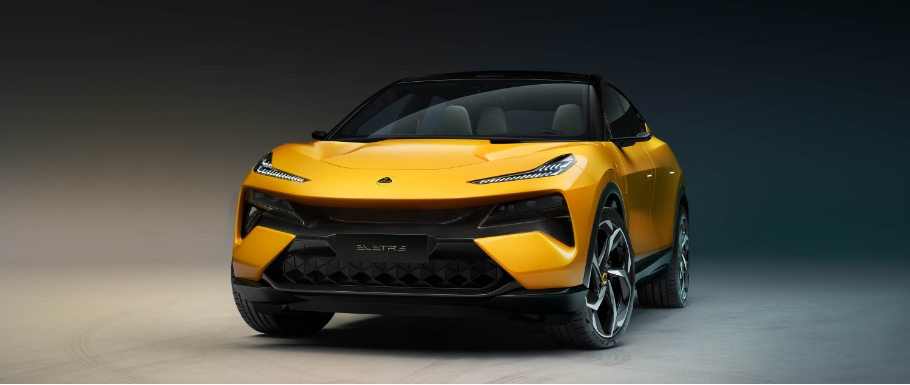
    The all-new and all-electric Lotus Eletre is a striking and progressive Hyper-SUV – the first of a new breed of pure electric SUVs. It takes the core principles and Lotus DNA from more than 70 years of sports car design and engineering, evolving them into a desirable all-new lifestyle car for the next generation of Lotus customers.

    The company’s famed expertise in the fields of ride and handling, steering and optimised aerodynamics have been carefully and respectfully evolved. The Eletre takes the heart and soul of the latest Lotus sports car – the Emira – and the revolutionary aero performance of the all-electric Evija hypercar, and reinterprets them as a Hyper-SUV.

    Known until two days ago only by its Lotus codename, Type 132, the Eletre is a globally relevant product, a shining halo of sustainable mobility for a worldwide audience. Embodying emotion, intelligence and prestige, it extends the reach of the Lotus name, badge and renowned driver engagement to a new audience.

    A bold new dimension to the Lotus performance car portfolio, the Eletre delivers a significant number of firsts for Lotus – the first five-door production car, the first model outside sports car segments, the first lifestyle EV, the most ‘connected’ Lotus ever. And yet it remains a true Lotus, a beautiful car ‘carved by air’, packed with pioneering technology, genuine sporting performance and simplicity of purpose, designed and developed by a passionate and global team. The Lotus Eletre is alive with character and personality.

    The Eletre is 4WD, has a battery capacity that’s over 100kWh and with power from 600hp. A 350kW charger will deliver a 400km (248 miles) range in just 20 minutes. The car’s target maximum WLTP driving range is c.600km (c.373 miles). It also comes with the ability as standard to accept 22kW AC charging which, where available, reduces the time plugged in.

    Technology includes the most advanced active aerodynamics package on any production SUV, and intelligent driving technologies such as the world’s first deployable Light Detection and Ranging (LIDAR) system in a production car. Add in a dynamic walk-up sequence that delivers a moment of theatre every time the driver approaches the car, and it’s clear the Eletre is making a simple statement – this is Lotus reinvented, the birth of a new icon into the Lotus stable.

    Matt Windle, Managing Director, Lotus Cars, commented: “The Eletre is a bold and revolutionary new car, delivering on our commitment to move Lotus into completely new automotive segments as we widen our global appeal and accessibility. This is a momentous point in our history and a clear signal of our ongoing desire to transform our business. It is a true Lotus, and we’re confident it will delight performance car customers and offer a distinct alternative to the segment’s established players. The Eletre has the soul of a Lotus and the usability of an SUV. Alongside the Emira sports car, this is the perfect two-car garage from Lotus.”

    Qingfeng Feng, CEO, Group Lotus, added: “The Eletre, our Hyper-SUV, is a new performance car from an iconic performance car brand and it will appeal to independent-minded and adventurous driving enthusiasts – those who love the thrill of driving. It is a unique combination of beautiful design, exceptional dynamic performance and everyday usability, for those who dare to look beyond the conventional, and marks a turning point for our business and brand.”

    He added: “While the worldwide critical acclaim for the Emira has reaffirmed Lotus’ position as a respected sports car marque, the Eletre will make Lotus accessible to a whole new audience. It is a compelling alternative for those who desire a true driver’s car but whose lifestyle demands something more practical than a traditional sports car. And it is only the start for Lotus – there is much more to come.”

    The Eletre is the first in a new range of premium lifestyle performance electric vehicles to be built at an all-new state-of-the-art production facility in Wuhan, China. The car has been ‘Born British, Raised Globally’, with design led by the UK, supported by collaborative work with teams in China, Sweden and Germany. The overall exterior and interior design has been led by an international team based at the Lotus Tech Creative Centre (LTCC) in Warwickshire, UK.

    Peter Horbury, Senior Vice President, Executive Advisor, Design, Lotus, commented: “The Eletre is a rare creative opportunity in performance car design – the chance to start with a blank sheet of paper and develop an all-new vehicle that takes a brand in a completely fresh direction. There has been a close working relationship and much collaboration between the Lotus design studios in Warwickshire and Hethel. The result is a ‘Hyper-SUV’ that is genuinely different to what’s on the market; the electric powertrain has inspired a ‘cab-forward’ design that echoes the iconic mid-engined layout of Lotus sports cars, creating a unique look and position in the SUV segment. The arrival of the Eletre signals the start of a new era of pure electric SUVs.”

    The Eletre is built on Lotus’ all-new and highly versatile Electric Premium Architecture (EPA). The low-to-the-ground design means outstanding handling, and the EPA can easily adapt to accommodate C+ to E+ vehicle class battery sizes, motors, component layouts and intelligent driving technologies.

    The platform will be the basis for an all-new range of premium lifestyle performance electric vehicles from Lotus. Led by the Eletre, these cars will catapult Lotus into a new era of higher retail volumes and significant revenues.

    The Lotus Eletre is on sale now across global markets, with first customer deliveries in 2023 starting in China, the UK and Europe. For more information and to reserve your Lotus Eletre please visit www.lotuscars.com.

    The Lotus Eletre in detail

    The Eletre is a new icon from Lotus. It is the latest in a long line of Lotus road cars whose name begins with the letter E, and means ‘Coming to Life’ in some Eastern European languages. It’s an appropriate link as the Eletre marks the start of a new chapter in the history of Lotus – the first accessible EV and the first SUV.

    The immersive experience with the Lotus Eletre begins before the driver has reached the car. Pressing the button on the key or smartphone app activates a moment of theatre that’s unique in the automotive world. The car’s exterior lights run through a short sequence, the active front grille ‘breathes’ and the illuminated flush door handles deploy. The experience is repeated inside the car as the door closes behind the occupant.

    Ben Payne, Head of Studio at LTCC, said: “This walk-up sequence is a ‘peacock moment’ – a little ‘showing-off’ that highlights the Eletre’s engaging personality. It’s a visual expression of a car coming to life, and a metaphor for the reinvention of the Lotus business and brand which begins with the Eletre.”

    From the very earliest discussions about the car and its position at the heart of the Vision80-led transformation of Lotus, the Eletre was to be a showcase for how a Lotus can deliver performance-oriented driving thrills and refinement outside of the traditional sports car segments.

    It is ‘Born British Raised Globally’ and that is more than a slogan. It has defined a rewarding collaborative process which has set the standard for the development and quality of the next generation of Lotus performance cars.

    The fundamentals of what makes the Eletre a Lotus were established in Hethel, UK – the iconic home of Lotus since 1966. The global Lotus team worked together to deliver the strategic direction for the forthcoming range of Lotus lifestyle vehicles, plus the dynamic development, systems integration, aerodynamic optimisation and overall driver satisfaction of the Eletre.

    A new Lotus research and development facility, established in China in 2020, utilises the market’s leading intelligent technologies and digital competencies to build the Eletre at an all-new state-of-the-art manufacturing centre. Teams at Lotus Tech Innovation Centre (LTIC) in Raunheim, Germany, have assisted with component integration, durability testing, certification and homologation, with experts from the engineering team in Gothenburg, Sweden, working on the car’s EV management systems.

    Exterior design: daring and dramatic

    Design of the Lotus Eletre has been led by Ben Payne. His team has created a daring and dramatic new model with a cab-forward stance, long wheelbase and very short overhangs front and rear. Creative freedom comes from the absence of a petrol engine under the bonnet, while the short bonnet echoes the styling cues of Lotus’ iconic mid-engined layout. Overall, there’s a visual lightness to the car, creating the impression of a high-riding sports car rather than an SUV. The ‘carved by air’ design ethos which inspired the Evija and Emira is immediately obvious.

    Ben commented: “The Eletre is a progressive all-electric performance vehicle embodying emotion, intelligence and prestige and, as the first of the brand’s lifestyle cars, it sets the standard for what will follow. We have taken the iconic design language of the Lotus sports car and successfully evolved it into an elegant and exotic Hyper-SUV.”

    A signature element of the design is its ‘porosity’ – the aerodynamic principle of air flowing through the car as well as under, over and around it. Porosity was at the heart of the Evija’s design, is integral to the Emira, and has provided clear inspiration for the Eletre. It is most obvious where air is channelled under the leading edge of the car, emerging through two exit vents in the bonnet above. There are other examples of porosity ahead of and behind the front wheel arches, behind the rear wheels, and even at the top of the D-pillar. For the driver there are clear benefits to porosity – less resistance in cutting through the air, delivering a more efficient journey in terms of improved vehicle range, speed and performance.

    At the front of the Eletre, the very sharp and crisp leading edge reveals a clear lineage with the Emira and Evija. It draws a distinct line across the very striking and contemporary design treatment below. There are further echoes of Evija in the layering of the surfaces, the creation of space and the optimised aerodynamic performance.

    Just above the leading edge are the very slim and technical light clusters which house the Daytime Running Lights and scrolling directional indicators. The main lamps, which are available with matrix technology to permit constant high beam use without affecting oncoming traffic, are housed below, recessed and partially hidden.

    Lower down is the Eletre’s active front grille, a network of interconnecting triangular petals that dominate the central section. Intricately designed, they remain closed when the car is at rest or when there’s a need to reduce drag during driving. They open in a distinctive pattern to feed air into the radiator, allowing the Eletre to ‘breathe’ when cooling of the electric motors, battery pack and front brakes is required. It’s a further example of the car’s porosity and also offers aerodynamic benefits.

    Overall there is a unique sense of flow and a kinetic quality to the Eletre’s front end, which also includes a deployable LIDAR sensor mounted at the top of the windscreen. All the black components are finished in carbon fibre while the body panels are aluminium. It is the bold leading edge of the Eletre’s bonnet which continues round into the front wing, wheel arch and ultimately the length of the vehicle as a feature line. The car’s taut and muscular lines are dominant above it, while the aerodynamic elements are below.

    Moving round the car, its muscular haunches dominate the profile view. The air outlet immediately behind the front wheels defines the sculpted shape of the doors, each of which has a flush handle. The electrically opening cover for the charging port is fitted in the front wing, as are the deployable LIDAR sensors, one on each side and a world-first technology for the Eletre.

    The aggressive rake of the windscreen is clearly visible in profile, with a relatively narrow, glass area – and black cantrail above – which tapers away dramatically at the rear. That leads into a unique floating D-pillar, engraved with the Eletre wordmark and featuring an innovative ‘air blade’ which aids drag reduction. Another example of porosity, it’s an aerodynamic performance enhancement taken directly from the front bumper of the Emira.

    Each door mirror is replaced by an Electric Reverse Mirror Display (ERMD), which houses three different cameras1 – one for the rear-view mirror, a second to help create a 360-degree view of the car from above to aid parking, and a third that’s part of the intelligent driving technologies. It works in tandem with the Eletre’s LIDAR system to deliver autonomous driving capability. The car rides on 23-inch machine-cut split-finish five-spoke alloys with carbon fibre inserts to aid air flow and ceramic composite 10-piston caliper brakes2.

    Moving to the rear, the full-width ribbon light strip picks up the feature line from the profile. Situated just above the Lotus wordmark, it is red when the car is moving and includes a scrolling directional indicator at each end, where it curves gently into the air outlets from the wheel arches – another design cue which echoes both the Emira and Evija. The light can appear in four colours, playing a role in the car’s theatrical unlocking sequence and indicating battery charge status.

    The rear is dominated by the unique cantilevered carbon fibre ‘floating’ split roof spoiler, a motorsport-inspired design feature that evokes race car winglets. With the central section removed weight is saved – a very Lotus concept – and allows the LIDAR sensor to be integrated at the top of the glass. Optimised for exceptional aerodynamics, the roof spoiler channels airflow down the glass and into the active tailgate spoiler which is deployed automatically at speed. It has three distinct deployment angles, depending on the drive mode selected.

    Interior design: a new level of premium for Lotus

    The Eletre takes Lotus interiors to an unprecedented new level. The performance-oriented and technical design is visually lightweight, using ultra-premium materials to deliver an exceptional customer experience. Shown with four individual seats, this is available to customers alongside the more traditional five-seat layout. Above, a fixed panoramic glass sunroof3 adds to the bright and spacious feeling inside.

    Sustainability has been a core focus of the design team, which has worked with leading supplier Kvadrat on material choices. The interior uses premium feel and highly durable man-made microfibres on the primary touchpoints, and an advanced wool-blend fabric on the seats. It is 50% lighter than traditional leather, allowing for further weight savings. The hard materials are carbon fibre, though rather than use the traditional ‘weave’ most often associated with automotive design, Lotus has recycled the fibres trimmed from the edge of the weave. These have been reconstructed into a new matting, then compressed in a resin to create the car’s premium marble-like finish.

    The driver-focused cockpit and high centre console are inspired by the Lotus Emira and Evija, creating a cossetted feeling. The layering of materials and textures creates a truly premium feel, augmented by a triangular theme – seen externally on the car’s active front grille – replicated in multiple locations around the cabin.

    The Lotus philosophy of light-weighting – removing material if it’s not needed – is clearly illustrated in the instrument panel. The floating wing’s central section has been taken out, echoing the design of the rear spoiler.

    There is a wealth of practical storage space in the Eletre’s cabin. The centre console includes a storage tray with wireless charging for mobile phones, as well as twin cupholders of different sizes which sit flush to the surface until they’re needed. The beautifully sculpted door design includes storage that will take a litre bottle.

    The smart design is continued in the rear of the car, with space in the doors and between the two chairs. There is a central draw at knee height and the armrest splits behind the two cupholders. It ends in an angled nine-inch touch-screen for infotainment, with a wireless charging tray beneath.

    Infotainment and technology: a world-class digital experience

    The infotainment experience in the Eletre sets new standards in the automotive world, with pioneering and innovative use of intelligent technologies. The result is an intuitive and seamless connected experience. It is a collaboration between the design team in Warwickshire and the Lotus team in China, who have huge experience in the fields of User Interface (UI) and User Experience (UX).

    Below the instrument panel a blade of light runs across the cabin, sitting in a ribbed channel that widens at each end to create the air vents. While it appears to be floating, the light is more than decorative and forms part of the human machine interface (HMI). It changes colour to communicate with occupants, for example, if a phone call is received, if the cabin temperature is changed, or to reflect the vehicle’s battery charge status.

    Below the light is a ‘ribbon of technology’ which provides the front seat occupants with information. Ahead of the driver the traditional instrument cluster binnacle has been reduced to a slim strip less than 30mm high to communicate key vehicle and journey information. It’s repeated on the passenger side, where different information can be displayed, for example, music selection or nearby points of interest. Between the two is the latest in OLED touch-screen technology, a 15.1-inch landscape interface which provides access to the car’s advanced infotainment system. It automatically folds flat when not required. Information can also be displayed to the driver via a head-up display featuring augmented reality (AR) technology, which is standard equipment on the car.

    While every element of the Eletre can be controlled digitally, certain key controls are duplicated with analogue switches – another nod to the simplicity for which Lotus is famed. Voice control through advanced speech recognition technology is also available.

    The technical look, compact size and premium feel of the steering wheel delivers maximum comfort, performance and usability. Visually lightweight, it houses switchgear for the adaptive cruise control and infotainment system. Both it and the driver’s seat move back to create more space for ingress and egress, returning to the pre-set position as the door is closed.

    The standard audio system on the car is provided by renowned British brand KEF. Called KEF Premium, it is a 1,380-watt 15-speaker set-up with Uni-QTM and surround sound technology. Uni-Q dispenses with separated tweeter and mid-range speakers, instead combining both into an acoustically idealised single unit. It covers the entire mid and high-frequency sound spectrum from a single point in space, delivering a more coherent, hyper-realistic sound experience.

    Customers can upgrade to KEF Reference, a 2,160-watt 23-speaker system with Uni-Q and 3D surround sound technology. KEF Reference also features Uni-CoreTM, a pioneering new approach to speaker and subwoofer design, and the Eletre marks its debut in the automotive world. It uses two dual force-cancelling drivers with concentrically arranged and overlapping voice coils, driven by a single motor. This enables high-level performance while reducing the subwoofer or speaker volume significantly. Both KEF Premium and KEF Reference feature partially exposed speakers in the doors, a very technical execution and beautiful design feature.

    At the core of the Eletre’s UI/UX is the Lotus attribute of simplicity, which is realised through three pillars. The first is ‘lightweight’, a name given to both the system components and the experience. For example, with three touches of the main screen users can access 95% of the car’s functionality. The second pillar of ‘intelligence’ means the system is versatile, creating a vehicle which is fully customisable through the settings menu. The final pillar is ‘immersive’, with carefully crafted and curated content and interactions that excite and engage occupants – a very Lotus attribute. This includes the on-screen three-dimensional world in which the car is viewed, showcasing the Eletre as the hero and adopting user experiences from the worlds of gaming and mobile technology.

    Technology is used for much more than infotainment on the Eletre. It is also at the heart of the car’s comprehensive suite of intelligent Advanced Driver Assistance Systems (ADAS), many of which are designed to be futureproof so new features can be enabled via Over The Air (OTA) updates. Several utilise the LIDAR system; its deployable sensors are hidden when not required, ensuring the car’s striking design shines through and only emerging from the top of the windscreen, the top of the rear glass, and from the front wheel arches as required.

    The LIDAR system means the Eletre supports end-to-end autonomous driving technology and is future-proofed for further development, achievable because of the hardware that’s already integrated. Further capability can be added via OTA software updates, as and when it is allowed by local market regulation.

    Maximilian Szwaj, Vice President of Lotus Technology and Managing Director, LTIC, commented: “The Eletre is packed with relevant technologies which take Lotus to a new level in the premium lifestyle segment, and also sets new standards across the global automotive landscape. ADAS technologies such as LIDAR sensors and cameras will become increasingly common on new cars as we move into a more autonomous era, and to have the world’s first deployable LIDAR system on the Eletre is a signal of the technology vision we have for Lotus. This car has tech for today, and also for tomorrow, as it’s been developed to accept OTA updates as standard. I’m hugely proud of what the LTIC team, working in close collaboration with colleagues in China, has achieved.”

    The Eletre is available with Intelligent Adaptive Cruise Control (ACC); Collision Mitigation Support Front (CMSF); Traffic Sign Information (TSI); Door Open Warning (DOW); Rear Cross Traffic Alert (RCTA); Front Cross Traffic Alert (FCTA); Lane Change Assist (LCA); Children Presence Detection (CPD); Lane Keep Aid with Lane Departure Warning / Prevention (LKA+); Parking Emergency Brake (PEB); Collision Mitigation Support Rear (CMSR); and Emergency Rescue Call (E-Call). There are i-Size child seat anchor points on the outboard rear seats.

    The latest connectivity technology, including 5G compatibility, is part of the Eletre package. This enables continuous connection to the car via smartphone app, OTA software updates and the ability for customers to purchase new features enabled via software as they become available. A smartphone app for Eletre owners will include access to driving logs, vehicle and charge status, remote features, location services and a host of other functionality.

    A dedicated all-new EV platform delivering outstanding performance

    Gavan Kershaw, Director, Attributes and Product Integrity, Lotus, has been involved in defining the attributes of the Eletre from the very start, and continues to lead the Hethel-based dynamics team in their collaborative work with colleagues in China, Sweden and Germany.

    He said: “Dynamically, the Eletre has been developed to deliver everything you would expect from a Lotus – outstanding ride and handling, highly communicative steering and exceptional driver engagement. From a performance perspective, we know the world is watching so there has been an obsession with getting everything just right. Everyone is delighted with it – it’s a world-class product and a true Lotus.”

    The Eletre is built on an all-new 800v dedicated electric vehicle architecture with integrated, high-voltage power distribution system. This architecture uses aluminium and high tensile steel for optimum structural rigidity. The flat ‘skateboard-style’ battery pack and electric motors are close to the ground to create a low centre of gravity and deliver on the core Lotus commitment of outstanding dynamic performance. The high energy density of the battery pack provides the best possible balance of performance and driving range. There are two electric motors, one driving the front wheels and another driving the rear wheels. A three-in-one electric drive system integrates each motor with a controller and reducer, an efficient design which makes the unit smaller and lighter – a very Lotus solution.

    Every Eletre comes with exceptional dynamics, outstanding comfort and true Lotus performance. The car has five-link suspension at the rear for optimised ride and handling, while standard equipment includes air suspension and Continuous Damping Control (CDC). Active ride height, active rear axle steering, an active anti-roll bar and torque vectoring via braking are all available.

    The car comes with four drive modes, which adjust the steering, damper settings, powertrain and accelerator pedal response. The modes are Range, Tour, Sport, Off-Road and Individual, and are standard on all versions of the car.

    Lotus Eletre: Technical Specification

    Power and performance:

    Eletre Eletre S Eletre R
    Max power (kW / hp) 450 / 603 450 / 603 675 / 905
    Max torque (Nm) 710 710 985
    Top speed (mph / km/h) 160 / 258 160 / 258 165 / 265
    0-62 mph / 0-100 km/h (secs) 4.5 4.5 2.95
    80-120 km/h (secs) < 2.2 < 2.2 < 1.9
    Battery capacity (kWh) 112 112 112
    Charging time 10%-80% (mins) via rapid charger 20 20 20
    WLTP maximum range (km / miles) 600 / 373 * 600 / 373 * 490 / 304

    * Using 20-inch wheel, available as a no-cost option in the UK

    Dimensions (mm):

    Length 5,103
    Width with Electric Reverse Mirror Displays 2,135
    Width with door mirrors 2,231
    Height 1,630 (20-inch wheel)
    1,636 (22/23-inch wheel)
    Wheelbase 3,019
    Ground clearance 187 (20-inch wheel)
    194 (22/23-inch wheel)
    Rear boot capacity 611 litres (four seats)
    688 litres (five seats)
    Rear boot capacity (five-seater, rear seats folded) 1,532 litres

    Lotus Eletre: UK and European Pricing

    Market Currency Eletre Eletre S Eletre R
    UK GBP 89,500 104,500 120,000
    Germany EUR 95,990 120,990 150,990
    Netherlands EUR 97,690 123,090 153,090
    Belgium EUR 97,690 123,090 153,090
    France EUR 96,890 122,090 152,090
    Italy EUR 98,490 124,090 154,890
    Norway NOK 887,990 1,114,990 1,390,990
    Sweden SEK 1,119,990 1,409,990 1,739,990
    Switzerland CHF 115,090 143,890 179,890
  • 2023 Ford F-150 Rattler Offers Customers Distinctive Styling, Rugged Off-Road Capability

    2023-ford-f-150-rattler

    Today Ford introduces the F-150 Rattler, a distinctive, rugged, entry-level addition to its 2023 F-150 lineup for adventure-seeking customers looking for a stylish truck with standard four-wheel drive for exceptional off-road capability.

    “Our new F-150 Rattler offers aspiring adventurers an off-road option with expressive looks and capability in one package,” said Todd Eckert, Ford truck group marketing manager. “This truck builds off the F-150 off-road legacy while allowing us to introduce new customers to the right blend of styling and value in the F-150 lineup.”

    The F-150 Rattler package is built off the XL series, with FX4 content featuring skid plates to help ensure Built Ford Tough protection for a confident off-road experience, electronic rear-locking differential for enhanced traction, hill descent control for precision throttle and braking on steep descents, and specially tuned off-road shock absorbers for increased stability over tough terrain. In addition, F-150 Rattler features rugged all-terrain tires for versatility and capability.

    Distinctive looks reflect the capabilities of the F-150 Rattler package, with a dual exhaust system that combines aggressive styling with a bold sound, plus painted 18-inch aluminum wheels that add to the truck’s solid, sporty stance. F-150 Rattler badging on the fender vents and rattlesnake-inspired graphics amplify its unmistakable appearance.

    Onyx seats featuring burnished bronze accents and impeccable stitching match the trim on the instrument panel to create a unique interior in keeping with the desert-inspired theme of the new F-150 Rattler. Exterior colors include Oxford White, Avalanche, Iconic Silver, Carbonized Gray, Antimatter Blue, Stone Gray, Agate Black and Rapid Red TriCoat*.

    The 2023 F-150 Rattler goes on sale this fall.

  • Volkswagen ID. Buzz

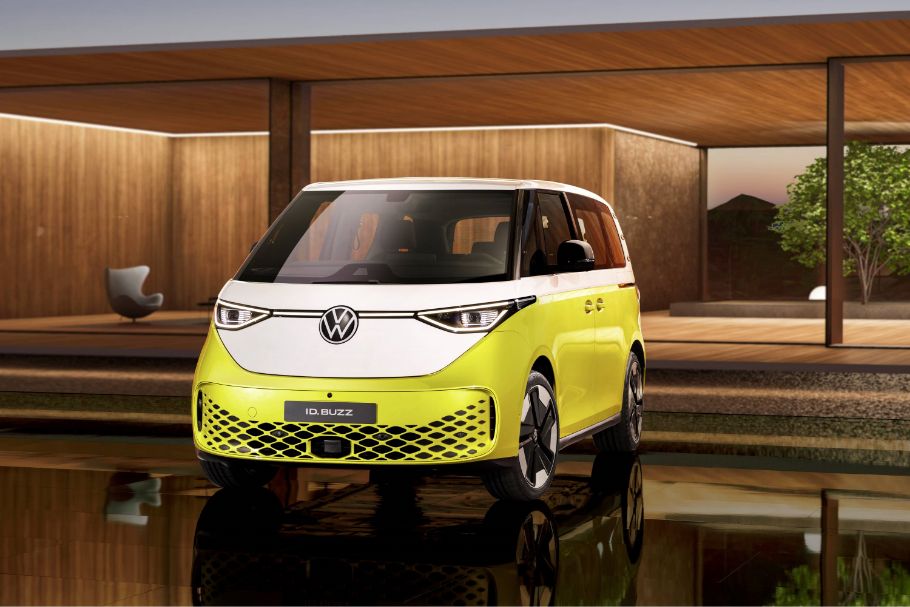
    Volkswagen ID. Buzz - Front Angle

    Today, Volkswagen Commercial Vehicles and Volkswagen Passenger Cars present the all-new ID. Buzz and ID. Buzz Cargo. The two zero-tailpipe emission vehicles transfer the design of one of the greatest automobile icons—the T1 Microbus—to the era of electric mobility. The short overhangs, spacious interior and available two-tone color palette pay homage to the past, while the high-tech interior, progressive and sustainably crafted design features, and EV technology marks it clearly as a vehicle of the future.

    The ID. Buzz and ID. Buzz Cargo will come onto the market in the first few European countries in the third quarter of this year. The features and specifications that follow apply to European models; details for the U.S. version will be available closer to launch.

    With the ID. Buzz, the Volkswagen Group further accelerates its transformation into one of the leading suppliers of electric vehicles. As with other models of Volkswagen’s all-electric family, the new ID. Buzz and ID. Buzz Cargo are based on the Group’s Modular Electric Drive Kit (MEB). The MEB is the world’s first scalable large-production-run platform, and it provides the basis across the brands for all sorts of different models and segments. At present, 30 percent of all electric vehicles in the Group are already based on the MEB. By 2025, it’s planned to be more than 80 percent. For Volkswagen Commercial Vehicles, the all-electric ID. Buzz is an important building block in order to continually help reduce the carbon footprint of the whole product portfolio.

    The first European versions of the ID. Buzz and ID. Buzz Cargo will come to market with a high-voltage lithium-ion battery providing gross energy content of 82 kWh (77 kWh net). With its twelve modules, the battery system supplies a 201 horsepower electric motor, which drives the rear axle. Maximum torque of 229 lb-ft is instantly available and the top speed is electronically limited to 90 mph. More battery versions with various power output levels are expected to follow in 2023.

    The battery is mounted in the floor of the vehicle, giving the ID. Buzz agile handling for a vehicle of its size. The charging power when using alternating current (AC) is 11 kW. Via a CCS plug connector at a DC fast-charging station (direct current), the charging power increases to as much as 170 kW. With DC-fast charging, the battery charge level rises from 5 to 80 percent in just 30 minutes. Using the latest software, the ID. Buzz model line will offer the Plug & Charge function in the future.

    For Europe, bi-directional charging will enable the new ID. Buzz and ID. Buzz Cargo to feed power that they don’t need into the domestic grid (vehicle-to-home). In the future, this can also make the power available for stabilizing the grid. The power transfer and communication take place via an optional DC bi-directional wall box.

    Exterior

    The ID. Buzz and ID. Buzz Cargo are launching in Europe this year in the normal-wheelbase form. In 2023, extended wheelbase versions of both ID. Buzz models will arrive on the European market: the U.S. version, arriving in 2024, will be based off the long-wheelbase passenger model.

    The standard wheelbase measures 2,988 mm (117.6 in), and both ID. Buzz models are 4,712 mm (185.5 in) long and 1,985 mm (78.1 in) wide, excluding wing mirrors. The ID. Buzz is 1,937 mm (76.3 in) high, while the cargo version is 1,938 mm due to slight differences in the chassis.

    The short body overhangs are possible because the zero-tailpipe emission vehicle’s electric drive system is built in a very space-efficient way. The advantages of this include maximum space utilization, more compact overall dimensions than a comparable model with a conventional drive system, and an unusually small turning circle for this vehicle class—just 11.1 meters (36.4 ft).

    “The T1 – an icon of the 1950s – represents freedom and the democratization of mobility. With the ID. Buzz, we are transferring the T1 DNA to the present day and thus into the era of electric mobility and sustainability”, says Jozef Kabaň, Head of Volkswagen Design. The looks of the ID. Buzz concept car shown in Detroit in 2017 have been closely followed for the production version. Kabaň adds: “We very consciously ensured that we were not making another T1. The ID. Buzz shows that it is successfully transferring the genes and stylistic elements of that iconic vehicle into the digital era.” That includes extremely short body overhangs, maximum space utilization on a minimal vehicle footprint, splitting the bodywork design into upper and lower levels, the unmistakable front end with its V-shaped “hood” between the charismatic headlights, and the unique rear section.

    The ID. Buzz makes full use of LEDs. At the front, it’s the charismatically styled headlights, daytime running lights, and a slim lateral bar between the headlights. In an homage to the T1, the VW logo is much larger than all other current Volkswagens. At the back, the ID. Buzz has horizontally arranged LED taillights, which are connected to one another by a full-width light strip for the first time on a Volkswagen Commercial Vehicles model.

    Volkswagen Commercial Vehicles will be offering the ID. Buzz and ID. Buzz Cargo—as is the tradition for the Microbus—both in the base colors and in various two-tone paintwork finishes for European markets. The spectrum consists of a total of eleven color variants: seven single-color options—‘Candy White’, ‘Mono Silver’, ‘Lime Yellow’, ‘Starlight Blue’, ‘Energetic Orange’, ‘Bay Leaf Green’, and ‘Deep Black’—and four two-tone options. On two-tone ID. Buzz models, the upper section, including roof and V-shaped hood, is finished in ‘Candy White’, while the areas below the character line are in a choice of four shades: ‘Lime Yellow’, ‘Starlight Blue’, ‘Energetic Orange’ or ‘Bay Leaf Green’. Exterior mirrors and door handles are finished in body color.

    Both European ID. Buzz versions will come with 18-inch steel wheels as standard. On passenger vehicle models, aluminum-alloy wheels are available in sizes ranging from 18 to 21 inches.

    Interior

    The ID. Buzz features a spacious cabin, which maximizes utility and comfort, while dazzling with high-tech features and an interplay of colors and materials.

    The standard length ID. Buzz will launch with five seats. Driver and front-seat passenger sit on individual seats with adjustable armrests (standard on the inside, optional on the outside). Integrated into the backrests of each front seat is a side thorax airbag, and in the driver’s seat there is also a center airbag, which in the event of a crash protects the driver and front-seat passenger from hitting each other. In top trims, the seats are completely electrically adjustable and have both memory and massage functions. Front seats can be adjusted up to 245 mm (9.6 in) forward and aft, and 61.5 mm (2.4 in) in height. A three-person bench seat in the rear can be folded down completely or split 40:60, and it can be moved lengthways a total of 150 mm (5.9 in). A love for detail is reflected in the stylized vehicle silhouette that is embossed in the lower side seat trim, and the fold-down tables located in the backs of the front seats. Wholly practical, by contrast, is the optional height-adjustable trunk floor, which creates a level load space surface. The upward-opening rear hatch reveals 1,121 liters (39.6 cu ft) of luggage space. Two side sliding doors are fitted as standard.

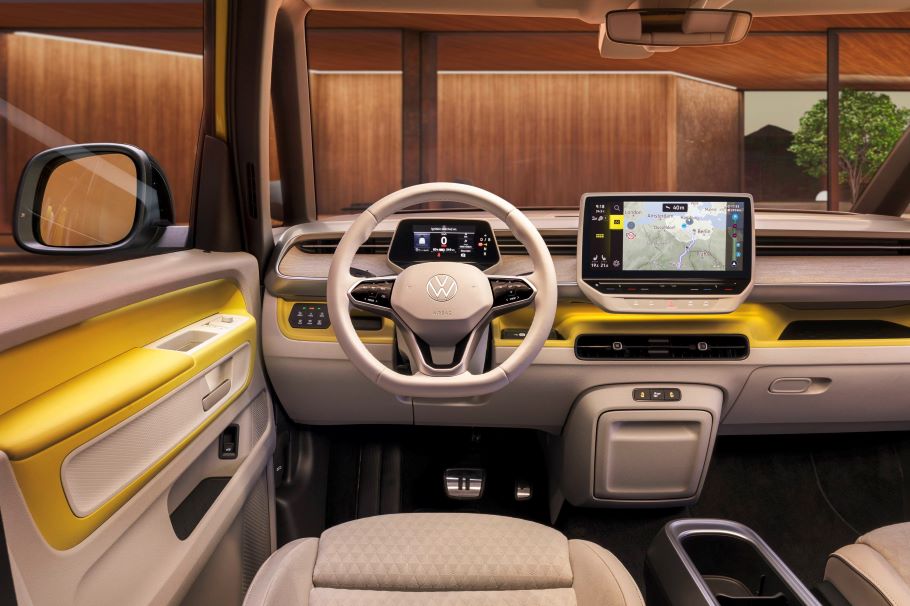
    2023 Volkswagen ID. Buzz Interior

    On the standard wheelbase, a six-seat configuration will come later with individual seats arranged in three rows of two. With the extended wheelbase, a seven-seat configuration will also be available in a 2/3/2 arrangement.

    The ID. Buzz Cargo is an ultra-modern zero-tailpipe emission van. It will launch with three seats in the cab as standard—driver’s seat plus double bench seat— and have an optional individual seat for the front-seat passenger. Behind the seats is a fixed partition, separating off the cargo space. This partition will be optionally available with a window and an opening for loading items. The cargo space measures 3.9 cubic meters (137.7 cu ft) and provides room for two euro pallets. Loads can be secured via lashing rings in the floor and bars on the side walls. The new ID. Buzz Cargo is fitted with a wide-opening tailgate and a sliding door on the passenger side. It will be possible to configure the van with a second sliding door as a custom option.

    The cockpit of the ID. Buzz is both high-tech and ergonomic. As standard, a 10-inch Digital Cockpit display is paired with a 10-inch infotainment system that is positioned centrally in the dashboard. A 12-inch display with navigation is optional. Both the Digital Cockpit and infotainment system are connected with the instrument panel only at the bottom, looking like free floating tablets. Beneath the infotainment system is a control bar with digital buttons and touch sliders. The touch sliders are used to regulate temperature and volume, while the buttons provide direct access to menus for the dual-zone Climatronic® HVAC settings, driver assist systems, driving profiles, and the parking functions.

    The transmission is operated via a steering column stalk: turn it forwards from the neutral position ‘N’ to ‘D’ for drive and back from ‘N’ to ‘R’ for reverse. To the left of the multifunction steering wheel, there is an island of digital controls for activating the light functions, as well as heating and defrost for the windshield and rear window. To the right of the steering wheel are two USB-C plugs and a tray for wireless charging (wireless App-Connect is also standard). In the center console there are, depending on specification, two more USB-C plugs; there is a fifth in the front passenger door, another in each of the two sliding doors, and one by the rearview mirror for a dash cam. Two cupholders fold out from the lower dashboard area. In the ID. Buzz Cargo, there are two more cupholders near the A-pillars.

    Volkswagen Commercial Vehicles has developed an optional movable and removable center console specifically for the ID. Buzz. The idea for this multifunction box was derived from the Detroit concept car. In its upper section, it provides storage bins (in the case of the Cargo a cup holder), a 1.4-liter (1.5 quart) flip-lid compartment (e.g. for a water bottle), and a 5-liter (1.3 gallon) drawer to accommodate tablets or laptops. In the two-seat Cargo and five-seat ID. Buzz, the center console is latched in place between the driver’s seat and front passenger seat. On the six-seat ID. Buzz, it can also be placed in the middle of the second seating row. It can be easily taken out and fitted back in.

    As with other models of Volkswagen’s all-electric vehicle family, the new ID. Buzz comes with the interactive ‘ID. Light’. It stretches across in front of the windshield in the driver’s field of vision above the instrument panel, and gives the driver intuitive information based on the color and position of the light signal. For example, a signal in the right-hand area of the strip advises of obstructions in this area or corresponds with a navigation instruction to change lanes. When ‘ID. Light’ goes red, it is signaling danger and the need to brake.

    The ID. Buzz also features standard 10-color ambient lighting, with 30 colors as optional. The 30-color version lights up a strip in the instrument panel, the decorative strips in the four doors, the storage bins in the doors and the footwell. The Digital Cockpit and the infotainment system also take on the chosen base shade. In addition, two colors can be combined in each case for the different zones, and a ‘Mood Menu’ activates preconfigured lighting profiles.

    In Europe, the base interior trim for the ID. Buzz and ID. Buzz Cargo that goes with all exterior colors is called ‘Soul’. Four ‘Mistral’ interior trim options—available exclusively for the ID. Buzz five-seater—feature the two-tone finishes found on the exterior. ‘Candy White’ is used in for the instrument panel, the door trim around the inserts, the seats’ outer panels and backs, and optionally even the steering wheel, while ‘X-Blue’, ‘Orange’, ‘Yellow’, and ‘Green’ are can be found in the dashboard and upper section of the door inserts, as well as the seat inner panels.

    Driver Assist Systems

    The spectrum of driver assist systems in the ID. Buzz includes innovatively interconnected technologies. European five-seater ID. Buzz models are equipped with standard Front Assist, Lane Assist, and Dynamic Road Sign Display. Optional systems include Adaptive Cruise Control, Side Assist, Travel Assist, Emergency Assist, Park Assist, Light Assist, and Area View.

    Sustainability

    Volkswagen is utilizing innovative technologies and processes demonstrating that both versions of the ID. Buzz have been designed with sustainability in mind. The array of such measures starts with removing any use of leather in the vehicle. The steering wheel cover is made of polyurethane, but looks just as high quality as leather and provides a similar feel. The materials used for the seat covers, floor coverings and roof liner of the ID. Buzz incorporate recycled material. There will be a fabric made of what is known as Seaqual® yarn, with fibers consisting of 10 percent collected ocean plastic and 90 percent recycled PET bottles.

    The two new ID. Buzz models will also use organically based vehicle paint and forgo cobalt in the high-voltage battery. The company’s sustainability measures include a plant that recycles the high-voltage batteries at the end of their automotive life cycle to prepare them for a second use. Volkswagen Commercial Vehicles gives a guarantee of eight years or 160,000 kilometers (100,000 miles)—whichever occurs first—on the ID. Buzz battery.

    Production

    The new ID. Buzz and ID. Buzz Cargo models are being produced by Volkswagen Commercial Vehicles at its main plant in Hannover. Production of the ID. Buzz here reaches, in parts, an automation level of up to 90 percent. In parallel with the transformation of the plant, the workforce is also taking a big step into the future. Many job profiles are changing, and through retraining measures, the workers are acquiring the necessary knowledge for dealing with the new hardware and software of the ID. Buzz.

    The majority of the ID. Buzz electric drive system modules being supplied to the plant for this are also being made in Germany, by the Group’s own Volkswagen Group Components division. The modules—including the electric motor, the axles and the battery system—are being produced at the components factories in Kassel, Braunschweig, Salzgitter and Hannover. The ID. Buzz is the first model in Volkswagen’s family of all-electric vehicles for which Volkswagen Group Components is making the axles. This is being done in an assembly hall specifically set up for the purpose at the Hannover-Barsinghausen site with 200 employees.

    Long term, Hannover also plans to produce the battery system for the ID. Buzz—it is currently being made in Braunschweig—and the company is currently investing around 100 million euros in the construction of the battery system assembly.

    QUICK FACTS – the ID. Buzz and ID. Buzz Cargo

    European models

    • ID. Buzz (five-seater)
    • ID. Buzz Cargo (van, three seats in the front)

    Important anticipated dates

    • Start of European ID. Buzz Cargo production: first half of 2022
    • Start of European ID. Buzz production: first half of 2022
    • European launch (initial countries): third quarter of 2022
    • Start of advance sales in Europe (initial countries): May 2022
    • North American debut of long wheelbase: 2023
    • North American sales launch: 2024

    Technical platform

    • Modular Electric Drive Kit (MEB)

    External dimensions

    • Width excluding wing mirrors: 1,985 mm (78.1 in)
    • Height:
      • ID. Buzz: 1937 mm (76.3 in)
      • ID. Buzz Cargo: 1,938 mm (76.3 in)
    • Length: 4,712 mm (185.5 in)
    • Wheelbase: 2,988 mm (117.6 in)
    • Load sill:
      • ID. Buzz: 619 mm (24.4 in)
      • ID. Buzz Cargo: 623 mm (24.5 in)

    Cargo space

    • ID. Buzz: up to 1,121 liters (39.6 cu ft)
    • ID. Buzz Cargo: 3.9  cubic meters (137.7 cu ft), room for two euro pallets

    Drive system

    • Type: all-electric rear-wheel drive
    • Max. power: 150 kW (201 horsepower)
    • Max. torque: 310 Nm (229 lb-ft)
    • Battery capacity: 82 kWh gross, 77 kWh net
    • AC charging power (alternating current): 11 kWh
    • DC charging power (direct current) at fast-charging stations: up to 170 kWh

    Driving performance and turning circle

    • Top speed: 145 km/h, electronically limited (90 mph)
    • Driving range: to follow at a later date
    • Turning circle: just over 11 meters (36.4 ft)

    Sustainability

    • Zero-tailpipe emission electric drive system
    • Leather replaced by non-animal material
    • Use of partial recycled materials in seat covers, floor coverings and roof liner

    Production site

    • Volkswagen Commercial Vehicles’ main plant in Hannover, Germany

    Colors

    • Non-metallic: ‘Candy White’
    • Metallic: ‘Mono Silver’, ‘Lime Yellow’, ‘Starlight Blue’, ‘Energetic Orange’ and ‘Bay Leaf Green’
    • Pearl-effect: ‘Deep Black’
    • Two-tone: ‘Candy White’ in combination with ‘Lime Yellow’, ‘Starlight Blue’, ‘Energetic Orange’ or ‘Bay Leaf Green’

    Fun Facts

    • The ID. Buzz is not the first ‘Bus with an electric drivetrain—50 years ago at the Hannover Trade Fair, Volkswagen showed a T2 powered by a rear-mounted electric motor with a maximum range of 85 kilometers (52.8 miles)
    • The five-seater ID. Buzz features a stylized silhouette of the vehicle embossed into the side of the luggage compartment and seats, reminiscent both of the T1 and the Microbus concept vehicle unveiled in 2000 in Detroit
    • The idea for the movable and removable center console of the production ID. Buzz originated in the 2017 I.D. BUZZ Detroit concept car
  • BMW 2 Series Coupe [UK]

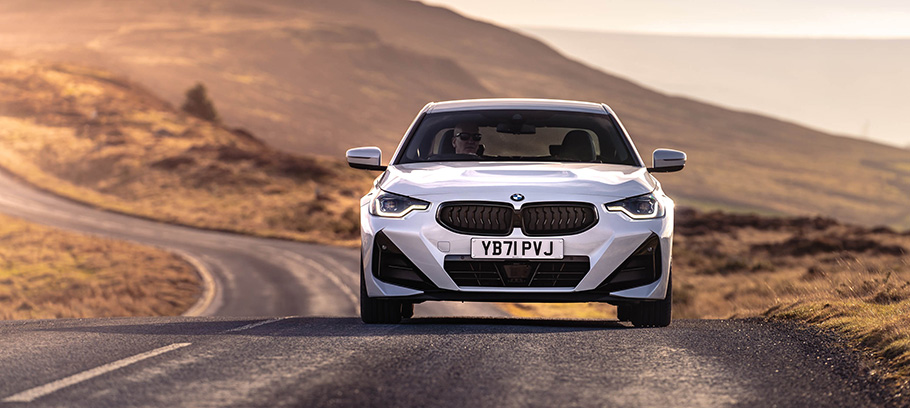
    2022 BMW 2 Series Coupe UK - Front View

    Striking looks, exceptional handling and classical rear-wheel drive will leave potential customers of the new BMW 2 Series Coupé in no doubt that this is a car to excite and inspire.

    The new generation of the two-door model incorporates the new BMW design language to highlight a fresh, youthful feel with meticulously engineered and perfectly balanced driving attributes.

    Reaffirming its sector-leading status, the BMW 2 Series Coupé boasts rear-wheel drive, a six-cylinder in-line engine option and new equipment features that combine to underscore its standout sporting characteristics.

    The advances made over the predecessor model are also reflected in a far broader range of driver assistance systems and the latest connectivity innovations.

    The standalone vehicle concept of the BMW 2 Series Coupé puts clear water between it and the BMW 1 Series models (which are based on an advanced front-wheel-drive architecture) and borrows extensively from the technology used in the BMW 3 Series and BMW 4 Series. As a result, the new BMW 2 Series Coupé occupies a defiantly niche position in both the brand’s model portfolio and among its rivals.

    The UK market launch begins in March 2022 with three model variants initially available. Topping the range is the all-wheel-drive BMW M240i xDrive Coupé, which is powered by a 374hp six-cylinder in-line engine, while customers can also choose from four-cylinder petrol and diesel versions in the standard M Sport specification.

    The new BMW 2 Series Coupé is built at the BMW Group’s San Luis Potosí plant in Mexico.

    Individual proportions, optimised aerodynamics

    The exterior dimensions provide the ideal starting point for excellent driving dynamics. A length of 4,537mm and width of 1,838mm represent increases over the predecessor model of 105mm and 64mm respectively. The new car is 28mm lower, however, with a vehicle height of 1,390mm. Its wheelbase is also 51mm longer at 2,741mm. Wider track widths of 1,575mm (an increase of 54mm) at the front axle and 1,587mm (an increase of 31mm) at the rear axle (BMW M240i xDrive Coupé: +63mm at the front, +35mm at the rear) are ideal for excellent cornering dynamics.

    The new BMW 2 Series Coupé’s boot offers load capacity of 390 litres – a 20-litre increase in primary capacity over its predecessor – and the height of the loading edge is 35mm lower.

    The concept for the new BMW 2 Series Coupé body also includes targeted measures for optimising its aerodynamics. An active air flap control system for the BMW kidney grille – adjustable through ten stages according to need – and the lower intake in the front apron, plus air curtains, flush-fitting door handles, aerodynamically optimised light-alloy wheels and an almost completely sealed underbody, serve to channel the airflow effectively. The BMW M240i xDrive Coupé also has turning vanes and splitters at the front of the underbody which deflect the air precisely as required to reduce lift.

    Intelligent lightweight design optimises rigidity and weight

    An intelligent mix of materials succeeds in minimising the weight of the new BMW 2 Series Coupé, while also enhancing the body’s rigidity and crash safety.

    As in the new BMW 4 Series Coupé, die-cast aluminium spring struts and an engine side member made from extruded aluminium profiles are deployed to save weight at the front end. Other advances over the outgoing model have been achieved through the aluminium construction of the bonnet and front side panels of the new BMW 2 Series Coupé. These measures alone account for a reduction in weight of around 9.6kg.

    A comprehensive passive safety concept maximises occupant protection and the BMW 2 Series Coupé is also equipped as standard with an active bonnet system to optimise pedestrian protection.

    Sporty, classically designed exterior with eye-catching front-end design

    The exterior design of the new BMW 2 Series Coupé instantly announces its overtly sporting nature. With powerful proportions set within the classical three-box design of bonnet, passenger compartment and boot, it truly embodies the extraordinary dynamic potential of the new 2 Series Coupé.

    Three-dimensional surfaces, triangular forms and diagonal lines are integral to the front end of the new BMW 2 Series Coupé. The low-reaching front apron, headlights positioned to the outer edges of the front end and the horizontal BMW kidney grille give the car a wide, low-slung look.

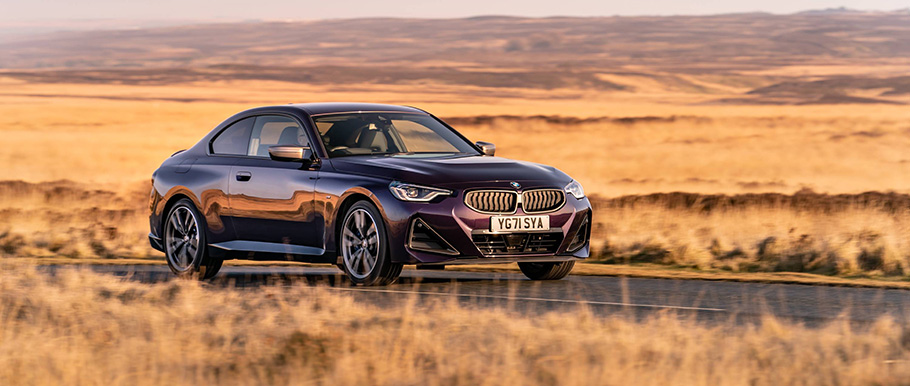
    2022 BMW2  Series Coupe M240i

    The BMW kidney grille features vertically arranged air flaps at its heart in place of the classical bars. These operate electrically and only open when the engine has an increased need for cooling air.

    Inspired by the legendary BMW 02 models, the headlight units each have a single individual circular headlight using full-LED technology for both low beam and high beam.

    A long bonnet, short overhangs and a set-back passenger compartment give the new 2 Series Coupé proportions cut from the time-honoured BMW mould. The car’s roofline, that dramatically swoops down from the B-pillar, and the short boot lid culminating in a pronounced spoiler lip, typify sporting compact BMW coupés.

    Powerful rear with striking light and shadow effects

    Horizontally pronounced surfaces give the rear end of the new BMW 2 Series Coupé its structure. They produce an interplay of light and shadow effects to accentuate the rear end and complement the darkened rear lights.

    The rear end also features a dark shadow rear apron insert, while the exhaust tailpipes on petrol-engined models come in a dual-branch arrangement. The tailpipes are circular on the BMW 220i Coupé and trapezoidal on the BMW M240i xDrive Coupé.

    Customers can choose from one non-metallic and six metallic exterior paint shades. A new addition to the range is the Thundernight metallic colour available exclusively for the sporty two-door model.

    Distinctive M accents enhance the performance-focused appearance

    Specific design features of the six-cylinder BMW M240i xDrive Coupé highlight its performance attributes. The surfaces bordering the lower air intake in the front apron display the U-shaped graphic typical of BMW M cars. A black splitter rounds off the front apron at its lowest point. The BMW kidney grille surround and side air-intake trim come in Cerium Grey, as do the M-specific exterior mirror caps, the exhaust tailpipes and the model badges. Also part of the standard specification for the BMW M240i xDrive Coupé are M High-gloss Shadow Line trim and 19‑inch M light-alloy wheels. Like the rear apron inlay, its side skirts are also in High-gloss Black. An M-specific boot-lid spoiler painted in body colour and a black diffuser between the exhaust tailpipes optimise the airflow at the rear of the car.

    The standard M Sport specification also sends a clear message about the car’s dynamic ability. It includes the powerfully structured front apron with large side air intakes, M High-gloss Shadow Line trim and 18-inch M light-alloy wheels. The side skirts and the lower section of the rear apron with integral diffuser are painted in Dark Shadow metallic.

    Interior: sports-car flair meets a premium ambience

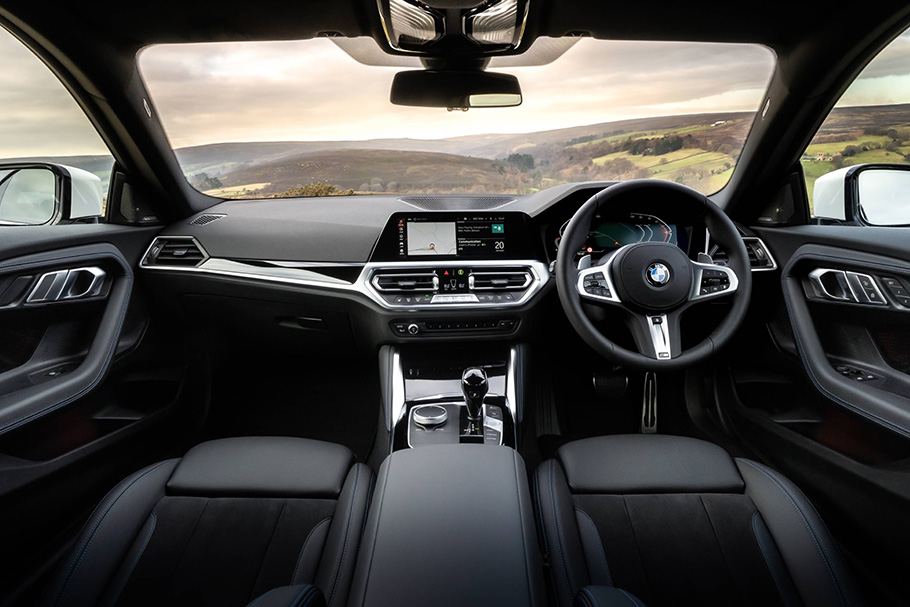
    Inside the new BMW 2 Series Coupé, the latest interpretation of the driver-focused cockpit design is defined by the ergonomically optimised arrangement and operation of the displays and controls. The BMW Controller, gear selector lever, Start/Stop button, Driving Experience Control switch and numerous other function buttons are grouped within a modern-looking control panel in the centre console. High-quality materials, precise workmanship and carefully executed details mark out the elevated quality levels of the interior.

    Standard equipment includes a Sport leather steering wheel with newly designed multifunction buttons. The standard M Sport specification come with Alcantara/Sensatec upholstery in Black with blue contrast stitching and the BMW M240i xDrive Coupé comes with Vernasca leather.

    The standard heated sport seats for the driver and front passengers of M Sport provide both excellent long-distance comfort and pronounced lateral support. Electric M Seats with integrated headrests and M seatbelts feature in the six-cylinder flagship model.

    2022 BMW 2 S0eries Coupe UK Interior

    The Easy-Entry function slides the electric front seats forward in a controlled movement when the backrests are folded, making it easier for passengers to access the rear compartment. The contours and integral headrests of the two rear seats give them a sporty look and feel.

    The combination of triangular surfaces and diagonal lines in the exterior of the car is carried over into the interior. A new design feature comes in the form of trapezoidal accent surfaces above the armrests in the doors.

    The interior trim strips on all variants come in High-gloss Black as standard. Standard equipment also includes cushioned knee pads on the centre console, an M headliner in Anthracite, door sill finishers bearing the M logo, M pedals, M floor mats and M-specific displays in the instrument cluster.

    Advanced chassis technology honed to deliver class-leading driving dynamics

    From day one, the series production development process for the new BMW 2 Series Coupé was focused squarely on leading the way in terms of dynamic performance in the premium compact segment. Compact dimensions, intelligent lightweight design for the body and chassis, almost perfect 50:50 weight distribution and optimised aerodynamics create an ideal blueprint for a vehicle character focused on sporting excellence.

    Another central element of the vehicle concept underpinning the new BMW 2 Series Coupé is power transfer to the rear wheels or – in the new BMW M240i xDrive Coupé – via intelligent all-wheel drive with a noticeable rear-wheel bias.

    In all model variants, sophisticated chassis components originally designed for the BMW 3 Series and BMW 4 Series models ensure supreme driveability at all times. While the new BMW 2 Series Coupé outstrips its predecessor in terms of performance agility, the comfort it offers remains at the same high level. When it comes to rolling comfort and acoustics, the new car has made significant improvements.

    Highlights of the chassis technology include a two-joint spring strut-front axle, five-link-rear axle, wheel bearings that are 2.7kg lighter and have 45 per cent less friction than before, lift-related dampers with bespoke characteristics, and weight-saving construction throughout.

    Adaptive M suspension spans an extremely wide spectrum between sportiness and comfort

    The adaptive M suspension available as an option for the new BMW M240i xDrive Coupé allows drivers the widest possible spread between sporty and comfort-oriented responses. Adaptive M suspension combines the characteristics of M Sport suspension with electronically controlled dampers.

    Switching between the various Driving Experience Control modes produces a clearly perceptible variation in the damping characteristics – from the well-balanced long-distance refinement of COMFORT mode through to the highly dynamic set-up activated in SPORT PLUS.

    An extra mode can be selected using the Driving Experience Control switch on models with adaptive M suspension. In the ADAPTIVE setting, the steering, damping and accelerator responses along with the transmission’s shift characteristics are automatically adjusted to suit the driving style.

    Variable sport steering is fitted as standard to all versions of the new BMW 2 Series Coupé.

    M Sport braking system with model-specific adjustments

    Powerful lightweight braking systems with a bespoke configuration also play a part in the car’s precisely controllable performance. The optional M Sport brakes (standard on the new BMW M240i xDrive Coupé) provide excellent braking performance through a specification that includes four-piston fixed callipers at the front and single-piston floating callipers at the rear. The callipers bear the M logo and are painted red as standard or with a blue finish option available at no cost.

    The functions provided by the Dynamic Stability Control (DSC) system include not only anti-lock braking (ABS) and Dynamic Traction Control (DTC), but also a variety of stabilising functions and the drive-off assistant. The Performance Control function gives the car even more agile handling by varying the distribution of drive torque to the rear wheels according to the situation at hand.

    BMW 2 Series Coupe M Sport braking system

    M Sport differential fitted as standard on the BMW M240i xDrive Coupé.

    The outstanding performance attributes of the new BMW M240i xDrive Coupé stem from a carefully composed package of powertrain and chassis technology, which also includes an M Sport differential as standard. Its electronically controlled, fully variable locking function in the rear differential optimises traction and directional stability, as well as agility and cornering dynamics.

    Trio of engine options include a six-cylinder in-line petrol engine in the BMW M240i xDrive Coupé

    The flagship model in the 2 Series Coupé range is equipped with the most powerful six-cylinder in-line petrol engine in the core BMW brand engine portfolio. Producing 374hp, the 3.0-litre unit develops 34hp more than the engine in its predecessor. Its peak torque of 500Nm is on tap from 1,900-5,000rpm. The BMW M240i xDrive Coupé accelerates from 0 to 62mph in only 4.3 seconds.

    Developed using the motor-racing expertise of BMW M GmbH, the engine features an aluminium crankcase with a closed-deck construction and an alloy cylinder head. Internal engine efficiency is increased by weight-optimised pistons and con rods and a forged steel crankshaft. Power development and efficiency also benefit from the latest BMW M Twin Power Turbo technology. The standard M Sport exhaust system provides the perfect soundtrack to the engine’s spirited power delivery.

    As well as the latest version of BMW TwinPower Turbo technology with twin-scroll turbocharging and High Precision Injection, the four-cylinder 2.0-litre petrol engine of the new BMW 220i Coupé also has a cylinder head with integrated exhaust manifold. Making its debut in the 184hp unit, this design enables particularly effective exhaust gas cooling, which helps to minimise emissions. It generates 300Nm of torque, enabling acceleration of 0-62mph in 7.5 seconds.

    The enhanced 2.0-litre power unit in the new BMW 220d Coupé develops 190hp and peak torque of 400Nm. It now features two-stage turbocharging and further developed common rail direct injection. Mild-hybrid technology supports the diesel engine. A 48V starter generator takes the role of an electric drive system, providing an extra 11hp of power. This electric boost enhances dynamic response when accelerating off the line and overtaking. The BMW 220d Coupé sprints from 0-62mph in 6.9 seconds.

    Model Max Power(hp) Peak Torque(Nm) Acceleration(0-62mph) Top Speed(mph)** Fuel economy(mpg)* CO2 emissions(g/km)* OTRStarting Price
    220i 184 300 7.5 147 44.8 155-144 £34,980
    220d 190 400 6.9 147 60.1 132-122 £36,900
    M240i xDrive 374 500 4.3 155** 34.9 200-185 £45,795

    **Electronically governed.

    Standard across the new BMW 2 Series Coupé: eight-speed Steptronic Sport transmission

    The eight-speed Steptronic Sport transmission fitted as standard in all BMW 2 Series Coupé model variants helps the driver to execute dynamic manoeuvres. As well as gearshift paddles on the steering wheel, this transmission also brings a Launch Control function for when the driver is looking to power off the line with optimal traction. For quick bursts of speed while on the move, meanwhile, there is the Sprint function. Here, the transmission automatically shifts into the lowest usable gear when the driver pulls the left-hand shift paddle for at least one second.

    BMW xDrive: precisely controlled power distribution for optimal traction and driving pleasure

    The intelligent all-wheel-drive system BMW xDrive in the new BMW M240i xDrive Coupé increases traction, directional stability and agility. It uses an electronically controlled multi-plate clutch in the transfer case interlinked with the powertrain and chassis systems to distribute power between the front and rear wheels as required for the situation at hand. In this way, any tendency of the vehicle to oversteer or understeer is nipped in the bud.

    In driving situations where all-wheel drive is not necessary, the power from the six-cylinder in-line engine is sent to the rear wheels alone. This set-up and the M Sport differential likewise fitted as standard in the new BMW M240i xDrive Coupé work together to deliver the type of performance experience customers expect from a BMW when pushing the dynamic limits.

    Standard equipment includes three-zone automatic climate control and BMW Live Cockpit Professional

    The standard-fitted BMW Live Cockpit Professional features a fully digital screen grouping. It includes a high-resolution instrument cluster behind the steering wheel with a screen diagonal of 12.3 inches and a 10.25-inch control display. The fully digital instrument display in the cockpit provides enough room to accommodate an excerpt from the navigation map, media content or status indicators for the driver assistance systems.

    The new BMW 2 Series Coupé is fitted as standard with acoustic glazing for the windscreen and a rain sensor with automatic headlight activation. Electrically adjustable, heated and folding exterior mirrors also form part of the standard specification, as does three-zone automatic climate control and LED lighting for the interior. The new version of the optional glass slide/tilt electric sunroof has a transparent surface that is 80mm longer than in the outgoing model and is nearly 20 per cent larger overall.

    Tailor-made performance: M Sport package Pro and M Performance Parts

    The standard M Sport trim can be further enhanced with the M Sport package Pro. Comprising M Sport brakes, 19-inch M light-alloy wheels, M High-gloss Shadow Line with extended features, the M lights Shadow Line, a black M rear spoiler, this package delivers optimised driving dynamics and particularly striking looks. A sporty drive sound in the interior, Steptronic Sport transmission, the harman/kardon hi-fi speaker system and M seat belts also increase levels of driving pleasure.

    In addition, the M Performance Parts available for the new BMW 2 Series Coupé allow customers to give their car an extra sporting touch, as per their personal tastes.

    New and improved driver assistance systems

    The new BMW 2 Series Coupé enhances safety and comfort with a significantly expanded selection of driver assistance systems. The automated assistance functions are among the best on the market. They assist the driver or lighten their workload in a wide variety of driving situations and when parking.

    The BMW 2 Series Coupé is fitted as standard with front-collision warning. This system includes Collision Warning with braking function and pedestrian and cyclist warning with braking function. Speed Limit Info with no-overtaking indicator is another feature fitted as standard.

    Also to be found on the standard equipment list is an enhanced version of Lane Departure Warning with lane return, which can be used when travelling at speeds between 44 and 130mph.

    Active Cruise Control with Stop&Go function is also optional as part of Driving Assistant. This system works when driving at speeds of 19-99mph and is capable of braking the vehicle to a standstill, if necessary, and even setting off again automatically after short pauses lasting up to 30 seconds. The standard and optional cruise control systems both include a manual Speed Limit Assist function.

    Drivers of the new BMW 2 Series Coupé can also benefit from effective assistance when parking and manoeuvring, for example from the standard Park Distance Control (PDC) with sensors at the front and rear. The optional Parking Assistant Plus offers even more assistance with features that, among other functions, generate an excellent 360-degree image of the vehicle and its surroundings.

    Innovative digital services enabled by the standard BMW Operating System 7

    Both driver and passengers will benefit from the enhanced options offered in the standard-fit BMW Operating System 7. Individually configurable display content and intelligent connectivity underpin multimodal and seamless interaction between driver and vehicle. Drivers can take their pick of control interface depending on the situation, using either the control display touchscreen, the BMW Controller, multifunction buttons on the steering wheel or voice control. The new BMW 2 Series Coupé also gives customers on-board access to a range of highly advanced digital services, including the BMW Intelligent Personal Assistant, optional BMW Digital Key, Real Time Traffic Information including hazard alert, Connected Music and Remote Software Upgrades.

    Making its BMW 2 Series Coupé debut: the BMW Head-Up Display

    The BMW Head-Up Display – available for the BMW 2 Series Coupé for the first time as an optional extra – helps the car to provide focused and safe driving experience. It projects driving-related information directly into the driver’s field of vision on the windscreen without the need to divert their eyes from the road. The latest generation of the system boasts a very large projection area and full-colour graphics.

    2022 bmw 2-series coupe uk navigation

    Fast, accurate, informative: the BMW Maps navigation system

    The cloud-based BMW Maps navigation system boasts significantly enhanced performance and excellent accuracy along with a simplified method of destination entry. The new-generation navigation system offers extremely fast route calculation carried out dynamically and based on precise real-time traffic data transmitted at short intervals.

    BMW Maps also uses Connected Parking to provide assistance when searching for a parking space close to the destination, providing information at both the start of a journey and near its end.

    Smartphone linking and integration of third-party services

    BMW Live Cockpit Professional comprises optimised smartphone integration, e.g. via Apple CarPlay, allowing customers to access an array of digital services such as Siri, various map apps, music streaming services like Apple Music and WhatsApp.

    The BMW Group has extended the reach of seamless connectivity in its vehicles with the addition of another customer-centric service. Android Auto™ provides a simple, safe way to use smartphone functions such as music, media and messaging apps during a journey. Customers can interact with their smartphone with the help of the Google Assistant. Highlights of the interplay between Android Auto and BMW include user-friendly and wireless connectivity and the intelligent integration of Google Maps™ navigation instructions in the BMW Head-Up Display.

    The My BMW App is available in more than 40 countries for both iOS and Android operating systems, and can be downloaded free from the Apple App Store or Google Play Store. It acts as a new universal interface to the car, providing information on the vehicle’s status at any time. Depending on the equipment fitted, it also enables remote operation of functions, such as vehicle locating, locking and unlocking the doors or monitoring the car’s immediate vicinity (Remote 3D View).

    The deep integration of Amazon Alexa means customers can now use the voice assistant from Amazon in their car in exactly the same way they already do at home. Amazon Alexa can be installed in the car in just a few steps with the help of the My BMW App.

    The optional BMW Digital Key enables customers to lock and unlock their new BMW 2 Series Coupé via Near Field Communication (NFC) with their Apple iPhone, making a conventional car key superfluous. Holding the smartphone up to the door handle opens the car. Once inside, the engine can be started as soon as the phone has been placed in the wireless charging tray.

    BMW Intelligent Personal Assistant with extended functions

    The latest generation of the BMW Intelligent Personal Assistant provides a particularly close connection between driver and car in the new BMW 2 Series Coupé. Activated by a spoken prompt (for example “Hey BMW”) or at the touch of a button, this digital companion acquires new capabilities all the time. Naturally formulated spoken instructions can now also be used to adjust the air conditioning. In addition, the BMW Intelligent Personal Assistant is also capable of learning routines that increase both convenience and driving pleasure in specific situations. For instance, the driver’s window can be opened automatically when the vehicle reaches a chosen location entered using GPS coordinates, such as the entrance to a garage or multi-storey car park.

    Always up to the minute: Remote Software Upgrades for over-the-air updates

    The BMW Group is one of the key players in the field of over-the-air function upgrades. The Remote Software Upgrades function keeps the BMW 2 Series Coupé right up to date with the latest software. All updates can be imported over the air, either on a smartphone via the My BMW App or directly into the car using its built-in SIM card. The intelligent connectivity technology also makes it possible to incorporate additional vehicle functions at a later date.

  • NOVITEC Ferrari Roma

    2021 NOVITEC Ferrari Roma

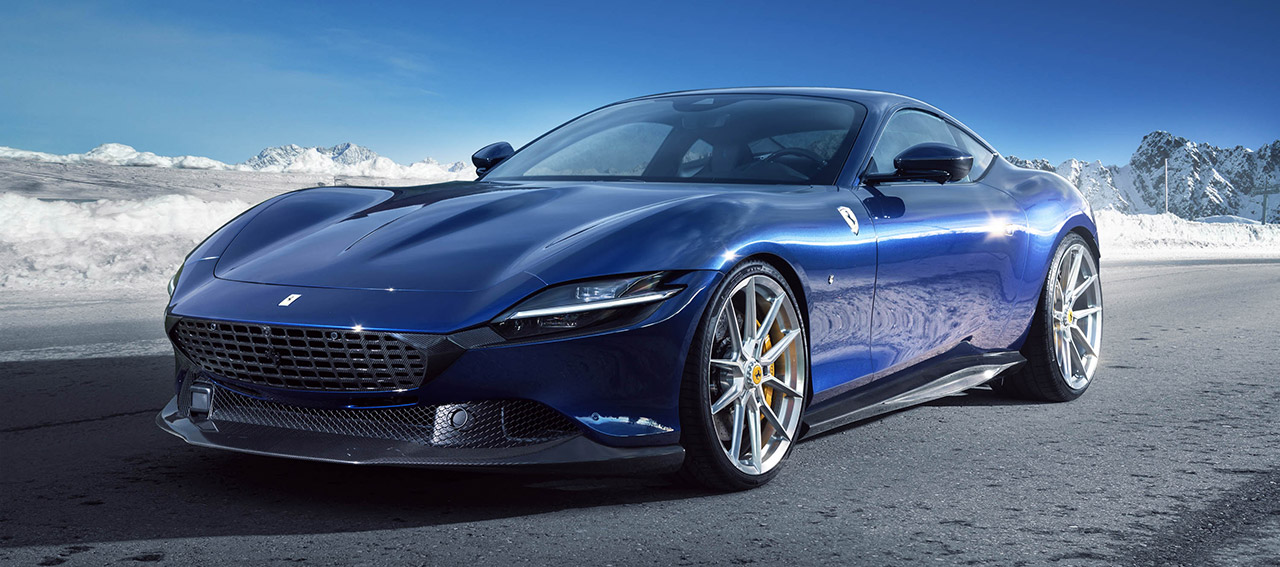
    Ferrari is further expanding its extensive vehicle range with the Roma. NOVITEC, globally leading refinement specialist for the sports cars from Maranello, now offers an exclusive customization range for the coupe.

    The NOVITEC engine tuning unleashes a peak output of 518 kW / 704 hp and a peak torque of 882 Nm from the 3.9-liter twin-turbo eight-cylinder engine. This engine slings the Roma from rest to 100 km/h in just 3.2 seconds and gives it a top speed north of 325 km/h.

    The NOVITEC carbon aerodynamic-enhancement components give the two-door a touch of racing looks. Hi-tech 21-inch and 22-inch forged wheels, developed in cooperation with American rim manufacturer Vossen, optimally fill out the available space under the wheel arches.

    The German company’s range also includes suspension modifications as well as the customization of the interior tailored to the customer’s personal preferences.

    NOVITEC has employed professional engine tuning for decades to make the cars from Ferrari even more dynamic and even faster. While the inner workings of the 3.9-liter twin-turbo V8 in the bow of the Roma remain untouched, the peripherals are modified in several expansion levels.

    In order to optimize the power delivery further, the engineers of the tuner developed modified controls for the electronic engine management system. All output levels use a NOVITEC N-TRONIC control module, which introduces specifically calibrated mapping for injection and ignition. It also upgrades the electronic boost pressure control. These measures benefit more than just the power delivery. They also further optimize the throttle response and the powerful in-gear acceleration. In addition, NOVITEC offers high-performance catalysts that have a performance-enhancing effect.

    In performance level 2, the peak output of the eight-cylinder engine increases by 61.8 kW / 84 hp while peak torque grows by 122 Nm over the stock configuration. With 518 kW / 704 hp at 7,400 rpm and 882 Nm at a low 3,750 rpm, the coupe sprints from zero – 100 km/h in just 3.2 seconds and reaches a speed of 200 km/h after a mere 8.9 seconds. The top speed is in excess of 325 km/h.

    The NOVITEC designers went into the wind tunnel to develop a body styling kit that makes the Roma even more streamlined and aerodynamically efficient. It also gives the Roma an even more extravagant appearance. All bodywork components are manufactured from especially light yet high-strength naked carbon and given a high-gloss coating.

    The NOVITEC front spoiler attaches to the production bumper and gives the powerful sports car a more striking face. Its sophisticated shape also optimizes the directional stability at high speeds. The trim elements on the left and right under the main headlights and the carbon-fiber grille add further decidedly sporty touches.

    The NOVITEC rocker panels give the Ferrari a lower and sleeker visual stance in the side view and optimize the airflow between the front and rear wheel arches. Another element sporting the racing look: the carbon covers for the side mirrors.

    In order to reduce rear-axle lift and thus achieve an optimal aerodynamic balance, NOVITEC enhances the Roma with a lip spoiler on the trunk lid. Further upgrades are the diffuser insert and the vertical carbon fin. In addition, there is a carbon cover for the retractable rear wing of the Roma. Carbon surrounds for the four taillights round out the exclusive NOVITEC look.

    Vossen produces the NOVITEC wheels using hi-tech forging technology. In addition to top quality, variety is key: Three different designs in 72 different colors and three different surface finishes are available for the Ferrari Roma. The vehicle pictured here sports silver NOVITEC NF10 alloys with brushed surface. Their hub cover in center lock design emphasizes the connection to the legendary motor racing tradition of the Italian make. These wheels with five delicate double spokes are mounted on the Roma’s front axle in size 9Jx21 with tires of size 255/30 ZR 21. The 12Jx22 rims on the rear axle carry tires of size 315/25 ZR 22.

    The NOVITEC sport springs are tailored specifically to these high-performance tires and lower the ride height of the Ferrari by about 35 millimeters. At the same time, the engineers also developed a feature that further optimizes the daily practicality of the Roma. The hydraulic NOVITEC front lift system enables raising the body at the front axle by 40 millimeters at the touch of a button in the cockpit. This makes it easier to navigate past parking garage ramps or speed bumps. Another tip of the switch reverts the front end to its original position. This process also takes place automatically upon reaching a speed of 80 km/h.

    NOVITEC also fulfills the personal wishes of every customer in the cockpit with perfectly finished leather and Alcantara interiors. The selection of colors is just as infinite as the range of designs.

  • Brabus Mercedes-Maybach GLS 600 4MATIC 800

    2022 Mercedes-Maybach GLS 600 4MATIC BRABUS 800

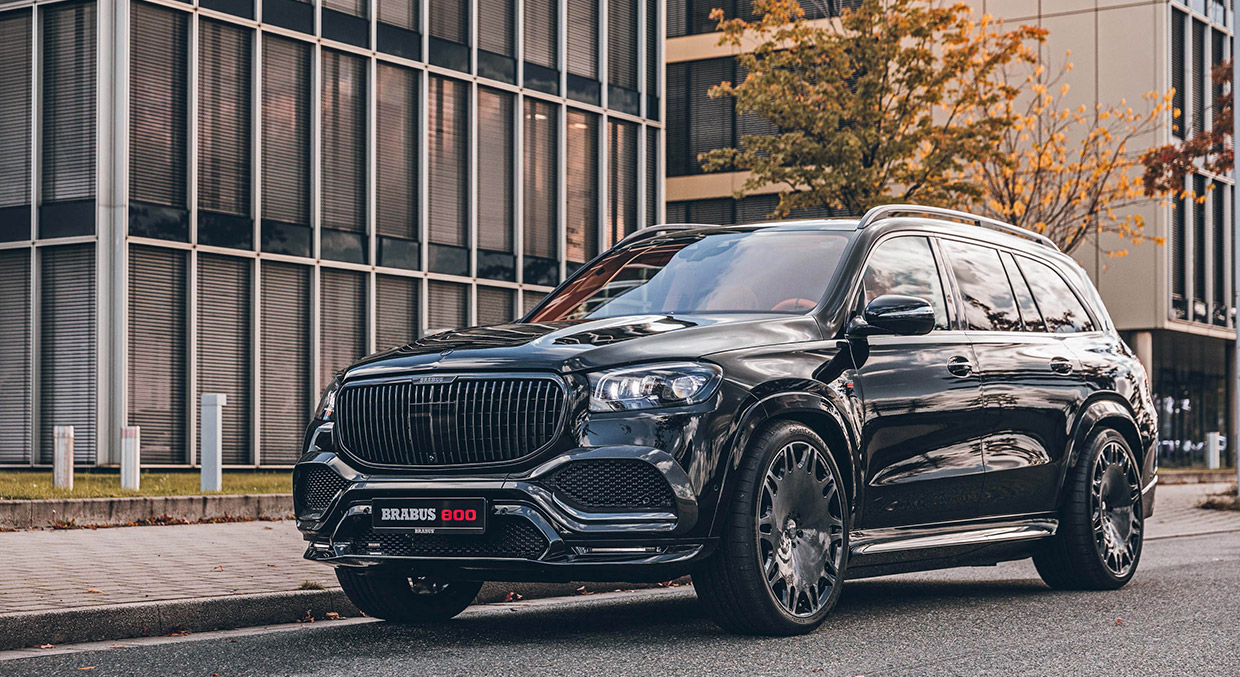
    The new Mercedes-Maybach GLS 600 4MATIC redefines the essence of a luxurious SUV. And consequently, making this extraordinary all-wheel-drive car even more exclusive, individual and sporty is the perfect challenge for the engineers, technicians and designers of BRABUS.

    The four-liter, twin-turbo V8 engine with BRABUS PowerXtra B40S-800 performance upgrade produces superior power in every situation and delivers the driving performance of a sports car. With an output of 588 kW / 800 hp (788 bhp) and a peak torque of 950 Nm (701 lb-ft), the black supercar catapults itself from rest to 100 km/h in just 4.5 seconds. The top speed is electronically limited to 300 km/h (186 mph).

    The looks of the BRABUS 800 are just as thrilling as the performance is, with dark Shadow Grey replacing the shiny chrome of the production car as a dominant feature. This includes all bodywork components and the BRABUS Monoblock M “PLATINUM EDITION” hi-tech forged wheels in king-sized 24-inch diameter.

    The BRABUS designers developed aerodynamically efficient exposed-carbon bodywork components with sporty and elegant styling specifically for this model. They give the luxury SUV a more athletic appearance.

    Choosing the finest leather for the exquisitely finished BRABUS fine leather interior in Leonis Orange creates a brilliant contrast.

    The Mercedes-Maybach GLS 600 4MATIC is powered by an eight-cylinder, four-valve engine with two turbochargers and a displacement of four liters. As befits the world’s largest provider of engine tuning for Mercedes-Benz automobiles, the engineers of the refinement specialist developed the BRABUS PowerXtra B40S-800 performance upgrade for this power unit.

    The top-of-the-line model of the GLS-Class puts out 410 kW / 557 hp (550 bhp) in stock configuration and produces a peak torque of 730 Nm (538 lb-ft). After the BRABUS engine upgrade, peak power jumps by 178.8 kW / 243 hp (239.7 bhp), while peak torque grows by 220 Nm (162 lb-ft). This naturally requires extensive modifications. Two special BRABUS turbochargers with larger compressor unit and modified core assembly fitted with uprated axial bearings replace the two production turbos. They produce a maximum boost pressure of 1.6 bar. To be able to take advantage of this required reprogramming the electronic boost pressure control as well. That is the job of the plug-and-play BRABUS PowerXtra control module, which also introduces specially developed mapping for injection and ignition to the electronic engine control unit.

    All components underwent extensive and complex bench testing and road tests, and all are TÜV-certified. Because BRABUS vouches not only for high performance, but also for maximum durability and daily practicality, this engine tuning is also backed by the exemplary three-year or 100,000-kilometer/62,000-mile BRABUS Tuning Warranty (see BRABUS Warranty Terms and Conditions, updated July 2013). BRABUS recommends high-performance lubricants from MOTUL.

    588 kW / 800 hp (788 bhp) at a low 6,000 rpm and the massive torque of 950 Nm (701 lb-ft) at a low 5,000 rpm bestow the road performance of a full-blooded sports car upon the BRABUS 800. The refined luxury supercar accelerates to 100 km/h in just 4.5 seconds. Due to the vehicle weight, the top speed is electronically limited to 300 km/h (186 mph).

    However, even more impressive than the raw data is the superior effortlessness with which the BRABUS engine pushes the SUV weighing some 2.8 metric tons in every rev range, delivering an extraordinary driving experience.

    The BRABUS stainless high-performance exhaust system with active sound management and a matt black tailpipe on either side enables the driver to choose at the touch of a button in the cockpit between a tasteful, urban acoustics and a powerful eight-cylinder sound in sport mode.

    The looks of the five-door are as thrilling as the driving experience is. To match the black paint finish of the vehicle, all production chrome parts were given Shadow Grey glazing. To emphasize the sporting ambitions of the BRABUS 800 visually as well and to optimize the aerodynamics further, the design studio of the refinement specialist developed tailor-made bodywork components for the Maybach variant of the GLS-Class.

    The front is upgraded with a BRABUS front spoiler, which in concert with the carbon front trim for the air intakes in the bumper gives the SUV an even more distinctive face. This aerodynamic-enhancement component is shaped to reduce lift at high speeds.

    There is also a sporty upgrade at the rear, where the bumper is fitted with a special BRABUS lower section, which accommodates the center diffuser and integrates two perfectly shaped cutouts on both sides for the tailpipes of the BRABUS sport exhaust system.

    The BRABUS Monoblock M “PLATINUM EDITION” high-end alloys are just as extravagant. With a diameter of 24 inches, they perfectly fill out the available space under the wheel arches, which are fitted with exposed-carbon flares. These wheels with large disc design are produced using a hi-tech forging process and consequently offer maximum strength. The front axle runs on rims of size 10Jx24 with Continental high-performance tires of size 295/35 R 24. The rear features twelve-inch-wide rims with 335/30 R 24 street tires.

    The mapping of the BRABUS control module for the AIRMATIC air suspension is specifically calibrated to these 24-inch low-profile tires. It lowers the ride height of the supercar by about 25 millimeters (1 in).

    BRABUS also offers virtually endless options to tailor the luxurious interior of a Maybach precisely, individually and in the highest quality to the personal taste of the vehicle owner. As a contrast to the black paint finish, the company upholstery shop of the refinement specialist created a classy BRABUS fine leather interior in bright Leonis Orange. This especially soft and breathable leather on the seat center sections, the door panels and the entire cabin floor features perforations and square quilting applied with pinpoint precision. In the rear, the BRABUS interior designers integrated a tailor-made business console with two retractable tables.

    To match the exterior design, all switches and trim elements feature Shadow Grey glazing. The BRABUS Signature carbon elements on the instrument panel, center stack and door panels add sporty highlights in the cockpit. They are complemented with aluminum pedals, door pins and paddle shifters on the steering wheel in BRABUS RACE design.

    The BRABUS 800 is built to order according to the customer’s wishes. Alternatively, BRABUS can upgrade any GLS 63 to this level all at once or in stages.

    Fuel economy, CO2 emissions and efficiency class:

    BRABUS 800 based on the Mercedes-Maybach GLS 600 4MATIC: city 16.0 l/100 km, highway 9.7 l/100 km, combined: 13.4 l/100 km. Combined CO2 emissions: 275 g/km, efficiency class D.

  • Toyota GR Supra Heritage Edition

    2021 Toyota GR Supra Heritage Edition

    The GR Supra Heritage Edition, which debuted at the 2019 Specialty Equipment Market Association (SEMA) Show, returns to the show floor along with its companion car, the GR Supra Sport Top. Both are located in Central Hall, Booth No. 24800 and are expected to be fan favorites once again.

    “The original MKIV Supra is considered by many to be one of the most desired vintage Supra models, and we wanted to pay tribute to its legacy,” said Lisa Materazzo, group vice president – Toyota Division Marketing. “Our team’s approach was to give a serious nod to the legendary A80 while doing justice to the great lines and performance of the new A90.”

    In order to conceive the Heritage Edition Supra, the Toyota Motorsports Garage worked with Beree Cox Design to render a prototype design based on the GR Supra that paid homage to the MKIV Supra’s visual cues. From there, it was off to the races to blend the “old” with the new.

    LG Motorsports crafted an integrated front splitter and a MKIV Supra wing modified to match the new GR Supra’s proportions. To optimize the aerodynamic balance and efficiency, Toyota and Cripwerks Engineering designed a custom rear diffuser and slotted the GR Supra’s stock front fender vent covers to help relieve pressure built up behind the tires. LA Prep then painted the creation in a vibrant custom color dubbed “Re-Entry Red.”

    Lead builder, Marty Schwerter searched for headlights and taillights that would work with the GR Supra’s modern body lines yet resemble those on the MKIV Supra. He ultimately chose to go with custom light buckets with lenses CNC machined from blocks of acrylic.

    Precision Turbo & Engine modified a stock turbocharger to produce 18% more airflow to the B58 inline-six cylinder engine. Mission Performance calibrated the engine management system, and a custom intake and three-inch center exit exhaust helps the engine breathe more freely. These modifications increased overall output to more than 500 horsepower.

    Toyota worked with Scarbo Performance to design an extremely unique custom inboard rocker arm system to replace the factory rear suspension. This allowed the team to maintain the factory body lines while creating room for a wider wheel and tire combination capable of managing the increased horsepower. The GR Supra Heritage Edition wears custom 19×11-inch HRE P107SC five-spoke wheels shod with 305/30R19 Toyo Proxes R888R competition tires at the rear. A matching set of 19×10.5-inch HRE P107SC wheels with 295/30R19 Toyo Proxes tires fill the front wheel wells.

    To close the gap between the tires and arches, the team used TEIN adjustable coil-overs and fitted massive Brembo six-piston monobloc calipers with 380mm two-piece rotors up front and four-piston monobloc calipers with 380mm rotors at the rear.

    When the GR Supra Sport Top debuts at its first live in-person SEMA Show alongside the GR Supra Heritage Edition, attendees will finally get to see GR Supras inspired by the MKIV side by side. Fixed roof rigidity and simplicity or a removeable roof to take in the sun or the stars? This year, SEMA concept car fans don’t have to choose.

  • Toyota GR Supra Sport Top Concept

    2021 Toyota GR Supra Sport Top Concept

    Last year, Toyota remained committed to the automotive aftermarket and the Specialty Equipment Manufacturers Association (SEMA), hosting its 2020 SEMA360 Showcase virtual presentation and unveiling its latest creations, including the GR Supra Sport Top. For 2021, Toyota is excited to “show the metal” and give the GR Supra Sport Top the live in-person SEMA Show debut it deserves.

    Intended as a continuation of Toyota’s tribute to the much heralded and loved MKIV Supra of the 1990s, it celebrates the removable-roof Supra models of the past and is a fitting companion to the wildly popular GR Supra Heritage Edition that debuted at SEMA in 2019.

    Both the GR Supra Sport Top and the GR Supra Heritage Edition will be on display in Toyota’s 2021 SEMA Show exhibit (Central Hall, Booth No. 24800). For the first time, SEMA attendees will be able to feast their eyes on both builds side by side and experience the ultimate Supra tribute.

    “We are very excited to finally get a chance to show off both of these incredibly cool GR Supra builds at the SEMA Show,” said Lisa Materazzo, group vice president – Toyota Division Marketing. “The team did some spectacular customization and fabrication work to pay tribute to Supras that came before, and we’re finally going to show them together so SEMA fans can see them up close and personal.”

    Marty Schwerter and the Toyota Motorsports Garage set out to conceptualize the GR Supra Sport Top Edition and create this open-air Supra tribute. It features many of the Heritage Edition’s custom visual cues and performance upgrades yet takes a fresh look at the retro-inspired build.

    “Toyota really wanted to have a companion to the Heritage Edition. But, this was no easy build, and we put a lot of thought into cutting the roof and removing a significant part of the car’s structure,” Schwerter said. “It was way more complicated than we originally thought. Removing the top was extremely tough and required some innovative work to retain the GR Supra’s rigidity. I love how it came out, and I hope others love it, too.”

    KC Mathieu, owner of KC’s Paint Shop in Fort Worth, Texas, led the roof removal work.

    “The steel was a little harder to cut through than we expected,” said Mathieu. “We started with an air saw and got nowhere real fast.”

    Though concerned that after 30 minutes they had only cut about an inch of steel, KC then switched gears and tried a different cutting tool. After some time, the metal of the roof really started to yield, and eventually the surgery would be a success.

    The roof design features two composite panels 3D printed by Toyota Motor North America Research and Development in Ann Arbor, Michigan. The roof panels were contoured to the GR Supra’s body lines and the car retains the windshield header and the driver’s and passenger’s side outer roof body structure shapes. To maintain structural integrity, the team reinforced the roof’s outer body structures and added reinforcement underneath from the engine bay to the back of the tub.

    With an opportunity to take a new look at some of the Heritage Edition’s custom upgrades, the team worked on making the hand-built rear diffuser and underbody airflow more efficient. They also reworked the exhaust and created a new custom setup featuring dual pipes in the center of the rear fascia. Of course, the iconic MKIV rear basket handle wing was also integrated into the decklid, while round taillights complete the MKIV rear treatment. KC’s Paint Shop did the final body work and applied numerous coats of BASF paint mixed to exactly match the OEM GR Supra color Absolute Zero White, creating a strikingly flawless finish. The GR Supra Sport Top Edition and GR Supra Heritage Edition share many of the same custom upgrades, but both are visually unique and fitting tributes to past Supra models.

  • Range Rover

    2022 range rover

    The elegant New Range Rover defines modern luxury, providing more refinement, customer choice and scope for personalization than ever before.

    Range Rover is the original luxury SUV and has led by example for 50 years, combining serene comfort and composure with incredible capability. The New Range Rover is the most desirable yet, mixing breathtaking modernity and aesthetic grace with technological sophistication and seamless connectivity.

    2022 Range Rover US Models and MSRP2

    Trim Level Powertrain MSRP2
    Range Rover P400 SE Mild Hybrid 3.0L Turbocharged I6 (395hp / 406 lb-ft) $104,000
    Range Rover P400 SE (LWB 7-Seat) Mild Hybrid 3.0L Turbocharged I6 (395hp / 406 lb-ft) $110,000
    Range Rover P530 SE 4.4L Twin Turbocharged V8 (523hp / 553 lb-ft) $118,700
    Range Rover P530 SE (LWB 7-Seat) 4.4L Twin Turbocharged V8 (523hp / 553 lb-ft) $124,700
    Range Rover P530 Autobiography 4.4L Twin Turbocharged V8 (523hp / 553 lb-ft) $152,000
    Range Rover P530 Autobiography (LWB 7-Seat) 4.4L Twin Turbocharged V8 (523hp / 553 lb-ft) $154,000
    Range Rover P530 Autobiography (LWB) 4.4L Twin Turbocharged V8 (523hp / 553 lb-ft) $156,000
    Range Rover P530 First Edition 4.4L Twin Turbocharged V8 (523hp / 553 lb-ft) $158,200
    Range Rover P530 First Edition (LWB) 4.4L Twin Turbocharged V8 (523hp / 553 lb-ft) $163,500

    With a suite of efficient mild hybrid and plug-in hybrid powertrain (available at 2023 model year) – and a pure-electric Range Rover set to join the line-up in 2024 – plus a choice of four, five or seven-seat interiors available across Standard and Long Wheelbase body designs, the New Range Rover is at home in any environment.

    Thierry Bolloré, Chief Executive Officer, Jaguar Land Rover, said, “The New Range Rover is a superb manifestation of our vision to create the world’s most desirable luxury vehicles, for the most discerning of customers. It writes the next chapter in the unique story of pioneering innovation that has been a Range Rover hallmark for more than 50 years.”

    The Land Rover brand’s new flexible Modular Longitudinal Architecture, MLA-Flex, underpins every aspect of this luxury SUV, from its incredible capability and agile handling to its peerless refinement.

    The new luxury SUV is available in SE and Autobiography models. A First Edition will be available throughout the first year of production, based on the Autobiography and featuring a unique specification. It is exclusively available in a Sunset Gold Satin finish, among a choice of five exterior colors. Both Standard (SWB) or Long Wheelbase (LWB) body designs are available with five seats, while the New Range Rover LWB model is available with a third row for extended comfort for up to seven adults.

    The new Range Rover SV, arriving at 2023 model year, is an exquisite interpretation of Range Rover luxury and personalization from the experts at Special Vehicle Operations. The SV model is available in both SWB and LWB body designs, with exclusive features including new SV Serenity and SV Intrepid design themes and a four-seat SV Signature Suite configuration.

    Breathtaking modernity

    The fifth-generation luxury SUV takes the Land Rover brand’s modernist design philosophy to the next level, with a contemporary interpretation of its trademark profile to create an incredible design statement. It continues to lead, bringing breathtaking modernity, aesthetic grace and sophistication to the latest flagship.

    Prof Gerry McGovern OBE, Chief Creative Officer, Jaguar Land Rover, said, “The New Range Rover is a vehicle with a peerless character, from the impeccable restraint of its exterior to the flawless tranquil sanctuary of its cabin. Informed by creative intellect and a desire for perfection, it doesn’t follow fashion or trend, but by a modernist design philosophy, combined with over 50 years of evolution, it is quite simply the most desirable Range Rover ever created.”

    The New Range Rover is defined by three lines that can trace their origins back through the generations; the falling roofline, strong waistline and rising sill line. These trademark features combine with a characteristically short front overhang and a distinctive new boat tail rear – complete with practical split tailgate – to create an elegant profile that conveys peerless presence of the Range Rover.

    The unbroken waistline showcases the Land Rover brand’s attention to detail as the rounded edge of the door meets the glass in a simple, clean finish thanks to a specially engineered hidden waist finisher. The design-enabling technology combines with flush glazing, hidden-until-lit lighting and precise detailing to create the impression that the vehicle has been milled from solid.

    The luxurious interior is underpinned by modern, intuitive and relevant technologies, designed to work harmoniously with the finest materials and wellbeing innovations to create a calm sanctuary for all occupants – turning every trip into an experience to savor.

    The exterior color palette elevates the elegant proportions and clean surfaces of the New Range Rover while the interior options are more sustainable, responsible and progressive than ever. Customers have a wider choice of materials and finishes, including innovative textiles and tactile Ultrafabrics™ with a continuation of the Land Rover brand’s pioneering relationship with Kvadrat™ – Europe’s leading manufacturer of premium textiles.

    Peerless refinement

    The New Range Rover makes every journey an occasion to be remembered, combining advanced technology with modern luxury to deliver peerless refinement for every occupant, including those in the new optional third-row seats. By eliminating unwanted noises, vibrations and distractions – and reducing the cognitive load on the driver and passengers – occupants will arrive at their destination feeling refreshed.

    Advanced speaker technology builds on the fundamental refinement provided by the MLA-Flex body architecture to deliver serene cabin calmness – ensuring passengers enjoy a first-class experience. It uses the 1,600W Meridian™ Signature Sound System (not available on SE; standard on Autobiography and First Edition models) to create one of the quietest vehicle interiors on the road, with additional 20W speakers in the four main headrests for the most immersive sound experience.

    Included with the Meridian™ Signature Sound System, the third-generation Active Noise Cancellation system monitors wheel vibrations, tire noise and engine sounds transmitted into the cabin and generates a cancelling signal, which is played through the system’s 35 speakers. These include a pair of 60mm diameter speakers in the headrests for each of the four main cabin occupants, which create personal quiet zones similar to the effect when using high-end headphones.

    The Range Rover was the first luxury SUV to feature Electronic Air Suspension in 1992. The New Range Rover continues this pioneering approach with Dynamic Response Pro and pre-emptive suspension that uses eHorizon Navigation data to read the road ahead and prime the suspension to provide appropriate responses.7

    The intelligent technology also works in conjunction with the Adaptive Cruise Control with Steering Assist to smooth out body movements resulting from sudden changes in speed.7 Fully independent suspension underpins the luxurious ride and features the Land Rover brand’s first ever five-link rear axle, which isolates the cabin from surface imperfections more effectively than ever using advanced air springs.

    The New Range Rover is also the first Land Rover vehicle to feature optional Power Assisted Doors – available at 2023 model year – with integrated hazard detection and anti-pinch features, which enhance its Soft Door Close capability and ensure every trip begins and ends with effortless refinement and sophistication. All four passenger doors are power assisted – also controlled via the Pivi Pro6 screen – for elegant entry and exit, including at angles of up to 10 degrees while off-road. Advanced hazard detection means the doors can automatically pause until the sweep of the door is cleared7. The practical two-piece split tailgate that has been a Range Rover hallmark since 1970 is updated for 2022, with a series of new technologies providing greater versatility and convenience.

    Inside, the new optional Versatile Loadspace Floor protects luggage and enhances convenience. Its clever floor panel can be raised forward, across the width of the load area around its mid-point, forming a partition to contain smaller items and keep them within easy reach when unloading. It can also pivot backwards along its leading edge to serve as a backrest when using the lower tailgate as outdoor seating. The new optional Tailgate Event Suite takes the Versatile Loadspace Floor backrest concept to new heights, combining additional lighting, audio features and tailored leather cushions to create the perfect vantage point for outdoor relaxation.

    Five-seat models debut a new Auto-Folding Loadspace Cover. Combining the practicality of a rigid cover with the convenience of a retractable design, it elegantly retreats when the upper tailgate is opened to provide unrestricted access to the load area, without opening the lower tailgate.

    Seamless technology

    The New Range Rover maintains its rich bloodline of pioneering innovation with a suite of technologies designed to effortlessly enhance convenience, efficiency, refinement and safety. The latest Electrical Vehicle Architecture (EVA 2.0) on Land Rover vehicles, is the enabler-in-chief and includes Software-Over-The-Air (SOTA) updates for more than 70 electronic modules, meaning the New Range Rover will constantly evolve, improve and remain up to date as it matures.

    The New Range Rover revolutionizes the in-car experience with seamlessly integrated Amazon Alexa1. Using intuitive natural voice commands goes one step beyond touchscreen or button interfaces in helping reduce cognitive load, providing a sense of effortless modern luxury. In this way, Alexa capabilities allow customers to manage everything from favorite infotainment features and music track selection to navigation or phone contacts – all while keeping their hands on the wheel, and eyes on the road.8

    Alexa1 voice AI is embedded within the New Range Rover, so users experience seamless interactivity and next-level convenience. Alexa capabilities also allow customers to check the news, weather and for any scheduled meetings using simple voice commands.8 The system can even turn on your lights at home and connect to other Alexa-enabled devices.

    Alexa1 works in addition to Wireless Apple CarPlay® and Wireless Android Auto™ and can be initiated either by saying “Alexa” or pressing the Alexa button on the central touchscreen4. It does not need a phone or external device to operate – only details of a customer’s Amazon account and an internet connection – while wireless charging for Qi compatible smartphones keeps devices topped up.

    SiriusXM with 360L3 debuts on 2022 Range Rover, offering an extensive and personalized radio experience on the road. The advanced in-car technology guides users through the largest in-car catalogue of SiriusXM channels, shows and exclusive content for a ride that’s unique to the driver. Users will enjoy a variety of ad-free music, plus sports, news and talk — and for the first time, experience SiriusXM’s on-demand content, ad-free personalized Pandora stations and curated recommendations for each vehicle.

    Nick Rogers, Executive Director, Product Engineering, Jaguar Land Rover, said, “The New Range Rover combines supreme on-road and all-terrain capability with electrified propulsion and new levels of connected capability. In the quest for comfort, we have been obsessed with human science and understanding brain activity to minimize cognitive impact and ensure these advanced technologies work in absolute harmony, creating a truly effortless driving experience. It’s an engineer’s duty to make people’s lives better, and that’s exactly what the New Range Rover will do for you.”

    The New Range Rover elevates the Land Rover brand’s award-winning Pivi Pro infotainment technology6 with its largest ever touchscreen. The 13.1-inch curved, floating screen embodies the architectural lightness of the interior with a minimalist frame design. It provides intuitive control of all the major vehicle functions, using the latest consumer technology to deliver a smartphone-inspired interface, allied to convenient hard switches for the climate control.

    Pivi Pro6 works in harmony with an elegant new semi-floating 13.7-inch Interactive Driver Display, which features new high-definition graphics based around a three-panel layout that intuitively reflects the design of the Pivi Pro homescreen. Customers can choose from a variety of configurations, including a conventional analogue layout, using the steering wheel controls.

    For the first time in a Land Rover vehicle, the central display will provide haptic feedback when customers touch and press the screen. Allowing users to feel a positive confirmation without the need to glance at the screen, it reduces the need to look away from the road and makes Pivi Pro even more intuitive6.

    Rear passengers can enjoy a new optional Rear Seat Entertainment system, which provides adjustable 11.4-inch HD touchscreens mounted on the rear of the front seatbacks. They can be operated independently and support the connection of most devices with an HDMI port, while using Wi-Fi hotspot9 capability means rear-seat passengers can enjoy smart TV entertainment on the move. The available eight-inch Rear Seat Touchscreen Controller mounted in the center armrest of Executive Class Rear Seats provides quick and intuitive control for the perfect seating position, elevating the luxurious rear-seat experience.

    New Maneuvering Lights help drivers complete low-speed maneuvers in dimly lit surroundings with complete confidence, by creating a blanket of light around the perimeter of the vehicle, working with the 3D Surround Camera system to provide maneuverability7.

    Serene capability and composure

    The flagship of the Land Rover family represents the pinnacle of refined capability thanks to advanced hardware and software systems working in complete harmony, enabled by the new MLA-Flex body architecture. This unrivalled breadth of dynamic capability is governed by the brand’s Integrated Chassis Control – a single control system for a suite of advanced technologies that tailor the vehicle dynamics to suit every mile of every journey, to pre-emptively and reactively fine-tune the driving characteristics.

    Rory O’Murchu, Vehicle Line Director, Jaguar Land Rover, said, “The New Range Rover combines advanced hardware with a pioneering toolkit of digital technologies and software, all enabled by our advanced electrical architecture – moving Range Rover from a mechanical world to a mechatronic ecosystem that delivers an intuitive drive. Our new Integrated Chassis Control system is a prime example of this philosophy and co-ordinates a suite of predictive and reactive technologies, that make this the most comfortable and agile Range Rover ever produced.”

    Every New Range Rover features All-Wheel Steering for an effortless drive with heightened stability at speed and improved maneuverability at low speeds, ensuring it is equally at home on the open road and negotiating tight urban streets7.

    The electrically operated rear axle provides up to seven degrees of steering angle and, at low speeds, turns out-of-phase of the front wheels, giving the New Range Rover a turning circle of 36 feet – the smallest of any Land Rover vehicle. At higher speeds the rear axle turns in phase with the front wheels for enhanced stability and comfort.

    The New Range Rover is also the first Land Rover vehicle to feature Dynamic Response Pro. The powerful new active 48-volt electronic roll control system is faster-acting and more efficient than a hydraulic set-up, with a torque capacity of over 1,000 lb-ft fed into the rollover protection system to keep body movements under control7.

    Fully independent air suspension isolates the cabin from surface imperfections more effectively than ever, for serene composure. It combines air springs volumes with twin-valve dampers – all managed by in-house-developed Adaptive Dynamics control software7.

    The intelligent All-Wheel Drive (iAWD) transmission is controlled by the Land Rover brand’s Intelligent Driveline Dynamics (IDD) system, which monitors grip levels and driver inputs 100 times a second to predictively distribute torque between the front and rear axles, and across the rear axle, for optimum traction on and off-road7.

    Every Range Rover also features an Active Locking Rear Differential. This optimizes traction from the rear axle during cornering, on slippery surfaces and during off-road wheel articulation, delivering enhanced capability and driver confidence7.

    All of this technology feeds into the Land Rover brand’s award-winning Terrain Response® 2 system, which harnesses the various chassis systems to automatically provide the perfect settings for the surroundings, from a choice of six driving modes, to minimize driver workload across various terrains. Alternatively, the driver can select the most appropriate setting manually or, use Configurable Terrain Response® to create a bespoke chassis set-up7.

    Electrified efficiency

    The New Range Rover maintains its compelling combination of effortless performance and peerless refinement with a comprehensive line-up of advanced six- and eight-cylinder powertrains. Spearheading the Land Rover brand’s Reimagine strategy, a pure-electric model will join the family in 2024, bringing full-time zero tailpipe emissions driving to the Range Rover for the first time.

    Available at 2023 model year, the new extended-range plug-in hybrid (PHEV) combines the inherent refinement of the Land Rover brand’s inline six-cylinder Ingenium engine with a 38.2kWh lithium-ion battery – with usable capacity of 31.8kWh – and a 105kW electric motor integrated with the transmission. Together, the powertrain provides up to 62 miles10 of near-silent pure-electric driving.

    The 434hp PHEV can reach up to 87mph5 without the use of the gasoline engine allowing customers to enjoy pure-electric driving for most journeys in town and country. The clever packaging of the battery, beneath the vehicle and within the wheelbase, ensures both luggage space and all-terrain capability are uncompromised.

    The use of advanced eHorizon navigation data also allows the hybrid system to optimize energy usage across a journey, to provide a peaceful arrival at a destination on electric power, while also optimizing EV usage.

    The six-cylinder Ingenium engine features the latest 48-volt mild hybrid technology. The system’s clever belt-integrated starter motor ensures more responsive and refined operation of the stop-start system and provides extra assistance to the engine when accelerating.

    Exquisite personalization

    The New Range Rover SV will provide an exquisite interpretation of Range Rover luxury and personalization, giving customers even more scope to create a truly individual vehicle with a choice of exclusive design themes, details and material choices from SV.

    This hand-crafted model will be the first Land Rover vehicle to carry the new ceramic SV roundel and simplified naming strategy – known simply as SV. The SV roundel represents the distillation of Special Vehicle Operations design and engineering passion for modern luxury, performance and capability. The SV roundel will identify all new Land Rover vehicles launched by Special Vehicle Operations in the future.

    Michael van der Sande, Managing Director, Special Vehicle Operations, said, “Special Vehicle Operations exists to amplify the core characteristics of Land Rover vehicles, obsessing over every detail with a passion for quality. In the case of Range Rover, that means injecting even more luxury into every part of the car. With more choice than ever before, our customers will be able to create a new Range Rover SV that truly reflects their personality, their dreams, their desires. That is how we interpret modern luxury.”

    Both Standard and Long Wheelbase body designs – including a five-seat LWB configuration for the first time – are available with specially curated SV Serenity and SV Intrepid design themes, which introduce two-tone front-to-rear contrasting colorways to Range Rover. Exclusive materials include lustrous plated metals, smooth ceramics, intricate mosaic marquetry and soft near-aniline leather, as well as sustainable non-leather Ultrafabrics™.

    The sumptuous new SV Signature Suite option on LWB models epitomizes the heightened luxury and craftsmanship of Range Rover SV, providing a peerless travelling environment for its most discerning customers. Its uniquely cosseting seats feature 24-way adjustment with massage functionality, while an elegant electrically deployable Club Table rises theatrically from the fixed full-length center console on beautifully engineered supports to provide a convenient workspace when required.

    The Range Rover SV will be available with the refined new 523hp twin turbocharged V8 powertrain.

    New quality benchmark

    The New Range Rover has been designed, developed and engineered in the UK and, during this process, Land Rover has filed no fewer than 125 patents covering everything from its pioneering chassis technologies to its PHEV battery. Land Rover engineers used motorsport-derived simulation technology to put the vehicle through its paces in the virtual world more comprehensively and intensively than ever, completing more than 140,000 hours of computational analysis prior to physical testing.

    A fleet of prototypes then embarked on a punishing global test and development program, taking in extreme temperatures ranging from the 100°F + heat of the desert to the -20°F cold of the Arctic.

    The New Range Rover will be produced exclusively at the Solihull Manufacturing Facility in the UK, using a state-of-the-art production line housed in the building used to produce early Series Land Rover vehicles. The historic building is the spiritual home of Land Rover and its reimagining as a new, ultra-modern center for Range Rover production showcases the way the company protects its heritage.

    The New Range Rover is available to order now, priced from $104,0002 in the U.S.

    Dimensions

      SWB LWB
    Wheelbase (in) 118 126
    Overall Length (in) 199 207
    Overall Width with Mirrors (in) 87 87
    Overall Width with Mirrors Folded (in) 81 81
    Overall Height (in) 74 74
    Curb Weight (lb) P400: 5,240P530: 5,530 P400: 5,385 – 5,600 (7-Seat)P530: 5,620 – 5,840 (7-Seat)
    Gross Vehicle Weight (lb) 7,385 7,385 – 7,560
    Turning Circle – Curb-to-Curb (ft) 36 37.8
    Standard Tire Size 255/60 R18 255/50 R20
    Loadspace Volume – Behind First Row (ft3) 83.5 92.9
    Loadspace Volume – Behind Second Row (ft3) 40.7 40.9 (5-Seat)43.1 (7-Seat)
    Loadspace Volume – Behind Third Row (ft3) N/A 8.7
    Legroom – Behind First Row (in) 40 40
    Legroom – Behind Second Row (in) 40 48 (5-Seat)40.4 (7-Seat)
    Legroom – Behind Third Row (in) N/A 34
    Wading Depth (in) 35.4 35.4
  • 2023 Chevrolet Corvette Z06

    2023-chevrolet-corvette-z06

    The next chapter in the mid-engine Corvette journey begins today with the introduction of the 2023 Chevrolet Corvette Z06, a new American supercar that puts the world on notice. Arriving two years after the first production mid-engine Corvette Stingray debuted and captivated a worldwide audience, the Z06 is designed and engineered to act as a precision tool for the track.

    The Z06’s striking appearance, sound and tactile feel are the result of intense focus. With new, wider sculpted front and rear fascia designs that define a confident stance and exotic proportions and a luxuriously-appointed interior, the Z06 is the ultimate supercar experience.

    “Corvette has always brought a discerning customer to the Chevy family,” said Steve Hill, vice president of Chevrolet. “This new Z06 was designed and engineered to set a higher bar with increased levels of craftsmanship, personalization and performance so customers can truly have their own bespoke performance car.”

    While the Z06 was created to dominate on the track when it debuted in 1963, the Z06 nameplate has also come to symbolize the perfect combination of track beast and supercar.

    “The new Corvette Z06 defines the American supercar,” said General Motors President Mark Reuss. “It builds on the distinctive design and groundbreaking dynamics introduced with the mid-engine Corvette and elevates them to deliver refined but uncompromising track capability with world-class performance.”

    The Z06 is set apart by its beating heart – the all-new 5.5L LT6, the highest horsepower, naturally-aspirated V-8 to hit the market in any production car, ever.

    An all-new flat-plane crankshaft design entices drivers to push the tachometer to a lofty 8,600 rpm, creating 670 hp. Engineers spent two years crafting a distinctive, rich exhaust tone unlike anything ever heard from a Corvette.

    Racing at its core

    The sound and appearance of the Z06 take direction from Corvette Racing. The direct knowledge transfer from the track to the street has never been more evident. The Z06 chassis has underpinned Corvette Racing’s C8.R since it began competing in 2020. Thanks to a shared chassis, similar engine architecture and exterior proportions, the C8.R has been referred to internally as the Z06 hiding in plain sight.

    “Racing was the reason the Z06 was developed in 1963, and it continues to support development of the road models that make them better on the street and the track,” said Tadge Juechter, executive chief engineer, Corvette. “It also means we’ve tested the Z06 on the best tracks around the world, from Circuit of the Americas here in the United States, to the Nürburgring in Germany.”

    The Corvette C8.R shined during IMSA’s 2020 sports car championship series, capturing six victories and seven pole positions, and setting the fastest class race laps in six events. During the 2020 series, Chevrolet won the GT Manufacturers title – its 13th since 2001. Jordan Taylor and Antonio Garcia and the No. 3 Corvette C8.R crew won the GTLM Drivers and Team championships.

    The performance envelope of Z06 builds on the foundation laid by Stingray, as does Z06’s design language and attention to detail. Expanded material offerings, new interior packages and features unique to Z06 enable owners to create their own bespoke American supercar.

    Additional highlights of the 2023 Corvette Z06 include:

    • A stance 3.6 inches (9.4 cm) wider than the Stingray, accommodating massive 345-series rear tires and more airflow through side air vents
    • Unique front and rear fascias, a first for Z06. The front fascia is designed to optimize the Z06’s cooling needs, including channeling air to a center heat exchanger, which is one of five for maximum cooling performance
    • A unique, standard reconfigurable rear spoiler with adjustable wickerbill elements designed to improve high-speed stability and cornering capability on a racetrack
    • Standard 20-inch front and 21-inch rear forged aluminum “spider” wheels (with five available finishes) — the largest wheels ever available on a production Corvette
    • Available lightweight and rigid carbon fiber wheels that deliver a 41-pound (18.6-kg) reduction in unsprung mass, which contributes to more agile and responsive handling
    • Specific suspension tuning, including Magnetic Ride Control 4.0, and larger brakes (six-piston front) than the Stingray, contribute to making the 2023 Corvette Z06 the most track-capable Corvette ever
    • Eight-speed dual-clutch transmission with a specific, “shorter” 5.56 final drive ratio compared to the Corvette Stingray, which enhances acceleration capability
    • Elevated cockpit surrounding the driver, with rich materials and textures, including more carbon fiber trim and new options
    • Available Z07 performance package that offers the greatest track capability and provides 734 pounds of downforce at 186 mph, more than any Corvette ever. It includes a carbon fiber high rear wing and ground effects, specific chassis tuning, specific Magnetic Ride Control calibration and unique Michelin® Cup 2 R ZP tires, along with Brembo® carbon ceramic brakes and optional carbon fiber wheels

    “Virtually every component that distinguishes the Z06 was developed to support or enhance its capability,” said Juechter. “By leveraging the mid-engine architecture’s inherent advantages, we are able to achieve six percent more downforce than a seventh-gen ZR1 at eight percent lower drag.”

    All-new LT6

    The 2023 Corvette Z06 debuts an all-new 5.5L DOHC V-8 engine that marks a return to natural aspiration for the track-capable performance model.

    Engine responsiveness and trackability, two characteristics of naturally aspirated motors, were the top priorities for providing an engaging driving experience for purists. As a result, it was determined that a clean sheet naturally aspirated powerplant was needed, with the goal of exceeding the power of any naturally aspirated production V-8 engine ever made. A lightweight, flat-plane crank design enables the engine to rev to the high rpms needed to create significant power.

    More than horsepower, the new LT6 is designed to complement all aspects of the Z06’s track-focused performance experience. From its 8,600-rpm redline and full racing-style dry-sump oiling system to meticulously tuned induction and exhaust systems, this engine exudes an entirely new and emotional character.

    The key to the LT6’s performance capability is a lightweight, low-inertia rotating assembly rooted in an all-new flat-plane crankshaft that, along with a comparatively short stroke (the distance each piston/connecting rod assembly travels with each rotation of the crankshaft), allows the engine to rev to its maximum range.

    A version of the LT6 has powered the C8.R race cars since 2019, and the rigors of endurance road racing helped engineers refine the engine’s performance and durability.

    Additional highlights include:

    • All-new aluminum cylinder block casting with the Small Block engine family’s signature 4.4-inch (111.76 mm) bore spacing
    • All-new dual-overhead-camshaft cylinder head design with fully CNC-machined combustion chambers and intake ports, supporting a mechanical “finger follower” valvetrain
    • Dual-coil valve springs to support titanium intake and sodium filled exhaust valves
    • Forged aluminum pistons and forged titanium connecting rods for low mass and high strength
    • Distinctive Edge Red camshaft covers
    • All-new active split intake manifold with twin 87 mm throttle bodies
    • All-new six-stage dry-sump oiling system with individual crank bay scavenging
    • Four-into-two-into-one stainless steel exhaust headers
    • 670 hp at 8,400 rpm (GM tested per SAE J1349)
    • 460 lb-ft (623 Nm) of torque @ 6300 rpm (GM tested per SAE J1349)

    The LT6 is hand assembled by master engine builders at the Performance Build Center within the Bowling Green Assembly Plant in Kentucky. Builders use precision tooling and hand fit pieces of the engine to meet Chevrolet’s exact specifications. Each engine features a plaque on the intake manifold with the signature of the technician who crafted it from start to finish.

    Designed to perform

    Almost every exterior detail unique to the Z06 serves a purpose for aerodynamics, handling or cooling, with styling cues that accentuate the car’s sense of motion.

    The wider fenders, for example, accommodate larger, wider wheels and tires for more grip. Larger vents — including a new front fascia that, like the C8.R race car, draws clean air into a center heat exchanger — provide more cooling air to the engine, brakes and transaxle for increased track capability. Additionally, a more aggressive aerodynamic package is designed to enhance cornering grip and high-speed stability.

    The wider wheels and tires include 20 x 10-inch (50.8 x 25.4 cm) front wheels wrapped with 275/30ZR20 tires and 21 x 13-inch (53.3 x 33 cm) rear wheels, used with 345/25ZR21 tires. Michelin® Pilot Sport 4S ZP tires are standard, with Sport Cup 2 R ZP tires included with the available Z07 package.

    Designers pulled out the fenders in the front and rear to cover the wider tire tread, which are 30 mm front and 40 mm rear wider than the Corvette Stingray. These extensions give the Corvette Z06 a wider, lower appearance further emphasized by a unique rear fascia that also features centered floating exhaust bezels. This floating design was key to the precise tuning in the exhaust note. The wider rear fender also allows for the larger air intakes required for the car’s cooling.

    Additionally, the new Z06 will offer three increasing levels of aerodynamic support:

    • The standard Z06 features a front splitter and a unique rear spoiler, which includes an installable fixed wickerbill – a small, vertical tab at the edge of the spoiler that significantly increases downforce, providing 365 pounds (165.6 kg) more at 186 mph (299.3 km/h).
    • The available carbon fiber aero package adds a larger front splitter, front-corner canards (dive planes), a pedestal-mounted rear wing and underbody aero strakes for the maximum track-capable downforce and maneuverability.

    Track-proven performance technologies

    The 2023 Corvette Z06 leverages the technologies introduced on the mid-engine Corvette Stingray, including the strategic use of lightweight materials and advanced driver technologies, with unique features and calibrations tailored for its capabilities.

    The new Z06 retains the SLA-type front and rear suspension design of the Corvette Stingray, but uniquely calibrated for its higher performance capabilities. Magnetic Selective Ride Control 4.0 is standard and can be adjusted for touring comfort or maximum track performance via the standard Driver Mode Selector.

    Like the Stingray, the Driver Mode Selector tailors more than a dozen features of the Z06 to suit the driver’s environment, including:

    • Launch control: Available in Track mode for maximum off-the-line acceleration
    • Active handling (StabiliTrak Electronic Stability Control): Z06 has performance traction management standard
    • Traction control: Weather mode tailors traction control and engine torque for driving in inclement conditions
    • Performance Traction Management: Available in Track mode and offers five settings of torque reduction and brake intervention for track driving
    • Electronic Limited Slip Differential: Adjusts the rate at which the limited slip engages to balance between steering response and stability in different driving conditions

    The Z06’s greater track performance capability is also matched with greater braking capability, with larger 14.6-inch-diameter (370 mm) front and 15-inch-diameter (380 mm) rear Brembo® rotors, compared with the Stingray. Z06 has six-piston front calipers compared to four-piston calipers on Stingray.

    Even larger, carbon ceramic rotors are available and also included with the Z07 package, which takes the Corvette Z06’s performance to its zenith.

    Z07 Performance Package additional features include:

    • Carbon fiber aero package with larger front splitter, front-corner dive planes, a rear wing and underbody strakes that enhance downforce
    • Unique FE7 suspension with specific Magnetic Ride Control 4.0 calibrations
    • Michelin Sport Cup 2 R ZP tires developed specifically for the Z06
    • Available carbon fiber wheels that deliver a 41-pound (18.6 kg) reduction in unsprung mass
    • Brembo® carbon ceramic brake system featuring larger, 15.7-inch-diameter (398 mm) front rotors and 15.4-inch-diameter (391 mm) rear rotors

    When equipped with the Z07 performance package in the track prepared configuration on a 300-foot diameter circle, the car is capable of 1.22 g of road-hugging grip.

    The Z06 is based on the same robust architecture as the Stingray — a rigid structure that enabled engineers to fine-tune the car’s chassis and suspension components with exceptional precision. The Z06 is so stiff that the track-capable Z06 is offered in a hardtop convertible model, and there is no variance in the suspension calibrations between it and the coupe.

    Bespoke attention to detail

    In the driver-focused cockpit, premium materials continue to elevate the luxurious look and feel introduced with the Stingray. They’re complemented with available carbon fiber trim that expresses the car’s lightweight, track-focused mantra.

    “To match its performance, the Z06 is an elevated execution of the eighth-generation design,” said Phil Zak, executive design director, Chevrolet. “From its wide planted stance with sculpted surfaces to its premium and carbon fiber materials, the Z06 instills an aura of raw power and performance with bespoke craftsmanship.”

    Unique features include an available carbon fiber-wrapped steering wheel, shift paddles and new carbon fiber interior trim package level 2. The Z06 also features hand-wrapped leather interior options, including the all-new, available fully trimmed interior in Adrenaline Red.

    Additional new wheel, color and trim options offer Z06 customers the most personalization choices in the Corvette lineup, including:

    • Twelve available exterior colors
    • Seven available wheel packages, including five finishes on the standard forged aluminum wheels and available carbon fiber wheels
    • Seven interior colors with the opportunity to expand it to thousands of combinations
    • Three seat choices and six seatbelt options
    • Two interior carbon fiber trim packages, plus Stealth Aluminum trim option
    • Six available brake caliper colors

    The 2023 Corvette Z06 will be seen, heard and experienced around the globe when production begins in summer 2022. It will be built from Bowling Green Assembly in left- and right-hand drive.

    FAST FACT: The Corvette Z06 was born in 1963, as an optional Special Equipment Package intended for racers. It included a stiffer suspension, heavy duty brakes, a thicker front stabilizer bar, and a large, 36 gallon fuel tank that reduced the number of necessary pit stops in longer races. A fuel-injected 5.4-liter engine (327 cubic inches) and a close-ratio four-speed manual transmission were required with the package.

    CORVETTE Z06 GENERATIONS

    YEARS ENGINE HORSEPOWER TRANSMISSION
    C2 (1963) L84 5.4L OHV V-8 360 4-speed manual
    C5 (2001-04) LS6 5.7L OHV V-8 385 (2001);           405 (2002-04) 6-speed manual
    C6 (2006-13) LS7 7.0L OHV V-8 505 6-speed manual
    C7 (2015-19) LT4 6.2L OHV V-8    supercharged 650 7-speed manual or 8-speed automatic
    C8 (2023) LT6 5.5L DOHC V-8 670 8-speed DCT

    PRELIMINARY SPECIFICATIONS

    EPA-EST. MPG

    Not yet available

    FUEL TANK CAPACITY (approx.)

    18.5 gal. / 70 liters

    ENGINE

    Type: LT6 5.5L DOHC V-8 Direct Injection
    Bore & Stroke (in / mm): 4.104 x 3.150 / 104.25 x 80
    Block Material: A319-T7 sand-cast aluminum with pressed-in iron cylinder liners and four-bolt main bearing caps
    Oiling System: Six stage dry sump (8-qt. capacity); includes oil-spray piston cooling
    Oil Type: DexosR synthetic 5W50
    Cylinder Head Material: A356 T6 cast aluminum
    Combustion Chamber Volume: 58.8cc
    Compression Ratio: 12.5:1
    Valvetrain: Dual overhead camshafts with mechanical finger follower valvetrain and dual-coil valve springs
    Valve Size (in / mm): 1.654 / 42 titanium (intake) & 1.378 / 35 sodium filled (exhaust)
    Fuel Delivery: Exhaust side direct injection. Max pressure: 5,076 psi (35 Mpa / 350 bar)
    Firing Order: 1-4-3-8-7-6-5-2
    Throttle Body: Twin 87mm single bore (electronic)
    ECU: GM E68 (32-bit processing)
    Horsepower (hp): 670 @ 8400 rpm (GM tested per SAE J1349)
    Torque (lb-ft/ Nm): 460 / 623 @ 6300 rpm (GM tested per SAE J1349)

    TRANSMISSION & AXLE

    Type: M1L 8-speed dual clutch (DCT)
    Final Drive Ratio: 5.56:1

    CHASSIS & SUSPENSION

    Front Suspension: Short/long arm (SLA) double wishbone, forged aluminum upper and cast aluminum L-shape lower control arms; monotube shock absorbers (46mm); Magnetic Selective Ride Control 4.0 available. Specific calibration with available Z07 package. front lift with memory is available
    Rear Suspension: Short/long arm (SLA) double wishbone, forged aluminum upper and cast aluminum L-shape lower control arms; direct-acting stabilizer bar; monotube shock absorbers (46mm); Magnetic Selective Ride Control 4.0. Specific calibration with available Z07 package
    Steering Type: Variable-ratio rack-and-pinion with electric power assist; includes Active Steer Stops with available Magnetic Ride Control 4.0
    Steering Ratio: 15.7:1
    Brake Type: Front and rear eBoost-assisted discs with Brembo six-piston/two-piece front calipers and four-piston/monobloc rear calipers
    Brake Rotor Size (in / mm): Front: 14.6  x 1.3 (370 x 34)
    Front: 15.7 x 1.5 (398 x 38) – w/ avail. carbon ceramic
    Rear: 15.0 x 1.3 (380 x 34)
    Rear: 15.4 x 1.3 (390 x 34) – w/ avail. carbon ceramic
    Wheel Size: Front: 20-inch x 10-inch (w/ 5 x 120mm bolt pattern)
    Rear: 21-inch x 13-inch (w/ 5 x 120mm bolt pattern)
    Tire Type and Size: Z06 (std.): Michelin Pilot Sport 4S ZP1
    Z07 Package (avail.): Michelin Sport Cup 2 R ZP1
    Front: 275/30ZR20
    Rear: 345/25ZR21

    EXTERIOR DIMENSIONS

    Wheelbase (in. / mm): 107.2 / 2722
    Overall Length (in. / mm): 184.6 / 4688 (std.)
    185.9 / 4722 (w/ carbon fiber ground effects)
    Overall Width (in. / mm): 79.7 / 2025
    Overall Height (in. / mm): 48.6 / 1235
    Track (in. mm): Front: 66.3 / 1685
    Rear: 66.1 / 1678

    INTERIOR DIMENSIONS

    Headroom (in. / mm): 37.9 / 962
    Legroom (in. / mm): 42.8 / 1087
    Shoulder Room (in. / mm): 54.4 / 1382
    Hip Room (in. / mm): 52 / 1321

    WEIGHTS & CAPACITIES

    Dry Weight (lb. / kg): 3434 / 1561 with Carbon fiber wheels and Z07
    Cargo Volume (cu. ft. / L): 12.6 / 357

    Cargo and load capacity limited by weight and distribution.

    SAFETY & DRIVER AWARENESS FEATURES

    Airbags: frontal and side-impact for driver and front passenger. Includes Passenger Sensing System
    Standard Tire Pressure Monitor System (includes tire fill alert)
    Standard Run Flat tires
    Standard Rear Park Assist
    HD Rear Vision Camera (1LZ)
    HD Front and Rear Vision Cameras with front curb view (2LZ and 3LZ)
    Side Blind Zone Alert (2LZ and 3LZ)
    Rear Cross Traffic Alert (2LZ and 3LZ)
    Standard Head-Up Display
    Rear Camera Mirror (2LZ/3LZ coupe – standard convertible)
  • 6 Benefits of Hiring a Car Accident Attorney

    Car accidents are unexpected events that can completely change the course of your life. Depending on the severity, experiencing an accident can cause financial and emotional duress for years to come.

    Hiring a car accident attorney is an excellent way to get through the process and get the help you need. Here are six benefits of hiring a car accident attorney to consider, whether you’re in a fender bender or a serious collision.

    6 Benefits of Hiring a Car Accident Attorney-910-680


    Understanding of Local Laws

    The rules of the road — and what happens after an accident — vary from state to state. In some cases, they can even vary from city to city. Working with a skilled car accident attorney will offer a deeper understanding of local laws. As a result, you’ll be better able to prepare a case.

    When finding a car accident attorney, choose someone who has proven experience in your district. They should understand the most common causes of motor vehicle accidents in your town, including everything from problematic intersections to the most common injuries.


    Negotiating With Insurance Companies

    It’s vital to remember that your insurance company is ultimately working to be profitable. Yes, they may cover your accident and medical bills, but they’ll always be looking to find ways to make cuts.

    When you work with a car accident attorney, they’ll handle the negotiation process for you. They will help you get more information about your rights and responsibilities, and how to best proceed. Your attorney will negotiate on your behalf and ensure that an impartial claims adjuster will review your case. This is also essential if the other party in the accident had no coverage or if you’re dealing with a work-related accident.


    Dealing With At-Fault Situations

    There’s a common misconception that if you’re deemed at fault in an accident, that’s the end of the story. In fact, many states have a comparative fault system and look at the whole picture to determine who’s more at fault, without entirely casting blame. While you may not receive full compensation if you played a role in the accident, you could still be eligible for some assistance.

    An attorney can review the case and pursue compensation, even if you’re partially or completely at fault for the accident. They may even showcase that you aren’t at fault based on various external factors. Remember not to admit fault at the scene of the accident or to your insurance provider. Even an apology can be considered an admission of guilt, so it’s best to say nothing at all.


    Gathering Evidence To Build a Case

    Building a legal case for a motor vehicle accident is complex and time-consuming. If possible, you should try to gather some evidence at the scene of the accident: take some photos, make notes, and jot down your experience while it is still fresh in your memory.

    A lawyer will take a deeper dive into the factors behind the accident. They’ll build the case while keeping you updated and informed about their progress, so you can focus on healing and moving forward.


    Streamlining the Process

    Navigating the post-accident experience is an attorney’s full-time job. As such, they know what to do, what to say, and who to contact to move your case forward.

    This dedicated attention and experience will help streamline the process, getting you results more quickly. Without the guidance of a skilled car accident attorney, the process could take months, or even years. This is especially true if you’ve been in an accident with a company vehicle.


    Improving Your Odds of Compensation

    Having a skilled attorney on your side improves your chances of success in your case. Their ability to navigate the process using their knowledge and expertise will be more effective than trying to manage the process yourself.

    For these six reasons, it’s well worth the investment of hiring a car accident lawyer if you experience an accident. Fortunately, many attorneys work on a contingency basis, meaning they don’t get paid unless you do. Take the time to find a car accident attorney to get you the compensation and support you need to cover your medical costs, so you can move forward with your life.