SR and PUR Wheels have collaborated again and the result of their work is this exceptional Lamborghini Gallardo. In general this particular vehicle is extraordinary enough! However, with received new refreshed and revitalized look, thank to the 1NE design from PUR Wheels. And to make it even more astonishing and irresistible, the Lamborghini received full Hamann aero kit tuning. And this is how one can make a Lamborghini extremely more adorable and desirable. Now, this Gallardo is a styling icon from head to toe just in time for the forthcoming months of the so long awaited summer. All in all, with the top down, and a new set of “shoes” that it just received, this SR Auto Lamborghini Gallardo Pure 1ne is ready to shine in the sun throughout the streets of any city.
The Mercedes SL. “Open top” immediately springs to mind. We tend to think of cabriolets as slow, wobbly and impracticable – a direct contradiction to what SL stands for. “Super Leicht“ or “Super Light” is the exact way where Mercedes are going with the new SL in town. Its more powerful, more economical, lighter and smarter.
The body is almost entirely made up of aluminum. The A pillars have some heavy duty steel in them but that’s understandable. The cover behind the fuel tank is from magnesium which is even lighter than aluminum. Compared to it’s predecessor, the new, longer and wider SL 350 weighs 140 kg less. That means more agility, better handling, better delivery of power and better economy. Most importantly, that diet does not compromise on rigidity, safety and comfort.
The all-new suspension set, which also has some bits and pieces in aluminum, is supposed to be comfortable yet up for occasional thrashing around the bends. Semi-adjusting damping control comes as standard but those who want even more flexibility can opt for the active suspension system ABC (Active Body Control). Either way, you are going to get some great feedback from the steering wheel as it uses an electromechanical Direct-Steer system which adjusts the firmness of the power steer in accordance with the current speed.
Mercedes-Benz SL (2013)
For power, the SL 500 uses a 4663 cc V8 that is 0.8 liters smaller than the one in the fifth generation SL. Despite that, it develops 435 hp – 12 percent more power. It’s more economical as well. 22 percent more economical to be exact. In the mean time torque now, is not 530Nm but the staggering 700Nm. The engine in the SL 350 is still a 3499 cc V6 but it too is more powerful than before. 306 hp and 370Nm of torque drink up only 6.8 litres of fuel per 100km – 30 percent less than before. All those percentages seem overblown but when we inspect the tech under the bonnet, all seems plausible. The engines are from a line called BlueDIRECT and as we all know, blue is the new green. ECO start/stop systems come strictly with both engines. The 7G-TRONIC PLUS automatic transmission that crunches all that power is fully optimized with comfort and frugality in mind. That however, does not mean, in any way, power compromising: The SL 350 accelerates from 0 to 100 km/h in 5.9 seconds, making it three tenths of a second faster than its predecessor. The SL 500 takes just 4.6 seconds – eight tenths less than the previous SL 500.
The options list is admirably lengthy. Among the many extras, there’s this Magic Vision Control and Magic Sky Control. One makes your wipers sprinkle water and the other is basically a panoramic vario-roof that can go from opaque to transparent with the push of a button. Pretty neat stuff but people wont be piling up to see you in the car. They’ll want to see the car itself because its too damn pretty.
Thank to all the new and wide range of Fiat Panda accessories now the customers have the unique to customize their car and personalize it even further. The new range of accessories was introduced for the first time at 2012 Geneva Motor Show. To go further into details, over 70 products were presented there, and they are being collected in three main clusters: Customization, Utility and Comfort.
Of course, every single item was designed with the initial aim to increase comfort, increase enjoyment of leisure activities and improve the quality of life on board for all customers. These exclusive accessories perfectly suit the new car and fully respect its technical, style and mechanical features. Moreover, the Customisation area includes many original products for the new Panda.
For example: three series of body stickers, 15” diamond-shape alloy rims, lengthwise roof bars, door mirror covers and alloy hub caps in four different colours (silver, beige, red and purple), steel tyre valve caps sporting the Fiat logo and carpet, velvet or rubber mats with three different graphic designs.
The safety ad security of the passengers are guaranteed by a full range of child seats, anti-theft systems, cargo nets and passenger compartment separation grilles for carrying animals, parking sensors and anti-theft wheel bolts. At last, the Comfort package is designed to satisfy the needs of people who want to customise their cars.
For example, the catalogue includes features for enhancing one’s leisure time, like roof-fitted cargo boxes (360 or 490 litres) and handy protective boot liner. There are bars for carrying bicycles or snowboards/skis (3 or 4 pairs), kayaks and windsurfing boards in total safety, with a touch of extra style and originality.
Carrying systems: Roof bars, Ski carrier (3 sets of skis), Ski carrier (2 sets of skis), Windsurf carrier, Kayak carrier, Standard steel bike carrier, Top aluminum bike carrier;
Techno Pack: Blue & Me TomTom 2 Live, Blue & Me, My port, Steering controls;
SRT Motorsports has just showed the 2013 NASCAR Sprint Cup Dodge Charger that will compete in the NASCAR Sprint Cup Series next season at Las Vegas Motor Speedway (LVMS). What the designers basically did is to expertly incorporate the Dodge Charger Features into the racing version. From the beginning they have worked in collaboration with NASCAR. From NASCAR they got all the basic specifications. However, the manufacturers also wanted a new look of to venture beyond the look of the current race car. The design and engineering group of Dodge transformed the Dodge Charger street version into the race car. In fact, the Dodge Charger street car is the only rear-wheel-drive model in Sprint Cup competition that is available with a V-8 engine. In addition, NASCAR eased rules on where manufacturers could put glass and solid body pieces. That freed designers and engineers to make the “greenhouse,” the area above the doors, hood and truck lid, more closely resemble production cars. Rules were also made lighter for the front and rear, and especially the sides, allowing the character lines that come directly from the street car. The 2013 Dodge Charger race car design is a great example of what the public is looking forward to seeing on the race track. In conclusion, 2013 NASCAR Sprint Cup Dodge Charger is a product which will be easily identifiable on the track without compromise in the area of competition.
The new 2012 Toyota Camry Hybrid Trifecta got its unique name because it has such an exclusive motoring trifecta: combining Power, Economy and Value in one car! The new model has to offer even more equipment and enhanced styling, aerodynamics, interior space, safety, ride comfort, handling and luggage space. And can you believe that although the vehicle has so many significant advances, the starting price for the entry-level Camry H has been lowered to $34,990.
Value has also been improved for high-grade Camry HL at $41,490.
Furthermore, Camry Hybrid debuts a highly revised version of Toyota’s Hybrid Synergy Drive powertrain. In other words this means that it includes 2.5-litre four-cylinder petrol engine and a high-torque electric motor. Furthermore, the system’s combined output has been lifted to 151kW (from 140kW) with power varied between the petrol engine and electric motor, or combined as needed. In addition, the new 2.5-litre engine uses the Atkinson cycle to achieve optimum efficiency while producing more power and torque than the previous engine. All this results in city fuel consumption of jus 5.7 litres/100km. On the other hand, while driving on the highway, the fuel consumption drops to 4.9 litres/100km. All in all, the combined fuel economy is 5.2 litres/100km. Another important fact is that the carbon-dioxide emissions have been cut to 121 grams/km from 142 grams/km. No second thought that the 2012 Camry Hybrid has better fuel economy and lower emissions than many small cars. Moreover, the vehicle uses one-third less fuel on the combined cycle than the already efficient petrol Camry.
In addition, the new model has improvements in the exterior and the interior: exclusive exterior and interior designs and badges differentiate the Camry Hybrid from other Camry models, for instance. Additionally, an exclusive radiator grille with a chrome upper section and a “hybrid blue” Toyota badge is flanked by headlights with blue-accented extensions. Wheen looked at the back, the rear design expresses a solid stance including the hybrid blue Toyota badge and, for the HL grade, a bootlid spoiler and chrome garnish. What about the interior? Inside of the coupe, there can be seem refined touches such as soft-touch padding, quality stitching and a three-dial Optitron instrument panel with chrome-accented outer rings and metallic-blue meter gradations. Not to mention, the hybrid-exclusive brushed silver inserts, which ornament the upper console panels, door-switch bases and gear selector.
2012 Toyota Camry Hybrid Trifecta
In the car s also featured, a comprehensive safety package, which includes stability and traction control, anti-lock brakes with brake assist and a reversing camera with the image displayed on a 6.1-inch touch-screen. In addition, there are also included seven airbags with the addition of a driver’s knee airbag plus seatbelt indicators for all five occupants. What is more, Camry Hybrid can offer quieter engine. Next, the proven nickel-metal hydride battery, located in the boot behind the rear seats, now has improved air cooling.
2012 Camry Hybrid is unique as well, because of the technology which improve the fuel consumption it features. It incorporates several measures to improve fuel economy and lower emissions, in particular the new EV (electric vehicle) drive mode. This mode may allow the driver to operate the car on the electric motor alone for up to 2km at lower speeds. Furthermore, the electric water pump, a roller-rocker type valvetrain and a variable-output oil pump boost economy by helping to reduce internal friction. Next, comes the water-cooled exhaust gas recirculation system, which helps to ensure low emissions at all vehicle speeds and helps improve fuel efficiency. The optimized aerodynamics and the lighter body contribute to the better performance and fuel economy while lower rolling resistance tyres also boost fuel efficiency. Another important feature concerning fuel consumption and CO2 emissions is the ECO drive mode which optimizes throttle response and air-conditioning output to prioritize maximum fuel economy. In addition, there is featured as well a hybrid-exclusive instrument cluster, which has features that help the driver to operate the car as economically as possible. For example, the instantaneous fuel economy is shown with LEDs (light-emitting diodes) around the outside of the average fuel-economy gauge. Applying the brake converts the motor to a generator that captures the kinetic energy from the wheels, storing it in the hybrid battery pack. At last, the new hill-start assist control helps prevent the vehicle from rolling backwards when starting off on an incline when the brake pedal is released.
2012 Toyota Camry Hybrid Trifecta is offered in two variants: Camry H and Camry HL.
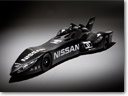
Nissan has revealed an interesting concept vehicle. It is called DeltaWing and it will showcase the pioneering technology that will show one potential direction for the future of motorsport and will feed into the research and development of future technologies, that filter down to Nissan’s road car product range.
It is powered by a race-prepared 1.6-litre four-cylinder direct injected turbocharged petrol engine. It is badged DIG-T (Direct Injection Gasoline – Turbocharged) and is expected to produce around 300HP, sufficient to give Nissan DeltaWing lap times between LMP1 and LMP2 machines at Le Mans, despite having only half the power of those conventional prototypes.
“As motor racing rulebooks have become tighter over time, racing cars look more and more similar and the technology used has had less and less relevance to road car development. Nissan DeltaWing aims to change that and we were an obvious choice to become part of the project,” said Andy Palmer, Executive Vice President, Nissan Motor Co., Ltd.
“But this is just the start of our involvement. Nissan DeltaWing embodies a vast number of highly-innovative ideas that we can learn from. At the same time, our engineering resources and commitment to fuel efficiency leadership via our PureDrive strategy will help develop DeltaWing into a testbed of innovation for Nissan. This announcement gives Nissan the opportunity to become part of a ground-breaking motorsport project and one which could shape the future of the sport,” he added.
Nissan DeltaWing is extremely different than everything else on track. The driver sits well back in the car, almost over the rear axle and looks ahead down a long, narrow fuselage to narrow twin front tyres, specially created for the car by tyre partner Michelin.
The engine is rear-mounted and the car has a strong rearward weight bias, which makes it highly manoeuvrable, while its light weight and slippery shape make it far more efficient.
Renault has announced their special edition Clio RS Red Bull Racing RB7. Actually, the model capitalises on the basic model’s acclaimed strengths, something which is sure not to escape sporting car and motorsport enthusiasts.
“Clio R.S. Red Bull Racing RB7 is a hot hatch combining stunning looks with the very latest features to have been developed by the wizards at Renault Sport Technologies,” commented Jean-Maxime Boulanger, Clio Renault Sport Product Manager.
“Clio R.S. Red Bull Racing RB7 is a dynamic car which will definitely turn heads. It is a tribute to the very close ties that exist between Renault Sport Technologies and Renault Sport F1!”, he added.
The Clio RS RB7 boasts a nice Profond Black exterior with some yellow accents, checkered decal and of course Red Bull badges. The exterior is completed by a set of nice 18” alloy wheels fitted with performance tires – Bridgestone RE050A.
It is powered by a 2.0 liter four-cylinder petrol engine with 203PS (149 kW) and 215Nm (159 lb-ft). 0-100 km/h in 6.9 seconds and a top speed of 225 km/h (140 mph).
The price for this toy is not low – €27 900. It will be available in France, Spain, Switzerland, Belgium and Austria.
Clio R.S. Red Bull Racing RB7 badge is the first limited edition in a series which go on to include Twingo R.S. and Megane R.S.
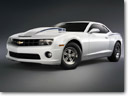
Chevrolet will put in production the Copo Camaro, which was the brand’s first purpose-built Camaro drag-racing specialty car designed to compete with the quickest in NHRA’s Stock Eliminator and Super Stock classes.
“The COPO Camaro is going to shake up the sportsman drag racing ranks this summer and give Chevy fans a great new reason to cheer on the Bowtie,” said Jim Campbell, GM U.S. vice president of Performance Vehicles & Motorsports.
“COPO builds off the strengths that have made the Camaro the best-selling sports car in America. And while it was developed strictly for the drag strip, the COPO Camaro is infused with the same performance pedigree that every Camaro shares.”, he added.
The engine range includes three superb power units: An LS7-based naturally aspirated 427 (7.0L) V-8, a supercharged, LSX-based 327 (5.3L) V-8 featuring a 2.9L supercharger and a supercharged, LSX-based 327 (5.3L) V-8 featuring a 4.0L supercharger.
There will be five colors available: Flat Black, Summit White, Victory Red, Silver Ice Metallic and Ashen Gray Metallic.
The COPO Camaro is designed to NHRA racing specifications including a solid axle and a full chrome moly roll cage. Inside, most of the standard sound deadening and power accessories have been deleted in order to optimize weight for NHRA racing. Also included is a pair of racing bucket seats (no rear seat), a safety harness for the driver, a competition floor shifter and Chevrolet Performance gauges.
Pricing starts at $89 000 and only 69 units will be built for this year.
M cars are not the only prime candidates for first-class tuning. Take the BMW 328i for example. It’s pretty neat, powerful, compact and nimble. It only takes a company like AC Schnitzer to turn it into a desirable performance machine.
The engine receives an extra control unit that amps the power from 245hp to 295hp. The maximum torque is now 410Nm. Top speed is still limited to 250 km/h but zero to one hundred happens in 5.7 seconds – .2 of a second less.
The suspension has been lowered thanks to a spring kit provided by Schnitzer and the choice of wheels is mind boggling: AC Schnitzer wheels Type IV BiColor and silver, Type VI and Type VIII in 18 , 19 and 20-inch sizes. The Type VIII are also available in BiColor – lacquered silver with bright turned aluminium accents.
Additional aerodynamic features include the AC Schnitzer front spoiler, rear roof spoiler, rear spoiler and rear skirt extension. From the latter, 2 pairs of chromy twin tailpipes stick out, giving away the AC Schnitzer sports rear silencer.
The interior of the car serves as a showcase of AC Schnitzer‘s“Black Line” aluminum themes – that includes the “i-Drive” system controller and the handbrake handle. Pedal set is aluminum as well and so is the foot rest. The floor mats are in velours.
You can go and see it right now at the Geneva Motor Show but if you want to get one, that’s going to have to happen latter this year. In the summer perhaps.
Full specs bellow.
AC Schnitzer BMW 328i
Basic car:
BMW 328i (F30)
Engine:
AC Schnitzer performance upgrade –
Performance: 217kW/295hp (standard: 180kW/245hp)
at 5800rpm (standard: 5000-6500rpm)
Maximum torque: 410Nm (standard: 350Nm)
at 2000-3000rpm (standard: 1250-4800)
Maximum speed (km/h) 250 – electronically limited
0 – 100 km/h: 5,7 seconds (standard: 5,9 seconds)
AC Schnitzer engine optics
Exhaust:
AC Schnitzer sports rear silencer with
2 chromed “Racing” tailtrims in
right / left combination
Suspension:
AC Schnitzer spring kit, lowering approx. 25 mm
Aerodynamics:
AC Schnitzer front spoiler
AC Schnitzer front grille, chromed
AC Schnitzer rear roof spoiler
AC Schnitzer rear spoiler
AC Schnitzer rear skirt
AC Schnitzer decals
Interior:
AC Schnitzer aluminium cover, “Black Line”
for BMW “i-Drive“ system controller
AC Schnitzer aluminium handbrake handle, “Black Line”
AC Schnitzer gear knob with digital shift display
AC Schnitzer leather gear knob, illuminated
AC Schnitzer aluminium gear knob “Black Line”
AC Schnitzer aluminium pedals
AC Schnitzer foot rest
AC Schnitzer floor mats, velours
Wheel/Tyre sets:
AC Schnitzer Wheel/Tyre Set with Type VIII Wheels BiColor Silver
front: 8,5 x 18″ with tyres 225/45 R 18
rear: 8,5 x 18″ with tyres 225/45 R 18
front: 8,5 x 19″ with tyres 225/40 R 19
rear: 8,5 x 19″ with tyres 255/35 R 19
front: 8,5 x 20″ with tyres 225/35 R 20
rear: 8,5 x 20″ with tyres 255/30 R 20
AC Schnitzer Wheel/Tyre Set with Type IV Wheels BiColor
front: 8,5 x 18″ with tyres 225/45 R 18
rear: 8,5 x 18″ with tyres 225/45 R 18
front: 8,5 x 19″ with tyres 225/40 R 19
rear: 8,5 x 19″ with tyres 255/35 R 19
AC Schnitzer Wheel/Tyre Set with Type IV Wheels Silver
front: 8,5 x 18″ with tyres 225/45 R 18
rear: 8,5 x 18″ with tyres 225/45 R 18
front: 8,5 x 19″ with tyres 225/40 R 19
rear: 8,5 x 19″ with tyres 255/35 R 19
AC Schnitzer Wheel/Tyre Set with Type VIII Wheels BiColor
front: 8,5 x 19″ with tyres 225/40 R 19
rear: 8,5 x 19″ with tyres 255/35 R 19
AC Schnitzer Wheel/Tyre Set with Type VI Wheels BiColor
When the latest BMW M5 came out, it was the definition of balance between mad performance and everyday sedan practicality. Now the Aachen-based AC Schnitzer want to tip the scales in faveor of more power, more sportiness and more flamboyancy. It’s the ACS5 Sport Saloon.
To start off, they added an additional control unit on the engine that boosts the power to620hp. The engine’s torque output is also increased to 790Nm. Zero to sixty now takes 4.1 seconds. An AC Schnitzer twin sports silencer with valve control provides the sound to match the grunt. Chromed “Sports Trim“ tailpipes enclose the Schnitzer carbon rear diffuser.
That brings us to aerodynamics. The diffuser plus the carbon front spoiler, rear roof spoiler and rear spoiler provide necessary down force which is there to tame the fresh power. In the mean time, a chromed front grille, “Magic Blue“ and silver livery, AC Schnitzer badges for the side and anAC Schnitzer logo “ACS5 Sport“ visually complete the aerodynamic power pack.
The suspension has been slightly tweaked as a new AC spring kit replaces the standard one. There is also a generous choice of wheels. 20-inch Type V forged alloy wheels orType IV BiColor rims in the same size. The third option involves a set of bigger, 21-inchType VIII racing and forged alloy rims.
“Magic Blue“ is the prevailing theme inside. A “Black Line“ aluminum cover for the “i-Drive” system controller and aluminum pedals add some contrast. The footrest also matches the pedals while the floor mats are in velours.
So if you ever want more from your BMW M5, AC Schnitzer is the company for you.
Full specs bellow
AC Schnitzer BMW M5
Basic car:
BMW M5 (F10)
Engine:
AC Schnitzer performance upgrade –
Performance: 456kW/620hp(standard: 412kW/560hp)
at 6300rpm(standard: 6000-7000rpm)
Maximum torque: 790Nm (standard: 680Nm)
at 3000 rpm (standard: 1500-5750rpm)
Maximum speed: 305 – electronically limited
0 – 100 km/h: 4,1 seconds (standard: 4,3 seconds)
AC Schnitzer engine optics
AC Schnitzer engine compartment optics
Exhaust:
AC Schnitzer twin sports rear silencer with
valve control and chromed “Sports Trim” tailtrims
Suspension:
AC Schnitzer spring kit, lowering approx. 25 mm
Aerodynamics:
AC Schnitzer carbon front spoiler
AC Schnitzer front grille, chromed
AC Schnitzer vitro emblems for side walls
AC Schnitzer rear roof spoiler
AC Schnitzer rear spoiler
AC Schnitzer carbon rear diffuser
AC Schnitzer emblem “ACS5 Sport”, side right/ left
Vehicle wrap BiColor “Magic Blue” – Silver
Interior:
AC Schnitzer aluminium cover, “Black Line”
for BMW “i-Drive“ system controller
AC Schnitzer aluminium pedals
AC Schnitzer foot rest
AC Schnitzer floor mats, velours
Interieur panels and steering wheel insert wrapped in “Magic Blue”
Jaguar has announced the new XF Sportbrake at the 2012 Geneva Motor Show. Practically, it is a Touring version of the XF series, but with sportier and more sleek appearance.
“There is a faily high roofline by necessity, but because of the rising waistline, it still gives the impression of this tapering side window so the car still looks low and lean.”, commented Jaguar Studio Director Wayne Burgess.
“This is precisely why Jaguar chose to include the word “sport” in the vehicle’s name.”, he added.
The XF Sportbrake boasts an impressive cargo area of 1 675 liters. It is also not much heavier than the saloon – just under 70kg.
The engine range includes two diesel units – the super-efficient 2.2 liter four cylinder and the mighty 3.0 liter V6. Both are coupled with an 8-speed automatic gearbox, which sends all torque to the rear wheels.
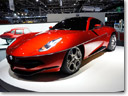
Touring Superleggera has announced the staggering Disco Volante Concept at the 2012 Geneva Motor Show. It is inspired by an old Alfa Romeo and features two seats and powerful V8 engine at the front.
The Disco Volante shares a lot of details from 8C Competizione like the engine, suspension and some other elements.
The mighty 4.7 liter V8 delivers 450PS (331 kW) and 470Nm (347 lb-ft) of torque. It is mated to an electronically controlled 6-speed sequential gearbox with paddle-shifters on the steering wheel. All that power is sent to the rear wheels through a LSD (limited slip differential) ensuring perfect traction at every conditions and even in sport driving. 0-100 km/h in 4.2 seconds and a top speed of 292 km/h (181 mph).
We just can’t imagine what will be the price of this car, because every one of these needs more than 4000 hours of highly skilled artisan and engineer work to be completed. Furhtermore, it needs an entire Alfa Romeo Competizione 8C for donor parts.
Stay tuned for more information about this interesting sports vehicle and check out the full specs, below!
Touring Superleggera Disco Volante Concept
TECHNICAL DATA
Dimensions
Length mm 4,613
Width mm 2,020
Height mm 1,335
Wheelbase mm 2,696
Track front/back mm 1,591/1,589
Boot volume l ca. 200
Fuel tank capacity l 88
Engine
Cylinders / type – 8 / V 90°
Cubic capacity cm³ 4,691
Nominal output kW/CV@ rpm 335.6/450@7,000
Max torque Nm@rpm 470@ 4750
Emission standard Euro 5
Driveline
6-speed, electroactuated sequential gearbox with paddle-shift control and automatic mode.
Limited slip differential.
Wheels
Tires Pirelli PZero Rosso, front 265/35 ZR20,
rear 285/35 ZR20
Wheel type Aluminium forged wheels
Performance
Top speed (est.) kph 292
Acceleration (est.) 0-100kph 4.2 sec.
 SR and PUR Wheels have collaborated again and the result of their work is this exceptional Lamborghini Gallardo. In general this particular vehicle is extraordinary enough! However, with received new refreshed and revitalized look, thank to the 1NE design from PUR Wheels. And to make it even more astonishing and irresistible, the Lamborghini received full Hamann aero kit tuning. And this is how one can make a Lamborghini extremely more adorable and desirable. Now, this Gallardo is a styling icon from head to toe just in time for the forthcoming months of the so long awaited summer. All in all, with the top down, and a new set of “shoes” that it just received, this SR Auto Lamborghini Gallardo Pure 1ne is ready to shine in the sun throughout the streets of any city.


 The Mercedes SL. “Open top” immediately springs to mind. We tend to think of cabriolets as slow, wobbly and impracticable – a direct contradiction to what SL stands for. “


 Nissan has revealed an interesting concept vehicle. It is called DeltaWing and it will showcase the pioneering technology that will show one potential direction for the future of motorsport and will feed into the research and development of future technologies, that filter down to Nissan’s road car product range.


 Renault has announced their special edition Clio RS Red Bull Racing RB7. Actually, the model capitalises on the basic model’s acclaimed strengths, something which is sure not to escape sporting car and motorsport enthusiasts.


 Chevrolet will put in production the Copo Camaro, which was the brand’s first purpose-built Camaro drag-racing specialty car designed to compete with the quickest in NHRA’s Stock Eliminator and Super Stock classes.


 M cars are not the only prime candidates for first-class tuning. Take the BMW 328i for example. It’s pretty neat, powerful, compact and nimble. It only takes a company like AC Schnitzer to turn it into a desirable performance machine.


 Jaguar has announced the new XF Sportbrake at the 2012 Geneva Motor Show. Practically, it is a Touring version of the XF series, but with sportier and more sleek appearance.


 Touring Superleggera has announced the staggering Disco Volante Concept at the 2012 Geneva Motor Show. It is inspired by an old Alfa Romeo and features two seats and powerful V8 engine at the front.


