Category: Auto News

Auto news – automobile industry news. Articles about all the latest car models and concepts. Breaking news, uncovered secrets.

  • Turbochargers Explained

    Turbocharged-badge-thumbEver wondered how WRC cars manage to deliver 300 bhp and above from an engine that, by rule, cannot exceed 2.0 liters of displacement? How on earth do the heavy, low-revving diesel engines in cars today stay competitive? Or what is it that makes it possible for the Bugatti Veyron to break the 1000 bhp threshold? Well, it certainly isn’t witchcraft. By means of “forced induction”, turbochargers today boost the automotive industry to a new direction of smaller, more-efficient and bloody good fun engines.

    Volkswagen like to brand their most successful turbo diesel range as TDI while Porsche, being more plain about it, call their turbocharged cars, Porsche (insert model here) Turbo. BMW, on the other hand, would never hesitate to utter their own terms like “bitrubo” or “TwinPower” whenever describing the latest M5 engine. The variety of depicting turbocharged cars is bountiful, but essentially the principles of work remain the same in every case.

    Beware reader, as I am now going to get technical:

    In order to understand how a centrifugal turbocharger works, one must also have some basic knowledge on how four-stroke, piston engines work. We have an engine block that contains the cylinders, right? Inside each cylinder, a piston moves up and down. Every movement made is a phase, a stroke. First we have intake – a mixture of fuel and air is sucked into the cylinder. Compression is the second stroke where the cylinder moves up and…well…compresses the molecules in the mixture. The next ignition stroke is downwards as the piston experiences pressure coming from the combustion of the mixture. The exhaust stroke has the job to expel the remaining gases through the exhaust valve. Then the intake valve lets in a new batch of fuel mixture and thus the process is repeated.

    However, as far as turbochargers are concerned, exhaust gases are not exactly throw-away material. Put simply, the turbocharger utilizes the energy of exhaust to compress the the newly arrived batch of air which is to be shoved in the cylinder. More air molecules means that more fuel can be injected into the mixture and more fuel means more power.

    Before those exhaust gasses reach the exhaust system they go trough a turbine connected to a shaft. The more exhaust that goes through the turbine blades, the faster they spin. On the other end of the shaft we find a compressor which welcomes fresh air from the atmosphere, compresses it using the force of the turbine and then feeds it into the engine. To further increase the efficiency of the turbocharging system, an intercooler is added – it looks much like a car radiator but instead of containing cooling fluid, it holds the compressed air from the compressor. Air is denser when cooler and that’s exactly what the intercooler does – it cools the incoming air.
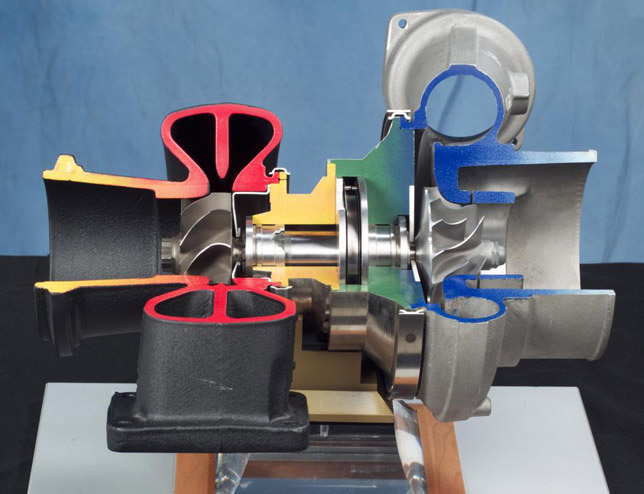
    Cut-away view of a turbocharger held by a foil-bearing
    Cut-away view of a turbocharger held by a foil-bearing

    There are issues however. First of all, a turbine amidst the flow of exhaust is essentially an obstacle. The exhaust stroke has to deal with more back-pressure thus being slightly less efficient. A functional turboshaft has to handle extreme forces (speeds go up to 150 000 rpm within the turbocharger) so a special kind of baring is needed – liquid ones or state-of-the-art ball bearings. The latter is more efficient but more expensive. Then there’s the dreaded turbo lag. The problem here is that when you put your foot down, the response is far from electric. The turbine needs some time to kick off and start spinning the compressor blades. That’s why at low engine rpm one can’t really tell if the car has a turbo or not.

    There are various ways to tackle this nuisance. Make things smaller and lighter. Tiny turbochargers will grant you that off-the-line jolt but won’t be too good on the upper rpm range. Besides, if too much exhaust starts going through a relatively small turbine things may get hot and disbalanced. Usually however, there’s the wastegate in most turbines – a valve that knows how much exhaust passes through and regulates the flow by simply diverting some of the gases away from the turbine. Some companies have started putting more than one turbochargers in their cars. One small and the other, big. The small one guarantees a more immediate response while the big one takes over at higher speeds.

    Essentially, that’s the story with turbochargers. We can further dive into numbers and calculations about pressure and efficiency but this, I think, is already nerdy enough. Hopefully some of you learned something new while others refreshed their memory on how the turbocharger brings easy power to our everyday lives.
  • Angry Birds will race on Formula 1

    Heikki-Kovalainen-Angry-Birds-Helmet-THUMBDo you know that funny little wingless cartoon birds. Well if you do, you are probably fan of the popular game “Angry Birds”. And more importantly we have some really good news for you. If you are looking forward to this year’s Formula 1 and are addicted to this particular game, then you will see some characters from the game onto the racing track. Till the present, maybe Formula 1 was one of those few areas where we couldn’t see our favourite characters. Nevertheless, recently the Finish company Rovio announced their newly signed contract with the Formula 1 racer Heikki Kovalainen. The Finnish god of the racing-track will wear a helmet, which was especially ornated with the logo of “Angry Birds” and in addition is designed to look just as the red wingless bird from the game. Actually, the Finnish F1 star has already debuted wearing this helmet on this weekend’s inaugural Formula 1 race in Melbourne, Australia. Furthermore Kovalainen seems to be a big fan of the game, and shares that given this fact and since he is Finn (as the funny characters are) he would be proud to wear the helmet.

    Heikki Kovalainen Angry Birds Helmet
    Heikki Kovalainen Angry Birds Helmet

    In details, Rovio is a Finnish based entertainment company, which became extremely popular with the launch of the above mentioned game. It is a casual puzzle game, which catches the attention with its unique cartoon characters. Moreover, it became an international phenomenon in just one year since its release and currently is number one paid application of all time.

    Pictures Source: Heikki Kovalainen Official Web Page

  • Peugeot 508 HYbrid4 RXH and Saloon

    Peugeot-508-RXH-HYbrid4-thumbTo have Peugeot‘s latest hybrid modular technology it takes a 2.0-litre HDi engine and a 37 bhp electric motor put on a single frame. The diesel engine deals with the front axle while the electric motor operates the rear. Such a setup was fist used in the 3008 HYbrid4. Now the Peugeot 508 RXH and 508 Saloon also join the company’s hybrid fleet by succumbing to the HYbrid4 badge.

    By adding such frugal technology to otherwise resourceful saloons and all-roaders (such as the RXH and Saloon), Peugeot hope to optimize the driving performance and economy and increase the model’s versatility. Lower taxation is expected too.

    Both of these AWD cars will carry the same HYbrid4 gear thus delivering identical figures of power – 163 bhp from the 2.0 HDi unit plus 37 bhp from the motor at the back. That’s 200 bhp in overall power. Their combined drive cycle economy is a charm, yet the RHX is the thirstier from the two with 68.9 mpg – the Saloon can go for almost 10 more miles on a gallon. Also the Saloon has a sub-hundred figure on CO2 emissions standing at 95 g/km. The RHX manages 107 g/km. The top speed for both is around 130 mph and zero to sixty takes 9.0 seconds (9.5 for the heavier RHX).

    In terms of equipment, the Saloon HYbrid4 is pretty similar to the 508 Allure – Keyless entry, an ignition button, cruise control with a speed limiter, automatic parking brake with Hill Assist, automatic dual-zone air conditioning, electric folding door mirrors, Peugeot Connect Navigation (RT6) with Bluetooth, Peugeot Connect SOS and Assistance, automatic headlamps and wipers, 18” alloy wheels and half leather seats are all included. All of that for $49,788.

    The Saloon however, is trumped by the $53,343 RXH which has an even vaster array of luxuries. On it, you will find 18” Attila alloy wheels, parking aid, a panoramic glass roof, an additional Colour Head Up display, an USB point and acoustic laminated side windows. It also has a higher stance that gives it an overall crossover look.

    Both models are available for ordering while shipping will start in May for the RXH and in July for the Saloon.

    Peugeot 508 RXH HYbrid4
    Peugeot 508 RXH HYbrid4

    Source: Peugeot

  • JMS Opel Insignia

    JMS-Opel-Insignia-thumbIn search for an executive saloon but tired of BMWs or Audis and Mercedeses? They are the usual choice but one can never get hurt from trying something different. Oh Look! Here’s an Opel Insignia… and it’s been tweaked by German motoring specialists JMS. It’s a starter project with more options due to come. I basically depends on the customer.

    What you do get however, is a KW coilover version 3 inox for a suspension. That will set you back $2,226. Because of it, the Insignia will be lower than usual – specifically, 55mm lower at the front and 45mm at the back. For a more modest sum of $315 you’ll also get a JMS racelook apron which you can screw on the standard front bumper and apply…glue, apparently.

    By far the most expensive feature on this Insignia are the 9×20 AR1 Race wheels wrapped in 245/35R20 tires. All four of them cost $3,423.

    More exterior enhancements and exhaust pipes can be ordered upon request for an overall complete look.

    JMS Opel Insignia
    JMS Opel Insignia

    Source: JMS

  • Mercedes-Benz SLS AMG Roadster [HD video] – 0-327 km/h

    Here is a nice video of Mercedes-Benz SLS AMG Roadster tested by Sport Auto.

    It is powered by a 6.2 liter naturally aspirated V8 with 571PS (420 kW) and 650Nm (479 lb-ft) of torque. It is mated to the AMG SPEEDSHIFT DCT 7-speed sports gearbox, which shifts in as little as 100 milliseconds. There are also four  different driving modes: “C” (Controlled Efficiency), ”S” (Sport), “S+” (Sport plus) or “M” (Manual).

    0-100 km/h in 3.7 seconds and a top speed of 317 km/h (197 mph). The kerb weight is 1661 kg (3661 lbs).

    The exterior boasts full AMG performance package as well as the interior. There is also – leather upholstery, mettalic accents and nice AMG sports seats with AIRSCARF. The options list includes a Bang & Olufsen audio system and an AMG Performance Media system.

    It stands on 19” rims at the front fitted with 265/35 ZR19 ultra-performance tires and 20” rims at the rear wrapped in 295/30 ZR20.

    Check out the acceleration from 0 to 327 km/h and some other interesting moments in the video below.

    httpv://www.youtube.com/watch?v=3uRAL_iLnCI

    Source: cc8186 via Youtube

  • ABT 2012 Audi AS3

    Abt Sportsline has announced their tuning program of the new 2012 Audi A3. The name of the project is ABT AS3, which stands for “happiness in driving, always and everywhere” as Mr. Hans-Jürgen Abt stated.

    The engine range includes two powerful power units – a 2.0 liter TFSI and a 2.0 liter TDI engine. The petrol will deliver 250PS (184 kW), instead of factory’s 200PS (147 kW) and the diesel will produce around 200PS (147 kW), instead of 170PS (125 kW). These results will be achieved thanks to ECU re-maps. The additional power will make the car faster and better to drive, because of the additional torque at the low revs.

    Besides the performance packages, ABT Sportsline also offers a coil-over adjustable suspension and high-performance brake system with 345 mm discs.

    The exterior package includes a new front spoiler, front grille and side skirts. There are also a new rear spoiler, the rear skirt insert and the two double rear mufflers.

    The tough vision is completed by a set of DR light alloy wheels , which are available in 18 and 19 inches.

    Nothing is mention about the prices though.

    ABT 2012 Audi AS3
    ABT 2012 Audi AS3

    Source: ABT Sportsline

  • 2012 Volkswagen Passat Alltrack UK – Price £28 475

    Volkswagen has announced the UK price list of the new 2012 Passat Alltrack. Esentially, the vehicle features raised ride height, 4MOTION four-wheel drive and rugged body enhancements.

    It is based on the popular and versatile Passat Estate, but offers better agility off-road. The vehicle is available in only one trim level in the UK with a choice of two engines: a 2.0 liter 140PS TDI with 6-speed manual gearbox starting at £28 475 OTR and a 2.0 liter 170PS TDI with 6-speed DSG transmission, which is £31 025.

    Standard equipment includes Alcantara upholstery, 2Zone electronic climate control, RNS 315 touchscreen satellite navigation, DAB radio, MDI iPod connectivity, Bluetooth telephone preparation, cruise control, front and rear parking sensors, tyre pressure monitoring system and 18” Canyon alloy wheels.  A Driver Alert System that monitors the driver’s responses to raise awareness of fatigue is also standard, as is ESP (Electronic Stabilisation Programme).

    The options list can add High Beam Assist, which automatically controls dipping of the headlights; Side Scan Lane Change Assist, which monitors the vehicle’s blind spot; Lane Assist; ACC Adaptive Chassis Control; Automatic Distance Control with City Emergency Braking function; Park Assist (second generation); an interior ambient lighting pack; a rear-view camera; and an electrically deployed towbar.

    The 2012 Passat Alltrack boasts a generous towing capacity of 2 000 kg, which is 200 kg more than an equivalent Passat Estate.

    Check out the price list below.

    2012 Volkswagen Passat Alltrack UK
    2012 Volkswagen Passat Alltrack UK


    Volkswagen Passat Alltrack model line-up and pricing

    Model Engine derivative CO2,
    g/km
    Combined
    mpg
    Price, £
    RRP OTR
    Passat Alltrack 2.0-litre TDI 140 PS 6 spd manual 150 49.6 28,475
    Passat Alltrack 2.0-litre TDI 170 PS 6 spd DSG 155 47.9 31,025

    Source: Volkswagen

  • SR Auto Exkalaber BMW M5 E60

    SR-Auto-BMW-M5-E60-thumbNew stuff from SR Auto. Well, actually it’s the BMW M5, the E60 one. A project called the “Excalaber” – the strange misspelling trend continues – aims to provide a refreshing look on a generation of BMWs that is on the verge of being overshadowed by its current successor.

    The idea here is that, SR Auto do not provide any parts of their own, but rather mash together what they can find and see if it works out as an art piece. That’s why we have here a Hamann aero kit (front lip, side skirts, and rear lip). Top priority for it was to be a perfect fit. Four matte black exhaust ends give away a Dinan exhaust system that apparently helps with the performance.

    The alteration that sticks out the most however, are the PUR 4OUR DEPTH wheels that are usually seen on Lamborghinis and Ferarris. In fact these 21-inch wheels have been originally made for Lamborghini with bolt patterns of 5×112. That’s why the SR people started drilling until they got a size of 5×120. So there you go, PURs on an M5. Neat!

    Overall, the job is not really that extensive. But SR Auto take it very personal when it comes to aftermarket changes. To them, observing a customization of a car is like watching a child growing up – endearing, rejoicing and contentful. Besides, too much flash makes the onlooker dash.

    SR Auto BMW M5 (E60)
    SR Auto BMW M5 (E60)

    Source: SR Auto

  • A Blue BMW M3 GTRS3 by Vorsteiner

    Vorsteiner-GTRS3-BMW-M3-thumbVorsteiner‘s GTRS3 program for the BMW M3 Coupe is not really something that came out yesterday – it’s been around for almost two years now. However, it sill is hot by today’s standards and the latest proof of that is what we see here – a matte blue GTRS3 M3 having a photo shoot in Taiwan and generally gaining popularity.

    The program is mainly visual and consists of a widebody kit – front and rear bumpers (rear end diffuser included), flaring wheel arches and extended side skirts, all made from carbon fiber, adorn the M3. The hood and bood lid have been completely replaced and some piping has been done as well. All summed up, as an end product, it is a flashy looking thing with its big air scoops everywhere, its asphalt grinding stance and its taunting stainless steel quad exhaust system.

    As a round up element, the wheels have been changed as well. It’s the twin 7-spoked, three piece Concave Forged Mesh wheels from Vorsteiner‘s V-308 line. Sizes come in both 19 and 20 inches.

    For how long are the Vorsteiner people going to rely on it? Although, with those looks, its hard to give it up as a portfolio car.

    Vorsteiner GTRS3 BMW M3
    Vorsteiner GTRS3 BMW M3

    Source: Vorsteiner

  • 2012 Fiat 500: The “Baby” Commercial [VIDEO]

    Fiat-Baby-Commercial-THUMBFiat has just launched a commercial to promote their new 2012 Fiat 500. The ad is genuinely refreshing and definitely will make you smile at the end of the working week. So, enjoy it! The new spot is named “Baby” and at the end of the video you will grasp why. In general the ad expresses fully Fiat’s philosophy.  In short, it is all about “discovery through passionate self-expression”. Fiat always stands behind the idea of encouraging people to be in charge of their lives, live confidently and celebrate the smallest of things with infectious excitement. Well, the iconic Fiat 500 (or Cinquecento) has embodied all of this. It is a small car that lives big, and more importantly expresses the Italian way of living: rich in emotions, but as well rooted in an abundant heritage. The Cinquecento has modern simple design, which blends form and function. What you might don’t know already is that the model has unquestionable popularity, because of Fiat’s great ability to deliver unmatched personalization options with advanced solutions in terms of quality, engine and passenger comfort.

    httpv://youtu.be/9CRKrkHGTRM

    Video Source: YouTube

    Source: FIAT

  • 2012 LSD Mercedes-Benz SLK R172

    2012-LSD-Mercedes-Benz-SLK-R172-THUMBThe Mercedes-Benz SLK is a roadster which was one of the firsts to have a foldable metal roof. Since then, the newest model R172 is the third generation of this exquisite vehicle. What LSD tuning company has done on it is basically to develop tailor-made door hinges for retrofitting, for more safety and precision when opening and closing the doors. In addition to that the LSD door hinges are equipped with the new Guided Roller System (GRS). Furthermore, in order to provide even more stability while the doors are being open, the swing arm is fixed with an additional locking mechanism. And this is why the LSD doors are so popular. Another highlight is that they come with a TÜV certificate, which proofs that they meet all safety standards.

    What is more, the LSD doors come with advanced technology and highest quality standards. In fact, “Federal Motor Transport Authority” has approved that the LSD solution patented in Germany is as secure as an original fitted door. But what does this mean: in general, it means that during side impact, the passenger’s safety is ensured through the LSD system. In addition, the door hinges are a perfect fit due to the three-dimensional adjustments and the fact that the LSD doors are installed at the original fixing points. And what happens when the doors begin to open: well, the original doors open with the LSD hinges first outwards and then gently glide upwards. The LSD hinges for the SLK come as a kit including complete set of cables, fitting components and accessories for 1799 Euro.

    2012 LSD Mercedes-Benz SLK R172
    2012 LSD Mercedes-Benz SLK R172

    Source: LSD

  • 2012 Formula 1 supported by Mercedes-Benz SLS AMG Safety Car and C 63 AMG Estate Medical Car

    Mercedes-Benz-SLS-AMG-Official-F1-Safety-Car-THUMBMercedes-AMG is going to include in the 2012 Formula 1 season Official F1™ Safety Car and the Official F1™ Medical Car based on SLS AMG and C 63 AMG Estate, respectively, thus ensurring maximum safety in extreme conditions. The gullwing model with its one-of-a-kind roof lights and distinctive FIA (Fédération Internationale de l’Automobile)  and F1 logos on its aluminium body, has been official Safety Car for Formula 1 for two years already. The SLS AMG is sent out on the track, as soon as the Race Control considers that the safe progress of the race may be impeded. In fact, FIA has entrusted the task of driving the Safety Car to the racer Bernd Mayländer since 2000. In addition, the SLS AMG Official F1™ Safety Car is also on call throughout the race weekend accompanying race series, such as the GP2 and GP3 Series and the Porsche Supercup. In details, during the last years Formula 1, the SLS AMG Official F1™ Safety Car was deployed twelve times. In addition, at the Monaco Grand Prix there were two Safety Car phases, while the Grands Prix in Belgium, Italy, Singapore, Japan and Korea each had just one Safety Car phase. But there was no other year like 2010, when the Safety Car was deployed 21 times, a figure which is an absolute record.

    What makes the SLS AMG the perect Safety Car? First, it is low kerb weight, has low centre of gravity and balanced weight distribution, which in addition both are combined with a powerful AMG V8 engine and dual clutch transmission in a transaxle arrangement. Furthermore, the engine, power train, suspension and braking system of the Safety Car are the same as those found in the standard production SLS AMG, with the exception of the newly developed exhaust, which was specifically designed to provide even more emotionally-charged sound experience. In detials, the AMG 6.3-litre V8 engine achieves a peak output of 420 kW (571 hp) at 6800 rpm and a maximum torque of 650 Nm (480 lb-ft) at 4750 rpm. This enables the vehicle to accelerate from 0 to 100 km/h in just 3.8 seconds. In addition, the outstanding SLS AMG’s driving dynamics deliver great performance thanks to the aluminium spaceframe body (it weighs only  1620 kg). The low center of gravity has been achieved thank to the dry-sump lubrication system. The installed position of the engine behind the front axle, and the transaxle arrangement of the transmission on the rear axle, have a positive effect on the weight distribution, which is 47/53 percent (front/rear). The AMG SPEEDSHIFT DCT 7-speed sports transmission with dual-clutch technology enables short shifting times. At the same time the integrated mechanical multi-disc differential lock, together with the 3-stage ESP® deliver nothing else but outstanding traction. The suspension of the AMG is with aluminium double-wishbone arrangement, which is usually found in racing cars. In fact, this technology offers a number of benefits like high cornering limits, precise turn-in ability, first-class agility and low mass inertia during fast changes in direction. Additionally, the braking distances are minimised and resistance to fading is maximised due to the high-performance AMG ceramic composite braking system. The SLS AMG also features weight-optimised 10-spoke forged wheels fitted with size 265/35 R 19 (front) and 295/30 R 20 (rear) tyres.

    2012 Mercedes Benz SLS AMG Official F1 Safety Car
    2012 Mercedes Benz SLS AMG Official F1 Safety Car

    What makes the Official F1™ Safety Car different from a standart production SLS AMG is the roof light bar. It boasts an aerodynamically efficient profile and sits on a carbon-fibre hood. All of the bar’s light functions are handled by LEDs; they offer a fast response time and low power consumption. In particular, the two centrally positioned green lights on the front and rear are lit up when the gullwing model joins the field at the start of a Safety Car phase. Permanent green is the signal for all Formula 1 drivers to overtake the Safety Car. On the other hand, the orange light are switched on, as soon as the Safety Car has positioned itself in front of all of the Formula 1 racing cars. The flashing orange lights on the outer ends of the bar indicate that no overtaking whatsoever is allowed. In additiom the roof light bar also incorporates a camera, and a second one is located next to the rear number plate, which allows the driver and co-driver to monitor the Formula 1 cars behind via a screen in the cockpit. There is also special number plate on the rear and 700 green LEDs. They provide additional safety in darkness or wet weather. Another important feature is the stroboscopic lights in the headlamps and tail lights, which are activated permanently and provide a signalling function.

    How about the interior of the Safety Car? Well, it is not much different from a standard production model: it includes sport bucket seats with black leather upholstery. On the right side of the AMG DRIVE UNIT there are four coloured buttons which are used for controlling the various light functions and the signal horn. The centre console is also finished in carbon-fibre. The steering wheel in wrapped leather/Alcantara and has a specially contoured grip area, a high-grade metal insert and a 370 mm-diameter rim with a flattened lower section. The seven gears of the dual-clutch transmission are changed using the two high-grade metal shift paddles. Furthermore, two central monitors in the cockpit are used to monitor the progress of the race.

    2012 Mercedes Benz C63 AMG Estate Official F1 Medical Car
    2012 Mercedes Benz C63 AMG Estate Official F1 Medical Car

    To accompany the SLS AMG Official F1™ Safety Car in the 2012 season, Mercedes-AMG has provided the Official F1™ Medical Car, which will be responsible for ensuring a rapid emergency response if an event of accident occurs. The C 63 AMG Estate is perfectly equipped and provides outstanding driving dynamics: it includes the AMG 6.3-litre V8 engine with the AMG Performance package, which produces 358 kW (487 hp). In addition, the forged pistons, connecting rods and lightweight crankshaft have been adopted from the drive system of the gullwing model. The lower inertia of the components, allows the naturally aspirated eight-cylinder engine to rev freely and respond with even more agility. What makes the car different from a standart C63 AMG, is the variable intake manifold, which lurks beneath the bonnet in a titanium grey paint finish. It helps to accelerate the vehicle from 0 to 100 km/h in only 4.4 seconds. The engine is mated to the standard AMG SPEEDSHIFT MCT 7-speed sports transmission, with wet start-up clutch, four driving modes, a double-declutch and a RACE START function. The excellent driving dynamics are also ensured by the adjustable coil-over suspension. The car sits on the AMG light-alloy wheels, painted in matt black with high-sheen rims and fitted with size 235/35 R 19 (front) and 255/30 R 19 (rear) tyres. The vehicle also has a differential lock and the 3-stage ESP®. Maximum durability is provided by the optimised coolant, engine oil, transmission fluid and power steering fluid cooling. Visually, the Medical Car resembles the Safety Car, and the main reason for this are the light bar on the roof, the FIA and F1‑logos, the stroboscopic LED lights at the front and rear, and the rear number plate illuminated with LEDs and with “Medical Car” lettering. Furthermore, four AMG sports bucket seats with six-point seat belts, two monitors integrated into the centre console for monitoring the race and a radio set for communicating with Race Control distinguish the interior of the Official F1™ Medical Car from that of the standard production C 63 AMG Estate. Of course, there is plenty of space for all of the emergency equipment.

    Source: Mercedes-Benz