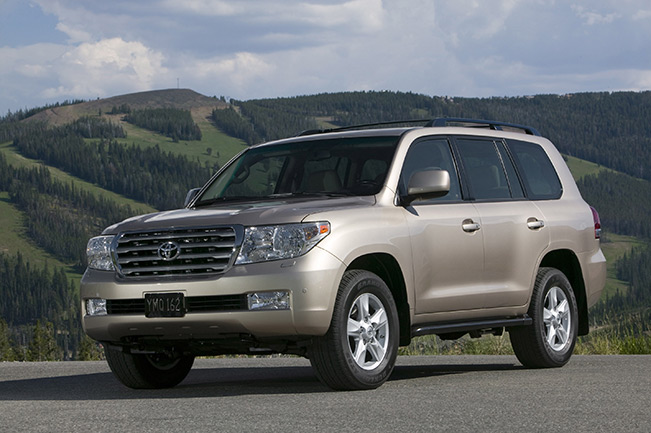
 The all-new seventh-generation Toyota Land Cruiser, introduced for the 2008 model year, gains new privacy glass on side and rear-quarter windows for 2009.
Performance
The Land Cruiser is powered by a new-generation 5.7-liter DOHC V8 engine. The engine uses electronic fuel injection, direct Ignition, four valves per cylinder, and a variable-length intake tract to produce 381 horsepower at 5,600 rpm and 401 lb-ft of torque at 3,600 rpm. Ninety percent of peak torque is available at just 2,200 rpm. The Land Cruiser uses regular 87-octane gasoline and is ULEV-II certified.
The V8’s advanced Dual Variable Valve Timing with intelligence (VVT-i) system controls valve timing and overlap on both the intake and exhaust valves, which helps to optimize power, fuel efficiency and emissions. The Acoustic Control Induction System (ACIS) switches the length of the intake tract in two stages, based on RPM and throttle angle, to improve torque across the engine speed range. Stainless steel exhaust manifolds flow into a full stainless steel exhaust system. A water-cooled oil cooler helps control oil temperature while towing.
The Land Cruiser’s six-speed automatic transmission is designed to handle high torque while performing with luxurious smoothness. Fourth gear is direct drive, and both fifth and sixth gears are overdrive gears. The transmission’s control unit estimates road conditions to select the appropriate gear ratio for the vehicle’s speed and driving conditions. A sequential shift mode allows the driver to select gears manually.
Capability, Handling and Ride
The Land Cruiser’s body-on-frame construction provides ruggedness and durability in extreme driving conditions, plus impressive towing capability and ride isolation characteristics. The front of the frame features a three-stage crush structure so frame damage to other areas of the vehicle is minimized in the case of frontal impact.
The Land Cruiser employs a high-mount double-wishbone front suspension system with gas-pressure shock absorbers, a hollow stabilizer bar, and coil springs. The system is designed to suppress alignment change while the suspension travels through its stroke, and maintain an optimal stroke length. This system provides a high level of off-road driving capability and suspension control while maintaining a high level of on-road driving comfort. Approach and departure angles are 30 degrees and 20 degrees, respectively.
At the rear, the reliable and proven four-link, coil-spring with lateral rod format was redesigned to provide a longer suspension stroke for improved on-and off-road performance. The Land Cruiser’s rear suspension also features gas-pressure shock absorbers and a hollow stabilizer bar.
The Kinetic Dynamic Suspension System (KDSS) adjusts the sway resistance provided by the front and rear stabilizer bars. KDSS may reduce maximum body-sway angle by as much as 50 percent to help enhance both on-road handling response and off-highway capability. By using hydraulic cylinders acting on each stabilizer bar and linked by a pressure-sensing valve, KDSS reduces the degree of sway stiffness provided by the stabilizer bars in response to changing road conditions and driver inputs.
In off-road driving situations, the KDSS allows the wheels on each axle to move with a larger degree of side-to-side independence, helping to minimize any tendency for wheel lift. During cornering, when both front and rear cylinders are compressed, no fluid is flowing in the system and the stabilizer bars work conventionally to help reduce body roll. When an uneven surface is encountered, one compressed cylinder causes fluid to flow between the front and rear cylinders, allowing the stabilizer bars to move freely. This action increases wheel articulation and travel, as well as helps to equalize wheel loading. By allowing the stabilizer bars to disengage in certain situations, the nominal stiffness of the bars can be notably increased, thereby reducing body roll and improving handling without negatively affecting ride comfort or off-road performance.
Land Cruiser rolls on P285/60 R18 mud-and-snow steel-belted radial tires mounted on 18 x 8.0-inch aluminum alloy wheels with a high-gloss finish and include a full-size spare tire. The Land Cruiser has a maximum payload of 1,585 pounds and maximum towing capacity of 8,500 pounds.
The brake system employs 13.4-inch ventilated discs with four-piston calipers up front and 13.6-inch ventilated discs at the rear. Variable gear ratio power-assisted rack-and-pinion steering requires just 3.1 turns lock-to-lock. Gear ratio is set larger around the steering center and smaller around the end position.
The newly-developed JF2A transfer case provides full-time four-wheel drive. This lightweight, compact, chain-driven unit offers a standard 1:1 high ratio for road travel and a low-range 2.618:1 ratio for traversing challenging driving surfaces, such as steep inclines. The system uses a TORSEN® limited-slip locking center differential to distribute power 40:60 front-to-rear, directing more power to the wheels with the best grip should slippage occur. Traction control (TRAC) employs both brake and throttle intervention to help control wheel spin. Vehicle Stability Control (VSC), with a cut-off switch, helps maintain directional control during cornering.
The Crawl Control feature helps make traversing difficult terrain easier and safer. With the transfer case shifted into low range, Crawl Control regulates engine speed and output (along with braking force), to propel the vehicle forward or in reverse at one of three low-speed settings. This allows the driver to maintain focus while steering over very rough level ground or steep grades, without having to also modulate the throttle or brake pedals. Crawl Control includes Downhill Assist Control (DAC), which is designed to augment the low-speed ascending ability of low-range by holding the vehicle to a target speed with no driver intervention. Hill-start Assist Control (HAC) provides additional control for off-road driving by helping to keep the vehicle stationary while starting on a steep incline or slippery surface.
Safety
The Land Cruiser utilizes welded high-strength sheet steel, especially in the A-, B-, C- and D-pillars, and in the rocker area to increase rigidity and reduce weight. The B-pillars are designed to help absorb side impacts and transfer them into the rest of the body structure where they can more safely dissipate.
Like all Toyota SUVS, the Land Cruiser comes standard with the STAR Safety System. A new, four-wheel multi-terrain anti-lock braking system (ABS) automatically selects the optimal ABS profile to provide the most suitable brake force for on- and off-road driving surfaces. Electronic Brake-force Distribution (EBD) employs the multi-terrain ABS to properly balance braking forces between the front and rear brakes, while Brake Assist (BA) provides auxiliary force to assist the driver during emergency braking. Active Traction Control (A-TRAC) helps maintain traction during acceleration by controlling engine output and braking forces to the wheel, distributing the drive force that might have been lost to the wheels and tires that have traction. VSC with a cut-off switch, helps maintain directional control during cornering by manipulating engine torque and individual wheel-braking influence if it detects tire slippage.
The new-generation Land Cruiser features 10 standards airbags. These include driver and front passenger dual-stage advanced airbags; driver and front passenger knee airbags; front- and second-row seat-mounted side airbags; and three-row roll-sensing side curtain airbags with a roll-sensing cutoff switch. -more2009
A direct tire pressure monitor system (TPMS) helps to alert the driver to pressure drops in any of the tires, including the spare. An intuitive parking assist system uses ultrasonic sensors on the front and rear bumpers to sense obstacles.
All eight seating positions feature three-point seatbelts. Active headrests on the driver and front passenger seats move up and forward almost instantly in the event of certain rear-end collisions to help reduce the distance between the occupant’s head and the headrest. An available advanced seatbelt system is designed to retract the front seatbelts when the brakes are suddenly applied or when tire slippage is detected by the VSC system.
Comfort and Convenience
With 28 total air vents, the climate control system is designed to bathe occupants in comfortable air, even during extreme heat, rather than simply projecting streams of cool air at them. For extreme cold situations, the Land Cruiser is equipped with an auxiliary positive temperature coefficient (PTC) heater.
The PTC heater warms air instantly by passing it over an electrically heated ceramic element. Finally, the system also includes a micro-dust and pollen filter, and seven-level blower control.
The Land Cruiser comes luxuriously equipped, with standard features that include a JBL premium audio system with in-dash six-CD/DVD changer and 14 speakers; Smart Key keyless entry with push-button start that allows the driver to unlock or start the vehicle by carrying the key; anti-theft security system; engine immobilizer; cruise control; power moonroof; auto-dimming rearview and side mirrors; HomeLink®; steering wheel-mounted audio; heated, power front seats with driver’s memory; and power tilt and telescopic steering column with memory.
Options
The Land Cruiser offers a variety of options as part of upgrade packages: a DVD rear-seat entertainment system with a nine-inch LCD screen; Bluetooth® technology; back-up camera; second-row heated seats; a touch-screen DVD-based navigation system with an eight-inch display that includes navigation, audio, HVAC, back-up monitor, headlamp washers, and Bluetooth® controls. For towing convenience, the Land
Cruiser has a towing connector and sub wiring harness to connect a commercial trailer brake controller.
Exterior Design
The new-generation is designed to convey an “Advanced and Rugged” theme with enlarged front and rear fenders. The thick, rectangular grille and headlamps maintain Land Cruiser’s steady and confident appearance, while the hood flows gracefully into the grille and beltlines.
Character lines in the front, the area around the rear door handles, and the back door panels suggest strength. Though new and fresh, the design is instantly recognizable as a Land Cruiser. Even with the roomier body, the new-generation Land Cruiser is just 2.3 inches longer and 1.2 inches wider than the previous model. Foam-filled A-pillars help reduce wind noise, and a “bifacial” molding between the windshield and the body helps reduce aerodynamic turbulence, and therefore noise.
Underbody panels behind the front bumper and extending under the engine and behind the rear wheels are designed to protect the engine and transmission and to help the vehicle traverse rocky terrain smoothly. These underbody panels in addition smooth the airflow under the vehicle to help minimize drag and turbulence.
Interior Design
The interior is optimized for the comfort, security and safety of its driver and up to seven passengers – two in the front, and three each in the second and third seating rows. The instrument panel features a set of bright Optitron gauges with clear turquoise illumination. Beneath these gauges, a multi-informational display shows gear selection, odometer, tripmeter, fuel consumption, individual tire pressures and cruising range.
The vehicle’s center console features a gate-type shifter with sequential shift mode operation, the parking brake, a storage box with several compartments and a removable tray, auxiliary audio jack and cup holders.
The passenger-side second-row seat features a one-touch tumble mechanism for easier third-row ingress and egress. The second-row seats slide forward and aft 4.1 inches for more passenger comfort and cargo storage versatility. The second row also provides the Lower Anchors and Tethers for Children (LATCH) child seat attachment system.
 The new Mercedes-Benz CL-Class comes with entirely re-designed V8 biturbo engine of the CL 500 BlueEFFICIENCY model delivering 435hp and returning the incredible 29.7mpg. Its NEDC figures show savings of up to 23 per cent over its predecessor model, CO2 emissions having dropped from 288 g/km to only 224.
 Recently, Volkswagen has announced the price list for 2011 Touareg and now it is available to order in UK. The first deliveries will start in October this year. Prices start at £38 225 for the SE 3.0-litre TDI 240 PS, while the Hybrid model, which goes on sale next month, costs £54 995.






 GM Holden will introduce fuel saving Active Fuel Management (AFM) technology on all its V8 automatic models from January 2009.


 Aston Martin’s V8 Vantage – originally launched to widespread critical acclaim at the Geneva Motor Show in 2005 – is to receive significant technical enhancements, reaffirming the car’s position as one of the world’s most desirable and exhilarating sports cars.

 Mercedes-Benz will in future also market its SLR McLaren super sports car in the form of a roadster with a top. In common with Formula 1 vehicles of today, it, too, will be made of carbon fibre, a material that will endow the vehicle with a very high degree of safety as well as extreme torsional stiffness at the same high level as the coupé version.



 Finally, an exclusive body upgrade to match the incredible


