Tag: McLaren

  • McLaren P1 To Deliver The Staggering 903 Horsepower

    mclaren-p1-THUMBIt is official! McLaren P1 is going to deliver the staggering 903 horsepower! The model will have the combined force of two highly-efficient powerplants: a mid-mounted 3.8-litre twin-turbo V8 petrol engine and a highly effective electric motor.

    Both will offer a combined output of 903 hp (664 kW) and a maximum torque figure of 900Nm (664 lb-ft), ensuring instantaneous throttle response through the rev range, more akin to a naturally aspirated engine.

    Furthermore, the emissions here are rated to be less than 200g/km on the combined cycle and are reduced to zero in full electric drive mode. On the other hand the Formula 1-derived DRS and IPAS technologies offer enhancement in straight-line speed and an instant boost of power.

    But to go into details, the 3.8-litre twin-turbo V8 petrol engine in P1 is a new version of the familiar M838T unit. This engine block has a unique casting in order to feature the electric motor.

    Here, the petrol engine produces 727 hp (535 kW) at 7,500rpm, and 720 Nm (531 lb-ft) of torque from 4,000rpm, while the lightweight electric motor produces 76 bhp (130 kW) and a maximum torque of 260 Nm (192 lb-ft).

    What is more, in this McLaren model is featured also a “boost” system called IPAS which provides up to 179 hp instantly. The instant response of the electric motor provides a sharper throttle response more associated with a normally aspirated engine, and the significantly enhanced air-charging system enables the McLaren P1 to have more top-end power.

    The electric motor is mounted directly onto the engine. The power of both units is channeled through the dual-clutch seven-speed gearbox to drive the rear wheels. Another advantage here is that the e-motor can provide faster upshifts through the application of instant negative torque at the point of shift, making the engine revs drop as quickly and efficiently as possible to the required engine speed for the upshift.

    What also has been revealed for the P1 is that it can be driven in a variety of modes, powered by the engine and electric motor together, or solely by the electric motor. Of course, the maximum power is delivered when both powerplants are utilized together together.

    However, even in E-mode the performance is strong enough. E-mode is the most economical mode available with zero tailpipe emissions, in which the vehicle can travel more than 10 km with electric-only power. When the battery is empty, the petrol engine will automatically start to maintain drive and charge the battery.

    Additional technology highlights featured in this new McLaren model are the DRS (Drag Reduction System) and IPAS (Instant Power Assist System)., which enhance the power available via the petrol engine and electric motor.

    The first system is a technology similar to that employed on Formula 1 cars. Speed is increased by reducing the amount of drag on the rear wing and, where the MP4-28 has a moveable flap on the rear wing, the McLaren P1™ has a wing that reduces in angle to lower drag by 23%. The system immediately deactivates when the button is released, or if the driver touches the brake pedal.

    The other system – IPAS, is designed in order to offer power rapidly for high performance acceleration, and provides 179 hp of instant additional power. In addition, in this system the power delivery was prioritized over energy storage, through a groundbreaking, lightweight battery pack, which offers greater power density.

    The latter has been achieved through high power cells, low pack weight and an innovative cooling system all working together. The battery weighs only 96kg, and is mounted onto the underbody of the high-strength Formula 1-grade carbon fibre MonoCage chassis. The battery can be charged via the engine or via a plug-in charger that can recharge it from empty in only two hours.

    Additional details for the McLaren P1 will be released in the coming weeks before its official world debut in Geneva next month.

    Source: McLaren

  • Teaser: DMC McLaren MP4 Velocita

    DMC-McLaren-MP4-Velocita-THUMBThe latest creation of the luxury tuner DMC is called DMC McLaren MP4 Velocita. It hasn’t been revealed fully yet, but instead the tuning team decided to tease our sense by releasing these new images.

    We can’t conclude much from the photo, but what we can see is that this McLaren is definitely going to have more aggressive stance than its other siblings. Given that there are re-designed front-grill and front lip, presumably there will be a whole body package.

    Having in mind the work of the luxury tuner, we’re also certain to see side skirts, rear diffuser and an aggressive wing on the MP4 package as well. In addition, there will be also a rear spoiler with a “ground braking new design”.

    Source: DMC

  • Exclusive: McLaren P1 With New Images Form Bahrain

    McLaren-P1-in-Bahrain-THUMBJust ahead of its official debut at 2013 Geneva Motor Show, McLaren P1 is being “teased” in a very special way. Some amazing new photographs of the new model were just revealed, which were taken at the Bahrain International Circuit.

    As a matter of fact, these images come not only ahead of Geneva, but also ahead of P1’s Middle East debut. Yesterday, McLaren officially revealed the first images of the interior of the car, which boasts good comfort and ergonomics.

    The windscreen is deeper than it is wide, so the visibility is further enhanced. This makes the car all the easier to plant on road and track.Furthermore, there are added a lot of luxury features such as full climate control, satellite navigation and a bespoke sound system, developed from the outset with Meridian.

    Of course, the company is a pioneer in the utilization of carbon fibre and this material is included extensively throughout the P1. More details around the McLaren P1 are set to be disclosed at its official first world appearance in Geneva. Until then, we can enjoy the beautiful photoshoot in Bahrain.

    Source: McLaren via Facebook

  • McLaren P1 Interior – First Pictures

    McLaren has revealed the interior of the P1. It is planned to be the best driver’s car in the world on road and track. In order to achieve this, performance and handling are key, but to extract the best from the aerodynamic bodyshape and the groundbreaking technology beneath the carbon fibre exterior, the driver has to feel comfortable and in control. The cabin of the McLaren P1 is fully focused on the driver, and is clear from clutter and distraction as these first images show.

    The interior boasts good comfort and ergonomics. The windscreen is deeper than it is wide, so visibility is optimized. This makes the car all the easier to plant on road and track.

    Light weight – as with the rest of the car – is a priority, and switchgear is kept to a minimum, yet the McLaren P1 retains luxury features such as full climate control, satellite navigation and a bespoke sound system, developed from the outset with Meridian.

    McLaren is a pioneer in the use of carbon fibre, and it features extensively throughout the P1, not least in the MonoCage chassis and the aerodynamically-shaped body panels, but also inside the two-seat cabin.

    This is the lightest possible material, while offering the strength desirable for safety and structural integrity, and is used for the dashboard, floor, headlining, doors, rockers and a single piece is shaped for the central control unit to further optimise weight. Attention to detail within the interior of the McLaren P1 is such that, to further reduce weight, the top layer of resin has been removed, to leave the carbon non-lacquered for a more natural look and saves a further 1.5kg.

    The racing bucket seats use the minimum amount of foam, are encased in ultra-thin carbon fibre shells, and mounted on lightweight brackets and runners, contributing to an overall weight of just 10.5kg, each. The seat backs are fixed to 28 degrees from the vertical, but can be set to 32 degrees to make them more suitable for racing as it will give more helmet head room. The height of the seat will be custom set to suit the driver and passenger, and can be subsequently adjusted in the workshop. Fixings for a six-point race harnesses are in place, in addition to inertia reel seat belts.

    The steering wheel diameter is as technically precise as a McLaren racing driver’s wheel. This is because past McLaren world champions’ grips were modelled on a CAD system and scanned to produce an exact replica. The rim is finished in Alcantara, with carbon fibre inserts.

    The P1 will be officially revealed at the 2013 Geneva Motor Show.

    Source: McLaren

  • McLaren P1 at the 2013 Geneva Motor Show

    McLaren Automotive has confirmed that the global debut of the production-ready McLaren P1 will be at the 83rd Geneva Motor Show.

    The manufacturer has released a short video revealing the awesome sound of the sports car. It will dopt a race-inspired digital dash readout, and gives further information relating to the levels of performance that can be expected with a highly-focused “Race” mode.

    On selecting Race mode, the large double element adjustable ‘active’ rear wing extends, and the pitch of the wing alters into an optimal aerodynamic position. In Race mode the screen includes a bank of lights across the top, which illuminate green, followed by red and finally blue. These act as a shift indicator, as in a Formula 1 car.

    Still, no performance details were revealed, but the car is expected to come with a modified version of the 3.8 liter twin-turbo V8 fitted in MP4-12C.

    The McLaren Automotive press conference will take place at 11.15am CET (10.15am GMT), Tuesday 5 March.

    httpv://www.youtube.com/watch?v=dVtCuyFSO6E

    Source: McLaren

  • MTM McLaren MP4-12C

    MTM has presented their tuning program for McLaren MP4-12C. The car received both styling and performance upgrades.

    The MP4-12C is powered by a 3.8 liter twin-turbo V8 with 600HP (441 kW) and 601Nm (443 lb-ft) of torque. 0-100 km/h in 3.2 seconds, 0-200 km/h in 8.9 seconds and a top speed of 333 km/h (207 mph).

    MTM boosted the engine to 680HP (500 kW) at 7,500RPM and 650Nm (481 lb-ft) at 3,100RPM. The result is thanks to a M-Cantronic system and a larger downpipe with freer flowing 200-cell metal catalytic converter.

    MTM MP4-12C comes with a set of BBS wheels – 8.5J x 19” at the front and 11.0J x 20” at the rear fitted with 235/35 ZR19 and 305/30 ZR20, respectively.

    No words about pricing, but the car itself starts from $229,000.

    Source: 9tro

  • McLaren Shows P1 Prototype Driven by Jenson Button

    McLaren-P1-651-THUMBMcLaren P1, which heading towards production, made a brief appearance at the McLaren Technology Centre. And it was driven by 2009 Formula 1 World Champion Jenson Button!

    As a matter of fact, this formed part of the launch event for the Vodafone McLaren Mercedes 2013 Formula 1™ challenger, the MP4-28. In addition, Sergio ‘Checo’ Perez, who is the Vodafone McLaren Mercedes official driver came to the event in a stunning orange McLaren 12C Spider.

    His team teammate followed him with the camouflaged McLaren P1. The latter debuted as a Concept study at last year’s Paris Motor Show which was held in September. Of course, it immediately provoked huge interest and a eager anticipation for its official release.

    Since then, the development of the technology beneath the carbon fibre skin of the P1 hasn’t stpped. The model is currently a subject of testing and it is expected to be the best driver’s car in the world on road and track.

    Source: McLaren

  • Renntech Mercedes McLaren SLR with ADV05 Deep Concave wheels

    Mercedes-Benz McLaren SLR is powered by a hand-built 5.4 liter supercharged V8 – 626HP (460 kW) at 6,500RPM and 780Nm (580 lb-ft) at 3,250RPM. Renntech boosted the engine to whopping 750HP (551 kW) and 992Nm (735 lb-ft). The result is thanks to upgraded headers, exhaust, intercooler, and an ECU re-map.

    Additionally, the tuned SLR comes with big brake system behind a set of ADV05 Deep Concave wheels – 9.5 J x 20”at the front and 10.5J x 21”| at the rear fitted with proper tires. The rims have a matte black center and gloss black lips and inners to create the ultimate hyper car.

    Nothing is mentioned about the prices of the performance mods as well as the set of wheels.

    Source: ADVwheels

  • Next Steps Towards Production: McLaren P1 Development Car [VIDEO]

    McLaren-P1-Development-Car-THUMBMcLaren P1 debuted as a Concept study at 2012 Paris Motor Show in September. Back then it provoked great interest and a eager anticipation for its official release. Since then, the development of the technology beneath the carbon fibre skin has continued in full speed.
    McLaren Automotive is currently subjecting it under testing programme. The final aim of the brand is to create the best driver’s car in the world on road and track. Below is disclosed a short video which gives the most detailed view of the production McLaren P1.

    Here, the great performance against aggressive targets was developed with the utilization of CFD (computational fluid dynamics) aerodynamic modelling and bespoke Formula 1™-derived dynamics simulation tools. This was even achieved before the first prototype builds.

    Furthermore, a fleet of XP-codenamed vehicles is being put through the most demanding conditions and on roads and circuits across the globe. In the process McLaren team of specialist were also helped from Akebono on a highly-efficient braking system, Pirelli on high performance tyres and Mobil 1 on leading cooling, lubrication and hydraulic fluids.

    The result is this remarkable vehicle with outstanding road and track dynamics and performance, coupled with levels of drivability and unprecedented refinement. In other words, everything included in it is designed for a reason.

    In the same manner the P1 was made the striking camouflage being worn on the development model. It was designed in-house by the team behind the shape of the car. Its graphic incorporates the outlines of famous circuits from across the world related to McLaren’s history.

    httpv://youtu.be/VW2LOgchfno

    Video Source: YouTube

    Source: McLaren

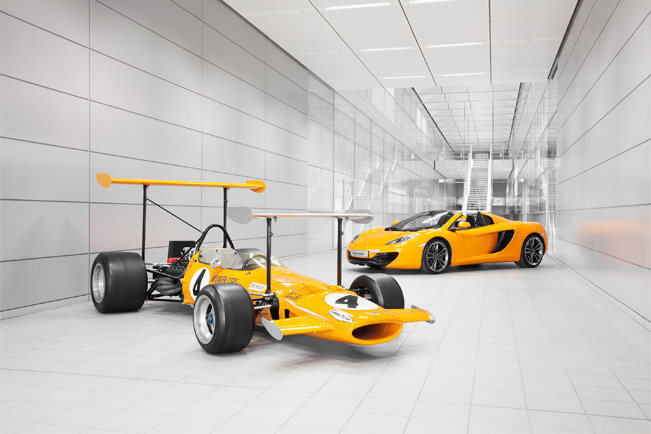
  • 1969 McLaren M7C and MP4-12C Spider

    McLaren is going to celebrate their 50th anniversary on September 2nd, this year.

    The original name of the company is Bruce McLaren Motor Racing Ltd and it has been launched since 1963. For the celebration, McLaren will use a 50th anniversary logo on everything from their shirts to the new MP4-28 Formula 1 that will debut on January 31st. They also intend to host a lot of unique events and celebration throughout the year.

    If we were to follow Bruce’s words to the letter, there’d be little time for recollection, but on the eve of our half-century there’s surely time for the briefest of breaths and the opportunity to take a look behind us at the sweeping vista built up in the indelible shadow of our founder:

    • Our Formula 1 team has become a global household name; since our arrival in the sport, at the 1966 Monaco Grand Prix, we have won more races (182) than any other constructor, started from pole position 155 times and scored 151 fastest laps. In 2012, we achieved the fastest-ever time for a Formula 1 pitstop (2.31s at Hockenheim), recorded our 58th consecutive points-scoring finish, an all-time record, and have now led more than 10,000 racing laps.
    • The exploits of our greatest world champions will always bring F1 to life: Emerson Fittipaldi ignited the passion of his native Brazil; James Hunt created as many headlines on the front pages as on the back; Niki Lauda and Alain Prost turned sport to science; the burning intensity of Ayrton Senna will live on for ever, while Mika Hakkinen and Lewis Hamilton will always be remembered for their raw speed and fearless aggression.
    • Our legacy in North American sportscar racing is writ equally large: in the heyday of the mighty CanAm series, we steamrollered the opposition, lifting five successive championship trophies (1967-1971) and winning an incredible 43 races in our iconic, thundering V8-engined sportscars.
    • We went to the Indy 500 for the first time in 1970, returning with greater strength until we won the USA’s most famous motor race in 1974 with Johnny Rutherford. We repeated the feat with Rutherford in 1976, too.

    • Today, every single car in Formula 1, the Indycar Series and NASCAR relies upon McLaren Electronics’ standardised ECUs to control their engines and feed data back to the garage.
    • Introduced back in 1993, the McLaren F1 road car has lost none of its unique appeal and is still considered by many to be automotive world’s definitive supercar. To this day, it remains the fastest naturally aspirated production car in the world. In GTR racing guise, it won the 24 Hours of Le Mans, also scooping third, fourth and fifth places on its debut in 1995.
    • The next roadcar project was with German manufacturer Mercedes-Benz, and saw the successful build of the Mercedes-Benz SLR McLaren, which became the best-selling carbon-based car ever.
    • Since its launch in 2010, McLaren Automotive has developed into a world-class road car manufacturer, successfully developing and building the 12C and the 12C Spider high performance sports cars. Both models exploit our unparalleled understanding of carbon fibre and electronic driver systems to create a groundbreaking product of unequalled weight, strength, performance and driveability.
    • In a return to our sportscar roots, the debut of the 12C GT3 was an unqualified success, scoring 19 victories on its competitive debut in 2012. In September, as Vodafone McLaren Mercedes crossed the flag to win in Monza, McLaren’s GT cars also took top spot at races in British, French and Spanish championships – an incredible achievement.
    • Fittingly, this year, McLaren Automotive stands poised to open its 50th global dealership ahead of the worldwide launch of the P1™ – our newest model and a machine that’s set to rewrite the definition of the modern supercar.
    • Away from the track, McLaren leads the world in the application of Formula 1 technology and expertise to other industries. McLaren Applied Technologies helped British cyclists, rowers, sailors and canoeists win 15 gold medals last summer. We worked alongside Specialized to design Mark Cavendish’s world championship-winning S-Works Venge bicycle. Working with Birmingham Children’s hospital, we have improved the monitoring of sick children in intensive care. McLaren has also designed systems to help the Bay Area Rapid Transit railway in San Francisco to run more efficiently and to reduce the CO2 emissions from plane movements at airports.

    Source: McLaren

  • McLaren Reveals Specifications of 2013 12C GT3

    2013-McLaren-12C-GT3-THUMB2013 McLaren 12C GT3 will compete in this years season and will continue to be raced by all active GT teams who competed in last year. In addition to this, several new teams have now taken delivery of the 2013 model.

    Furthermore the specifications of the new McLaren have already been disclosed and show that there will be number of changes, all of which designed to improve drivability, reliability and efficiency, coupled with reduced complexity.

    Some of the changes feature a revised aerodynamics package, an upgraded ECU with a revised electrical system and alternative dampers. What is more, the 12C GT3 will also benefit from an updated cooling system which maximizes the performance of the car in the more varied conditions found in global championships.

    There are also evident transformations on the bonnet and ducting, which now ensure that the 12C GT3 can run competitively in higher temperatures. Additionally, the revised aerodynamic package will enhance the balance and the tyre management of the vehicle.

    2013 McLaren 12C GT3 technical specifications:

    Chassis/Body

    • McLaren carbon fibre MonoCell with aluminium front and rear sub-frames
    • Bespoke lightweight carbon fibre body panels
    • Left hand drive
    • FIA approved safety roll cage

    Aerodynamics

    • Front splitter
    • Rear wing, fully adjustable with gurney
    • Front and rear diffusers

    Engine/Management

    • Race prepared 3.8L V8 twin turbo McLaren M838T
    • McLaren Electronics ECU interfacing with Bosch ABS and Shiftec transmission control units

    Transmission

    • Six-speed sequential motorsport transmission pneumatically actuated via steering wheel mounted paddles

    Electrical System

    • Lightweight motorsport specification wiring and connectors
    • Electronic power management system
    • Membrane type switch panel

    Data System

    • McLaren Electronics ‘ATLAS’ data system
    • Digital dash display

    Front/Rear Suspension

    • Double wishbone adjustable for ride height, camber and toe
    • Four-way adjustable dampers with coil over springs
    • Motorsport axles with single wheel retaining nut
    • Adjustable anti-roll bars
    • Forged aluminium wheels: Front 12” x 18”, Rear 13” x 18”

    Steering

    • Electro-hydraulic power assisted steering
    • Unique McLaren GT steering wheel developed from MP4-24 Formula 1 steering wheel

    Fuel System

    • Motorsport ‘bag tank’ system with 120L capacity
    • Motorsport ‘quick-fill’ system

    Lubrication

    • Mobil engine and transmission lubrication

    Brake System

    • Akebono monoblock calipers with ventilated discs:
      • Front – 6 piston caliper, 378Ø x 36mm disc
      • Rear – 4 piston caliper, 355Ø x 32mm disc
    • Bosch motorsport ABS

    httpv://youtu.be/72jgg4BqYsY

    Video Source: YouTube

    Source: McLaren

  • Hamann Blue MemoR McLaren MP4-12C

    Hamann has announced the Blue MemoR McLaren MP4-12C coming with completely new body kit and nice baby blue paint.

    The body kit includes a new big front splitter, a pair of redesigned side skirts, upper and side wheel arch ventilation inserts, a bigger rear wing and extended diffuser. There is also a roof air duct and custom rear fender from the rear window to the wheel arches. At the rear, we can see triple exhaust layout.

    The interior boasts a new upholstery, which is a combination between Alcantara and leather. There are also carbon fiber or wood elements.

    The price for the conversion is serious – 95,000.

    No performance modifications are planned. The MP4-12C is powered by a 3.8 liter twin-turbo V8 with 600HP (441 kW) and 600Nm (443 lb-ft). 0-100 km/h in 3.3 seconds, 0-200 km/h in 9.1 seconds and a top speed of 330 km/h (205 mph). ¼ mile in 10.9 seconds.

    Source: Hamann