Tag: Frankfurt Motor Show

  • Volkswagen NILS Concept

    NILS, a single-seat electric concept vehicle that offers a glimpse of a new form of minimalist mobility, has been unveiled ahead of its public debut at the Frankfurt Motor Show later this month.  This concept car – which features an aluminium space frame, wing doors and free-standing wheels – has the dynamic performance of a sports car, yet travels silently, and with zero emissions.

    The NILS project is supported by the German Federal Ministry of Transport, Building and Urban Development, and is designed to be both technically realistic and economically supportable.

    ‘NILS anticipates the future.  The goal of the NILS project is to research a technically concrete and economically feasible vehicle concept for micromobility which restructures individual transportation to make it more efficient and environmentally compatible based on electric drive technology,’ said Dr Ulrich Hackenberg, member of the Board of Management and Head of Development for the Volkswagen Brand.

    With a range of 65 kilometres (40 miles) and a top speed of 130 km/h (80 mph) NILS would be the ideal vehicle for the majority of commuters in Germany.  According to the German Bureau of Statistics, 73.9 per cent of all commuters residing between Berlin and Munich cover less than 25 kilometres (15.5 miles) on their way to work.

    Volkswagen NILS Concept
    Volkswagen NILS Concept

    Cars have always been mirrors of their times – their design styles and technological standards reflecting a particular era – and NILS is no different.  It uses emissions-reducing electric drive technology to fulfil the specific requirements of commuters.  In Germany, for example, about 60 per cent of all commuters travel by car, according to the Federal Bureau of Statistics; of these over 90 per cent travel alone.  Zero-emissions vehicles like NILS will offer these frequent drivers a new eco-friendly mobility solution.

    NILS is a very compact car that requires extremely little space in traffic.  It is only 3.04 metres long – making it about 50 cm shorter than the new Volkswagen up! – just 0.39 metres wide from wheel to wheel, and a mere 1.2 metres tall.

    NILS has the same basic layout as a Formula 1 race car, with the driver in the middle, the engine in back, and free-standing outboard wheels.  The 17-inch alloy wheels are equipped with 115/80 (front) and 125/80 (rear) tyres optimised for low rolling resistance.

    Though its inspiration may come from Formula 1, the styling has its origins at the Volkswagen Design Centre in Potsdam, Berlin.  Designer Thomas Ingenlath, the centre’s director, said: ‘NILS was designed to make a visual statement and transport a vision of the automotive future to the present.  I am especially pleased that we managed to implement the concept of the two glass wing doors.  This allowed us to create large transparent surfaces and simultaneously to make entering and exiting the vehicle very comfortable, even in the most cramped of parking spaces.’

    Because NILS is so compact and lightweight (460 kg), it is a lot of fun to drive.  It has a top speed of 130 km/h, and can accelerate to 100 km/h in less than 11 seconds.  This is achieved using an electric motor with a reasonably small 15 kW nominal power and short-term peak power of 25 kW.  A lithium-ion battery supplies the electric motor with energy.  The battery capacity (5.3 kWh) enables driving ranges of up to 65 km, depending on the style of driving.  A battery of this size is relatively inexpensive, and can be charged either via a conventional 230-volt electrical outlet (maximum charging time two hours) or at an electric vehicle charging station.  The socket is located at the back underneath the rear lighting module.

    The centrepiece of the electric drive system is the lightweight 19 kg electric motor together with its transmission and battery.  Energy management is via a high-voltage pulse inverter, which – together with the 12-Volt DC/DC converter for the vehicle electrical system and the charger – forms an integral drive unit.  All drive unit components are located compactly in an aluminium housing at the rear of NILS; drive is to the rear wheels.

    The motor, battery and all other components are so compact that there is still space for a small but practical bootspace.  The body-coloured area above the rear lighting module swings upward, revealing space suitable for items such as a case of drinks and a bag.

    Optimal weight distribution helps to ensure that NILS allows drivers not only to commute with zero emissions, but also to have fun while doing so.  The lightweight NILS drives like a go-kart.  The steering is purely mechanical (the low weight means power assistance is unnecessary), while the electric motor produces its maximum torque of 130 Nm from standstill, via a one-speed transmission.  Suspension is by double wishbones front and rear; while ESP (Electronic Stabilisation Programme) helps to tame any over-exuberance on the part of the driver.

    Safety is of course even more important than fun, and NILS is fitted with an automatic distance control system.  This uses radar sensors to scan the space in front of the vehicle over a distance of about 200 metres and uses brake interventions to ensure that the distance to vehicles in traffic in front of the car does not drop below a specified minimum value.  The system can even automatically brake the car to a stop, depending on the situation.  Not only are the four disc brakes used to brake; electric traction by electric motor and battery regeneration can be used to brake as well.  Last but not least, Front Assist is integrated in the automatic distance control system.  This continually active system warns the driver of a potential collision; at speeds below 30 km/h (18 mph), automatic braking can avoid a collision under some circumstances.

    The instrument cluster is a seven-inch TFT display.  The vehicle’s speed is shown digitally in the middle, while energy flow is represented by bars.  Another graphic display offers information on the driving range.  The second central instrument is a mobile multifunctional device like the one used in the new up!: the Portable Infotainment Device (PID).  It is snapped into theA-pillar to the right of the instrument cluster.  Via touchscreen, the driver controls functions related to Navigation, Radio, Media, Telephone, Trip computer and – to preconfigure the driving range – ‘Eco.  The PID computes the expected driving range, then it not only displays the route on the map display, but also the radius and thereby the destinations that can be reached using the current battery charge.

    To save on weight and costs, certain functional elements and controls do without electrical assistance.  The side mirrors, for example, are adjusted manually.  The heating and ventilation system has full electronic control, and there is seat heating.  Located to the right of the steering column is the motor start-stop switch; this round switch is also used to select D, N or R.

    The aluminium space frame body was designed to be a highly effective safety cell.  The body in white is produced from extruded aluminium, cast aluminium and sheet aluminium.  The roof frame together with the door mounts, a roll bar, the bootspace and the front bulkhead consist of high-strength sheet aluminium.  Extruded aluminium is used in the side sills, the transverse profiles and the front and rear car sections.  The front and rear side body are aluminium.  Parts made of high-strength plastic include the bumpers and the trim panels on the side sills.

    The frames of the wing doors consist of three main elements: an inner section, a crash reinforcement section and an exterior part.  When closed, they offer optimal crash safety.  The door windows are made of lightweight, scratch-resistant, layered polycarbonate, while the front window is made of laminated safety glass.

    The headlights are striking bi-xenon modules, while the indicator lights and daytime running lights are white and yellow LEDs.  In the acrylic glass of the rear lights – integrated in the rear section like small wings – the light generated by LEDs is routed via transparent semiconductors which (appropriately for an electric vehicle) consume minimal amounts of power.

    Source: Volkswagen
  • Ford Evos Concept

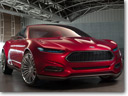
    Making its global debut at the 2011 Frankfurt Motor Show in September, the Ford Evos Concept represents the ultimate expression of Ford’s new global design language, and explores key future powertrain and vehicle technologies.

    Created as a bespoke concept vehicle, the fastback introduces Ford’s first truly global design language as the momentum of the company’s One Ford product plan continues to build.

    “The Ford Evos Concept unites three key elements which are at the core of our One Ford global product strategy: outstanding design, smart technologies and fuel economy leadership,” said Derrick Kuzak, group vice president of Global Product Development.

    “With its compelling design and innovative technology experience, this is a clear demonstration of the exciting vision we have for the Ford brand. While you will never see this car on the road, the next generation of Ford products around the world will display many of the distinctive design ideas and advanced technologies it showcases.”

    Technology vision for enriched customer experience

    Ford Evos Concept is not just a design-led exercise. It also embodies the global Ford product development team’s move to design and develop vehicles as more than just an interior and exterior, or a collection of attributes.

    “Our goal is to focus on enriching a customer’s every experience with their vehicle – by personalising it, adapting it, and creating unique, unexpected features that surprise and delight them,” said Kuzak. “In the Ford Evos Concept, this objective is explored and extended to the area of connectivity, where the intent is not to convert the vehicle into a smartphone, but rather to provide personalised and safe connection to the outside world in an enriching manner designed totally for the vehicle context.”

    Ford’s global Research and Innovation team, led by Paul Mascarenas, was tasked with building Evos Concept around a technology experience as visionary as the design. The result signals how Ford intends to build on the momentum of innovations like the SYNC in-car connectivity system.

    Ford Evo Concept
    Ford Evo Concept

    “At Ford, the future of technology in the car will be defined by the experience that it delivers to the driver and passengers,” said Paul Mascarenas, chief technical officer and vice president of Ford Research and Innovation. “We see technology as more than just an impressive list of microprocessors, sensors and software; it’s about the application of that technology to create an experience that enhances the driver’s time behind the wheel.”

    The concept’s technology experience embraces a new generation of driver interaction and awareness currently under development in the Ford Research and Innovation laboratories.  Seamless connectivity between the vehicle and the driver’s ‘personal cloud’ of information is at the heart of the vision for its capabilities.

    “The possibilities are fascinating when we explore how to enable a seamless lifestyle between home, office and car linked by access to the driver’s personal information,” Mascarenas said.

    With information from the cloud, the vehicle can provide the same connected lifestyle the driver experiences at home or office. The car knows the driver, and automatically adapts handling, steering and engine controls to deliver an exceptionally dynamic driving experience.

    Ford researchers are focusing their efforts in this area to deliver on four key customer benefits: personalisation, seamless enhancement of the driving experience, looking after the driver’s well-being and delivering smart electrified powertrain optimisation.

    The personalised, cloud-connected lifestyle

    While today’s Ford products provide drivers with many personalisation options, cloud connectivity will enable future Ford vehicles to take the experience to the next level.

    Drawing from a detailed understanding of the driver’s preferences and driving habits, the Ford Evos Concept combines this personal information with additional data from the cloud, such as the driver’s work schedule and local traffic or weather conditions. This information provides a personalised and seamless experience as the driver transitions in and out of the car.

    “We’re researching how we can use patterns or preferences set by the driver to make life simpler,” said Mascarenas. “The car gets to know you and can act as a personal assistant to handle some of the usual routines of a daily commute.”

    It could automatically play the same music or news program that was just streaming at home, or heat or cool the interior to an ideal temperature before the driver gets in without having to be requested by predicting departure time based on his calendar. Wirelessly communicating with devices in the home, it could close the garage door and switch off the lights automatically as it pulls away.

    “This cloud-connected vision shows the enormous potential of tailoring the driving experience to suit the exact personal tastes and moods of the driver,” said Mascarenas. “From recommending a great driving road from friends on your social networks or resetting your alarm clock to let you sleep in when a morning meeting gets cancelled!”

    Enhanced driving experience

    Ford Evos Concept explores adaptive vehicle technologies to redefine the driving experience.

    Current technology requires vehicle chassis settings to be defined based upon the abilities and tastes of a cross-section of drivers and the topography of typical roads. The concept foresees tuning handling and performance to the road ahead and the specific individual behind the wheel.

    Learning driver habits and capabilities, the technology can overlay map and weather data sourced from the cloud to adjust powertrain, steering, suspension and braking systems for optimum enjoyment, comfort and safety.  Because the vehicle is adaptive and honed to maximum performance based on the situation, it takes driving engagement to a new level.

    Driver wellness

    Ford researchers have already developed technologies focused on driver wellness, such as the heart-rate monitoring seat and certified allergy-free interiors. With a seamless connection to the cloud, the Ford Evos Concept monitors the physical state and workload of the driver and adjusts the driving experience accordingly.

    “Our wellness research and technologies are focused on relieving driver stress and enhancing their situational awareness,” said Mascarenas. “Drivers around the world are spending more time behind the wheel, and the car should not be another stress point in their lives.”

    The Ford Evos Concept is also equipped with advanced air quality sensors and filtration systems to help allergy sufferers. Location aware, it can access air quality data from the cloud and proactively suggest a healthier route to the destination.

    In dynamic driving situations, the vehicle may simplify the appearance of the instrument panel to display only necessary gauge information and switch the driver’s connected smartphone to “Do Not Disturb” mode to help keep the focus of attention on the road.

    Cloud-optimised hybrid powertrain

    Completing the vision for the Ford Evos Concept is a state-of-the-art lithium-ion plug-in hybrid (PHEV)powertrain providing the same next-generation performance and fuel economy as the Ford C-MAX Energi scheduled for introduction in North America in 2012 and Europe in 2013.

    Ford ‘powersplit’ hybrid architecture allows the electric motor and petrol engine to work together or separately to maximise efficiency. The advanced powertrain typically runs in all-electric mode before switching to charge-sustaining hybrid mode for continued optimal fuel efficiency.

    Cloud connectivity would provide further opportunities to enhance performance and efficiency by selecting the optimum combination of powertrain modes for any given journey.

    “Access to historical driver behaviour and travel patterns allows us to calculate the optimal fuel and energy efficiency by predicting the destination,” said Mascarenas. “Our researchers are working to increase understanding of driver behaviour, develop accurate protocols to predict it and enhance the trip by providing the smartest use of fuel or battery for the situation.”

    The cloud-optimised powertrain would automatically ‘know’ when to save energy and switch modes, using information about the vehicle’s predicted travel route, any emission zone restrictions during the journey and current weather conditions.

    In the future, communities may place firm restrictions on the types of vehicles allowed to use certain roads or highway lanes, and some city centres may choose to be open only to full electric vehicles. Helping drivers comply with such regulations could therefore be among the benefits of this technology. For example, the French government is considering creating zones mandating lower emissions, while cities such as London, Berlin, and Stockholm already have them in place.

    This capability would further enhance the performance of Ford’s advanced PHEV technology, which offers an overall driving range of more than 500 miles (800 kilometres) using the battery and engine – more than any other plug-in or extended-range electric vehicle.

    “With its leading-edge ‘cloud-optimised’ PHEV powertrain offering outstanding efficiency and range with supreme driving enjoyment, the Ford Evos Concept highlights our vision for greener, smarter vehicles with outstanding customer appeal,” said Kuzak.

    Ford’s new design direction

    The Ford Evos Concept was specifically developed to introduce the new Ford design direction.  Key design elements will be applied to forthcoming Ford vehicles.

    The new global design DNA provides the company’s worldwide design teams with a common framework to guide the creation of new products, enabling them to shape a coherent family of distinctive vehicles sharing the same fundamental design character.

    “We wanted the Ford Evos Concept to give a clear message about where Ford design is heading – shaping vehicles that are fun to drive, have a strong premium visual appeal, and above all, are stunningly beautiful,” said J Mays, group vice president, Design and chief creative officer.

    “Our exciting new design DNA has been developed and refined by an intensive effort by all of our talented global design team,” said Mays.  “As a team, we wanted to create a more technical design vocabulary to help communicate the smart technology that is now core to the Ford brand.  In addition, we worked particularly hard on meeting the high-expectations of a new generation of buyers – a group of consumers who have grown up surrounded by beautiful, premium design work on even the most affordable products.”

    Dramatic fastback design with unique proportions

    To provide a fitting vehicle to introduce the new design language, the Ford Evos Concept was conceived as a dramatic fastback concept, combining a striking new profile with innovative proportions. Attention-grabbing lines conceal a unique new format, with a four-door, four-seat layout which combines dynamic appearance with surprising practicality.

    “This is an exciting new interpretation of the fastback bodystyle, with a really innovative silhouette as well as dramatic and very modern proportions,” Mays said.

    With the length of a typical C-car, but with width of a CD-car, the Ford Evos Concept has a powerful, sporting stance. The forward position of the cowl, the strongly rounded front screen and the A-pillars set further to the rear enabled the designers to create the impression of a classic GT car, but with a very contemporary feel.

    The concept’s spectacular hinged gullwing-style doors, both front and rear, provide outstanding access to the spacious four-seat cabin.

    The concept car measures 4.50m (177in) long, 1.97m (77in) wide and 1.36m (53in) high, with a wheelbase of 2.74m (108in).

    Distinctive evolution

    Shaped as the ultimate expression of the new design DNA, the Ford Evos Concept highlights key elements of Ford’s distinctive new global design language.

    “The new design DNA marks a bold evolution of the kinetic design language featured on existing global Ford products and is characterised by a number of important elements that will contribute to an unmistakable future Ford look,” said Mays.

    From the front, the Ford Evos Concept immediately signals the arrival of something new – a new face for Ford featuring the signature trapezoidal grille mounted higher on the car and creating a confident, more premium look.

    Bold, technical shapes, such as the extremely slim ‘laser cut’ front lamps or the dramatic graphic created by the front and rear screens connected by the thin glazed section of the roof, add a distinctive character to the design.  Sculptured flanks highlight attention to detail on the surfacing, which lends a refined quality and a tauter, more muscular character.

    “The Ford Evos Concept embodies the core elements of the new global design language, while capturing the dynamic, fun-to-drive spirit which is central to the Ford DNA,” said executive design director Martin Smith.  “Most notable is the brand new ‘face of Ford’, with its higher mounted trapezoidal grille, and the design is characterised by the use of very bold, technical graphics.  We have also created much more refined and precise surfacing, and these elements together give a strong visual sense of premium quality.

    The vehicle was sculpted with the same purity of surface sculpture and attention to detail which characterise premium vehicles.  Around the world, a new generation of buyers have come to expect premium design in all products, regardless of the purchase price.

    Built around the driver

    Reflecting the fun-to-drive spirit of its exterior design, the interior of the Ford Evos Concept is built around the driver.  A stylish and innovative cockpit promises new levels of driving pleasure and driver interaction.

    The interior architecture features clean and simple surfaces, with a muscular, athletic character to the slim upper instrument panel, enhanced by bold trapezoidal cut-outs.  Contrasting these muscular forms, curvaceous cockpit display surfaces sweep down either side of the driver, providing secondary information about vehicle and infotainment systems.

    The concept features a bold red driver’s seat and the vision of unprecedented driver interaction via an advanced driver interface. The two rear seat passengers get an equally special experience, with dedicated touch-screen displays to interact with the vehicle and individually adjustable sports seats.

    “Both the exterior and interior of the Ford Evos Concept clearly communicate that this is a driver’s car, so that as soon as people see the vehicle, they will immediately want to get in and drive,” said executive design director Moray Callum.

    Source: Ford

  • Porsche 911 (991) 7-speed manual layout – first looks

    When Porsche released the information about their new 7-speed manual gearbox, which they are introducing with the long-awaited 911 replacement, reactions were pretty much split between disbelief and annoyance. After all, in many cases even 6 speeds could be a handful and, in a car of the 911’s breed, it is kind of important to be able to work the shifter with the same ease you slice through mom’s freshly-baked pie.

    Therefore, initially there was disbelief, which grew into concern about the usability of a seven-speed manual in a car traditionally touted for its German practicality, utilitarianism, and efficiency. Still, Porsche have moved ahead with their production plans and we are about to see the official presentation of the newest 911 at the Frankfurt Auto Show (September 15-30, 2011). Shortly before, however, we are finally able to see the shifting layout of the transmission, which the guys at CarEnvy.ca have posted on their Facebook page.

    Porsche 911: 7-speed manual layout

    Judging by the picture, using the shifter would not be an issue, at least for those who managed just fine with its 6-speed predecessor in the current model generation. Seventh gear is ‘squeezed in’ just beside sixth, which does not change anything about the layout of the other gears – no surprises for Porsche drivers. In addition, Porsche’s claim has been that the top gear is added with the sole purpose of reducing engine noise and fuel consumption and is to be used only on occasions, such as leisurely cruising, so this should happen rarely enough.

    All of this is supposed to do away with the practicality/efficiency doubts. In fact, Porsche estimates that the 991 (as is the factory designation of this 911 generation) should be around 15% more fuel efficient than the current car, which is already extremely frugal by supercar standards. Of course, we will have to wait and see the official unveiling of the new 911, in order to be sure, but so far it appears that more is still better.

  • 2012 Aston Martin V12 Zagato

    Aston Martin V12 Zagato will be appearing in September at the 64th IAA International Motor Show at Frankfurt. Along with the largest display of contemporary Aston Martins ever seen at a Motor Show, two V12 Zagatos, both having completed their engineering sign-off at the Nurburgring 24 hour race, will be shown for the first time at a mainstream event.

    Hand assembled at the company’s global headquarters in Gaydon, England, the V12 Zagato is based on the highly acclaimed V12 Vantage and features a beautiful ’handcrafted‘ aluminium and carbon fibre body. Combining traditional craftsmanship and high technology, the V12 Zagato also boasts Aston Martin’s most dynamic bonded aluminium platform and the power of the company’s acclaimed 6.0-litre V12 engine producing 510 bhp (380 kW / 517 PS), and 570 Nm (420 lb ft) of torque.

    Following extremely positive initial customer reaction, the V12 Zagato is being offered for sale at £330,000 GBP (excluding local taxes) and will go into strictly limited production of up to 150 cars in summer 2012. 50 years on from the introduction of the iconic DB4GT Zagato, Aston Martin and Zagato have collaborated to create this modern interpretation which remains true to the focus of craftsmanship, performance and exclusivity which underpinned the original collaboration.

    2012 Aston Martin V12 Zagato
    2012 Aston Martin V12 Zagato

    Launched successfully in late May at the famous Villa D’Este Concours on Lake Como, Italy, the V12 Zagato saw off tough competition to be awarded the coveted Design Award for the concept and prototypes class. Just a week later, the V12 Zagato made its racing debut at the 53rd ADAC ACAS H&R-Cup VLN race at the historic Nurburgring racetrack in Germany. Following other appearances in the series, both prototypes of the V12 Zagato were entered into the gruelling 39th ADAC Nurburgring 24 Hour on 25/26 June, successfully amassing a combined 230 laps and over 3,700 miles of intense durability testing – both taking the chequered flag to maintain Aston Martin’s 100% finish record in the race.

    The first of the two V12 Zagatos being shown at the Frankfurt Motor Show, finished in its distinctive green livery is the full endurance race car concept specification as campaigned at the Nurburgring. The car, nicknamed ‘Zig’ by the factory team features a full aerodynamic package including front splitter, dive planes, large rear diffuser and spoiler designed to make the most of the Nurburgring’s multitude of corners and lengthy straights.

    The second of the cars, nicknamed ‘Zag’, was originally shown at the Villa D’Este before being converted into the same full racing specification as the sister car. Since the 24 hour race, Zag, has been returned to its original show specification which, although showing a racing car interior, has an exterior more representative of the exclusive road car currently offered for order. In addition to this, Aston Martin today releases the first conceptual illustrations of the road car variant that will go into production from mid 2012.

    The pair of V12 Zagatos will join the Aston Martin stand at Frankfurt in September alongside the stunning One-77 supercar and the recently launched Virage and Vantage S.

    Source: Aston Martin

  • 2012 Mercedes-Benz B-Class

    Substantially more agile and efficient, but as comfortable and spacious as ever – the new B-Class from Mercedes-Benz is a winner on all fronts. The vehicle’s lower height and more upright seat position provide for a first impression that hints at the compact sports tourer’s dynamic credentials.

    With a new four-cylinder petrol engine featuring direct injection and turbocharging, a new diesel engine, a new dual clutch transmission, a new manual transmission and new assistance systems, the front-wheel-drive car also rings in a new technological era for compact cars from Mercedes-Benz. “No model change in the history of Mercedes-Benz has ever seen so many new developments introduced in one fell swoop,” stresses Dr. Thomas Weber, Member of the Board of Management responsible for Group Research and Head of Development, Mercedes-Benz Cars. “Future B-Class customers will benefit from this quantum leap in terms of higher fuel consumption and lower CO2 emissions combined with driving pleasure, plenty of space and the highest standard of safety that has ever been available in this class.”

    The world premiere of the new B-Class (length/width/height: 4359/1786/1557 millimetres) will take place at the Frankfurt International Motor Show (13 to 25 September 2011). It will be making its way to the UK in March 2012 .

    The exterior design: perfect space in a most attractive guise

    The new B-Class is a typical Mercedes sports tourer, offering plenty of space combined with impressive dynamic performance as a hatchback saloon. The character lines of the exterior design indicate both of these attributes: the front and rear feature width-emphasizing design, with a wide, prominent grille and headlamps extending along the sides at the front while the rear end features a wide rear window, two-piece tail lights and a large tailgate with low loading sill.

    The new sporty lines and the outstanding aerodynamics are particularly evident in the side line: the bonnet flows seamlessly into the A-pillar and the roof line descends sleekly to the striking roof spoiler. The roof features a contoured line which lends the vehicle a longer appearance. The pronounced wheel arches offset by dynamic feature lines under the beltline are a sporty interpretation of the current design line from Mercedes-Benz. The bottom edge of the body features dynamic side skirts which add a light touch to the vehicle’s appearance. Refined details such as the exquisitely designed headlamps with the new spotlight element confirm the brand’s unmistakable premium credentials which shine through in the compact segment, too.

    2012 Mercedes-Benz B-Class
    2012 Mercedes-Benz B-Class

    Outstanding aerodynamics: astounding cd value

    An outstanding drag coefficient of cd = 0.26 places the new B-Class at the forefront of its market segment. As well as the aerodynamic exterior design, numerous optimisation measures on points of detail such as the air flow around the front wheels, the underbody design and the cooling air flow are also crucial contributory factors to this excellent aerodynamic performance. Patents are pending for innovative details such as the serrated wheel arch spoiler.

    New concept: lower overall height but more space inside

    The new vehicle concept underscores the dynamic aspirations of the new B-Class. The most striking aspect is the reduced height: at 1557 millimetres, the new model crouches almost five centimetres lower on the road than its predecessor. The seat height in relation to the road has also been reduced (minus 86 mm) in order to facilitate getting in and out of the car easily, while maintaining a clear overview of the vehicle’s contours when driving.

    In response to requests from many customers, the sitting position is more upright, however. At the same time, the headroom has been further improved. With maximum headroom of 1047 mm at the front (without sliding roof), the B-Class is among the most spacious cars in its segment in this discipline, too. The ergonomically expedient more upright sitting position in combination with a lowering of the vehicle’s floor at the rear leads to a segment-leading degree of legroom (976 mm) which even surpasses that of the S- and E-Class.

    The B-Class is optionally available with the EASY-VARIO-PLUS system. This enables simple reorganisation of the interior so as to enable the transportation of bulky items. Features of the EASY-VARIO-PLUS system include fore/aft adjustment of the rear seats by up to 140 millimetres (thereby increasing the luggage compartment volume from 488 to 666 litres) and a front passenger seat whose backrest can be folded forward onto the seat cushion.

    The interior design: superior quality in a new dimension

    High-quality materials and finely structured surfaces, stylish details, precision workmanship and a new spaciousness – the interior of the B-Class defines a whole new benchmark in the compact segment.

    Many features have been the reserve of higher classes of vehicle to date and embody Mercedes-Benz‘s special definition of quality and aesthetics. The dashboard is optionally available in ARTICO man-made leather finish and features stitching, for example. Four equipment packages (Chrome, Sports, Exclusive and Night package) enable individualisation according to personal tastes.

    On the inside the large, three-dimensional trim covering the entire dashboard first strikes the eye. It is available in four variants, covering a broad spectrum from modern through sporty to classic. Common to all versions is a high-class appeal combining an attractive look and feel with easy care and durability.

    2012 Mercedes-Benz B-Class Interior
    2012 Mercedes-Benz B-Class Interior

    The three large round vents in the middle and their uniquely designed cruciform nozzles add a sporty attribute to the interior’s emotional design idiom. The display, which is available in two sizes (5.8- and 7-inch) appears to hover over the vents. With its stylish design – the trim frame with galvanised finish contrasting with the piano black of the front panel – and slender lines, the colour display (TFT) is a highly attractive feature in the cockpit.

    The 3-spoke leather trimmed steering wheel, which always incorporates a silver chrome insert in the middle spoke, the instrument cluster with four analogue round dials and suspended pointers in the 6 o’clock position and the seats with contrasting stitching underscore the sporty character.

    The drive: designed for maximum efficiency

    The new B-Class features new petrol and diesel engines as well as new manual and automatic transmissions. All transmissions and engines have been developed in-house, with production taking place at the plants in Stuttgart-Unterturkheim and -Hedelfingen, Rastatt/Baden, Gaggenau/Baden and Kolleda/Thuringia. The simultaneous development process enabled perfect coordination of engines and transmissions, e.g. with regard to implementation of the ECO start/stop function which features as standard on all B-Class models.

    Common features of the new drive systems are the use of state-of-the-art technologies for maximum efficiency, very smooth running, high tractive power right from low revs, sustainability in terms of impending emissions standards and low weight. For the purposes of transverse installation the engines, all of which are turbocharged, and the two transmissions are very compactly designed, providing the B-Class with an exemplary small turning circle for a front-wheel drive vehicle of eleven metres. The engine and transmission suspension consists of a four-point mounting system comprising engine mount, transmission mount and two self-aligning supports. This suspension system has been designed specifically to meet the requirements of the high-torque engines with regard to minimum noise levels.  The hydraulic damping integrated in the transmission mount is a key contributory factor to the exceptionally high ride comfort.

    The new four-cylinder petrol engines (internal designation M270) mark the launch of a completely new engine series. The combustion process is based on the third-generation Mercedes-Benz direct injection system which was introduced last year with the BlueDIRECT V6 and V8 engines. Its use in the B-Class marks this technology’s debut in the compact segment. The new four-cylinder engines have been designed for both transverse and longitudinal installation. In the new B-Class they are initially available with a displacement of 1.6 litres, as the B 180 rated at 122 hp and the B 200 with an output of 156 hp. Their maximum torque of 200 and 250 Nm respectively is available from an engine speed of 1250 rpm.

    The new four-cylinder diesel engine is a further development of the OM651 deployed in the C- to the S-Class, a common rail direct-injection engine of the third generation. With its displacement scaled down to 1.8 litres and numerous optimised points of detail, this is the first time that the compression-ignition engine has been mounted transversely in a Mercedes-Benz car. The B 180 CDI generates 109 hp of power, while the B 200 CDI has an output of 136 hp. The maximum torque stands at 250 Nm from 1400 rpm for the 80 kW variant and 300 Nm from 1600 rpm for the 100 kW variant.

    Another Mercedes-Benz premiere is the new 7G-DCT dual clutch transmission in the B-Class. This transmission is extremely compact, extremely variable with regard to adaptation of the engine speed thanks to seven gears, features an electric oil pump for start/stop capability, shifts gear without any interruptions in tractive power and combines the comfort of an automatic with the efficiency of a manual transmission.

    The new 6-speed manual transmission designed along similarly compact lines as a three-shaft transmission is a close relative of the DCT. Extremely easy gear shifting, low shift forces, low internal friction and a low weight are among its most important characteristics.

    The chassis and suspension: refined sportiness now for the sports tourer, too

    “Fantastically agile” is the assessment of all test drivers who have put the new B-Class through its paces to date. Three factors are instrumental to the substantially enhanced dynamic performance in comparison to its predecessor, which does not come at the cost of any compromises on comfort: the lowered centre of gravity, the new four-link rear axle and the upgraded ESP®Electronic Stability Programme. A sports suspension is optionally available for further enhanced agility. The centre of gravity has been lowered by a further 20 mm and the suspension additionally features sports dampers with amplitude-selective damping and a Direct-Steer system will be standard on the Sport model line.

    Steering: mechanical with electric assistance

    The electromechanical steering of the B-Class has been redesigned. The electric motor of the servo assistance system is now located directly on the steering gear as a dual pinion EPS system, thereby optimising the package as a whole. The steering ratio becomes noticeably more direct at greater steering angles, enhancing the vehicle’s handling and agility substantially. The electromechanical steering system makes an important contribution to the vehicle’s overall efficiency, as the steering assist function only requires energy when steering actually takes place.

    New assistance and braking system reduces the risk of rear-end collisions

    As a world first in the compact segment, the B-Class features a radar-based collision warning system with adaptive Brake Assist as standard, which lowers the risk of rear-end collisions. The COLLISION PREVENTION ASSIST system outputs a visual and acoustic warning to alert a possibly distracted driver to identified obstacles, and prepares Brake Assist for the most precise possible braking response. This is initiated as soon as the driver emphatically operates the brake pedal.

    In contrast to systems currently on the market in the compact class, the new COLLISION PREVENTION ASSIST brake assist feature is not merely a system intended to minimise minor damage in urban traffic. Rather, this innovative solution is aimed at protecting motorists from typical rear-end collisions in dangerous traffic situations. Mercedes-Benz expects the new safety system to have a significant positive effect on accident statistics.

    The area of safety also encompasses an array of other assistance systems which have been adopted into the B-Class from the larger model series. These include:

    • Adaptive Headlamp Assist
    • Blind Spot Assist and Lane Keeping Assist
    • ATTENTION ASSIST (standard)
    • Speed Limit Assist (speed limit sign recognition)
    • Active Parking Assist(standard)
    • Brake HOLD function (standard with 7G-DCT)
    • Hill Hold function (standard)
    • LINGUATRONIC
    • Reversing camera
    • DISTRONIC PLUS

    Premiere in the compact class: PRE-SAFE® available for the first time

    The PRE-SAFE® preventive occupant protection system which features in the B-Class is available for the first time in this vehicle category.  This represents a further step in the ongoing implementation of this innovation, which was premiered in the S-Class in 2002. Core features of PRE-SAFE® are reversible belt tensioning, the closing of side windows and sliding sunroof in case of critical lateral dynamics and adjustment of the fully electric front passenger seat with memory function to an ideal position for maximum effectiveness of the restraint systems. PRE-SAFE® is always activated in response to critical longitudinal and lateral dynamics and may also be triggered upon intervention by certain assistance functions.

    he scope of restraint facilities takes special account of the B-Class’ use as a family car. Great importance has been attached to the safety of the rear occupants. Belt tensioners, belt-force limiters and belt height adjusters come as standard on the outer seats. Rear sidebags are optionally available. Integrated child seats and automatic child seat recognition are available as in the predecessor. Driver and co-driver are provided with new pelvis bags which are able to cover the pelvis and the entire upper part of the body. For head protection, a windowbag is fitted as standard.

    COMAND Online multimedia system with internet access

    Internet access, the convenient LINGUATRONIC voice control system, two navigation solutions tailored to different budgets, connection for mobile audio devices and an intuitive operating concept – the information and communication systems in the B-Class offers excellent user-friendliness and a superior level of functionality which has been the reserve of higher categories of vehicle to date. It is the new multimedia generation from Mercedes-Benz which delivers these standards. The operating concept featuring the turn/push control in front of the armrest and the control knob on the head unit is also familiar from other Mercedes model series.

    The COMAND Online multimedia system offers internet access. Customers can either surf the web as they wish while the car is stationary or call up a Mercedes-Benz app whose particularly fast page loading and simple operation make it suitable for use while driving. Integrated apps include Google™ Local Search and Weather, and the facility for downloading a route which has previously been configured on a PC using Google Maps and transmitted to the car.

    All set for the future: modular “Energy Space” concept

    The modular “Energy Space” concept means that the new B-Class is already designed to accommodate versions with an alternative drive: appropriate interfaces in the body shell enable the main floor panel to be modified and a step to be produced for the versions with alternative drive. An underfloor compartment covering part of the area under the rear bench seat offers space for alternative energy accumulators.

    Source: Mercedes-Benz

  • 2012 Bentley Continental GTC

    The second generation of Bentley’s iconic Continental GTC convertible will debut at next month’s International Automobile Exhibition (IAA) in Frankfurt.

    Taking cues from its GT coupe sibling launched last year, the new Continental GTC builds on the highly successful foundation of the previous cabriolet, which premiered in 2006. Bentley’s design and engineering teams have improved virtually every aspect of the iconic convertible with an uncompromising focus on quality.

    While the first Continental GTC was elegant and understated, the sharper radii and assertive stance of the new model delivers a more contemporary and muscular presence. Advanced manufacturing techniques produce aluminium front wings without the need for seams or welds creating the look and feel of a coach-built car. Twenty-inch wheels are now standard with three styles of 21-inch wheel, a first for GTC, available as an option, reinforcing the distinctive, sporting stance of the new Bentley.

    The four-seater luxury convertible features a new, even more spacious and sumptuous hand-crafted cabin, with soft-touch leather hides, an extensive range of wood veneers, cool-touch metals and deep-pile carpets. There are 17 standard soft-touch leather hide colours with six colour split combinations, complemented by a range of seven veneers, all produced by Bentley’s talented craftsmen and women.

    2012 Bentley Continental GTC

    The GTC’s renowned coupe-like refinement is also enhanced. The tailored, multi-layered fabric hood is complemented by acoustic glass and under-body panels, for optimum noise isolation.

    Superb everyday practicality for a luxury convertible was a hallmark of the original GTC and much valued by its customers. The cabin of the new GTC is now even more practical, with additional rear legroom, new storage solutions and innovative features such as touch-screen infotainment, automatic seat-belt presenters and a Bentley-designed Neck Warmer for comfortable roof-down motoring whatever the temperature.

    A wider track, front and rear, sharper steering and retuned suspension provides a more exhilarating and class-leading drive. Bentley’s advanced all-wheel drive system features a new 40:60 rear torque bias (compared with 50:50 of the original GTC) minimising understeer during hard cornering and allowing the spirited driver to manage the car’s line and balance via precise throttle control.

    This compelling dynamic package is combined with a more powerful 6.0-litre, twin-turbocharged W12 engine as well as a new QuickShift transmission enabling faster gear changes than ever before. Power output is raised from 560PS to 575PS (567bhp/423kW) and the famed Bentley ‘wave of torque’ has been increased by a further 50Nm to 700Nm (516lb ft).

    Pricing Information

    POUNDS STERLING £149,350
    US DOLLAR $212,800 MSRP
    EURO €170,060
    RENMINBI RMB 3,838,000
    YEN ¥26,400,000

    Pounds Sterling inclusive of 20% VAT.
    Euro price does not include individual market taxation rates.
    US Dollar pricing is exclusive of individual state taxes.

    2012 Bentley Continental GTC – AT A GLANCE

    Sculpted exterior design

    • Advanced production techniques such as aluminium Super Forming (front wings) allow for a more sculpted body and sharp ‘power lines.’
    • Unique jewelled headlamps with LED daytime-running lights.
    • More upright matrix radiator grille and new ‘double horseshoe’ rear profile first shown on the flagship Bentley Mulsanne.

    Luxurious, practical, hand-crafted cabin with class-leading infotainment

    • New interior with a bold, sweeping dashboard and instrument panel finished in premium soft-touch leather.
    • Choice of 17 hide colours, six colour split combinations and seven veneers.
    • Distinctive ‘cobra style’ seats for added comfort and enhanced rear cabin space.
    • A new touchscreen, 30GB infotainment system introduces advanced satellite navigation with dynamic route guidance, seven-digit postcode entry and Google Map compatibility (market specific).
    • Audio systems feature the latest wide-frequency Balance Mode Radiator speakers as standard.
    • Revolutionary Dirac Dimensions™ DSP for exceptional sound reproduction (Naim for Bentley premium audio).

    More powerful 6-litre W12 engine with FlexFuel capability

    • 6-litre W12 engine twin-turbocharged engine produces 575PS (567bhp/423kW) and 700Nm (516lb ft) of torque.
    • FlexFuel capability – runs on E85 biofuel, petrol or any combination of the two.
    • 0 – 60mph 4.5 secs (0-100 km/h 4.8 secs).
    • 0 – 100mph 10.9 secs (0 – 160km/h 10.9 secs).
    • Top speed 195 mph (314 km/h).

    Dynamic Bentley driving experience

    • ZF 6HP28 transmission with ‘Quickshift’ system that cuts shift times by up to 50% and enables double downshifts.
    • New 40:60 rear-biased torque split for the all-wheel drive system reduces understeer when powering out of bends and provides for better modulation of line and attitude by ‘throttle steering.’
    • Increased front and rear track improves grip and stability.
    • Advanced ESC system fully exploits the potential of the more powerful W12 engine and improved chassis.
    • 20” ‘Five Spoke’ alloy wheels with optional 21” wheels in ‘Five Spoke Two-Piece’, ‘Seven Spoke Elegant’ and ‘Ten Spoke Propeller’ designs.

    TECHNICAL SPECIFICATION

    ENGINE

    • Type: 6-litre twin-turbocharged W12
    • Max Power: 567bhp / 423kW / 575PS @ 6000 rev/min
    • Max Torque: 700Nm / 516lb/ft @ 1700 rev/min

    TRANSMISSION

    • ZF 6-speed automatic with quickshift and steering wheel-mounted paddleshift
    • Driveline: Continuous all-wheel drive (40:60 rear bias)

    Ratios:

    • 1st. 4.17
    • 2nd. 2.34
    • 3rd. 1.52
    • 4th. 1.14
    • 5th. 0.87
    • 6th 0.69
    • Final drive: 3.526

    BODY CONSTRUCTION

    • Steel monocoque

    BRAKES

    • Front: 405mm ventilated discs (optional 420mm Carbon Silicon Carbide, cross drilled)
    • Rear: 335mm ventilated discs (optional 356mm, Carbon Silicon Carbide, cross drilled)

    WHEELS AND TYRES

    • 9.5J x 20” (optional 9.5J x 21”)
    • Pirelli P Zero 275/40ZR 20 (optional 275/35 ZR21)

    STEERING

    • Type: rack & pinion, power assisted, speed-sensitive ZF servotronic
    • Turns lock to lock: 2.6 turns
    • Turning circle: 11.3m

    SUSPENSION

    • Front: Four link double wishbones, computer controlled self-levelling air suspension, with anti roll-bar.
    • Rear: Trapezoidal multi-link, computer-controlled self-levelling air suspension, with anti roll-bar.
    • Damping: Continuous Damping Control, tuned for dynamic performance.


    DIMENSIONS

    • Wheelbase 2746mm
    • Overall Length 4806mm
    • Width (across body) 1943mm
    • Width (including mirrors) 2227mm
    • Overall Height 1403mm
    • Fuel Tank 90 litres
    • Boot Volume 260 litres
    • Kerb Weight (EU) 2495 kg / 5501 lb
    • Gross Vehicle Weight 2900 kg / 6393 lb

    PERFORMANCE

    • Top Speed: 195 mph (314 km/h)
    • 0 – 60 mph: 4.5 secs (0 – 100 km/h: 4.8 secs)
    • 0 – 100 mph: 10.9 secs (0 – 160 km/h: 10.9 secs)
    • 30 – 50 mph: 2.0 secs (60 – 100 km/h: 2.5 secs)
    • 50 – 70 mph: 2.4 secs (80 – 120 km/h: 3.1 secs)

    FUEL CONSUMPTION (EU Cycle) *

    • Urban 11.1 mpg (25.4 l/100km)
    • Extra Urban 24.9 mpg (11.4 l/100km)
    • Combined 17.1 mpg (16.5 l/100km)
    • CO2 emissions 384g/km

    * Fuel consumption figures are provisional and subject to Type Approval

    • FUEL CONSUMPTION (EPA Cycle) **
    • City Driving 11 mpg (US)
    • Highway Driving 19 mpg (US)
    • Combined 14 mpg (US)

    ** Fuel consumption figures are provisional and subject to EPA certification.

    EMISSIONS CONTROLS
    EU 5 and US LEV 11

    Source: Bentley

  • 2012 Porsche 911 Carrera To Debut At Frankfurt Show

    Porsche is proud to present the new 911 Carrera, a completely new generation of the iconic coupe that has been acclaimed as one of the world’s benchmark sports cars since its launch in 1963.

    Tradition meets modernity
    True to the 911 tradition, the distinctive Porsche design language exudes power and elegance. The unmistakable silhouette still catches the eye while incorporating new, exciting contours and precisely designed details; a 100mm longer wheelbase for improved stability and greater interior space; front and rear overhangs are shorter, maintaining the compact footprint that has been a longstanding 911 attribute; the sporting stance is emphasised by the lower roof line and a wider front track increases on-road presence further still while raising the renowned chassis dynamics.

    The rear-mounted, flat six cylinder engine is an equally symbolic component of the 911 identity; and behind the rear axle of the new car lies an uprated range of powerful, efficient and evocative ‘boxer’ engines. The 911 Carrera is powered by a new 3.4-litre engine developing 350 hp, and the Carrera S features a 400 hp version of the familiar 3.8-litre. These new engines offer performance improvements for both models. The 3.4-litre Carrera with PDK accelerates from 0-62mph in 4.6 sec, 0.1 sec quicker than the prior model. Pressing the Sport Plus button on the optional Sport Chrono Pack cuts that to 4.4 sec. The 3.8-litre Carrera S with PDK can accelerate from 0- 62 mph in 4.3 sec (Sport Plus 4.1 sec), 0.2sec quicker than its predecessor.

    All-new lightweight body
    Principle among the innovative steps forwards is the all-new, lightweight body, featuring intelligent aluminium-steel composite construction. It is responsible for a significant proportion of the vehicle weight reduction of up to 45 kg. The body structure also delivers significantly greater rigidity, and aerodynamic optimisation – including a wider, variably extending rear spoiler – has reduced the lift generated by the new 911 Carrera while retaining an impressive overall drag factor.

    Innovative chassis technology
    That the new 911 offers better acceleration in a straight line goes without saying, but it also offers top performance at an unprecedented level across the entire dynamic repertoire. In addition to the longer wheelbase, the greater agility, precision and driving stability are based, among other things, on the wider front track, a new rear axle and new electro-mechanical power steering.

    Depending on the model, there are other standard or optional active control systems available as well that further enhance the driving dynamics. That is especially true for the Porsche Dynamic Chassis Control (PDCC) active roll stabilisation system, available for the first time on the 911 Carrera S. The system reduces body roll when cornering, with the result that the tyres are always in the optimal position relative to the road surface and thus able to transmit higher lateral forces. Consequently, maximum cornering speeds are increased, and even faster lap times on racing circuits are possible.

    Exterior design
    The familiar athletic appearance of the 911 is given further dynamism with a 100mm longer wheelbase, reduced height, and up to 20-inch diameter alloy wheels. At the same time, the typically compact exterior dimensions have been retained. Seen from the front, the eye is drawn to the trademark wide-arched wings, emphasising the wider front track and making the new 911 Carrera models adopt a particularly sporting stance on the road. The redesigned exterior mirrors are now mounted on the upper edge of the door and not as before on the mirror triangle. Not only is this aerodynamically advantageous, it also emphasises the new design line and visual impression of width.

    2012 Porsche 911 Carrera
    2012 Porsche 911 Carrera

    Interior design
    To complement the modern exterior, the Porsche designers created an interior style which takes its cue from that of the Porsche Carrera GT. The driver is now even more closely integrated with the cockpit thanks to the centre console rising up to the front with the high-mounted shift lever – or PDK gear selector – located close to the steering wheel in typical motorsport fashion. Classic Porsche style elements are also to be found inside, just as they are on the outside. For example, the instrument cluster with five round instruments, with the central dial naturally the rev counter. On the right is a new, high resolution multi-function screen, just one of the comfort features added to meet evolving customer demands.

    2012 Porsche 911 Carrera Interior
    2012 Porsche 911 Carrera Interior

    Porsche Intelligent Performance
    Setting the standard in its class, as it has for generations, the new 911 Carrera and Carrera S raise the performance and efficiency standard to new levels. Fuel consumption and emissions of all versions are up to 16 per cent lower compared with its predecessors. Among other things, this is achieved by systems and functions such as auto start/stop, thermal management, electrical system recuperation, the world’s first seven-speed manual transmission and – in conjunction with the Porsche-Doppelkupplungsgetriebe (PDK) – a ‘coasting’ function that decouples the engine for enhanced fuel efficiency when the throttle is closed.

    The new electro-mechanical power steering system offers not only the typical precision and feedback expected of a Porsche, but also helps to increase efficiency and reduce fuel consumption. For example, the 911 Carrera with the new 350 hp (257 kW) 3.4-litre direct injection engine and optional PDK returns 34.4mpg Combined based on the New European Driving Cycle (NEDC) – 6mpg less than its predecessor. Also, at 194 g/km CO2, it is the first Porsche sports car to sit below 200 g/km CO2. In the case of the Carrera S, with its 400 hp 3.8-litre direct injection engine, economy when paired with the optional PDK is increased by 14 per cent, or 5 mpg, to 32.4mpg Combined despite 15 hp more power. That equates to CO2 emissions of 205 g/km.

    Evidently, it has therefore been possible in the new 911 Carrera to extend yet further the span of apparently contradictory attributes such as performance and efficiency, sportiness and everyday usability that has always typified the Porsche 911. It could be said that the new 911 Carrera is thus more of a 911 than ever.

    In the UK from December 2011
    The new Porsche 911 Carrera celebrates its world premiere at the 2011 IAA Frankfurt Motor Show and the new 911 models will be in UK Porsche Centres from December 17 2011.

    The 911 Carrera is priced from ?71,449 and the 911 Carrera S is priced from ?81,242. Standard equipment on all models is leather interior, sports seats, automatic climate control, Bi-Xenon headlights, 7-inch colour touch-screen Porsche Communication Management with satellite navigation, a universal audio interface offering MP3 connectivity, Porsche Stability Management (PSM) and a three year warranty.

    The Carrera S adds 20-inch alloy wheels, Porsche Active Suspension Management (PASM) and Porsche Torque Vectoring (PTV) with rear limited slip differential, in addition to the power advantage of the larger 3.8-litre engine.

    Fitted to every 911 is a Porsche Vehicle Tracking System (VTS), a sophisticated vehicle security package approved to Thatcham Category 5 standard, and customers will also be able to explore the potential of their new car by participating in a complimentary course at the Porsche Experience Centre, Silverstone.

    Source: Porsche

  • 2012 Volkswagen Up! – First Photos

    The first photos of the Volkswagen up! have been released, ahead of the new small car making its debut at the Frankfurt motor show in September.

    The up! is an entirely new design, offering maximum space on a minimal footprint (3.54 x 1.64 m), making it ideal for driving in the world’s cities. It will be launched in Europe in December.  There are three versions for different budgets and needs: take up! is the entry-level car, move up! the comfort-oriented model and high up! the top version.  At the car’s market launch, there will also be two models based on the high up!: up! black and up! white.

    Making its debut in the up! is a new generation of three-cylinder petrol engines, with outputs of 60 PS and 75 PS.  Combined fuel consumption as a BlueMotion Technology version (including a Stop/Start system) is 4.2 l/100 km (60 PS), and CO2 emissions for this version are less than 100 g/km.  There are also plans for an up! with electric drive.

    2012 Volkswagen Up
    2012 Volkswagen Up

    An important new safety technology in the up! is the optional City Emergency Braking system.  It is automatically active at speeds under 18mph, and uses a laser sensor to detect the risk of an impending collision.  Depending on speed and situation, City Emergency Braking can reduce accident severity by initiating automatic brake interventions that can even avoid a crash.  So far, the up! is the only vehicle in the segment to be offered with this function.

    At 3.54 metres in length and 1.64 metres in width and 1.48 metres in height, the up! is one of the smallest four-seater cars.  Its overall length consists of short body overhangs and a long wheelbase of 2.42 metres.  Use of space in the car is exceptionally good, because of the wheelbase, which is one of the longest in the segment, combined with an engine that is mounted well forward.  The 251-litre boot is also significantly larger than is typical in this class.  When the rear seat is fully folded, cargo space is increased to 951 litres.

    The interior is as colourful as it is capacious, with either decor paint or body colour (depending on the equipment line) used in the interior, including across the dashboard facia.  The clean and well-organised layout of the interior of the up! also offers clever details, fun styling and a level of quality that will enhance the market segment.

    2012 Volkswagen Up Interior
    2012 Volkswagen Up Interior

    For the first time in a Volkswagen, the maps + more system is now being offered, which is a mobile Personal Infotainment Device (PID).  In the economically priced up!, this is an equally economical system that was developed to organise navigation, telephone, information and entertainment, and was designed in cooperation with Navigon, one of the world’s leading suppliers of navigation systems.  The user simply snaps the PID into place above the centre console.  Unlike many other similar systems of this type, maps + more melds with the car’s network of systems more effectively: navigation, telephone and infotainment can be controlled and viewed via the maps + more touchscreen, which can also be used to view vehicle information, such as the display of the parking sensors (where fitted).  Apps specially developed for the up! also let users extend maps + more to meet their specific needs.

    Source: Volkswagen

  • KIA Four-door Sports Sedan Concept at Frankfurt Motor Show

    Kia will exhibit a new powerful and dynamic four-door sports sedan concept at the 2011 Frankfurt Motor Show. The interesting about the vehicle is that it comes with RWD… finally.

    The Concept also features distinctive new design, sleek and muscular proportions with a sophisticated and elegant four-seater cockpit.

    Kia will also bring the all-new Rio and a facelift version of the Kia Soul  at the IAA Frankfurt, so there will be plenty to see at the stand in Hall 3.1, booth A21.

    “No matter from which perspective you look at it – this concept car is roaring with energy and ready for take-off,” commented Peter Schreyer, Kia Motors Chief Design Officer, proudly.

    “I believe the car is a strong statement from Kia: we are ready to fast forward to an all new chapter.”, he finished.

    KIA Four-door Sports Sedan Concept FrontSide
    KIA Four-door Sports Sedan Concept FrontSide

    Source: KIA

  • 2012 Suzuki Swift Sport ahead of Frankfurt Motor Show

    2012 Suzuki Swift Sport will be exhibited at this year’s Frankfurt Motor Show in September.

    The small hatchback is powered by a 1.6 liter M16A engine developed exclusively for the Swift Sport. It is mated to a 6-speed manual gearbox boasting nice performance that is both exciting and environmentally responsible. The four-cylinder delivers 136 PS (100 kW) and 160Nm (118 lb-ft).

    The new Swift Sport offers superior cornering stability and brisker, more responsive handling thanks to struts with internal rebound springs and an exclusive rear-suspension design.

    High levels of safety are assured by features such as a light, stiff, impact-absorbing body, 7 airbags including curtain airbags and a driver’s knee airbag; and ESP (Electronic Stability Program).

    The new Swift Sport will hit the market later this year. Stay tuned for more information and price list.

    Check out the specification, below!

    2012 Suzuki Swift Sport FrontSide
    2012 Suzuki Swift Sport FrontSide

    2012 Suzuki Swift Sport Specification:

    • Overall length 3,890mm
    • Overall width 1,695mm
    • Overall height 1,510mm
    • Wheelbase 2,430mm
    • Treads Front 1,470mm
    • Rear 1,475mm
    • Piston displacement 1,586cm³
    • Maximum output 100kw/6,900rpm *²
    • Maximum torque 160N-m/4,400rpm *²

    *¹ The show will be open to the press on 13 and 14 September. It will be open to the general public from 15 to 25 September. The Suzuki stand will be located in hall 3.1, stand no A07.

    *² The data is provisional pending the results of homologation procedures.

    Source: Suzuki

  • 2012 Mazda CX-5 at the Frankfurt Motor Show

    MMC (Mazda Motor Corporation) has announced the new 2012 Mazda CX-5 compact crossover SUV, which will be exhibited at the 2011 Frankfurt Motor Show on Tuesday, 13 September.

    The vehicle will adopt SKYACTIV TECHNOLOGY and the new design theme – KODO – Soul of Motion.

    The compact crossover SUV will compete against the proven BMW X3, Mercedes-Benz GLK and Audi Q5. 2012 CX-5 will come with a SKYACTIV-G 2.0 gasoline engine and SKYACTIV-D 2.2 diesel engine. Both power units will be available in Standard Power and High Power versions.

    Mazda’s engineers focused on achieving exceptional environmental performance for a compact SUV and targeted CO2 emissions of less than 120g/km for the SKYACTIV-D 2.2 engined model.

    Joining the CX-5 on Mazda’s stand at the Frankfurt Show will be the upgraded Mazda3.  This hugely popular Mazda now delivers lower CO2 emissions, more sporty and stable driving dynamics, with an updated interior and exterior design, and higher quality levels.

    Check out Mazda’s main exhibits at this year’s Frankfurt Motor Show, below!

    2012 Mazda CX-5
    2012 Mazda CX-5

    Mazda at the 2011 Frankfurt Motor Show

    New Models Mazda CX-5  (World premiere)
    Mazda3 upgraded model  (European premiere)
    New Technology New Mazda SKYACTIV-G direct injection gasoline engine
    New Mazda SKYACTIV-D clean diesel engine
    New Mazda SKYACTIV-Drive automatic transmission
    New Mazda SKYACTIV-MT manual transmission
    Current vehicle range on sale in Europe Mazda2, Mazda5, Mazda6, Mazda MX-5, Mazda CX-7

    *Standard Power SKYACTIV-D 2.2 model with front-wheel-drive, SKYACTIV-MT manual transmission and i-stop fuel-saving technology

    Source: Mazda

  • 2012 Honda Civic – more confident, clever and versatile

    Honda will exhibit the ninth generation hatchback for Europe at the 2011 Frankfurt Motor Show. Until then, the manufacturer has released two pictures, where the new Civic is completely covered.

    Still, Honda is aiming to create more confident, clever and versatile Civic, which will offer stand-out looks combined with class-leading space for passengers and luggage. Quality and comfort levels have improved dramatically over the outgoing model.

    2012 Honda Civic will hit the market sometime in the next year.

    The engineers in the company focused a huge amount of time and effort improving ride quality and handling of the Civic, and through significant changes to the suspension set-up they have enhanced both comfort and body control. Of course, the new car has been tested on public roads as well as race tracks.

    To give customers the biggest cabin and boot space in the C-sector, the Civic retains a rear torsion beam suspension system – but the latest set-up uses clever fluid-filled compliance bushes to improve overall ride performance and handling. It has also been strengthened to give better stability, particularly at high speeds.

    Stay tuned for more information about the engine range.

    2012 Honda Civic at the track
    2012 Honda Civic at the track
    2012 Honda Civic Development team
    2012 Honda Civic Development team

    Source: Honda