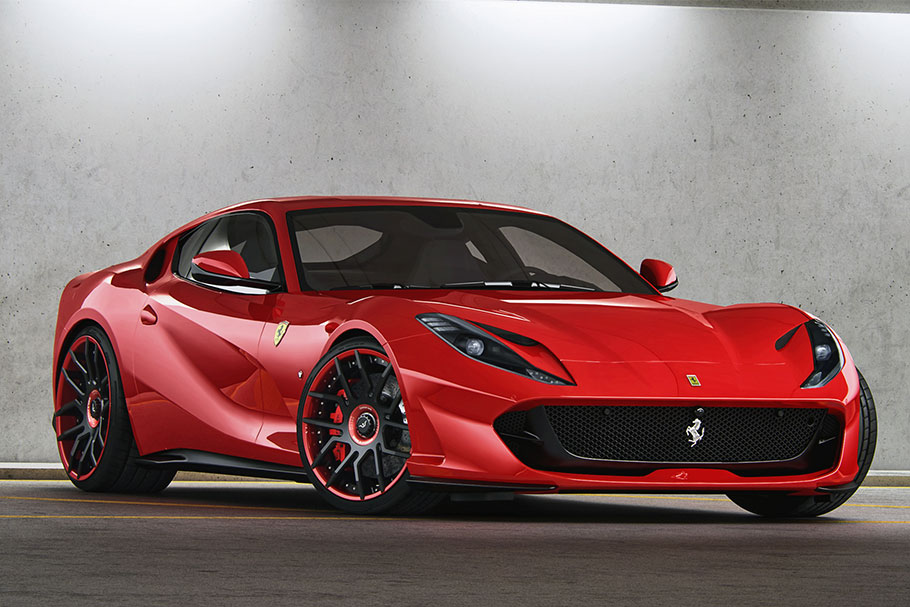
The Ferrari SP48 Unica, the latest addition to the Prancing Horse’s One-Off series, was unveiled today and joins the most exclusive group in Maranello’s entire production: unique, absolutely bespoke cars crafted to the specifications of a single client and designed as a clear expression of their own individual requirements.
The SP48 Unica, designed by the Ferrari Styling Centre under the direction of Flavio Manzoni, Chief Design Officer, is a two-seater sports berlinetta developed on the F8 Tributo platform. Its taut lines and aggressive stance make it instantly recognisable with respect to the original model, and it is unmistakable too, thanks to its arrow-shaped front profile. Central to achieving this effect was the redesign of the headlights and the subsequent relocation of the brake air intakes.
A pivotal aspect of the design of this unique new car is the extensive use of procedural-parametric modelling techniques and 3D prototyping (additive manufacturing) which enabled the Ferrari Styling Centre designers and Maranello’s engineers to completely redesign the front grille and engine air intakes. This advanced production process resulted in perfect 3D grilles that seem carved from a solid volume creating a sense of seamless continuity and dynamic fluidity.
The procedural graphic solutions adopted on the bodywork dialogue directly with the grilles and influence the SP48 Unica’s overall design: the transition from black – which includes the windows, roof and engine cover – to the body colour is especially clear. The striking visor effect of the front is further heightened by the reduction in the size of the side windows and the elimination of the rear screen, highlighting the powerful muscularity of the SP48 Unica which seems sculpted from a single block of metal.
The plan view emphasises the central section of the roof which includes a graphic representation of the air intakes set into the rear part of the carbon-fibre engine cover before the rear wing. This angle allows the viewer to appreciate the styling research that went into the SP48 Unica and reveals the sophisticated interplay of symmetries and intersecting lines created by its forms.
The SP48 Unica’s thermal-fluid-dynamic design has been honed and perfected to guarantee it satisfies all cooling requirements in addition to delivering a different aerodynamic balance. The biggest changes compared to the F8 Tributo’s styling include the air intakes for cooling flows for the engine on the front bumper and beneath the rear spoiler. Each has a deep procedural grille, every section of which is optimally angled to maximise the amount of air passing through. The car’s configuration also allowed the engineers to locate an intercooler intake immediately behind the side windows, which in turn enabled them to reduce the dimension of the intakes on the flanks. The longer rear overhang reduces suction from the roof area, boosting rear downforce.
Although the cabin retains the F8 Tributo’s technical identity – excluding the rear screen – meticulous development work was lavished on achieving the perfect combination of colour and trim to reflect the SP48 Unica’s sleek, sporty and aggressive personality. A good example is the specially developed black laser-perforated Alcantara® used on the seats and most of the cabin trim, beneath which are glimpses of iridescent reddish-orange fabric that match the exterior colour. Its motif picks up the hexagonal motif of the grilles and the procedural livery on the roof, creating an appealing continuity between the car’s interior and exterior. In the SP48 Unica cockpit, the eye is immediately drawn to the polished sill covers with the same laser-embossed hexagonal motif. Matte carbon-fibre imbues the cockpit with a sense of technicality and exclusivity, and is complemented by the Grigio Canna di Fucile accents.
Designed for a long-standing client who was deeply involved in every step of its creation, the one-off Ferrari SP48 Unica is a bold interpretation of a sports car and cleverly enhances its racing soul and vocation for speed. The SP48 Unica achieves its goal of transforming an existing model to masterful effect, taking inspiration from and paying homage to the company’s core values of innovation and passion.
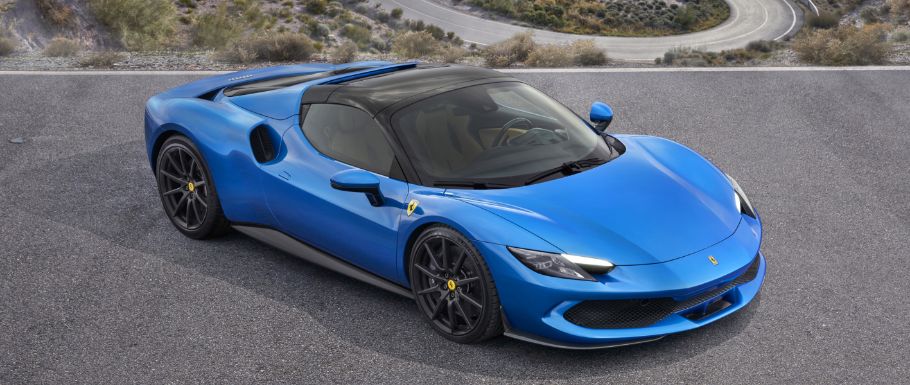
The 296 GTS, the latest evolution of Maranello’s mid-rear-engined two-seater berlinetta spider, premiered today. The 296 GTS flanks the 296 GTB in redefining the whole concept of fun behind the wheel, guaranteeing pure emotions not just when pushing the car to its limits, but also in day-to-day driving situations.
The 296 GTS uses the new 663 cv 120° V6, coupled with an electric motor capable of delivering a further 122 kW (167 cv), which debuted on the 296 GTB. This is the first 6-cylinder engine installed on a road-going spider sporting the Prancing Horse badge; it unleashes its class-leading 830 cv total power output to deliver previously unthinkable performance levels and an innovative, exhilarating and unique soundtrack, further enhanced by the fact that it can be relished with the top down.
The car’s name combines its total displacement (2992 l) and number of cylinders with the GTS (Gran Turismo Spider) acronym in finest Ferrari tradition, to underscore this new engine’s epoch-changing importance to Maranello. It is not simply the living, beating heart of the 296 GTS, but it also ushers in a new V6 era that has its roots deep in Ferrari’s unrivalled 75-year history.
The very first Ferrari V6 featured a 65° architecture and debuted on the 1957 1500 cc Dino 156 F2 single-seater. This was followed in 1958 by larger displacement versions on the front-engined sports prototypes – the 196 S and 296 S – and the 246 F1 car which powered Mike Hawthorn to the F1 Drivers’ Championship title the same year.
The 296 GTS’s plug-in hybrid (PHEV) system guarantees it is an incredibly usable car as well as cutting pedal response times to zero and delivering a 25km range in all-electric eDrive mode. The car’s compact dimensions and the introduction of innovative dynamic control systems as well as meticulously honed aero ensure that the driver will instantly be impressed by its astonishing agility and responsiveness to commands. Its sporty, sinuous design and extremely compact dimensions also visually underscore its unique and modern forms, while skilfully referencing the likes of the 1963 250 LM, the perfect marriage of simplicity and functionality.
The RHT (retractable hard top) guarantees exceptional occupant comfort. With the roof stowed it features a sleek, sporty design and with the roof up, the silhouette remains very similar to that of the 296 GTB. The lightweight RHT takes a mere 14 seconds to retract or deploy at speeds of up to 45km/h. The separation line between the car’s body and the roof is above the B post. As a result, the folding roof splits into two sections that fold flush over the front of the engine, thus maintaining the engine bay’s thermal dissipation characteristics and the balance of the overall design. This also allowed the designers to introduce a window in the rear section of the engine cover through which the new V6 is clearly visible. When the top is retracted, the cabin and the rear deck are separated by a height-adjustable glass rear screen which guarantees optimal passenger comfort even at high speeds.
As was the case with the SF90 Stradale, for clients who want to exploit the car’s extreme power and performance to the utmost, particularly on the track, the 296 GTS is also available with the Assetto Fiorano package, which includes lightweight features and aero modifications.
Powertrain
The 296 GTS is the first Ferrari road-going spider to sport a V6 turbo with a vee with an angle of 120° between the cylinder banks, coupled with a plug-in electric motor. Presented for the first time in 2021 on the 296 GTB, the V6 has its turbos installed inside the vee. Aside from bringing significant advantages in terms of packaging, lowering the centre of gravity and reducing engine mass, this particular architecture helps deliver extremely high levels of power. The result is that the Ferrari V6 set a new specific power output record for a production car of 221 cv/l.
As the V6 turbo is integrated with an electric motor at the rear, the 296 GTS’s combined maximum power output is 830 cv, putting it at the top of the rear-wheel-drive spider segment. The hybrid element not only makes the car extremely versatile in terms of day-to-day driving with a full-electric mode range of 25 km, but also benefits the driving experience by providing instant and consistent response at all engine speeds.
The powertrain assembly comprises the turbo-charged V6 that feeds power to the rear wheels via the 8-speed DCT and E-Diff, and the MGU-K located between the engine and the gearbox. A clutch is set between the ICE and the electric motor to decouple them in electric-only eDrive mode. Lastly, there is a high-voltage battery and an inverter which powers the electric motor.
Internal combustion engine
Thanks to its 663 cv and 221 cv/l, the 296 GTS’s ICE sets the new specific power output record for a serie-production road-going spider. Central to achieving this result was the introduction of the 120° vee configuration with equally-spaced firings as well as the positioning of the turbos inside the vee, which produces a much more compact engine and optimally distributed masses.
The architecture provides the ideal combustion, but was also perfected in terms of component integration: in fact both the intake plenums and the engine supports are integrated on the intake sides of the cylinder heads. The engine is thus lighter and more compact because of the elimination of the plenums and additional supports, while the internal fluid-dynamics benefit from the reduction in volume, boosting intake efficiency. The 120° vee architecture, which offers more space between the cylinder banks than a 90° vee, meant the turbos could be installed centrally, thus significantly reducing the unit’s overall size and the distance the air has to cover to arrive in the combustion chamber, maximising the fluid dynamics and efficiency of the intake and exhaust line ducts.
To obtain this specific power output, the pressure in the combustion chamber had to be pushed to new heights. Boosting the pressure in the chamber demanded exceptional development from both a thermal-fluid-dynamic and structural point of view without compromising on engine weight and reliability. To that end, Ferrari poured all of its significant expertise in alloys, dimensioning and components into engineering the aluminium engine block and cylinder heads. Both components were designed specifically for the V6 architecture.
A timing chain takes drive from the crankshaft to the pump assembly (water and oil) and the valvetrain is commanded by an offset sprocket and a dedicated timing chain per cylinder bank. The main chain has a dedicated hydraulic tensioner, two bush chains with relative hydraulic tensioner and different calibrations for right and left bank, as well as a dedicated chain for the oil pump assembly. The valvetrain, which has roller fingers with hydraulic tappets, has specific intake and exhaust valve profiles.
The engine benefited from the latest Ferrari combustion chamber developments: central injector and spark plugs with 350-bar pressure injection system improve the fuel-air mix in the chamber, performance and reduce emissions. The intake and exhaust ducts were redesigned and tuned to maximise volumetric efficiency and thus guarantee high levels of turbulence in the chamber.
With the introduction of the V6 the IHI turbochargers have been completely redesigned using higher performance alloys. This meant the maximum revs of the turbos could be increased to 180,000 rpm, with a consequent improvement in performance and boost efficiency, which increases by 24%. The symmetrical, counter-rotating turbos are of the mono-scroll type: the technical solutions adopted have reduced the compressor wheel diameter by 5% and the turbo rotor by 11% compared to the V8 applications, despite the very high specific power. The reduction in the rotating masses (the inertia of the two rotating elements has been reduced by 11% compared to the 3.9l V8 solution) has reduced the spool-up time ensuring instantaneous power delivery.
The crankshaft is made from nitrided steel. To ensure it has a 120° crank angle, after the initial forging of the rough ingot, the crankshaft is twisted and then subject to deep nitriding heat treatments (to guarantee resistance to high loads), machining and balancing. The firing order of the new V6 (1-6-3-4-2-5) is the result of the crankshaft journal geometry. 100% of the rotating masses and 25% of the alternating masses are balanced, and therefore its level of balance allows loads on the bushings to be reduced without increasing the weight of the engine.
The variable displacement oil pump was developed to guarantee that the oil pressure is continuously controlled right across the engine’s entire operating range. A solenoid valve, controlled by the engine ECU in a closed loop, is used to control the pump’s displacement in terms of flow and pressure, delivering only the amount of oil required to guarantee the functioning and reliability of the engine, whilst simultaneously providing a reduction in the power absorbed by the pump itself. On the oil scavenge side, to minimise splashing losses, the suction system was made more powerful using six scavenge rotors: three specific, dedicated rotors for the crankcase below the crank throws, one for the distribution compartment and two for the cylinder heads.
In Ferrari engines, the intake plenum is normally located in the centre of the vee. However, the V6 hails a paradigm shift in that regard: its plenums are on the side of the cylinder heads and are integrated with the support for the throttle valve. The light thermoplastic material used to make them keeps engine weight down. This solution boosts performance because of the shorter ducts and consequent fluid-dynamic detuning, in addition to reducing time-to-boost as a result of the high pressure line’s smaller volume.
This architecture also led to the development of a more linear exhaust line located in the upper part of the engine compartment. The shape of the exhaust reduces back pressure and contributes to boosting performance. The exhaust manifold and catalyser housings are made entirely from Inconel®, a steel-nickel alloy that reduces the weight of the exhaust and makes it more resistant to high temperatures.
Sound-wise, the V6 engine rewrites the rulebook by harmoniously combining two characteristics that are normally diametrically opposed: the force of the turbos and the harmony of the high-frequency notes of a naturally-aspirated V12. Even at low revs, inside the cabin, the soundtrack features the pure V12 orders of harmonics which then, at higher revs, guarantee that typical high-frequency treble. This Ferrari’s soundtrack matches its performance, creating a sense of unprecedented involvement even with the top down, and marking the turning of a new page in Maranello’s berlinetta history.
Even to those outside the car, the shrill sound of the engine is instantly recognisable. The first in the F163 engine family, this V6 earned itself the nickname “piccolo V12” (little V12) during the development phase. The 120° V architecture guarantees a symmetrical firing order while the equal-length, tuned exhaust manifolds combined with the single exhaust line outside the hot-V amplify the pressure waves. These characteristics are what lend such purity to the orders of harmonics, which are further helped by a rev limiter that hits an impressive 8500 rpm. The patented “hot tube” adopted on the 296 GTB has been completely redesigned for the 296 GTS to further enhance the engine sound both when the top is deployed and retracted. It is positioned prior to the exhaust gas treatment systems so that it channels the pure sound into the cabin, further enhancing driver involvement and excitement.
Redesigning the 296 GTS’s engine bay to seamlessly integrate the retractable hard top means that the engine has the same wonderfully rich tone and intensity as the 296 GTB when the roof is up. The exhaust resonator system (Hot-Tube) has been optimised for the new cockpit geometry. When the top is retracted the whole driving experience goes into another dimension: the dropping of the top creates a direct, completely unobstructed connection between the cockpit and the sound produced by the single tailpipe exhaust line.
Electric motor
This is the first ever Ferrari spider with a rear-wheel drive-only PHEV (Plug-in Hybrid Electric Vehicle) architecture in which the ICE is integrated with a rear-mounted electric motor producing up to 122 kW (167 cv) derived from the Formula 1 application from which it also inherits the MGU-K (Motor Generator Unit, Kinetic) moniker. The electric motor and ICE communicate via the Transition Manager Actuator (TMA) which allows them to be used both together to produce a combined power output of 830 cv, or decouples them to allow the electric motor to run solo.
Aside from the V6 turbo and the 8-speed DCT already adopted on the SF90 Stradale, Ferrari Roma, Portofino M, the SF90 Spider and the 296 GTB, the powertrain architecture also includes the MGU-K electric motor positioned between the engine and gearbox, the TMA to decouple the electric motor from the ICE, the 7.45 Kwh high voltage battery, and the inverter which controls the electric motors.
The MGU-K is a dual-rotor single-stator axial flux motor. Its compact size and its structure allowed the length of the powertrain to be reduced which, in the final analysis, helped shorten the 296 GTS’s wheelbase. The electric motor charges the high voltage battery, turns on the ICE, supplies it with additional torque and power (up to 167 cv) and allows the car to be driven in all-electric eDrive mode. The MGU-K’s improved design allows it to reach maximum torque of 315 Nm, around 20% more than previous applications.
The TMA (Transition Manager Actuator) allows very rapid static and dynamic transitions from electric to hybrid/ICE mode and vice-versa, thereby guaranteeing smooth, progressive torque. Its control software, which was developed entirely in-house by Ferrari, communicates with the DCT, motor and inverter software to more efficiently manage ICE ignition and its connection and disconnection to the transmission. Thanks to new generation components, the TMA allowed the design of an incredibly compact transmission: the system has an overall impact on the length of the powertrain of just 54.3 mm. Its architecture comprises a triple-plate dry clutch, a clutch command module in line with the driveline with a clutch control linkage, and ECUs.
Thanks to an innovative design manufactured using laser welding, the 296 GTS’s high voltage battery has a 7.45 kWh capacity and a competitive weight/power ratio. The battery pack is located on the floor behind the seats and to minimise volume and weight, the cooling system, structure and fixing points are integrated into a single component. The modules contain 80 cells connected in series. Each Cell Supervisor Controller is installed directly in the modules to reduce volume and weight.
The 296 GTS’s inverter is based on two silicon modules connected in parallel, the power deliver mode of which has been optimised to achieve the MGU-K’s torque increase to 315 Nm. This component converts the electric energy with an extremely high level of efficiency (over 94%) and can supply the power required to start the V6 even when there is maximum demand for electric power.
Aerodynamics
The 296 GTS bursts into the mid-engined berlinetta sports car range with several radical and innovative solutions. With the turbo installed above the vee of the crankcase in a hot-V configuration, that all of components most critical to heat generation are now clustered in the upper centre area of the engine bay, which in turns allows more efficient heat management both of the engine bay itself and of the electrical components. This sharp break from the past is further highlighted by aero choices, which have turned the active aero paradigm, introduced from the 458 Speciale onwards, on its head. On the 296 GTS, an active device is being used not to manage drag but to generate extra downforce. The LaFerrari-inspired active spoiler integrated into the rear bumper allows the 296 GTS to generate a high level of rear downforce when required: the equivalent of a maximum of 360 kg at 250 km/h in the high-downforce configuration with the Assetto Fiorano package.
This impressive performance was achieved by seamlessly optimising the car’s volumes. The result is a car with an extremely clean, elegant design in which all the performance-oriented elements meld effortlessly with the styling, underscoring the inextricable marriage of technology and aesthetics that is the signature of all Ferraris. The aero development work done on the 296 GTS means that even in low-drag configuration the car can deliver more downforce than previous applications. In high-downforce configuration, there is an additional 100 kg in downforce thanks to the active spoiler.
The ICE and the gearbox are cooled by two radiators installed at the front of the car, ahead of the front wheels, where there are also two condensers for the high-voltage battery cooling. The hot air is evacuated along the underbody, to avoid it interfering with the cooling air to the intercoolers along the upper part of the flanks. This choice made it possible to maximise efficiency and thus minimise the size of the air intake, further streamlining the car’s already clean styling. The radiators for the hybrid system have been given two vents just below the side sections of the spoiler. This solution frees up the central part of the front of the car, which has thus been used to generate downforce, and optimises the routing of the various circuits, to the direct benefit of packaging and weight.
The engine bay incorporates both the usual ICE components, which function at peak temperatures of over 900° Celsius, and electric and electronic components that must function at lower temperatures. This led to a complete redesign of the turbo layout and the entire exhaust line.
The brake cooling system was developed around the Aero callipers that debuted on the SF90 Stradale with ventilation ducts integrated into their castings. This brake cooling concept requires a dedicated duct to correctly channel cool air coming in through the air intakes on the front bumper through the wheelarch. In the case of the 296 GTS, the intake has been integrated into the headlight design. Just below the DRL, on the inner section, an aperture connects the wing to the wheelarch via a duct running parallel to the chassis strut.
This made it possible to push the design of the car’s underbody to new extremes, increasing the cooling capacity of the underbody without having to adopt any active front aero mechanisms. The signature aerodynamic element at the front of the 296 GTS is the ‘tea-tray’. The arrangement of the radiating masses at the sides of the car frees up a central volume into which the tea tray is set, framed by the bridge that perfectly integrates it into the architecture and styling of the front bumper. This aero device uses a concept widely applied to single-seaters: the rear surface of the bumper works in synergy with the upper surface of the tea tray to create a high overpressure field, which counteracts the depression field that characterises the underbody. The two different pressure regions remain separate as far as the edges of the tea-tray. But at those points, the two fields of opposing pressure come together once again and the air flow rolls back on itself creating an extremely coherent and energised vortex that is directed below the underbody. The vortex movement of the air translates into a localised acceleration of the flow that produces a high level of suction and greater downforce over the front axle.
Looking at the car from the front, the side volume creases sharply inwards, almost folding up over the side splitter. The empty volume thus created allows the flow to be more efficiently channelled and maximises the flow in the lower part of the bumper. To exploit the potential of the flow striking the side splitter to the fullest, the bumper ahead of the wheel is completed by a vertical nolder which generates a local recompression area that increases downforce and increases the extraction capacity of the hot air from the radiators. Also on the side of the bumper, the side air curtain channels the air from the front part of the bumper towards the wheel well, so that it vents through a specially created opening in the wheelarch. The exit section of this duct is calibrated to contain the transverse expansion of the wake.
In the central section of the underbody, there is a localised lowering of the surfaces to the minimum height permitted under homologation requirements. This brought the car’s lower surface closer to the road, exaggerating the suction created as a result of ground effect, as well as front downforce. Immediately downstream of the lowered central area, the underbody has been slightly raised above the minimum height to maximise the quality of air flowing between the underbody and the ground, and also to expose more of the vertical surfaces of the vortex generator strakes. Their specific geometry and effect on the rear underbody guarantee that the car remains correctly balanced in all dynamic driving conditions.
The adoption of the ‘Aero’ brake callipers allowed the dedicated cooling system to be created without an intake duct under the suspension arm. The extra space freed up was used to widen the flat underbody in that area, which increased the downforce generating surface, and also to add an extra vortex generator with an innovative L section.
The aerodynamic development of the rear of the 296 GTS centred around managing the rear deck wake solution which has been optimised to work despite the constraints imposed by the installation of the RHT. The wing profile and flying buttresses guarantee the same aerodynamic and thermal efficiency as the 296 GTB. The spider version maintains the active aero device to generate downforce, a new concept for mid-rear-engined Ferrari berlinettas, which delivers an exceptionally high level of downforce.
This active rear spoiler generates extra downforce and maximises the car’s handling and braking performance at high speeds. The active aero concept is actually the exact opposite of the one introduced on the Ferrari’s berlinettas from the 458 Speciale onwards. In previous applications, flaps on the diffuser allowed a transition from a high-downforce (HD) configuration to a low-drag (LD) one that allowed maximum speed to be reached on the straight. However, on the 296 GTS, when the active aero device is deployed it increases downforce.
The spoiler is seamlessly integrated into the bumper design, taking up almost all of the space between the taillights. When maximum downforce is not required, the spoiler is stowed in a compartment in the upper section of the tail. But as soon as acceleration figures, which are constantly monitored by the car’s dynamic control systems, exceed a specific threshold, then the spoiler deploys and extends from the fixed section of the bodywork. This combined effect results in a 100 kg increase in downforce over the rear axle which enhances the driver’s control in high-performance driving situations and also minimises stopping distances under braking.
The specific conformation of the 296 GTS’s tonneau cover creates a virtual fairing that mimics the aerodynamic behaviour of the coupé. This means that the air above the profile is correctly deflected so that the car’s aerodynamics and cooling are as efficient as possible. Thanks to this optimisation work, the 296 GTS’s active spoiler delivers the same downforce as the 296 GTB.
The significant development of the front required the effect on the rear to be counterbalanced in low drag configuration i.e. when downforce over the rear does not benefit from the extra 100 kg. In this regard, the designers fully exploited the opportunities opened up by the layout of the exhaust line which clustered the main heat sources in the upper part of the engine compartment. This allowed the ventilation apertures for the components under the engine cover to be optimised, thereby clawing back large surfaces for downforce generation, particularly in the central area under the engine, which avoided damaging impacts on the efficiency of the underbody flow.
Because the flow upstream from it is so efficient, the rear diffuser has a very clean, linear design that is in perfect symbiosis with the upper section of the rear bumper. The central channel of the diffuser is characterised by a double kink line. Thanks to this device, it is possible to modify the direction in which the flow sucked along the underbody is released into the car’s wake, thereby containing the vertical expansion of the car’s wake and thus drag.
To guarantee the same level of on-board comfort as Ferrari’s berlinettas, solutions were developed to offset the turbulence inside the cockpit and manage air recirculation around the occupants. The geometry of the trim behind the headrests was optimised to channel as much of the air as possible towards the tonneau cover to reduce the amount of flow recirculating inside the cabin.
The remainder of the flow that still hugs the rear trim then strikes a nolder seamlessly integrated into the trim itself. This interrupts the recirculation, dissipating the turbulence before it reaches the lower part of the central tunnel.
Vehicle dynamics
The 296 GTS’s dynamic development focused around boosting the car’s pure performance, delivering class-leading levels of driver engagement making full use of the new architectural solutions (V6, hybrid powertrain, shorter wheelbase) as well as improving the usability and accessibility, not just of the car’s performance, but also the functionalities afforded by the hybrid layout.
The targets were achieved by honing the architecture and keeping all the main vehicle components as compact as possible, as well as managing energy flows and their integration with the car’s vehicle dynamic controls. Specific components were also developed, not least the Transition Manager Actuator (TMA) and the 6-way Chassis Dynamic Sensor (6w-CDS) – a world first for the automotive sector. There are also new functions, such as the ABS EVO controller, which uses the data gathered by the 6w-CDS, and the grip estimation integrated with the EPS.
In Ferrari, the way the car handles and provides feedback to the driver (what internally is referred to as the fun to drive factor) is measured by five different indicators:
Lateral: response to steering wheel inputs, the prompt reaction of the rear axle to steering inputs, effortless handling
Longitudinal: rapidity and smoothness of the accelerator pedal’s response
Gear shifting: shifting times, sensation of coherent progression through the gears with every gear change
Braking: brake pedal feel in terms of travel and response (efficiency and modular travel)
Sound: level and quality in cabin and progression of engine sound as revs rise.
How easily accessible and usable the performance is is also of significant importance when driving the 296 GTS: for instance, in electric-only eDrive mode, the car can reach speeds of up to 135 km/h without resorting to the ICE. In Hybrid mode, on the other hand, the ICE backs up the electric motor when higher performance is required. The transition between electric and hybrid driving modes is managed very fluidly to guarantee smooth, constant acceleration and to make the power of the powertrain available as rapidly as possible. Stopping distances in the dry have been significantly shortened by the ABS EVO and its integration with the 6w-CDS sensor, which also ensures more consistent braking force under repeated heavy braking.
From a chassis perspective, at 2,600mm, the wheelbase is 50 mm shorter than previous Ferrari mid-rear-engined berlinettas to the benefit of the car’s dynamic agility. Other solutions that enhance the car’s handling and performance include the brake-by-wire system, the ‘Aero’ brake callipers, electric power steering, the rear active aero device and SCM-Frs magnetorheological dampers.
The 296 GTB’s chassis was redesigned and optimised for the 296 GTS to improve torsional rigidity and bending stiffness compared to previous spider applications. This was achieved to the tune of 50% in the case of the former and 8% in the case of the latter. The main areas involved were the A-pillar, B-pillar and sills.
Meticulous attention was paid to reducing weight to ensure the car’s balance and delicacy of handling: adding the weight of the hybrid system was offset by a number of different solutions, including the new V6, which weighs 30 kg less than the V8 unit used on previous berlinettas, and the extensive use of lightweight materials. The result is a dry weight of just 1540 kg which is class-leading in regards to the overall weight-to-power ratio: 1.86 kg/cv.
The 296 GTS has a single electric motor which drives the rear wheels only. The power delivery from the electric motor is available in hybrid and full-electric driving modes and is supplied according to the driver’s pressure on the accelerator pedal, managed by the hybrid power flow control and monitored by traction control.
With regard to the main charging functions, there is regenerative braking at the rear in normal braking conditions as well as when ABS intervenes, overbraking on the rear axle on lift-off and battery charging via combined management of the ICE and electric motor.
Aside from electric traction control and energy recovery thanks to the new brake-by-wire unit, which guarantees hydraulic and electric blending in all operating modes (including ABS), another traction control and distribution solution present on the 296 GTS is the ‘ABS Evo’ which premiered on the 296 GTB. Thanks to brake-by-wire, pedal travel is reduced to an absolute minimum, which boosts the feeling of sportiness without neglecting efficiency when braking lightly or the pedal travel feel when on the track. The ABS control module, which is integrated with the 6w-CDS sensor, allows the grip limits of the rear tyres to be pushed still further, making for greater repeatability of stopping distances and thus improving performance when turning into corners as it permits the driver to trail brake towards the apex.
Once again on the 296 GTS, a power management selector (eManettino) has been adopted alongside the traditional Manettino. The eManettino has four positions which can be selected from the steering wheel:
eDrive: the internal combustion engine is off and there is pure electric drive to the rear wheels; with a fully-charged battery the car can cover 25 km at a maximum speed of 135 km/h
Hybrid (H): this is the default mode on ignition. The power flows are managed for maximum efficiency and the control logic defines the intervention of the internal combustion engine. With the engine on, the car develops its maximum power and performance
Performance: the ICE is always on and helps maintain the battery efficiency to ensure full power at all times. This is the ideal setting for press-on driving
Qualify: provides maximum performance but at the cost of lower battery recharging.
The grip estimator in the electronic Side Slip Control (eSSC) system is flanked by a second device based on the electric power steering. By using the information from the EPS and cross-referencing it with the side slip angle estimated by the eSSC, it can estimate the grip of the tyres during every steering manoeuvre, including when the car is not being driven on the limit, in order to guarantee that the controllers intervene correctly based on grip conditions. When driving on the track, grip estimation is 35% faster than previous applications.
As was the case on the 296 GTB, the 296 GTS has an ABS control module developed exclusively for Ferrari and available from the ‘Race’ position upwards. It uses the information from the 6w-CDS to obtain a more precise estimation of speed and optimise braking distribution compared to the Yaw Rate Sensor used up until now. The 6w-CDS measures both the acceleration and the speed of rotation on three axes (X, Y, Z) enabling the other vehicle dynamic controls to more accurately read the car’s dynamic behaviour, thus optimising their intervention. This accuracy allows the longitudinal force of the tyres to be better exploited when braking in a straight line and on switchbacks, when the rear axle is subject to the natural compromise between braking performance and lateral stability. The result is a decisive improvement in braking distances: compared to the F8 Spider, the 296 GTS reduces the 200-0 km/h braking distance by 8.8% and also improves the repeat braking efficiency from that speed by 24%.
Exterior
The 296 GTS further emphasises the clean, sophisticated lines of the 296 GTB . When the top is down, it is the peerlessly elegant epitome of the open-air hybrid concept. Its unprecedented architecture for a spider, in fact, opens a whole new chapter in the marque’s story. The designers’ goal of retaining the 296 GTB’s main characteristics required a period of meticulous analysis of the dimensions of its technical components. There was, of course, a clear focus on minimising the impact of any modifications on the exterior bodywork and also on introducing a clear, instantly recognisable theme that would encapsulate the complexity of the design whilst translating it into accomplished linear forms.
The need to stow the RHT (Retractable Hard Top) inside the engine compartment inspired the Ferrari Styling Centre’s team under Flavio Manzoni to create a new tonneau cover design, the geometries of which have produced styling elements very different to Ferrari spiders of the recent past. While on the 296 GTB the engine bay is completely horizontal and dominated by two flying buttresses in a nod to the 250 Le Mans archetype, the 296 GTS’s tail is absolutely unique.
As is the case with the 296 GTB, dominant feature of the new car’s architecture is the signature ‘aero bridge’. The overall effect is of an extremely compact cabin effortlessly integrated with the wings and flanks. The buttress theme is further enhanced by contrasting sculpted extensions that frame the engine cover screen and integrate the novel fuel filler and battery charge covers, avoiding architectural disharmony.
Cockpit
The 296 GTS’s cockpit was developed around the new concept of an entirely digital interface. This interior layout draws on the latter’s stylistic coherence for its forms. While with the SF90 Stradale the designers wanted to highlight the presence of the advanced technology and underscore a clear break with the past, in the case of the 296 GTS, the idea was to clothe that technology to sophisticated effect. The result is a pure, minimalistic connotation characterised by a powerful elegance that, on an aesthetic level, perfectly mirrors the design of the exterior.
The 296 GTS’s cabin raises the concept of the formal purity of the functional elements to new heights. From a formal perspective, when the engine is off, the onboard instruments go black, underscoring the minimalist look of the cabin. Exclusive Italian leather trim to the seats and trim is further enhanced by the noble technical materials used on the functional components. Aerodynamic flaps have been integrated into the rear trim structure to reduce buffetting and increase comfort in open-top driving.
The sculptural door panel is a seamless continuation of the dashboard in terms of both materials and colour. On the central medallion, the styling cue is a deep lozenge-shaped scoop, a three-dimensional element. This type of architecture makes the entire door panel look extremely light and integrates the theme that connects it to the rear trim. The tunnel incorporates the modern take on the classic gear-shift gate and a compartment for stowing the ignition key with its characteristic Prancing Horse badge. The tunnel has also been redesigned, so that rather than being open as on the 296 GTB, it has a closing oddments compartment, which further emphasises the continuity between mats and tunnel. For the 296 GTS, the designers created specific diapason-style seats using contrasting grooves which coordinate aesthetically with the edge strip of the instrument cluster.
Assetto Fiorano
For clients who want to exploit the car’s extreme power and performance to the utmost, the 296 GTS Assetto Fiorano package is available; it is completely uncompromising in terms of maximum performance, thanks to significant weight reduction and aero content. Most notably, these include special GT racing-derived adjustable Multimatic shock absorbers optimised for track use; high downforce carbon-fibre appendages on the front bumper that can deliver an additional 10 kg of downforce, and more extensive use of lightweight materials such as carbon-fibre for both cabin and exterior.
The Assetto Fiorano package involves much more than simply replacing elements. Some components required that the standard basic structure be redesigned, including the door panel, resulting in an overall weight-saving of 8 kg. Lastly, a special livery inspired by the 250 Le Mans can also be ordered exclusively by owners who opt for the Assetto Fiorano package. Its design runs from the front wings and hugs the central grille and delineates its edges. This styling element continues along the bonnet, creating a hammer motif before running lengthways up to the RHT, tonneau cover and then down onto the rear spoiler. Other content available to order solely with the Assetto Fiorano package includes Michelin Pilot Sport Cup2R high performance tyres which are especially suited to track use because of their grip.
7-Year genuine maintenance
Ferrari’s unparalleled quality standards and increasing focus on client service underpin the extended seven-year maintenance programme offered with the 296 GTS. Available across the entire range, the latter covers all regular maintenance for the first seven years or 120,000 km of the car’s life. This scheduled maintenance programme for Ferraris is an exclusive service that allows clients the certainty that their car is being kept at peak performance and safety over the years. This very special service is also available to owners of pre-owned Ferraris.
Regular maintenance (at intervals of either 20,000 km or once a year with no mileage restrictions), original spares and meticulous checks by staff trained directly at the Ferrari Training Centre in Maranello using the most modern diagnostic tools are just some of the advantages of the 7-Year Genuine Maintenance Programme. The service is available on all markets worldwide and from all Dealerships in the Official Dealership Network.
The 7-Year Genuine Maintenance programme further extends the wide range of after-sales services offered by Ferrari to meet the needs of clients wishing to preserve the performance and excellence that are the signatures of all cars built in Maranello.
296 GTS – Technical specifications
POWERTRAIN Type
Overall displacement
Bore and stroke
Max. power output ICE*
Max. power output hybrid system**
Max. torque
Max. revs
Compression ratio
High voltage battery capacity
V6 – 120° – turbo – dry sump
2992 cm3
88 mm x 82 mm
663 cv
610 kW (830 cv) at 8000 rpm
740 Nm at 6250 rpm
8500 rpm
9.4:1
7.45 kWh
DIMENSIONS AND WEIGHTS
Length
Width
Height
Wheelbase
Front track
Rear track
Dry weight***
Dry weight/power ratio
Weight distribution
Rear bench capacity
Fuel tanks capacity
4565 mm
1958 mm
1191 mm
2600 mm
1665 mm
1632 mm
1540 kg
1.86 kg/cv
40.5 % front / 59.5 % rear
49 litres
65 litres
TYRES AND WHEELS
Front
Rear
245/35 ZR 20 J9.0
305/35 ZR 20 J11.0
BRAKES
Front
Rear
398 x 223 x 38 mm
360 x 233 x 32 mm
PERFORMANCE
Max. speed
0-100 km/h
0-200 km/h
200-0 km/h
Fiorano lap time
> 330 km/h
2.9 s
7.6 s
107 m
1’ 21” 80
Fuel consumption and CO2 emissions
Under homologation
Transmission and gearbox
8-speed F1 DCT
Electronic controls
eSSC: eTC, eDiff, SCM, FDE2.0, EPS, ABS Evo, 6w-CDS; high-performance ABS/EBD with energy recovery
* With 98 RON petrol ** with eManettino in Qualify mode *** With optional lightweight content
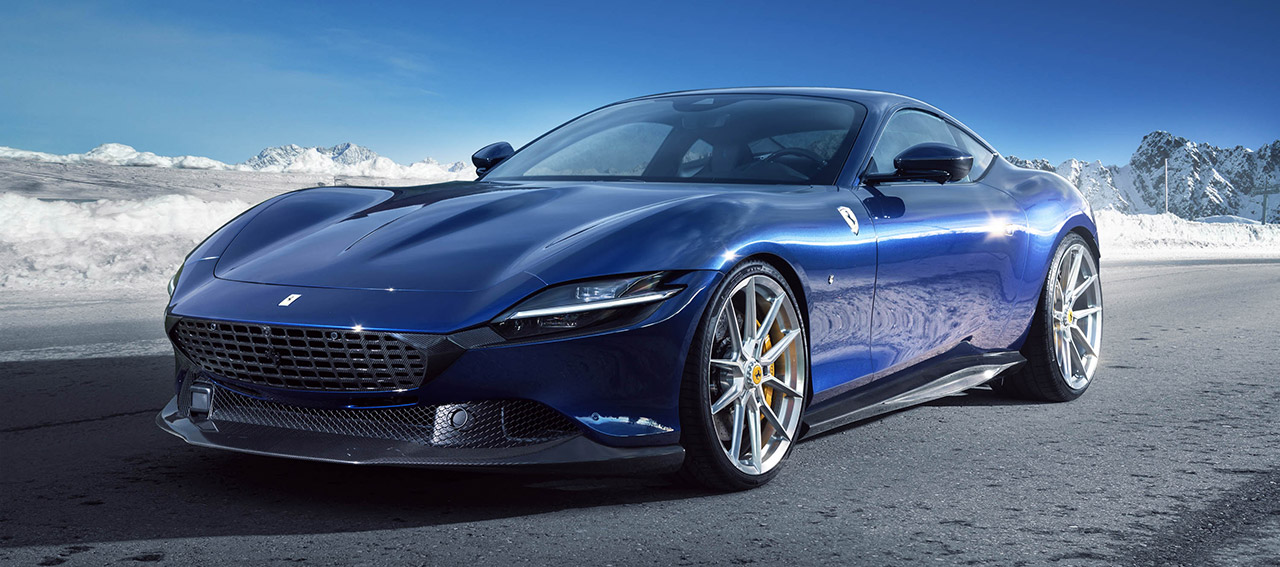
Ferrari is further expanding its extensive vehicle range with the Roma. NOVITEC, globally leading refinement specialist for the sports cars from Maranello, now offers an exclusive customization range for the coupe.
The NOVITEC engine tuning unleashes a peak output of 518 kW / 704 hp and a peak torque of 882 Nm from the 3.9-liter twin-turbo eight-cylinder engine. This engine slings the Roma from rest to 100 km/h in just 3.2 seconds and gives it a top speed north of 325 km/h.
The NOVITEC carbon aerodynamic-enhancement components give the two-door a touch of racing looks. Hi-tech 21-inch and 22-inch forged wheels, developed in cooperation with American rim manufacturer Vossen, optimally fill out the available space under the wheel arches.
The German company’s range also includes suspension modifications as well as the customization of the interior tailored to the customer’s personal preferences.
NOVITEC has employed professional engine tuning for decades to make the cars from Ferrari even more dynamic and even faster. While the inner workings of the 3.9-liter twin-turbo V8 in the bow of the Roma remain untouched, the peripherals are modified in several expansion levels.
In order to optimize the power delivery further, the engineers of the tuner developed modified controls for the electronic engine management system. All output levels use a NOVITEC N-TRONIC control module, which introduces specifically calibrated mapping for injection and ignition. It also upgrades the electronic boost pressure control. These measures benefit more than just the power delivery. They also further optimize the throttle response and the powerful in-gear acceleration. In addition, NOVITEC offers high-performance catalysts that have a performance-enhancing effect.
In performance level 2, the peak output of the eight-cylinder engine increases by 61.8 kW / 84 hp while peak torque grows by 122 Nm over the stock configuration. With 518 kW / 704 hp at 7,400 rpm and 882 Nm at a low 3,750 rpm, the coupe sprints from zero – 100 km/h in just 3.2 seconds and reaches a speed of 200 km/h after a mere 8.9 seconds. The top speed is in excess of 325 km/h.
The NOVITEC designers went into the wind tunnel to develop a body styling kit that makes the Roma even more streamlined and aerodynamically efficient. It also gives the Roma an even more extravagant appearance. All bodywork components are manufactured from especially light yet high-strength naked carbon and given a high-gloss coating.
The NOVITEC front spoiler attaches to the production bumper and gives the powerful sports car a more striking face. Its sophisticated shape also optimizes the directional stability at high speeds. The trim elements on the left and right under the main headlights and the carbon-fiber grille add further decidedly sporty touches.
The NOVITEC rocker panels give the Ferrari a lower and sleeker visual stance in the side view and optimize the airflow between the front and rear wheel arches. Another element sporting the racing look: the carbon covers for the side mirrors.
In order to reduce rear-axle lift and thus achieve an optimal aerodynamic balance, NOVITEC enhances the Roma with a lip spoiler on the trunk lid. Further upgrades are the diffuser insert and the vertical carbon fin. In addition, there is a carbon cover for the retractable rear wing of the Roma. Carbon surrounds for the four taillights round out the exclusive NOVITEC look.
Vossen produces the NOVITEC wheels using hi-tech forging technology. In addition to top quality, variety is key: Three different designs in 72 different colors and three different surface finishes are available for the Ferrari Roma. The vehicle pictured here sports silver NOVITEC NF10 alloys with brushed surface. Their hub cover in center lock design emphasizes the connection to the legendary motor racing tradition of the Italian make. These wheels with five delicate double spokes are mounted on the Roma’s front axle in size 9Jx21 with tires of size 255/30 ZR 21. The 12Jx22 rims on the rear axle carry tires of size 315/25 ZR 22.
The NOVITEC sport springs are tailored specifically to these high-performance tires and lower the ride height of the Ferrari by about 35 millimeters. At the same time, the engineers also developed a feature that further optimizes the daily practicality of the Roma. The hydraulic NOVITEC front lift system enables raising the body at the front axle by 40 millimeters at the touch of a button in the cockpit. This makes it easier to navigate past parking garage ramps or speed bumps. Another tip of the switch reverts the front end to its original position. This process also takes place automatically upon reaching a speed of 80 km/h.
NOVITEC also fulfills the personal wishes of every customer in the cockpit with perfectly finished leather and Alcantara interiors. The selection of colors is just as infinite as the range of designs.
Ferrari team presents the new LaFerrari Power warranty and maintenance service for owners of LaFerrari and LaFerrari Aperta.
The LaFerrari Power service is specially created for customers who want to maintain the excellent performance of Ferrari’s first-ever hybrid car, which is equipped with the F1-derived HY-KERS hybrid system.
LaFerrari Power is a two-year renewable program that can be activated at any official Ferrari dealer, regardless of the vehicle’s year of production.
Owners of LaFerrariand LaFerrari Aperta who take advantage of the LaFerrari Power service will benefit from the extension of the vehicle’s factory warranty, which includes, among other things, the HY-KERS system and high-voltage battery. This is the first time that Maranello offers this kind of extended warranty for one of its limited-series models, testifying to the quality and reliability of its cars.
LaFerrari Power also includes annual maintenance during which Maranello specialists will perform a wide range of inspections to ensure that the car is maintained to optimum levels.
The LaFerrari Power launch coincides with the tenth anniversary of the introduction of Genuine Maintenance, the premium scheduled maintenance program available on every new Ferrari in the range up until seven years after purchase. This new service confirms the Company’s commitment to providing maximum peace of mind and how it continues to set the standard throughout the industry for customer care.
The Concours d’Elegance, which gathers the world’s rarest and more bizarre vehicles, will see the return of the Junior Concours in 2021. On September 3-5, the event will welcome an array of beautiful hand-crafted half-size and three-quarter scale electric and petrol cars to sit alongside their bigger siblings.
Just like the full-size machines, the Junior Concours attendants are mostly handcrafted and will borrow the best from the world of motorsport. Audience will have the chance to witness cars like Porsche 911, Jaguar E-Type, Alfa Romeo PS Monza, and Ferrari F40.
Over the course of the event, the Works Drivers, supported by their Mechanics, will pilot their vehicles on the Concours Live Stage. Competitors will try to win a plethora of awards, some of which are ‘Best Pedal Car’, ‘Best Electric Car’, ‘Best Petrol Car’, ‘Most Original Car’ and ‘Best Dressed’.
Andrew Evans, Concours of Elegance Director, said: The Junior Concours was such a success last year, that we’ve decided to bring it back for 2021. This feature really shines a light on the fascinating world of bespoke built children’s cars, popularised by the Austin J40 of which almost 32,000 were built from 1950. This year, as we did last year, we have gathered together a wonderful collection of handbuilt cars of all ages, complete with working headlamps, innovative powertrains, and a near-perfect likeness to the full-size models they seek to imitate. With the support of their drivers and mechanics, the Junior Concours will be as much of a spectacle as any of our other priceless displays.
This event is expected to gather about 1000 unique cars and will also celebrate Her Majesty The Queen’s 95th birthday, and a 30UNDER30 Concours aimed at inspiring the next generation of classic car enthusiasts.
Classic Car Auctions’ third auction of 2021 is right behind the corner and on Saturday, 25th of September, the attendees will witness numerous cool exhibitions and neat show.
The confirmed early entries that will be on sale include a 1991 BMW 325i (E30) Convertible, with a single owner and with an exclusive BlackM-Tech leather interior, and with a mileage of 73, 665.
Another notable machine attending the show is a 2006 Ferrari F430 Spider “F1”. With only 33,889 miles covered, this one has three main dealer stamps in the service record with invoices. Still bearing its original leather-bound handbook, this Ferrari is eagerly awaiting its new owner.
Gary Dunne, CCA’s Sales Manager commented: In the last couple of weeks we have launched some of the first entries confirmed for this auction. This is just the start of many with new additions continuing to go live on our website every week. There is still time for you to submit your entry alongside the cars previewed, contact our expert team today and we will guide you through the process.
The third early entry is a 1985 Lamborghini Jalpa P350 3.5 V8. The vehicle has covered a total of 50,700km and is exclusively designed by Marcello Gandini of Bertone to rejoin the battle with Ferrari 308. This unit is at the moment part of a private collection and is accompanied by a good history file and is a part of a limited run of only 410 vehicles.s
The final early entry is a 1986 Porsche 911 3.2 Carrera SuperSport Cabriolet. This is a very rare vehicle and comes with 104,000 miles and is presented in Guards Rev G1V9 with matching red leather piped in black. There are only 75 produced of these.
Brembo team celebrates its 60th birthday at the 42nd Annual Concours d’Elegance of America.
Established in 1961 as a small mechanical workshop by Emilio Bombassei and his brother-in-law Italo Breda, the small business expanded to what we know today as one of the most popular and influential automotive businesses. Today, Brembo is a leader in the design, development and production of braking systems and components for cars, motorbikes, industrial vehicles, and racing vehicles.
Although we celebrate the past at this week’s Concours, our focus is on the future with the world’s cars and trucks going electric. Brakes are playing an even more significant role in the future of electrification. In addition, we announced just this week the opening of Brembo Inspiration Lab in Silicon Valley to further strengthen our expertise in artificial intelligence, data science and software development.
At the show, Brembo displays an array of performance and braking components with carbon-ceramic brake discs and full aluminum calipers on the all-new Cadillac CT5-V Blackwing. Also, there’s a full array of the brand’s aftermarket products like Brembo Xtra rotor can be viewed alongside a MotoGP Championship carbon rotor and caliper as well as a competition master cylinder.
Highlighting the Brembo sponsored Super Car category are a Viper GTS-R, Ford GT, Lamborghini Aventador, Ferrari 488 Pista, Ferrari F12, Mercedes AMG GT R, and a Porsche 992 Turbo S.
Ferrari SF90 Stradale Asssetto Fiorano has set the fastest lap record ever set by a production vehicle at the 2.439-mile Indianapolis Motor Speedway road course, finishing at the impressive 1:29.625 seconds at a maximum speed of 174.6 mph to set this time.
It was a great moment to witness, seeing how the impressive performance of the Ferrari SF90 Stradale put down this lap record on July 15, says Mark Raffauf, Senior Director of Race Operations at International Motor Sports Association (IMSA), which oversaw the test.
The vehicle is by far one of the most powerful Ferraris ever built and is the first series-production PHEV machine that the Italian brand has built. The model is designed with performance in mind and adopts numerous cutting-edge technologies. Some of the features include figures like 1,000 cv, and a weight-to-power ratio of 1.57 kg/cv, 390 kg of downforce at 250 km/h, and a V8 rated as the top-of-the-range unit.
Furthermore, the model can be specified with the optional Assetto Fiorano pack that includes special GT racing-derived Multimatic shock absorbers, extra lightweight features made from high-performance materials such as carbon fiber (door panels, underbody) and titanium (springs, entire exhaust line), resulting in weight-saving of 30 kg. Another difference is the high downforce carbon-fiber rear spoiler which generates 390 kg of downforce at 250 km/h.
The SF90 Stradale derives its name from 90 years of the Scuderia Ferrari, underscoring the vital importance of motor sports in the development of our road cars, says Matteo Torre, President, Ferrari North America, so running the SF90 Stradale here at the Indianapolis Motor Speedway during Ferrari Racing Days, where we also had the Ferrari Challenge, XX and F1 Clienti programmes on-track this weekend, was fitting indeed.
Silverstone Auctions attended National Ferrari Owners’ Day at Sywell Aerodrome where they hosted their dedicated marquee sale of Ferrari vehicles. The Auction house had a neat sale with millions of worth of deals achieved. The event was a huge success and showcased a837 Ferraris and about 1,800 people attended the event.
Throughout the day a number of beautiful vehicles were sold. One of the most notable automobiles was a 2010 Ferrari 458 Italia DCT. This one has celebrity provenance behind it and comes with a rich equipment and comprehensive service history.
Another vehicle, the 2003 Ferrari 575M Maranello F1 has caught the attention of the audience with its impeccable condition and a double-dose of celebrity provenance. An elegant 1996 Ferrari F355 GTB, which presented immaculate condition and low mileage was also showcased and found its new owner at the event.
Furthermore, a number of Ferrari Dinos also were on display. Especially popular were the 974 Ferrari 246 Dino GTS – RHD Factory ‘Flares’ Car, 1972 Ferrari Dino 246 GT – Matching Numbers – just one of 488 and with less than 35,000 miles from new, a 1971 Ferrari Dino 246 GT with very few miles since a full engine rebuild, and a 1973 Ferrari Dino 246 GT.
The first official images of Ferrari’s last limited-edition lineup have been published. This new model is the expression of the brand’s concept of an extreme front-engined Berlinetta, and adopting the characteristics of the 812 Superfast to new levels. The result will be a vehicle that adopts Ferrari’s engineering experience of the past 70 years and will aim at the brand’s most passionate collectors and connoisseurs.
As with any other Ferrari unit, the new family member features an advanced drivetrain system – in this case, this is Maranello’s famous 65° V12 engine that reaches the highest output to date – 830 cv – and revs to 9,500 rpm. Further characteristics include a new valve timing mechanism and a new exhaust system along with many others.
Furthermore, the technical refinement also adopts independent steering on all four wheels and the overall weight reduction. This is achieved by using extensively carbon fiber, both on the exterior and in the cockpit. Last, but not least, the new model also comes with version 7.1 of the renowned Side Slip Control vehicle dynamics system.
In terms of aerodynamics, one of the most striking aspects of the new Ferrari model is the research that the engineering team has done before coming up with the vehicle’s final design. This includes focusing mainly on enhancing the downforce of the vehicle by including new front air intakes, diffusers, and rear exhaust configuration, and patented design approaches. All these changes and additions follow bran’s notion of form following function.
In terms of interior, the vehicle reflects the design concept of the 812 Superfast, retaining the main dash and door panel interfaces and volumes, including the signature diapason motif. Also, the door panel has been redesigned to reduce weight and, combined with the introduction of the H-Gate theme on the tunnel, more modern expression is achieved.
Tec-Tronic add-on control unit for Ferrari Tributo
Of course, even a top-class sports car can never have enough power. From now on wheelsandmore also refines the new Ferrari F8 Tributo. This includes high performance in the form of engine tuning to 816 hp and 890 Nm, which makes the two-seater 347 km/h fast. Less noticeable and detectable is the use of an additional control device, which does its work next to the control circuit and leaves less obvious entries than a chip tuning. By means of a plug-and-play additional control unit, which wheelsandmore offers under the name “Tec-Tronic”, the engine power and torque of the Ferrari increases efficiently and safely. The performance box has a value of 4.999,00€.
Three wheel designs for the Tributo
Forged F.I.W.E., FORK and 6Sporz² alloy wheels
To emphasize the wedge shape of the racer even more, the wheelsandmore forged rims with the designation F.I.W.E., FORK and 6Sporz² are mounted on the Tributo in the combination 9.5×21 inch on the front axle and 12.5×22 on the rear axle. The optimal tires are high-performance tires of the sizes 255/30 ZR 21 and 335/25 ZR 22. The complete wheel sets are available starting from 10.990,00€.
These alloy wheels for the Ferrari Tributo convince not only by a stable construction, but much rather by a greatest possible individuality for the customer. Surface and color are made exactly according to the customer’s requests, all colors with code and RAL colors are possible. Special requests such as manufacturer logo in the hub caps, own brand milling or engraving, a carbon look coating and color accentuating outlines are welcome at wheelsandmore.
F.I.W.E., FORK and 6Sporz² – Available sizes for Ferrari Tributo:
9,5×20 with 255/35-20 – 12×21 with 325/25-21
9,5×21 with 255/30-21 – 12×21 with 325/25-21
9,5×21 with 255/30-21 – 12,5×22 with 335/25-22
Lowering for Ferrari Tributo
Specially tuned for high speeds are lowering springs that lower the Ferrari by about 35 millimeters towards the asphalt. It even allows an amateur to perform the perfect ride on the track. These are suitable for the series chassis – can also be used with original lift-up-system. Price: 1.170,00€
Hydraulic height adjustment for Ferrari Tributo:
Consisting of a spring kit for lowering the vehicle in conjunction with the original shock absorbers, a lift-up-system is available that raises the vehicle by four centimeters at the front axle just by the touch of a button. Price: 5.940,00€
MegaSound for Ferrari Tributo:
Matching the visual and technical demand, enhance your Ferrari Tributo to a priceless acoustic sound with this exhaust system. Already with the first gas push a gabble, or hoarse hissing up to high-frequency screaming escape the
tailpipes of the sport exhaust system. The exhaust system is made of heat-resistant 1.4828 stainless steel. All made in Germany, of course.
Now all you have to do is call, make an appointment, optimize and drive off. According to the motto: Power, performance, individuality and pure fun….simply enjoy the extremely sporty feeling!
The crew of Wheelsandmore did not hold back from the currently sharpest weapon born in Maranello, the strongest 12-cylinder engine with 800hp and presents fine upgrades that will be at least as unreasonable for the “average citizens” as the car itself.
800hp and 718nm are ready from stock to teach the customers fear by accelerating and heading the curves. The state-of-the-art assistance and control systems take the driver unnecessary excitement and tension and make the 812 Superfast amazingly tradable.
Where many other manufacturers are implementing larger turbochargers in downsizing delusions with less and less capacity, Ferrari remains with the V12 engine and that’s a good thing. Ferrari deliberately designed the 812 Superfast with a restrained exhaust system to create the perfect mix of sporty and everyday usability. Wheelsandmore´s first tuning component to improve sound and power is a handcrafted valve flap exhaustsystem with sport catalysts and x-pipe, which was developed in cooperation with the european exhaust system manufacturer Kline Innovation and comes optionally made of ultralight Inconel 625 or typically made of finest stainless steel. With the exhaust the Ferrari 812 Superfast becomes a hellish roaring formula-1 grenade. Optimized flow and diameter ensures additional 20hp und 15nm of torque.
The tuner and wheel manufacturer is showing 2 different wheel designs for the 812 Superfast, on the one hand the concave model F.I.W.E with central locking optics which was released last year and on the other hand the world exclusive new wheel design “FORK” which was specially designed for the Ferrari 812 Superfast. The exclusive forged wheel design is coming with some new innovations, such as a real oem style central lock application and with directional wheel centers for left and right installation. As always the wheels are crafted by hand on order and according to customer´s options in color and surface.
Both wheel models are offered perfectly suitable for the Ferrari 812 Superfast in the following dimensions:
Front axle: 10,0×21 with 275/30/21 P Zero tires by Pirelli
Rear axle: 12,0×21 with 325/30/21 Pirelli tires or with 12,5×22 inch rims and 335/25/22 tires
Wheelsandmore is currently satisfied with the engine power and keeps hands off the remapping of the ecu as the aerodynamically perfect ingenious vehicle concept is completely convincing so far.






 Ferrari team presents the new LaFerrari Power warranty and maintenance service for owners of LaFerrari and LaFerrari Aperta.
 The Concours d’Elegance, which gathers the world’s rarest and more bizarre vehicles, will see the return of the Junior Concours in 2021. On September 3-5, the event will welcome an array of beautiful hand-crafted half-size and three-quarter scale electric and petrol cars to sit alongside their bigger siblings.
 Classic Car Auctions’ third auction of 2021 is right behind the corner and on Saturday, 25th of September, the attendees will witness numerous cool exhibitions and neat show.


 Brembo team celebrates its 60th birthday at the 42nd Annual Concours d’Elegance of America.
 Ferrari SF90 Stradale Asssetto Fiorano has set the fastest lap record ever set by a production vehicle at the 2.439-mile Indianapolis Motor Speedway road course, finishing at the impressive 1:29.625 seconds at a maximum speed of 174.6 mph to set this time.
 Silverstone Auctions attended National Ferrari Owners’ Day at Sywell Aerodrome where they hosted their dedicated marquee sale of Ferrari vehicles. The Auction house had a neat sale with millions of worth of deals achieved. The event was a huge success and showcased a837 Ferraris and about 1,800 people attended the event.


 The first official images of Ferrari’s last limited-edition lineup have been published. This new model is the expression of the brand’s concept of an extreme front-engined Berlinetta, and adopting the characteristics of the 812 Superfast to new levels. The result will be a vehicle that adopts Ferrari’s engineering experience of the past 70 years and will aim at the brand’s most passionate collectors and connoisseurs.