Tronatic Everia Concept is a product of the elaborations of the French graphic design studio Tronatic Production. They have created it with the aim to make a true European muscle car.
As a matter of fact the Everia is a form of evolution of a previous project by the same design studio – called Atmos. They have applied the same design philosophy here. Nevertheless, the new concept is more aggressive in terms of visual stance.
In addition, what is also special about this French concept is that is an electric muscle car. And if you have wondered whether this is a possible combination, well the designers have proved it is.
Furthermore the exterior of the car is so distinctive that it speaks for perfection and immediately grabs the attention. This is due to the unique combination of materials and graphic elements. Additionally, it conveys class and style thanks to its sporty front end.
Unfortunately no technical specifications were announced jet, but we are definitely eagerly looking forward to seeing this car in production … even in not that large numbers.
EXTREM has been created especially for Brazil. The cross-over has been designed for and built in the country and has its world debut at the 27th Sao Paulo International Motor Show.
“Brazil is a country of great natural beauty and it has a passionate, rich culture. But this is not always reflected in the cars on its streets, especially the more affordable locally produced vehicles which tend to be conservative in design, colour and specification,” commented Shiro Nakamura, Senior Vice President and Chief Creative Officer.
“EXTREM, with a dynamic, high-character design, is far from conservative. It was created to appeal to the country’s growing band of city-based young professionals who are passionate about design and want to make a personal statement. The lightweight two-door 2+2, has a dynamic stance, fresh surfacing, and a clear rugged ability to tackle the urban jungle everyday,” he added.
EXTREM will be powered by Nissan’s advanced direct injection and turbocharged (DIG-T) 1.6-litre gasoline engine, which shares its technology concept with the powertrain in the innovative Nissan DeltaWing Le Mans race car. EXTREM could also be offered with a choice of front or four-wheel drive with Torque Vectoring for enhanced handling capabilities.
The vehicle is designed by Nissan Design America (NDA) in San Diego, California, in collaboration with Brazilian designers and produced in Brazil, the concept previews a new breed of car. By blending versatility and toughness with the agility of a compact 2+2, EXTREM is a new genre of urban compact sports car.
Although strictly a concept car with no immediate plans for production, elements of EXTREM‘s styling offers a glimpse into future Nissan products, for Brazil and beyond.
The exclusive Solar Cortex body color, a deep metallic orange with radiant highlights, pays homage to Brazilian nature. Brightly coloured accents provide ‘pops’ of energy and can also be found on the gas cap, tow hook and the wheels, adding to the urban rally car theme.
The roof pattern, a mix of gloss and matte textures, is inspired by iconic Brazilian graphics.
Six-spoke 19” alloy wheels are double layered with a dark inner and brushed metal outer and provide enhanced cooling to the brakes.
Showcasing the versatility of Nissan’s acclaimed V-platform – used by the Nissan March – dimensionally EXTREM is taller, wider and longer than the global city car.
Subaru has unveiled their latest sports car – BRZ STi Concept at the 2012 Australian International Motor Show. The car comes with a complete aerodynamics package and some other interesting upgrades. It is also expected to hit the market really soon.
“All indications are that many BRZ buyers want to add some performance touches to their cars and choosing genuine Subaru equipment offers great design, quality and peace-of-mind that aren’t necessarily guaranteed by after-market suppliers.”, commented Nick Senior, Managing Director, Subaru Australia.
The STi is respected worldwide by car enthusiasts for its high quality range, all tested to the same rigorous quality control standards as Subaru’s vehicle range.
Lamborghini Perdigón Concept is an inspirational design worthy of carrying the Lamborghini badge, made by an independent designer working outside the brand. His name is Ondrej Jirec and surprisingly he is a final year Transport Design student at the Art Center College of Design in Pasadena, California.
He decided to name his vision Lamborghini Perdigón, the latter word of which in Spanish stands for Pellet. In fact, Perdigón is actually named after a famous fighting bull. The concept obviously is stealth jet inspired and includes sharp angles and polygonal surfaces reminiscent of aircraft like the F117 Nighthawk and F22 Raptor.
One of the untypical design elements which the young student included is for example the large air intake mounted just below the windscreen. In particular, this features a fan-like design on the inside which gives it the appearance of a jet engine.
But take a look at the interior of the car! It is literally breathtaking! On the inside the Lamborghini Perdigón concept features a sharply styled and futuristic cabin which perfectly compliments the exterior.
The steering wheel is high-tech and multi-functional. There are positioned the digital display showing the gear selection, and couple of buttons and switches. The instrument cluster is envisioned small with the gauges deeply inset into their housings.
Furthermore, the high center console not only gives opportunity to the air to be funneled from the front air intake to the mid-mounted engine, but also is the place where what looks like i-Drive inspired control knobs are positioned. In addition it leads up to the central infotainment screen mounted towards the front of the dashboard.
News and Pictures Source: Ondrej Jirec via diseno-art.com
Another teaser image of the new Suzuki S-Cross Concept has just been released. This is a concept vehicle which fits in the C-segment crossover models.
The new S-Cross will make its debut in less than 10 days during the International Paris Motor show, where the visitors will be in fact the first to witness this new crossover by Suzuki.
No much of information and details have been shared so far. However, one is sure, the concept will embody an “Emotion x Quality x Aerodynamics” design theme. This design philosophy is characterized by distinctive dynamic lines which start from the front bumper, sweep across the doors, and continue to the rear of the body.
Furthermore, what Suzuki has revealed so far, the crossover will have a cutting-edge appearance. The design elements which suggest stability and solidity contribute towards this visual stance.
Additional information about the S-Cross will be announces at the Suzuki Press Conference. The 2012 Paris Motor Show will be open to the press on 27 and 28 September and then to the general public from 29 September to 14 October.
The S-Cross is a concept car by Suzuki, which will be officially presented at the upcoming 2012 Paris Motor Show. It will be held from 27 September to 14 October. The premiere will be 7.30 a.m. on 27 September at Hall 5.2 – Aisle B – Stand 509, where everything for this new vehicle in the C-segment will be revealed.
Suzuki will also be presenting its Alto, Splash, Swift, Swift Sport, SX4, Jimny, and Grand Vitara models.
Suzuki’s crossover concept S-Cross features an “Emotion x Quality x Aerodynamics” design theme, which is typified by distinctive dynamic lines which start on the front bumper, sweep across the doors, and continue to the rear of the body. Design elements which suggest stability and solidity also help create a cutting-edge crossover look.
Here is a nice look of the future vehicles – Nagel Dakkar Dartz Concept. The car is sketched by DARTZ stuff designer Alex Isaev and German designer Pochwatta.
According to them: “DARTZ-SAM will be favorite car in Your garage – as when you will wake up don’t knowing what’s your plans for today, you can easy jump in in DARTZ-SAM – you can go off-road, all-road, or any-road.”
DARTZ-SAM sales plan on nearest years:
2013 10 units
2014 20 units
2015 40 units
2016 40 units
2017 40 units
Car price is planned €250,000 – €300,000 for base model.
Car Specifications:
Engine
8 cylinder AMG Mercedes V8 Bi-turbo
Capacity 5.5L
Performance 650 HP, 850 Nm (626 lb ft)
Top speed 250 km/h
Drive train
Gearbox 7
gear double clutch gearbox
Clutch AP Racing
Sinter metallic Differentials Sadev
Body
Titanium tubular frame chassis Base for all the vehicles
2012 MINI Rocketman Concept is especially prepared by the British premium car brand MINI for the Olympics and Paralympics that will take place in few months in London. The new edition has already appeared as a concept and debuted at the International Geneva Motor Show last year.
The new design of the MINI Rocketman Concept is absolutely stunning! It combines fresh ideas for personal mobility in big cities while at the same time keeping the classical, unmistakably British design features.
And if you are going to visit London during the Olympics, this extraordinary vehicle will be on show in the BMW Pavilion located close to the Olympic and Paralympic Village.
The 3+1-seater has three doors and an exterior length of just over three meters. It has irresistible design, clever functionality, great agility and exceptional efficiency. The advanced technology included in the vehicle underpins a lifestyle-focused mobility solution. In other words the MINI is equipped for life in big cities.
Further detail is that MINI Rocketman Concept’s spaceframe is made from carbon-fibre-reinforced plastic. This enables the lightweight construction of the car. If you go throughout the pictures of the car, you will see its innovative interior concept, which can accommodate three full-size seats.
2012 MINI Rocketman Concept
The exterior and interior color schemes of the Rocketman are influenced mainly by its British heritage. All that has been used in the creation are high-quality materials thanks to which the stylish details can be additionally emphasized. All in all, it embodies a typically British form of sporting elegance.
The MINI runs on 18-inch light-alloy wheels, which have white polished areas and a metallic red accent. Matt Porcelain White paintwork is also utilized for the mirror caps, boot opener and surrounds for the radiator grille and headlights.
The grille structure is made up entirely of MINI logos. It has a red metallic paint finish and contrasting white surround. A red strip emphasises the path of the hallmark MINI diagonal link between the wheel arch and door at the foot of the A-pillar.
Another unique and special feature is the distinctive lighting design for the roof, which is full-surface glass roof. It has illuminated braces which recreate the look of Britain’s Union Jack flag. Even when the roof is not illuminated, the braces keep on shining in bright Porcelain White. In darkness, the integrated optical fibres provide a pleasant indirect illumination of the interior and a compelling night design visible from the outside. The roof’s transparent surfaces are bordered by a metallic red painted strip.
The interior is influenced by the Union Jack-led colour concept as well. Sporting ambience and intricate details are the characteristics of the coupe of the car. The inner door panels and rear side sections are trimmed in dark blue nubuck leather, while the elliptical door rings are in white leather.
The most distinctive element of the dashboard is the cockpit surface. The latter is bordered by a red bar and has a striking 3D effect. Its relief structure shows the name of every Summer Olympic Games host city.
MINI Rocketman Concept catches the imagination thanks to its innovative technology and irresistible combination of driving fun and sustainability.
Ford Evos Concept is an exceptional vehicle which is going to make its first Asian appearance at Computex 2012, which is one of the biggest and most important computer exhibitions in the world.
The Evos Concept, which was first unveiled at last year’s Frankfurt Motor Show, not only embodies Ford’s new global design language but also offers a glimpse of the company’s vision on integrating more technology into its vehicles.
The Evos Concept started from a vision of an outstanding design. In addition, the designers intended for the concept to include the momentum of innovations like the SYNC in-car connectivity system.
The latter system offers a new generation of driver interaction and awareness and is currently under development by Ford. The aim is to offer uncompromised connectivity between the vehicle and the driver’s ‘personal cloud’ of information.
Ford Evos Concept
For example, the vehicle can utilize information from the driver’s cloud to provide the same connected lifestyle they experience at home or office. In other words this means that the car knows the driver, and automatically adapts handling, steering and engine controls to deliver an exceptionally dynamic driving experience.
In addition, this amazing connectivity system can also provide an integration of on-board data about driver preferences with cloud-based information such as work schedules, music and weather conditions, and local data delivered through vehicle-to-vehicle communications.
Evos Concept will also enchant its drivers with the same music or news they were listening to on live streaming at home. Or for instance, can also cool the interior to an ideal temperature before the driver gets in by simply predicting departure time based on his calendar.
Almost unbelievably, Ford’s researchers have also included technologies which can improve driver’s health and wellness while driving. How is that possible? There are features included such as the heart-rate monitoring seat and certified allergy-free interiors connect to the cloud to monitor the physical state and workload of the driver, and adjust the driving experience.
Ford Evos Concept
And for all people who suffer from allergies, the Evos Concept comes equipped with advanced air quality sensors and filtration systems. They are ‘aware” of the location and thus can access air quality data from the cloud and suggest a healthier route to the destination.
Another highlight here is that the Concept uses the power of the cloud in order to get more information on the driver’s behavior and travel patterns. Thus it will be able to predict the destinations and adjust the control strategies for the state-of-the-art lithium-ion plug-in-hybrid powertrain. Therefore, Evos can switch between running on battery or engine power in order to use the least amount of energy for any situation.
Ford Evos Concept explores adaptive vehicle technologies to redefine the driving experience. For instance, the chassis settings can be defined based upon the abilities and tastes of a cross-section of drivers and the topography of typical roads. Again, here the concept car predicts the tuning handling and performance to the road ahead and the specific individual behind the wheel.
At last but not least, what is very specific for this concept is that it utilizes Ford’s “powersplit” hybrid architecture. The latter allows the electric motor and petrol engine to work in collaboration or separately in order to optimize efficiency.
The advanced powertrain typically runs in all-electric mode before switching to charge-sustaining hybrid mode for continued optimal fuel efficiency. The cloud-maximized powertrain automatically “knows” when to save energy and switch modes It does this by using information about the vehicle’s predicted travel route, the emission zone restrictions during the journey and current weather conditions.
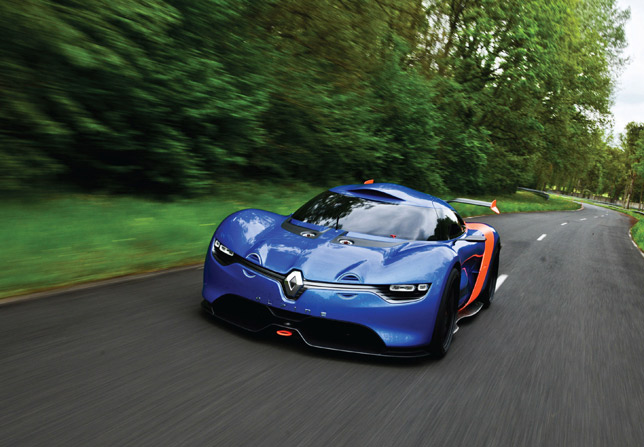
Completely out of the blue, it’s the Renault Alpine A 110-50 – a tribute to the original 1962 Alpine A 110 Berlinetta. A nostalgic DNA strain is clearly visible on the concept’s design cues. Don’t be fooled though – it’s as modern as a teenager’s mobile phone. The base for it is a Renault Mégane Trophy with minor changes in detail that make the difference.
The familiar bits can be seen on the bodywork – a slippery line, a reminiscence of the A 110 additional headlights (yellow LED arches), the 3D rear window, the air vents on the rear-wheel arches serve the same functions as the ones on the Berlinette – the rigt-hand one cools the gearbox while the left-hand one channels air to the engine bay.
The body is made from carbon fiber, the aerodynamic components (the front splitter, rear diffuser and back-wing) have been designed to give maximum downforce. The engine is now mid, instead of rear-mounted. Thus weight distribution stands at 47.8% on the front axle. The wheelbase is identical to that of the Megane Trophy but the track is slightly wider – 1,680 mm at the front and 1,690 mm at the back. Special 21-inch wheels with central bolts complement the whole look and are fitted with homologated Michelin tires.
The suspension is provided by Sachs and can be adjusted in terms of height and compression. Even, further, one can fiddle with the A 110-50’s camber, anti-roll and alignment settings. What is again a throwback however, is the lack of ABS or traction control nonsense. Still, you do get 356 mm disc brakes with six-piston callipers at the front and 330 mm ones at the back clamped by four-piston callipers.
The engine is also taken from the Mégane Trophy – its the Renault V4Y block that has 3.5-liters of displacement, six cylinders in the V formation and 400 bhp. The moving bits have been replaced in order to fit the purpose – think in terms of pistons, connecting rods, crankshaft, camshafts and valve springs. Modifications on the intake and exhaust systems have also been made. (that gash on the roof is not really faulty welding, but in fact an air scoop).
For the transmission, Renault have put all their F1 know-how into work – a semi-automatic sequential box and a ceramic twin-plate clutch operated by either a pedal or a paddle behind the wheel.
Renault Alpine A 110-50 Concept
Here’s a comprehensive list of specs:
CHASSIS
Type
Tubular 25CD4S steel chassis with semi-load bearing engine and gearbox
BODYWORK
Carbon
Aerodynamic
features Front splitter, diffuser, rear wing
ENGINE
Position
Longitudinal, mid-rear
Type
Renault V4Y – 6 cylinders – 24 valves – 3,498cc
Bore x stroke
95.5mm x 81.4mm
Injection/ignition
Magneti-Marelli Marvell 6R
Maximum power
400hp at 7,200rpm
Maximum torque
422Nm at 6,200rpm
Maximum revs
7,500rpm
TRANSMISSION
Type
Rear-wheel drive
Gearbox
Six speeds + reverse – sequential
Gear shift
Semi-automatic (pedal-operated clutch and paddle)
Differential
Limited slip differential
Clutch
Cerametallic twin-plate 184mm-diameter clutch
SUSPENSION & BRAKES
Suspension
Double wishbones, adjustable two-way Sachs damper/spring assemblies, front anti-roll bar
Front brakes
Ventilated steel discs (O 356mm x 32mm) with six-piston AP Racing callipers
Rear brakes
Steel discs (O 330mm x 32mm) with four-piston AP Racing callipers
WHEELS & TYRES
Wheels
Aluminium alloy – Front: 8 x 21 / Rear: 9.5 x 21
Tyres
Michelin 245-35 x 21 (front) and 265-35 x 21 (rear)
What we see here, is evidence that the world has gone SUV-mad. Lamborghini have brought the heavy artillery to the 2012 Beijing Auto Show with the Urus SUV Concept. We say heavy, but actually, the company claims that the Urus will thrash the other fatties from the segment thanks to their ever-improving craftiness with carbon-fiber composites.
So what’s at the core of this concept? Some might be surprised but this is not Lamborghini’s first venture into the SUV world. It’s their second. Back in 1986 the LM002 was launched which looked like a Hummer on steroids, had 450 bhp and a top speed of 210 km/h. Despite remaining in production until 1992, only 300 units were ever made. Not what you call a commercial success then.
The name behind the new one is in part ironic. Urus (or aurochs) is an extinct species of cattle – a rather majestic and tall looking breed of bulls, ancestors of the modern Spanish Bull. Now, we understand that you can’t name something that looks like a genetically modified Lamborghini Aventador on hoofs after a standard bull but isn’t the fact that the aurochs have been “outdated” sort of a bad sign?
Anyways, Lamborghini are still quiet about what’s under the hood. “Expect something around 600 bhp” is not something we can work with here. Low emission pioneering is also amidst the company’s daring claims, because it will be light they say. But how light can a 5 meter long and 2 meter wide bulk of brawn can be? It sends its power trough trough a permanent AWD system complete with traction control. (which, again, does not sound very light).
Aerodynamics are said to play an important part as well. The suspension is widely adjustable. The front spoiler is also height adjustable so that it can provide a proper ground clearance or add some stability and efficiency on the flat tarmac. The outside features are less than a handful but for a purpose – a minimalist construction. No side view mirrors (cameras inside), no gun turrets and no excess weight. The only thing that sounds too much is the size of the wheels: 24 inches of matte aluminum glory and double spoke design.
Inside the Lamborghini Urus, there is a seating for four (two too many for a Lamborghini to be honest). The carbon fiber diet there is just as relevant as it is for the outside. The center tunnel for example, is an open skeletal carbon fiber structure made from Forged Composite. It’s the backbone of the whole interior and it is only partially clad in leather-upholstered cushioning. The four bucket seats (Forged Composite as well) are also cushioned by a single body. Then, behind the steering wheel, one would find only paddle shifters. So Lamborghini has gone the Ferrari Italia way and placed the indicator storks/buttons somewhere irrelevant. And this is supposed to be an everyday vehicle?
The exceptional BMW i8 Concept Spyder is an open-top two-seater, which can grab literally any heart! It has the entire necessary characteristic and in addition adds to them with sporting and emotional appearance.
This concept is purposefully built in order to meet the changing needs of customers and transform the understanding of personal mobility. It is equipped with intelligent technologies and definitely has an innovative design, however what is more is that now embraces a philosophy which adopts significant degree by sustainability throughout the value chain.
This is the third BMW i model, which is here to “inform” us what will be the future of cutting-edge and emotionally appealing mobility concepts. It is not only a mixture between sporting design with an open-top two-seater, but is also a combination of lightness, dynamic capability and efficiency with a very special aesthetic value.
What is worth mentioning as well is that it is a blend of intelligent lightweight design and state-of-the-art hybrid technology. This results in exciting sports car performance and driving pleasure combined with exceptional fuel-consumption unmatchable in this segment before.
BMW i8 Concept Spyder has the upward-swivelling, windowless doors and a range of purpose-oriented on-board equipment which features electric kickboards stowed under a transparent tailgate. The concept vehicle is built on the innovative LifeDrive architecture. The latter includes lightweight modular construction and the utilization of high-quality high-tech materials.
BMW i8 Concept Spyder
Furthermore, the BMW i8 Concept Spyder is a plug-in hybrid powered by an eDrive drivetrain. This drivetrain combines the excellent performance of the electric motor and petrol combustion engine, while the lithium-ion battery supplies the motor with power that can be recharged in an extremely short space of time from any domestic power socket. In addition, the car has significantly reduced weight, low centre of gravity and is precisely balance. Everything is combined with a system output of up to 260 kW (354 hp).
Like its Coupe sibling (2+2-seater BMW i8 Concept), the BMW i8 Concept Spyder blends intelligent lightweight design with the leading-edge drivetrain technology eDrive, which delivers extremely low fuel consumption and emissions.
The concept got compact dimensions and specific exterior paintwork. Additionally, it has the upward-swivelling, windowless doors and a transparent glass panel at the rear. How about the interior: a revised material is used and a colour concept provides an extra dose of sportiness.
Moreover BMW i8 Concept Spyder is built around the innovative modular LifeDrive architecture, which comprises of independent functional units. For instance, the carbon-fibre-reinforced plastic (CFRP) Life module gives the car an extremely lightweight passenger cell, while the Drive modules bring together all the car’s operational driving functions, such as the powertrain, chassis and safety structure. And thanks to the intelligent lightweight design and the use of innovative materials, the vehicle delivers great fuel-efficiency. In particular in the LifeDrive architecture the front and rear axle modules are connected by an “energy tunnel”, which houses the hybrid battery, this results in low centre of gravity and ideal balance.
The BMW i8 Concept Spyder’s includes emotion-led design as well which vividly spotlights the car’s qualities, with lightness, dynamic capability and efficiency highlighted to particularly prominent effect. The key elements which contribute for this sporty dynamic stance are the large body panels, a hunkered-down stance and numerous aerodynamic elements such as contact surfaces, spoiler lips, AirCurtains and aeroflaps.
What is more here is that the front end offers a revealing window into the open-top two-seater’s dynamic talent. In addition a spoiler lip on the windscreen frame guides the airflow over the heads of the passengers. Of course there is also featured a two-section folding roof.
Observed from side, the Spyder has short front and rear overhangs and a low-slung silhouette. Additionally, the alluring lines and forms generate a strong forward-surging stance even before the car powers off the line.
Compared to the front end, the rear also is positioned low to the road. Its headline feature is a transparent cover revealing the two folded electric kickboards accommodated below. A rear diffuser, three-dimensional air outlets and the U-shaped rear lights makes the BMW i8 Concept Spyder with extremely wide appearance and further emphasize its sportiness.
Going further, the interior of the BMW i8 Concept Spyder is defined by three levels. Each one has various functions. The interlocking of surfaces and lines for instance, is also one of the stand-out features of the interior design. On the other hand, the outer layer also frames the supporting structure, while the inner “comfort” layer includes seat surfaces and stowage compartments. The third layer is represented by the cockpit, and brings together the instrument panel, steering column and steering wheel with the instrument cluster, central information display and control elements. Of course, the car has a low drivers’ seating position. Moreover, an 8.8-inch (22.4 cm) screen displays the driving information in three-dimensional, high-resolution quality.
BMW i8 Concept Spyder Interior
Furthermore, the Spyder’s interior is a mixture of plastic, carbon and leather, with theoff-white of the outer layer and the bold orange tone of the naturally tanned leather generating a sporting atmosphere.
The BMW i8 Concept Spyder with eDrive means that it is a plug-in hybrid which combines two different power sources: electric motor and combustion engine. First, the electric motor produces 96 kW (131 hp) and it is on the front axle. It works in combination with a turbocharged three-cylinder petrol engine delivering 164 kW (223 hp) through the rear wheels. When combined, both units generate an aggregate system output of 260 kW (354 hp) and peak torque of 550 Nm.
And if you wonder about the acceleration data, well – here’s some: the Spyder accelerates from 0 to 100 km/h (62 mph) in just five seconds. It has a electronically limited top speed of 250 km/h (155 mph). It’s performance in other words is exceptional. However, despite these numbers, the two-seater burns just three litres of petrol per 100 kilometres!
Furthermore, the electric motor gets its energy from a lithium-ion battery which can be fully charged from a domestic power socket in less than two hours. The battery is located in the energy tunnel between the front and rear axle modules.
With its battery fully charged, the BMW i8 Concept Spyder can go up to 30 kilometres (19 miles) only on electric power. And if it is required, a high-voltage alternator hooked up to the combustion engine generates additional power, which is then stored in the hybrid battery.
Additionally, the concept vehicle has as wee the ability to send power through the front, rear or all four wheels at the same time. It has the intelligent control electronics, which ensure that the optimum drive configuration is available for the situation at hand. Next, the electronic systems ensure maximum energy recuperation under braking or when coasting.
BMW i is equipped with new generation of driver assistance systems such as the camera-based proactive Collision Warning system, Parking Assistant and Traffic Jam Assistant. Remote functions accessed via a smartphone are also included, such as the Last Mile Navigation function and the Intermodal Route Planning function.
Two large displays can be found inside the BMW i8 Concept Spyder. They make up the interface between the car, its passengers and the outside world. They are positioned next to the instrument cluster behind the steering wheel. What is innovative here is that all the screens display their information in 3D.
On the other hand the instrument cluster displays important driving and it is positioned alongside the digital speedometer. For example, the efficiency display allows drivers to view how much energy they are currently using, and shows extra navigation details and information on the car’s range as well. If the driver switches to energy-saving ECO PRO mode, the display turns blue in colour to signal the shift in functional emphasis, and the ellipses now also vary in form. By the same token, moving into SPORT mode treats the driver to an emotional orange hue. As well as the changes in colour, the displays also provide information tailored to the driving mode selected and to assisting the driver as effectively as possible.
BMW i8 Concept Spyder Specifications
Length/Height/Width
L 4480 mm, H 1208 mm, W 1922 mm
Wheelbase
2650 mm
No. of seats
2
Kerb weightTop speed
Acceleration
1630 kg250 km/h (155 mph) electr. governed
0-100 km/h (62 mph) 5 s 80-120 km/h (50-75 mph) 4.0 s
System output TwinPower Turbo engineFuel consumption (EU cycle)

 Tronatic Everia Concept is a product of the elaborations of the French graphic design studio Tronatic Production. They have created it with the aim to make a true European muscle car.





 Lamborghini Perdigón Concept is an inspirational design worthy of carrying the


 Another



 Here is a nice look of the future vehicles – Nagel Dakkar Dartz Concept. The car is sketched by DARTZ stuff designer Alex Isaev and German designer Pochwatta.
 2012 MINI Rocketman Concept is especially prepared by the British premium car brand


 Ford Evos Concept is an exceptional vehicle which is going to make its first Asian appearance at Computex 2012, which is one of the biggest and most important computer exhibitions in the world.


 Completely


 What we see here, is evidence that the world has gone SUV-mad.


