 New Epica on sale now From 13,595 on-the-road Choice of 2.0-litre engines – six-cylinder petrol or four-cylinder diesel Incredible levels of standard equipment (more…)
Tag: Chevrolet
-
Chevrolet Epica – big on space, big on comfort, huge on value!
-
The Chevrolet Aveo – the small car that’s big on value!
 New Aveo on sale now from 7,695, replacing Kalos Fuel consumption and CO2 emissions reduced
Stylish looks and upmarket interior To be built in Europe from summer 2008
It may be small, but Chevrolet’s new Aveo is big on value, big on style and big on quality. (more…) -
Captiva Style – Now Even Better Value!
 It already has a reputation for offering superb value for money, but the Chevrolet Captiva has just got even more affordable thanks to the addition of a new entry-level diesel model.
At £18,295, the new five-seater Captiva 2.0 VCDi LS is £1,900 cheaper than Kia’s base model Sorento, over £2,000 less expensive than the cheapest diesel Nissan X-Trail, and more than £3,500 less pricey than the five-seat Hyundai Santa Fe 2.2 CRTD GSi. (more…)
-
Chevrolet Aveo

 Chevrolet Europe will present the Kalos’ successor at the Frankfurt Motor Show (13 to 23 September 2007). The most significant features of this completely reworked model are its striking exterior, its high-class interior and a new, even more efficient petrol engine. Like its notchback stable mate, the new hatchback model will now bear the Aveo name throughout Europe. Sales will start in March 2008.
The Aveo hatchback sports Chevrolet’s new design features, as characterised by the big horizontally split radiator grille with a body-coloured crossbeam and the brand logo sitting prominently in the center. The dynamic detailing includes large, curved, clear-glass headlamps and fog lamps that project like spotlights from the lower part of the bumper. In profile, the body’s prominent shoulder lines catch the eye, while the back of the car is dominated by the solid bumper and the round tail lamps in a clear-glass housing.
There is a choice of two petrol engines: a new 1.2-litre unit with an output of 84 hp, and the existing 1.4-litre engine, which now develops 98 hp and is available with automatic transmission.
-
Chevrolet Corvette

 Get comfortable. There’s so much new and exciting with the 2008 Corvette that you’ll want to grab a hot drink, sidle up to your computer screen and absorb all the details.
The changes involve everything from an all-new, larger and more powerful V-8 engine to refinements in driving characteristics that solidify the Corvette’s position as the preeminent American sports car – and further the argument that it is one of the world’s best. There are also a host of exterior and interior refinements that raise the Corvette’s luxury status and enhance the feeling of craftsmanship.
“Corvette is an uncompromising sports car that rewards its owners with impeccable performance and great comfort,” said Ed Peper, Chevrolet general manager. “The changes and enhancements to the 2008 Chevrolet Corvette reflect continual improvements that speak to Chevrolet’s unflagging commitment to building the best sports car – and with nearly 55 years of experience, the Corvette just keeps getting better and better.”
Also back again for ’08 is the 505-horsepower Corvette Z06, an American super car that has won over enthusiasts, journalists and racers around the world for its balance of racetrack-bred performance, daily-driving civility and value.


Engine
A new, 6.2L LS3 small-block V-8 is the standard engine in Coupe and Convertible models. It is rated at 430 horsepower (321 kW)* and 424 lb.-ft. of torque (586 Nm)* with the standard exhaust system; with the new, optional two-mode exhaust system, power ratings increase to 436 horses / 325 kW and 428 lb.-ft. / 592 Nm. As a result, the standard Corvette is true supercar, capable of 190 mph. The LS3 with the six-speed paddle-shift automatic is the fastest automatic-equipped Corvette ever, with 0-60 mph capability of 4.3 seconds.
This new iteration of the storied small-block family features a revised, larger-bore cylinder block – 4.06-inch / 103.25 mm vs. the previous 6.0L’s 4.00-inch / 101.62 mm bores – high-flow, LS7/L92-style cylinder heads; larger-diameter pistons; revised camshaft and camshaft timing; revised valvetrain with offset intake rocker arms; high-flow intake manifold; high-flow fuel injectors from the Z06’s LS7 engine; and a new engine beauty cover.
The LS3 features an aluminum cylinder block with cast iron cylinder liners. In addition to its larger bores, which help create a 376-cubic-inch displacement, the block casting also features revisions and machining in the bulkheads that enhance its strength and improved bay to bay breathing. But while the bore of the 6.2L engine is increased when compared with the previous 6.0L engine, the engine’s stroke remains at 3.62 inches (92 mm). The pistons for the larger 6.2L engine also are new and are designed for its high-rpm performance capability.
Breathing for the new 6.2L engine is accomplished via new, high-flow cylinder heads. They’re based on the large port/large valve design found on the LS7 engine and other GM L92 engines, with larger-capacity, straighter intake ports. The design optimizes intake flow to the combustion chamber and the exhaust ports are also designed for better flow.
Complementing the larger-port design of the heads are commensurately sized valves. The intake valve size alone increases from 2.00 inches (50.8 mm) to 2.16 inches (55 mm) – an increase of nearly 9 percent. The intake valves feature lightweight hollow stems, which enable the engine’s 6,600-rpm capability. The exhaust valves also are large, measuring 1.60 inches (40.4 mm) in diameter.
To accommodate the engine’s large valves and enable more direct intake port flow, the intake-side rocker arms are offset 6 mm between the valve tip and the push rod. Actuating the valves is a new camshaft, with intake-side lobes providing more than a 5-percent percent in increase in lift, from 0.521-inch to 0.551-inch (13.25 mm to 14 mm). Exhaust-valve lift remains unchanged from the LS2. The camshaft timing was revised to optimize performance with the higher-lift intake cam profile.
Ensuring the cylinder heads receive all the air they can handles falls to a new, acoustically tuned intake manifold. The composite design is manufactured with a “lost core” process that improves runner to runner variation and reduces airflow losses. An acoustic foam material is used to reduce radiated engine noise; it is sandwiched between the outer top of the manifold and an additional “skull cap” acoustic shell. Also new beauty covers atop the engine shield the rocker covers and also feature a noise-reducing, acoustically tuned insert to provide a more refined engine sound.
Exhaust system
Optional on ’08 Coupe and Convertible models is a new, two-mode performance exhaust system. Similar in design and function to the system used on the Z06, the dual-mode exhaust uses vacuum-actuated outlet valves, which control engine noise during low-load operation, but open for maximum performance during high-load operation. It is not identical to the Z06 system; the Coupe/Convertible uses a 2.5-inch-diameter exhaust, while the Z06 uses a three-inch system.
With the new, dual-mode performance exhaust, power output for Coupe/Convertible rises from 430 horsepower (321 kW) and 424 lb.-ft. of torque (575 Nm) to 436 horses (325 kW) and 428 lb.-ft. (580 Nm). This system gives the Corvette a more aggressive exhaust sound character that will appeal to performance enthusiasts.
Transmissions and axle ratios
The shifting efforts for both the six-speed manual transmission and paddle-shift six-speed automatic transmissions have been improved in ’08 Corvette models. The manual transmission shifting improvements include a more positive and direct feel during gear changes, with better gate-to-gate location.
The six-speed paddle-shift automatic transmission on Coupe and Convertible is improved with new hardware and a new controller calibration that deliver quicker shifts. This change bolsters the feeling of performance and driver control when using the shifting paddles.
Also new for ’08 models is the availability of the 2.73 performance axle ratio with the automatic transmission. It is included with the Z51 package.
Steering system – The Corvette’s precise rack-and-pinion steering system is revised to provide improved feel at all speeds. The revisions are due to a new, premium machining process of the system’s internal components, a new, stiffer intermediate shaft and controller calibration changes.
Wheels – Corvette Coupe and Convertible models come with a new split-spoke wheel design for ’08. The design was introduced on the limited-edition ’07 Indianapolis 500 Pace Car replicas with a Sterling Silver finish. The standard 18-inch front wheels and 19-inch rear wheels feature a Sparkle Silver finish, with a Competition Gray version optional.
Also new is a distinctive, performance-oriented forged aluminum wheel for Coupe and Convertible. It comes in a polished finish.
Exterior colors – There are two new premium exterior colors available with 2008 Corvette models: Jetstream Blue Metallic Tintcoat and Crystal Red Metallic Tintcoat; they replace Le Mans Blue Metallic and Monterey Red Metallic Tintcoat.
Custom Leather-Wrapped Interior Package – Available on Coupe, Convertible and Z06 models, the new Custom Leather-Wrapped Interior Package offers a stylish, two-tone leather-appointed cabin with details that enhance the feeling of Corvette’s craftsmanship.
Feature changes and enhancements – All Corvette models now come standard with features that were previously optional or part of equipment packages.
Dramatic fender forms and exposed headlamps combine with the grille to create a strong visual identity for the Corvette, while the tapered rear deck and fascia improve high-speed performance. The lean rear design sports round taillamps and center-exit exhaust. The fixed Xenon high-intensity discharge headlamps provide superior lighting performance. With a 0.286 coefficient of drag, the Coupe models are the most aerodynamic Corvettes ever.
The 2008 Corvette Convertible features a power-operated soft top with the 3LT package; an easy-to-operate manual top is standard. Both configurations use a five-layer fabric that conceals the underlying structure for a good top-up appearance, plus it helps preserve the car’s excellent aerodynamics and reduces road noise.
Corvette’s interior is inspired by the car’s dual-cockpit heritage. High-quality materials, craftsmanship and functionality help deliver premium quality meant to enhance performance driving. The instrument panel and doors are covered with cast-skin foam-in-place trim that looks like a leather-wrapped, padded panel. It is warm and inviting and has double the life of conventional trim materials.
An AM/FM/XM radio with CD player and audio input jack is standard. An optional Bose audio system with an in-dash six-disc changer adds to the choices available to the audiophile owner. Steering-wheel mounted audio controls – introduced in ’07 – are included with the Bose premium system.
A full-function OnStar system is standard and an onboard navigation system with voice recognition is available. Using a 6.5-inch (165 mm) color touch-screen display, the DVD-based system contains all the map data for the 48 contiguous states and most of Canada on one disc.
Driving dynamics
Corvette Coupe and Convertible have a hydroformed steel rail backbone structure, which features cored composite floors, an enclosed center tunnel, rear-mounted transmission and aluminum cockpit structure. Suspension cradles, control arms, knuckles, springs, dampers, bushings, stabilizer bars and steering gear have all been redesigned. New Goodyear Extended Mobility Tires (EMT) take advantage of the latest sidewall design and compound technology for run-flat capabilities.
Three suspension choices allow drivers to choose the setup that best suits their driving style. The standard suspension is tuned for a balance of ride comfort and precise handling. Corvette is now more poised at even higher handling levels, yet easier to drive.
The optional Magnetic Selective Ride Control suspension features magneto-rheological dampers able to detect road surfaces and adjust the damping rates to those surfaces almost instantly for optimal ride control. Cross-dilled brake rotors are included when this feature is selected, allowing customers to combine the larger brakes from the Z51 performance package with the comfort of Magnetic Selective Ride Control.
The Z51 Performance Package brings Coupe and Convertible performance very close to the widely admired previous generation Z06. The Z51 offers more aggressive dampers and springs, larger stabilizer bars, Goodyear Eagle F1 Supercar EMT tires, enhanced cooling and larger cross-drilled brake rotors (13.4 inches / 340 mm in front and 13 inches / 330 mm in rear) for optimum track performance while still providing a comfortable ride.
With each suspension, three standard dynamic chassis control systems – anti-lock braking, traction control and Active Handling – operate in concert. In all, the dynamic chassis control systems are smarter, less intrusive and more adept at making the total driving experience precisely what drivers have come to expect from their Corvette.
As the fastest, most powerful and most technologically advanced production model in Corvette’s history, t he Corvette Z06 offers an unprecedented level of capability and technology, making it one of the best performance values on the market.
Design
The Z06 has an unmistakable and aggressive appearance, with design cues that include. A wide front fascia with a large, forward-facing grille opening, a splitter along the bottom and wheel opening extensions along the sides to provide aerodynamic downforce. The trailing edge of the front wheel opening is radiused to achieve improved drag, but protects the body finish with a tough molding, and a large air extractor is located behind the wheel.
The aerodynamics of the Z06’s exterior were shaped by the experiences of the Corvette racing program, where high-speed stability and cornering capability are paramount. And while the race cars use large rear wings, the Z06’s elevated spoiler provides sufficient downforce to balance the road-worthy front splitter without adversely affecting aerodynamic drag. The Z06’s Cd is 0.34.
For all its race-inspired functionality, the Z06 is designed to be a daily-driveable high-performance vehicle. To that end, comfort and convenience are held to a very high standard. High-Intensity Discharge lighting, fog lamps, leather seating, dual-zone air conditioning, cabin air filtration and head-up display (HUD) with track mode and g-meter are standard.
The Z06 gauge cluster displays the Z06 logo on the 7000-redline tachometer and has a readout on the oil pressure gauge to reflect the higher standard pressure of the dry-sump oiling system. The seats feature two-tone leather surfaces, with Z06-logo embroidery and contrasting stitching.
Z06 options include a Bose audio system with an in-dash six-CD changer, polished, Competition Gray or chrome wheels, a telescoping steering wheel, heated seats, side-impact air bags, a navigation system with GPS and universal home remote.
LS7 engine
The Z06’s LS7 7.0L engine delivers 505 horsepower (377 kW) in a 3,132-pound (1,421 kg) package – a combination that delivers 0-60 performance of 3.7 seconds in first gear, quarter-mile times of 11.7 seconds at 125 mph and a top speed of 198 mph (as recorded on Germany’s Autobahn). It also provides maximum lateral acceleration of 1.04 g and 60-0 braking in 111.3 feet; it also circuited Germany ’s famed N ü rburgring in a time of 7:43 .
The LS7 reintroduced the 427-cubic-inch engine to the Corvette lineup. It is easily identified under the hood by red engine covers with black lettering. The LS7 shares the same basic Gen IV V-8 architecture as the Corvette’s 6.0-liter LS2, but it uses a different cylinder block casting with pressed-in steel cylinder liners to accommodate the engine’s larger diameter, 4.125-inch (104.8 mm) cylinder bores.
Internally, the LS7’s reciprocating components make use of racing-derived lightweight technology, including titanium connecting rods and intake valves, to help boost horsepower and rpm capability. The rpm fuel shut-off limit is 7,100 rpm.
One of the clearest examples of the LS7’s race-bred technology is its use of titanium connecting rods. They weigh just 464 grams apiece and besides being lightweight, which enhances high-rpm performance and rpm range, titanium makes the rods extremely durable.
The LS7’s CNC-ported aluminum cylinder heads are designed to meet the high airflow demands of the engine’s 7.0-liter displacement. A hydraulic roller camshaft with 0.588/0.593-inch valve lift is used to allow plenty of air to circulate in and out of the engine. To ensure optimal, uninterrupted airflow, the LS7’s heads have straight, tunnel-like intake runners. Very large by production-vehicle standards – even racing standards – they are designed to maintain fast airflow velocity, providing excellent torque at low rpm and exhilarating horsepower at high rpm. The heads feature 70-cc combustion chambers that are fed by huge, 56-mm-diameter titanium intake valves. They are complemented by 41-mm sodium-filled exhaust valves.
To accommodate the large valve face diameters, the heads’ valve seats are siamesed; and, taken from experience with the engines of C6.R racecars, the LS7’s valve angles are held at 12 degrees – vs. 15 degrees for the LS2 – to enhance airflow through the ports.
The LS7 has a dry-sump oiling system designed to keep the engine fully lubricated during the high cornering loads the Corvette Z06 is capable of producing. An engine compartment-mounted 8-quart reservoir delivers oil at a constant pressure to a conventional-style oil pump pick-up at the bottom of the engine. The pressurized oil feed keeps the oil pick-up continually immersed in oil at cornering loads exceeding 1 g.
Oil circulates through the engine and down to the oil pan, where it is sent back to the reservoir via a scavenge pump. The large-capacity reservoir, combined with a high efficiency air-to-oil cooler, provides necessary engine oil cooling under the demands of the engine’s power output. With the dry-sump system, oil is added to the engine via the reservoir tank – which includes the oil level dipstick.
Drivetrain
The Corvette Z06’s powertrain and drivetrain systems are matched to the LS7’s performance capability. The light, four-into-one headers discharge into close-coupled catalytic converters and through two-mode mufflers. The mufflers each feature a vacuum-actuated outlet valve, which controls exhaust noise during low-load operation but opens for maximum power.
At the rear of the LS7 engine, a single-mass flywheel and lightweight, high-capacity clutch channel torque to the rear transaxle. The six-speed manual transmission has been strengthened to handle the LS7’s increased torque load. The transmission includes a pump that sends transmission fluid to the front radiator for cooling. Upon its return, the fluid removes additional heat from the differential lube before returning to the transmission. The six-speed transmission connects to a limited-slip differential, with enlarged ring and pinion gears. Stronger axle half-shafts with tougher universal joints transmit power to the rear wheels.
Structure
The Z06 has a unique aluminum body structure for optimum stiffness and light weight for the fixed-roof bodystyle. Perimeter rails are one-piece hydroformed aluminum members featuring cast suspension nodes, which replace many welded steel components on other Corvette models. Other castings, stampings and extrusions are combined into the innovative structure with state-of-the-art manufacturing technologies.
Advanced structural composites featuring carbon fiber are bonded to the aluminum structure. The wider front wheelhouses, for example, are carbon composites and the passenger compartment floors combine carbon-fiber skins with an ultra-lightweight balsa wood core.
The Z06 has a new magnesium cradle that serves as the attachment point for the engine and some front suspension components. Magnesium is lighter than aluminum yet incredibly strong. The magnesium cradle helps improve the front-to-rear weight distribution, as do carbon-fiber front fenders and wheelhouses. Engineers also moved the battery from underhood to a position in the rear cargo area, behind one of the rear wheels.
The mass reductions are offset by some added performance enablers, including dry-sump lubrication, exhaust system with outlet valves, larger wheels and tires, larger brakes and larger roll stabilizers.
Suspension and brakes – The Z06 retains the 105.7-inch (2686-mm) wheelbase of other Corvette models, as well as the short-long arm suspension and transverse leaf spring design, but it rides on all-new wheels, tires, brakes, as well as its own rear spring and roll stabilizer.
The firmer suspension works harmoniously with large 18 x 9.5-inch cast-spun aluminum wheels and 275/35ZR18 tires in the front, and 19 x 12-inch cast-spun aluminum wheels with 325/30ZR19 tires in the rear – the largest wheel-and-tire combination ever offered on a Corvette. The tires use the latest extended-mobility technology from Goodyear to provide a satisfactory ride, but still allow the vehicle to achieve lateral acceleration of more than 1 g. The extended-mobility tires eliminate the need – and weight – for a spare tire and jack or inflator kit, while also reducing the chance of a sudden loss of handling capability.
Complementing the suspension system and large rolling stock is an equally capable four-wheel disc brake system, consisting of 14-inch (355 mm) vented and cross-drilled front rotors and 13.4-inch (340 mm) vented and cross-drilled rear rotors.
The front rotors are acted upon by large, red-painted six-piston calipers that use six individual brake pads. Individual brake pads are used because they deliver more equalized wear compared to what would otherwise be a pair of very long single-piece pads. For the rear brakes, four-piston calipers with four individual brake pads are used. A Delphi four-channel ABS system is standard, as is a very competent active handling system – complete with a Competitive Driving mode.
-
Chevrolet Groove
 A “funkastalgia”-themed vehicle too tough-looking to be “cute,” the Groove concept is a retro-inspired vehicle with bodacious fender flares and an upright windshield. It looks much longer than it is, thanks to its short hood and long cabin. The front-drive Groove is powered by a small, efficient 1-liter diesel engine.
Three Chevrolet minicar global concepts designed to appeal to young car buyers in urban markets prove that art needn’t take a back seat just because the canvas is small. Revealed today at the NY Motor Show, the highly creative Chevrolet Beat, Chevrolet Groove and Chevrolet Trax concepts drive the energy, diversity and excitement of urban life into cars that deliver good-looking fun, fuel economy and value.


All three concepts were designed at GM’s Design Studio in Inchon , South Korea . One of GM’s 11 Global Design Studios, the designers in the Korean center are experts in small car product development.
Built on GM’s global mini architecture, these concepts demonstrate the flexibility, creativity and innovative focus of design in GM’s Asia Pacific region. The Chevrolet Beat concept, a running prototype of a micro import tuner, was built in India ; while the Chevrolet Groove and Trax micro urban crossover concepts were built at the GM Tech Center in Warren , Mich.
“The Chevrolet Beat, Groove and Trax concepts highlight the strength and diversity of GM’s Global Design capabilities, as well as the ability of our Global Product Development team to anticipate and quickly meet the evolving needs of our diverse markets around the world,” said Ed Welburn, vice president, GM Global Design.
“The design team was so enthused about being given the assignment to develop the perfect small car for urban commuters that they created not one, but three interpretations of how this car may be developed for Chevrolet customers around the world.”
Chevrolet is one of four GM global brands, meeting diverse customer needs in 120 countries with vehicles that range from subcompacts and family sedans to full-size pickups and SUVs and iconic sports cars such as the Corvette. The concepts revealed in New York , for example, offer three different fuel-efficient engines, including a diesel.
“The Chevrolet Beat, Groove and Trax concepts have the potential to expand the reach of Chevrolet – already a beloved brand around the world – even further, connecting with young buyers on multiple continents who desire fun-yet-efficient transportation,” said Chevrolet General Manager Ed Peper. “These are the same brand attributes that made Chevrolet a household name in the U.S. “
-
Chevrolet Beat
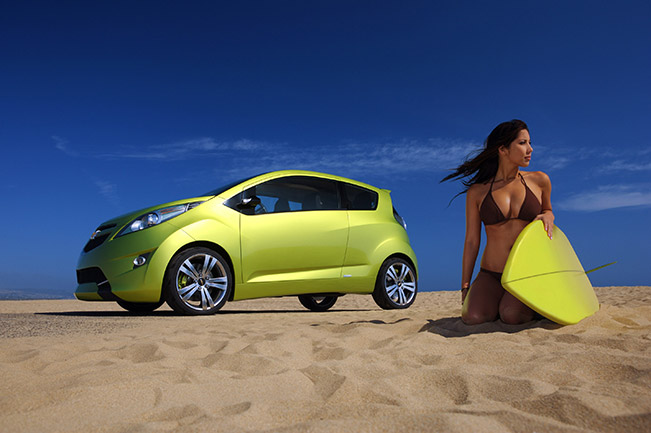 Designed to evoke the mood of a speedy micro import tuner, the Beat is a front-wheel-drive, three-door hatchback concept built to be personalized, and powered by a 1.2-liter turbocharged gasoline engine mated to an automatic transmission. It’s loaded with technology, including a navigation system and premium stereo.
Three Chevrolet minicar global concepts designed to appeal to young car buyers in urban markets prove that art needn’t take a back seat just because the canvas is small. Revealed today at the New York Auto Show, the highly creative Chevrolet Beat, Chevrolet Groove and Chevrolet Trax concepts drive the energy, diversity and excitement of urban life into cars that deliver good-looking fun, fuel economy and value.


All three concepts were designed at GM’s Design Studio in Inchon , South Korea . One of GM’s 11 Global Design Studios, the designers in the Korean center are experts in small car product development.
Built on GM’s global mini architecture, these concepts demonstrate the flexibility, creativity and innovative focus of design in GM’s Asia Pacific region. The Chevrolet Beat concept, a running prototype of a micro import tuner, was built in India ; while the Chevrolet Groove and Trax micro urban crossover concepts were built at the GM Tech Center in Warren , Mich.
“The Chevrolet Beat, Groove and Trax concepts highlight the strength and diversity of GM’s Global Design capabilities, as well as the ability of our Global Product Development team to anticipate and quickly meet the evolving needs of our diverse markets around the world,” said Ed Welburn, vice president, GM Global Design.

2007 Chevrolet Beat Concept
“The design team was so enthused about being given the assignment to develop the perfect small car for urban commuters that they created not one, but three interpretations of how this car may be developed for Chevrolet customers around the world.”
Chevrolet is one of four GM global brands, meeting diverse customer needs in 120 countries with vehicles that range from subcompacts and family sedans to full-size pickups and SUVs and iconic sports cars such as the Corvette. The concepts revealed in New York , for example, offer three different fuel-efficient engines, including a diesel.
“The Chevrolet Beat, Groove and Trax concepts have the potential to expand the reach of Chevrolet – already a beloved brand around the world – even further, connecting with young buyers on multiple continents who desire fun-yet-efficient transportation,” said Chevrolet General Manager Ed Peper. “These are the same brand attributes that made Chevrolet a household name in the U.S. ”

-
Chevrolet Trax

 An urban crossover concept that’s equally at home on the trails or in traffic, it gets a low-cost all-wheel-drive system and looks the part of a rugged SUV many times its size, thanks to a voluminous one-piece bumper and fender system in the front and back, a rear-mounted spare tire and a roof rack. Trax is powered by a 1-liter gas engine
Three Chevrolet minicar global concepts designed to appeal to young car buyers in urban markets prove that art needn’t take a back seat just because the canvas is small. Revealed today at the New York Auto Show, the highly creative Chevrolet Beat, Chevrolet Groove and Chevrolet Trax concepts drive the energy, diversity and excitement of urban life into cars that deliver good-looking fun, fuel economy and value.
Democracy lovers will even get the chance to pick their favorite by visiting www.vote4chevrolet.com and casting their vote for the Beat, Groove or Trax. The results will help Chevrolet determine U.S. market interest in the minicar segment, and which design/capability package resonates best with potential buyers.


All three concepts were designed at GM’s Design Studio in Inchon , South Korea . One of GM’s 11 Global Design Studios, the designers in the Korean center are experts in small car product development.
Built on GM’s global mini architecture, these concepts demonstrate the flexibility, creativity and innovative focus of design in GM’s Asia Pacific region. The Chevrolet Beat concept, a running prototype of a micro import tuner, was built in India ; while the Chevrolet Groove and Trax micro urban crossover concepts were built at the GM Tech Center in Warren , Mich.
“The Chevrolet Beat, Groove and Trax concepts highlight the strength and diversity of GM’s Global Design capabilities, as well as the ability of our Global Product Development team to anticipate and quickly meet the evolving needs of our diverse markets around the world,” said Ed Welburn, vice president, GM Global Design.
“The design team was so enthused about being given the assignment to develop the perfect small car for urban commuters that they created not one, but three interpretations of how this car may be developed for Chevrolet customers around the world.”
Chevrolet is one of four GM global brands, meeting diverse customer needs in 120 countries with vehicles that range from subcompacts and family sedans to full-size pickups and SUVs and iconic sports cars such as the Corvette. The concepts revealed in New York , for example, offer three different fuel-efficient engines, including a diesel.
“The Chevrolet Beat, Groove and Trax concepts have the potential to expand the reach of Chevrolet – already a beloved brand around the world – even further, connecting with young buyers on multiple continents who desire fun-yet-efficient transportation,” said Chevrolet General Manager Ed Peper. “These are the same brand attributes that made Chevrolet a household name in the U.S. “
-
Chevrolet N2A 789 by Kanter Concepts
 Chevrolet N2A 789 by Kanter Concepts is a car to speak of. You can take a look at the pictures but if you need more reasons I’ll give you some. First of all, the 789 combines the classic design elements from different models Chevy has released through the fifties. It actually mixes the designs of Chevys from the ’57. ’58 and ’59. Then the look of this particular model is so iconic that it can’t be mistaken with any other else.
Let’s talk about it in details now. The car has been built on a 2005-2007 Corvette C6 chassis. If this does not speak anything to you, then you should know that this is regarded one of the best performance chassis ever produced by Chevrolet. In addition, the 789 has the “hooded eyes” and chrome grille bar of a ’57 Bel Air model. It has been mixed with a mid-section and tri-toned interior that is reminiscent of the Impala from the 1958. The “bird in flight” rear tailfins are taken from the distant 1959.
The benefit of the 789 is that it isn’t a car form the fifties but it can hit the 190 mph within an instant and still use around 25 miles per gallon on the highway.


Another advantage here is that each and singe car produced will be unique. How will this happen? There won’t be any two identical paint scheme or colors, and the interior combinations are more than 10,000! This is how you will make sure that all eyes are on your vehicle.
The design process began with sketches first and then hand made clay models. The experts at Kanter Concepts find it really important to make everything the old-fashioned way so that they can keep the spirit of the fifties alive.
If you ask how much it would cost you to own this car, the answer is $135,000USD. For this amount of money you will get a machine capable of 400 horsepower produced by its aluminum block V8 engine, the abundant equipment of the Corvette, custom Borla exhaust system (each car gets a different one), PST high performance anti-sway bars and great wheel/tire combination. Optionally, anyone can opt for turbocharging or ceramic brakes, 1000 watt stereo or ostrich leather interior, at an additional pricing, of course.
https://www.youtube.com/watch?v=QqcpwibhaKw
Source: Kanter Concepts
-
Chevrolet Corvette Victory Edition
 To celebrate the success of Corvette in sports car racing – and in particular the prestigious Le Mans 24-Hour event, a limited series of just 250 ‘Victory Edition’ Corvette Coupes is being produced. Since Corvette Racing made its debut in 1999, the team has won over 50 races, including five class wins at the 24 Hours of Le Mans between 2001 and 2006.
-
Chevrolet Volt Concept
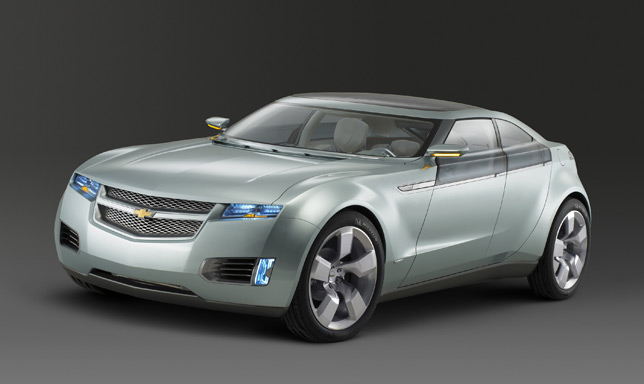
While the technologically advanced Chevrolet Volt has the capability to travel 40 miles on electricity alone, at first glance, the concept could easily be mistaken as simply a design statement.The Volt conveys an immediate message of agility and sophistication, with exterior proportions more commonly associated with classic sports cars. Twenty-one-inch wheels and sheer, taut surface relationships reiterate the statement. The Chevrolet Volt’s athletic design challenges the notion that an environmentally conscious vehicle can’t be beautiful and possess an aesthetic spirit that matches its driving characteristics.
“We’ve leveraged our resources around the globe to develop the design aesthetic for the Volt,” said Ed Welburn, vice president, GM Global Design. “It was important that the design capture the face of Chevrolet as it’s recognized around the world.” Design and engineering collaboration between GM designers and GE Plastics, using unique material technology and design engineering support, helped achieve the Volt’s distinctive appearance. True to the heritage of its Chevrolet bowtie, the Volt’s exterior design suggests spirited performance and is wrapped in a stylish package, with classic Chevrolet performance cues that hint at both Camaro and Corvette.
Inside, a host of current or near-term technologies and materials, combined with ingenious use of ambient light, creates an interior environment that’s light, airy and thoughtful.
“First and foremost, this is an advanced technology vehicle that uses little or no fuel at all. But we didn’t see any reason why that should compromise its design,” said Anne Asensio, executive director, GM Design. Asensio led the design team that created the Volt concept, with designs solicited from GM’s studios around the world.


“We wanted a size that connected with everyone, so we designed a small car,” said Asensio. “In the end, the interior design team from England inspired the final interior execution, and the exterior was the work of the Michigan advanced design team.
“Our job was to design a vehicle people could easily imagine seeing on the road,” said Asensio. “It couldn’t be a ‘science project,’ because that’s not what this car is all about. It had to be realistic, executable and carry the essence of the Chevrolet brand.”
Athletic, bold exterior
Sized for an urban-centric lifestyle, the Volt concept sedan carries dimensions similar to a Chevrolet Cobalt, with an overall length of approximately 170 inches (4,318 mm), a height of 52.6 inches (1,336 mm) and a width of 70.5 inches (1,791 mm). However, the Volt’s proportions, dictated by the layout of its electrically driven powertrain system, make it distinctly different from its mainstream Cobalt sibling.
“The configuration of the drive and energy components dictated we push the front wheels forward and outward to the corners,” said Bob Boniface, design director, GM Design, and lead exterior designer. “We wanted to keep the overall dimensions relatively small. This is an urban-centric car, so it needs to fit into small areas.”
The Volt’s proportions, combined with large wheels, wide front and rear tracks (64 inches / 163 mm, front and rear) and a tight wheel-to-body relationship, enable a sporty, confident stance. Other key proportional highlights include a dash-to-axle length that positions the driver far rearward of the front wheels; large 21-inch by 7.5-inch wheels; short front and rear overhangs and departure angles that deliver a sense of taut, compact energy. Also, the offsets between the upper glass elements and tire planes (the glass is inboard of the face of the tires) contribute to the sedan’s balanced stance and enhance the vehicle’s dynamic static image, resulting in pure, athletic proportions.
“What’s beautiful about the proportions is that when you think about some of the competitors out there, you tend to think of those vehicles as ‘the sensible shoe,’ “said Boniface. “People buy environmentally friendly cars because they feel it’s the right thing to do, not necessarily because of their looks or to make a fashion statement. But the Volt is different. It’s something one would buy because it is so compelling to look at, and the fact that it has the potential to never burn any gasoline – that’s just a bonus.”
Transparent roof and beltline
The Volt’s roof, side glass and beltline are constructed of GE Plastics transparent, glazed polycarbonate material that delivers the scratch resistance and gloss surface appearance of glass, combined with the formability of a plastic composite.
As a result, the Volt provides the driver and occupants with exceptional visibility, enabling a “city lights” theme in which the outside world passes through to the interior of the vehicle. Also contributing to the visibility is a shouldered, tinted side glass – constructed of the same GE polycarbonate material – that enables a dual beltline.
Additional exterior design elements
In addition to the upper daylight opening and roof, key exterior panels are made with a GE Plastics composite, and each – in and of itself – is designed as an artful shape that could be displayed on its own. As a result, the exterior panels fit together like a well-crafted puzzle, with flowing surface-to-surface cut lines that bring a sophisticated composition and overall harmony to the Volt’s exterior appearance.
The front door hinges enable enhanced entry/egress to the vehicle, as well as a graceful, forward-leaning door cut line. Milled from billets of stainless steel, the hinges serve as design elements, extending into the front quarter fenders and incorporating a plug-in recharging port access on both sides of the vehicle.
The vehicle face – designed to carry a serious, confident appearance – is clearly Chevrolet, with a twin-port front grille, center-positioned bowtie and lower air intake. Horizontal headlamps with aluminum bezels deliver a jeweled appearance, leading to translucent light-emitting diode (LED) forward illumination elements.
The underside of the vehicle consists of a flat, composite molded belly pan that is integrated with the fascias and rockers for a clean, uncluttered and finished appearance. The belly pan – which contributes significantly to the Volt’s 0.30 coefficient of drag – contributes to the sedan’s overall impression of refinement and demonstrates the design of the underbody was just as important as the upper body.
Thoughtful interior
The interior environment of the Volt was designed to appeal to an urban dweller who desires a smart, daily-use vehicle, according to Wade Bryant, design director, GM Design.
“On the interior of the Volt, you’ll find technologies, materials and an environment that enable the car to help make life simpler for a person who’s environmentally conscious and leads a city-centered lifestyle,” said Bryant. “It’s ergonomically correct, provides connectivity to the world, and demonstrates smart responsibility through the use of lightweight, recyclable materials.” Two such examples are the instrument panel topper and steering wheel made with GE Plastics.
Bryant said the interior environment of the four-passenger Volt is defined by a host of current or near-term technologies and materials combined with the ingenious use of ambient light. “It’s definitely based in reality. All the things you see on the interior are within reach in the next few years.”
According to Bryant, the interior team and the exterior designers worked closely together to make the Volt look like one vehicle. Two examples of their collaboration are the dual beltline and the door hinge that’s visible outside of the car. “We designed this as one element that comes inside the door and becomes the interior pull handle,” said Bryant. “It’s all about integration, refinement and thoughtfulness.”
Super Imaging instrument cluster
Super Imaging is an innovative, dual-mode technology display that provides two visual levels of vehicle information to the driver in the instrument cluster. It is a design innovation developed to provide a primary interface between the driver and the vehicle’s key feature: the next-generation, electrically driven propulsion system.
“The dual-mode instrument cluster was developed to highlight the car’s plug-in capability,” said Bryant. “The powertrain technology is the key feature, so we wanted to make sure the interior communicated that, and the driver would have a sophisticated, fun and useful interaction with the electric-drive system.”
The first level of information – configured similarly to a conventional instrument cluster – provides traditional data in the form of analog, three-dimensional (3D) LED displays, including three gauges for fuel level, speedometer, odometer, battery level and the transmission “PRNDL” indicator. The second level of information – a transparent screen positioned in front of the 3D LED displays – delivers color, animated data related to the Volt’s advanced propulsion system with a holographic-like appearance.
Super Imaging works by using invisible, fluorescent inks that are printed on the transparent screen. When illuminated by an ultraviolet (UV) laser projector located behind the instrument cluster (from the driver’s perspective), the inks become excited, and provide four-color illumination and animation.
Foam/fabric surfaces
Compression-molded foam with a textile-patterned surface layer is applied on the entire lower instrument panel, lower door trim panels and rear quarter trim areas. The material enables soft, tactile, low-gloss surfaces throughout the interior cabin that appear hand-crafted and specifically tailored to the car.
This material, used in some of the latest luggage designs, enables zippered access to traditional storage areas such as the glove box, doors, etc. The material is very inexpensive, wears well and enables flexibility in design.
Composite panels
Molded GE plastic panels provide thin, structural interior surfaces that can be cantilevered in space. The material is applied on the upper instrument panel, seat backs, center console sides and door inserts.
Light, strong, affordable and recyclable, the panels are sheathed in reconstructed scrap leather to achieve a soft, hand-crafted surface.
Use of ambient light
The aspect of light – from outside and within the vehicle – is played throughout the interior environment. Highlights include a transparent upper roof that provides large quantities of natural light and is enhanced with thinner pillars and rail sections; Gelcore® LED indirect lighting around the roof periphery that illuminates during evening hour entry/egress and can be seen from outside the vehicle; LED functional storage lighting that passes through transparent zippers and provides ambient light during evening hours; and conductive ink controls situated on the interior surface of the glass roof that provide touch access to lights, OnStar buttons and more.
“All the storage areas are lighted internally, and the light escapes through the clear zippers, so you’ll always be able to find your storage at night,” Bryant said. “It all adds a nice little ambient effect, and the illumination will be color-keyed to the instrumentation lighting color. It’s functional and cool, and when you open it, light from the interior storage area spills out.
“A big enabler is the transparent upper roof. It provides the Volt with more natural light than most other vehicles. It’s very distinctive and appealing.”
-
Chevrolet Camaro Convertible
 The Chevrolet Camaro concept was the celebrated star of the American 2006 auto show season. Now, at the beginning of the 2007 auto show season, there is a new star rising: The Chevrolet Camaro convertible concept. It will be unveiled on the eve of the North American International Auto Show at GM Style, an exclusive, fashion-splashed event combining celebrities, couture and automobiles. Chevrolet already has announced production plans for the Camaro, which will go on sale in the US in 2009. A production convertible model will be added later that year.
The Camaro convertible concept is based on the original Camaro concept, with only minor changes required to accommodate the convertible body style. It shares exterior dimensions with the Camaro concept (L/W/H: 4,730/2,022/1,344 mm), although the convertible concept’s windshield surround, which features a bright anodized finish, is changed slightly to accommodate the convertible top. The Camaro convertible concept is motivated by a torquey V-8 engine that rightly sends power to the rear wheels via a manual transmission. It also features a four-wheel independent suspension system and four-wheel disc brakes.
“The best follow-up to last year’s award-winning Camaro concept is a Camaro convertible,” said Ed Welburn, GM vice president, global design. “The Camaro convertible concept instantly evokes an emotional response – it’s a vehicle that you want to make room for in your garage.”
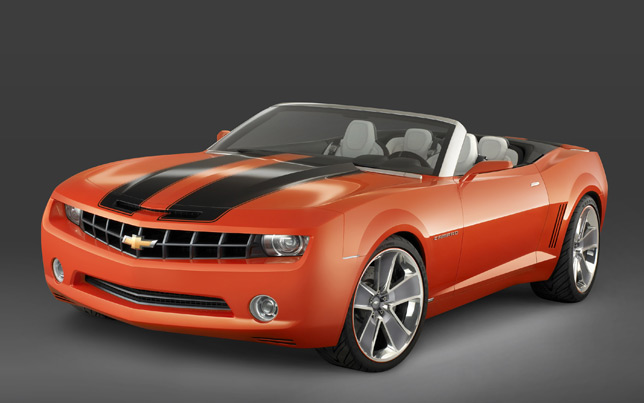
Chevrolet Camaro Concept 2007 


Like the Camaro concept vehicle, the Camaro convertible concept blends a dramatic, forward-looking design that is mindful of the brand’s storied heritage. That design includes classic long hood/short deck proportions and a wide, wheels-at-the-corners stance that gives the vehicle the look of hugging corners even when stationary.
Additional design details include:
• Tonneau cover over the folded top
• “Halo” headlamps
• LED taillamps
• Rear spoiler with LED-lit CHMSL
• Racing-inspired fuel filler door
• Front-inlet hood scoop, inspired by the Corvette Z06
• Heritage-inspired rear fender “gills”The Camaro convertible concept’s Hugger Orange pearl tri-coat color is a contemporary update of the classic hue, which was originally offered in 1969. It is complemented with twin gunmetal gray sport stripes. The modern interpretation of the classic color and its dark accent stripes simultaneously reflect the Camaro’s heritage and deliver a deep, lustrous and thoroughly contemporary appearance.
The Camaro convertible concept rides on 21-inch front wheels and 22-inch rear wheels. The wheels have a deep-dish, five-spoke design and feature charcoal center sections with bright outer edges and an orange outline on the wheel edge. The charcoal wheels complement the gunmetal gray stripes on the body.
Inspired cockpit
Inside, the Camaro convertible features a simple yet purposeful interior that reflects design elements inspired by the muscle car era, including the first-generation Camaro. A new, light-and-dark color scheme enhances the airy feel of the convertible, particularly when the top is lowered.
The seats’ fronts feature platinum-tone leather surrounding suede-like Alcantara® inserts, with black, sculpted seatbacks. The use of light color only on the seating surface is reminiscent of vintage houndstooth interiors, while a matching, tri-coat platinum paint is used to accent the door panels and instrument panel, giving a modern, bold feel to the interior.
“The light-on-dark interior coloring makes a strong statement that conveys the spirit of freedom and fun that is embodied by a Camaro convertible,” said Micah Jones, interior designer.
As with the Camaro coupe concept, the convertible concept features an instrument panel inspired by first-generation Camaros (1967 – 1969), including an intricate “round-gauges-in-square-holes” design. The gauges have a deep, three-dimensional appearance, with white faces and red pointers. “The instrument panel – including the four auxiliary gauges mounted in front of the shifter – pays homage to first-generation Camaros, while achieving a modern appearance through its refined integration of components,” said Jones.
Craftsmanship and attention to detail are evidenced throughout the interior, including the smoke satin aluminum finish on trim plates, vents, seat handles and safety belt buckles. The shifter and pedals are made of billet aluminum. The steering wheel has a detailed, deep-dish three-spoke design and the front seats are hinged at the center – rather than the sides – for an integrated appearance. A separate ignition button is used to start the engine and the speedometer and tachometer needles complete full-sweep indexing when the engine rumbles to life.
A “spine” motif runs through the center of the vehicle and on the seatbacks, including a prominent center console that stretches to the rear seat. The spine reinforces the symmetry of the Camaro convertible, as well as its precision.
An attainable icon
The original Camaro was introduced to the Baby Boomer generation, a large group of young, individualistic and mobile Americans that drove fundamental changes in the auto industry. The Camaro was personal, sporty and powerful – attributes that were typically found on more expensive, smaller and, often, foreign sports cars. The Camaro represented a real life-sized sporty car that was attainable for just about everyone. An almost endless list of optional features, colors and trim combinations ensured owners could tailor their Camaro to their exact taste.
As Boomers transitioned into larger vehicles to accommodate growing families, younger drivers embraced used Camaros as their first cars, and third- and fourth-generations of the Camaro continued to deliver affordable fun and performance to a new generation of enthusiasts. Indeed, hundreds of thousands of owners of all walks of life have found driving fun in a Camaro during the past 40 years.
The new Camaro concepts draw on their namesakes’ heritage, but also the global, youthful influences of the 21st century. These influences are seen in the Camaro convertible concept’s bold proportions, tailored wheel-to-body relationship and detailed interior – including the multi-dimensional instruments. It’s a design that resonates with a generation of younger car buyers influenced by highly stylized “tuner” cars and import sports cars.
“Youthful buyers want a car that makes a statement in its design as much as its performance,” said Brian Smith, exterior designer. “The new Camaro concepts bridge heritage with contemporary style, with a design that is simultaneously admired among import-influenced youth and traditional enthusiasts.”
Along with style and performance, the timeless spirit of fun is woven into the new Camaro concepts.
“Camaro has always represented the American ethic that style and performance don’t belong exclusively to the wealthy,” said Smith. “Camaro has always been everybody’s sports car, and these new concepts demonstrate its spirit is relevant for a new generation.”


