Tag: Bugatti

  • Turbochargers Explained

    Turbocharged-badge-thumbEver wondered how WRC cars manage to deliver 300 bhp and above from an engine that, by rule, cannot exceed 2.0 liters of displacement? How on earth do the heavy, low-revving diesel engines in cars today stay competitive? Or what is it that makes it possible for the Bugatti Veyron to break the 1000 bhp threshold? Well, it certainly isn’t witchcraft. By means of “forced induction”, turbochargers today boost the automotive industry to a new direction of smaller, more-efficient and bloody good fun engines.

    Volkswagen like to brand their most successful turbo diesel range as TDI while Porsche, being more plain about it, call their turbocharged cars, Porsche (insert model here) Turbo. BMW, on the other hand, would never hesitate to utter their own terms like “bitrubo” or “TwinPower” whenever describing the latest M5 engine. The variety of depicting turbocharged cars is bountiful, but essentially the principles of work remain the same in every case.

    Beware reader, as I am now going to get technical:

    In order to understand how a centrifugal turbocharger works, one must also have some basic knowledge on how four-stroke, piston engines work. We have an engine block that contains the cylinders, right? Inside each cylinder, a piston moves up and down. Every movement made is a phase, a stroke. First we have intake – a mixture of fuel and air is sucked into the cylinder. Compression is the second stroke where the cylinder moves up and…well…compresses the molecules in the mixture. The next ignition stroke is downwards as the piston experiences pressure coming from the combustion of the mixture. The exhaust stroke has the job to expel the remaining gases through the exhaust valve. Then the intake valve lets in a new batch of fuel mixture and thus the process is repeated.

    However, as far as turbochargers are concerned, exhaust gases are not exactly throw-away material. Put simply, the turbocharger utilizes the energy of exhaust to compress the the newly arrived batch of air which is to be shoved in the cylinder. More air molecules means that more fuel can be injected into the mixture and more fuel means more power.

    Before those exhaust gasses reach the exhaust system they go trough a turbine connected to a shaft. The more exhaust that goes through the turbine blades, the faster they spin. On the other end of the shaft we find a compressor which welcomes fresh air from the atmosphere, compresses it using the force of the turbine and then feeds it into the engine. To further increase the efficiency of the turbocharging system, an intercooler is added – it looks much like a car radiator but instead of containing cooling fluid, it holds the compressed air from the compressor. Air is denser when cooler and that’s exactly what the intercooler does – it cools the incoming air.
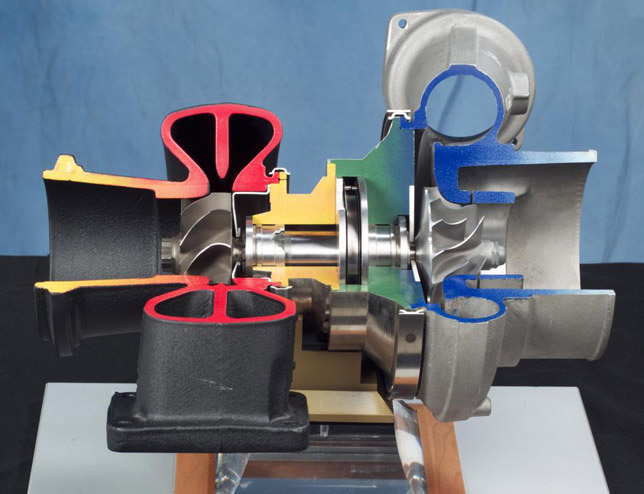
    Cut-away view of a turbocharger held by a foil-bearing
    Cut-away view of a turbocharger held by a foil-bearing

    There are issues however. First of all, a turbine amidst the flow of exhaust is essentially an obstacle. The exhaust stroke has to deal with more back-pressure thus being slightly less efficient. A functional turboshaft has to handle extreme forces (speeds go up to 150 000 rpm within the turbocharger) so a special kind of baring is needed – liquid ones or state-of-the-art ball bearings. The latter is more efficient but more expensive. Then there’s the dreaded turbo lag. The problem here is that when you put your foot down, the response is far from electric. The turbine needs some time to kick off and start spinning the compressor blades. That’s why at low engine rpm one can’t really tell if the car has a turbo or not.

    There are various ways to tackle this nuisance. Make things smaller and lighter. Tiny turbochargers will grant you that off-the-line jolt but won’t be too good on the upper rpm range. Besides, if too much exhaust starts going through a relatively small turbine things may get hot and disbalanced. Usually however, there’s the wastegate in most turbines – a valve that knows how much exhaust passes through and regulates the flow by simply diverting some of the gases away from the turbine. Some companies have started putting more than one turbochargers in their cars. One small and the other, big. The small one guarantees a more immediate response while the big one takes over at higher speeds.

    Essentially, that’s the story with turbochargers. We can further dive into numbers and calculations about pressure and efficiency but this, I think, is already nerdy enough. Hopefully some of you learned something new while others refreshed their memory on how the turbocharger brings easy power to our everyday lives.

  • Bugatti Veyron Grand Sport Vitesse – full specs

    Bugatti has unveiled the Veyron Grand Sport Vitesse at the Geneva Motor Show. Now, the manufacturer has released full details about the new convertible Grand Sport.

    2012 Bugatti Grand Sport Vitesse is powered by an 8.0 liter W16 quad-turbo engine with mind blowing 1200HP (883 kW) and 1500Nm (1106 lb-ft) of torque. The engine is paired with a 7-speed DSG gearbox. It sends all that torque to an AWD system. 0-100 km/h in 2.6 seconds and to 200 km/h in 7.1 seconds, to 300 km/h in 16 seconds dead. The top speed is 410 km/h (254 mph).  ¼ mile is covered in 10.0 seconds flat and 1 mile in just 25.0 seconds.

    Other interesting disciplines like 0-100-0 km/h take 5.9 seconds and 0-200-0 take 12.9 seconds. The interesting 0-300-0, which is brutal for the brakes take 23.9 seconds.

    The official fuel consumption is 23.1 liters per 100 km on average cycle and the city cycle is around 37.2 liters per 100 km, so the owners will visit gas stations very often.

    The overall weight of the vehicle is 1990 kg and the fuel tank can take up to 100 litres of fuel or around 250 km range in city.

    The suspension features three different settings: Standard, Handling and Top Speed.

    The brake system includes 400 mm front discs with 8 piston calipers and 380 mm discs at the rear with 6 piston calipers.

    2012 Bugatti Veyron Grand Sport Vitesse Jet Grey
    2012 Bugatti Veyron Grand Sport Vitesse Jet Grey
    General
    Length 4462 mm
    Width 1998 mm
    Height 1190 mm
    Wheelbase 2710 mm
    Curb weight 1 990 kg
    Max. laden weight 2 240 kg
    Tank capacity 100 l
    Drivetrain
    Engine W16
    Displacement 7993 cm3
    Power output 1200HP (882 kW) at 6400RPM
    Torque 1500Nm at 3000RPM
    Bore 86
    Stroke 86
    Compression ratio 8.3:1
    Gearbox 7-speed DSG
    Drive AWD
    Power distribution Front axle differential with Haldex
    Clutch, rear axle with transverse
    Differential lock
    Suspension
    Wheel suspension Double wishbone front/rear
    Max. weight per axle 1010/1230 front/rear kg
    Tyres front 265-680 ZR 500A
    Tyres rear 365-710 ZR 540A
    Tyre pressure 3.0 bar front/rear
    Suspension height Standard – 115/155 mm, Handling 80/95 mm, Top speed 65/70 mm (front, rear)
    Brakes
    Brake disc diameter 400 mm / 380 mm (front, rear)
    Brake disc material Ceramics
    Pistons per caliper 8 /6 (front, rear)
    Brake pads 4 / 2 (front rear)
    Performance
    Top speed 410 km/h
    Acceleration
    0-100 km/h 2.6 seconds
    0-200 km/h 7.1 seconds
    0-300 km/h 16 seconds
    ¼ mile 10.0 seconds
    1 mile 25.0 seconds
    Lateral acceleration 1.4g
    Braking distance 31.4 m 100-0
    Acceleration and braking
    0-100-0 km/h 5.9 seconds
    0-200-0 km/h 12.9 seconds
    0-300-0 km/h 23.9 seconds
    0-100-0 mph 9.5 seconds
    0-200-0 mph 27.1 seconds
    Gearbox shift time 0.1 seconds
    Fuel consumption
    City cycle 37.2 l/100 with 867 g/km CO2
    Highway cycle 14.9 l/100 with 348 g/lm CO2
    Combine cycle 23.1 l/100 with 539 g/km CO2
    Fuel type Super lead free 98 RON/ ROZ
    Max rate of gear at 6500RPM
    1st 104 km/h
    2nd 148 km/h
    3td 197 km/h
    4th 257 km/h
    5th 313 km/h
    6th 377 km/h
    7th 410 km/h
    Aerodynamics
    CW-Value
    Standard 0.39
    Handling 0.48
    Top speed 0.36
    Airbrake 0.69
    Wing/ spoiler angle
    Standard Retracted 6 cool-down position
    Handling with rood/without roof 16 / 27, 21 / 27
    Top speed 3
    Brake setting 55 / 27
    Special features Central hyndraulics / double diffusor
    Three suspension heights
    Standard For town traffic and speeds of up to 180 km/h. From 180 km/h,

    automatic configurations switches from Standard to Handling

    (flaps in front diffusers open)

    Handling For open roads and highways or manually selectable for race

    tracks (flaps in front diffusers open)

    Top speed For very high-speed driving (over 375 km/h), manually

    selectable with separate key (flaps in front diffusers closed)

    Source: Bugatti

  • Bugatti Grand Sport Vitesse Debut at Geneva

    Bugatti-Veyron-Grand-Sport-Vitesse-thumbThe Lamborghini Aventador J that is currently on a stand at the Geneva Motor Show is without question a magnificent looking roadster. Powerful too, with 700 BHP to play with. But, its mad looks and the fact that it has no windshield render it a bit silly. It shouldn’t be taken as a joke in any case, it can still shed your face off, but it’s all a bit of fun, it relies on flamboyancy and spunk. It beats its chest that it is what it is – a Lamborghini titan of hypercars.

    However, the Aventador J does not, in any possible way, overshadow that other roadster at the show. I am talking about the god of hypercars (with a haircuts) – Bugatti Veyron 16.4 Grand Sport Vitesse.

    As far as the figures are concerned, today this is the fastest open-top in the world. The Vitesse builds on the success of the previous Grand Sport that had “mere” 1001 ponies at its disposal. Now, by overhauling the four turbos and intercoolers, Bugatti have made the Vitesse more Super Sport-worthy. Let’s sum it up: a 7.9 liter W16 engine that brings 1,200 BHP and 1500 Nm of torque to all four wheels. The top speed is 410 kph or 255 mph (limited to 375 kph/233 mph). A zero to sixty time – 2.6 seconds. Yikes!

    Bugatti Veyron Grand Sport Vitesse
    Bugatti Veyron Grand Sport Vitesse

    That new-found power has triggered an inevitable chain reaction that jolts trough the whole Veyron construction. Bugatti has promptly reinforced all drivetrain components in order to safely transfer the immense forces at any given moment. The bits within the 7-speed DSG gearbox have been specially modified to cope fairly with the new stresses. The same goes for the airflow that used to run through the components of the previous Grand Sport. It has now been further optimized. Ironically, somehow with the more power, the fuel economy has also been improved.

    The chassis has had some work done. New, “quick-responding” dampers have been fitted which literally obliterate the possibility of body roll or pitching during braking or accelerating. The ESP has been revised to “lag” just a little bit after shooting out form a corner so that you can have that millisecond of slipperishness. Additionally, the brakes are now being cooled more efficiently in order for them to cope with the increased power.

    Many aerodynamic components from the Super Sport have been picked off, redesigned and stuck to the Grand Sport Vitesse. At the front, bigger air intakes around the center grille, slashed with a line horizontally, give the car some identity. The bottom air vent stretches sideways into the wheel housing and gives this exceptional sports car an extremely masterful appearance. Further down, there is a newly made front spoiler. The Headlights, with their black frames are also new. The rear end also comes from the Super Sport but with two diffusers and two tailpipes clustered in the middle. All-new, lighter 20-inch “Vitesse”-type alloy wheels complete the picture

    The two highest points of the car are the air scoops on the engine cover. Familiar from the Grand Sport, these are now again redesigned for the Vitesse and also act as components of an anti-roll protection system. Needless to say, that just like its predecessor, the Vitesse is virtually made all from carbon fiber.

    Since you can go your way with the customization process, the end products may vary. That is why at the Geneva Motor Show there are two Vitesse configurations – one is in a strikingly blue, exposed carbon fiber finish and the other in “JetGrey” coating with an orange interior and black rims and grille. For the more conventional Veyron fans there’s also a classic Grand Sport version present just to remind you that it still exists.

    Bugatti Veyron Grand Sport Vitesse
    Bugatti Veyron Grand Sport Vitesse

    Source: Bugatti

  • 2012 Bugatti Grand Sport Vitesse

    Bugatti has celebrated the world premiere of Grand Sport Vitesse in Geneva Molsheim. 2012 Bugatti Grand Sport Vitesse is the most powerful roadster of all time.

    It is powered by an 8.0-liter sixteen-cylinder quad-turbo engine with 1200HP (882 kW) at 6400 RPM and 1500Nm (1107 lb-ft) at 3000RPM. The official top speed is 415 km/h and 0 to 100 km/h is just 2.5 seconds. However, the Grand Sport is able to top 431 km/h.

    The Vitesse therefore also ensures the supreme range of excellent features one would expect of a Bugatti super sports car, from precise driving dynamics to extraordinary acceleration and braking.

    “The rapid success of the Super Sport convinced us to increase the performance of the Bugatti roadster. Once again our engineers worked hard to demonstrate that Bugatti is able to constantly redefine the boundaries of what is technically feasible,” commented Bugatti President Wolfgang Dürheimer.

    “We did our utmost to transfer the achievements of the Super Sport over to the Grand Sport, thereby turning open-top driving itself into an extraordinary experience at high speed.”, he finished.

    2012 Bugatti Grand Sport Vitesse
    2012 Bugatti Grand Sport Vitesse

    Source: Bugatti

  • Most Collectible Cars from the Present

    2013-bugatti-veyron-ThumbHere is a short list of some of the most collectible cars from the present, which in my opinion, are going to cost even more amount of money in the near or distant future. They are unique in several aspects, including style, speed, expense and produced examples of their particular model. Such cars are driven for prestige and are considered as a symbol for high status.

    Let’s start with Dodge Viper, which undeniably is one of the most famous cars ever produced. Its production started back in 1992 and continues till now. The vehicle has 6 speed manual transmission which allows the person behind the wheel to experience the excitement of driving. Moreover it is usually equipped with very powerful engine which produces a pleasant roaring sound and in some versions achieves the whole 600 hp (442 kW). Therefore, if you seat behind the steering wheel with the aim to achieve the top speed, then you’ll get up to 202 mph (325 km/h). Undoubtedly, this model is an emblematic one for the American automotive history and I am sure that one day models will cost a lot.

    2010 Dodge Viper SRT10 ACR-X
    2010 Dodge Viper SRT10 ACR-X

    Next comes the Chevrolet Corvette ZR1, which production started in the near past – in 2009 and since then it is still being produced. Although it has a short history, it is the most powerful Corvette ever made. It includes six speed manual transmission, but unlike the previous discussed vehicle, it can produce the astonishing 638 hp (470 kW) at 6,500 rpm of torque. The top speed here is 205 mph (325 km/h)! It definitely deserves the investment, because it is going to be one of the most desirable collectables in the future.

    2012 Chevrolet Corvette ZR1
    2012 Chevrolet Corvette ZR1

    Here comes the luxury Mercedes-Benz SLR McLaren without which the sport car industry wouldn’t be the same. Its production began in the 2003 and lasted till 2010. Unlike the Corvette and the Viper, it has five speed automatic gearbox. Here the Mercedes achieves the 617 hp (454 kW) at 6,500 rpm, but its maximum speed is higher than Corvettes. This vehicle can reach up to 208 mph (335 km/h). And the price as well is far grater than the ZR1’s. The last one costs around $100 000. The Mercedes however, is estimated around $ 450 000. What is so typical and emblematic about this model, are its unmistakable gullwing doors.

    Mercedes-Benz SLR McLaren
    Mercedes-Benz SLR McLaren

    There is a real rarity present to our attention – the two door coupe named Lamborghini Reventón, which production lasted just one year (from 2008 till 2009). What makes this car so special and priceless is that you can’t see it on the streets very often. And this isn’t due to its high price (which by the way is estimated around $1.6 million dollars), but due to the fact that there is only twenty of it produced! This beauty, has a six speed manual or six-speed paddle shift transmission, and as you expect its engine is a powerful V12 6,5 liter one. Hence, it produces the astonishing 650 hp (478 kW) at 8,000 rpm of torque. The top speed is exactly 211 mph (340 km/h).

    Lamborghini Reventón
    Lamborghini Reventón

    Without a doubt a collectible one is Bugatti Veyron, for anyone who can afford it of course. It costs around 1,7 million dollars and since 2005, when it production started, is one of the most appealing cars to the famous people. Its acceleration, which for only 2.5 seconds goes from 0 to 100 km/h, is due to the unbelievable 1001 hp (736 kW) at 6,000 rpm! And not to forget the maximum speed of 268 mph (431 km/h) which makes the car one of the fastest cars in the world! But wait this is not all! The new hyper car model, which is going to make its debut in 2013, will be also powered by the famous 8.0 liter W16 quad-turbo engine mated to a 7-speed dual-clutch gearbox. Moreover, it is expected to achieve more than 1200 hp (895 kW)! This makes it a real collectable car even before its official release, isn’t it!

    2013 Bugatti Veyron
    2013 Bugatti Veyron

  • Bugatti Veyron 16.4 Grand Sport at Qatar International Motor Show

    Bugatti thumbThe legendary European manufacturer Bugatti took part in this year’s Qatar International Motor Show. This is the second time, in which the brand takes part in the Motor Show. This time, Bugatti has just presented an exclusive and uniquely colored model of the Bugatti Veyron 16.4 Grand Sport. In details this is the fastest, most powerful and most luxurious open top car in the world.

    The model has a unique color and is made from unique materials, thus making it unique car. It has a horizontal color split with a bright yellow body framed in visible black carbon, including black-tinted wheels. This impressive color contrast is continued inside in the interior of the car with seats finished in yellow-colored leather with black stitching. Additionally, the middle console is in black carbon, while the dashboard, steering wheel and gearshift are made of black leather with yellow stitching. And if you wonder how much such piece of art would cost, well you have to be prepared to hear the sum of 1.58 million Euros. Not a car for anyone, isn’t it?

    Bugatti Veyron 16.4 Grand Sport
    Bugatti Veyron 16.4 Grand Sport

    To go further into details, the last sale of Bugatti Veyron coupé was in June 2011. With this it marked an end to the successful era and exclusive production run of 300 units of the supercar and its even faster cousin the Super Sport. Now the Bugatti Veyron 16.4 Grand Sport includes supreme technology. For example when the roof is on, the vehicle can reach a top speed of 407 km/h, while speeds of up to 350 km/h are possible with the roof off. It is not a surprise therefore, that this makes the Grand Sport the fastest roadster in the world! Moreover the Bugatti Veyron Grand Sport 16.4 will be assembled by hand at the company’s headquarters in Molsheim, France. Of course, the customers will have the opportunity to tailor their vehicles to their personal preferences and taste by choosing from a broad array of exquisite materials and colors. This model which is on display in Qatar, demonstrates an ever growing number of options. However Bugatti Automobiles S.A.S. has limited the Grand Sport to only 150 units of which 105 slots are still open.

    Source: Bugatti

  • Top 3 Most Expensive Celebrity Cars

    The first place goes to Jay-Z’s Maybach Exelero with the cost of the $8 000 000. Beyonce’s husband obviously can provide such ride for him, his DIVA and their upcoming baby. You can even see this “look-like-a-batmobile” vehicle in his video for the song “Lost One”. The optimum speed of this unbelievably expensive car goes up to the number of 351.45 km/h (218.38 mph). Moreover it’s acceleration from 0 to 100 km/h is achievable only in 4.4 seconds. And all this the superstar gets despite the weight of the vehicle, which is the whole 2.66 tones! Maybah Exelero is a high-performance German luxury sports car that was originally made as a one-off for Fulda Tires back in 2005. However nowadays Maybach decided to manufacture them for the general public. I guess only the rich ones can afford them!

    Maybach Exelero
    Jay-Z and Maybach Exelero

    The second place deservedly goes to the Rapper Birdman with his purchase of Bugatti Veyron for the $2 000 000. And although you might think the sum is far less than Jay-Z’s, this car is absolutely worth the price! This European car is one of the most expensive ones in the world, but also is the fastest street legal car in the world! This mid-engine grand touring car has a top speed of 408.00 km/h . In comparison to it, the Super Sport version is much faster with a top speed of 431 km/h (268 mph). The fact you might not know is that it was originally based on the Bentley Hunaudieres concept, and designed and developed by Volkswagen Group. More details about the vehicle is that it features an 8.0 litre quad-turbocharged W16 cylinder engine, which is the equivalent of the two narrow-angle V8 engines.

    Bugatti Veyron
    Rapper Birdman and Bugatti Veyron

    Not surprisingly probably for anyone, the third place goes again to …. Bugatti Veyron. This time on the driver’s seat is Simon Cowell – the Super Super-Producer, best known for American Idol and X-Factor. Of course, given these facts, we can imagine that the sum of the $1 700 000 wasn’t a heartbreak for Simon. What we haven’t said about the car already is its acceleration, which for only 2.5 seconds goes from 0 to 100 km/h. And not to forget the maximum speed of 431 km/h (268 mph) which makes the car the one of the fastest car in the world (sorry Jay-Z!). And obviously Simon Cowell has a very good taste for cars and likes to collect them, because in his “backyard” you can also see Ferrari, Rolls Royce Phantom, and 100EX Cabriolet.

    Bugatti Veyron
    Simon Cowell and Bugatti Veyron
  • Nissan Skyline GT-R R34 900HP vs. Bugatti Veyron 1001HP

    The reaction time in drag racing is almost as important as the power of your car, because you may have less horsepower than you opponent and still win. However, in this case, the reaction time doesn’t matter and the more powerful car is a winner with few thousandths of a second.

    The epic battle is between Bugatti Veyron and highly tuned Nissan Skyline GT-R R34. The run is on one mile and as you can see in the video, the GT-R R34 is in front all the time, because of the superb reaction time and the better ¼ mile time. The power-to-weight ratio is extremely important, when the race is at ¼ mile (402.33 m)and much less, when it is on a full mile (1.609 km).

    Bugatti Veyron stops the clock at 10.523 at ¼ mile with 223 km/h and 26.122 at one mile with 328 km/h, while the Skyline GT-R R34 achieved 10.426 at ¼ mile with 216 km/h and 26.154 at one mile with 311 km/h.

    Bugatti Veyron is powered by a 8.0 liter quad-turbocharged sixteen-cylinder engine delivering 1001PS (736 kW) and 1250Nm (922 lb-ft) of torque.

    The original Nissan Skyline GT-R R34 is powered by a 2.6 L twin-turbo inline-six with 332PS (244 kW) and 392 Nm (289 lb-ft).

    httpv://www.youtube.com/watch?v=uoEJR3mRTek

    Bugatti Veyron vs Nissan Skyline GT-R R34
    Bugatti Veyron vs Nissan Skyline GT-R R34

    Source: Dragtimesinfo via Youtube

  • Bugatti Grand Sport Middle East Editions

    At the Dubai International Motor Show the legendary French brand presents three very special models of the Bugatti Veyron 16.4 Grand Sport, which is the fastest, most powerful and exclusive open top car in the world.

    There will be three models, which fully stand in the tradition of Ettore Bugatti’s constant strive to use new colour schemes and materials to provide his clientele with unique cars for its exclusive taste. Today Bugatti is still expanding the possibilities of options to offer more and more sophisticated individualisation.

    The first Grand Sport on display at Dubai Motor Show has a horizontal colour split with a bright yellow body and a underside in visible black carbon, including black-tinted wheels. The striking contrast of black and yellow, Ettore Bugatti’s favorite colours, is continued by seats finished in yellow-colored leather with black stitching. The middle console is in black carbon, while the dashboard, steering wheel and gearshift are encased in black leather with yellow stitching. This Grand Sport model comes at a price of €1 580 000

    The second individualized Grand Sport model is also presented in a two-tone horizontal colour split consisting of visible blue carbon, framed in polished, anodised aluminium. The rims are highlighted in an aluminium polished and Diamond Cut two-tone finish. The grills at the front and the air intakes are in aluminium with a mirror shine finish. The interior of this car is finished with tangerine leather throughout. Only the door panels, dashboard, steering wheel and console are covered in dark blue Indigo leather or exposed blue carbon fibre, with tangerine stitching on the steering wheel and gearshift knob. This special edition model has a price of €1 740 000.

    The third Grand Sport comes in the newly developed green carbon fibre tone with polished aluminium. This special model takes up the traditional Bugatti two-tone-specification. The rims, the exterior rearview mirrors and even the EB-logo at the rear are of polished aluminium to create an elegant and harmonious overall appearance. The interior, especially and tastefully selected, is also dominated in green and silver which matches perfectly with the flamboyant exterior. The third Dubai Motor Show 2011 special edition model will be delivered at a price of €1 740 000.

    Bugatti Grand Sport Middle East Editions
    Bugatti Grand Sport Middle East Editions

    Source: Bugatti

  • Bugatti Veyron Grand Sport L’Or Blanc

    Bugatti has unveiled Veyron 16.4 Grand Sport L’Or Blanc (“White Gold”) in Berlin. This is a unique model featuring the finest porcelain on its body, as well as in its cabin.

    “At first, it seems to be an unusual idea to use porcelain in a car, especially in the world’s fastest convertible,” comments Dr. Stefan Brungs, Director of Sales and Marketing at Bugatti Automobiles.

    “But this is what Bugatti stands for: the realization of exceptional ideas whilst striving for the utmost in quality and aesthetics. This allows us to continue Ettore Bugatti’s heritage, who himself loved to experiment with new materials.”, he added.

    Bugatti Veyron 16.4 Grand Sport is powered by a 8 liter 16-cylinder quad-turbo engine with 1200hp at 6400 RPM and 1500Nm between 3000 and 5000RPM. The official top speed is 415 km/h and 0 to 100 km/h is just 2.5 seconds. The car made 431 km/h during a test.

    The L’Or Blanc is priced at €1 650 000.

    Bugatti Veyron Grand Sport L'Or Blanc
    Bugatti Veyron Grand Sport L'Or Blanc

    Source: Bugatti

  • Bugatti at Auto Shanghai 2011

    At the display of Auto Shanghai 2011, Bugatti has showcased its latest two extremely-fast, state-of-the-art rides, the Bugatti Veyron 16.4 Grand Sport and Bugatti Veyron 16.4 Super Sport. (more…)

  • Bugatti Galibier goes into production

    Bugatti 16C Galibier Concept was unveiled before year and a half and now the car will go in production. However, it will hit the market in 2013 or 2014 with a base price of 1 000 000 EURO, that’s right – 1 million. 16C Galibier Concept officially debuted at the the 2010 Geneva Auto Show.

    “Four-door vehicles open up a whole new market for exotic- car makers,” commented Kevin Tynan, an automotive analyst for Bloomberg Industries.

    “It makes good sense for Bugatti to get in there. Those cars are loyal to design language and brand heritage.”, he added.

    16C Galibier is powered by the same engine as Veyron – 8.0 liter sixteen-cylinder engine, but the power will be between 800PS (588 kW) and 1 000PS (735 kW).

    Stay tuned for further details!

    Bugatti Galibier

    Source: Bloomberg