Tag: BMW

  • BMW i3 and i8 at the Frankfurt Motor Show

    BMW exhibits the ECO-friendly concepts i3 and i8 at the 2011 Frankfurt Motor Show. Both vehicles will set a new bars in turn of efficiency.

    The small i3 Concept is a four-seater city car with 5 doors, which is powered only by electric motor, but with astonishing power – 170PS (125 kW) and 250Nm (184 lb-ft) of torque. There is a lithium-ion battery package delivering up to 160 km (100 miles) range. 0 to 100 km/h in 7.9 seconds and top speed of 150 km/h (93 mph). The overall weight of the vehicle is 1250 kg (2755 lbs). BMW i3 is perfect for everyday driving with its range and once the battery is depleted, it can be recharged in just 6 hours to 100%.

    The i8 Concept is completely different vehicle. It comes with a turbocharged 1.5-liter three-cylinder petrol combined with an electric motor. The total power is 353PS (260 kW) and 550Nm (406 lb-ft) of torque. 0 to 100 km/h in 4.6 seconds and top speed of 250 km/h (155 mph). The curb weight of the vehicle is 1480kg, so the results are impressive.

    The i8 can go on electricity alone up to 35 km (20 miles), which means that you’ll need just 2.7 liters of fuel per 100 km and the CO2 emission are as low as 66 g/km.

    BMW i8 Concept Rear
    BMW i8 Concept Rear

    Source: BMW

  • Brabus vs G-Power (part 2)

    To continue the epic battle between the two of the most brutal tuning companies on the market -G-Power and Brabus, now we will compare BMW M3 E92 SK II and BULLIT. Both cars are extremely powerful and expensive, of course, especially the Mercedes.

    Let’s start with the less powerful G-Power BMW M3 E92 SK II, which is based on the sports compact executive M3 Coupe. It is powered by the well-known high-revving 4.0 liter V8, which is now boosted to the exquisite 570PS (419 kW) and 565Nm (417 lb-ft) of torque.

    The performance is awesome – 4.4 seconds to 100 km/h and just 12.9 seconds to 200 km/h. The top speed is somewhere around 333 km/h. Actually, you can check the tuned M3 doing that in the video below.

    httpv://www.youtube.com/watch?v=8pXrWx2CV3g

    Besides the incredible acceleration, G-Power SK II also has incredible deceleration system consisting of 396 mm diameter discs on the front axle with 6-piston calipers and 380mm discs at the rear axle with 4-piston calipers. The high-performance brake system alloys decellerations beyond 1.0g.

    Other upgrade is the GM3 RS coilover suspension and Silverstone alloy wheels fitted with Michelin Pilot Super Sport road tires.

    The overall price is not calculated, but BMW M3 E92 starts at €68 750 and the “Sporty Drive” supercharger kit is priced at €11 500.

    Continuing with Brabus Bullit based on the mighty Mercedes AMG C 63 AMG originally producing 457PS and 600Nm of torque from the most powerful naturally aspirated 6.2 liter V8 in the world. However, Brabus decided that this engine is not good enough and they fitted the small C-Class with enormous bi-turbo V12. It develops 730PS (540 kW) at 5100RPM and 1320Nm (970 lb-ft) of torque from 2100RPM.

    The performance – 0 to 100 km/h in 3.9 seconds, to 200 km/h in 10.5 seconds and top speed of more than 362 km/h (225 mph). The car is way more powerful and faster than the G-Power SK II and still it is street-legal.

    Brabus Bullit also features a modified 5-speed transmission, a LSD, full aerodynamic body kit, huge brakes and an adjustable rear suspension. The car also has an aluminum hood with ventilation slots and Brabus wheels fitted with high-performance tires.

    The interior boasts custom sports seats with carbon fiber covers and carbon fiber elements.

    The price for this pleasure is no less than €348 000.

    The conclusion is easy – Brabus Bullit rocks!

    G-Power BMW M3 E92 SK II
    G-Power BMW M3 E92 SK II
    Brabus Bullit Black Arrow
    Brabus Bullit Black Arrow
  • BMW Alpina D5 Bi-Turbo

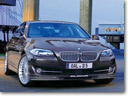
    Alpina has introduced one more vehicle – D5 Bi-Turbo based on 535d. It comes with one of the most powerful diesel engines in the world.

    In other words – 350PS (257 kW) coming from a 3.0 liter twin-turbo straight-six diesel, which has the same fuel-economy rating as the 530d with 245PS (180 kW) – 6.2 liters per 100 km on combined cycle. Not bad for such amount of power, not bad at all! 0 to 100 km/h in just 5.2 seconds and a top speed of 270 km/h (168 mph). That is the reason why 535d is called ///M diesel.

    The mighty engine is mated to the new ZF SWITCH-TRONIC 8-speed Sport Automatic gearbox. It is further improved to handle all new torque.

    The stance is improved by adding a set of lowering springs. There are also a set of 20” Alpina alloy wheels fitted with Michelin Pilot Super Sport tires in dimensions – 255/35 ZR20 at the front and 285/30 ZR20 at the rear.

    BMW Alpina D5 Bi-Turbo
    BMW Alpina D5 Bi-Turbo

    Source: Alpina

  • BMW Alpina B6 Bi-Turbo Convertible

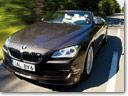
    One of the most interesting and eagerly awaited cars was revealed at the 2011 Frankfurt Motor Show. BMW Alpina B6 Bi-Turbo Convertible is based on the well known 650i model.

    The all-aluminium bi-turbo V8 power plant boasts 507PS (373 kW) and staggering 700Nm (516 lb-ft) of torque, which is an increase of 100PS (74 kW) and 100Nm (74 lb-ft). So, there is no coincidence. 0 to 100 km/h in 4.8 seconds and a Vmax of 311 km/h (193 mph). Still, the vehicle manages to achieve an average 10.9 litres per 100 km and 255 g/km of CO2.

    Alpina B6 Bi-Turbo Convertible also comes with complete aerodynamic package including front and rear bumpers and side skirts. There are also a four-tailpipe Akrapovic sports exhaust system and huge 20” alloy wheels in the well-known design fitted with Michelin Pilot Super Sport tires.

    The B6 Bi-Turbo Convertible features an extensive range of standard equipment, including leather upholstery, fully adjustable comfort seats with heating system, navigation system with preparation for Bluetooth mobile phone, USB audio interface, Xenon lights and LED fog lights.

    BMW Alpina B6 Bi-Turbo Convertible
    BMW Alpina B6 Bi-Turbo Convertible

    Source: Alpina

  • BMW 1-Series Performance Upgrades

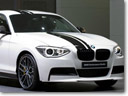
    BMW will exhibit a number of Performance Accesorries for the new 2012 1-Series at the 2011 Frankfurt Motor Show. The newly developed range for the interior includes a variety of products the design of which perfectly adapts to the character of the BMW Lines. These features are exclusive available for 1-Series for the first time.

    The Performance Package includes a new front and rear bumpers, modified side skirts and carbon fiber mirrors. The suspension is also improved and lowered for perfect stance and handling.

    Last, but not least, M GmbH added nice 19” alloy wheels and big performance brakes behind them.

    The interior boasts a sports steering wheel, some carbon fiber and Alcantara and new floor mats. The changes are more likely to catch your attention, instead of helping the car to move faster.

    Still, BMW Performance power kit for the BMW 135i will be available. It will boost the 3.0 liter twin-turbo six-cylinder engine with 20PS (15 kW) to 326PS (240 kW). The power unit is mated to a 6-speed automatic transmission or 7-speed double-clutch sports automatic transmission.

    There is no price list for the products, yet!

    BMW 1-Series Performance FrontSide
    BMW 1-Series Performance FrontSide

    Source: BMW

  • CLP BMW M3 GT

    BMW M3, designed at the Bavarian engine works, a sports car of high power, in the road traffic or on the race circuit, currently convinces in its fourth generation. The high level of perfection and attention to the parts from the supplier plant make the M3 a Brocken powerful mountain in relation to the modification topic.

    CLP Automotive, the company specializing in the body kits, from the city of Georgensgmünd, Germany, responds to this challenge and is proud to provide BMW M3 GT, the top-class car.The long set of CLP, called, the “Interceptor”, which transmits its name to the BMW M3 GT, and which should be paid 8880 euro for, is responsible for the optics.

    In a set you will receive:

    • the forebody section carbon facing
    • the motor hood
    • the front wing
    • the side channel bar
    • the sidewall jet
    • the rear apron
    • the rear spoiler

    CLP BMW M3 GT - Front Angle

    The solid 9 and 12×19 inch sports disks shine not only because of its white color, adapted to the rest of the car, but also due to the optical adapter plugs of the delayed firing, which gives the wheel a central attachment optics.

    The power increase, based on the compressor, the responsibility for which lies on the 600 hp, can be found under the bonnet along with the optimized Bilstein-thread of the running gear, which monitors the binding driving pleasure. The Akrapovic titanium exhaust system – naturally with the suitable modified exhaust pipe – completes the set and contributes to the acoustic link.
    There are the Recaro bucket seats and the modified fixture in the CLP-M3 GT saloon for the overtaking from Wiechers for the binding security. Naturally, the weight optimization is taken into consideration and is persistently carried out.

    The total cost of the reconstruction is 69.000 euro.

    Source: CLP Automotive

  • Brabus vs G-Power

    Brabus was founded back in 1977 and specializes in tuning for prestigious vehicles from Mercedes-Benz, Smart and Maybach. The tuning company is famous with the performance upgrades offered for the most powerful Mercedes’ engines. Furthermore, Brabus offers entire aerodynamics packages for almost every available model as well as a number of interior modifications.

    G-Power was founded 6 years later than Brabus. The specialists from G-Power specializes in tuning BMW cars. The tuning company became very famous recently with their several world records like that one for fastest saloon car in production – M5 Hurricane RR.

    It is difficult to say, which tuning company is better, but one thing is for sure – both are just brutal. They fit extremely powerful engines to production cars, enormous rims with ultra-performance tires, huge brakes and proper suspensions. The exterior and interior customization is also at decent level.

    To make things more interesting, we can check G-Power BMW M5 Hurricane RR and Brabus Rocket Mercedes-Benz CLS.

    Firstly, Brabus Rocket is powered by a  6.2 liter twin-turbo V12 with staggering 730PS (540kW) at 5100RPM and 1320Nm (970 lb-ft) at 2100RPM. Because of safety reasons for the gearbox, the torque is limited to “just” 1100Nm (810 lb-ft). The engine was modified from a 5.5L V12 engine block -M275.

    The performance is superb – 0 to 100 km/h in 4.0 seconds flat, to 200 km/h in 10.5 seconds and to 300 km/h in 29.5 seconds. The top speed is 365.7 km/h as this is a world record for fastest street-legal saloon.

    The price for this pleasure is 348 000 EURO.

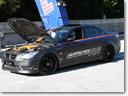
    The opponent is G-Power BMW M5 Hurricane RR having twin-supercharged 5.0 liter V10 with 800PS (588 kW) at 7500RPM and 800Nm (593 lb-ft) at 5000RPM.

    The hurricane is slightly slower to 100 km/h – 4.35 seconds, but a lot faster to 200 and 300 km/h – 9.5 seconds and 25.8 seconds, respectively. The top speed is 372 km/h, which is 6.3 km/h faster than the rocket.

    G-POWER Hurricane RR stands on 255/35 ZR 19 at the front and 305/30 ZR 19 at the rear high-performance Michelin Pilot Sport tires.

    Hurricane RR is priced at 251 100 EURO.

    So, Hurricane RR is the fastest street legal saloon on the planet … for now!

    G-POWER M5 HURRICANE RR
    G-POWER M5 HURRICANE RR
    Brabus Rocket Mercedes-Benz CLS
    Brabus Rocket Mercedes-Benz CLS
  • BMW Laser Headlights

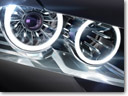
    Laser light is the successor of the successful LED headlights. BMW is developing a new laser headlights, which will be more efficient and effective.

    In the field of exterior vehicle lights, BMW also leads the way for example with full LED headlamps for the BMW 6 Series and with new developments such as the “Anti-dazzle High- Beam Assistant”, as well as with “Dynamic Light Spot”.

    A further advantage of laser lighting technology, and one which the BMW engineers intend to use to full effect, is its high inherent efficiency. A single statistic will make this clear: whereas LED lighting generates only around 100 lumens per watt, laser lighting generates approximately 170 lumens.

    Safety is a key consideration in the development of laser lighting for use in passenger cars. For BMW, the complete eye safety of this technology for all road users and its complete reliability in day-to-day use have top priority.

    BMW Vision ConnectedDrive Headlight
    BMW Vision ConnectedDrive Headlight

    Source: BMW

  • APP Europe BMW 1 M

    New BMW 1 M Coupe should logically be named M 1, but of course it can’t have such a name because M 1 usually refers to super sport cars made by BMW in 1980-s and expected new variants are excluded.

    APP Europe adopted the 1 M Coupe in Igling, Bavaria which was called the most “uncompromisingly intensive” BMW and designed a car for everyday use with a unique combination of performance characteristics and light construction; this car is suitable for both track events and personal use and pleasure.
    Basic parameters were aimed at lightweight construction and suitability for everyday use, better performance characteristics and good handling. In cooperation with System and Technology APP was able to create a new hit.

    MR. Car Design from Erfstadt is responsible for “received” power increase from 340 hp (production cars) to 410 hp. Larger intercooler, silicon tires as well as appropriate software make it possible. Undoubtedly, a crucial role in the power increase is played by the lightweight titanium exhaust system with a new muffler inlet pipe, Metallkats with larger diameter. 50% weight saving compared to mass production is a good example of effectiveness of the abovementioned system.

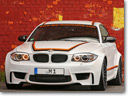
    APP BMW 1 M
    APP Europe BMW 1 M

    The steam hammer is equipped with 6 piston cramps of disk wheel braking system on the front axle and 4 piston cramps on the rear axle due to the optimization of the weight of the braking system Movit Cer Ceramic and therefore it is able for the forced braking power which is evident.
    ATS super light wheel rims with a set of P Zero tires by Pirelli perfectly fit into the whole picture and contribute to the weight savings and better maneuverability.

    A new car Variante 3 + suspension system with the direct digital control from iPhone/iPod touch App – muffler creates a link between daily comfort and absolute suitability for fast driving. An interesting processing of the tires with foil which repeats the interior color (orange, black and gray) is made by ZFZ Weilheim.

    The interior design offers lightweight seats covered with BMW-Performance artificial leather and BMW-Performance steering wheel with a display. Thanks to APP Company the car was manufactured without any hustle or time economy. It is inevitable that this car is faster than similar production models but it can comfortably be used for everyday driving. An outstanding maneuverability has been reached due to the savings made by reducing chassis especially of bare masses.

    Conversion costs without brakes: 14.000 Euro
    Brake: 20.000 Euro

    Source: APP Europe

  • 5 Most Aerodynamic Family Saloons on the Market

    BMW E90 3 Series - Front Angle View

    We have all heard the idiom “This … has the aerodynamics of a brick” at one time or another and it is not by accident that the expression has become universally popular among automotive enthusiasts. It turns out, in fact, that when it comes to aerodynamics (which in a car determines a number of characteristics, including but not limited to top speed, fuel consumption, and noise inside) you pretty much cannot do any worse. How do we know? Well, some really smart people invented the ‘drag coefficient’, which is a useful number to measure the frontal area resistance of a solid object in air or liquid. When this solid object is a brick, the number equals 2.

    Back to cars, ever since people recognized that cars and carriages are not the same thing, car manufacturers started to pay more attention to aerodynamics as part of their efforts to make their cars go faster, be more stable, and look better (although the latter turned out to be way more than a function of wind resistance). All in all, in the last half a century aerodynamics has had a crucial role in shaping our concept about the attributes of a car’s exterior.

    So what are the 5 cars of today, which are most brick-un-like in terms of their Cd (the accepted designation of drag coefficient)?

    5. Opel Insignia

    So it is not only beautiful but also efficient in the way it slips through the air. The 2009 European ‘Car of the Year’ award winner has been a total hit so far with its sales in Europe and is well-received on the US market, as well, where it appears with a Buick badge. Of course, the Insignia has its faults – the scarce rear passenger leg room is something the vast majority of automotive journalists who have tested the car agree on. Another thing they agree on, however, is its successful design, which is not only pleasing to the eye but also responsible for a Cd of only 0.27.

    4. BMW E90 3 Series

    In our minds, BMW’s have never won people over through their aerodynamic design – something which has been the reserved territory of brands, such as Citroen for example. Still, despite the fact that the little bimmer is quite different to look at when compared to the renaissance-like shapes of the Insignia, it has the same Cd value of 0.27 as the Opel. That is, only if it bears a 318i/320i badge  – the reason is that larger wheels and fatter tires, as well as a few other exterior tweaks, increase the Cd number slightly in the name of better stability and driving security.

    1-3. Japanese Wedges versus the Three-Pointed Star: A Three-Way Tie!

    There are three cars, which occupy the top of this ranking: the Mercedes-Benz E-Class, the Toyota Prius, and the Honda Insight. They all share a drag coefficient of just 0.25 and two of them – the Prius and the Insight – also share a largely similar design concept. In fact, to use the word ‘share’ would not be entirely correct because the Insight came in 2008 in response to the Prius’ considerable market success and stole its silhouette in an attempt to steal its sales. Nowadays, however, we are all quite used to automotive anonymity and other such examples abound, so it is hardly scandalous. While the two cars have the same Cd value, the Honda needs it a bit more to compensate for the smaller gasoline engine it packs (1.5 vs. 1.8 liters).

    Unlike the above two cars, whose hybrid nature and green marketing obligations force them to be as aerodynamic as possible, the E-Class Mercedes is built around the idea of comfort and luxury. It is the most prestigious and expensive car in this ranking and has the most conventional visual profile of the lot. Therefore, we consider it a small miracle that it manages to equal the achievement of the Japanese ‘eco-wedges’. Hat tip to Mercedes, therefore, as they have found a way to win in one more category without giving up any of their traditional qualities!

  • JM Cardesign BMW Z4 E85

    It is a regularly recurring process: if a car manufacturer presents a new model, its predecessor generation often seems outdated and old-fashioned all of a sudden, even though there was no reason for complaint previously. This happens at a time when the model usually has already gone through more or less intense model care. Although this kind of “spontaneous aging” is rather below average for the first-generation-BMW Z4, JM Cardesign from Bergheim performed a very special kind of face-lifting on the E85-Roadster presented here. The tuner fitted the “old” Z4 with the front pieces of the new E89 model. The front bumper and grille were modified in extensive handiwork to match the headlights, mudguards and bonnet of the E85. The result is very harmonious: even MBMW enthusiasts will take a moment to entirely identify the cross-generation transformation. JM Car Design also applied some classic craftsmanship in the area of the rear wheel runs.

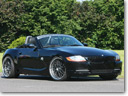
    JM CarDesign BMW Z4 E85
    JM CarDesign BMW Z4 E85

    The sheet was extended by about 30 millimetres on each side, and the wheel running edge was then re-built in the “original” look. Of course, this widening also required adjustment of the rear apron and side sills to the new situation. The latter also had ventilation openings integrated that facilitate the cooling air flow to the rear brake system (in connection with the corresponding ducts). Before the vehicle was re-painted from silver to solid black in the in-house paint shop, JM Cardesign made the antenna, which is usually located on the rear left mudguard, vanish. It is now invisibly placed in the rear bumper. The door handles, side mirrors and side indicator lights in a BMW logo shape at the doors were also equipped with coming-home-lighting LEDs by JM Cardesign.

    The car is lowered by a 3-thread chassis version KW, adjustable in several parameters (height, pressure and tensile dampening), which also provides for fresh driving dynamics. The three-part screwed Work VS XX-light-metal wheel rims with their stars in matte “Gunmetal” are also put in the best light this way; at the front, the 9×20 inches ET32 size is used – at the rear even a full 11×20 inches ET32. The fine wheels were equipped with Dunlop Sport Maxx high-performance tyres in 245/30R20 and 285/25R20 respectively. The long front end of the vehicle is given added stiffness by the Wiechers dome rod installed under the bonnet. The Eisenmann end muffler with its 76 millimetre double-end tube emphasises the deep six-cylinder sound of the Z4 3.0i audibly. JM Cardesign took action in the interior as well. Various interior parts like the dashboard cover, entrance bars, steering wheel spokes and the gear knob were painted the same colour as the car.

    Source: JM Cardesign

  • 2012 BMW 528i and Z4 Pricing – $47 575 and $49 525

    2012 BMW 528i will come with a TwinPower turbocharged 2.0-liter four-cylinder engine. The car is scheduled to hit the US market this fall.

    The new “28i” replaces the 3.0 liter version, but it is not less powerful. It features a high-pressure direct-injection, VALVETRONIC and a single twin-scroll turbocharger. 2012 528i delivers 240PS (177 kW) at 5000RPM and the torque at 1250RPM is just brutal – 351Nm (260 lb-ft).

    The 2012 528i is priced at $47 575. This is $2 505 more than the previous 2011 F10.

    2012 BMW Z4 has a price tag of $49 525, which is $2 075 more than the 2011 model.

    However, the new models offer better engine with lower fuel consumption and nice power coming from low RPM. The difference in the price is not so much and you’ll enjoy the new 2.0 liter TwinPower turbocharged four-cylinder power unit.

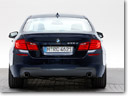
    BMW F10 M Sport Package Rear
    BMW F10 M Sport Package Rear

    Source: BMW