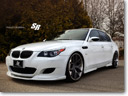
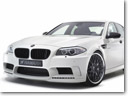
As we know, the old BMW M5 (the E60 model) is one of the most unreliable vehicles on the market. It has a lot of problems with all kind of electrical features. Still, it was a great car.
The new M5 (the F10) and the new M6 (F12/F13) also have big problems and the manufacturer has stopped deliveries of these models, because of an engine oil pump issue. The company also issued a recall on the models produced from July 2012 until September 2012. If the pump driveshaft separates from the pump rotor, the engine will lose oil pressure and that will cause critical damage… usually entirely broken engine.
In the US around 696 units are affected by this recall, which is not too much. The repair is easy and takes about two hours. This includes replacing the engine oil pump with a brand new one. It will be made free of charge and it might take longer in some cases depending on the scheduling and processing of the repair center.
So, it is very important to mention that BMW states that the affected cars should not be driven, until the problem is solved. If the owner of an M5 or M6 does notice a sudden loss of oil pressure, the car should be stopped immediately as well as the engine.
It was not long ago when we got a word from Kelleners Sportabout their work on theBMW 5 Touring F11 Series – a somewhat subtle and refined job, perfectly appropriate for the mildly sensible man. With this one though, they have gone an extra mile. It’s an F10 BMW M5 and according to the figures, it’s one of their most powerful products yet.
The program is called the KS5-S and it boost the M5‘s 4.4-liter V8 to 600 hp. That’s around 40 bhp on top. Because of that, the top speed is now 330 km/h but one would not have to reach such extremes to notice the additional power. The Kelleners Sport valve-controlled stainless-steel rear silencers with four 90 mm diameter tailpipes will make sure you get the point as soon as you turn the key.
On the outside, the mirror-caps have been given a carbon fiber makeover. That is also true for the Kellener rear spoiler and diffuser. The front lip spoiler and side mouldings complete the custom aerodynamic kit.
As for the suspension, again a Kelleners Sport system has been provided which can be height adjusted but also rebound and compression configurable. Throw in two pairs of Kelleners “Hamburg” wheels 9×20 and 10×20 respectively and you get little to no space for the wheel housings.
Inside, a typical BMW-ish environment has been supplemented by black leather seats with gray stitching. On the front two head restraints there’s the Kelleners Sport logo. The wheel is also new, the floor mats are from velour and the pedals are all aluminum.
The beauty if this program is that if you don’t like something, rule it out. Everything is available individually.
BMW has announced two exclusive new M Performance Editions. The cars are based on the latest BMW E92 M3 and BMW F10 M5, which will be available only in UK priced at £74 080 OTR and at £95 140, respectively.
Showcasing BMW Individual, these M Performance Editions will bring three new Frozen paint colours to the UK for the first time; BMW Individual Japan Red with a Frozen Red wrap, BMW Individual Frozen White and BMW Individual Frozen Blue. All are on sale now. To complement the striking exterior colours, all M5 M Performance Editions come with Full Black Merino leather upholstery and all M3 M Performance Editions come with extended Black Novillo leather upholstery, both with contrasting Mugello Red, Lotus White or Tobago Blue stitching as standard.
Floor mats with contrast piping, an Alcantara steering wheel, BMW Individual Piano Black interior trim with a One of 30 laser cut designation, front headrests with M stitching and door sills with ‘BMW M Performance Edition’ designation complete the look of the interior.
The M5 F10 is powered by a 4.4 liter V8 with 560HP (412 kW) at 5750RPM and 680Nm(502 lb-ft) at just 1500RPM. The engine has M TwinPower Turbo technology, twin-scroll turbochargers, high-precision direct fuel injection, VALVETRONIC variable valve control and a cross-bank exhaust manifold. 0-100 km/h just 4.4 seconds, 0-200 km/h in 13 seconds and top speed of 250 km/h (limited).
Combining track-car dynamics with supreme touring comfort, the new BMW M5 M Performance Edition includes £22,075 worth of additional equipment as standard.
For this added value 20” M Double-spoke Matt Black alloy wheels, Dark Chrome exhaust, side gills and kidney surround, M Sport multi-function seats with lumbar support, powered bootlid operation, sun protection glass, split-folding rear seats, comfort access and soft close doors add to the already impressive standard equipment list. A reversing assist camera, High-beam assistant, Internet, BMW Professional 12-loudspeaker system, telephone USB audio interface, mobile application preparation and speed limit display complete this exclusive model.
2012 BMW M5 M Performance Edition
The E92 M3 is powered by the well-known 4.0 liter V8 with 420HP (309 kW) at 8300RPM and 400Nm (295 lb-ft) at 3900RPM. 0-100 km/h in 4.6 seconds and a top speed of 250 km/h (155 mph) – electronically limited The car also comes with the Competition Package as standard, which features 10mm lowered suspension, Electronic Damper Control with Sport mode and a revised DSC+ system.
Additionally, the BMW M3 M Performance Edition boasts an array of extra standard equipment including; 19” M Y-spoke Matt Black alloy wheels, Dark Chrome exhaust, side gills and kidney surround, jet black bonnet intakes, carbon-fibre front splitters, high-gloss Shadowline exterior trim, folding exterior mirrors and sun protection glass to complement its unique exterior. Adaptive headlights, DAB digital radio, a Harman/Kardon 13-loudspeaker system, BMW Professional Media Package, mobile application preparation, telephone USB audio interface and Internet add to the M3’s practicality. While the sliding front armrest, front seat heating and front and rear Park Distance Control complete the package. The extensive list of equipment, now standard, is worth £9 790.
Back in 2010, G-Power created this monster of a thing. It had 800 hp, 780 Nm and held a high-speed record of 372 km/h which was previously owned again by G-Power. Apparently, a great interest has boomed from this and today G-Power are delivering their 100th BMW Hurricane M5 RR. So why not make it special? They have – it’s the Hurricane M5 RRs with even more power and spunk.
Based on the E60, this performance beast harbors a BI-Kompressor „Sporty Drive” system. In other words, two superchargers that are now even bigger than before – a move from ASA T1-313 to ASA T1-316 (clearly visible with that orange cover over them). For the optimum performance, further down the line, that compressed air is efficiently cooled by an intercooler prior to ignition. But it’s not just the lungs that had undergone an operation. The heart has been tweaked as well: All ten pistons (good old E60s were still produced with V10 engines) have been replaced with lighter, more durable and more balanced MAHLE ones. That includes the connecting rods and the piston pins – all heavy duty stuff. Add a little engine management fiddling and you get an end result of 830 hp that get conjured up within the 7,500 and 8,000 rpm range.
With the help of some peripherals like the G-POWER SPEEDFLOW exhaust system that incorporates two, back-pressure reducing racing catalysts and the buffed fuel injectors and pump, the Hurricane RRs is said to reach the 100 km/h threshold in just 4.3 seconds. By the time the stopwatch reaches 9.1, this light blue beast would be doing 200 km/h. Want to hear another bonkers claim? 300 km/h for 25,2 seconds from a standstill!
It should be good on the curves as well – a G-Power RS coilover suspension with nine settings for the compression and rebound can achieve miracles if one knows how to use it. Then there are the brakes which are expected to comply with the new found power – six-piston calipers at the front gripping 396 mm steel brake disks. At the back, you get the slightly less impressive 380 mm ones operated by four-piston calipers. You can get the carbon-ceramic set which will be significantly more expensive but essentially non-fading alternative.
It’s not all stop and go with this jubilee M5 though. The stainless steel muffler with deeptone technology and four 83 mm tail pipes will provide the much needed thunder to shatter glass. The alloy wheels, wrapped in Michelin Pilot Sport tires, are equally impressive with their ten double-spoke design. Think in numbers: 255/35 ZR19 tires at the front and 305/30 ZR19 ones at the back.
Eisenmann BMW F10 M5 is the latest conversion made from the German tuning company Eisenmann. In fact, the tuners specialize in high-end sports car exhaust systems.
What they have done on this inclredible machine is that they are delivering the right fit for its growling engine.
Eisenmann has modified and redesigned the system of the vehicle, which now comes in Sport model for highway and the Race model for the racetrack.
They have done this with the help of their rear mufflers, which are known for their charismatic sound. In addition to this they also offer four tailpipe design, each with a diameter of 90mm or 102mm (3½ or 4 inches).
Eisenmann BMW F10 M5
Not only do they have this gleaming brilliance, but also the tailpipes set themselves apart with the full-throttle roar of the typical Eisenmann sound. Hence, the new BMW M5 sport exhaus system is able to produce more than impressive sound. Furthermore, the racetrack model Race enhances the limits of sound even further.
Of course, the entire system is hand-crafted in high-quality, double-walled stainless steel. The design is puts high value on a streamlined appearance for the exhaust of the car.
More modifications can be made on the rear muffler whic can be expanded with an optional center exhaust box to make it a complete system.
Eismann has confirmed that the system will soon be available in Inconel alloy as well. Inconel has excellent characteristics such as heat resistance and a lower weight. For this reason it is often used in Formula 1.
The Fifth Generation of BMW M5 – the 2013 F10 model is priced at $90 695. It is joined by the new M6 Convertible, which will be the first of the three new M cars to arrive in US BMW Center showrooms. The new M6 Convertible will hit the US market in June at $113 995 – including $895 Destination and Handling.
The sports family saloon is powered by a 4.4-liter twin-turbo V8 with 560PS (412 kW) and 680Nm (502 lb-ft). It is mated to a 7-speed M Double Clutch Transmission. 0 to 100 km/h in 4.4 seconds, 0 to 200 km/h in 13 seconds and top speed of 250 km/h (155 mph) electronically limited and 305 km/h (190 mph) with M Driver’s Package.
Still, this a car to bring your family to vacation, so the fuel consumption is good enough – 9.9 liters per 100 km on combined cycle (28.5 mpg) and CO2 emissions of 232 g/km.
The Active M Differential which optimizes power transfer between the rear wheels ensuring the engine’s performance is transferred to the ground.
The M6 Convertible has the same engine, gearbox and other equipment as always.
Ever wondered how WRC cars manage to deliver 300 bhp and above from an engine that, by rule, cannot exceed 2.0 liters of displacement? How on earth do the heavy, low-revving diesel engines in cars today stay competitive? Or what is it that makes it possible for the Bugatti Veyron to break the 1000 bhp threshold? Well, it certainly isn’t witchcraft. By means of “forced induction”, turbochargers today boost the automotive industry to a new direction of smaller, more-efficient and bloody good fun engines.
Volkswagen like to brand their most successful turbo diesel range as TDI while Porsche, being more plain about it, call their turbocharged cars, Porsche (insert model here) Turbo. BMW, on the other hand, would never hesitate to utter their own terms like “bitrubo” or “TwinPower” whenever describing the latest M5 engine. The variety of depicting turbocharged cars is bountiful, but essentially the principles of work remain the same in every case.
Beware reader, as I am now going to get technical:
In order to understand how a centrifugal turbocharger works, one must also have some basic knowledge on how four-stroke, piston engines work. We have an engine block that contains the cylinders, right? Inside each cylinder, a piston moves up and down. Every movement made is a phase, a stroke. First we have intake – a mixture of fuel and air is sucked into the cylinder. Compression is the second stroke where the cylinder moves up and…well…compresses the molecules in the mixture. The next ignition stroke is downwards as the piston experiences pressure coming from the combustion of the mixture. The exhaust stroke has the job to expel the remaining gases through the exhaust valve. Then the intake valve lets in a new batch of fuel mixture and thus the process is repeated.
However, as far as turbochargers are concerned, exhaust gases are not exactly throw-away material. Put simply, the turbocharger utilizes the energy of exhaust to compress the the newly arrived batch of air which is to be shoved in the cylinder. More air molecules means that more fuel can be injected into the mixture and more fuel means more power.
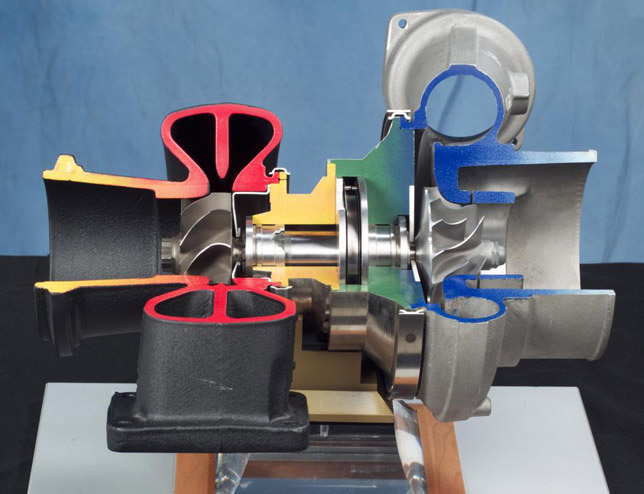
Before those exhaust gasses reach the exhaust system they go trough a turbine connected to a shaft. The more exhaust that goes through the turbine blades, the faster they spin. On the other end of the shaft we find a compressor which welcomes fresh air from the atmosphere, compresses it using the force of the turbine and then feeds it into the engine. To further increase the efficiency of the turbocharging system, an intercooler is added – it looks much like a car radiator but instead of containing cooling fluid, it holds the compressed air from the compressor. Air is denser when cooler and that’s exactly what the intercooler does – it cools the incoming air.
Cut-away view of a turbocharger held by a foil-bearing
There are issues however. First of all, a turbine amidst the flow of exhaust is essentially an obstacle. The exhaust stroke has to deal with more back-pressure thus being slightly less efficient. A functional turboshaft has to handle extreme forces (speeds go up to 150 000 rpm within the turbocharger) so a special kind of baring is needed – liquid ones or state-of-the-art ball bearings. The latter is more efficient but more expensive. Then there’s the dreaded turbo lag. The problem here is that when you put your foot down, the response is far from electric. The turbine needs some time to kick off and start spinning the compressor blades. That’s why at low engine rpm one can’t really tell if the car has a turbo or not.
There are various ways to tackle this nuisance. Make things smaller and lighter. Tiny turbochargers will grant you that off-the-line jolt but won’t be too good on the upper rpm range. Besides, if too much exhaust starts going through a relatively small turbine things may get hot and disbalanced. Usually however, there’s the wastegate in most turbines – a valve that knows how much exhaust passes through and regulates the flow by simply diverting some of the gases away from the turbine. Some companies have started putting more than one turbochargers in their cars. One small and the other, big. The small one guarantees a more immediate response while the big one takes over at higher speeds.
Essentially, that’s the story with turbochargers. We can further dive into numbers and calculations about pressure and efficiency but this, I think, is already nerdy enough. Hopefully some of you learned something new while others refreshed their memory on how the turbocharger brings easy power to our everyday lives.
New stuff from SR Auto. Well, actually it’s the BMW M5, the E60 one. A project called the “Excalaber” – the strange misspelling trend continues – aims to provide a refreshing look on a generation of BMWs that is on the verge of being overshadowed by its current successor.
The idea here is that, SR Auto do not provide any parts of their own, but rather mash together what they can find and see if it works out as an art piece. That’s why we have here a Hamannaero kit (front lip, side skirts, and rear lip). Top priority for it was to be a perfect fit. Four matte black exhaust ends give away a Dinan exhaust system that apparently helps with the performance.
The alteration that sticks out the most however, are the PUR 4OUR DEPTH wheels that are usually seen on Lamborghinis and Ferarris. In fact these 21-inch wheels have been originally made for Lamborghini with bolt patterns of 5×112. That’s why the SR people started drilling until they got a size of 5×120. So there you go, PURs on an M5. Neat!
Overall, the job is not really that extensive. But SR Auto take it very personal when it comes to aftermarket changes. To them, observing a customization of a car is like watching a child growing up – endearing, rejoicing and contentful. Besides, too much flash makes the onlooker dash.
Here’s a Pagani Huayra. Beautiful isn’t it? However, when it goes on sale in 2013, prices will start from $1,150,000. I think “Huayra” is the sound one makes upon signing a deal. This is roughly the price of four Lamborghini Aventadors. What are Pagani‘s arguments on that? Yes, it has an AMG V12, 6.0-liter engine that develops above 700 hp and 1000Nm of torque, it’s clever enough to operate, by itself, a set of flaps that can either reduce drag or increase downforce and it will most probably do 230 mph when pressed. But, because it is such an engineering perfection, it will be horrible to live with – Imagine this: You get in it, start the ignition and an oil well in Sahara evaporates. Whenever you see a speed hump, you’ll have to spend precious time in looking for an alternative route and how are you going to take the children to school in it? A BMW M5 suddenly seems much more “sensible” and fit for the job.
So in an attempt to justify the Huayra‘s cosmic price, Pagani have released a documentary about the process of building one. It’s rather good and it accents on the fact that the people making it are painfully striving towards attention to detail perfection. The rear emblem starts as a block of aluminum which is due to undergo a 24h carving procedure. The design process of the whole car took 5 years of research and inspiration (partly drawn from Leonardo da Vinci, obviously).
Set aside 15 minutes to watch the clip and afterward, you’ll close the browser with a sense of awe. You still might not get convinced to sell your house, sell your other house and the yacht in order to order one, but you’ll leave home knowing something about a great car, from a great car manufacturer. And that is always useful in the pub.
When the latest BMW M5 came out, it was the definition of balance between mad performance and everyday sedan practicality. Now the Aachen-based AC Schnitzer want to tip the scales in faveor of more power, more sportiness and more flamboyancy. It’s the ACS5 Sport Saloon.
To start off, they added an additional control unit on the engine that boosts the power to620hp. The engine’s torque output is also increased to 790Nm. Zero to sixty now takes 4.1 seconds. An AC Schnitzer twin sports silencer with valve control provides the sound to match the grunt. Chromed “Sports Trim“ tailpipes enclose the Schnitzer carbon rear diffuser.
That brings us to aerodynamics. The diffuser plus the carbon front spoiler, rear roof spoiler and rear spoiler provide necessary down force which is there to tame the fresh power. In the mean time, a chromed front grille, “Magic Blue“ and silver livery, AC Schnitzer badges for the side and anAC Schnitzer logo “ACS5 Sport“ visually complete the aerodynamic power pack.
The suspension has been slightly tweaked as a new AC spring kit replaces the standard one. There is also a generous choice of wheels. 20-inch Type V forged alloy wheels orType IV BiColor rims in the same size. The third option involves a set of bigger, 21-inchType VIII racing and forged alloy rims.
“Magic Blue“ is the prevailing theme inside. A “Black Line“ aluminum cover for the “i-Drive” system controller and aluminum pedals add some contrast. The footrest also matches the pedals while the floor mats are in velours.
So if you ever want more from your BMW M5, AC Schnitzer is the company for you.
Full specs bellow
AC Schnitzer BMW M5
Basic car:
BMW M5 (F10)
Engine:
AC Schnitzer performance upgrade –
Performance: 456kW/620hp(standard: 412kW/560hp)
at 6300rpm(standard: 6000-7000rpm)
Maximum torque: 790Nm (standard: 680Nm)
at 3000 rpm (standard: 1500-5750rpm)
Maximum speed: 305 – electronically limited
0 – 100 km/h: 4,1 seconds (standard: 4,3 seconds)
AC Schnitzer engine optics
AC Schnitzer engine compartment optics
Exhaust:
AC Schnitzer twin sports rear silencer with
valve control and chromed “Sports Trim” tailtrims
Suspension:
AC Schnitzer spring kit, lowering approx. 25 mm
Aerodynamics:
AC Schnitzer carbon front spoiler
AC Schnitzer front grille, chromed
AC Schnitzer vitro emblems for side walls
AC Schnitzer rear roof spoiler
AC Schnitzer rear spoiler
AC Schnitzer carbon rear diffuser
AC Schnitzer emblem “ACS5 Sport”, side right/ left
Vehicle wrap BiColor “Magic Blue” – Silver
Interior:
AC Schnitzer aluminium cover, “Black Line”
for BMW “i-Drive“ system controller
AC Schnitzer aluminium pedals
AC Schnitzer foot rest
AC Schnitzer floor mats, velours
Interieur panels and steering wheel insert wrapped in “Magic Blue”
Apart from the Hawk SLS AMG Roadster, Hamann have a BMW M5 ready for us at the Geneva Motor Show. That means more style, more dynamics and more fun in a package of quality and exclusiveness.
Hannman focused on expressing the M5 posture. A wide posture in this case – 25 mm over the standard front wings and 30 mm more at the back. Combine that with a lower center of gravity thanks to special springs provided, and you get a fully blown, wide, mean, lean sports saloon that can put to shame even touring cars. An additional down force comes from the custom front and rear aprons, side skirts and roof and trunk spoilers. So there wont be a need for grip we presume
But just to be sure, Hamann have provided some sticky and wide (325/25 ZR 21 at the back just to get an idea of how wide) Continental Sport Contact 5P tires that go on the 9.5Jx21-inch front and 12.0Jx21-inch rear wheels. And the wheels themselves have a sporting pedigree, being all light and “anodized”, fitted with titanium bolts.
Hamann are still working on the power issues. With the addition of a new sports muffler and some crafty engine-management, the M5‘s V8 is expected to deliver 120 PS and 220 Nm of torque more than it normally does.
For the interior, the company has gone the extra mile. The cabin has the feel of a VIP lounge crossed with motorsport accents. Leather wraps around the seats, the wheel and the center console. Aluminum pedals peak at you from the foot well. Alcantra materials are also available as an option for the picky customers.
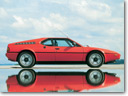
Throughout the years, besides being utterly magnificent, M BMW cars have always been a statement. “I am the kind of person which has a an impressive annual income, a family, clout and an insatiable thirst for sideway buffoonery”. Whichever M car one might choose, the perks are always going to be the same – practicality and sensibility get you trough the mazes of society while sheer power and playfulness make for a great time at the countryside. Small wonder then, that today many well dressed men consider the M batch of BMW’s as a really, really good investment. But few people ask themselves, how and when did it all begin? Let’s just say, that the whole practical performance, 5-door saloonishness was definitely not the case at the beginning of the M odyssey. Enter the 1978 M1 – BMW’s first and only mid-engined road car.
BMW M1 (1978-1981)
Its birth hadn’t been easy. The company had to act quickly as, at the time, the Porsche 911 was becoming increasingly dominant in the field of motor sports. Believe it or not, BMW needed help. And that help came from Lamborghini. Sort of. The Italian company was assigned to do the design, engineering and production work. Without a doubt, that sounds like a recipe for success – BMW overseering the company that brought to the world the Lamborghini Miura and the Countasch. Probably one of the most talented designers ever, Giorgetto Giugiaro, sketched the lines of the M1 with a particular signature that can be seen in other works of his, such as the Lotus Esprit. Sadly, the times were tough, an oil crisis swept the world and Lamborghini went bust. That meant that BMW had to turn to someone else to finish the job. It was a painstaking process that consumed both time and money. The end result was an overpriced, plastic car of a thing that spawned only 455 times. On top of that, by the time everything was sorted out, most of the motor sport regulations moved on and the Bavarian was left trailing behind.
Lotus Esprit S2 (1978-1981)
The real tragedy however, is that, for its time, the M1 was a really decent car. It had the looks, it had the quintessential supercar setup (2 seats, mid-engined, rear-wheel drive), it weighed like a super car (1400 kg) and it had a wonderful 3.5 liter straight six engine that developed 273 bhp. And it wasn’t some sort of an experiment power plant, but a proper one with a Kugelfischer mechanical fuel injection system and DOHC operating 24 valves in total. Later on the M635Csi and the first-generation M5 would get pretty much the same engine.
And that’s the thing about the M1. It died off quickly for a novel cause. Mercifully, the M badge stuck on, but now the BMW people were caught thinking – “Why don’t we shove such an engine in one of our own pefectly good saloons, beef up the brakes and suspensions and see what happens?” Today the results are evident. Almost every BMW car in the conteporary line up has an M counterpart which is hugely successful on the market and almost always highly valued by critics and automotive journalists.