Tag: Audi

  • Audi R8 Coupe V10 GT RWD

    12 years after the premiere of the first Audi R8 GT, Audi Sport GmbH is launching the second edition of this exclusive super sports car: the new Audi R8 Coupé V10 GT RWD. The 5.2-litre, naturally-aspirated V10 engine’s output is boosted to 620PS (Combined fuel consumption in l/100 km**: 15.0 (18.8 UK mpg); combined CO2 emissions in g/km: 340), making it the most powerful rear-wheel drive unit in the history of the brand. A new seven-speed dual-clutch transmission for faster shifts and the new Torque Rear driving mode allows drivers to choose their own level of ESC support. This enables controlled and simultaneously precise oversteering. The seven-stage torque rear can be adjusted via the control satellite on the steering wheel. The new R8 GT is limited to 333 units worldwide with just 15 allocated for the UK market – pricing is to be confirmed. New and exclusive exterior and interior features pay homage to the first generation of the R8 GT such as sequential numbering, special light alloy wheels, and an interior in a combination of black and red.

    The R8 GT Says Goodbye to the V10 Engine

    Compared with the R8 V10 performance RWD with 570PS, which forms the basis for the second edition of the R8 GT, Audi Sport GmbH is increasing the performance of the special model to bring it up to the same level as the quattro model. Specifically, this means: 620PS from 10 cylinders, 5.2 litres of displacement, and 565Nm, available from 6,400 until 7,000rpm (max: 8,700 rpm). As a result, the new R8 GT accelerates from 0-62mph in 3.4 seconds, covers 0-124mph in 10.1 seconds, and reaches a top speed of up to 199mph.

    Another decisive difference: a new seven-speed dual-clutch transmission with even faster shift times. Thanks to an altered gear ratio and the associated higher speed, the new gearbox allows even more impressive acceleration in all gears. On top of that, there’s an exclusive design feature for the R8 GT: the intake manifold is painted in black.

    New Torque Rear Drive Mode

    For the first time, Audi Sport GmbH, which manufactures the new R8 GT largely by hand at Böllinger Höfe, is offering Torque Rear mode. Slippage is controlled on the rear axle by the traction control system (ASR). It is part of the ESC. Seven characteristic curves are stored in the ASR, offering different levels of support. Level one allows little slippage, while level seven allows a lot of slippage. The desired torque rear level can be set by turning the control satellite on the steering wheel. This function also enables a different adaptation as driving skills and road conditions develop. Depending on how that progresses and taking into account information from wheel speed sensors, steering angle, accelerator pedal position, and the selected gear, the engine control unit measures engine power on the rear axle.

    Less Is More

    Compared with the R8 Coupé V10 performance RWD, various measures resulted in a weight reduction of around 20kg to a total of 1,570kg (without driver). The exclusive 20-inch, 10-spoke wheels, which can be combined with high-performance Michelin Sport Cup 2 tires, designed for road and racetrack use, play a key role in reducing weight. The lightweight forged wheels are based on Audi’s motorsport vehicles. The extremely powerful ceramic braking system, which is standard equipment in the R8 GT, saves additional weight.

    In addition, there are R8 bucket seats and the performance sports suspension with the CFRP anti-roll bar. The front anti-roll bar is made from carbon fiber reinforced plastic. Together with the two coupling rod connections made of red anodized aluminium (which protects against corrosion), it reduces weight and increases road-holding and cornering dynamics. Even sportier R8 GT coilover suspension is available as an option. This allows you to individually adjust the trim position and the compression and rebound levels for your R8 GT. On delivery, R8 GT customers receive adjustment instructions and the corresponding tools.

    A Look to Fit Its Status

    To differentiate the new Audi R8 V10 GT RWD from its relatives, the special model is equipped with exclusive add-on parts. The first distinguishing feature is the black “R8 GT” lettering on the rear. All other emblems are in black. With the Carbon Aerokit in high gloss Black, which was developed in the wind tunnel, the package generates better stability on the road, and therefore also faster cornering speeds. In all, the Carbon Aerokit consists of the following attachments: front splitter, flics, side skirt covers, cW-elements on the sides of the rear bumper, a diffuser, and a rear wing with gooseneck suspension. This insert ensures optimum wing underflow and thus improves aerodynamic efficiency.

    A carbon fibre engine cover and side blade, and door mirror housings in carbon high gloss will be further standard features on UK R8 GTs. Additional spec also includes the B&O sound system, an Alcantara diamond headlining and dark tinted laser headlamps.

    In the style of its predecessor, the new R8 GT comes in matte Suzuka Gray. Alternatively, Tango Red Metallic, Mythos Black Metallic and Daytona Gray Metallic are available.

    In the interior, Audi Sport GmbH continues its homage to the first R8 GT from 2010. The interior is crafted in a combination of black and red. This includes red belts – only available in the R8 GT from 12 years ago. The floor mats and the R8 bucket seats feature the lettering of the special model in black and red. One highlight: Customers can find the sequential numbering of their R8 GT in the middle of the selector lever, partially matted in the carbon inlay

  • Audi TT RS Coupe Iconic Edition

    Exclusive and performance-focused: the market launch of the Audi TT RS Coupé iconic edition, limited to 100 units in Europe with 11 examples bound for the UK, will celebrate the success story of a quarter-century for the Audi TT Coupé. This iconic sports car has been an inspiration the world over since its premiere in 1998 due to its pure driving dynamics and timeless design. The limited-edition Audi TT RS Coupé iconic edition stands out with its legendary five-cylinder performance combined with sporty design elements, both in the exterior and interior. In the UK, the Audi TT RS Coupé iconic edition will be priced from £87,650 (OTR), with customer deliveries beginning in the first quarter of 2023.

    Timeless through time: the TT has been Audi’s design icon for almost a quarter of a century. Now the Audi TT RS Coupé iconic edition is continuing the trend into the future – a sports car with new innovations whilst retaining the typical TT RS properties: design and dynamics.

    “The name of the Audi TT RS Coupé iconic edition says it all,” says Sebastian Grams, Managing Director of Audi Sport GmbH. “The edition model is reminiscent of the iconic TT design language, which at the same time stands for courage and elegance in uncompromising form. Thanks to the exclusive exterior and interior highlights, the much-loved performance of our ultimate sports coupé, with its multiple award-winning five-cylinder engine, is not only palpable, but also visible to fans.”

    Inspired by the Bauhaus: the TT Coupe

    With a vision of ‘a car for enthusiasts’, Audi presented the Audi TT Coupé as a sports car study at the IAA in Frankfurt in the Autumn of 1995. Almost symmetrical, the Audi TT consistently followed a design principle based on geometric, circular shapes. Three years later, the coupé went into production almost unchanged. One year after the TT Coupé, Audi launched the TT Roadster. In its second model generation, the Coupé was enhanced with an S and RS variant.

    “The TT was inspired by the Bauhaus and its universal design philosophy of ‘less is more,’” says Head of Audi Design Marc Lichte. “The maximum reduction – the omission of everything unnecessary and insignificant – was so radical and so courageous that the TT, in its simplicity, quickly achieved the highest attribute of good design: to be timeless. Once you’ve achieved that, you’re beyond trends and yet you’re never out of fashion – simply because good style doesn’t wear out.”

    This is why – three TT generations and a quarter of a century later – the typical lines of the 1998 coupé can still be found in the current TT RS Coupé iconic edition. The edition model also remains true to the idea of reduction to the essentials; the minimalist design extends from the clear exterior to the interior, which is still clearly and simply focused on the driver to this day. The typical tube and cylinder shapes, which blend into the interior of the instrument design, can also be found in the current Audi TT RS Coupé iconic edition – such as the standard fuel tank cap, round ventilation outlets, shift gate edging, and the striking gear knob. The enthusiasm that was declared back in 1995 continues to inspire the TT Coupé to this day.

    Setting the Right Tone: Dark Elegance on the Exterior

    The special edition Audi TT RS Coupé iconic edition confidently meets the high expectations set by its aesthetics. The RS-specific Nardo Grey finish sets the right tone for the exclusive and athletic demands of the special model. This elegant shade of grey was named after the legendary Italian race track, Pista di Nardó, where Audi RS models also rack up their first test kilometres. As one of the most popular individual finishes with customers, it ensures an optimal first impression.

    The stylish feel is further enhanced by standard Matrix LED lights and the glossy black grille with a matte black single-frame, which clearly emphasizes the quattro lettering in a matte titanium look. The RS model also confidently wears side skirts in glossy black, along with the Audi rings, the TT RS model designation on the front and rear, as well as the casings of the exterior mirrors. The unique 20-inch glossy black alloy wheels with a seven-arm design and matching black brake calipers continue the design language down to the last detail. Partially frosted rear triangular windows with the exclusive “iconic edition” lettering complete the striking dark look of the coupé right down to the rear and the standard OLED rear lights.

    Motorsports Genes: Aerokit Enhances Sporty Character

    The Audi TT RS Coupé iconic edition also gains dynamic strength from the Aerokit, developed in a wind tunnel. Inspired by motorsports, the front apron features side flics, a front splitter, and blades in the side front air intakes.

    At the rear, the fixed carbon rear wing, with its side winglets, ensures a sporty finish and, as part of the aerodynamic concept, supports both performance and efficiency.

    There are vertical design elements on both sides above the RS-specific diffuser. The two striking, oval-shaped exhaust tailpipes remain the RS signature at the rear end.

    The relationship between drag and lift was explicitly taken into account during the development of the Aerokit in the wind tunnel and is thus optimally balanced – improving both aerodynamics and driving performance. The increased contact pressure of the rear wing and rear diffuser places the sports car much more firmly on the road and significantly improves handling in fast corners.

    11 of 100: Highly Exclusive Interior Design Accents

    The interior of the TT RS Coupé iconic edition is characterized by exclusivity and attention to detail. Here, too, the dark colour scheme of the exterior remains the central motif, which is further accentuated by the deliberate use of accents from Audi-exclusive components. The RS sports seats are two-tone with fine Nappa side panels in jet grey and centre panels in black Alcantara, along with honeycomb stitching in calendula yellow. Exclusive “iconic edition” embroidery is embedded in the black Alcantara at shoulder height. The black floor mats are finished with RS embroidery in calendula yellow, whilst the door armrest and centre console are also in jet grey and decorated with contrast stitching in calendula yellow – just like the black cowl of the Audi virtual cockpit.

    Further enhancements include black Alcantara on the door panels, the RS sports Alcantara steering wheel with calendula yellow marking at 12 o’clock, and a numbered badge on the selector lever which marks each of the 100 vehicles.

    While the moody ambient light creates an atmosphere in the interior, the Bang & Olufsen Premium Sound System with 3D sound, enables a rich sound audible experience. A rear-view camera and comfort key enhance the day-to-day experience.

    Form Needs Function: Legendary Five-Cylinder Engine Brings Unparalleled Sound

    The TT RS Coupé iconic edition (combined fuel consumption in l/100 km**: – (NEDC); 9.1 (25.8 US mpg) (WLTP); combined CO2 emissions in g/km**: – (NEDC); 207 (333.1 g/mi) (WLTP)) relies on Audi Sport’s proven 2.5 TFSI engine with 400PS and maximum torque of 480 Nm. Numerous successes in motorsports make it one of Audi’s most compelling powertrains. Countless motorsports victories and strong day-to-day performance have earned the five-cylinder engine the “International Engine of the Year Award”, nine consecutive times since 2010.

    As is typical of the TT RS, its power goes via a seven-speed S tronic to the permanent all-wheel quattro drive. An electro-hydraulically controlled multi-plate clutch, which debuted in 1998 as part of the Audi TT, distributes all-wheel power freely between the front and rear axles. The Audi drive select driving dynamics system allows the driver to control the quattro drive system and other components, such as steering, seven-speed S tronic, exhaust flaps, and engine characteristics.

    The top speed of the TT RS Coupé iconic edition is increased to 174mph. This compact sports car sprints from 0-62mph in just 3.7 seconds. The engine provides a highly emotional driving experience, with its typical 1-2-4-5-3 firing order and the accompanying throaty sound. Because of the firing order, adjacent and non-adjacent cylinders fire alternately, producing a very specific rhythm and character which is emphasized by the RS Sport Exhaust system.

    In addition to the usual low weight (1,475kg TT RS Coupé), the RS sport suspension plus with adaptive dampers in the Audi magnetic ride technology, ensure excellent handling and stability. Steering feel can also be adjusted through the Audi drive select driving dynamics system.

  • Audi RS Q e-tron E2

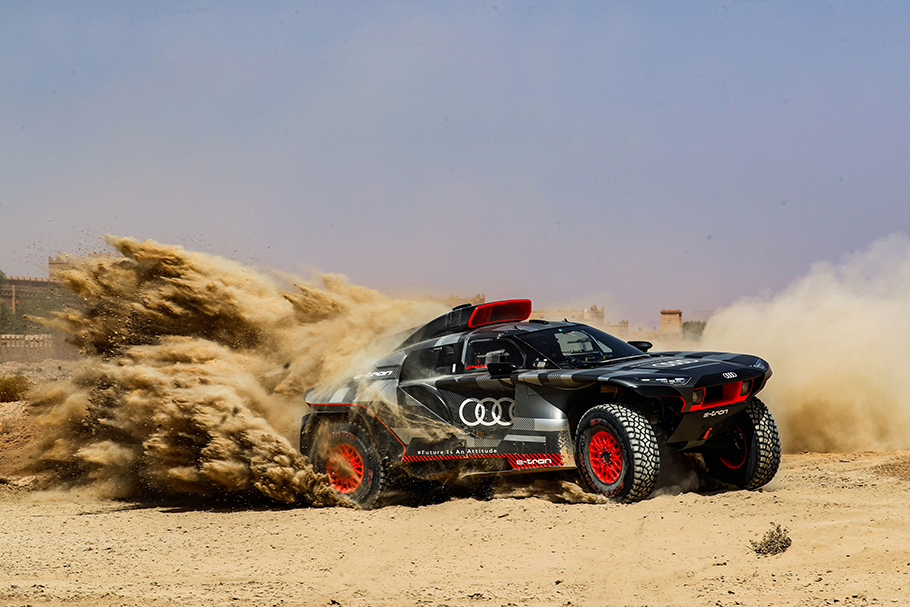
    In March 2022, the Audi RS Q e-tron won its first desert rally in Abu Dhabi, and now the next evolution is ready. The innovative prototype presents itself significantly improved for the 2022 Morocco Rally and the 2023 Dakar Rally. The body is completely new and features significantly enhanced aerodynamics. It helps lower the prototype’s weight and centre of gravity. New operating strategies further improve the efficiency of the electric drivetrain. In the interior and when changing wheels, the driver and co-driver benefit from easier operation. Following these evolutions, the RS Q e-tron now bears the abbreviation E2. It is reminiscent of the legendary Audi Sport quattro in its final development stage for Group B rallying in the 1980s.

    Second phase of the development program 

    “We’ve managed a good debut at the Dakar with the Audi RS Q e-tron and even our first stage victories in a motorsport discipline that is new to us,” says Rolf Michl, Managing Director of Audi Sport GmbH and responsible for motorsport at Audi. “The entire team is working excellently together and pulling in the same direction. As is usual at such an early stage, the drivers, co drivers and technicians quickly agreed on the next development targets. We have summarized the result in a new evolution package – the RS Q e-tron E2.” This marks the beginning of the second phase of the development program. In October, Team Audi Sport will prepare for the 2023 Dakar Rally with the new prototype in Morocco.

    Gentle in the air, light in the sand: the new body

    “The Audi RS Q e-tron E2 does not adopt a single body part from its predecessor,” says Axel Löffler, Chief Designer of the RS Q e-tron. In order to comply with the prescribed interior dimensions, the cockpit, which was previously narrowly recessed towards the roof, is now significantly wider. The front and rear hoods have also been redesigned. “We are now doing away with the underflow of the rear hood to the left and right of the B-pillars. In conjunction with modified lay-ups, i.e. optimized fabric layers of the composite materials, this solution reduces weight,” says Löffler. The T1U prototypes will have to weigh 2,100 instead of 2,000 kilograms in the future. Given that the first generation of the RS Q e-tron was overweight, it was still necessary to save several dozen kilograms. This is accompanied by the lowering of the vehicle’s centre of gravity.

    The aerodynamic concept in the area of the body below the hoods is completely new. This section is almost reminiscent of the shape of a boat’s hull: its widest point is at the height of the cockpit, while the body tapers significantly towards the front and rear. Audi has now dispensed with the part of the fenders that was behind the front wheels and formed the transition to the door. Internally, this structure was called the “elephant foot.” As a result, the designers saved more weight and optimized the air flow. “The aerodynamic aspect should not be underestimated in desert rallying either,” says Löffler. Admittedly, the new cockpit dimensions mean that the body has a larger and therefore less favourable cross-section. Nevertheless, it was possible to reduce the overall aerodynamic drag by around 15 percent, i.e. the product of the CD value and the frontal area (A). This does not change the top speed. It remains limited to 170 km/h in the regulations. Nevertheless, the improved air flow offers one major advantage. “It further reduces the energy requirements of the electrically powered car,” says Löffler. “We implemented the aerodynamic calculations entirely using computational fluid dynamics (CFD).” These computer simulations replace the time-consuming work in the wind tunnel and still deliver highly precise results.

    Even more environmentally friendly: optimized energy management 

    The electric drivetrain of the Audi RS Q e-tron E2 comprises an energy converter consisting of an internal combustion engine and a generator, as well as a high-voltage battery and two electric motors on the front and rear axles. Energy management plays a crucial role here. The electronic control system of the complex electric drivetrain proved its worth in the first rally events. Challenges only arose in extreme cases. At the Dakar Rally, for example, Audi noted short-term surpluses of power in situations where the wheels made less contact with the ground while jumping or on uneven terrain. The officials of the FIA, the world automobile federation, intervene at a threshold of 2 kilojoules of excess energy and impose sporting penalties. “By way of comparison, more than one hundred times the amount of energy flows to the motors per second within the permissible limits,” says Florian Semlinger, development engineer for embedded software, application and test bench. “We could have made it easy on ourselves and set our threshold several kilowatts lower, but that would have meant performance disadvantages. Instead, we put a lot of fine-tuning into the power controllers.” Two individual limits – one for each motor – are now recalculated by the software within milliseconds. As a result, it operates precisely along the permissible limit.

    The so-called auxiliary consumers also benefit from optimized control. The servo pump, the air conditioning cooling pump and the fans have a measurable impact on the energy balance. In the course of the debut season in 2022, the Audi and Q Motorsport rally team gained valuable experience that enables better assessment. Take the air-conditioning system, for example: It works so aggressively that it could cause the coolant to freeze when constantly running at its maximum output. In the future, the system will run in an intermittent mode. This saves energy, yet the interior temperatures only fluctuate slightly, even over longer periods. The operating strategy for the fans and the servo pump has also been optimized. For example, the systems can now be regulated differently for the lower loads on the liaison stages than on the special stages.

    Simplified operation: Ease of use in the cockpit and when changing wheels 

    The Audi drivers Mattias Ekström/Emil Bergkvist, Stéphane Peterhansel/Edouard Boulanger and Carlos Sainz/Lucas Cruz can look forward to their new workplaces. The displays are still in the driver’s field of view and located in the centre console in the usual style, and the central switch panel with its 24 fields has also been retained. However, the engineers have restructured the displays and controls. “The totality of all the functions quickly creates confusion,” says Florian Semlinger. “That’s why, for the first time, the driver and co-driver can now select from four system areas using a rotary switch.” The “Stage” theme contains all the functions that are important while driving competitively – such as the speed limiter in sections with speed limits or the air jack. The “Road” part contains, for example, turn signals and the rear-view camera, functions that are often in demand on the liaison stages. The “Error” option is used to detect, categorize and catalogue errors. The “Settings” section includes everything that is useful for the engineering team during testing or after the car arrives at the bivouac, for example, detailed temperatures of individual systems.

    Crews can now work much more easily after a puncture. Simple, flat and easily removable body components replace the previous bulky covers for the spare wheels in the flanks. The new ten spoke rims from partner Rotiform are much easier to handle. Drivers and co-drivers can grip them more easily and complete the change more safely.

    “We have combined all the important lessons in a very short time. The result of our ideas is the E2 evolution,” says Uwe Breuling, Head of Vehicle Operations at Audi Sport. “Our development team’s determined and cost-efficient work has prepared us perfectly for our second Dakar Rally.”

    Following initial testing led by Arnau Niubó Bosch, Head of Test Engineering, Audi Sport unveiled the RS Q e-tron E2 in Neuburg an der Donau on September 1. From October 1 to 6, the new technology will have to prove itself in competition for the first time at the Rally du Maroc. All three Audi driver pairings will then contest the desert rally that begins and finishes in Agadir, in the southwest of the North African country.

  • Audi enters Formula 1

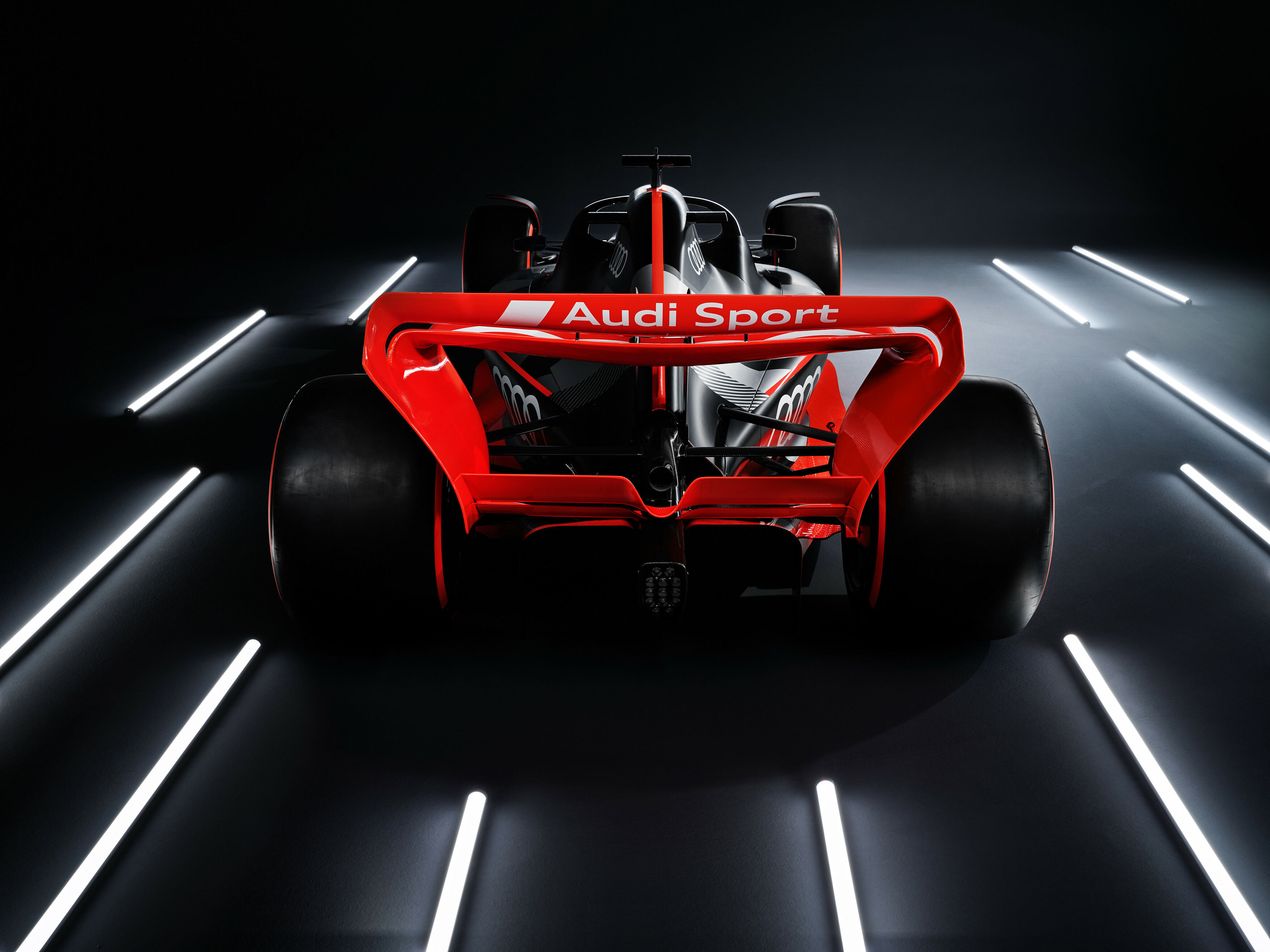
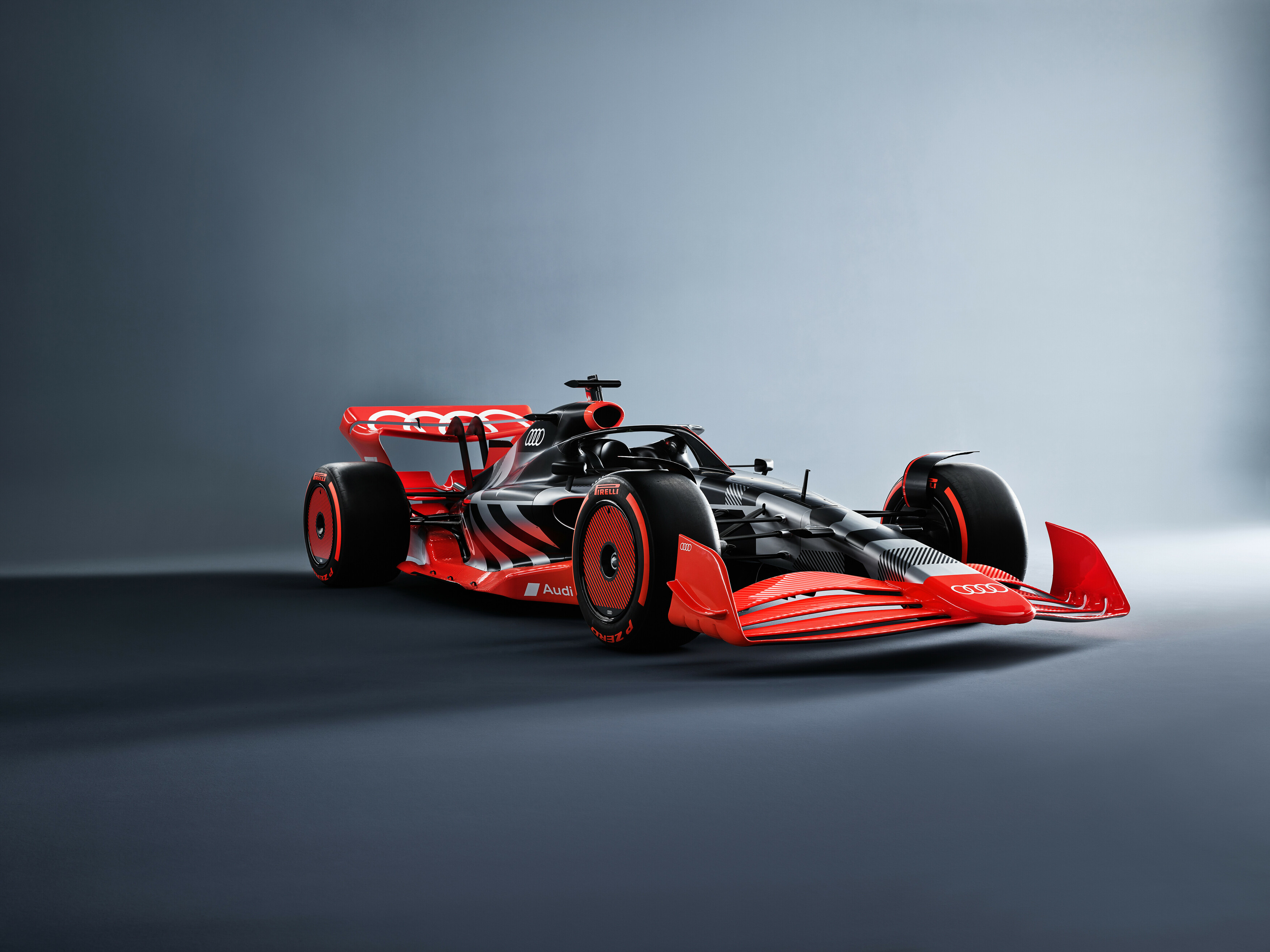
    Audi Formula 1 - Front Angle

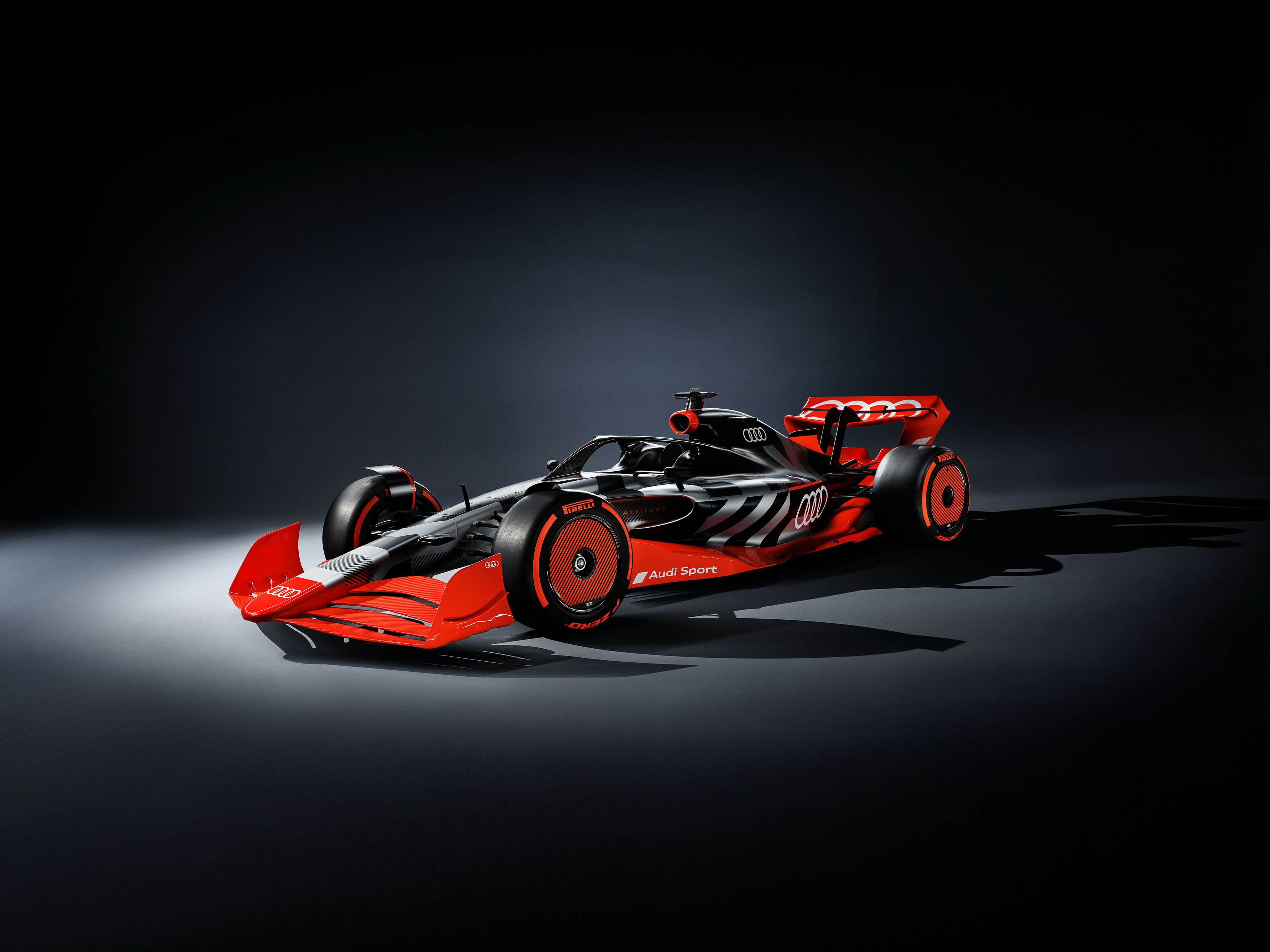
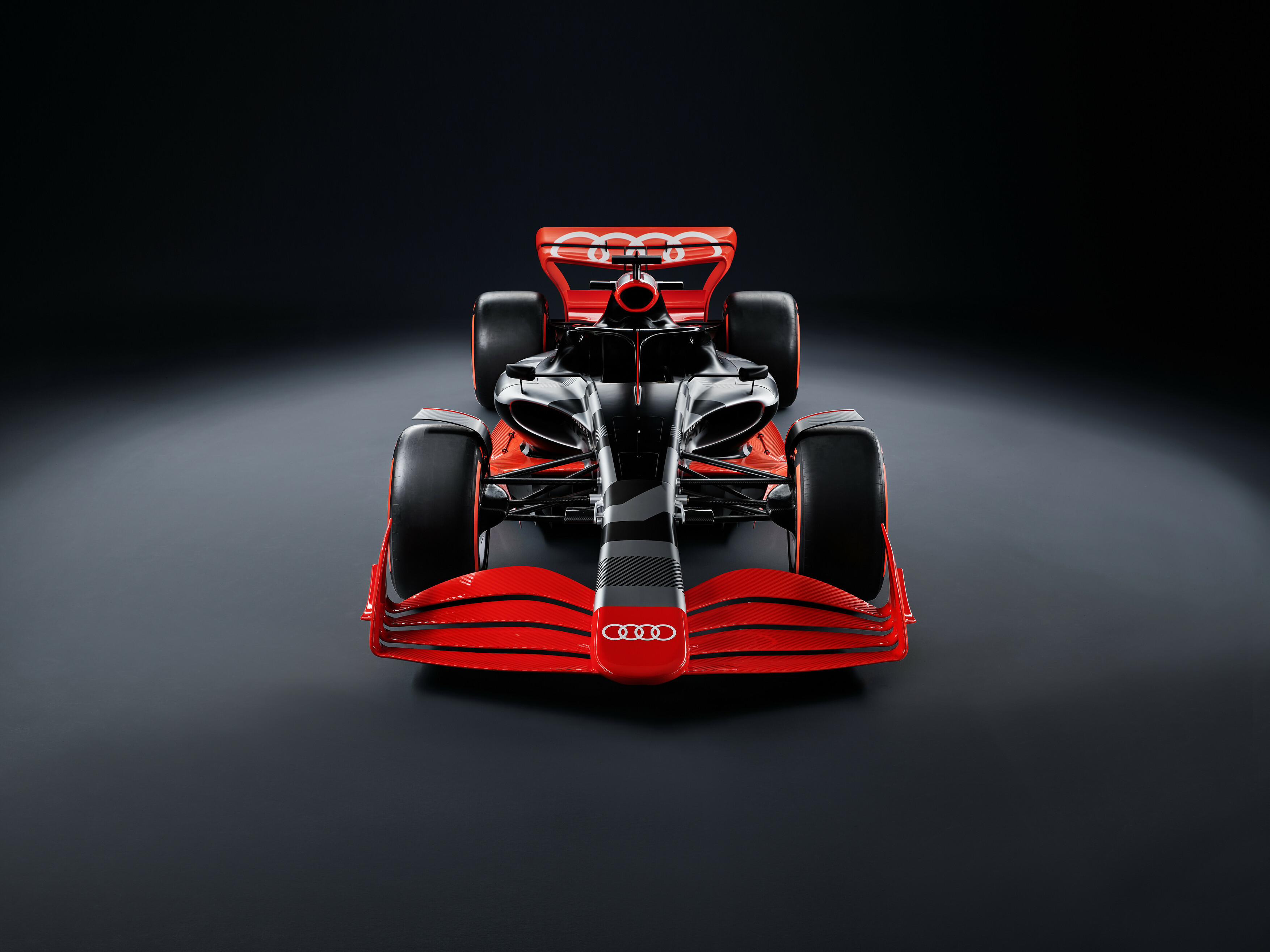
    Audi enters the premier class of motorsport. From 2026, the premium Audi brand will compete in the FIA Formula 1 World Championship with a specially developed power unit. The project will be based at Audi Sport’s facility in Neuburg near Ingolstadt. This is the first time in more than a decade that a Formula 1 power train will be built in Germany.

    Audi announced its entry at a press conference at the Formula 1 Belgian Grand Prix at Spa- Francorchamps. At the event, Markus Duesmann, chairman of the Board of Management of AUDI AG, and Oliver Hoffmann, member of the Board of Management for Technical Development, answered questions in the company of Formula 1 President and CEO Stefano Domenicali and Mohammed bin Sulayem, president of the International Automobile Federation (FIA).

    “Motorsport is an integral part of Audi’s DNA,” says Markus Duesmann. “Formula 1 is both a global stage for our brand and a highly challenging development laboratory. The combination of high performance and competition is always a driver of innovation and technology transfer in our industry. With the new rules, now is the right time for us to get involved. After all, Formula 1 and Audi both pursue clear sustainability goals.”

    The key to getting involved in the world’s most popular racing series is the clear plan to become more sustainable and cost-efficient. The new technical rules, which will apply from 2026, focus on greater electrification and advanced fuel that is more sustainable than that which is currently used. In addition to the existing cap on costs for teams, a cost cap for power unit manufacturers will be introduced in 2023. In addition, Formula 1 has set itself the ambitious goal of being a carbon-neutral racing series by 2030.

    Actively Shaping Formula 1’s Transformation

    Oliver Hoffmann, member of the Board for Technical Development, says: “In view of the major technological leaps that the series is making towards sustainability in 2026, we can speak of a new Formula 1. Formula 1 is transforming, and Audi wants to actively support this journey.

    A close link between our Formula 1 project and AUDI AG’s Technical Development department will enable synergies.”

    From 2026, the electric power output for the power units, consisting of an electric motor, battery, control electronics, and a combustion engine, will increase sharply compared to today’s Formula 1 drive systems. The electric motor will then be nearly as powerful as the combustion engine, which has an output of about 400 kW (544 horsepower). The highly efficient 1.6-liter turbo engines run on advanced fuel that is more sustainable – also a prerequisite for Audi’s entry into the series.

    202 Audi Formula 1 - Front

    High Popularity in Key Markets and with Young Target Groups

    Globally recognized, highly emotional, and technologically advanced – that’s how Formula 1 has met Audi’s exact requirements. The series holds races in all relevant markets of the brand. As a spectacular platform for the most demanding electrified racing cars in the world, it is of particular interest to car manufacturers. Audi is taking on the challenge of proving its “Vorsprung durch Technik” in this competitive environment.

    The great interest in Formula 1 is global and this racing series is one of the sporting events with the highest reach in the world. In 2021, more than 1.5 billion TV viewers watched the races. Formula 1 is popular in key markets such as China and the United States, and the trend continues to rise – even among younger target groups. On social media, Formula 1 is now experiencing the highest growth rates among the world’s most popular sports.

    Neuburg Site to Develop the Power Unit

    The power unit will be built at Audi Sport’s state-of-the-art Competence Center Motorsport in Neuburg an der Donau, not far from AUDI AG’s company headquarters located in Ingolstadt. “For the development and manufacture of the Formula 1 power train, we will build on the valuable expertise of our motorsport employees, continue to invest in our motorsports center, and also recruit highly specialized professionals,” says Audi Sport managing director Julius Seebach, who organized the entry into Formula 1 as part of Audi’s realignment toward motorsport.

    In Neuburg there are already test benches for F1 engine testing as well as for electric motor and battery testing. Additional necessary preparations are currently being made in terms of personnel, buildings, and technical infrastructure, with everything essential to be set in place by the end of the year. A separate company was recently founded for the power unit project as a wholly owned subsidiary of Audi Sport. Adam Baker will take over the management of the company and thus the Formula 1 project as CEO. As a trained engineer he has held various senior positions for manufacturers and teams in motorsport. Before joining Audi in 2021, he worked for the FIA for three years.

    Audi will announce a decision on which team they will be lining up with in 2026 by the end of this year.

    202 Audi Formula 1 - Rear

    Formula 1 Decision Governs Motorsport Focus

    Audi Sport is assembling its strengths for the Formula 1 project and as a consequence is discontinuing its LMDh project. The motorsport division had recently suspended the development of the sports car for endurance racing. Alongside customer racing, Audi Sport will continue its innovation project with the RS-Q e-tron in the Dakar Rally. Next year, Audi’s aim is to gain overall victory in the desert.

    Whether the World Rally Championship, World Sportscar Championship, U.S. motorsport, DTM, Le Mans, or Formula E – Audi Sport has set standards in many categories with numerous titles. “Formula 1 is the next major milestone in Audi’s motorsport history,” says Julius Seebach.

    Rolf Michl to succeed Julius Seebach

    Audi’s entry into Formula 1 marks the conclusion of its motorsport restructure, but also the close of a formative period at Audi Sport GmbH. managing director Julius Seebach will join AUDI AG on September 1, 2022, and will take on a new strategic business area in Technical Development, reporting directly in to the Executive Board.

    Hoffmann, who, in his role as an executive board member also serves as chairman of the Advisory Board of Audi Sport GmbH, thanked Seebach for his performance: “Julius stands for strategic foresight, consistent action, and sustainable results in challenging times.” Under his leadership, Audi Sport GmbH has repeatedly achieved record sales and earnings figures. Sales doubled with the RS model offensive and the all-electric RS e-tron GT was successfully brought to market.

    In 2020, Seebach also assumed responsibility for motorsport at Audi and resolutely made it ready for the future. Under his leadership, the most complex racing car in Audi history was developed in record time: the RS Q e-tron for the Dakar Rally. Following its successful debut with four stage wins at the Dakar Rally in January, the Audi RS Q e-tron achieved its first overall victory in Abu Dhabi in March – the first triumph of a car with an electric powertrain in a desert rally. Entering Formula 1 is the successful conclusion of his work.

    2026 Audi Formula 1- Front Angle

    Starting September 1, Seebach will be succeeded by Rolf Michl, who has been chief operating officer, Racing at Audi Sport since February. Together with Dr. Sebastian Grams, he will form the Management Board of Audi Sport GmbH. Michl has a degree in business administration and is a long-standing member of the Audi Sport family. After holding various positions in marketing at AUDI AG and Audi Sport, he took over as Head of Product Marketing RS Models in 2016. After moving to Abt Sportsline as Director Vehicle Customization, he returned to Audi Sport GmbH as Head of Sales/Marketing in 2019. Michl has played a key role in shaping the company’s portfolio and sales successes over time. Hoffmann notes that “Rolf is an authentic leader and brings with him the experience he will need from motorsport and series production.” In addition to his positions in marketing, Michl was responsible for devising and implementing the Audi Sport TT Cup in 2014.

    *Information on fuel consumption and CO2 emissions as well as efficiency classes in ranges depend on the tires/wheels used as well as the selected equipment.

  • 2023 Audi RS 4 Avant competition UK pricing and specification

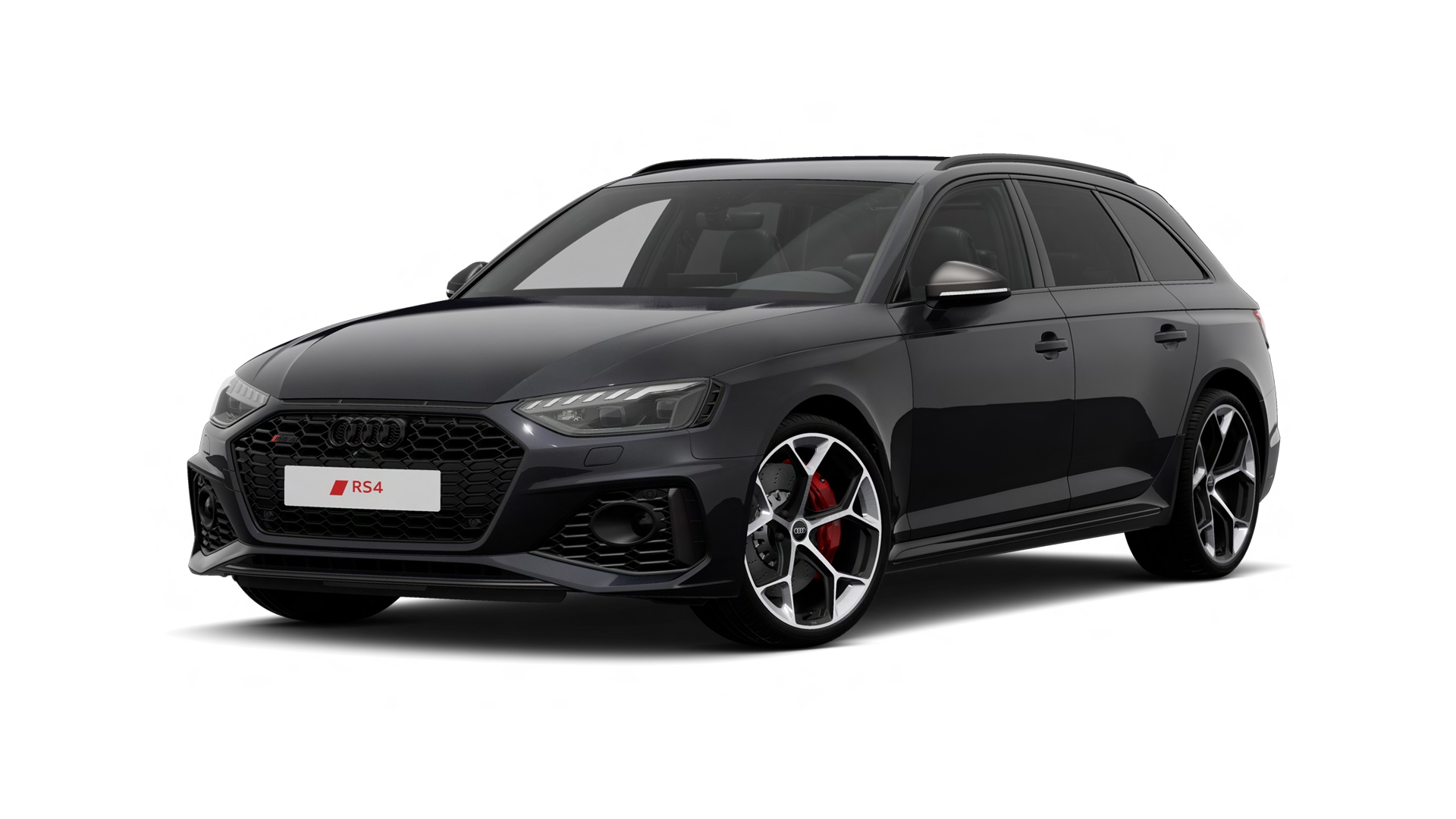
    2023 Audi RS 4 Avant [UK] - Front Angle

    Audi Sport’s RS 4 Avant is renowned for its exceptional balance of presence, performance, and practicality. Its remarkable blend of everyday usability and extraordinary potency has earned it a place in the brand’s hall of fame. Now, the newly launched RS 4 Avant Competition takes this to the next level with a driving experience that is even more immersive and track-focused. This highly exclusive model is limited to just 75 units in the UK and is equipped with an array of visual enhancements and chassis improvements, including the RS Sport Suspension Pro, RS Sports Exhaust System Plus, and a top speed increase to 180mph.

    As the successor to the iconic RS 2 Avant, the RS 4 has been a milestone model in Audi’s range for over two decades. Audi UK Director, Andrew Doyle, notes that every evolutionary step has cemented their eminent position in the segment, and the RS 4 Avant Competition with its elevated performance and exclusivity continues that trend.

    The RS 4 Avant Competition features an exclusive performance upgrade, the RS Sport Suspension Pro, which maximizes handling performance without compromising everyday usability. The coilover suspension is manually adjustable, enabling the driver to prioritize comfort or agility as required. The Competition model sits 10mm lower than a standard RS 4 Avant and can be lowered by a further 10mm by the driver. A higher spring rate, three-way adjustable dampers, and stiffer anti-roll bars guarantee exceptional precision, composure, and control.

    The biturbo 2.9-litre V6 engine produces 450 PS and 600Nm of torque, with further improvements made to the transmission control unit resulting in shorter shift times and enhanced acceleration. The Audi RS 4 Avant Competition can accelerate from 0-62mph in just 3.9 seconds, an improvement of 0.2 seconds over the standard model, with a top speed of 180mph, making it the fastest RS 4 Avant in the model range.

    The dynamic steering is fixed at a ratio of 1:13.1, and the enhanced quattro sport differential ensures an increased degree of adjustability. A new data set in the control unit with revised parameters places more emphasis on the rear axle, and further fine-tuning to the engine control unit software makes for tighter load changes in S mode when “dynamic” mode is active. These chassis improvements result in improved handling and even greater precision.

    The RS 4 Avant Competition boasts unique visual enhancements, including Sebring Crystal Black Paint finish, exclusive 20-inch Competition wheels with Pirelli P Zero Corsa high-performance tires, and red brake calipers. The front splitter, mirror housings, front air intake inserts, and rear diffuser feature an exclusive carbon matte finish, while the standard RS Sports seats feature a leather/Dinamica honeycomb combination upholstery that is exclusive to the RS 4 Avant Competition. Red decorative stitching and edging on various interior components add a touch of exclusivity.

    Upgraded standard equipment includes an advanced key, the Bang & Olufsen 3D Sound System, a 360-degree camera, and a multi-coloured extended LED interior Lighting Pack. The RS 4 Avant Competition is priced from £84,600 (OTR) and will be available for order in early September with first customer deliveries at the start of 2023.

  • The 2022 Audi RS 7 exclusive edition ups the exclusivity ante

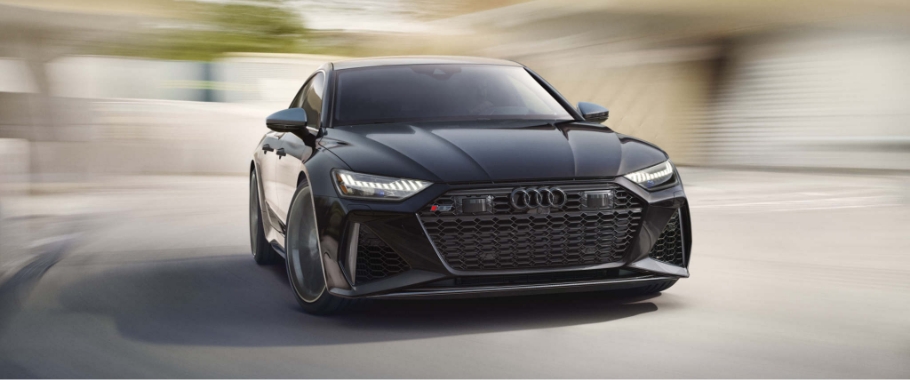
    2022 Audi RS 7 exclusive edition- front

    The RS 7 exclusive edition joins the Audi Sport portfolio featuring tailored design cues and standout performance. Limited to 23 units, the RS 7 exclusive edition is characterized by refined design elements on both the exterior and interior while maintaining the visceral performance capabilities of any Audi Sport product.

    Exclusive performance

    Powering the RS 7 exclusive edition is the Audi 4.0-liter TFSI® bi-turbo V8 engine delivering 591 horsepower and 590 lb-ft of torque that sprints from 0-60 mph in just 3.5 seconds. The standard Sport exhaust elevates the visceral symphony of the V8 engine by amplifying the sound quotient and heightens an element of performance oriented design with black-finished exhaust tips. The special edition RS 7 can reach an electronically controlled top track speed of 190 mph thanks to the addition of 439mm (17.3”) Audi front and 371mm (14.6”) Audi rear Ceramic brakes with blue painted calipers.

    An exclusive exterior

    The most powerful expression of the Audi Sportback showcases a striking silhouette style equipped with a distinctive collection of Audi exclusive components. The exterior is painted in the exclusive Mamba Black pearl effect that presents as a sophisticated bold black paint with undertones of blue.

    An exterior Carbon optic package reinforces the exclusive model’s pinnacle performance position and extends to a Black optic exterior including Black Audi rings and badges, Carbon exterior mirrors, front spoiler, and rear diffuser elements. Shod with 22” 5 V-spoke gloss anthracite wheels wrapped in 285/30 ZR22 summer performance tires, the exclusive edition evokes aggressive performance cues. Standard Audi laser lights supplement the LED high beam headlights for the driver by projecting a low and wide beam of light on the road ahead and can be identified by a blue light signature in the headlight housing.

    An exclusive interior

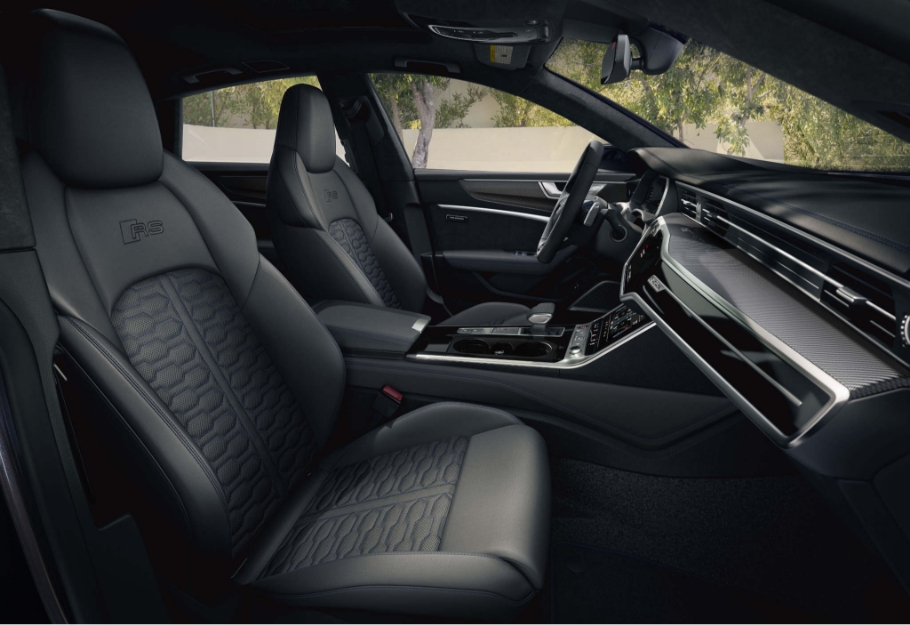
    The distinctly refined interior of the 23 exclusive edition units includes RS brand accents and bespoke Audi exclusive details. Black leather and dinamica treatments are complemented by Sepang blue stitching woven throughout the interior.

    2022 Audi RS 7 exclusive edition - Interior

    The Audi exclusive extended leather package extends the premium material to door armrests, center console trim, upper door panels, and the upper dashboard all finished in black leather with Sepang blue stitching, while Audi exclusive controls are also braided in Sepang blue stitching. Front passenger seats are treated to an Audi exclusive low side trim in black leather with Sepang blue stitching while Audi exclusive floor mats are offered with black leather edges and finished with Sepang blue stitching. Finally, a black Dinamica headliner traces the interior of the striking Sportback design of the RS 7 exclusive edition.

    Limited availability

    The 2022 Audi RS 7 exclusive edition will be available in limited production to just 23 units and will be available in the late summer timeframe.

    MSRP pricing detail

    Model
    2022 Audi RS 7 exclusive edition $165,400

    Price excludes $1,095 destination charge, taxes, title, options, and dealer charges. Dealer sets actual price.


  • The all-new Audi RS 3: Legendary performance revolutionized

    2022 Audi RS 3 sedan - Front Angle

    Today, Audi of America announces the return of the attainable entry point to the Audi Sport portfolio with the all-new second generation Audi RS 3 Sedan. The RS 3 reaches new heights in dynamic handling with an RS Torque Splitter included for the first time in an Audi vehicle that actively distributes torque to the rear axle with two RS 3-specific Audi drive select models to accompany its legendary quattro lineage. The all-new RS 3 Sedan showcases an expressive exterior design matched with progressive interior design elements that emphasize the car’s sporty position.

    Exterior design – Powerful proportions and expressive details

    The second generation Audi RS 3 exhibits powerful proportions and expressive details starting at the front where a wider RS front bumper underpins a redesigned Singleframe grille with honeycomb grid structure in matte black flanked by larger air intakes than the predecessor. The flared wheel arches include a functional side air outlet signaling a nod to Audi’s motorsport heritage and the front track is widened by 33mm (1.3 inches) in comparsion to the predecessor.

    At the rear, the RS 3 integrates a glossy black rear lip spoiler on the trunklid for dynamic balance and a sportier look. The motorsport-inspired details include the redesigned RS-specific rear bumper with built-in diffuser and RS exhaust system which includes a fully variable flap control with large oval/elliptical tailpipes on both the left and right side. The RS 3 can be painted in a total of eight different colors, including the Audi Sport specific Kyalami Green and Kemora Gray finishes.

    Audi’s commitment to lighting innovation continues to progress. The RS 3 includes standard front Matrix-design LED headlights with a darkened bezel featuring all-new digital daytime running lights with a 3 x 5 LED pixel segment – when the vehicle is locked or unlocked, the R-S-3 checkered flag sequence appears on the driver’s side, while a checkered flag appears in the pixel field on the passenger side. When driving, the checkered flag remains illuminated as a daytime running light below the headlamp on both sides. At the rear, LED taillights include dynamic turn signals and an RS 3-specific coming home/leaving function sequence.

    The RS 3 is standard equipped with 19-inch cast aluminum wheels in a dynamic 10-Y-spoke design with graphic print and reverse staggered summer performance tires. For the first time optional Pirelli P Zero Trofeo R motorsport tires can also be mounted and were developed specifically for use on racetracks. An available Carbon package adds carbon fiber mirror housings, rear spoiler, and side sill inlays underlining the RS 3 performance quotient. Additionally, an available Black optic plus package offers the 19-inch 10-Y-spoke design wheels finished in full matte Black, Black Audi rings and badges, and a Brilliant Black roof for a distinctive sporty contrast.

    Interior Design – Visual driving engagement

    On the interior, performance enthusiasts are met with engaging motorsport elements that form a genuine driver-oriented cockpit. The standard equipped 12.3-inch Audi virtual cockpit plus displays pertinent performance data through a new “RS Runway” design. In this mode, the values are displayed in a manner that visually resembles an airplane runway – presenting the highest number of revolutions in the foreground, and lowest in the background. Additionally, the Audi virtual cockpit also includes an exhibit of g-forces, lap times, and acceleration from 0-60 mph, 0-125 (200 km/h) mph, quarter mile, and eighth of a mile.

    The RS-specific blinking shift indicator in manual transmission mode changes the RPM display from green to yellow to red – blinking in a manner identical to that used in motorsports scheduling the ideal time to change gears. This signal is also presented in the available head-up display, which presents relative data onto the windshield within the driver’s line of sight. The center 10.1-inch dashboard display can also show the coolant, engine, transmission oil temperatures, as well as the g-forces and tire pressure figures.

    A three-spoke round design RS sport leather multifunction steering wheel with hands-on detection includes polished zinc die-cast steering wheel paddles. The steering wheel also now comes standard with a steering wheel button specific for RS driving modes including RS Performance, RS Individual, or the most recently used mode. Fine Nappa leather front sport seats come standard with RS embossing and RS-specific honeycomb stitching, and provide the perfect balance of support with 8-way power front seats with 4-way power lumbar and driver memory.

    Available for the first time, the RS design package includes distinctive elements of green throughout including the seat shoulders finished in Micrommata green Dinamica, a center bar of air vents in Micrommata green, floor mats with RS logo and green stitching on piping, green edging on seatbelts, a carbon atlas matte inlay, and the center console trim in high gloss black. A standard black headliner frames the cabin with an additional element of sportiness.

    The epitome of driving dynamics – The RS Torque Splitter, DCC, transmission, and brakes

    An Audi first – the RS Torque Splitter – is one of the most significant performance innovations in the RS 3. Audi quattro supports the rear-axle differential with an upstream multiplate clutch package that has now been replaced by an electronically controlled multiplate clutch on each drive shaft. This innovation enables the RS Torque Splitter to distribute the drive torque for the rear axle fully variably between the rear wheels. The result is better stability, especially on wet ground, and improved agility during fast cornering.

    Several influencing factors of operation prompt character, including longitudinal and lateral acceleration, steering angle, throttle position, current gear, and yaw angle. When cornering, the RS Torque Splitter increases drive torque to the outside wheel to significantly reduce understeer. For example, if the driver pushes through a fast left turn, drive torque is immediately distributed to the right wheel. The RS Torque Splitter is fully integrated in to Audi drive select, and also varies based on selected five different mode selections:

    • Comfort mode – prioritizes front axle efficiency
    • Auto mode – offers balanced front/rear torque distribution
    • Dynamic mode – offers as much torque as possible to rear axle
    • RS Torque Rear mode – allows for controlled drifts
    • RS Performance mode – designed for track use to minimize understeer and oversteer in fast cornering

    To support an even closer connection to the road and track, the all-new RS 3 introduces the standard RS Sport suspension plus with dynamic chassis control (DCC) sitting 10mm (0.39”) lower than the Audi S3, and 25mm (0.98”) lower than A3. Serving as a progressive successor to Audi magnetic ride the DCC offers continuous and individual adjustment based on several factors including road conditions, driving situations, or mode selection with Audi drive select, while dynamic height sensors measure vertical acceleration of the body and relative movement to the wheels. When RS Performance mode is engaged, the shocks are preset to minimize vertical oscillations while optimizing lateral dynamics to reduce potential wheel bounce and to amplify cornering characteristics. The seven-speed dual-clutch S tronic® transmission arranges lightning quick shifts with optimized circuit time and sporty spread between gears.

    The RS 3 comes standard with newly developed and larger front steel brakes offering 20% better cooling compared to its predecessor thanks to integrated airflow guides in the bumper and undercarriage. The 6-piston fixed caliper front brakes utilize 375mm (14.8”) brake discs, while the rear brakes use a single-piston caliper with 310mm (12.2”) brake discs, with all calipers painted red. Designed for high performance driving, an available ceramic brake option with 380mm (15.0”) front ceramic discs exhibits powerful braking ability, while reducing overall weight by 22 pounds – and remains more resistant to brake fade thanks to faster temperature reduction.

    Hear that heritage sound? It’s legendary performance.

    The five-cylinder engine has deep historical roots in Audi’s DNA, and is a fundmental pillar of the emotional connection to the Audi Sport brand. The engine has achieved countless victories in motorsports from the legendary Group B rally courses around the world, to the tarmac in the IMSA GTO and at the Nürburgring in the legendary 24-hour race, the five-cylinder has prevailed. It even earned the  “International Engine of the Year Award” nine times in a row since 2010. Yet – it is the unique and distinctive sound of the five-cylinder engine that has captured the emotion of enthusiasts. Due to the odd number of cylinders, and more specifically, the 1-2-4-5-3 firing order, the Audi five-cylinder engine’s sound is unmistakable and presents a symphonic rhythm that is accompanied by deep tone characteristics, which can be further enchanced with the available RS sport exhaust system.

    Besides its visibility in motorsports, the legendary engine harkens back to the Ur-quattro coupe from the 1980s, and remains one of the brand’s more powerful engines with 401 horsepower and 369 lb-ft of torque – an increase of 7 horsepower and 15 lb-ft of torque over the predecessor, which brings the RS 3 from 0-60 mph in just 3.6 seconds and improvement of 0.3 seconds over the predecessor. The RS 3 available in the U.S. is also the most powerful and raucous sounding RS 3 in the world, further amplifying the sound and presence of the legendary five-cylinder engine. Additionally, the all-new Audi RS 3 set the lap record for compact cars on the Nürburgring Nordschleife with a time of 7 minutes 40.748 seconds

    The 2022 Audi RS 3 is slated to be on sale by this summer.


    MSRP pricing detail

    Model
    2022 Audi RS 3 Sedan $58,900
  • Space travel through the megacity

    2022 Audi Urbansphere Concept - front view

    Systematically designed from the inside out – Audi is presenting the Audi urbansphere concept car. Designers and engineers have created the Audi urbansphere primarily for use in traffic of Chinese megacities. In these metropolitan areas, where personal space is in particularly short supply, the concept car offers the largest interior space of any Audi to date. In addition, it intelligently coordinates this with technologies and digital services that appeal to all the senses and thus offer a new quality of experience.

    The development process took place in close collaboration between Audi’s design studios in Beijing and its headquarters in Ingolstadt. For the first time, potential customers in China also took part, contributing their own desires and experiences to the development process (known as “co-creation”).

    The result of this process can be seen in the Audi urbansphere concept, above all in the interior. As such, the spacious automobile acts as a lounge on wheels and mobile office – the vehicle serves as a third living space during the hours spent in traffic. To this end, the Audi urbansphere combines the luxury of complete privacy with a comprehensive range of high-tech features on board, even during the daily rush hour. Level 4 automated driving technology transforms the interior without a steering wheel, pedals, or displays into a mobile interactive space that opens up to the offerings of a comprehensive digital ecosystem.

    Audi sphere – first class to the power of three

    Audi skysphere, Audi grandsphere, and Audi urbansphere are the three concept cars that the brand with the four rings is using to showcase its vision of the premium mobility of tomorrow. Audi is creating a vehicle experience that goes far beyond the purpose of merely spending time in a car to get from point A to point B.

    In August 2021, Audi debuted the electrically-powered skysphere concept roadster – the spectacular vision of an autonomous GT that transforms itself into a self-driving sports car with a variable wheelbase.

    Just a few weeks later, Audi unveiled the second model in the sphere series, the Audi grandsphere concept, at the IAA 2021. This large, prestigious four-seater saloon exemplified the brand’s ambition to define the future of progressive luxury.

    What both concept cars have in common with the Audi urbansphere is that the entire concept is derived from the ability to drive in a level 4 autonomous vehicle. This is a technology that Audi is working towards introducing in the second half of the decade together with CARIAD, the Volkswagen Group’s software think tank.

    Interior size

    en at first glance, the Audi urbansphere concept reveals itself as the largest model in the sphere family, indeed of all Audi concept cars to date. Its grand dimensions – 5,510mm long, 2,010mm wide, and 1,780mm tall – place it in the upper echelons of the automotive world, yet the Audi urbansphere concept radically breaks with the conventions of the segment.

    This is because it has been systematically designed from the inside out, as it were, around its passengers. Consequently, the most important dimension for passengers is the unrivalled wheelbase of 3,400mm. The interior of the Audi urbansphere is not subject to the conventional maxim of squeezing as many seats, storage compartments, and functional elements as possible into a space limited by the physics of driving. Instead, it primarily responds to the passengers’ need to be able to experience generous space as a distinctive element of comfort.

    The Audi urbansphere not only frees the driver from the burden of driving whenever possible, but at the same time offers everyone on board a wide variety of options to use this freedom to enjoy customizable experiences – communication or relaxation, work, or a retreat into a private sphere when desired. The Audi urbansphere concept itself also transforms from merely an automobile into a platform for groundbreaking experiences.

    Thanks to Audi’s own options and the ability to integrate digital services from other providers, the possibilities are nearly endless. These can be used to access a wide range of services related to the current trip. The vehicle also takes care of everyday tasks that go beyond the ride itself – such as making dinner reservations or shopping online from the car. In addition, the autonomous Audi urbansphere concept picks up its passengers at home and independently takes care of finding a parking space and charging the battery.

    Customized infotainment offerings are also available, such as the seamless integration of onboard streaming from music and video providers the customer already uses. In an additional step, Audi will make personalized and exclusive options available in the future – concerts, cultural events, or even sporting events that customers will be invited to.

    The architecture – from the inside out

    The word “sphere” in the name already suggests that the focus of the Audi skysphere, grandsphere, and urbansphere concept cars is on the inner space, the interior. It is no longer the powertrain or the driving dynamics that are at the top of the list of requirements for this new generation of cars. Instead, the interior becomes the foundation for design and technology. And this means that it transforms into the passenger’s sphere of life and experience on the road.

    Their needs and desires shape this space, its architecture, and all of the integrated functions. As a result of this shift, the design process itself also changes. At the beginning of all discussions, the focus is on the interior. Only then are the package, exterior lines and proportions designed, which, together with the technological specifications, turn the automobile into a complete work of art.

    Surface, form, function – the interior

    The doors of the Audi urbansphere concept are counter-hinged at the front and the rear; there is no B-pillar. As a result, the whole world of the interior opens up to passengers as soon as they climb in. Seats that swivel outward and a red carpet of light projected onto the ground next to the vehicle transform the simple act of entering the car into an experience of comfort.

    A wheelbase of 3,400mm and a vehicle width of 2,010mm delineate what is a more than stately footprint, even for a luxury-class automobile. Together with 1,780mm of headroom and expansive glass surfaces, these dimensions result in an exceptionally spacious experience of the interior – both subjectively and objectively.

    Four individual seats in two rows offer passengers luxurious first-class comfort. The seats in the rear offer particularly generous dimensions and a wide range of adjustment options. In Relax and Entertain modes, the backrest can be tilted up to 60 degrees while leg rests extend at the same time. The centre-mounted armrests integrated into the sides of the seats and their counterparts in the doors create a comforting feeling of security.

    The seats also cater to the changing social needs of passengers in a variety of ways. While conversing, passengers can turn to face each other on their swivelling seats. On the other hand, those who want some seclusion can conceal their head area from the person next to them using a privacy screen mounted behind the headrest. In addition, each seat has its own sound zone with speakers in the headrest area. Individual monitors are also built into the backs of the front seats.

    When passengers want to use the infotainment system together, on the other hand, there is a large-format and transparent OLED screen that pivots vertically from the roof area into the zone between the rows of seats. Using this “cinema screen,” which occupies the entire width of the interior, the two passengers in the back row can take part in a video conference together or watch a movie. Even split-screen use is possible. When the screen is not in use, it offers a clear view to the front thanks to its transparent design –or when folded upwards –also through the glass roof area to the sky.

    Like in the Audi grandsphere concept, the interior of the urbansphere blends space and architecture, digital technology, and authentic materials into a single entity. The lines emphasize the vehicle’s horizontal proportions.

    The open, wide interior supports the impression of a one-of-a-kind space. The steering wheel, pedals, and conventional dashboard can be hidden during automated driving, which enhances the feeling of transparency and spaciousness.

    The seating surfaces and backs of the two seats with integrated seat belts are visually separate. Between the rear seats – normally locked in place in a low position – is a centre console that swivels upwards. It contains a water dispenser and glasses – another testament to the Audi urbansphere concept’s first-class credentials.

    The Audi urbansphere also qualifies as a wellness zone thanks to innovative digital options that emerged in no small part as a result of the input from the co-creation process with Chinese customers. Stress detection is a prime example – this adaptive program uses facial scans and voice analysis to determine how passengers are feeling and offers each of them individual ways to relax, for example with a meditation app that can be used via the personal screen and the private sound zone in the headrests.

    Less is more –displays and operation

    In the Audi urbansphere, simplicity has become a design principle. Neither batteries of circular instruments nor black screens for virtual display concepts are visible before activating the driving functions.

    Instead, passengers find clearly structured and calm zones composed of materials of the highest quality. Wood and wool as well as synthetic textile fabrics serve as panelling, seat coverings, and floor carpets, all of which have a high-quality feel and are pleasant to the touch.

    Soft beige and grey tones structure the interior horizontally. A dark, toned-down green serves as the colour of the seat shells and soothes the eye. The interior colour zones become lighter from top to bottom and, together with the natural light entering the space, create a homogeneous, wide interior.

    It almost comes as a surprise that, when the vehicle comes to life at a simple tap of the finger, there are displays at all – albeit in the form of projections on the wooden surfaces below the windshield. Depending on the driving status – whether manual with a steering wheel or level 4 – they are either distributed across the entire width of the interior or segmented for the driver and front seat passenger. All the information needed during the journey can be viewed in ultra-fine resolution.

    In addition, a sensor bar is integrated under the projection surfaces for quick switching between content – for instance, for music or navigation. It shows all the functions and applications that are active in the car. Icons flash for the different menus.

    One particular, extremely innovative control element is located near the door cut-out on the interior cladding: the MMI touchless response. If the driver or passenger is sitting in the upright position, far forward in his or her respective area, they can use this element to physically select various function menus via a rotating ring and buttons and click their way through the individual levels. A simple, intuitive operation.

    If, on the other hand, the seatback is reclined far back, passengers still do not have to forgo the use of this convenient feature. This is because in this position, they can use a combination of eye-tracking and gesture control. A sensor directed at the eye detects the line of sight when the control unit is to be engaged. And the passenger only needs to make analogous hand motions – without leaning over – that are similar to physical operation and can use the system just as well that way – without touching a thing.

    When it comes to all operating modes, including eye-tracking, gesture or voice control, and touch, the Audi urbansphere concept adapts to the respective user and learns their preferences as well as frequently used functions – and on this basis can not only usefully supplement rudimentary commands, but also make individual suggestions to the user itself.

    Control panels are even integrated into the armrests on the doors. That way, the car always offers passengers invisible touch surfaces using an optic indicator to show its position. At the same time, there are VR glasses in the armrests on the left and right doors that can be used in conjunction with infotainment options – for instance for the Holoride system.

    Sustainability as a guiding principle

    Many of the materials in the interior of the Audi urbansphere concept, such as the hornbeam veneers, come from sustainable sources. This wood makes it possible to use wood that has grown close to the site, and the entire trunk can be utilized. During processing, the manufacturers do not use any chemicals.

    The seat padding is made of ECONYL®, a recycled polyamide. This material can also be recycled after its use in the automobile – without any loss of quality. The fact that the respective materials are installed separately also plays an important role in the ability to recycle them, as mixing them would drastically reduce the potential for recycling.

    Bamboo viscose fabric is used in the armrests and the rear of the vehicle. Bamboo grows faster than ordinary wood, sequesters a great deal of carbon, and doesn’t require herbicides or pesticides to grow.

    Space concept for the luxury class – exterior design

    A grand, and undoubtedly self-assured, appearance – one’s first encounter with the Audi urbansphere concept is certain to leave an impression. A length of five and a half metres, its height of almost 1,780mm, and its width of more than two metres are undoubtedly prestigious enough to rub shoulders with the automotive elite.

    The flowing silhouette of the vehicle body features traditional Audi shapes and elements, but are combined here to create a new composition – the distinctive Singleframe with the digital eyes of the adjacent lighting units. Viewed from the side, is the widely curved, dynamic roof arch, a massive sill that conceals the battery unit, and large 24-inch wheels. They reference an icon of the 90s – the Audi Avus concept car. The six double spokes simultaneously convey lightweight design and stability, reminiscent of functional motorsport wheels and the Bauhaus tradition of the brand’s design.

    The implied wedge shape of the vehicle body is emphasized by the large, flat windshield. At the front and also at the rear, there are large digital lighting surfaces that leave their mark on the design and at the same time serve as communication elements.

    The Audi urbansphere defies classification into conventional vehicle categories. Nevertheless, it reveals itself to be a typical Audi at first glance. The similarities to the Audi grandsphere concept are particularly eye-catching. The monolithic design of the vehicle body is common to these two concept cars, as is the sculpted, soft shape of the wheel arches. A long wheelbase of well over three metres and short overhangs indicate that this is an electric vehicle. Elegance, dynamism, an organic design language – these are the attributes that immediately spring to mind despite the stately proportions of the Audi urbansphere, just as they do in the significantly flatter grandsphere.

    Visible technology – light

    The front end features an innovative interpretation of the Singleframe that defines Audi’s look – it is shaped like a large octagon. Even though the grille has lost its original function as an air intake on the EV, it still remains prominent as an unmistakable signature of the brand. The digital light surface lies behind a slightly tinted, transparent visor that covers a large area of the front. The three-dimensional light structure itself is arranged in dynamically condensed pixel areas. The upper and lower edges of the Singleframe are still made of aluminium, the vertical connections are formed by the LEDs as part of the light surface.

    The entire surface of the Singleframe becomes a stage or canvas (known as the “Audi Light Canvas”) and can be used for communication – with dynamic lighting effects to clearly signal to other road users in order to improve road safety.  Low beams and high beams are implemented via light segments in the outer sections of the Singleframe.  A similarly functioning matrix LED surface is located in the rear.

    The lighting units to the right and left of the Singleframe look narrow, like focused eyes. These digital lighting units, known as Audi Eyes, echo the logo of the brand with the four rings, as they enlarge and isolate the intersection of two rings to form a pupil – a new, unmistakable digital light signature.

    The illuminated surfaces – and therefore the expression of the eyes – can be adapted to the traffic situation, environment, or even the mood of the passengers. As a daytime running light, the gaze can be focused or open, and the iris can be narrow or wide. A digitally created eyebrow also functions as a dynamic turn signal when required. Thanks to their outstanding visibility, they make an unmistakable statement in favour of safety.

    A special tribute to China,  is a luminous accessory that passengers can take with them when they leave their Audi urbansphere – the Audi Light Umbrella, a self-illuminating umbrella. Inspired by traditional Chinese umbrellas, this one acts as a protective companion and multifunctional light source – the inner skin of the umbrella is made of reflective material, so the entire surface acts as a glare-free lighting unit.

    The Audi Light Umbrella not only gives users a better view of their path, but they also become more visible – when crossing a street or in dangerous situations, it activates a rhythmic flashing of the luminous cone by means of artificial intelligence and sophisticated sensor technology.

    And the Light Umbrella also literally places its wearer in the best possible light, because it evenly illuminates their face for perfect selfies whenever needed.

    Drive system and charging

    The technology platform of the Audi urbansphere – the Premium Platform Electric or PPE – was designed exclusively for battery-electric drive systems and therefore takes full advantage of all the benefits of this technology. The key element of the PPE is a battery module between the axles, which – as in the Audi grandsphere –holds around 120 kWh of energy. Audi has succeeded in achieving a flat layout for the battery by using almost the entire base of the vehicle between the axles.

    Together with the large 24-inch wheels, this produces basic proportions that are perfect not only from a design perspective. The core benefits include a long interior and therefore legroom in both rows of seats. Additionally, the absence of a gearbox cover and a cardan tunnel increases spatial comfort in electric cars.

    The Audi urbansphere concept’s two electric motors are capable of delivering a total output of 295 kW (401ps) and a system torque of 690Nm. These are impressive figures that are often not fully utilized when driving as part of a convoy in urban traffic. Nevertheless, the Audi urbansphere is still equipped with quattro permanent four-wheel drive – an essential feature for the brand’s high-performance models.

    The concept car has one electric motor each on the front and rear axles which, by means of electronic coordination, implement the permanently available all-wheel drive as required and, above all, with a view to economy and range. An innovative feature is that the motor on the front axle can be deactivated as required in order to reduce friction and thus energy consumption when coasting.

    Fast charging, high range

    The heart of the drive system is the 800-volt charging technology. It ensures that the battery can be charged with up to 270 kW at fast-charging stations in the shortest possible time. As such, charging times are approaching those of a conventional stop to refuel a car powered by an internal combustion engine, as just 10 minutes are enough to charge the battery to a level sufficient to power the car more than 300 kilometres (186 miles). In addition, the battery, which holds more than 120 kWh, can be charged from 5 to 80 percent in less than 25 minutes. This means that a range of up to 750 kilometres (466 miles) can be expected acing to the WLTP standard –and even when used for more energy-intensive city and short-distance trips, it is generally possible to avoid making unexpected stops to charge.

    Air suspension for maximum comfort

    The front wheels are connected via a five-link axle that has been specially optimized for electric vehicles. In the rear, there is a multi-link axle that, like the front, is made of lightweight aluminium. Despite the long 3,400mm wheelbase, the steerable rear wheels provide excellent manoeuvrability. The Audi urbansphere concept, like its closest relative the grandsphere, features Audi adaptive air suspension –a single-chamber air suspension with semi-active damper control. It offers outstanding comfort not only on city highways but even on the uneven, often patched asphalt of downtown streets with no noticeable body movement.
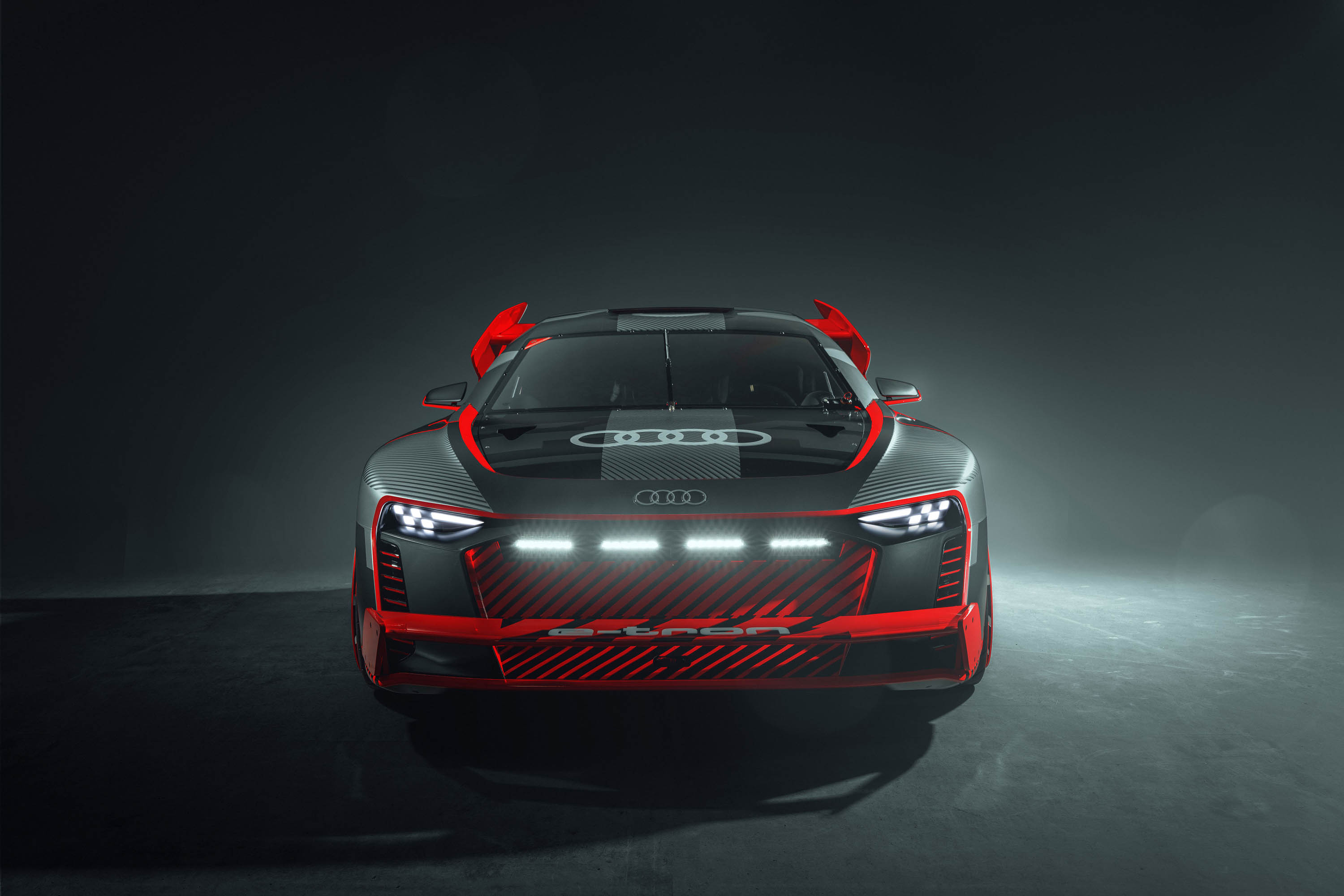
  • This is Ken Block’s Audi S1 Hoonitron

    2021 Audi S1 e-tron quattro Hoonitron

    It instantly brings back memories of the legendary Audi Sport quattro S1 with which the four rings used to charge to the summit in the famous Pikes Peak Hill Climb event, aka the “Race To The Clouds:” Audi is presenting the Audi S1 e-tron quattro Hoonitron that it has exclusively and uniquely developed for American drift artist Ken Block. This all-electric one-of-a-kind car will be the protagonist in a new video that Block is producing together with his team for release in the next few months.

    “The S1 Hoonitron combines a lot of what Audi was already famous for in the nineteen-eighties,” says Ken Block, whose enthusiasm for Audi’s rally cars was sparked at an early age. “For instance, the car’s spectacular aerodynamics have now been translated into a totally modern form. I think it’s cool that the Audi designers have been inspired by their own past and uniquely transferred the car’s technologies and appearance into the present.”

    Two electric motors, all-wheel drive, power galore, a carbon fiber chassis, and the full safety standards as prescribed by motorsport’s top governing body, the FIA – these are merely the S1 Hoonitron’s  statistics. In November, the driver got to know the car for the first time. “Audi gave me the opportunity to test it for a few days in Germany,” says Ken Block. “I’m familiar with a wide variety of cars using internal combustion engines and transmissions, but there were a lot of new things for me to learn here. Spinning into a donut at 150 km/h directly from standstill – just using my right foot – is an all-new experience for me. Our work was focused on getting the car and I used to each other. My thanks go to the whole Audi Sport squad for their outstanding teamwork.”

    The entire development, including the technology, of the S1 Hoonitron was conducted by Audi Sport at the Neckarsulm location – a perfect fit for the project, because that’s also where the Audi RS e-tron GT is produced. Audi Design in Ingolstadt was responsible for the styling, which has been anything but a run-of-the-mill job for Marc Lichte and his team. “When we first heard about this project, the whole team was thrilled immediately: we had the opportunity to develop a car that combines an icon of our brand with the future,” says Audi’s chief designer. The challenges were tremendous: “It was about creating a modern, all-electric interpretation of the S1 Pikes Peak. The timeline was extremely tight: while our design process normally takes one to one-and-a-half years, we only had four weeks from the first drawing to the final design. We were constantly in touch with Ken Block and his team and engaged in intensive exchanges.”

    Fans will soon be able to see the US star’s success with the project for themselves: under the working title Elektrikhana, Ken Block and his team are going to produce the next video of his famous Gymkhana series featuring the S1 Hoonitron. “The collaboration with Audi is a very special partnership for me. The brand and its passion for motorsport motivated me to get into rallying,” says Ken Block. “That Audi has now developed this car for me and my team, and has joined us in our next project, has made a dream come true for me. The Hoonitron is writing the next chapter in our history and taking our Gymkhana story into the future.”

    A story of the future that everyone at Audi is also looking forward to: “Knowing that we’re developing a car for a video with Ken Block that millions of people around the world are going to watch has provided our team with additional motivation,” says Marc Lichte. “These new inspirations are also immensely important for our daily work. The development of this car will encourage us to approach future projects with an even more open and progressive mindset.”


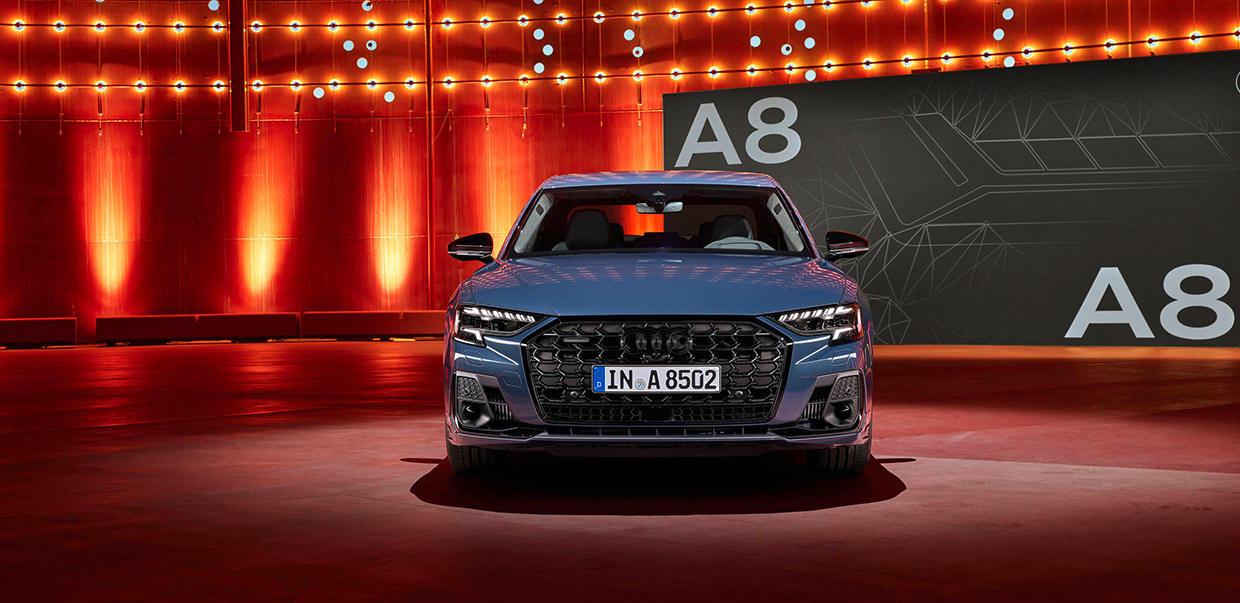
  • 2022 Audi A8

    2022 Audi A8

    With sharpened design, particularly in the front and rear, and innovative technologies, Audi is ensuring the increased presence and sporty elegance of the A8. For that reason, the company with the four rings is even more intensively working out the confident and progressive character of the active luxury sedan. The new high-end headlights and taillights inspire with innovative functions and form the apex of the A8’s established technology portfolio.

    Thanks to the enhancement, the exterior of the A8 has an even more representative, confident, and athletic effect. To summarize, the newly designed and precisely orchestrated design elements in the front, side, and rear areas significantly increase the A8’s presence and authority and sharpen the profile of the brand’s top model. Beyond the basic exterior, Audi is offering its customers the chrome exterior package and, for the first time in the A8, the new S line exterior package. The look is even more defined with the additional black appearance package. The color swatch for the A8 includes eleven colors, among them the new metallic district green, firmament blue, Manhattan gray, and ultra blue. New in the Audi A8 are five matte colors – Daytona gray, florette silver, district green, and glacier white.

    Digital Matrix LED headlights and OLED rear lights

    Comparable with video projectors, the Digital Matrix LED headlights use DMD (digital micromirror device) technology. Each headlight has approximately 1.3 million micromirrors, which disperse the light in tiny pixels and precisely control them. One new function is lane and orientation lights for highways. The enhanced A8 comes with Digital OLED rear lights(OLED = organic light emitting diode) as a standard feature. When ordering the car, there are two rear light signatures to choose from – three with the S8. In conjunction with the assistance systems, the digital OLED rear lights have a proximity indication feature.

    Reduction as a design medium

    The architecture of the interior is strictly horizontally oriented to emphasize the car’s width. In the dark, the ambient light package plus (standard with Audi design selection and in the S8 elegantly stages the interior and there are reading lights in the rear that use Matrix LED technology.

    The range of seats and seat equipment in the enhanced Audi A8 is varied, very comfortable, and radiates the highest degree of authority – especially for the back seats, where many options are available. The relaxation seat in the A8 L2 is the apex of the program. It offers numerous adjustment options and a footrest on the back of the passenger seat. Passengers can use it to have the bottoms of their feet warmed and massaged to various degrees. The high-quality workmanship underscores the A8 interior’s workshop character.

    New solutions: Navigation and Audi connect

    MMI Navigation plus is standard in the enhanced Audi A8 series. It is supported by the third generation modular infotainment toolkit (MIB 3). The likewise standard online and Car-2-X services from Audi connect augment the navigation system. They are divided into two packages: Audi connect Navigation & Infotainment and Audi connect Safety & Service with Audi connect Remote & Control.

    For modern demands: the new screens in the back

    Attractive options are also available for the infotainment hardware. The new screens in the back are tailored to the expectations of today’s rear-seat passengers. That means two 10.1 inch displays with full HD resolution attached to the backs of the front seats.

    Three packages: the driver assistance systems

    There are about 40 driver assistance systems available in the enhanced Audi A8. Some of them – including the Audi pre sense basic and Audi pre sense front safety systems – are standard equipment for the series. Options are clustered into the “Park,” “City,” and “Tour” packages. The assistance package plus consolidates the packages. Features like the night vision assistant and surround view cameras are available separately.

    Sovereign and efficient: the engine range

    To begin with, the enhanced Audi A8 is available with three motorizations. Apart from the 3.0 TFSI as a V6 engine, the 4.0 TFSI, which is available for the A8 and the S8 in various output levels, distributes its four liters of displacement to eight cylinders with cylinder on demand technology. In brief, the A8 is also available as a Diesel engine; a plug-in hybrid model (PHEV) will follow.

    The Audi S8 – inspirational performance in the luxury class

    The Audi S8 TSFI quattro1 is the sporty top model in the series. The biturbo V8 generates 420 kW (571 PS) of power and 800 Nm of torque from 2,050 to 4,500 rpm. Only in the S8 are the predictive active suspension, sport differential, and dynamic all-wheel steering built in ex factory. All the previously mentioned motorizations come with mild hybrid technology (MHEV) as a standard feature, which uses the A8’s 48-volt main electrical system.

    tiptronic, quattro and the sport differential: the whole gamut of driving experience

    All engines in the Audi A8 are connected to a fast and gently toggling eight-step tiptronic. Thanks to an electric oil pump, the automatic transmission can change gears even when the combustion engine is not running. The constant all-wheel drive quattro with the self-locking center differential is standard, optionally supplemented with the sport differential (standard in the S8 ). It actively distributes torque between the rear wheels during fast cornering and thereby makes the handling even sportier and more stable. The adaptive air suspension with controlled damping is standard. Progressive steering is another standard feature. Dynamic all-wheel steering is also available as an option. It is standard equipment in the Audi S8.

    Predictive active suspension

    One highlight of the enhanced A8 is the predictive active suspension. It can load or unload each wheel with additional power individually via an electric motor and thereby actively regulate the position of the chassis in any driving situation. The wheel range for the enhanced Audi A8, which goes from 18 to 21 inches, includes six new designs from Audi and Audi Sport. In top versions like the Audi S8, Audi offers carbon fiber ceramic brake disks as an option.

    A8 L Horch: special for the Chinese market

    The Audi A8 L Horch, the top version for the Chinese market, is 5.45 meters (17.9 ft.) long, which is 13 cm (5.1 in.) longer than the A8 L2. In the interior, the expanded diamond quilting, logo embossing in the cushions, and deep-pile floor mats in the back emphasize the exclusivity of this version. On the exterior, the specifically designed Singleframe with vertical braces, among other things, indicate that it is a luxury model. Also unmistakable are the Horch badge and the “H crown.” For the first time in the D segment, the top model is offering a two-color finish for customers in China.

    Base price: starting at 99,500 euros

    The enhanced Audi A8 starts in December in European markets. In Germany, the base price for the A8 is now 99,500 euros. The Audi S8 is available starting at 144,800 euros.

  • Audi Dakar team heads to Morocco to test out the mighty RS Q e-tron

    2021 Audi A8 DakarAfter some comprehensive tests in Germany and Spain, the Audi RS team heads for the desert and the dunes in the heart of Morocco. All three driver crews were involved in the project. Also, Dakar record winners Stéphane Peterhansel, Carlos Sainz and Mattias Ekström took turns at the wheel of the highly complex prototype.

    As expected, their co-drivers Edouard Boulanger, Lucas Crus, and Emil Bergkvist were there. Driver and co-driver form an important unit in the Dakar Rally and they have to feel comfortable in the cockpit.

    We expect much lower temperatures at the Dakar Rally, says Andreas Roos, Nevertheless, we deliberately went to Morocco to test our concept under the most extreme conditions. Components such as the MGU, for example, were basically not developed for use in such high ambient temperatures, but the drivetrain and other components were also pushed to their limits or even beyond by the heat. The insights we gained in Morocco are invaluable, but they also show us that we still have a lot to do before the Dakar Rally and there is not much time left.

    The high-voltage battery, exclusively developed for the Dakar Rally, is also a central topic.

    SEE ALSO: Nissan Qashqai is the winner at the 2022 TowCar event

    It’s all about optimum temperature management and being able to call up the battery’s maximum performance, says Roos, This is where we are learning with every test. And that’s exactly why we are going to the desert with an electrified drivetrain: We are gaining an incredible amount of experience that we are sharing with our colleagues from road car development.

  • 2022 Audi e-tron GT is here: check out the summary of the lineup

    2021 Audi e-tron GTThe new Audi e-tron GT is already on sale. The vehicle is performance-oriented and features an elegant design and a fully electrified drivetrain system. In fact, this is Audi’s first full-electric tourer and serves as a halo of the ever-growing electrified portfolio of the manufacturer. So, let’s see what this model has to offer.

    Exterior design

    The beautiful design of the new e-tron GT is characterized by large wheels, wide and long wheelbase, and an overall menacing front face. The flat greenhouse with a sloping roofline contributes to an overall sleek appearance, while the rear is tight and minimalistic, and retains that neat sporty spirit.

    The model features large 20-inch 5-spoke alloys, carbon-fiber roof panels, Matrix-design headlights, and lowere door sills.

    Interior design

    The cabin is driver-focused and minimalistic but still manages to include all the utility one expects from a contemporary high-end Audi vehicle.

    The interior is completely leather-free and incorporates Dinamica and Alcantara upholsteries. There’s also Nappa leather package as an optional feature. Furthermore, driver and passengers will benefit from a “monoposto” cockpit with a 12.3-inch Audi virtual cockpit and 10.1-inch MMI touch response displays.

    SEE ALSO: INFINITI announces details for the new QX60 lineup

    Drivetrain system

    The model can be specified with a drivetrain system that generates a total of 469 up to 5637hp and up to 612lb-ft of torque. This power allows the GT to accelerate from 0 to 100km/h in 3.1 seconds and chase a top speed of 155mph.

    Depending on the trim level, the e-tron GT can be geared with available rear-wheel steering, which allows the vehicle to turn in the opposite direction from the front wheels at speeds up to 30mph.

    Additional systems include a fully variable power distribution system, Quattro drive with torque vectoring, and e-torque vectoring plus as an optional feature.