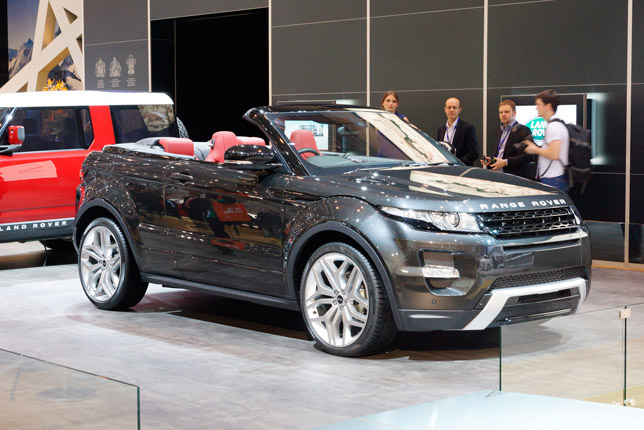
Land Rover has unveiled the special Range Rover Evoque Convertible at the 82nd Geneva Motor Show.
It is powered by a 2.2 liter disel with 150PS and 190PS. There is also a 240PS 2.0 liter petrol engine. The performance and fuel consumption suffer, but no so much. Mainly, because of the added extra weight and strengthening. The soft-top retracting mechanism is neatly snug below the belt-line and the distinctive shape of the original has been preserved to near perfection.
The Convertible Evoque boasts a lot of extras Terrain Response, surround cameras, Park Assist, an 8” dual view touch screen and a Meridian sound system. The vehicle sits on 21” wheels in Titan silver finish.
The design looks really stunning, but it is way better than Nissan’s creation from two years ago. Range Rover Evoque Convertible will be well appreciated by the customers for sure.
Ferrari has officially showcased the new stunning F12berlinetta at the Geneva Motor Show. The super sports car is displayed on the stand in two new colours, Rosso Berlinetta and Aluminium. It features a brutal naturally aspirated V12 and aerodynamics have also been honed to the extreme in an innovative design that redefines classic Ferrari themes.
It is powered by a 6.3 liter 65° V12 engine with 740PS (544 kW) and 690Nm (509 lb-ft). 0-100 km/h – 3.1 seconds and 0-200 km/h in 8.5 seconds. The top speed is over 340 km/h. The efficiency is poor – an average 18.8 mpg UK – 15 litres per 100 km with CO2 emissions of 350 g/km.
The car is pretty small and its engine, dashboard and seats are lower in the chassis to achieve low center of gravity. A new suspension and gearbox layout helps reduce the car’s rear volume. The result is fantastic with a weight distribution 46:54 (front-rear axle).
The stand also features a special area for clients wishing to make their Ferrari truly unique by availing of the exclusive Tailor-Made programme which offers a selection of materials, colours and finishes that span both the marque’s tradition and history and the very latest trends. The Tailor-Made area will be showcasing an FF with several unusual personalisation features, including a new three-layer Grigio Ingrid livery, pinstripe cloth and Testa di Moro semi-aniline leather seats, cashmere headliner and teak-trimmed boot.
Hamann currently is exhibiting the tuned Range Rover Evoque at the 2012 Geneva Motor Show. The visitor will be able to examine carefully all details of the fashion SUV.
The exterior package includes a new two-piece front lower spoiler, big fender extensions and side sills. The track is widen by 70mm at the front axle and 80mm at the rear. This is a lot and the Hamann Evoque looks really stunning. To complete exterior, the tuning specialists added a double-pipe stainless-steel muffler.
The vehicle stands on nice Anniversary EVO and Anniversary EVO Black line 22” wheels – 10.5J x 22” with 295/30 ZR22 tires. The three-piece Hamann Edition Race Anodized alloys are also available/
There are also three performance packages for the 2.2 TD4 and the 2.2 ED4 boosting the power with 31PS (25 kW) and 65Nm (48 lb-ft) of torque. The powerful 2.2 Si4 can boast 38PS (31 kW) and 55Nm (41 lb-ft) more.
Finally, the interior received a new upholstery in any desired color.
The Lamborghini Aventador Jthat is currently on a stand at the Geneva Motor Show is without question a magnificent looking roadster. Powerful too, with 700 BHP to play with. But, its mad looks and the fact that it has no windshield render it a bit silly. It shouldn’t be taken as a joke in any case, it can still shed your face off, but it’s all a bit of fun, it relies on flamboyancy and spunk. It beats its chest that it is what it is – a Lamborghini titan of hypercars.
However, the Aventador J does not, in any possible way, overshadow that other roadster at the show. I am talking about the god of hypercars (with a haircuts) – Bugatti Veyron 16.4 Grand Sport Vitesse.
As far as the figures are concerned, today this is the fastest open-top in the world. The Vitesse builds on the success of the previous Grand Sport that had “mere” 1001 ponies at its disposal. Now, by overhauling the four turbos and intercoolers, Bugatti have made the Vitesse more Super Sport-worthy. Let’s sum it up: a 7.9 liter W16 engine that brings 1,200 BHP and 1500 Nm of torque to all four wheels. The top speed is 410 kph or 255 mph (limited to 375 kph/233 mph). A zero to sixty time – 2.6 seconds. Yikes!
Bugatti Veyron Grand Sport Vitesse
That new-found power has triggered an inevitable chain reaction that jolts trough the whole Veyron construction. Bugatti has promptly reinforced all drivetrain components in order to safely transfer the immense forces at any given moment. The bits within the 7-speedDSG gearbox have been specially modified to cope fairly with the new stresses. The same goes for the airflow that used to run through the components of the previous Grand Sport. It has now been further optimized. Ironically, somehow with the more power, the fuel economy has also been improved.
The chassis has had some work done. New, “quick-responding” dampers have been fitted which literally obliterate the possibility of body roll or pitching during braking or accelerating. The ESP has been revised to “lag” just a little bit after shooting out form a corner so that you can have that millisecond of slipperishness. Additionally, the brakes are now being cooled more efficiently in order for them to cope with the increased power.
Many aerodynamic components from the Super Sport have been picked off, redesigned and stuck to the Grand Sport Vitesse. At the front, bigger air intakes around the center grille, slashed with a line horizontally, give the car some identity. The bottom air vent stretches sideways into the wheel housing and gives this exceptional sports car an extremely masterful appearance. Further down, there is a newly made front spoiler. The Headlights, with their black frames are also new. The rear end also comes from the Super Sport but with two diffusers and two tailpipes clustered in the middle. All-new, lighter 20-inch “Vitesse”-type alloy wheels complete the picture
The two highest points of the car are the air scoops on the engine cover. Familiar from the Grand Sport, these are now again redesigned for the Vitesse and also act as components of an anti-roll protection system. Needless to say, that just like its predecessor, the Vitesse is virtually made all from carbon fiber.
Since you can go your way with the customization process, the end products may vary. That is why at the Geneva Motor Show there are two Vitesse configurations – one is in a strikingly blue, exposed carbon fiber finish and the other in “JetGrey” coating with an orange interior and black rims and grille. For the more conventional Veyron fans there’s also a classic Grand Sport version present just to remind you that it still exists.
What happens when you cross mad lunacy with refinement and sensibility? Obviously and epic lovechild that has the best of both worlds. In our case that’s the VW Polo BlueGT (no, it’s not a sad GTI). It’s a super fun 140 PSPolo that has the looks and feel of a GTI and the metabolism of a BlueMotion. Today, on a stand at the Geneva Motor Show and within months, on to the European roads.
A system described as “ACT cylinder deactivation” is at the core of the BlueGT ideology. The second and third cylinders are automatically shut down within the 1,250 and 4,000 rpm. range and when torque output is between 25 and 100 Nm. If the driver decides to give it the beans, reactivation of the cylinders happens seamlessly in a matter of milliseconds but the dashboard will tell you nevertheless. That gives the 1.4 turbocharged, 140 PS engine the upper edge in fuel economy. Its combined cycle of fuel consumption amounts to 4.7 litres per 100 km (around 60 mpg). CO2 emissions equal to 108 g/km. Opt for the DSG transmission and you’ll get even more frugality. At the same time the top speed is at 210 kmh (130 mph) and zero to 62 mph takes 7.9 seconds.
For the styling of the BlueGT, Volkswagen have gone the “Frankinstain’s monster” way – GTI strains account for the front and rear bumpers, the rear spoiler, the instruments inside, the sports seasts and the leather steering wheel.The BlueGT is also 15 mm closer to the ground and sits on 17-inch multi-spoked alloys. The side sills and front windscreen rain channels, on the other hand, are from a Polo BlueMotion. This particular model is also the typical BlueMotion shade and the badges are all blue. Unlike the Frankinstain story however, the BlueGT might turn out to be a success rather than a tragedy. In fact, the BlueGT carries the first of Volkswagen‘s EA211 series of engines – a line that will underpin most of the models in the company’s production future.
Hopefully, shipments are going to start in July within mainland Europe. Whether there’s going to be a production for the UK, is still not announced.
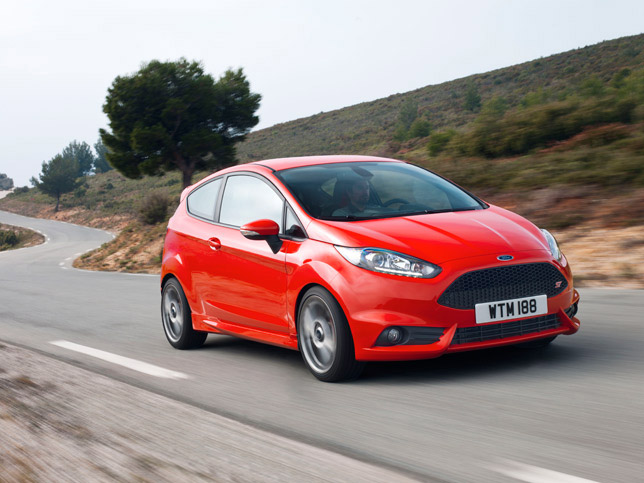
Here’s a preview of Ford’s new Fiesta ST. It’s at Geneva at the moment with plans to go on sale in the UK early next year. It has been four years since the last Fiesta ST and recently the fan base has started feeling uneasy. Now everyone can calm down as this little fellow here is meet their needs.
A four year gap between the two models can only mean one thing: massive improvements in terms of performance. The numbers speak for themselves – 180PS 1.6-litre EcoBoost, 240Nm of torque, 0-62mph in under seven seconds, and top speed of more than 136mph. All the while, CO2 emissions are down by 20 percent in comparison to the old ST.
Hopefully the new Fiesta will have the handling to match the performance. The guys at Team RS have put a lot of their WRC know how in use while working on the chassis which leaves the ST15mm lower than a standard Fiesta. The car’s Torque Vectoring Control system and three Electronic Stability Control modes have all been rigorously developed and tested at the Nurburgring.
Inside, Recaro sports seats will provide support for the enthusiastic drive for the first time in a Ford Fiesta. There’s something for the novice drivers as well – the car will be fitted with Ford’s MyKey solution which can limit the car’s power and speed to a certain degree thus effectively preventing your kids to end up in a ditch.
The Fiesta ST is sure to come to Europe, but Ford are considering other markets as well:
“We’re delighted to be bringing a new generation Fiesta ST to our European enthusiasts in 2013 and we’ll have more to say about our plans for other markets in the near future,” said Jost Capito, Ford’s director of Global Performance Vehicles.
There it is! The Lamborghini Aventador J – J as in FIA’s ‘Appendix J’ regarding the tech spec of race cars. Hope you like wildlife in your hair as this Geneva participant doesn’t really make any use of a roof. Or a windshield for that matter. Why would it? It’s a 700 bhp open top. Isn’t that enough?
Unsurprisingly, the J is based on the Aventador LP 700-4 – An AWD layout with a 6.5-litre 700bhp V12 engine. Imagine the wind resistance one is going to experience on their face whilst closing in on the 300 km/h barrier. They should have called it the Aventador D for Drama.
Obviously, the disposal of otherwise vital components calls for some structural changes.An innovative monocoque construction made from carbon fiber reinforced polymers combines lightness with optimum stiffness and strength. There are two safety bars behind the seats that are made made from a forged composite and reinforced with carbon fiber inserts. The thing about open tops and convertibles is that most people cringe at the sight of them knowing that speed and agility have been compromised. However, that’s not the case with the Aventador J. Because we don’t have a roof or a windshield, we also don’t have air conditioning. There are no distractions inside (if we can call it an inside) – Things like the satellite navigation and audio system have been deemed redundant. The J’s cockpit and parts of the seats are clad in a material called “Carbonskin” – woven carbon fibers that have been soaked in a special epoxy resin that stabilizes the fiber structure and keeps things soft and flexible. All that hi-tech, light weight material and the feature diet make the bull extremely light – 1575 kg of dry weight.
Lamborghini Aventador J
Lamborghini have put to use these materials in the maddest of ways. See that horizontal stabilizer pinned between the two inferior looking wind guards? That is not a horizontal stabilizer but a rear view mirror. The front nose is narrower than the standard one and is dominated by a highly distinctive carbon fiber air scoop. Upward fins on the side complete the look. The wheels are 20 and 21-inch front and back respectively and carry a five-spoke design and an additional carbon fiber fan-like feature that vents air toward the massive brakes. All you need to know for the back end is that it has a carbon-fiber rear diffuser, four huge tail pipes and an enormous fixed spoiler mounted on the bodyshell by two arms.
So far, only one Aventador J has been made (Unica) and at the end of the Geneva Motor Show it will be sold to someone who would be brave enough and strong enough to handle it. This car is not a concept, not a prototype but a fully functional, road legal roadster.
Hamann, have a few treats for us awaiting at the Geneva Auto Show. There, we’ll see their idea of a BMW M5 and also this – the Hamann Hawk AMG SLS Roadster. It’s a hardcore matte-red lacquered open top SLS. Their recipe for it rather common – add some aerodynamic bits, squeeze the engine for more power, make it sound better, big wheels and an interior, more luxurious than a honeymoon suite. The end result is brilliant.
Straight to the point, power is now 636 BHP with maximum torque being 680 Nm at 4,850 rpm. A new, sports exhaust system, an air filter and some fiddling with the electronics are all to blame for that. Set the launch control right and you’ll the 100 km/h threshold in no more than 3.6 seconds. Keep your foot on the throttle and eventually the needle will reach 320 km/h.
The outside additives have been designed in a wind tunnel to get the maximum down force potential from them. The front bumper is new and supposed to reduce lift while the aggressive air inlets and new LED modules on it, give the SLS‘s face some spunk. And while we are at the front, it’s worth mentioning the carbon fiber checkered hood that has equally menacing air outlets. The wheel arches are so flared up, that they’ll even make a hippopotamus green with envy. Side skirts sort of connect the both ends and complement the wheels while the back bumper has a diffuser and housing for four 90mm wide exhaust pipes.
Hamann Hawk AMG SLS Roadster
For some exceptional handling, the Hawk has been fitted with four height-adjustable dampers which can lower the whole thing by 30 mm in total. Also, four sticky tires – 245/30 ZR 21 at the front and 345/25 ZR 21 at the rear – are wrapped around single piece, super light “Unique Forged Anodized” 21 inch wheels.
Inside, attention to detail is what it counts. Leather and suede patterns are seen all around while red carbon patches adorn the center console, instruments, door sill protectors and air vents. As an overall product, the Hamann Hawk SLS Roadster does really do honor to its potential owner.
Apart from the Hawk SLS AMG Roadster, Hamann have a BMW M5 ready for us at the Geneva Motor Show. That means more style, more dynamics and more fun in a package of quality and exclusiveness.
Hannman focused on expressing the M5 posture. A wide posture in this case – 25 mm over the standard front wings and 30 mm more at the back. Combine that with a lower center of gravity thanks to special springs provided, and you get a fully blown, wide, mean, lean sports saloon that can put to shame even touring cars. An additional down force comes from the custom front and rear aprons, side skirts and roof and trunk spoilers. So there wont be a need for grip we presume
But just to be sure, Hamann have provided some sticky and wide (325/25 ZR 21 at the back just to get an idea of how wide) Continental Sport Contact 5P tires that go on the 9.5Jx21-inch front and 12.0Jx21-inch rear wheels. And the wheels themselves have a sporting pedigree, being all light and “anodized”, fitted with titanium bolts.
Hamann are still working on the power issues. With the addition of a new sports muffler and some crafty engine-management, the M5‘s V8 is expected to deliver 120 PS and 220 Nm of torque more than it normally does.
For the interior, the company has gone the extra mile. The cabin has the feel of a VIP lounge crossed with motorsport accents. Leather wraps around the seats, the wheel and the center console. Aluminum pedals peak at you from the foot well. Alcantra materials are also available as an option for the picky customers.
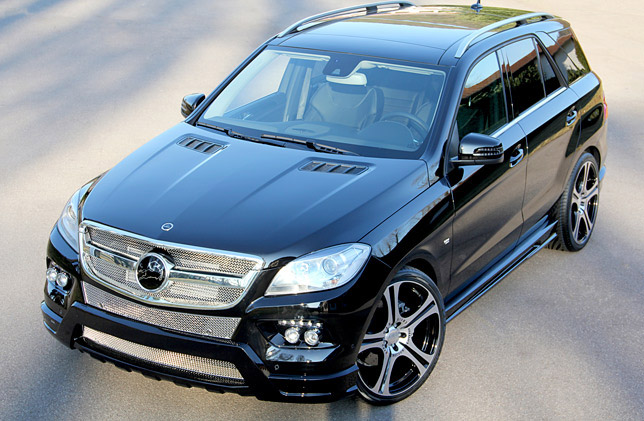
We can’t get enough of Carlsson and luckily, they seem to be unable to stop churning out projects. So in this latest win-win situation, we welcome the Carlsson ML CD35 – It’s based on the current Mercedes-Benz M-class (W 166) and will premiere at the Geneva Motor Show this week. 22-inch wheels, suspension tweaks, an aerodynamic package and a performance package all highlight the Carlsson mark on the luxury SUV.
To start off, we have a new look that can only accent the already aggressive stance of the M-Class. A new front apron and dual headlight modules with LED daytime running lights, give the front a typical Carlssonish feel. The mesh inserts withing the bumper, are from an electro-polished stainless steel and so is the main radiator grille. Some sikdeskirts also complement the whole kit and a rear apron and a set of exhausts adorn the back end. Although, we can’t be sure of that until Carlsson fully reveal the ML CD35.
Carlsson Mercedes ML CD35
In terms of performance, the standard W166 that has gone under the knife has a 3.0 liter V6 BlueTEC 4MATIC diesel engine that develops 190 HP 680 Nm of torqe. Carlsson have taken that power up to 310 HP and 700 Nm thanks to a C-Tronic supplementary control unit. It’s not just brute power extraction that violates the engine. Rather, the C-Tronic thing cleverly monitors all temperature, emission and rpm reading and shuts off when it senses that the engine has reached a wear-and-tear zone. Soon enough, there will be even more performance tweaks available for the CD35 from Carlsson.
In order to make you even more dependent on your iPhone, the C-Tronic Carlsson suspension provided is linked to an application that allows remote control. Feel free to rise up or lower the CD35 whenever you like. As long as your phone battery isn’t dead. By default, the Carlsson M-class is around 30 mm lower than standard and sits on 10 x 20-inch, light alloy wheels with Carlsson 1/5 Revo design. At the Geneva Motor Show, five-spoke wheels in the Brilliant Edition and Dark Series surface finish will be installed.
The interior has been delicately altered with the help of illuminated door sill panels imprinted with Carlsson lettering, Carlsson door pins, and a footrest plus pedals made from aluminum.
Here’s a video from Lamborghini of two quite brisk headlights. It’s actually a teaser video from the Bologna company regarding the upcoming reveal of… something. Most likely, it’ll be called the the Lamborghini Unica. But, there’s a lot speculation going around. Some say it will be the Aventador J Speedster – a Spyder version/concept of the Aventador. Recently some photos have also been circulating the web showing a completely topless Aventador rendering.
In any case, if the the Unica/J Speedster has anything to do with the current AventadorLP 700-4, we should be expecting at the very least a V12, 6.5 liter engine developing 700 units of horsepower and nearly 700 Nm of torque. Hope you like windy weather.
A premiere at the Geneva Motor Show tomorrow will most likely substitute speculation with awe (we hope so). Obviously you can also follow the events on Twitter.
On a side note, Unica roughly translets from Italian into “the one and only” or ‘unique’ if you will.
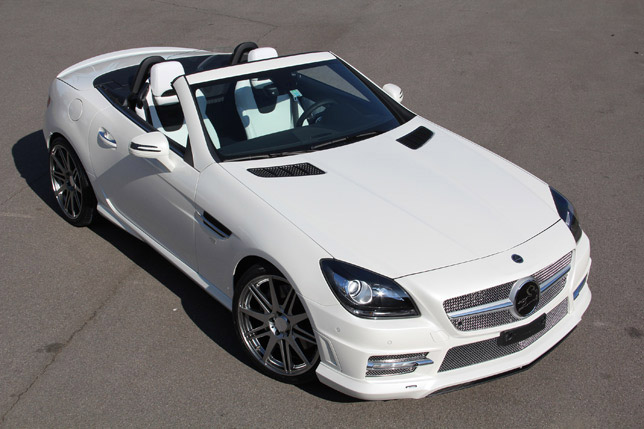
Another Carlsson gem at the 2012 Geneva Motor Show – the Carlsson Mercedes-Benz SLK will showcase all there is to showcase in exclusive accessories. The interior has been adorned with some Nappa leather, the exterior with some aerodynamic bits and pieces along with some wheels and there’s a performance upgrade for that extra punch.
Additional power comes from something called CB25 S. It’s a package for the SLK engine. Alongside a C-Tronic additional control unit from Carlsson’s Plug-and-Drive series, the kit also sees a new, larger intercooler. At the end of the day we have 176 kW (239 BHP) rushing out as apocalyptic thunder from the flow-optimized, stainless steel rear muffler.
Visually, the Carlsson SLK harbors an aerodynamic package similar to the one found in the AMG sports package. At the front there’s a Carlsson bumper with an RS lip spoiler made from carbon. Grille inserts made from electro-polished stainless steel replace the plastic honeycomb grille found in the front skirt of the series model. At the back we also have a new skirt insert along with the diffuser and a trunk lip spoiler. Thanks to a suspension tweak, the SLK sits lower by 30 mm on a set of Carlsson light metal alloy wheels measuring 8.5 x 19 inches at the front axle and 9.5 x 19 inches on the rear.
Inside a hand-stitched Nappa leather festival opens up as you step in. It’s called the Carlsson Signature Line and no matter what the temperature, the natural and exclusive material on the seats constantly assimilates to the temperature of your own body. In case you forget, Carlsson have scattered numerous reminders that this car is their child – Carlsson pedal overlays, Carlsson footrests, Carlsson door locking pins made from brushed aluminum, door sill panels and the glass wind deflector with the laser-printed Carlsson logo.
 Land Rover has unveiled the special Range Rover Evoque Convertible at the 82nd Geneva Motor Show.


 Ferrari has officially showcased the new stunning F12berlinetta at the Geneva Motor Show. The super sports car is displayed on the stand in two new colours, Rosso Berlinetta and Aluminium. It features a brutal naturally aspirated V12 and aerodynamics have also been honed to the extreme in an innovative design that redefines classic Ferrari themes.


 Hamann currently is exhibiting the tuned Range Rover Evoque at the 2012 Geneva Motor Show. The visitor will be able to examine carefully all details of the fashion SUV.


 The


 What happens when you cross mad lunacy with refinement and sensibility? Obviously and epic lovechild that has the best of both worlds. In our case that’s the VW Polo BlueGT (no, it’s not a sad GTI). It’s a super fun 140 PS Polo that has the looks and feel of a GTI and the metabolism of a BlueMotion. Today, on a stand at the Geneva Motor Show and within months, on to the European roads.


 Here’s a preview of Ford’s new Fiesta ST. It’s at Geneva at the moment with plans to go on sale in the UK early next year. It has been four years since the last Fiesta ST and recently the fan base has started feeling uneasy. Now everyone can calm down as this little fellow here is meet their needs.


 There it is! The Lamborghini Aventador J – J as in


 Hamann, have a few treats for us awaiting at the Geneva Auto Show. There, we’ll see their idea of a


 Apart from the


 We can’t get enough of Carlsson and luckily, they seem to be unable to stop churning out projects. So in this latest win-win situation, we welcome the Carlsson ML CD35 – It’s based on the current Mercedes-Benz M-class (W 166) and will premiere at the Geneva Motor Show this week. 22-inch wheels, suspension tweaks, an aerodynamic package and a performance package all highlight the Carlsson mark on the luxury SUV.
 Here’s a video from Lamborghini of two quite brisk headlights. It’s actually a teaser video from the Bologna company regarding the upcoming reveal of… something. Most likely, it’ll be called the the Lamborghini Unica. But, there’s a lot speculation going around. Some say it will be the Aventador J Speedster – a Spyder version/concept of the Aventador. Recently some photos have also
 Another Carlsson gem at the 2012 Geneva Motor Show – the Carlsson Mercedes-Benz SLK will showcase all there is to showcase in exclusive accessories. The interior has been adorned with some Nappa leather, the exterior with some aerodynamic bits and pieces along with some wheels and there’s a performance upgrade for that extra punch.