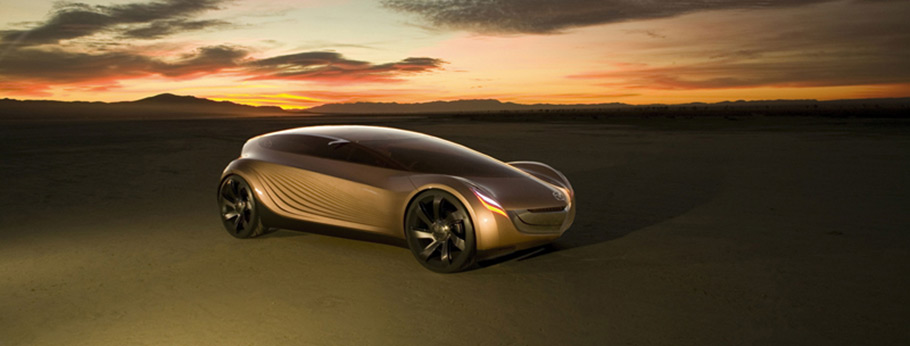
Mazda’s design DNA
To come up with a new design identity for Mazda, Laurens van den Acker and his design team had to condense and refine important heritage and brand identifiers into future design DNA. But what is design DNA?
As its name would suggest, it’s not so different from a human genome. Design DNA is a name for the basic building blocks that makes a car recognisable. It’s a design element that ensures a car shares visual characteristics with other vehicles in the same family, while at the same time distinguishing it from other brands and other products. Essentially they are the visual features that a family of cars has in common – in this case the elements that make a Mazda look like a Mazda.
Usually these elements include the look and shape of the grille, the roof angle and the shape of the headlights and even rear taillights. It can also mean a crease in a body panel, the shape of a window or even an unusual wheel design that is visually identifiable with a car brand. If these are the essential ingredients for a design language then the combination of them together, crafted expertly, and when well executed, should lead to a number of distinctive and brand unique new cars. In this case the goal is to create a family of beautiful vehicles, all uniquely different, yet recognizably Mazda.
Car design: one integrated process from concept to creation
At Mazda concept car development plays a vital role in enhancing consumer brand perception and represents a vital opportunity to communicate good ideas and assess consumer reaction.
But the origins of a concept vehicle rarely – though sometimes – originates solely in the design studio. In fact, concept vehicle development begins with early Advanced Product Strategy (APS) – strategic team meetings comprising team members from design, marketing and engineering.
This strategic planning starts with research into emerging consumer lifestyle and future automotive trends to determine the market’s requirement and potential acceptance of a concept vehicle.
Often, this early research involves documenting the nature of consumers’ lifestyles through observation; by watching how consumers use the vehicles they own and documenting how they feel about them. In combination with market data – which indicates consumers’ buying habits – the APS team is able to evaluate the potential marketability of future vehicles. At this point the APS team is able to create a design and development strategy for any given concept vehicle while ensuring that any such development remains faithful to the Mazda brand and fulfils the strategic goal for the concept.
With engineering, planning and design professionals all working together as one group, the design development process is enhanced. At this stage a comprehensive design brief is created and full concept development begins.
From here designers work with packaging engineers to develop the vehicle concept, ensuring it meets the needs of target consumers. Designers begin to create vehicle sketches for the possible concept vehicle. This is called concept generation. At this stage the design is considered more ‘free’, sketches are inventive and investigate a range of ideas involving proportions and form, and even more detailed explorations of face graphics and surface texture. Designers take into account packaging and platform constraints and vehicle ‘hard points’ – the underpinnings of the vehicle chassis and powertrain – determined by engineers and often from a ‘donor vehicle’.
Once a design is determined further sketches are developed, comprising different vehicle views and interior and exterior details. From here three-dimensional clay model development of the concept vehicle begins. This continues with digital modeling via the use of computer aided design techniques so that different views of the vehicle – often in different environments and different lighting conditions – can be evaluated.
Interior designers begin in earnest to create interior designs for the concept, working closely with colour and trim specialists who are developing mood boards and colour palettes – including interesting textures and materials. Once an interior design is identified digital modeling gets underway to generate three-dimensional renderings and ultimately modeling data.
From here interior and exterior prototype components are developed for the final concept vehicle build. This is usually assembled in the design studio, or may be built off-site by a specialist concept vehicle and prototype construction supplier.
This development process involves hundreds of steps to successfully realize a full-size three-dimensional and faithful iteration of the car design team’s original sketches. For concept cars this process usually takes 12-18 months. Should the concept go on to production, it may take as long as five years before the production vehicle comes to market.
How to design a car: 9 steps to sketching a concept
Almost all car design begins with design sketches. Though these are approached from a number of perspectives, the One-Point Perspective is the easiest to master and the quickest to execute and is where most designers’ ideation begins.
Step 1 – the foundations
Using a pencil start by drawing a ground line, set two wheel positions and create a shoulder line. It is important to keep your lines light so that you can change things easily and correct mistakes as the design progresses without succumbing to the desire to start again.
Step 2 – rough proportion
Mark out the rough proportions of the vehicle, of what will become the vehicle’s bodywork, using a centre line and the window opening.
Step 3 – defining bodywork
Outline the top edge of the vehicle’s body from the rear bumper, across the roof and down to the front bumper. Note that the closer the roofline is to the centre line the less the curvature is implied.
Step 4 – adding detail
Once you are happy with the general shape and proportions of your vehicle you can begin to add detail such as the bumpers, headlamps and wheels.
Step 5 – firming up the details
This will be the final stage before adding some colour. If you are happy with the way your design is progressing then you can add more details indicating surface texture and wheel design.
Step 6 – adding shading, suggesting light If your are happy with your design so far then you can begin to add some shading of the windows and wheels using a marker. Note that if you make the front wheels darker than the rear wheels you are better able to suggest movement.
Step 7 – horizon and scenery
This is the stage that requires some courage. Take a coloured marker and begin to suggest the reflection of light in the windows and body surface. Imagine where the horizon line is behind you and imagine how that would be reflected in the vehicle’s surfaces and even the scenery behind you.
Step 8 – adding colour
Apply the colour marker or pastel of your choice across the length of the bodywork, centering just below the shoulder line. Note it is best to choose a colour that is similar to your earlier marker work.
Step 9 – cleaning up
This is the final stage. Take an eraser and try to determine which of the surfaces are upwards facing. If you have accidentally coloured these then remove it. This should ensure that you have the best opportunity to suggest three-dimensional form.
Mazda Design: from concept to production
In most cases, concept-cars give a preview of design cues of future mass production models. Following are two examples of such an evolution:
Ibuki concept to Mazda MX-5 (3rd generation)
Inspired by the face and form of the original 1990 MX-5 design, Mazda launched the distinctive Ibuki concept in 2004 Tokyo motor show.
Meaning ‘breathing new energy into’, the Ibuki name suggested the concept car’s secret – that it really was the new MX-5 – while the world’s press reported that any link was merely theoretical.
In fact, the Ibuki’s ovular design motif – which was apparent all over the car – really would become the design motif of the next generation Mazda MX-5 when launched at the Geneva Motor Show 2005. The ovular headlights and pronounced arches and the clean, uncluttered and clear surfaces would all ultimately be seen in the final vehicle. Inside the production MX-5 kept some elements from Ibuki’s design, such as the three-point steering wheel and ovular centre console, the strong centre tunnel and rectangular door-pull handles.
What’s more, for the Ibuki concept, Mazda moved the entire drivetrain rearwards and downwards to make the centre of gravity lower and closer to the center of the car. The goal was to improve balance and handling, and maintain the 50/50 weight distribution. The resulting concept had unusually short overhangs and was a full foot shorter than Mazda’s current production MX-5.
By the time of the launch of the subsequent MX-5, the production vehicle did indeed exhibit shorter overhangs and improved handling.
Sassou concept to Mazda2 (2nd generation)
The Mazda Sassou concept suggested what Mazda’s next generation B-segment product could look like when it was introduced at the Frankfurt Motor Show in 2005.
Designed at Mazda’s design center in Oberursel, Germany, the name Sassou is a Japanese term that means having an optimistic state of mind.
The concept was designed to appeal to young, first-time buyers and explored what young people would want from a car in terms of future technologies. As a result of this research, Sassou’s interior was based on a concept of ‘illumination’ and an interactive connectivity ideal which saw the car’s entertainment and personalisation system uploaded to the vehicle’s hard drive via a user-operated USB stick key.
Though the interior contributed much to the concept’s success it was the exterior design that would prevail to the Mazda2 production vehicle. Sassou contained many Mazda design features that would ultimately be apparent in the later Mazda2 production model, including the overall form, the surface creases and the front end – with its large, sporty five-point grille and bonnet – itself an evolution of the Mazda RX-8 front end.
Advanced design at Mazda: four global studios in full flow
The responsibility for the successful worldwide introduction of Mazda design falls to four global design studios – located in Irvine, California, Oberursel, near Frankfurt, Germany and Yokohama and Hiroshima, Japan – all guided by Laurens van den Acker.
This is an incredible challenge, not least in communication terms alone. As Laurens van den Acker is based at the firm’s global Mazda’s headquarters in Hiroshima, Japan, it means he spends a lot of time traveling between studios.
All four of Mazda’s studios are playing a vital role in the supply of ideas for future design directions. At its simplest each of the studios focus on the creation of products for their local markets. In Irvine, Mazda’s North American design studio works on vehicles and concepts for North America, under the daily direction of Franz von Holzhausen. In Frankfurt, Peter Birtwhistle’s studio focuses on vehicles for Europe. While back in Japan, Yokohama – under Atsuhiko Yamada – concentrates its energy on products for Asia, together with the design headquarters in Hiroshima which guides overall global design strategy and engineering integration.
The reality is rather more complex, with product origination in one geographic location via import from different global design studios and often destined for more than one market. The result is that each of the studios is effectively globally focused but with local expertise. This leads to an incredibly healthy environment of competition and rivalry in the global design team, but still with openness that ensures efficient working processes.
Each studio works in three different areas, creating concept cars, crafting production vehicles and evolving a better understanding of how to improve future Mazda vehicles. All are aspects that will crucially affect design. But, arguably, it is the third aspect that is the most important as it asks ‘where are we headed and what do we need to do to get there?’
It is usually this ‘third way’ that most impacts vehicle architecture and packaging. It starts with a philosophy and then leads to questions as essential as ‘how will we build these cars and what will we build them from?’
Usually the design studio located geographically closest to production design and advanced engineering and planning that spends the most time focusing on how and where to build a car. This leaves more time available to generate concepts and other ‘experimental’ work to secondary studios. These studios are vital in the development of cars, simply because they have more time to ask questions that their ‘client’, the design headquarters, may not yet even has asked.
Under van den Acker, each of the studios are encouraged to imagine ‘further out’, to explore future ideas and concepts.
Nagare, a new design language
Zoom-Zoom: the physical interpretation of Mazda’s brand heritage
When Mazda unveiled the Nagare concept car at the LA Motor Show in 2006, it was unlike any concept car seen before; due to its exterior form language of textured surface lines and dramatic, futuristic wedge-like shape.
At first the car appeared to be a complete visual sea change from the trio of concept vehicles that had immediately preceded it – Sassou, Senku and Kabura – and no one, not even on Mazda’s design team, knew how big an impact their new design philosophy would make around the world.
The earlier trio of award-winning* concept cars had all wowed audiences at the world’s motor shows in 2005 and 2006 – exhibiting a new and energetic commitment to exciting and contemporary automotive design at Mazda. But with the introduction of the Nagare concept, everything shifted. It was as dramatic an introduction as any car company could hope for.
But why such a dramatic shift when the latest concepts had been so successful? Franz von Holzhausen, Director of Design for Mazda North America, explains:
“Mazda has a strong line up of products but we felt that, for the future of the Mazda brand, we needed to create a design language that reflected an emotional attachment to the cars, in a similar way that Zoom-Zoom represented an emotional attachment to the cars when in motion. The three concepts explored ideas that would become part of Flow design philosophy. Nagare really evolved from these concepts when Laurens suggested that we be even bolder and go further than we had before.”
Mazda’s brand DNA – the component philosophical parts from which a Mazda vehicle is constructed – can be summarized in a series of adjectives: ‘Zoom-Zoom’, ‘young’, ‘stylish’, ‘spirited’, ‘insightful’, ‘emotion in motion’, ‘innovative’, all are adjectives that have, over the years, become directly associated with the Mazda brand. This is because Mazda cars have long been heralded for their exceptional functionality, responsive handling and excellent driving performance.
“We looked at all of these adjectives and wondered whether they were really being visually expressed through the design at Mazda,” Franz von Holzhausen explains. “Our cars were dynamically great and proportionally they were good but visually we felt that they needed work. It’s already time to prepare the design evolution of tomorrow. The Nagare concepts show the way.”
The design team set out to discover something new and fresh for Mazda design; in terms of an aesthetic that would define Mazda, that visually communicated the brand and which would become something that Mazda could ‘own’ from a design perspective.
Under Laurens van den Acker, the design team was challenged to capture Mazda’s driving spirit – embodied in Zoom-Zoom – by trying to capture Mazda’s essential brand characteristics visually in Mazda vehicles, even when they were stationary.
The result was Nagare or Flow, a whole new design language for Mazda cars.
*Mazda’s Senku concept car was awarded the Grand Prix du Plus Beau Concept Car at the XXIst Festival Automobile International in 2006 in Paris. Mazda’s Kabura concept won the Detroit Motor Show’s Aesthetic and Innovation Award.
How to design a Mazda? The lines and elements that make a Mazda a Mazda
Under Mazda’s emerging Nagare (or Flow) form language, there are many design elements that define a Mazda vehicle.
The most apparent is the surface treatment itself, which suggests air or fluid flow over the vehicles’ side surfaces. This is apparent for all of the Nagare concept vehicles. Their surface designs are textured to play with light as if the car is speeding through the air, suggesting the vehicles’ dynamic driving characteristics. These surfaces vary in accordance with the vehicle type and its individual shape and characteristics, as seen in the concept cars. Although different between each of the vehicles, it is always appropriate.
A further clear and all-important element is Mazda’s five-point grille, which again differs between vehicles but which has a strong family resemblance. The exact shape and nature of the grille is dependent again on the appropriateness of the grille (it’s size and shape) within the overall ‘face’ of the vehicle.
Other elements are apparent in the bonnets, the RX-8-style wheel arches and the head- and tail lamp treatments of each of the concepts.
These elements – along with the concepts’ fast wedge shape – are essential building blocks for Flow design.
Inside design: the future of interior design at Mazda
Until now the majority of Mazda’s design focus has been in the evolution of the Nagare exterior form language. This has been seen in the design progression apparent in the five concept vehicles. But as Laurens van den Acker explains, the focus is shifting to how to translate Flow to the interior of future Mazda vehicles.
“The interior is a different approach; it is a collection of things. We are naturally maturing this language, by approaching interior development with the goal of having a holistic philosophy.”
“Interior development is focusing on three key areas – driver orientation, lightness – which is very important to Mazda – and Flow. The idea is that the combination of these three aspects will make our interiors unique and makes our cars uniquely Mazda. You could argue that other brands have driver orientation and they may be trying to be light too. But only Nagare combined with the other two can define Mazda.”
The goal with the interior design is to generate similar design DNA for the interior that the design team has been identifying for the outside of future Mazda vehicles, in order to create consistent interiors across Mazda’s future product range.
Driver orientation is a key focus because the soul of all Mazdas should be the essence of a sports car. This is a key brand characteristic for Mazda. The second aspect lies within the intellectual interpretation of ‘lightness’ as a future brand value.
According to Laurens van den Acker, there are four aspects to this lightness:
“The first aspect is to create a visual lightness: things need to ‘look’ light. We can achieve this through creating ‘floating surfaces’, thin looking shapes, openings etc. The second aspect is physical lightness: the interior parts and pieces need to ‘be’ as light as possible, in terms of weight. The third aspect is the mental aspect of lightness – this is the fun aspect because we don’t want things to become too serious. With Zoom-Zoom we are more young at heart so I want us to make sure that we keep a twinkle in the eye. The fourth aspect is sustainable lightness: the environmental aspect to this. ‘Don’t leave any footprints behind, tread lightly, etc’. Of course, choice of responsible materials and processes, re-use etc plays an important role.”
This philosophy of lightness is extraordinarily prescient. Van den Acker believes that within an increasingly stressful world our ability to enjoy driving a Mazda may have as much to do with the purity and serenity of its interior form as it does to its driving dynamics.
In terms of lightness Nagare also means less denseness, less emotional drain, less visual static:
“Flow is also about not being bothered by too much information, about being given information only when you need it. We need less rather than more. Our interiors will look very simple with just a few areas of information and technology. The ultimate goal is to have a interior, created from Flow, which is calming and peaceful.”
So Nagare – from an interior perspective – is devoid of mental stress and anxiety. It is just as central to Mazda’s new design approach as the exterior surface textures.
Colour & Trim: driving developments with new materials
The successful execution of creating Flow interiors with the visual lightness that Laurens van den Acker describes is highly dependent on new and innovative ways of using materials.
Here Mazda’s design team is working hard to develop a revolutionary approach to both exterior and interior form and material choice.
Simple forms which flow in terms of both shape and function across components will require a sea of change in interior design and may require complex manufacturing techniques. The ideal of having conventionally separate and distinct interior components flowing into one another – such as the instrument panel flowing into the centre console and on into the front seats, while combining functional and technical elements such as climate control and audio entertainment systems – will require a revolution in form creation and manufacturing.
Mazda is already developing advanced materials that meet its environmental responsibilities. Bioplastics which produce less CO2 in their manufacture than conventional plastics, have already shaped the interior of the Taiki concept and work continues to bring these materials – and others – to production vehicles. To do so while maintaining functional simplicity and ergonomic clarity and yet still maintain an occupant friendly, sensual and calm interior is a challenge that will depend upon such an innovative approach to colour and material use. As Laurens van den Acker explains:
“By applying the thinking of Nagare then Flow becomes how one object flows into another; such as how an interior form like an IP (Instrument Panel) could become a seat – like in Taiki – or how driver information systems flows into the car and how this is managed. We are just starting to think this way. Instead of being a typewriter – where every button has a function – we are starting to link all these things. In reality everything is linked anyway. Though with Nagare there will be an emotional and visual link through the use of colour and materials.”
Mazda’s design process: the fusion of art and science
“The most interesting thing about Mazda design, in terms of the technology used to help create it, is that 20 years ago, it wouldn’t have been possible,” explains Peter Birtwhistle, chief of design, Mazda Europe. “The complexity and the subtlety of the surfaces would mean, even in the hands of the most skilled clay modelers, that it is virtually impossible to do by hand.”
Traditionally, during the car design process, a car designer would sketch a car and then make a small exterior clay model before moving to larger clay models at the green light stage. Highly skilled modelers then work on the full-size clay to generate a life-size, near-realistic ‘vehicle’. This process has been used for generations of cars, but in recent years the integration of digital design processes has seen car development change. Though the exact methods used vary between automakers, cars are increasingly created within the computer (or transferred there from the initial 2D sketches) using digital design software. Ultimately this software allows 3D mathematical form data to be created from a 2D drawing. This information is combined with technical information, such as the existing components including the chassis and drive system, – known as the ‘hard points’ – to create a 3D ‘realistic model’ before a time-consuming clay model ever needs to be cut. At this stage, this data can be exported to a multi-axis milling machine, which can produce a life size clay facsimile of the vehicle containing the exact complexities of the original design. Ultimately this data can be used to create actual car components and production tooling moulds for the manufacturing process.
Today complex surfaces could only have been executed digitally. This is because it is easier to design and produce clean, clear surfaces than the complex textured surface language. This combined with a technological understanding that is rare amongst car designers and the integration of advanced computer aided design and engineering processes within Mazda, means that Mazda has the technical ability to bring design ideas to market.
“If you break it down to its simplest forms it is not that much more complicated to do that current construction” says Franz von Holzhausen, “but the manufacturability of the textures will be crucial because these textures are a signature design language for Mazda.”
“Every concept car that we have done has been a learning process,” explains Laurens van den Acker. “We have worked with some of the most adventurous engineers in the world. There is a long history of this kind of innovation at Mazda. It’s a designers dream to have engineers that want, so much, to do this. We do have to work very closely with our engineers and our suppliers. Everyone has to be on board.”
The story and importance of Flow: the Nagare generation
After lots of brain storming, sketching, research and feasibility studies the Nagare design language was born, in the form of the Nagare concept car: but where did it come from and how did it evolve?
The design team began by looking at the dynamic qualities existent in Mazda vehicles. Of these nothing summed up Mazda better than ‘emotion in motion’; Mazda’s commitment to engineering vehicles that offered a purity of childlike enjoyment through the sheer joy of motoring.
Hours of discussion confirmed amongst the design team that Mazda deserved the same emotion in its cars when they were static as it had earnt when they were moving.
“We turned to nature for inspiration, focusing on images of motion created by forces like wind and water,” explains Laurens van den Acker. “Such natural flow lines all lend an intuitive sense of motion.”
“We wanted to create cars that had a ‘snapshot feeling’ of this natural motion,” explains Laurens van den Acker. “We realised that the automotive industry is one of the few industries that hadn’t yet captured these amazing natural textures from the landscape. Architecture, fashion and product design have all looked at these landscape elements. There was a great opportunity for us to interpret this for Mazda design.”
“Our new surface language is car-centric,” adds Franz von Holzhausen. “After studying the architectural approach, which tends to be strictly rigid, and the organic approach, which is highly fluid, we created Nagare to straddle those two disciplines. It is fluid, graceful, and dynamic. But the message it registers on the beholder is flow-motion.”
From here Mazda’s designers began to explore the possibility of textured surfacing on cars: as if the cars’ surfaces had been naturally sculptured by air or water. Mazda’s design team began by developing a surface language to visually describe their Flow philosophy. Like the natural elements that had inspired them the team wanted to communicate the sheer raw power of Mazda motion even when their cars were still, as van den Acker explains:
“It was in making the transition from observing motion in nature as an expression of energy to applying it to a manmade object such as a car that we discovered what a thoroughly exciting and logical creative approach the design concept represented. This revelation allowed us to proceed to create one dramatic and unique design after another.”
Conventional automotive design dictates that the panels of car bodies are comprised of smooth, clean and clear surfaces. Yet Flow is like a ripple or a wave effect across the surface of the metal.
“The surface language of Nagare goes against conventional design thinking of clean, uncomplicated surfaces,” explains Franz von Holzhausen. “This is what we are all taught at college so it goes against the grain.
“We are breaking the golden rule of design – which is to simplify,” explains Laurens van den Acker. “Everybody will tell you to remove lines until you have no more left to remove. We are adding lines, which is kind of counter intuitive, but if we do it well it looks natural and creates beauty.”
‘Flow’ – Mazda’s Nagare design series
“Each concept displays a slightly different interaction between motion and flow in terms of its surfacing. There is no right or wrong way to capture the impression of motion, so each of the concepts we present…[embodies] a different interpretation of our new surface language.”
– Laurens van den Acker, General Manager Design Division
The first concept car created using Flow was the Mazda Nagare, launched in November 2006. As the first of a series of design concepts – some closer to actual production vehicles than others – Nagare was a pure exploration in Flow surfacing.
Mazda Ryuga followed soon after – in January 2007 – and began to explore the idea of combining the beauty of motion with man-made structures – in this case, the traditional Japanese rock garden.
By the time of the Mazda Hakaze design concept – in April 2007 – Flow had begun to investigate the different vehicle iterations that the design philosophy could realize practically.
The interior possibilities for Flow design really began to take shape with the introduction of the Taiki concept, in October 2007.
Furai, of course, began to communicate extremel sporty possibilities for Flow design, when it was introduced in January 2008.
All of the Nagare concepts confirm that far from being a design exercise in experimental form, Mazda’s Flow strategy is evolving towards a true production reality.
The Nagare concept car series is to be continued with the introduction of further vehicles in 2008.
Mazda Nagare concept – Los Angeles Motor Show 2007 (October 2006)
According to Franz von Holzhausen, who led Irvine’s design team in the development of the Nagare concept, Mazda’s first public display of Nagare design, the Nagare concept vehicle was actually “a concept of a concept”.
At the time Mazda’s designers were simply exploring potential surface language and vehicle proportions that would began the evolution of Flow. Nagare’s form had been unconstrained by functional realities, it was simply a visual blueprint of conceptual intent.
Yet, despite coming – as it did – at the very beginning of an intellectual process that was evolving ‘on the fly’, Nagare displayed a number of Flow elements that would remain. Its sleek and aerodynamic form was to prove justifiably robust and this ‘fast’ shape would later inform all of the subsequent concepts, as would the wheels planted firmly in all four corners to express agility.
Most impressive of all was the two long butterfly doors that moved forward and up to enable access to the four-seat interior. With a centrally located driving seat and wraparound lounge effect rear seating, Nagare managed to combine driving dynamics and interior function all in the one innovative package.
“Our Irvine studio really pioneered the design philosophy, the concept of Nagare. It grew from the earlier Senku and Kabura concepts and Nagare evolved from there,” explains Franz von Holzhausen. “As we started to develop the Nagare concept we realised that we were creating a design philosophy that had a lot of light.”
Mazda Ryuga concept – North American International Auto Show 2007
By the time the Mazda Ryuga followed from Mazda’s Hiroshima Design Center, in Japan – led by Chief Designer Yasushi Nakamuta – Mazda’s design team had begun to ask ‘how would nature form objects if artificially controlled by man?’
The result was the hugely successful and beautiful Ryuga concept, ‘an exploratory study’ that added definition and reality to Flow by adding the kind of detail that was impossible on the first concept.
Ryuga (pronounced ree-yoo-ga) managed to express both natural beauty as well as man-made motion. Ryuga’s stunning side surfaces were actually inspired by the simple yet beautifully refined flow of carefully raked rocks found in Japanese karesansui gardens.
The Flow wedge shape, so apparent on the Nagare concept, again added dynamicism and movement, thanks to smaller volumes at the front and larger volumes at the rear.
As Laurens van den Acker put it Ryuga “added definition” to the evolving Nagare design philosophy, by adding powertrain and interior design details that were absent from the first Nagare concept.
Again, the design team placed large wheels far into the corners of the concept. The wheels, with their 21-inch slightly twisted wheel spokes, added drama as if they too were moving even when Ryuga was static – the effect, like a powerful gas turbine, was stunning.
Details such as a headlight shape inspired by the flow of morning dew falling from bamboo and rear tail lights, suggesting lava flow, underlined how far the approach had come.
Mazda Hakaze concept – Geneva Motor Show 2007
Conceived at the Mazda Motor Europe design centre near Frankfurt, Germany, the Hakaze concept (pronounced hah-kah-zay) is a crossover coupe with the feel of a roadster, and represented a more practical and functional iteration of Flow design.
Hakaze was developed for consumers that wanted to drive an exciting coupe or convertible but who – due to their own lifestyle demands – required a more practical vehicle. Hakaze set out to fulfil the requirements of all of these groups and had a number of features that communicated this intention: The concept is fun and agile like a coupe, yet it still has the practicality and function of an SUV, while a roadster feel was possible thanks to its glass roof which can be removed and stored in a slide-out compartment in the rear bumper.
Most surprising of all was Hakaze’s extremely compact proportions. Though wider and taller it is just 15mm longer than a Mazda3 hatchback.
The surface treatment for Hakaze took its inspiration from a combination of natural elements like sand-dunes and technological man-made objects such as helicopters, speed boats and jetfighters. The result was a more muscular and taut interpretation of Nagare form language, entirely appropriate for a vehicle of its type.
Continuing from Mazda Europe’s earlier Sassou concept, Hakaze displayed a unique illumination system with light flowing directly into the lower rear window creating an impression of floating light.
The result was a concept that was agile yet tough, a combination of coupe and SUV, and the most contemporary interpretation of Nagare form language yet seen.
Mazda Taiki concept – Tokyo Motor Show 2007
The most futuristic of the Nagare concepts the Taiki (pronounce tie-kee) is a sports cars designed for a future sustainable society, exploring weight reductions and aerodynamics technologies in pursuit of improving fuel efficiency and reducing CO2 emissions.
Taking its inspiration from the Earth’s atmosphere (Taiki means just that in Japanese) the groundbreaking stretched coupe form with its front-engine rear-wheel-drive layout, short overhangs, and all-glass canopy, was designed to visually express air flow and can be seen in everything from its surface treatment to its complex but beautiful wheel arches and wing-like tail.
With a form comprising complex rippled shapes, Taiki’s exterior was inspired by the flow of fabric in the wind – the flowing robes of a celestial maiden in Japanese legend and Japanese koinobori “climbing carp streamers”. The result is an unusually non-aggressive and responsible take on future sports car design.
The design team, led by Atsuhiko Yamada, chief designer, Manager /Advance Design Group at Mazda’s Design Division in Yokohama, Japan, took the koinobori theme to create an air-tube concept that is most apparent in its complex and futuristic form.
Taiki shows the most advanced iteration yet of Flow interior form language with the flow of air literally shaping the flow of the interior components – specifically the way in which the dashboard flows through the seats and down into the door trim. Advanced materials in the form of bioplastics which produce less CO2 in their manufacture than conventional plastics, shaped the interior with its yin-yang split of driver-focused cockpit and calm, relaxing passenger area.
Mazda Furai concept – North American International Auto Show 2008
The Mazda Furai concept (pronounced ‘foo-rye’ – Japanese for ‘sound of the wind’) is the latest in Mazda’s family of Nagare-based concepts and celebrates 40 years of Mazda involvement in motorsport.
Created at Mazda North American Operations’ (MNAO) studio in Irvine, California under the leadership of Franz von Holzhausen, Director of Design, the design team set out to design a car that blurred the boundaries between road-car and weekend racer to create an actual functional race car.
Mazda’s Irvine design team began by taking the successful Le Mans Courage C65 chassis and added a closed cockpit and Nagare design elements. But while the four previous concept cars explored Nagare’s emerging design aesthetic, and featured core Nagare design elements such as the aggressive headlamps and unique five-point grille, Furai has each of its Nagare textures and details serving a functional purpose.
Where Taiki had been a visual interpretation of the flow of air, it fell to Furai to actually channel it. On Furai, Nagare’s ‘flow lines’ actually enhance the vehicle’s aerodynamic performance, by channelling and directing the air flow over Furai’s body surface. At the front the air flow package takes air moving under the car and directs it inside the body to the engine-cooling radiators, while the form of Furai’s side surfaces feeds air to the rear brakes, the oil cooler and the transmission cooler. Elsewhere, an under-car diffuser helps draw the volume of air flowing through the radiators and engine bay, out the rear.
Mazda people – The spirit of Mazda
Laurens van den Acker, general manager, Design Division, Mazda Corporation
Laurens van den Acker is general manager of Mazda’a Design Division. He is responsible for the overall design and styling of all of Mazda’s global products including concept vehicles and it was his initiative that introduced the new global design identity of Nagare form language at Mazda. Van den Acker is the driving force that has established Mazda’s strong and creative global design network.
Before joining Mazda van den Acker was chief designer of Strategic Design in the Dearborn Advanced Studio at Ford Motor Company, North America.
Prior to that assignment, he held several different design positions during his seven years with Ford, including chief designer for the Ford Escape and Mercury Mariner and was chief designer of Strategic Design and chief designer of Ford’s Brand Imaging Group. He has also designed for Volvo and Audi.
During his time at Ford Laurens van den Acker contributed to key vehicles – including the Ford Model U, 427, Bronco and GloCar concepts.
Van den Acker graduated from Delft University of Technology in the Netherlands with a Master of Engineering degree from the Faculty of Industrial Design
Laurens van den Acker says he is delighted to be heading Mazda Design, particularly at this time and for a company that is so supportive of such innovation.
“By tuning up the visual volume this way we are creating a new generation of Mazda vehicles and reinforcing Mazda’s commitment to build sporty and passionate vehicles. Ultimately this Nagare form language – as applied on the Taiki and Ryuga concepts – will be seen as similar exterior textural elements on future Mazda production vehicles.”
Peter Birtwhistle, chief designer, Mazda Research & Development, Europe
Peter Birtwhistle is chief of design for Mazda Europe. He is responsible for overseeing the design and development of all vehicles for Mazda’s European design operations and is based at Mazda’s European research and development centre in Oberursel, Germany. Responsible for creating vehicles in the world’s most competitive and challenging car market, Birtwhistle leads an international team of designers.
Birtwhistle joined Mazda as a senior designer in 1988 and has been leading Mazda’s European design operations since 2000. Before joining Mazda Birtwhistle was assistant exterior studio chief designer at Porsche, and a studio designer at Audi and Vauxhall.
He studied automotive design at the Royal College of Art, London.
“With the new design philosophy we will get more visual expression and excitement into the bodies of Mazda cars beyond conventional elements. It’s great to have such a common goal and it is a very creative time because there is such openness to new ideas; to have designers able to create so many elements and so many details. We are creating forms and features that would not have been possible before the new Nagare form language”.
Franz von Holzhausen, director of design, Mazda North American Operations
Franz von Holzhausen is director of design at Mazda’s North American Operations (MNAO).
He is responsible for overseeing the design and development of all vehicles for Mazda North American Operations and is based at Mazda’s North American design and research and development centre in Irvine, California, USA.
Von Holzhausen joined Mazda from General Motors where he was design manager, managing programs including the Pontiac Solstice concept and production vehicles, as well as Saturn derivatives. Prior to his time at GM, von Holzhausen served as assistant chief designer for Volkswagen.
At Volkswagen, he was a key designer involved in the design development of the Audi TT and Concept 1 New Beetle, working under J Mays.
Von Holzhausen led the Nagare concept car development – the first concept to show Mazda’s Flow Design philosophy – and which would later spawn Ryuga. Under his day-to-day direction, he and his Irvine design team help design and co-develop the Ryuga concept that would later be finished and built in Japan. Also, the latest Nagare concept – Furai – was executed back in his Irvine studio.
Von Holzhausen says he is most inspired when he is involved in projects that are truly innovative:
“I love breaking new ground, whether just for the brand or generally. To a certain extent we are simply providing the design that people have been waiting for. I think we are breaking some boundaries in automotive design that needed to be broken.
“It is pioneering design. It is forging a way ahead for everyone in the industry. If you think about the textured surfaces, the surface language and manufacture, it is a pioneer for change. It is so different from anything else that is out there”.
Atsuhiko Yamada, chief designer, Manager /Advance Design Group, Design Division, Yokohama
Atsuhiko Yamada is chief designer and manager of the Advance Design Group in Mazda’s design division in Yokohama, Japan. He is responsible for overseeing the day-to-day design and development of all vehicles for Mazda’s Japanese and Asian operations.
In Yokahama his team is engaged in the development of designs for five to ten years from now. It was Yamada’s team that developed the Ryuga and Taiki concepts. He leads a team that investigates and studies design trends in various areas such as pop culture, architecture, product and fashion design and synthesizes them into products relevant to local markets.
In recent years, he has had lead involvement in the design development of the Mazda2, Mazda6, and CX-9 projects.
“The philosophy of Nagare is very natural to me for designing a car,” explains Atsuhiko Yamada. “Japanese culture and design, historically, are heavily influenced by nature and we see a lot of beautiful flow design languages in architecture, garden, art and fashion. I was brought up in such an environment and I am excited that I have the opportunity to translate the beauty of nature into car design”.
“I think this language will appeal to many people even if they have different cultural backgrounds, because nature is so beautiful to everyone. The journey could be endless and there is potentially unlimited design inspiration.”
 It already has a reputation for offering superb value for money, but the Chevrolet Captiva has just got even more affordable thanks to the addition of a new entry-level diesel model.
 When customers take their new Ford Flex for its first spin this summer, they may be surprised by what’s missing: the noise.
 The Dodge brand is moving into top gear this summer with the launch of the all-new Journey crossover, which offers very competitive fuel economy, masses of interior space and value for money, without compromising its bold, good looks.


 The two-litre turbodiesel version of the Volvo C30, S40 and V50 is now also available with a fully-automatic transmission.
 The first official photographs have been published of the Ferrari California, the latest addition to the new generation of Ferraris launched in 2004 with the 612 Scaglietti and added to more recently with the 430 Scuderia.
 The Volvo V70 and S80 are now also available with a five-cylinder, 2.5-litre turbocharged Flexifuel engine with a power output of 200 hp (147 kW) and 300 Nm of torque.


 Chrysler LLC today celebrated the production launch of one of the industry’s most highly anticipated vehicles—the all-new 2008 Dodge Challenger SRT8®. Dodge Challenger is back in Chrysler’s line-up as a modern muscle car with a new SRT8 model. A full line-up will follow in the 2009 model-year. Consumer interest in the Dodge Challenger has been some of the highest seen at Chrysler.
 Sporty and superlative, progressive and emotive – the A4 takes Audi into a new dimension in the midsize car segment. The two FSI direct injection gasoline engines provide supreme performance with fuel consumption that is more than 10 percent lower than the previous model. The highly efficient engines are clear evidence of Audi’s outstanding technical expertise. The dynamic suspension and many other technologies have been adopted directly from the large luxury class. The Audi A4 reaches the U.S. market in Fall 2008.
 The best-selling Volvo V70 becomes the fifth Volvo model to be offered with the sporty factory-fitted R-Design option pack. This further cements Volvo Cars’ aim to offer unique products to particularly discerning customers.
 A specialist jury made up of 65 respected automotive journalists from 32 countries has voted the 2.0 TFSI winner of the 1.8-litre to 2-litre category at the International Engine of the Year Awards for the fourth year in a row.