Blog

  • STaSIS Audi R8 V8 Challenge Extreme Edition

    STaSIS has introduced Audi R8 V8 Challenge Extreme Edition, which is available specially for the British market. The car is developed to bring high doses adrenaline, which is not so hard especially, when you have 540BHP.

    Following on from the successful UK debut of the R8 V10 STaSIS Challenge Extreme Edition, which was released last month. From concept to production each new STaSIS component is rigorously tested to ensure maximum performance and factory levels of reliability.

    The STaSIS Audi R8 V8 Challenge Extreme Edition accelerates from 0 to 60 mph in 3.6 seconds, thanks to the 28% power increase.

    The performance package is available now from APS of Brackley and the UK STaSIS sales agent network.

    To celebrate this fact until May 31st 2011 UK importer APS of Brackley is offering the 540BHP STaSIS Audi R8 V8 supercharger package at a specially discounted price, with the additional bonus of an extra 10% discount from any associated STaSIS product purchased at the same time.

    httpv://www.youtube.com/watch?v=KSFWRKUvZ14

    STaSIS Audi R8 V8 Challenge Extreme Edition

    Audi R8 V8 Challenge Extreme Edition:

    • Engine – Eaton / Magnusson TVS 1900 supercharger running 7.5 psi of boost, independent charge cooler system to ensure consistent high power output, CNC billet alloy machined intake plenum for durability and strength, high performance STaSIS ECU remap – performance increases to 540 bhp and 435 lb.ft of torque
    • Exhaust – 3.0 inch TIG welded and individually numbered stainless steel, cross-flow exhaust system with reduced back pressure for improved power and efficiency
    • Brakes – Alcon 390mm front / 355mm rear with two piece floating discs
    • Suspension – Lowering springs to improve handling and give a more aggressive appearance while retaining ride quality, matched bump stops, factory ‘drive select’ feature retained
    • Wheels – 9.5 x 20 inch ultra-lightweight forged aluminium front, 12 x 20 inch forged aluminium rear with high performance low profile tyres

    STaSIS Audi R8 V8 Challenge Extreme Edition Performance Specification:-

    Factory Audi
    R8 V8
    STaSIS Audi R8
    V8 Challenge Extreme Edition
    Factory Audi
    R8 V10
    Power: 420 bhp 540 bhp 525 bhp
    Torque: 350 lb.ft 435 lb.ft 391 lb.ft
    Weight: 1560 kilos 1575 kilos 1620 kilos
    0-60 mph: 4.4 sec 3.6 sec 3.7 sec
    Lateral accel’: 0.96 G 1.01 G 0.99 G
    Brake decel’: 1.04 G 1.06 G 1.02 G

    Source: Stasis

  • Porsche Cayman S Black Edition

    Porsche has announced a factory tuned version of Cayman S called Black Edition. The special edition will be limited to just 500 units, which will boast extreme performance and superb specification.

    Cayman S Black Edition is powered by a 3.4 litre six-cylinder boxer engine with 330PS (243 kW) at 7400RPM and 370Nm (274 lb-ft) of torque at 4750RPM. The acceleration is brutal – 0 to 100 km/h in 5.1 seconds with 6-speed manual and 5.0 seconds flat with the optional PDK gearbox. However, with the launch control, which will be available with the Sport Chrono package, the time is dropped to just 4.8 seconds. The top speed is 279 km/h (173 mph) with manual gearbox and 277 km/h (172 mph) with the PDK.

    Cayman S Black Edition stands on 19” wheels fitted with 235/35 ZR 19 at the front and 265/35 ZR 19 at the rear. The wheels are half an inch wider than the regular 18” alloys.

    The car is superbly well equipped. It features Bi-Xenon headlights with dynamic cornering lights and LED daytime running lights, automatic anti-dazzle interior and exterior mirrors with integrated rain sensor, black partial leather seats with Porsche crest on the headrests, climate control, Sport Design steering wheel and cruise control.

    The dashboards is black as well as the gear lever and instrument dials. The interior also boasts door entry guards emblazoned with the lettering “Black Edition” made of stainless steel, Sound Package Plus.

    The Porsche Communication Management (PCM) controls the navigation

    module and universal audio interface (AUX, USB, iPod).

    Porsche Cayman S Black Edition is priced at 67 807 Euro in Germany including VAT.

    Porsche Cayman S Black Edition

    Source: Porsche

  • Superchips Ford S-MAX 2.0 Ecoboost

    Superchips Ltd has developed another performance package for the latest Ford S-Max with 2.0 liter direct injected turbocharged Ecoboost engine.

    The ECU re-map boosts the 2.0 litre petrol engine with 40BHP at 5648RPM and 67Nm at just 2065RPM. With all that new power, the family vehicle is even more friendly to drive than before. Furthermore, the exceptional mileage is unchanged – 35 mpg on combined cycle. So despite the performance increase produced by the upgrade, if a Superchips remapped S-MAX is driven in a “like for like” manner, fuel consumption will not be adversely affected.

    Customers will get a full Service Guarantee and an industry-leading 12 month / 30 000 supplementary full vehicle warranty.

    The performance upgrade is suitable for all Ford S-MAX 2.0-litre, 203 PS Ecoboost models produced from March 2010 onwards. The result is 243PS and 367Nm of torque. The price is £455.00, so don’t compromise, optimise.

    Superchips Ford S-MAX 2.0-litre Ecoboost

    Source: Superchips

  • Cobra VW Touran, Sharan and Caddy

    Cobra now offers an exterior package for the latest Volkswagen Touran.
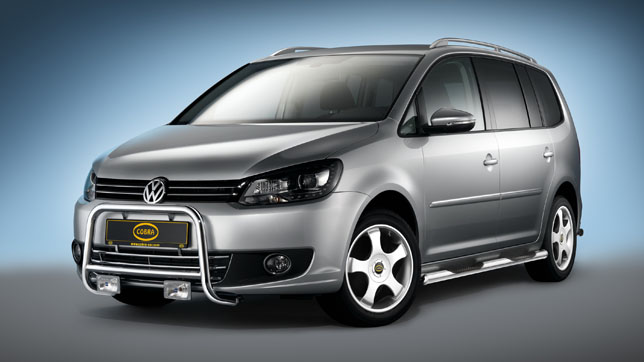
    It includes a high-gloss stainless-steel front brush guard with a tube diameter of 48mm and a stainless-steel bumper grille. The Touran also comes with high-gloss side guards with integrated step and a tube diameter of 60 mm, and a version with a brushed surface finish without the integrated step. At the rear, there is a bumper guard with a choice of high-gloss or brushed finishes.

    Cobra Touran stands on new alloy wheels with dimension 8Jx18”.

    The tuning company also offers some upgrades for the latest Sharan.

    The minivan comes with a stainless-steel front brush guard and bumper grille. At the sides, there are guards with integrated step.

    The five-spoke 17” wheels are available as one-piece and multi-piece designs. The width is 8J.

    VW Caddy also benefits from Cobra Technology and Lifestyle. The front received brush guard and bumper grille, both made from high-gloss stainless steel. Side guards with and without integrated step are also available.

    These accessories are complemented with striking Cobra Grenada alloy wheels in size 7Jx15 for retaining the stock tires or in size 8Jx17 for mounting sporty low-profile tires.

    Cobra VW Touran

    Source: Cobra

  • Mercedes G-Class “BA3 Final Edition” and “Edition Select”

    The iconic G-Class of Mercedes-Benz will be available in two new special editions – BA3 Final Edition and Edition Select.

    The first – Edition Select costs €6 735 for the long-wheelbase model. It includes  two-tone paint scheme, an AMG sports exhaust and black 18” alloy wheels. The interior boasts two-tone designo leather upholstery and piano black wood trim.
    The second – BA3 Final Edition is based on the short-wheelbase model and celebrates its end of production. It includes AMG flared wheel arches in the vehicle colour, 5-twin-spoke 18” light-alloy wheels fitted with 265/60 R 18 tires. There are also a 3D Mercedes-Benz star in stainless steel and an AMG radiator grille in a 3-louvre design with chrome highlights. The interior comes with black leather seats, burr walnut trim and ambient lighting.

    There are two engine available – G 350 BlueTEC comes with a six-cylinder diesel with 211PS (155 kW) and 540Nm (398 lb-ft). The G 500 has a 5.5-liter V8 petrol with 388PS (285 kW) and 530Nm (391 lb-ft).

    Mercedes-Benz G 350 BlueTEC BA3 Final Edition is priced at €90 511 and the more powerful G 500 has a price tag of €100 685.

    G-Klasse - BA 3 Final Edition

    Source: Mercedes

  • McLaren MP4-12C GT3 Price – £310 000

    The price of the new McLaren MP4-12C GT3 is £310 000. The manufacturer will build just 20 units, which will race for teams in 2012.
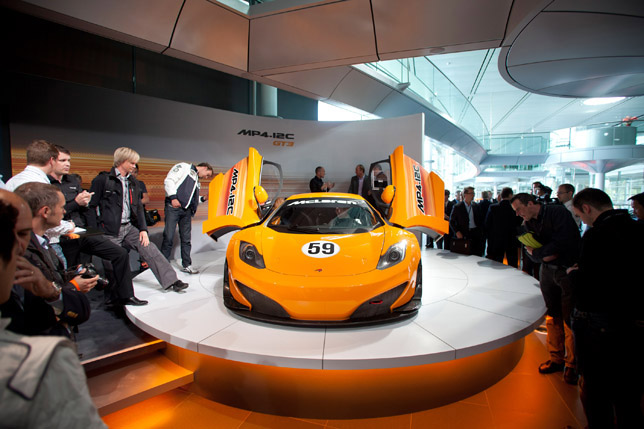
    At a press conference held at the McLaren Technology Centre, senior McLaren GT executives revealed to the world’s media and a group of prospective 12C GT3 clients the price and development programme details of the first non-Formula 1 race car built by McLaren since the McLaren F1 GTR.

    “Having been a customer of GT car manufacturers for many years, I’m delighted we are now able to offer a carbon chassis based GT3 car for £310,000. There will be no hidden costs and we will work as hard as we can to support as many races as we can.”, commented Andrew Kirkaldy, CRS Racing Team Principal and Project Manager for McLaren GT

    “We will spend the 2011 season developing the car with a team from McLaren Racing, McLaren Applied Technologies and McLaren Automotive and make sure this is the most efficient, reliable and easy to drive GT3 car on the grid when we deliver cars to customers next year.”, he added.

    “The new MP4-12C sports car is the essence of a race car and we used Formula 1 simulation technology to get us ahead in our development programme. We have a unique mix of experience in the McLaren GT team and I expect the 12C GT3 to be the start of our GT racing plans. We have had great success outside of Formula 1, from the US, to France, to Japan and there is no reason why we can’t repeat that success in sports cars after 2012.”, said Martin Whitmarsh, McLaren Group CEO.

    McLaren MP4-12C GT3 Conference

    Source: McLaren

  • 2012 Mercedes SLS Roadster

    Mercedes-Benz has released first official photos of the all new 2012 SLS AMG Roadster. After the Gullwing version, the luxury open-top variant is the second car, which will be independently developed by AMG.

    The new SLS AMG Roadsters are slightly disguised as they cover their test routes. However, it is easily to identify the vehicles, because of the two seats and a fabric soft top. The proportions are well-known: a long bonnet, large wheels and a short rear end.

    The SLS AMG Roadster gets a soft-top roof made of cloth that can be retracted or closed in 11 seconds at speeds of up to 50 km/h (31 mph). Despite losing the gullwing doors, the weight of the roadster didn’t suffer at all. The weight of the bodyshell is just 2 kilograms more.

    2012 Mercedes SLS Roadster is powered by a 6.2 liter naturally aspirated V8 with 571PS (420 kW) and 650Nm (479 lb-ft). 0 to 100 km/h takes 4.0 seconds, flat and the top speed is electronically limited to 317 km/h (197 mph). Whether open or closed, even at top speed the SLS Roadster is perfectly stable.

    The 2012 Mercedes-Benz SLS AMG Roadster will make its official debut at the Frankfurt motor show in September and it will hit the market in the end of the year.

    2012 Mercedes SLS Roadster

    The endurance testing at a glance:

    Long-term testing on a variety of different roads:

    • All the components and systems are tested together in everyday operation. Loaded up to their permitted gross vehicle weight, the test cars are put through a precisely defined test programme on country roads, on motorways and in city traffic.

    Endurance testing on heathland:

    • In this case, the developers focus on the durability of the chassis and suspension components, the entire bodyshell and the integral subframe on which the front axle, steering and engine are mounted. The test cars are loaded up to their permitted gross vehicle weight.

    “Accelerated” endurance testing:

    • Testing of the entire vehicle, focussing on the powertrain, chassis and suspension. Special features of the AMG programme include 10,000 kilometres on the Nürburgring’s North Loop and 10,000 kilometres in city traffic.

    Full-load endurance testing:

    • Extreme acceleration and braking manoeuvres with a high proportion of full-load operation, making extreme demands on the cooling, fuel-delivery and braking systems.

    Long-term corrosion testing:

    • Corrosion testing of the entire vehicle simulates the toughest dynamic and climatic environmental influences.

    Final board approval:

    • All-inclusive verification of the degree of development and production maturity.

    Source: Mercedes

  • Team Peugeot RCZ Nokia – RCZ 2.0 HDi Sport Coupe

    Team Peugeot RCZ Nokia with two Kumho-shod RCZ 2.0 HDi Sport Coupes made it to 1st and 2nd place in class in round two at the Nurburgring last weekend (April 30).

    Peugeot No.545 with Michael Bohrer, Stéphane Caillet and Jürgen Nett came on 1st place with a best lap of 9:55.224 minutes with average speed of 137.777 km/h.

    Peugeot No.546 with Alexandre Premat, Olivier Perez and Guillaume Roman finished in 2nd place.

    “I was very positively surprised by the grip, torque and acceleration of the RCZ on such a technical circuit.”, said Alexandre Premat.

    “I must congratulate the team for the race strategy and our tyre partner Kumho for the S700 slicks. During my eight 14-mile laps, the times varied by no more than two seconds.”, commented Jürgen Nett.

    “The balance of our Peugeot RCZ is just a dream.”, said Stéphane Caillet.

    “This team is clearly fully into its stride already and it’s very encouraging to learn how well our tyres our working and how well the cars handle on them.”, said Kumho’s European Motorsport Manager Steve Thompson.

    Team Peugeot RCZ Nokia - RCZ 2.0 HDi Sport Coupe

    Source: Peugeot

  • 1 000 KM of Spa-Francochamps

    The 2011 Le Mans 24 Hours is the biggest upcoming motor sport event. That’s why Team Peugeot Total had a test day held on 24th April, which is crucial to acquire important data necessary to ensure it arrives at Le Mans with the best possible car set-up.

    There will be three Peugeot 908s with totally nine drivers, who have two targets. The first one is to prepare for Le Mans without taking any risks and the second is picking up ILMC points.

    “The ILMC season got underway with a podium spot at Sebring, after an intense 12-hour race. The conditions were perfect to prepare for our main target of the year, the 24 Hours of Le Mans. Since then, the cars have had a lot of track time in private testing. The test day really got us into the mood at Le Mans; competing in this race at Spa-Francorchamps is the best way of checking that our racing reflexes are well and truly in place. The entire team will be at the event. We will be working in the same conditions that we’ll have in Le Mans. The ILMC is an important goal for us; however, we are not going to go after the race win at any cost, just a few weeks away from Le Mans. Above all, we need to make it to the end of the 1,000 kilometres of Spa-Francorchamps with all three cars intact and collect as much information as we can during the race. If we manage that, Peugeot will undoubtedly come away with a serious haul of points.”, commented Olivier Quesnel, Peugeot Sport Director.

    Team Peugeot Total is unbeaten since 2007 and the great success came in 2010, when they recorded a one-two at the 1 000 kilometres of Spa-Francorchamps. The race was won by Sébastien Bourdais, Simon Pagenaud and Pedro Lamy, followed by Franck Montagny and Stéphane Sarrazin in second.

    This year, the official driver line-ups are identical to those of 2010:

    Peugeot 908 No.7 (blue rear-view mirrors):
    Anthony Davidson, Marc Gené and Alexander Wurz

    Peugeot 908 No.8 (white rear-view mirrors):
    Nicolas Minassian, Franck Montagny and Stéphane Sarrazin

    Peugeot 908 No.9 (red rear-view mirrors):
    Sébastien Bourdais, Pedro Lamy and Simon Pagenaud

    Check out the schedule for the event, below!

    Peugeot 908 prepares for Le Mans

    SCHEDULE FOR THE 1 000 KM OF SPA-FRANCORCHAMPS:

    Thursday 5 May 2011
    12.20pm – 1.20pm: Free practice
    2.45pm – 3.10pm: Press briefing at the Peugeot Sport hospitality area

    4.55pm – 5.55pm: Free practice

    Friday 6 May 2011
    11.50am – 12.50pm: Free practice
    4.20pm – 4.40pm: LMP1/LMP2 qualifying

    Saturday 7 May 2011
    9.55am – 10.15am: Warm up
    2pm – 8pm: 1,000 kilometres of Spa-Francorchamps

    ILMC STANDINGS BEFORE SPA:

    Manufacturers:
    1. Peugeot, 27 points
    2. Audi, 17 points

    Teams:
    1. Team Oreca Matmut, 15 points
    2. Team Peugeot Total, 12 points
    3. Audi Sport Team Joest, 9 points
    4. Rebellion Racing, 6 points

    Source: Peugeot

  • Peugeot EX1 – Nurburgring Nordschleife Record Time

    Electric vehicle with a record lap around Nurburgring Nordschleife race track?!
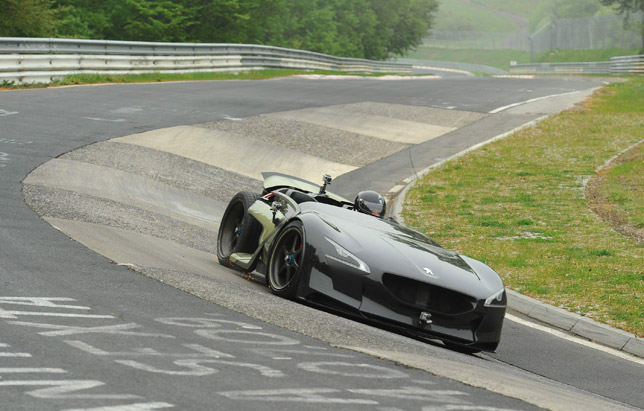
    Yes, Peugeot EX1 with Stéphane Caillet, driver and tuner-technician from the Company’s Research & Development Centre, behind the steering wheel.  The vehicle made a record lap for electric vehicles around the 20.832 kilometres (12.944 miles) race track.

    EX1 set the clock at 9 minutes, 1.338 seconds (9:01.338) at an average speed of 138.324 km/h (85.951 mph). The weather conditions were far from perfect, but the vehicle managed to beat the previous electric speed record on this circuit, which was  9:51.45 seconds clocked in 2010.

    The record achieved by EX1 was formally recognised by WIGE Performance, the official time-keeping body for the Nordschleife.

    Peugeot EX1 at the Nurburgring Nordschleife

    Source: Porsche

  • McLaren MP4-12C GT3: full details

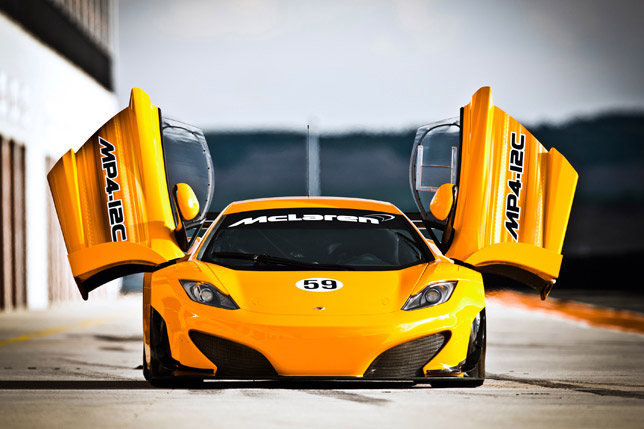
    McLaren MP4-12C GT3 will be the first car from the manufacturer built for FIA GT series racing since the famous McLaren F1 GTR. The iconic F1 finished production in1997. 12C GT3 is based on the new MP4-12C, which is one of the best super sports cars in the world.
    “McLaren has racing in its blood and it was a natural step to take our MP4-12C road car and turn it into the most reliable, efficient and easy to drive GT3 car.  Every car on the grid will have its performance balanced by race rules, meaning our objective must be to select a technical specification that ensures any driver is able to access the 12C GT3’s performance limit with ease.”, commented Martin Whitmarsh, McLaren Group Chief Executive Officer.

    The 12C GT3 made its race debut at the UK circuit – Silverstone. Just a week after, the car was sent to the Circuito de Navarra in Spain for its first FIA circuit test. In simulated tests, McLaren GT was able to fine-tune engine calibration, power steering, spring rates, weight distribution, gear ratios and differential settings.

    McLaren MP4-12C GT3 comes with a new aerodynamics package, which is made entirely from carbon fibre. It is specially created by McLaren Racing in compliance with GT3 regulations. The body kit includes – a new front splitter, door blade, rear wing, diffuser and louvres in the front fenders.

    MP4-12C GT3 has the same 3.8-litre McLaren V8 twin-turbo M838T engine as the road car, but it will be de-tuned to 500PS (from 600PS) in order to provide optimum power for this performance-balanced race car. The car also includes the TAG-400 Engine Control Unit, which is a compact, self-contained engine management system and data logger for race engines designed and built by McLaren Electronic Systems.

    Other very important features are the unique engine calibration, bespoke racing transmission developed in partnership with Ricardo and a suspension arrangement tuned specifically for racing.

    Check out the specification, below!

    McLaren MP4-12C GT3

    McLaren MP4-12C GT3 Technical Specification:

    Width (mm) 1995mm
    Height (mm) 1145mm
    Wheelbase (mm) 2670mm
    Fuel tank capacity 120 litres
    Chassis/body McLaren carbon fibre MonoCell with aluminium front and rear frames and bespoke carbon body panels
    Aerodynamics Front and rear diffuser, front splitter, dive planes and adjustable rear wing.
    Transmission 6 speed sequential using actuation via steering wheel mounted paddles

    Limited slip differential with a range of ramps and adjustable pre-load.

    Wet sump

    Sintered clutch hydraulically operated

    Driveshafts with tripod joints

    Engine type V8 twin turbo McLaren M838T
    Engine capacity 3.8L
    Bore x Stroke 93 x 69.9
    Max. Engine speed Limited to 7500rpm
    Cylinder block Cast aluminium , 90 deg V angle, dry sump scavenge, Nikasil coated liners
    Crankshaft Forged steel flat plane
    Pistons Forged aluminium
    Conrods Forged steel
    Cylinder head Cast aluminium with plastic composite cam covers, inlet & exhaust variable cam timing
    Valvetrain 32V with 40 deg variable cam timing on intake & exhaust. Low mass with sliding contact end pivoted pinger followers, single variable rate springs and hollow cast chilled iron camshafts
    Intake system Two water/air charge air coolers. Plastic composite plenum.
    Exhaust system Cast stainless steel exhaust manifold with compact MHI fixed geometry turbo chargers.  970 deg C turbine inlet temperature.
    Fuel system Returnless fuel rail with twin fuel tank mounted pumps and twin spray injectors
    Engine management MESL TAG400 ECU & CIU 100

    Interfacing with Bosch ABS and Shiftec control units

    Wiring harness Modular installation: Engine, chassis, fuel cell
    Lubrication MOBIL1: engine and transmission
    Cooling Air/water heat exchangers for engine water and charge air cooling combined with water/oil heat exchangers for engine, transmission & PAS.
    Front axle SKF integrated axles with handed single wheel retaining nut
    Rear axle SKF integrated axles with handed single wheel retaining nut
    Front suspension Double wishbone adjustable for ride height camber and toe
    Rear suspension Double wishbone adjustable for ride height camber and toe
    Dampers Coil over Multimatic dampers with DSSV technology with independent bump and rebound adjustment
    Front brake system Akebono 6 piston monoblock calliper

    378Ø x 36mm Iron ventilated disc

    Rear brake system Akebono 4 piston monoblock calliper

    355Ø x 32mm iron ventilated disc

    Steering Electro-hydraulic PAS
    Wheels Forged Aluminium

    Front 12” x 18”

    Rear 13” x 18”

    MESL TPS system compatible

    Cockpit electronics Multifunction steering wheel with integrated driver display

    Central switch panel with systems display screen

    Steering wheel Derived from MP4-24 Formula 1 wheel retaining integrated driver display, paddle shift and switches

    Source: McLaren

  • Nissan NV200 – New York Taxi

    New York is the city with the largest taxi fleet in the US. It has selected Nissan to design and supply the next-generation “Taxi of Tomorrow”. The New York City Taxi and Limousine Commission (TLC) selected the Nissan NV200 as the exclusive taxi of New York City beginning in late 2013.

    “Nissan is proud to provide the next generation of taxis for the City of New York,” commented Nissan Americas Chairman Carlos Tavares.

    “The NV200 taxi will give Nissan the opportunity to showcase our dedication to vehicle quality and urban mobility to more than 600 000 passengers every day.”, he added.

    The NV200 taxi will be produced and assembled at Nissan’s facility in Cuernavaca, Mexico. A very good idea, because it will be much cheaper than building in the US.  However, the NV200 taxi will be a tuned version of the compact commercial vehicle currently available in global markets including the UK.

    The program will also include working  with the City and taxi owners on a pilot training to study the use of zero-emission, electric vehicles as taxis. The manufacturer will also provide up to six electric Nissan LEAFs to taxi owners for testing in 2012.

    “The city’s Taxi of Tomorrow is the Nissan NV 200 – and it’s going to be the safest, most comfortable and most convenient cab the city has ever had,” saide Mayor Bloomberg.

    “We started this process to leverage our taxi industry’s purchasing power to get the highest quality taxi, one that that can expand and redefine the legendary image of New York City taxicabs. The new taxis will be custom-designed to meet the specific demands of carrying 600,000 passengers a day in New York City traffic and the vehicle meets the top priorities identified by the public in our on-line survey.”, he added.

    There are more than 13 000 taxis in the city of New York, which have a cumulative 500 million miles per year, so the durability was a key factor in the “Taxi of Tomorrow” selection process. That’s why, Nissan will train taxi fleet operators to conduct routine in-house service and repairs.

    Nissan NV200 Taxi

    Nissan NV200 Taxi

    Nissan NV200 Taxi

    Planned innovations:

    • 2.0L 4-cylinder powertrain, engineered to enhance the emission performance and fuel efficiency of the taxi fleet;
    • Ample room for four passengers and their luggage, substantially improved over current taxi models;
    • A low-annoyance horn with exterior lights that indicate when the vehicle is honking, helping reduce noise pollution;
    • Sliding doors with entry step and grab handles, providing easy entry and exit;
    • Transparent roof panel (with shade) that will provide unique views of the city;
    • Independently controlled rear air conditioning with a grape phenol-coated air filter to improve cabin air quality;
    • Attractive, breathable, antimicrobial, environmentally friendly and easy-to-clean seat material that simulates the look and feel of leather;
    • Overhead reading lights for passengers and floor lighting to help locate belongings;
    • A mobile charging station for passengers that includes a 12V electrical outlet and two USB plugs;
    • A six-way adjustable driver’s seat that features both recline and lumbar adjustments, even with a partition installed;
    • Standard driver’s navigation and telematics systems.

    Key safety features include:

    • Front and rear-seat occupant curtain airbags, as well as seat-mounted airbags for the front row;
    • Standard traction control and Vehicle Dynamic Control (VDC);
    • Sliding doors to reduce the risk of pedestrians, cyclists and other motorists getting struck by doors opening unexpectedly;
    • Lights that alert other road users that taxi doors are opening.

    Source: Nissan