Category: Car Makes

Car Makes

  • First exterior sketches of SKODA VISION 7S

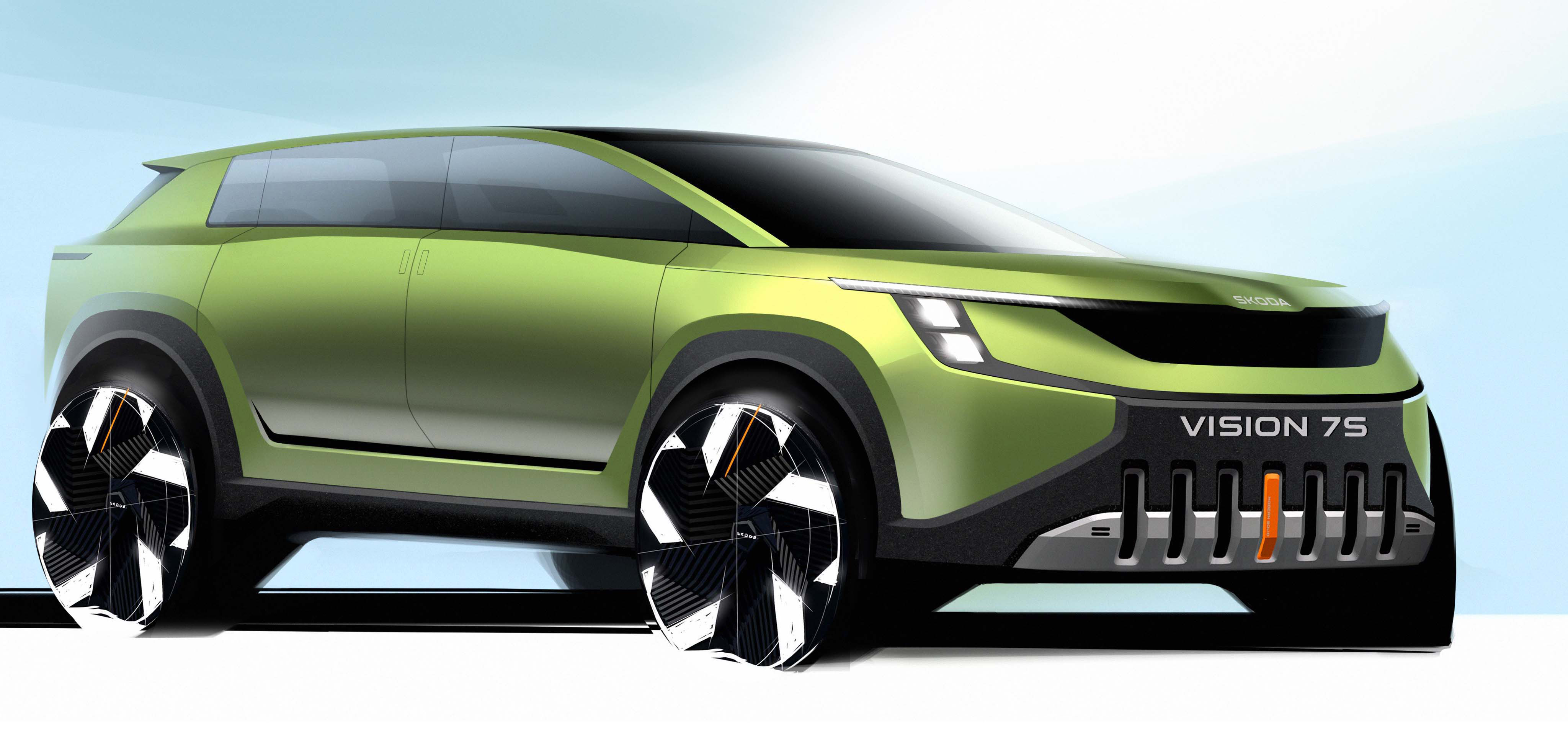
    SKODA VISION 7S - Front Angle

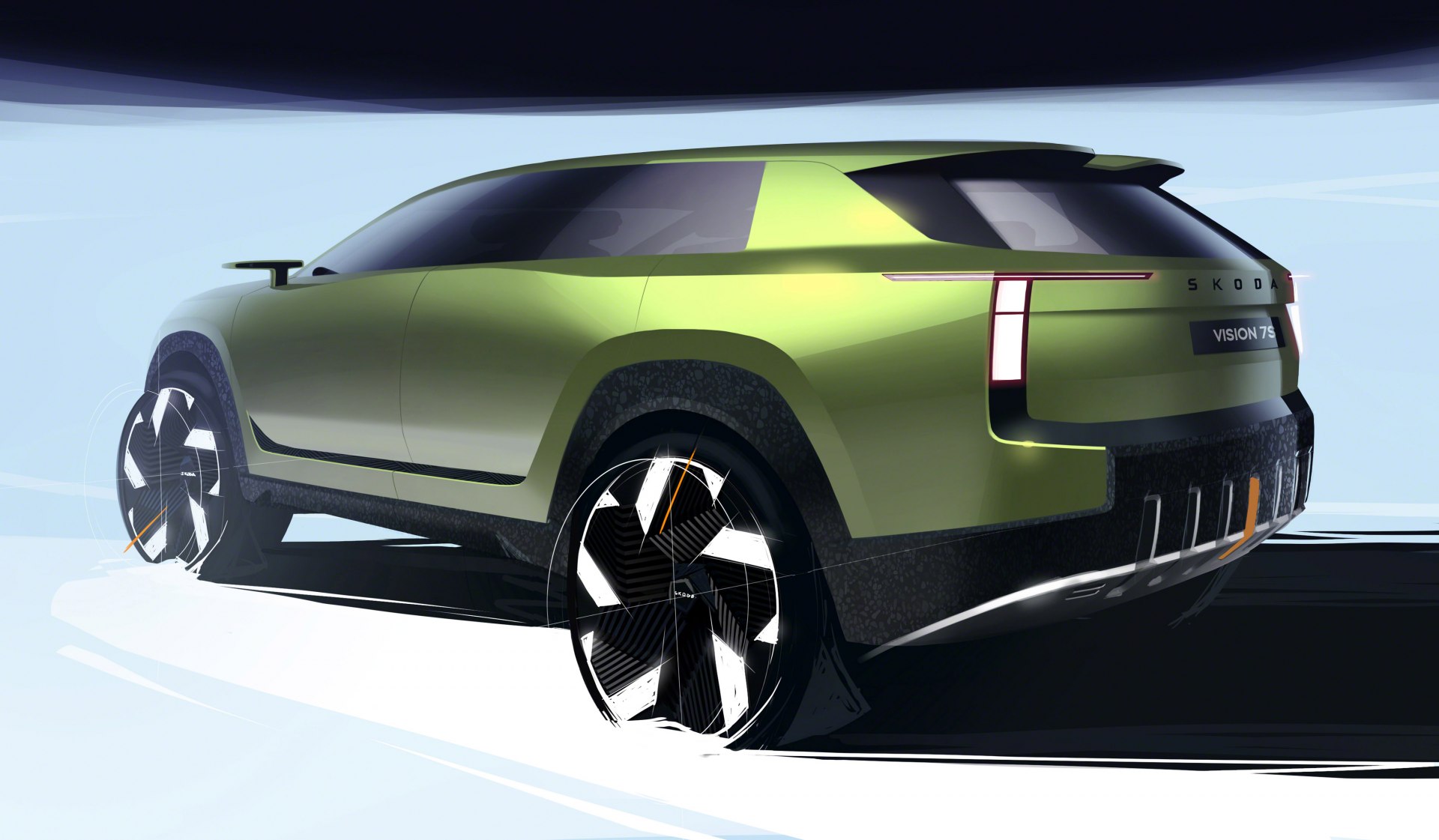
    Releasing the first exterior sketches of the VISION 7S concept car, ŠKODA AUTO reveals further details of its new design language. The drawings provide a preview of the study’s body. The sketches show a powerful SUV featuring a striking front end with T-shaped headlights.

    The exterior sketches of the all-electric ŠKODA VISION 7S concept car depict a newly designed, striking front end. The significantly wider and flatter ŠKODA grille is dark and closed. The front headlights, which have been repositioned far out to the edge of the vehicle, are arranged in two rows one above the other, and the sharply defined daytime running light strip above them extends laterally into the pronounced wings, extending the light cluster to form a ‘T’.

    The sharply contoured bonnet cites the well-known ŠKODA line. The striking, completely redesigned bumper features seven vertically arranged air inlets, with the central one sporting an insert in eye-catching orange. The lower apron area is fitted with an aluminium underride guard. Large, aerodynamically optimised wheels emphasise the VISION 7S’s powerful visual appearance. The side view is defined by clear surfaces and a gently sloping roof line to the rear.

    ŠKODA’s new design language reflects familiar brand values, such as robustness, functionality and authenticity, and stands out with its spacious interior, durable, sustainable materials and aerodynamic, efficient body.

    SKODA VISION 7S - Rear Angle

  • Ford Mustang Shelby GT500 Code Red

    Shelby American, a wholly owned subsidiary of Carroll Shelby International Inc. (CSBI:PK), made history today at the Michigan Woodward Dream Cruise when it unveiled the limited-edition Shelby GT500 CODE RED with a twin turbocharged V8 pumping out up to 1,300 horsepower. For the first time in its history, the company turned an experimental car into a limited edition vehicle. In addition to the replacement of the factory supercharger with a twin turbo setup, each hand-built CODE RED Shelby GT500 will receive suspension, braking, cooling and aesthetic upgrades.

    • CODE RED pumps out 1,000+ horsepower and 780-foot pounds of torque on 93 octane pump gas with up to 1,300 horsepower and 1,000-foot pounds of torque on E85 Ethanol
    • Only 10 total worldwide per model year for 2020-2022 Shelby GT500s will be built
    • Shelby GT500 CODE RED is the first twin turbo limited edition car offered by Shelby American

    “Shelby American has built cutting-edge experimental versions of the Shelby GT500 since the model was launched in 1967,” said Joe Conway, CEO of Shelby American. “While these testbeds for innovation never became production cars at the time, they helped make our vehicles better. For the first time in our 60-year history, we’re turning an experimental car into a limited-edition vehicle. The enormous demand for a CODE RED edition is an opportunity to demonstrate our capabilities, as well as the enormous potential of Ford Motor Company’s marvelous Shelby GT500 as a dedicated straight-line performer.”

    Famous “EXP” experimental cars have included the Green Hornet, the Super Snake, Little Red and the 2008 twin turbo CODE RED. Shelby’s ’67 GT500 Super Snake had a 427-race engine while the Green Hornet was an experimental ’68 hardtop used to test fuel injection and independent rear suspension. The 1967 Little Red had twin superchargers and a host of other innovations.

    Shelby American replaced the supercharger with a pair of turbos on the experimental 2008 CODE RED Shelby GT500. The 5.4-liter V8 re-engineered by Nelson’s Racing Engines had a dual-feed fuel system that blended in high-octane racing gas as needed. Shelby American enhanced the cooling capacity to handle the heat and worked with AMS to develop a speed-sensitive boost controller for the car.

    Along the way, the drivetrain was reworked to include a new transmission that could withstand all the power, a one-piece aluminum driveshaft, Currie 9-inch rear end, Air Locker differential and 35-spline axles. The car boasted Shelby/Eibach adjustable suspension, Shelby/Baer brakes and rotors, 20-inch wheels shod with Pirelli P Zeros on front and stickier Nitto NY555R drag radials at the rear.

    However, the high cost of the car and its extreme nature meant it was not viable for production.

    “CODE RED is designed to be the pinnacle of Shelby Mustangs,” said Gary Patterson, president of Shelby American. “While we never put it into production during 2008, many were keen to own one. The current generation Shelby GT500 is so robust and spectacular that many of the issues we encountered 14 years ago no longer exist. It’s so perfect for CODE RED transformation that we began quietly building a few for insiders who asked. Though we did not initially intend to offer a formal edition, demand was so strong that we elected to build a very small number of them.”

    Based on the 2020-2022 Ford Shelby GT500, the new CODE RED edition is truly a horse of a different color than the Shelby Super Snake and Shelby GT500KR. Only 10 per model year (2020-22) will be built.

    “The unique nature of this new car required us to pour in lessons learned from extreme vehicles like the 2008 CODE RED, Shelby 1000 and 2020 Shelby GT500 Dragon Snake concept,” said Vince LaViolette, Shelby American Vice President of Operations and Chief of R&D. “All of the massive horsepower and torque we develop with the new CODE RED car required us to focus on optimizing traction. That is why CODE RED is more of a straight-line performer than a road course warrior. While not street legal, it’s very capable at moderate speeds in most any curve. But when the turbos spool up, the car is best enjoyed moving straight ahead.”

    Over the past 60 years, Shelby has worked with some of the biggest names in the business, such as Ford Performance Brembo, Michelin, Borla, Recaro and Tremec. CODE RED’s drivetrain was engineered in collaboration with Fathouse Performance, an official development partner of Shelby American.

    “We worked closely with Shelby American to develop a robust, powerful and reliable package based on our 50 years of combined experience in the high-performance auto industry,” said Ben Stoner, vice president of Fathouse Performance. “The 5.2L engine now features all-new high-performance components boosted by an intercooled premium twin turbo system, a new fuel system, engine management system and more. CODE RED boasts 1,000+ horsepower and 780-foot pounds of torque on 93 octane pump gas with up to 1,300 horsepower and 1,000-foot pounds of torque on E85 Ethanol.”

    CODE RED is far more than just a drivetrain upgrade. It also features the widebody package with new wheels, tires, axles, suspension tuning, interior, badges, carbon fiber hood, and more. Shelby American has spent countless hours testing the car. Both LaViolette (chief test driver) and Patterson (senior test driver) worked hard to refine and tame CODE RED.

    Each CODE RED Shelby GT500 includes membership in Team Shelby, the worldwide club Carroll Shelby established in 2008, and will be documented in the official Shelby Registry. The package MSRP starts at $209,995, not including the base car. Production has begun in Las Vegas and owners of 2020-2022 model year Shelby GT500s can contact Shelby American about transforming their car into a CODE RED edition.

    Package MSRP starts at $209,995

    Standard Features

    Powertrain Features

    • Shelby by FHP Twin Turbo System
      • Xona 7869S Dual Ball Bearing Turbos
      • Stainless Steel Tial Vband Exhaust Housings
      • PTP Titanium Turbo Blankets
      • PTP Titanium Turbo Manifold Blankets
      • Tial MVS Wastegates
      • Custom High Flow Air Filters
      • 3″ Stainless Steel Turbo Downpipes
      • Stainless Steel Tubular Turbo Headers with Billet Collectors and Merges
      • 3″ Stainless Active Exhaust
      • ARP Header Bolt Kit
    • Engine Upgrade
      • Custom Manley Pistons 10.5:1 CR
      • Manley I Beam Rods
      • ARP Main Studs
      • ARP Head Studs
      • Oil Squirter Block Offs
      • PAC Valve Springs
      • Ferrea Competition Valves
      • HD Secondary Timing Chains
      • Ford Performance Oil Pump Gear and Crank Sprocket
      • Amsoil 5w50 Signature Oil
      • NGK Spark Plugs
      • Billet Anodized Coil Cover Set with Shelby Logo
    • Intake and Intercooler System:
      • Fathouse Performance Intake Manifold/ A2W Intercooler
      • Fathouse Performance Billet Throttle Body Adapter and Coupler
      • Fathouse Performance Ice Tank with Reservoir
      • Coated Aluminum Intercooler Piping
      • Tial Blow Off Valve
      • Upgraded Heat Exchanger
      • Custom Turbo Scavenge System
      • Fathouse Performance Race Oil Catch Can
      • Fathouse Valve Cover Adapter Fittings
      • BMRS High Temp Polymer Hose Plumbing
    • Fuel System
      • ID1300x Injectors
      • Billet Fuel Rails
      • Return Style Fuel System
      • BMRS Line Kit
      • Fore fittings, Fuel Pressure Reg, and Fuel Filter
      • Upgraded fuel pumps
    • MoTeC M150 Engine Management Package:
      • MoTeC M150 ECU
      • Plug and Play Mil-Spec Wiring Harness
      • Power Adjustment via Factory Drive Mode Controls (650hp-1200hp)
      • Advanced Traction Control (9 Different Levels)
      • Boost-by-Gear
      • Rolling Anti-Lag
      • Flex Fuel 93/E85 System Automatically Adjusts Power Based on Ethanol Content
      • Ghost Cam Feature (Activated in Drag Mode)
      • Advanced Launch Control
      • Engine Protection Features
      • Level 3 Advanced Data Logging (Captures Data Automatically)

    Performance Features

    • Shelby Widebody package
    • Performance half-shafts
    • Ride-height adjustable front and rear springs
    • Ford Performance front and rear sway bars
    • MagneRide®> suspension recalibration
    • Caster camber plates
    • Shelby forged aluminum wheels
      • One-piece 6061-T6 forged aluminum
      • 20×11 front
      • 20×13 rear
    • Performance spec 305/30/20 front tire
    • Performance spec 345/30/20 rear tire
    • Extended and hardened wheel studs

    Exterior and Interior features

    • Shelby carbon fiber hood
    • Carbon fiber front splitter
    • Carbon fiber rear diffuser
    • Carbon fiber pedestal wing
    • Shelby rocker panels
    • Carbon fiber rocker wings
    • Billet engine caps
    • 60th Anniversary Badging (2022 MY only)
    • Code Red badging
    • Leather seat recovers
    • Shelby rocker stripes
    • CSM numbered engine and dash plate
    • Door sill plates
    • Rear seat delete and harness bar

    Optional Features

    • Le Mans style over the top stripes
    • Painted stripes
  • Bentley Mulliner Batur

    Bentley Motors has today unveiled the Bentley Mulliner Batur – a new two-door grand touring coupé limited to 18 series pieces that embodies the start of a design revolution at Bentley.

    Created by Director of Design Andreas Mindt and his team, the Batur is a showcase of a new design DNA that will ultimately guide the design of Bentley’s future range of Battery Electric Vehicles (BEVs).

    The collection of just 18 series examples of the Batur is the latest project by Bentley’s in-house bespoke and coachbuilding division, Mulliner, and succeeds the Bacalar – a run of 12 individually specified, designed and handcrafted Barchettas that relaunched coachbuilding at Bentley. Like its predecessor – the Bacalar – the Batur is named after a beautiful natural body of water. Lake Batur is an 88m deep, 16 km2 crater lake in Kintamani on the island of Bali, Indonesia, and provides nutrient-rich water to both local hot springs and agriculture.

    The Batur will also be the most powerful Bentley yet, with a 740+ PS version of the iconic, hand-assembled 6.0-litre twin-turbocharged W12 engine that has metaphorically and literally powered Bentley’s success for the last two decades. As the engine enters its twilight years as part of Bentley’s Beyond100 transformation journey to being fully electrified, the Batur forms the first part of a celebration of the W12’s extraordinary power, torque and refinement. Engine performance will be matched to the most advanced Bentley chassis ever, with Speed-tuned air suspension, electric active anti-roll control, eLSD, four-wheel steering and torque vectoring.

    All 18 examples of the Batur have already been reserved. Each one will be designed collaboratively with each customer, guided by Mulliner’s in-house design team. Customers will be able to specify the colour and finish of practically every surface of the Batur, to create a car as individual as they are. Each one will then be handcrafted over the course of several months in Mulliner’s workshop at Bentley’s carbon neutral factory in Crewe, England, with first deliveries expected in mid-2023.

    The Batur was unveiled at Bentley’s Signature Party at Monterey Car Week, in front of almost 500 VIP guests, by Bentley’s Chairman and Chief Executive, Adrian Hallmark, who comments:

    “The Batur is a significant car for Bentley. Far more than the heir to the highly successful Bacalar, the Batur showcases the design direction that we’re taking in the future as we develop our range of BEVs. Andi Mindt and his team have reimagined the classic Bentley design cues into a stronger, bolder design that remains both elegant and graceful.

    “Beneath the beautiful exterior lies the most powerful engine we’ve ever developed. Our W12 engine is easily the most successful twelve-cylinder automotive engine in history, and as it approaches its retirement to make way for future hybrids and BEVs, we want to mark its accomplishments.

    “The 18 lucky customers who have already reserved their Batur will enjoy an unrivalled co-creation experience with our Mulliner Design team in specifying their cars. The Batur is the next step in Mulliner’s expansion, demonstrating the demand for truly bespoke vehicles that combine luxury and performance in ways that only Bentley can deliver.”

    A Design Revolution

    The design of the Batur is the work of Bentley’s Director of Design, Andreas Mindt, and his team including Head of Exterior Design, Tobias Suehlmann and Head of Interior Design, Andrew Hart-Barron. The Bentley design DNA that has driven the creation of the Continental GT, Flying Spur and Bentayga families has been revolutionised for the Batur, introducing new themes, approaches and details. The new form language defines a new chapter for Bentley design, as part of Bentley’s Beyond100 transformational journey to become the world’s leading sustainable luxury mobility company.

    The Batur previews the design principles that are driving the development of the company’s first BEV – due in 2025 – and the families of cars that follow.

    Andreas Mindt explains the design:

    “For any design team, the chance to redefine our own rules is the most exciting challenge. We have reimagined the Bentley design language, keeping some continuity to the past and present while also drastically changing key elements.

    “The design of a modern Bentley should always be potent, inspirational and harmonious. The form has to be strong and muscular whilst remaining graceful – there must be both elegant flow and muscularity. The term we use is the “resting beast stance” – picture a lion or tiger, laying low in attack position in long grass. That powerful shape – of ultimate power at rest, that looks fast even when stationary – is one that drives our new interpretation of the classic Bentley power line and haunch.

    “A mark of power and prestige has always been a long bonnet. Our new design cues include a line that stretches from the bonnet along the whole length of the car, connecting the bonnet into the body, making the car long and lean and giving an elongated proportion to the front end. We call this feature the “endless bonnet”, and it’s the only accent highlight to the cleaner shape. Meanwhile the visual mass of the car is moved rearwards, giving the impression that the car is sat on the rear axle, which adds further depth to the haunches.

    “At the very front of the car, we’ve modernised the famous Bentley grille and made it lower and more upright, to give a stronger face and a more dominant stance. This upright elegance bring self-confidence with a luxury stance. The grille is flanked by a new headlight shape and design, an evolution of the design used on Bacalar and maintaining the single large headlight either side. These are matched with all-new tail-lamps at the rear, that sit either side of a deployable spoiler.

    “Overall, the form is cleaner and simplified, and we rely more on curvaceous surfaces bisected in the right places to reflect light and dark and bring more muscle to the design.”

    The Next Exceptional Mulliner Project

    The Batur is the heir and successor to the Bacalar, the 12-off Barchetta design that brought coachbuilding back to Mulliner. Mulliner has become adept at delivering complex projects, including the Bacalar and the Blower Continuation Series – the world’s first continuation of a pre-war car. The coachbuilding skills that have been reborn through both projects will combine with generational handcraftsmanship to deliver the 18 Baturs that are to be built, each one entirely and meticulously by hand.

    Paul Williams, Director of Mulliner, comments:

    “With Bacalar, we proved the appetite of our clients for truly bespoke and individual Bentleys. We’re building on that story with the Batur, and the fact that all 18 cars are already reserved is testament to the fact that our design team is creating cars that our clients want to buy. Batur is not only a beautiful handcrafted Bentley – it is the next member of a distinguished line of cars coachbuilt by Mulliner, which include the W.O. Bentley’s favourite car in the 8 Litre and the now truly-iconic R-Type Continental.”

    Mulliner’s in-house design team will co-create every Batur with its customer, working together for several hours through a specially-created Mulliner visualiser that allows any part of the car to be customised in colour and surface finish. Endless samples of unique materials bring texture to the process, and the resulting designs will be truly individual and created by the customer – limited only by their imagination. From the main exterior paint to the surface finish of the air vents, and literally everything in between, each customer will specify even the tiniest of details.

    Through handcrafted materials and exceptional colours, each Batur will then be brought to life by Mulliner’s team of automotive artisans in a process taking several months for each car.

    Exterior Details

    Beyond the exterior form of the car lies an almost endless array of choices for each car’s future owner to make. Paint choice is infinite – starting with the full Mulliner colour palette and travelling beyond into fully bespoke paint and even hand-painted graphics.

    The aerodynamic additions of front splitter, side skirts and rear diffuser can be crafted in both carbon fibre or new, sustainable Natural Fibre composite.

    The exterior brightware can be any mix of light and dark, satin or gloss or even titanium. As per the first car, another option is graduated contrast colour to the front grille, for a vibrant ombre effect.

    The Batur sits on unique 22” wheels, with the ‘standard’ option being painted in Black Crystal and then surface bright machined and polished. A darker option combines dark gloss faces with satin spokes, while customers can also choose to paint-match the wheels to the body with or without contrast finish, or to choose a totally different contrast colour.

    The car revealed in Monterey has been specified to showcase the Batur’s form language. The exterior paintwork is a bespoke colour – Bonneville Pearlescent Silver – that provides flowing contrast across the curvaceous surfaces. The bodywork is underscored by carbon fibre front splitters, side skirts and rear diffuser painted in Black Crystal. The front of the car features a grille of exceptional art – with the main matrix finished in Gloss Dark Titanium, accented with contrast chevrons in a horizontal ombre pattern that flows from Hyperactive Orange in the centre and gradually darken to the sides to Black Crystal. The “endless bonnet” line is finished in Satin Titanium paint, as are the 22” wheels – with the spokes in Satin Dark Titanium to match the grille.

    A Cabin of Sustainable Bespoke Beauty

    The two-seat interior space of the Batur is designed for ultimate personalisation and long-distance grand touring. Inspired by the success of the interior design of the Bacalar, the Batur builds on the core elements of the Bacalar’s cabin design and adds new sustainable luxury features.

    Every element of the cabin is tailored to the customer’s specifications. Clients can choose from a variety of sustainable interior materials, including:

    • Low-carbon leather sourced from Scotland, which travels significantly smaller distance than leather sourced from outside the UK.
    • Sustainable tannage leather from Italy, in five different colours.
    • Dinamica, an alternative suede-like sustainable material to leather.

    The range of veneers available for the fascias include a new material for Bentley – Natural Fibre composite, which is a sustainable alternative to carbon fibre. Available as a 2×2 twill weave and finished in satin lacquer, the Natural Fibre composite brings a new sustainable texture to the cabin. Regardless of the veneer chosen, the passenger fascia panel is finished with a unique etching of the audio signature of the W12 engine – and bespoke etching is also available.

    The final sustainable elements are the carpets, which are matched to the leather and made from recycled yarn, in a first for Bentley.

    Clients will choose between bright or dark treatments to the interior brightware and titanium options are also available. Certain controls – like the organ stops for ventilation – are even available in 3D-printed 18K gold.

    The interior of the launch Batur has been trimmed by hand in a stunning combination of black, red and orange – specifically, Beluga, Hotspur and Hyperactive. Beluga main hide is contrasted with new, even more sustainable low CO2 Mulliner Hyperactive Orange leather. A complementary texture is provided through the use of Dinamica – a suede-like alternative to leather – in both Beluga and Hotspur. Unique “Batur Chevrons” to the outer wings of the seats are finely embroidered by hand in Snap Orange thread, whilst the remainder of the upholstery carries a white thread in contrast throughout. The soft elements are completed with a new feathered artisan piping in Beluga, with Hyperactive Orange piping to the seat centres and a Hyperactive Orange finish to the lower spoke of the steering wheel.

    The veneers to the Instrument Panel, fascias and doors are Gloss Black painted, with a ‘guitar fade’ to Fine Brodgar that flows from the fascias to the doors, before fading back to black. The fascia is completed with a unique piece of art – a laser-etched sound wave, which represents the unique sound generated by the W12 engine. The metallic elements of the interior are a blend of Black Anodised Aluminium and Satin Titanium, completed with a hallmarked 18 karat gold Bentley Dynamic Drive Selector and ‘12 o’clock’ steering wheel centre band.

    The Mighty W12

    The Batur features the most power engine yet fitted to a Bentley. The 6.0-litre W12 that started the rebirth of Bentley with the Continental GT in 2002 has been through several design iterations since, and is now the most advanced twelve-cylinder engine in the world. It has always been hand-crafted in Bentley’s carbon neutral factory in Crewe, England.

    For the Batur, a new intake system, upgraded turbochargers, new intercoolers and extensive recalibration more than 740 PS and 1,000 Nm of torque, to deliver exceptional performance for this new pinnacle grand tourer. This development of the engine is in celebration of its achievements over 20 years, over which time it has been developed to produce nearly 40% more power while fuel economy has improved by 25%. For the Batur, the W12 is paired with Bentley’s eight-speed double-clutch transmission, and a sports exhaust to provide a soundtrack in keeping with the level of performance. The entire exhaust system is in titanium, while the finishers are 3D-printed in titanium in a first for Bentley.

    As Bentley moves towards the era of electrification, the W12 is entering its twilight years. Before its retirement, this engineering masterpiece is worthy of commendation, and the Batur is the perfect home for the ultimate development of W12 performance.

    A Chassis System to Match

    As well as being the most power and most exclusive Bentley coupe to date, the Batur will also be the most dynamic.

    Adaptive three-chamber air springs each have three switchable chambers, changing the volume of the air spring and so its effective stiffness. The driver can select the balance between ride comfort and body control using the four-mode Drive Dynamics Control in the centre console, choosing between Sport, Bentley, Comfort and Custom.

    The Drive Dynamics Control also changes the behaviour of the 48V electric active anti-roll control system, which can provide up to 1,300 Nm of anti-roll torque in 0.3 seconds or completely decouple the wheels at either end of each axle. The anti-roll control system can also be used to adjust the roll stiffness front-to-rear, giving the Batur sharper turn-in and greater ability to balance the car on the throttle when in Sport mode.

    Overall traction and cornering grip is maximised through the use of an electronic Limited Slip Differential (eLSD) that actively vectors drive torque across the chassis. This is complemented by torque vectoring by brake, whereby the car can lightly brake the inside rear wheel on turn-in for greater front-axle response, and also lightly brake both inside wheels on corner exit to move power across to the outside, loaded wheels for better traction.

    Braking is via Bentley’s CSiC (Carbon-Silicon-Carbide) braking system, with 440 mm front and 410 mm rear discs, matched with 10-piston front and four-piston rear calipers. The Batur rides on bespoke 22” wheels with Pirelli tyres.

  • RUF Bergmeister

    RUF Automobile GmbH, manufacturer of exclusive and authentic high-performance sports cars, reveals two special vehicles at The Quail, A Motorsports Gathering during Monterey Car Week. Project RBS, or “Bergmeister,” makes its world debut alongside the naturally aspirated SCR, which is being seen for the first time in North America.

    The never-before-seen Bergmeister is inspired by the legendary Porsche 906, the 909 Bergspyder and the 718 RS 60 Spyder hillclimb cars and was designed by Tony Hatter. Mounted in the rear is a dry sump, RUF-engineered, air-cooled 3.6-liter single-turbocharged flat-six engine producing 450 bhp and 442 lb-ft of torque, connected to a six-speed manual transmission.

    The Bergmeister all-carbon skinned roadster combines the best of classic design and modern engineering in a package ready to master both road and track. True to RUF’s heritage, the pursuit of the perfect driving experience has never been more visceral. Black Alcantara lines the entire interior and the driver sits in bucket seats, with an Alcantara-clad steering wheel rounding out the driving experience. With its direct steering, the Bergmeister responds to the slightest wheel input and ensures precise handling.

    “When we began building our own automobiles in 1974 it was all for the thrill of the drive,” said Alois Ruf, owner of RUF Automobile GmbH. “We are honored to be featured at The Quail and to celebrate the passion for driving with our friends. Bergmeister embodies the most elemental driving experience, while the SCR highlights the latest technology offerings from our team in Pfaffenhausen.”

    Alongside Bergmeister and debuting in North America for the first time, the newly developed SCR prototype carries much of the same DNA as the 1978 original dressed in a modern package using RUF’s latest technology and engineering. The carbon-fiber monocoque and bodywork deliver maximum strength with minimum weight, while an integrated roll cage and rear space frame provide rigidity.

    The iconic SCR build is designed as a state-of-the-art sports car for those who prefer the soundtrack of a naturally aspirated engine. The consistent light-weight construction and powerful engine result in the feeling of a racecar built for the street. The 4.0-liter flat-six produces 510 bhp at 8,270 RPM and 346 lb-ft of torque. Power is routed to the rear wheels via a six-speed manual gearbox, giving the car the optimal mechanical feel.

  • Porsche 911 GT3 RS Carrera RS 2.7 Tribute

    The 2023 Porsche 911 GT3 RS made its first in-person appearance today at The Quail, A Motorsports Gathering, only two days after its digital world premiere. The show car – customized by the GT Model Line and Style Porsche – is a tribute to the 1972 911 Carrera RS 2.7. Additionally, as announced by Kjell Gruner, President and CEO of Porsche Cars North America Inc. (PCNA), the car will serve as inspiration for a limited-availability Porsche Exclusive Manufaktur offering exclusive to U.S. customers: a Tribute to Carrera RS Package.

    “America is the second home of the 911 and a special tribute exclusive to the U.S. is the perfect way to celebrate the 50th anniversary of the 911 Carrera RS 2.7,” said Gruner. “So many of us idolized the original 1972 car. We want to create a special experience that combines exclusive options on the new GT3 RS with a one-of-a-kind list of accompanying items. Together, it will be an exciting and individual tribute to the RS lineage. This is a live project in its early stages, and is being created by enthusiasts, for enthusiasts as a joint effort between our colleagues in Zuffenhausen, Flacht and our team in America. The ideas and concepts are really exciting and we’re having a lot of fun developing it – all of us are looking forward to sharing more details with you soon.”

    Appropriately for Monterey Car Week, the model on display is extensively personalized. Finished in white with key areas in Python Green, the car is a direct reference to the iconic white and green color configuration offered in 1972 on the first 911 “RS” model as well as a new interpretation of it. In this instance, the body is finished in non-metallic white including side air intakes painted to match with model designation graphics on the sides and rear in Python Green, forged aluminum wheels in Python Green with white pinstripes. Exclusive Design taillights emphasize the green-on-white theme by eliminating the red color from the rear taillights and third brake light. Finally, the side plates on the left and right ends of the large rear wing are painted white with RS logos in Python Green.

    “Porsche Exclusive Manufaktur allows customers to personalize their car to a point where the vehicle is as much a reflection of them as it is of Porsche,” said Karl-Heinz Volz, Director of Exclusive Manufaktur Options. “Personalization is a Porsche tradition dating back to our first production model, the 356, when a customer requested a wiper be added to the rear window of their car. Today it is an incredibly extensive personalization program, offering options ranging from small changes to true one-off creations.”

    The headlights also feature a pinstripe ring in white, something that is not available via the normal list of factory-available options. The color combination continues inside the car with matching stitching, trim panels in white to match the exterior.

    “As a car enthusiast growing up, my walls were plastered with models that I was particularly fond of. One of the most influential was the 911 Carrera RS 2.7. As a young kid it captured me imagination and even today it puts a smile on my face,” said Andreas Preuninger, Director GT Model Lines. “That’s where the styling inspiration of the 996 GT3 RS came from, which was one of my first projects at Porsche. At the time, that car felt totally extreme so colors nodding to the forefather made sense. Today, it’s a very emotional moment for me to pay tribute to the first 911 RS model with our most extreme and capable 911 GT3 RS yet.”

    About the 2023 911 GT3 RS
    The 2023 Porsche 911 GT3 RS is the most extreme street-legal 911 model yet. Its 4.0-liter naturally aspirated boxer six-cylinder engine generates 518 hp, and revs to 9,000 rpm. That power is routed exclusively to the rear wheels via a seven-speed PDK dual-clutch automatic transmission. Making extensive use of motorsport-derived aerodynamics, it generates more than 900 lbs. of downforce at 124 mph and 1,895 lbs of downforce at 177 mph. This is also the first example of a 911 GT3 RS with active aerodynamics, a feature that is used to offer incredible levels of downforce, provide deceleration assistance by creating an air brake, and by offering a Drag Reduction System (DRS) that can reposition aerodynamic elements to cut drag at the driver’s command in certain conditions.

    About the 1972 / 1973 911 Carrera RS 2.7
    Fifty years ago, the world knew the 911 Carrera RS 2.7 as Germany’s fastest sports car. It began as a homologation special and featured many technological innovations. It was the most powerful version of the first-generation 911, generating 210 PS at 6,300 rpm and 188 lb.-ft. of torque at 5,100 rpm from its air-cooled flat-six developed by Hans Mezger and Valentin Schäffer.

    A more potent engine was only part of the success story. Much like the new 911 GT3 RS, wind tunnel testing and aerodynamic science introduced never-before-seen technology to the 911. The ducktail, now as much an icon of style as an element of function, was critical in achieving stability at high speeds. Not only did it unlock the ability to drive faster, but it did so without incurring additional drag. In fact, it reduced the drag coefficient.

  • Koenigsegg CC850

    Twenty years ago the introduction of the Koenigsegg’s first production car, the CC8S, defined the new “megacar” category. Today, in celebration of the CC8S’s 20th anniversary, the Koenigsegg CC850 was unveiled at The Quail, A Motorsports Gathering to an audience of media, customers, and industry luminaries.

    The CC850 is a contemporary reimagination of the Koenigsegg CC8S. It is also a dual tribute for Koenigsegg, celebrating 20 years of vehicle production, as well as the 50th birthday of the company’s founder and namesake, Christian Von Koenigsegg. As such, CC850 production will be limited to just 50 cars worldwide.

    “The CC850 is an homage to the single most meaningful car in Koenigsegg history,” said Christian von Koenigsegg. “The CC8S put us on the map and made us successful – and celebrating 20 years of production, alongside my 50th birthday, felt like the right time to reveal the CC850 to appreciate our roots.”

     The Ultimate Driver’s Megacar

    The CC850’s mission is to deliver the purest, most fundamentally joyful driving experience of any Koenigsegg so far. While visually the CC8S inspiration is apparent, the drivetrain, engine, and capabilities of the CC850 are anything but vintage.

    The CC850’s 5.0-liter twin-turbo V8 was engineered and constructed entirely in-house. As seen in the Jesko, this V8 does not feature a flywheel and is therefore the most responsive, fastrevving engine possible. The visceral experience and accompanying aural signature are otherworldly and incomparable.

    Performance is staggering—the CC850’s 5.0-liter twin-turbo V8 delivers 1,185 hp on gasoline or 1,385 hp on E85, as well as 1,385 nm (1,020 lb-ft) of torque.

    As with the iconic Koenigsegg ONE:1 released in 2014, the CC850 also achieves a 1:1 power to weight ratio with 1385 hp and a 1385 kg curb weight.

    Revolutionary World-First Transmission

    What makes the Koenigsegg CC850 truly unique and driver-focused is its revolutionary, worldfirst Engage Shift System (ESS). The ESS allows for different gear ratios depending on the driving mode, providing tailored experiences based on road or track use. But that’s not what truly sets ESS apart.

    Based on Koenigsegg’s Light Speed Transmission (LST), ESS, paired with a clutch pedal, is an adaptable, multi-ratio, 6-speed manual transmission that also can run as a super-fast, smoothshifting 9-speed automatic. The ability for the driver to seamlessly choose between an unadulterated manual transmission or more laid-back automatic shifting is unprecedented. It places the CC850 in a class by itself.

    The gated ESS shifter is a work of mechanical art and is reminiscent of Swiss chronographs— intricate, aesthetically beautiful, and completely functional. Great care has been taken to make the ESS one of the most engaging manuals ever created. Additionally, the Swedish flag crowns the manual shifter as it did in the original manual CC8S.

    CC850 Design: Familiar, Yet All-New 

    The exterior showcases sleek Nordic Koenigsegg design, telephone-dial style rims and triple taillights, all of which draw inspiration from the earliest Koenigsegg models.

    The interior boasts a symmetrical, minimal design aesthetic akin to the CC8S. This symmetry makes adaptations for left- and right-hand drive versions practical. The round steering wheel, the open-gate shifter with exposed mechanical components, and the analogue chrono cluster showcase the precision work that underpins the CC850.

    And of course, as a Koenigsegg, the CC850 features the iconic detachable hardtop, the synchrohelix door system, the Autoskin function – and, naturally, it can run on renewable fuels.

    Historic and Unforgettable

    The original CC8S was a showstopper. It not only broke records immediately and won awards— it set new industry standards and put Koenigsegg, a small, determined Swedish Megacar company, on the map.

    The CC850 was not created to break Jesko’s track records or set new high-water marks for top speed, but to offer the highest level of driver satisfaction and enjoyment with the exhilarating performance for which Koenigsegg is renowned.

  • Bugatti W16 Mistral

    Ever since the Veyron was introduced in 2005, the W16 engine has been the beating heart of every Bugatti. The roadgoing car that brings the W16 era to an end was always destined to be special: exclusive, elegant and powerful. It must be the very best of its kind. This is W16 Mistral: the ultimate roadster.

    Mate Rimac, Bugatti Rimac CEO, said: “For the final roadgoing appearance of Bugatti’s legendary W16 engine, we knew we had to create a roadster. Well over 40% of all Bugatti vehicles ever created have been open-top in design, establishing a long lineage of performance icons that – to this day – are revered the world over. In the Chiron* era there had, to-date, been no roadster, so the introduction of W16 Mistral continues this legacy, driven by enormous demand from our clients for an all-new way to experience the mighty performance of our iconic engine. The W16 Mistral opens the next chapter in the Bugatti roadster story, inspired by over a century of open top legends.”

    For a car as evocative and important as this, great consideration went into the badge it should wear. Far more than simply a development of the Chiron, the roadster needed a name associated with freedom, elegance and speed. Inspiration came from the mistral, a powerful wind that blows from the Rhône River valley, through the chic towns of the Côte d’Azur in southern France and into the Mediterranean. And with the engine so central to this roadster’s character, it stands side-by-side with this mighty wind: W16 Mistral.

    Built around the definitive 1,600 PS incarnation of the W16 engine, first used in the Chiron Super Sport 300+*, the W16 Mistral offers performance unlike any open top car that has gone before. In its design and engineering it is completely bespoke; the existing monocoque is not simply cut off above the A-pillars to make way for the new open-top design but has been reengineered and reshaped to create a more rounded silhouette without compromising performance.

    Achim Anscheidt, Bugatti Design Director, said: “We know the W16 Mistral will always have significance in the story of Bugatti, marking the last time that perhaps the greatest ever automotive powertrain is used in a roadgoing production car. We, as a design team, felt enormous pressure to deliver styling that immediately conveyed this landmark moment, drawing inspiration from some of the most beautiful roadsters in Bugatti history.”

    Their muse would be the 1934 Bugatti Type 57 Roadster Grand Raid, a sporting roadster that represents the pinnacle of elegant design. Marked out by its dual aerodynamic headrests, flowing backwards into the bodywork, and a cut down V-shaped windscreen, this particular Grand Raid – on display at the Louwman Museum in Den Haag – is effortlessly sophisticated with an understated sportiness. Finished in a duo-tone black and yellow livery, it would provide the perfect inspiration for this watershed moment in the Bugatti story.

    The W16 Mistral debuts in colors inspired by the Bugatti Type 57 Roadster Grand Raid; a warm black with hints of truffle brown and subtle yellow accents throughout. Not only is it an homage to the iconic coachbuilt body, but also to Ettore Bugatti, who chose the black and yellow combination for many of his personal cars, including his Type 41 Royale. To enthusiasts of the brand, it is a timeless visual pairing.

    The W16 Mistral captures the essence of the Grand Raid’s V-shaped windscreen and evolves it into a modern-day work of art. A curving windscreen that seemingly wraps around the A-pillars, blending seamlessly into the side windows and creating a ‘visor’ effect that hints at the motorsport levels of performance W16 Mistral offers. The windscreen itself is a marvel of engineering, curved just enough to create the rounded visor design, without distorting the driver’s vision.

    The top line of the windscreen and side windows flows purposefully around the side air intakes. This character line then flows back underneath the side glass to shoot through all the way to the front horseshoe grill creating a new three-dimensional character for the famous Bugatti C-line introduced on Chiron. To keep the body side section slim, but also allow for optimum airflow to the W16, the oil cooler intakes on the side were deliberately separated from the engine air intakes, which now sit on the roof, just behind the occupants. The two-new roof-mounted engine air scoops are a nod to the Type 57 Roadster Grand Raid, as well as the first open top Bugatti of the modern era: the Veyron 16.4 Grand Sport. Tighter, more powerful and appearing to leap forwards, W16 Mistral exhibits an entirely different character.

    Anscheidt continues: “To reflect the W16 Mistral’s new character, we also totally reinvented its frontal appearance, in line with the vertical layout of our unique or few-off models like Divo* and La Voiture Noire*. It’s immediately imbued with a sense of exclusivity; the vertically stacked headlights are completely bespoke and the famous horseshoe grille is reimagined to be much more three-dimensional; both deeper and wider. At the rear, we challenged ourselves to create a striking but also more elegant iteration of Bolide’s* X-theme taillight motif, which forever left its mark on the world of automotive design.”

    To design a car like the W16 Mistral requires careful practice of Bugatti’s ‘Form Follows Performance’ design mantra, with each component penned not just to set new standards for beauty, but to also play a role in achieving completely new levels of performance.

    Frank Heyl, Bugatti Deputy Design Director, said: “The headlights themselves are intricately shaped, incorporating a four-light signature that subtly nods to the W16 Mistral’s four-wheel-drive and four turbochargers. But their three-dimensional surface also functions as an aerodynamic aid that funnels air through the light and out through the wheel arch to improve aerodynamic drag. The wider horseshoe grille allows the high temperature engine radiator to be fully fed purely from one intake, leaving the two side intakes to focus only on providing air to the intercoolers.

    “The X-taillight, meanwhile, serves the function of venting the side oil coolers through ducts connecting the triangular negative space in between the X beams to the side radiators. Therefore, a pressure drop is created between the side intakes and the outlets at the back of the W16 Mistral which helps to manage the mid-temperature cooling circuit of the mighty W16 most effectively.”

    But the functional design highlights don’t end there. The new ram induction air scoops behind the headrests were developed from the very beginning with stringent rollover tests in mind, so each is made from a bespoke carbon fiber structure that can support the whole weight of the car in case of a roll over. This new intake layout also enriches the driver’s W16 experience, emphasizing the orchestra between the low down, mighty, rumbling 8-liter displacement intake noise at throttle on and the blow off valve whistle from the four turbo chargers at throttle lift. It is an unmatched aural sensation in the automotive world.

    To develop incomparable levels of elegance and excitement, the W16 Mistral features the very latest engineering innovations. Bugatti’s advanced composite materials are paired with cutting-edge titanium and aluminum 3D-printing to ensure striking design, ultimate performance and robust reliability. A detailed analysis of the W16 Mistral’s dynamic stiffness allowed engineers to develop lightweight solutions that would ensure optimum handling and performance under the most extreme conditions.

    The W16 Mistral’s interior takes its lead from Chiron, carefully honed to deliver an experience that’s both elegant and luxurious, but also functional enough to ensure all information is easily visible at up to 420 km/h.  The dedication to material quality remains a hallmark of Bugatti design; advanced, lightweight titanium, aluminum components milled from a solid block and soft, blemish-free leathers. But in this swansong to the W16, there are also brand new design flourishes.

    There is an intricate woven leather used on newly designed door panels, meticulously tested and produced to Bugatti quality standards with a vision of regular use over a hundred years into the future. And in a nod to the W16 Mistral’s illustrious forebears, the gear shifter – machined from a solid block of aluminum – features a touch of wood and an amber insert with Rembrandt Bugatti’s famous ‘dancing elephant’ sculpture locked within. Iterations of this sculpture adorned the bonnet of the legendary Type 41 Royale; the most luxurious roadster ever created.

    Underneath the gargantuan side opening hood of the Royale was an ambitious 12.7-liter straight-eight engine, the likes of which the world had never seen before. And the W16 Mistral’s engine is equally ambitious – the only W16 powertrain in automotive use today.

    When Bugatti’s last roadster, the Veyron 16.4 Grand Sport Vitesse set a world speed record of 254.04 mph (408.84 km/h) in 2013, its 8.0-liter quad-turbo W16 had 1,200 PS. The W16 Mistral has 1,600 PS, making use of the same power unit that propelled the Chiron Super Sport 300+ to a world-record-breaking speed of 304.773 mph in 2019. There can only be one goal in mind: to become the fastest roadster in the world once more.

    Mate Rimac, Bugatti Rimac CEO, said: “The union of a roadster format and our W16 powertrain is absolute perfection. With the roof removed, and a pair of large air intakes directly behind your head feeding around 70,000 liters of air through the engine every minute at full bore, driving the W16 Mistral connects you to the intricate workings of this revolutionary powertrain like no other Bugatti to date.

    “What we also continue with W16 Mistral is a legacy of Bugatti roadsters, each of them incomparable in design, performance and rarity, which stretches right back to the genesis of Bugatti. The Type 40, Type 41 Royale, Type 55 Roadster, Type 57 Roadster Grand Raid that inspired this car, or even the incredible elegance of the Type 57SC Corsica Roadster – Bugatti has always been associated with the purity of open top driving. So even though the legacy of the roadgoing W16 ends with the W16 Mistral, we continue the legacy of the roadster, first established by Ettore Bugatti more than a century ago.”

    Only 99 examples of the W16 Mistral will be built, priced at 5 million euros net, with deliveries due to begin in 2024. The entire production run of W16 Mistral is already sold out.

  • McLaren Solus GT

    McLaren Automotive today reveals the McLaren Solus GT, the stunning realization of a concept car from the screens of virtual racing into an extreme expression of track driving engagement that will exhilarate in the real world.

    A special commission for just 25 customers – with all cars already sold – the single-seat, closed-cockpit track car was unveiled during Monterey Car Week in California by Michael Leiters, McLaren Automotive Chief Executive Officer.

    Engineered to reality by drawing on the full range of McLaren’s experience and expertise across the highest levels of motorsport and supercar and hypercar development, the Solus GT brings to life the futuristic McLaren concept that featured in the Gran Turismo SPORT video game.

    At less than 2,205lbs in weight and with aerodynamic performance including downforce in excess of 2,645lbs, the Solus GT – which is powered by a naturally aspirated 5.2-liter V10 engine – is capable of the fastest lap times of any McLaren outside of single-seater racing and delivers a driving experience close to the engagement and sensation of driving a Formula 1 car.

    “The McLaren Solus GT is the realization of a radical McLaren concept vehicle originally created for the world of virtual racing. Engineered free of any restrictions from road or race regulations, but with the full spectrum of McLaren’s expertise to bring it to reality, it epitomizes our pioneering spirit.”
    Michael Leiters, Chief Executive Officer, McLaren Automotive

    The striking exterior design, which is remarkably faithful to its virtual inspiration, is based on proven aerodynamic principles and McLaren’s ‘everything for a reason’ design ethos, honed by additional CFD (Computational Fluid Dynamics) and wind-tunnel aerodynamic research.

    The list of distinctive external features is lengthy, with the sliding canopy above the single, central seat being one of the most striking. The wheels are shrouded in aerodynamic pods and located by suspension arms. A large front splitter feeds air into ground-effect tunnels before it exits the car via a full diffuser. A motorsport-inspired intake above the cockpit integrated into the design of the roll hoop cover feeds cold air into the engine, while also providing an engaging induction sound. Race car design also inspired the sidepods which house the Solus GT’s radiators.

    A twin-element, fixed rear wing is key to a downforce figure that exceeds the overall weight of the car. The downforce to drag ratio is also optimized, aiding straight-line performance as well as enhancing cornering abilities.

    The Solus GT experience begins even before the engine is started, with the driver opening the distinctive cockpit canopy that slides forward through a shallow arc to allow access. This is nothing like a conventional car door, or even the signature dihedral doors of other McLaren cars, rather more like stepping into a jet fighter plane.

    The means of getting into the car adds to the sense of occasion provided by the single seat that dominates an interior focused solely on the driver and performance. The seat position is fixed – the 25 Solus GT owners experience their own motorsport-style ‘seat fitting’ – with the pedal box adjustable as in a race car, although with the convenience of a remote system operated from the seating position.

    The steering wheel – the design of which is unique among McLaren production cars – takes its inspiration from Formula 1, with dash display and essential controls integrated to suit the tight confines of a single-seater track car. Beyond the steering wheel is a view through the glass ‘bubble’, with integrated halo-style cockpit protection – mounted to which is a rear-view display fed by a wide-angle camera placed within the roll hoop. The perfectly symmetrical 180-degree line of sight provided by the central driving position is further aided by the dramatically styled wheel pods in helping the driver to position the car on a track.

    To further enhance the exhilaration for Solus GT customers, McLaren is offering a full ‘racing driver experience’. This includes a driving seat molded to the driver’s individual body shape; an FIA-homologated race suit, helmet and HANS device bespoke to each owner, and radio-enabled ear inserts. A full driver-development coaching program will also be available to help customers fully exploit the potential of their new track hypercar.

    The Solus GT is powered by a unique 5.2-liter V10, constructed using low-volume, machined components, that revs to more than 10,000rpm and delivers extreme performance and thrilling driver engagement. The engine’s responsiveness is enhanced by the use of barrel-driven throttles for each cylinder – a system only suitable for track application – and is entirely gear-driven, with no chains or belts for camshaft or ancillary systems.

    In addition to having power and torque outputs in excess respectively of 829bhp and 479lb ft, the engine was also chosen for its structural qualities; for the first time in a McLaren production car, the engine is an integral part of the chassis. Conventional practice in race car construction, this design approach optimizes weight reduction by negating the need for additional chassis structures or subframes behind the carbon fibre monocoque.

    The race-derived seven-speed sequential gearbox, which features a bespoke casting and casing – the latter manufactured from aluminum with magnesium panels – is mounted to the back of the engine with the rear suspension fixed to the gearbox casing. Internally, straight-cut gears engaged via a multi-plate carbon fibre clutch are ideally suited to the aggressive shifts demanded in a track application. The system is fully automated and software controlled, removing the need for the driver to operate the clutch, aiding pit-lane pull-away.

    In common with every McLaren since 1981, the Solus GT is based around a carbon-fibre monocoque, in this case one created using specialist low-volume production methods including a carbon ‘pre-preg’ process for higher structural strength and a high uniformity of finish to the material. The front and rear chassis structures are also made from carbon fibre, with the engine and gearbox forming the rest of the chassis.

    Carbon fibre is not the only high-value material in the Solus GT. Further embracing technologies used in the top tiers of motorsport, 3D-printed titanium components have been used for the halo cockpit protection structure and roll hoop. This is the first time the approach has been adopted for structural elements in a McLaren production car, allowing a tailored design as well reducing weight.

    The suspension system incorporates double wishbones with inboard torsion bar damping, operated via pushrods at the front and pullrods at the rear. Both axles are linked by anti-roll bars, with tuning options available to the driver. Fabricated from steel for enhanced durability, the front suspension links are encased in aerodynamic carbon fibre shrouds similar to the approach in Formula 1.

    Housed within the distinctive wheel pods are 18-inch forged aluminum wheels with center locking nuts, shod with Le Mans Prototype-specification tires available in both slick and wet compounds. Braking is provided by 6-piston monobloc machined aluminum calipers and carbon brake discs and pads. Bias between the front and rear brakes can be adjusted in the cockpit by the driver.

    Traditional performance metrics are not as relevant for a track car, but with a target time of 2.5 seconds for 0-62mph acceleration and a maximum speed of more than 200mph – in combination with the car’s light weight and strong aerodynamic abilities – the McLaren Solus GT has the performance credentials needed for an extreme track machine.

    In incorporating every element that has made McLaren a world-beating automotive force, the Solus GT is also a showcase for the craftmanship available to McLaren customers from McLaren Special Operations (MSO). With a project such as this, the MSO service goes beyond the car itself to a level of luxury customer engagement and accessibility unique to McLaren. A bespoking process ensures every Solus GT is unique and regular updates on the development program, including access to prototype drive sessions that can influence the driving characteristics of the car ahead of production, are offered.

    Solus GT track events are planned, and all cars will be delivered with a flight case to allow owners to support their own track activities. This includes a comprehensive set of tools, vehicle jacks, stands, radio sets and a coolant pre-heater.

    The McLaren Solus GT is currently at the track-testing stage of its development process. The first of 25 customer cars – all of which are sold – will be delivered in 2023.

    The McLaren Solus GT in detail

    A concept for the virtual world becomes reality

    • Originally a virtual concept driven by millions in the Gran Turismo SPORT video game; now a reality as the astonishing McLaren Solus GT
    • Striking single, center-seat cockpit and strong focus on aerodynamic principles throughout
    • Showcases McLaren signature design features, including ‘hammerhead’ front, teardrop-shaped cabin and ‘shrink-wrapped’ bodywork

    The roots of the McLaren Solus GT are in a stunning concept that featured in the  Gran Turismo SPORT video game.

    From the original design sketches through to the virtual gaming triumph and now the astonishing machine that an exclusive few customers will enjoy on track, this is a car that epitomizes the ‘everything for a reason’ design philosophy and relentless pursuit of engineering excellence within every McLaren. From the outset, the concept was based on proven aerodynamic principles, with a sports-prototype racecar package as its foundation.

    The bodywork is very much a technical sculpture, shrink-wrapped over the high-performance engineering package and the two full-length ground effect tunnels. These contain distinctive air intakes at the front and a NACA duct – a low-drag air inlet – which also acts as a step, accelerating the airflow into the radiators.

    From the front, the distinctive McLaren ‘hammerhead’ nose helps to separate airflow from the underbody ground effects and the full-length diffuser. The visibility from the wraparound canopy screen of the teardrop cockpit is outstanding, with an uncluttered, 180-degree view of a track. The wheel pods in each corner are not only a dominating design feature, they also allow overall weight-reduction and individually ‘work’ the airflow with a distinctive tear-drop shape that ends in a dramatic blade-like rear edge to calm the turbulent air in the wake of each tire and mitigate pressure build-up within the wheel well.

    The rear of the car features a full clam that provides easy access to the engine bay, with super-low trailing bodywork edges that employ the same principles as the Speedtail in order to minimize base pressure across the back of the car, reducing drag.

    Engineering a virtual design into extreme reality

    • Naturally-aspirated V10 engine chosen to optimize performance, driver engagement and packaging
    • Aerodynamic performance integrated into bodywork surfaces to preserve overall shape using CFD and wind-tunnel research
    • Heavily optimized structural work includes monocoque geometry

    The original engineering brief for the McLaren Solus GT was to turn a prestigious virtual gaming concept into an extremely powerful and highly exclusive McLaren hypercar. This was to be a track-only car, with motorsport engineering expertise and a V10 powertrain coming together to deliver the supreme driver engagement demanded for a no-compromises experience.

    The racing-derived engine was chosen for reasons of packaging as well as performance; a pared-down track car with minimal weight and shrink-wrapped bodywork meant having the engine as part of the chassis was a natural choice. This construction technique is rarely seen in production cars for NVH (Noise, Vibration, Harshness) reasons, but in a focused track car it gives many benefits, not least added feedback and exhilarating engagement for the driver.

    Once the program parameters were set, the engineering team faced the challenge of integrating real-world aerodynamic performance into the original design surfaces. This was resolved with extensive CFD and wind-tunnel work to prove the aerodynamic, cooling and efficiency properties of the concept.

    Racing-inspired chassis design and construction

    • Bespoke monocoque structure employs Formula 1 chassis technologies, with front and rear carbon structures
    • Low-volume, carbon ‘pre-preg’ process provides strength, rigidity and quality of finish
    • Engine and gearbox are stressed chassis members; carbon crash structure is incorporated into gearbox
    • 3D printing techniques used for structural components – titanium halo protection and rollover bar

    Like every McLaren built in the last 40 years, the Solus GT features a carbon-fibre monocoque at its heart. However, the single-seat cockpit and production-based engineering processes demanded a bespoke approach embracing the differing disciplines of competition and road car construction and the resulting design takes greater inspiration from motorsport than other McLaren Automotive products, with the monocoque using Formula 1 and sportscar racing chassis technologies. The front and rear impact structures are made from carbon fibre – traditionally McLaren Automotive chassis structures feature aluminum structures fixed to the passenger cell – and with the engine and gearbox both stressed chassis members, there is no requirement for a rear subframe.

    The construction of the chassis employs specialist low-volume production methods including a carbon ‘pre-preg’ process whereby the carbon fibre is pre-impregnated with a resin system that simplifies the curing process. The material is ready to lay into the mold before heat and pressure treatment is applied, allowing the higher structural strength demanded by a track-only car. The process also allows a high uniformity of finish to the material that enhances visual appeal.

    The chassis of the Solus GT also features 3D-printed titanium components, including the halo cockpit protection structure and roll hoop. While previously used by McLaren Automotive– notably for the exhaust system of the Elva – this is the first use of the technology for structural components in a McLaren production car and demonstrates the absolute focus applied to finding the best solutions for the Solus GT.

    Refined and optimized bodywork and aerodynamics

    • Carbon fibre bodywork incorporates aerodynamic surfaces including front splitter, individual wheel pods, structural floor with ground-effect tunnels and fixed, twin-element, high-downforce rear wing
    • Huge downforce generated – at 2,645lbs, greater than the weight of the car – with drag penalty minimized for straight-line speed
    • Formula 1-inspired, carbon fibre suspension aero shrouds, air intakes and sidepod-mounted radiators

    Despite the freedom the development team enjoyed in exploring the boundaries of possibilities for the Solus GT as a track car, the exterior design of the virtual reality concept did impose restrictions on what could be done if the real car was to retain the ‘wow factor’ of the car that featured in Gran Turismo SPORT.

    As befits an ultra-lightweight track-only car, the bodywork of Solus GT is made from carbon fibre; the complex shapes and swooping lines achieved without the weight penalties that would come from the use of conventional metal panels. The form of these has been finely honed – ironically in virtual reality – to ensure stability and maximize aerodynamic efficiency for both straight line-speed and downforce.

    A large front splitter feeds air into ground-effect tunnels in the full structural floor, which has been designed to accept high aerodynamic loads. The air exits the car via a full diffuser. The front wheels are outboard of the main bodywork, with the suspension wishbones exposed to the airflow and shrouded in aerodynamically-shaped carbon fibre that directs air towards the sidepod-mounted radiators. The sidepod-siting of the high-temperature radiators is directly inspired by motorsport, providing a direct cooling solution for engine fluids and reducing frontal surface area.

    A motorsport-inspired air intake above the cockpit, which is integrated into the design of the roll hoop cover, takes in cold and flow-conditioned air above the car while also creating a pleasingly engaging engine induction sound.

    The twin-element, fixed rear wing is one of the more distinctive visual features of Solus GT. Designed to maximize downforce over the rear of the car, it works alongside the combination of high-downforce ground effect and low pitch sensitivity from the motorsport-derived suspension system, to negate the need for active front or rear wings and so help to keep weight down.

    Overall, the aerodynamic package downforce exceeds the total weight of the car, but the downforce to drag ratio is also optimized, aiding straight-line performance and enhancing cornering speeds.

    Unique, single central seat interior

    • Driver enters car via sliding canopy incorporating Formula 1-style halo cockpit protection device
    • Single-seat cockpit with fixed seat and adjustable pedals
    • Main driver controls and TFT instrument display mounted on carbon-fibre-structured steering wheel
    • Rear wide-angle camera located above roll-hoop, linked to driver view screen

    The Solus GT McLaren driving experience begins even before the V10 engine is started – simply stepping into the cockpit is an event in itself. Instead of signature McLaren dihedral doors, a sliding canopy – more akin to that of a fighter jet – is opened using a mechanical lever. The spring-loaded canopy moves through a shallow arc, lifting clear of the cockpit and sliding forwards to allow easy access to the driving seat.

    Recent technological safety innovations from the top tiers of motorsport are integrated in the design, with the canopy reinforced by a halo-style structure to protect the driver. An escape hatch is also built into the canopy to allow safe departure from the cockpit should the sliding mechanism be obstructed.

    The interior is purpose-built for extreme track performance; an owner can specify their car with an entirely bespoke environment, but it will remain focused on the driving experience. The molded seat is fitted with a 6-point harness and is fixed in position; instead, the pedal box is adjustable as in a race car, but with the convenience of being able to be operated from a sitting position.

    To ensure the single seat is a perfect fit for the customer, MSO has adopted a process taken from motorsport which is yet another example of the full range of McLaren expertise being available for the Solus GT. A phenolic resin-based system with advanced micro-bead technology is used to create a mold from which the seat is created, ensuring in turn that the driver remains comfortable in the car throughout the most intense track driving sessions.

    Almost all controls are concentrated on the steering wheel, which is constructed from carbon fibre. Inspired directly by motorsport, all essential functions are easily reached with both hands on the wheel. A full HVAC air system also keeps the driver fully alert throughout the driving experience.

    Above the driver’s head are switches for vehicle ignition and the fully plumbed-in emergency fire extinguisher. This area also houses the rear-view display, streamed in real-time from a camera located on the roll hoop behind the driver’s head. The wide-angle camera provides a comprehensive rear view of the track to allow traffic to pass on a slowing-down lap or aid pit-lane maneuvering.

    Powertrain with a proven motorsport pedigree

    • Motorsport-derived, naturally-aspirated 5.2 liter V10 engine that revs to over 10,000rpm
    • McLaren-specific engine, with crank, cylinder capacity, air intake and exhaust system all bespoke to Solus GT
    • Gear-driven camshaft and ancillary systems, with no chains or belts in the engine
    • Barrel throttles for individual cylinders sharpen throttle response

    The 5.2-liter V10 engine specified to power the McLaren Solus GT is incorporated into the vehicle chassis structure. The engine capacity is unique to the Solus GT, as are the air intake and exhaust system. The induction system directs air towards barrel throttles that are individual to each cylinder – a technology that is not suitable for road use but offers clear advantages in engine performance, including improved throttle response.

    The engine also incorporates low-volume machined components optimized for performance and is entirely gear-driven; there are no chains or belts for ancillary systems. Output is greater than 829bhp, with the full benefit of the ram effect provided by the high air intake and the engine revving past 10,000rpm. Maximum torque is in excess of 479lb ft.

    The resulting performance is a target acceleration time of 2.5 seconds from standstill to 62mph and a maximum speed in excess of 200mph, despite the Solus GT generating downforce that exceeds its weight.

    Competition gearbox

    • Seven-speed sequential gearbox
    • Incorporates bespoke casting and aluminum casing with magnesium panels; rear suspension locates to gearbox
    • Uses motorsport-derived straight-cut gears
    • Carbon fibre clutch with automated software control for combination of both aggressive shift strategy and user-friendly operation

    The Solus GT has a seven-speed sequential gearbox, with race-proven internals located within a bespoke casting and casing, designed as a mounting point for the rear suspension. The casing is made from aluminum, with magnesium panels optimizing weight.

    Originally designed for LMP sportscar applications, the gearbox internals include straight-cut gears, a technology not usually incorporated in production cars for reasons of NVH refinement but acknowledged as providing greater efficiency than helical-cut gears in a high-performance track car.

    The gearbox is engaged by a carbon fibre clutch, designed to complement aggressive gearshift strategy demanded in a track application. It is though also fully automated and controlled by software – removing the need for a pedal or lever-operated clutch control – to aid the driver when pulling away from the pit-lane.

    Track-focused suspension design

    • Formula 1-inspired suspension design incorporates double wishbones and front pushrod and rear pullrod activated torsion bars
    • Manually adjustable four-way dampers
    • Incorporates anti-roll bars, ride-height springs and a heave spring and damper system

    The McLaren Solus GT was designed from the outset as a track-only car and its suspension follows the principles of motorsport engineering, starting with the wheels located via double wishbones. With the front wheels mounted outboard of the main body, the front damping is inboard with pushrods operating torsion bars and corner dampers. At the rear, the bars are linked to pullrods, and the rear suspension is mounted to the gearbox casing.

    The wishbones and rods are fabricated from steel for enhanced durability, but the front suspension links are encased in carbon fibre shrouds for aerodynamic efficiency. The system also incorporates ride height springs and a heave spring and damper system. This is employed to provide stiffness at speed by limiting vertical movement, the effect of this is to create a more aerodynamically stable profile, making the car’s dynamic behavior at speed more predictable and therefore increasing driver confidence on high-speed tracks.

    Housed within the distinctive wheel pods are 18-inch forged aluminum wheels with center locking nuts, shod with Le Mans Prototype-specification tires available in both slick and wet compounds. Braking is provided by 6-piston monobloc machined aluminum calipers with carbon brake discs and pads. Bias between the front and rear brakes can be adjusted by the driver in the cockpit.

    Each axle is linked by anti-roll bars, which are connected via drop links. Both bars are adjustable.

    The complete – and bespoke – MSO customer journey

    • Complete customer journey includes involvement in product development
    • Fully bespoke product – each car is unique
    • Full racing driver experience available, including bespoke driver-wear and tailored seat

    Solus GT showcases the level of craftmanship available to McLaren customers through McLaren Special Operations.

    From the beginning of the development process, individual presentations were given to customers wishing to secure one of the 25 cars available. This has previously taken place only for purchasers of the McLaren Sabre, a car homologated for the US market only, whereas with Solus GT being a track-only product, the customer base is global.

    The 25 Solus GT depositors have also been involved throughout in the finer details of the car’s development from the virtual world to the real world, with new, MSO-developed software at the core of realizing the vision of each customer. This bespoke, individual approach reflects an intimate accessibility to McLaren that goes beyond even the usual levels of luxury experience and engagement.
  • Lamborghini Urus Performante

    Automobili Lamborghini announces the Urus Performante, raising the bar on Super SUV sportiness and performance with design emphases that reflect the new Urus’ prowess on street, track and loose surfaces. The Urus Performante establishes itself on first sight with a new level of powerful styling that asserts the super sports engineering within.

    Ahead of its premiere the Urus Performante set a new record in the production SUV category on the Pikes Peak International Hill Climb Road, crossing the finish line at 4302 meters (14,115 ft) in 10:32.064 and beating the previous 2018 record of 10:49.902.

    “The Urus Performante takes the supreme performance and distinctive looks of Lamborghini’s ground-breaking Super SUV to the next level, retaining its luxurious versatility and delivering the most engaging driving experience: not only on road but in every environment, distinguished through an alluring design that denotes new benchmarks for driving dynamism in what is already a remarkable car,” says Stephan Winkelmann, Lamborghini Chairman and CEO. “The Urus set a new standard at its launch, taking Lamborghini’s design DNA and technological talent and delivering the world’s first Super SUV for a new era: the Urus Performante sets the bar even higher for the SUV segment.”

    Designed for performance

    The Urus Performante resounds with bold, aeronautical dynamism, from first glance, at every angle: it’s not just from the front that the Performante commands the road. A pure, sharper, more prominent bonnet and bumper design immediately highlights the Performante’s super sports genetics yet retains the Urus’ innate elegance. The Urus Performante’s extensive use of composite materials makes it the car with the highest number of carbon fiber parts in its segment.

    “The Urus Performante’s very bold and characterful design perfectly integrates the improved aerodynamics incorporating the front bumper’s air curtain, with significant visual differentiation including the new lightweight carbon fiber engine bonnet and extensive use of carbon fiber throughout reminding of its ‘Performante’ heritage. This benchmarking Urus is designed as a unique driver-oriented Super SUV,” says Mitja Borkert, Head of Design.

    With deep cuts in the hood lines down to the new front bumper, the bonnet including air outlet is forged from lightweight carbon fiber in body colour or partially visible carbon fiber as an option. A roof in optional carbon fiber references Lamborghini super sports models such as Huracán Performante and Super Trofeo.

    The front bumper and splitter in carbon fiber sport assertive new lines: new black front air-intakes deliver increased engine cooling and maximum expression of the SUV’s super sports heritage. A new air curtain draws airflow over the front wheels, within an aerodynamic design theme that decreases drag the new bonnet’s air outlet contribute to the overall aerodynamics efficiency and helps the engine cooling. The newly-designed rear spoiler, increases rear downforce of the Urus Performante by 38%.

    New steel springs lower the Performante’s chassis by 20 mm, with a wheel track that is broader by 16 millimeters, over which wider carbon fiber wheel arches embrace new optional 23” or forged 22” lightweight wheels with titanium bolts and specially developed Pirelli tires.

    In profile, the Urus Performante’s lowered stance is accented by its prominent front, and rear wing and bumper, increasing its overall length by 25 mm. The rear of the Urus Performante is equally distinctive by its purposeful high-performance design. A rear spoiler with carbon fiber fins takes design inspiration from the Aventador SVJ and contributes to the increased downforce.

    The lower rear bumper and diffuser is also in carbon fiber with a lightweight titanium Akrapovič sports exhaust as standard, developing its characteristic Lamborghini resonance depending on the drive mode selected. The bi-color livery scheme accentuates the dynamism of this Performante model: against the body color, features such as black painted door handles, CFK air outlets over the bonnet and CFK spoiler lip.

    Inside, the cockpit features Nero Cosmus black Alcantara as standard with a new hexagonal seat stitching design, the “Performante trim”, and further options including a leather interior. Dedicated color and trim options include extension of the Performante trim on doors, roof-lining, seat backrest and rear wall, with further Ad Personam customization including interior matt carbon fiber details, red door handles, and a customized kickplate with Ad Personam logo. The black Alcantara/leather steering wheel is trimmed in matt black as well as the Aluminum interior trim in black anodized. With the optional “Dark Package”, the matt black treatment can be extended to other interior details including the lever of the Urus’ central ‘TAMBURO’, hosting controls such as the start/stop button and drive mode selector. A new HMI graphic, with a dedicated design for the Urus Performante, features on both the center console screen and in a large arc across the main display.

    Engineered for driving

    “The Urus Performante takes to the road as a lightweight, honed athlete. Its muscular stance, distinctive design, V8 twin turbo powerplant and lightweight sports exhaust establish it through sight, sound and experience as the most exciting contender on every road, track and loose surface. This is a super sports car driver’s SUV,” says Rouven Mohr, Chief Technical Officer.

    The Performante’s power is increased by 16 CV to 666 CV, and its weight reduced by 47 kg, giving it a best-in-class weight-to-power ratio of 3,2. Accelerating from 0-100 km/h in just 3.3 seconds, and braking from 100 km to standstill in 32.9 m, the Urus Performante produces 850 Nm of torque at 2,300 to 4,500 rpm, with its benchmarking longitudinal abilities including a top speed of 306 km/h matched by its responsiveness, handling and stability. Aerodynamic efficiency is improved, and overall downforce increases by 8%. Torque distribution is optimized thanks to a new differential, delivering a ratio increase from 3.16 to 3.4 in drive conditions and from 3.02 to 3.33 when coasting.

    The tires Pirelli P Zero (sizes 285/40 R22 and 325/35 R22) come alongside with an evolution of the Urus Pirelli P Zero Trofeo R: for the first time, the Pirelli semi-slick tire has been developed to meet the characteristics of an SUV, with this particular variant developed in co-operation with Lamborghini. The result of the collaboration is a tire with increased versatility, returning high performance both on dry asphalt with high ambient temperatures and on wet surfaces with colder temperatures.

    At the wheel, the Urus Performante allows the driver a new intimacy with the road beneath him, with enhanced agility, feedback and sports orientation. A recalibration of the front wheel steering enhances connection with the road with precise inputs and direct feedback. The rear-wheel steering’s faster intervention increases turn-in agility complemented by torque vectoring of the rear differential both on-road and in off-road mode.

    The re-engineered drive modes allow the Urus Performante pilot to select the perfect set-up for every environment: in STRADA, the Urus provides a comfortable and luxurious ride with smooth damping. In SPORT mode the driver enjoys enhanced throttle response, with the rear-wheel steering more agile at low speeds and stable at high speed, with oversteer fun-to-drive characteristics and a faster gear-shift: the sportier chassis set-up including new stiffer steel springs and specific dampers’ tuning, maximizes feedback to engage the pilot in serious driving fun.

    In CORSA, the Urus Performante’s race car persona is let loose with supreme handling: high-speed stability, flat cornering supported by the active anti-roll bars and maximum damping, while the sports exhaust reminds those inside and out that this is a Lamborghini built on super sports heritage.

    Alongside the standard drive modes, the Urus Performante introduces a new RALLY selection, elevating the Super SUV’s fun-to-drive sportiness to a thrilling new level on dirt tracks. Its oversteer character is amplified with anti-roll and damping systems optimized for steel springs on rough and more extreme surfaces, raising the bar for a new level of Super SUV performance.

    The Chinese market will enjoy the technical upgrades delivered by the new Urus Performante, with engine power set at 640 CV for homologation reasons.

    Prices without taxes and delivery

    First delivery to customer within end of 2022

    Italy 215,261 €
    UK 170.260 GBP
    Europe 218,487 €
    USA 260,676 $
    China 3,297,290 RMB (including VAT)


    Technical Data

    CHASSIS AND BODY
    Chassis Integral lightweight body in aluminum composite design
    Body shell Outer skin made from aluminium and composite material
    Suspension Multi-link front and rear
    Springs and dampers Steel springs and dampers, electromechanical active roll stabilization, electronic damper control
    Electronic Stability Control (ESC) ESC/ABS characteristics can be adjusted via TAMBURO, ESC can be deactivated
    Steering Electromechanical power steering, steering gear with different servotronic characteristics and Lamborghini Rear-wheel Steering (LRS), managed by the Tamburo drive modes
    Steering wheel ratio 13.3:1
    Brakes Front and Rear carbon-ceramic brakes discs with front monoblock aluminum 10 piston brake calipers and rear cast iron floating 1 piston brake calipers with integrated electric parking brake
    Brake discs Carbon ceramic discs, ventilated Ø 440 x 40 mm front Ø 370 x 30 mm rear
    Tires (standard) PIRELLI PZERO 285/40 ZR22 (front) – 325/35 ZR22 (rear)
    Wheels (standard) 10Jx22″ ET20 (front) 11,5Jx22″ ET14 (rear)
    Mirrors Electrically controlled exterior mirrors
    Airbags Up to 8 Airbags: front driver and passengers airbag, front and rear side airbags, curtain airbag for head protection
    Type Eight -cylinder V, 90°
    Displacement 3.996 cm3
    Bore / stroke Ø 86 mm x 86 mm
    Valve control Intake and exhaust camshafts with continually variable adjustment
    Turbocharger Bi-turbo twin-scroll
    Compression 9.7: 1
    Max. power 490 kW / 666 CV at 6,000 rpm
    Max. torque 850 Nm at 2,300-4,500 rpm
    Emissions class EURO 6
    Exhaust treatment 4 catalyst with lambda regulation
    Cooling system Water cross flow cooling
    Engine Management Bosch
    DRIVETRAIN
    Type 4WD with integrated front differential, central differential (Torsen) and active torque vectoring rear differential
    Transmission 8-speed automatic gearbox, characteristic depending on TAMBURO drive mode
    PERFORMANCE
    Top Speed 306 km/h
    0–100 km/h 3.3 s
    0–200 km/h 11.5 s
    Braking (100-0 km/h) 32.9 m
    DIMENSIONS
    Wheelbase 3,006 mm
    Length 5,137 mm
    Width 2,026 mm
    Width
    (incl. ext. mirrors)
    2,181 mm
    Height 1,618 mm
    Track front 1,711 mm
    Track rear 1,718 mm
    Kerb-to-kerb turning circle 11.8 m – average value, variable due to dynamic condition, thanks to Lamborghini Rear-wheel Steering (LRS)
    Weight (DIN) 2,150 kg
    Weight/power 3.23 kg/CV
    Weight Distribution 58% (front) – 42% (rear)
    CAPACITIES
    Fuel 85 liters
    Trunk 616 liters
    CONSUMPTION The vehicle is not yet offered for sale and is therefore not subject to Directive 1999/94/EC. The fuel consumption and emissions data are in the type of approval stage
  • Aston Martin V12 Vantage Roadster

    Aston Martin is proud to introduce the new V12 Vantage Roadster – a uniquely exciting and ultra-exclusive limited production model which combines the thrilling performance of the most powerful Aston Martin Vantage ever made with the freedom and sensory stimulation of roof-down driving.

    With production strictly limited to just 249 customer examples globally, with all examples sold ahead of release, the V12 Vantage Roadster boasts a compelling combination of dramatic widebody design, ground-hugging wide-track suspension and – for the first time in a Vantage Roadster – the mighty 5.2-litre Twin-Turbo V12 engine. With searing straight-line speed and the unfiltered howl of Aston Martin’s sonorous 700PS 12-cylinder engine, the V12 Vantage Roadster elevates the open-top driving experience to a scintillating new level.

    Roberto Fedeli, Aston Martin Chief Technical Officer, said: “We have worked extremely hard to ensure the V12 Vantage Roadster possesses the same potency and dynamism that characterises the V12 Vantage, while surpassing it in terms of raw sensory excitement that you only achieve with roof down driving. With more power and torque than any Vantage Roadster before it, a wide-track chassis with precisely tuned suspension calibration, and up to ten times the downforce of the series production Vantage Roadster, this is a breathtaking machine created for our most enthusiastic customers”.

    Key to this exhilarating driving experience is the powerhouse of the engine. Developing 700PS at 6500 rpm and 753Nm of torque at 5,500 rpm, the quad-cam 60-deg 5.2-litre V12 is a true force of nature. With a power-to-weight ratio of 372PS-per-ton and an endlessly impressive delivery which combines effortless in-gear response with epic acceleration, every squeeze of the V12 Vantage Roadster’s throttle leads to an unforgettable adrenaline rush.

    Accelerating from rest to 60mph in just 3.5sec and with a top speed of 200mph the V12 Vantage Roadster occupies the very highest echelon of open-top sportscar performance. With a ZF 8-speed automatic transmission and mechanical Limited-Slip Differential (LSD) mounted at the rear, the car possesses the purity and balance of a front-mid-engined rear-wheel drive layout. An optimised transmission calibration minimises shift speeds and maximises driver interaction, while adaptive software in the transmission’s control system monitors operating conditions and driver demands to enhance the driver’s feeling of response and control.

    Sharing the same suspension hardware as the V12 Vantage, but featuring a bespoke tune for its adaptive dampers, the V12 Vantage Roadster’s dynamics have been honed to the keenest possible edge. The steering calibration mirrors that found in the V12 Vantage, to offer maximum steering feel and quick response, improvements which bring the car alive through corners and can be felt with every steering input.

    Like the V12 Vantage, the V12 Vantage Roadster features powerful Carbon Ceramic Brakes (CCB) as standard. Measuring 410mm x 38mm the front discs are gripped by 6-piston calipers, while the 360mm x 32mm rear discs are paired with 4-piston calipers. With much increased stopping power and tremendous resistance to brake fade at high temperatures, the CCB technology also makes a considerable 23kg of unsprung weight saving compared to steel brakes, benefitting steering response and ride quality.

    In order to further reduce overall mass the V12 Vantage Roadster’s front bumper, clamshell bonnet, front fenders and side sills are made from carbon fibre, with the rear bumper and deck lid made from weight-saving composite material. Additional savings have been made with the adoption of a lightweight battery and a special centre-mounted twin-exit exhaust system fabricated from lightweight 1mm stainless steel. Tuned to ensure the V12 Vantage Roadster has a rousing voice to match its looks, this new system weighs 7.2kg less than the Vantage Roadster’s exhaust.

    It’s an indication of the V12 Vantage Roadster’s monstrous performance that its dramatic form is driven by function. For example, the formidable physique of the widebody design is necessary to accommodate the widetrack suspension, which is 40mm wider than Vantage. The new front bumper design, complete with full width front splitter generates additional downforce and aerodynamic balance, while increased cooling is achieved by the reshaped front grille, which is 25% larger, and the ‘horse shoe’ engine vent in the bonnet.

    Aerodynamic performance also informs the new sculpted single-piece sills and rear bumper, which comes complete with integrated diffuser – the effectiveness of which has been improved by the routing of the centre mounted, twin tailpipe, exhaust system. In contrast to the V12 Vantage, the V12 Vantage Roadster comes without the dramatic rear wing as standard, though it can be specified as an option. Those who choose the more understated look can do so in the knowledge that aerodynamic balance is maintained thanks to detailed management of underbody airflow.

    Final visual touches come in the form of impressive 21in alloy wheels, which are offered in two finishes, satin black or satin black diamond turned. An optional lightweight forged wheel option is also available in both satin black and satin black diamond turned, which saves a further 8kg of unsprung mass. Michelin Pilot 4S high performance tyres – 275/35 R21 front and 315/30 R21 at the rear – are standard fitment on all rims.

    As flagship of the Vantage range, the V12 Roadster is fitted with Sports Plus Seats trimmed in full semi-aniline leather and featuring ‘Wings’ quilt and perforation pattern as standard. A carbon fibre performance seat with exposed twill carbon fibre shell and manual 6-way adjustment can be had as an option for those looking for the ultimate in dynamic design and maximum support for high performance driving, also saving 7.3kg without skimping on occupant comfort.

    V12 Vantage Roadster customers can further boost the exclusivity of their car by engaging the services of the marque’s bespoke personalisation service, Q by Aston Martin, for everything from striking exterior graphics and liveries to woven leather. With extensive use of exposed carbon fibre in its design, the V12 Vantage Roadster also lends itself perfectly to Q by Aston Martin: Commission’s range of tinted lacquers, which change appearance under different lighting conditions to make a spectacular feature of the hand-laid carbon fibre panels.

    Marek Reichman, Aston Martin Chief Creative Officer, adds: “From a design perspective, V12 Vantage Roadster is a combination of living sculpture and physiology, such as the functions of an elite runner or thoroughbred racehorse. On one hand, much like the way their systems are developed to handle the stresses of peak performance and trained to work together to increase efficiency and power using oxygen, V12 Vantage Roadster was designed to maximize the benefits of airflow into, throughout and around the car. And on the other, for our Drivers, we created this explicit open-top sports car for those craving excitement and drama. The platform presented us with a design opportunity to make a contemporary visual statement of intent. The result is a living, breathing, driving sculpture with a level of control that sits at the fingertips”.

    Production of the V12 Vantage Roadster is due to commence in Q3 of 2022, with first deliveries scheduled to begin during Q4 2022.

  • Hyundai Releases 2023 Santa Cruz Pricing Including New Night Model

    Hyundai Santa Cruz (2023) - Front Angle

    Hyundai has released pricing for the 2023 Santa Cruz Sport Adventure Vehicle, including the new Santa Cruz Night model.

    New Santa Cruz Night Model

    The 2023 Santa Cruz Night, in addition to AWD SEL Activity equipment, adds:

    • 2.5-liter, turbocharged, direct-injected engine
    • Eight-speed wet-type dual-clutch transmission
    • Steering-wheel-mounted paddle shifters
    • Dark chrome grille
    • NIGHT-exclusive dark, 20-inch alloy wheels
    • NIGHT-exclusive dark front and rear lower fascia design
    • NIGHT-exclusive gloss black mirror caps and door handles
    • Dual side steps

    2023 Hyundai Santa Cruz Pricing

    Model Engine Transmission Drivetrain MSRP
    SE 2.5L 4-cyl. 8-speed automatic
    with SHIFTRONIC®
    FWD $25,450
    SEL 2.5L 4-cyl. 8-speed automatic
    with SHIFTRONIC®
    FWD $27,790
    SEL Activity 2.5L 4-cyl. 8-speed automatic
    with SHIFTRONIC®
    FWD $31,060
    SE 2.5L 4-cyl. 8-speed automatic
    with SHIFTRONIC®
    AWD $26,950
    SEL 2.5L 4-cyl. 8-speed automatic
    with SHIFTRONIC®
    AWD $29,290
    SEL Activity 2.5L 4-cyl. 8-speed automatic
    with SHIFTRONIC®
    AWD $32,560
    NIGHT 2.5L Turbo 4-cyl. 8-speed DCT
    with SHIFTRONIC®
    AWD $35,810
    SEL Premium 2.5L Turbo 4-cyl. 8-speed DCT
    with SHIFTRONIC®
    AWD $37,350
    Limited 2.5L Turbo 4-cyl. 8-speed DCT
    with SHIFTRONIC®
    AWD $40,320

    Freight Charges for the 2023MY Santa Cruz are $1,295.

  • Acura Precision EV Concept

    Acura today debuted the Acura Precision EV Concept previewing the performance brand’s future design language as it prepares to enter the electrified era starting in 2024 with a dynamically styled all-electric SUV. Once again showcasing the performance brand’s design direction during Monterey Car Week, one of the world’s top gatherings of automotive and motorsports enthusiasts, the concept model was created by the Acura Design Studio in Los Angeles to push the boundaries of Acura design and technology, showcasing Acura’s future vision of electrified vehicles with distinct manual and full driving automation experiences.

    “The Acura Precision EV Concept is a design study that will shape the direction of future Acura products in the electrified era including our first all-electric SUV in 2024,” said Emile Korkor, assistant vice president of Acura National Sales. “We are committed to delivering Precision Crafted Performance in every facet of the Acura client experience which includes a powerful and very exciting direction for the next generation of electrified Acura models.”

    Inspired by the elegance, artistry and harmony of form and function unique to luxury Italian power boats, the Acura Precision EV Concept expresses Acura’s intense focus on performance with a wide, athletic stance, expressive silhouette and sharp character lines dressed in eye-catching Double Apex Blue with a matte finish.

    “The Acura Precision EV Concept is a look into our future direction and continues Acura’s Precision Crafted Performance design language with a modern expression of performance” said Dave Marek, Acura executive creative director. “The Acura Precision EV Concept will be our North Star as we move into an exciting electrified future, and you will see these design cues translate over to future production models.”

    The Acura Precision EV Concept features a theatrical lighting approach that previews an electrified powertrain through a dramatic illuminated evolution of Acura’s Diamond Pentagon grille, Chicane DRL signature and new “Particle Glitch” lighting on the front and rear facias. The emotional “Particle Glitch” design theme is repeated on the spokes of the Concept’s striking 23-inch wheels.

    “The Acura Precision EV Concept continues to build on Precision Crafted Performance ‘Seamless and Dynamic’ exterior design language with a pronounced front fascia to emphasize the next-generation Seamless Illuminated Fascia for an EV,” said Andy Foster, exterior chief designer. “The ‘Particle Glitch’ lower detailing explores what EV performance could look like as Acura shifts toward its electrified future.”

    Stimulating, visceral and premium, the performance-focused interior design of the Acura Precision EV Concept reveals Acura’s vision of an immersive experience that engages the driver’s senses. Inspired by the cockpit of a Formula 1 race car with a low-slung driving position, high-performance driver sightlines and a two-grip yoke-style steering wheel, the hyper-modern EV interior space features dual experiences – an exhilarating Instinctive Drive mode that heightens the performance experience and a calming Spiritual Lounge mode during autonomous operation.

    • Instinctive Drive mode maximizes the joy of performance driving by elevating the dynamic connection with the machine with racing-style digital instrumentation and invigorating red ambient and pipe lighting.
    • Spiritual Lounge mode retracts the steering wheel as it transforms the cabin into a warm, calming experience with soothing scents and restful “under water” animated projection so the driver can relax and recharge.

    A sanctuary of speed and spirit, the cabin is beautifully crafted with sustainable, environmentally-responsible materials creating premium, unique finishes including marbled recycled plastic trim and 100% biomass leather. All the aluminum used, as well as the dimensional green cast acrylic that forms the steering wheel secondary controls, were made from recycled materials. Milled FSC certified wood, harvested from responsibly managed forests that provide environmental, social and economic benefits, adds warmth and a connection to nature.

    “As the definition of premium and performance evolves to include the application of sustainable materials, we are looking at new and innovative material technologies to inspire our customers while both reducing our carbon footprint and enabling the Acura brand to reshape the perception of quality,” said Gypsy Modina, principal designer: color, materials and finish.

    Acura’s third design concept since 2016, the Acura Precision EV Concept also previews the next generation of Acura HMI with an intuitive and easy to use hyper-wide, curved transparent display and haptic touch response. “Particle Glitch” boot up graphics mirror the Concept’s signature exterior detail, visually harmonizing the experience. Life advancing new technologies create an emotional union with the user, automatically identifying and matching the driver’s state with the optimal driving dynamics settings.

    “The Acura Precision EV Concept gives a sneak peek of our future Dual Experience interior design philosophy,” said Simon Yu, senior interior designer. “We want to provide exhilarating performance driving control with a sophisticated and invigorating lounge environment that immerses the driver’s senses.”