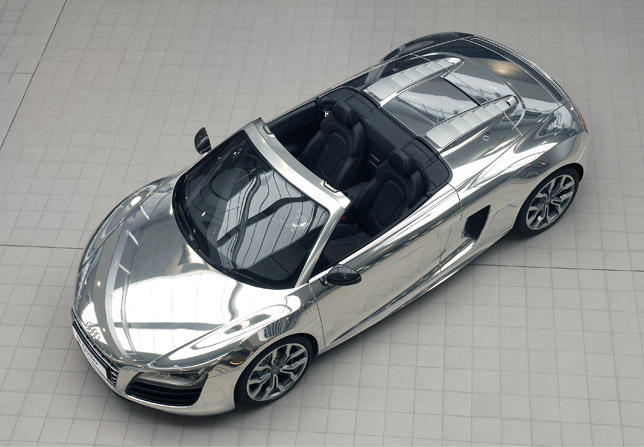
Audi has unveiled a special edition R8 V10 Spyder, which will be auctioned at at this year’s White Tie and Tiara Ball. The car features stunning mirror-like chromed finish and brutal V10 engine.
“Sir Elton John’s fundraising ball really is a golden ticket event that is as glamorous as it is hugely effective in fundraising terms,” commented Jeremy Hicks, Director of Audi UK.
“We are delighted, and enormously proud, to support it for a ninth year with the donation of what is arguably our most fittingly glamorous model,” he added.
Audi R8 V10 Spyder is powered by a 5.2 liter V10 with 525HP (386 kW) and 530N/m (393 lb-ft) of torque. 0 to 100 km/h takes 4.1 seconds and the top speed is 312 km/h (194 mph). The car features a fully-automatic lightweight fabric roof, Quattro all-wheel drive and manual gearbox. The base price is £117 710 OTR.
The White Tie & Tiara Ball, now in its 13th year, is the EJAF’s foremost fundraising event, and has been supported by Audi with special auction lots for the past eight years
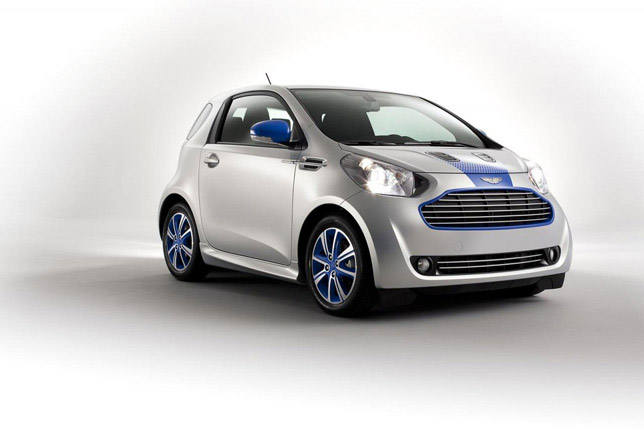
Aston Martin has introduced Cygnet Colette special edition, which is designed by the Paris fashion house. Only 14 units of the limited edition Cygnet & Colette will be produced. All of them are handcrafted and there are limitless options personalised precisely to customer specification through the brand’s world famous Works Service facility.
The Works Tailored team has created unique “Cygnet & Colette” elements including:
Stainless steel hand formed and engraved door handle badges
‘Cygnet & colette’ branded hand enamelled boot badging manufactured by Thomas Fattorini
Quilted Alcantara sun visors to complement the quilted leather door and seat inserts
Hand trimmed, quilted colette blue leather occasional cushions for the rear seats
‘Cygnet & colette’ branding on satellite navigation start up
A unique ‘Cygnet & colette’ key ring machined from solid aluminium with blue enamelling
“Aston Martin and colette are both cool brands that successfully blend modernity and innovation. It made perfect sense to work together and create this limited piece of automotive fashion for the city.”, commented Aston Martin Director of Design, Marek Reichman.
“The colette car is the first of the exclusive ‘Cygnet &’ collaborations. These cars will give Aston Martin a relevant platform to reach out to new customers in urban areas.”, he added.
Volkswagen has introduced the Temporary Auto Pilot (TAP), which includes some semi-automatic functions.
“Above all, what we have achieved today is an important milestone on the path towards accident-free car driving,” commented Leohold at today’s final presentation of the EU research project HAVEit in the Swedish city of Boras.
“Nonetheless, the driver always retains driving responsibility and is always in control,” continues Leohold.
“The driver can override or deactivate the system at any time and must continually monitor it.”, he finished.
TAP always offers the driver an optimal degree of automation as a function of the driving situation, acquisition of the surroundings and driver and system states. It is intended to prevent accidents due to driving errors by an inattentive, distracted driver. In the semi-automatic driving mode – referred to as Pilot Mode, for short – TAP maintains a safe distance to the vehicle ahead, drives at a speed selected by the driver, reduces this speed as necessary before a bend, and maintains the vehicle’s central position with respect to lane markers.
Volkswagen's Temporary Auto Pilot
The system also observes overtaking rules and speed limits, which is kind of stupid, because it can be crucial in some situations, when you need to go really fast to prevent accident.
Stop and start driving manoeuvres in traffic jams are also automated. With TAP, it is possible to drive at speeds of up to 130 kilometres per hour on motorways or similar roads. Drivers must still continually focus their attention on the road, so that they can intervene in safety-critical situations at any time.
In contrast to previous research vehicles such as “Junior” and “Stanley”, TAP is based on a relatively production-like sensor platform, consisting of production-level radar-, camera-, and ultrasonic-based sensors supplemented by a laser scanner and an electronic horizon.
“One conceivable scenario for its initial use might be in monotonous driving situations, e.g. in traffic jams or over sections of a driving route that are exceedingly speed-limited,” said Leohold.
MINI has introduced a specially prepared Endurance version of the new John Cooper Works Coupe. It will line up at this year’s 24-hour race at the Nurburgring-Nordschleife circuit, previewing the series-production version of the car due to be unveiled to the public in autumn 2011.
It is powered by a 1.6-litre four-cylinder unit with a twin-scroll turbocharger and petrol direct injection. The total power is 250HP and 330Nm in Overboost. Top speed is over 240 km/h.
The John Cooper Works Aerodynamics Package further enhances the Coupe’s already supreme handling; the front spoiler, rear diffuser and adjustable rear wing generate downforce, optimising the balance between the front and rear axle.
The MINI John Cooper Works Coupe Endurance achieves an exceptionally high level of safety thanks to features including a roll cage welded to the body and a sports bucket seat with six-point safety belt and Formula One-style HANS (Head And Neck Support) system.
It is also equipped with with Race ABS from MINI Challenge and specially tuned DSC dynamic control system.
MINI John Cooper Works Coupe Endurance
Technical data. MINI John Cooper Works Coupé Endurance
Engine
Tuned version of series-produced MINI John Cooper Works engine with adapted engine management. Four-cylinder in-line engine (front/transverse-mounted) with twin-scroll turbocharger and petrol direct injection. Racing exhaust system
Displacement
1,598 cc
Output
Approx. 184 kW / approx. 250 hp
Max. torque
Approx. 330 Nm (incl. Overboost)
Top speed
> 240 km/h
Power transfer
Front-wheel drive, sequential six-speed gearbox with electronic differential lock
Suspension
Independent race suspension (KW Suspension) with adjustable compression and rebound, adjustable front strut brace
Tyres
Racing tyres (Dunlop) / slicks: 215/45 R17, wets: 205/620 R17, 17-inch racing rims (Borbet)
Body
John Cooper Works Aerodynamics Package, adjustable rear wing, rear diffuser acc. to regulations, pneumatic jack
Safety
MINI Challenge braking system with Race ABS, race-tuned DSC, welded-in roll cage, six-point safety belt, racing seat (Recaro) with HANS system, main switch concept with electronically controlled fire extinguishing equipment
Interior
Racing steering wheel (Sparco), Drive Data Display with shift display
A sports car is a low car with a huge engine, true or false? Mazda says false. 1,3 naturally aspirated and stunning 250HP in the latest RX8. The RX7 even features a sequential twin turbocharged 1,3 with 280HP.
Especially for the newer generations, the Wankel engine is considered a Mazda engine only. A thorough look at the years after 1950s proves otherwise. The first Wankel engine was started in 1957 and produced 21 hp. It has many design differences compared to what we can see nowadays. Alfa, Ford, Nissan, Porsche and Suzuki are just some examples of companies that tried to take advantage of the new technology. So, the Wankel engine is lighter, simpler, has less moving parts and has twice the power coming from the same displacement. So there must be something wrong, look around, 4 pistons, 4 strokes, all around us. The seal system of the Wankel engines has improved significantly through the years, but it still remains the main drawback of this engine. It turns out that MPG wise it is comparable to a V8 with the same performance.
After all, who is using these engines nowadays? The answer is Mazda. The sporty coupe with RX badge is powered by this technology. And it turns to be a successful one through the years. The RX7 has sold more than 800 000 units till it was replaced by the RX8 in 2003. Through its 24 years of manufacturing the RX7 always somehow managed to find its niche on the market. In the late 1970s and early 1980 it used to be a participant in some of the greatest motorsport events. The world rally championship, the Australian Touring Car Championship, 24 hours of Le Mans and so on.
What is the future? The RX9 it seems. According to some press releases it will more resemble the RX7 rather than the RX8. Mazda seem to be sticking to modern technologies and is going turbo again. Unlike the RX8 the new RX is expected to have plenty of torque not being naturally aspirated. Combined with a LSD transmission it will definitely be a great fun to drive. Less than 1250 kg, expected 290 hp and the REVs of the Wankel engine promise to make 2014 a good year. Yet another reason to hope 2012 is not fatal.
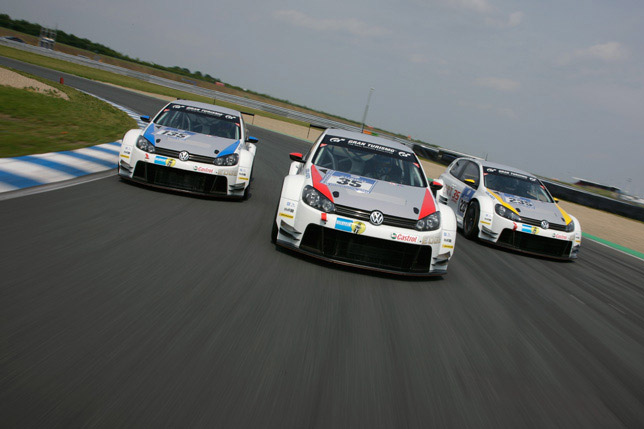
The fastest Volkswagen Golf will compete tomorrow at the Nurburgring-Nordschleife in the legendary 24-hour race. The spectacular Golf24 has been prepared specially to take place at the race – June 23 to June 26, 2011. Fitting the 35th anniversary of the Golf GTI, Volkswagen Motorsport has developed a thorough-bred racing version of the world’s highest-volume production car.
It is powered by a 2.5 liter five-cylinder turbocharged engine with 440PS (324 kW) and 540Nm of torque. It features four-wheel drive, a sequential 6-speed gearbox with paddle shifters and, last but not least, an impressive body shell.
Check out Volkswagen driver line-up, below!
Volkswagen Golf 24h Rollout – Oschersleben 2011
The Volkswagen driver line-up for the 2011 Nurburgring 24-hour race:
#35 – Golf24 – white / red
Peter Terting (D) / Nicki Thiim (DK) / Franck Mailleux (F) / René Rast (D)
#135 – Golf24 – white / blue
Thomas Mutsch (D) / Fredrik Ekblom (S) / Patrick Simon (D) / Edoardo Mortara (I)
#235 – Golf24 – white / yellow
Johnny Herbert (GB) / Patrick Bernhardt(D) / Mark Blundell (GB) / René Rast (D)
#116 – Scirocco GT24-CNG – blue / silver
Dr Ulrich Hackenberg (D) / Vanina Ickx (B) / Peter Wyss (CH) / Bernd Ostmann (D)
#117 – Scirocco GT24-CNG – blue / orange
Nasser Al-Attiyah (Q) / Carlos Sainz (E) / Giniel de Villiers (ZA) / Klaus Niedzwiedz (D)
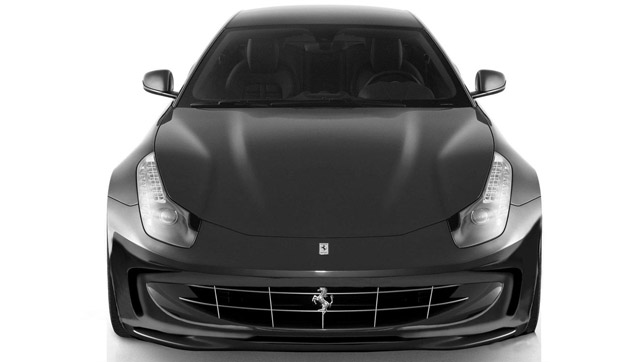
After the tuning package for Lamborghini Aventador, the German tuned DMC has announced their package for the staggering Ferrari FF. The project is called Maximus and includes both styling and exterior upgrades.
The new aerodynamics kit includes new front and rear bumpers, side scoops, rear diffuser, trunk spoiler and a rear wing. Furthermore, the car will benefit from a huge weight saving of 70 kg (154 lbs), because all parts are made from carbon fiber.
The performance package for the brutal 6.3 liter V12 consists of twin superchargers, a stainless-steel sport exhaust with 90 mm tailpipes, a new intake manifold, larger fuel-injectors, high-flow air filters and a large intercooler. As you may suggest, the power increasing is significant – a whopping 222 PS (160 kW) and 179 Nm (132 lb-ft) over the series edition. The total number are 888PS (653 kW) and 862Nm (636 lb-ft) of torque. 0 to 100 km/h in 3.2 seconds, to 200 km/h in 9.1 seconds and top speed is 340 km/h (211 mph).
Maximus Ferrari FF stands on 21” wheels at the front and 22” at the rear fitted with ultra-performance Pirelli Pzero tires. For better handling and stance, there are also lowering springs and a front-axle lift system.
Toyota has unveiled an interesting vehicle – GRMN SPORTS HYBRID Concept II, which is a convertible mid-engined petrol-electric hybrid concept. The concept will take place at the 39th Nurburgring 24-hour endurance race, this weekend.
This is an updated version of a petrol-electric sports concept shown at Tokyo Auto Salon in 2010. The drivetrain includes petrol engine, rear-wheel drive motors and transmission.
Toyota launched the world’s first mass-produced petrol-electric vehicle, the Prius, in 1997, and has long conducted active research on applying hybrid technologies to racing and sports cars. The GRMN SPORTS HYBRID Concept II is the next step in the evolution of these efforts.
Toyota GRMN Sports Hybrid Concept II
GRMN SPORTS HYBRID Concept II
Engine
Type
Petrol V6
Displacement (cc)
3,456
Maximum output (bhp)
245
System
Maximum output (bhp)
295
Body
Length (mm)
4,350
Width (mm)
1,890
Height (mm)
1,200
Wheelbase (mm)
2,575
Weight (kg)
1,500 or less
Vehicle layout
Mid-engined with front electric motor
Tyres
Front
225/40R19
Rear
255/35R19
24 Hours Nürburgring Race Outline
Name
39th ADAC Zurich 24h-Race 2011
Dates
June 23-26, 2011 (main competition runs from June 25 and 26)
Venue
Nürburgring (Nürburg, Ahrweiler, State of Rhineland-Palatinate, Germany)
1 A vehicle-development and motor-sports support program created by GAZOO, which also operates the GAZOO.com customer-participation portal site launched in 1998, “GAZOO mura” driving events and the “Drive Kingdom” large-scale test-drive events for the general public.
2 Stands for “Meister of Nürburgring”, referring to Hiromu Naruse (1944-2010), a TMC test driver and chief of the GAZOO Racing team.
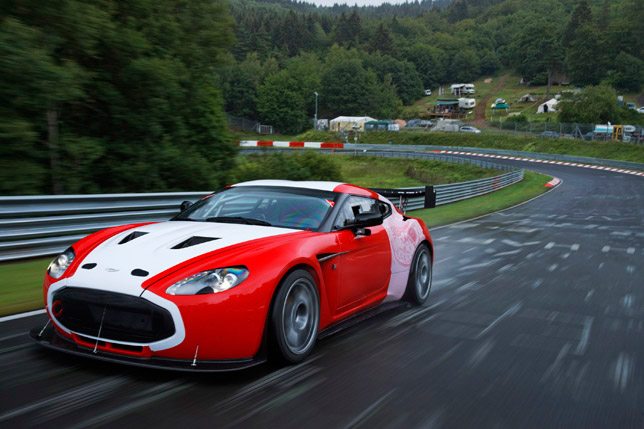
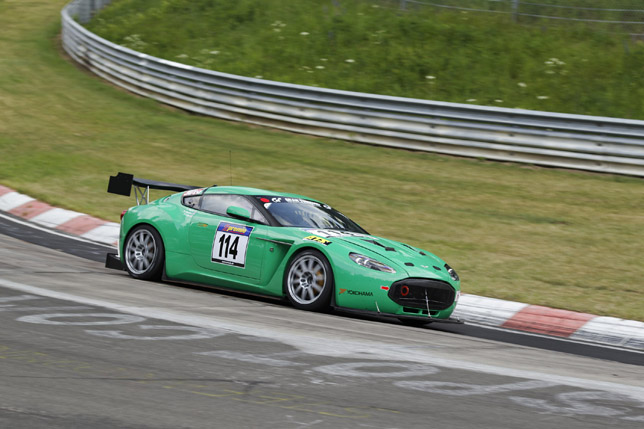
Aston Martin is putting the final touches to its race preparations for the toughest 24 hour race of them all – the annual ADAC Nurburgring 24 Hours on 25 and 26 June. Two V12 Zagato cars will compete in this challenge.
The first one is the show car from Concorso D’Eleganza at Villa D’Este, which has been transformed into the number 3 race car, nicknamed “Zag” (red). It will be piloted by Aston Martin CEO, Dr. Ulrich Bez, the company’s Nurburgring Test Centre Director, Wolfgang Schuhbauer and automotive journalists Horst von Saurma and Matthew Marsh.
The second V12 Zagato is a green race car – nicknamed “Zig” with number 5, which will be raced by One-77 Chief Engineer Chris Porritt, experienced sports car driver Oliver Mathai, automotive journalist Richard Meaden and experienced amateur racer Peter Cate.
Aston Martin V12 Zagato – Zag
Furthermore, at the race track will be a V8 Vantage GT4 nicknamed “Smurf” – which will be driven by Aston Martin Racing works driver, Darren Turner, journalist and experienced 24 hour driver, Shinichi Katsura, Australian racer Rob Thomson and seasoned Nürburgring pilot Jurgen Stumpf.
Aston Martin V12 Zagato Nurburgring – Zig
“Our entries this year extend our Nürburgring racing philosophy. For five years now we have signed-off our new products by entering a car which is as close to the road car as possible and subjecting it to the toughest 24 hour test on what best simulates the extremities of public roads. This year we go a step further by testing a car at prototype stage.”, commented Aston Martin’s Head of Motorsport, David King.
“As ever, the race will present an enormous challenge in a vast and increasingly competitive field which will be fraught with all the unpredictable elements associated with racing at the Nürburgring. However, we are excited by the potential we have seen from the V12 Zagato in the testing we’ve completed and that gives us great hope for the task ahead. We look forward to a safe, successful and enjoyable race for our teams and customers.”, he added.
V12 Zagato has a new handcrafted aluminium body and is powered by a smooth 6.0 liter V12 with 517PS (380 kW) and 570Nm (420 lb-ft) of torque. It also has a specially developed chassis for maximum performance.
Audi has introduced a new super economical A1 1.6 TDI, which is sub 100 g/km of CO2.
The price of progress in the Audi A1 1.6 TDI falls even further from this week as an even more fuel efficient version of the frugal premium sub-compact hatchback shrugs off road tax and the London congestion charge through a lower 99g/km CO2 output.
It also comes with improved 74.3mpg economy potential, and unchanged OTR prices for the SE, Sport and S line models ranging.
2012 Audi A1 1.6 TDI starts from £14 480 to £17 865.
The 1.6 TDI features an optimized ECU and fuel system, which means 74.3 mpg and 99 g/km of CO2, instead of 70.6 mpg and 105 g/km. The power is 105PS (77 kW) and 250Nm (184 lb-ft) of torque. 0 to 100 km/h takes 10.5 seconds and the top speed is 190 km/h (118 mph).
Standard features include engine start-stop function, energy recuperation, alloy wheels, air conditioning, single CD audio system with MP3 compatibility, ESP with latest differential lock system.
BMW has finally revealed the new M5 F10, which is exactly the same as the M5 Concept.
The new BMW M5 includes an aggressive front bumper, aerodynamic side skirts and a new rear diffuser. It also features front fenders, a unique grille with black slates, adaptive xenon headlights with LED angel-eyes, a four-tailpipe sports exhaust system and huge 19” light alloy wheels.
The interior boasts Merino leather sport seats, a new instrument cluster and a multifunctional ///M steering wheel. There are two ///M buttons with pre-selected engine, transmission and suspension setups, so the driver is able to choose the settings immediately. Inside, there are also aluminium trace trim, an Anthracite headliner and a 10.2” iDrive display.
2012 BMW M5 F10 Interior
The M5 F10 also comes with a head-up display, night vision technology with pedestrian recognition, a lane change and departure warning system, a surround view camera and internet connectivity. All these features make the driving real pleasure and guarantees the safety of the passengers.
The power as you may suggest is staggering. A twin-turbo 4.4-liter V8 with 560PS (412 kW) at 5750RPM and 680Nm(502 lb-ft) at just 1500RPM. It features M TwinPower Turbo technology, twin-scroll turbochargers, high-precision direct fuel injection, VALVETRONIC variable valve control and a cross-bank exhaust manifold. 0 to 100 km/h in 4.4 seconds, 0 to 200 km/h in 13 seconds and top speed of 250 km/h (155 mph) electronically limited and 305 km/h (190 mph) with M Driver’s Package. However, the fuel consumption is also amazing – 9.9 liters per 100 km on combined cycle (28.5 mpg) and CO2 emissions of 232 g/km.
2012 BMW M5 F10 Engine
The M5 F10 offers electronically controlled dampers with three modes – Comfort, Sport and Sport Plus. The M-specific Servotronic steering system, high-performance compound brakes and an Active M Differential make the driving a real pleasure.
The safety is provided by the DSC (Dynamic Stability Control) system, which operates via FlexRay high-speed data transfer technology, and constantly cross-checks the data collected by its sensors with the feedback from DSC. In other words, the car won’t allow to suicide yourself.
Porsche will take place at the 2011 Goodwood Festival of Speed. The manufacturer will exhibit several cars including 911 GT3 RS 4.0 and Panamera Turbo S as well as Semper Vivus, 718 F2, 917/30, GT2 RS and 911 Turbo. The company celebrates 60 years of Porsche in the UK and you will be able to follow Porsche Origin for latest Goodwood news and action on-line
Porsche 911 GT3 RS 4.0 is powered by a twin-turbocharged flat 4.0 liter flat-six with staggering 500HP. It will be tested alongside the ultimate turbocharged 911, the 620 hp GT2 RS. The new 550PS twin-turbo Panamera Turbo S will make its first public appearance.
The company is also bringing the famous Porsche 917/30 to Goodwood. It has a 5.3 liter 180° flat-12 cylinder layout, twin overhead camshafts driven from centrally mounted gears and twin spark plugs fed from two distributors. The power – over 1 100 bhp (820 kW) and 1 580 bhp (1 180 kW) in qualifying tune. Remember, this happens in the begging of 70’s, when there weren’t any ASC,DSC and other stability programs. The record on closed circuit is 356 km/h (221 mph). Nice!
At the 1951 Earl’s Court Motor Show, the first right-hand drive examples of the Porsche 356 made their UK debut. To celebrate the diamond jubilee of Porsche in the UK, a range of iconic Porsche road cars over the decades including an early 911 from the 1960s and the 928 GT from the 1980s will be on display at the Porsche Experience Centre Goodwood.
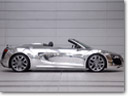 Audi has unveiled a special edition R8 V10 Spyder, which will be auctioned at at this year’s White Tie and Tiara Ball. The car features stunning mirror-like chromed finish and brutal V10 engine.




 Volkswagen has introduced the Temporary Auto Pilot (TAP), which includes some semi-automatic functions.


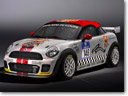 MINI has introduced a specially prepared Endurance version of the new John Cooper Works Coupe. It will line up at this year’s 24-hour race at the Nurburgring-Nordschleife circuit, previewing the series-production version of the car due to be unveiled to the public in autumn 2011.




 The fastest Volkswagen Golf will compete tomorrow at the Nurburgring-Nordschleife in the legendary 24-hour race. The spectacular Golf24 has been prepared specially to take place at the race – June 23 to June 26, 2011. Fitting the 35th anniversary of the Golf GTI, Volkswagen Motorsport has developed a thorough-bred racing version of the world’s highest-volume production car.


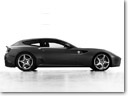 After the tuning package for Lamborghini Aventador, the German tuned DMC has announced their package for the staggering Ferrari FF. The project is called Maximus and includes both styling and exterior upgrades.


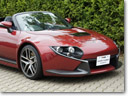 Toyota has unveiled an interesting vehicle – GRMN SPORTS HYBRID Concept II, which is a convertible mid-engined petrol-electric hybrid concept. The concept will take place at the 39th Nurburgring 24-hour endurance race, this weekend.


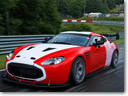 Aston Martin is putting the final touches to its race preparations for the toughest 24 hour race of them all – the annual ADAC Nurburgring 24 Hours on 25 and 26 June. Two V12 Zagato cars will compete in this challenge.