
Car crashes are the number-one killer of teenagers in the United States. Contributing factors include behaviors such as speeding, lack of seat belt use, drinking, and texting. Various manufacturers have addressed this issue with safety technology and the many of the systems they have developed are quite unique. In this article we looked at systems from Ford, GM, Hyundai, and Mercedes-Benz.
GM’s Family Link is part of OnStar and costs $3.99 a month on top of the OnStar subscription fees. It allows parents to find their teen’s car on a map on their website and receive a text or email as to their whereabouts. Parents can set a time to receive a geo-based alert, which is helpful to verify they arrived at their destination safely.
Hyundai BlueLink is similar to OnStar in that it keeps track of the vehicle and driver’s safety in an emergency. For $179 a year, you get roadside-assistance features in addition to teen safeguards, such as a speed alert, geo-fencing (restricts where the car can be driven), and curfew alert. This allows parents to set these boundaries on the car and to receive a message when they are overridden.
The Ford MyKey system became standard on most Ford models in 2010. It allows a parent to program a second vehicle key that holds specific driving restrictions. Here are some of the features offered to parents:
- Sets off an alarm and won’t allow the radio to go on when a seat belt isn’t fastened
- Sets a top speed up to 80 mph, with chimes that go off at 45, 55, or 65 mph.
- Limits audio volume.
- Set the low-fuel warning at an earlier level, so instead of 50 miles to empty, you can change it to 75 miles.
- Driving aids such as blind spot, park aid, and traction control cannot be deactivated.
Mercedes-Benz mbrace2 has similar features as Hyundai’s BlueLink. It adds an interesting feature called Safe Ride that allows the driver to signal they need help getting home, such as if they are intoxicated. The cost for mbrace2 is $280 a year and $20 more for mbrace plus, which adds a geo-fencing, speed alerts, a comprehensive driving journal, and travel assistance.
The reception to the public to these features by the public has been strong. The fees can sometimes sound expensive for these services, yet in reality, most families would probably use them just for a couple of years. Of course, most parents don’t necessarily buy a new car for their teen, but when sharing a family car (which saves on insurance), teens can benefit from these potentially life-saving services.
Source: Anthony Buick GMC


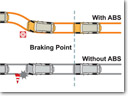
 Before Anti-lock Braking Systems (ABS) were installed on cars, drivers were told to rapidly pump their brakes if they felt a tire start to skid. Today, you don’t need to pump your car’s brakes when skidding, anti-lock braking systems do this for you. In this article, we’ll learn about anti-lock braking systems and how they work.The operational theory starts with the fact that a skidding wheel has less traction than a non-skidding one. The best thing to do when a skid does occur is to slow your engine down and let the tires “grab”. ABS systems do the same thing, they sense when a wheel is skidding during braking and then they pulse the brake automatically to regain traction. This not only allows you to stop in a shorter distance, you’ll be able to regain your steering too. Here are four components we should quickly discuss:1) Speed Sensors – The ABS needs some way of knowing when a wheel is about to lock up. Speed sensors, which are located on each wheel assembly, provide this information.2) Brake Line Valves – There is a valve in the brake line of each brake controlled by the ABS. This electrically-controlled valve controls the brake pressure going to each brake assembly.3) Electric Pump – When a Brake Line Valve reduces the pressure in a brake line, there is an electric pump to bring the restore the pressure.4) ABS Controller – The ABS controller is a small computer. It runs the whole ABS system.The ABS Controller is the brain of the system. It constantly monitors the four wheel speed sensors, looking for speed decelerations in any of the four wheels that are out of the ordinary. The ABS controller knows that rapid deceleration is technically “impossible” under normal driving conditions, so it reduces the brake line pressure to the brake involved until it sees it speed up again. The result: this gives the system maximum braking power. When the ABS system is in operation you will feel a pulsing in the brake pedal; this comes from the rapid opening and closing of the valves.Have you ever wondered what you should do when your car starts to skid? First, do not pump your brakes! The ABS system does this for you. In an emergency stop in a car with ABS, you should just apply your brake pedal firmly and hold it while the ABS does all the work. You will feel a pulsing in the pedal that may be quite noticeable but this is completely normal so don’t let off the brake. When your ABS system is functioning properly, you should have some steering control quickly return so use that to get back on course.
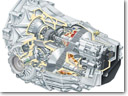
 Today we have a new type of transmission to consider and it is called a continuously variable transmission (CVT). A CVT is a type of automatic transmission but it operates very differently than older automatics. CVTs provide more useable power, better fuel economy and smoother driving than traditional automatic transmissions. CVTs have been around for years in motorized applications such as snowmobiles and off-road recreational vehicles, but just started to be used in regular automobiles a decade or so ago.Conventional automatic transmissions use sets of gears inside that provide different ratios or speeds. Control units sense speeds and shift a transmission’s gears automatically to provide the most appropriate ratio for a given driving situation: lowest gears for low speeds, middle gears for acceleration and passing, and higher gears for efficient cruising. This is visually indicated in most vehicles with a selector display (P-R-N-D-L).A CVT replaces the complex gears sets common in standard transmissions with two variable-diameter pulleys, each shaped like a pair of opposing cones, with a metal belt running between them. One pulley is connected to the engine, the other to the drive wheels. The way it works is that during operation the pulleys move in and out such that a drive belt between moves higher on one pulley, lower on the other. You can picture this roughly as the way a 10-speed bike works, by routing the chain over smaller or larger gears to change the gear ratios.The controls for a CVT-based car are the same as an automatic-based car: Two pedals (gas and brake) and a P-R-N-D-L-style shift pattern. When driving a car with a CVT, you won’t hear or feel the transmission shift, though. It simply raises and lowers the engine speed as needed, calling up higher engine speeds (or RPMs) for better acceleration and lower RPMs for better fuel economy while cruising. Many people find that driving a CVT-based automobile is a little disconcerting because of the sound it makes. When you push hard on the accelerator, the engine races a bit as it would with a slipping clutch or a failing automatic transmission. This is normal, the CVT is simply adjusting itself to provide optimal power for acceleration.Engines do not develop constant power at all speeds; they have specific speeds where either torque, horsepower or fuel efficiency are at their optimum levels. Because a CVT can theoretically adjust to any gear ratio, engineers can program it to give maximum performance during all these situations. For example, when power is needed, or maximum fuel-economy is desired, a CVT can adjust to those conditions more accurately than a standard automatic transmission.The CVT’s biggest problem has been user acceptance. Because the CVT allows the engine to rotate at any speed, the noises coming from under the hood can sound odd to ears accustomed to conventional automatic transmissions. The gradual changes in engine note sound like something is “slipping”– signs of trouble with a conventional transmission, but perfectly normal for a CVT. Automakers have gone to great lengths to make the CVT feel more like a conventional transmission.Because early automotive CVTs were limited as to how much horsepower they could handle, there has been some concern about the long-term reliability of the CVT. This has not proven to be a problem, though. Advanced technology has made the CVT quite robust and reliable. Nissan has more than a million CVTs in service around the world and says their long-term reliability is comparable to conventional transmissions.The future of the CVT remains to be seen. In spite of the obvious efficiencies of CVTs, customers can be fickle and may prefer and older technology. We will likely see how CVT transmissions fare over the next few years or so.
 A quarter-century ago







 In two weeks

