Author: Victor Ivanov

  • The high Spec tech behind modern vehicle manufacture


    Many drivers take for granted the technology that goes into getting their vehicle off the assembly line and onto the road. The fact that motor vehicles even exist is down to the growth of radical technology in the 19th century – the internal combustion engine – aided by the increasing availability of petroleum. Technology continues to shape the motor industry and in recent decades the sector has become incredibly high-tech. Indeed, the availability and precision of engineering technology has allowed car manufacturers to create a generation of truly advanced vehicles.

    Engineering innovation is particularly notable in the luxury car sector of the motoring industry. Precision is essential in the supercar segment, with manufacturers required to make niche vehicles that can withstand the type of driving conditions that the ordinary family car would never be exposed to. Many of the technologies used in racing cars have gravitated towards mainstream manufacturing too, from developments in engine technology to the use of lighter materials, such as aluminum, in the bodies of vehicles.

    The advent of computer aided design (CAD) has been a great boon to car manufacturing, allowing designers and engineers to bring their concepts to fruition. A key element of CAD is that it facilities cooperation between designers and engineers, making the sharing of information so much easier as the feasibility of a project is evaluated and the concept moves towards the factory floor. Modern CAD software even allows the simulation of actual vehicle performance. From the point of view of marketing and selling the finished vehicle, CAD also allows designers to create visual prototypes of what it will look like. CAD can be employed along each step of the way, including the development of tools from specialist manufacturers such as Transducer Techniques, who offer load cells requiring precision engineering, to accurately measure the type of forces they are designed to measure. CAD systems for automotive design are even used to identify and eliminate faults in the design, using 3D simulations to model real-life situations in which vehicles are exposed to various conditions, such as high speeds and adverse weather conditions.

    Of course, high-tech is not limited to the manufacturing floor, with modern, luxury vehicles featuring high-spec systems that make the actual driving process as smooth as it can possibly be. The level of electronics featured in luxury models is astonishing; with some cars relying on a level of software integration that people might more readily associate with an airliner. From adaptive cruise control to sensors that enable safer parking, software is used to manage many of the features that people have come to take for granted in their vehicles. In recent years, mobile technology has been integrated into vehicles, and has moved from the luxury segment down into more mainstream market segments.

    Technology, therefore, plays an integral role in the manufacturing of modern vehicles. Nonetheless, it is humans who design technology and not the other way around, so the role of real-life automotive designers still remains central to the design of high-tech vehicles.

  • Cam Shaft Volkswagen Golf VII GTI

    Cam Shaft has teamed up with PP-Performance to complete their latest project based on the hot-hatchback Volkswagen Golf VII GTI. The Golf VII GTI is powered by a 2.0 liter turbocharged petrol – 220HP (162 kW) and 350Nm (258 lb-ft). The engine is connected to a 6-speed manual gearbox. 0-100 km/h in 6.5 seconds and a top speed of 246 km/h (153 mph). There is also GTI Performance package boosting the engine with 10HP more. In this case, it will do 0-100 km/h in 6.4 seconds and 250 km/h (155 mph). PP-Performance boosted the engine to 280HP (206 kW). The package is just €799. Other upgrades include a ST-Suspensions XTA-chassis together with H&R stabilizer kit. There is also a new set of AS3 gun metal polished wheels – 8.5J x 19” fitted with 225/35 R19 tires. There are also extended GFK wings of Muecke Carbon and Kunststofftechnik by 35mm. Standard equipment of the new Golf VII GTI includes dual-zone climate control, sporty seats with Jacara cloth upholstery, sports steering wheel, black roof lining, red ambience lightning, stainless steel pedal caps, bespoke instrument cluster and gear lever, along with a touchscreen infotainment system with Bluetooth, iPod and DAB digital radio connectivity. The exterior is wrapped in exclusive mint mat metallic featuring black mat metallic passages on both sides and on tail.” Cam Shaft has teamed up with PP-Performance to complete their latest project based on the hot-hatchback Volkswagen Golf VII GTI.

    The Golf VII GTI is powered by a 2.0 liter turbocharged petrol – 220HP (162 kW) and 350Nm (258 lb-ft). The engine is connected to a 6-speed manual gearbox. 0-100 km/h in 6.5 seconds and a top speed of 246 km/h (153 mph). There is also GTI Performance package boosting the engine with 10HP more. In this case, it will do 0-100 km/h in 6.4 seconds and 250 km/h (155 mph).PP-Performance boosted the engine to 280HP (206 kW). The package is just €799.

    Other upgrades include a ST-Suspensions XTA-chassis together with H&R stabilizer kit. There is also a new set of AS3 gun metal polished wheels – 8.5J x 19” fitted with 225/35 R19 tires. There are also extended GFK wings of Muecke Carbon and Kunststofftechnik by 35mm.

    Standard equipment of the new Golf VII GTI includes dual-zone climate control, sporty seats with Jacara cloth upholstery, sports steering wheel, black roof lining, red ambience lightning, stainless steel pedal caps, bespoke instrument cluster and gear lever, along with a touchscreen infotainment system with Bluetooth, iPod and DAB digital radio connectivity.

    The exterior is wrapped in exclusive mint mat metallic featuring black mat metallic passages on both sides and on tail.

    Source: Cam Shaft

  • Volkswagen Golf IV R32 by HPerformance – 650HP

    HPerformance presented a highly-tuned Volkswagen Golf IV R32. The top-of-range Golf Mk4 boasts a 3.2 liter naturally aspirated V6 petrol engine with 241HP (177 kW) and 320Nm (237 lb-ft) of torque.

    HPerformance equipped the engine with other radius rods, Precision-PT6235 turbocharger, complete custom air intake system as well as a catch tank and an additional fuel pump. There is also a new flap-controlled exhaust system. The result is epic – between 500 and 650HP (478 kW). It interesting that the team of specialists has reduced the displacement of the engine to 3.0 liter. No idea why, but seems legit.

    Other upgrades include a big brake system including – 356×32 mm front and 304×28 mm rear discs with corresponding calipers. There is also a new Bilstein B16 coilover suspension combined with H&R stabilizers.

    Last but not least are the new carbon tube, upholstery and fire extinguisher for the second load compartment. There are new Recaro race seats, an electronic boost controller and some carbon fiber elements.

    The complete conversion costs no less than €20,000, which is a bit pricy considering you will drive a 15-year old Volkswagen Golf. However, the extreme petrolheads will really love it and there is no doubt that a lot of Mk4 R32 Golfs will get their additional punch.

    Source: Volkswagen

  • Mercedes-Benz Viano by KTW Tuning


    KTW Tuning
    has presented their latest project based on Mercedes-Benz Viano 3.0 CDI BlueEFFICIENCY. The tuned MPV comes with improved performance as well as a unique style. The diesel engine is pumped up by Brabus performance package – ECO PowerXtra D6S.

    The 3.0 liter V6 diesel is boosted to 265HP (195 kW) and 500Nm (370 lb-ft) – an increase of 41HP and 60Nm. 0-100 km/h in 8.7 seconds and a top speed of 208 km/h (130 mph), which is not bad for an MPV at all. Assembly and TÜV approval cost €1,990 (plus VAT).

    The tuning company also offers a new set of wheels – 9.5J x 22” ET45 fitted with 255/30 R22 tyres. Assembly, including wheel locks, red painted calipers, wheel alignment, TÜV acceptance and registration will cost additional €3,516. Of course, there is also a new suspension provided by Bilstein – B14 coilovers including installation and registration – €1,866 (plus VAT).

    Last, but not least KTW offers some interior tweaks – called One Look Navi INE-W970BT from Alpine including Gladen-Subwoofer and installation – €1,700. Additionally, you can mount a TrackJack tracking module for just €200.

    Other highlights include new sills, sports exhaust system, Brabus logos, foliation and new interior trim. Price are available upon request.

    Source: KTW

  • Ultimate gift ideas for the gearhead in your life


    Shopping for somebody else is always tricky. If they have a favorite hobby, that makes it easier, but getting up to speed with that hobby in time to find them something really appealing can be tough. Turning to hobby magazines is one option, but if you’re looking for something for a gearhead, why not check out some of these options?

    It’s the little things that matter

    If you’re on a limited budget or if you want to find a little something extra to complement a larger present, you might be surprised how many great low cost items there are that come in really handy when driving. From suction cup smartphone holders that keep the map in view to USB mini-coolers for water and fruit, there’s something that will appeal to everyone. If you’re buying for someone who goes driving in remote areas, you might want to pick up a hand-cranked emergency radio, and if your loved one likes to keep a classic car in pristine condition, a soft clay cleaner is the professional secret that can make all the difference. Driving gloves are the perfect gift for the distinguished driver, and if you’re really strapped for cash, you can always offer to clean the car.

    Splashing out for something special

    If you’re ready to spend a little more, it’s worth remembering that every car enthusiast should have a good toolkit. In this case it’s best to check what’s already owned, but tools do need to be replaced from time to time and well-engineered ones are always appreciated. A solar charger means a driver will never be stranded for long due to a flat battery (except perhaps in Alaska); Italian leather driving shoes create a really classy vintage look; and there are any number of attractive accessories available, such as Autodromo watches, inspired by classic dashboard designs. For a real treat, why not arrange a day at the track racing classic cars?

    Spectacular surprises

    For those with big money to spend, the choice is even wider. One of the most exciting areas to look at is off-road vehicles, where engineering technology has created more and more exciting options. Imagine how the car enthusiast in your life would feel receiving a snowmobile! They’re enormous fun to use and make it possible to conquer landscapes that would be inaccessible otherwise. They’re also fun to tinker around with, and Pat’s snowmobile parts make it easy to acquire the necessary bits and pieces. A gift like this will please the adventurer and the inner geek.

    There’s such a variety of driving related gifts out there that there’s really no need to struggle to find something suitable. If all else fails, consider automobile themed items for use in other areas of life, from pet beds to classic car tankards, posters and DVDs. Choosing a gift like this will make it clear that even if you don’t share that passion, you appreciate what it means to the recipient.

  • Ready for Laser-powered Headlights?


    Lasers can do some amazing things. They are being used today to read DVDs, correct blurry vision and even for destroying Imperial Star Cruisers. Now you can add this to the list, “replacing car headlamps.” That’s right; vehicle headlights are getting the laser treatment.

    BMW, one of the first automakers to adopt the technology, says that lasers have an illuminating power 1,000 times more powerful than LEDs — which up until just recently provided the greatest wow factor of all the bulb technologies out there. BMW explains that the technology has some compelling advantages, for example: laser automobile lights can be much smaller than conventional lighting systems, they can use less energy to operate, and they look pretty darn cool, too.

    But wait a minute, can’t lasers burn your eyes out? Not a problem says BMW, because of the way the beam energy is directed, then reflected, then ultimately displayed out of the headlight housing, you can’t accidentally injure your eyes. This is not like “looking into a laser”. What happens with each headlight is that three blue lasers positioned at the rear of the assembly fire onto a set of mirrors closer to the front. Those mirrors focus the laser energy into a lens filled with yellow phosphorus. The yellow phosphorus, when excited by the blue laser, emits an intense white light. That white light shines backward, onto a reflector then the reflector bounces the more diffused white light forward to illuminate the road.

    Because laser-powered headlight systems can be much smaller, automotive designers can have a lot more flexibility to make more aerodynamic shapes or fit more stuff into the engine compartment with the freed-up space.

    BMW, the developer and so far frontrunner on this technology, hasn’t yet said when laser-powered headlights will be a regular option on its production cars and SUVs. And other companies? Given the “arms-race” nature of the auto business, it’s probably a safe bet that other manufacturers are already trying to figure out how to produce their own laser-augmented lighting systems. We will likely be seeing a great deal more about automotive laser illumination systems in coming years.

    Source: Crosstown Chrysler Dodge Jeep Ram

  • Family Heritage in Dodge Custom Convertible


    Collector cars usually have a base price to them, and are usually cataloged based on whether it is all original, packed with certain features, as well its overall mileage. But what can not be explained or defined in the pricing is how that vehicle came to be, the story behind that specific car, and who the original owner can improve the price of the vehicle.

    A 1964 Dodge 880 Convertible is the topic of this discussion. It is a custom convertible produced in a model year celebrating the 50th year of the Dodge auto brand. It is also the year in which Dodge produced over 100 thousand vehicles. Out of all those created, there were just a thousand or so of these convertibles created. That alone adds value to the vehicle.

    Now the major kicker to all of this is that the original owner was Anna Thomson Dodge, aka Mrs. Dodge herself. The widow of one of the Dodge Brothers, Horace. The convertible was purchased and given to her from her son Horace Jr. The sad end of that story was Horace never got around to seeing his mother drive her new vehicle, and died that following December.

    Now almost 50 years later we now know this remarkable story of a vehicles history, and the people that were involved with it. The current owner Mary Wilson, and whose husband was the founding owner of the Buffalo Bills, says she knows the vehicle could use some restoration work done, but she is always glad to take it for a spin whenever she gets the chance.

    Source: Kolosso Dodge

  • CVTs – The Perfect Transmission?


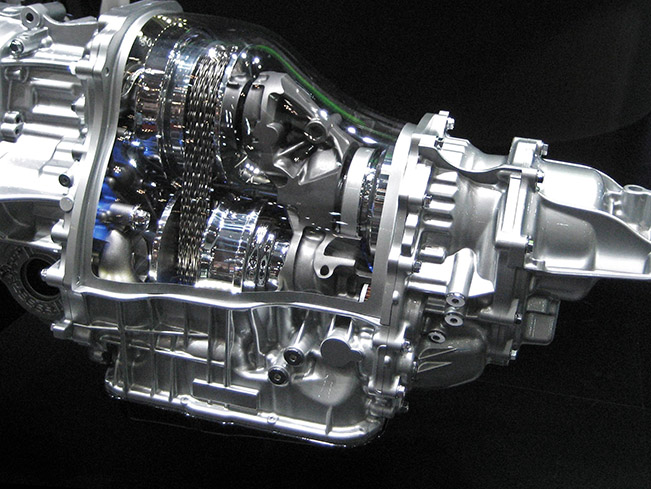
    A continuously variable transmission (CVT) is a type of automatic transmission but operates very differently than older fluid-based automatics. CVTs are mechanically-based transmissions and provide more useable power, better fuel economy and smoother driving than traditional automatics. It should be noted that CVTs have been around for years in other motorized applications. Vehicles such as snowmobiles and some off-road recreational vehicles have utilized CVTs for decades. Only just recently has the technology seen mainstream automotive use.

    How they work

    Conventional automatic transmissions have sets of gears inside their housings that provide different gear ratios or speeds. Control units sense a vehicle’s speed and other parameters and use that information to shift the transmission’s gears. The user just puts the transmission in the appropriate mode with the gear selector switch (P-R-N-D-L). A CVT uses a similar selector switch but replaces the complex gears sets common in automatic transmissions with two simple variable-diameter pulleys, each shaped like a pair of opposing cones, with a metal belt running between them. The way it works is that during operation the pulleys move in and out such that a drive belt between moves higher on one pulley, lower on the other and this provides a numerical gear reduction. You can picture this roughly as the way a 10-speed bike works, by routing the chain over smaller or larger gears to change the gear ratios. The gearing effect with a CVT is essentially “continuous”, hence the nomenclature.

    What they are like to drive

    The controls for a CVT-based car are the same as an automatic-based car: Two pedals (gas and brake) and a P-R-N-D-L-style shift pattern. When driving a car with a CVT, you won’t hear or feel the transmission shift, though. It simply raises and lowers the engine speed as needed, calling up higher engine speeds (or RPMs) for better acceleration and lower RPMs for better fuel economy while cruising. Some people find that driving a CVT-based automobile is a little disconcerting because they sound different when being driven.

    Advantages of CVTs

    Internal combustion engines do not develop constant power at all speeds; they have specific speeds where either torque, horsepower, or fuel efficiency are at their optimum levels. Because a CVT can theoretically adjust to any gear ratio, engineers can program them to give maximum performance in all these situations.

    Disadvantages of CVTs

    The CVT’s biggest problem has been user acceptance. Because the CVT allows the engine to rotate at any speed, the noises coming from under the hood can sound odd to ears accustomed to conventional automatic transmissions. Automakers have gone to great lengths to make the CVT feel more like a conventional transmission. For example, many CVTs are now programmed to simulate the “kick-down” feel of a regular automatic when the pedal is floored.

    Reliability of CVTs

    Because early automotive CVTs were limited as to how much horsepower they could handle, there has been some concern about the long-term reliability of the CVT. This has not proven to be a problem, though. Advanced technology has made the CVT quite robust and reliable. Nissan has more than a million CVTs in service around the world and says their long-term reliability is comparable to conventional transmissions.

    The future of the CVT remains to be seen. In spite of the obvious efficiencies of CVTs, customers can be fickle and may prefer and older technology. Give it a few more years and we should know how user acceptance plays a role in the adoption in CVT technology.

    Source: Team Nissan North

  • Common Electrical Problems in Jeeps


    If your engine components go there is an easy decision on whether to fix it, replace it or trade in for a new vehicle. But when there is something small like an electrical problem, it always seems like those little ones can lead to larger problems, and are incredibly challenging to fix.

    Faulty Instrument Lights. One problem any vehicle can face, not including Jeep models is a instrumental or gauges that aren’t lighting up properly. This could be a problem for a number of reasons, one you can’t see how fast your going, you can’t see your fuel gauge just to name a couple.

    No blinker or hazards, or even blinkers that are blinking too fast. This is oddly a problem that does happen often with some LED lights. Sometimes just by adding LED lights could cause this problem, or more commonly you have lost a bulb recently. Nobody wants to be driving behind a Jeep that looks like they are having a rave whenever they turn.

    Brake Light is staying lit, well after releasing the brake? The main cause for this is because the tab doesn’t release from the connector properly, which signifies the light as if the brake is still on. But it also could be something as natural as a corroded connector or broken wire.

    The problems with electric components can be large of very small and granular. This is the challenge of owning any vehicle, and not a Jeep. But in order to maintain the longevity of your vehicle as recommended to us by a local car tech, is to simply have it maintenance on the regular. Just like visiting your doctor, have your check-ups done to catch the small things before they come big problems.

    Source: Service Center of Pomoco Chrysler

  • Take a Look Into The Production of the Chrysler 200


    Chrysler Group subsidiary Chrysler has gone ahead and created a new website that allows online users to explore their Chrysler 200 plant in Sterling Heights, MI. It is a very interesting and interactive way of providing people a look into the facility.

    Let us start by explaining the facility. It is a completely overhauled facility just outside the Detroit metropolitan area. It is designed solely for the production of the all new Chrysler 200 sedan model. This is the same model that Chrysler is pushing out to the North American market, expressing they have a completely redesigned 200 sedan, that is fresh, and should fulfill many who are looking for a midsize sedan.

    This facility might be one of the hardest working facilities over the next 4-5 years as they work hard to reach the FIAT Chrysler CEO Sergio Marchionne’s goal of selling over 700 thousand units of the Chrysler 200 by the 2018 year. This is a very optimistic stretch goal for the Chrysler Group, as in 2013 they were only able to sell just 350 thousand units.

    Now back to the tour itself. It includes a great narrative, and segmented structure. So it allows you to pick and choose what part of the manufacturing plant you wish to tour. It gives you a blue line to follow for a scripted tour, or you can take a more manual tour, and just click around the screen.

    The tour is powered by Google Maps Business, and throughout the tour you will reach highlighted areas where you can watch a video to gain a better understanding of what happens at each and every station throughout the production of the Chrysler 200.

    Related Article: Chrysler 200 Sedan on Thompson Chrysler Baltimore

  • ‘Build Your Own’ Site by Chevy Goes Live


    With the 2015 Chevrolet Colorado hitting Chevy Dealers across North America this fall, the introduction of the “Build Your Own” tool by Chevy couldn’t have gone live at a better time. As the marketing manager for the Colorado says, “Our truck lineup is all about giving truck buyers a choice”.

    In their press release Chevrolet was able to put together some sample customized builds of the Colorado. But starting off the base extended-cab model has a 200-hp, 2.5l four cylinder engine, and starts off at just $20,995. Some of the unique sample builds they mention are:

    1. This package was simply designed for the working man or woman, with great towing and hauling capability. It includes a Z82 trailering package, and the beefier 3.6L V6 engine for better towing power.
    2. This package was designed for the polar opposite of the labor worker. It was designed for the purpose of simply getting a driver from point A to point B. It starts off with the 2WD Crew Cab, a spray-in bedliner, GearOn divider and tie down rings.

    These are just a couple of the sample custom packages that they have using the “Build Your Own” tool from their website. The beauty of this tool it will give each and everyone their own freedom to add whatever options they feel are necessary for their day to day needs.

  • Peugeot Quartz Concept – Ultra-Athletic Crossover

    Peugeot has presented the interesting Quartz Hybrid Crossover Concept. The vehicle is expected to make its official public debut at the Paris Motor Show, next month. Peugeot Quartz Concept is designed to present the future imagination of the French manufacturer for the SUV models.

    Quartz boasts a set of enormous 23” alloy wheels as well as a huge body – 4.5 meters in length and 2.06 meters in width. It features composite structure and bonded body panels to save weight. Since the model doesn’t have B-pillars, it will be fitted with scissor doors, which will boost the concept’s presence.

    The engine is a 1.6 liter THP turbocharged petrol with 270HP (198 kW) and 330Nm (243 lb-ft) powering the rear wheels, while the front are powered by an electric motor – 115HP (85 kW) charged by a battery pack positioned into the floor of the vehicle. At the back there’s another 115HP (85 kW)electric motor for propulsion and battery charging.

    The Quartz offers an all-electric range of 50 km (31 miles). There is also a Road mode as well as Race mode unleashing the maximum power of the vehicle.

    The interior of the vehicle boasts i-Cockpit design with a small steering wheel with built-in controls for shifting gears as well as changing driving modes. There are four bucket seats for occupants and retractable harness.

    The Peugeot Quartz concept will be exhibited from 4th October at the 2014 Paris Motor Show.

    Source: Peugeot