Tag: Volkswagen

  • An overview of a modern legend: Volkswagen Phaeton

    2010 Volkswagen PhaetonBack in the 1990s, VW’s CEO, Ferdinand Piëch pursued an ambition to create a vehicle for the luxury segment. His first project was unveiled at the 1999 Frankfurt Motor Show. This was the Concept D with a 5.0-liter direct-injected V10 engine and a rather beautiful exterior and interior design. Two years later, the Phaeton would enter production, looking to establish a name for itself among other luxury sedans.

    At first, the Phaeton came with a 3.6-liter V6 engine as a standard, but a larger 6.0-liter W12 unit was also available for purchase. The W series of engines were just beginning to be included in mass-produced vehicles at the time.

    What was also special about the vehicle, was the design of the entire drivetrain system – brakes, suspension, and steering were designed to cope with speeds that exceed the 155mph limit.

    2010 Volkswagen Phaeton

    The Phaeton enjoyed tons of attention both in Germany and all around the world, especially China. In fact, the Phaeton was successful enough that the VW team unveiled a second-generation back in 2010. This particular machine featured a larger interior with a 4Motion AWD system, Continuous Damping Control, adjustable suspension, electric seats, and laminated finish.

    SEE ALSO: Lambo team enhances the connectivity possibilities of the Huracan lineup

    The success of the vehicle was continued throughout the 2010s: 7,500 were built in 2010 and over 60,000 between 2001 and 2011. Vehicle production was discontinued in 2016, as Volkswagen shifted resources of the Dresden factory towards a focus on electric vehicles.

    2010 Volkswagen Phaeton

    Source: Volkswagen 

  • New Golf R: a quick overview

    2021 Volkswagen Golf RNew Golf R comes with quite impressive performance rates, measuring 320hp and 420-newton meters of torque. What helps distributing and controlling this massive output is the new 4MOTION AWD system with torque vectoring on the rear axle. Also, this is the first Golf that will be geared with 4MOTIOR with Performance Torque Vectoring system.

    New R Performance Package

    The latest Golf R can also be specified with an optional Performance Package upgrade which increases the top speed of 270km/h and adds a sexy and more prominent rear spoiler for extra downforce on the rear axle. Also included are the 19-inch wheels in the Estoril design and two selectable driving modes – Special and Drift.

    More control for the driver

    2021 Volkswagen Golf R

    In both models, stock or R Performance, the accelerator pedal has been crafted in such a way that enhances the feel of control over the acceleration process. This contributes to more comfortable and pleasurable driving experience and also gives an advantage when the driver drifts on snow and ice, or even on asphalt. In both vehicle variants, the gearbox is fine-tuned and calibrated to ensure that the 420Nm of output keeps a relatively high rpm.

    SEE ALSO: Lexus reveals the first details of the new F SPORT Launch Edition

    Also, for the first time since the introduction of DSG, the gearbox stays in manual mode if the driver has chosen so. The unwitting switching back to automatic mode is now a thing of the past. As it seems, this new tech approach is highly praised by professional racers who now benefit of more precise and secure control over the entire vehicle.

    2021 Volkswagen Golf R

    Source: Volkswagen 


  • VW will make the new Golf R the most powerful in the lineup so far

    2021 Volkswagen Golf RThe new 2022 Volkswagen Golf R will arrive later this year and will offer the best output in the Golf R to date with 315hp and 310 pound-feet of torque. In order to distribute this power more efficiently and get the maximum out of it, engineers have also included a revised 4Motion AWD system with rear-axle torque vectoring.

    This new torque vectoring system uses a rear differential with two multi-plate clutches that can distribute up to 100 per cent of the rear torque to an individual rear wheel. This approach ensures that the distributed power is just enough to get the vehicle and drier out of the situation.

    Also, for the first time ever, the 4Motion system has been connected to the Vehicle Dynamics Manager, a smart system that integrates the torque vectoring axle, the electronic differential locks and the cornering performance of the DCC adaptive damping system. The Vehicle Dynamics Manager monitors the vehicle’s behaviour on every corner and uses a combination of selected single-wheel braking.

    SEE ALSO: ROUSH reveals its new tuning project. It involves an F-150 this time

    The torque vectoring technology was also the key function of the new track-only “Drift” mode which changes the stability control parameter and the torque vectoring sends all available rear torque to the outside wheel.

    Source: Volkswagen 

  • Volkswagen announces details for the new Touareg R lineup

    2021 Volkswagen Touareg RVolkswagen Touareg R is the first fully-fledged production R model that will be launched with an electrified drivetrain system. The chosen setup is capable of incredible performance and also will ensure low emissions. So, let’s find out more, shall we?

    New Touareg R incorporates numerous talents and the most notable ones are these performance rates. The high-performance SUV generates a total of 462hp and 700Nm of torque and can sprint from 0 to 100km/h in 5.1 seconds. The vehicle’s top speed is limited to 279km/h. What is also interesting about this setup is that about 70 per cent of the vehicle’s torque can be transferred to the front wheels and up to 80 per cent to the rear ones, thanks to the centre differential lock with asymmetric torque distribution.

    2021 Volkswagen Touareg R

    Talking about performance, the heart of the beast I an advanced 3.0-litre V6 eHybrid plug-in powertrain. This is a refined system and advanced enough to make the R lineup the most running-cost-friendly model in the Touareg lineup with its economy and CO2 emissions of 94.2mpg.

    Not only powerful and with a sporty spirit, the new Touareg is also generously equipped. The new model comes with black “Puglia” leather upholstery, diamond-quilted ergoComfort seats with contrasting blue stitching and piping, and active climate control for the front occupants. The new R lineup also benefits from an exclusive heated leather sports steering wheel with R logo and DSG shift paddles, 30-colour interior lighting setup and keyless locking and starting system.

    The standard equipment also includes an air suspension system with automatic self-levelling function, Park Assist with 360-degree Area View camera and LED matrix headlights. Additionally, buyers will benefit from Adaptive Cruise Control and Lane Assist functions that are part of the standard equipment.

    2021 Volkswagen Touareg R

    Source: Volkswagen 


  • Volkswagen reveals firsts details for new Trinity project

    2026 Volkswagen Trinity Volkswagen gives us the first glimpse of Project Trinity: an electrically powered sedan with expanded range, new technologies and an overall new approach towards the EV sector.

    The name comes from the Latin “Trinitas” and means tri-unity. As it comes to the project, there are indeed three new approaches: a newly developed electronics platform with modern software, a simplification of the supply structure, and intelligent production at the main plant in Wolfsburg.

    In the future, the individual configuration of the vehicle will no longer be determined by the hardware at the time of purchase. Instead, customers will be able to add functions on demand at any time via the digital ecosystem in the car, says Ralf Brandstätter.


    What we know so far is that some of the future vehicles will be produced with fewer variants and the hardware will be standardized for all models across the lineup. Also, the vehicles will have an extended list of utility features that will be activated on demand by occupants at any level via the fully-digital cockpit and advanced VW digital ecosystem. This not only aims to enhance the comfort of driving but also is expected to significantly reduce the complexity in production.

    Along with presenting us with a vehicle, the Volkswagen team is also aiming at developing a software-based product. VW team aims at creating the right conditions for new data-based business models. This means that entry barriers to individual mobility will be lowered and at the same time, VW will offer more attractive user packages. What they will also try is to generate more customer interest by changing the energy and software services that customers will be able to customize.

    SEE ALSO: 2021 Kia Telluride wins the 2021 Kelley Blue Book Best Resale Value Award

  • Vincentric reveals record low maintenance cost for VW cars

    2021 Volkswagen Atlas Volkswagen of America, Inc. announces that results from a maintenance cost study reveal that some of the brand’s models have the lowest cost of maintenance. The analysis is performed by Vincentric, an automotive data firm. It shows that Atlas and Jetta’s lineups offer the lowest costs for maintenance over the first five years of ownership, whereas Tiguan, Passat and Arteon outperformed key models from competitive brands.

    Furthermore, Vincentric’s maintenance cost analysis shows that some 2021 VW models feature outstanding results. Such are:

    2021 Atlas Family of vehicles has the lowest cost of maintenance among midsize SUVs. The Atlas Cross Sport ranked #1 for the lowest cost of maintenance in the category.

    2021 Jetta ranks #1 for the lowest cost of maintenance among compact sedans.

    2021 Tiguan has a lower cost of maintenance than competitive models by Honda, Toyota and Subaru in the compact SUV segment.

    2021 Passat and Arteon models have a lower cost of maintenance than competitive models by Toyota, Honda and Hyundai in the midsize sedan segment.

    It seems that Volkswagen has managed to retain its high standards and high-quality vehicles. Not only the brand has revealed tons of new gadgets and ideas but also has managed to successfully incorporate all these in new vehicle models. For example, the new ID lineup has managed to catch the attention of both brand enthusiasts and sceptics with its advanced technologies and tons of innovations.

    Volkswagen’s operations in the US include technical research and development, vehicle processing, distribution centres, sales and service offices. Volkswagen Group remains one of the largest producers of passenger vehicles and Europe’s largest manufacturer.

    SEE ALSO: Volkswagen ID.3 receives its 10th prestigious award. Check out some details!

    As it comes to Vincentric, the firm provides data, knowledge, and insight to the automotive industry by applying numerous aspects of automotive value. This data is used by large organizations like Mercedes-Benz, Toyota, AAA, Nissan and many others.


  • VW celebrates Golf GTI’s 45th anniversary with a special edition

    Volkswagen Golf GTI Clubsport 45Back in 1976, VW launched the first prototype of the famous Golf GTI lineup. At the time, the people at Volkswagen had no idea that this will eventually turn out to become one of the brand’s most notable model. Now Volkswagen celebrates the 45th birthday of the iconic vehicle with a special anniversary model: the 300hp (221kW) Golf GTI Clubsport 451.

    Some of the specs include a 55hp increase over the standard GTI turbocharged model and a dedicated Special driving mode for race tracks. Visually, the vehicle includes large air intakers that not only contribute to the sporty stance but also deliver more oxygen to the TSI. Also, there’s an exclusive open roof spoiler that allows better airflow and greater downforce and a separate sport exhaust system.

    Even the “standard” Golf GTI Clubsport is technically distinct from the standard Golf GTI4/5, with features including a 55 PS increase over the standard GTI’s turbocharged engine (TSI) and the Special driving mode for race tracks. Visual highlights of the Clubsport include larger air intakes (delivering more oxygen to the TSI), a specially designed open roof spoiler to allow improved airflow (greater downforce), and a separate sport exhaust system.

    Volkswagen Golf GTI Clubsport 45

    What is also special about the Clubsport 45 is the ton of custom details. For example, the exterior boasts a beautiful black roof, black roof spoiler in homage to the first-ever Golf GTI. The optional Race package offers 19-inch Scottsdale alloy wheels in glossy black with a narrow accent pinstripe in Tornado Red. The Race pack also includes a sport exhaust system and removal of the Vmax limiter. Of course, there’s the notable “45” added t the lettering on the boot id underpin. The Clubsport 45 also comes with IQ. Light LED matrix headlights with a red strip which is a standard feature.

    SEE ALSO: Bentley Continental Tuning by Wheelsandmore

    In terms of interior, the anniversary model comes in classic GTI insignia. There are embellishments with GTI lettering on the backrests of the front premium sports seats. There’s also this cool “45” on the multifunctional steering wheel right at the central spoke.

    Volkswagen Golf GTI Clubsport 45

    Volkswagen Golf GTI Clubsport 45

  • Volkswagen Arteon

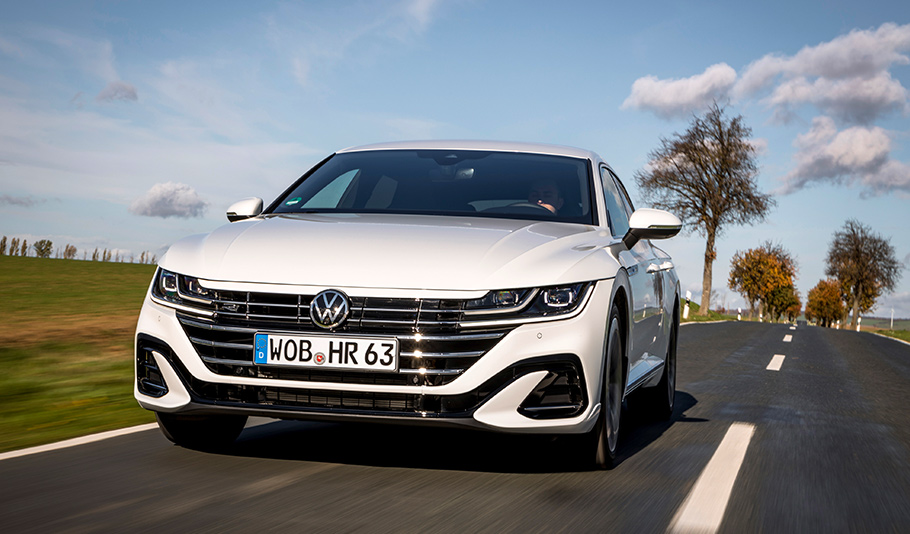
    2021 Volkswagen Arteon1

    The new plug-in hybrid drivetrain is supported by a 13 kWh battery which can provide an electric-only range of up to 39 miles, while the 115 PS electric motor can power the Arteon along at speeds up to 80 mph, where permitted. With the high-torque characteristics of the electric motor, both Arteon models can sprint from a standstill to 62 mph in just 7.8 seconds and, where allowed, onto a top speed of 138 mph.

    The enhanced Arteon range is now available to order in over 20 configurations, split equally between the fastback and Shooting Brake models, with the new hybrid option now available across both body styles. Two equipment lines remain available – Elegance and R-Line – with the latest hybrid drivetrain available on both. The Arteon R with 320 PS and 4MOTION will arrive in due course for both body types.

    Across the entire range, the revised Arteon and new Arteon Shooting Brake feature Adaptive Cruise Control (ACC), 3Zone climate control, Digital Cockpit, LED headlights and Wireless App Connect, with We Connect Plus adding live data services to the 8-inch Discover Navigation system.

    Elegance-trim models are marked out by their 18-inch ‘Almere’ alloy wheels, and gain keyless entry across both body shapes, along with a rear-view camera and Travel Assist – Volkswagen’s adaptive cruise control and lane-keeping system.

    The Arteon R-Line maintains its striking styling, with distinctive, 19-inch ‘Montevideo’ alloys fitted as standard. New dual trapezoidal exhaust tips on each side of the bumper are moulded into the redesigned R-Line body kit, for an assertive, sporting appearance. A sunroof is standard for all R-Line models, while the Shooting Brake gains a larger, standard-fit panoramic sunroof. Both cars also benefit from rear tinted-glass and interior ambient-lighting with 30 colour options.

    The battery in the new eHybrid can be charged in five hours using a domestic 3-pin plug. This time reduces to 3hrs 33mins when using 3.6kW AC charger. Energy can also be recovered while driving, this function being programmable via the infotainment system. In this way battery power can be conserved if, for example, the last part of a journey is in a low-emission zone.

    Lisa Hartley, Arteon Product Manager at Volkswagen UK, said: “We are really excited to be adding an electrified model to the Arteon range and these eHybrid models are ready to impress with their own distinctive styling and high levels of efficiency. With an electric-only range of up to 39 miles we expect many customers will be able to achieve zero-emissions driving for most day-to-day trips.”

  • Volkswagen Golf MK8 GTE

    2021 Golf MK8 GTE1

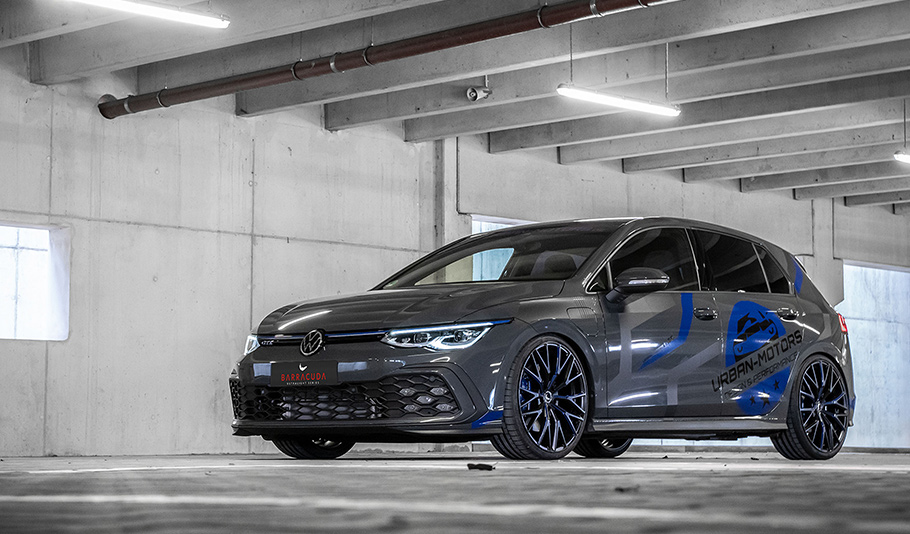
    The new Golf has been on the market since the end of 2019. And although VW has completely detached its compact electric car in the form of the ID.3, electrification also plays a major role in the eighth generation of the classic bestseller. Several versions have different levels of electrical assistance, with the top of the range being the Golf GTE with plug-in hybrid drive, which has been available since summer 2020. Not least because of its dynamic design and sporty look, this is a perfect basis for tuning projects. This is proven by this example, which Urban Motors equipped with a set of high-quality light alloy wheels from Barracuda Racing Wheels.

    The team from Eschweiler near Aachen installed the Project 3.0 wheels from the Ultralight Series, which are very light thanks to the flow forming process, on the axles of the compact class. They measure 8.5×20 inches, are equipped with 235/35 tires and wear a black milled finish. The milled edges of the spokes are wrapped in blue – so they go perfectly with the factory color accents of the GTE and the also partially blue wrapping that Urban Motors applied to the gray body.

    A supplementary lowering should of course not be missing at this point. The Golf was given a KW Variant 3 coilover kit that reduced its ground clearance by around 45 millimeters and promised even more dynamic handling.

    On request, Urban Motors can also offer performance enhancements and other tuning components in addition to the work carried out on the vehicle presented.

  • Most powerful Golf R to date opens for order alongside agile new Golf GTI Clubsport

    2021 Volkswgen Golf R1

    With three performance Golfs already on sale in the form of the GTI, GTD and GTE, the arrival of these two flagship models gives fans of performance Golfs more choice than ever before. Both newcomers offer greater levels of focus and driver involvement. In addition, each model features a raft of equipment and driver assistance systems, including IQ.Light matrix LED headlights, keyless entry, Lane Assist and Travel Assist, which facilitates Level 2 assisted driving up to speeds of 130 mph (where legal). Car2X is also fitted, as per the rest of the Golf range, allowing communication between Car2X-equipped cars and infrastructure, to warn road users of hazards ahead.

    The new Golf GTI Clubsport

    The first of these new cars is the Golf GTI Clubsport. This model builds upon the already award-winning formula offered by the 245 PS/370 Nm Golf GTI, but dials the power output of its 2.0-litre turbocharged four-cylinder engine up to 300 PS and 400 Nm of torque for a 0-62 mph time of just 5.6 seconds. This makes it the fastest-accelerating production Golf GTI in history. Special features for the new car include a driving mode developed especially for the demands of the Nürburgring, a large two-part rear spoiler resulting in a reduction in lift over the rear axle, and an exclusive front bumper, offering not only augmented styling, but incorporating a new front splitter for greater downforce on the front axle. The rear of the Clubsport is also distinguishable from the GTI, with oval tailpipes, rather than the GTI’s circular pipes, which sit further apart either side of an enhanced diffuser.

    In addition to exterior and performance upgrades, the Golf GTI Clubsport also benefits from the standard fitment of Clubsport-specific ArtVelours seats alongside the acclaimed Digital Cockpit Pro and Discover Media navigation system, offering greater convenience and style. The Golf GTI Clubsport starts at £37,215 RRP OTR.

    The Vehicle Dynamics Manager system works in combination with all the electronically controlled running gear including the electromechanical front-axle locking differential and XDS electronic differential lock to eliminate the understeer often associated with front-wheel drive cars. This focus is complemented by a larger braking system, and can be further optimised with the addition of the optional Dynamic Chassis Control (DCC) adaptive damper system.

    The new Golf R

    Meanwhile, the Golf R returns as the Golf’s outright flagship in terms of performance and positioning, now with 320 PS and 420 Nm on tap from its turbocharged 2.0-litre engine, equating to a top speed of 155 mph (increasing to 168 mph with the optional R-Performance Pack), where permitted. The 0 to 62 mph sprint is dispatched in just 4.7 seconds – making it the fastest-accelerating Volkswagen on sale.

    The powerful and advanced EA888 evo4 engine is installed with a 7-speed DSG transmission, and, like all vehicles from Volkswagen R, 4MOTION all-wheel drive. The system has been comprehensively uprated for the latest generation of Golf R, with the introduction of R-Performance Torque Vectoring that distributes the engine output to all four wheels. The new differential on the rear axle distributes the drive power not just between the front and rear axles, but also variably between the two rear wheels. Up to 100% of torque can be directed to the wheel on the outside of a bend if necessary. This, working in conjunction with the all-new Vehicle Dynamics Manager and XDS electromechanical differential locks, allows a higher level of agility and a reduction in understeer, which in turn contributes to even greater driver involvement and dynamics.

    An optional R-Performance Package is available on the Golf R for £2,000. It brings upgraded 19-inch ‘Estoril’ alloy wheels, a performance rear spoiler for added downforce, and an increased top speed of 168 mph (where permitted). The pack also adds two new driver modes; Drift and Special. Drift mode is entirely focused upon driver enjoyment away from public highways. This mode uses the full potential of the new R-Performance Torque Vectoring and enables the driver to drift the new Golf R on private tracks. The pack also introduces a Special mode that provides the car with the perfect setup to tackle the famously challenging Nürburgring. This is an extension of the standard Race driving mode, in which the engine sound is increased, while the DSG, optional DCC, progressive steering and the all-wheel drive system are adjusted to a sportier setup.

    The Golf R is priced from £39,270 RRP OTR, and sits atop the new Golf range. It is identifiable by its attractive 18-inch ‘Jerez’ alloy wheels, full R body kit, roof spoiler and quad exhaust pipes – a feature that subtly hints at the model’s potency compared with other Golf models. A bespoke, heated R steering wheel features, with a new R button which allows the driver direct access to the car’s newly enhanced range of drive modes without needing to take their hands away from the wheel. Extended paddle shifters also add to the driver-focused convenience of the model’s cockpit. Sports seats with integrated head restraints feature a ‘Sardegna’ design in black-blue cloth, unique to the new R models, while the outer areas are in ArtVelours. The model’s brake callipers are finished in the hallmark shade of Volkswagen R blue, and feature the R division’s logo, while the car’s door mirrors are finished in a matt chrome effect – another identifier of the powerful and enthusiast-focused Golf R.

    Several accessories are available for the Golf R including an Akrapovič titanium exhaust, panoramic sunroof, Harmon/Kardon sound system and a head up display.

    Sarah Cox, Head of Marketing at Volkswagen UK, said: “Christmas has come early for fast Volkswagen fans, with not just one performance hero opening to UK customers today, but two.

    “The Golf GTI Clubsport takes the iconic GTI with its winning formula and turns the dial up for even more driver involvement and focus, while the Golf R maintains its all-round appeal, with a fantastic new version of our 4MOTION system providing even more fun behind the wheel.

  • Volkswagen Golf Estate

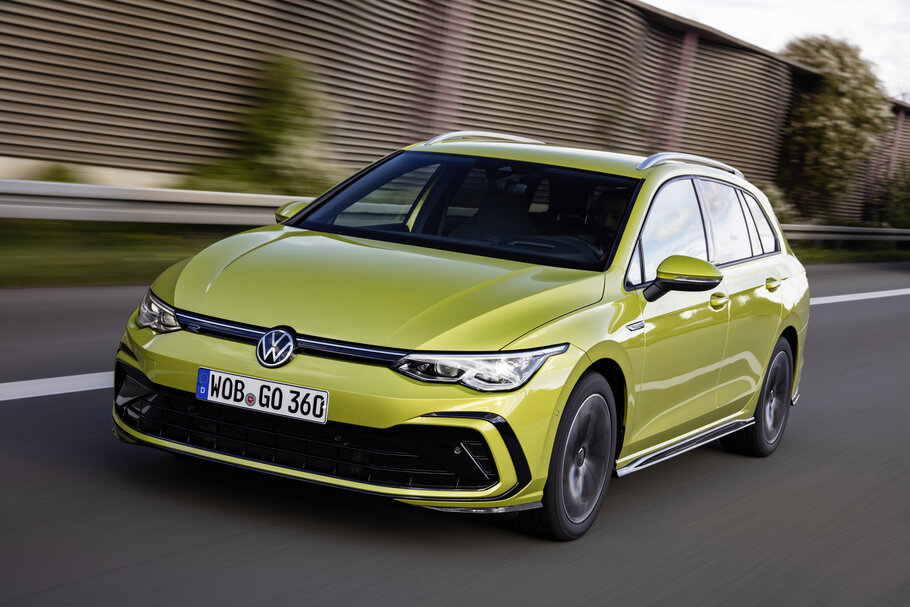
    The new Volkswagen Golf Variant R-Line

    The Golf Estate arrives in the UK available to order now in a diverse range of specification and drivetrain configurations split across three new trim levels: Life, Style and R-Line. The new Alltrack variant also makes its first appearance and is characterised by increased ground clearance, an all-terrain look and 4MOTION permanent all-wheel drive.

    The initial wave of engine and gearbox options in the new Golf Estate opens with a 1.0-litre 110 PS engine, fitted with a 6-speed manual transmission as standard, but available also as an eTSI-designated 48V mild-hybrid powerplant with the brand’s 7-speed DSG transmission. Depending on the chosen Golf Estate trim level, the other engines available to order from today are a 1.5-litre 130 PS TSI, 1.5-litre 150 PS TSI, 2.0-litre 115 PS TDI and 2.0-litre 150 PS TDI, all available with 6-speed manual gearboxes. In addition, 1.5-litre, 130 PS eTSI and 150 PS eTSI mild-hybrid units are also available, exclusively with the 7-speed DSG transmissions as standard. A 2.0-litre 200 PS TDI engine with 7-speed DSG and 4MOTION is reserved exclusively for the Golf Alltrack.

    Performance figures for the range of engines offered in the Golf Estate and Golf Alltrack are undeniably respectable: the Alltrack is capable of 0 to 62 mph in as little as 7.1 seconds (2.0-litre 200 PS TDI), while even the entry level 1.0-litre 110 PS TSI unit will carry the Golf Estate to 62 mph from a standing start in a sprightly 10.5 seconds.

    Clearly identifiable as a sibling of the new Golf hatchback, today’s Estate family of models features a longer roof line and more muscular shoulder section which combine to give it a more overtly sporty appearance than its predecessor.

    The increase in length also alters the car’s proportions, making the Golf Estate appear more substantial but also lower. The new model is 4,633 mm in length and now boasts a wheelbase of 2,686 mm (respectively 349 mm and 66 mm increases compared with its predecessor). The new Golf Estate is 1,789 mm wide and 1,455 mm high (without roof rails). In comparison, the current Golf hatchback is 4,284 mm long and boasts a wheelbase of 2,619 mm. The height and width of both Golf versions are identical.

    Larger external dimensions translate into more useable space inside this new estate. Five occupants can be transported comfortably, while the car’s extra capacity is most noticeable in the rear where maximum legroom increases from 903 mm to 941 mm. Luggage space is enhanced, too, and passengers can stow their belongings in a generously dimensioned boot. When loaded to the top edge of the rear seat backrest, today’s Golf Estate offers 611 litres of storage space (six litres more than the Golf Estate Mk 7) and when loaded to the roof with the integrated luggage net partition up to the front seat backrests, the volume increases to 1,642 litres (up 22 litres).

    The Golf Estate Life, Style and R-Line, and the Golf Alltrack, all offer an ascending selection of features that help mark out the new models as leaders in the fields of technology, safety and driver assistance – while every new car boasts a generous selection of standard-fit equipment.

    The entry-level Life specification includes many features not traditionally seen as ‘entry level’ such as automatic LED headlamps with separate LED daytime running lights; dynamic headlight range control; tail lights incorporating LED technology; a body-coloured rear spoiler; ‘Norfolk’ 16-inch alloy wheels; interior ambient lighting with 10-colour adjustment; leather trimmed gear knob and multifunction steering wheel; Discover Navigation system with 10-inch colour touchscreen; FM and DAB digital radio receiver with six speakers; Bluetooth connectivity; App-Connect and the Volkswagen eCall emergency SOS call service.

    Life buyers also benefit from the likes of Active Info Display Digital Cockpit Pro: a 10.25-inch high resolution TFT dash display screen with customisable menus; Car2X connectivity; Dynamic Road Sign Display; Front Assist and Adaptive Cruise Control; Lane Assist and parking sensors front and rear.

    Step up to the Style trim and the range of design, comfort, safety and convenience features grows still further. Among the highlights for Style buyers, in addition to the features found in Life models, are: ‘Belmont’ 17-inch alloy wheels; LED ‘Plus’ headlights; High Beam Assist; front sports seats; 30-colour interior ambient lighting; 3-Zone climate control air conditioning; Side Assist and Traffic Jam Assist; and Lane Change Assist.

    Golf Estate R-Line buyers can look forward to even more in the way of standard-fit equipment with, in addition to the above, 17-inch Valencia grey metallic alloy wheels; R-line body-coloured bumpers; tinted glass from the B pillar backwards; R-Line door and side trim panels; an R-Line three-spoke heated leather steering wheel; sports suspension; Driving Profile Selection; and progressive steering.

    The Golf Alltrack returns with rugged, SUV-inspired styling and 4MOTION all-wheel drive which endows it with strong capability beyond paved roads. The model is also marked out as a top Golf by its honeycomb-design fog light clusters – also seen on the GT family of variants. The Alltrack receives 17-inch ‘Ronda’ alloy wheels, illuminated front grille and silver roof rails, while both driver and passengers can enjoy 3Zone climate control. Like the GT family of models, the Golf Alltrack also benefits from an enhanced suite of driver assistance systems, with Travel Assist, Emergency Assist, Side Assist and Lane Change Assist included as standard.

    At launch today, the Life specification is available with three petrol engines, each with a 6-speed manual gearbox as standard, or the option to include a 7-speed DSG alongside a 48V mild-hybrid system. These are available in 1.0-litre, three-cylinder 110 PS, or 1.5-litre, four-cylinder 130 PS and 150 PS versions. The Life’s diesel option is the frugal and flexible 2.0-litre 115 PS TDI, allied to a 6-speed manual gearbox.

    While Style buyers can’t opt for the 1.0-litre engines, they have the additional choice of a 2.0-litre 150 PS TDI mated to either a 6-speed manual or 7-speed DSG. R-Line models are equipped exclusively with the higher-powered, 150 PS petrol and diesel units, each offered with a choice between a manual or automatic transmission. The range-topping, 2.0-litre 200 PS TDI with 7-speed DSG and 4MOTION all-wheel drive is reserved for the Golf Alltrack, and is perfect for traversing trickier terrains than asphalt.

  • Well-balanced and sporty at the same time– the new id.4 chassis

    The new Volkswagen ID.4

    Nimble in the city, agile on country roads, relaxed on the highway: the new ID.4 from Volkswagen is an all-rounder that is effortless and easy to drive. Volkswagen has invested a great deal of know-how in the chassis of the E-SUV – in the mechanical components and the electronic control system.

    “The purely electrically driven SUV ID.4 is great fun to drive, similar to the compact ID.32,” explains Karsten Schebsdat, Head of Driving Dynamics, Steering and Control Systems at Volkswagen. “In its chassis, we have implemented numerous ideas and new control systems that further increase safety and driving pleasure.”

    Sporty handling due to low center of gravity. The ID.4 already offers the best prerequisites for a great driving pleasure. The rear-wheel drive ensures strong traction – the driver experiences this already when they arrive at a set of traffic lights in the wet. The high-voltage battery is located between the axles at the lowest point of the car. This benefits the center of gravity and weight distribution: with all drive variants, it deviates from the ideal value by no more than one percent, 50:50.

    The front axle of the ID.4 follows the McPherson design, the steering is translated with a 15.9:1 ratio. For the first time at Volkswagen, the steering system is located in front of the center of the wheel, this position guarantees high stability during fast cornering. At the rear is a complex new development – a compact five-link suspension with a subframe that is elastically connected to the body. Parts of the suspension are made of lightweight aluminum to reduce weight.

    Large wheels and powerful brakes. The range of wheels for the ID.4 starts with the 18- inch format, either in steel or aluminum. Starting with the ID.4 Life model, 19-inch wheels are standard; above that, there are only light-alloy wheels with 20- or 21-inch diameters. Although the large wheels in the wheel arches take up a corresponding amount of space, the ID.4 only requires a turning circle of 10.2 meters – extremely little for a car in its class.

    The wheels are aerodynamically optimized by their flat design, the tires have low rolling resistance. In the ID.4 Pure and ID.4 City entry-level models, they are 235 millimeters wide at the front and rear, with cross-sections varying according to wheel size. All other ID.4 models roll off the production line on combination tires – 235 millimeters wide at the front and 255 millimeters at the rear.

    The robust E-SUV has powerful brakes – the discs on the front axle of the ID.4 models with the 77-kWh battery are 358 millimeters in diameter. Drum brakes operate on the rear wheels. Their pads are designed to last the lifespan of the car. Corrosion is impossible, although the brakes are rarely used in everyday driving. Most of the deceleration is performed by the electric motor, which recovers energy in the process.

    Progressive steering, DCC chassis control and driving mode selection. With the “Plus” sports package (in the top model ID.4 Max), the ID.4’s chassis takes on a whole new form. One of its two components is the Progressive Steering, which works more and more directly as the steering angle increases – its ratio ranges from 15.9:1 to 14.5:1. The other component is the DCC adaptive chassis control, which works depending on the road surface and the driving situation. It regulates the characteristics of the damper on each wheel 200 times per second – this enables a high level of ride comfort or a tight connection to the road.

    The DCC and Progressive Steering are coupled with Driving Profile Selection, which gives the driver a choice of four modes. Eco, Comfort and Sport are preconfigured. In Individual mode, the driver is given additional setting options on the central display: They can select fine intermediate levels between Comfort and Sport or make both modes even more extreme – in other words, even more comfortable or even more dynamic.

    The Vehicle Dynamics Manager. When the driver wants to, the ID.4 takes corners very quickly, stably and almost naturally – also thanks to the electronic Vehicle Dynamics Manager, which works closely with the stability control ESC. Volkswagen has introduced it in the new Golf. The Driving Dynamics Manager controls the wheel- selective brake interventions of the XDS electronic transverse drive lock and the work of the DCC damper control. It uses a digital target model to achieve optimum driving and steering behavior in every situation. As soon as the vehicle turns into a corner, the ID.4 behaves more spontaneously, linearly and accurately.

    The ESC in turn cooperates closely with the control units for the electric engine and the power electronics. Although a rear-wheel drive car tends to oversteer in principle, this networking ensures that the rear wheels of the ID.4 find stable grip in every situation – during full acceleration, when cornering fast and when decelerating by brake recuperation. This traction control – another innovation at Volkswagen – is speed-based. And it takes place automatically every millisecond, i.e. so fast and therefore so gently that the driver hardly feels it.

    Start with eight models. The ID.4, Volkswagen’s first fully electric SUV and the brand’s first electric world car, will be launched after the 1ST Edition with eight preconfigured models. The high-voltage battery is available with 52 or 77 kWh energy capacity (net), the range is up to 520 kilometers (WLTP). The electric motor is available in three power levels between 109 kW (148 PS) and 150 kW (204 PS).

    The future of mobility is electric. As part of the “Transform 2025+” strategy, the Volkswagen brand is investing eleven billion euros in electromobility by 2024. The ID.4 is the second model of the ID. family following the ID.3. This new product line has recently been added to the brand’s traditional portfolio. The term ID. stands for intelligent design, identity and visionary technologies.

    1ID.4 – Power consumption in kWh/100 km (NEDC): 16.9 – 16.2 (combined); CO2 emission in g/km: 0; efficiency class: A+.
    2ID.3 – Power consumption in kWh/100 km (NEDC): 15.4 – 14.5 (combined); CO2 emission in g/km: 0; efficiency class: A+.