The Taos Basecamp Active concept starts with a 2022 Volkswagen Taos SEL 4Motion® and adds rugged Basecamp styling components and graphics package shared with the Atlas Basecamp Camping concept. Similar to the Atlas concept, the Taos concept features 17-inch fifteen52 Traverse MX wheels in Frosted Graphite, 225/55R17 all-terrain tires, and a lifted suspension with H&R springs and TRAK+ wheel spacers. Volkswagen Accessories on the concept include base carrier bars and bike racks, along with the Full Display Mirror, tablet holder, Muddybuddy floor liners, roadside assistance and first aid kit, Bumperdillo protection plate, and rear seat cover. In addition, a custom cargo divider and custom trunk flood lighting help keep gear organized and visible on the go. The Taos Basecamp Active concept is shown with Marin bicycles, bike helmets, and a fire extinguisher.
Tag: Volkswagen
-
Volkswagen Atlas Basecamp Camping Concept
Featuring rugged Basecamp® styling components and a custom graphics package, the Atlas Basecamp Camping concept makes the outdoors more accessible. To get you where you want to go, the concept—based on a 2022 Volkswagen Atlas SEL VR6 3.6L 4Motion—adds an H&R® raised suspension, utilizing Street Performance Adventure Lift coilovers and TRAK+® wheel spacers. Custom floodlights and 17-inch fifteen52® Traverse MX wheels in Frosted Graphite are wrapped in 245/70R17 all-terrain tires to add an aggressive look to match the off-road styling of the Atlas concept.
To increase the versatility of the Atlas, the concept has a Volkswagen Accessories cross bar and Thule® Basket & Side Awning, as well as a prototype 2-in-1 Air Pump by NSV incorporated in the trunk area to inflate a camping mattress or sporting equipment. Other Volkswagen Accessories on the concept include the Full Display Mirror®, security console safe by Tuffy® Security Products, tablet holder, Muddybuddy® floor liners, roadside assistance and first aid kit, Bumperdillo® protection plate, and hood deflector. The Atlas Basecamp Camping concept is shown with an air mattress, camping lights, and a fire extinguisher.
-
Volkswagen Gen.Travel Concept
At Chantilly Arts & Elegance near Paris, the Volkswagen Group will present an innovative design study that will redefine the long-distance mobility of the future on September 24. The all-electric powered Innovation Experience Vehicle (IEV) is a real prototype that drives autonomously (Level 5) and gives a realistic outlook for the mobility of the coming decade. The car’s modular interior concept makes it a flexible, sustainable Mobility-as-a-Service alternative to short-haul flights. As a research vehicle, the purpose of the Gen.Travel is to test the concept and new functionalities for customer response. Based on the study results, individual features may later be transferred to series vehicles.
With GEN.TRAVEL, the Volkswagen Group has developed an iconic, innovation-packed study that constitutes a completely new vehicle category in the premium portfolio between sedan and MPV (Multi Purpose Vehicle). “With its NEW AUTO strategy, Volkswagen defines the mobility for generations to come – sustainable and digital,“ says Dr. Nikolai Ardey, Head of Volkswagen Group Innovation. “In the group-wide Volkswagen Innovation Research department, we are further advancing this idea, showing how our customers will be able to experience mobility in the future – for example, as a service. With GEN.TRAVEL, we can already experience today what will be possible in the near future with innovative technology. Door-to-door travel at a new level. Emission-free and stress-free.”
The GEN.TRAVEL drives autonomously and turns the driver into a relaxed passenger who has time for other things: Work. Relaxation. Entertainment. Family. Klaus Zyciora, Head of Volkswagen Group Design, explains: “The GEN.TRAVEL offers us a glimpse of the travel of the future. It shows us what autonomous driving will look like in the future. The GEN.TRAVEL embodies the visionary design of beyond tomorrow for the mobility of tomorrow. Efficient shaping characterizes the extremely distinctive design. Thus, in an age of technical perfection and virtually unlimited possibilities, ‘form follows function’ becomes ‘form follows freedom’. The automobile will not only be better, but also more exciting than ever before.”
The GEN.TRAVEL has a unique, modular interior concept that can be customized for each journey and booked as a Mobility-as-a-Service offering. Depending on the configuration, up to four people can be transported in the concept vehicle. For business trips, the conference setup with four comfortable seats and a large table in the middle of the interior provides relaxed surroundings. Dynamic lighting creates a pleasant working environment and avoids the danger of kinetosis (motion sickness). A configuration in the overnight-setup allows the conversion of two seats into two beds that can be folded out to a full-flat position.
An innovative passenger restraint system ensures maximum safety even in a lying position. The GEN.TRAVEL lighting system influences melatonin production to help passengers fall asleep and wake up naturally. For family trips, the GEN.TRAVEL with front seats can be configured to entertain the children using augmented reality (AR). The interior is light, with a natural design. All HMI (human-machine interface) elements are produced using sustainable materials, combined with recycled or natural materials.
The futuristic exterior of the GEN.TRAVEL is divided into two parts: The transparent, glass cabin is perfectly incorporated into the lower section, which houses all the technical features. The edge of the window is at waist level, making it very low so as to maximize the view of the outside. At the same time, when passengers are lying down flat in the car, they do not experience any external influences. The wing doors of the GEN.TRAVEL facilitate better entry and exit.
For maximum comfort, the GEN.TRAVEL has the active suspension eABC (electric Active Body Control) that calculates vertical and lateral movements such as acceleration, braking, or cornering ahead of time, and optimizes the driving style and trajectory accordingly. Artificial intelligence (AI) and platooning – fully autonomous driving in convoys – are used to further increase the range for long-distance journeys.
-
Volkswagen ID Xtreme Concept
Volkswagen presents the ID. XTREME in Ticino, an exceptional off-road concept car that will generate an enthusiastic response among the many electric mobility fans at the event. The fully electric concept car with all-wheel drive system is based on the ID.4 GTX and combines the strengths of a modern SUV with the sense of adventure embodied by a rugged off-road vehicle.
The ID. XTREME01 from Volkswagen stands for maximum emotion and a desire for adventure. The concept vehicle was created by the team of Andreas Reckewerth (Head of overall vehicle MEB) in the Volkswagen Development department. “The modular electric drive matrix (MEB) has enormous technical potential,” says Silke Bagschik, Head of the MEB Product Line. “For many of our customers, vehicles are much more than just a means of transport. With the ID. XTREME, we are raising electric mobility from VW to a new performance level.” The result of the project is a unique off-road vehicle that impresses with its rugged appearance and outstanding power. A high-performance drive on the rear axle and software adaptations in the drive control unit increase the system power of the concept car by 65 kW to 285 kW compared with the ID.4 GTX02 – in other words, by about 30 percent. “The ID. XTREME is made by enthusiasts at Volkswagen for ID. enthusiasts here in Locarno. We are really eager to find out how the fans of electromobility react to the vehicle. Based on the feedback from our community, we will decide how to proceed with the project,” adds Silke Bagschik.
The exterior of the VW ID. XTREME01 also shows that the vehicle is ready for every off-road adventure. Raised rally running gear, 18-inch off-road wheels, a modified crash member with additional front bumper, and 50 mm-wider wings manufactured by 3D printing combine to give the concept vehicle an authentic off-road look. The roof carrier with additional LED lights and the completely closed aluminium underbody also equip the fully electric all-wheel drive vehicle for excursions away from paved roads.
Acoustically also, the ID. XTREME01 has something special to offer: the driving noise was developed together with Volkswagen Design especially for the concept vehicle and is output to the outside via a sound generator in the wheel housing. In the interior, the concept car impresses with various highlights, including numerous Alcantara applications, revamped seats and elements in the accent colour orange. And it goes without saying that the ID. XTREME is sustainable: a no longer required test vehicle from production development and a used 82 kWh battery were taken as the basis for the concept vehicle.
Volkswagen is presenting the ID. XTREME01 to the public for the first time at the ID. Treffen in Locarno. The event by and for fans of electric mobility is taking place for the second time this year and could become the green and sustainable event for electric mobility modelled on the GTI meeting at Lake Wörth (Austria). This year, ID. enthusiasts from the whole of Europe are meeting up on the shore of Lago Maggiore from 6 to 10 September to share their experiences with electric mobility.
Initiated and organized by private members of the ID. Drivers Club the ID. Treffen is supported by Volkswagen as part of its commitment to the way to ZERO. Together with experts from the company the team of the Volkswagen Drivers Club is attending the event to provide insights into the current developments in the area of sustainable mobility. Alongside the ID. XTREME01, Volkswagen is also presenting other models from the ID. family in Locarno.
-
Volkswagen Golf R 20th Anniversary Edition
Volkswagen of America today announces the highly anticipated Golf R 20th Anniversary Edition for the North American market. A world model, it celebrates 20 years of high-performance all-wheel-drive Golf vehicles, beginning with the release of the Golf R32 in Europe in 2002.
“Twenty years is a significant milestone for the R performance brand of models, and we’re excited to share in a global celebration of two decades of R32 and Golf R heritage,” said Hein Schafer, Senior Vice President, Product Marketing and Strategy. “Being the first official worldwide special model for the Golf R, it was important to include our North American Volkswagen performance hatch enthusiasts in this birthday party for the Golf R brand.”
The Golf R 20th Anniversary Edition builds upon the latest generation Golf R, which utilizes Volkswagen’s advanced MQB chassis and turbocharged 315-horsepower EA888 evo4 TSI® engine. Unique to the North American market, the 20th Anniversary Edition is offered with either a 6-speed manual or 7-speed DSG® dual-clutch automatic transmission.
Select changes to the Golf R’s exterior make the 20th Anniversary Edition easily discernable without compromising the sophisticated appeal of the Golf R. Starting from the top, deleting the standard sunroof shaves weight from the Golf R’s highest point and streamlines the hatchback’s roofline. From the side, Golf R’s large 19-inch Estoril wheels are finished in Gloss Black and are fitted with 235/35 summer performance tires. As in every Golf R, a torque vectoring all-wheel-drive system is paired with an advanced DCC® adaptive damping system to help ensure power makes it to the wheels that need it in any driving situation.
The 20th Anniversary Edition will be offered in Lapiz Blue Metallic, Deep Black Pearl, and Pure White, with a limited allocation of vehicles for each color. Subtle trim details further differentiate the special edition: The mirror caps are finished in Lapiz Blue on Pure White and Deep Black vehicles, while on those painted in Lapiz Blue, the mirror caps are gloss black. In all cases, the puddle lights project “20 R” onto the pavement below. Finally, the “R” logos—on the front and rear bumpers and front fenders—are finished in blue, while 20th Anniversary badges tastefully adorn the B-pillars.
The subtle but deliberate nod to performance continues to the interior, where the dash panel and front door trim feature genuine carbon fiber décor inserts for the first time in a production Volkswagen vehicle. These impart a racing personality to an already sporty cabin that is appointed with an ergonomically optimized “D” shape steering wheel and supportive high-bolster sport seats. Keen eyes will note the “R” logo finished in blue on the steering wheel clasp as well. Even away from the vehicle, owners of 20th Anniversary Golf R models will be reminded of the uniqueness of the limited-edition model by the key fob, which features an “R” logo that is finished in blue.
The 20th Anniversary Edition will go on sale in this fall, and will have an MSRP of $44,940 for the manual transmission model and $45,740 for the 7-speed DSG.
-
Pick-up improved in every area: 2023 Volkswagen Amarok

Volkswagen Commercial Vehicles presents the world premiere of the new Amarok. The on- and off-road all-rounder has been designed and conceived in Germany and Australia; it is being produced in South Africa. A premium pick-up for Australia and New Zealand, numerous countries of Africa, the Middle East and Europe.
Charismatically designed, cleverly conceived. Its well thought-out set of features, over 20 new driver assist systems, mobile online services, engines that are both efficient and high-torque, two all-wheel drive technologies, tailor-made accessories and clear Volkswagen design DNA make the new Amarok one of the most versatile and well-balanced pick-ups in the world. Slogan: ‘No matter what’. The premium pick-up will come onto the market in the first few countries from the end of the year.
Volkswagen Commercial Vehicles (VWCV) sold over 830,000 units of the first-generation Amarok in Europe, Australia, New Zealand, Africa, North Asia and South and Central America. Now comes the second generation.
Everything is new. But the Volkswagen design makes it immediately clear: this is an Amarok. It has become bigger, more powerful, more athletic and more charismatic. “For the new generation we have significantly modified the Amarok’s archetypal design. It is now unambiguously more expressive and even more impressive”, says Albert Kirzinger, Head of Design at Volkswagen Commercial Vehicles. Making a statement in itself is the new front section of the pick-up, which is launching in the specification variants ‘Amarok’, ‘Life’ and ‘Style’, as well as the top versions ‘PanAmericana’ (off-road styling) and ‘Aventura’ (exclusive styling). Striking: the straight and very upright bonnet with unambiguous Volkswagen DNA. The same applies to the bars running horizontally across the radiator grille with the concisely integrated LED headlights, which come as standard on all versions. On the Amarok PanAmericana, Aventura and Style the headlights used will be ‘IQ.Light – LED matrix headlights’ which interactively light up the road as bright as day and have an unmistakable light design. Below the transverse bars, the radiator grille unit merges depending on version into a further horizontal level of the front section or – in the case of the PanAmericana and Aventura – into an X-shaped design. Embossed above the number plate holder is the word ‘Amarok’.
The new Amarok is being launched with a four-door double cab (DoubleCab) and two-door single cab (SingleCab). In silhouette the wheel arches, which are half-round as before, are especially striking on both versions. In contrast to many other pick-ups the upper termination of the wheel arches forms a practically straight rather than a circular line – a typical Amarok design feature. The wings above the up to 21-inch alloy wheels have a powerful look and around the wheel arches are clad with robust plastic. The shape of the panels creates a look of the Amarok slightly flexing its muscles. The new pick-up is striking from the back too. Beneath the large VW symbol the word ‘Amarok’ is embossed across almost the entire width of the tailgate.
The outer frame of the rear section is formed by the C-shaped tail lights, which reach far into the silhouette. On the PanAmericana and Aventura versions they too use LED technology.


Long wheelbase enhances proportions and off-road qualities
At 5,350 millimetres, the new Amarok is 96 mm longer than its predecessor. A wheelbase of 3,270 mm represents an increase of 173 mm. That provides more room, especially on the double cab’s second row of seats. The wheelbase has thus grown much more than the total length. And that shortens the body overhangs. The result: sharper proportions and improved off-road capability thanks to better approach angles. The off-road capabilities of the Amarok, which will have all-wheel drive as standard in many markets, are also enhanced by much greater fording depth for driving through watery terrain. Previously it was 500 mm, now it’s 800 mm.
High-quality Volkswagen interior for professional tasks
With its self-explanatory and digital displays, the interior has been configured by the Volkswagen Commercial Vehicles design team in a very functional and high-quality way. The spectrum of display units is made up of digital 8.0-inch instruments (‘Digital Cockpit’, fully digital and 12.0-inch in size on the Style and above) and a highly modern touchscreen in tablet format (10.0-inch in size; on the Style and above 12.0-inch as standard) for the infotainment system. Volkswagen Commercial Vehicles has implemented a mix of digital functions and ergonomically configured buttons and/or push/rotary switches in the Amarok that are intuitive to use. The infotainment system’s volume and all-wheel drive system’s settings are, for instance, controlled via such hard keys. Dependent on specification, these both robust and premium-looking features are framed in aluminium.
Further features such as the sound system from Harman Kardon – as standard in the Amarok PanAmericana and Ventura and available as an option for other specification lines – fit well into this scene of high-quality detail. It is a system being used exclusively in the Amarok. Likewise included as standard in the Amarok PanAmericana and Aventura: a leather-look instrument panel with elegant contrast stitching. The vehicle’s premium positioning is also matched by the new seating: the Amarok’s driver and front-seat passenger sit on ergonomically designed seats, which in the higher specifications can be electrically adjusted into multiple positions. The rear of the DoubleCab also offers plenty of space and comfort for three adult passengers to enjoy the journey. The seats of the Style version have ArtVelours covers as standard, while in the Amarok PanAmericana and Aventura Volkswagen Commercial Vehicles uses high-quality leather.
Ample room in the cargo box for payloads of up to 1.16 tonnes
It is also strikingly spacious behind the double or single cab: in what is known as the cargo box. As was the case on the predecessor model, the cargo bed between the wheel arches has enough room for a Euro pallet loaded in sideways. The single cab version can even take two pallets loaded in sideways. The load is strapped down via eye rings on the cargo bed, which can each take a load of up to 500 kilograms. In line with this high load capability, the maximum payload has gone up from a good tonne to now 1.16 tonnes. The cargo box can also be secured using an electrically operated roll cover. This roll cover can be opened and closed from the cargo box itself, from inside the vehicle or by remote control via the vehicle key.
New range of accessories fulfils all requirements
An interesting fact for globetrotters is that the static roof load capacity is 350 kg – sufficient, for instance, for a four-person roof tent that will be available as an accessory. Either ex-factory or in the range of accessories, there will also be features such as alloy wheels up to 21-inch in size, all- terrain tyres (up to 18-inch) and a diverse array of trailer mounts. Further features available for the cargo box will include a bike holder, a multifunction carrier system, a manual version of the roll cover and a very diverse range of styling bars. There will once again be a hardtop for the cargo bed, with which the pick-up effectively transforms itself into an SUV with the load capacity of a van. The off-road qualities, meanwhile, can be further optimised by a bull bar, underbody protection elements, all-terrain running gear, eye rings for hauling, and a snorkel attached on the outside to the left-side A-pillar for supplying the engine with fresh air when driving through water.
Five turbocharged engines, individually tailored to the world’s markets
Four turbo diesel (TDI) engines and one turbocharged petrol (TSI) engine have been developed for the new Amarok. Qualities common to all five engines are efficiency and high levels of torque. On the African market, for instance, it is the base specification engine that is being used: a four- cylinder, 2.0-litre TDI delivering 110 kW (150 PS). In terms of power output the next engine for many markets of the world is a 2.0-litre four-cylinder TDI delivering 125 kW (170 PS). As the third level, Volkswagen Commercial Vehicles will be offering a four-cylinder TDI engine with 2.0 litres of cubic capacity and bi-turbocharging; it develops 150 kW (204 PS) or 154 kW (209 PS) dependent on the market. The engine used as the new top TDI is a 3.0- litre V6. It provides power output of 177 kW (241 PS) or 184 kW (250 PS) dependent on the market. A 222 kW (302 PS) 2.3-litre turbocharged petrol engine has also been designed specifically for the traditional petrol engine markets.
New 10-speed automatic transmission and 4MOTION systems
As of a power output of 154 kW all Amarok versions will come onto the market as standard with a new 10-speed automatic gearbox served via a (by wire) e-shifter. For the 150-kW version this automatic transmission will be available as an option. The new 10-speed gearbox replaces the 8-speed automatic transmission of the predecessor model. In addition, there will be 6-speed automatic transmission and manual 6- or 5-speed gearboxes for various engines.
In many markets the Amarok is being supplied with all-wheel drive (4MOTION) as standard. Depending on region and engine there will be two different 4MOTION systems here: one with selectable all-wheel drive based on the given situation, and one with permanent all-wheel drive. The drive system technology ensures that the new Amarok too is able to master any terrain and depending on engine version is permitted to tow up to 3.5 tonnes.
Over 20 new driver assist systems make driving even more effortless
‘No matter what’: up to six different driving profiles (Drive Modes) assist the driver in a variety of situations – for instance, when driving on slippery surfaces or on demanding off-road terrain. The new Amarok is also made easier to drive by a whole armada of driver assist systems. More than 20 of these systems – for example ACC+ Adaptive Cruise Control (incorporates road signs into the automatic control of speed via camera scans) and ‘IQ.LIGHT – LED matrix headlights’ – are new on the Amarok and make the Volkswagen more effortless to drive than almost any other pick-up on the world market.
EXTERIOR IN DETAIL – DESIGN AND DIMENSIONS
The Volkswagen’s design makes it immediately clear: this is an Amarok. And yet every millimetre of the pick-up has been rethought, redefined and redesigned. The dimensions alone already show that the all-rounder has been significantly further developed: at 5,350, the new Amarok is 96 mm longer than the predecessor model. A wheelbase of 3,270 mm also equates to an increase of 173 mm. That provides more space. As the new Amarok’s wheelbase has grown more than the pick-up’s total length, the body overhangs are now shorter. The new model is 1,910 mm wide, including wing mirrors it’s 2,204 mm. Compared to the predecessor generation the usable body width has increased. Dependent on wheel/tyre combination, the Amarok’s height is up to 1,888 mm.
Off-road capability has also been improved. The fording depth for driving through water, for example, has increased from 500 to 800 mm. Thanks to the now shorter bodywork overhangs, the off-road qualities have also been improved by optimised approach angles: for the front angle of approach the figure is 29 degrees and for the back 21 degrees. The ramp angle between the axles is also exactly 21 degrees.

Charismatic Volkswagen design
The exterior of the Volkswagen pick-up has a very powerful look. “For the new generation we have significantly modified the Amarok’s archetypal design. It is now unambiguously more expressive and even more impressive”, says Albert Kirzinger, Head of Design at Volkswagen Commercial Vehicles, summarising the result.
The new front section is a statement in itself. Striking: the firm, towering bonnet with its unambiguous Volkswagen DNA. Charismatic: the horizontal, upper radiator grille crossbars with the concisely integrated, narrow LED headlights, which are standard for all versions. Fitted as standard on the Amarok PanAmericana, Aventura and Style: ‘IQ.LIGHT – LED matrix headlights’. The high-end headlights bathe the night-time road ahead of the pick-up in light as bright as day without dazzling oncoming traffic. They also create an unmistakable light design. Below the transverse bars, the radiator grille unit merges into a horizontal division of the front section or – in the case of the PanAmericana and Aventura – into an X-shaped design.
Embossed above the number plate is the word ‘Amarok’.
Particularly pronounced in silhouette: the half-round wheel arches as on the previous model. In contrast to many other pick-ups the top of the arches forms a practically straight rather than circular line – a typical Amarok characteristic. The wings above the up to 21-inch alloy wheels and all- terrain tyres (up to 18-inch; standard specification for the PanAmericana), which are available for the first time, have a powerful look and the wheel arches are clad with robust, black, plastic elements.
The design of Volkswagen Commercial Vehicles’ new pick-up is striking at the back too. Framing the wide tailgate are the C-shaped rear lights (in LED technology on the PanAmericana and Aventura), which extend way into the silhouette. Embossed across practically the entire width of the tailgate is the word ‘Amarok’. The tailgate itself is now integrated into the central locking system on the Life version and above. The cargo box can also be secured with an electrically opening and closing roll cover. There will in addition be a hardtop and a wide spectrum of further features available for the cargo box (see Accessories section).
There will be eight colours to choose from in the Amarok configurator: the ‘Clear White’ single-colour paintwork finish, plus the metallic shades ‘Midnight Black’, ‘Bright Blue’, Light Grey’, ‘Dark Grey’, ‘Deep Red’, ‘Bright Beige’ and ‘Mid Blue’.
INTERIOR IN DETAIL – FEATURES AND DIMENSIONS
Perfectly connected and intuitive to use
Volkswagen Commercial Vehicles has given the new Amarok an interior concept that is both systematically functional and high in quality. The features include digital 8.0-inch instruments (‘Digital Cockpit’, fully digital and 12.0-inch in size on the Style and above) and a highly modern infotainment system with a display in tablet format (10.0-inch screen as standard, 12-inch on the Style and above). Always included in the systems: Android Auto (Google) and CarPlay (Apple) for integrating smart phone apps into the infotainment system, mobile Volkswagen online services and two USB ports. Typical of Volkswagen Commercial Vehicles: the self-explanatory controls – from the standard specification Volkswagen multifunction steering wheel all the way to the Keyless Access lock and ignition system or the electric parking brake for the all-wheel drive versions (Life and above). Also fitted as standard in the Amarok PanAmericana and Aventura is a high- end sound system from Harman Kardon.
In fact, Volkswagen Commercial Vehicles is using a mix of digital functions and ergonomically configured buttons and/or push/rotary switches in the Amarok that are especially intuitive to use. The infotainment system’s volume and all-wheel drive’s settings are, for instance, controlled via such hard keys. On the higher specification models these both robust and premium-looking features are all framed in aluminium. The seat system has also been completely redesigned. It provides passengers with the customary Volkswagen comfort; in the top versions the seats feature electric, 10-way adjustment. The back of the double-cab Amarok also offers plenty of space and comfort for three adult passengers to enjoy the journey.

Up to 20 compartments and trays document a love for detail
In the latest generation too the Amarok is a vehicle that functions like a perfect tool – tailored just as uncompromisingly to private adventures as to everyday life and work. Dozens of places for storing things simplify life on board. It begins in the Amarok at the front with a roof console for items like sunglasses (Life and above); the sun visors meanwhile can take toll tickets or vehicle documents (driver’s side only on the base version); a large compartment on the dashboard serves as a shelf; on the front passenger side there is not one but two glove compartments; the front centre console underneath the infotainment system houses a compartment with an optional inductive charging function for smart phones (as standard on the Style and above); in the back of the centre console there are two cup holders, a bin for small items like coins and a roomy compartment under the centre armrest for larger things like a tablet; large bins in the front doors inclusive of bottle holder (up to 1.5 litres) and a practical storage compartment under the front seats (Life version and above) round off the array of storage options. In the back, map/tablet pockets in the backrests of the front seats, small smart phone pockets in the backrests of the leather versions, a centre armrest with two cup holders, bins in the door panels and relatively large storage space behind the seats add to the array of compartments and trays in the interior of the Amarok, which, depending on specification, totals up to 20.
Multifunctional and roomy cargo box
A cargo bed measuring 1,544 mm long and 1,224 mm wide opens up behind the cab (DoubleCab version). The maximum width between the wheel arches is 1,206 mm. Once again, a Euro pallet (1,200 x 800 mm) thus fits on the cargo bed sideways. The cargo box of the single-cab Amarok is 2,305 mm long and 1,224 mm wide; it provides space for two Euro pallets loaded in sideways one behind the other. The space height is 529 mm in all versions. Pallets and other objects can be secured on the cargo bed via robust lashing rings; each ring can take a tensile load of up to 500 kg. The specification-dependent maximum load capacity of up to 1.16 tonnes can thus be fully utilised and secured.
ENGINES, GEARBOXES, ALL-WHEEL DRIVE – TDI, TSI, 4MOTION
The Amarok will launch, varying by market, with four efficient turbo diesel engines (TDI) and one turbocharged petrol engine (TSI). In numerous countries – for example, the European markets – all versions will be shipped as standard combined with all-wheel drive (4MOTION).
Turbo diesel engines from 110 kW to 184 kW
The spectrum of diesel engines begins with three four-cylinder engines, in each case with 2.0 litres of cubic capacity. The base version specially developed for various African markets builds up 110 kW (150 PS) of power output and maximum torque of 350 Nm. This engine version is equipped with a manual 5-speed gearbox and rear-wheel drive.
Following one level up comes a 125 kW (170 PS) TDI with maximum torque of 405 Nm, selectable all-wheel drive and manual 6-speed gearbox. In numerous countries this engine will be available, dependent on market and model specification, with pure rear-wheel drive and likewise selectable all- wheel drive as well. Alternatively there will also be a 6-speed automatic transmission available there.
The most powerful four-cylinder TDI has a bi-turbocharger and – in markets such as Europe – puts top power output of 150 kW (204 PS) and supreme maximum torque of 500 Nm at the driver’s disposal. In many countries this engine will launch in this power output class with permanent all-wheel drive (4MOTION) and 6- or 10-speed automatic transmission; in each case power is distributed between front and rear axle via an additional electromechanical transfer box. In other countries this TDI will be available as a 154-kW version (209 PS) in combination with selectable all-wheel drive and 10-speed automatic transmission.
As outlined above, the 125 and 150 kW TDI engines relay their power as standard to a 6-speed manual gearbox. As an option, it will also be possible to order the 150-kW TDI with the newly developed (by-wire) e-shifter 10- speed automatic transmission (154-kW version will come with 10-speed automatic transmission as standard).
The engine used as the top TDI is a 3.0-litre V6; the six-cylinder engine develops, for example in Europe, power output of 177 kW (241 PS). In some markets different emissions stipulations result in a power output of 184 kW (250 PS). At both power output levels the maximum torque of 600 Nm is always transferred by the six-cylinder engine to a standard-specification 10- speed automatic gearbox. The gearbox is coupled to permanent 4MOTION all-wheel drive.
One turbocharged petrol engine delivering 222 kW
In some markets Volkswagen Commercial Vehicles will also offer the Amarok with a petrol engine. This will be a turbocharged, 2.3-litre four- cylinder engine, providing power output of 222 kW (302 PS). 452 Nm is the maximum torque. The turbocharged petrol engine will likewise be shipped with 10-speed automatic transmission and permanent all-wheel drive.
Like the predecessor model, all versions of the Amarok have an 80-litre fuel tank. The possible range figures will be correspondingly high, dependent, of course, on load and trailer load. The capacity of the TDI models’ AdBlue tank has gone up by 6.3 to 19.3 litres, an increase of almost 50 per cent.
Two 4MOTION systems for all conceivable uses
In Europe and some other markets the Amarok is being supplied with all- wheel drive (4MOTION) as standard. The same applies worldwide for all engine variants delivering 154 kW or more. Depending on market and engine there will be two different 4MOTION systems here: one with permanent all-wheel drive and one with all-wheel drive that can be selected in any relevant situation.
The permanent all-wheel drive system is fitted with an additional electromechanical 2-speed transfer box, which is flanged onto the manual or automatic gearbox. It engages on demand. The 4MOTION system with permanent all-wheel drive is being used for the higher power versions as of 150 kW and offers a wide range of drive variations. The driver can select four different modes via the 4MOTION switch on the centre console: The default mode is permanent all-wheel drive. In this mode the system distributes the drive force variably between the four wheels based on grip and acceleration. In the second mode, 4H, the 4MOTION drive system relays the engine power to the wheels at a reduced ratio in order for example to pass perfectly along snow-covered stretches of road (high traction at normal speed). In addition, the 4L mode is available as a third mode for off- road use (high torque at low speed). The Amarok is especially efficient in the fourth mode: 2H; here – primarily on dry roads – power is sent only to the rear axle.
The second 4MOTION system is a temporarily selectable all-wheel drive system. It provides three modes and utilises an electronic transfer box that likewise connects to the main gears and transfers the torque when necessary to the rear and front wheels. The default mode here is rear-wheel drive, i.e., 2H. Modes 4H (on-road) and 4L (off-road) are also used to master demanding stretches of road or terrain. No matter with which all-wheel drive system the pick-up is equipped, the supreme technology ensures that the Amarok is able to master any terrain and depending on engine version is permitted within a much bigger spectrum to tow trailers weighing up to 3.5 tonnes.
SPECIFICATIONS – AMAROK, LIFE, STYLE, PANAMERICANA, AVENTURA
The new Amarok will come onto the market in five specification variants. The entry-level version is the ‘Amarok’. It is followed by the ‘Life’ and ‘Style’. Launching as equal top versions will be the PanAmericana (accentuated off- road character) and Aventura (high-end specification with on-road character).
Guaranteeing greatly increased levels of effortless driving are the Amarok’s more than 30 driver assist systems, of which over 20 are new in the now unveiled Amarok. These include interactive ‘IQ.LIGHT – LED matrix headlights’, ACC Adaptive Cruise Control, Traffic Jam Assist and the Front Assist area monitoring system. Many of the driver assist systems, such as the ACC Adaptive Cruise Control, are part of the standard specification.
Amarok base version in detail
Even the ‘Amarok’ base version is already equipped with exterior features such as LED headlights, electric fold-in wing mirrors, tracks with lashing rings in the cargo box and a cab rear wall protector. The ‘Amarok’ line is launching with 16-inch steel wheels.
Like the exterior, the interior of the ‘Amarok’ version is also already comprehensively equipped. The standard array of features includes digital instruments with 8.0-inch display, an infotainment system with 10.0-inch touchscreen plus digital radio reception (DAB+), online connectivity, four loudspeakers, multifunction steering wheel and height adjustment for the driver’s seat.
The ‘Amarok’ version’s functional features include systems such as ACC Adaptive Cruise Control (with integrated speed limiter), Dynamic Road Sign Display, Intelligent Speed Assist (integrates road sign recognition), Lane Assist, the Rear View reversing camera and the Front Assist surrounding area monitoring system. Parking is also made easier by the Park Distance Control function at the back.
Amarok Life in detail
On the Amarok Life, extra exterior features at launch will include LED fog lights, the front bumper painted in the vehicle body colour and heated, fold- in wing mirrors with surrounding area illumination. The Life version is further enhanced by 17-inch alloy wheels.
In the interior the Amarok Life differentiates itself from the base version via among other features the seat covers. The front seats also have 8-way adjustment (including lumbar support). The rim of the multifunction steering wheel is covered with leather, and the front windows have a dark tint for privacy. The Life version’s extended range of functional features additionally includes Park Distance Control for the front, the integration of the tailgate into the central locking system, a rain sensor, automatic running light activation and an automatic anti-dazzle rear-view mirror. Enhanced sound is provided by a total of six loudspeakers.
Amarok Style in detail
The features of the Amarok Style are even more comprehensive. On the exterior it is distinguished by the standard ‘IQ.LIGHT – LED matrix headlights’. The rear bumper is also clad with chrome elements and the cargo space with robust plastic. In addition, the Amarok Style leaves the factory in South Africa with black-painted 18-inch alloy wheels.
The Amarok Style is equipped with fully digital 12.0-inch instruments, a 12.0-inch touchscreen for the infotainment display and a telephone interface for inductive smart phone charging. It is also fitted with a 230V socket. The seats are covered in ArtVelours. The gear knob in leather. Added comfort and convenience are provided by heated seats in the front, two- zone automatic air conditioning (left/right), an insulated glass windscreen, 10-way electrically adjustable driver’s seat and the ‘Keyless Access’ lock and ignition system. Effortless driving is enhanced by further electronic systems, such as Blind Spot Detection (lane change assistance).
Amarok PanAmericana and Aventura
Following as the top versions come the PanAmericana and Aventura. The Amarok PanAmericana is the globetrotter of this product line; the name ‘PanAmericana’ has a long tradition at Volkswagen Commercial Vehicles. In the case of the new Amarok it is also a tribute to the predecessor model, which accomplished the complete Panamericana from Alaska to Argentina in 2019 in just ten days, thus setting a new world record.
Amarok PanAmericana in detail
Exterior features that distinguish the new Amarok PanAmericana from the Style version include a front bumper in the X design, LED rear lights, high- sheen 18-inch wheels, plus styling bar and step treads in black. In comparison with the Style, the Amarok PanAmericana gains added elegance in the interior from ‘Cricket’ leather, which matches the globetrotter character of this top version. Both front seats can also be electrically adjusted to any of 10 settings. Another distinguishing feature of the PanAmericana is the instrument panel, which is upholstered in soft-touch, premium-look faux leather with integrated contrast stitching. Likewise as standard: the navigation function, the sound system from Harman Kardon featuring eight loudspeakers, and ambient lighting. Also equipped with lighting is the cargo box. In addition, the Amarok PanAmericana also comes with ACC+ Adaptive Cruise Control including Intelligent Speed Assist (via Dynamic Road Sign Display), Park Assist and Area View (360-degree camera). Last but not least, the permanent 4MOTION four-wheel drive has a mechanical differential lock as standard.
Amarok Aventura in detail
The Amarok Aventura’s trim level is particularly exclusive. In contrast to the Amarok Style, it has high-sheen 20-inch aluminium wheel rims as standard. Like the Amarok PanAmericana, the Aventura too is equipped with the ‘IQ.LIGHT – LED matrix headlights’ and LED rear lights. It also shares the X- design front bumper with the PanAmericana. The Aventura differentiates itself from all other versions on the exterior via chrome-trimmed wing mirror caps and door handles, a sports bar painted in the vehicle body colour and chrome trim strips in the step treads. Likewise chrome-trimmed is the rear bumper.
As in the PanAmericana, the instrument panel in the Aventura is also covered in a soft-touch leather look; decorative stitching provides an additional elegant contrast. For the seats and door inserts Volkswagen Commercial Vehicles uses in this case elegant, genuine ‘Savona’ leather. Further comfort and functional features include, as in the PanAmericana, the navigation function, the Harman Kardon sound system with eight loudspeakers, the ambient lighting and the cargo box lighting. The Aventura likewise has ACC+ Adaptive Cruise Control with Intelligent Speed Assist, Park Assist and Area View on board. Another driver assist system provided as standard on the Amarok Aventura is Lane Assist with lane centring.
Six intelligent driving profiles assist the driver
Up to six different intelligent driving profiles assist the driver, making driving the Amarok even more effortless. Depending on specification version the profiles are Normal, Eco, Slippery, Snow/Sand, Mud/Rut and Tow/Haul. Thus equipped, the Amarok can take on practically every challenge that it may encounter in everyday pick-up life.
ACCESSORIES – TAILOR-MADE DETAILED SOLUTIONS
The Amarok can be further individualised using a wide range of accessories. The range includes various different wheel/tyre combinations, such as 21- inch ‘Varberg’ alloy wheels (tyres: 275/45) and – for the first time ex-factory – all-terrain tyres too (up to 18-inch). In addition to this there will be specific pick-up accessories, with which the Amarok can be tailored to its uses for leisure activities, long trips and everyday work. It all starts up top on the roof: thanks to a specific roof load capacity of 350 kg, a four-person roof tent will be available for the first time as an accessory, which can be set up on the pick-up’s carrier system.
For the cargo box, features such as a drawer system, a toolbox, a bike holder and a multi-function carrier system will also be available. In addition to that a manual and electric roll cover, a hardtop with windows, cladding for the floor and inside walls and a lighting system will be offered for the cargo box, plus a protector for the front section of the bonnet. It goes without saying that the accessories range also includes a wide variety of versions of the styling bar. The range is supplemented by electric winches and trailer couplings, and by small yet important details such as protective grilles for the rear lights. The Amarok can also be made ready for bigger off- road adventures via a bull bar, underbody protection elements, all-terrain running gear with 20 mm extra ground clearance, eye rings for hauling (front and back), and a snorkel rising up on the side of the front section for supplying the engine with fresh air when driving through water.
-
Volkswagen’s first fully-electric sedan: world premiere of the ID. AERO

With today’s world premiere of the ID. AERO1 concept car in China, Volkswagen is providing a foretaste of the brand’s first global fully-electric sedan. The future model will be positioned in the premium mid-size sedan segment. Its progressive, stylish and aerodynamic design also allows for generous interior space. The production version for China is expected to go on sale in the second half of 2023. Volkswagen is also planning to start production of a European series version in Emden in 2023.
“With the ID. AERO show car, we are revealing a preview of the next member of our electric vehicle family. It’s a car with an emotional and at the same time extremely aerodynamic design, a range of more than 600 kilometers, an extraordinary amount of space and a premium interior,” says Ralf Brandstätter, Chief Executive Officer of Volkswagen Passenger Cars. “With our ACCELERATE strategy, we are intensively driving forward the electrification of our model range. Following the ID.4, this model will be our next global car for Europe, China and the U.S.”
The concept vehicle is almost five meters (more than 16 feet) long and was designed based on aerodynamic principles. The roof slopes elegantly to the rear like a coupe’s and contributes to achieving an excellent drag coefficient of 0.23. Volkswagen’s modular electric drive matrix (MEB) additionally permits short overhangs, a long wheelbase and an exceptionally spacious vehicle interior. The ID. AERO is equipped with a powerful lithium-ion battery with a net energy content of 77 kWh. Thanks to the interaction of the efficient drive system and the excellent aerodynamic properties, the ID. AERO achieves WLTP ranges of up to 620 kilometers (385 miles) 2, making it suitable for long distances.


Electric offensive in China: With the close-to-production ID. AERO concept car, Volkswagen is stepping up its electric offensive in China as part of the ACCELERATE strategy. The production version of the ID. AERO will be the fourth fully-electric model series in China, with expected availability in the second half of 2023. Two versions are planned there—one for each Volkswagen joint venture. Based on its regional strategy, Volkswagen is aiming to become the leading supplier of sustainable vehicles in China. As early as 2030, it is planned that at least every second vehicle sold in China will be an electric vehicle.
Volkswagen is driving forward its electric offensive worldwide on the Way to ZERO. As the new flagship model of the electric vehicle family, the ID. AERO will therefore be offered globally in future—in Europe and North America in addition to China.
The ID. AERO transfers the design language of Volkswagen’s electric vehicles to a premium mid-size sedan for the first time. The aerodynamically designed front end and roof ensure that air flows optimally over the vehicle. The air flow is calmed by the slightly drawn-in rear end designed to separate the airflow. The sporty 22-inch two-tone wheels are integrated flush into the wheel housings. Classic door handles are replaced by illuminated touch surfaces, which reduce the drag even further. At the top of the side profile, the bold tornado line and downward sloping roof line are highlights. The powerful shoulder section of the ID. AERO is located above the tornado line. These lines make the electric sedan appear lower and give it a dynamic look.
The ID. AERO concept vehicle has a Polar Light Blue Metallic paintwork—a light metallic color with pigments that create a golden shimmer in appropriate light conditions. The roof is painted in a high-gloss black to contrast with the vehicle body.
The front end is characterized by the honeycomb motifs typical for Volkswagen’s electric vehicle family. The front is horizontally split into two at the bumper and is a defining design element for the ID. AERO design. Another distinctive feature that makes the ID. AERO stand out from the crowd is a narrow light strip extending horizontally across the front that wraps into the fenders and side panels. This light strip is continued visually to the rear end with a few interruptions. The dominant rear end features a striking dark light strip and LED taillight clusters with a honeycomb structure.
The ID. AERO demonstrates the flexibility of Volkswagen’s purely electric MEB architecture, which can be adapted for vehicles of different shapes and sizes. The MEB can be used across segments—from compact crossover or SUV and minibus through to spacious sedan. The MEB also fully exploits the possibilities of electric mobility, allowing long ranges, a maximum of digital connectivity and over-the-air update capability.
It is expected that the production version of the ID. AERO for Europe will roll off the assembly line in the Emden plant in 2023. With volume production of electric vehicles, Emden will be one of the first Volkswagen plants of this kind in Lower Saxony and will make a decisive contribution to electrifying the model range and reducing the CO2 emissions of the overall new vehicle fleet.
-
Volkswagen ID. Buzz
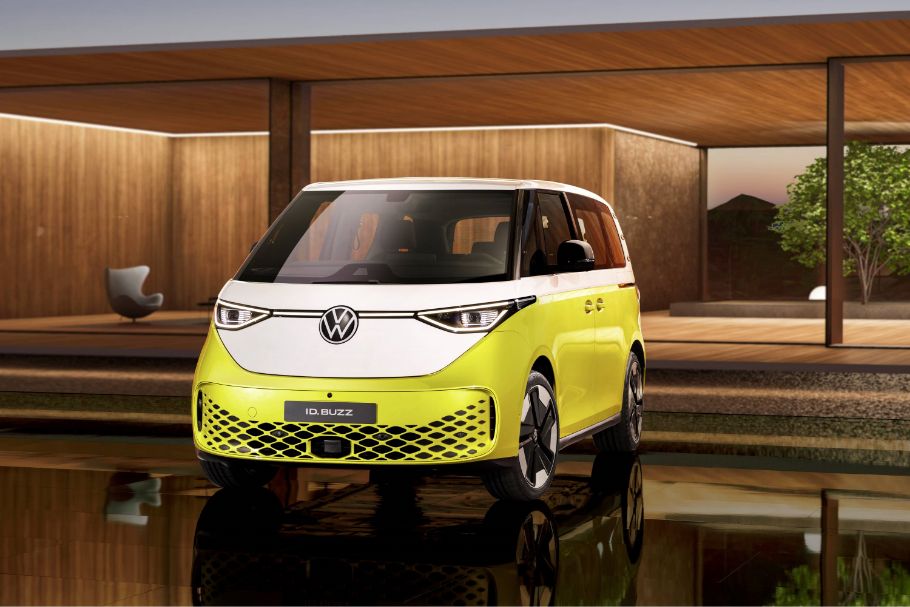
Today, Volkswagen Commercial Vehicles and Volkswagen Passenger Cars present the all-new ID. Buzz and ID. Buzz Cargo. The two zero-tailpipe emission vehicles transfer the design of one of the greatest automobile icons—the T1 Microbus—to the era of electric mobility. The short overhangs, spacious interior and available two-tone color palette pay homage to the past, while the high-tech interior, progressive and sustainably crafted design features, and EV technology marks it clearly as a vehicle of the future.
The ID. Buzz and ID. Buzz Cargo will come onto the market in the first few European countries in the third quarter of this year. The features and specifications that follow apply to European models; details for the U.S. version will be available closer to launch.
With the ID. Buzz, the Volkswagen Group further accelerates its transformation into one of the leading suppliers of electric vehicles. As with other models of Volkswagen’s all-electric family, the new ID. Buzz and ID. Buzz Cargo are based on the Group’s Modular Electric Drive Kit (MEB). The MEB is the world’s first scalable large-production-run platform, and it provides the basis across the brands for all sorts of different models and segments. At present, 30 percent of all electric vehicles in the Group are already based on the MEB. By 2025, it’s planned to be more than 80 percent. For Volkswagen Commercial Vehicles, the all-electric ID. Buzz is an important building block in order to continually help reduce the carbon footprint of the whole product portfolio.
The first European versions of the ID. Buzz and ID. Buzz Cargo will come to market with a high-voltage lithium-ion battery providing gross energy content of 82 kWh (77 kWh net). With its twelve modules, the battery system supplies a 201 horsepower electric motor, which drives the rear axle. Maximum torque of 229 lb-ft is instantly available and the top speed is electronically limited to 90 mph. More battery versions with various power output levels are expected to follow in 2023.
The battery is mounted in the floor of the vehicle, giving the ID. Buzz agile handling for a vehicle of its size. The charging power when using alternating current (AC) is 11 kW. Via a CCS plug connector at a DC fast-charging station (direct current), the charging power increases to as much as 170 kW. With DC-fast charging, the battery charge level rises from 5 to 80 percent in just 30 minutes. Using the latest software, the ID. Buzz model line will offer the Plug & Charge function in the future.
For Europe, bi-directional charging will enable the new ID. Buzz and ID. Buzz Cargo to feed power that they don’t need into the domestic grid (vehicle-to-home). In the future, this can also make the power available for stabilizing the grid. The power transfer and communication take place via an optional DC bi-directional wall box.


Exterior
The ID. Buzz and ID. Buzz Cargo are launching in Europe this year in the normal-wheelbase form. In 2023, extended wheelbase versions of both ID. Buzz models will arrive on the European market: the U.S. version, arriving in 2024, will be based off the long-wheelbase passenger model.
The standard wheelbase measures 2,988 mm (117.6 in), and both ID. Buzz models are 4,712 mm (185.5 in) long and 1,985 mm (78.1 in) wide, excluding wing mirrors. The ID. Buzz is 1,937 mm (76.3 in) high, while the cargo version is 1,938 mm due to slight differences in the chassis.
The short body overhangs are possible because the zero-tailpipe emission vehicle’s electric drive system is built in a very space-efficient way. The advantages of this include maximum space utilization, more compact overall dimensions than a comparable model with a conventional drive system, and an unusually small turning circle for this vehicle class—just 11.1 meters (36.4 ft).
“The T1 – an icon of the 1950s – represents freedom and the democratization of mobility. With the ID. Buzz, we are transferring the T1 DNA to the present day and thus into the era of electric mobility and sustainability”, says Jozef Kabaň, Head of Volkswagen Design. The looks of the ID. Buzz concept car shown in Detroit in 2017 have been closely followed for the production version. Kabaň adds: “We very consciously ensured that we were not making another T1. The ID. Buzz shows that it is successfully transferring the genes and stylistic elements of that iconic vehicle into the digital era.” That includes extremely short body overhangs, maximum space utilization on a minimal vehicle footprint, splitting the bodywork design into upper and lower levels, the unmistakable front end with its V-shaped “hood” between the charismatic headlights, and the unique rear section.
The ID. Buzz makes full use of LEDs. At the front, it’s the charismatically styled headlights, daytime running lights, and a slim lateral bar between the headlights. In an homage to the T1, the VW logo is much larger than all other current Volkswagens. At the back, the ID. Buzz has horizontally arranged LED taillights, which are connected to one another by a full-width light strip for the first time on a Volkswagen Commercial Vehicles model.
Volkswagen Commercial Vehicles will be offering the ID. Buzz and ID. Buzz Cargo—as is the tradition for the Microbus—both in the base colors and in various two-tone paintwork finishes for European markets. The spectrum consists of a total of eleven color variants: seven single-color options—‘Candy White’, ‘Mono Silver’, ‘Lime Yellow’, ‘Starlight Blue’, ‘Energetic Orange’, ‘Bay Leaf Green’, and ‘Deep Black’—and four two-tone options. On two-tone ID. Buzz models, the upper section, including roof and V-shaped hood, is finished in ‘Candy White’, while the areas below the character line are in a choice of four shades: ‘Lime Yellow’, ‘Starlight Blue’, ‘Energetic Orange’ or ‘Bay Leaf Green’. Exterior mirrors and door handles are finished in body color.
Both European ID. Buzz versions will come with 18-inch steel wheels as standard. On passenger vehicle models, aluminum-alloy wheels are available in sizes ranging from 18 to 21 inches.
Interior
The ID. Buzz features a spacious cabin, which maximizes utility and comfort, while dazzling with high-tech features and an interplay of colors and materials.
The standard length ID. Buzz will launch with five seats. Driver and front-seat passenger sit on individual seats with adjustable armrests (standard on the inside, optional on the outside). Integrated into the backrests of each front seat is a side thorax airbag, and in the driver’s seat there is also a center airbag, which in the event of a crash protects the driver and front-seat passenger from hitting each other. In top trims, the seats are completely electrically adjustable and have both memory and massage functions. Front seats can be adjusted up to 245 mm (9.6 in) forward and aft, and 61.5 mm (2.4 in) in height. A three-person bench seat in the rear can be folded down completely or split 40:60, and it can be moved lengthways a total of 150 mm (5.9 in). A love for detail is reflected in the stylized vehicle silhouette that is embossed in the lower side seat trim, and the fold-down tables located in the backs of the front seats. Wholly practical, by contrast, is the optional height-adjustable trunk floor, which creates a level load space surface. The upward-opening rear hatch reveals 1,121 liters (39.6 cu ft) of luggage space. Two side sliding doors are fitted as standard.
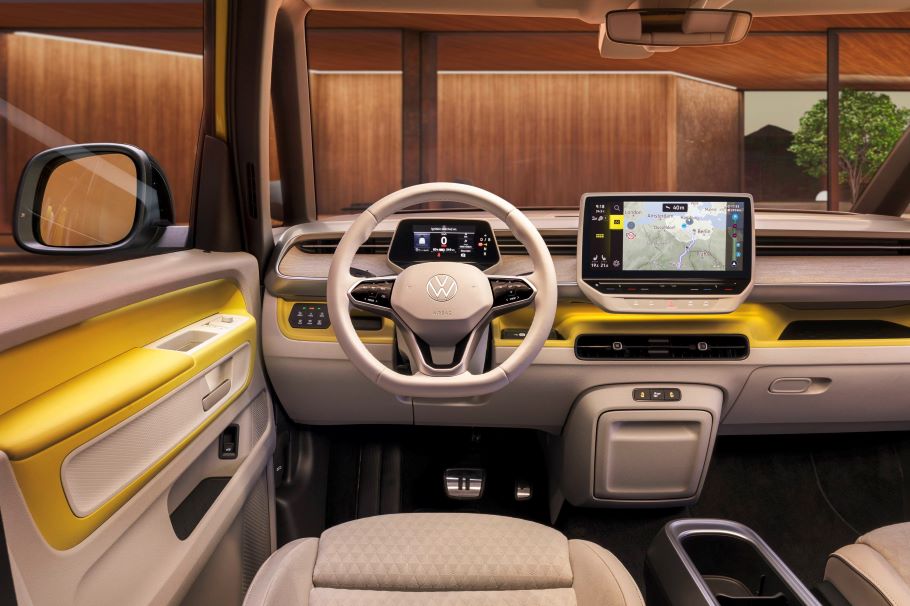
On the standard wheelbase, a six-seat configuration will come later with individual seats arranged in three rows of two. With the extended wheelbase, a seven-seat configuration will also be available in a 2/3/2 arrangement.
The ID. Buzz Cargo is an ultra-modern zero-tailpipe emission van. It will launch with three seats in the cab as standard—driver’s seat plus double bench seat— and have an optional individual seat for the front-seat passenger. Behind the seats is a fixed partition, separating off the cargo space. This partition will be optionally available with a window and an opening for loading items. The cargo space measures 3.9 cubic meters (137.7 cu ft) and provides room for two euro pallets. Loads can be secured via lashing rings in the floor and bars on the side walls. The new ID. Buzz Cargo is fitted with a wide-opening tailgate and a sliding door on the passenger side. It will be possible to configure the van with a second sliding door as a custom option.
The cockpit of the ID. Buzz is both high-tech and ergonomic. As standard, a 10-inch Digital Cockpit display is paired with a 10-inch infotainment system that is positioned centrally in the dashboard. A 12-inch display with navigation is optional. Both the Digital Cockpit and infotainment system are connected with the instrument panel only at the bottom, looking like free floating tablets. Beneath the infotainment system is a control bar with digital buttons and touch sliders. The touch sliders are used to regulate temperature and volume, while the buttons provide direct access to menus for the dual-zone Climatronic® HVAC settings, driver assist systems, driving profiles, and the parking functions.
The transmission is operated via a steering column stalk: turn it forwards from the neutral position ‘N’ to ‘D’ for drive and back from ‘N’ to ‘R’ for reverse. To the left of the multifunction steering wheel, there is an island of digital controls for activating the light functions, as well as heating and defrost for the windshield and rear window. To the right of the steering wheel are two USB-C plugs and a tray for wireless charging (wireless App-Connect is also standard). In the center console there are, depending on specification, two more USB-C plugs; there is a fifth in the front passenger door, another in each of the two sliding doors, and one by the rearview mirror for a dash cam. Two cupholders fold out from the lower dashboard area. In the ID. Buzz Cargo, there are two more cupholders near the A-pillars.
Volkswagen Commercial Vehicles has developed an optional movable and removable center console specifically for the ID. Buzz. The idea for this multifunction box was derived from the Detroit concept car. In its upper section, it provides storage bins (in the case of the Cargo a cup holder), a 1.4-liter (1.5 quart) flip-lid compartment (e.g. for a water bottle), and a 5-liter (1.3 gallon) drawer to accommodate tablets or laptops. In the two-seat Cargo and five-seat ID. Buzz, the center console is latched in place between the driver’s seat and front passenger seat. On the six-seat ID. Buzz, it can also be placed in the middle of the second seating row. It can be easily taken out and fitted back in.
As with other models of Volkswagen’s all-electric vehicle family, the new ID. Buzz comes with the interactive ‘ID. Light’. It stretches across in front of the windshield in the driver’s field of vision above the instrument panel, and gives the driver intuitive information based on the color and position of the light signal. For example, a signal in the right-hand area of the strip advises of obstructions in this area or corresponds with a navigation instruction to change lanes. When ‘ID. Light’ goes red, it is signaling danger and the need to brake.
The ID. Buzz also features standard 10-color ambient lighting, with 30 colors as optional. The 30-color version lights up a strip in the instrument panel, the decorative strips in the four doors, the storage bins in the doors and the footwell. The Digital Cockpit and the infotainment system also take on the chosen base shade. In addition, two colors can be combined in each case for the different zones, and a ‘Mood Menu’ activates preconfigured lighting profiles.
In Europe, the base interior trim for the ID. Buzz and ID. Buzz Cargo that goes with all exterior colors is called ‘Soul’. Four ‘Mistral’ interior trim options—available exclusively for the ID. Buzz five-seater—feature the two-tone finishes found on the exterior. ‘Candy White’ is used in for the instrument panel, the door trim around the inserts, the seats’ outer panels and backs, and optionally even the steering wheel, while ‘X-Blue’, ‘Orange’, ‘Yellow’, and ‘Green’ are can be found in the dashboard and upper section of the door inserts, as well as the seat inner panels.
Driver Assist Systems
The spectrum of driver assist systems in the ID. Buzz includes innovatively interconnected technologies. European five-seater ID. Buzz models are equipped with standard Front Assist, Lane Assist, and Dynamic Road Sign Display. Optional systems include Adaptive Cruise Control, Side Assist, Travel Assist, Emergency Assist, Park Assist, Light Assist, and Area View.
Sustainability
Volkswagen is utilizing innovative technologies and processes demonstrating that both versions of the ID. Buzz have been designed with sustainability in mind. The array of such measures starts with removing any use of leather in the vehicle. The steering wheel cover is made of polyurethane, but looks just as high quality as leather and provides a similar feel. The materials used for the seat covers, floor coverings and roof liner of the ID. Buzz incorporate recycled material. There will be a fabric made of what is known as Seaqual® yarn, with fibers consisting of 10 percent collected ocean plastic and 90 percent recycled PET bottles.
The two new ID. Buzz models will also use organically based vehicle paint and forgo cobalt in the high-voltage battery. The company’s sustainability measures include a plant that recycles the high-voltage batteries at the end of their automotive life cycle to prepare them for a second use. Volkswagen Commercial Vehicles gives a guarantee of eight years or 160,000 kilometers (100,000 miles)—whichever occurs first—on the ID. Buzz battery.
Production
The new ID. Buzz and ID. Buzz Cargo models are being produced by Volkswagen Commercial Vehicles at its main plant in Hannover. Production of the ID. Buzz here reaches, in parts, an automation level of up to 90 percent. In parallel with the transformation of the plant, the workforce is also taking a big step into the future. Many job profiles are changing, and through retraining measures, the workers are acquiring the necessary knowledge for dealing with the new hardware and software of the ID. Buzz.
The majority of the ID. Buzz electric drive system modules being supplied to the plant for this are also being made in Germany, by the Group’s own Volkswagen Group Components division. The modules—including the electric motor, the axles and the battery system—are being produced at the components factories in Kassel, Braunschweig, Salzgitter and Hannover. The ID. Buzz is the first model in Volkswagen’s family of all-electric vehicles for which Volkswagen Group Components is making the axles. This is being done in an assembly hall specifically set up for the purpose at the Hannover-Barsinghausen site with 200 employees.
Long term, Hannover also plans to produce the battery system for the ID. Buzz—it is currently being made in Braunschweig—and the company is currently investing around 100 million euros in the construction of the battery system assembly.
QUICK FACTS – the ID. Buzz and ID. Buzz Cargo
European models
- ID. Buzz (five-seater)
- ID. Buzz Cargo (van, three seats in the front)
Important anticipated dates
- Start of European ID. Buzz Cargo production: first half of 2022
- Start of European ID. Buzz production: first half of 2022
- European launch (initial countries): third quarter of 2022
- Start of advance sales in Europe (initial countries): May 2022
- North American debut of long wheelbase: 2023
- North American sales launch: 2024
Technical platform
- Modular Electric Drive Kit (MEB)
External dimensions
- Width excluding wing mirrors: 1,985 mm (78.1 in)
- Height:
- ID. Buzz: 1937 mm (76.3 in)
- ID. Buzz Cargo: 1,938 mm (76.3 in)
- Length: 4,712 mm (185.5 in)
- Wheelbase: 2,988 mm (117.6 in)
- Load sill:
- ID. Buzz: 619 mm (24.4 in)
- ID. Buzz Cargo: 623 mm (24.5 in)
Cargo space
- ID. Buzz: up to 1,121 liters (39.6 cu ft)
- ID. Buzz Cargo: 3.9 cubic meters (137.7 cu ft), room for two euro pallets
Drive system
- Type: all-electric rear-wheel drive
- Max. power: 150 kW (201 horsepower)
- Max. torque: 310 Nm (229 lb-ft)
- Battery capacity: 82 kWh gross, 77 kWh net
- AC charging power (alternating current): 11 kWh
- DC charging power (direct current) at fast-charging stations: up to 170 kWh
Driving performance and turning circle
- Top speed: 145 km/h, electronically limited (90 mph)
- Driving range: to follow at a later date
- Turning circle: just over 11 meters (36.4 ft)
Sustainability
- Zero-tailpipe emission electric drive system
- Leather replaced by non-animal material
- Use of partial recycled materials in seat covers, floor coverings and roof liner
Production site
- Volkswagen Commercial Vehicles’ main plant in Hannover, Germany
Colors
- Non-metallic: ‘Candy White’
- Metallic: ‘Mono Silver’, ‘Lime Yellow’, ‘Starlight Blue’, ‘Energetic Orange’ and ‘Bay Leaf Green’
- Pearl-effect: ‘Deep Black’
- Two-tone: ‘Candy White’ in combination with ‘Lime Yellow’, ‘Starlight Blue’, ‘Energetic Orange’ or ‘Bay Leaf Green’
Fun Facts
- The ID. Buzz is not the first ‘Bus with an electric drivetrain—50 years ago at the Hannover Trade Fair, Volkswagen showed a T2 powered by a rear-mounted electric motor with a maximum range of 85 kilometers (52.8 miles)
- The five-seater ID. Buzz features a stylized silhouette of the vehicle embossed into the side of the luggage compartment and seats, reminiscent both of the T1 and the Microbus concept vehicle unveiled in 2000 in Detroit
- The idea for the movable and removable center console of the production ID. Buzz originated in the 2017 I.D. BUZZ Detroit concept car
-
2022 Volkswagen ID.5

On the “Way to ZERO”: The new ID.5 does more than just expand the successful ID. family; the new Volkswagen launch moves the electrification of its new car fleet forward and into a new market segment. The elegant, expressive E-SUV coupé is equipped with the new ID. software version 3.0, which includes improved charging performance and voice control among other features. With the use of swarm data and latest-generation driver assistance systems, Volkswagen is also taking the next step towards automated driving.
“The ID.5 is electric, sporty and elegant. Our premium SUV coupé with all-electric drive marks another milestone in our ACCELERATE strategy,” says Ralf Brandstätter, brand CEO. “It offers locally carbon-neutral driving enjoyment for a discerning customer group. We are breaking into a completely new market segment with this model.”
Elegant and dynamic design, outstanding aerodynamics, extensive range. The new ID.5 and the sporty ID.5 GTX with dual-motor all-wheel drive are the new, long-range top models in the ID. family. Like all ID. models, Volkswagen’s first e-SUV coupé is based on the Volkswagen modular electric drive matrix (MEB).
“The ID.5 is the body style of the future: aerodynamic, expressive, sporty and, thanks to MEB, with short overhangs,” says Jozef Kabaň, Head of Volkswagen Design. “That’s how we have been able to ensure a spacious interior despite the dynamic roof line – this simply wasn’t possible before.”
The new software generation 3.0 allows for over-the-air updates and activation of additional functions, so that the ID.5 can stay up-to-date for a long time. Innovative assistance systems such as Travel Assist with swarm data allow for an even more relaxed and predictive driving experience. The new optional Park Assist Plus with memory function will take care of personalised parking processes on request.
At 4599 mm long (ID.5 GTX: 4582 mm), the e-SUV coupé from Volkswagen will launch in 2022 with three engine options. The ID.5 will be powered by an electric engine in the rear. The dual-motor all-wheel drive of the ID.5 GTX will be powered by an e-motor on the front and rear axles.
“The electronic Vehicle Dynamics Manager is a groundbreaking development by Volkswagen,” says Thomas Ulbrich, member of the Board of Management for Technical Development. “We have networked it with other important control systems, and it is also integrated with the all-wheel control function. This brings an entirely new level of sporty driving pleasure, traction and driving safety.”
All ID.5 engine types are powered by a large, long-range battery. A low drag coefficient of 0.26 (or 0.27 in the ID.5 GTX) increases efficiency and boosts the vehicle’s extensive range. This capability is further supported by the integrated spoiler in the wide-opening, aerodynamically shaped tailgate. Electric cooling air vents in the front of the vehicle open only when necessary, so as to ensure optimal air flow.
The new Volkswagen e-SUV coupé projects independence and uniqueness from every angle. The characteristic LED technology, with light strips on the front (optional) and rear, unmistakably identifies the ID.5 as a member of the ID. family. Many features – including the striking bumper, painted door panelling and new roof line – set the e-SUV coupé apart from the ID.4, which was named World Car of the year. The expressive coupé design has a high recognition value. Its large air inlet and IQ.Light LED matrix headlights with intelligent high beams and 3D LED rear lights as standard give the ID.5 GTX an even more dynamic appearance. The Vehicle Dynamics Manager networks the drive and chassis control systems, while an optional adaptive DCC chassis ensures optimal driving dynamics. The ID.5 and ID.5 GTX coast in driving mode D and recuperate energy in mode B.
The new body style and lounge-like spatial concept highlight the innovative power of Volkswagen and its ID. family. Despite its coupé-type shape, the ID.5 has just 12 mm less headroom in the back than the Volkswagen ID.4. The long 2766 mm wheelbase facilitates interior spatial conditions comparable to those of SUVs in higher vehicle classes. The luggage compartment volume is 549 litres, and the materials and manufacturing of the vehicle are of premium quality. Seat covering materials vary depending on the interior version. The optional Top Sports seats are distinguished by perforated ID logos at the top of the backrests.
The ultra-modern digital cockpit offers a new operating concept. The driver display and high-resolution multimedia system deliver strikingly brilliant visuals. An innovative augmented reality head-up display (optional) within the driver’s field of vision presents additional information. The new ID. software 3.0 features various improvements including natural voice control (“Hallo ID”.) It is now learning-enabled and enables online access to information from the Cloud. For atmospheric interior lighting, the Ambient Lighting feature offers a choice of up to 30 colours. We Connect services provide the driver with real-time online traffic information, online map updates, information about charging stations, web radio and much more.
With Car2X communication, Volkswagen is taking safety to a whole new level. Data from compatible vehicles in the Volkswagen fleet and signals from infrastructure within a radius of up to 800 metres can be locally interpreted in a fraction of a second, enabling driver alerts about dangerous areas, accidents and stationary traffic. The ID. Light in the cockpit helps by providing visual warnings.
With the ID.5 and ID.5 GTX, Volkswagen is tapping into an entirely new market segment and thereby advancing its electric offensive in all vehicle classes in the framework of its ACCELERATE strategy. By 2030, at least 70 per cent of Volkswagen’s unit sales in Europe are expected to come from electric-only vehicles – that is equivalent to more than one million vehicles. In North America and China, the goal is that electric vehicles will account for at least 50 per cent of unit sales. To achieve these goals, Volkswagen is launching at least one electric vehicle onto the market every year. The CO2emissions per vehicle are set to decrease by up to 40 percent by as soon as 2030. On its “Way to ZERO”, the company is planning to become climate-neutral by 2050 at the latest.
The new ID.5 and the sporty premium ID.5 GTX with dual-motor all-wheel drive are manufactured at the Volkswagen plant in Zwickau and are carbon-neutral upon handover to the customer. When charged using 100 percent green energy, the vehicles are already virtually climate-neutral. With its We Charge charging system, Volkswagen offers the fastest-growing environmentally friendly system for convenient, networked and sustainable charging. The network has around 250,000 charging points across Europe. Using the standard Mode 3 cable, the e-SUV coupé can also be charged with up to 11 kW of alternating current (AC), even when it is out and about. Charging performance can reach up to 135 kW as standard at a fast-charge station.


-
Volkswagen ID.4 reaches its turnaround point after an epic tour
 Long-distance driver Rainer Zietlow and photographer Derek Collins have reached an impressive milestone on their cross-country road trip in the Volkswagen ID.4 EV as the team finished at their turnaround point in Los Angeles, CA.
Two months ago, Zietlow and Collins took off from Herndon, VA with a mission to visit more than 600 Volkswagen Dealers in 48 states with Volkswagen’s first long-range EV for the U.S. market, the ID.4. When the duo reached the turnaround point in LA, they had driven 22,303 miles and visited 418 Volkswagen dealerships across 36 states. The pair also made time to stop by 6 Volkswagen Group of America offices to meet with employees and share stories of their adventure.
Throughout the journey, Zietlow and Collins have taken the ID.4 through the bustling streets of New York City, the Midwest, Oregon and many other U.S. terrains. The team has documented their stops, at peculiar destinations such as vintage diners with neon signs and larger-than-life statues.
Electrify America has been a massive support to the trip with 116 stops at Electrify America charging stations made by the time the turnaround point was reached. Electrify America has the nation’s largest open DC fast-charging network with more than 650 charging stations and more than 2,800 individual DC fast chargers. Electrify America expects to have more than 1,800 total charging stations with over 10,000 chargers in the United States and Canada by the end of 2025.
SEE ALSO: Citroen showcases two new trim levels for the SpaceTourer lineup
The journey continues along the southern half of the United States as Zietlow and Collins make their way back to the East Coast. They will continue to chronicle the event at vwid4-usatour.com, where visitors to the website can also monitor the location of the ID.4 in real-time.


-
2022 VW ID.4 earns a TOP SAFETY PICK PLUS award by the IIHS
 Volkswagen of America, Inc. announces that the 2021 ID.4 has won the 2021 TOP SAFETY PICK PLUS award by the Insurance Institute for Highway Safety (IIHS).
To qualify for a 2021 TOP SAFETY PICK+ award, a vehicle must earn good ratings in each of the Institute’s six crashworthiness evaluations. It must also have good or acceptable headlights and available front crash prevention that earns advanced or superior ratings in both vehicle-to-vehicle and vehicle-to-pedestrian evaluations.
The 2021 Volkswagen ID.4 EV managed to earn an acceptable rating for the standard LED headlights, a good rating for the available premium LED projector headlights, and good ratings in the six crashworthiness evaluations. The Front Assist system—standard on all ID.4 models—receives a superior rating for vehicle-to-vehicle front crash prevention and an advanced rating for vehicle-to-pedestrian front crash prevention.
The ID.4 features standard IQ.DRIVE advanced driver assistance with hands-on semi-automated capability. On the highway, IQ.DRIVE features lane centering and a capacitive steering wheel to help make driving easier. Around town, IQ.DRIVE can alert you to surprise obstacles in front of you and keeps an eye around you to help make driving safer.
SEE ALSO: Mercedes team reveals new EQS lineup
With its full equipment package, the ID.4 comes with a front radar, front camera, two rear radars and eight ultrasound sensors to collect data from the surrounding area, enabling Travel Assist (semi-automated driving assistance), Front Assist (Forward Collision Warning and Autonomous Emergency Braking with Pedestrian Monitoring), Active Blind Spot Monitor, Rear Traffic Alert, Adaptive Cruise Control (ACC) Stop & Go, Lane Assist (Lane Keeping System), and Emergency Assist (semi-automated vehicle assistance in a medical emergency). In addition to IQ.DRIVE, the ID.4 includes Dynamic Road Sign Display; Park Distance Control; and Light Assist (High Beam Control for headlights).
-
50 years of Volkswagen Jetta GLI: what has changed?
 For 50 years, the Jetta has proven itself as one of the most trustworthy and beloved Volkswagen models ever created. Especially popular among the North Americans, the Jetta GLI offers enhanced power and performance, as well as cutting-edge safety and utility features.
The Jetta GLI first arrived in the US back in 1984. Following the success oft the Golf GTI, VW team decided to create a similar sporty version of the Jetta. However, unlike the Golf, the Jetta offers four or five doors, as well as spacious trunk, and ample cargo space.
This meant that the GLI’s first iteration was able to incorporate tons of cutting-edge technologies. Such included a fuel-injected, 90-horsepower, 1.8-liter engine with revised cylinder heads, lighter pistons and higher compression ratio. It also had a close-ratio five-speed manual transmission and improved sports suspension.
Throughout the years, Jetta GLI evolved even more and in 1990 debuted with the first 16-valve, 2.0-liter engine.
Sometime later, the new millennium brought new improvements to the Jetta. Such include 2.8-liter narrow-angle VR6, and an efficient 1.8-liter turbocharged for even later versions. Then the Mk5 was unveiled – the vehicle featured an agile 2.0-liter TSI turbo engine that generated a total of 200hp and came with an independent rear suspension and exclusive 18-inch alloys.
In 2012, Jetta GLI Mk6 was introduced and offered a fully independent rear suspension and luxurious interior.
SEE ALSO: Porsche is the winner at the J.D. Power APEAL Study for 3rd consecutive year
In 2020, the current generation of Jetta GLI debuted at the Chicago Auto Show, based on the successful MQB platform, offers the 2.0 liter engine out of the GTI with 228 horsepower and an available manual transmission. These Mk7 GLI models feature a VAQ electronically-controlled, torque-sensing, limited-slip differential which hydraulically varies torque to each front wheel, working in tandem with the XDS electronic differential lock to reduce understeer and limit wheelspin. The seventh-generation Jetta GLI includes a plethora of new interior features including available ten-color customizable ambient lighting, heated front seats, and the Volkswagen Digital Cockpit.
For 2022, a midcycle refresh brings Jetta GLI a ton of changes. The refreshed Jetta GLI keeps the 2.0-liter turbo TSI engine, which now delivers 228 horsepower and 258 pound-feet of torque and is mated to either the seven-speed DSG automatic or a six-speed manual. The GLI exterior upgrades include a new honeycomb grille and a bumper which encompass the signature GLI red accent lines on either side. The design is rounded out with new 18-inch alloy wheels. GLI interior upgrades refine the sporty appearance of this much-loved model.


