Tag: Turbo

  • Porsche at the 2011 Goodwood Festival of Speed

    Porsche will take place at the 2011 Goodwood Festival of Speed. The manufacturer will exhibit several cars including 911 GT3 RS 4.0 and Panamera Turbo S as well as Semper Vivus, 718 F2, 917/30, GT2 RS and 911 Turbo. The company celebrates 60 years of Porsche in the UK and you will be able to follow Porsche Origin for latest Goodwood news and action on-line

    Porsche 911 GT3 RS 4.0 is powered by a twin-turbocharged flat 4.0 liter flat-six with staggering 500HP. It will be tested alongside the ultimate turbocharged 911, the 620 hp GT2 RS. The new 550PS twin-turbo Panamera Turbo S will make its first public appearance.

    The company is also bringing the famous Porsche 917/30 to Goodwood. It has a 5.3 liter 180° flat-12 cylinder layout, twin overhead camshafts driven from centrally mounted gears and twin spark plugs fed from two distributors. The power – over 1 100 bhp (820 kW) and 1 580 bhp (1 180 kW) in qualifying tune. Remember, this happens in the begging of 70’s, when there weren’t any ASC,DSC and other stability programs. The record on closed circuit is 356 km/h (221 mph). Nice!

    At the 1951 Earl’s Court Motor Show, the first right-hand drive examples of the Porsche 356 made their UK debut. To celebrate the diamond jubilee of Porsche in the UK, a range of iconic Porsche road cars over the decades including an early 911 from the 1960s and the 928 GT from the 1980s will be on display at the Porsche Experience Centre Goodwood.

    Porsche Panamera Turbo S - Front Angle

    Source: Porsche

  • TechArt Power Kit for Porsche Panamera Turbo

    Porsche Panamera Turbo is just astonishing car. It comes with 4.8 liter twin-turbo V8 engine delivering 500PS (368 kW) and 700Nm (516 ft lb) between 2 250 and 4 500rpm.

    The TECHART power kit TA 070/T1 for the Porsche Panamera Turbo provides the sports car with an extra boost of power whenever the driver needs it – all the time. The overall power of the sports car is 580 hp and 830Nm of torque. This results to the time from 0 to 100km/h, which now is 3.8 sec, but the sprint to 200 km/h is more interesting – just 12.5 sec and top speed of 315 km/h. Pretty impressive for 4-door car with 4 seats, air conditioning, etc. (more…)

  • TECHART Porsche 911 Turbo Cabriolet

    Since 1974, this vehicle has been making the hearts of true sports car fans beat faster: the Porsche 911 Turbo – a masterpiece made of the finest materials and a symbol of top engineering and design. An almost-perfect sports car. Almost, because individuality and personality are essential elements in achieving perfection. TECHART automobile design stands for the creation of individual masterpieces for sports car enthusiasts looking to give their vehicle a touch of individual flair. The result is the TECHART personalization program for the new 911 Turbo and 911 Turbo S models consisting of a new aerodynamic package, light metal wheels, and exquisite interiors will be presented at the 80th International Motor-Show in Geneva, Switzerland. (more…)

  • 321,2 km/h – Fullsize-SUV high speed record for TECHART

    TECHART Automobildesign really set the sparks flying at this year`s trial of strength at the High Speed Event in Nardo/Italy. Test driver Sandro Reuter reached a top speed of 321,2 km/h, respectively 200 mph, with the TECHART refined Porsche Cayenne Turbo. TECHART thus secured a new speed record for Fullsize-SUVs. The circular 12.4 kilometer track is still considered to be the world´s fastest motor racing circuit, even ahead of the Indianapolis Motor Speedway in the United States.

    The winner car, refined with the TECHART equipment, is based on a Porsche Cayenne Turbo with Turbo S technology. The installed TA 055/2.2 performance kit takes the engine up to 680 hp, an increase of 130 hp compared with the standard production model. The Aerodynamics Kit I, together with the “Sport” air suspension module, additionally delivered the necessary performance on the circuit.

    But thought was also given to TECHART´s usual external upgrades on the vehicle. The TECHART daytime running lights, sports steering wheel, carbon kit, aluminium pedals, decorative stitching and seat belts in gray, additional leather in Luxury Black and illuminated door entry guards with the TECHART logo made the car to a highlight in the pit lane.

    Along with the driver`s skills, this success was primarily driven by the perfect, systematic adjustment of the wheels and the suspension. For the record run at moderate temperatures the TECHART Team chose Continental Cross Contact UHP high-performance tires on 22-inch TECHART Formula rims, which were exposed to specific loading as a result of the one-sided cornering on the circuit. Longstanding TECHART test driver Sandro Reuter said with great satisfaction: “The SUV was ideally prepared for the event. Both the engine and the tires showed a high level of performance and consistency.”

  • More power and efficiency for next Porsche 911 Turbo

    Porsche is proud to present a new top model at the pinnacle of its broad range of production sports cars; the next generation 911 Turbo.

    All key features of this high-performance sports car have been improved significantly and combine far-reaching technical innovations with supreme refinement. As a consequence, the new 911 Turbo offers increased performance, lower weight, enhanced driving dynamics and greater fuel efficiency. (more…)

  • A New Model Year – A New Range Of Additions And Enhancements From Volvo

    A new model, new engines and new engine technologies are the key additions to the Volvo range for the 2010 model year, all of which offer enhanced drivability, lower CO2 emissions and improved fuel consumption.

    Volvo C30, S40 and V50
    The Volvo C30 SportsCoupe, S40 saloon and V50 Sportswagon DRIVe models now all feature the intelligent new Start/Stop function which brings CO2 emissions down to 104 g/km and improves fuel consumption up to 72.4 mpg. The sports-inspired R-DESIGN specification and body styling has also been introduced to the DRIVe range offering CO2 emissions of up to 119 g/km and 62.8 mpg in all three models1.

    Prices for the C30 range start at £14,995 OTR for the entry level 1.6 S. The 1.6D DRIVe with Start/Stop variants start at £15,745. The S40 and V50 ranges start at £14,745 and £16,495 OTR for the 1.6 S models with the DRIVe with Start/Stop range commencing at £17,495 for the S40 and £18,845 for the V50.

    Volvo XC60
    A new front-wheel-drive variant of the Volvo XC60 is now available with the upgraded 2.4D 175 PS engine. This combination with a manual transmission reduces CO2 emissions to 159 g/km and is badged DRIVe. In addition to the lower CO2 emissions, fuel economy is also dramatically improved; from 37.7 mpg (combined) to 47.1 mpg, a 25% improvement. The new D5 engine is also now available in the XC60 offering up to an 11% increase in performance and an 8% reduction in CO2 emissions to 183 g/km.

    Prices for the XC60 range start at £24,995 for the 2.4D DRIVe S model, with the new D5 engine joining the range at £26,745.

    Volvo XC70

    The Volvo XC70 benefits from the two new diesel engines – 2.4D and D5 – which join the range in SE specification and cost £27,995 and £31,495 OTR respectively. The 2.4D engine will only be available with front-wheel-drive and models with manual transmission feature CO2 emissions of just 159 g/km and will be badged DRIVe. It will also benefit from improved fuel consumption of up to 47.1 mpg.

    Other changes to the XC70 range include a new front grille displaying the large iron mark and new steering wheel chrome highlights and chrome trim around the ignition area. Cars with the D5 and T6 AWD engines will also have visible twin rear exhaust pipes as standard.

    The new Volvo S80

    As announced on 26 February 2009, the Volvo S80 has benefitted from a full re-fresh this model year, both externally and internally.2

    The driving dynamics and ride of the new Volvo S80 have also been updated and improved by the introduction of two new chassis – the Lowered Dynamic Chassis and the Comfort Chassis. The Lowered Dynamic Chassis has been developed to offer drivers enhanced sporting driving characteristics and more responsive handling, while the Comfort Chassis offers a compliant and un-interrupted smooth ride. The introduction of these new chassis’ gives customers the opportunity to tailor their S80 to suit their driving style – for inspired, enthusiastic driving or relaxed comfort.

    The Lowered Dynamic Chassis will be offered as standard on the SE and SE Lux models. The Comfort Chassis will be the only chassis available on the Executive trim level.

    The new Volvo S80 will also feature three new diesel engines, the 2.4D, D5 and the low CO2-emitting DRIVe. As well as providing the Volvo S80 with a different driving experience, the car will also benefit from lower fuel consumption and fewer emissions. An upgraded 2.5T is available, offering a 31 PS performance boost to provide 231 PS and 340 Nm of torque. Despite this 13% increase in power, CO2 emissions have been reduced to 206 g/km and fuel consumption improved to 32.8 mpg with the manual transmission.

    A new R-DESIGN Interior Pack has been introduced which includes Dynamic Sports leather faced front seats, R-DESIGN leather sports steering wheel and gearknob, instrument dials, aluminium pedals and sports floor mats. The pack is available on SE Premium and SE Lux premium models and is priced at £500.

    Prices for the new Volvo S80 range start at £21,745 for the new low-CO2 emitting DRIVe SE model. The new 2.4D starts at £25,845 in SE specification, while the D5 joins the range at £27,745.

    Volvo V70
    The Volvo V70 gains the two new diesel engines with prices for the 2.4D starting at £26,845 OTR and £28,745 for the D5 both in SE trim. Changes to the V70 range also include a new front grille displaying the large iron mark and new steering wheel chrome highlights in SE and SE Lux and chrome trim around the ignition area. Cars with the D5 and T6 AWD engines now have visible twin rear exhaust pipes as standard.

    The 2.5T engine has been updated to offer a performance boost to 231 PS and 340 Nm of torque. Despite this 13% increase in power the CO2 emissions have been reduced to 209 g/km and fuel consumption improved to 32.1 mpg with the manual transmission.

    Prices for the Volvo V70 range start at £22,745 for the new low-CO2 emitting DRIVe model.

    Volvo C70

    The 2.0D engine in the C70 has been updated to offer CO2 emissions of 158 g/km to enable the car to fall below the 160 g/km threshold for the Capital Write Down Allowance. The Volvo C70 range starts at £24,995 OTR for the 2.0D S model.

    Volvo XC90

    Volvo’s seven-seat XC90 receives a new, lighter chassis and new dampers designed to improve drivability. In spite of this new chassis there are no price rises for the XC90. The range starting price remains static at £29,995 OTR for the D5 Active model, while prices for the flagship Executive variant have been reduced for the 2010 Model Year. The Executive now starts at £42,985 OTR for the 3.2-litre petrol model, a decrease of over £4,000 with minimal specification changes.

    New D5 and 2.4D engines

    The Volvo S80, V70, XC70 and XC60 all benefit from the new and improved D5 and 2.4D diesel engines which were announced earlier this year3. The new D5 engine with its twin sequential turbo charging offers a 20 PS performance boost to provide 205 PS and 420 NM of torque. Despite this power increase, CO2 emissions have been cut to 169 g/km in the XC70 and V70, 183 g/km in the XC60, while the S80 offers 164 g/km.

    The 2.4D has also been upgraded and the new engine offers a 12 percent improvement in performance to 175 PS and 420 Nm of torque whilst bringing down CO2 levels to 155 g/km in the S80 and 159 g/km in the V70. In the XC60 and XC70 the 2.4D coincides with the introduction of front-wheel-drive and together, they reduce emissions to just 159 g/km. Crucially, this figure enables these two models to fall below the 160 g/km threshold for the Capital Write Down Allowance.

    New Premium Pack and updated Satellite Navigation system
    Volvo is offering the ultimate upgrade with an additional Premium Pack specification on all trim levels and engines in XC60, V70, XC70, S80, XC90 models for an extra £2,000. The Premium Pack includes the addition of Leather-faced Upholstery and Satellite Navigation System (RTI) in the XC60, V70 and XC70. On the XC90 the Premium model adds Satellite Navigation System (RTI), Dual Band Integrated GSM Telephone and Volvo On Call. Meanwhile the C70 also gets a Premium Pack for an extra £1,800 and features Satellite Navigation System (RTI), Bluetooth Handsfree System and Keyless Drive. The Premium Packs are designed to complement the existing high levels of specification on whichever engine or trim level chosen.

    An updated Satellite Navigation system (RTI) has also been introduced in the XC60, V70, XC70, S80 and XC90 to bring them in line with the smaller cars in the Volvo range. A new driver interface, new colours and an improved premium feel to the menu and symbols are the key features and the unit costs £1,950 (including VAT).

    All new MY’10 models are available to order now with first customer cars expected in July.

  • Opel Adds New Turbo CNG Unit To Pro-Environmental Engine Range

    Higher output and torque with lower consumption and emissions
    Rüsselsheim. In 2009, Opel will introduce one new 1.6-liter turbo CNG engine (Compressed Natural Gas) with around 110 kW/150 hp and 210 Nm of torque. Developed by GM Powertrain in Turin, the new unit joins Opel’s current aspirated CNG engine, which has the same displacement and an output of 69 kW/94 hp. “Environmental awareness and driving fun are no longer mutually exclusive,” says Alain Visser, Chief Marketing Officer, GM Europe. “With this newly developed turbocharged CNG engine, we continue pursuing our strategy of turbocharging engines to increase efficiency – meaning lower consumption and emissions – without making any concessions in performance.” (more…)

  • Porsche 911 GT2

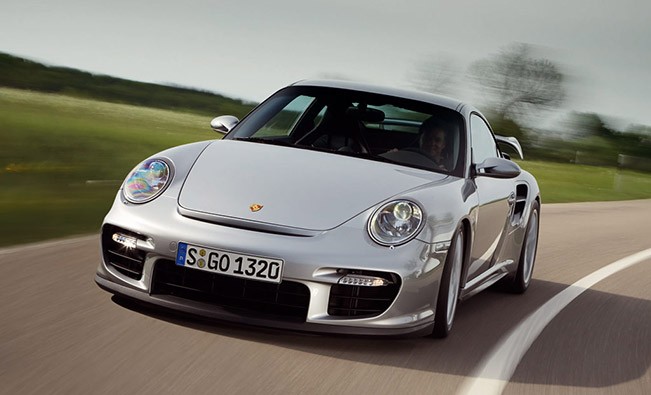
    Porsche 911 GT2Presenting the new 911 GT2 at the Frankfurt Motor Show, Dr. Ing. h.c. F. Porsche AG, Stuttgart, is proudly launching the most powerful 911 so far homologated for road use. Through its striking design with large air intakes at the front and the rear wing so characteristic of this very special model, the new 911 GT2 expresses the power and performance potential of the fastest-ever 911 right from the start even at a standstill.

    Available exclusively with rear-wheel drive and a manual six-speed gearbox, this high-performance athlete accelerates to 100 km/h in just 3.7 seconds and reaches a top speed of 329 km/h (204 mph) on average fuel consumption of just 12.5 litres/100 km (equal to 22.6 mpg imp) in the New European Driving Cycle (NEDC), thus offering a level of fuel economy regarded as quite impossible in this performance class just a few years ago.

    The power unit of the new 911 GT2 is based on the six-cylinder boxer engine of the 911 Turbo, with air supply by two exhaust gas turbochargers featuring variable turbine geometry (VTG). The 3.6-litre boxer engine achieves its maximum output of 530 bhp (390 kW) at 6500 rpm, with maximum torque of 680 Newton-metres maintained consistently between 2,200 and 4,500 rpm. With its unladen weight of 1,440 kg or 3,175 lb, finally, the 911 GT2 offers a power-to-weight ratio of just 2.72 kg/6.00 lb per horsepower.

    The increase in engine power by 50 bhp over the ”regular“ power unit is provided in the new 911 GT2 by two turbochargers with a larger compressor wheel and a flow-optimised turbine housing raising turbocharger pressure to an even higher level. And for the first time Porsche’s engineers have combined the turbocharged engine with an expansion-type intake manifold – a genuine revolution on turbocharged power units.

    The expansion intake manifold uses the principle of oscillating air in the intake manifold during the cooler expansion phase, keeping the temperature of the fuel/air mixture lower than in the 911 Turbo. This, in turn, means a significant increase in all-round efficiency, with fuel consumption down by up to 15 per cent under full load despite the increase in engine output.

    The 911 GT2 offers new achievements also in terms of emission management and control: This is the first Porsche homologated for the road to feature a rear silencer and tailpipes made of titanium as standard equipment. This expensive material reduces weight by approximately 50 per cent versus a comparable component made of stainless steel to just 9 kg.

    The new 911 GT2 comes as standard with PCCB brakes featuring brake discs made of a composite carbon fibre/ceramic compound ensuring maximum stopping power maintained with an extremely high level of consistency. A further advantage is that PCCB brakes reduce the weight of the unsprung masses versus comparable grey cast-iron discs by approximately 20 kg or 44 lb.

    Yet another feature fitted as standard is the electronically controlled PASM Porsche Active Suspension Management. (PASM). The GT2 comes on 19-inch light-alloy wheels running at the front on 235/35 ZR 19, at the rear on 325/30 ZR 19 sports tyres.

    The new 911 GT2 will be at the dealership in November 2007. The base price of the car in Germany is Euro 159,100.-, the market price including 19 per cent value-added tax Euro 189,496.-.

  • Porsche 911 Turbo Cabriolet

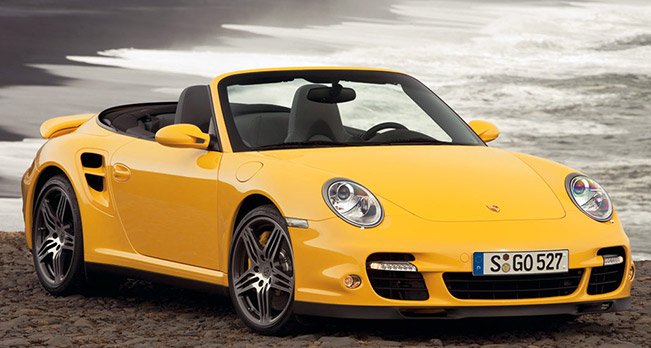
    Porsche 911 Turbo CabrioletPorsche will be sending the new 911 Turbo Cabriolet to the starting line on September 8. The 20-year tradition within the 911 Series of the 911 Turbo with a classic soft top is continued with this open, top model. Firstly, the open 2+2 seater offers the driving performance of a high-performance sports car while still providing convertible driving pleasure. Secondly, compared to the competition the 911 Turbo Cabriolet is economical in its fuel consumption, thanks to its deliberate design, outstanding aerodynamics and advanced engine technology.

    As with the 911 Turbo Coupe, the Cabriolet will also be powered by a 3.6 liter six-cylinder ‘boxer’ engine with biturbo turbocharging and Variable Turbine Geometry (VTG). The powerplant already generates 480 hp (353 kW) and 620 Nm of torque at 1950 rpm. With the new, optional “Sport Chrono Turbo Package”, which includes an overboost function, up to 680 Nm is even intermittently possible. The manual transmission version can accelerate from 0 to 100 km/h in just four seconds. With Tiptronic S the time can be cut to 3.8 seconds. Both versions can reach speeds of up to 310 km/h. Fuel consumption for the 911 Turbo Cabriolet is 12.9 liters per 100 kilometers – an exemplary value in the competitive environment.

    In spite of the convertible-specific reinforcement of the chassis and automatic and the extendable rollover protection behind the rear seats, the open version of the 911 Turbo only weighs 70 kilos more than the Coupe. The light, three-layer soft top, which can completely automatically be opened or closed in roughly 20 seconds, enables a low balance point.

    Together with the running gear that is tuned to convertible-specific needs, which includes the active suspension system Porsche Active Suspension Management (PASM) as standard equipment, the new 911 Turbo Cabriolet offers the sporting driving performance typical for a Porsche 911 as well as extremely high driving safety together with appealing driving characteristics. The driving stability control Porsche Stability Management (PSM) and the managed all-wheel drive Porsche Traction Management (PTM) also contribute to its uncommon performance. The system with an electronically controlled multi-plate clutch can, according to the requirements, alternatively shift the drive output from the engine between the front and rear axles, and – with shift intervals of a maximum of 100 milliseconds – quicker than the reaction of the engine to load changes.

    With a drag coefficient of Cw=0.31, the 911 Turbo Cabriolet travels at the level of the coupé models. Together with the rear spoiler, which automatically extends at speeds from 120 km/h – extending 30 mm further than with the Coupé, the vehicle is the only standard series convertible that generates negative lift at the rear axle. Along with its passive safety systems, including six airbags as standard equipment and the comprehensive rollover protection system – with steel tubing integrated into the windshield frame and an extendable rollover protection behind the rear seats – the 911 Turbo Cabriolet also fulfils all legal requirements for passive safety applicable in the worldwide sales markets.

    Furthermore, it is equipped with one the most high-performance brake systems. The six-cylinder fixed-brake caliper up front stems from the Porsche Carrera GT. Upon request, the race-proven and light Porsche Ceramic Composite Brake (PCCB) ceramic brake system is also available for the 911 Turbo Cabriolet.

    Also included in the extensive standard series equipment of the 911 Turbo Cabriolet are Bi-Xenon headlights, 19 inch forged wheels with two-tone appearance, an air conditioner, the wind deflector, the Porsche Communication Management (PCM) – with the navigation module and 5.8 inch color monitor and the Bose Surround Sound System, among other things. The basic price in euro for the Turbo Cabriolet is EUR 126,600. In Germany the price is EUR 150,862 (including VAT and country-specific requirements).

  • TechArt GT Street – based on Porsche 911 Turbo

    TechArt revealed the first renderings of its new GTstreet model based on the 911 Turbo of the latest 997 series. A direct inheritor of the 2001 TechArt GTstreet based on the Porsche 911 Turbo of the 996 model series, the new beast boasts 630 hp / 463 kW at 6,800 rpm, up from standard 480 hp / 353 kW, the peak torque is increased to 820 Nm at 4,500 rpm.

    (more…)

  • Hennessey Venom 1000 Twin Turbo SRT

    The fastest and most powerful limited-edition street car in the world. Only 24 will be built. Hennessey Performance Engineering will build just 24 Venom 1000 Twin Turbo SRT Coupes and 24 Venom 1000 Twin Turbo SRT Convertibles for the 2006 model year. (more…)

  • Yes! Roadster 3.2 Turbo

    Compared to its predecesor, the new YES! has grown significantly. Larger engines and a longer wheel base have resulted in more over – hang at the front aswell as the rear leading to a more stretched and full of suspense appearance of the roadster.

    The wedge-shaped ascending sideline and the racy accentuated wings in the front and rear do remain THE striking attributes.

    (more…)