Tag: Turbo

  • Porsche Taycan Turbo GT


    Porsche is amplifying the Taycan’s performance capabilities with the introduction of the Taycan Turbo GT and Taycan Turbo GT with Weissach Package. These new additions represent the pinnacle of electric sports car design, boasting exceptional power, lightweight construction, and advanced aerodynamics.

    Unparalleled Performance from the Start

    Demonstrating their track prowess even before customer deliveries, the Taycan Turbo GT with Weissach Package shattered the record for the fastest series-production electric car at Laguna Seca Raceway. Development driver Lars Kern piloted the car to a staggering lap time of 1:27.87 minutes, solidifying the Taycan’s position as a leader in electric vehicle performance. Additionally, the model established a new electric car record on the Nürburgring Nordschleife circuit, further cementing its dominance.

    Enhanced Driving Dynamics with Attack Mode

    The Taycan Turbo GT models offer an exhilarating driving experience, amplified by the innovative Attack Mode. This driver-selectable function delivers an additional 120 kW of power for 10 seconds, ideal for overtaking maneuvers or unleashing bursts of acceleration. The intuitive paddle-shifter activation ensures seamless control while maintaining focus on the track.

    Cutting-Edge Powertrain Technology

    Porsche has significantly upgraded the Taycan powertrain for these high-performance models. New rear-axle pulse inverters featuring silicon carbide semiconductor technology deliver increased power and torque compared to previous iterations. Additionally, the transmission has been reinforced to handle the augmented power figures.

    Lightweight Design Meets Striking Aesthetics

    Intelligent lightweight construction measures contribute to the Taycan Turbo GT’s impressive weight reduction of 75 kg compared to the Taycan Turbo S. Extensive use of carbon fiber components, from B-pillars and mirror housings to side skirt inlays, exemplifies Porsche’s commitment to weight reduction. Lightweight bucket seats and a focus on eliminating unnecessary amenities further optimize the car’s weight-to-power ratio.

    The exterior design emphasizes the Taycan Turbo GT’s performance aspirations. The front spoiler with integrated aeroblades and the adaptive rear spoiler with a Gurney flap in carbon fiber create a visually aggressive stance. Exclusive paint finishes and customizable decal options allow for a personalized touch.

    Sporty Interior with Standard Bucket Seats

    The Taycan Turbo GT’s interior reflects its racing pedigree. Standard Race-Tex upholstery with black leather accents establishes a sporty yet luxurious ambiance. Lightweight bucket seats finished in a glossy carbon weave offer exceptional support during spirited driving. The GT sports steering wheel with a 12 o’clock marker underlines the car’s performance focus.

    Weissach Package: The Ultimate Track-Focused Variant

    The Taycan Turbo GT with Weissach Package further elevates the performance envelope. Additional aerodynamic enhancements and weight-saving measures transform this variant into a dedicated track weapon. The Weissach Package sheds an additional 70 kg compared to the standard GT model by incorporating a lightweight carbon fiber rear section in place of rear seats and through other purposeful omissions. This translates to a phenomenal 0-100 km/h acceleration time of just 2.2 seconds and a top speed of 305 km/h.

    The Weissach Package further distinguishes itself with a fixed rear wing in carbon fiber for maximized downforce, and an optional striped wrap for a true motorsport aesthetic.

    The Taycan Turbo GT and Taycan Turbo GT with Weissach Package represent the vanguard of electric vehicle performance. These exceptional models offer a thrilling driving experience, unparalleled by any other electric car on the market today.

  • Carlex Design Porsche 911 Turbo

    The Porsche 911 Turbo in this unique edition, whose lines cannot be mistaken for anything else in the world. A collectable and a real treat for the lovers of sheer beauty and luxury.

    The characteristic feature of all Racing Green conversions is emerald green 100% hand-brushed paint. The subtle and glittering pattern under the coat of paint, carefully mastered by Carlex Design experts, has given the Porsche 911 Turbo a unique touch. The Porsche 911 Turbo in this special version is a real piece of art with an extraordinary character and a totally lavish look. The Carlex Design bespoke forged three-piece rims, painted to match the car’s exterior, as well as copper-hued brake callipers, perfectly mark the car’s outstanding interior.

    Top quality leather, unmatched design and original handcraft. This perfect combination is possible only when creating limited editions, due the availability of materials and the demand for collector cars.

    This is what makes the work on special editions absolutely fascinating.

    The new interior of the Racing Green Edition is all about top quality aged leather that is classic, light chocolate brown, and perfectly corresponds with bottle green hued leather inserts, matching the Racing Green car body. The seat chord seams give it a rough and artisanal look, and the perforation has increased the comfort and aesthetic qualities. These is a lot more to discover: the Alcantara® headlining, the plastic parts painted to match the car body colour, or the subtle embossed motifs in leather headrests with the Carlex Design crest. A stylish holdall and a backpack perfectly match this unique special edition.

  • Renault 5 R5 Turbo 3E

    Renault promised “a pop year full of surprises” when it kicked off the 50th anniversary celebrations in January 2022 for the Renault 5, one of its most prominent icons. Renault took part in the Rallye Monte-Carlo Historique, Rétromobile motor show, Le Mans Classic and other festive jamborees before then unveiling its Renault 5 Diamant electric show-car. Now the brand will stage the R5 TURBO 3E’s worldwide premiere at the Chantilly Arts & Elegance 2022 contest, taking place on 25th September.

    This all-electric show car’s contribution to the Renault 5’s 50th anniversary celebrations is a contemporary take and tribute to the most celebrated sports versions – the Renault 5 Turbo and Turbo 2. It has been named R5 TURBO 3E because it follows the Turbo 2 with the “E” standing for electric.

    Renault’s Vice-President Design, Gilles Vidal said, “Renault 5 TURBO 3E combines ultra-tech design and wilful exuberance with numerous references to the world of car racing and video games. This combination propels the show car into modernity and technology, and it’s at the frontier between the real and virtual realms. This pure electric “drifter” demonstrates that electric cars can also be fun with incredible performance!”

    R5 TURBO 3E is another example, alongside the Renault 5 Prototype, of the “electric rebirth” of a flagship model of the brand. Renault is electrifying its history to better prepare its all-electric future in Europe by 2030.

    This reinterpretation of the Renault 5 Turbo 2 is deliberately exuberant and its performance is at the top of its class. It will be a show-stopper at the elegance contest  in Chantilly, and a perfect fit for this gathering’s ethos, a blend of “the automobile of the future and fashion.”

    During the parade, the model and driver accompanying the R5 TURBO 3E will wear previously unreleased suits created by La Fameuse, a fashion designer that has built a name for himself by turning existing garments into one-of-a-kind sporty and classy apparel. These suits use Renault’s vintage signs and colours and will feature original logos and branded T-shirts, combined with today’s style. They were designed as contraries and counterparts: white for the woman and black for the man, with the opposite colour on the arm and leg bands; with X-shaped insets on the woman’s legs and diamond-shaped insets on the man’s legs. The fabric is padded to befit the sportwear universe and combined with a printed Renault monogram.

    A HIGH PERFORMER DESIGNED TO DRIFT

    R5 TURBO 3E is engineered for performance and tracks. It’s an all-electric, rear-wheel drive, pure drifter. Like its iconic predecessor, it is strictly a two-seater. However, the rear now houses the powertrain – two electric motors, each moving one of the wheels, with the batteries in the middle under the floor.

    R5 TURBO 3E is built on a tubular chassis, protected by a flat base and shielded by roll bars approved by the Fédération Internationale de l’Automobile (FIA). The motor has 280 kW (eq. 380 hp) of total power and 700 Nm of instantly available torque.

    This new-generation R5 Turbo 2 can reach a top speed of 124mph. Its 42 kWh battery has plenty of capacity for several laps or a raging gymkhana. In these situations, it has a 50-plus steering angle so it’s easier to dodge obstacles.

    To record the R5 TURBO 3E performance, it comes with 10 mounting brackets for cameras inside and outside – for instance in the slots for the headlights and for the exterior mirrors, which are perfect to get the best footage of its drifting prowess.

    EXUBERANCE, FUN AND ICONIC REFERENCES

    “A work of art with exaggerated lines, inspired by the videogame universe, with hints at the Renault 5 and Renault 5 Turbo inside as much as out.” This was the brief handed to the teams working with Sandeep Bhambra, Chief Designer for Renault concept cars, for the R5 TURBO 3E show car.

    The bonnet, doors and cockpit are the same shape as their predecessors – but this time the body is made of carbon fibre. R5 TURBO 3E, in other words, is unmistakably part of the dynasty. It also has a fresh take on the Turbo 2’s iconic air inlets on the rear fenders. It is 2.02 metres wide (25 cm more than its forbear), 4 metres long and 1.32 metres high. Its most striking feature is its huge rear spoiler that pulls the car to the ground, even on the wildest drifts.

    The large air inlets on R5 TURBO 3E’s front bumper cool the engine and add downforce. The three vertical sections are instantly reminiscent of the Renault 5 Turbo 2’s bumper. The square fog lights look a lot like the ones “back in the day” – but now there are four and each contains 16 LEDs.

    There are also pink, blue and yellow LED strips at the front and rear, which flash when the car drifts, adding a 1980s and 1990s videogame vibe. Retro videogames also provided the inspiration for the camouflage stickers adorning the body. Lastly, the Plexiglass windows are pink and a sticker reading “La vie en rose” on the rear left window adds a sweet je-ne-sais-quoi to this show car’s appearance.

    The hints at history in R5 TURBO 3E’s design are the opposite of nostalgic. On the contrary, by their contemporary and playful treatment, they propel the show car into modernity.For example, the air inlet on the bonnet – another wink at the Renault 5 Turbo 2 – houses the opening for the battery charging socket. And the see-through parts of the body – especially the ones above the taillights – provide windows to admire the show car’s electric mechanism.

    POP AND GAMING MOOD

    Inside the R5 TURBO 3E show car, the mood is a present-day and cheerful combination of hallmarks from motorsports, videogames and, of course, the Renault 5 and Renault 5 Turbo 2 icons and their time.

    The carbon fibre racing bucket seats, safety harness and steering wheel are the result of teamwork with Sabelt1 . The imposing upright handbrake lever – a drifter car mainstay – in the middle of the centre console that is eminently “pop” yellow. The same yellow intertwines with pink to add sparkle to the grey and black tartan – a tip of the hat to the 1980s – on the seats and dashboard. The tartan in turn produces a visual effect based on the Renault logo. There is also a logo – which lights up this time – on the steering wheel hub. All these colourful touches also contrast with the black cork floor and Alcantara lines the top of the dashboard and the door panels.

    In a modern twist on one of the Renault 5 Turbo 2’s instantly recognisable features, the 10 analogue dials facing the driver have been replaced by 10 digital screens on R5 TURBO 3E’s dashboard. They work like widgets and look a lot like Pixel Art2  and Glitch Art3 , which seem to have leapt out of the retro gaming universe. For example, to start the car, you have to push the “Free play” button on the centre console. Likewise, the various driving modes have been renamed “Turbo” (for drifting), “Track invader” (for playing), “Donut” (for 360° spins) and so forth.

    The final touch showing that R5 TURBO 3E doesn’t take itself too seriously is a teddy bear called Drifty. He is there to relax and comfort passengers overwhelmed by the show car’s muscle.

    A REAL OBJECT IN VIRTUAL WORLDS

    Besides being a very real car, the R5 TURBO 3E show car is also a sign of its times. Its digital double will spring to life in the universe of virtual games in the Web3, the decentralised Internet where online platforms and services use a model based on blockchain. A collection of NFTs (Non Fungible Tokens) based around the vehicle will also be available and people who own these digital assets will be offered exclusive advantages and rewards.

    After the elegant contest in Chantilly, R5 TURBO 3E will be on display on Renault’s stand at the 2022 Paris Motor Show (from 17th to 23rd October). More details on this show-car’s symbolism will be provided at the event.

    R5 TURBO 3E TECH SPECS

    • Length: 4.006 m including the rear spoiler
    • Width: 2.02 m
    • Height: 1.32 m
    • Wheelbase: 2.54 m
    • Front overhang: 625 mm
    • Rear overhang: 740 mm
    • Chassis: tubular (+ flat base + FIAapproved roll bar)
    • Weight: 980 kg (+ 520 kg of batteries)
    • Front tyres: 225 x 35 R19
    • Rear tyres: 325 x 25 R20
    • Powertrain: All-electric
    • Power: 280 kW (eq. 380 hp)
    • Torque: 700 Nm
    • Battery: 42 kWh lithium-ion
    • Full charge: 2 hours with a 380V/32A charger
    • Top speed: 200 km/h
    • 0 to 100 km/h: 3.5 sec (3.9 sec in Drift mode)
  • ECOTECH: 2016 Opel Astra Comes With To Show What Style and Pleasure

    ecotechOpel‘s latest 1.4-liter engine is called ECOTEC Direct Injection Turbo and will celebrate its debut in the latest Opel Astra at the International Motor Show in Frankfurt, held this September. In its core this is a four-cylinder turbocharged machine, that comes with a special direct injection system and will be available with two outputs: 125 hp (92 kW) and 150 hp (110 kW). As you also noticed, this combination is similar to the recently introduced 1.0-ECOTEC Direct Injection, geared with Opel ADAM and Corsa models. We can even say, that the 1-4-liter ECOTEC is sort of the big brother of the 1.0 version. Furthermore, both engines are part of the small gasoline engine family: this is a lineup of advanced engines with three and four cylinders and trunks below 1.6 liters. This lineup plays important role in today’s Opel plans for development, as the lineup contains 17 engines.

    The Latest Opel ECOTECH engine is a pleasure to the ears and for the purse

    ecotech

    Opel team paid a lot of attention to improve the dynamics and responsiveness of the unit. Now, the ECOTECH unit provides between 2,000 and 3,500 rpm: incredible torque plateau. Further improvements were also made onto the efficiency rates of the powerplant. Now it delivers not that bad emissions, measured at 114g/km and consumes about 5 liters of gasoline for every 100 km (62 miles). And this is not all. Engineers have also paid attention to the reduction of the noise volume, coming from the engine, that now purrs like a little kitten. But beware! The kitten can instantly become a furious tiger if you dare to step properly on the gas pedal!

    SEE ALSO: 2015 Vauxhall Astra Comes More Flexible and Even More Adaptive!

    Lightweight and efficiency. ECOTECH offers both.

    ecotech

    The 1.4 ECOTECH engine now adds less kilograms to the overall weight of the vehicle, which means two things: the fewer kilograms mean lighter and better handling and also it means lower fuel consumption. Furthermore, while the three-cylinder Opel vehicles are developed even smaller, lighter and more efficient, the 1.4 ECOTECH is “rightsized”: engineers at Opel use this term to explain, that the vehicle reached the perfect balance between weight, performance and comfort.

    The 2016 Astra looks really promising vehicle and we will continue to bring news about it and from Opel brand. So, for further information stay with us!

    Source: Opel

  • MANSORY Uprates Porsche Cayenne Turbo S to 620HP via Simple Plug & Play

    MANSORY Porsche Cayenne Turbo S Front and Side ViewMANSORY Porsche Cayenne Turbo S looks devilish in this red and black dual-tone outfit. It is a true instance of luxury and class, isn’t it? This is not only because of its undisputable visual characteristics, but also because its ability to produce 550 hp (405 lb-ft) and 750 Nm (554 lb-ft) of torque. Wait … there is a hint here. These horses are only if the car is with the stock output. If this is so, then the model can accelerate from 0 to 100 km/h in 4.1 seconds on its way to a top speed of 283 km/h.

    Vigorous Power

    However, the Cayenne here has been fitted with power enhancements, which give it even more force that the production one. Even MANSORY call the new horsepower capability of the Porsche “vigorous”. The reason for this is that the experts have developed and integrated an additional engine control unit.

    This additional element can be actually fitted to both Porsche Cayenne Turbo and Turbo S supercharged engines. The result is impressive and it is an extra of 50 horsepower.

    MANSORY Powerbox

    MANSORY Porsche Cayenne Turbo S Engine

    Via simple Plug & Play process a special Powerbox is fitted. And this is where the magic happens. The V8 under the hood of the Cayenne Turbo, which initially has the 520 hp (382 kW) at 6,000 rpm and 750 Nm (554 lb-ft) between 2.250-4.000 rpm, is now capable of pumping out 570 hp (419kW) at 6.000 rpm and 830Nm (613 lb-ft) between the same as the standard rpm range.

    Of course, these enhancements also result in better acceleration time. The Cayenne Turbo needs only 4.1 seconds to cover the 0-100km/h sprint. In comparison, the standard time is 4.5 seconds.

    After the power enhancements, the MANSORY Cayenne Turbo S is now capable of 620 hp (456 kW) at 6.000 rpm and 870 Nm (642 lb-ft) between 2.500-4.000 rpm. Due to this performance optimization, the time needed for the sprint from standstill to 100 km/h is mere 3.8 seconds.

    Source: MANSORY 

  • This Porsche 911 Turbo S Nemesis is Capable of More Than 600 HP

    It is time to hear about something new from the tuning world and this time it is not only related to the tuned car but also to the company. Under the spot is the perfect Porsche 911 Turbo S wich has been transformed by the Prototyp Production tuning company. The specialists have been working for a year now, but this is the first project we hear they are releasing.

    Since birth, the tuner has promised to make literally everything in-house: ranging from the paint finish to the carbon elements. For this Porsche, the company hasn’t done much. However, we think that it is perfectly sufficient.

    SEE ALSO: Porsche 911 Turbo S Gets MCCHIP-DKR Three-Stage Treatment 

    To start with the exterior, first that capture the glances are the changed wheels. The new ones are in-house made and are called NEMESIS. Being a limited edition of only 50 units, they measure 21 inches and are fitted with the appropriate Michelin Pilot Super Sport tires in 245/30 ZR21 at the front and 305/25 ZR21 at the rear.

    At the back of the car, we also see a new stainless steel exhaust system, which features 2 valves and 200 cells sports cats. This perfectly compliments the improvements done on the engine. Via software treatment the output of 911 Turbo S unit has been enhanced up to 604 hp (444 kW) and 820 Nm (605 lb-ft) of torque.

    At last, some simple additions are included throughout the interior like the mat carbon details.

    We sincerely hope to see more from the Prototyp Production because this is a promising start of their automotive career.

    Source: Miranda Media 

  • Electric Turbochargers – Coming Soon


    A very popular method that uses forced air induction to momentarily increase the horsepower of an internal combustion engine is turbocharging. This technique has been around for decades and hasn’t changed a great deal until recently. Several manufacturers have announced that they are working on electrically-powered turbos. Before we explain why this is such an interesting advance, let’s take a quick look at exactly how turbocharging works.

    Engineers know that the speed and power of an internal combustion engine is limited by a number of factors. One of them, and a critical one, is the rate and pressure that fresh air can be drawn into the combustion chambers. Standard engines “pull” outside air into their combustion chambers by means of pistons sliding down and sucking the air in. This works fine for standard engines but when higher power is desired, one way of achieving it is to “push” in more air, instead of pulling it. And that’s exactly what turbochargers do. This technique is often referred to as “forced induction”. This is how it works:

    A turbocharger is basically two fans connected together. On one end, it has a fan that is located in the exhaust manifold. When the engine is running, hot exhaust gases hit the fan blades and makes the unit spin very rapidly. On the other end is fan that sucks in the outside air and drives it down into the cylinders hence the term “forced induction”. Essentially what you have is a dual fan device that takes energy from hot, moving exhaust gases and uses it to drive more fresh air into the combustion chambers. Turbochargers have been around for years and work quite well but have a limitation: it takes a second or so for a turbo to come up to speed when rapid acceleration is needed. This is called “Turbo Lag”.

    The folks at Audi tell us that it will have an electrically-driven turbocharger in 2016 models. Some journalists have referred to this as an e-turbo and it will be very interesting to see how well it works. The inherent advantage of an electrically-driven turbocharger is that it should have very little turbo lag. In fact, the engineers at Audi say the duration before boost is some .25 secs. This is essentially instanteous, much better than standard turbochargers. Astute readers will note that the best definition of this forced induction device might technically be an “e-supercharger” because no exhaust gases are involved but whatever way the industry goes electrically-driven forced induction is likely to catch on quickly. We suspect you will be seeing a lot of press soon concerning “e-Turbos”.

    Courtesy of: Team KIA

  • Irmscher Opel Astra GTC Turbo

    Irmscher has preented their latest project based on Opel Astra GTC Turbo powered by a 1.4 liter turbocharged petrol engine. Irmscher Astra i 1400 comes with styling and performance upgrades as well. There are also interior modifications bringing more pleasure for the occupants.

    The exterior boasts a new front lip spoiler, a modified front grille and a set of enormous 20” light alloy wheels fitted with ultra-low profile tires. There are also wide side skirts, a tailgate-mounted spoiler, a new rear diffuser and a four-tailpipe sports exhaust system. The ride height is lowered by a set of sport springs with 30 mm. This improves not only the stance, but the handling as well.

    The interior comes with a new premium leather upholstery, new aluminum door pins, a set of aluminum pedals and branded floor mats with Irmscher logo.

    The 1.4 liter four-cylinder turbocharged petrol engine is boosted to 170HP (125 kW) – an increase of 30HP (22 kW).

    Irmscher will produce only 100 units and pricing is available upon request. All components are also available separately.

    Source: Irmscher

  • Nissan ZEOD RC Racer 1.5 liter Turbo Engine – 400HP

    Nissan has unveiled the engine for the ZEOD RC Racer – a 1.5 liter turbocharged petrol with whopping 400HP.

    The new version of ZEOD RC was presented by the manufacturer back in October, 2013 and now Nissan has revealed more information about the engine. It is an all-new 1.5 liter three-cylinder turbocharged petrol with code DIG-T R. It produces 400HP (298 kW) and 380Nm (280 lb-ft) of torque. The redline is at 7,500RPM. Other important feature is the weight of the motor – 40 kg (88 lbs) and according to Nissan offers more power per kg than a F1 engine. It is also quite compact – around – 400mm long, 200mm wide and 500mm tall

    Nissan ZEOD RC Racer is getting ready to compete in Le Mans 24 Hours – June 14-15th.

    Source: Nissan

  • 2014 Porsche 911 Turbo Cabriolet [video]

    Porsche has introduced the new 2014 911 Turbo and Turbo S Cabriolet. The sports drop-top will make its official debut at the 2013 Los Angeles Auto Show scheduled for November 20th. By adding the two new 911 Turbo models into the mix, Porsche is doubling its offering of the top-of-the-range models to four versions. In extending the range, the 911 Turbo Cabriolet and 911 Turbo S Cabriolet deliver the same blend of sporty dynamism, performance and efficiency offered by the Coupe model unveiled a few months ago.

    2014 Porsche 911 Turbo Cabriolet is powered by a 3.8 liter turbocharged flat-six with 520HP (383 kW) and 560HP (412 kW) for the S model. 0-100 km/h in 3.1 seconds and a top speed of 314 km/h (195 mph). It is able to return 17 mpg in city and 24 mpg on highway.

    The interior of the new Cabriolet models follows that of the 911 Turbo Coupe. The S-model boasts a particularly extensive range of features, including an exclusive interior available in Black/Carrera Red and adaptive Sport Seats Plus with 18-way adjustment and memory. In addition, the backrest shells of the seats are leather trimmed with double stitched seams, and various elements are made from lightweight carbon fiber. As with predecessor models, the Bose sound system is fitted as standard, and for the first time, a Burmester sound system is available as an option. The radar-controlled adaptive Cruise Control system, camera-based road sign and speed limit recognition function and reverse camera are also available as options.

    The new 911 Turbo Cabriolet will hit the US market in the beginning of the next year with pricing starting from $160,700, while the Turbo S Cabriolet will have a price tag of $193,900.

    httpv://www.youtube.com/watch?v=T9gX5BpjnXQ

    Source: Porsche

  • Mcchip-DKR Porsche 993 GT2 Turbo Widebody MC600

    Mcchip-DKR has presented the highly tuned Porsche 993 GT2 Turbo 3.6 Widebody MC600. Behind this long name there is a hell of a car. Of course, the last number means the amount of power under the rear hood.

    The 3.6 liter bi-turbo flat-six engine has a new engine block and rebuilt K26 turbochargers developed by PUTZ Motorsport. The result is 612HP (450 kW) and 847Nm (625 lb-ft) of torque. The power is put on the road through the rear wheels with the help of a Drexler LSD (limited-slip differential). CARGRAPHIC provided the full exhaust system including sport catalysts.

    The widened Porsche rolls enormous 10J x 18” front wheels and 13J x 18” rear ones fitted with high-performance tires. The suspension comes from KW – Competition Variant 3.

    The interior boasts Recaro bucket seats, safety roll-cage and some panels from carbon fiber. There are also a fire extinguisher, a STACK display with video system and data recording capabilities, along with a shift-throw reduction to the shifter.

    The complete conversion costs whopping €200,000.


    Source: mcchip-dkr

  • Turbochargers Explained

    Turbocharged-badge-thumbEver wondered how WRC cars manage to deliver 300 bhp and above from an engine that, by rule, cannot exceed 2.0 liters of displacement? How on earth do the heavy, low-revving diesel engines in cars today stay competitive? Or what is it that makes it possible for the Bugatti Veyron to break the 1000 bhp threshold? Well, it certainly isn’t witchcraft. By means of “forced induction”, turbochargers today boost the automotive industry to a new direction of smaller, more-efficient and bloody good fun engines.
    Volkswagen like to brand their most successful turbo diesel range as TDI while Porsche, being more plain about it, call their turbocharged cars, Porsche (insert model here) Turbo. BMW, on the other hand, would never hesitate to utter their own terms like “bitrubo” or “TwinPower” whenever describing the latest M5 engine. The variety of depicting turbocharged cars is bountiful, but essentially the principles of work remain the same in every case.

    Beware reader, as I am now going to get technical:

    In order to understand how a centrifugal turbocharger works, one must also have some basic knowledge on how four-stroke, piston engines work. We have an engine block that contains the cylinders, right? Inside each cylinder, a piston moves up and down. Every movement made is a phase, a stroke. First we have intake – a mixture of fuel and air is sucked into the cylinder. Compression is the second stroke where the cylinder moves up and…well…compresses the molecules in the mixture. The next ignition stroke is downwards as the piston experiences pressure coming from the combustion of the mixture. The exhaust stroke has the job to expel the remaining gases through the exhaust valve. Then the intake valve lets in a new batch of fuel mixture and thus the process is repeated.

    However, as far as turbochargers are concerned, exhaust gases are not exactly throw-away material. Put simply, the turbocharger utilizes the energy of exhaust to compress the the newly arrived batch of air which is to be shoved in the cylinder. More air molecules means that more fuel can be injected into the mixture and more fuel means more power.

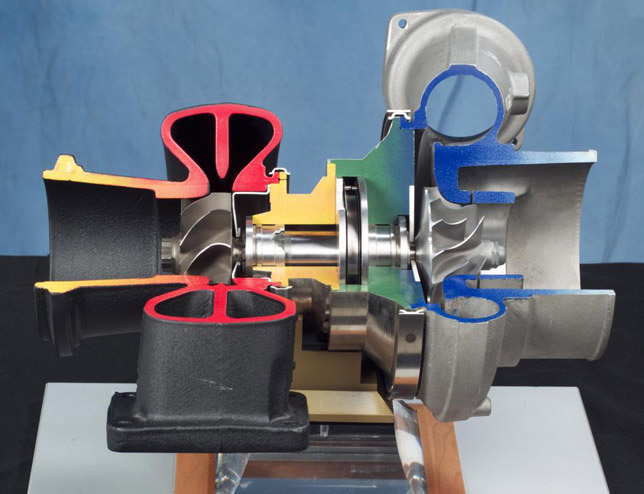
    Before those exhaust gasses reach the exhaust system they go trough a turbine connected to a shaft. The more exhaust that goes through the turbine blades, the faster they spin. On the other end of the shaft we find a compressor which welcomes fresh air from the atmosphere, compresses it using the force of the turbine and then feeds it into the engine. To further increase the efficiency of the turbocharging system, an intercooler is added – it looks much like a car radiator but instead of containing cooling fluid, it holds the compressed air from the compressor. Air is denser when cooler and that’s exactly what the intercooler does – it cools the incoming air.

    Cut-away view of a turbocharger held by a foil-bearing
    Cut-away view of a turbocharger held by a foil-bearing

    There are issues however. First of all, a turbine amidst the flow of exhaust is essentially an obstacle. The exhaust stroke has to deal with more back-pressure thus being slightly less efficient. A functional turboshaft has to handle extreme forces (speeds go up to 150 000 rpm within the turbocharger) so a special kind of baring is needed – liquid ones or state-of-the-art ball bearings. The latter is more efficient but more expensive. Then there’s the dreaded turbo lag. The problem here is that when you put your foot down, the response is far from electric. The turbine needs some time to kick off and start spinning the compressor blades. That’s why at low engine rpm one can’t really tell if the car has a turbo or not.

    There are various ways to tackle this nuisance. Make things smaller and lighter. Tiny turbochargers will grant you that off-the-line jolt but won’t be too good on the upper rpm range. Besides, if too much exhaust starts going through a relatively small turbine things may get hot and disbalanced. Usually however, there’s the wastegate in most turbines – a valve that knows how much exhaust passes through and regulates the flow by simply diverting some of the gases away from the turbine. Some companies have started putting more than one turbochargers in their cars. One small and the other, big. The small one guarantees a more immediate response while the big one takes over at higher speeds.

    Essentially, that’s the story with turbochargers. We can further dive into numbers and calculations about pressure and efficiency but this, I think, is already nerdy enough. Hopefully some of you learned something new while others refreshed their memory on how the turbocharger brings easy power to our everyday lives.