SEAT is adding to the Arona range with the introduction of a 1.5-liter TSI engine available exclusively with a seven-speed DSG dual-clutch transmission.
The new engine option will be the most powerful in the Arona line-up, boasting a 0-62mph time of just 8.2seconds and a top speed of 130mph**.
Even with the extra performance, the 1.5 TSI DSG delivers up to 45.6mpg of fuel efficiency and CO2 emissions as low as 140g/km based on the combined WLTP cycle.
The new powertrain is RDE2 compliant, meaning it meets the Euro-6d Final emissions standards and emits less than 60mg/km of NOx.
Available on the FR and FR Sport trim, this latest addition to the range will be the sportiest Arona on offer and comes with outstanding levels of equipment as standard.
FR trim includes full LED headlights and taillights, SEAT Drive Profile with four different modes, FR sports seats, electric folding side mirrors, rear parking sensors, Full Link smartphone integration, and wireless phone charging.
FR Sport adds 18” ‘Performance’ alloy wheels, microsuede upholstery, a digital cockpit, and heated front seats.
Richard Harrison, Managing Director, SEAT UK, commented:“SEAT is constantly looking to evolve its model line-up based on innovation and consumer demand; with the market continuing to shift towards automatic transmissions, it was time to add a new engine option available with the DSG dual-clutch transmission.”
The SEAT Arona is the brand’s small SUV and is designed, developed, and produced in Barcelona, at the brand’s Martorell facilities.
Volkswagenhas announced that the new and revised Jetta is now open for ordering at Volkswagen retailers. The first deliveries will occur in December of this year.
The new Jetta arrives with better efficiency, revised styling for the front and rear parts of the car and enhanced features and trims. The car is now sleeker than before and the overall improvement when it comes to aerodynamics reaches 10 per cent. A revised radiator grille is up front and it comes with three horizontal fins; a reprofiled bumper is beneath. In the back the boot lid has been revised to incorporate an aerodynamically efficient lip that extends into the wings at the side. New tail lights and a revised bumper are underneath.
On the inside the new Jetta offers a new design for the steering wheel, a variety of new trims around the center console, revised instruments and new fabric designs for the seats and the door trims. The ambient light inside the Jetta has also been updated. There are a few optional assistance systems too including Blind Spot Detection and Rear Traffic Alert.
And now we come to the sweetest spot – engines. We can tell you that all of them come with BlueMotion Technology that features some modifications too, including stop/start and battery energy recuperation. All engines also fully meet the latest EU6 requirements. There are four of them – a 1.4-liter TSI unit with 125 horsepower (92 kW) and a six-speed manual gearbox; a 1.4-liter TSI unit with 150 horsepower (110 kW) and a six-speed manual or seven-speed DSG gearbox; a 2.0-liter TDI engine with 110 horsepower (81 kW) and a five-speed manual or seven-speed DSG gearbox and a 2.0-liter TDI engine with 150 HP (110 kW) with either a six-speed manual or six-speed DSG gearbox. Three trim levels are available – S, SE and GT. The standard equipment includes a DAB digital radio, Electronic stability control, electric windows and air conditioning.
SE trim adds to the list 16-inch “Atlanta” alloy wheels, lumbar support, Bluetooth telephone connectivity, a leather-trimmed multifunction steering wheel, MDI multi-device interface and cruise control. The top-of-the-range GT trim comes with 15 mm lower sports suspension, 17-inch ‘Lancaster’ alloy wheels, front fog lights, front sports seats, automatic headlights and rain-sensing wipers, an auto-dimming rear-view mirror, heat-insulating tinted rear glass, a color multifunction trip computer, driver alert system and ambient interior lighting.
So, the NAIAS draws near and so do the good news. In our case, the latest Volkswagen Golf R: it’s coming to the US market. There will be a preview at the show, but the actual sales won’t happen until 2015. What’s also interesting is that this US-spec R will be a tiny bit underpowered than its European counterpart.
Still, it will be the most powerful Golf on the market, brandishing 290 hp and 280 pound-feet of torque. The source of that power is a GTI-sourced TSI 2.0 engine. However, in order to make it meet the needs of the R, engineers had to tweak quite a few bits. the cylinder head (together with exhaust valves, valve seats, and springs), pistons, high-pressure injection system, and turbocharger have all been modified or completely redesigned. As a result, the latest flagship Golf will be the most powerful to date with 34 hp more than the previous 2013 model. Volkswagen also hail the TSI in it as one of the most powerful four-cylinder engines in the world (“one of the” being key here).
Mated to a manual six speed gear, it can propell the Golf R to 60 mph from a standstill in 5.3 seconds. Go for the DSG dual-clutch automatic and that number drops to 4.9 seconds. The same ratio is true for the combined fuel consumption. 33 mpg (manual) and 28 mpg (DSG).
The power transferred from the engine to the wheels goes through Volkswagen’s 4MOTION permanent all-wheel-drive system. Apparently not so permanent these days since a clever Haldex 5 coupling unit uses an electro-hydraulic oil pump to continuously alter the torque distribution. Under relatively light loads, the R can go all day with all the power going to the front wheels. When necessary, 100 percent of the torque can also be directed to the rear wheels. Flamboyant cornering should cause no sweats thanks to an XDS+ cross differential lock operates on both axles. The bravest of the brave can even completely switch off the electronic stability control, thus indulging in the car’s purest mode of driving.
An extra option that can come along with the R is the DCC dynamic chassis control – a state of the art software-operated system that has us confused with its many modes and settings. The gist of it, though, is the independent regulation of the damper rebound and compression on each wheel. The process is fast, adaptive and rather autonomous.
In terms of visuals, you will recognize a Golf R – granted you miss the R badges – by it’s lower stance (0.8 inches lower than any other regular golf and 0.2 inches lower than the GTI). The brake disks are also quite noticeable at a diameter of 13.4 inches at the front and 12.2-inches at the rear wheels. Distinctive body parts: the bumpers, side skirts, the rear diffuser, and two dual exhaust tips in chrome. The headlights (Bi-Xenon) get complemented by “U”-designed LED daytime running lights whatever that means. 18-inch “Cadiz” aluminum-alloy wheels shod with 225/40 tires complete the picture.
Skoda has announced the facelift version of Yeti. 2014 Skoda Yeti Facelift will make its official debut at the 2013 Frankfurt Motor Show in September.
The exterior features a new front bumper, bi-xenon headlights with LED DRLs, modified front hood, different taillights and more prominent badging on the tailgate.
“The Skoda Yeti is one of the most attractive compact SUVs on the market and has far exceeded our sales expectations since its launch four years ago. With this all-new look and being offered for the first time in two variations, we are establishing new benchmarks. We plan to continue our outstanding development in this rapidly growing vehicle class. The Yeti is another cornerstone of the 2018 growth strategy and will strengthen our international position in the markets.” commented Skoda CEO Prof. Dr. h.c. Winfried Vahland.
The engine range includes a the well-known power units starting with 1.2 liter TSI – 105HP (77 kW) and finishing with the powerful diesel – 2.0 liter TDI with 170HP (125 kW). Depending on engine choice, front- or all-wheel drive system is available, along with si6x-speed manual or six- and 7-speed DSG. The 1.6 liter TDI Greenline is able to return 51.1 mpg US – 4.6 liters / 100 km with CO2 emissions of only 119 g/km.
UK pricing and specification will be announced nearer to the on sale date.
Volkswagen’s 1.4 liter TSI petrol engine managed to win Engine of the Year in its category (from 1.0 to 1.4 liter) for 7th consecutive time.
This makes the 1.4-litre TSI the most successful engine in the 15-year history of this international engine technology competition.
The manufacturer was the world’s first manufacturer to introduce active cylinder management (ACT) in the TSI four-cylinder last year – a technology that until then had been more familiar in large eight- or twelve-cylinder engines. Active cylinder management made its debut in the Polo and Golf 140HP (103 kW) 1.4 TSI. Temporary shutoff of the second and third cylinders – in conjunction with an economical style of driving – reduces fuel consumption by over 0.5 litres per 100 km.
Even with two cylinders the excellently balanced 1.4 TSI runs just as quietly and with low vibration as with four active combustion chambers. All mechanical switchover processes take place within one camshaft rotation; depending on engine speed this takes just 13 to 36 milliseconds. Accompanying interventions in ignition and throttle valve processes smooth the transitions.
Altogether, the components of active cylinder management weigh just 3 kg. Their actuators, the camshafts and their bearing frames are integrated in the cylinder head; two low-friction bearings reduce shaft friction. Important to know: only with the TSI concept – petrol direct injection plus turbocharging – is cylinder deactivation even conceivable in the form being implemented today.
Compared to its predecessor, fuel consumption and CO2 emission values of the TSI engines were reduced to 9% in part also by such measures as reducing internal friction, lowering weight and optimising thermal management. The savings potential is as much as 15% in conjunction with the innovative active cylinder management (ACT) feature.
An auto show in Leipzig (the Auto Mobil International) is dangerously close and automakers are scrambling to get the word out. There, on June the 1st, Volkswagen will introduce the 2013 CC R-Line – hardcore driving action for the four-door coupe type of people.
It’s power will be drawn from a 2.0 liter TSI engine and will amount to 200 horsepower. The transmission for it can be either a six-speed manual or VW’s DSG six-speed dual-clutch engineering piece.
Some specific R Line features include a sporty front bumper with big fog lights on it, an “R” logo on the grille and some side skirts. At the back, in true fast and furious fashion, the taillights are tinted while the mad 18-inch aluminum-alloy wheels complete the overall look. Inside, stainless-steel scuff plates bare a revealing engraving “R-Line” and the wheel is all sporty and functional.
As standard equipment, the CC R-Line gets adaptive Bi-Xenon headlights with accompanying LED Daytime Running Lights, LED taillights, LED license-plate lights, clever windshield wipers, climate control, heated power seats, touchscreen/multimedia/surround….iPod/Bluetooth/V-Tex thingy. Really, not a point of interest for a real gear head.
Sales in the US will start at the end of 2012. The price issue remains to be addressed.
Abt sportsline has unveiled the tuned 2012 Beetle at the 82nd Geneva Motor Show.
The exterior package includes a new front bumper, a rear diffuser with oval exhaust pipes and a pair of side skirts. There are also headlight brows and some nice graphics. The car is lowered by a set of sport springs. It stands on Abt DR wheels fitted with low profile tires.
The tuning specialists have developed five performance packages for the “bug” – 1.2 TSI with 140PS (103 kW), 1.4TSI with 210PS (154 kW) and the mighty 2.0TFSI is delivering 240PS (176 kW). The diesel range features 1.6 TDI receiving additional 20PS (15 kW) and the bigger 2.0TDI will have 170PS (125 kW).
Actuall, the ABT Beetle looks much better than, it was originally planned. The headlight brows give more aggressive look and the stripes complete the stunning exterior.
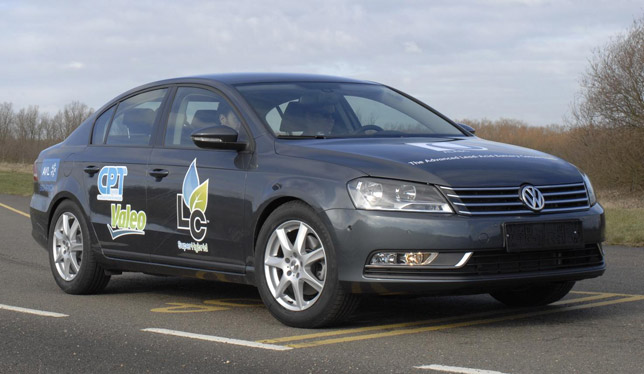
The LC Super Hybrid Technology is conceived by Controlled Power Technologies (CPT) and the Advanced Lead-Acid Battery Consortium (ALABC) with the only aim to show significant CO2 reduction through the means of electric hybridisation at low voltages (12-48 volts) using the latest lead-carbon batteries. The technology offers the potential of a mass market, petrol-powered, large family car with superb drivability, with spectacular performance and excellent 5.6 litres/100km (51mpg) fuel economy.
The LC Super Hybrid Technology is going to be showcased for the first time at the 2012 Geneva International Motor Show. The low voltage (12 volts) technology has been created by UK-based Controlled Power Technologies in colaboration with the US-based Advanced Lead-Acid Battery Consortium. The vehicle includes production-ready technology sold by CPT to Valeo. Other international companies involved are AVL Schrick based in Austria and Germany, Mubea also from Germany, and the UK-based Provector.
Volkswagen Passat 1.4-litre TSI model with LC Super Hybrid Technology
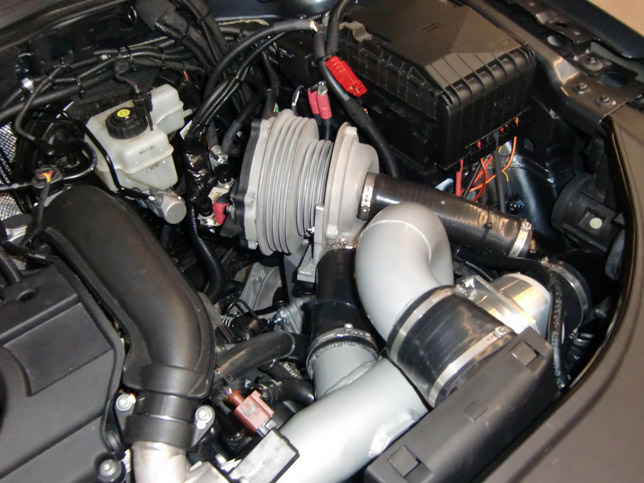
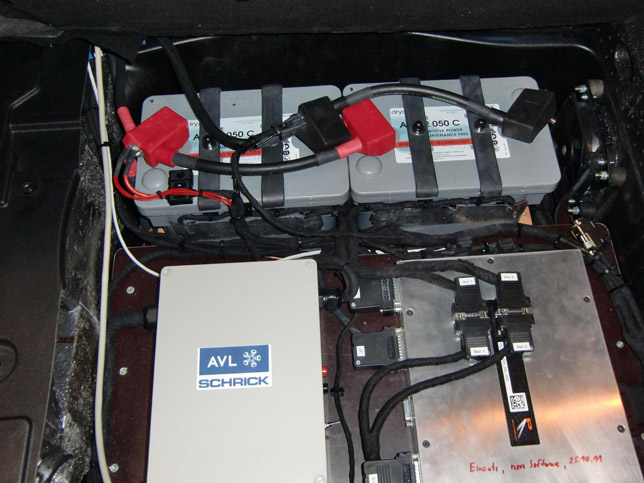
To be more precise, the technology is mounted on the series production 1.4-litre turbocharged VW Passat TSI model. Including the LC upgrade, the vehicle weighs around 1530kg which means that the technology adds the additional 79kg. Nevertheless, much of this additional mass including the test equipment would be eliminated in a production vehicle as well as the existing starter motor. The additional payload further underscores the excellent performance and drivability of the LC Super Hybrid demonstrator. Going straight to the point, the technologies features an electric supercharger, next generation belt-integrated starter generator with an advanced belt tensioning system, carbon improved valve regulated lead–acid (VRLA) batteries which avoid the need for super-capacitors, and higher gear ratios to reduce engine speed. Thus, this results in increase of power from 122 PS (90 kW) to 142 PS (104 kW) and torque from 200 Nm (148 lb-ft) to 275Nm (203 kW). The effects can be compared to the Passat’s bigger 1.8-litre TSI gasoline engine, which delivers 160 PS (118 kW) and 250 Nm (185 lb-ft), and hence the engine output of the LC Super Hybrid Technology is generally equivalent to vehicles in the 2-litre class. Additional advantage is that the vehicle also achieves near diesel levels of fuel economy, but with substantially lower production costs. Furthermore, the LC Super Hybrid delivers CO2 emissions of less than 130g/km compared with 140g/km for the baseline Passat 1.4-litre TSI. This represents a reduction in CO2 emissions of 8 per cent. Another benefit is the great fuel economy of 5.6 litres/100km (51mpg), which is significant 11 per cent improvement when compared with 6.2 litres/100km (46mpg) for the 1.4-litre TSI. Moreover, the 0-100 km/h (0-62 mph) acceleration time is reduced by 2.5 seconds from 11.1 to 8.7 seconds compared with the 1.4-litre TSI. In addition, the demonstrator embraces low voltage switched reluctance (SR) motor-generators, which are not currently used by the automotive industry in mass production. The motors are constructed from steel, aluminium and copper and avoid the use of increasingly expensive rare earth materials. The SR technology is licensed from Nidec Corporation of Japan, one of the world’s leading suppliers of electric motors.
LC Super Hybrid Technology
Furthermore, the improved lead-carbon battery design allows for an excellent charge and discharge characteristic, while the carbon-enhanced negative plate formulations enhance life under hybrid vehicle duty cycles. Additional improvements in the battery are achieved by careful attention to battery management and they also retain the long established end-of-life re-cycling benefits of lead-acid batteries. At 48 volts the low voltage LC Super Hybrid is expected to deliver more than the nominal 25 per cent improvement in CO2 emissions and fuel economy already achieved when compared with typical 2-litre naturally aspirated vehicles. In addition, the demonstrator develops low carbon ELC concept by incorporating CPT’s next generation SpeedStart stop-start system. The latter features intelligent torque and current control with enhanced stop-start capabilities. Moreover, it is world’s most powerful belt-integrated starter generator (B-ISG) which operates at 12 volts, and the first and only system based on the highly controllable switched reluctance motor-generator technology.
LC Super Hybrid Technology
LC Super Hybrid technology demonstrator is based on a VW Passat 1.4-litre TSI model and also features an electric supercharger which boosts the existing turbocharger, and CPT SpeedStart stop-start technology (top right) and Mubea belt tensioner.
At Skoda these days are busy developing their not yet ready for production “Green E Line” vehicles – a segment of electric cars based on the Octavia Estate. Right now, a fleet of ten E Lines is undergoing a phase where day to day conditions are recreated so see how the cars behave. The whole green thing is a part of Skoda’s plan to excel in the field of fuel efficiency. Other projects concerned with that often work to optimize the TDI and TSI drivetrains and also various transmissions.
The gathered data will be of extreme value for fine-tuning to get the most out of the cars. Issues that concern potential customers can also be addressed – being extremely silent in traffic might be a disadvantage for example.
The whole testing procedure comprises of three phases: the first and the second are ongoing now and deal with in-house (on the Prague airport to be more exact) trials and research of the car’s various systems. The third phase, set to begin in March this year, will put the fleet to the real test as the cars will go to different institutions other than Skoda Auto (government, educational institutions etc.) for further research and testing in real life conditions.
Skoda Green E Line (Octavia based)
Because of being based on the Octavia Estate, the Green E Line is ideal for harboring electric car components such as batteries, motors and electronic controllers. Power output stands at 85 kW and generous figure of 270 Nm. (because of being electric, torque tends to be always high and instantly available throughout the whole rev range). A zero to sixty time is said to be around 12 seconds and top speed is as high as 135 kph. On a single charge it is estimated that the E Line will go for 150 km which is more than enough to satisfy various European communities.
Volkswagen UK has announced the price list for the new 2012 Beetl.
Firstly, two engines will be available: the small 1.2 litre TSI with 105PS mated to a 7-speed DSG gearbox and a 1.4 litre TSI with 160PS mated to a 6-speed manual.
There are three trim levels: Beetle, Design and Sport. The standard equipment includes air conditioning, remote central locking, an RCD 310 CD system with DAB radio and rear Isofix seat preparation.
Design adds 17” alloy wheels in a choice of two styles, Bluetooth telephone preparation with MDI iPod connectivity, front fog lights, an alarm, an RCD 510 DAB CD/radio, multifunction leather-wrapped steering wheel and body-coloured door and dashboard panels.
The top-of-range Sport specification brings 18” alloys in a choice of two styles, tinted glass, cruise control, sports seats, parking sensors, gloss black door mirrors, dashboard and door panel and 2Zone electronic climate control.
The options list includes Keyless Access, satellite navigation systems, a panoramic sunroof and bi-xenon headlights.
Volkswagen Golf VI GTI Edition 35 will have its official debut on June 1st. However, the manufacturer has released some pictures ahead of its premiere. The car is built specially to celebrate the model’s 35th anniversary.
Golf VI GTI Edition 35 boasts new front bumper, revised interior trim and a lot of “35” badging. The “35” signature appears on the wing panels, door sill plates, head restraints and centre seat panel.
Golf VI GTI anniversary model is powered by a 2.0 liter TSI petrol engine with 235PS (173 kW), which is 25PS more than the factory’s 210PS (155 kW).
Under the hood, power comes from a revised 2.0-liter TSI petrol engine that develops 235 PS (173 kW / 232 hp) instead of the usual 210 PS (155 kW / 207 hp). Nothing is mentioned about the torque, but perhaps it is slightly increased, too.
Golf VI GTI Edition 35 will hit the market at price of €30 425 EURO. The company will begin accepting pre-orders on May 12th.
Volkswagen has introduced a new version of the super popular Beetle. The company revived one of the most popular models in its history in 1998. The new model is inspired by the Beetle Ragster concept shown in Detroit in 2005.
2012 Bettle is bigger and has more masculine and dynamic appearance Its dimensions are: 4 278 mm in length, 1 808 mm in width and 1 486 in height. The wheelbase is 2 537 mm, which is also increased. The boot capacity is 310 litres, which is a more than 100 litres than a 1998 model. The Beetle has four seats, with a split-fold rear seat for added versatility.
The interior features good quality materials, distinctive appearance with easy to identify and ergonomic controls.
There are three trim levels: Beetle, Design and Sport. The options list is huge, too. It includens Keyless Access, SAT NAV systems, a panoramic sunroof, bi-xenon headlights, LED daytime running lights, etc.
The engine range consists of three petrol and one diesel power plants. The petrols are a 1.2 litre TSI 105PS, a 1.4 litre TSI with 160PS and a mighty 2.0 litre TSI developing 200PS. The diesel is a 1.6 litre TDI with 105PS with BlueMotion Technology. Thanks to the addition of Stop/Start and battery regeneration systems the Beetle 1.6-litre 105 PS is estimated to have a combined fuel consumption of 65.7 mpg and CO2 emissions of 112 g/km.
The safety is at very high level, because of the laser-welded and galvanised body structure which has one of the highest torsional rigidity values in the segment at 26,000 Nm/˚. The car also has six airbags and ESP as standard. The 2.0-litre 200 PS, will feature standard XDS electronic differential lock as fitted to the Golf GTI.
The new Beetle will hit the market in early 2012. Price list is not announced, yet!




 So, the NAIAS draws near and so do the good news. In our case, the







 An auto show in Leipzig (the Auto Mobil International) is dangerously close and automakers are scrambling to get the word out. There, on June the 1st,


 Abt sportsline has unveiled the tuned 2012 Beetle at the 82nd Geneva Motor Show.




 At Skoda these days are busy developing their not yet ready for production “Green E Line” vehicles – a segment of electric cars based on the Octavia Estate. Right now, a fleet of ten E Lines is undergoing a phase where day to day conditions are recreated so see how the cars behave. The whole green thing is a part of Skoda’s plan to excel in the field of fuel efficiency. Other projects concerned with that often work to optimize the TDI and TSI drivetrains and also various transmissions.

 Volkswagen UK has announced the price list for the new 2012 Beetl.


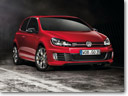 Volkswagen Golf VI GTI Edition 35 will have its official debut on June 1st. However, the manufacturer has released some pictures ahead of its premiere. The car is built specially to celebrate the model’s 35th anniversary.


 Volkswagen has introduced a new version of the super popular Beetle. The company revived one of the most popular models in its history in 1998. The new model is inspired by the Beetle Ragster concept shown in Detroit in 2005.
