Masterful technology Audi Q7 V12 TDI quattro For two decades Audi has driven forward the advancement of diesel technology – from the very top. Now the brand with the four rings is presenting another world first: the first V12 TDI in a passenger vehicle. (more…)
Tag: TDI
-
The best Golf of all times
 Volkswagen is unveiling its most important automotive secret of the year: the new Golf. The car – Europe’s most successful with more than 26 million sold – was improved in all areas. “This sixth generation of Golf cars will completely redefine the quality and comfort level of its class over broad categories, offering more customer value than ever before”, says Prof. Dr. Martin Winterkorn, Chairman of the Board at Volkswagen AG. (more…)
-
Maximum efficiency all the way to the finish
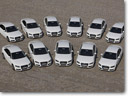 Powerful dynamism, stamina and endurance are just as important in sport as out on the road. To be successful, you need to use your energy as efficiently as possible: On June 23, eleven white Audi A4 2.0 TDI models took to the start in the efficiency competition organized by Audi and Auto Bild. To stand a chance of winning, however, the teams have to complete the total distance of over 1,650 kilometers (1,025.26 miles) with an average fuel consumption of under four liters (over 58.80 US mpg). (more…)
-
Volkswagen working on high-performance energy storage
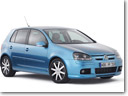

Dynamic partnership between the Volkswagen Group and Sanyo
Agreement has been reached on a co-operation which sees Volkswagen joining forces with Sanyo, one of the world’s leading developers of rechargeable batteries, to work on new and extremely efficient high-performance storage systems based on lithium-ion technology.
“Our focus in future,” says Prof Martin Winterkorn, CEO of the Volkswagen Group, “will be directed more strongly at making electrically powered automobiles alongside ones driven by more efficient combustion engines. Drivetrain electrification is the way forward if we wish to secure mobility in tomorrow’s world. This will involve energy recovery.
The whole idea will be to no avail, however, as long as we do not have powerful energy storage systems at our disposal and as long as vehicle operations are not in tune with customer demands. This cooperation is an important step for us,” Winterkorn adds.
Emissions-free travel in an all-electric operating modus is already possible today, though only at limited speeds and over short distances. That makes it all the more important to develop new accumulators with the capacity, size, weight and cost attributes which will enable them to be used more efficiently in tomorrow’s automobiles.
Lithium-ion technology, already very successfully used in communications electronics and portable computers, has the potential to satisfy even the particularly exacting demands placed on electro-traction systems in motor vehicles.
Back in March, at the Geneva Motor Show, Volkswagen showcased its Golf TDI Hybrid design study, which demonstrated just how much potential for energy reduction there is when you combine high-tech-diesel, electric-drive and 7-speed-DSG technology.
Conceived as a powerful full-hybrid vehicle, the Golf TDI Hybrid can be operated using combustion-engine power only or using a combination of combustion and electric drive or using E-drive – i.e. the powerful and energy-efficient combination of TDI technology and an electric motor.
The A1 project quattro presented by Audi at the most recent Tokyo Motor Show features a powertrain already designed to cover a distance of 100 km using this innovative storage method. The Group hopes to be able to employ lithium-ion technology in its first vehicles by 2010.
-
Audi A3 TDI clubsport quattro – Updated photos
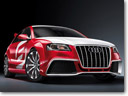 The two-liter TDI unit under the bonnet of the Audi A3 TDI clubsport quattro delivers 165 kW (224 hp) and musters up 450 Nm (331.90 lb-ft) of torque – the sort of pulling power normally associated with a sports car. The show car races from 0 to 100 km/h (62.14 mph) in just 6.6 seconds and attains a top speed of 240 km/h (149.13 mph). (more…)
-
Audi A3 TDI clubsport quattro
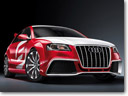
 A TDI from Audi is more than just another diesel – it is, in fact, a dynamic power unit and a rich source of driving pleasure. At the 27th annual Lake Wörther Tour being held in the Austria province of Carinthia from May 21-25, Audi is demonstrating the potential of TDI technology with a very special concept study: the Audi A3 TDI clubsport quattro is powered by an engine delivering a whole 165 kW (224 hp) from its displacement of two liters. And with a torque of 450 Nm (331.90 lb-ft), it endows the premium compact model with the pulling power of a sports car.
The Audi A3 TDI clubsport quattro qualifies as an uncompromising sports machine in all other technical respects too. A six-speed transmission channels the engine’s power to the quattro all-wheel drive. 20-inch wheels keep the drive force glued to the road; behind the wheels at the front can be found brake disks made from carbon-fiber-reinforced ceramic. Using the Audi drive select driving dynamics system the driver is able to adjust the throttle response and exhaust sound characteristics, the steering’s power assistance, the ESP control and the damper characteristics as desired.
The dynamic image presented by the scintillating A3 study is rounded off by spectacular body styling and a high-class, sporty interior. Parts such as bolt-on wheel arch extensions and a large rear spoiler lend lasting impact to the exterior’s looks; the interior is dominated by the racing bucket seats in the front and the open aluminum gear lever gate.


The design
The Audi A3 TDI clubsport quattro has a distinctly confident air about it. Sensational styling instantly sets the three-door show car apart from the standard production Audi A3. It measures 4,254 millimeters (167.48 inches) millimeters/2.36 inches), but just 1,385 millimeters (54.53 inches) high, – a reduction in height of 36 millimeters (1.42 inches) in spite of the large wheels. The track width measures 1,568 millimeters (61.73 inches) at the front (+ 34 millimeters/1.34 inches) and 1,553 millimeters (61.14 inches) at the rear (+ 46 millimeters/1.81 inches).
The design team has kitted out the Audi A3 TDI clubsport quattro with a whole array of new exterior parts to give it an extremely sharp and dynamic look – almost like a racing car. The paint finish is also a picture of vibrancy: the engine hood, tailgate and roof are Ibis White and the flanks Brilliant Red, while a large white figure “8” is emblazoned across each door in reference to the year 2008. The color scheme is an allusion to the colors of the Austrian national flag.
The single-frame grille has grown slightly in width, which also entailed modifications to the engine hood. The grille’s bars – including pronounced vertical sections – have a high-gloss black finish. The bi-xenon headlamp assemblies are embellished by LED daytime running lights and wings. The front bumper incorporates large, square-edged air intakes, together with a blade section that juts a long way forwards and is slightly raised in the centre.
The modified front fenders feature bolt-on wheel arch extensions. The doors and the rear side sections – again with muscular wheel arch paneling – have been given a new, boldly contoured flare at the bottom. This blends together harmoniously with the door sills, which have themselves been restyled. The exterior mirror housings, with their arms that look to have been crafted by the wind, are likewise new. The tinted glass used for the rear windows gives the model yet greater visual presence.
The tail of the Audi A3 TDI clubsport quattro sports a dark grey diffuser. It is a variant on the design of the front blade, and incorporates the two large circular tailpipes of the separate exhaust branches. Modifications have also been carried out to the tail light assemblies. The most striking impression, however, is made by the spoiler atop the rear window that bears a close resemblance to the part featured on the new A4 race car from the German Touring Car Masters (DTM).
Inside the Audi A3 TDI clubsport quattro, the eye is immediately caught by the illuminated door sill trims with their “TDI Power” badging. Awaiting the driver and front passenger are anatomically shaped bucket seats, just like those found in motor racing cars. The rear seats sport the same upholstery design, with special foam padding used to sculpture them into roomy and comfortable individual seats.
The driver takes hold of an elegantly styled steering wheel with a flat-bottomed rim that is reminiscent of the Audi R8 high-performance sports car. The scales of the dials are colored white, the monitor for navigation and entertainment together with its control panel stems from the R8. The jet-style air outlets have multi-way adjustable louvers, and the usual buttons in the center console have given way to classic, sporty toggle switches. The bars underneath the console are covered in leather, the door handles have been milled hollow to save weight. The door linings and floor mats have been newly designed.
The drive train
The high-performance TDI under the bonnet of the Audi A3 TDI clubsport quattro is like nothing that has gone before it. From its displacement of just 1,968 cc, it summons up an output of 165 kW (224 hp). Torque – the true measure of effortless motoring ability – peaks at an exhilarating 450 Nm (331.90 lb-ft), which is on tap from just 1,750 rpm; in other words, the very bottom of the rev range. As for in-gear flexibility, the diesel model leaves its gasoline-powered rivals standing.
The mighty TDI bestows the Audi A3 TDI clubsport quattro – which tips the scales at just 1,475 kilograms (3251.82 lb) – with pulling power befitting of a sports car. The sprint from 0 to 100 km/h (62.14 mph) is over in a fleeting 6.6 seconds and the speedometer needle keeps rising all the way to 240 km/h (149.13 mph).
The four-valve sports engine is smart too; it responds spontaneously to the throttle and pampers the occupants with the low-vibration running of its mechanics. On an acoustic level, however, it proudly proclaims its abilities for all to hear: the exhaust system is a new development, with controllable resonance chambers on both tailpipes to amplify the rich, sonorous sound.
The engineers took as a basis the undersquare engine (bore x stroke = 81.0 x 95.5 millimeters) with an output of either 103 kW (140 hp) or 125 kW (170 hp), depending on the configuration, and added to it an optimized turbocharger. The advanced design of its blades allows it to supply more air; as in the series-production version, the variable geometry of the turbine’s blades ensures spontaneous response.
The 2.0 TDI, which is managed by one of the most sophisticated control units currently available on the market, is brimming with high tech. Fuel injection is handled by a common-rail system with piezoelectric injectors and eight-hole nozzles. The high-precision metering of as many as five injections of fuel per power stroke has the effect of audibly reducing the noise level. The system operates at a pressure of 1,800 bar – this results in extremely fine atomization of the fuel which, together with the revised piston geometry, makes the combustion process a highly efficient one.
The engine’s intake manifold houses swirl flaps that generate a tumbling action in the inflowing air; electric motors regulate the flaps’ position so that this tumbling motion is always perfectly suited to the current load and engine speed. Two balancer shafts in the engine reduce the degree of vibration in the crank drive. The drive unit for the belt that propels the two camshafts has also been reworked with a view to improving the engine’s acoustics.
The engine: low on emissions, high on efficiency
In its high-performance 165 kW (224 hp) version, the 2.0 TDI unit is still able to make use of a high proportion of recirculated and sharply cooled exhaust gas to achieve cooler combustion with lower oxygen levels – this brings about a substantial reduction in untreated nitrogen oxide emissions. The four-cylinder power unit already complies with the limits of the Euro 5 emissions standard, which is not due to come into force until September 2010 and whose foremost aim is to cut NOx emissions.
The ultra-efficient two-liter engine attains a power-to-displacement ratio of 83.8 kW (113.8 hp) per liter, and torque-to-displacement ratio of 228.7 Nm (168.68 lb-ft) per liter – figures which comparable gasoline engines are simply unable to match.
The Audi A3 TDI clubsport quattro has been designed strictly in accordance with the principle of maximum efficiency. Power is transferred by a compact, transverse-mounted six-speed transmission whose casing is made from lightweight magnesium. The short-throw gear lever can be moved swiftly and precisely through a classic open gate made of aluminum. The transmission ratios have been adjusted and the components reinforced to make allowance for the TDI engine’s extremely high performance.
The engine’s power is transferred to the road with virtually zero losses thanks to the quattro all-wheel drive. The system’s key component is a multi-plate clutch which is positioned at the rear, thereby further optimizing the weight distribution. Under normal driving conditions, the electronically controlled and hydraulically operated clutch directs the engine’s drive power to the front wheels; whenever necessary, however, an infinitely adjustable proportion of the propulsive force can be diverted rearwards.
When altering the power split, the plates inside the clutch are subjected to high oil pressure, pushing them together – a procedure which is completed in a matter of milliseconds thanks to a newly designed pressure reservoir for the pump. The quattro drive constitutes the perfect power transmission system for the mighty two-door model, significantly enhancing traction, handling characteristics, stability and straight-line running, whatever the weather.
The chassis
The Audi A3 TDI clubsport quattro comes equipped with a sports suspension that is more than capable of handling the formidable power. The front suspension – a classic McPherson layout – is pivoted on a light, high-strength aluminum subframe. A rack-and-pinion steering system with a direct ratio produces a sensation of close contact with the road. Power assistance is generated by an electromechanical drive unit for high efficiency, and its level decreases as the speed increases.
The rear suspension comprises four links per wheel which fulfill all manner of tasks. The trailing links absorb the propulsive and braking forces. As an aid to ride comfort, their configuration is relatively soft. The connections to the three transverse links, on the other hand, are rigid in order to direct transverse forces into the body with absolute precision. In this instance, the coil springs and shock absorbers are also kept separate from one another. The set-up is decidedly firm, while the body has been lowered by 36 millimeters (1.42 inches) compared to the standard production version.
The Audi A3 TDI clubsport quattro rides on impressive ten-spoke wheels measuring 9 J x 20, which are in turn shod with size 265/30 ZR 20 tires.
Whereas the brakes at the rear wheels were borrowed from the series-production A3, their counterparts on the front would not be out of place on a supercar: six-piston calipers exert a vice-like grip on brake discs measuring 356 millimeters (14.02 inches) in diameter. The discs themselves are made of a material which has been of tremendous value to the aerospace industry, consisting of high-strength carbon fibers embedded in hard silicon carbide.
They have a lightweight construction, can withstand extreme levels of strain, are corrosion-free and have a service life in the region of 300,000 km (approx. 186,400 miles).
Motoring à la carte with Audi drive select
The Audi A3 TDI clubsport quattro boasts yet another highlight in the form of the Audi drive select driving dynamics system. This system has control over a number of technical components that mould the motoring experience. By simply pushing a button, the driver can determine at will whether these components should work in the comfort mode, the dynamic mode or even the “Individual” mode that allows partial manual programming of the way in which they interact.
In the show car, Audi drive select influences the engine’s throttle response, the sound from the exhaust system, the power assistance for the steering, the cut-in thresholds for the ESP stabilization system, as well as the damper characteristics. This is where the adaptive damping system Audi magnetic ride comes in: a magneto-rheological fluid circulating in the shock absorber pistons alters its viscosity – and, by consequence, the damping characteristics – in an instant when a voltage is applied.
The interplay between all these cutting-edge technologies makes the Audi A3 TDI clubsport quattro a thrilling road machine that is tremendously fun to drive. It darts into bends with exceptional spontaneity, and corners with stolid stability and at high speed, guided with unfailing precision by the sensitive steering. Its handling limits are extremely high, with just a minimal amount of understeer kicking in as the limits are approached. A sense of effortless, assured controllability is a key virtue of the A3 study – just as it is on all Audi models.
TDI engines – the superior drive force
Power, refinement and efficiency – ever since they first made their debut in 1989, the TDI engines from Audi have been synonymous with a sophisticated and smart form of sportiness, blazing a trail for the rest of the motor industry to follow. The triumphant advance that the diesel-engined Audi R10 TDI racing car has been enjoying for two years now on race tracks around the world has delivered a powerful demonstration of its potential.
The R10 TDI has been causing a sensation since spring 2006, with its twelve-cylinder diesel powerplant ushering in a new era in the world of motor racing. The 5.5-litre TDI develops in excess of 1,100 Nm (881.32 lb-ft) – a torque figure that positively eclipses its gasoline-powered competitors. Its output of 650 hp translates into a top speed of around 330 km/h (205.05 mph).
One of the fortes of the R10 TDI is its low fuel consumption. And fewer fuel stops means a higher average speed – the car’s high efficiency was one of the key factors in its two successive victories at the Le Mans 24 Hours. Frank Biela (Germany), Emanuele Pirro (Italy) and Marco Werner (Germany) won in 2006 and 2007 in emphatic style. It is a similar story in the American Le Mans Series, where the diesel race car bearing the four Audi rings has racked up a string of successes, easily securing the constructors’ title in the large LMP 1 category in both years.
For the first time ever, superior TDI power from the race track can now be experienced in a series-production sports car – both the Audi TT Coupé 2.0 TDI quattro and the Audi TT Roadster 2.0 TDI quattro feature a diesel engine. The two-liter four-cylinder unit delivers dynamic thrust, with a power output of 125 kW (170 hp) and 350 Nm (258.15 lb-ft) of torque. Despite this, the TDI engine in the Coupé burns just 5.3 liters of fuel per 100 km (44.38 mpg) on average – a benchmark value in the sports car segment.
Also on show at the Lake Wörther Tour is the Audi R8 TDI Le Mans, whose drive train technology is closely related to that of the R 10 TDI. The high-performance sports car is driven by a six-liter V12, whose 368 kW (500 hp) of output and 1,000 Nm (737.56 lb-ft) of torque propel the world’s most powerful series-production TDI model to a top speed far in excess of 300 km/h
(186.41 mph). -
Audi: Successful start to 2008
 Following a very successful 2007, Audi is on course to achieve top figures once again in 2008. “We will continue to pursue our course of profitable growth,” said Rupert Stadler, Chairman of the Board of Management of AUDI AG, today at the company’s 119th Annual General Meeting in Ingolstadt. “We produce cars in such a customer-orientated and individualized way that they are like “made-to-measure” suits. In this sense we will deliver a million “made-to-measure” cars to customers in 2008. The new A4 Sedan and the new A4 Avant will play a major part in achieving this. And countless innovations will help us expand our “Vorsprung durch Technik” when it comes to efficiency.” (more…)
-
The Audi TT 2.0 TDI quattro – Coupe and Roadster
 Performance and efficiency
Purist sportiness and compelling performance, combined with sensational efficiency – Audi is setting the trends yet again. The Audi TT Coupe 2.0 TDI quattro and Audi TT Roadster 2.0 TDI quattro are the first series-production sports cars in the world to be powered by diesel engines. The two-liter fourcylinder engine delivers dynamic thrust, with a power output of 125kW (170 hp) and 350 Nm (258.15 lb-ft) of torque. (more…) -
Audi R8 TDI Le Mans
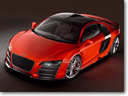 Audi is presenting a revolution in the top class – the first 12-cylinder diesel engine in a high-performance roadgoing sports car. The V12 TDI with a displacement of six liters powers a concept car based on the Audi R8. This unit generates a huge 500 hp and 1,000 Newton-meters (737.56 lb-ft) of torque. Audi is writing a new chapter in diesel technology with this power unit. Equipped with the expertise that Audi has built up through its motor sport activities, the R8 TDI Le Mans in Brilliant Red embodies superb road handling, pioneering technology and fascinating design. (more…)
-
Seat Altea Freetreack

 At the upcoming Barcelona Motor Show from 7 to 17 June, SEAT will be presenting its first all-road vehicle – the Altea freetrack. After unveiling the prototype version in Geneva, which hinted at the new model’s silhouette, the definitive version can be seen in Barcelona and goes on sale this summer.
With this model, SEAT is making its debut in the SUV segment, an area of the market which has grown considerably in recent years. The new Altea freetrack is one of the few compact monospace cars on the market featuring clear off-road styling, as well as engines that deliver up to 200 hp. This factor proves the dynamic character of SEAT’s new all-road model, whose slogan “auto emoción” works just as well on- as well as off-road.
Exclusive off-road looks
Based on the Altea XL, the visual enhancements on the new freetrack include protective moulding below the waistline, as well as the specific plastic front and rear bumpers. These elements lend a rugged and robust image to the new model while also protecting the body when driving off-road.
The exterior stands out with new, exclusive design 17-inch wheels and larger diameter tyres. The Altea freetrack also has 40 mm more ground clearance than the Altea XL, making it easier for the new model to tackle any kind of terrain.


Top level performance
The Altea freetrack is available with four-wheel drive via a Haldex-type arrangement with a hydro-mechanical connection and electronic control, to ensure that the tractive force is distributed permanently in a progressive and precise manner. Under normal use, power is fully transferred to the front wheels, with up to 50% being distributed to the rear wheels when the need arises.One of the most outstanding features of the new Altea freetrack is its engine range, with performance levels that make the new SEAT model the market’s most dynamic family-sized SUV. A 200 hp 2.0 TFSI petrol and a 170 hp 2.0 TDI diesel engine are responsible for taking the Altea freetrack over all types of terrain.
The 2.0 TFSI engine enables the newcomer to reach a top speed of 214 km/h, with 0 to 100 km/h taking just 7.5 seconds – yet it can still average fuel consumption of 9.4 litres. On the other hand, the freetrack 2.0 TDI reaches a top speed of 204 km/h, accelerates from 0 to 100 km/h in 8.7 seconds and consumes an average of 6.8 litres for every 100 km of driving.
Besides these performance figures, the new Altea freetrack matches the Altea XL in terms of impressive interior space and generous load capacity. With its 593 litre boot, the freetrack can carry everything needed for the entire family’s hobbies and leisure activities.
The rear seats are exceptionally roomy and flexible, as they can slide back by up to 16 centimetres for added legroom while still allowing more than enough boot space.
Multimedia system as standard
The Altea freetrack will be sold with just one trim level featuring a complete set of standard equipment.
The most outstanding feature is a new multimedia system, which comprises a 7-inch TFT screen hinged on the ceiling and an RCA connection that allows connection to a DVD player, videogames, laptops and even MP3 players. This way the sound is transmitted over the car’s own sound system.
The Altea freetrack also features new rear window shades as standard, that are hidden inside the doors when not in use, leaving the view unobstructed for rear seat passengers.
Further standard-fit elements on the Altea freetrack include dual climatise control, rain sensor wipers, light sensor, parking sensors, cruise control, trip computer, plus CD MP3 radio and steering wheel mounted controls, among others. Safety highlights include standard ESP (Electronic Stability Control), six airbags, EPS electro-mechanical steering and tyre pressure warning.
Designed, developed and manufactured in SpainThe new Altea freetrack has been wholly designed and developed at the SEAT Technical Centre in Martorell, where over 1,000 highly qualified staff work daily to develop new models.
It will be exclusively made at the SEAT facilities in Martorell, one of Europe’s most modern and most flexible automotive factories, where the Ibiza, Córdoba, Altea, Altea XL, Toledo and León models are also produced.
-
Je Design Seat Altea XL
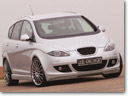
 Whoever admires minivan look would do well deciding on a Seat Altea XL. JE DESIGN provides a clearly sportier version for its mid-size family car through its Spanish alterations. A car body kit completes the aesthetically pleasing form. In addition, JE DESIGN offers amongst other options a lowering, a sports exhaust and new rims.
Facelift by JE DESIGN
A complete facelift procedure is performed by JE DESIGN on the front of the SEAT Altea. A new grill with grid inset – in contrast to the original version minus brand labelling – is available in Matt Black or by request in matching vehicle finish and is just the first step offered. Next are headlight eye brows providing the Altea series-produced headlights with a much more serious look. The third step is a new front spoiler available to optimise aerodynamics. Naturally, JE DESIGN dedicates its attention as well to the other side of the Seat Altea. Side skirts set provide this and thanks to the new rear apron fitting, an optical lowering of this vehicle ensures a rear sporty look. The single parts for the Seat Altea XL are also available as a complete kit.
Further optical measures pertain to the doors as JE DESIGN provides an 8-component highly polished door handle set in chrome. Matching to this the Leingarten, Germany, based tuner offers the B-pillar in “3D Chrome”.


More power
Even a mid-sized family van can have the liberty of a power boost. JE DESIGN increases the 2.0 TDI engine from series-produced 103 kW/166 PS to 130 kW/176 PS with 4000 U/min. Improved elasticity values follow this procedure maximizing the torque to 405 Nm compared to the series-produced 320 Nm. The power surge effects high-speed as well. With 210 km/h the Altea runs a quick 9km/h faster than the series-produced version. The sprint from 0-100 km/h is performed in just 8,9 seconds versus 9,9 seconds. As required for any serious tuner, JE DESIGN supplies the power enhancement with TÜV parts approval.
Better vehicle handling, improved brakes
More agility is promised through a lowering set lowering the „Altea XL“ by approximately 35 mm. Optionally offered by JE DESIGN is an adjustable coilover suspension with preset damper setting.
For those who prefer sustained deceleration, JE DESIGN installs a 330x28mm 4-piston sports brake system on the front axle providing more safety.
19-inch und more sound
Absolute mandatory are new rims. For example, offered within the complete wheel sets is the design „Multispoke“in 8.0 x 19 ET 45 with tires 225/35 R19 This wheel also comes in Chrome-look in sizes 17 und 18-inch. Alternatively JE DESIGN offers the design „Masterline“ in 17-inch.
Tuning of sound is modified by JE DESIGN for the Seat Altea in way of powerful sound equipped through a rear silencer. It is composed of four anti-corrosion stainless steel 90mm tailpipes two on the left and two on the right providing an even more sporty look.
-
Audi Q7 4.2 TDI
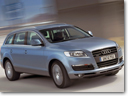 240 kW/326 bhp and 760 Nm of torque – Audi proudly presents the most powerful diesel SUV on the world market. A state-of-the-art eight-cylinder engine with common rail fuel injection and Piezo injectors not only stands out on account of its sheer output but also demonstrates outstanding efficiency: the 4.2 TDI has an average fuel consumption of just 11.1 litres of diesel per 100 kilometres. (more…)


