Skoda has announced the facelift version of Yeti. 2014 Skoda Yeti Facelift will make its official debut at the 2013 Frankfurt Motor Show in September.
The exterior features a new front bumper, bi-xenon headlights with LED DRLs, modified front hood, different taillights and more prominent badging on the tailgate.
“The Skoda Yeti is one of the most attractive compact SUVs on the market and has far exceeded our sales expectations since its launch four years ago. With this all-new look and being offered for the first time in two variations, we are establishing new benchmarks. We plan to continue our outstanding development in this rapidly growing vehicle class. The Yeti is another cornerstone of the 2018 growth strategy and will strengthen our international position in the markets.” commented Skoda CEO Prof. Dr. h.c. Winfried Vahland.
The engine range includes a the well-known power units starting with 1.2 liter TSI – 105HP (77 kW) and finishing with the powerful diesel – 2.0 liter TDI with 170HP (125 kW). Depending on engine choice, front- or all-wheel drive system is available, along with si6x-speed manual or six- and 7-speed DSG. The 1.6 liter TDI Greenline is able to return 51.1 mpg US – 4.6 liters / 100 km with CO2 emissions of only 119 g/km.
UK pricing and specification will be announced nearer to the on sale date.
Audi has published a video with a test drive of the SQ5 TDI at Silverstone race track. Behind the steering wheel is Allan McNish (three-time winner of the 24 Hours of Le Mans, most recently in 2013, and three-time American Le Mans Series champion).
“We’ve been racing diesels now, and high-performance diesels, for such a long time, we’ve got fantastic power, torque and also economy.”, commented Mr. McNish.
The SQ5 TDI is powered by a twin-turbocharged 3.0 liter V6 diesel with 313HP (230 kW) and 650Nm (479 lb-ft) of torque. The engine is connected to an 8-speed tiptronic transmission and a quattro all-wheel drive system. 0-100 km/h in 5.1 seconds and a top speed of 250 km/h (155 mph).
Volkswagen has revealed the Amarok Power-Pickup Concept at the 2013 Worthersee Motor Show.
The Power-Pickup is powered by a 3.0 liter V6 TDI with 272HP (200 kW) and 600Nm (444 lb-ft) of torque. 0-100 km/h in 7.9 seconds thanks to an 8-speed automatic gearbox and permanent 4MOTION all-wheel-drive system.
The striking exterior design features widened wheelarches to accommodate 22” alloy wheels, 80 mm lowered suspension, bi-xenon headlights with chrome surround and a chrome grille plus an enlarged lower air intake. At the rear there is also a carbon fibre diffuser and dual exhausts, plus tinted taillights and red, white and black side decals.
Inside, the dashboard, door trims and exclusive Nubuck leather sports seats have a black, red and white colour theme. In-car entertainment is supplied via an infotainment system with an eight-inch touchscreen and 500 watt subwoofer
Audi US has announced the pricing of the new 2014 A8 L TDI. The luxurious saloon offers stylish exterior, superb comfort, technology, performance and efficiency. All this comes at reasonable price of $82,500.
2014 Audi A8 L TDI has a 3.0 liter diesel with 240HP (179 kW) and 550Nm (406 lb-ft) of torque. 0-60 mph (0-96 km/h) in 6.4 seconds and an an EPA-estimated 24 mpg city / 36 mpg highway/ 28 mpg combined.
For the 2014 Audi A8 L TDI, the package options were optimized to better reflect customer demand. The available Premium Package now consists of Audi side assist and pre sense rear, 22-way multi-contour comfort seats, font seat ventilation with massage and full LED headlights.
The A8 L TDI joins an expanding model line-up including the A8 3.0T, A8 4.0T, S8 4.0T and A8 W12. The A8 L TDI will be available in the long-wheelbase version only.
Audi SQ5 TDI has received better performance from the German tuner – B&B. The tuning specialists worked on the engine of the cross-over in order to get maximum power without ruining the fuel consumption.
Audi SQ5 TDI is powered by a twin-turbocharged 3.0 liter V6 with 313HP (230 kW) and 650Nm (479 lb-ft) of torque.
B&B Stage 1 includes an increase in boost pressure of 0.15 bar and revised electronics. The result is 340HP (250 kW) and 728Nm (537 lb-ft). The price is just €1,498.
B&B Stage 2 boosts the engine to 365HP (268 kW) and 750Nm (553 lb-ft) of torque. The price is €1,698.
B&B Stage 3 includes new injectors, bigger intercooler, air ducts and new intake paths. The result is sensational – 395HP (290 kW) and 800Nm (590 lb-ft) of torque. The price is much higher – €4,950.
The most powerful version accelerates to 100 km/h in 4.7 seconds and has a top speed of 270 km/h (168 mph). This is 0.5 seconds faster as well as 20 km/h more.
B&B also offers a set of lowering springs -25 mm reducing the body roll – €398. If you want to turn your SQ5 into a real track car – a custom adjustable coilover suspension is available for €1,698 as well as a complete stainless steel sport exhaust system – €1,950.
It’s an Audi Q5 diesel…S. It’s also a concept and the latest buzz that’s come out from Inglostad. However, when we say “concept” we don’t really mean something far fetched. All is planned and the Audi dealerships will get their batch of TDI S goodness well into the first quarter of 2013.
So then, the core of the Audi SQ5: a 3.0-liter TDI engine that has two (not one) turbochargers. It’s oily bits have been reinforced in way so that they can take the stress of 313 hp and 650 Nm of torque. The latter comes at you within the 1,450 and 2,800 rpm range. Don’t fear diesel rattling either as most of the noises will most probably be coming from the “sound actuator” in the SQ5‘s exhaust system.
Some performance figures:
zero to 62 mph: 5.1 seconds
Top speed: 155 mph
Fuel economy: around 33 mpg combined.
Some clever stuff: a Quattro system with torque vectoring that manages all four wheels. A start/stop system and a regulated oil pump for saving fuel and a very lean eight-speed tiptronic gearbox.
The fact that it’s an Audi S means that the suspension is firmer and lower by around 1.18 inches but still high enough – this is a Q5 we are talking about. The wheels are monstrous at 20-inches in size (21” optional) and so are the 255/45 tires around them.
Obviously, this being an SQ5, there is going to be a cosmetic distinction from the mortal Q5s – platinum gray single-frame grille with galvanized double bars, a roof spoiler and modified bumpers. Inside, black will be the color that prevails made up of Nappa leather and Alcantra. You can have some brushed aluminum with that and some gray dials on the instruments. Other highlights include the S badges on the door sill trims, the S gear lever knob, the start button and the specially designed steering wheel.
The Audi SQ5 TDI is expected to come around during the Spring of 2013 with a starting price of 58,500 Euros or $73,593.
We often get figures from car makers that, from time to time beggar belief. Especially when we are talking about estimated mpg data. It goes without saying then, that nothing beats a real life test to see exactly what’s what. That’s exactly what record breaking duo John and Helen Taylor have done – travel 1626.1 miles on a single tank of fuel (a record breaking distance). The car of choice was a 2012, manual Volkswagen Passat TDI SE Clean Diesel.
It was a three day journey with a starting point at Houston Texas. The tank was brimmed up with a batch of ultra-low sulfur diesel and the fuel cap was then sealed by officials. And when we are talking real life, we mean real life – 120 pounds of luggage was stuffed at the back and the driving was done only during daytime hours so that the traffic could also contribute as a factor. On the third day of the journey, after 1626.1 miles, the couple reached Sterling, Virginia where the world record was confirmed – 99.5 miles better than the previous record holder (a Volkswagen Passat 1.6 BlueMotion diesel). The average consumption of the TDI Clean Diesel turned out to be 84.1 mpg.
That’s pretty impressive when we take into account that the 2.0-liter engine inside it generates 140 hp and 236 pound-feet of torque. The given EPA estimated fuel economy for it stands at 43 mpg at the highway. Every single state is quite happy about the Passat’s emissions as it has been fitted with a Selective Catalytic Reduction System (SCR) – some sort of which craft that makes rainbows and butterflies come out from the exhaust.
“The Passat was engineered and designed to be a comfortable yet fun to drive alternative in the midsize segment. The TDI Clean Diesel version unites driving dynamics and fuel efficiency that isn’t found in the competitive set,” said Rainer Michel, Vice President of Product Strategy, Volkswagen of America, Inc. “We’re honored that the Taylors chose the 2012 Passat TDI as the vehicle to set this outstanding distance record. Their record shows just how economical the Passat TDI can be in the right hands.”
This is not Taylor’s first efficiency venture. They are in fact renown for independently researching various ways of efficient driving, holding workshops globally. Their collected data from drivers around the globe is as vast as their ambitions.
John and Helen Taylor next to the Volkswagen Passat TDI SE Clean Diesel
Welcome, to the Audi A6 Allroad. It’s like that beefy relative of yours that’s always around when a pickle jar needs to be opened. The one that also has a degree in geology… anyways. What we have here is a quattro Avant that comes with smart, stop/starting, thermo-efficient engines, a light body and a sturdy look.
There are four engine choices available – three diesels and a TFSI, all in the V6 category. That last one, the petrol, doesn’t make much sense. It’s 3.0-liter displacement accommodates 310PS and 440Nm of torque. It will get the A6 to 60 mph from a stand still in no more than 5.9 seconds and, supposedly, it will return around 31.7 mpg on the combined cycle. That sounds impressive by itself but when a 3.0-liter BiTDI engine is out there as an alternative, the choice is a no brainer really. “Bi” as in two turbochargers, this one has the same power output as the TFSI (313PS) and almost a third more torque – 650 Nm. 0 to 60 mph is done in 5.6 seconds and the economy amounts to 42.2mpg – better in every way really.
If it’s economy you’re after however, then the “standard” TDI is the engine for you – respectable power of 205PS and an economy figure of 46.3mpg with a CO2 output rate of 159 g/km – just bellow a taxation threshold in many countries. For those who won’t be comfortable even with that, there will always be a fourth option which is the mid-range TDI that has 40PS more than the base one and a healthy lump of torque that amounts to 580 Nm. The 60 mph run is done in 6.6 seconds and the cost of it won’t be much as the economy figures are the equally impressive 44.8 mpg.
Except for the BiTDI Allroads, a seven-speed S tronic dual-clutch transmission comes as standard. The BiTDI ones get the latest eight-speed tiptronic automatic transmission.
Regardless of what you might choose, know that power will always go trough Audi’s quattro all-wheel-drive that splits the incoming torque in a 40:60, front to back manner. Know also that, the engines will have the task to propel the lightest A6 generation so far – 70 kg less then the previous models.
Audi A6 Allroad Avant
To affirm itself as an Allroad, the A6 has to flare its wheel arches a bit. The side sills are kind of extended and there are front and rear stainless steel underbody guards that keep rocks out of the sump department.
It’s not all rough-and-tumble with the Allroad. Inside, there’s cleverness as well – a 6.5 inch display, sat nav, an electromechanical steering, Bluetooth and a drive selector that lets you choose how all the gizmos, as well as the adaptive suspension and the engine, work – Comfort, Dynamic, Automatic, Individual and Efficiency are the modes to chose from.
So, does it do better than the VW Passat Alltrack? As a bigger brother, it should so.
Ever wondered how WRC cars manage to deliver 300 bhp and above from an engine that, by rule, cannot exceed 2.0 liters of displacement? How on earth do the heavy, low-revving diesel engines in cars today stay competitive? Or what is it that makes it possible for the Bugatti Veyron to break the 1000 bhp threshold? Well, it certainly isn’t witchcraft. By means of “forced induction”, turbochargers today boost the automotive industry to a new direction of smaller, more-efficient and bloody good fun engines.
Volkswagen like to brand their most successful turbo diesel range as TDI while Porsche, being more plain about it, call their turbocharged cars, Porsche (insert model here) Turbo. BMW, on the other hand, would never hesitate to utter their own terms like “bitrubo” or “TwinPower” whenever describing the latest M5 engine. The variety of depicting turbocharged cars is bountiful, but essentially the principles of work remain the same in every case.
Beware reader, as I am now going to get technical:
In order to understand how a centrifugal turbocharger works, one must also have some basic knowledge on how four-stroke, piston engines work. We have an engine block that contains the cylinders, right? Inside each cylinder, a piston moves up and down. Every movement made is a phase, a stroke. First we have intake – a mixture of fuel and air is sucked into the cylinder. Compression is the second stroke where the cylinder moves up and…well…compresses the molecules in the mixture. The next ignition stroke is downwards as the piston experiences pressure coming from the combustion of the mixture. The exhaust stroke has the job to expel the remaining gases through the exhaust valve. Then the intake valve lets in a new batch of fuel mixture and thus the process is repeated.
However, as far as turbochargers are concerned, exhaust gases are not exactly throw-away material. Put simply, the turbocharger utilizes the energy of exhaust to compress the the newly arrived batch of air which is to be shoved in the cylinder. More air molecules means that more fuel can be injected into the mixture and more fuel means more power.
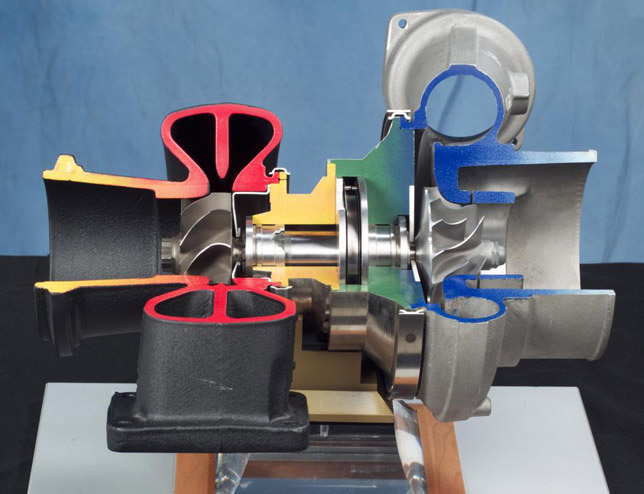
Before those exhaust gasses reach the exhaust system they go trough a turbine connected to a shaft. The more exhaust that goes through the turbine blades, the faster they spin. On the other end of the shaft we find a compressor which welcomes fresh air from the atmosphere, compresses it using the force of the turbine and then feeds it into the engine. To further increase the efficiency of the turbocharging system, an intercooler is added – it looks much like a car radiator but instead of containing cooling fluid, it holds the compressed air from the compressor. Air is denser when cooler and that’s exactly what the intercooler does – it cools the incoming air.
Cut-away view of a turbocharger held by a foil-bearing
There are issues however. First of all, a turbine amidst the flow of exhaust is essentially an obstacle. The exhaust stroke has to deal with more back-pressure thus being slightly less efficient. A functional turboshaft has to handle extreme forces (speeds go up to 150 000 rpm within the turbocharger) so a special kind of baring is needed – liquid ones or state-of-the-art ball bearings. The latter is more efficient but more expensive. Then there’s the dreaded turbo lag. The problem here is that when you put your foot down, the response is far from electric. The turbine needs some time to kick off and start spinning the compressor blades. That’s why at low engine rpm one can’t really tell if the car has a turbo or not.
There are various ways to tackle this nuisance. Make things smaller and lighter. Tiny turbochargers will grant you that off-the-line jolt but won’t be too good on the upper rpm range. Besides, if too much exhaust starts going through a relatively small turbine things may get hot and disbalanced. Usually however, there’s the wastegate in most turbines – a valve that knows how much exhaust passes through and regulates the flow by simply diverting some of the gases away from the turbine. Some companies have started putting more than one turbochargers in their cars. One small and the other, big. The small one guarantees a more immediate response while the big one takes over at higher speeds.
Essentially, that’s the story with turbochargers. We can further dive into numbers and calculations about pressure and efficiency but this, I think, is already nerdy enough. Hopefully some of you learned something new while others refreshed their memory on how the turbocharger brings easy power to our everyday lives.
Abt Sportsline has announced their tuning program of the new 2012 Audi A3. The name of the project is ABT AS3, which stands for “happiness in driving, always and everywhere” as Mr. Hans-Jürgen Abt stated.
The engine range includes two powerful power units – a 2.0 liter TFSI and a 2.0 liter TDI engine. The petrol will deliver 250PS (184 kW), instead of factory’s 200PS (147 kW) and the diesel will produce around 200PS (147 kW), instead of 170PS (125 kW). These results will be achieved thanks to ECU re-maps. The additional power will make the car faster and better to drive, because of the additional torque at the low revs.
Besides the performance packages, ABT Sportsline also offers a coil-over adjustable suspension and high-performance brake system with 345 mm discs.
The exterior package includes a new front spoiler, front grille and side skirts. There are also a new rear spoiler, the rear skirt insert and the two double rear mufflers.
The tough vision is completed by a set of DR light alloy wheels , which are available in 18 and 19 inches.
Abt sportsline has unveiled the tuned 2012 Beetle at the 82nd Geneva Motor Show.
The exterior package includes a new front bumper, a rear diffuser with oval exhaust pipes and a pair of side skirts. There are also headlight brows and some nice graphics. The car is lowered by a set of sport springs. It stands on Abt DR wheels fitted with low profile tires.
The tuning specialists have developed five performance packages for the “bug” – 1.2 TSI with 140PS (103 kW), 1.4TSI with 210PS (154 kW) and the mighty 2.0TFSI is delivering 240PS (176 kW). The diesel range features 1.6 TDI receiving additional 20PS (15 kW) and the bigger 2.0TDI will have 170PS (125 kW).
Actuall, the ABT Beetle looks much better than, it was originally planned. The headlight brows give more aggressive look and the stripes complete the stunning exterior.
Afzal Kahn has always maintained that combining technical perfection with aesthetic brilliance is his true calling. Recently, in the arsenal of his arguments, he has added yet another example – the Kahn Q7 wide track.
A voluminous amount of exterior parts have been added to form the vision of Afzal Kahn – the front fenders are now with huge vents complemented by flaring wheel arches on both ends. The front bumper is also new with, again, more vents on it and gunmetal gray detailing. Sill plates in stainless steel complete the sides while a distinctive rear wing juts out from the top, back end. Things that feel a little bit excessive are the daytime running LED lights which sort of flood the headlights and also the liquid gold calipers. It’s a good thing that the provided Kahn RSX22” wheels, with their complex spoke patterns, are not too reveling. As a rounding feature, Kahn design have also thrown in a stainless steel exhaust system with neat tailpipes hidden discreetly behind the new rear bumper.
The interior has also been restyled with strong contrasting accents – The dials the seats are wrapped in black quilted perforated nappa leather red stitched and with a red line across them. The rev counter and the speedo are both respectively colored in red and cream as if the dashboard is suffering from heterochromia. However, this is the place where usually the Kahn people offer unlimited versatility. A customer is free to choose from the widest spectrum of colors imaginable for both the exterior and interior.
Power will come from the standard Audi 3.0-liter TDI which sends 233 bhp trough an 8-speed Tiptronic automatic transmission. The price for this model here is $96 995




 We often get figures from car makers that, from time to time beggar belief. Especially when we are talking about estimated mpg data. It goes without saying then, that nothing beats a real life test to see exactly what’s what. That’s exactly what record breaking duo John and Helen Taylor have done – travel 1626.1 miles on a single tank of fuel (a record breaking distance). The car of choice was a 2012, manual

 Welcome, to the


 Ever wondered how WRC cars manage to deliver 300 bhp and above from an engine that, by rule, cannot exceed 2.0 liters of displacement? How on earth do the heavy, low-revving diesel engines in cars today stay competitive? Or what is it that makes it possible for the Bugatti Veyron to break the 1000 bhp threshold? Well, it certainly isn’t witchcraft. By means of “forced induction”, turbochargers today boost the automotive industry to a new direction of smaller, more-efficient and bloody good fun engines.
 Abt Sportsline has announced their tuning program of the new 2012 Audi A3. The name of the project is ABT AS3, which stands for “happiness in driving, always and everywhere” as Mr. Hans-Jürgen Abt stated.


 Abt sportsline has unveiled the tuned 2012 Beetle at the 82nd Geneva Motor Show.


 Afzal Kahn has always maintained that combining technical perfection with aesthetic brilliance is his true calling. Recently, in the arsenal of his arguments, he has added yet another example – the Kahn Q7 wide track.


