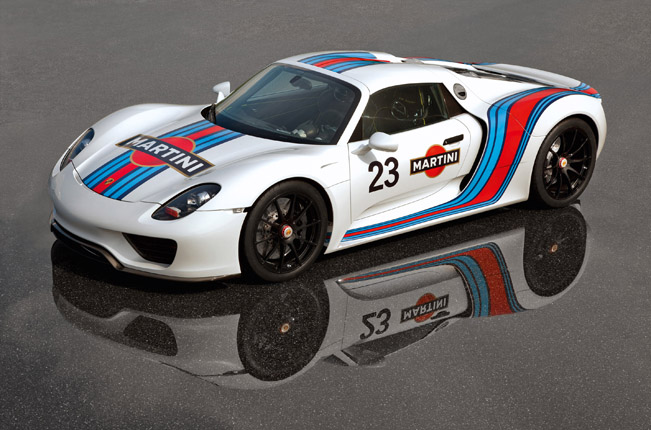
Tag: Spyder

  • Porsche 718 Spyder RS

    Porsche has launched a new version of the 718 Spyder, called the 718 Spyder RS, which is the most powerful mid-engined roadster they have produced yet. The new model features the high-revving naturally aspirated engine from the 911 GT3, which has never before been used in an open-topped mid-engined sports car. The 718 Spyder RS is the open-top version of the 718 Cayman GT4 RS, and is designed for maximum driving pleasure. The engine used in the 718 Spyder RS is the same one that powers the Porsche 911 GT3 Cup racing car. The lightweight and purist-pleasing manual soft-top roof of the 718 Spyder RS amplifies the sound of the engine, which is already a highly evocative experience. The car also comes with a lightweight stainless steel sports exhaust system and distinctive process air inlets on the sides behind the headrests.

    High-revving naturally aspirated engine and resolutely lightweight construction

    The powertrain of the 718 Spyder RS is the same as the 718 Cayman GT4 RS coupe. It has a 4.0-liter six-cylinder boxer engine that can rev up to 9,000 rpm and produce 368 kW (500 PS) of power and a maximum torque of 450 Newton metres. With a short-ratio seven-speed PDK transmission, the car can go from 0-100 km/h in 3.4 seconds and reach 200 km/h in just 10.9 seconds. The 718 Spyder RS is 80 PS more powerful than the regular 718 Spyder and can reach 100 km/h half a second faster. It has a top speed of 308 km/h.

    The car is only available with Porsche’s dual-clutch transmission (PDK) which can shift through its seven gears quickly. Drivers can use gearshift paddles or the selector lever on the center console to manually shift gears. The car’s lower weight, which is 1,410 kg, contributes to its better performance. It is 40 kg lighter than the 718 Spyder with PDK and five kilograms lighter than the closed 718 Cayman GT4 RS. The Spyder RS is the latest addition to the 718 model line, which was introduced in 2016.

    Balanced aerodynamics

    The front end of the new Porsche 718 Spyder RS is very similar to the 718 Cayman GT4 RS. It has a standard front bonnet made of CFRP and a wide air outlet above the bumper. Two NACA ducts improve brake cooling while maintaining the car’s Cd value. Sideblades on the outer ends of the bumper increase downforce. The front spoiler lip is slightly shorter than that of the 718 Cayman GT4 RS. This, along with the large rear wing, creates more overall downforce on the Cayman and requires a larger spoiler lip for aerodynamic balance. Instead of a wing, the 718 Spyder RS has a noticeable ducktail-shaped tear-off edge. All aerodynamic components work together to maintain the car’s aerodynamic balance and ensure maximum driving stability at high speeds.

    Purist soft-top design

    The 718 Spyder RS has a single-layer, lightweight soft-top that can be manually operated. It consists of a sun sail and a weather deflector, both of which can be removed and stowed separately or together in the car. The sun sail can also be used as a ‘Bimini top’ to protect the driver and passenger from sunlight while leaving the side and back open. When combined with the weather deflector, it creates a complete roof that offers protection against rain when the side windows are up. The entire roof, including its mechanical parts, weighs only 18.3 kg, which is 7.6 kg less than the 718 Spyder and 16.5 kg less than the 718 Boxster. If the weather allows, drivers can remove the top entirely to shave an additional eight kilograms from the car’s weight.

    Sports suspension of the highest precision and agility

    The 718 Spyder RS uses parts from the 718 Cayman GT4 RS and 718 Spyder for a thrilling driving experience on winding roads. It comes with Porsche Active Suspension Management (PASM) and has been lowered by 30 millimetres. The car also has Porsche Torque Vectoring (PTV) with mechanical limited-slip differential, ball-jointed suspension bearings and 20-inch forged aluminium wheels. The chassis provides precise steering and agile, neutral handling. The ride height, camber, track and anti-roll bar are all adjustable. The spring and damper rates have been reduced compared to the 718 Cayman GT4 RS for a more relaxed convertible-style feel.

    Performance-focused interior

    The car’s interior is designed to be functional and ergonomic, with a sporty character. The RS sports steering wheel is covered with Race-Tex and has a yellow 12-o’clock marking. The standard full bucket seats are made of lightweight CFRP and provide excellent lateral support. The seat covers are made of black leather with a perforated Race-Tex centre in a contrasting colour of Arctic Grey or Carmine Red.

    A ‘Spyder RS’ logo in the corresponding colour is embroidered on the headrests. The dashboard and trims are covered with leather. The car is available in four plain and three metallic colours, including the new Vanadium Grey Metallic, as well as the special colours Arctic Grey, Shark Blue and Ruby Star Neo.

    Optional Weissach Package and matching chronograph

    You can also make the content more readable by breaking it down into smaller sections with shorter sentences. Here’s my attempt:

    The Spyder RS offers a Weissach Package option that comes with exceptionally lightweight forged magnesium wheels and a sports exhaust system made of titanium. The upper part of the dashboard is covered with anti-glare Race-Tex, which looks amazing inside the car.

    What’s more, buyers of the Spyder RS can get a Porsche Design Timepieces handcrafted chronograph. The watch matches the car’s configuration with a lightweight titanium case, carbon dial, and vehicle leather strap. The rotor on the back mimics the respective wheel rim design on the Spyder RS.

    According to Andreas Preuninger, Head of GT Cars, “The 718 Spyder RS raises driving pleasure to a new level for open-top cars.” The car offers an unfiltered driving experience thanks to its GT3 engine, close-ratio transmission, compact dimensions, low weight, and racing suspension.

    The new Porsche 718 Spyder RS makes its public debut in June at the 75th anniversary of Porsche Sports Cars in Stuttgart-Zuffenhausen. It will also appear at the Goodwood Festival of Speed in England shortly after.

  • Hennessey Venom F5 Roadster

    Hennessey Special Vehicles, the Texas-based hypercar manufacturer, has released details of its Venom F5 Roadster ahead of the new car’s global debut at The Quail, A Motorsports Gathering in Monterey, California.

    The Venom F5 Roadster is based on the Hennessey Venom F5 Coupe – the two are nearly identical mechanically – yet distinguishing the Venom F5 Roadster from its fixed-roof sibling are several attributes that set the open-air model apart – physically, cosmetically, and emotionally.

    Mid-mounted in the carbon-fiber monocoque chassis is Hennessey’s celebrated twin-turbocharged, 6.6-liter, ‘Fury’ V8 engine rated at an astonishing 1,817 bhp. Power is sent to the rear wheels through a robust automated single-clutch gearbox. With a dry weight of under 3,100 pounds, the Venom F5 Roadster promises phenomenal performance… and an engineered top speed exceeding 300 mph.

    Hennessey expects the Venom F5 Roadster to surpass the company’s own ‘world’s fastest convertible’ record – 265.6 mph – currently held by the Hennessey Venom GT Spyder.

    John Hennessey, company founder, and CEO: “We created the Venom F5 to be the ultimate expression of a hypercar. The Roadster version takes the Coupe’s speed, exhilaration, and awe, plus a sprinkling of respect-inducing fear, to a new, truly visceral level that brings owners closer to the Venom F5’s extreme performance. Our 1,817 bhp ‘Fury’ engine screams behind the exposed cockpit, with its roar unobstructed by a roof – it is an unmatched automotive experience.”

    Most conspicuous is the hypercar’s new roofline. In contrast to the F5 Coupe, the F5 Roadster’s roof has been re-engineered with a removable panel crafted from rigid carbon fiber composites. The single-piece roof is fully insulated against the elements and lined with soft Alcantara upholstery. The weatherproof panel is secured with four quick-release bolts and a pair of high-strength latches to withstand the hypercar’s staggering acceleration capabilities and aerodynamic forces at extreme speed. The lightweight roof panel weighs a mere 18 lbs (8 kg), making removal and installation easy for one person.

    Owners may choose to store the panel in a bespoke Merino wool travel bag or as a standalone work-of-art on a custom-made, sculptural pedestal – devised by Hennessey’s in-house design team to enhance the ownership experience. The roof pedestal, crafted in carbon fiber like the roof panel, mirrors design themes from the Venom F5 Roadster. Viewed from above, its ‘blade legs’ trace the shape of the car’s rear decklid, while the side profile uses the hypercar’s bodyside air intake form for inspiration. In addition, the sharply angled, streamlined stand displays the ‘Venom F5 Roadster’ script on the front face of the base in the same eight-microns thin aluminum as the car’s ‘H’ nose badge.

    The Venom F5 Roadster features a new tempered glass engine viewing window. This panel, in the middle of the rear engine cover, spotlights the massive ‘Fury’ V8 engine in all its glory. Its engineering was no simple task – developed and certified for use in jet aircraft. The sizeable glass panel can withstand aerodynamic forces exceeding 300 mph and temperatures beyond 1,000 degrees Fahrenheit (540 degrees Celsius). The detail is extraordinary – the engine viewing window is encapsulated within a removable carbon fiber engine cover that features intricately-milled heat extraction holes that match those in the rear bumper. Additional heat extraction is achieved by dual aluminum air vents, four on each side of the glass panel, which match the vents behind each front wheel.

    The Roadster is further distinguished from its coupe sibling by its unique wheels. Forged from aluminum alloy and then milled to perfection, the lightweight wheels feature seven pairs of spokes, each resembling an elongated Hennessey ‘H’. Milled into the outer face of each wheel rim is the ‘Hennessey’ script, mirrored by the ‘Roadster’ script on the opposite side. Owners may opt to upgrade the Hyper Silver wheels to highly polished aluminum – this exclusive finish requires a painstaking process of hand polishing that takes weeks to complete. The wheels are secured with five titanium nuts, an alloy revered for its strength, heat tolerance, corrosion resistance, and extremely low mass.

    Hennessey’s Venom F5 Coupe was engineered from the outset with an open-top version in mind, so only minor adjustments were required to deliver coupe-rivaling chassis rigidity, strength, and stiffness – this ensures that drivers may access the same crisp handling characteristics as the Venom F5 Coupe with or without the roof in place.

    As with the Venom F5 Coupe, discerning Roadster buyers may specify any exterior and interior color combination or leave areas of the Venom F5’s carbon fiber chassis and body panels exposed. Opting for either a gloss or satin finish allows the stunning woven composite to be appreciated fully (pre-exposed areas of carbon fiber on the Venom F5 Roadster are standard, as they were on the Coupe). The same minimalist yet high specification of the coupe model is retained within the passenger cabin.

    “It’s exciting to see the continued innovation from Hennessey from the test track to the road,” said Steve Reindl, President of Shell Lubricants Americas. “We share a passion for performance, and our co-engineering alliance provides us with an extreme testbed for Pennzoil in some of the fastest road cars.”

    The Venom F5 Roadster will be manufactured in Texas in an exclusively low volume of just 30 units (this approach of guaranteeing a unique ownership experience saw the 24-unit Venom F5 Coupe production run sell out shortly after its appearance at Monterey Car Week in 2021). Roadster production begins in late 2022, with validation of the model’s high-speed capabilities set to occur as the production rate levels out.

    Hennessey Special Vehicles has priced the new Venom F5 Roadster at $3 million, with each of the 30 personalized examples individually commissioned to its owner.

    Hennessey Venom F5 Roadster – Technical Specifications

    Name Hennessey Venom F5 Roadster
    Construction Bespoke carbon-fiber monocoque
    Carbon-fiber body panels
    Suspension Double-wishbone independent
    Fully adjustable coilover dampers
    Engine Hennessey ‘Fury’ 6.6L twin-turbo V8
    Transmission 7-speed single-clutch automated gearbox
    Rear-wheel drive
    Power 1,817 bhp @ 8,000 rpm
    1,193 lb-ft @ 5,000 rpm
    Top Speed 300+ mph*
    Power-to-Weight Ratio 0.59 hp/lb
    Weight 1.29 hp/kg3,098 lbs
    1,405 kg
    Dimensions 183.7 in / 77.6 in / 44.5 in
    4,666 mm / 1,971 mm / 1,131 mm
    Production RunWarranty 30 units4 Years
    (* Top speed limited with roof panel removed)
  • Lambo Huracan Spyder With Convertible Top? Yes, Please!

    2016 Lamborghini Huracan LP 610-4 SpyderAs you know, Automobili Lamborghini presented the latest Huracan LP 610-4 Spyder at Frankfurt International Motor Show. This open version combines the power and performance of the coupe model with the style and elegance of the open-air vehicle.

    Now the Huracan Spyder comes with inspiring technology, incredible quality and stunning performance. And the lightweight, electrohydraulic soft top ensures that this beauty has its own and distinctive presence with roof either opened or closed and ensures maximum comfort and pleasure of driving.

    Design

    The Huracan Spyder demonstrates how Lamborghini’s design concept evolves and changes through time. The outstanding visuals and the elegant lines surely contribute to that stylish and yet aggressive presence. Definitely the most distinctive addition to the car is the new soft top. The roof is available in black, brown or red color. But this addition is not just a cosmetic one. It also helps the Spyder for the perfect center of gravity. How cool is that?

    Chassis

    The special hybrid chassis combines aluminum parts with numerous carbon-fiber elements in order to achieve the perfect lightweight – flexibility ratio. The chassis provides incredible stiffness, which is further improved by 40%. This helps the vehicle to offer even better handling precision and driving dynamics.

    2016 Lamborghini Huracan LP 610-4 Spyder

    The Spyder’s outstanding aerodynamics also include flat and smooth underbody, while the large diffuser dissipates air under the rear end. And when it comes to downforce, Lambo team knows how it’s done. The Huracan Spyder comes with 50% better enhanced downforce, compared to the Gallardo predecessor and with roof closed the vehicle benefits from low drag coefficient and virtually eliminated noise.

    Drivetrain system

    The vehicle is geared with naturally aspirated, long-stroke 5.2-liter V10 unit with full engaging potential with the top down. The engine offers the same technical qualities as the Huracan Coupe model, especially with the top down. The extremely responsive engine with revs up to 8,700 rpm it develops a total of 610 hp (449 kW) at 8,250 rpm and 560 Nm of torque at 6,500 rpm. And this unit is paired to a “Lamborghini Doppia Frizione” 7-speed dual-clutch gearbox ensures fast and smooth shifts.

    2016 Lamborghini Huracan LP 610-4 Spyder

    This all helps the Huracan to go from 0 to 100 km/h (62 mph) in 3.4 seconds and from 200 km/h (124 mph) in 10.2 seconds to chase the top speed of 324 km/h (124 kW). And the new stop start technology and cylinder on demand the fuel consumption is lowered to 12.3 liters per 100 km and the CO2 emissions are reduced with 14% compared to the Gallardo Spyder.

    And this stunning power is controlled by standard-fit brake system provides the vehicle with reliable and powerful deceleration. The front discs are 380mm in diameter and the brake calipers can be painted in numerous colors.

    SEE ALSO: MANSORY Unveiled the One and Only Carbon Beast

    But the control and handling of the new Spyder is also enhanced by the special ANIMA switch (Advanced Network Intelligence MAnagement) which allows different driving models to be selected from sporty and dynamic to extreme performance. The modes are indeed “Strada”, “Sport” and “Corsa”. All of these three impact the engine, transmission, AWD system and the ESC handling system to ensure characteristics that completely fit the driver’s requirements.

    Interior

    The cabin welcomes you to an interesting and innovative place. The 12.3-inch TFT display can be configurated in several modes and offers the driver key information, including and virtual map. Numerous more features and gadgets can be directly controlled via the buttons on the steering wheel. In fact, even the electric seats are geared with an ECU that ensures all movements are made without engine wall contact.

    2016 Lamborghini Huracan LP 610-4 Spyder

    And the slender dashboard and center console not only help the driver to control the hi-tech gadgets, but also contribute to the elegance of the interior. The beautifully crafted cabin, which, in fact, can be further personalized, comes with five trim choices: Standard, Elegante, Sportivo with Alcantara, Sportivo bicolor with Alcantara and Sportivo bicolor with soft leather. And all this with additional 17 interior colors.

    At the end it looks like Lamborghini team has done some incredible job with the latest Huracan. The vehicle keeps that signature and well-known Lambo spirit, but at the same time has and numerous changes in its appearance and character. This is definitely a must-see vehicle.

    Source: Lamborghini

  • Porsche 918 Spyder Goes for a Special Ride

    Porsche 918 SpyderPorsche 918 Spyder is on the lead on the UK road trip along with its brothers: Cayenne and Panamera S E-Hybrid. The dream car for many joins a special road trip around England and Whales. The lucky guy is Ingo, who won a special competition in Facebook, especially organized by Porsche team. Now he will visit numerous interesting places, while seated in the legendary 980 Spyder.

    Interesting fact is that, at each stage, Porsche fans will have the chance to sign the car as a memento of the trip. The trip itself will start from London through Oxford, Wales and Cotswolds before going to the Porsche Experience Centre at Silverstone. This route is especially chosen to demonstrate the performance and efficiency of the car.

    SEE ALSO: Porsche Brings the Boxter Spyder in New York

    The vehicle itself comes with a V8 Petrol engine, that produces a total of 608 hp (447 kW) and two special electric motors, that gives additional 129 hp (95 kW) and 156 hp (115 kW) respectively. The total of 887 hp (652 kW) is capable of incredible acceleration, that is measured from 0 to 100 km/h (62 mph) for 2.5 seconds. And the total speed is 385 km/h (214 mph) Crushing force, isn’t it?

    Porsche team surely knows how to make special events even more special with the right car. You should definitely check it out!

    Source: Porsche


  • Porsche Brings the Boxter Spyder in New York

    Porshe Boxter Spyder Side View

    Porsche confidently starts the 2015 season by showing the world the revised Boxter Spyder. The supreme sports car will make debut at New York International Auto Show (NYIAS). We will be dealing with a machine that, as its predecessor, has autonomous character, which makes the Boxter a truly loved and anticipated model. Do you remember the hand-operated roof? Or the manual only gearbox? With the redesigned Spyder come not only these, but many more goodies.

    As a true and honorable member of a big family, the Spyder brings a well-known driving experience, but with a present-day technical and performance tuning. Get ready to try a beast, that comes with stiff suspension, that lowers the height with 20mm, supreme brakes, as in the 911 Carrera, tweaked steering capabilities and a 3.8Liter flat six-cylinder powerplant, with overall output of  375 hp (276 kW).

    This, in fact, is the lightest and most powerful Boxter up to date. It takes 4.5 seconds to reach from 0 to 100 km/h with a top speed of 180 km/h. The overall fuel consumption is calculated to 9.9L/100 km (28mpg).

    And when it comes to driving experience, the Porsche team knows how to bring smile on your face. The interior atmosphere makes you feel the character of the car, as it brings that prime and pure sport car feel. The lightweighted seats come with wider side supports, and the steering wheel is with a diameter of 360 mm – especially made to ensure great agility and response.

    As in the spirit of a sport car, the Spyder doesn’t include radio or air conditioning systems, so the overall weight is further reduced. However, you can order them at no cost. In fact, you can get a whole pack of audio system that can be installed in any model of the Boxter line. The Porsche Communication Management system is also included in the optional sets.

    Porsche Boxter Spyder will be on sale in July. You can make orders directly from the Porsche Centers.

    Source: Porsche 

  • Porsche 918 Spyder – 0-333 km/h [video]

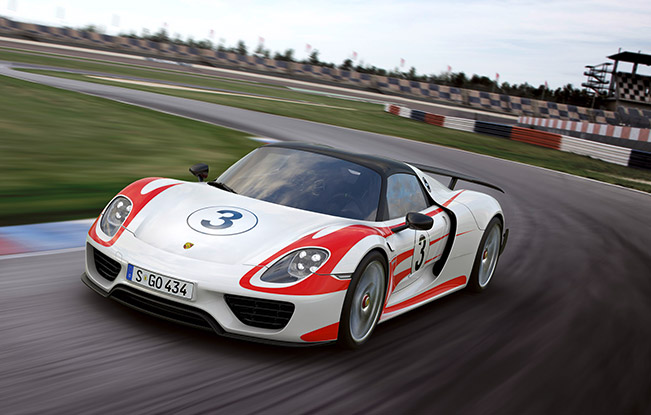
    Christian Gebhardt from Sport Auto had tested the spectacular Porsche 918 Spyder. This particular car is equipped with the Weissach package, so it is even faster compared to the normal version.

    The 918 Spyder is not alone in its segment, but it has to compete with LaFerrari and McLaren P1. Still, the Porsche’s hyper-car is currently the fastest production vehicle on the Nordschleife with lap-time of 6 minutes and 57 seconds. McLaren P1 is aiming at 6 minutes and 35 seconds, but until an official lap, this is only a speculation.

    2015 Porsche 918 Spyder is powered by a 4.6 liter V8 engine and two electric motors with combined power of 887HP (652 kW) and 1,280Nm (944 lb-ft) of torque. 0-100 km/h in 2.6 seconds, 0-200 km/h in 7.2 seconds and 0-300 km/h in breathtaking 19.9 seconds.

    The Weissach package includes carbon fiber roof, rearview mirrors, windscreen frame and the rear wing. There are also ceramic wheel bearings, titanium chassis bolts and a super lightweight braking system. Last, but not least are the 20” and 21” forged magnesium wheels fitted with ultra-performance tires. The overall result is weight saving of 41 kg (90.3 lbs).

    The interior boasts 6-point seatbelt harnesses and additional Alcantara upholstery.

    Enjoy!

    httpv://www.youtube.com/watch?v=aI-DUULV1tE

    Source: Porsche

  • 2014 Porsche 918 Spyder – Test Drive [video]

    Drive has published a test drive video of the awesome hybrid supercar – Porsche 918 Spyder. It is driven by Mike Spinelli, who makes several laps at the Circuit of the Americas with a little help from Porsche factory driver Patrick Long
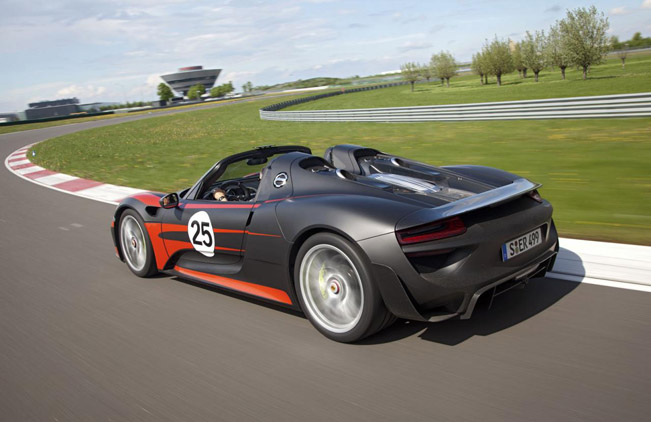
    Porsche 918 Spyder is powered by a 4.6 liter twin-turbocharged V8 with 608HP (447 kW) and 530Nm (391 lb-ft) of torque. There are also two electric motors with 156HP (115 kW) and 129HP (95 kW) at each axle (front and rear). The maximum combined output is 887HP (661 kW) and over 800Nm (590 lb-ft) of torque. 0-100 km/h in 2.8 seconds and a top speed of 340 km/h (211 mph).

    The 918 Spyder is priced at $845,000 excluding destination and handling tax. The manufacturer also offers Weissach Package for another $84,000. The package reduces the curb weight by 34 kg (77 lbs) by removing the audio system, air conditioning, door storage and armrest, while the regular paint is removed to be changed with an exterior foil.

    Porsche 918 Spyder also holds a lap record on the Nurburgring – 6 minutes and 57 seconds with an average speed of over 179.5 km/h(111 mph), as measured by Wige Solutions.

    Enjoy!

    httpv://www.youtube.com/watch?v=nGSLARXwb90

    Source: Drive via Youtube

  • Porsche 918 Spyder With Weissach Package

    Porsche-918-Spyder-with-Weissach-Package-THUMBPorsche 918 Spyder is definitely the fastest Porsche currently on the road. The reason for this is that it has been optimized with Weissach package that firstly contributes towards weight reduction. The result of course is nearly limitless speed and astonishing acceleration.

    To speak in numbers, the 918 Spyder accelerates from standstill to 62 mph (100 km/h) in just 2.6 seconds, which is 0.2 seconds quicker than the previous model; and from 0 to 124 mph (200 km/h) in 7.2 seconds (which saves 0.5 seconds). The top speed is passes the 186 mph (300 km/h) and it is reached after 19.9 seconds.

    The improvements delivered by the package also bring benefits in terms of the electrical performance of the hybrid super sports car. The latter has been equipped with two electric motors on the front and rear axle which allow the 918 Spyder to accelerate from zero to 62 mph (100 km/h) in 6.1 seconds, without producing any emissions.

    What is more, Porsche 918 Spyder complete with Weissach package has also achieved a lap record for road vehicles on the Nürburgring Nordschleife, with a time of 6:57 minutes. At the same time, the model is certified to efficiency class A+, as a vehicle which is particularly low in consumption and emission figures.

    To be more precise, the thanks to the Weissach package, the total NEDC fuel consumption of the 918 Spyder amounts to 94 mpg (3.0 l/100 km) , while the CO2 emissions are estimated at 70 g/km. The level of energy consumption is 12.7 kWh/100 km during the approval cycle.

    Source: Porsche

  • BMW i8 Spyder [render]

    Theophiluschin has published several render pictures of BMW i8 Spyder. After the revealing of the i8 Coupe, which make astonishing impression at the 2013 Frankfurt Motor Show, we expect a convertible version of BMW’s supersport car.

    The powertrain will be the same – a 1.5 liter three-cylinder TwinPower Turbo petrol engine – 231HP (170 kW) and 320Nm (236 lb-ft) powering the rear wheels and an electric motor – 131HP (96 kW) and 250Nm (184 lb-ft) on the front axle. The total output is 362HP (266 kW) and 570Nm (420 lb-ft) of torque. 0-100 km/h in less than 4.4 seconds and a top speed of 250 km/h (155 mph).

    It is able to return 113 mpg UK or 94 mpg US – 2.5 liters / 100 km and a zero-emission range of 35 km (22 miles) with top speed of 120 km/h (75 mph).

  • 2013 Frankfurt International Motor Show: 2014 Porsche 918 Spyder

    Porsche has finally unveiled the 2014 918 Spyder at the Frankfurt Motor Show in Germany. The debut of the hyper-car marks the start of a new chapter in the future of the hybrid drive. And the technology pioneers are not the only ones who are excited by this flagship project, as the 918 Spyder demonstrates the potential of the hybrid drive to a degree never seen before, achieving a parallel improvement in both fuel efficiency and performance without compromising on either.

    Porsche 918 Spyder is powered by a 4.6 liter twin-turbocharged V8 with 608HP (447 kW) at 8,700RPM and 530Nm (391 lb-ft) of torque. There are also two electric motors with 156HP (115 kW) and 130HP (95 kW) at each axle (front and rear). The maximum combined output is 887HP (661 kW) and 917Nm (676 lb-ft) of torque. 0-100 km/h in 2.8 seconds,0-160 km/h in 7.0 seconds and a top speed of 340 km/h (211 mph). The 918 Spyder managed to lap the Nurburgring in just 6 minutes and 57 seconds. The fuel consumption is just 3.0 liters / 100 km.

    The manufacturer offers Weissach package including lightweight magnesium alloy wheels (-35kg), six-point harness seat belts, optional film coating instead of a paint finish, as well as several carbon fiber aerodynamic parts.

    The 2014 Porsche 918 Spyder is 4643mm long, 1940mm wide and 1167mm tall, with a 2730mm wheelbase. It rolls 20” front and 21” rear wheels fitted with 265/35 ZR20 and 325/30 ZR21 tires.

    2014 Porsche 918 Spyder is priced at $845,000 for the US. The Weissach package is another $84,000.

    • Displacement:    4,593 cm (V8 engine)
    • Engine power:    608 hp (447 kW) at 8700/min (V8 engine)
    • 286 hp (210 kW) at 6500/min (electric motors)
    • 887 hp (652 kW) at 8500/min (combined)
    • Max. torque:        917–1,280 Nm (overall, depending on the gear)
    • Maximum revs:   9,150/min
    • Power output per litre:   132 hp/litre (V8 engine)

    Gearbox: Combustion engine with hybrid module and transmission bolted together to form a single drive unit; seven-speed Porsche Doppelkupplung (PDK); rear-wheel drive; front electric motor with transmission for driving the front wheels (decoupled from 235 km/h); five pre-selectable operating modes for optimum coordination of all drive units

    Gear ratios PDK:

    1st gear 3.91
    2nd gear 2.29
    3rd gear 1.58
    4th gear 1.19
    5th gear 0.97
    6th gear 0.83
    7th gear 0.67
    R gear 3.55
    Final drive ratio 3.09
    Clutch diameter 220 mm/164 mm

    Chassis: Double-wishbone front axle; optional electro-pneumatic lift system on front axle; electro-mechanical power steering; multi-link rear axle with adaptive electro-mechanical system for individual rear wheel steering; electronically controlled twin-tube gas-filled shock absorbers at the front and rear with Porsche Active Suspension Management (PASM) system

    Brake system: High-performance hybrid brake system with adaptive recuperation; internally ventilated and perforated front ceramic brake discs (PCCB) with a diameter of 410 mm and thickness of 36 mm; rear discs with a diameter of 390 mm and thickness of 32 mm

    • Wheels and tyres:  918 Spyder wheels
    • (Weissach package: 918 Spyder forged magnesium wheels)
    • Front 9.5 J x 20 with 265/35 ZR 20
    • Rear 12.5 J x 21 with 325/30 ZR 21
    • Weight:   DIN unladen weight 1,634 kg
    • Dimensions:   Length 4,643 mm
    • Width 1,940 mm
    • Height 1,167 mm
    • Wheelbase 2,730 mm
    • Track width Front 1,664 mm
    • Rear 1,612 mm
    • Luggage compartment volume, VDA ~ 110 litres
    • Fuel tank capacity:   70 litres
    • Energy supply:  Lithium-ion battery with 6.8 kWh capacity (BOL nominal), 220 kW maximum power and
    • mains-compatible plug-in charger
    • Performance:    Top speed 345 km/h
    • Purely electric 150 km/h
    • Acceleration:    0–100 km/h 2.8 s (62 mph)
    • 0–200 km/h 7.7 s (124 mph)
    • 0–300 km/h 22.0 s  (186 mph)
    • Consumption (NEDC):    Total 3.3–3.0 litres/100 km   (85 – 94 mpg)
    • CO2 emissions:  Total 79–70 g/km
    • Energy consumption:   12.5–13.0 kWh/100 km
    • Efficiency class: Germany A+
    • Range Purely electric: 16–31 km
    • Warranty:   Vehicle 4 years
    • Battery 7 years

    Source: Porsche

  • Porsche 918 Spyder – 887 HP and 800 Nm

    Porsche 918 Spyder combines pedigree motor racing technology with excellent everyday utility, and maximum performance with minimum consumption.

    It is powered by a 4.6 liter twin-turbocharged V8 with 608HP (447 kW) and 530Nm (391 lb-ft) of torque. There are also two electric motors with 156HP (115 kW) and 129HP (95 kW) at each axle (front and rear). The maximum combined output is 887HP (661 kW) and over 800Nm (590 lb-ft) of torque. 0-100 km/h in 2.8 seconds and a top speed of 340 km/h (211 mph). The 918 Spyder managed to lap the Nurburgring in just 7 minutes and 14 seconds.

    The sports car has five available driving modes, which can be selected through the steering wheel. These are E-Power, Hybrid, Sport Hybrid, Race Hybrid and Hot Lap.

    In E-Power, the car is able to operate only on electricity, but still it is very fast 0-100 km/h in under 7 seconds and a top speed of 150 km/h (93 mph). It can travel up to 30 km (18.6 miles) on electricity alone

    In Hybrid mode, the electric motors and the combustion engine work alternately to maximize efficiency. The Hybrid mode is typically used for a fuel economy-oriented driving style.

    In Sport Hybrid mode, the combustion engine operates continuously and provides the main propulsive force. In addition, the electric motors provide support in the form of electric boosting or when the operating point of the combustion engine can be optimised for greater efficiency.

    Race Hybrid is similar to Sport Hybrid mode, but it allows the engine to recharge the battery, when the driver is not using the maximum output. Electric power is thus available even with several very fast laps.

    The Hot Lap button in the middle of the map switch releases the final reserves of the 918 Spyder and can only be activated in “Race Hybrid” mode. Similar to a qualification mode, this pushes the traction battery to its maximum power output limits for a few fast laps. This mode uses all of the available energy in the battery.

    If the battery is depleted, it can be recharged within 4 hours using a 230V outlet.

    Other nice technology is a Porsche Active Aerodynamic system that has three modes to provide optimal downforce.

    The Porsche 918 Spyder can be outfitted with a Weissach package, which adds a race car inspired exterior including visible carbon fiber on the roof, mirrors and windshield. The package also reflects to the interior – Alcantara upholstery, carbon fiber trim and six-point seatbelts. Last, but not least are the lightweight magnesium wheels fitted with ultra-performance tires.

    Source: Porsche

  • Porsche 918 Spyder – Price $845,000

    Porsche announced the pricing of the 2014 918 Spyder. The sports car will be sold in the US with a starting price of $845,000 excluding destination and handling fees.

    The 2014 Porsche 918 Spyder is powered by a 4.6 liter V8 with 580HP (432 kW) and 500Nm (369 lb-ft) of torque. The petrol engine will be paired with an electric motor generating 245HP (183 kW) more, so the overall power will be around 795HP (593 kW) and 780Nm (575 lb-ft).

    0-100 km/h in 3.2 seconds and a top speed of 320 km/h (199 mph).

    Still, if this isn’t faster enough, you can opt for the Weissach package for additional – $84,000. It reduces the curb weight with 34 kg (77 lbs) by removing the audio system, air conditioning, door storage and armrest, while the regular paint is removed to be change with an exterior foil.

    In other words, you’ll have to pay $84,000 to the manufacturer to strip your car. Definitely, not a good idea!

    Source: Porsche